

Introduction
Livestock farming based on local breeds constitutes a very valuable animal industry from the economic, social and environmental points of view. Local breeds have remarkable special characteristics like resistance to prevailing diseases, fertility, maternal ability, longevity, adaptation to the environment and unique attributes of their final products, among others (García, Reference García1980). Nevertheless, the increasing demand for animal products has led to an intensification of production systems and the subsequent restriction of the livestock industry to a few specialized breeds. This practice has reduced the use of local breeds and put their survival in danger (Oldenbroek, Reference Oldenbroek1999), which is also the case of the Ripollesa breed. To overcome this problem, the Food and Agriculture Organization (FAO; http://www.fao.org) of the United Nations recommended establishing conservation programmes for the maintenance of animal genetic resources. Note that these programmes include, among other actions, the characterization of these local breeds.
Most of the native breeds of Spain included in the inventory of Spanish livestock breeds belong to the ovine species (Spanish Real Decreto 2129/2008, http://www.boe.es/boe/dias/2009/01/27/pdfs/BOE-A-2009-1312.pdf). The Ripollesa is the most abundant local sheep breed in Catalonia (Milán, Arnalte and Caja, Reference Milán, Arnalte and Caja2003; Caja et al., Reference Caja, Bach, Piedrafita, Milán and Casellas2010), an Autonomous Community located in the NE of Spain. The breed is usually considered as being moderately prolific and is exploited for the production of “pascual”-type lambs (Guillaumet and Caja, Reference Guillaumet and Caja2001; Caja et al., Reference Caja, Bach, Piedrafita, Milán and Casellas2010). Indeed, previous studies reported both appealing productive (Torre et al., Reference Torre, Caja, Fàbregas, Paramio, Such, Flamant and Morand-Fehr1989; Torre, Reference Torre1991; Casellas et al., Reference Casellas, Caja, Such and Piedrafita2007c) and reproductive (Casellas et al., Reference Casellas, Caja, Ferret and Piedrafita2007a, Reference Casellas, Caja, Ferret and Piedrafita2007b) performance within the context of a remarkable adaptability to the geo-climatic conditions of the Mediterranean area (Guillaumet and Caja, Reference Guillaumet and Caja2001). Nevertheless, additional efforts to typify this breed become necessary, given that there is a substantial phenotypic heterogeneity that could even lead to different subpopulations (Torre, Reference Torre1991).
Although the existence of different Ripollesa subpopulations was advocated by stakeholders for decades and suggested by different authors (Torre, Reference Torre1991; Guillaumet and Caja, Reference Guillaumet and Caja2001), this hypothesis has never been tested. If true, this breed could suffer from a severe genetic structure (bottleneck) with important consequences on its effective population size and, by extension, on its conservation or even selection programme. These hypothetical subpopulations may have originated in different geographic areas and could differ in both, production and morphological traits, the latter being the main objective of our study.
In the present work, an attempt has been made to characterize the morphological diversity of the Ripollesa sheep breed, both between and within flocks. This research was performed on the basis of standardized morphological measurements and the subsequent calculation of zootechnical (ethnological and functional) indexes.
Material and methods
The Ripollesa breed
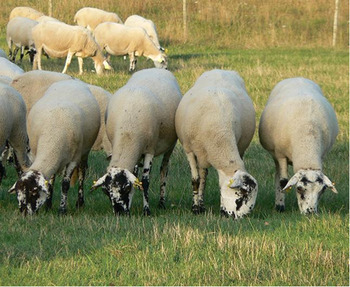
The Ripollesa sheep were described as a medium-sized breed with convex profile and characteristic pigmentation with black or brown spots on the head and legs (Sánchez-Belda and Sánchez-Trujillano, Reference Sánchez-Belda and Sánchez-Trujillano1986; Guillaumet and Caja, Reference Guillaumet and Caja2001; Caja et al., Reference Caja, Bach, Piedrafita, Milán and Casellas2010). This breed belongs to the Spanish medium-fine (i.e. “entrefino”) wool-type trunk with white wool and packed fleece (wool fibre diameter, 23–26 µm; Sánchez-Belda and Sánchez-Trujillano, Reference Sánchez-Belda and Sánchez-Trujillano1986) (Figure 1). The breed is characteristically Mediterranean exploited under semi-extensive production systems in the mountains and cultivated plains of Catalonia and currently intended for meat production (Guillaumet and Caja, Reference Guillaumet and Caja2001; Caja et al., Reference Caja, Bach, Piedrafita, Milán and Casellas2010). Lambs are sold for slaughter as “pascual”-type (22–24 kg live weight; ~12 kg carcass weight), usually directly by the sheep owners to the local butchers.
Grazing ewes of the Ripollesa sheep breed.

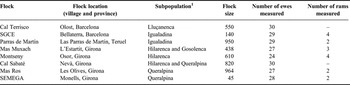
Most Ripollesa flocks are located in the provinces of Barcelona and Girona (Torre, Reference Torre1991; Milán, Arnalte and Caja, Reference Milán, Arnalte and Caja2003; Caja et al., Reference Caja, Bach, Piedrafita, Milán and Casellas2010), covering a wide range of environments from plains to coastal mountains. This heterogeneity, and even geographic isolation, may have led to the evolution of the breed towards different subpopulations. Although this kind of population structure has never been properly studied in the Ripollesa breed, putative subpopulations have been suggested according to geographic locations (Torre, Reference Torre1991; Guillaumet and Caja, Reference Guillaumet and Caja2001; Torres, Reference Torres2007). Different names of these subpopulations are derived from particular localities in the area, their main features being the following (Table 1):
(1) Gosolenca, from Gòsol (Barcelona), horned ewes with large body size.
(2) Igualadina, from Igualada (Barcelona), non-horned ewes with scarce wool on the belly.
(3) Lluçanenca, from the Lluçanès (Barcelona), medium body size.
(4) Queralpina, from Queralbs (Girona), smaller and less prolific sheep with longer and the finest wool fibres.
(5) Hilarenca, from Sant Hilari Sacalm (Girona), the largest rams with long horns and presence of abundant hair in the wool in rams and ewes. Lambs are markedly hairy at birth.
Description of the flocks and number of animals measured in each flock.

1The original types described in previous manuscripts were Gosolenca, Igualadina, Queralpina and Hilarenca (Torre, Reference Torre1991; Guillaumet and Caja, Reference Guillaumet and Caja2001; Torres, Reference Torres2007).
Main differences among subpopulations should be expected with regard to body size and characteristics of wool and horns (Guillaumet and Caja, Reference Guillaumet and Caja2001).
Sheep samples
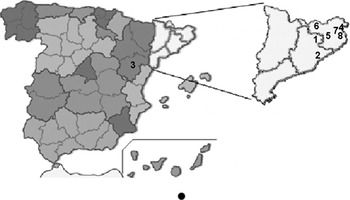
Morphological measurements were taken between September 2007 and June 2008, on adult Ripollesa animals (more than two years old) belonging to eight flocks registered in the official Flock-Book of the breed. Flocks were distributed across the geographic areas where the Ripollesa sheep are located (Figure 2), providing samples from the subpopulations described by Torre (Reference Torre1991) (Table 1).
Geographical location of the flocks (1: Cal Terrisco flock, 2: SGCE flock, 3: Las Parras de Martín flock, 4: Mas Muxach flock, 5: Montseny flock, 6: Cal Sabaté flock, 7: Mas Ros flock, 8: SEMEGA flock).

Flocks 1–6 were commercial farms under semi-intensive production systems, whereas flocks 7 and 8 were experimental farms under intensive conditions. Sheep sampled from each flock consisted of 24–30 non-pregnant ewes and 0–4 rams taken at random from the older-than-two-year breeding stock; note that rams were produced in the same flock or acquired from the neighbour flocks. A total of 241 sheep (224 ewes and 17 rams) were included in the study, as detailed in Table 1.
Morphological measurements
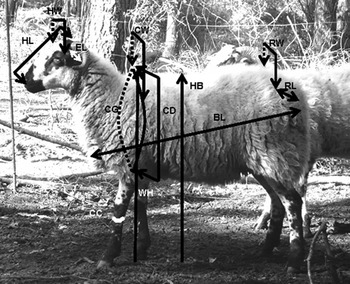
Morphological variables were measured by the same trained operator in the mornings, before the animals left the shelter to graze to avoid undesirable variations because of changes in live weight and rumen volumes. On the basis of Aparicio (1944), the following 12 morphological measures were taken on each animal (Figure 3):
(1) head length (HL), frontal distance from mouth to poll,
(2) head width (HW), maximum distance between zygomatic arches,
(3) ear length (EL), distance from the base to the tip of the right ear, along the dorsal surface,
(4) chest depth (CD), vertical distance from the top of the withers to the xyfoid process of the sternum,
(5) chest width (CW), maximum intercostal diameter at the level of the 6th rib, just behind the elbows,
(6) chest girth (CG), perimeter of the chest at the level of the 6th rib,
(7) withers height (WH), height from the top of the withers to the ground,
(8) back height (BH), height at the middle of the back, between the thoracic and the lumbar vertebrae,
(9) body length (BL), distance from the manubrium of the sternum to the pin,
(10) rump length (RL), distance from hip to pin,
(11) rump width (RW) maximum distance between left and right hurls,
(12) cannon perimeter (CP), perimeter of the right foreleg, between the knee and the pastern.
Zoometric measures. HL: head length; HW: head width; EL: ear length; CD: chest depth; CW: chest width; CG: chest girth; WH: withers height; HB: height at the middle of the back; BL: body length; RL: rump length; RW: rump width; CC: Cannon circumference.

These variables were obtained using a ribbon measuring tape and a measuring stick for horses (Hauptner & Herberholz, Solingen, Germany). Additionally, live weight was recorded using fixed (SR2000, Tru-Test, Auckland, New Zealand) or portable FX1 (Iconix NZ, Oamaru, New Zealand) electronic scales.
Zootechnical indexes
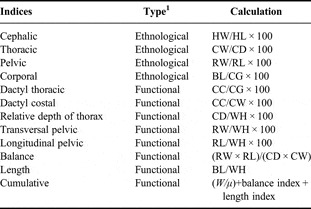
In order to evaluate the morphological characteristics of the Ripollesa breed, 12 zootechnical indexes were calculated according to Sotillo and Serrano (Reference Sotillo and Serrano1985) and Alderson (Reference Alderson1999). A definition of these indexes is shown in Table 2. Cephalic, thoracic, pelvic and corporal indexes are ethnological, which gave us general information about the breed characteristics in terms of describing structure and proportions (i.e. compactness, height, length and weight). The remaining indexes are functional, providing information about the type, aptitude and production performance of the animal. See Sotillo and Serrano (Reference Sotillo and Serrano1985) and Alderson (Reference Alderson1999) for a detailed description of the interpretation of the different zootechnical indexes.
Definition of the zootechnical indexes calculated for each Ripollesa individual.

HL: head length; HW: head width; EL: ear length; CD: chest depth; CW: chest width; CG: chest girth; WH: withers height; HB: height at the middle of the back; BL: body length; RL: rump length; RW: rump width; CC: cannon perimeter; W: body weight; μ: estimated average for W.
1Ethnological indexes contributed general information about breed characteristics whereas functional indexes contributed information about the type, purpose and performance of the breed.
Statistical analyses
All measurements and indexes were separately analysed under the following linear model:

where Y ijk was the dependent phenotypic record, μ was the population mean, F i was the effect of the flock (1–8), S j was the effect of the sex (1 or 2) and ɛijk was the residual term. Flock effects were contrasted by a one-way ANOVA test followed by the Student Newman–Keuls multiple comparison test, implemented in the General Linear Model procedure of SAS 9.1 (SAS Institute Inc., Cary, NC, USA).
The residuals obtained from the previous analyses on morphological measurements were used for a principal component analysis (PCA) performed by the SPAD 5.5 (2002) software (Coheris, Suresnes, France). For all subsequent analyses, only data from ewes were used because of the small number of rams contributing to this study. This analysis allowed us to understand the differences among flocks with regard to morphological measures, where only principal components accounting for more than 10 percent of the phenotypic variance were retained.
On the basis of the estimates from the PCA analysis, a discriminant analysis (SPAD 5.5) was conducted to estimate the proportion of animals that were properly classified into their own flock. This was an additional way of evaluating within-flock resemblance and the degree of differences between flocks. As a final step, a cluster analysis (SPAD 5.5) was performed for classification of data to establish the optimum number of groups (i.e. subpopulations) based on the number of principal components accounting for at least 80 percent of the total inertia. Between-group differences of morphological measures were compared by means of a Student Newman–Keuls multiple comparison test (SAS 9.1).
Results and discussion
Morphological diversity between sexes and flocks
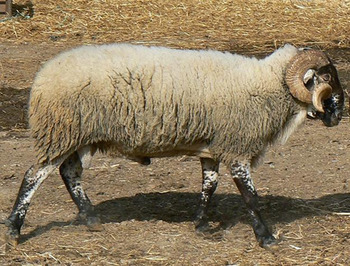
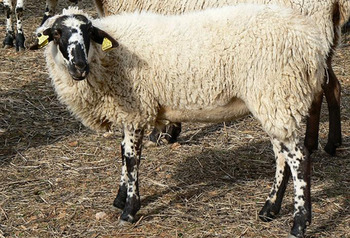
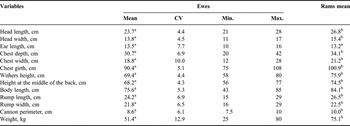
According to the values reported in this study, the Ripollesa breed showed a marked sexual dimorphism, as rams (Figure 4) were larger than ewes (Figure 5) for almost all measurements (P < 0.05), except for ear length and rump width (Table 3). Sexual dimorphism is a fundamental morphological characteristic of most ungulates (Andersson, Reference Andersson1994), and has important consequences for ecology, behaviour, population dynamics and evolution (LeBlanc, Festa-Bianche and Jorgenson, Reference LeBlanc, Festa-Bianchet and Jorgenson2001).
Ram of the Ripollesa sheep breed.

Ewe of the Ripollesa sheep breed.

Mean, coefficient of variation (CV), minimum value (Min.) and maximum value (Max.) of the morphometrical measures.

Means with the same superscript did not differ significantly (P > 0.05) between sexes.
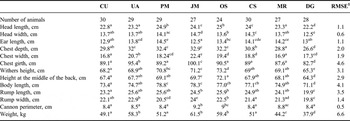
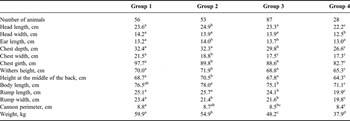
It is expected that all animal populations have certain variability between groups or subpopulations, these differences being of great importance to improve performance by selection. In our study, a moderate variability (CV ranging between 4 and 13 percent) in all the morphological measures considered was observed for the whole ewe sample (Table 3). The highest CVs were for live weight (12.9 percent), chest width (10.0 percent), ear length (7.7 percent), chest depth (6.9 percent), rump length (6.9 percent) and rump width (6.5 percent). Despite this, the greatest differences between average estimates for each flock with respect to the overall means were reported for withers height (65.3–73.2 cm; 11.4 percent), chest depth (26.6–32.9 cm; 20.5 percent), rump width (19.8–22.9 cm; 14.2 percent), head width (12.5–14.7 cm; 15.9 percent) and ear length (12.5–14.5 cm; 14.8 percent) (Table 4). These differences could be attributed to the geographic location and specific feeding conditions of each flock, combined with morpho-structural differences that may have a genetic origin.
Average of the morphological measures and live weight of Ripollesa ewes of flocks of different origins.

Flock of origin = CU, Cal Terrisco; UA, SGCE of the Universitat Autònoma de Barcelona; PM, Las Parras de Martín; JM, Mas Muxach; OS, Montseny; CS, Cal Sabaté; MR, Mas Ros; DG: SEMEGA, Diputació de Girona.
1RMSE: root mean square error.
Means with the same superscript did not differ significantly (P > 0.05).
We compared the Ripollesa breed with breeds located in neighbour geographical areas to characterize this breed and highlight differences and similarities with related breeds; Ripollesa ewes had greater morphological measures, mainly regarding head width, rump length, rump width and body length, than those reported for the Canaria (Alvarez et al., Reference Álvarez, Fresno, Capote, Delgado and Barba2000a), Gallega (Sánchez et al. Reference Sánchez, Fernández, López and Sánchez2000), Palmera (Alvarez et al., Reference Álvarez, Fresno, Capote, Delgado and Barba2000b), Xisqueta (Avellanet, Reference Avellanet2006), Yankasa and Wad (Salako, Reference Salako2006) sheep breeds.
Principal components analysis
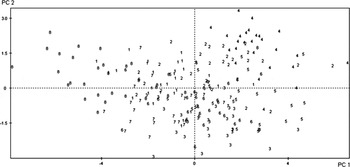
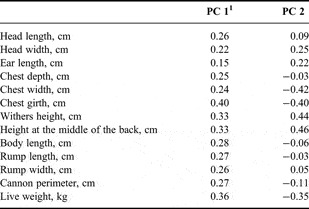
The principal components analysis allowed us to spatially characterize the relationships among sheep from different flocks according to a plane delimited by two main axes, PC1 and PC2, which accounted for 47.6 and 12.3 percent of the phenotypic variance, respectively, (Figure 6). As suggested by Table 5, the PC1 axis could be linked to the variables related to greater diameter amplitude and heavier live weight of the animals, whereas the PC2 axis gave a major relevance to their height and ear length of animals. Although individuals from the same flock tend to be plotted together, some flocks overlapped in Figure 6, which would suggest a common origin or belonging to the same subpopulation. Indeed, it would be possible to suggest that Mas Muxach ewes (#3) were the largest framed and heaviest individuals, SEMEGA (#7) had the smallest and lightest ewes, and Montseny (#5) and Las Parras de Martín (#6) ewes were the tallest (Table 4; Figure 6). Nevertheless, the results from the PCA did not allow for a clear-cut grouping of all of the different flocks and showed a remarkable degree of heterogeneity. Overlapping shown in Figure 6 could be due to the exchange of breeding stock between flocks (ANCRI, personal communication), which would suggest that current flocks could be a mixture of animals from different origins with a heterogeneous contribution from each original subpopulation (Torre, Reference Torre1991). Nonetheless, this hypothesis does not invalidate the presence of several subpopulations derived from one or several ancient subpopulations.
Representation of active individuals on the principal components (PC1 and PC2) space (1: Cal Terrisco flock, 2: SGCE flock, 3: Las Parras de Martín flock, 4: Mas Muxach flock, 5: Montseny flock, 6: Cal Sabaté flock, 7: Mas Ros flock, 8: SEMEGA flock).

Eigenvectors from the principal components analysis performed on the morphological measurements.

1PC: principal component; PC1 accounted for 47.6 percent of the variance and PC2 accounted for 12.3 percent of the variance.
Discriminant and cluster analyses
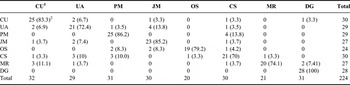
The results from the discriminant analysis (Table 6) confirmed this partial overlapping as the percentage of individuals correctly classified into their own flock ranged between 70 and 100 percent, with only 18.7 percent of the animals, on average, being classified in wrong flocks. The high percentages of matching suggested a marked degree of differentiation among flocks, being the greatest in the SEMEGA (#7) flock in which 100 percent of their own ewes were assigned correctly and only two ewes more from other flocks were incorrectly assigned to this flock.
Number of animals and corresponding percentage classified into each flock from the discriminant analysis.

Flock of origin = CU, Cal Terrisco; UA, SGCE of the Universitat Autònoma de Barcelona; PM, Las Parras de Martín; JM, Mas Muxach; OS, Montseny; CS, Cal Sabaté; MR, Mas Ros; DG: SEMEGA, Diputació de Girona.
1Rows indicate the flock-of-origin of the animals whereas columns indicate the flock where each animal is assigned.
2Number of animals correctly classified and corresponding percentage (rounded off within parentheses to the nearest unit).
On the other hand, the cluster analysis defined four sheep groups, each represented mainly by the following flocks (number of ewes and percentage of matching):
(1) Group 1 (19.6 percent of the ewes): Mas Muxach (24 ewes, 89 percent) and SGCE (13 ewes, 45 percent), characterized by being heavy and large framed animals.
(2) Group 2 (17.9 percent of the ewes): Montseny (13 ewes, 54 percent) and Las Parras de Martín (13 ewes, 45 percent), characterized mainly by being tall animals.
(3) Group 3 (40.6 percent): Cal Sabaté (20 ewes, 67 percent), Cal Terrisco (20 ewes, 67 percent) and Mas Ros (14 ewes, 52 percent), characterized by including animals with intermediate frame and long ears.
(4) Group 4 (21.9 percent): SEMEGA (24 animals, 86 percent), with the smallest body size (Table 7).
Means of the variables studied in females of each group of Ripollesa sheep breed.

Means with the same superscript did not differ significantly (P > 0.05).
Group 1: Mas Muxach and SGCE flocks; Group 2: Montseny and Las Parras de Martín flocks; Group 3: Cal Sabaté, Cal Terrisco and Mas Ros flocks; Group 4: SEMEGA flock.
This grouping can be justified in part by the different subpopulations that contributed to the studied flocks. Although the Montseny and Las Parras de Martín flocks must have come from the same original subpopulations as do Mas Muxach and SGCE (Hilarenca and Igualadina subpopulations), they are characterized by having a greater height than the general average. Even assuming a common origin, departures between Groups 1 and 2 must be probably linked to variable contributions from the Hilarenca and Igualadina historical subpopulations and an independent evolution during several years or decades. Focusing on Group 3, it was expected that animals from Cal Sabaté flock had a medium size, because this flock derived from original Hilarenca and Queralpina subpopulations, although differing from flocks assigned to Groups 1 and 2; in a similar way, the Cal Terrisco flock (Lluçanenca subpopulation) and Mas Ros flock (Queralpina subpopulation) were assigned to this Group 3. Nevertheless, there are also animals from the original Queralpina subpopulation in the group of SEMEGA ewes, the smaller individuals of the Ripollesa breed reported.
Within this context, the morphological characteristics of the historical subpopulations are still present in current morphological groups, although influences from more than one subpopulation could be found in the same flock and independent evolutionary patterns would have led to different subpopulations although departing from the same original genetic background. This makes evident the moderate-to-low genetic flow between flocks, where some specific morphotypes were preferentially preserved in each flock. In consequence, a substantial genetic structure could be anticipated in the Ripollesa populations, increasing the complexity of a conservation programme.
Differences among flocks were also found by Avellanet (Reference Avellanet2006) in ewes of the Xisqueta breed, where the values of the morphological measures varied depending on the location of the flocks, management and feeding, among others. Also Kunene, Nesamvuni and Fossey (Reference Kunene, Nesamvuni and Fossey2007) found that the location of the flocks had a significant effect on the morphological measures of Zulu ewes. In this study, however, it is possible that the differences among flocks could also have a genetic origin because some of the differences among the hypothetical subpopulations of origin are retained when the flocks are reared in other areas.
Zootechnical indexes
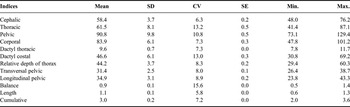
The calculation and analysis of the different zootechnical indexes allowed us to ethnologically classify the Ripollesa sheep breed (Table 8). On the basis of the cephalic index, the Ripollesa showed to be a dolichocephalic breed, because the length of the head predominated over the width. Both the thoracic and the length indexes allowed us to classify the breed as long shaped, whereas the pelvic index indicated that it is a convex breed, with the rump length predominating in relation to its amplitude. The breed had a medium frame according to the dactyl-thoracic and dactyl-costal indexes. These results agreed with the visual valuations of Torre (Reference Torre1991) and Guillaumet and Caja (Reference Guillaumet and Caja2001). The relative depth of the thoracic index indicated that the breed is suitable for meat production, lower values indicating better meat aptitude (Aparicio, Reference Aparicio1944), in agreement with Daza (Reference Daza1997), Guillaumet and Caja (Reference Guillaumet and Caja2001) and Milán, Arnalte and Caja (Reference Milán, Arnalte and Caja2003). This index also indicated that the length of the legs suggests that the breed had good adaptation to the environmental conditions under which it is raised. The transversal pelvic and longitudinal pelvic indexes also provided information about the aptitude of the animal, supporting the Ripollesa as a sheep breed for meat production, which reinforces the results obtained from the calculation of the cumulative index.
Mean, standard deviation (SD), coefficient of variation (CV), standard error (SE), minimum value (Min.) and maximum value (Max.) of the calculated zootechnical indexes.

Given that some of the indexes gave the same information, we suggest simplifying the number of analysed indexes for the future to the following ones: thoracic, cephalic, pelvic, dactyl thoracic and relative depth of thorax. These subsets of indexes are enough to ethnologically classify the breed and also to provide information about the productive purposes of the Ripollesa breed.
Average differences between flocks and subpopulations of Ripollesa relied on sheep size, weight and height. The cluster analysis suggested four differentiated groups, although there were ewes that could not be assigned to a particular group. The results of the analysed indexes allowed us to classify the Ripollesa sheep breed as medium framed and convex, predominantly suitable for meat production.
Note that our results contribute essential information to characterize this meat-type breed following FAO recommendations, and has become a relevant source of basic information to support the conservation and selection programme of the Ripollesa sheep breed.
Acknowledgements
The work was funded by the Departament d'Agricultura, Alimentació i Acció Rural de la Generalitat de Catalunya, and by a CONACyT scholarship granted to Cecilia Esquivelzeta. Authors are indebted to A. Bach (Vidrà, Spain) for providing pictures of the Ripollesa breed.