Acute kidney injury is common after paediatric cardiac surgery and is a risk factor for poor outcomes.Reference Zappitelli, Bernier and Saczkowski 1 – Reference Blinder, Goldstein and Lee 4 Longer duration of mechanical ventilation, length of ICU and hospital stays, and increased risk for mortality have all been associated with acute kidney injury in neonates following exposure to cardiopulmonary bypass with or without circulatory arrest.Reference Morgan, Zappitelli and Robertson 2 , Reference Blinder, Goldstein and Lee 4 Neonates with hypoplastic left heart syndrome and a functionally single ventricle are at an increased risk for the development of acute kidney injury following the Norwood procedure (Norwood).Reference Blinder, Goldstein and Lee 4 Given an already substantial mortality risk for neonates with single ventricle physiology, acute kidney injury is an additive risk burden that ought to be mitigated if at all possible; moreover, for patients who survive the postoperative period, emerging data suggest the presence of long-term subclinical renal impairment nearly a decade after acute kidney injury.Reference Cooper, Claes and Goldstein 5 This long-term renal impairment may be particularly important in the single ventricle population, who will undergo further staged surgical palliation with exposure to cardiopulmonary bypass.
The hybrid stage I procedure (Hybrid), a combined surgical–transcatheter strategy for first-stage palliation of single ventricle heart disease, is a recognised alternative to the Norwood procedure that avoids neonatal exposure to cardiopulmonary bypass.Reference Akinturk, Michel-Behnke and Valeske 6 , Reference Akintuerk, Michel-Behnke and Valeske 7 This procedure is offered in some centres in lieu of the Norwood procedure, although most centres offer Hybrid stage I palliation as an alternative to Norwood for all patients with hypoplastic left heart syndrome or for those select candidates deemed to be at a high risk.Reference Murphy, Bellsham-Revell and Morgan 8 Although patients who undergo Hybrid palliation for hypoplastic left heart syndrome will require surgical palliation – with exposure to cardiopulmonary bypass – at a later stage, first-stage Hybrid palliation offers the potential advantage of avoiding exposure to cardiopulmonary bypass as a neonate. Further, this approach may allow for resolution of modifiable risk factors – for example, shock or ventricular dysfunction – before exposure to cardiopulmonary bypass. Avoiding early cardiopulmonary bypass in neonates with hypoplastic left heart syndrome may also reduce risk for the development of postoperative acute kidney injury, although this has not been studied to date. On the other hand, exposure to intravascular iodinated contrast, a known nephrotoxic agent, during Hybrid palliation may offset the hypothetical benefit of avoiding cardiopulmonary bypass. Given these competing risk factors for acute kidney injury, and the potential benefit to short- and long-term outcomes by avoiding neonatal acute kidney injury, we sought to investigate the risk for acute kidney injury following the Hybrid procedure. The aims of this pilot study were to determine the incidence of acute kidney injury following the Hybrid procedure, to compare the incidence of acute kidney injury following the Hybrid procedure with the incidence of acute kidney injury in a contemporaneous cohort of patients undergoing Norwood operation, and to investigate differences in novel urinary biomarkers of renal injury following the Hybrid and Norwood procedures. We hypothesised that patients undergoing the Hybrid procedure would demonstrate a reduced incidence of postoperative acute kidney injury and biomarker elevation compared with Norwood patients.
Materials and methods
This prospective single-centre case–control study was approved by the Institutional Review Board at Cincinnati Children’s Hospital Medical Center. All patients with functional single ventricle physiology undergoing the Hybrid procedure between 1 October, 2013 and 1 June, 2014 were approached for participation. Patients with structural kidney disease or those requiring preoperative renal replacement therapy were excluded. Written informed consent was obtained before enrolment from a parent or legal guardian. Patients enrolled for the Hybrid procedure served as cases.
Urine samples for biomarker analysis were obtained immediately before and at 2, 6, and 24 hours after initiation of the Hybrid procedure. Urine samples were stored in aliquots at −80°C. Serum creatinine levels were measured preoperatively, immediately after Hybrid, and at least once daily in the postoperative period. Contemporaneous patients undergoing Norwood were identified from two prospective studies of acute kidney injury following paediatric cardiac surgery, with patient selection based on matching for weight, diagnosis, and age at surgery by blinded investigators – B.H.G. and D.S.C.Reference Krawczeski, Goldstein and Woo 9 , Reference Kwiatkowski, Goldstein, Cooper, Nelson, Morales and Krawczeski 10 These contemporaneous Norwood studies employed the same exclusion criteria as those used in this study. Patients who underwent Norwood served as controls and were matched to Hybrid patients in a 2:1 fashion, in order to augment statistical power.
The primary outcome was the development of acute kidney injury, defined as a ⩾50% increase in serum creatinine levels from preoperative baseline within 48 hours following the procedure. 11 Novel urinary biomarkers evaluated included neutrophil gelatinase-associated lipocalin, interleukin-18, kidney injury molecule-1, and liver fatty acid-binding protein. These biomarkers have previously been demonstrated to predict serum creatinine-based acute kidney injury after paediatric cardiopulmonary bypass.Reference Krawczeski, Goldstein and Woo 9 , Reference Mishra, Dent and Tarabishi 12 Urinary neutrophil gelatinase-associated lipocalin level was measured using a human-specific commercially available enzyme-linked immunosorbent assay (AntibodyShop, Grusbakken, Denmark).Reference Bennett, Dent and Ma 13 Urinary interleukin-18 and liver fatty acid-binding protein levels were measured using commercially available ELISA kits (Medical & Biological Laboratories Co., Nagoya, Japan; and CMIC Co., Tokyo, Japan, respectively) as per the manufacturer’s instructions. Enzyme-linked immunosorbent assay for urinary kidney injury molecule-1 was developed using commercially available reagents (R&D Systems Inc., Minneapolis, Minnesota, United States of America), as described previously.Reference Chaturvedi, Farmer and Kapke 14
High-risk candidates were defined as those patients with ⩾1 of the following risk factors: suspected or confirmed genetic syndrome, ⩾2 extracardiac congenital anomalies, premature birth, birth weight <2 kg, initial clinical presentation with shock, and/or preoperative cardiac arrest. Vasoactive inotrope score was calculated as described previously.Reference Gaies, Gurney and Yen 15 Patients underwent stage I single ventricle palliation with either Hybrid or Norwood procedure based on established institutional clinical practices and provider preference without influence from participation in this study.
Statistical analysis was carried out for only those patients who had measurements of all four novel urinary biomarkers at baseline and at a minimum of two postoperative time points, to allow for adequate comparison of biomarkers. Analyses were performed using SPSS (Version 21; IBM Corporation, Armonk, New York, United States of America). Demographics, medical characteristics, and measured serum creatinine levels were compared between patients who underwent Hybrid and Norwood procedures using the t-test, χ2 test, and the Wilcoxon exact test or Fisher exact tests. Absolute and percentage change ((SCrPeak−SCrBaseline)/SCrBaseline) in serum creatinine levels were determined at the patient level and compared between groups using the signed-rank test. Differences in median baseline urinary biomarker measurements were assessed between groups using the Kruskal–Wallis test, whereas differences in novel urinary biomarker measurements across all samples were assessed using a non-linear longitudinal mixed-effect model, accounting for differences between groups and between time points of postoperative measurements. Additional mixed-effect models generated included birth length and risk category as fixed factors, given the baseline differences in these variables between cohorts.
Results
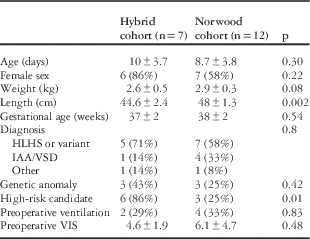
In all, seven consecutive patients who underwent Hybrid were enrolled in the study at a mean age of 10±3.7 days and weight of 2.6±0.5 kg (Table 1). Urinary biomarker samples adequate for analysis were available for all patients who underwent Hybrid at all prescribed time points. A total of 14 contemporaneous patients who underwent Norwood were selected as matched controls, but only 12 of them had adequate urinary biomarker data available for inclusion in the final analysis. The mean age and weight of the Norwood cohort was 8.7±3.8 days and 2.9±0.3 kg, respectively. Cardiac diagnoses were similar between groups with the majority of patients having hypoplastic left heart syndrome or variant anatomy. Patients who underwent Hybrid were generally smaller based on weight and length measurements and were more likely to be high-risk surgical candidates (86 versus 25%, p=0.01) compared with their Norwood counterparts, reflecting inherent differences between the cohorts. In the Hybrid cohort, high-risk status was due to genetic syndrome with (n=2) or without (n=1) extracardiac congenital anomalies, prematurity (n=1), birth weight <2 kg (n=1), and preoperative ventricular fibrillation arrest with cardiogenic shock (n=1). A single standard-risk patient with posterior malalignment ventricular septal defect and interrupted aortic arch underwent Hybrid palliation as a “bridge to a decision” regarding ultimate single versus biventricular circulation. In the Norwood cohort, high-risk status was exclusively due to genetic syndrome (n=3). There were no differences between groups in preoperative use of mechanical ventilation or vasoactive inotrope score.
Demographic and medical characteristics of the study population.

HLHS=hypoplastic left heart syndrome; IAA/VSD=interrupted aortic arch with ventricular septal defect; VIS=vasoactive inotrope score
Data are presented as n (%) or mean±SD
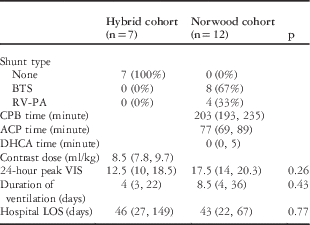
Operative and postoperative characteristics of the cohorts are displayed in Table 2. The median contrast dose in the Hybrid cohort was over 8 ml/kg. Blalock–Taussig shunt placement was more common than was right ventricle to pulmonary artery (Sano) shunt placement in the Norwood cohort. Peak vasoactive inotrope score within 24 hours, duration of mechanical ventilation, and length of hospital stay were not different between cohorts, with wide variability in these measures demonstrated between patients. Renal replacement therapy – peritoneal dialysis – was utilised in four Norwood patients (33%), all of whom met the criteria for acute kidney injury, but it was not used in any Hybrid patient.
Operative and postoperative characteristics of the study population.

ACP=antegrade cerebral perfusion; BTS=Blalock–Taussig shunt; CPB=cardiopulmonary bypass; DHCA=deep hypothermic circulatory arrest; LOS=length of stay; RV-PA=right ventricle to pulmonary artery shunt; VIS=vasoactive inotrope score
Data are presented as n (%) or median (Q1, Q3)
Acute kidney injury by creatinine criteria
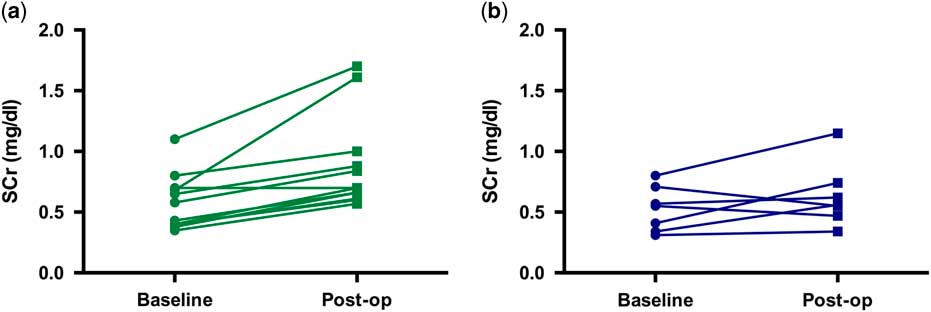
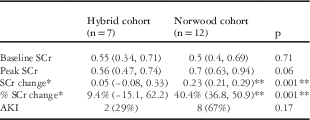
As demonstrated in Table 3, baseline preprocedural serum creatinine levels were not different between cohorts. Peak serum creatinine level during the immediate 48 hours following the index procedure trended towards a significant difference (Fig 1), with the Norwood group demonstrating a higher peak serum creatinine (0.7 (0.63, 0.94) versus 0.56 (0.47, 0.74), p=0.06). The absolute and percentage changes in serum creatinine levels from baseline to peak were significant in the Norwood cohort (p=0.001) but not in the Hybrid cohort. Acute kidney injury was twice as common in the Norwood cohort (n=8, 67%) than in the Hybrid cohort (n=2, 29%) but this difference was not significant (p=0.17).
Line plots for serum creatinine (SCr) levels at baseline and peak post-procedure in patients who underwent ( a ) the Norwood procedure and ( b ) Hybrid stage I palliation. The median increase in SCr was significant in patients who underwent Norwood (p=0.001) but not different in those who underwent Hybrid.

Change in serum creatinine after cardiac procedure.

AKI=acute kidney injury; SCr=serum creatinine
Data are presented as n (%) or median (Q1, Q3)
* SCr and % SCr change reflect the median difference from the baseline to the peak value within 48 hours of the procedure
** p values reflect a significant difference in change
Kidney injury and novel urinary biomarkers
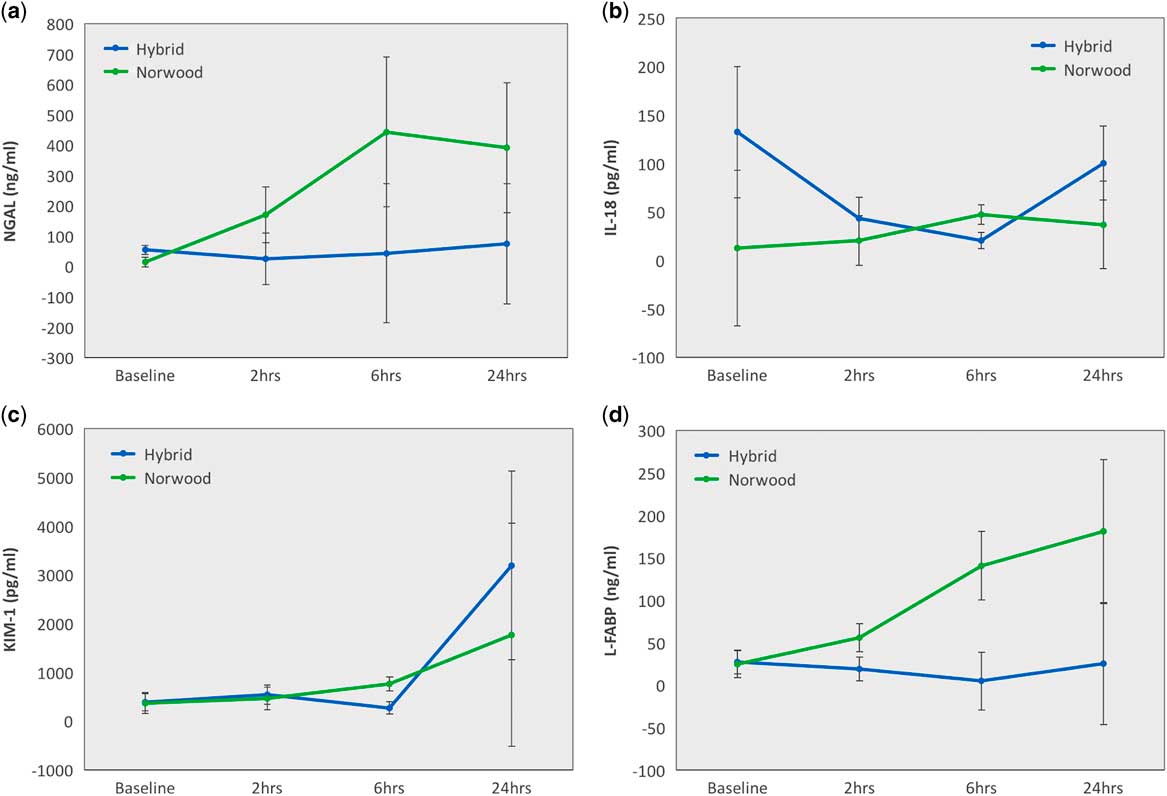
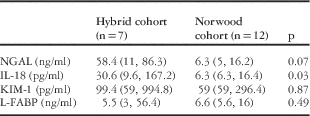
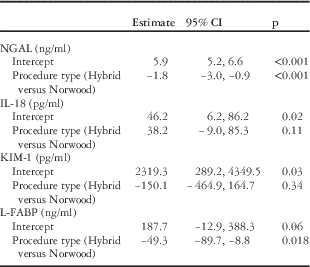
A comparison of baseline urinary biomarkers between procedural cohorts is displayed in Table 4. At baseline, levels of neutrophil gelatinase-associated lipocalin and interleukin-18 were elevated in the Hybrid cohort, suggesting evidence of preoperative renal insult. Results of non-linear longitudinal mixed-effects models for postoperative urinary biomarkers, including predictors, are presented in Table 5 and Figure 2. In the models developed for both neutrophil gelatinase-associated lipocalin (Fig 2a) and liver fatty acid-binding protein (Fig 2d), procedure type – that is, Hybrid versus Norwood – was a significant fixed predictive factor, with the Hybrid procedure being negatively associated with high postoperative biomarker levels, indicating its protective impact. Procedure type was not a predictive factor for interleukin-18 (Fig 2b) or kidney injury molecule-1 (Fig 2c), suggesting the significant difference between cohorts in baseline interleukin-18 values was not persistent postoperatively. The addition of other fixed factors – including patient length and risk status – to the models resulted in a loss of model validity.
A matrix of line plots demonstrating changes in mean novel urinary biomarker levels from the baseline to the postoperative state, stratified by procedural cohort. Error bars reflect the standard error. Panels ( a to d ) reflect changes in levels of neutrophil gelatinase-associated lipocalin (NGAL), interleukin-18 (IL-18), kidney injury molecule-1 (KIM-1), and liver fatty acid-binding protein (L-FABP), respectively.

Differences in preoperative novel urinary biomarkers between Hybrid and Norwood cohorts.

IL-18=interleukin-18; KIM-1=kidney injury molecule-1; L-FABP=liver fatty acid-binding protein; NGAL=neutrophil gelatinase-associated lipocalin
Data are presented as medians (Q1, Q3)
Results of longitudinal mixed-effect models for predicting postoperative novel urinary biomarkers.

IL-18=interleukin-18; KIM-1=kidney injury molecule-1; L-FABP=liver fatty acid-binding protein; NGAL=neutrophil gelatinase-associated lipocalin
Data are presented as estimates and 95% confidence intervals (CI) for each fixed effect. Variables evaluated in the mixed-effect models included procedure type, birth length, and risk category
Discussion
In this prospective case–control study of acute kidney injury following first-stage palliation for single ventricle heart disease, we did not identify a significant difference in acute kidney injury between cohorts; however, we did identify differences in the incidence and pattern of subclinical kidney injury based on the palliation method. Patients who underwent the Norwood procedure demonstrated significant increases in levels of serum creatinine and urine biomarkers – namely neutrophil gelatinase-associated lipocalin and liver fatty acid-binding protein – following surgical palliation, whereas those who underwent Hybrid palliation did not show any significant changes. To our knowledge, this is the first study to suggest a potential reduction in risk for postoperative kidney injury with the Hybrid approach to initial single ventricle palliation.
Since its first description in 2002, the Hybrid procedure has gained broad acceptance as an alternative to Norwood surgery for first-stage single ventricle palliation.Reference Akintuerk, Michel-Behnke and Valeske 7 Whether used only for high-risk candidates, offered more broadly as an alternative to Norwood, or presented as a centre’s primary strategy for first-stage palliation, early outcomes following Hybrid palliation have generally been comparable to those established from the Norwood procedure.Reference Akinturk, Michel-Behnke and Valeske 6 , Reference Caldarone, Benson, Holtby, Li, Redington and Van Arsdell 16 – Reference Venugopal, Luna and Anderson 18 In otherwise heterogeneous centres reporting outcomes of Hybrid stage I palliation, operative mortality, days on ventilation, and length of ICU stay tend to be significantly shorter following Hybrid compared with Norwood palliation.Reference Caldarone, Benson, Holtby, Li, Redington and Van Arsdell 16 , Reference Galantowicz, Cheatham and Phillips 17 To the extent that acute kidney injury has previously been shown to be a key driver of these clinical outcomes, avoiding acute kidney injury using the Hybrid procedure may be a major contributor to these empirical improvements; moreover, emerging data suggest that postoperative acute kidney injury following stage I palliation is associated with a significant risk for severe acute kidney injury following subsequent stages of surgical palliation, suggesting that avoiding early acute kidney injury has long-term benefits to patients.Reference Wong, Selewski and Yu 19
At our centre, the Hybrid strategy has generally been reserved for use in high-risk neonates with single ventricle and hypoplastic left heart syndrome or variant anatomy, although not all high-risk candidates undergo Hybrid palliation.Reference Karani, Zafar, Morales and Goldstein 20 This strategy is reflected in the discrepancies in cohort makeup; the Hybrid cohort was smaller, contained more high-risk candidates, and showed biomarker evidence of greater renal injury – that is, levels of neutrophil gelatinase-associated lipocalin and interleukin-18 – preoperatively compared with the Norwood cohort. We hypothesise that the increased levels of preoperative biomarkers are reflective of the impact of prematurity, genetic anomalies, and overall high-risk status in the Hybrid cohort. Elevated preoperative neutrophil gelatinase-associated lipocalin levels have been previously shown to be associated with an increased risk for postoperative acute kidney injury.Reference Krawczeski, Goldstein and Woo 9 It is therefore particularly important that Hybrid palliation not put these high-risk patients at further increased risk for mortality and morbidity associated with postoperative acute kidney injury. The findings that the serum creatinine level did not increase and, moreover, that urine biomarker levels did not increase – in fact, preoperative concentrations in neutrophil gelatinase-associated lipocalin and interleukin-18 actually stayed the same or decreased during the early postoperative period – suggest that the Hybrid procedure may not add significantly to the baseline risk for the development of postoperative clinical or subclinical acute kidney injury. This is an important finding that has not been reported previously; moreover, this would suggest that altering the preoperative physiology using the Hybrid procedure was able to mitigate the biomarker-identified – subclinical – preoperative kidney injury present in the Hybrid cohort. Thus, despite the use of nephrotoxic iodinated contrast during the Hybrid procedure, avoiding cardiopulmonary bypass and circulatory arrest may have a greater impact on overall postoperative acute kidney injury risk.
Early postoperative haemodynamics may also impact the incidence of acute kidney injury. Systemic cardiac output is immediately increased following branch pulmonary arterial band placement in the Hybrid procedure. Hypothetically, the Hybrid procedure may not induce the postoperative nadir in cardiac output that typically occurs during the several hours following paediatric cardiac surgery with cardiopulmonary bypass.Reference Hoffman, Wernovsky and Atz 21 Indeed, several centres have reported early extubation and feeding following Hybrid palliation, consistent with avoiding cardiopulmonary bypass-induced inflammation and resultant low-cardiac output syndrome;Reference Galantowicz, Cheatham and Phillips 17 , Reference Carpenito, Prusinski and Kirchner 22 however, in a single-centre pilot study of systemic haemodynamic measures in postoperative Norwood and Hybrid cohorts, the Hybrid cohort was not demonstrated to have a superior haemodynamic profile in the early postoperative period.Reference Li, Zhang and Benson 23 Unique approaches to the Hybrid procedure in that centre – for example, placement of a “reverse” Blalock–Taussig shunt – however, may limit the generalisability of these findings. In this study, we did not identify significant factors – for example, peak 24-h vasoactive inotrope score – to suggest an obvious difference in the early postoperative course between cohorts, but the depth of perioperative haemodynamic and clinical data collected was limited.
The prospective measurement of four biomarkers previously demonstrated to predict acute kidney injury after paediatric cardiac surgery is a novel aspect of the current study.Reference Krawczeski, Goldstein and Woo 9 , Reference Mishra, Dent and Tarabishi 12 , Reference Bennett, Dent and Ma 13 Urinary neutrophil gelatinase-associated lipocalin, interleukin-18, kidney injury molecule-1, and liver fatty acid-binding protein are up-regulated and released by kidney tubules in response to injury and are biologically mechanistic in ischaemia–reperfusion injury of the kidney. Urinary biomarkers are measurable at low concentrations preoperatively and increase substantially in the face of renal injury.Reference Krawczeski, Goldstein and Woo 9 Neutrophil gelatinase-associated lipocalin, which may play a key role in renal tubular survival and recovery, is produced in excess following ischaemic and nephrotoxic injury.Reference Mishra, Ma and Prada 24 Interleukin-18 is produced by the proximal tubules as a mediator of inflammation and is somewhat specific to ischaemic acute kidney injury.Reference Melnikov, Faubel, Siegmund, Lucia, Ljubanovic and Edelstein 25 Kidney injury molecule-1 is a membrane protein found in abundance in proximal tubule cells after ischaemic or toxic injury, whereas liver fatty acid-binding protein is an inflammatory proximal tubular protein, also up-regulated after acute kidney injury.Reference Mishra, Ma and Prada 24 , Reference Ferguson, Vaidya and Waikar 26 In our study, we demonstrated that Norwood palliation was associated with a significant increase in neutrophil gelatinase-associated lipocalin and liver fatty acid-binding protein levels, suggesting that cardiopulmonary bypass and circulatory arrest adversely impacts varied aspects of renal tubular function. Importantly, Haase et alReference Haase, Devarajan and Haase-Fielitz 27 previously demonstrated that patients with elevated urine neutrophil gelatinase-associated lipocalin concentration but normal levels of serum creatinine – that is, those with subclinical kidney injury – had a similar risk for adverse clinical outcome compared with patients with elevated creatinine alone – that is, those with manifest kidney injury or acute kidney injury. In fact, more recent data suggest that the presence of biomarker elevation, reflective of structural kidney injury, in the absence of serum creatinine elevation, reflective of a lack of functional kidney injury, predicts worse long-term outcomes than creatinine elevation alone, following cardiac surgery.Reference Basu, Wong and Krawczeski 28 Further, in an investigation of the impact of acute kidney injury at stage I palliation on clinical outcomes at subsequent staged surgical palliation, Wong et alReference Wong, Selewski and Yu 19 demonstrated that acute kidney injury following Norwood palliation was associated with acute kidney injury at stage II palliation and with a longer duration of mechanical ventilation at Fontan completion. Taken together, these findings further support the acute and potentially long-term clinical relevance of biomarker-detected kidney injury manifest in the Norwood cohort but not in the Hybrid cohort in the present study.
Our study has important limitations. First, this protocol was limited to a single-centre and, despite 100% capture of eligible Hybrid patients, the small sample size limits statistical power. Validation of these important but hypothesis-generating findings in a larger and possibly multicentric cohort is necessary. Second, this study recruited patients with single ventricle undergoing Hybrid palliation, but utilised existing data for a Norwood-patient population from contemporaneous but separate acute kidney injury and biomarker studies for comparison. Although incorporation of the patients undergoing Norwood was carried out in a blinded manner, the lack of prospective enrolment does create a risk for the introduction of bias. Third, because our centre generally limits Hybrid palliation to high-risk surgical candidates, our results may not be generalisable to centres that offer the Hybrid approach to candidates with standard-risk hypoplastic left heart syndrome and its variants. That said, in general, the high-risk patients are at greater risk for renal injury due to concomitant risk factors for acute kidney injury, and thus these data may represent a “worst case” scenario for the Hybrid cohort, facilitating reasonable translation to a standard-risk cohort. Finally, the focus of this particular study was on the early postoperative period; therefore, conclusions regarding long-term clinical outcomes could not be assessed.
Despite these limitations, this study has several important strengths. First, we utilised a prospective design with a rigorous biomarker collection protocol. Second, we included a contemporaneous Norwood cohort with an identical biomarker protocol for direct comparison. Third, matching of patients who underwent Norwood and urine biomarker measurements were each carried out in blinded fashion. Finally, assessment of the surgical support times and overall postoperative course of the patients enrolled are broadly reflective of the current clinical practice – as reported in the Pediatric Heart Network Single Ventricle Reconstruction trial – contributing to this study’s generalisability.Reference Pasquali, Ohye and Lu 29
Acknowledgements
The authors would like to acknowledge Michael Bennett, who performed the urinary biomarker analysis in this study. Authors’ Contributions: B.H.G.: Study conception and design, data analysis and interpretation, drafting of the manuscript, final approval. S.L.G.: Study conception and design, data analysis and interpretation, critical revision of the manuscript, final approval. P.D.: Infrastructure for sample analysis, data analysis and interpretation, critical revision of the manuscript, final approval. F.Z.: Statistical analysis, critical revision of the manuscript, final approval. D.M.K.: Data collection, data analysis and interpretation, critical revision of the manuscript, final approval. B.S.M.: Study conception and design, data analysis and interpretation, critical revision of the manuscript, final approval. D.L.M.: Data analysis and interpretation, critical revision of the manuscript, final approval. C.D.K.: Data analysis and interpretation, critical revision of the manuscript, final approval. D.S.C.: Study conception and design, data analysis and interpretation, critical revision of the manuscript, final approval.
Financial Support
P.D. is supported by NIH P50 DK096418.
Conflicts of Interest
P.D. is a co-inventor on submitted patents on the use of neutrophil gelatinase-associated lipocalin as a biomarker of kidney injury. No other relevant disclosures are present.
Ethical Standards
The authors assert that all procedures contributing to this work comply with the ethical standards of the relevant United States guidelines on human experimentation and with the Helsinki Declaration of 1975, as revised in 2008, and has been approved by the Institutional Review Board at Cincinnati Children’s Hospital Medical Center.