Introduction
Following the global financial crisis of 2008, the rating agency Standard & Poor’s downgraded the government bonds of a Eurozone member, Greece, for the first time. The other Eurozone member states (MSs) initially perceived this as a ‘Greek’ and not a ‘European’ problem. However, as market confidence in Irish, Italian, Portuguese and Spanish bonds also started declining, it became apparent that European banks that had invested in such bonds were at great risk. By 2010 an immense market of credit default swaps had developed in which speculators treated sovereign public debt as if it were equivalent to private corporate debt, betting on the decline of the EURO. By 2011 the second strongest currency in the world had become hostage to the domestic politics of its 17 MSs and experts seriously considered the demise of the EURO and even of the European Union (EU) a possible outcome. Compared with previous crises in European integration, this one attracted unprecedented public attention. Across the EU, very few party politicians, interest spokesmen, financial analysts, journalists or television pundits could remain indifferent to what EU officials were saying. EU-jargon moved beyond university lecture halls and parliaments and penetrated the national media and personal discussions around the continent. Citizens in all 28 EU MSs found themselves sharing anxieties and reflecting on the same issues. For some, more regional integration seemed an opportunity – even a necessary part of the solution; for others (and there were far more of them), it was perceived as a serious threat to its very existence.
Is the current crisis going to be a ‘good’ or ‘bad’ one for the process of European integration? Whether the Eurozone breaks up or advances further – or indeed whether the EU as a whole survives or perishes – is of concern to the ∼500 million Europeans that are directly affected by the uncertainty of the outcome. This, in turn, feeds back into the global economic and political order. Given that the crisis is far from over and that the European project is still at a make-or-break moment, attempting to answer this question is a fundamental obligation for the social sciences. To date, economists and financial experts, who disagree about the root of the problem and, consequently, about the appropriate remedy, have almost completely dominated the debate – despite the fact that the problem facing Europe today is primarily political.
Approaching the question from this perspective, in the next section we revisit Schmitter’s model of crisis-induced decision-making cycles (1970). Based on this theory, the present crisis should be a ‘good’ one for Europe: the current cycle could even be the transcending one, whereby economic union will transform itself into political union. Observing current developments with this model in mind (section ‘The Transcending Cycle?’), we see that, as expected, the EU has been forced out of its ‘zone of indifference’ and compelled to consider major extensions of its scope and authority in favor of fiscal and banking unity – which in turn would seem to imply taking steps towards political union. But ‘political’ union remains the least overtly debated issue and the one that, at least for the moment, both rulers and citizens find the hardest to imagine. We will discuss critically whether and why this crisis might be a ‘good’ one for transcending the EU’s existing limitations or a ‘bad’ one that could threaten its very existence (A ‘Bad’ Crisis? section). In the Conclusion, we make some final reflections regarding potential future developments.
The role of crisis in the process of integration
Crises have been an integral part of the process of European integration and, by and large, they have had positive effects.Footnote 1 Collective reactions to crises by national actors have led to an increase in the authority and/or an expansion of the tasks of the institutions of the EU and its predecessors.
The underlying reason for this is obvious. It begins with the unprecedented nature of the process of integrating sovereign national states peacefully into a regional organization. The actors involved have an intrinsic difficulty in acting rationally because it is so difficult to assess the costs and benefits of possible courses of action: first, because the range of alternatives (especially given the presumption of peaceful negotiation among relative equals rather than violent imposition by the strongest) is so different from analogous choices made during their respective processes of national integration; second, because, however, well-considered their policies and well-intentioned their implementation, they are bound to generate unexpected and, often, undesired consequences. The current crisis of the EURO and the public finances of several MSs is a near perfect example of how causal complexity and unanticipated consequences can impact the process of regional integration.
In an article written four decades ago, Schmitter (Reference Schmitter1970) incorporated this notion of intrinsic crisis into a revised understanding of the basic neo-functionalist paradigm developed by Ernst Haas (Reference Haas1968). Schmitter’s argument rested on the assumption that treaty-based international organizations, whether regional or global, were especially prone to entropy. They would settle into a self-encapsulating ‘zone of indifference’ based on their initial task endowment and resources, and simply continue to perform the circumscribed tasks assigned to them with as little impact as possible upon either their MSs or other international organizations – until a crisis forced them to revise their practices.
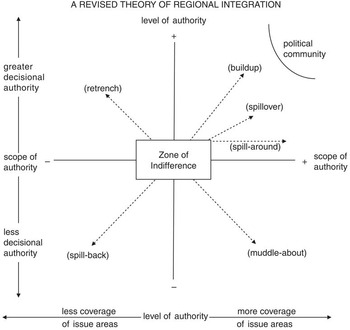
In times of crisis, there are alternative strategies that actors (national states, supranational functionaries, cross-national parties, interest associations, and social movements) can adopt (Figure 1). The resulting outcome of their conflicts, if the crisis is sufficient, forces the regional organization out of its entropic zone of indifference. Given favorable conditions, this will enhance either the scope of its tasks or the level of its authority. And, under especially favorable conditions, a package deal can emerge that accomplishes both, an outcome labeled as ‘spill-over’.
Alternative actor strategies.

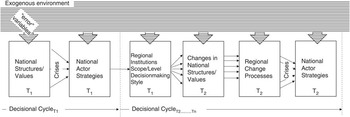
The argument has a temporal structure and consists of decision-making cycles induced by successive crises. These cycles first change the strategies of national actors – governments and non-governmental organizations – that, in turn, place pressure on the scope and level of regional institutions (Figure 2).Footnote 2 If the response is expansive, this changes the perceptions of national and sectoral interests (and eventually, their very identities), which then trigger further changes at the regional level that, as the result of a subsequent crisis, transform the basic expectations and strategies of national actors et ainsi de suite. For what a ‘good’ crisis should do is disappoint established member expectations and/or raise the prospect of new opportunities and, thereby, compel actors to redefine either the tasks or the level of authority (or both) of regional organizations by making their collective agreement ‘spill-over’ into previously untreated or ignored areas (see Figure 1).
Crisis induced decision-making cycles.

In the process of integration, the original European Economic Community has changed its overriding goal from regional security to trade promotion to agricultural subsidization to fishing regulation to encouraging cross-investment and financial liberalization and to coping with the competitive pressures of globalization – not to mention the more recent aims of police cooperation, immigration, energy, transport, foreign, and security policy. Each time the EU has expanded its competences, the stakes in the game have involved ever more complex packages of policies whose interactive effects and emergent properties have proven more difficult to predict.
What has made the EU unique is precisely this capacity to exploit successive crises positively by repeatedly breaking out of its momentary zone of indifference. Up to now, no other regional organization has acquired this dynamic characteristic. The key hypothesis was (and still is) that this has been due to three distinctive factors:
-
1. The high level of supranationality that was initially given to the Secretariat of the European Coal and Steel Community and then passed on to its successor, the European Economic Community – combined with the unusually ‘collegial’ nature of decision-making within its Commission whose members were chosen by member governments but were not supposed to represent their national interests.
-
2. The existence of a rapidly expanding number and variety of non-state organizations – interest associations and social movements – that formed at the regional level and became capable of exerting influence on EU policy-making across the borders of MSs and independently of their governments.
-
3. Needless to say, both of these features rested on the fact that all of the MSs were liberal democracies that tolerated both the relative autonomy of supra-national organizations and the formation of cross-national associations.
The Transcending Cycle?
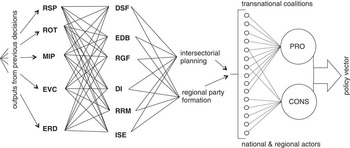
In theory, the present EURO-crisis would seem to conform almost perfectly to what Schmitter (Reference Schmitter1970) modeled as ‘the Transcending Cycle’ (Figure 3). This cycle of decision-making should have compelled actors in MSs to:
-
(a) Engage in more comprehensive policy coordination across sectors and policy arenas; thereby, institutionalizing at the supranational level the central governing mechanisms of planning, budgeting, taxing, and subsidizing characteristic of a federal polity.
-
(b) Break out of predominantly national partisan alliances and to form more salient cross-national ones, thereby laying the foundation for the establishment of the most important missing element in the EU-polity, namely, a distinctively European party system. Once this was accomplished, the five-year cycle of elections to the European Parliament (EP) would become much more significant to citizens and eventually result in the formation of an EU government transparently dependent upon their results and not upon the opaque calculations of member governments as at present.
The ‘Fourth’ or ‘Transcending’ Cycle of Crisis Decision-Making. A Glossary of Variables: Changes in National Structures/Values. RSP=relative size & power; ROT= rates of transaction; MIP=member internal pluralism; EVC=elite value complementarity; ERD=extra-regional dependence. Regional Processes. DSE=domestic status effect; EDB=equitable distribution of benefits; RGF=regional group formation; DI=development of regional identity; RRM=regional reform-mongering; ISE=international status effect.

In short, this was supposed to be the crisis that would drive the EU from economic to political integration.
In practice, however, we are not (yet) there. EU decision-making during the EURO-crisis has been reluctant and disappointing. Since the outbreak of the global financial crisis, MSs have retreated to exclusive and state-centric calculations of interest that have often undermined their own decisions taken at EU Summits (Barroso, Reference Barroso2012a). Ironically, the defense of self-interest often comes under the guise of ‘forced solidarity’ towards crisis-hit members. In general, developments have fallen – at least so far – short of the second expectation, while evidence regarding the realization of the first is mixed.
To be sure, the crisis has been sufficient to force the Union to break free from its ‘zone of indifference’. Predictably, the Commission tried to exploit the opportunity by advancing several proposals for reinforcing its authority in fiscal, budgetary and banking arenas and even raised the prospect of a ‘quantum leap’ towards political union (Barroso, Reference Barroso2012a, Reference Barrosob, Reference Barrosoc; European Commission, 2012; Reding, 2012Reference Redinga, Reference Redingb, Reference Redingc).
Moreover, and without EP involvement, the Presidents of the European Council, the Commission, the Eurogroup and the European Central Bank (ECB) made joint proposals for integrated frameworks of financial, budgetary, and economic policy (Van Rompuy, Reference Van Rompuy2012). If ratified and implemented, these would transfer a very substantial set of new competences to the EU level, thereby enhancing the role for EU institutions in such sensitive policy areas as public expenditure, revenues, and borrowing.
Given their political sensitivity, their proponents recognized that such initiatives would require ‘strong mechanisms for legitimate and accountable joint decision-making’, that is, a strengthening and extension of democracy (Van Rompuy, Reference Van Rompuy2012; see also European Commission, 2012). Their joint proposal did not specify how this would be achieved. But in his ‘state of the Union address’ to the EP, Barroso (Reference Barroso2012c) spoke of strengthening EU democracy through the reinforcement of Europarties by enhancing their role in the nomination of candidates for the Presidency of the Commission – a competence previously based on intergovernmental consensus. Inter alia, Barroso committed himself to tabling ideas for treaty change before the 2014 EP elections, so as ‘to move towards a federation of nation-states’ (ibid.). His choice of the dreaded F-word caused vivid debates among MEPs and was widely commented in the national media of MSs.
‘More Europe’ – even ‘more political and democratic Europe’ – has crept onto the agenda as a result of the crisis and there is gradual acknowledgment of the need for a ‘European public space’ (Barroso, Reference Barroso2012b; Draghi, Reference Draghi2012) or a ‘European political space’ (Future of Europe Group, 2012: 8), but the objective remains ambiguous – even among its proponents. Whether and how the aforementioned ideas will become fully fledged proposals and whether representatives from other, more reluctant, MSs (e.g. the United Kingdom, Denmark or Finland) would endorse them remains highly uncertain, especially since ratification of any treaty containing these new rules would require the unanimous approval of all 28 MSs.
Last, but definitely not least, mass publics – rather than favoring more integration in gratitude for the benefits it has given them – have by-and-large expressed hostility to the prospect of political union. According to recent polls, citizens in the core countries of France and Germany have only weak (and declining) faith in Europe (Die Welt, Reference Die2012; Le Figaro, 2012). EU-wide public opinion surveys show that, on the aggregate, fewer citizens throughout the EU trust national and EU institutions than in the past,Footnote 3 although they do tend to trust the latter more than the former with solving the crisis (Armingeon and Ceka, Reference Armingeon and Ceka2013). This downward trend has accelerated since the crisis began in the Autumn of 2009, but had started even earlier (Standard Eurobarometer, 2011: 19–21).
A ‘Bad’ crisis?
Could it just be that the ‘good’ crisis that Schmitter imagined 40 years ago has turned out to be a ‘bad’ one? This would not be just a miscalculation, but a serious one – in both theoretical and practical terms. Not only would it invalidate a major element in neo-functionalism, but it might even threaten the famous acquis communautaire reversing much, if not all, of what has been accomplished at the regional level since the early 1950s. It could even return Europe to its previous status as a squabbling set of antagonistic national states prone to using violence to settle their disputes or to aggressively expanding their respective domains.Footnote 4 In what follows, we reflect on whether and why this might not be as ‘benign’ a transcending cycle as Schmitter originally thought.
Endogenous and exogenous factors
The neo-functionalist approach underlying the cyclical model is essentially endogenous.Footnote 5 It presumes that the crises that emerge are produced by the very functioning of the integration process and, hence, that their resolution can be internalized, that is, handled by apposite changes in regional institutions and their policies.
At first glance, the EURO crisis seems to fit this specification. Given the EMU’s deficient design at its origins, the crisis was generated by the unregulated ‘sovereign’ behavior of its MSs in response to lower rates of interest and apparently unlimited opportunities for public and private borrowing. This, however, ignores two aberrant factors.
First, the timing of the crisis was triggered by a financial collapse that began not in Europe but in the United States, and its resolution remains critically dependent on exogenous responses, especially on the reactions of international ratings agencies and capital markets. No one imagined that, as a result, sovereign public debt would be treated the same as commercial private debt – even when it seemed to be protected by the umbrella of a common supra-national currency. Hence, it is worth contemplating whether, if the crisis of the EURO and of public finance in the weaker MSs had occurred in a more settled (even an expansive) global financial context, it would have been a much better one for the process of European integration.
Second, the ‘spill-over’ into monetary integration had little to do with the ‘low politics’ of immediate functional pressures and almost everything to do with the ‘high politics’ surrounding German unification. It was the product of an ‘intergovernmental’ deal whereby Western Germany was allowed to reunify with Eastern Germany in exchange for ensuring its partners that it would remain firmly anchored in the EU. And that meant giving up the Deutsch Mark in exchange for a common European currency.Footnote 6 No doubt its deficient design would have eventually generated the sort of functionalist pressures envisaged by the theory, but that would have been much later, in more endogenous circumstances and, perhaps, at a different stage of the global business cycle.
Uneven vs. cumulative impact of crisis
One of the presumed causes of a ‘good’ crisis was supposed to be the unexpected and uneven functional distribution of costs and benefits of some regional-level policy across MSs – and this has certainly occurred – but it implicitly assumed a fundamental underlying pluralism in the interest structures of the polities involved. In other words, the impact of the crisis should not have been cumulative – striking some distinct group of members in multiple dimensions with particular force and leaving the others relatively unaffected or, worse, relatively better off.
The EURO-crisis has definitely had such a cumulative impact. Moreover, it accentuated a North-South developmental and cultural cleavage within the EU that already existed with the result that both sides have accused each other of inexcusable or overbearing behavior – with neither side capable of expressing solidaristic or mutually sympathetic feelings.Footnote 7 For some populist politicians and media outlets, ‘nation bashing’ via recourse to cultural stereotypes has been used as a strategy for attracting the support of frustrated citizens in both the North and South. This tactic has been especially damaging since it has long been presumed that the EU had succeeded in eliminating such nationalistic excesses and in promoting mutual trust across national borders.
The role of an epistemic community
Both the archeo-functionalism of David Mitrany and the neo-functionalism of Ernst Haas presumed a leading role for experts – whether in regional institutions or in the associations and movements surrounding them. They were expected to constitute what came to be known as an ‘epistemic community’ and, hence, were supposed to be capable of identifying the nature of the problem and agreeing upon the policies for its resolution. Needless to say, this theory also presumed that such a consensus would usually include the need to expand the scope or enhance the authority of regional institutions as part of the problem-solving process.
Neo-functionalism also presumed that the economic policy-paradigm of the 1950s and 1960s – that is, Keynesianism – would remain hegemonic and prevail into the indefinite future. The ontological response to crisis, whether cyclical or episodic, should have involved an increasing role for public authority in regulation and re-distribution – gradually and fitfully shifting to the higher regional level. It did not anticipate that, during the 1980s and 1990s, a coherent and dedicated group of neo-liberal economists would come to dominate national, regional and global policy-making and, especially, international financial institutions. This has resulted in policy choices becoming increasingly determined by their assumptions, models and policies (Chwieroth, Reference Chwieroth2007) – which became immediately apparent during the EURO-crisis. All of the key players (the Commission, the ECB, the IMF – not to mention Germany and the other Northern MSs) advocated fiscal balance and budgetary austerity with the assumption that this would result in monetary stability and a shift of available investment from public institutions to private firms, which in turn was supposed to have triggered a general expansion of employment, production, and prosperity.
In reality, however, these monetary and budgetary policies endanger national welfare states and social services (e.g. pensions), undermine collective bargaining systems (and labor rights more broadly) and attack wages and public ownership.Footnote 8 The widespread public resistance and social protests against these developments have been ignored; in the extreme version, elected governments were replaced by technocratic ones that were presumed to be more successful in pursuing these policies (vide Monti in Italy and Papademos in Greece).
Unfortunately, the result of these policies has been dramatically disappointing. Since May 2011, unemployment in the EURO-area increased to concern 1,820,000 people, and the aggregate unemployment rate reached 11.1% (Eurostat, 2012). Austerity policies and severe cuts in social protection have assumed tragic dimensions, leading to increased rates of homelessness, malnutrition and even so-called ‘economic suicide’ in the countries worse hit by the crisis.
Worse for the process of integration, these developments have resulted in public opinion increasingly associating the EU with declining incomes for most of the population and rising ones for the privileged few – exactly the opposite of its historical ‘Keynesian’ image (Standard Eurobarometer, 2012). This anti-Europe trend has been reflected in popular protests and electoral results. Desperate and disappointed citizens look more and more for salvation from their national governments (who conveniently attempt to shift the blame to the EU).Footnote 9 And they increasingly do so by supporting populists on the left or right who proclaim their opposition to the EURO, EU policies and even to the EU itself. Unless an epistemological community of experts with different assumptions and norms emerges, the crisis is much more likely to be a ‘bad’ one for European integration.
Pro-integration bias
The neo-functionalist approach was biased toward further integration – at least in the relatively favorable conditions initially present in Western Europe. Although the conditions that might lead to disintegration were not explicitly theorized, it was conceived as possible if groups sharing short-run negative expectations vis-à-vis the European project worked together in order to block a specific policy and were successful (Haas, Reference Haas1968). Groups with such negative expectations have not (yet) managed to halt or reverse the integration process as a whole, but they were successful in blocking the Constitutional Treaty at the national level (French and Dutch referenda, 2005). Now that Europe is in deep crisis, and with public opinion increasingly associating the EU with negative outcomes, the prospect of disintegration has been openly discussed. Although relatively few groups (e.g. United Kingdom Independence Party) advocate outright withdrawal from the EU, many other parties are overtly contrary to any further ‘spill-overs’ that would benefit European institutions and some even favor ‘spill-backs’ in specific policy areas (e.g. Freiheitliche Partei Österreichs, British National Party, Front National). The more radical proposals range from encouraging or compelling ‘problematic’ members’ to leave the Eurozone (e.g. Strache, Reference Strache2010), to their own country’s withdrawal from the EURO, to dramatically reducing their contribution to EU budget, to ending the common agricultural policy and, most, seriously, to re-instating the superiority of national over EU law, for example Marine Le Pen.
Moreover, the momentary success of these anti-EU populist movements exerts pressure on mainstream parties to adopt some of these positions for immediate electoral purposes – if not to co-opt the extremists more securely into their ranks. The entire political spectrum has shifted away from the ‘permissive consensus’ that prevailed previously and EU-related conflicts are threatening the internal unity of established centrist parties. Despite this, most politicians remain aware that such proposals are not easy to implement without breaking up the entire project. What is particularly disturbing about monetary integration, as opposed to other EU policies, is the excessively high costs of defecting from it or allowing it to collapse altogether. It is one thing to revoke a tariff, to abandon a common fishing policy or to renege on an agreement for cooperation in police or foreign affairs, and quite another to abandon the EURO and return to national currencies. In short, once it has been implemented, a regional policy in this domain becomes virtually irrevocable and, even if it could be ‘arranged’ for one or two members of the Eurozone to leave, their removal would be bound to generate suspicion about others following suit in the future.
The impact of enlargement
The entire neo-functional approach completely ignored one of the EU’s greatest successes, namely, its enlargement to include new MSs. In the process of integration, the EEC/EC/EU has incorporated 22 MSs in addition to the original six. But neo-functionalism lacked a theory of when or why this would occur and, most importantly for the present crisis, it had no understanding of how regional decision-making might be affected by such an increase in the number of MSs and the diversity of their socio-economic interests. To be sure, each time enlargement has occurred – thanks in large part to the sacred nature of the acquis communautaire – the effects on existing policy commitments and the likelihood of agreeing upon new ones has become less predictable.
Admittedly, only five of the new MSs are so far in the Eurozone (Cyprus, Estonia, Malta, Slovakia, and Slovenia), but all have been affected by its crisis. Moreover, the entire decision-making structure was designed from the beginning to over-represent these (and other) smaller MSs. Whatever solution is found – for example, the much touted ‘two-speed Europe’, that is, a core group forging ahead to further economic, monetary and even political integration, it will have to take into account the reactions (and voting weights) of these new MSs in order to bring it about. And there is every indication that the more recent the membership, the more likely a given member is to be sensitive about being placed in a second-class status. At the same time, the more rigorous the norms of economic governance become within the Eurozone, the more remote the prospect for those on the outside to join it anytime soon.
La finalité politique
Neo-functionalists have been notoriously reluctant to speculate about the end-product of regional integration – its so-called finalité politique. The implicit assumption seems to have been that it would eventually approximate a supra-national federal state – perhaps one closer to the Swiss or Canadian model than the American one. At the core of this assumption was the idea that progressive spill-overs in tasks and authority (compétences in the EU jargon) would accrue to the complex of institutions in Brussels, especially the Commission, and that all national states would have the same rights and obligations.
Instead, the emerging EU polity has proven to be much more complex and unprecedented. Schmitter (Reference Schmitter1996) called this a ‘condominio’ in that it has a fixed number of members at any given moment in time, but they have a variable set of rights and obligations. Moreover, the decision-making structure has become increasingly poly-centric with new institutions emerging that are not subordinated to the central administrative core in Brussels. The ECB with its Eurozone and only 17 of the 28 EU members is a prime example of these two features. What this means is a built-in inability to know for sure which regional institutions are competent to make decisions alone or only in concert with others.
At various moments during the crisis, different and competing actors have emerged to declare their competence and respective responses: the ECB, the ECO-FIN Committee, the Commission, the President of the Eurogroup (not to be confused with the President of the EURO-Summit), the President of the Council of Ministers and the President of the European Council. It was the latter that produced two parallel agreements, the European Financial Stability Facility and the European Financial Stability Mechanism (note that neither is a treaty) delegating unprecedented powers to the Commission to monitor its implementation and even to punish any transgressions of its terms. Needless to say, this type of poly-centrism (without an overriding constitutional mandate and without any increase in democratic accountability) greatly complicates the resolution of crises, confounds the comprehension of mass publics and, hence, jeopardizes the legitimacy of whatever is eventually decided.
Politicization
The original neo-functionalist assumption was that this had to happen eventually, but when it happened, the crisis driven by it would generate higher levels of popular support based presumably on its ‘output’ legitimacy (i.e. the positive material benefits the EU had generated for most Europeans in most MSs). National politicians were explicitly expected to reject further extensions of regional competence because these increments would threaten their acquired status and undermine their historical importance.
Neo-functionalists also seem to have made a second – this time implicit – assumption. It was generally believed that the course of post-war Western European politics was and would remain biased to the Left, that is, that successive elections would involve a challenge from the naturally innovative party or parties; their progressive involvement in government; and the subsequent acceptance by Right parties of their policy innovations.Footnote 10 This ‘drift to the Left’ by the national party systems and electorates was supposed to favor a ‘shift to the Region’ since it would intrinsically favor more government regulation and redistribution – and the EEC/EC/EU was there to provide a capacity for greater functional efficiency in accomplishing this.Footnote 11
But empirical reality has proved to be perverse in both regards. Over time, we have seen national political elites in MSs prepared to sign away important aspects of sovereignty and national mass publics expressing suspicion or outright opposition to this – especially when they were given the chance to express themselves in referendums (e.g. Draft Constitutional Treaty: France and Netherlands in 2005, Treaty of Lisbon: Ireland in 2008).
In fact, the referendums on treaty ratification conducted only in some MSs constitute one of the few instances of direct public involvement in the integration process. But such referendums asked publics to approve or disapprove faits accomplis, that is, after decisions had been taken at the EU level. And, if they failed to vote ‘correctly’, they were given a second chance to change their minds. A different, input-oriented direct democratic tool was introduced only recently and establishes a direct (albeit non-binding) link to the Commission: the European Citizen Initiative (ECI) (Art. 11.4 Lisbon Treaty). Since the ratification of the Treaty and its official launch in April 2012, there has emerged an ever longer list of prospective ECIs.Footnote 12 Although limited to matters involved in the implementation of existing Treaty provisions (i.e. it cannot be used as an instrument for Treaty revision), the tool’s success presupposes the presence of cross-national social movements or parties capable of mobilizing one million citizens in seven MSs – which probably means that it can also be used in defense of less, rather than more integration (as Schmitter had imagined).
As for the anticipated ‘drift to the Left’, the exact opposite has occurred. Innovations in policy have come predominantly from the Right. Traditional European conservative parties have since the 1980s become more similar to what Duverger called ‘les partis de mouvement’, and previously progressive parties have responded by becoming more defensive of established policies. The latter have steadily (if not uniformly) lost electoral support. The former have (so far) been more successful in convincing citizens that less rather than more government intervention is in their interests. It seems as if they have also convinced social democratic and socialist parties; few resisted austerity policies, the weakening of the welfare state and collective bargaining systems, and, essentially, the liberalization of the European social model during the crisis. Finally, and completely contrary to anyone’s scenario, all traditional parties have more recently been losing ground to newly formed populist movements, as we shall argue infra.
Since its foundation by a restricted group of elite politicians and experts, the Union’s legitimacy has relied on output, not input, democracy (Scharpf, Reference Scharpf1999; Bellamy, Reference Bellamy2010). Wider publics have not been afforded the opportunity to act either in defense of or in opposition to specific EU policies. This is because national political elites who have structured the debate in both national and European electoral arenas and who, in turn, were supposed to constitute the exclusive institutional channels for regular citizens’ expression about such matters systematically kept EU policies outside electoral politics (Pennings, Reference Pennings2006).Footnote 13 Elections to the EP have functioned as ‘second-order elections’ (Reif and Schmitt, Reference Reif and Schmitt1980) revolving either around national issues or around the ‘wrong’ EU issues (e.g. constitutional design, see Mair, Reference Mair2007, Reference Mair2000; Lefkofridi and Kritzinger, Reference Lefkofridi and Kritzinger2008). In this way, national parties have tried, with variable success, to suppress their internal conflicts over EU policiesFootnote 14 and their limited capacity to act unilaterally on key public policy issues.Footnote 15 Even worse, instead of defending EU ‘outputs’ – even when faced with pro-EU publics, such as in Italy or Greece, mainstream political elites used ‘Brussels’ as an alibi when they had to promote unpopular reforms (Smith, Reference Smith1997; Lefkofridi, Reference Lefkofridi2009). This behavior combined with low levels of EU-related knowledge among EU electorates has contributed to the EU’s ‘demonization’.
As Mair (Reference Mair2007) observed, the crux of the problem was that the policies that got de-politicized at the national level did not get re-politicized at the EU level. For this to occur, likeminded national parties in different countries would have to integrate across national borders. But this requires a great deal of difficult programmatic coordination, not to mention change in internal organization and the sharing of leadership positions. This is because EU membership places party organizations in a multilevel policy arena where numerous other actors pursue their own policy objectives. National and sub-national parties have deliberately kept Europe on their organizational and ideological periphery (Poguntke et al., Reference Poguntke, Aylott, Carter, Ladrech and Luther2007; Ladrech, Reference Ladrech2009). Despite the transfer of sovereignty in so many policy areas, traditional party elites did not even make an effort to transfer their organizations’ ‘loyalty’ to the EU level. This is because they – even those momentarily involved at the EU level – have been deeply entrenched and professionalized in terms of career expectations in their respective national regimes (and this has been a crucial complication for EU democratization, see Schmitter, Reference Schmitter2000).
As the public’s ‘permissive consensus’ gradually transformed into ‘constraining dissensus’ (Hooghe and Marks, Reference Hooghe and Marks2009), extreme left- and right parties took electoral advantage of the growing gap between citizens and mainstream elites on European integration.Footnote 16 To be sure, it is difficult to discern whether support for fringe parties actually expresses opposition to the EU or opposition to domestic governmental policies – since supra-national and national policy-making are increasingly interwoven (Mair, Reference Mair2007).
It is precisely this (hidden) inter-relationship of regional and domestic policy that this crisis brought to light. Electoral outcomes in one member were increasingly recognized as affecting the governing coalitions’ vulnerability in other MSs and the EU as a whole. Thus, EU concerns penetrated deeply (and for the first time) in the conduct and results of recent French Presidential and Greek and Dutch parliamentary elections. In each of these, elites in office were called upon by their EU partners to commit to ‘long-run’ EU policy goals, at times when, due to widespread anti-EU sentiments, these policy positions were likely to have an obverse impact upon their parties’ (short-run) vote optimization strategies.
In sum, Europe’s politicization is here to stay. Moreover, it comes in an era of general public disenchantment with traditional parties and pervasive distrust of elected politicians.Footnote 17 This, too, was not part of the neo-functionalist scenario, which presumed that the image and legitimacy of well-established national parties would eventually be transferred to the regional polity. As we have seen, new populist movements are constantly being formed,Footnote 18 while existing ones are gaining in support. Hence, pro-EU elites are now under great pressure not just to defend existing integration policies, but also to collectively articulate alternative ones in response to the crisis. And they may not be able to successfully accomplish the latter without admitting the necessity for political integration and, with it, the democratization of their Union (see Schmitter, Reference Schmitter2000).
Conclusion
In response to the crisis, national representatives have shared a common short-run objective: to use EU institutions and resources to calm and dampen market fluctuations. In this, after some confusion and misdirection, they have been successful – at least for the moment: the EURO has survived. Indeed, the outcome of the Eurozone crisis reveals an uneven pattern of outcomes across policy issue areas, with elements of ‘build-up’ (e.g. the role of the ECB), ‘spill-around’ (e.g. fiscal policy), and ‘retrenchment’ (e.g. the European Stability Mechanism).Footnote 19
Now, however, the same political elites must decide whether (and, if so, to what extent) they share longer-run objectives – not just to prevent a recurrence of the same crisis, but to ensure the legitimacy of the measures they have taken in response to the present one. Having devolved such substantial new competences upon EU institutions inevitably raises the sensitive issue of whether its citizens will tolerate being governed by a ‘benevolent’ technocracy without demanding more participation in it for themselves and accountability from their rulers for the policies they have chosen. If not – if the motto ‘no taxation (and budgeting and borrowing) without representation’ still has any meaning – then, the entire edifice of regional integration could be threatened – and, with it, the security community Europeans have built around themselves during the past 60 years or so. As far as one can judge, no governing politician in Europe wants to bear responsibility for such a drastic ‘spill-back’, but how many are prepared to accept responsibility for political integration and supra-national democratization has yet to be proven.
The crisis of the Euro has not been ‘the revenge of neo-functionalism’ – at least, not yet.Footnote 20 Instead, it has revealed why its founder, Ernst B. Haas, always insisted that it was an ‘approach’ or a ‘pre-theory’.Footnote 21 Neither the origin nor the timing of the crisis was the result of endogenous conditions stipulated by the approach. Moreover, our analysis has revealed a number of important – if often implicit – assumptions embedded in neo-functionalism that were either not present, less salient or even more perverse than presumed. Experts were divided over the causes and what to do. To the extent that something approximating an epistemic community prevailed among neo-liberal economists, its policy paradigm was opposed to rather than in favor of government intervention in response to the cyclical fluctuations of capitalism. Nor was there the expected ‘left-leaning’ dynamic of party competition. This more or less ensured that mass publics would not recognize the necessity for greater regulation of financial markets or the desirability of compensation for increasing inequality and risk-bearing by individuals as expected. The upsurge in populist, anti-EU parties, usually on the Right, came as a complete surprise – and not just to neofunctionalists. Nor did anyone imagine the growing significance of distrust in politicians at all levels of aggregation and in (almost) all MSs. Even more perverse was the pattern of cleavages underlying the interest conflicts between these MSs. Instead of cutting across these boundaries, they lined up in a cumulative and polarized fashion. The admission of new members made it more difficult to apply ‘variable geometry’ to potential policy solutions. And, finally, the expected devolution of tasks to EU institutions did take place, but it resulted in a dispersed – multi-level and poly-centric – set of institutions without a pre-established hierarchy of compétences to deal with the crisis. Had these parameters been weaker or even reversed, the neo-functionalist approach/pre-theory would have faced a strong test of its validity. Under such conditions, the EU should have ‘transcended’ its vocation for economic integration and ‘spilled-over’ in political integration.
But the crisis is not over and certainly its consequences will be felt for some time to come – which means that there is still an opportunity to turn an apparently bad crisis into a good one. Moreover, the instrument for doing so already exists in the form of that unprecedented delegation of competence to the Commission.Footnote 22 What will make the immediate difference will be the purpose for which it will exercise those powers. Two elements of change are likely to make the difference:
-
1. The emergence of agreement among a different epistemic community of economists – let us call them neo-Keynesians or born again institutionalists.
-
2. The cross-national formation of a political movement within a sufficient number of MSs in favor of a set of expansionary as opposed to austerity policies at the EU level (e.g. EURO-bonds guaranteed by all MSs; a program of European scale public works in energy and transport – even in research and development – financed by the European Investment Bank).
There does seem to be a critical mass of dissident economists (and plenty of social scientists) in favor of this, as well as an emerging coalition of national governments (of the Right in Spain and Portugal, of the left in France, of both in Greece and Italy). It remains to be seen whether this will prove sufficient to nudge the European Council in such a new direction. If it is sufficient and (even more problematic) if it is successful, then the EU could re-acquire and greatly strengthen its association with economic prosperity and social justice – that famous ‘European Model of Society’ that Jacques Delors was so fond of invoking. What will still be missing is that as yet to be defined and rarely invoked ‘European Model of Democracy’ that will be necessary to legitimate such a massive ‘spill-over’ from the national to the supra-national level (see Schmitter, Reference Schmitter2012). Seen from this (admittedly improbable) perspective, the current EURO-crisis could just be the detonator of that ‘Transcending Cycle’ that Schmitter imagined 40 years ago.
Acknowledgments
We thank Vessela Hristova for comments on an earlier draft and Arta Osmanaj for helping us with the artwork.