PURPOSE
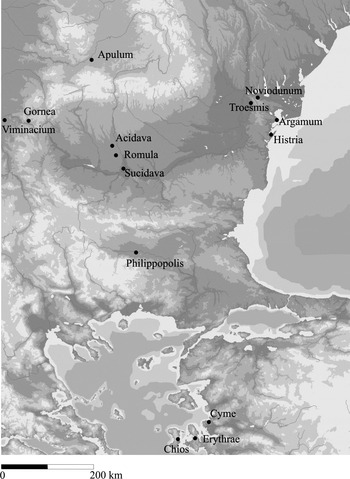
This paper has two aims. The first is to present the recent discovery of a kiln that manufactured amphorae of type Dressel 24 similis on the island of Chios. This is an amphora type that flourished during the Late Hellenistic and Early Roman periods, and most likely continued into Late Roman and Early Byzantine times. The paper also attempts to clarify the origin and explain the evolution of this type from Hellenistic through to Early Roman times, discussing similar discoveries from the Erythrai and Kyme area. These finds bring to light the crucial importance of the central Aegean region in provisioning with olive oil the eastern part of the Roman Empire, mainly the lower Danube and the Pontic area (see Fig. 1).Footnote 1
Map showing archaeological sites of the eastern Aegean, lower Danube and Pontic area mentioned in the article.

CHIOS
The extensive urban renovation that commenced in the town of Chios at the beginning of 1980, and which still continues today, has affected many remains of the ancient town. The intense rescue excavations carried out by Aris Tsaravopoulos during 1983 increased our knowledge of the various limits of the ancient town and of its commercial and industrial activity (Tsaravopoulos Reference Tsaravopoulos1986). Many remains of the ancient site, such as graves, aqueducts, houses and two pottery production areas on the northern and southern sides of the town, came to light through his excavations. The focus of this paper is the southern manufacturing area that specialised in making amphorae during the Early Roman period.Footnote 2
Kilns
The workshop was identified on the property of Katsighiorgis-Travlos. The prompt archaeological intervention rescued two kilns from demolition by bulldozer and allowed succinct stratigraphical observations.
The production area seems to have been enclosed by a wall of large stones, but only the remains of the eastern and western sides have been identified by excavation; the stones of the northern side were most likely robbed during Late Roman or modern times, while only the kiln lining of bricks is preserved.
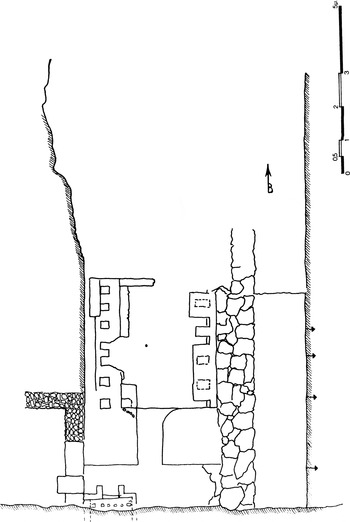
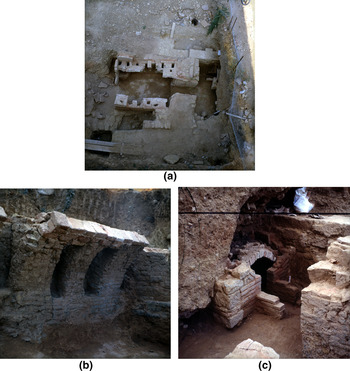
The two pottery kilns were double chambered and rectangular (Figs. 2, 3a, 3b). The larger kiln has the interior dimensions 3.50 × 2.55 m. As the upper chamber was destroyed by the bulldozer, only seven courses of the brick wall were preserved on the western side, which meant that detailed information about this chamber is drastically reduced. More information is available about the combustion chamber, as it was better preserved. It was partially cut into the bedrock, which forms its western wall, subsequently brick lined, while the eastern wall is formed by the enclosing wall of the workshop, likewise lined with bricks. The kiln is closed to the north by a brick wall, presumably also attached to a stone wall, while, to the south, a stone wall was lined by bricks with an opening of only 0.75 m and a length of c.1.5 m, forming the praefurnium. The base of this praefurnium was 0.45 m above the floor of the combustion chamber, which was deeper in the centre and rose at the sides. In this way the space between the oven floor and the combustion chamber was reduced, thereby increasing the heat at the sides and the corners of the room, solving a permanent problem that frequently occurs when one tries to uniformly heat a rectangular space. Perhaps because of this feature the oven floor received a more uniform heat, as the distance between the centre of the combustion chamber and the oven floor increased. The raised oven floor was supported by six large brick arches that sprang from the side walls. These arches left a large space in the combustion chamber and provided a solid support for the oven chamber, which may have been used not only for amphorae, but also for tiles.Footnote 3 The floor of the oven chamber still preserves two rows of rectangular vent-holes next to the western and eastern walls of the kiln. According to the dimensions of the kiln, it may have had five rows of six vent-holes each, i.e. thirty vent-holes.
Chios workshop plan. After Tsaravopoulos Reference Tsaravopoulos1986, pl. 33.

Chios workshop.

Facing this kiln, immediately to the south, was another much smaller kiln (Figs. 2, 3c), which was a miniature copy of the former. The inner dimensions of the oven chamber are 0.70 × 0.90 m. Its west side was also cut into the bedrock and was lined with bricks, while the eastern, southern and northern sides were formed by bricks. The praefurnium on the northern side of the kiln, but not on the same axis as the firing tunnel of the first kiln, is worth noting. The floor of the oven chamber had seven rows of eleven small vent-holes each. As this kiln was partly covered by a street, it was not possible to uncover it completely.
Flanking the western side of both kilns was a room that had its floor 30 cm higher than the level of the oven chamber; unfortunately it was only possible to partially uncover this room. Most likely this room was part of the manufacturing area of the workshop.
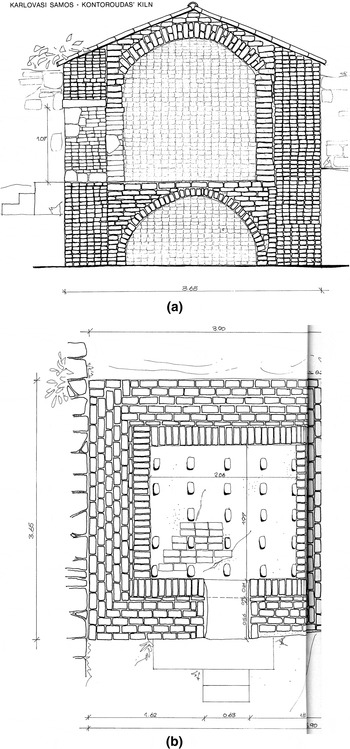
This type of kiln does not find a perfect parallel in the typology of Cuomo di Caprio (Reference Cuomo di Caprio1985, 142, figs. 19.1 c and 19.2 b), as it is a hybrid between a round kiln with the oven floor supported by arches and a rectangular kiln with a central corridor. The rectangular or square kiln types seem to be frequent in eastern Europe and the Mediterranean, although they also occur on military sites in Britain (Swan Reference Swan1984, 89). However, the best parallel for the Chian workshop is a rectangular kiln discovered in a vicus in the territory of Tomi, at Neptun (Constanţa).Footnote 4 Its oven chamber was also supported by six large arches that provided a large space in the combustion chamber. Another comparable kiln was discovered at Kuç i Zi (Albania), dated to the third/second century bc (Shehi Reference Shehi2010, 56, fig. 3). A similar type of rectangular kiln with four arches was used during the Byzantine period at Ganos (Günsenin Reference Günsenin and Garlan1999). It also seems to have been used successfully on some Aegean islands, including Chios and Samos, into modern times. The continuity of cultural and technological traditions may be seen not only in the rectangular shape of the kilns, but also in clay preparation, as can be seen below. These modern kilns also have stone walls lined with bricks. The oven floor also has rectangular vent-holes and is supported by arches that extend from one side of the combustion chamber to the other. This is the case with a kiln in Samos (Psaropoulou Reference Psaropoulou1984, 118–21) (Figs. 4a–b), which has a large space in the combustion chamber, while a modern kiln at Armolia in ChiosFootnote 5 has two sets of arches that spring from the centre of the combustion chamber and end on the lateral walls of the kiln (Figs. 5a–b). These kilns were sealed by a vaulted brick roof, which may have been covered by a gabled tiled roof or left uncovered, both roof types having a central aperture for the expulsion of gases.
Samos workshop plan. After Psaropoulou Reference Psaropoulou1984, 118 and 120.

Chios workshop plan. After Psaropoulou Reference Psaropoulou1984, 150 and 152.

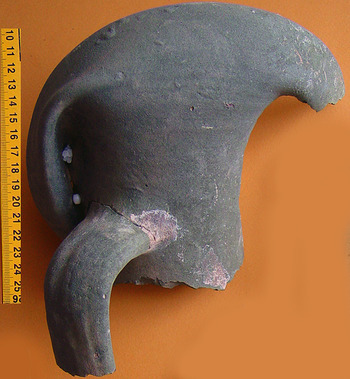
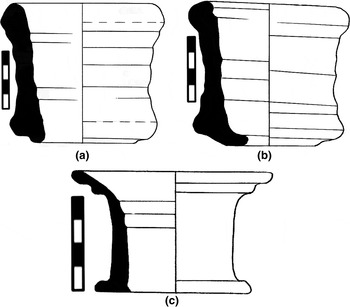
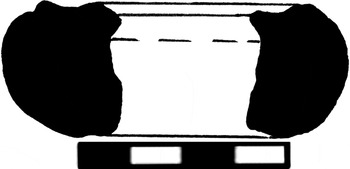
The manufacturing activity is shown not only by over-fired amphorae and wasters (Fig. 6), but also by fittings such as supports (Figs. 7a–c), distancing rings (Fig. 8), and a conical ceramic object (Fig. 9). This last piece was perhaps used to narrow some vent-holes.
Chios workshop, amphora waster.

(a) Catalogue no. 60; (b) Catalogue no. 61; (c) Catalogue no. 59. Chios workshop, pottery supports.

Catalogue no. 62. Chios workshop, distancing ring.

Catalogue no. 58. Chios workshop, conical piece.

The workshop produced not only a variety of large and small containers for olive oil such as amphorae, ampullae, unguentaria and jugs, but also wares used in the olive oil industry.
Amphorae
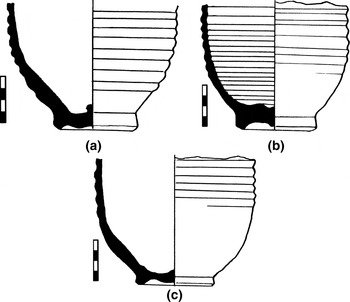
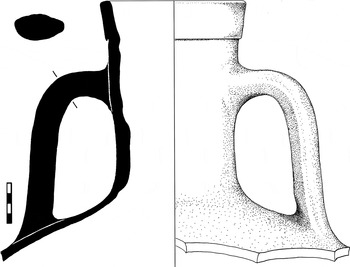
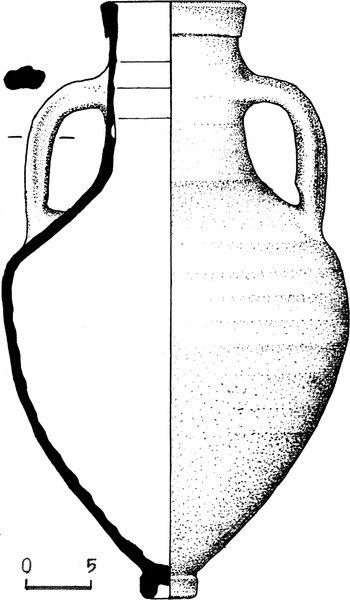
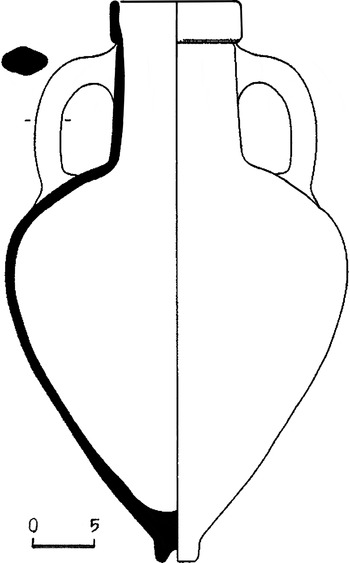
The main output of the Chian kiln was indicated by the heap of sherds of over-fired amphorae found mainly in the southwest corner of the excavation, outside the wall that enclosed the kiln. They belong to a variant of type Dressel 24 similis (Opaiţ Reference Opaiţ, Bonifay and Tréglia2007). Four large upper parts of amphorae were recovered, one of them a completely vitrified waster (Fig. 6). The other three show a tall cup-shaped mouth with an interior-thickened rim with an internal concavity, and thick handles, almost rectangular in cross section, attached to the mouth–neck and neck–shoulder junctions. The height of the mouth varies between 9 and 12 cm (Figs. 10a–c). Many fragmentary rims attest to the existence of at least two sizes of amphorae: large, with rim diameters varying between 17 and 18 cm (Figs. 11a–c), and small, varying between 14 and 15 cm (Figs. 11d–e). However, we do not exclude a later date for these smaller rims. If this were the case, these small rims would belong to a later variant of the first quarter of the third century ad; only the discovery of upper amphora parts will clarify the situation.Footnote 6 The handles are wider at the top (4.9/2.3 cm) narrowing to the lower attachment (3.9/2.6 cm). In addition to these finds, there are some conical stubs (Figs. 12a–f). It is also worth pointing out the occurrence of an earlier type of cup-shaped rim, with a diameter of 15 cm, that can be dated to the first century bc or beginning of the first century ad (Figs. 13a–b). The body was probably ovoid and covered by shallow grooves, as is suggested by body fragments uncovered on site and by similar amphorae discovered at Noviodunum (Simion Reference Simion1984, 84, pl. XII.1) (Figs. 14a–b), Histria (Moesia Inferior) (Coja Reference Coja1959, 287, fig. 9.1), and Intercisa (Pannonia) (Kelemen Reference Kelemen1993, 45–7 type 23, fig. 1.9). Despite these striking resemblances, the Noviodunum find has a completely dissimilar fabric that suggests a different production area.Footnote 7
(a) Catalogue no. 1; (b) Catalogue no. 2; (c) Catalogue no. 3. Chios workshop, upper parts of amphorae.

(a) Catalogue no. 6; (b) Catalogue no. 5; (c) Catalogue no. 4; (d) Catalogue no. 7; (e) Catalogue no. 8. Chios workshop, amphora rims, Roman period.

(a) Catalogue no. 11; (b) Catalogue no. 12; (c) Catalogue no. 13; (d) Catalogue no. 14; (e) Catalogue no. 15; (f) Catalogue no. 16. Chios workshop, amphora toes.

(a) Catalogue no. 9; (b) Catalogue no. 10. Chios workshop, amphora rims, Late Hellenistic period.

Noviodunum.

Ampullae
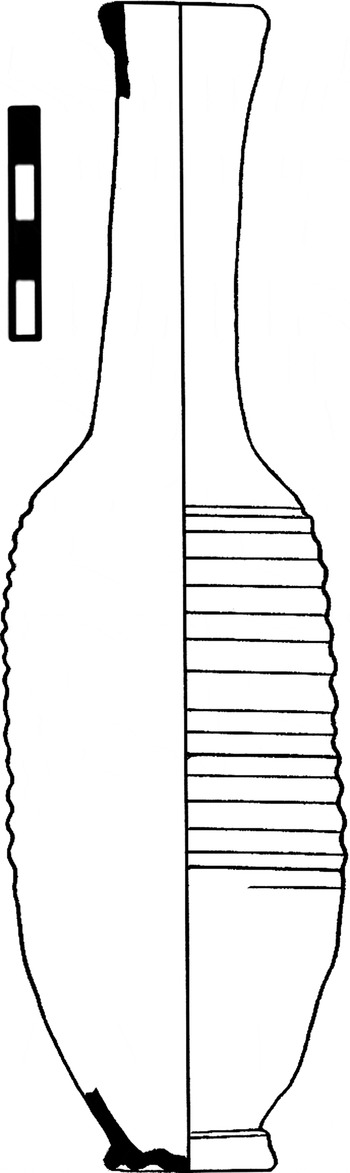
Closely related to this amphora type are some miniature amphorae discovered next to the small kiln. The cup-shaped rim is set on a long neck with small handles attached to the middle of the neck and shoulders; the body is ovoid with deep grooves and ends in a ring-base with a central nipple. Although none of these small jars was completely preserved, judging from the rim and body diameters, they were manufactured in three sizes. The smallest has a rim diameter varying between 2.4 and 2.7 cm, a body diameter of 7 cm, and base diameter of 3.5 cm (Figs. 15a–c, 16a–c). The medium-size vessel has a rim diameter of 3.8 cm, a body diameter of 7.5 cm and base diameter of 3.7 cm (Figs. 15f, 16c). The large size is represented only by a fragment of an upper part, the rim being missing; however, the fragment that was preserved suggests without any doubt a larger ampulla than the previous examples (Fig. 15e). Two close parallels have been found at Histria and Radyuvene, Vratsa district (northwestern Bulgaria). The former is a fragmentary vessel (the central part of the body is missing) with a long neck and cup-shaped rim and a ring-base with a maximum diameter of 11 cm that may belong to the largest variant. It was discovered in the necropolis of Histria and dates to the second century ad (Alexandrescu Reference Alexandrescu and Condurachi1966, 212 tumulus XVII, no. 11, pl. 80). The latter is also fragmentary, with the lower part of the body missing but with an identical body, neck, cup-shaped rim and handles to our Chian vessels (Fig. 17). It has a preserved height of 15 cm and was discovered in a cremation grave together with a coin minted by Antoninus Pius. The second-century necropolis was overlapped by a medieval cemetery (Miyatev Reference Miyatev1928/9, 343, fig. 201).
(a) Catalogue no. 17; (b) Catalogue no. 19; (c) Catalogue no. 18; (d) Catalogue no. 21; (e) Catalogue no. 22; (f) Catalogue no. 20. Chios workshop, upper parts of ampullae.

(a) Catalogue no. 23; (b) Catalogue no. 24; (c) Catalogue no. 25. Chios workshop, lower parts of ampullae.

Radyuvene (Bulgaria), after Miyatev Reference Miyatev1928/9, fig. 201.

The correct name of this small jar is in our opinion ‘ampulla’, which is the diminutive name of an amphora. Recently Peña discussed an inscription discovered in the Campus Martius and dated around ad 365Footnote 8 that mentions that ‘De ampullis placuit ut post degustationem possessori reddantur’ (‘regarding the ampullae, it has been resolved that these should be returned to the landowner after testing’) (Peña Reference Peña2007, 116). Peña supposes that these ampullae should be identified not with flasks but with small, flat-bottomed containers (Peña Reference Peña2007, 117). In our opinion these miniature amphorae fit better with the diminutive name of an amphora than those flat-bottomed jars that have a considerable capacity, if they are to be used only for testing the contents. Miniature amphorae (i.e. ampullae) were used also at Athens during the Hellenistic period.Footnote 9 With regard to ampullae, perhaps it is worth mentioning another variant also related to Dressel 24 similis, which retains the amphora shape with a long neck, cup-shaped mouth, and an ovoid body that ends in a flaring base with central convexity. However, it differs from the Chian variant not only by its micaceous fabric, covered by a thick slip that exfoliates from the majority of the body, but mainly by its small, almost vestigial, handles attached to the neck–shoulder junction (Figs. 18, 19). It was reused as a grave offering in a necropolis in the vicinity of Chersonesos.Footnote 10
Chersonesos, necropolis Sovhoz No.10.

Chersonesos, Sovhoz No.10 necropolis.

Unguentaria
Together with ampullae were many unguentaria, the quotidian small containers full of olive oil carried by people when they went to the public bath (Amouretti Reference Amouretti1986, 184). One of them was discovered in one of the vent-holes of the small kiln. Although the vast majority are clearly Roman in date, some were manufactured during Hellenistic times, suggesting a long continuity of this pottery workshop.
The Roman unguentaria were made in three main shapes:
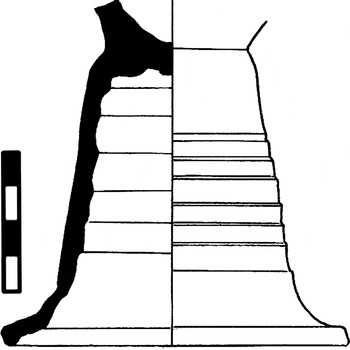
A. This shape is quite similar to that of an ampulla, having a long neck and cup-shaped mouth, but it does not have handles and ends in a solid, splayed flat base (Figs. 20a–e). It was manufactured in at least two sizes; the smaller has a more elongated shape, close to those small containers called ‘vials’ by Rotroff (Reference Rotroff2006, 163, 301, cat. nos. 542–4, fig. 70, pl. 60) (Fig. 20f).
B. A fragmentary example has an ovoid body that also ends in a splayed flat base (Fig. 20g).
C. The complete shape of this variant was not found, as the rims of all examples were missing, perhaps due to their thinness. It has a pear-shaped body set on a short, wide-splayed foot. It was also made in three different sizes. The smallest size is represented only by one fragmentary example that still preserves the beginning of a flaring or cup-shaped mouth (Fig. 20h). The medium size also has the rim missing (Fig. 20i). Good parallels exist at Troesmis (Opaiţ Reference Opaiţ1980, 360, pl. XX. 6). The largest example is fragmentary (Fig. 20j).
(a) Catalogue no. 26; (b) Catalogue no. 27; (c) Catalogue no. 28; (d) Catalogue no. 29; (e) Catalogue no. 30; (f ) Catalogue no. 33; (g) Catalogue no. 31; (h) Catalogue no. 32; (i) Catalogue no. 34; (j) Catalogue no. 35. Chios workshop, Roman unguentaria.

The Hellenistic production is represented by five unguentaria, four of them made in a beige-orange fabric, typical for this workshop (Figs. 21a–d), and one grey in colour (Fig. 21e). Typologically they can be connected to Rotroff's ‘category 2 unguentaria’ at Athens (Rotroff Reference Rotroff2006, 151). Our unguentaria, of course, represent the Chian production and differ in many aspects from the Athenian finds. They retain the amphora shape, but have a bulging body and a solid stem that ends in a flat, discoid or widely spreading base. A good parallel was found in the necropolis of Histria in a grave dated to the third century bc.Footnote 11 Taking into account the general shape that did not become elongated, they may be dated to the first half of the third century bc. One example is covered by an orange-brownish slip (Fig. 21c).
(a) Catalogue no. 37; (b) Catalogue no. 38; (c) Catalogue no. 39; (d) Catalogue no. 40; (e) Catalogue no. 36. Chios workshop, Hellenistic unguentaria.

It is worth noting that the Roman unguentaria continue the Hellenistic tradition of vessels that end in a solid stem, as the local potters did not adopt the well-known unguentaria with bulbous body and elongated neck that replaced the Hellenistic unguentaria in the second half of the first century bc (Hübner Reference Hübner, Malfitana, Poblome and Lund2006, 33).
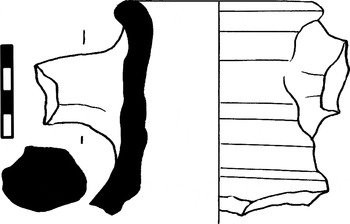
Chios did not produce only these variants of unguentaria during the Roman period. A complete unguentarium in the Chios archaeological museum was discovered at the southern outskirts of the town at a site called Ververato (Inv. No. 3849; rim diameter 2.8 cm, height 1.3 cm, maximum diameter 5.4 cm and the base diameter 2.8 cm) (Fig. 22). It has a slightly flaring mouth, tall neck and almost cylindrical partially ridged body that narrows at the lower part and ends in a flaring ring-foot with slightly conical base. Maybe this is a later subtype. Good parallels for this unguentarium come from the Crimea, but in a first half of the third century ad context (Orlov Reference Orlov1987, 115, fig. 4.1), and the Peloponnesus (Zavou and Maltezou Reference Zavou, Maltezou, Papanikola-Bakirtzi and Kousoulakou2010).
Chios, Ververate site, Roman unguentarium.

Jugs
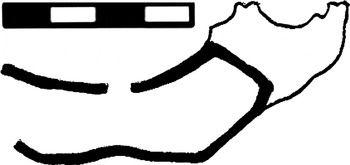
Six jug necks have been collected from the heap of discarded pottery. Their rim is everted, almost horizontal, with a shallow concavity on the interior while the neck is cylindrical, and ridged on the exterior. One handle is attached to the middle or upper part of the neck; it is almost rectangular in cross section with two shallow grooves on the external part. The rectangular section of the handle is similar to the handle section of local amphorae (Figs. 23a–c). Internally, the join of the neck to the shoulder is visible, and it is this area where the jugs were often broken. Most likely the fragment of a lower body part with a ring-foot and slightly conical base belongs to this type (Fig. 23a). The horizontal rim and its shallow groove suggest the existence of a lid. If this is the case we must assume that the jug was used for containing olive oil, the lid covering the jug after every removal of olive oil for daily use. The rim diameter varies between 5.4 and 7 cm, the handle between 2.3/1.2 and 2.5/1.5 cm, while the base has a diameter of 6.4 cm. Parallels are difficult to find for these jugs.
(a) Catalogue no. 41; (b) Catalogue no. 42; (c) Catalogue no. 43. Chios workshop, jugs.

Basin(?)/krater(?)
The rims of two main types have been found among the discarded sherds of this workshop.
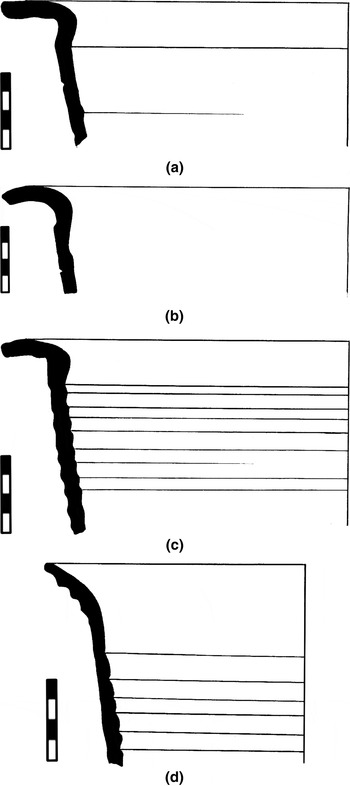
A. The rim is wide and horizontal with a truncated conical body; the exterior and interior of the body are wheel ridged. The lower part of the body is missing. This is a common shape that may be paralleled with some basins discovered at Athens (Robinson Reference Robinson1959, 16 F 60, pl. 2, 72), Knossos (Hayes Reference Hayes1983, 108–9, 128 no. 117, fig. 10.117), and Ephesos (Gassner Reference Gassner1997, 104 no. 374, pl. 31.374). The Athenian find is dated to the first century bc. The rim diameter varies between 35 and 40 cm (Figs. 24a–c). However, it is also possible that these vessels may have been kraters, as good parallels exist at Tel Anafa (Berlin Reference Berlin and Herbert1997, 138, pl. 46. PW 417–8). This hypothesis may be supported by one of the fragments that still preserves the beginning of an attachment 2 cm under the rim.
B. The rim is only flaring on the exterior with three deep grooves beneath; the body is the same as A. The rim diameter is 24.6 cm (Fig. 24d).
(a) Catalogue no. 45; (b) Catalogue no. 44; (c) Catalogue no. 46; (d) Catalogue no. 47. Chios workshop, basins(?)/kraters(?).

Funnel(?)/deep bowl(?)
This shape is characterised by an everted, short rim with a shallow internal concavity and a convex body; as the lower part is missing, it is difficult to say if it is a bowl or funnel. However, the large diameter of the opening and the inturned rim to prevent splashing may point to a funnel rather than a simple bowl. Parallels exist at Tel Anafa (Berlin Reference Berlin and Herbert1997, 139–40, pl. 47, PW 420–3) and Athens (Robinson Reference Robinson1959, 16–17, F 63, F 64, pls. 2, 19; 85, M 9, pl. 18; 95, M 119, pl. 18). Our examples are made in the same fabric as the amphorae (Figs. 25a–b).
(a) Catalogue no. 48; (b) Catalogue no. 49. Chios workshop, funnels(?).

Large vessel feet
Three large feet belonging to a large vessel also come from the same mass of discarded fragments. The shape of these vessels is unknown, but a similar fragment of foot was discovered at Knossos (Hayes Reference Hayes1983, 128, fig.10.132). They were made in the same fabric as the amphorae (Fig. 26).
Catalogue no. 50. Chios workshop, vessel foot.

Late Roman amphorae
In addition to these discarded pieces manufactured at the workshop were some Late Roman amphora fragments of types LRA (Late Roman Amphora) 3, the fourth century ad predecessor subtype of LRA 1, and a sixth century ad LRA 1 subtype (Figs. 27, 28).
Catalogue no. 53. Chios workshop, Late Roman Amphora 1 predecessor.

Catalogue no. 54. Chios workshop, Late Roman Amphora 1.

Fabric
The fabric of Chian amphorae has attracted the interest of many scholars and has been described from the hand-specimen and by spectrographic, chemical and petrographic analyses. However, the focus of these analyses was on amphorae of the Greek period (Whitbread Reference Whitbread1995, 138–9). Recently, Roman amphorae sherds from this workshop have been analysed petrographically by D. Williams and chemically by P. Dupont.Footnote 12 The petrographic results show:
A fairly fine-textured anisotropic clay matrix which is lime-rich, and contains small pieces of cryptocrystalline limestone and calcite, together with frequent flecks of mica, mostly muscovite. Scattered throughout are moderately frequent unimodal-sized subangular grains of monocrystalline quartz and rare feldspar, both generally below 0.20 mm in size. Also present is a little siltstone and some iron oxide.
This fabric is similar to that described by Whitbread [1995] for his Fabric Class 2 Chian amphorae and modern potters' clay from Armolia, situated in the south-west of Chios. (D. Williams pers. comm.)
The colour of the fabric is light brown to reddish yellow (7.5 YR 6/4 to 6/6 and 6/8).
Occasionally, a fabric with a similar texture but with a pale yellow colour (5Y 7/4) is found in one of the rims (Fig. 11d). However, the fabric of basins has a yellow colour (2.5 Y 7-6) and much finer texture with elongated holes.Footnote 13
The producers
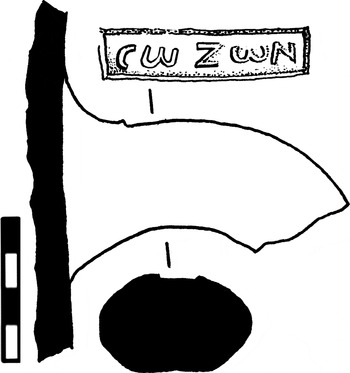
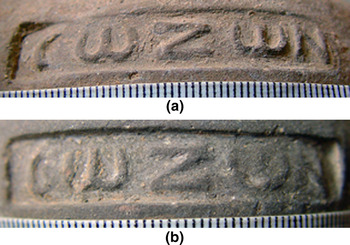
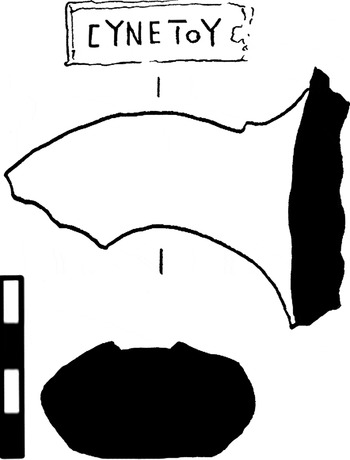
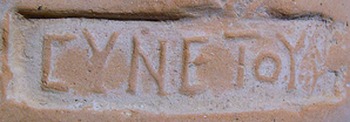
Although no stamps have been recovered from the mass of ceramics discarded in the immediate vicinity of the kiln, an important group of stamps has been collected from other trial trenches in this area. The stamps bear the names of three manufacturers: Σώζων, Σύνετος, and Ζώσιμος.
Σώζων (Figs. 29, 30a, 30b, 31d) is a well-known producer, attested in Dacia at Romula (three examples: Ruscu Reference Ruscu2003, 60–1, no. 99, pl. XVIII.99; Ardeţ Reference Ardeţ2007, 209–10, nos. 21, 24–5, figs. 105, 108–9), Sucidava (Ruscu Reference Ruscu2003, 75, no. 127) and Apulum (Ruscu Reference Ruscu2003, 32, no. 31, pl. VIII.31); in Moesia Inferior at Tyras;Footnote 14 in Moesia Superior at Saldum (Jeremić Reference Jeremić2009, 113, cat. no. 324, fig. 57) and Viminacium (Bjelajac Reference Bjelajac1996, 58, Cat. nos. 91–2, fig. XVIII.91–92); and in Thracia at Plovdiv (Dyczek Reference Dyczek2008, 518). Σύνετος (Figs. 32, 33, 31c) is present also in Dacia with two examples at Acidava (Ruscu Reference Ruscu2003, 13, no. 1), and Gornea (Ruscu Reference Ruscu2003, 40, no. 54, pl. XII.54). The last officinator, Ζώσιμος (Figs. 34, 35, 31b), is so far unknown on consumer sites.Footnote 15
Catalogue no. 63. Chios workshop, amphora handle with Σώζων stamp.

(a) Catalogue no. 63; (b) Catalogue no. 64. Chios, amphora stamp of Σώζων.

(a) AE.4029; (b) Catalogue no. 66 (AE.15898); (c) Catalogue no. 65 (AE.15899); (d) Catalogue no. 63 (AE.15879); (e) Catalogue no. 14 (AE.15831); (f) Catalogue no. 2 (AE.15841); (g) Catalogue no. 9 (AE.15839); (h) Catalogue no. 3 (AE.15844); (i) Catalogue no. 7 (AE.15838); (j) Catalogue no. 45 (AE.15875); (k) Chersonesos – Farm 106; (l) Erythrai – Courtesy P. Dupont and V. Lungu. See page 375 for colour version.

Chios workshop, amphora handle with Συνέτου stamp.

Catalogue no. 65. Chios, amphora stamp of Συνέτου.

Catalogue no. 66. Chios workshop, amphora handle with Ζωσίμου stamp.

Catalogue no. 66. Chios, amphora stamp of Ζωσίμου.

Dating
A fragmentary lamp, some fragments of flanged Çandarli bowls, and the shape of the amphora type itself, which is well dated in Dobrudja, provide us with useful information to date the last phase of the manufacturing activity at this site.
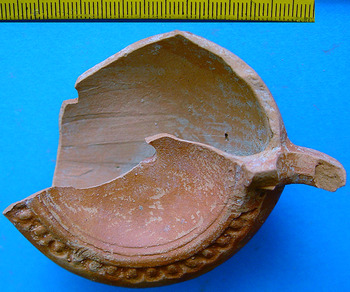
The lamp is fragmentary as the nozzle and part of the body is missing (Figs. 36, 37). Although no perfect parallel has been found, it has a common shape (Broneer type XXVII), with ring-handle and with undecorated, shallow discus, while the shoulder is decorated by a band of studs; the base is concave. A similar lamp, but with scallop-shell decoration on a discus and a raised base, occurs at Cnidus and is dated by Bailey to the second half of the second century ad.Footnote 16
Catalogue no. 57. Chios workshop, lamp.

Chios workshop, lamp.

The flanged Çandarli bowls belong to Form H3 (Hayes Reference Hayes1972, 321, Form 3. 2, fig. 64; Hayes Reference Hayes1983, 118, no. 26–7, fig. 3; Kenrick Reference Kenrick1985 260, B 366.5; Atlante delle forme ceramiche II, 78, Form H 3) and may be dated between the mid-second century ad and the early third century ad (Figs. 38a–b).
(a) Catalogue no. 55; (b) Catalogue no. 56. Chios workshop, bowls.

As mentioned above, the ampulla discovered at Radyuvene (Bulgaria) in a cremation grave was dated by a coin minted during the reign of Antoninus Pius.
Regarding the shape of the upper amphora parts discarded in this workshop, it is almost identical to the tall cup-shape mouth of a complete amphora discovered in the necropolis at Noviodunum (Simion Reference Simion1984, 84, pl. XII. 1). This amphora is dated by a coin issued during the reign of Marcus Aurelius. A similar amphora was also discovered in a c.170–80 ad destruction level at Histria (Coja Reference Coja1959, 287, fig. 9.1). In addition, a fragmentary amphora discovered in the camp of Intercisa, Pannonia, shows a similar body. It is dated sometime during the reign of Antoninus Pius or Marcus Aurelius when that camp was built (Kelemen Reference Kelemen1993, 45–7, type 23, fig. 1.9). We should also not exclude the possibility that some amphora rims with small diameters might be dated to the first quarter of the third century ad. Thus we can conclude that this subtype was present on the market probably from the third quarter of the second century ad to the first quarter of the third century ad. Some fragments of imported cooking pots, casseroles and trefoil-mouthed jugs may also be dated around the middle to the third quarter of the second century ad (Hayes Reference Hayes1983, 122, Cat. nos. 58–63, 76, 81–2, figs. 5–7) (Fig. 39). An exception is a rim fragment that may be Late Hellenistic; the closest parallel is a pot discovered at Athens (Robinson Reference Robinson1959, 18, F 81, pl. 3, 72) (Fig. 40). Other exceptions are the Late Roman amphora rims that certainly are intrusions into this quite homogenous archaeological context. It is difficult to know if these pieces intruded during ancient times or during the modern excavation, as the archaeologist arrived at the site when it was partially destroyed by the bulldozer and detailed observations of the context were impossible to make.
Catalogue no. 51. Chios workshop, Roman kitchenware.

Catalogue no. 52. Chios workshop, Hellenistic kitchenware.

We can conclude that the last period of activity of this workshop was sometime during the second half of the second century ad, most likely the third quarter of the century.
Content
The content of these amphorae is suggested not only by their cup-shaped rims and ovoid body, a morphology that suggests an olive oil content, but also by the presence of tituli picti mentioning oleum on amphorae of this type, one discovered at Romula (Tudor Reference Tudor1968, 396, no. 17; Popilian Reference Popilian1976, 40, pl. 76.23), and two on Monte Testaccio (Remesal Rodríguez and Garcia Sánchez Reference Remesal Rodríguez, Garcia Sánchez, Blázquez Martines and Remesal Rodríguez2007, 178 no. 530, 180 no. 533, pl. 39.533). The latter site, made of discarded olive oil amphorae, also contains many cup-shaped rim fragments of type Dressel 24 similis (Remesal Rodríguez and Garcia Sánchez Reference Remesal Rodríguez, Garcia Sánchez, Blázquez Martines and Remesal Rodríguez2007, 353, figs. 79–80).
ERYTHRAI
In close proximity to Chios is Erythrai, a famous amphora producer, renowned during ancient times for the high quality of its amphora products (Pliny Natural History 35.46; Athenaeus 111.475c, cited by Tchernia Reference Tchernia, Empereur and Garlan1986, 31–4). Recently, Erythraian jars have received considerable attention in the specialist literature. According to some research undertaken in 1970 by R. Cook, P. Dupont and E. Akurgal, traces of pottery activities have been identified to the north, northwest and southeast of the acropolis of Erythrai, including also the mouth of the rivers Axos and Aleon (Lungu Reference Lungu, Kassab Tezgör and Inaishvili2010, 47). In 1988 an excavation made by Ö. Özyiğit at the mouth of the river Axos, north of the acropolis of Erythrai, identified a Dressel 24 similis amphora production area (Özyiğit Reference Özyiğit1990, 125–50, pl. 4, 5). This discovery confirms that in the central Aegean area a koine was created that shared the same type of amphora, starting with the Hellenistic period. This interesting discovery, although only briefly published, drew the attention of other scholars. Two recent papers have tried to establish a typology for the Erythraian amphorae of the fourth through to the first centuries bc.
The first typology, initiated by D. Carlson and M. Lawall (Reference Carlson and Lawall2005/6), divides these amphorae into four types:
1. tall rounded rim, short flaring neck, round body with a variant.
1a. tall rounded rim, tall cuffed neck, bobbin-shaped body; they are dated mid-fifth to the beginning of the fourth centuries bc.
2. mushroom rim form, dated from sometime in the fourth century to the last quarter of the fourth century bc.
3. band rim form from the second quarter of the third to the mid-second century bc.
4. cup-shaped rim from the mid-second to the middle of the first century bc.
Although there is general agreement with this typology, some questions still remain. For example, the second type, with a mushroom rim, seems rather an Erythraian imitation of a form in fashion in the Aegean than an internal development from type 1 to type 3. A hybrid variant should not be excluded that makes the transition from a tall rounded rim to a band rim. It is also difficult to establish when the Hellenistic cup-shaped rim type ceases and the Roman cup-shaped type starts to be manufactured, as the transition was very smooth and the new shape was adopted by many workshops in the central Aegean.
The second typology, that of V. Lungu, is focused mainly on the third and fourth types of the previous typology, i.e. amphorae with band rim and with cup-shaped rim. The former she names type A, and the latter type B. The latter is also divided into two variants (Lungu Reference Lungu, Kassab Tezgör and Inaishvili2010, 48–50), B1 (with a band rim that flares to the exterior) and B2 (the equivalent of an amphora with a cup-shaped rim in the Carlson-Lawall typology). This typology is not as clear as the first one. For example, it is not understandable why type B1 is not a variant of A, as both have a band rim. Also, the fact that one fragment of a band rim together with a fragment of cup-shaped rim was discovered at Ephesos in an Augustan context is not a solid proof that the band rim continued to be manufactured until that moment, as this isolated find could very well be an intrusion into that context. Based on this supposed simultaneity in manufacturing types A and B, Lungu concludes that type A was made for olive oil and type B for wine. In our opinion, the shape of the rims is not enough to differentiate olive oil from wine amphorae. Much more drastic differences should exist in the geometry of the form of vessels that need to accommodate such different products. Although Lungu rightly acknowledges the simultaneity of an Erythraian and a Chian production of band rim jars, she does not follow this track and includes some Chian vessels in Erythraian types, as we will see below. Most likely, Carlson and Lawall are right when they consider amphorae with band rims as predecessors of cup-shaped rims.
CHIOS AND ERYTHRAI
As stated above, it is not possible to understand the amphora production of this area if we do not consider it as the production of a koine with similar forms that have only minor differences in morphology and fabric. As the borrowing of shapes is visible in the Aegean area through Classical and Hellenistic times,Footnote 17 a detailed discussion of both Chian and Erythraian amphora production is necessary for a better clarification of this phenomenon and for understanding the place of the Chian amphora production in the central Aegean economy.
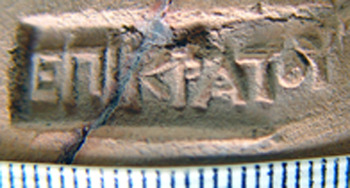
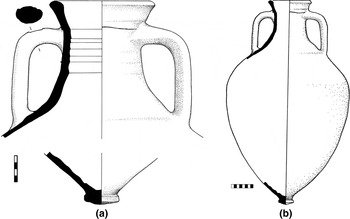
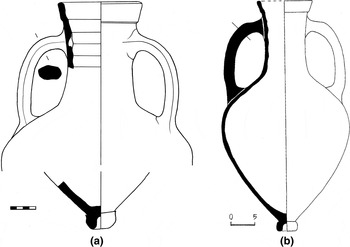
The Chian production as part of this koine developed its own variant. In addition to the well-known Hellenistic type depicted on the coins of the state, with a conical body and long neck and handles, most likely used for wine,Footnote 18 starting perhaps with the beginning of the third century bc we have a new Chian type well illustrated by an amphora discovered by A. Tsaravopoulos in the necropolis of Chios (Zacharou-Loutrari Reference Zacharou-Loutrari1989, photo 20 a). This example bore the stamp of Epikrates in the genitive case (Fig. 41). This amphora is distinguished from its Erythraian counterpart mainly by its flaring mouth with a band rim, flaring neck, massive, ovoid-sectioned handles, and an ovoid body ending in a discoid knob (Figs. 42a–b, 43, 31a).Footnote 19 This Chian find very likely represents the full-size jar as the mathematical calculus indicated a volume of 52 litres. Two similar amphora rims with diameters varying between 17.4 and 18 cm were discovered at Vani (Opaiţ Reference Opaiţ, Kassab Tezgör and Inaishvili2010, 158, pls. 7.6–7, 91.5–6). On the other hand, a well-preserved fractional example discovered at Orgame (Dobrudja) has a capacity of 9.8 litres (Figs. 44a–b, 45).Footnote 20 Its neck enlarges to the upper part ending in a flaring mouth and a band rim. The ovoid body ends in a hollow ring-toe with an echinus profile. Another small-size amphora discovered at Kalos Limen (the Crimea) has a flaring band rim, and its body ends in a hollow ring-toe with a slightly truncated conical profile. Its dimensions are slightly greater, as the rim diameter is 13.5 cm, maximum diameter c.30–2 cm,Footnote 21 and the capacity is 13 litres (Fig. 46). Maybe it also represents a Chian variant with a different profile of the toe, but only a laboratory analysis will decide on its origin. The fabric of the Epikrates amphora and of those two flaring banded rim fragments discovered at Vani (Opaiţ Reference Opaiţ, Kassab Tezgör and Inaishvili2010, 158, pl. 7.6–7) shows large calcareous inclusions that are not seen on examples of Late Hellenistic and Early Roman times.
Chios, Hellenistic amphora stamp AE4029.

Chios, Hellenistic amphora AE4029.

Chios, Hellenistic amphora.

Orgame, Hellenistic band rim amphora. After Lungu Reference Lungu, Kassab Tezgör and Inaishvili2010, pl. 24.2.

Orgame, Hellenistic band rim amphora.

Kalos Limen, Hellenistic band rim amphora.

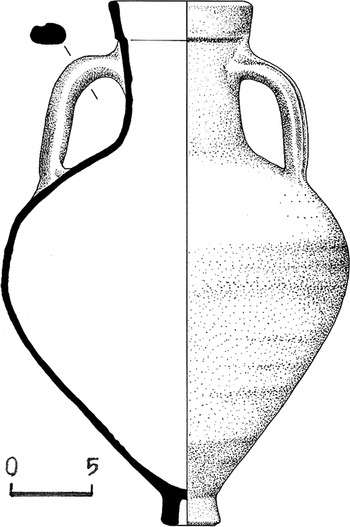
The Erythraian band rim jar differs from the Chian variant in the shape of the neck, which is cylindrical with an upright band rim continuing the vertical line of the neck, and in its lower part, which ends in a hollowed toe. It is well exemplified by the upper part of a full-size amphora which was discovered in the Chersonesan territory at Farm 106 (Figs. 47, 31k),Footnote 22 while a fractional jar uncovered in the necropolis of Chersonesos has a rim diameter of 11 cm, maximum diameter of 27 cm, height of 47 cm, base diameter of 4.5 cm, and a capacity of 9.4 litres (Opaiţ Reference Opaiţ, Bonifay and Tréglia2007, figs. 4.20 a–b) (Fig. 48). Another well-preserved fractional example found at New Halos has a short, cylindrical hollow toe and a capacity of 10 litres (Beestman-Kruyshaar Reference Beestman-Kruyshaar, Reiders and Prummel2003, 265, type 3, P287) (Fig. 49). These two small amphorae may represent different Erythraian variants as two toes published by Lungu (Reference Lungu, Kassab Tezgör and Inaishvili2010, pl. 26.1–2) suggest. All these Erythraian examples are dated to the end of the first third of the third century bc.
Chersonesos – Farm 106, Hellenistic band rim amphora.

Chersonesos, Hellenistic band rim amphora.

New Halos, Hellenistic band rim amphora . After Beestman-Kruyshaar Reference Beestman-Kruyshaar, Reiders and Prummel2003, P287.

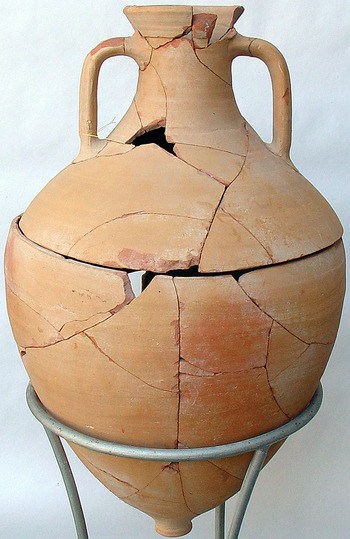
The Chian subtype of the last third of the second century bc is represented by an amphora discovered at Maresha in Israel.Footnote 23 This vessel continues to have an ovoid body with a flaring rim but the band is not prominent and the mouth is distinguished from the neck only by a groove (Fig. 50). The amphora is certainly Chian in origin, being stamped with the letters ΠΑΡ, in ligature, a stamp frequently found in Chios, not only on amphorae but also on Chian lagynos handles. An amphora discovered in the necropolis of Chersonesos represents perhaps the small-size Chian variant of the first century bc (Fig. 51). It has no distinction between the mouth and the neck and both are slightly flaring. The junction between the shoulder and body is slightly carinated and its body ends in a small cylindrical toe (Opaiţ Reference Opaiţ, Bonifay and Tréglia2007, 631, fig. 7.34 a–b; Opaiţ Reference Opaiţ, Kassab Tezgör and Inaishvili2010, 158, pl. 89.3). The Erythraian shape of the first century bc form is shown by a fragmentary amphora discovered in the necropolis of Histria (Opaiţ Reference Opaiţ, Kassab Tezgör and Inaishvili2010, 158, pl. 89.4) (Figs. 52a–b).Footnote 24 The Erythraian origin of this jar is suggested by its slightly banded rim, which is not distinguished by an offset from the neck at the exterior, although a groove is sometimes present (Opaiţ Reference Opaiţ, Kassab Tezgör and Inaishvili2010, 158, pl. 92.1–2); an internal concavity announces the cup-shaped rim; the neck is cylindrical and the rotund lower body ends in a deep conical hollow toe; a typical toe was discovered at Vani (Opaiţ Reference Opaiţ, Kassab Tezgör and Inaishvili2010, 158, pl. 92.3). Both small-size amphorae have capacities of 11 litres. Most likely these last two examples testify to the fact that the transition from band rim to the cup-shaped rim took place between the last third of the second century bc and the beginning of the first century bc.
Maresha, Chian band rim amphora. Courtesy G. Finkielsztejn, Israel Antiquities Authority.

Chersonesos, Hellenistic transitional variant.

Histria. Hellenistic cup-shaped amphora.

We know that the amphora with cup-shaped rim, the last stage in the evolution of this Hellenistic type, was intensively manufactured at Erythrai (Özyiğit Reference Özyiğit1990; Carlson and Lawall Reference Carlson and Lawall2005/6, 37–8; Lungu Reference Lungu, Kassab Tezgör and Inaishvili2010, pl. 26), perhaps starting in the second half of the second century bc or even the first quarter of the first century bc (Carlson and Lawall Reference Carlson and Lawall2005/6, 37). However, for the first time we have cup-shaped rims discovered in the workshop of Chios (Figs. 13a–b), supporting the idea of continuous production of the same amphora type at both Erythrai and Chios. The rim will continue to flare even more during the first two centuries ad, while the interior of the rim becomes more concave, forming what we call Dressel 24 similis (Opaiţ Reference Opaiţ, Bonifay and Tréglia2007). According to Lungu (Reference Lungu, Kassab Tezgör and Inaishvili2010, 48), there are two distinct Erythraian fabrics: ‘one is beige to pinkish beige, compact and fine calcareous particles, rarely with little mica; the second is brownish, sometimes purplish-brown, with more calcareous inclusions’.Footnote 25 The second fabric type has been petrographically described by D. Williams as:
An anisotropic clay matrix which is lime-rich, containing small pieces of cryptocrystalline limestone or voids which once contained limestone but which have been leached out during deposition and now contain crystallic void coating [this is easily seen in the hand-specimen]. Also present are frequent grains of quartz, mainly silt-sized and just above. The larger fractions tend to be polycrystalline while the smaller grains are monocrystalline. There are also rare small plagioclase feldspar, chert, and some small pieces of siltstone. The Erythrai sherd lacks the relatively high mica content of the Chios sherd. (D. Williams pers. comm.)
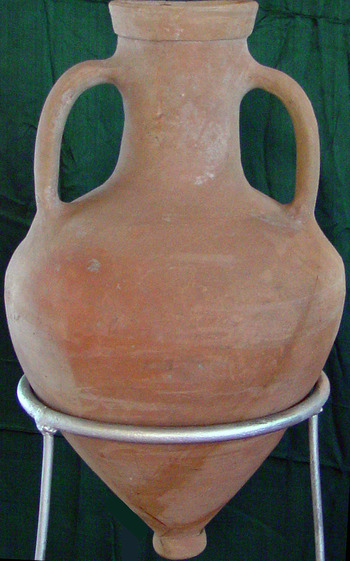
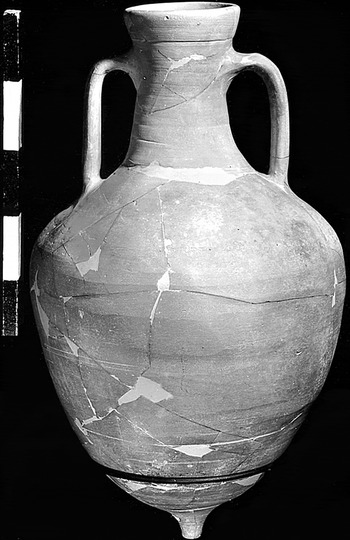
An amphora discovered in the necropolis of Sovhoz No. 10, near Chersonesos (Strjeletskiiy et al. Reference Strjeletskiiy, Vysotskaya, Ryzhova and Jestkova2005, pl. 43, urn 90), by its fabric and external greyish-brownish skin most likely belongs to the second century ad Erythraian production (Figs. 53a–b). It has a rim diameter of 15.5 cm; handle diameter of 3.4/3.1 cm; maximum diameter of 45.5 cm; height of 96 cm and a capacity of 65.8 litres. The capacity of cup-shape rim amphorae suggests that these vessels were already made according to a new metrological system.
Chersonesos – Erythraian amphora.

KYME
A recent discovery at Monte Testaccio may enlarge the Chios–Erythrai koine to include the city of Kyme (Remesal Rodríguez and Garcia Sánchez Reference Remesal Rodríguez, Garcia Sánchez, Blázquez Martines and Remesal Rodríguez2007, 176, no. 519, fig. 79.3, pl. 89.n.519; the amphora comes from a context dated ad 254). It is an upper amphora part that still preserves three lines of dipinti on its shoulder. On the third line the authors read: […] KYMΔΙΩΝ[…](Fig. 54). However, in a letter of 13 June 2008, Al. Avram suggested a more plausible reading as Κυμαίων (belonging to the people of Kyme), the main city in Aeolis. The city had been an olive oil producer since the fourth century bc, as it minted coins with the image of a small vase for olive oil flanked by the letters K and Y for at least two centuries. Recently, Kovalenko has argued that this vessel represents an anagram for the city name, as this vessel was a vase for libation called KYMBH or KIMBION.Footnote 26 This symbol was also used on amphora stamps discovered at Kyme (Lagona Reference Lagona1984) and Callatis (Avram Reference Avram1988, 312, no. 145, fig. 14/1; the stamp was read as Κυ - vessel with one handle – μαί [ον]). The Monte Testaccio find of the mid-third century ad confirms the prolonged olive oil manufacturing in this Aeolic city. As the morphology of this example is typical for many variants of Mid-Roman Dressel 24 similis, it is likely that the area of this koine included Kyme.
Dressel 24 similis amphora dipinti. After Remesal Rodríguez and Garcia Sánchez Reference Remesal Rodríguez, Garcia Sánchez, Blázquez Martines and Remesal Rodríguez2007, pl. 38 no. 519.

CONCLUDING REMARKS
The rescue excavation of the Chian workshop brought new information encompassing the following:
1. The evolution of Dressel 24 similis – Chios subtype – from the Hellenistic period to the end of the second or the first quarter of the third century ad. Other Chian discoveries complete this picture.
2. The organisation of the workshop, which shows a remarkable ability to make efficient use of a limited space with two different-size kilns for different-size products.
3. The name of three officinatores, two of them well known from consumer sites of the lower Danube. In addition to these names, other officinatores’ names, stamped on Dressel 24 and Dressel 24 similis amphorae, are known in the same region: Παῦλος, Ἡρακλᾶς, Μãρκος, ἜΦηβος, Στρατόνεικoς, Ῥοῦφος (Tudor Reference Tudor1968, 393–4; Popilian Reference Popilian1976, 40–3; Opaiţ Reference Opaiţ1980, 296, pl. IV: T-1072; Bjelajac Reference Bjelajac1996, fig. XVIII; Benea Reference Benea2000, 437–8, fig. 2; Ruscu Reference Ruscu2003, 32–3, 48, 59–61, 75; Ardeţ 2006, 210–30). However, excepting ἜΦηβος we still do not know if these latter officinatores worked in the Chios–Erythrai area as we do not know the fabric of these amphorae. Most certainly many of these stamps belong to amphorae of Dressel 24 type. The stamping occurring on this amphora type is also an interesting feature that needs to be pointed out. During the Early Roman period the custom of stamping amphorae seems to be restricted mainly to olive oil containers, such as Dressel 20 in Spain, Dressel 6B in the north Adriatic, Tunisian and Tripolitanian in North Africa, and Dressel 24 and Dressel 24 similis in the Aegean.Footnote 27 Most likely this epigraphic habit may be correlated with an excessive care for olive oil, an important component of the annona, this commodity being the subject of a tied official control and trade. The epigraphic habit cannot be connected with the fashion of the second century ad (MacMullenReference MacMullen1982), for wine amphorae are only occasionally stamped during this period as wine was traded on a free market.
4. A clear fabric definition of Chian and Erythraian olive oil amphorae of the Late Hellenistic and Early Roman times. In the future, it will be possible to connect, by identifying the fabrics and the amphorae stamps, these supplying centres with the consuming sites, which in our case are not only the Greek cities of the western and northern Euxine coasts but also many military sites of a large area that includes Dacia, Moesia Superior, Moesia Inferior and Thracia. We witness the continuation of a successful strategy that was initiated by the Aegean centres in the Archaic period (Dupont Reference Dupont, Cook and Dupont1998; Dupont Reference Dupont and Solovyov2006a; Dupont Reference Dupont2006b). The Chian economic policy of this period was well pointed out by Barron: ‘…Chios more prudently attended to the merchant marine, where the profits were less dramatic, but sure’ (Barron Reference Barron, Boardman and Vaphopoulou-Richardson1986, 95).
5. A continuous cultivation of a regular route and establishment of a lasting relationship with a secure market always in need of Aegean olive oil and wines. As the lower Danube area became integrated into the Roman Empire, hosting many Roman legions, a larger market developed with a diet and cultural practices, like bathing, based on olive oil. The same phenomenon seems to take place also on the eastern frontier of the Roman Empire (Gren Reference Gren1941). In our opinion, for the lower Danube and north Pontic areas, it was not a ‘significant shift’ from the pre-Roman trade situation as has recently been suggested (Mitchell Reference Mitchell, Mitchell and Katsari2005, 98–9). The Roman government only adopted and increased a pre-existing, most likely preferential and trustful, long-distance trading connection between the Aegean area and the lower Danube and Pontic region. We can assume also that the central Aegean changed its mixed economy to a more profitable, cash crop olive cultivation starting in the Early Roman period. If we take into account the great cultural, ethnic and social diversity of the Danube and Pontic area, the nature of trade was very mixed, with market exchange in the Greek and Roman cities, redistribution to the military sites and reciprocity with some tribes outside the borders of the Empire. However, the situation would be drastically changed during the Late Roman period as state-controlled trade became predominant and the presence of Late Roman Amphora 2, the new form of Dressel 24 similis, became predominant only in the heavily fortified lower Danube area, while on the northern Pontic shores, lacking military units, the presence of LRA 2 was to be severely diminished in comparison with that of its predecessor. Also, it is worth pointing out that important manufacturing centres of tableware such as Pergamon, Çandarli, and Phocaea belong also to the Chios–Erythrai–Kyme region. Most likely, this tableware, so abundantly found in Dobrudja, rode piggy-back on olive oil amphora cargoes.Footnote 28
6. The production of small-size amphorae, most likely named ‘ampullae’, perhaps samplers of the product carried by larger-size amphorae.
7. The flourishing olive oil industry of the island of Chios during the Hellenistic and Early Roman periods, as it manufactured not only large- and small-size amphorae but also ampullae, unguentaria and equipment related to the olive oil industry. We can assume that this industrial activity also continued during the Late Roman period, but we need to discover the workshops. This central Aegean region, represented so far by Chios–Erythrai–Kyme, together with the Peloponnesus, was one of the main suppliers of the new capital, Constantinople, and of the northern border of the empire from the fourth through the sixth centuries ad.
We should bear in mind that all these typologies are working hypotheses. The task was relatively straightforward so long as we built preliminary typologies based mainly on the shapes of amphorae. Yet, when we pay more attention to their fabric, we can divide very similar shapes into different subtypes and variants, i.e. workshops. The question is how far we can continue with these typologies in the absence of kilns. A temporary, simplifying, solution would be to assign the amphorae discovered on the consumer sites to a koine, a region that does not correspond to a certain administrative province but may incorporate many such provinces, united by a specific economy and cultural traditions. When we finally discover the manufacturing sites, as is the case with Chios, Erythrai and very likely Kyme, we have to consider them as parallel subtypes and give a correct definition. Only by examining microregions such as this koine can we understand the ancient Mediterranean (Horden and Purcell Reference Horden and Purcell2001, 80) and how the market demands of the Roman Empire changed their pattern of cultivation from a mixed culture to a large-scale cash crop, increasing their interconnectivity with other microregions by means of a long-distance trading network (Mitchell Reference Mitchell, Mitchell and Katsari2005, 99).
CATALOGUEFootnote 29
1. Amphora, upper part. Inv. no. AE 15836 (Fig. 10a). RD 18.3/14.9 (deformed by over firing); HD 4.9/2.3 (upper part), 3.9/2.6 (lower part); PH 35.
2. Amphora, upper part. Inv. no. AE 15841 (Figs. 10b, 31 f). RD 17.4; PH 25.
3. Amphora, upper part. Inv. no. AE 15844 (Figs. 10c, 31 h). HD 5/2.3; PH 25.
4. Amphora, rim fragment. Inv. no. AE 15843 (Fig. 11c). RD 17; PH 13.
5. Amphora, rim fragment. Inv. no. AE 15842 (Fig. 11b). RD 18; PH 9.
6. Amphora, rim fragment. Inv. no. AE 15837 (Fig. 11a). RD 18; PH 10.
7. Amphora, rim fragment. Inv. no. AE 15838 (Figs. 11d, 31 i). RD 15.2; PH 7.5.
8. Amphora, rim fragment. Inv. no. AE 15840 (Fig. 11e). RD 14; PH 9.
9. Amphora, rim fragment. Inv. no. AE 15839 (Figs. 13a, 31 g). RD 15; PH 9.
10. Amphora, rim fragment. Inv. no. AE 15877 (Fig. 13b). RD 15; PH 6.
11. Amphora, lower part. Inv. no. AE 15825 (Fig. 12a). BD 1.8; PH 8.5.
12. Amphora, lower part. Inv. no. AE 15827 (Fig. 12b). BD 2; PH 7.5.
13. Amphora, lower part. Inv. no. AE 15828 (Fig. 12c). BD 2.2; PH 8.5.
14. Amphora, lower part. Inv. no. AE 15831 (Figs. 12d, 31 e). BD 2; PH 9.
15. Amphora, lower part. Inv. no. AE 15832 (Fig. 12e). BD 2; PH 7.
16. Amphora, lower part. Inv. no. AE 15834 (Fig. 12f). BD 2; PH 6.
17. Ampulla, upper part. Inv. no. AE 10083A (Fig. 15a). RD 2.8; HD 0.8/0.6 (upper part), 0.6/0.4 (lower part); PMD 6; PH 13.2.
18. Ampulla, upper part. Inv. no. AE 15847 (Fig. 15c). HD 0.8/0.6 (upper part), 0.6/0.4 (lower part); PMD 6.7; PH 9.7.
19. Ampulla, upper part. Inv. no. AE 15848 (Fig. 15b). RD 2.7; HD 0.8/0.6; PH 7.5.
20. Ampulla, upper part. Inv. no. AE 15853 (Fig. 15f). RD 3.8; HD 1.4/1 (upper part), 0.8/0.7 (lower part); PH 9.5.
21. Ampulla, upper part. Inv. no. AE 15849 (Fig. 15d). HD 1/0.6 (upper part), 0.7/0.6 (lower part); PMD 7; PH 7.
22. Ampulla, upper part. Inv. no. AE 15854 (Fig. 15e). HD 2/1.2; PH 13.
23. Ampulla, lower part. Inv. no. AE 15850 (Fig. 16a). BD 3.6; PMD 7; PH 5.
24. Ampulla, lower part. Inv. no. AE 15851 (Fig. 16b). BD 3.8; PMD 7; PH 6.
25. Ampulla, lower part. Inv. no. 15855 (Fig. 16c). BD 3.7; PMD 7.6; PH 6.
26. Unguentarium. Inv. no. AE 10142A (Fig. 20a). RD 2.6; MD 4.2; BD 2.3; H 13.3.
27. Unguentarium, rim missing. Inv. no. AE 10078 (Fig. 20b). MD 4.4; BD 2.1; PH 13.
28. Unguentarium, upper part missing. Inv. no. AE 15857 (Fig. 20c). MD 3; BD 2; PH 8.5.
29. Unguentarium, upper part missing. Inv. no. AE 15858 (Fig. 20d). MD 4.7; BD 2.4; PH 7.7.
30. Unguentarium, upper part missing. Inv. no. AE 15856 (Fig. 20e). MD 4.4; BD 2.1; PH 13.
31. Unguentarium, upper part missing. Excavation inv. no. 29 (Fig. 20g). MD 6; BD 2.4; PH 5.5.
32. Unguentarium, upper part missing. Excavation inv. no. 31 (Fig. 20h). MD 5; BD 2.5; PH 10.
33. Unguentarium, upper and lower parts missing. Excavation inv. no. 30 (Fig. 20f). MD 4.5; PH 8.7.
34. Unguentarium, upper and lower parts missing. Inv. no. AE 10084 (Fig. 20i). MD 6.8; BD 3; PH 10.2.
35. Unguentarium, upper and lower parts missing. Inv. no. AE 10143 (Fig. 20j). MD 11; PH 10.
36. Unguentarium; bluish grey (5PB 5/1) fabric. Inv. no. AE 10079C (Fig. 21e). RD 2.4; MD 4.4; BD 2.1; H 8.8. Dating: 3rd century bc.
37. Unguentarium; pale red (10R 6/4), red slip (10R 5/6), lower part reserved. Inv. no. AE 10079B (Fig. 21a). RD 3; MD 6.5; BD 2.8; H 12.5. Dating: 3rd century bc.
38. Unguentarium, upper part missing. Inv. no. AE 10079A (Fig. 21b). MD 4.8; BD 3.3; PH 12. Dating: 3rd century bc.
39. Unguentarium, upper part missing. Inv. no. AE 10079E (Fig. 21c). MD 4.6; BD 2.2; PH 7. Dating: 3rd century bc.
40. Unguentarium, lower part missing. Inv. no. AE 10079D (Fig. 21d). RD 2.9; MD 4.8; PH 7.2. Dating: 3rd century bc.
41. Jug, upper and lower part. Excavation inv. nos. 33 and 34 (Fig. 23a). RD 5.4; HD 2.3/1.2; PH (upper part) 10.5; BD 6.5; PH (lower part) 3.
42. Jug, upper part. Excavation inv. no. 32 (Fig. 23b). RD 7; HD 2.6/1.5; PH 9.
43. Jug, upper part. Excavation inv. no. 35 (Fig. 23c). RD 5.8; PH 9.3.
44. Basin(?)/krater(?), upper part. Inv. no. AE 15874 (Fig. 24b). MD 40.4; PH 6.
45. Basin(?)/krater(?), upper part. Inv. no. AE 15875 (Figs. 24a, 31 j). MD 35; PH 7.
46. Basin(?)/krater(?), upper part. Inv. no. AE 15876D (Fig. 24c). MD 35; PH 9.5.
47. Basin(?)/krater(?), upper part. Inv. no. AE 15876G (Fig. 24d). MD 24.6; PH 9.5.
48. Funnel(?)/deep bowl(?), upper part. Inv. no. AE 15876A (Fig. 25a). RD 37; MD 38; PH 5.
49. Funnel(?)/deep bowl(?), upper part. Inv. no. AE 15876B (Fig. 25b). RD 36; MD 38; PH 4.
50. Large vessel foot. Inv. no. AE 10147B (Fig. 26). BD 9.5; PH 9.5.
51. Kitchen pot, fragment. Excavation inv. no. 44 (Fig. 39). RD 16; PH 3.
52. Kitchen pot, fragment. Excavation inv. no. 41 (Fig. 40). RD 15; PH 5.
53. Predecessor Late Roman Amphora 1, amphora rim. Excavation inv. no. 42 (Fig. 27). RD 6.8; PH 3.5.
54. Late Roman Amphora 1, amphora rim. Excavation inv. no. 43 (Fig. 28). RD 8.6; HD 3.5/2.7; PH 9.
55. Bowl, upper part. Excavation inv. no. 36 (Fig. 38a). RD 18; PH 6.
56. Bowl, upper part. Excavation inv. no. 37 (Fig. 38b). RD 14; PH 5.
57. Lamp, fragment. Excavation inv. no. 27 (Fig. 36). Disc diam. c.9; PH (of disc) 2.4.
58. Ceramic conic piece. Excavation inv. no. 46 (Fig. 9). Upper diam. 2.8; lower diam. 5.8; PH 7.
59. Support. Inv. no. AE 10140E (Fig. 7c). Upper diam. 8.4; lower diam. 6.4; PH 5.
60. Support. Inv. no. AE 10140Z (Fig. 7a). Upper diam. 11; lower diam. 10; PH 9.3.
61. Support. Inv. no. AE 10140ST (Fig. 7b). Upper diam. 9.6; lower diam. 9; PH 8.5.
62. Ring. Inv. no. AE 10140D (Fig. 8). MD 6.4; H 2.4.
63. Stamped amphora handle. Inv. no. AE 15879 (Figs. 29, 30a, 31d). HD 4/2.7; stamp: 5.5 × 1. Text: Σώζων.
64. Stamped amphora handle, fragmentary. Inv. no. AE 15880 (Fig. 30b). HD 4/2.6; stamp: 5.5 × 1. Text: Σώζων.
65. Stamped amphora handle. Inv. no. AE 15899 (Figs. 33, 31c). HD 4.5/2.5; stamp: 5 × 1. Text: Συνέτου.
66. Stamped amphora handle. Inv. no. AE 15898 (Figs. 34, 35, 31b). HD 3.5/2.8; stamp: 4 × 1. Text: Ζωσίμου.