Introduction
Clay minerals such as Laponite and montmorillonite (Mnt) have interesting phase states, e.g. glassy phase and gel phase, that occur as a function of clay concentration and aging time in a solution (Bonn et al., Reference Bonn, Kellay, Tanaka, Wegdam and Meunier1999; Jabbari-Farouji et al., Reference Jabbari-Farouji, Tanaka, Wegdam and Bonn2008; Mourchid et al., Reference Mourchid, LéColier, Damme and Levitz1998; Pujala et al., Reference Pujala, Joshi and Bohidar2015; Ruzicka & Zaccarelli, Reference Ruzicka and Zaccarelli2011; Ruzicka et al., Reference Ruzicka, Zulian and Ruocco2006). The various phase states, aging behavior, route of gelation, and gelation kinetics of clays have been reported extensively by many authors (Abou et al., Reference Abou, Bonn and Meunier2001; Bandyopadhyay et al., Reference Bandyopadhyay, Liang, Yardimci, Sessoms, Borthwick, Mochrie, Harden and Leheny2004; Joshi et al., Reference Joshi, Reddy, Kulkarni, Kumar and Chhabra2008; Knaebel et al., Reference Knaebel, Bellour, Munch, Viasnoff, Lequeux and Harden2000; Kroon et al., Reference Kroon, Wegdam and Sprik1996; Mourchid & Levitz, Reference Mourchid and Levitz1998; Mourchid et al., Reference Mourchid, Delville, Lambard, LeColier and Levitz1995; Pujala et al., Reference Pujala, Pawar and Bohidar2011b; Ranganathan & Bandyopadhyay, Reference Ranganathan and Bandyopadhyay2017; Ruzicka et al., Reference Ruzicka, Zulian and Ruocco2004, Reference Ruzicka, Zulian, Zaccarelli, Angelini, Sztucki, Moussaïd and Ruocco2010). Various techniques such as dynamic light scattering (DLS) (Arfin & Bohidar, Reference Arfin and Bohidar2014; Bellour et al., Reference Bellour, Knaebel, Harden, Lequeux and Munch2003; Kretzschmar et al., Reference Kretzschmar, Holthoff and Sticher1998; Nicolai & Cocard, Reference Nicolai and Cocard2000; Pujala & Bohidar, Reference Pujala and Bohidar2013), small angle X-ray scattering (SAXS) (Li et al., Reference Li, Harnau, Rosenfeldt and Ballauff2005; Mori et al., Reference Mori, Togashi and Nakamura2001; Morvan et al., Reference Morvan, Espinat, Lambard and Zemb1994; Pignon et al., Reference Pignon, Magnin, Piau, Cabane, Lindner and Diat1997a), small angle neutron scattering (SANS) (Avery & Ramsay, Reference Avery and Ramsay1986; Pignon et al., Reference Pignon, Magnin and Piau1998; Ramsay & Lindner, Reference Ramsay and Lindner1993), refractometry (Ravi Kumar et al., Reference Ravi Kumar, Muralidhar and Joshi2008), and rheology (Chang et al., Reference Chang, Ryan and Gupta1993; Keren, Reference Keren1989; Luckham & Rossi, Reference Luckham and Rossi1999; Neaman & Singer, Reference Neaman and Singer2000; Pignon et al., Reference Pignon, Magnin and Piau1997b; Ramsay, Reference Ramsay1986; Rao, Reference Rao2010; Teh et al., Reference Teh, Leong, Liu, Fourie and Fahey2009) have been used to understand the behavior of clays in various solvents. Clays have been used for a wide range of biomedical applications such as bio-sensing (Mousty, Reference Mousty2010), bioimaging (Ding et al., Reference Ding, Hu, Luo, Zhu, Wu, Yu, Cao, Peng, Shi and Guo2016; Mornet et al., Reference Mornet, Vasseur, Grasset and Duguet2004), tissue engineering (Mihaila et al., Reference Mihaila, Gaharwar, Reis, Khademhosseini, Marques and Gomes2014; Reffitt et al., Reference Reffitt, Ogston, Jugdaohsingh, Cheung, Evans, Thompson, Powell and Hampson2003), delivery of regenerative microenvironments (Dawson et al., Reference Dawson, Kanczler, Yang, Attard and Oreffo2011), 3D cell printing for skeletal applications (Ahlfeld et al., Reference Ahlfeld, Cidonio, Kilian, Duin, Akkineni, Dawson, Yang, Lode, Oreffo and Gelinsky2017), drug delivery (Chen et al., Reference Chen, Li, Li, Cao, Wang, Shi and Guo2015; Gonçalves et al., Reference Gonçalves, Figueira, Maciel, Rodrigues, Qu, Liu, Tomás and Li2014; Wang et al., Reference Wang, Wu, Guo, Huang, Wen, Shen, Wang and Shi2013; Wu et al., Reference Wu, Guo, Wen, Shen, Zhu, Wang and Shi2014; Zhuang et al., Reference Zhuang, Zhao, Zheng, Hu, Ding, Li, Liu, Zhao, Shi and Guo2017), and many more (Chrzanowski et al., Reference Chrzanowski, Kim and Neel2013; Kim et al., Reference Kim, Choi, Elzatahry, Vinu, Choy and Choy2016; Rodrigues et al., Reference Rodrigues, Figueiras, Veiga, de Freitas, Nunes, Filho and Leite2013; Tomás et al., Reference Tomás, Alves and Rodrigues2017).
Apart from biomedical applications, clays have been used in the paint industry (Seydibeyoglu et al., Reference Seydibeyoglu, Demiroglu, Atagur and Ocaktan2017), water purification (Annan et al., Reference Annan, Agyei-Tuffour, Bensah, Konadu, Yaya, Onwona-Agyeman and Nyankson2018; Brown et al., Reference Brown, Mendoza, Tinsley, Bee-DiGregorio, Bible, Brooks, Colorado, Esenther, Farag, Gill, Kalivas, Lara, Lutz, Nazaire, Mazo, Rodriguez, Schwabacher, Zestos, Hartings and Fox2021), packaging coatings (Chandio et al., Reference Chandio, Channa, Rizwan, Akram, Javed, Siyal, Saleem, Makhdoom, Ashfaq, Khan, Hussain, Albaqami and Alotabi2021), pollution remediation associated with gasoline (Sentenac et al., Reference Sentenac, Lynch, Bolton and Taylor2007), and waste management as clay liners (Alther, Reference Alther1983, Reference Alther1987; Anderson, Reference Anderson1982; Broderick & Daniel, Reference Broderick and Daniel1990; Fernandez & Quigley, Reference Fernandez and Quigley1991). A clay-based liner system can minimize groundwater contamination by restricting pollutant migration. During the period of operation, the liner system may encounter various types of pollutants, chemicals, and organic solvents such as phenols, alcohols, etc. The exposure to organic solvents may affect the clay-based liner system and thus hamper its effectiveness and efficiency in ways that differ from estimates based on laboratory conditions. Researchers have thus tried to understand the effect of various organic solvents on clays. Sentenac et al. (Reference Sentenac, Ayeni and Lynch2012) studied the effect of gasoline and diesel additives (ethanol and methyl-t-butyl ether) on kaolinite. A hybrid process of clay adsorption that removed soluble organics such as phenol and o-cresol from the water was studied by Lin et al. (Reference Lin, Hsiao and Juang2006). The macro and microstructure of Na-bentonite in the presence of methanol, acetone, acetic acid, and citric acid were studied by Goodarzi et al. (Reference Goodarzi, Fateh and Shekary2016).
Although clays that are used as geosynthetic clay liners are almost exclusively natural clays with various chemical or physical modifications, the anomalous behavior of the synthetic clay, Laponite XLG, in a binary solvent and the unknown reason for some of the anomalous behavior were studied by Kimura and Haraguchi (Reference Kimura and Haraguchi2017). Researchers have tried to understand the effect of alcohol on clays; the literature on this topic is scarce, however, and among the few studies available, Permien and Lagaly (Reference Permien and Lagaly1994) discussed the formation of a band-type network in clay particles in a water-alcohol binary solvent. Those authors stated that band networks were shown to undergo contraction to form thicker particle aggregates at greater alcohol contents in water-alcohol binary mixtures. The scaling behavior of physical properties, i.e. zeta potential, hydrodynamic radius, viscosity, and surface tension of Laponite and montmorillonite in water-alcohol binary mixture was investigated by Pujala et al. (Reference Pujala, Pawar and Bohidar2011a). They noticed that the scaling behavior was independent of the aspect ratio of the different types of clays, though the scaling behavior was dependent on the solvent polarity. The self-association of clay minerals in water-alcohol binary mixtures was discussed by Pawar and Bohidar (Reference Pawar and Bohidar2009) who revealed that the structure formation depends on the hydrophobicity of the solvent. The cluster formation phenomenon in Laponite which resulted from using oil instead of alcohol was explored by Garcia and Whitby (Reference Garcia and Whitby2012) who studied the breaking and recovery of the structure of the Laponite in an oil-in-water emulsion. An anomalous increase in the viscosity of Laponite XLG in water-alcohol binary solvents occurs when the alcohol used is ethanol, propanol, or butanol but does not occur with methanol (Kimura & Haraguchi, Reference Kimura and Haraguchi2017). The phase diagram of Laponite in an alcohol-water binary mixture using real space imaging techniques and mechanical-strength techniques was investigated by Pujala and Bohidar (Reference Pujala and Bohidar2019).
The objective of the present study was to investigate further the viscosity behavior of Laponite® RD in a water–methanol binary solvent, using small-angle X-ray scattering, and compare the results with those observed by Kimura and Haraguchi (Reference Kimura and Haraguchi2017) for Laponite® XLG. It was assumed that both Laponite® RD and Laponite® XLG will behave similarly because of their structural similarities and gel-forming capacity, irrespective of the few dissimilarities between them. Laponite® XLG is a high-purity form of Laponite® RD and is commonly employed in biomedical applications as it has small heavy metal content and shows very little toxicity (Cummins, Reference Cummins2007; Tomás et al., Reference Tomás, Alves and Rodrigues2017). The hypothesis was that the viscous behavior of Laponite® RD would be in accord with Laponite® XLG and that the viscosity fluctuations are due to interparticle repulsion between charged Laponite surfaces within the aggregates.
Materials and Methods
Laponite® RD (BYK-Additives Ltd., UK) was received as a gift from Aroma Chemical Agencies (India) Pvt. Ltd, New Delhi, India. Methanol with a purity of 99.7% was purchased from Merck (Darmstadt, Germany).
Laponite is a hygroscopic material that can absorb moisture from the environment which adds to its weight and leads to inconsistency during sample preparation. Therefore, to remove excess moisture and obtain uniform dispersions in aqueous solutions, Laponite® RD powder was dried in an oven at 50°C for 8–10 h. Dried Laponite® RD (0.45 g) was then stirred and dissolved in 5 mL, 12.5 mL, 10 mL, and 7.5 mL of deionized water, using a magnetic stirrer, until the suspension was clear. Different volumes of methanol were added and stirred immediately to the above aqueous Laponite® RD suspensions, to make up the final volume of the solution to 15 mL until a 3% w/v Laponite® RD in water–methanol binary solvent was obtained with various water:methanol (W:M) ratios, i.e. 1:0, 5:1, 2:1, and 1:1 (v/v). The samples were prepared at room temperature, nominally 25°C.
Dynamic light scattering, SAXS, and viscosity measurements were carried out to study the time-dependent behavior of samples. The storage and loss modulus of the samples were studied using a rheometer.
The DLS study was performed using a Zetasizer Nano ZS (Malvern Panalytical, Worcestershire, UK). The light scattering technique is often used to study ergodic and non-ergodic systems. Ergodic systems are those where the time average description is similar to its ensemble average property. However, in the arrested phase (a phase in which the particles do not execute Brownian motion due to restrictions in movements caused by jamming and/or crowding), the ergodicity condition may fail, resulting in a non-ergodic system. The scattering centers in non-ergodic systems are localized near fixed mean positions and execute restricted Brownian motion. The condition of non-ergodicity results in the failure of the Siegert relation given by Eq. 1.

where,
 is the intensity correlation function, β is the coherence factor, and
 is the field correlation function.
The issue of non-ergodicity was thus resolved using Eq. 2 as mentioned by Coviello et al. (Reference Coviello, Burchard, Geissler and Maier1997):

where βˈ is the coherence factor and has a maximum value of 1 and X is the ergodic parameter.
The SAXS experiments were carried out at the SWAXS beamline (BL-18) of the Indus-2 synchrotron at Raja Ramanna Centre for Advanced Technology (RRCAT), Indore, India. BL-18 is a bending magnet (1.5 T)-based synchrotron beam line facility which is equipped with a double-crystal monochromator (pair of flat Si [111] crystals) to tune the monochromatic X-ray energy in the range of 5–20 keV with a resolution of ~10–3 keV. A 1.5 m long toroidal X-ray mirror (60 nm Pt and 5 nm Rh coating on a silicon substrate) was used to focus the monochromatic X-ray beam onto the detector plane. The SAXS data, using monochromatic X-rays of 16 keV (wavelength ~ 0.77 Å) were collected on a 2D online image plate (mar 345) detector keeping the sample-to-detector distance at ~3.2 m. The background noise and the empty cell scattering signal with an estimated transmission factor were subtracted from the raw SAXS data before further processing. The viscosity of samples was measured by a sine wave vibro-viscometer (SV: 10–100, A&D Co. Ltd., Tokyo, Japan). All the viscosity readings were recorded at the interval of 5 s. The rheology experiment was carried out using an AR-500 model stress controller rheometer (T.A. Instruments, Cheshire, UK). The elastic modulus of samples was measured by cone-plate geometry (2 cm diameter, 2° cone angle) with the oscillation stress value set at 0.1 Pa. The study was used to determine the frequency-dependent storage modulus in the frequency range 0.1–100 rad/s.
Results and Discussion
Dynamic Light Scattering (DLS)
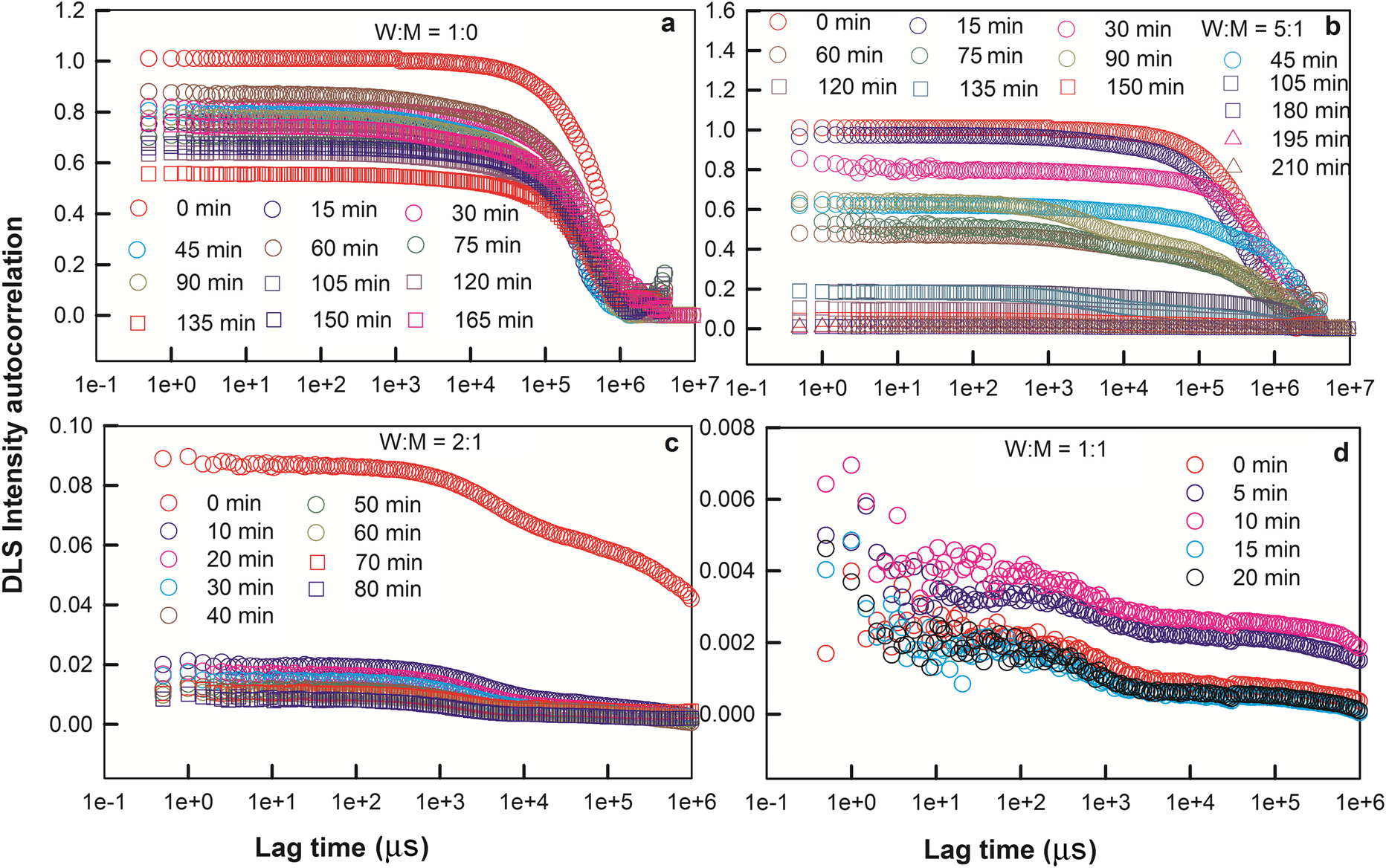
The aging behavior in soft matter systems is usually probed by scattering experiments through dynamic-structure factor and correlation-curve analysis. The correlation function (Fig. 1) showed the emergence of non-ergodic behavior of Laponite® RD (3% w/v) in a water–methanol binary solvent as a function of methanol content and aging time.
Intensity autocorrelation curve of 3% w/v Laponite® RD in a water–methanol binary solvent for various W:M ratios: a 1:0, b 5:1, c 2:1, and d 1:1

The issue of non-ergodicity in DLS experiments is understood by scanning the entire phase space of the sample cell via rotation (Coviello et al., Reference Coviello, Burchard, Geissler and Maier1997). Nevertheless, the heterodyne approach (Coviello et al., Reference Coviello, Burchard, Geissler and Maier1997) can also be implemented to understand the non-ergodic system using Eq. 2. The value of X = 1 in Eq. 2 transforms it into Eq. 1 where the Siegert relation holds; whereas, for the non-ergodic phase, the value of X < 1 and the term 2X(1 − X) makes a finite contribution to g 2(τ). The pre-factor of the linear term for g 1(τ) in Eq. 2 was observed to be much larger than the quadratic second term in most of the cases and thus
 can be written as Eq. 3:

The intercept of the plot of
 vs. delay time, τ, at τ → 0 gives β′[2X − X
2] from which the value of X was calculated.
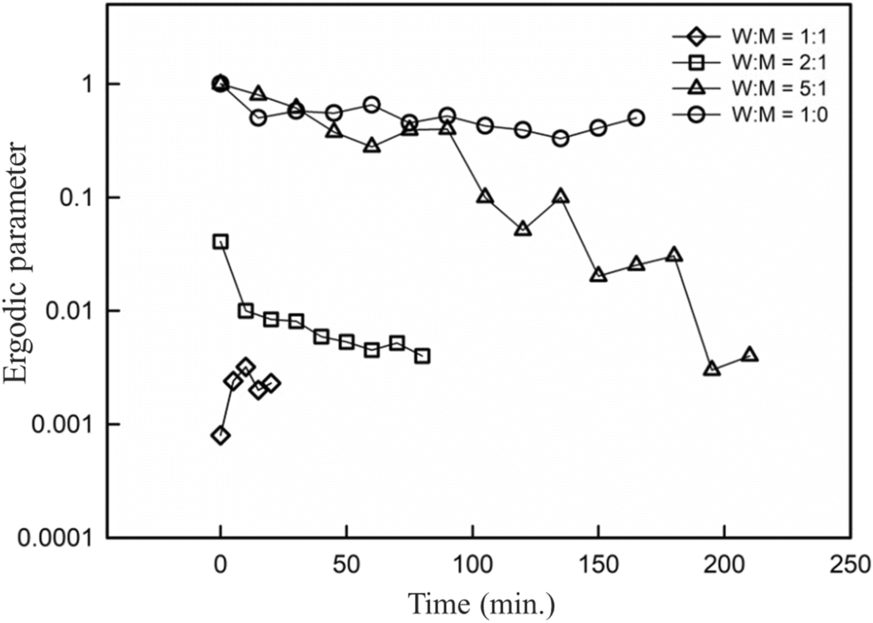
The calculated value of the ergodic parameter, X, was plotted (Fig. 2) and the value of X for Laponite® RD in the binary solvent decreased with aging as well as with the increase in methanol content. The plot of X (Fig. 2) suggested that the sample with a W:M = 1:0 ratio remained ergodic until 165 min whereas samples with a larger methanol content became non-ergodic at a much earlier time.
Variation of the ergodic parameter (X) as a function of time for 3% w/v Laponite® RD in various W:M ratios: a 1:0, b 5:1, c 2:1, and d 1:1

Viscosity Measurement
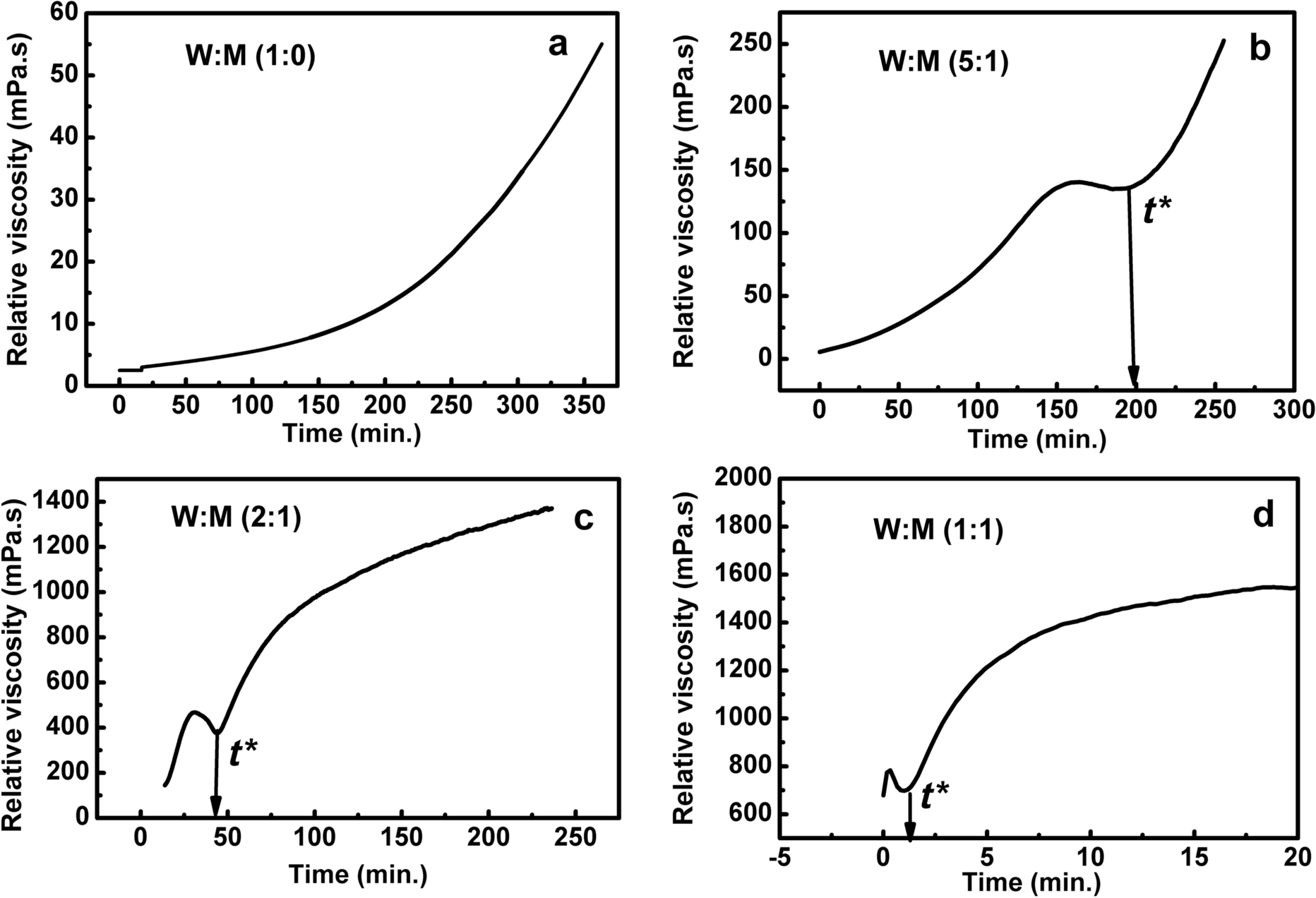
Viscosity studies were used to determine the evolution of the non-ergodic behavior of Laponite® RD in the binary solvent. The viscosity data (Fig. 3a) showed that initially (t ≈ 0 min) the relative viscosity was very small for Laponite® RD in W:M = 1:0; with aging, however, the viscosity increased. The increase in viscosity led to the formation of a gel with a house-of-cards arrangement. As discussed in various previous studies (Cummins, Reference Cummins2007; Martin et al., Reference Martin, Pignon, Piau, Magnin, Lindner and Cabane2002; Mongondry et al., Reference Mongondry, Tassin and Nicolai2005; Ruzicka et al., Reference Ruzicka, Zulian and Ruocco2004; Shahin & Joshi, Reference Shahin and Joshi2010), the house-of-cards arrangement was formed due to the interaction between the negatively charged surfaces and positively charged edges of Laponite® RD in a high ionic-strength solution. The assertion of the house-of-cards arrangement, however, was derived from the work of Shahin and Joshi (Reference Shahin and Joshi2010) who suggested that the aging that occurs over a long period of time in a low salt-concentration system is qualitatively similar to that occurring in high salt-concentration systems over a short period of time.
Time-dependent viscosity of 3% w/v Laponite® RD in a water–methanol binary solvent for various W:M ratios: a 1:0, b 5:1, c 2:1, and d 1:1. The arrow indicates the time, t*, where viscosity fluctuation was observed

The plot of viscosity vs time (Fig. 3) suggested that the relative viscosity (at t ≈ 0 min) for 3% w/v Laponite® RD in the binary solvent increased with the increase in methanol content. This increase was attributed to the aggregation of Laponite® RD particles owing to the limited availability of water for hydration. Note that the viscosity trend of Laponite® RD for W:M ratios of 1:0 and 5:1 (Fig. 3a,b) was evolving whereas the saturated viscosity profile was observed for W:M ratios of 2:1 and 1:1 (Fig. 3c,d). The data indicated that the large viscosity value and the plateau region may have evolved due to the aggregation of particles because of jamming and limited access to water for hydration.
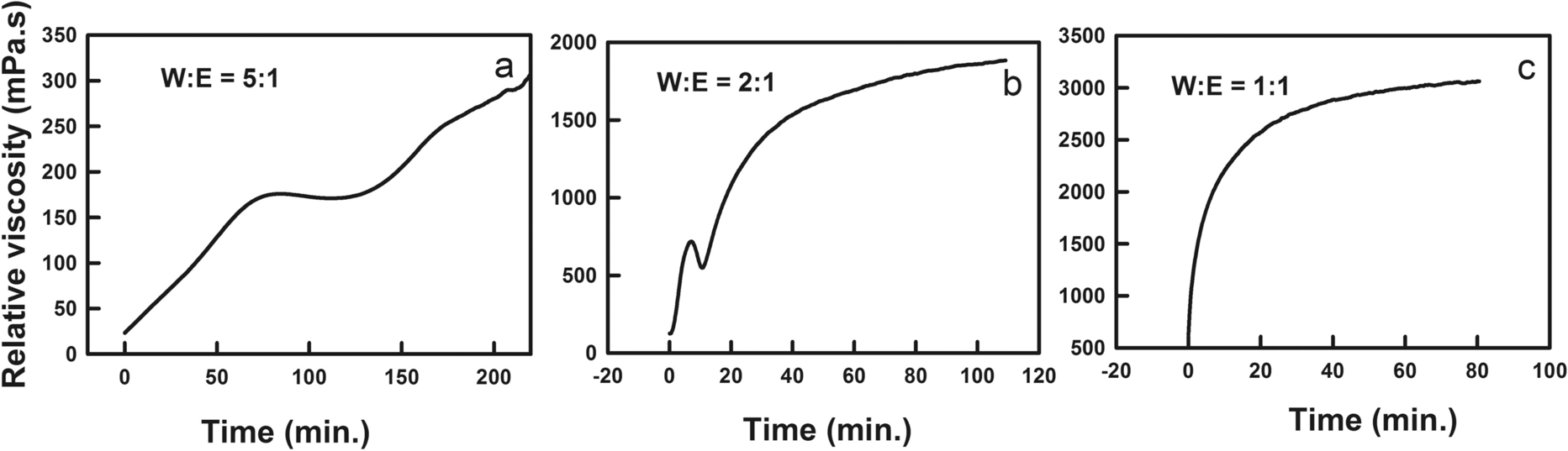
Nevertheless, in the viscosity profile (Fig. 3b, c, d), an anomaly was noted at time t* at which a reduction in viscosity was observed. The anomalous fluctuation in viscosity at t* and a plateau region for large alcohol contents in binary solvents was not an artefact; in fact, the anomalous fluctuation and plateau region could invariably be seen in binary mixtures when ethanol was used instead of methanol (Fig. 4). An anomalous viscosity fluctuation by Laponite XLG in a water-alcohol binary mixture was also observed by Kimura and Haraguchi (Reference Kimura and Haraguchi2017).
Time-dependent viscosity of 3% w/v Laponite® RD in a water–ethanol binary solvent with various water:ethanol ratios: a 5:1, b 2:1, and c 1:1

Small-angle X-ray Scattering (SAXS)
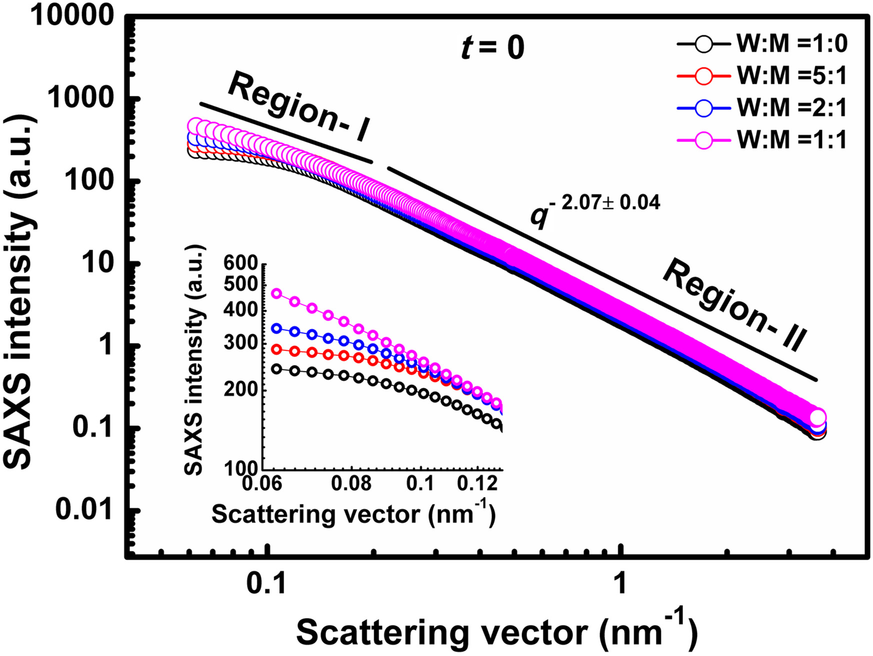
Viscosity measurements revealed the occurrence of aggregation in Laponite® RD particles with the passage of time and increasing methanol concentration in the binary solvent. Nothing definitive could be stated about the viscosity fluctuations, i.e. the reduction in the viscosity measurements. This suggests that the reduction was due to repulsion between negatively charged Laponite® RD surfaces within the aggregates. This hypothesis of aggregation and repulsion behavior within aggregates was supported by results from the SAXS study. The plot (Fig. 5) depicted the scattering intensity (I) profile of Laponite® RD in a water–methanol binary solvent as a function of scattering vector (q) for various W:M ratios immediately after sample preparation, i.e. t = 0. The SAXS data (Fig. 5) revealed that the scattering profile could be split into two regions, referred to here as I and II. The data points in region II for all samples could be fitted with the power law I ≈ q –α where the value of α = 2.07 ± 0.04. The value of 2 for α in the high-q region (region II) suggested that the Laponite® RD particle is disc-shaped (Cui et al., Reference Cui, Pizzey and van Duijneveldt2013). Data from the low-q region (region I) revealed that scattering intensity from Laponite® RD increased with the increase in methanol concentration in the binary solvent (see inset in Fig. 5). The increase in scattering intensity suggested enhanced aggregation of Laponite® RD in samples with increasing methanol content (Chatani et al., Reference Chatani, Inoue, Imamura, Sugiyama, Kato, Yamamoto, Nishida and Kanaya2015; Kikhney & Svergun, Reference Kikhney and Svergun2015; Lecomte et al., Reference Lecomte, Dauger and Lenormand2000; Londoño et al., Reference Londoño, Tancredi, Rivas, Muraca, Socolovsky, Knobel and Sharma2018).
SAXS scattering intensity (I) profile of 3% w/v Laponite® RD in a water–methanol binary solvent as a function of scattering vector (q) for various W:M ratios at the initial time (t = 0). Inset is a close-up image of region I

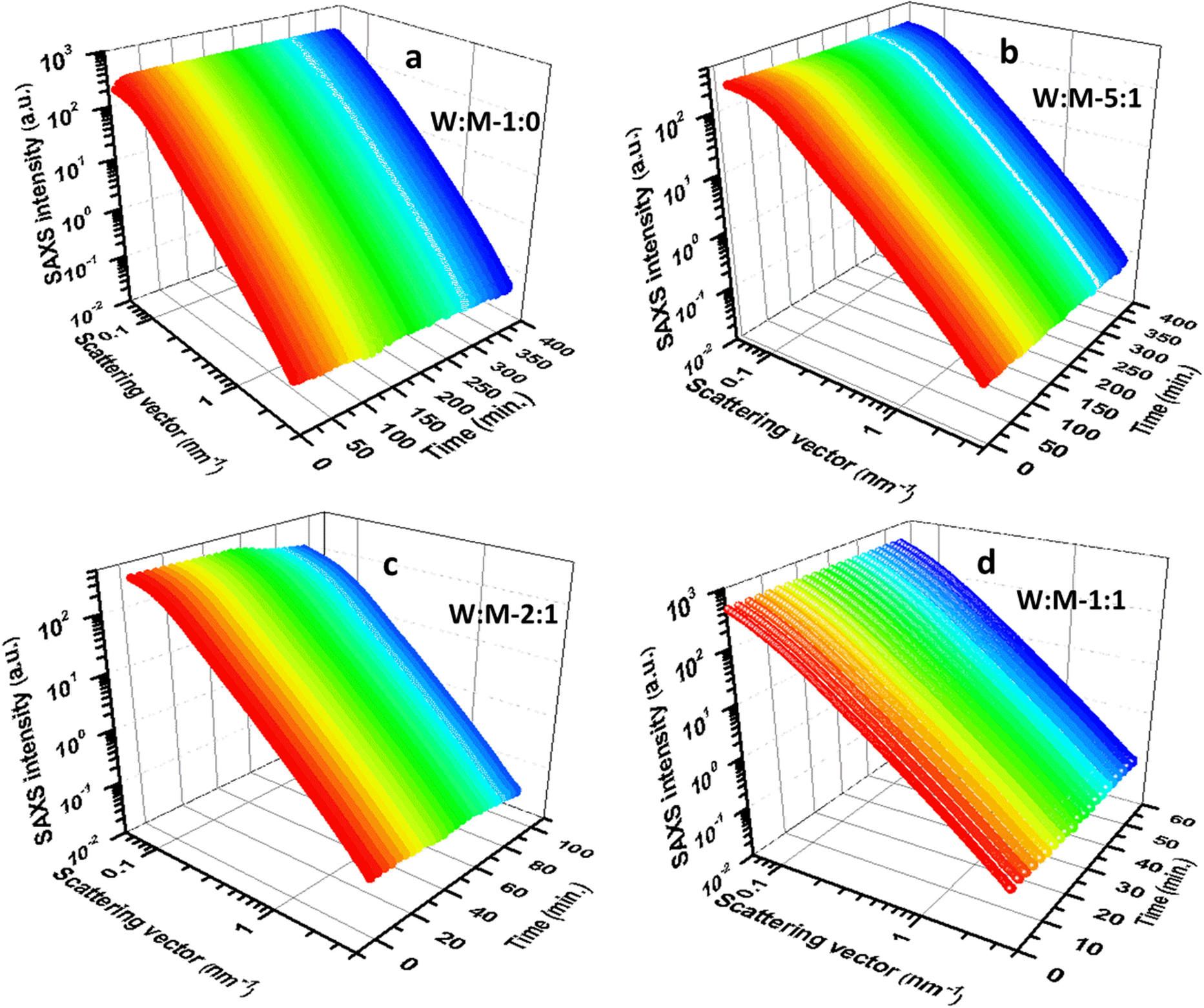
The data (Fig. 5) showed a variation (immediately after sample preparation, i.e. t = 0) of scattering intensity as a function of the scattering vector; the data, however, revealed nothing about the anomalous fluctuation that occurred with the passage of time. The aging behavior was observed from the time-dependent scattering intensity of the SAXS profile of each individual sample (Fig. 6); apparently the scattering profile was the same with aging for larger q values; at smaller q values, however, some variations were noticed.
SAXS intensity (I) profile as a function of the scattering vector (q) and aging time for 3% w/v Laponite® RD in a water–methanol binary mixture at various W:M ratios

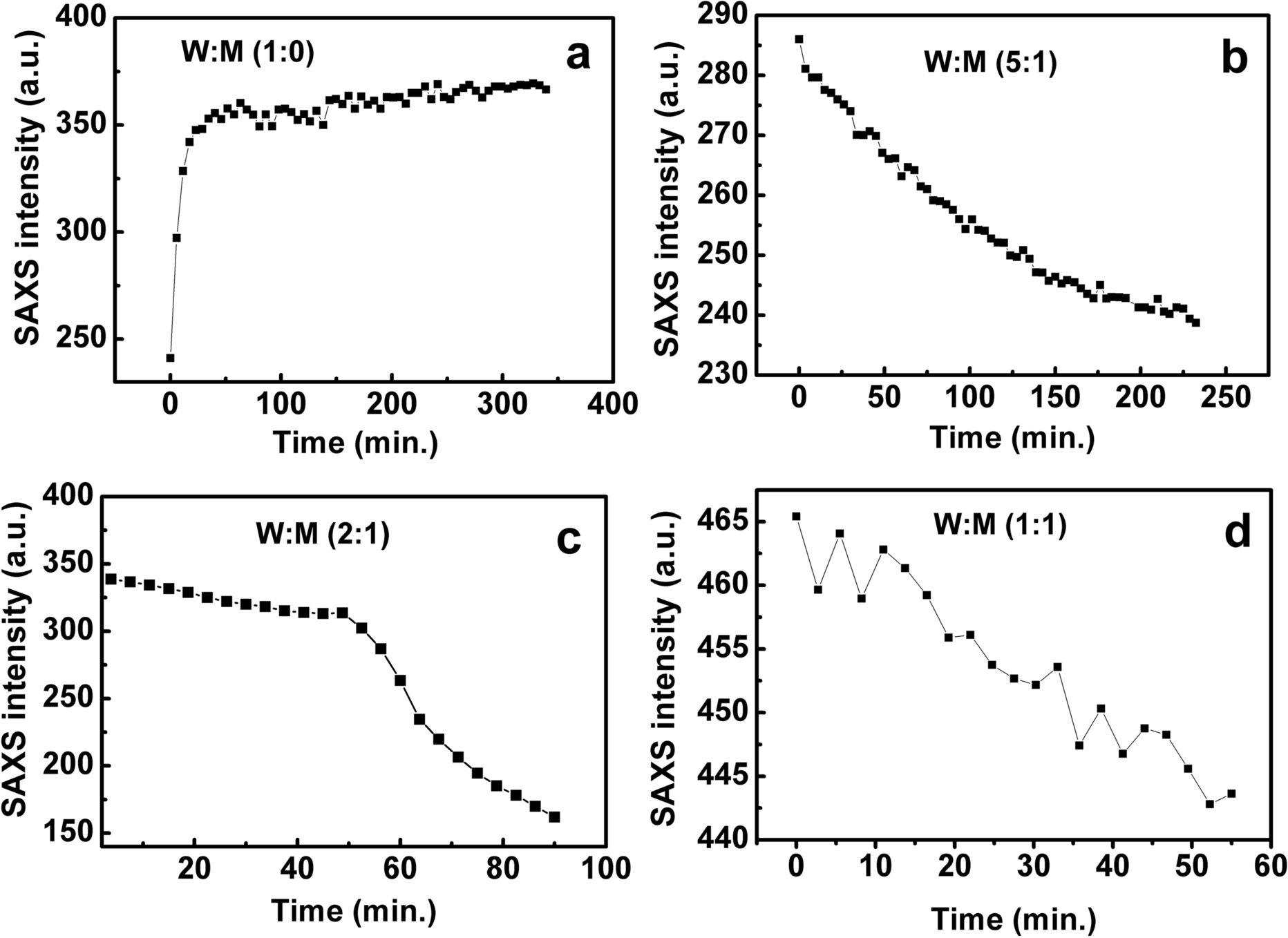
The explicit variation of the scattering profile with aging time at low q (0.0627 nm–1) revealed the interactions between Laponite® RD particles in the water–methanol binary solvents. The variation of scattering intensity for each sample at q = 0.0627 nm–1 as a function of time (Fig. 7b, c, d) revealed that the scattering intensity decreased with aging in all the samples with methanol, which suggests a repulsive interaction (Franke et al., Reference Franke, Kikhney and Svergun2012; Kikhney & Svergun, Reference Kikhney and Svergun2015) between Laponite® RD particles. The repulsive force within aggregates might be the reason for the observed anomalous fluctuation (reduction in viscosity) as mentioned in the viscosity section (Fig. 3).
SAXS intensity (I) profile of Laponite® RD as a function of time at the lowest scattering vector (q = 0.0627 nm–1) for various W:M ratios

The sample without methanol (W:M = 1:0) showed an increase in scattering intensity with time (Fig. 7a), which suggested an attractive interaction (Franke et al., Reference Franke, Kikhney and Svergun2012; Kikhney & Svergun, Reference Kikhney and Svergun2015) between the negatively charged basal surface and the positively charged edge of the Laponite® RD, thus forming the house-of-cards arrangement discussed above.
Note that the rise in viscosity of Laponite® RD in water–methanol binary solvent as observed in this work was not in accord with the results obtained by Kimura and Haraguchi (Reference Kimura and Haraguchi2017); those authors did not note an anomalous increase in the viscosity of Laponite XLG in water–methanol binary solvents. Although both Laponite® RD and Laponite XLG are structurally similar and have gel-forming properties, the difference in the results may be attributed to the sample preparation. Kimura and Haraguchi (Reference Kimura and Haraguchi2017) prepared samples by adding alcohol in a dropwise manner whereas in the current study methanol was added immediately during the preparation of samples. The sudden and immediate addition of methanol may have contributed to the sudden flocculation and aggregation of Laponite® RD, which was responsible for the anomalous increase in the viscosity. The occurrence of dissimilar anomalous behavior among different grades of Laponite in water-alcohol binary solvents needs meticulous investigation, considering various parameters, such as purity, heavy-metal content, extent of exfoliation, and hydration behavior, as mentioned by Kimura and Haraguchi (Reference Kimura and Haraguchi2017).
The observed time-dependent fluctuation in the viscosity of Laponite® RD in a water-alcohol binary solvent was, however, in accord with the results obtained by Kimura and Haraguchi (Reference Kimura and Haraguchi2017). The SAXS data revealed that the repulsive forces due to negatively charged Laponite® RD platelets within aggregates were the reason for such anomalous viscosity fluctuations.
Rheology
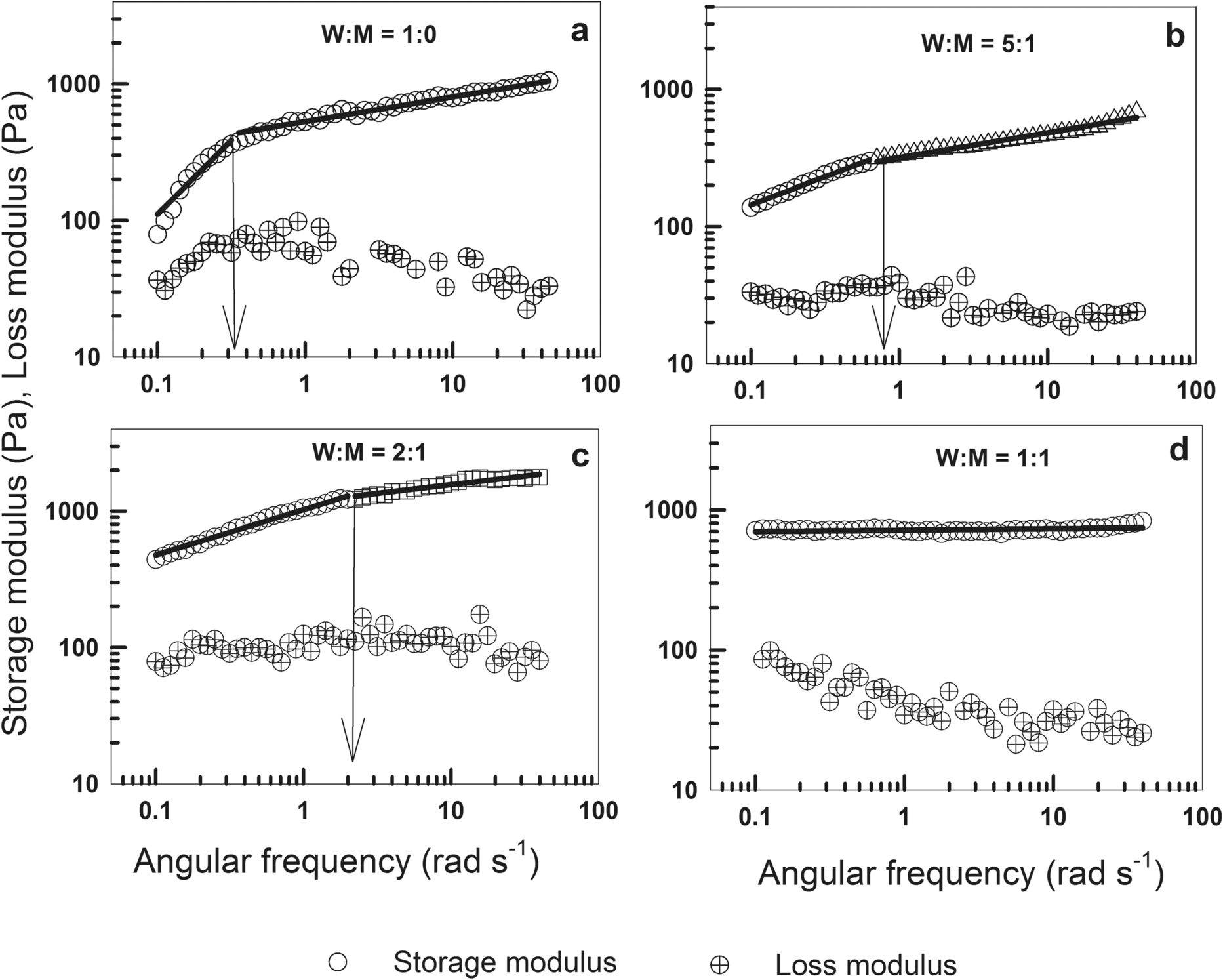
The viscoelastic properties of the samples were characterized using rheology. The samples were allowed to mature for 30 h before performing the rheological experiments. The storage modulus (Gˈ(ω)) and loss modulus (Gˈˈ(ω)) of the samples were plotted (Fig. 8) to characterize the viscoelastic properties. The explicit frequency dependence of the storage modulus was determined by fitting Gˈ(ω) to the power-law function given by Eq. 4 (Barnes, Reference Barnes2000).

where ω is the angular frequency.
Variation of storage modulus (Gˈ(ω)) and loss modulus (Gˈˈ(ω)) as a function of frequency for 3% w/v Laponite® RD in a water–methanol binary solvent with various W:M ratios: a 1:0, b 5:1, c 2:1, and d 1:1. The arrow indicates the frequency at which the slope of the storage modulus changed

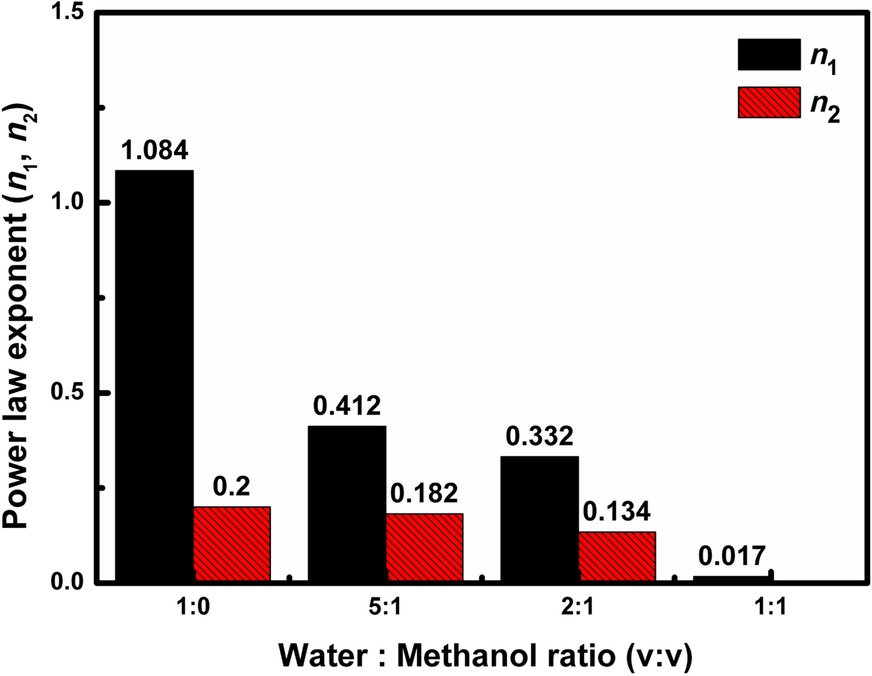
The data (Fig. 8) showed the frequency-dependent storage and loss modulus of 3% w/v Laponite® RD in a binary solvent with W:M ratios of 1:0, 5:1, 2:1, and 1:1. The data (Fig. 8) revealed that the interaction between Laponite® RD particles increased with high methanol concentrations, which gave rise to a large storage modulus. Furthermore, the storage modulus exhibited two regions (indicated by the arrow) based on the slope of the graph except for the case when W:M = 1:1. The two regions were fitted to Eq. 4 which gave two power law exponents n 1 and n 2.
The linear viscoelastic model (Barnes, Reference Barnes2000) predicts that the power-law frequency dependence behavior given by Eq. 4 with 0 < n < 1 will be followed. The number of crosslinks (excess crosslinks, n < 1/2 and lack of crosslinks, n > 1/2) defines stoichiometric balanced and unbalanced networks strictly for chemically crosslinked gels. The data (Fig. 8) were, however, fitted to Eq. 4 and the value of n was determined in order to understand the strength of the samples.
The power law exponents (n 1 and n 2) were obtained and plotted (Fig. 9) by fitting the storage modulus data (Fig. 8) using Eq. 4. From the large storage modulus (Fig. 8) and almost zero frequency dependence (Fig. 9) for W:M = 1:1, the present authors concluded that a high concentration of methanol provided greater physical interaction between Laponite® RD particles.
Variation in the power law exponents (n 1 and n 2) for 3% w/v Laponite® RD in a water–methanol binary solvent with various W:M ratios: a 1:0, b 5:1, c 2:1, and d 1:1

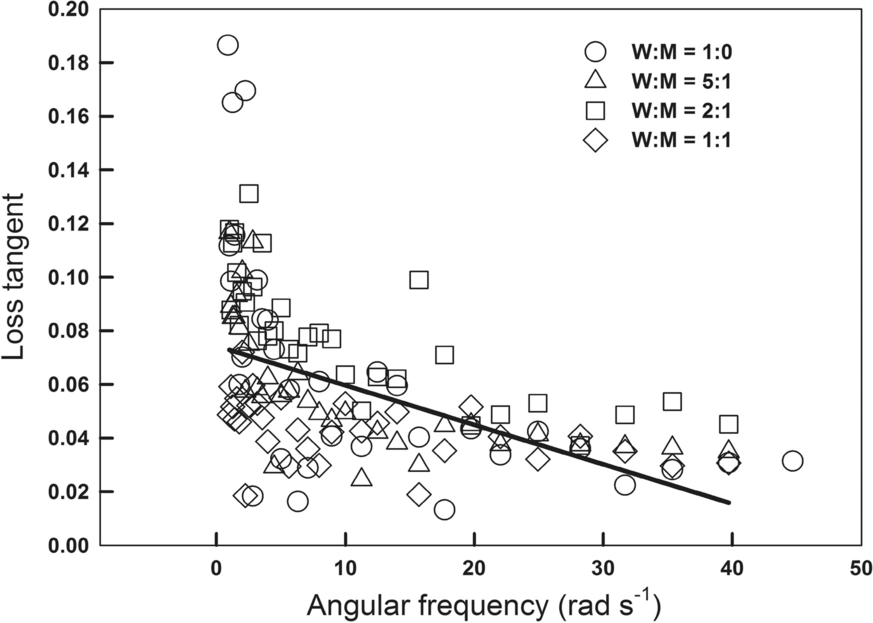
Furthermore, understanding whether Laponite® RD in the binary solvent has gel or melt-like behavior is important. In order to understand the arrested phase, a plot of the loss tangent (tan δ = Gˈˈ(ω)/Gˈ(ω)) as a function of frequency (Fig. 10) for various W:M ratios yielded a straight-line equation (tan δ = 0.07 – 0.001 ω) of almost zero slope, indicating that Laponite® RD aggregates in binary solvent behaved almost like a gel in all the samples.
Variation of the loss tangent (tan δ) as a function of frequency for Laponite® RD in a water–methanol binary solvent with W:M ratios of 1:0, 5:1, 2:1, and 1:1. The straight line in the graph shows a single fitting to all the data points

The low-frequency storage modulus, G 0, defined as G 0 =
 was determined explicitly using Eq. 5 (Arfin et al., Reference Arfin, Aswal and Bohidar2014; Barnes, Reference Barnes2000). The equation gave the measure of elastic free energy stored per unit volume of a characteristic viscoelastic network of size ζ (Barnes, Reference Barnes2000).

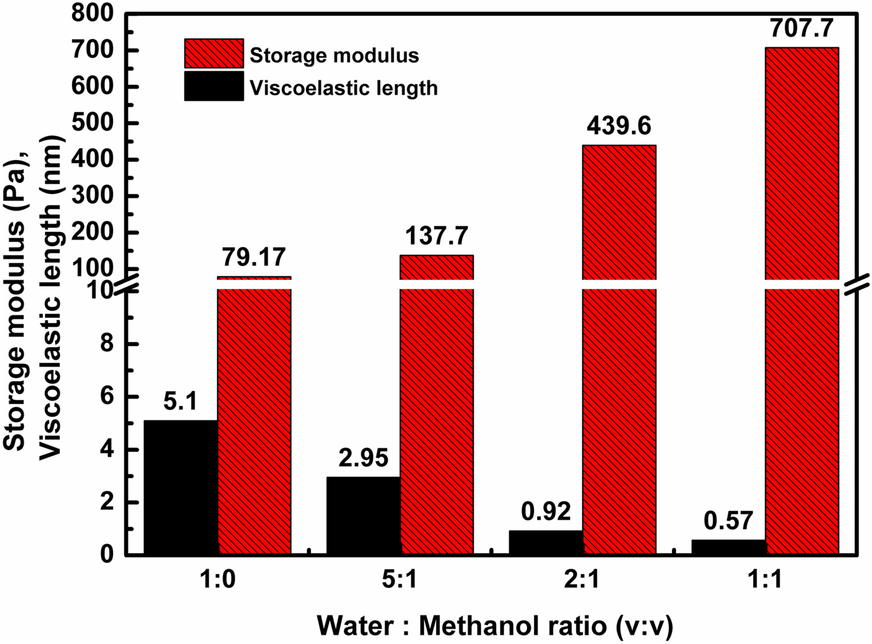
The value of G 0 for each sample in this work was determined at 0.1 rad/s. The values for G 0 and viscoelastic length (ζ) obtained from Eq. 5 were plotted (Fig. 11) and indicated that the rigidity of the Laponite® RD network increased with the increase in methanol concentration in the binary solvent.
Variation of the storage modulus (G 0 (ω)) at 0.1 rad/s and viscoelastic length (ζ) for 3% w/v Laponite® RD in a water–methanol binary solvent with various W:M ratios: a 1:0, b 5:1, c 2:1, and d 1:1

Conclusions
The non-ergodic behavior and viscosity of Laponite® RD in a water–methanol binary solvent increased strongly with aging time and methanol content. The increase in viscosity was attributed to the aggregation of Laponite® RD particles as revealed through the SAXS experiment. The hypothesis that the fluctuation in the viscosity behavior occurred due to the repulsion between negatively charged Laponite® RD surfaces within the aggregates is consistent with the analysis of the SAXS. Nevertheless, the results obtained are at variance with the results obtained for Laponite XLG (Kimura & Haraguchi, Reference Kimura and Haraguchi2017) which showed no significant increase in viscosity in the water–methanol binary solvent.
Acknowledgements
Ms Preeti Tiwari is grateful to the Council of Scientific and Industrial Research (CSIR) for the CSIR-SRF fellowship (09/466(0222))/2019-EMR-I. The authors are also grateful to the UGC start-up grant (F.30-359/2017(BSR)) for funding. Avik Das and Jitendra Bahadur acknowledge Dr S. M. Yusuf, Director of Physics Group, Bhabha Atomic Research Centre, for his support and encouragement for the SAXS beamline (BL-18) activity. The authors also acknowledge Aroma Chemical Agencies (India) Pvt. Ltd. for the supply of Laponite® RD (BYK-Additives and Instruments, UK) and the Central Instrumentation Facility, Centre for Interdisciplinary Research in Basic Sciences, Jamia Millia Islamia, for the instrumentation facility.
Data Availability
Not Applicable.
Code Availability
Not Applicable.
Declarations
Conflicts of Interest
There are no conflicts to declare.