INTRODUCTION
The Gulf of Antalya is located in the north-eastern Levantine Basin and is highly susceptible to invasions by aliens due to its proximity to the Suez Canal. One hundred and twenty established and casual alien fish have been reported from the Mediterranean Sea (Zenetos et al., Reference Zenetos, Meriç, Verlaque, Galli, Boudouresque, Giangrande, Çınar and Bilecenoğlu2008) and 50 of them were recorded from the Levantine coast of Turkey (Çınar et al., Reference Çınar, Bilecenoğlu, Öztürk, Katağan and Aysel2005; Zenetos et al., Reference Zenetos, Meriç, Verlaque, Galli, Boudouresque, Giangrande, Çınar and Bilecenoğlu2008).
Four alien cardinal fish species were reported from the Mediterranean Sea (Haas & Steinitz, Reference Haas and Steinitz1947; Eryılmaz & Dalyan, Reference Eryilmaz and Dalyan2006; Golani et al., Reference Golani, Appelbaum-Golani and Gon2008; Goren et al., Reference Goren, Yokes, Galil and Diamant2008, Reference Goren, Galil, Diamant, Gayer and Stern2009a). The first record of the cardinal fish, Apogon smithi (Kotthaus, 1970) was reported by Golani et al. (Reference Golani, Appelbaum-Golani and Gon2008) from the Israel coast of the Mediterranean Sea. The second location record was reported by Goren et al. (Reference Goren, Yokes, Galil and Diamant2008) from the İskenderun Bay, Turkey. Golani et al. (Reference Golani, Appelbaum-Golani and Gon2008) and Goren et al. (Reference Goren, Yokes, Galil and Diamant2008) observed this species on sandy and muddy bottoms at depths of 20–40 m.
Six alien gobiid species were reported from the Mediterranean Sea (Goren et al., Reference Goren, Gayer and Lazarus2009b). Vanderhorstia mertensi Klausewitz, 1974 was first recorded from the Gulf of Fethiye (Turkey) by Bilecenoğlu et al. (Reference Bilecenoğlu, Yokeş and Eryiğit2008) who reported an established population on sandy and muddy bottoms at depths of 2–52 m.
Apogon smithi (Kotthaus, 1970)
MATERIAL EXAMINED
Two specimens of Apogon smithi were collected at the depth of 40 m in September 2009, nine specimens in February 2010, and twenty-three specimens in April 2010, at depths of 25–50 m by a bottom-trawler, from the coordinates between 36°49′N–30°54′E and 36°48′N–31°03′E, in the Gulf of Antalya, Levantine Sea. The specimens caught in April were fully mature and the females were full with eggs.
The specimens were preserved in 4% formalin and kept in the Akdeniz University of Fisheries Faculty Fish Museum (AUFFFM). Brief description of the specimens collected in Gulf of Antalya, Turkey: specimens with 7–8 faded dark vertical bars on body and head. There was a black spot on upper front of first dorsal fin. Two longitudinal black stripes on second dorsal fin, one on upper margin, second at mid height of fin. A narrow black bar on distal of caudal fin. Lateral line scales 24–26 + 1–2 scales without pores on base of caudal fin. Median predorsal scales 4–5, the anterior one enlarged with median notch. First dorsal fin with seven spines; the first very short, about half that of the second spine which is about half that of the fourth spine. Second dorsal fin contains a spine and nine rays. Anal fin with two spines and eight rays. Pectoral fins have 15 rays. Developed gill rakes on first gill arch 1 + 9–11. The total length of 32 specimens ranged from 77.5 to 112.5 mm, standard length from 62.1 to 90.5 mm, body depth from 18.1 to 29.3 mm, weight from 6.9 to 23.1 g.(Tables 1 & 2)
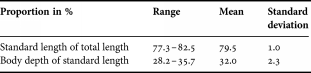
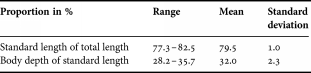
Selected proportions (in %) of 32 specimens of Apogon smithi collected from the Gulf of Antalya.
Descriptive statistics and length–weight relationship parameters for Apogon smithi caught in the Gulf of Antalya.

n, sample size; range, minimum and maximum; Wmean, mean weight in g; Lmean, mean length in mm; SD, standard deviation; a and b, parameters of the length–weight relationship; r 2, coefficient of determination.
Vanderhorstia mertensi Klausewitz, 1974
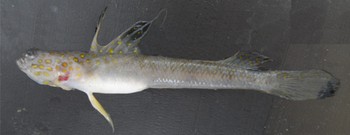
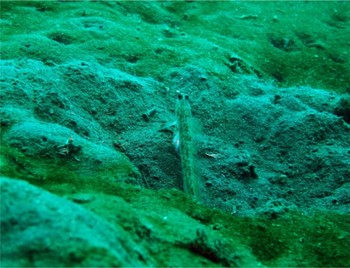
On 19 April 2009, during SCUBA diving under fish farm cages located in Maden Bay, Gulf of Antalya, the gobiid fish, Vanderhorstia mertensi (Figures 1 & 2) was observed over sandy/muddy bottoms, with a population of 3–4 ind/m2 between the depths of 20 and 25 m. The water temperature was measured as 22°C at the surface and 17–18°C between the depths of 20 and 25 m. A single specimen was sampled for species identification. The total length of this specimen was 11.10 cm and the weight was 4 g. The specimen was preserved in 4% formalin and kept in the AUFFFM. Dorsal finrays VI-I, 15; anal finrays, I + 16; pectoral finrays, 16; ventral finrays, I + 5; caudal fin segmented rays, 5; scales in longitudinal series on body, 52. Dark stripe on the maxilla, numerous yellow/orange spots on head and the dorsal part of the body, a dark spot on the opercle, a vertical dark stripe below the fourth ray of first dorsal fin, three large dark spots below the second dorsal fin and one dark spot on the caudal peduncle. All fins are covered with distinct yellow spots. Abdomen of fish is white in colour.
Vanderhorstia mertensi Klausewitz, 1974 from the Gulf of Antalya.

Vanderhorstia mertensi Klausewitz, 1974 and its hole from the Gulf of Antalya.

The V. mertensi was recorded for the first time in the Mediterranean by Bilecenoglu et al. (2008) and later, in the Gulf of Antalya by Gökoğlu et al. (Reference Gökoğlu, Özgür, Kaya and Atik2009) and Yokeş et al. (Reference Yokeş, Bilecenoğlu, Goren, Galil and Diamant2009). In the present study, a dense population of V. mertensi in association with burrows constructed by the alpheid shrimps was reported in the Gulf of Antalya.
DISCUSSION
Thirty-four alien fish species were reported from the Gulf of Antalya (Özgür Özbek et al., Reference Özgür Özbek, Kebapçıoğlu, Çardak, Gökoğlu and Beğburs2010; Özgür Özbek, unpublished data).
So far, four alien cardinal fish species were reported from the Mediterranean Sea (Haas & Steinitz, Reference Haas and Steinitz1947; Eryılmaz & Dalyan, Reference Eryilmaz and Dalyan2006; Golani et al., Reference Golani, Appelbaum-Golani and Gon2008; Goren et al., Reference Goren, Yokes, Galil and Diamant2008, Reference Goren, Galil, Diamant, Gayer and Stern2009a). The native species, Apogon imberbis (Linaeus, 1758), and the alien, A. pharaonis Bellotti, 1874 were formerly known in the Gulf of Antalya. These fish are found on the rocky or gravelly bottoms. Apogon smithi is a new Indo-Pacific apogonid species in the Gulf of Antalya. This newcomer was first recorded from the coast of Israel in 2008 (Golani et al., Reference Golani, Appelbaum-Golani and Gon2008). It is important that this species has adapted and constituted a population towards the north-western coast of the Mediterranean.
Oxyurichthys papuensis (Valenciennes, 1837) is the only alien gobiid fish reported from the Gulf of Antalya and is very common on soft bottoms at depths of 25–150 m (Özgür Özbek et al., Reference Özgür Özbek, Kebapçıoğlu, Çardak, Gökoğlu and Beğburs2010). Bilecenoğlu et al. (Reference Bilecenoğlu, Yokeş and Eryiğit2008) reported the population of the second alien gobiid fish, V. mertensi from Fethiye (36°39′59″N 29°02′06″E) and morphometric characteristics of a single specimen (21 mm SL, 26 mm TL) collected at a depth of 23 m. We observed V. mertensi over sandy, muddy bottoms, with a population of 3–4 ind/m2 between the depths of 20 and 25 m.
The above mentioned two species are the native species of the Red Sea. It is possible that the entrance of these species to the Mediterranean Sea was mediated by the Suez Canal. Multiple stressors—pollution, eutrophication, destruction and fragmentation of habitats, fisheries overexploitation, climate change—are implicated in a web of linkages that caused the pre-introduction decline in the richness and diversity of the native Mediterranean littoral ecosystem and thus to its domination by invasive aliens. Local population losses and niche contraction may not induce immediate extirpation, but they augur reduction of genetic diversity, loss of functions, processes, and habitat structure, increase the risk of decline and extinction, and lead to biotic homogenization (Galil, Reference Galil2007, Reference Galil2008a, Reference Galilb). Thus, long-term approaches are required to monitor the alien species in proportion to local and endemic species, to examine the competition between them and to document the displacement and replacement events.
ACKNOWLEDGEMENT
We wish to thank our Contract/grant sponsor Scientific Research Projects Administration Unit of Akdeniz University.