INTRODUCTION
The concept of parasitic castration has received considerable attention in evolutionary parasitology. Nonetheless the definition of ‘parasitic castration’ remains clouded because the host pathology (phenotype) and the proximate mechanism by which host reproduction is curtailed or inhibited are not always considered jointly. Baudoin (Reference Baudoin1975) presented an insightful explication of parasitic castration, linking host phenotype with mechanism and leading to a definition of true castration: ‘destruction or alteration of gonad tissue, reproductive behaviour, hormonal balance or other modification of host reproductive effort above and beyond that which results from a non-selective use of host energy reserves by the parasite.’
Baudoin's (Reference Baudoin1975) definition reveals the fundamental difference between a castrator and a nutrient thief. Castrators use physical or chemical means directly to shut down host reproduction, whereas nutrient thieves have an indirect effect on host reproduction simply as a result of stealing host energy. In the first case, the effect on host reproduction is a parasite adaptation resulting in host manipulation. The latter case represents a side effect of infection. The proximate mechanism by which host reproduction is affected provides the distinction between the two types of parasites, just as mechanism is important in fully understanding phenotypic differences involved in other biological phenomena such as phenotypic plasticity as compared with natural selection. Given the focus on the mechanism by which the phenotypic effect occurs, the difference is more than a debate over semantics. Moreover, the difference in proximal causation should have important implications for understanding the impact of anthropogenic global change on hosts, parasites and host–parasite interactions – which are likely to be complex (Barber et al. Reference Barber, Berkhout and Ismail2016; Marcogliese, Reference Marcogliese2016).
Parasites manifest two different strategies relative to the effects on host energy budgets, direct manipulation of host energy allocation by ‘castrators’ and simple nutrient theft by ‘consumers’, which are expected to cause demonstrably different effects on host reproductive function and thus allow insight into the parasite's strategy (Hall et al. Reference Hall, Becker and Cáceres2007; Heins and Baker, Reference Heins and Baker2010). Parasitic manipulation of host energy allocation resulting in true castration should occur early in infections (Hall et al. Reference Hall, Becker and Cáceres2007) and therefore be observed among both lightly and heavily-infected hosts (Hacker and Kilama, Reference Hacker and Kilama1974; Renshaw and Hurd, Reference Renshaw and Hurd1994; Hogg and Hurd, Reference Hogg and Hurd1995; Hurd, Reference Hurd2001). In cases where infections occur before sexual maturity, manipulation should cause castration among juvenile-size fish before the size (age) at which reproduction begins. A small percentage of lightly-infected fish might reproduce because castration is not likely to be instantaneous (Heins and Baker, Reference Heins and Baker2010). Simple nutrient theft should allow reproduction among lightly- and heavily-infected adult-size hosts depending on the availability of nutrient resources. Reproductive performance should decline as severity of infection increases until, in a heavily infected host late in an infection, host reproduction ceases or the host dies (Javadian and MacDonald, Reference Javadian and MacDonald1974; Hurd, Reference Hurd2001; Hall et al. Reference Hall, Becker and Cáceres2007; Heins and Baker, Reference Heins and Baker2010). Simple nutrient theft should, therefore, allow reproduction in lightly- and heavily-infected adult-size hosts, although they should manifest decreasing metrics of reproduction as the severity of infection (host:parasite biomass ratio) increases. The functional difference is that parasitic manipulation specifically targets host energy allocation, preventing or dramatically curtailing host reproduction early in an infection; but simple nutrient theft functionally starves the host, reduces reproduction over the course of an infection, and may eventually shut down host reproduction (Hall et al. Reference Hall, Becker and Cáceres2007; Heins and Baker, Reference Heins and Baker2010).
Early research on one natural population of the ninespine stickleback fish Pungitius pungitius infected by the cestode parasite Schistocephalus pungitii in south-central Alaska (Airolo Lake; Heins et al. Reference Heins, Ulinski, Johnson and Baker2004; Heins and Baker, Reference Heins and Baker2010) showed symptoms consistent with predictions of the castration hypothesis modelled by Hall et al. (Reference Hall, Becker and Cáceres2007). Adult-size female ninespine stickleback hosts were unable to reproduce if the parasite mass exceeded 10% of the host mass; and host reproductive capacity was eliminated before host size (age) at sexual maturity (Heins et al. Reference Heins, Ulinski, Johnson and Baker2004; Heins and Baker, Reference Heins and Baker2010), suggesting that the parasite shut down reproduction early in infections. Moreover, infected females appeared to be in better body condition than uninfected, reproducing females (Heins et al. Reference Heins, Ulinski, Johnson and Baker2004). Host fish might, therefore, live longer into the summer and extend the transmission period for the parasite (Heins et al. Reference Heins, Ulinski, Johnson and Baker2004). Thus, reproductive curtailment of ninespine stickleback infected by S. pungitii appeared to be an adaptive manipulation of the host by the parasite. Although host pathology seemed to reflect true parasitic castration, simple nutrient theft was not excluded as a causal factor (Heins et al. Reference Heins, Ulinski, Johnson and Baker2004).
The diphyllobothriidean parasite S. pungitii is a trophically transmitted parasite of the ninespine stickleback P. pungitius (Nishimura et al. Reference Nishimura, Heins, Andersen, Barber and Cresko2011; Henrich and Kalbe, Reference Henrich and Kalbe2016). The life cycle of S. pungitii includes a free-living coracidium larva, copepod (first intermediate host), ninespine stickleback (second intermediate host) and aquatic, piscivorous bird (definitive host), with almost all growth of the parasite occurring within the body cavity of the fish host (Smyth, Reference Smyth1962). Notwithstanding the intriguing interrelationship between S. pungitii and the ninespine stickleback, the interplay between the two organisms is poorly known. Inter-population variation in the host–parasite system has not been studied.
This report presents an 11-year investigation of host reproductive status in a second population of ninespine stickleback from south-central Alaska. The major objective for this study was to quantify the effects of the parasite on host reproduction to test the castration hypothesis. Second, I sought to determine the degree of variation in reproductive pathology, if any, between the host populations in an effort better to understand this host–parasite relationship. Finally, the research on the relationship between S. pungitii and the ninespine stickleback is compared with that on the host–parasite relationship between Schistocephalus solidus and the threespine stickleback for a more complete understanding of the relationship between the two species of Schistocephalus and their stickleback hosts.
MATERIALS AND METHODS
Field collections
Samples of P. pungitius were taken from Dog Bone Lake, Alaska, from 2000 to 2010 during the annual reproductive season (late May–early June; Heins et al. Reference Heins, Johnson and Baker2003) of ninespine stickleback in Alaska. All sampling was conducted under protocols approved by the Institutional Animal Care and Use Committee at Tulane University and under permits for scientific collection purposes issued by the Alaska Department of Fish and Game.
Dog Bone Lake (60·694 N. Latitude, 151·294 W. Longitude) is located in the north-west part of the Kenai Peninsula at an elevation of 74 m (personal observation). It covers 10 ha and has a maximum depth of 4 m ( R. Massengill, personal communication, Alaska Department of Fish and Game). Lakes in the region usually are covered with ice from October into May (Woods, Reference Woods1985).
Collections were made with 6-mm wire-mesh minnow traps and occasionally with 3-mm traps, which were set near the shore. Some samples were unsorted and included all stickleback that were caught, whereas other samples were sorted for gravid females to increase sample sizes for analyses of clutch parameters. Stickleback were anaesthetized until quiescent with an overdose of MS222 prior to fixation in 10% formalin, following the institutionally approved protocol. Preserved specimens were stored until examination in 10% buffered formalin.
Specimen dissection
Digital calipers were used to measure the lengths of fish to the nearest 0·1 mm standard length (SL), after which specimens were dissected to remove the viscera and any S. pungitii plerocercoids from the body cavity. The blotted wet mass of each eviscerated fish carcass (body mass, BM) was measured to the nearest 0·001 g following dissection and evisceration of all internal organs except the kidney. Identification of S. pungitii was based on the reported host specificity of Schistocephalus in species of sticklebacks (Bråten Reference Bråten1966; Orr et al. Reference Orr, Hopkins and Charles1969) and genetic and experimental analyses supporting the status of this cryptic species (Nishimura et al. Reference Nishimura, Heins, Andersen, Barber and Cresko2011; Henrich and Kalbe, Reference Henrich and Kalbe2016).
Females were classified into six stages of ovarian condition following guidelines from prior research on reproduction in ninespine stickleback (Heins et al. Reference Heins, Johnson and Baker2003), which may be consulted for more detailed descriptions. Ovaries of latent (LA) females have a unimodal size group of follicles with clear to translucent cytoplasm and visible nuclei, whereas ovaries of early maturing (EM) females have a unimodal group of follicles with the nuclei obscured by cytoplasmic depositions resulting in translucent to opaque white oocytes. Late maturing (LM) females typically have a bimodal group of follicles in the ovaries, the larger oocytes being opaque and yellow. Mature (MA), mature-ripening (MR) and ripe (RE) females have two distinct size groups of ovarian structures, the group of larger structures representing the next clutch to be oviposited. The clutch in MA females is composed of largely opaque follicles, whereas in MR females it is composed of translucent to transparent follicles and a small proportion of eggs, which have just been ovulated from the follicles. In RE females, the eggs in the clutch have been completely ovulated and occur entirely in the lumens of the ovaries as transparent eggs.
These ovarian categories reflect changes in the ovaries associated with the attainment of sexual maturity and the production of egg clutches. Those females without clutches were either sexually immature (LA) or developing a clutch of eggs (EM and LM). LM, MA, MR and RE females sequentially cycle through these four stages of ovarian condition (the clutch-production cycle; Heins and Baker Reference Heins and Baker1993) as they produce multiple clutches in a given reproductive season (Heins et al. Reference Heins, Johnson and Baker2003). Females in all three clutch-bearing stages (MA, MR and RE) were used to determine the number of eggs in each clutch, but only RE females were used to obtain estimates of ovum mass because only their eggs were fully formed.
After the ovaries were removed from each female with dissecting forceps, oocytes of MA and MR females were teased from their follicles while using a dissecting microscope and teasing needles modified to facilitate the extrusion of oocytes. Ripe eggs of RE females were extruded from the lumens of the ovaries with teasing needles. Oocytes and eggs in each clutch were separated from any other oocytes or eggs, as needed, with the teasing needles. Clutch size (number of eggs) was determined by direct counts of all enlarged oocytes or eggs within both ovaries of each female with a discernible clutch. Each clutch from an RE-stage female was dried for 24–28 h at 40 °C and weighed to the nearest 0·01 mg to obtain the clutch mass. Mean egg dry mass for each female was estimated by dividing clutch mass by the clutch size.
A small number of females in the unsorted samples had ovaries, which did not fit well into the classification system outlined above and were classified as LM for analyses of reproductive capacity because they had clearly become reproductive but were unlikely to produce another clutch. Typically these anomalies appeared to be manifestations of infection, but some appeared to have resulted from senescence or reproductive dysfunction. A total of 18 females, both infected and uninfected, had ovaries that were egg bound, regressing or held very small clutches.
Infection characteristics
Plerocercoids from each host were counted and weighed together to the nearest 0·001 g after they were blotted with a paper towel. When individual parasites were too small to weigh, the mass of each one was estimated to be 0·0005 g. As an indication of the severity of infection, a parasite:host biomass ratio (parasite index, PI) was determined by dividing the collective weight of parasites (P) in a host by the eviscerated somatic mass of the host fish (H), which was multiplied by 100, to get a percentage value using the formula PI = (P/H) × 100 (Arme and Owen Reference Arme and Owen1967; Tierney et al. Reference Tierney, Huntingford and Crompton1996; Heins et al. Reference Heins, Singer and Baker1999).
Study design and statistical analyses
SYSTAT statistical software was used in performing statistical analyses. I made some assumptions about the host–parasite relationship of ninespine stickleback and S. pungitii based on research on the relationship between S. solidus and the threespine stickleback. I assumed that young-of-the-year ninespine stickleback become infected in late summer or fall (possibly also winter) each year after hatching earlier that spring (Heins et al. Reference Heins, Singer and Baker1999, Reference Heins, Johnson and Baker2003, Reference Heins, Baker and Green2011, Reference Heins, Eidam and Baker2016). Ninespine stickleback in Alaska usually appear to live as long 2 years and become reproducing adults at 2 years of age, although some larger individuals might be 3 years of age (Heins et al. Reference Heins, Johnson and Baker2003; Heins, personal observations). Thus, female sticklebacks apparently are infected within a short period of time after birth and grow to adult size almost 2 years later. As with S. solidus, S. pungitii is assumed to have been selected to allow its host to grow post-infection, thus allowing the parasite to reach the size at which it can become competent to infect and reproduce in its definitive host (Christen and Milinski, Reference Christen and Milinski2005).
Catches of ninespine stickleback, especially uninfected females, varied among years, in part due to an epizootic, which peaked in 2003 (Heins and Ecke, Reference Heins and Ecke2012; D. C. Heins, personal observations). Consequently samples or combinations of samples used for analyses performed for this study differed among the characteristics being analysed.
I used all females in unsorted samples collected between 2000 and 2010 to determine size at sexual maturity of uninfected females and to assess the effect of infection on the ability of host females to produce clutches of eggs. The reproductive capacity of infected females was addressed in three ways. First, I compared the sizes of infected and uninfected females with and without clutches. Second, I compared the reproductive condition of infected, adult females (≥50 mm SL, see the ‘Results’ section) in various stages of ovarian condition with PI. Third, I used adult females to test whether PI had an effect on clutch presence using a log-likelihood ratio test in a binary logistic regression (clutch presence, categorical variable, PI, continuous variable); however, for purposes of illustration, I calculated the percentage of infected, adult-size females with clutches (+95% confidence interval; Wilson, Reference Wilson1927; Newcombe, Reference Newcombe1998) after grouping females into classes of parasite:host ratio in 10% intervals (uninfected, 0%; infected ≤10%, 11–20%, ≥21%). I assumed that infected females that were able to develop a fully yolked clutch of eggs (MA females) should also be able to ripen and ovulate the clutch (MR and RE females), as energetic demands for the former process should be greater.
Females from unsorted and sorted collections made in 2002 and 2004 were used for analyses of clutch size and egg mass. Other annual samples had small numbers of infected females or host females with a range of parasite:host mass ratios. Following conversion of raw data to log10 base, analysis of covariance (ANCOVA) was used to compare clutch size and egg mass of stickleback from different years. BM was used as the covariate to adjust for body size (Wootton, Reference Wootton, Bell and Foster1994).
I asked whether clutch size and egg weight (adjusted for female weight) showed reductions, which were related to PI. This analysis serves as a first-order analysis of whether the reduction in reproductive traits resulting from parasitism is an adaptation or a side-effect associated with the infection. To obtain as many infected females with a range of PIs for analysis of the relationship between clutch size or egg mass and PI. I used all clutch-bearing females collected 2000–2010 from unsorted and sorted samples. Residuals from regressions of log10 base clutch size or egg mass on log10 base BM were regressed against PI.
RESULTS
Size at reproduction
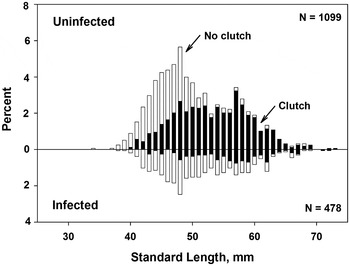
The size at which female ninespine stickleback began producing clutches appeared to vary among years (D. C. Heins, personal observations). Overall most uninfected females ≥50 mm SL produced clutches (Fig. 1). These combined data from unsorted samples collected 2000–2010 do not allow age determination using length–frequency analysis; however, data from selected years suggest that fish larger than 50 mm SL were mostly 2 years old (D. C. Heins, personal observation).
Length–frequency distributions (SL, mm) of female ninespine stickleback Pungitius pungitius from Dog Bone Lake, Alaska, 2000–2010 that were uninfected or infected by Schistocephalus pungitii. The percentages of females with (filled bars) or without (open bars) clutches of eggs are shown using stacked bars.

Host reproductive capacity
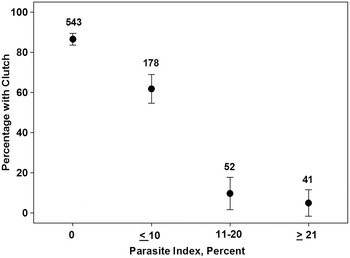
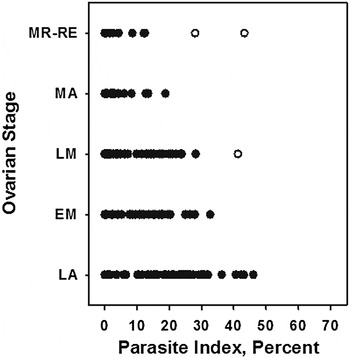
Infected, adult females of all sizes were capable of producing clutches of eggs (Fig. 1). Binary logistic regression based on adult females (≥50 mm SL) showed, however, that reproductive capacity was significantly reduced as PI increased (log-likelihood = −362·955, d.f. = 1, P < 0·001). Among uninfected females (n = 543), 86·6% had a clutch, whereas 61·8% of infected females with PI ≤ 10% had clutches, 9·6% of infected females with PI 11–20% had clutches, and 4·9% of infected females with PI ≥21% had clutches (Fig. 2). The distribution of ovarian condition with PI among infected females (Fig. 3) shows that with few exceptions increasing PI resulted in a reduction of females reaching more advanced stages of reproductive condition. Among MA females (n = 26), the average PI was 1·2% (range 0·03–13·46%); and among MR–RE females the average PI was 0·49% (range 0·00–43·29%). With the exception of three females outside the main group of observations (open circles, Fig. 3), females with a PI >32·67% did not show any observable ovarian development, and those with PI >28·19% were unable to undergo secondary oocyte growth (≥LM stage). Moreover, females with a PI >18·80% were unable to produce a clutch of eggs.
Relationship between parasite: host biomass ratio (PI) and the proportion of Pungitius pungitius adult females (≥50 mm SL) having a clutch (±95% confidence interval) among fish uninfected (PI = 0) or infected by Schistocephalus pungitii (0 < PI) from Dog Bone Lake, Alaska. The numbers above each plot indicate the sample size for that category.

Relationship between parasite: host biomass ratio (PI) and ovarian condition (stage: LA, latent; EM, early maturing; LM, late maturing; MA, mature; MR, ripening; RE, ripe) in un-parasitized and parasitized female ninespine stickleback (Pungitius pungitius, n = 814) from Dog Bone Lake, Alaska, during the reproductive seasons of 2000–2010. Open circles represent observations for three exceptional females.

Clutch size
A two-way ANCOVA using data from 2002 and 2004 showed that clutch size differed between years (F = 16·584; df = 1, 484; P < 0·001) but not between infected and uninfected females (F = 2·123; df = 1, 484; P = 0·146); however, there was a significant interaction between year and infection status (F = 12·784; df = 1, 484; P < 0·001). Clutch size increased between 2002 and 2004, whereas clutch size of infected females decreased (albeit non-significantly) between the 2 years. Analysis of clutch size for each year showed that it did not differ significantly between infected and uninfected females in 2002 (F = 2·650; df = 1, 321; P < 0·105); however, there was a significant difference (F = 12·211; df = 1, 162; P = 0·001) between infected (anti-log, 121) and uninfected (anti-log, 107) females in 2004. Among all host females used in these analyses (n = 121) the average PI was 2·3; and 97 of these infected females had a PI ≤ 1·0, whereas 24 had a PI > 1·0.
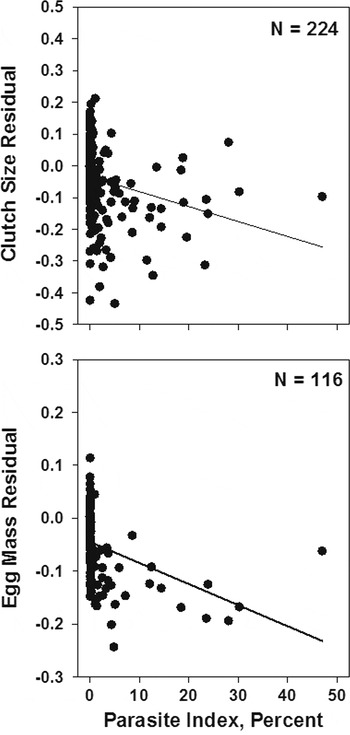
One-way ANCOVA using all clutch-bearing females caught from 2000 to 2010 showed that clutch size was significantly reduced (F = 54·798; df = 1, 1187; P < 0·001) among infected females (anti-log, 84) when compared with uninfected females (anti-log, 96). Among infected females, clutch size (residuals, correction for BM) showed a significant decline (F = 13·998; df = 1, 222; P < 0·001) with increasing PI (Fig. 4).
Relationship between clutch size residual (upper panel) and egg weight residual (lower panel) with PI among parasitized ninespine stickleback (Pungitius pungitius) from Dog Bone Lake, Alaska, 2000–2010.

Egg mass
Using data from both years, a two-way ANCOVA showed that mean egg weight differed between years (F = 6·442; df = 1, 304; P = 0·012) and between infected and uninfected fish (F = 70·890; df = 1, 304; P < 0·001). There was not a significant interaction between year and infection status (F = 2·943; df = 1, 304; P = 0·087). Mean ovum mass (anti-logs) was greater in 2004 (490 ug) than in 2002 (467 ug), whereas female hosts produced smaller ova in 2004 (444 ug) than those in 2002 (514 ug).
Among all ripe females caught from 2000 to 2010, a one-way ANCOVA showed that egg weight was significantly reduced (F = 195·021; df = 1, 598; P < 0·001) among infected females (anti-log, 435 µg) when compared with uninfected females (anti-log, 511 µg). Among infected females, egg weight (residuals, correction for BM) showed a significant decline (F = 20·286; df = 1, 114; P < 0·001) with increasing PI (Fig. 4).
DISCUSSION
The results of this investigation are consistent with two predictions of the nutrient theft hypothesis. Firstly, infected adult ninespine stickleback females in Dog Bone Lake are capable of reproducing at all sizes (ages), and host females with PIs as large as 19% can produce and ovulate clutches of eggs. Although the greatest PI observed for a ripe female (12%) was less than that of a MA female (19%), MA females should be able to ripen and ovulate their clutches if energy demands of ripening and ovulating do not exceed those of forming the clutch. Ninespine stickleback are apparently infected soon after they are born, and uninfected females typically become reproductive at the age of 2 years (Heins et al. Reference Heins, Singer and Baker1999, Reference Heins, Baker and Green2011). Larger, infected females would not be expected to reproduce if S. pungitii were a true parasitic castrator because the parasite should shut down reproduction early in the infection and before sexual maturity is attained. Second, the metrics of reproduction, including capacity for reproduction, clutch size, and egg weight, all decrease as the PI increases. Thus, the results of this study are consistent with nutrient loss resulting from parasite growth, hence, the nutrient theft hypothesis.
Baudoin (Reference Baudoin1975) argued that castration could be a host defence if: (1) the host is iteroparous; (2) the host has a chance to reproduce after the parasite leaves; and (3) reduced host fitness is compensated for by increased host survivorship and/or future fecundity. Host adaptation does not appear to be an explanation for loss of host reproductive capacity in this system because the death of the host is required for parasite transmission (Lafferty and Kuris, Reference Lafferty and Kuris2002; Kuris, Reference Kuris2003).
The impact of S. pungitii on reproduction of ninespine stickleback females in Airolo Lake was much more severe than that observed in Dog Bone Lake. In Airolo Lake, infected females typically were inhibited from producing clutches of eggs (Heins et al. Reference Heins, Ulinski, Johnson and Baker2004; Heins and Baker, Reference Heins and Baker2010). Only 4% of infected adult-size females were able to produce a clutch of eggs, and those females bearing clutches had PIs less than about 10% (Heins et al. Reference Heins, Ulinski, Johnson and Baker2004). Moreover, 73% of infected adult-size females were unable to initiate oocyte development and a total of 86% of them were unable to initiate secondary oocyte growth (Heins et al. Reference Heins, Ulinski, Johnson and Baker2004). The most parsimonious explanation for the difference in host pathology is that ecological differences involving resource ecology between the lakes resulted in different effects of the parasite on host reproduction. For example, Dog Bone Lake had more emergent vegetation along the shores than Airolo Lake (personal observation) and might have been a more productive lake. Thus, S. pungitii does not appear to be a true castrator, as suggested by results of earlier studies of the Airolo Lake population.
This study provides data contrasting with earlier reports addressing the host–parasite system involving ninespine stickleback and S. pungitii. The conclusion reached here serves as a hypothesis to be tested further, namely that nutrient theft is the causal mechanism for reproductive curtailment in host females and there might be population variation in reproductive traits of infected female fish resulting from differences in resource ecology among lakes.
Dog Bone Lake is about 133 air kilometres south-west of Airolo Lake. An alternative hypothesis to the resource ecology hypothesis is that there may be different genetic strains of S. pungitii that have evolved to exploit their hosts more or less aggressively. Although field studies like this one can provide a hypothesis to explain observed phenomena, research involving energetic studies and modern molecular methods such as transcriptomics and genomics are needed in natural and laboratory experiments to test the hypothesis.
The impact of S. pungitii on host reproduction is more severe than the impact of S. solidus on reproduction in threespine stickleback females (cf. Heins et al. Reference Heins, Singer and Baker1999, Reference Heins, Baker, Toups and Birden2010; Heins and Baker, Reference Heins and Baker2008). Reproductive capacity is lost at lower PIs in ninespine stickleback than in threespine stickleback. How, then, does one account for the difference in the effect of parasitism between stickleback species? The severe effect of infection on ninespine stickleback reproduction vis-à-vis that of threespine stickleback might reflect the heavy energy demands placed on a host that is much less capable of sustaining an infection. Uninfected threespine stickleback have a greater somatic mass at similar lengths than do ninespine stickleback (Heins and Ecke, Reference Heins and Ecke2012). Testing this hypothesis will require an analysis of reproductive effort (proportion of available energy that is allocated to reproduction) in host fish compared with healthy individuals (Schultz et al. Reference Schultz, Topper and Heins2006).
In summary, the initial hypothesis that S. pungitii was a true castrator – contrary to results emerging at that time for S. solidus – is now rejected based on new observations. S. pungitii appears to be a nutrient thief and the severity of pathology from infections appears to be influenced by environmental conditions, most likely resource availability. New discoveries based on new techniques such as energetic studies and transcriptomics, whether based on natural or laboratory experiments, will either support the nutrient theft hypothesis, lead to its modification, or result in its rejection and substitution of an alternative hypothesis.
ACKNOWLEDGMENTS
Several students at Tulane University have contributed to this research in the field and in the laboratory over the years, most notably including Kelly Barry, Emily Birden, Amanda Burr, Brent Carr, David Coffey, Gayan DeSilva, Johanna Ecke, Helen Knoper, Hillery Martin, Eric Soycher and Jennifer Weaver.
FINANCIAL SUPPORT
This research was supported by grants to David Heins from the Newcomb Foundation of Tulane University.