Introduction
Hematopoietic cell transplantation (HCT) is often indicated for children with severe primary immune deficiencies (PIDs). Families undergo significant psychological distress during the HCT hospitalization and have documented anxiety, depression, posttraumatic stress symptoms, and declines in health-related quality of life (Packman et al., Reference Packman, Weber, Wallace and Bugescu2010; Rodrigue et al., Reference Rodrigue, MacNaughton, Hoffmann, Graham-Pole, Andres, Novak and Fennell1997; Taskiran et al., Reference Taskıran, Adanır and Özatalay2016). It is well-established that parental depression and anxiety affect the attachment between the parent caregiver and child, and attachment disturbances are a significant risk factor for development of mental and physical health problems for a child (Colletti et al., Reference Colletti, Wolfe-Christensen and Carpentier2008; Wagner et al., Reference Wagner, Chaney, Hommel, Page, Mullins, White and Jarvis2003). Left unaddressed, many families may become overwhelmed by the process and use more hospital resources (Kazak et al., Reference Kaza, Cant, Jensen, McSherry, Rourke, Hwang and Lange2003).
Psychosocial services such as individual and family counseling and connection to community resources provide crucial support for patients and families affected by PID. Unfortunately, many of these nonmedical services provided to patients and their families vary in quality or are lacking completely across treatment centers. Currently, there are no evidence-based interventions or literature on what psychosocial services are offered to families going through the HCT process. Additionally, there is no published information on or evaluation of the psychosocial services that are provided to families.
To help healthcare providers, patient foundations, and researchers better understand what types of psychosocial care services are provided to patients and their families and learn more about how these services can be improved, we undertook an electronic survey of families of patients with one of three severe PIDs: severe combined immunodeficiency disease (SCID), Wiskott Aldrich syndrome (WAS), and chronic granulomatous disease (CGD). SCID is the result of absence of T cell immunity and inability to make specific antibodies (Dorsey et al., Reference Dorsey, Dvorak and Cowan2017) with >90% of affected children currently being diagnosed with newborn screening in the United States (Kwan & Puck, Reference Kwan and Puck2015). WAS and CGD are often diagnosed later in life and, depending on the severity of the disease, may not necessarily need an HCT (Griffith et al., Reference Griffith, Cowan, Notarangelo, Puck, Buckley, Candotti and Shearer2009). For all three PIDs, HCT is associated with a lengthy hospitalization of anywhere from 2 to 6 months. The objective of this study was to describe the psychosocial services that were offered and used by patients and their families affected by PID during HCT.
Methods
Research design and participants
Families were recruited by e-mail invitation containing a link to an anonymous unincentivized Web-based survey between April and May 2016. The survey was distributed through the following organizations given that PIDs are rare illnesses: Immunodeficiency Foundation; Primary Immune Deficiency Treatment Consortium (National Institutes of Health grant U54AI082973); SCID Angels for Life; Wiskott-Aldrich Foundation; and the Chronic Granulomatous Disease Association. Inclusion criteria were caregiver age ≥18 years of child with SCID, WAS, or CGD who received an HCT. Exclusion criteria included patients and families living outside the United States. Responses were reviewed for duplicates and potential overlap by examining demographic and medical characteristic details (e.g., age, place of transplant, date of transplant, current residency). The study received an institutional review board exemption from the Schulman institutional review board.
Measures
The 140-question survey instrument took approximately 30–45 minutes to complete and included some basic information about the caregiver, including, age, additional children, and household income. Additional information was collected about the child, including demographics (age, gender, race, and ethnicity), type of health insurance, type of PID, years since transplant, and hospital name and location in which transplant occurred.
The survey also included whether the family was offered a variety of counseling services, including individual, family, and sibling counseling during the HCT hospitalization. The importance of each counseling service was ranked on a 5-point Likert scale. If these services were offered, we asked about which member of the care team (physicians, nurses, or social worker) offered these services. Among those offered counseling services, we asked whether services were used and, if so, the family's satisfaction with each of these services (using a 5-point Likert scale). Survey respondents were also asked the reasons for not using counseling services. When the affected child or sibling was too young to be offered services, they were excluded from the analysis of individual or sibling counseling, respectively. Among those families not offered counseling services, survey respondents were asked whether they would have wanted these counseling services.
The need for financial assistance for medical costs in addition to housing was assessed. In addition, we collected the types of assistance received (foundation, self-fundraising, combination, none). The full survey instrument is available on-line (Supplementary material Appendix A).
Statistical analyses
Analyses were generally descriptive in nature, with categorical data summarized as frequencies/percents and numeric data summarized as median/range. Comparisons between groups were done using the Fisher's exact test for categorical data and Kruskal-Wallis test for quantitative data.
Results
Caregiver and patient characteristics
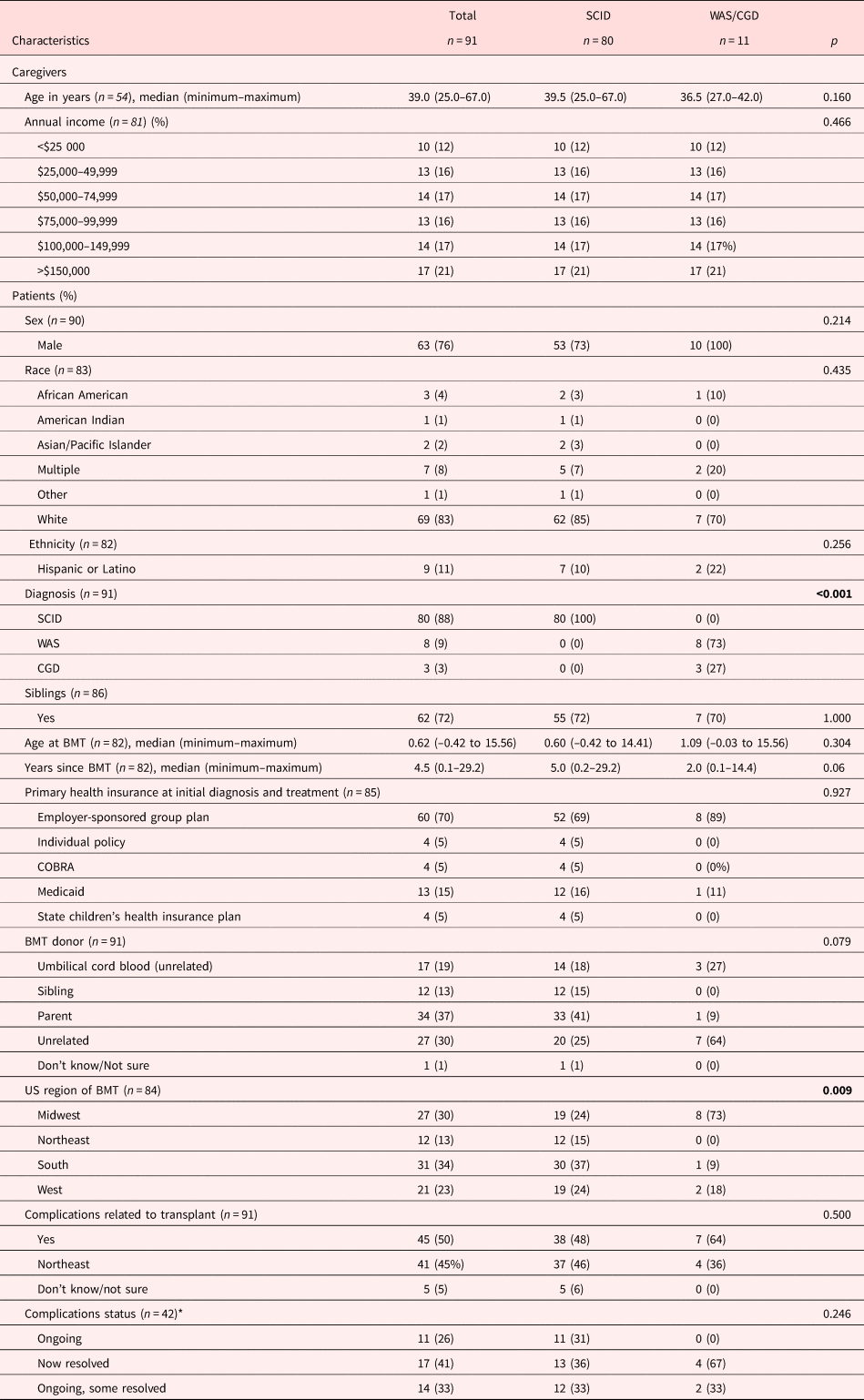
Among the 173 individuals who responded, 53% (91/171) met criteria for inclusion for this study across 35 hospitals. Eighty people were excluded because their child did not receive an HCT (71), they were not living in the United States (7), or there were duplicate entries for the same patient (2). Caregivers’ median age was 39 years (range: 25–67) with a median household income of $75,000–$99,000. The majority of the children with PID were male (76%, 63/91), white (83%), privately insured (71%), and had siblings (72%). The majority (88%) were diagnosed with SCID, had an HCT at a median age of 0.62 years (range: 0.42–15.56 years), with 50% having complications posttransplant. Complete details are provided in Table 1. Because respondents were allowed to skip portions of the survey and not required to answer all questions, the remaining results have variable denominators reported per variable in the tables. There were no significant differences between SCID and WAS/CGD families (Table 1).
Selected demographic and medical characteristics of caregivers and patients

BMT, bone marrow transplantation; CGD, chronic granulomatous disease; COBRA, Consolidated Omnibus Budget Reconciliation Act; SCID, severe combined immunodeficiency disease; WAS, Wiskott Aldrich syndrome.
Bolded values indicating significance P<0.05.
*Complication status was only asked of those who stated there were complications.
Psychosocial resources
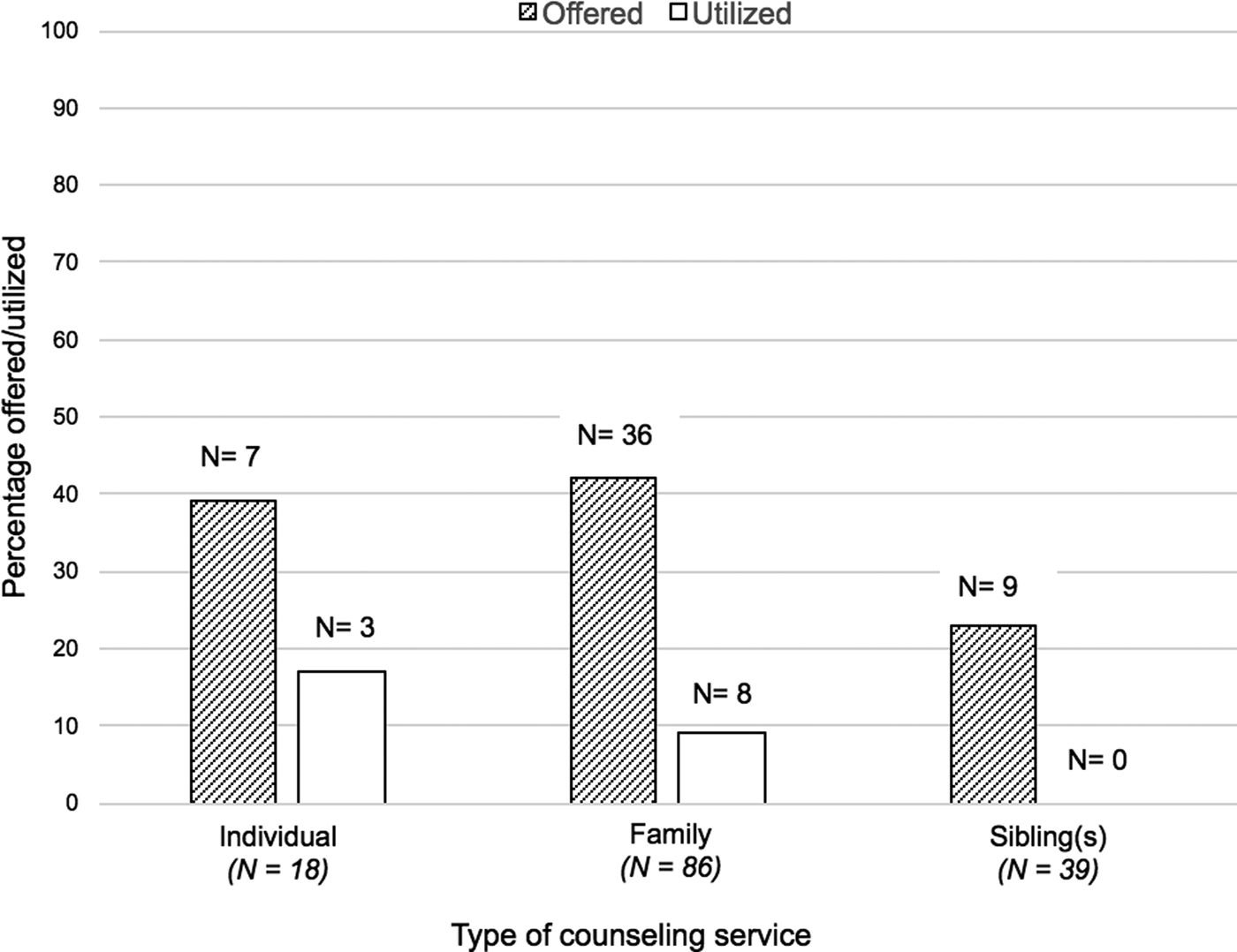
Figure 1 shows availability and utilization of different counseling services offered to families: (1) individual counseling for the pediatric patient; (2) family counseling; (3) sibling counseling; and (4) sibling donor counseling. Among pediatric patients who were old enough to receive counseling, 39% (7/18) were offered individual counseling and, among those offered, 58% (4/7) used these services and 75% (3/4) reported satisfaction. Among the 42% (36/80) of families who were offered counseling, only 22% (8/36) completed the treatment and 85% (17/20) reported satisfaction. Among the siblings who were old enough to receive counseling, 23% (9/39) were offered these services and none completed the counseling. Among sibling donors who were old enough to participate in counseling, 71% (5/7) were offered counseling and 80% (4/5) completed the services.
Availability and utilization of counseling.

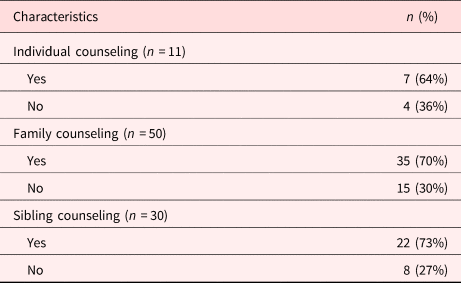
Among survey participants not offered individual counseling services, 64% (7/11) reported they would have liked these services for the pediatric patient. Similarly, of those not offered family counseling services, 70% (35/50) reported wanting these services. Among the 30 families not offered sibling counseling, 73% (22/30) wanted sibling counseling services. All parents of sibling donors who were not offered counseling services wanted counseling for their healthy child(ren). More details are found in Table 2.
Desire for counseling services among those who were not offered these in the hospital

Material needs
A total of 69% (62/80) of families reported needing housing during the transplantation. The majority (60%) of families also required financial assistance, with 46% (39/84) of those families receiving this aid from foundations.
Discussion
Our findings, although specific to families with PID, have broad implications for provision of psychosocial support for caregivers of all pediatric patients undergoing HCT. Our study found that less than one-half of families with PID were offered counseling services during the HCT process. Moreover, for those not offered counseling, more than one-half of the families indicated that they would like to have more individual, family, and sibling counseling. Family-based psychosocial interventions have been shown previously in other pediatric chronic illness populations, such as those with diabetes, to demonstrate sustained long-term improvements in health outcomes for both the child and family (Distelberg et al., Reference Distelberg, Emerson and Gavaza2016; Kazak et al., Reference Kazak, Boeving, Alderfer, Hwang and Reilly2005; Peris et al., Reference Peris, Rozenman, Sugar, McCracken and Piacentini2017).
Involvement of nonmedical services such as early palliative care consultations during inpatient hospitalization have been shown in prior research to decrease hospital resource utilization by facilitating transitions of care to outpatient settings (Ananth et al., Reference Ananth, Melvin and Berry2017; Conte et al., Reference Conte, Mitton and Trenaman2015). Initiating counseling services before hospitalization and tailoring sessions to specific issues relevant to each treatment phase including postdischarge and transitions home may improve completion rates (Fife et al., Reference Fife, Von Ah, Spath, Weaver, Yang, Stump and Farag2017). Further enquiry is needed to determine what the best timing, frequency, and type of intervention is needed for these nonmedical services.
Of those families offered counseling, few families completed counseling and/or declined counseling altogether because of time, financial cost, and lack of outpatient counseling options. This is consistent with the literature that reports difficulty of initiating and completion of counseling services because of availability of services, clinical staff not having time to offer services, transportation difficulties, and financial cost (Drotar et al., Reference Drotar, Eckl and Beitzel1997). Technology-enhanced services such as telecounseling can be used to reduce these barriers and increase access for families (Dorstyn et al. Reference Dorstyn, Mathias and Denson2012; Duan-Porter et al., Reference Duan-Porter, Van Houtven and Mahanna2017). When patients and their families completed counseling offered by the hospital, the overwhelming majority of families was very satisfied or satisfied indicating the need to reduce barriers and improve completion rates.
For patients and families that received financial assistance within the past 5 years, assistance was more likely to come from a combination of foundations and self-fundraising compared with only self-fundraising >5 years ago. Foundations play a major role in reducing the burden of financial hardship patients and families face. Perhaps connecting these families with foundations early will help provide the much-needed financial and psychosocial resources. Furthermore, community-based, family-to-family support has been demonstrated to reduce caregiver burden through shared experiences (Mittelman & Bartels, Reference Mittelman and Bartels2014).
Study limitations included small sample size, homogenous population, and convenience sampling; however, notably, these limitations are commonly reported with this PID population with small sample sizes generally ranging from 10 to 250 and fairly homogenous populations with infrequent diagnoses in nonwhite, non-Hispanic subjects (Bazregari et al., Reference Bazregari, Azizi and Tavakol2017; Cozon et al., Reference Cozon, Clerson and Dokhan2018; Macginnitie et al., Reference Macginnitie, Aloi and Mishra2011; Picard et al., Reference Picard, Al-Herz, Bousfiha, Casanova, Chatila, Conley and Gaspar2015; Sowers et al., Reference Sowers, Litwin, Lee and Galantino2018; Sultan et al., Reference Sultan, Rondeau, Levasseur, Dicaire, Decaluwe and Haddad2017). Given the rarity of PIDs, this study is the first to explore the offering and utilization of psychosocial services in this population during the HCT process. That said, further research is needed to survey subpopulations such as racial, ethnic minorities, non-English–speaking immigrants, and low-income populations. Further, this study has broader implications for offering psychosocial services to caregivers of children with life-threatening and/or chronic illnesses with long hospitalizations.
Only a minority of families are offered counseling during hospitalization for HCT for PID. Patients, caregivers, and siblings undergoing HCT, or similar long hospitalization stays, may all benefit from various psychosocial support mechanisms. Hospitals should consider offering individual, family, and sibling counseling to more PID patients and their families on early and frequently in the HCT process. Future research should focus on reducing barriers in accessing and completing counseling services such as online treatment modalities with telemedicine consultations, bedside counseling services, and broadening psychosocial support through connections to PID foundations.
Supplementary material
The supplementary material for this article can be found at https://doi.org/10.1017/S1478951518000603.
Acknowledgments
This study was a collaborative effort between the Primary Immune Deficiency Treatment Consortium, Immune Deficiency Foundation, SCID Angels for Life, the Wiskott-Aldrich Foundation, and the Chronic Granulomatous Disease Association. Special thanks to Barbara Ballard, Ann Boulis, Marcia Boyle, and Mary Hurley (deceased).
Conflict of interest
MJC discloses Data and Safety Monitoring Board (DSMB) for Bluebird Bio and Scientific Advisory Board (SAB) for Exogen Bio and Homology Medicine with stock options. CM was supported by a grant from the National Institute of Mental Health (K23 MH093689). JY was supported by the University of California San Francisco Resource Allocation Program for Trainees (RAPtr). MJC and BL are supported by the Division of Allergy, Immunology and Transplantation, National Institute of Allergy and Infectious Diseases; and the Office of Rare Diseases Research, National Center for Advancing Translational Sciences, National Institutes of Health, Bethesda, MD, Public Health Service grant/cooperative agreements U54-AI082973 (principal investigator: MJC) and R13-AI094943 (principal investigator: MJC). The remaining authors declare no potential competing interests.