Hypoplastic left heart syndrome is a rare congenital heart defect managed with staged Fontan palliation which is associated with late-term complications including arterial and venous thromboembolism, single ventricle failure, and arrhythmias.Reference Alsaied, Alsidawi and Allen1 However, thromboembolism of the coronary arteries is rare, especially in young patients. We report a case of coronary emboli in a 10-year-old Fontan patient.
Case description
Our patient is a 10-year boy with hypoplastic left heart syndrome who underwent staged, extracardiac fenestrated Fontan palliation, completed at 3 years of age. At 5 years, he underwent device closure of his fenestration with no residual right-to-left shunt. To our knowledge, he was compliant with his only home medication, aspirin 81 mg daily.
He presented with chest pain radiating to the neck, which resolved within a few minutes without any intervention. Electrocardiogram showed ST depression in leads V1–V3 (Supplemental Figure 1) and his serum troponin was elevated at 1.4 ng/ml. Chest X-ray, basic metabolic panel, and complete blood count were within normal limits. Initial echocardiogram demonstrated low normal right ventricular systolic function and a patent, undilated Fontan pathway. He was admitted to the cardiac ICU and his troponins continued to rise, peaking at 33.4 ng/ml.
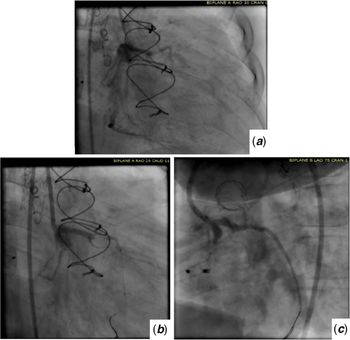
Due to the rising troponins, a heparin drip was initiated. He underwent cardiac catheterisation, which showed near-complete occlusion of the left circumflex artery (Fig 1a and b). Balloon angioplasty of the left circumflex artery followed by manual aspiration of the clot was performed, leading to significant improvement in flow to the distal left circumflex artery (Fig 1c). He was started on clopidogrel and was maintained on a heparin drip and aspirin.
First cardiac catheterisation for Case 1. LCX = left circumflex artery. (a) Near occlusion of LCX noted. (b) LCX with wire in place pre-intervention. (c) LCX post-intervention, demonstrating good flow into vessel.

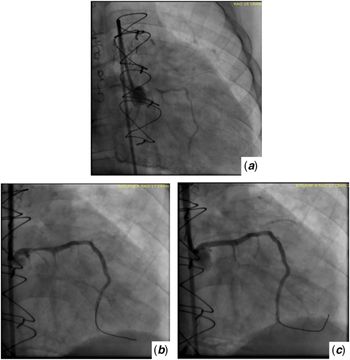
The following day, he developed neck pain and vomiting without any chest pain. Repeat echocardiogram showed moderately depressed right ventricular systolic function with akinesis of right ventricle apex and interventricular septum. His troponins increased from 19.25 ng/ml after cardiac catheterisation on the previous day to a peak of 46.65 ng/ml. He underwent emergent cardiac catheterisation and was noted to have recurrent near-complete occlusion of the left circumflex artery (Fig 2a). Mechanical thrombectomy and aspiration were performed, with restoration of flow in the left circumflex artery (Fig 2b). Due to severe stenosis of the vessel, a Medtronic Resolute Coronary Stent was placed (Fig 2c).
Second cardiac catheterisation for Case 1. LCX = left circumflex artery. (a) Near occlusion of LCX. (b) Following aspiration of emboli, improved flow through LCX, though proximal portion appears stenotic. (c) LCX after stent placement, demonstrating good blood flow.

Carotid duplex, abdominal duplex, and CT scan of thorax did not show any evidence of clot. His thrombophilia work up including lupus anticoagulant, extractable nuclear antigen antibodies (ENA), anti-nuclear antibody (ANA), anticardiolipin, and Protein S were all within normal limits except for protein C which was low at 24%. He improved clinically, and since thromboelastography suggested potential aspirin resistance, he was discharged on warfarin, aspirin, and clopidogrel. On his echocardiogram prior to discharge, his right ventricular function improved slightly but still remained moderately depressed.
Comments
Patients with Fontan palliation are at risk of thromboembolism, with the incidence estimated to be as high as 11.3%.Reference Alsaied, Alsidawi and Allen1 The risk factors for thromboembolism are low cardiac output, residual right-to-left shunting, decreased coagulation factors, and atrial arrhythmias.Reference Alsaied, Alsidawi and Allen1 Thromboembolic complications can be as high as 55% in 10 years after developing an arrhythmia.Reference Egbe, Connolly and McLeod2
Despite predisposition to thromboembolism, myocardial infarction is rare in Fontan patients. On review of the literature, we found at least four cases of coronary artery thromboembolism reported in this patient population, with ages varying between 17 and 24 years.Reference Morchi, Wolfe and Kay3–Reference Deshpande, Dalal and Kim6 Two of them were born with hypoplastic left heart syndrome, and the other two were diagnosed with pulmonary atresia and tricuspid atresia, respectively.Reference Morchi, Wolfe and Kay3–Reference Deshpande, Dalal and Kim6 Chest pain with ST-segment changes on electrocardiogram was the presenting complaint leading to coronary angiogram in all cases. While one underwent medical management with warfarin and aspirin, the other three patients required percutaneous coronary intervention, which included balloon angioplasty and thrombectomy.Reference Morchi, Wolfe and Kay3–Reference Deshpande, Dalal and Kim6 Of the intervention group, one of them required percutaneously inserted ventricular assist device placement as a bridge to heart transplant due to significant systemic ventricular dysfunction.Reference Deshpande, Dalal and Kim6 To our knowledge, our 10-year-old patient is the youngest patient with Fontan palliation presenting with coronary artery embolism.
The mechanism for coronary artery emboli in Fontan patients is unclear. We speculate that anastomosis of the aorta to the pulmonary trunk performed as a part of the Norwood procedure may serve as a nidus for thrombus formation and predispose to coronary artery embolism at a later time. Previous case reports have proposed that the under-functioning, hypoplastic left ventricle (LV) may be a source of thrombus.Reference Morchi, Wolfe and Kay3,Reference Shamoon, Habib and Rampal5 One patient was noted to have antiphospholipid syndrome, which was potentially a contributing factor to myocardial infarction.Reference Morchi, Wolfe and Kay3 Our patient had an essentially negative thrombophilia work up, making the chances of a coagulation disorder leading to the embolism unlikely.
Optimal anticoagulation for patients with Fontan palliation remains unclear. A recent meta-analysis suggests that the use of aspirin or warfarin prophylaxis may reduce thromboembolism in these patients.Reference Alsaied, Alsidawi and Allen1 However, there are no statistical differences in rate of thromboembolism for aspirin versus warfarin.Reference Alsaied, Alsidawi and Allen1 The recent American College of Cardiology guidelines for the care of patients with adult CHD recommend initiation of anticoagulation for Fontan patients with history of atrial arrhythmias or previous thromboembolic events.Reference Stout, Daniels and Aboulhosn7 Our patient had no such predisposition, but after incurring this life-threatening thromboembolic episode, he will likely be on life-long anticoagulation.
Chest pain is a frequently reported symptom in post-operative cardiac patients. While most of the time, the chest pain is non-cardiac in aetiology for these patients, our case and the other previously reported ones underscore the importance of evaluating this non-specific symptom carefully and systematically keeping in mind some rare complications specific to this group of patients. Most reported patients had abnormalities in their electrocardiogram which should be carefully reviewed and compared to the previous studies.Reference Morchi, Wolfe and Kay3–Reference Deshpande, Dalal and Kim6 Cardiac enzymes should be obtained and serially followed if deemed necessary.
In summary, patients with Fontan palliation may be at risk for developing coronary event due to thromboembolic phenomenon even in the absence of traditional coronary artery disease risk factors. Aspirin resistance should be considered and evaluated for in these patients. A high index of suspicion for coronary events is required for evaluation of chest pain, and these patients should be monitored closely.
Supplementary material
To view supplementary material for this article, please visit https://doi.org/10.1017/S1047951120001274
Acknowledgements
None.
Financial support
This research received no specific grant from any funding agency, commercial or not-for-profit sectors.
Conflicts of interest
None.