THE POWER THAT COMES FROM being English in the Victorian period is crucially dependent on a categorizing imperative that establishes and structures a series of distinctions such as those between citizen and foreigner, colonizer and colonized, and metropole and colony. These distinctions have epistemological borders that require policing, as do all cross-border interactions that threaten to muddy the imperial landscape with unsanctioned forms of knowledge and affiliation. It is against such a framework of constraints for understanding the regulation of Englishness that the story of the Jamaican-born Mary Seacole and her self-styled role as “Mother” Seacole to British soldiers during the Crimean War appears particularly pregnant with bothersome possibilities. Seeking self-consciously to identify herself with the “mother” country and the imperial metropole, she constantly tests the waters of reception by English society in the mid-nineteenth century. Seacole deploys the image of her racially different body in various noticeably frontier places, mainly Panama and the Crimea, to induce a recognition of herself, if not as English, then as at least functionally so. In so doing, she disrupts the claim to cultural or national identity that is frequently grounded in racial and geographical specificity.1
Indeed, Seacole's Anglophilism and identification with Englishness has proven to be a source of considerable embarrassment for many scholars. In their introduction to Wonderful Adventures, for example, Ziggi Alexander and Audrey Dewjee note that Seacole “is not an obvious heroine for modern times” because of her mixed feelings about representing herself as a black woman (9). Evincing a similar disquietude, David Dabydeen and Nana Wilson-Tagoe characterize Seacole's show of patriotic fervor towards the British in her narrative as “embarrassing and gauche” (137). At the same time, despite Seacole's relative silence about Jamaica in her text, she has been enshrined as a national figure in Jamaica. Her name graces a hall of residence at the University of the West Indies and a stamp was issued bearing her image. See Alexander and Dewjee 40; and Hawthorne 311. Seacole's text has also been resuscitated under the banner of the Schomburg Library series of nineteenth-century African-American and Black women writers. William L. Andrews, who wrote the introduction to the Schomburg edition of the text, explicitly (if rather unproblematically) identifies Seacole as “Afro-American” (xxvii).
Born to a Scottish father and a Jamaican Creole mother, Mary Seacole was a business-woman and “doctress” who journeyed to such unconventional destinations as Panama and Cuba.2
For biographical material, see Alexander and Dewjee 9–45.
A combination of autobiography and travel narrative, Wonderful Adventures is a self-endorsing testimonial of patriotic and heroic work performed during the Crimean War. It is an exercise in self-fashioning that represents Seacole's attempts to negotiate a socially and economically comfortable position for herself vis-à-vis a white metropolitan audience. For someone from the Empire, the act of claiming an English subject position is a fraught dialectical process always informed by those who can speak from under the umbrella of “authenticity.” As a racially-mixed or mulatto woman, Mary Seacole was visibly outside the physical markers of Englishness, plainly situated beyond the pale. Yet she staked out a maternal role for herself in relation to her British soldier-sons, publicly lodging herself within the privileged private seat of familial affection and sentiment. That she could appropriate and rewrite that most intensely-felt of blood ties – the mother-son bond – is a move enabled in large part by the liminality of the Crimean warfront. At once embodying and transgressing the norms of Victorian femininity, Seacole came to represent the comforts and values of home in the relative absence of other white British women. Ironically, if less obviously, I argue, the condition of possibility for this move also lies paradoxically in its sheer incongruity. Through some adroit rhetorical maneuvering in Wonderful Adventures, I suggest that Mary Seacole forges links with Englishness in ways that clearly and strategically draw attention to her body and the material “fact” of her racial difference. Writing with characteristic good humor, she highlights rather than elides the inconsonant, revealing a keen eye for the ridiculous and the dramatically comic throughout her travels and many adventures. She pushes the idea of embodying Englishness – adopting an English subject position and literally inhabiting a body that must cohere with such a position – in new directions and suggests the ways in which Englishness as a discourse produces materiality in the form of racialized bodies.
Seacole's genial tone and her frequent willingness to cast herself as the object of humor, however, disguise deep anxieties. As a Jamaican Creole woman, she had to confront entrenched and specific representations of black and mulatto women from the West Indies. The specter of black and mulatto female sexuality, with its associated images of promiscuity and gross sexual appetite, lurks on the edges of Seacole's text and haunts her performative strategies. In narrating her adventures, she positions her ideal reader as English and male, at times adopting a coyly flirtatious tone when signaling the fact of her widowed and unmarried status. For the most part, however, she downplays the potential sexual implications of her independent peregrinations and her friendly association with British soldiers by glossing over references to her own sexuality. Claiming motherhood and deploying the attendant rhetoric of care and domestic comfort becomes a way of defusing more problematic questions about sexuality. Moreover, Seacole's attempt to legitimize her hold on the British public's attention as a benevolent desexualized mother figure had to be undertaken in the shadow of another Crimean heroine – the indomitable Florence Nightingale. Irreproachably white, upper-class and well-connected, the Lady with the Lamp lent herself more readily to appropriation as a national icon. In contradistinction to the heroic yet in many ways more remote figure Nightingale cut, however, the emphatically corporeal, even corpulent, Seacole sought simultaneously to insinuate herself into a more elevated position as “doctress” while also representing the simple, tangible, and earthy virtues of home.
Throughout Wonderful Adventures, Seacole mobilizes the narrative energies of conventional travel writing, using many of its tropes to script her identity and subject position (see Figure 1). The unorthodox places to which she travels form the sites of the multiple encounters with different groups and cross-cultural interaction reminiscent of the “contact zone.”3
See Pratt 6–7.
To be a colonial subject in the nineteenth century, then, is to exist in a cultural cul-de-sac: you cannot speak or exist except in the terms established by the imperium; you have to speak to exist, but you can utter only what the dominant allows you to utter; even when you speak against the culture of colonialism, you speak its language because it is what constitutes what you are. (142)
For an alternative reading of Seacole's narrative as subversive of the imperium despite her open support for England, see McKenna.

Cover illustration, The Wonderful Adventures of Mrs. Seacole in Many Lands. London: Blackwood, 1857.
Yet, to what extent is this dilemma readily acknowledged, even flaunted, by Seacole in her appeals to her English audience? Gikandi observes that Seacole is well aware of the precarious and problematic nature of her claims to an English identity. Could we, however, read that self-awareness as paradoxically instrumental to Seacole's definition of her connection to Englishness? While not downplaying the historical constraints that prevent her from being an autonomous subject, I want at the same time to put greater store by this discursive appearance of extra knowledge and read her text in terms of an interactive performance. Thus what might ultimately serve to connect her to Englishness is not so much her repeated assertions of loyalty and patriotism to England but a sense of shared knowledge with the English audience she constructs – a shared knowledge of discrepancy, of irony, and of mimicry5
See Bhabha 85–92.
For an assessment of Seacole's “inauthenticity” as a Caribbean subject, see Paquet. In “The Enigma of Arrival,” Paquet relies on an essentialist language of self and true identity to examine Wonderful Adventures. Her emphasis is on excavating the “inner core of Mary Seacole” (661) and charting the rhetorical tussle in the latter's text between the “Jamaican core of her fate and personality” (659) and her attempts to assume the mantle of Crimean heroine. Seacole's individualistic celebration of her place in Empire and her refusal to engage with the “politics of colonialism as a lived reality in the Jamaica of her day” (658) constitute her alleged inauthenticity. In contrast to Seacole's text, Mary Prince's slave narrative, The History of Mary Prince, A West Indian Slave (1831), is more authentic for “reflect[ing] an embryonic nationalism formed in resistance to slavery” (651). In telling her story, Mary Prince is valorized for her “peasant rootedness” (661) and implanted securely in the West Indies in a way that Seacole is not. Authenticity is here linked to implied and ostensibly more material states of being, to such indisputably physical and palpable objects as land and a body that registers the fact of slavery so conspicuously and indelibly on itself. Proceeding from less essentialist assumptions about identity, Cheryl Fish employs the notion of what she calls a “mobile subjectivity” to analyze Seacole's shifting subject positions according to the specificities of location, genre, colonial power, and racial and gender politics (477). Reading Seacole as a picara figure, she shows how Seacole's various narrative strategies explode easy binaries and deny rigid, authentic identity formations. Faith Smith counters the easy binarism between the authentic and the inauthentic, England and the Caribbean, by floating the possibility of “remain[ing] regionally identified even when one's attachment is inflected by all sorts of influences” (902). Baggett teases out some of the contradictions and complexities in Seacole's identity negotiations, arguing that “home” for her might in the end be less a geographical place than “a space of constant negotiation between the intersections of racial, sexual, cultural, and ideological difference” (55).

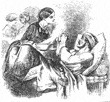
“Our Own Vivandière.” Punch 30 May 1857, 221.
Performance Rules in Wonderful Adventures of Mrs. Seacole in Many Lands
MARY SEACOLE BEGINS HER NARRATIVE by carefully plotting out the co-ordinates of her personal history and providing her readers with the racial compass with which she would like them to navigate the rest of her story.7
All subsequent page numbers refer to the 1988 Oxford UP edition of Wonderful Adventures.
In laying out the genealogical basis for her unique character and chosen path in life, Seacole also attempts to determine the terms of her relationship with her readers and to establish discursive authority. Lacking the social power that comes from being white, male, and English by birth, Seacole is ill-placed to claim the textual and narrative authority that typically forms the natural corollary of such power. Compounding this narrative disadvantage is the extratextual problem of her bankruptcy, the key factor motivating her writing. Wonderful Adventures must ultimately appeal to the English public and to their pockets. Seacole's bid for discursive authority, however, does not lie in merely being obsequious and ingratiating to her English audience. Like all performances, hers must be interesting. She moves from drawing on shared knowledge with her readers to insisting on her own experiential knowledge, thus casting herself as one of a community with her English audience on some occasions and asserting her individuality on others. In Seacole's view, involving her audience calls for humour, irony, and occasional self-parody. Near the start of her book, she refrains, for instance, from disclosing the year of her birth, begging leave of her readers to exert this traditional prerogative as “a female, and a widow” (1). Her tone is one of easy familiarity and seeming propriety: she strikes the conventionally coy pose of a woman concerned not to reveal her age and establishes a bond with the reader that borders on the flirtatious. Seacole continues this rather playful mode of addressing the reader when she alludes to her travels and adventures, pursuits more commonly understood as masculine. She notes that “some people” have called her a veritable “female Ulysses,” adding “I believe that they intended it as a compliment; but from my experience of the Greeks, I do not consider it a very flattering one” (2). With one stroke, she claims the right to her own self-definition, privileging the “homespun” and first-hand experience of modern Greeks gained through travel over knowledge of the Western classical tradition. As with many of Seacole's linguistic manoeuvres in the text, the dissenting edge of this move is tempered by the winsome sense of ignorance and simplicity she also attempts to convey. Seacole slips into the rhetorical posture of a likeable and harmless character replete with quirks and peculiarities towards which she invites the English reader to be indulgent. Indeed, the way she courts her reader is an open affectation and the latter must play his or her part in order to come along for the promised ride.
In Wonderful Adventures, the main theatres for Seacole's performance and embodiment of Englishness are the culturally fluid sites of Panama and the Crimea. Serving as the point of confluence for travelers making their way to and from the gold fields of California, Panama is both contact zone and carnivalesque space. As contact zone, Panama represents a site of cultural entanglement and negotiation where “[c]ultural action, the making and remaking of identities, takes place…along the policed and transgressive intercultural frontiers of nations, peoples, locales” (Clifford 7). The presence of other races and cultures in the town of Cruces where she manages her store presents Seacole with a classic opportunity for strategically aligning herself with England and English values.8
See, for example, Cooper 125; and Kavalski 8.
I think, if I have a little prejudice against our cousins across the Atlantic – and I do confess to a little – it is not unreasonable. I have a few shades of deeper brown upon my skin which shows me related – and I am proud of the relationship – to those poor mortals whom you once held enslaved, and whose bodies America still owns. (14, emphasis added)
In addition to being the site of multi-cultural contact, Panama is also characterized by the carnivalesque. Revelling in its general lawlessness, it is a space of chaos and excess where the “natural” social order is reversed and distinctions are blurred. In this space, Seacole seeks to embody the avowedly English imperial values of order and civilization, a charge she takes on in strategically comic terms. She depicts her life in Panama as a constant war waged against all manner of thieves, cheats and disreputable customers who throng her otherwise respectable hotel. She decries the “unpleasant specimens of the fair sex” (50) she encounters only to display self-consciously and humorously her ordered and properly feminine body amidst all the chaos. As she takes great pains to assure the reader, she was dressed in strict adherence to Victorian middle-class standards of femininity. Directing the reader's gaze onto herself, she reveals her person outfitted in “a delicate light blue dress, a white bonnet prettily trimmed, and an equally chaste shawl” (13). As narratives by female travellers in the Victorian period show, rhetorical insistence on feminine modesty and dress is de rigueur as these women venture metaphorically into masculine territory through their journeys to foreign lands. Seacole's description of her appearance fits this narrative pattern. At the same time, she is eager to appeal to shared ideals of decorous female behaviour as a means of locating herself within the same cultural space as her English readers. Her choice of the word “chaste” reiterates her uncontaminated moral worth and dispels any hint of sexual impropriety. On another level, this textual moment also serves to further the endearingly comic image of herself Seacole is invested in cultivating. She invites the reader to sympathize with her “distress” and “piteous plight” as, predictably enough, her dress is destroyed in the course of her journey and “looked as red as if, in the pursuit of science, [she] had passed it through a strong solution of muriatic acid” (13). The comedy is destabilizing but it is Seacole's invitation to the reader to laugh with her at herself that becomes another, perhaps stronger, point of connection.
Comedy becomes more complicated, however, in the face of explicit English racism. The outbreak of the Crimean War prompts Seacole to volunteer her services as a nurse to the British army. Her “long and unwearied application at the War Office” comes to naught (77). But she is determined not “to blame the authorities who would not listen to the offer of a motherly yellow woman to go to the Crimea and nurse her ‘sons’ there,” alleging that it was “natural” that they should “laugh, good-naturedly enough” (78) at her. Seacole hedges her criticism of how, as a “yellow” woman, she was obviously rejected on racial grounds by the authorities. Far from being accusatory, her tone is half-apologetic and appears to be that of someone unwilling to believe the worst of others. Her earnest attempts to explain away the authorities’ “natural” reaction belie, however, the ironic, knowing quality of her writing. After failing in her appeals to Sidney Herbert, the Secretary-at-War, his wife, and another associate of Florence Nightingale, she writes:
Doubts and suspicions arose in my heart for the first and last time, thank Heaven. Was it possible that American prejudices against colour had some root here? Did these ladies shrink from accepting my aid because my blood flowed beneath a somewhat duskier skin than theirs? Tears streamed down my foolish cheeks, as I stood in the fast thinning streets. (78–79)
Camped at the warfront and close to the scenes of fighting, Seacole is uniquely located within a male-identified terrain that allows her to generate a play on gender, racial, and national identities. While war solidifies national identities by pitting nations against each other and asking soldiers to die in the name of their countries, the war zone might nonetheless be said to be characterized by a certain fluidity and liminality. Although not without its own social rules and codes, the war zone is by definition a provisional space. It represents a temporary suspension of the normal power relations and restrictions that govern day-to-day living as its principal actors are caught in a liminal state between life and death, victory and defeat. But “liminality,” as Victor Turner has described in relation to theatre and ritual, is “full of potency and potentiality. It may also be full of experiment and play…In it, play's the thing” (33).9
See Turner 33.
Seacole's position at the Crimea among the British soldiers, she tells the reader, was that of “doctress, nurse, and ‘mother’” (124). As “Mother Seacole” or “Mami” to her British soldier “sons,” she sought to naturalize her connection to England.10
In A Culinary Campaign, Alexis Soyer mentions that Seacole had a daughter called Sarah. Alexander and Dewjee think he was likely mistaken. Whether Sarah was Seacole's biological daughter or not, it is significant that the latter makes no mention of her. In her narrative, Seacole is free of any biological family ties by the time she is in the Crimea and she is careful not to give any semblance of having any dependents. Her affections and maternal feelings center squarely on her British soldier sons.
But in assuming a maternal role, Seacole is also invested in creating a comic, non-threatening, and desexualized feminine identity. Thus she directs the reader's gaze repeatedly to her rotund, motherly body, to her “well-filled-out, portly form – the envy of many an angular Yankee female” (86). Fat and jolly, she stands for home in the eyes of the British soldiers by bringing them English comfort food and nourishment. At one point, she petitions the male reader directly and appeals to his ability to identify with his fellow countrymen when she asks rhetorically:
Don't you think, reader, if you were lying, with parched lips and fading appetite, thousands of miles from mother, wife, or sister, loathing the rough food by your side, and thinking regretfully of that English home where nothing that could minister to your great need would be left untried – don't you think that you would welcome the familiar figure of the stout lady whose bony horse has just pulled up at the door of your hut, and whose panniers contain some cooling drink, a little broth, some homely cake, or a dish of jelly or blanc-mange – don't you think, under such circumstances, that you would heartily agree with my friend Punch's remark: –
“That berry-brown face, with a kind heart's trace
Impressed on each wrinkle sly,
Was a sight to behold, through the snow-clouds rolled
Across that iron sky.” (126)
More frequently than was agreeable, a shot would come ploughing up the ground and raising clouds of dust, or a shell whizz above us. Upon these occasions those around would cry out, “Lie down, mother, lie down!” and with very undignified and unladylike haste I had to embrace the earth, and remain there until the same voices would laughingly assure me that the danger was over, or one, more thoughtful than the rest, would come to give me a helping hand, and hope that the old lady was neither hit nor frightened. (157)
The full import of Seacole's maternal performance and incursion into Englishness cannot be understood without considering it in relation to the position Florence Nightingale occupied in the British public's cultural and national imagination during the Crimean War.11
Florence Nightingale is commonly regarded as the founder of modern nursing. The job of tempering her image as a compassionate ethereal figure by calling attention to her stern professional, even unpleasant, side was undertaken posthumously by various biographers – most famously, Sir Edward Cook (1914), G. Lytton Strachey (1918), and Mrs. Cecil Woodham-Smith (1951). See Hebert for a sample of different writings on Nightingale. See Goldie for a comprehensive selection of Nightingale's letters to various officials and family members.
She had an utter disregard of contagion; I have known her spend hours over men dying of cholera or fever. The more awful to every sense a particular case, especially if it was that of a dying man, her slight form would be seen bending over him, administering to his ease in every way in her power, and seldom quitting his side till death released him.12
See Hebert 94.
See “The Nightingale's Song to the Sick Soldier,” Punch 1854, 184; “A Nightingale in the Camp,” Punch 1855, 229; “The Nightingale's Return,” Punch 23 August 1856, 73.

“The Nightingale's Song to the Sick Soldier.” Punch 4 Nov. 1854, 184.
In economic and social terms, the fact of Nightingale's class background means that her voluntary assumption of nursing as a job is easily recoded into a language of saintly self-sacrifice and vocation ideal for the national narrative. Thus spared of the association with the laboring poor and the working class as well as the reputation for drink and unsavory behavior traditionally assigned to nurses, Nightingale's story made possible her distance from material concerns even as she was intimately involved in practical matters regarding army and hospital supplies. Without the luxury of Nightingale's class status, Seacole's uneasiness about being identified as a sutler engaged in the running of a hotel and store in the midst of a war is clear. That she is vulnerable to charges of opportunism and self-interest is alluded to and managed from the start, addressed in the preface to the narrative by the influential W. H. Russell. Russell writes to convince the reader that Mrs. Seacole is the “first who has redeemed the name of ‘sutler’ from the suspicion of worthlessness, mercenary baseness, and plunder” (viii). While Seacole does not hide her business activities in Wonderful Adventures, she markets herself as a purveyor of “home” comforts and regales her readers with an inventory of her merchandise, styling her food and goods as so many commodified forms of Englishness to be consumed. In a similar vein, her boarding house, the British Hotel, is stripped of profit-making associations and presented as a safe haven and respectable establishment free from the twin vices of drink and gambling. “Confusion and disorder” may reign in the camps and on the battle-field, Seacole writes, but “comfort and order were always to be found at Spring Hill” (113).
For the most part, at the risk of jeopardizing support for her own story in Wonderful Adventures, Seacole maintains a prudent and politic silence when it comes to Florence Nightingale. Her comments on the latter in her narrative are brief and confined to general praise. Of their first meeting, Seacole writes:
A slight figure, in the nurses’ dress; with a pale, gentle, and withal firm face, resting lightly in the palm of one white hand, while the other supports the elbow – a position which gives to her countenance a keen inquiring expression, which is rather marked. Standing thus in repose, and yet keenly observant – the greatest sign of impatience at any time a slight, perhaps unwitting motion of the firmly planted right foot – was Florence Nightingale – that Englishwoman whose name shall never die, but sound like music on the lips of British men until the hour of doom. (90–91)
Seacole's agreeable persona is also reinforced by press coverage. See, for example, the Times account of “The Seacole Festival” (28, 30 July 1857) held to raise funds for her after the war.
In her study of Florence Nightingale and the latter's emergence in the mid-nineteenth century as a central player in the national and imperialist mythologizing of England, Mary Poovey notes how Nightingale's views on nursing underscored the tenets of Victorian domestic ideology while outwardly appearing to subvert them.15
See Poovey 164–98.
In one instance in Wonderful Adventures, for example, when a yellow fever epidemic in Jamaica left many Britons dead, Seacole muses, “Indeed, the mother country pays a dear price for the possession of her colonies” (60). This carefully understated comment hints at a retributive justice at work against a hubristic imperial power that has dared to rule and control territories so completely different from itself both geographically and culturally. However, Seacole proceeds to annul the force of her observation by suggesting the fortuitousness of Jamaican Creoles naturally taking it upon themselves to look after their English colonizers. “Nature” has “instill[ed] into the hearts of the Creoles an affection for English people and an anxiety for their welfare, which shows itself warmest when they are sick and suffering” (60). Yet, while the colonial relationship between the English and the Creole is deliberately figured in non-conflictual terms, it is significant that the power dynamic is in the Creole's favour: the latter is the one naturally blessed with the “healing art” (60) and positioned to administer aid and comfort to the weaker colonial master. In a similar vein, we may read Seacole's maternal performance during the Crimean War as equally if implicitly suggestive of authority and power since the mother/son and doctor/patient configuration counters the power asymmetry of the colonizer/colonized and white Englishman/colored Jamaican woman relationship.
More often than not, the subversive elements in Seacole's text and her performance of Englishness are inextricably bound up with a sense of play and framed within an overtly theatrical and dramatic context. In “Authority and the Public Display of Identity,” Amy Robinson shows how Seacole draws on Victorian conventions of minstrelsy.16
See Robinson 545; and McKenna 225.
Seacole's rhetorical construction of a persona able to appreciate the comic potential of her performance is perhaps most evident when she narrates her reception by the Russians following the fall of Sebastopol. Highlighting the fact that she was the first woman from the English lines to enter Sebastopol bearing relief supplies, she writes: “I was one of the first to ride down to the Tchernaya, and very much delighted seemed the Russians to see an English woman. I wonder if they thought they all had my complexion” (188). In apparent enjoyment of the opportunity to pass for English, Seacole describes how she was made the object of much attention when her companions tried first to persuade the Russians she was that very symbol of Englishness herself, Queen Victoria, and later, the Queen's first cousin (190). The sheer incongruity and absurdity of the comparison is the obvious source of comedy here. Yet Seacole's casual inclusion of this incident in her text belies the boldness of her gesture in forcing the comparison between her own person and that of Victoria, Queen and mother of England. Despite the latent disruptiveness of this carnivalesque moment, such play can only be short-lived (as the war drew to a close) and ambivalent at best. For the laughter Seacole invites is a double-edged sword: at once destabilizing conventional ontological categories and hence suggestive of the precariousness of Englishness, while simultaneously reiterative of her subordinate position as the butt of a collective joke.
Wonderful Adventures was published in 1857, the year of the so-called Indian Mutiny, that historically crucial demonstration of anti-colonial sentiment. Reacting to the situation in India, that “excellent old lady” Mary Seacole was reported by the Times as having declared to the Secretary of War: “Give me…my needle and thread, my medicine chest, my bandages, my probe and scissors, and I’m off.” Although this trip was not to be, her declaration of intent no doubt made for good press at this historical moment of colonial authority in crisis. As a final revealing anecdote, it captures succinctly the uncanny sense of the theatrical Mary Seacole possessed in producing for English consumption a reassuring image of the colonial Other. Yet as a non-occurrence, it also serves to mark the end of her reiterative and playful performance of Englishness on the stage of national emergency where it could best be watched and appreciated.
Many thanks to Professor Faith Smith, Brandeis University, for her helpful comments on an earlier version of this article.