Introduction
Evidence has accumulated that shows that patients with a mental illness in a hospital setting have higher rates of violence in comparison to people with mental illness living in the community.Reference Swanson 1 – Reference Swanson, McGinty, Fazel and Mays 3 Investigations into patient violence in psychiatric hospitals have typically examined variables such as sex, age, ethnicity, and diagnosis. These investigations have typically found higher prevalence of violence among inpatients who are female,Reference McNiel, Binder and Greenfield 4 – Reference Abderhalden, Needham, Dassen, Halfens, Fischer and Haug 7 younger,Reference Hoptman, Yates, Patalinjug, Wack and Convit 8 – Reference Raja and Azzoni 10 and of ethnic minority status.Reference Dietz and Rada 11 , Reference Noble and Rodger 12 However, these findings have not been universal across all studies, as noted in the review by Bowers et al. Reference Bowers, Stewart and Papadopoulos 13 Their review found that of the 26 studies of psychiatric inpatients that specifically investigated the roles of age and aggression, 13 reported no significant relationship and 13 reported that aggressive patients were significantly younger. Likewise, with regard to diagnosis, their review again found discrepancies; across 19 studies, 9 reported no significant differences in diagnosis between the aggressor and non-aggressor groups, and only 1 study directly addressed the issue of personality disorder among aggressive and non-aggressive groups.Reference Soliman and Reza 9 The presence and number of contradictory findings raises questions regarding methodological issues, such as the setting of the study (and subsequent generalizability to other settings), along with issues of statistical power related to the sample size of the study, which may have limited the ability of the investigators to find significance when the impact of a variable was small.
In the decade or more since many of these studies were conducted, there have been significant changes in the state psychiatric hospital system; these include a simultaneous reduction in hospital beds with an increase in the demand for beds by the criminal court system (ie, forensic patients).Reference Linhorst and Scott 6 , Reference Parks, Radke and Haupt 14 Nationwide, as of 2012, expenditures by state psychiatric hospitals for forensic patients had grown to 36% of the total budget, with an additional 4.7% of expenditures dedicated for persons committed under sex offender commitment statutes. While several states now have a forensic population over 50% of the total inpatient population, perhaps nowhere has this impact been felt more than in the California State Hospital system, where shifts over the past decade have resulted in criminal-related, forensic inpatients comprising over 92% of the hospitalized patients.
The increasing number of forensic patients admitted to state hospitals creates a number of concerns, chief among these the concern of risk for violence. Because commitment to a state hospital in California requires an assessment of whether the patient can be safely treated in the community as an alternative to hospitalization, a patient can only be committed if the court finds that person too dangerous to treat in the community. Since the only distinguishing feature between those treated as outpatients or committed to a state hospital is that of dangerousness, in essence patients are hospitalized by courts primarily due to the issue of dangerousness and secondarily due to mental illness. Also considering the requirements of the commitment criteria in California, as the patients committed by the courts are presumed to be dangerous, they cannot be discharged solely by the treatment team’s recommendation; the court must evaluate any treatment team discharge recommendation and can choose to follow or not follow any such recommendation based on the relevant legal issue(s) brought up at the hearing or trial. This potentially can increase the length of stay of these patients, beyond what would reasonably be expected for simple treatment of their mental illness needs. In view of previous research findings that patients who were more violent in the community are more likely to be violent while hospitalized, and those patients diagnosed with schizophrenia with recent violence or law enforcement contact have increased violence risk, there are concerns that violence by forensic patients in state hospitals may be both quantitatively and qualitatively different from violence in other psychiatric facilities that do not treat forensic patients.Reference Swanson, Swartz and Van Dorn 2 , Reference McNiel, Binder and Greenfield 4 Due to these issues, and a need to develop effective methodologies to decrease violence, we decided to enumerate both the prevalence of violent assaults, as well as investigate details of the assaults that may warrant further evaluation.
Previous studies that examined prevalence of inpatient violence in psychiatric facilities typically followed one of several common methodologies. Studies conducted before 2000 routinely used questionnaire-type surveys administered to staff, asking about previous violence—a technique methodologically subject to under-reporting.Reference Blow, Barry, Copeland, McCormick, Lehmann and Ullman 15 , Reference Novaco 16 Another methodology was to conduct a 1-year “look-back” at the violence committed by all patients resident in the hospital, which could systematically overlook patients resident during any part of the year but discharged prior to the study initiation.Reference Linhorst and Scott 6 , Reference Novaco 16 In one such study, it is estimated that potentially up to 25% of all patients resident at any point during the year were not included.Reference Linhorst and Scott 6 More recent studies have commonly followed inpatients for a prescribed length of time and had nursing staff fill out standardized aggression surveys immediately after aggressive/violent events.Reference Abderhalden, Needham, Dassen, Halfens, Fischer and Haug 7 An issue for some of these studies is that nursing time resources are needed, if aggression ratings forms are not a routine part of nursing duties, resulting in a more limited duration for the study period.
The present study endeavored to overcome these limitations encountered by past investigations by using a computerized violent incident reporting system that is routinely used by staff to record the occurrence of every violent incident. Use of other available patient databases enabled us to cross-reference patient information with the violent incident data, and determine who was and was not violent. Additionally, the use of these databases allowed us to track and record every patient and every violent incident for 3 years, allowing a sufficient time period to ensure a representative portrayal of violent incidents over time. To the best of our knowledge, this is the single largest study on violent assaults in a state psychiatric hospital system.
Methods
This study was reviewed and approved by the California Health and Human Services Agency Committee for the Protection of Human Subjects (CPHS), the IRB with oversight over all research with human subjects in the California Department of State Hospitals.
Description of setting
The California Department of State Hospitals (DSH) operates 5 different state hospitals across the state, with current populations ranging from 600–1500 patients at each facility. All facilities have a mix of patients, although one hospital is the designated Sexually Violent Predator (SVP) treatment facility. Typical housing unit size at each facility ranges from 35–70 patients, with the majority of units being single sex, although there are several co-ed dorms exclusively for the nonforensic patients. According to California law, forensically involved patients cannot be mixed with nonforensic patients; otherwise, patients of all forensic classes (while housed on units according to legal commitment code) typically mix during daytime group and leisure activities. Treatment modalities are also similar, with a similar range of individual and group treatments available to all patients, in addition to leisure and recreational activities on evenings and weekends.
Subjects
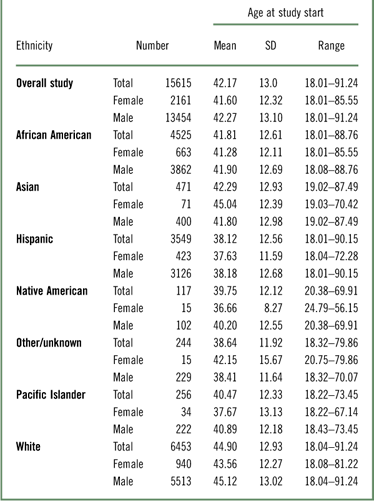
The study subjects consisted of the entire adult (age 18 and greater) patient population in resident at, or admitted to, all 5 California DSH hospitals between January 1, 2011, and December 31, 2013. The total number of subjects during the entire study period was N=15,615 and included n=2161 females and n=13,454 males of various ethnicities, with a mean age of 42.17 years. (Table 1 lists the subject demographics.) At the start of the study period (January 1, 2011) there were 5499 patients in residence at the hospitals; during the study period, 2887 of these patients discharged. During the course of the study period, 10,116 patients were admitted; of these, 7220 were discharged before the study period ended, and 2896 were admitted at various points during the 3-year study period and remained until the end of the study (December 31, 2013), at which point 5508 patients were residing in the hospitals.
Summary of subject demographics by ethnicity

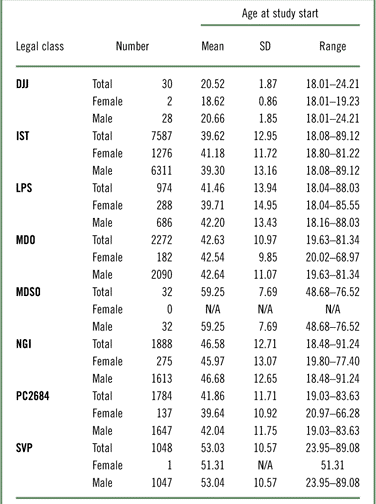
The patients were grouped according to the overall “umbrella” legal commitment under which the exact legal code fell. (California has 39 different legal sections for holding patients in state psychiatric facilities, which can be collapsed into 8 general categories.) Details and a description of the legal classes in the hospitals are shown in Box 1. Table 2 shows a summary of study subject demographics by general legal class.
Summary of subject demographics by legal class

See Box 1 for description of legal class abbreviations.
Description of legal class and abbreviations
Nonforensic Commitment:
LPS: short for “Lanterman-Petris-Short,” i.e., non-forensically committed patients, typically patient conserved by county courts
Forensic Commitments:
DJJ: Patients referred for treatment from the Division of Juvenile Justice system
IST: Patients found incompetent to stand trial
MDO: Mentally disordered offenders, ie, parolees from the prison deemed too dangerous to allow to parole back to the community
MDSO: Mentally disordered sex offender, a since discontinued legal commitment that was a precursor to the present-day SVP commitment
NGI: Patients found not guilty by reason of insanity
PC2684: Mentally ill prisoners, ie, prison inmates referred to DSH for treatment
SVP: Patients adjudicated under the Sexually Violent Predator law
Data Collection
Patient demographic and legal class information were collected from system databases that are routinely used for census tracking. Data on violent incidents were collected through a computerized incident management module of the patient treatment planning database.
Study variables
Sex, ethnicity, age, and legal commitment code were collected from the patient demographic information database. Information on patient Diagnostic and Statistical Manual of Mental Disorders, Fourth Edition, Text Revision (DSM-IV-TR) diagnosis was collected from the patient admission diagnostic fields contained in the patient information database. 17 Since patients commonly had multiple diagnoses, only the primary diagnosis indicated on Axis I and the primary diagnosis (if any) indicated on Axis II were used. Over 280 different DSM-IV-TR diagnoses were recorded for all the patients on admission; these various diagnoses were collapsed according to the DSM-IV-TR category or chapter title, with diagnoses of particular interest (such as schizophrenia, schizoaffective disorder, bipolar disorder, and psychotic disorder NOS/miscellaneous psychotic disorders) kept as separate categories.
Statistical analyses
Data preparation and analyses were performed with R version 3.1.1. 18 Data files were provided by the centralized data management office of the California DSH for all patients who were in residence or admitted to the hospitals during the periods 2010–2014; from these were extracted the records of all patients resident or admitted to a hospital between January 1, 2011, and December 31, 2013, inclusive. Data files were also provided for all the records of physical assaults by patients during the period 2010–2014, which were again further refined to extract just the physical assaults recorded during the period between January 1, 2011, and December 31, 2013, inclusive.
The first level of data analysis consisted of a descriptive review of violence prevalence in the hospital system stratified by previously researched variables (sex, ethnicity, age, legal classification, DSM-IV-TR Axis I diagnosis and Axis II diagnosis), and calculated the prevalence of violence and approximate 95% confidence intervals (CI). Chi-squared tests were then performed to test the prevalence rates for significance. Last, a logistic regression main effects model was fitted to obtain the adjusted odds ratios (ORs) and 95% CI of violence for the different demographic and clinical diagnosis variables.
Description of aggression data
Physical violence during the study was defined as assaults directed against either another patient or a staff member, as defined in the California DSH policies (see Box 2). Analogous codes and definitions also existed for verbal aggression and property damage, but were not used in this study, as we examined only physical violence. There were a total of 11,302 unique recorded acts of physical violence against other patients during the study period, and a further 8482 unique recorded acts of physical violence directed against staff members. Of these total numbers, aggressors were identified in 10,958 assaults against patients, and in 8429 assaults against staff; these incidents in which aggressors were identified were used as the final count of violent assaults, as well as to determine an individual patient’s aggressor and victim status.
Definitions of physical violence or assault, and aggressor/victim status
Aggressive Act to Another Patient–Physical: Hitting, pushing, kicking, or similar acts directed against another individual to cause potential or actual injury
Aggressive Act to Staff–Physical: Hitting, pushing, kicking, or similar acts directed against a staff person that could cause potential or actual injury
Aggressor: One who completes acts of hostility or assault; one who starts a hostile action or exhibits hostile behavior. An aggressive act must have occurred for there to be an aggressor
Victim: Recipient of an aggressive act
Results
Overview of violent incidents and patients
The total number of subjects in the study was N=15,615. The number of unique patients having a single violent incident (whether patient assault or staff assault) was n=4895, yielding an overall prevalence of violence during the study period of 31.35% (95% confidence interval (CI) 30.62%–32.08%). The number of patients having at least a single patient assault incident was n=4075, yielding a violent patient assault prevalence of 26.10% (95% CI 25.54%–26.79%). The number of patients having at least a single staff assault incident was n=2504, yielding a staff assault prevalence of 16.04% (95% CI 15.46%–16.62%). A simple tally showed that the top 156 aggressors (1% of the study population) were involved in 28.7% of all these violent assaults. When examining the patients still hospitalized at the conclusion of the study, those remaining (n=5508) had an overall violence prevalence of 41.25% (95% CI 39.95%–42.55%), with a patient violence prevalence of 35.48% (95% CI 34.22%–36.74%) and a staff violence prevalence of 22.97% (95% CI 21.86%–24.08%), which led us to investigate how violence impacted length of stay; these findings will be reported below.
Regarding severity of assaults, only data on patient injury severity were collected; these data showed that, for the most part, injuries suffered by patient victims were typically not severe, although 1 homicide did occur during the study period.
Sex differences
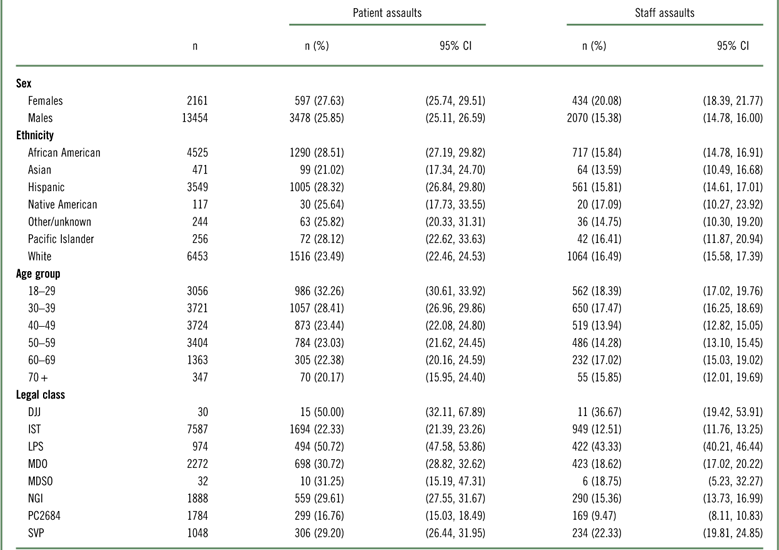
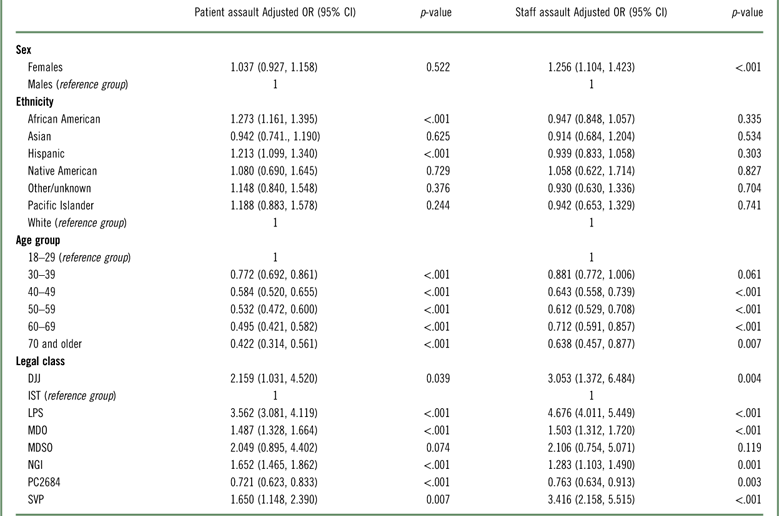
As shown in Table 3, there were no significant differences for patient assault, but there was a significant difference for staff assault [χ2 (1, N=15,615)=30.51, p<.001], with assaults committed by females more prevalent (20.08%, 95% CI 18.39%–21.77%) than males (15.38%, 95% CI 14.78%–16.00%). Examining the adjusted odds ratios (ORs) in Table 4 shows a similar relationship, with no significant difference in the adjusted odds between females and males for patient assault, but a significant difference (p<.001) in the odds for staff assault, with females having a higher odds (OR 1.256, 95% CI 1.104–1.423).
Prevalence (%) and 95% confidence interval (CI) of physical violence by demographic category

See Box 1 for a full description of the legal class abbreviations.
Adjusted odds ratios (OR) and 95% confidence interval (CI) of physical violence by demographic variables

See Subjects section, under Methods, for methodology of legal class assignment.
Ethnicity
There were significant differences in patient assault [χ2 (6, N=15,615)=52.27, p<.001], but not for staff assault [χ2 (6, N=15,615)=3.76, p=0.709], among the various ethnic groups (Table 3). Both the prevalence of African-Americans (28.51%, 95% CI 27.19%–29.82%) and Hispanics (28.32%, 95% CI 26.84% to 29.80%) for patient assault were higher than those of other ethnicities. However, there were no significant differences among the groups for staff assault. Similarly, the logistic regression model (Table 4) showed parallel results with the prevalence rates. Again, there were no significant differences among the various ethnicities for staff assault.
Age differences
Younger patients had a higher prevalence (Table 3) of violence than older patients for both patient [χ2 (5, N=15,615)=116.84, p<.001] and staff assault [χ2 (5, N=15,615)=39.25, p<.001]. The prevalence in the 18–29 age group was 32.26% (95% CI 30.61%–33.92%), and the prevalence in the 30–39 age group was 28.41% (95% CI 26.96%–29.86%), which were both higher than the prevalence rates in the older age groups. The logistic regression model showed parallel results, with younger patients having higher odds of both patient and staff assault (Table 4). For patient assault, with age 18–29 as the reference group, those subjects in the age 30–39 group were significantly lower (OR 0.772, 95% CI 0.692–0.861), and those in the remaining age groups lower still. For staff assault, again with age 18–29 as the reference group, the odds of staff assault for subjects in the age 30–39 group were not significantly lower (p=0.061), but those in the older age groups were all significantly lower than the reference group.
Legal commitment
There were significant differences among the various groups in both patient [χ2 (7, N=15,615)=503.83, p<.001] and staff [χ2 (7, N=15,615)=728.21, p<.001] assaults (Table 3). Patients in the nonforensic (ie, LPS) group had the highest prevalence of both patient assaults (50.72%, 95% CI 47.58%–53.86%) and staff assaults (43.33%, 95% CI 40.21%–46.44%), while the mentally ill prisoners (PC2684) had the lowest patient assault (16.76%, 95% CI 15.03%–18.49%) and staff assault (9.47%, 95% CI 8.11%–10.83%) prevalence. The logistic regression model (Table 4) showed that when taking the other variables into account, some legal commitments (both forensic and nonforensic) had a significantly higher odds of patient assault than others. Specifically regarding patient assault, those in the legal class DJJ (OR 2.159, 95% CI 1.031–4.520), LPS (OR 3.562, 95% CI 3.081–4.119), MDO (OR 1.487, 95% CI 1.328–1.664), NGI (OR 1.652, 95% CI 1.465–1.862), and SVP (OR 1.650, 95% CI 1.148–2.390) had significantly higher odds of patient assault, while one group, the mentally ill prisoners (PC2684 group), had a significantly lower odds (OR 0.721, 95% CI 0.623–0.833). A similar pattern held for staff assault.
Axis I diagnosis
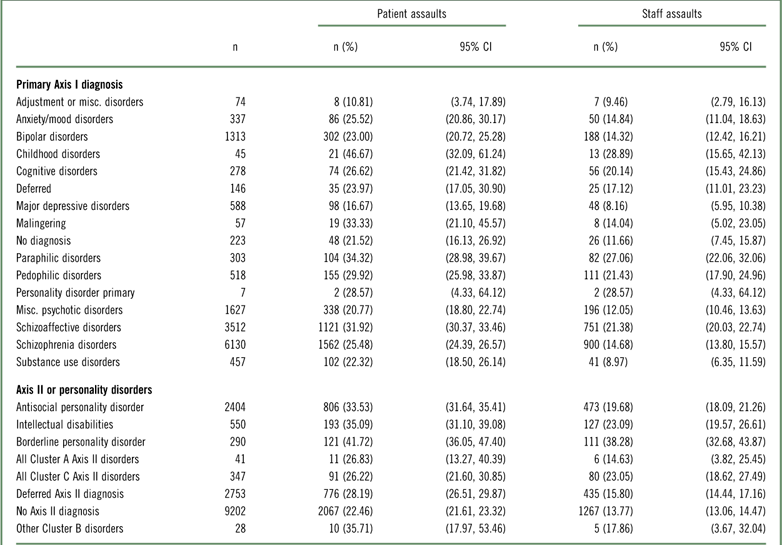
Significant differences were noted across the various diagnoses for both patient [χ2 (15, N=15,615)=163.61, p<.001] and staff assault [χ2 (15, N=15,615)=206.16, p<.001]. Focusing on the categories with the largest numbers of patients, as these results are likely the most robust (Table 5), those diagnosed with schizoaffective disorder (any type, n=3512) had the highest prevalence of both patient assault (31.92%, 95% CI 30.37%–33.46%) and staff assault (21.38%, 95% CI 20.03%–22.74%), while those diagnosed with major depressive disorders had the lowest patient assault (16.67%, 95% CI 13.65%–19.68%) and staff assault (8.16%, 95% CI 5.95%–10.38%) prevalence. Patients diagnosed with schizophrenia, miscellaneous psychotic disorders, and bipolar disorder had prevalence rates that fell between these 2 groups (see Table 5).
Prevalence (%) and 95% confidence interval (CI) of physical violence by diagnosis

See Study variables section, under Methods, for how diagnoses were grouped.
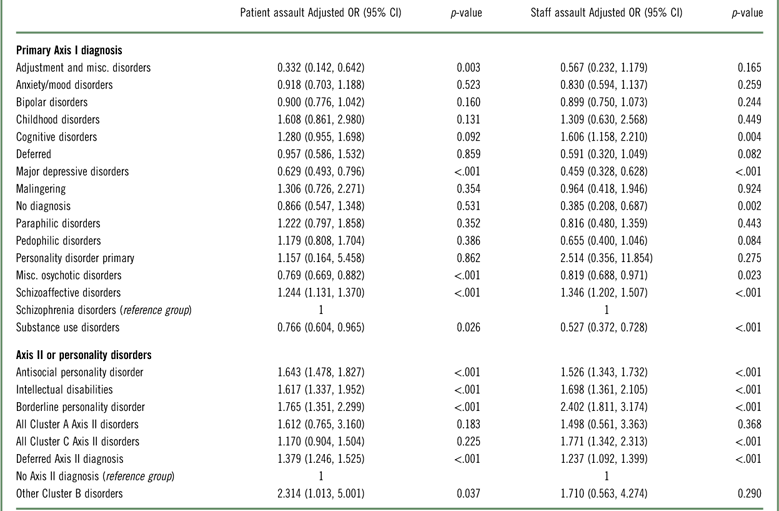
Results of the logistic regression model showed that (using schizophrenia as a reference group, see Table 6), patients diagnosed with schizoaffective disorder had significantly higher odds of patient assault (OR 1.244, 95% CI 1.131–1.370), while those diagnosed with adjustment or miscellaneous disorders (OR 0.332, 95% CI 0.142–0.642), major depressive disorders (OR 0.629, 95% CI 0.493–0.796), miscellaneous psychotic disorders (OR 0.769, 95% CI 0.669–0.882), or a primary diagnosis of a substance use disorder (OR 0.766, 0.604–0.965) had lower odds of patient assault. Patients diagnosed with schizoaffective disorder also had a higher odds of staff assault (OR 1.346, 95% CI 1.202–1.507), as did patients diagnosed with cognitive disorders (OR 1.606, 95% CI 1.158–2.210). Those patients diagnosed with a major depressive disorder (OR 0.459, 95% CI 0.320–0.628), miscellaneous psychotic disorders (OR 0.819, 0.688–0.971), a primary diagnosis of a substance use disorder (OR 0.527, 95% CI 0.372–0.728), or had no diagnosis on Axis I (OR 0.385, 95% CI 0.208–0.687) all had lower odds of staff assault.
Adjusted odds ratios (OR) and 95% confidence interval (CI) of physical violence by diagnosis

See Study variables section, under Methods, for how diagnoses were grouped.
Axis II diagnosis
Significant differences in assault prevalence (Table 5) were noted across Axis II diagnosis for both patient [χ2 (7, N=15,615)=193.66, p<.001] and staff assault [χ2 (7, N=15,615)=197.81, p<.001)]. Most patients (n=9202) did not have any diagnosis on Axis II; these patients served as the reference group for the logistic regression model. Patients diagnosed with borderline personality disorder (n=290) had the highest prevalence of both patient assault (41.72%, 95% CI 36.05%–47.40%) and staff assault (38.28%, 95% CI 32.68%–43.87%), followed by those diagnosed with intellectual disabilities (specifically, mental retardation or borderline intellectual functioning, n=550; patient assault prevalence 35.09%, 95% CI 31.10%–39.08% and staff assault prevalence 23.09%, 95% CI 19.57%–26.61%), and then those diagnosed with antisocial personality disorder (n=2404; patient assault prevalence=33.53%, 95% CI 31.64%–35.42% and staff assault prevalence=19.68%, 95% CI 18.09%–21.26%).
The logistic regression model (Table 6) showed that having a personality disorder diagnosis typically meant that the patient had a significantly higher odds of both patient and staff assault when compared to the reference group (ie, no personality or Axis II diagnosis). More specifically, regarding patient violence, having a diagnosis of antisocial personality disorder (OR 1.643, 95% CI 1.478–1.827), intellectual disabilities (OR 1.617, 95% CI 1.337–1.952), borderline personality disorder (OR 1.765, 95% CI 1.351–2.299), or a deferred diagnosis on Axis II (OR 1.379, 95% CI 1.246 to 1.525) or other Cluster B disorders (specifically, histrionic and narcissistic personality disorders, OR 2.314, 95% CI 1.013–5.001) were all associated with significantly higher odds of patient assault. Likewise, a very similar pattern for staff assault was seen as well.
Other major findings
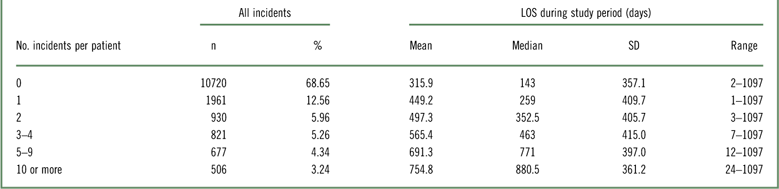
Overall, 31.35% of patients committed at least one violent act. The top 1% of physically violent patients (n=156) accounted for 28.7% of all assaults. As mentioned above, the fact that patients still hospitalized at the end of the study period (n=5508) had a significantly higher prevalence of violence (41.25%, 95% CI 39.95%–42.55%) than the overall study subject violence prevalence (31.35%, 95% CI 30.62%–32.08%) led us to investigate violence and its impact on length of stay (LOS) in the hospitals. As seen in Table 7, when all patients in the study (N=15,615) were categorized by number of violent incidents (grouped according to having had 0 assaults, 1 assault, 2 assaults, 3 or 4 assaults, 5–9 assaults, or 10 or more assaults), a significant difference in LOS was seen among the different groups (Kruskal–Wallis χ2=1509.775, df=5, p<.001). When pairwise Mann–Whitney U-tests were carried out post-hoc with a Bonferroni correction, significant differences in LOS were found between patients with 0 violent incidents and 1 violent incident (p<.001), between 1 violent incident and 2 (p<.001), between 2 violent incidents and 3 or 4 (p=.001), between 3 or 4 violent incidents and 5–9 (p<.001), and between those with 5–9 violent incidents and the 10 or more group (p=.012).
Length of stay (LOS), in days, by total number of violent assaults during the study period

Discussion
This study represents what we believe to be the largest single study of the prevalence of violence in a forensic psychiatric hospital setting. Given the large number of patient subjects, and also the array of diagnoses, ethnicity, and commitment types, this study allowed for a broader and more detailed analysis of the range of demographic and clinical factors related to physical violence. With these advantages, there was potential to provide further insights into physical violence in a forensic hospital setting.
Sex differences
The finding that females had a higher prevalence of violent physical assaults against staff is counter to many previous studies in the literature that focused on nonforensic settings. However, it is consistent with some previous findings that found that females engaged in proportionally more physical attacks than males.Reference Convit, Isay, Otis and Volavka 5 , Reference Binder and McNiel 19 The large sample size of this study likely afforded us more statistical power, or this may be a finding specific to forensic settings.
The finding that females had a higher rate of staff assault (but not patient assault) has interesting implications for treatment interventions. Because the female population is far less numerous in DSH hospitals, it is possible that violence reduction efforts that are effective in male patients may be less effective in female patients. DSH hospitals have already begun efforts to implement newer treatments that may have enhanced effectiveness, such as dialectical behavior therapy and trauma-informed treatments. The information here may help better target continuing risk identification and violence reduction efforts.
Age differences
These findings showed that patients in the 18–29 age group had a significantly higher prevalence and odds for patient violence, and that those in both the 18–29 and 30–39 age groups had a higher prevalence and odds for committing staff assault. The finding that younger patients had higher levels of violence is consistent with much of the literature on this topic.Reference Hoptman, Yates, Patalinjug, Wack and Convit 8 – Reference Raja and Azzoni 10 Young age may be one of the most important risk factors to consider when determining the intensity of treatment services.
Ethnicity
Although this study showed African-American and Hispanic patients had a higher prevalence of patient assault, we suspect that, as Monahan et al,Reference Monahan, Steadman and Silver 20 discussed, many ethnic minority groups may have a higher risk for violence due to the fact that they have lived primarily in disadvantaged neighborhoods, where all ethnicities have a higher prevalence of violence. Our suspicion is that ethnicity is actually a proxy variable for early learning experiences associated with potentially any or all of the following: (a) early exposure to poverty, (b) low educational-attainment expectations, (c) early exposure to violence, and (d) limited social support systems. If ethnicity could instead be replaced with a variable that better captured that information, it is possible that ethnicity would then no longer be a risk factor for patient violence, just as in this study it was not a significant finding for staff assault.
These findings, in conjunction with the finding that younger males, regardless of ethnicity, have a higher prevalence of patient violence, endorse continued cultural competency efforts, and additionally suggest continued examination of issues related to male-dominance aggression—a topic usually investigated in the context of penal institutions or street gangs, but that may also apply to a forensic hospital setting.
Legal commitment
There was a wide range of prevalence associated with the 8 umbrella legal classes. The finding that the nonforensic commitment (ie, the group in California referred to as LPS) had the highest rate of violence is a consistent with previous studies from other states.Reference Linhorst and Scott 6 , Reference Novaco 16 , Reference Stokman and Heiber 21 A peculiarity in California is that the number of hospital beds for nonforensic (LPS) patients is extremely limited, approximately 560 patients at any one time. In a state of 40 million, this likely indicates that the overwhelming majority of nonforensically involved, mentally ill patients are successfully treated in the community, and may also be an indicator that these LPS patients in this study may have been selectively placed in state hospitals due to confounding factors that could potentially include violence.
What has not been as well researched in the literature are the differing levels of violence among various forensic commitments. In this study of forensically committed patients, a wide range of violence prevalence was found (as well as differing odds of physical violence). In some cases, the prevalence or odds of physical violence almost equaled that of the nonforensic, LPS group.
We should note that the findings that the group of prison inmates committed to the forensic hospitals (the PC2684 group) had both significantly lower prevalence and significantly lower odds of patient and staff assault may be due to administrative factors, as opposed to actual prevalence. In California, mentally ill prisoners (the PC2684 group) are carefully screened by correctional staff prior to referral, with only the inmates screened as lower risk for violence sent to DSH hospitals. The remaining inmates screened as higher risk for violence are treated in special psychiatric programs on prison grounds; these inmate/patients were not included in this study.
Axis I diagnosis
The large sample size and diversity of the current population provided the opportunity to investigate prevalence among a broad range of diagnoses. Findings revealed that patients with schizoaffective disorder had higher odds of both patient and staff assault when compared to the reference group (patients diagnosed with schizophrenia), while patients diagnosed with bipolar disorder were not significantly different from those diagnosed with schizophrenia.
Another interesting area of future study concerns the finding that patients diagnosed with cognitive disorders (ie, pathologies involving cognitive loss after age 18) had a significantly higher odds of staff assault.Reference Kennedy 22 Related disorders such as intellectual disabilities (ie, pathologies involving intellectual deficits before age 18) were also associated with higher odds of both patient and staff assault. Given the numbers of patients with these diagnoses in the forensic setting, this indicates the need for further exploration.
Axis II or personality disorder diagnosis
Personality disorder diagnosis may be the least well-researched area of inquiry for inpatient hospital violence, although it is commonly seen as a risk factor for violence. Consistent with previous research, these results showed that having a diagnosis of a personality disorder was associated with a higher prevalence and higher odds of violence, for both patient and staff assault.Reference Soliman and Reza 9 , Reference Kennedy 22 , Reference Daffern and Howells 23 With patients having no diagnosis of a personality disorder as the reference group, having any personality disorder, or even being considered for a personality disorder (ie, deferred diagnosis), was associated with higher levels of violence in the study subjects. The finding that patients with limited intellectual or cognitive functioning had higher levels of assault is of particular interest. This special population is often treated and housed with general populations. This study may add support for investigating specialized treatment programs that address violence risk in the population. Currently, DSH hospitals have in place several programs for cognitive remediation that are aimed at working with patients who have suffered cognitive losses as adults. It seems apparent, based on this current study, that these programs should be extended to patients with lifelong developmental disability diagnoses, and that specific efforts to screen for and identify these patients would be important aspects of violence reduction efforts.
The present study is not without its limitations. With the size of the staff involved, lack of inter-rater reliability training and study among the diagnosing psychiatrists is a limitation, but a reality that exists in clinical settings. The use of a locally developed special incident tracking tool limits comparability with other studies. However, the fact that the violence reporting form was integrated into regular nursing staff duties meant that the nursing staff did not view filling out this form as an extra duty, enabled the collection of data for a far longer period of time than in previous studies, and likely also reduced under-reporting. The fact that the prevalence of physical violence in this study was at levels comparable to other studies, or even higher than some other studies, provides assurance that violent incidents were routinely reported and were not systematically overlooked.
The collapsing of the patient’s diagnoses into overarching DSM-IV-TR diagnostic categories undoubtedly has led to a loss of specificity. However, given the fact that there were over 280 different primary Axis I diagnoses, few options existed to present diagnostic data in a concise, meaningful way. We plan to examine specific diagnoses in detail, as well as comorbid substance use diagnosis, as the next logical step in our programmatic study of physical violence.
This study highlights the limitations of using solely prevalence to describe violence in this population. While prevalence indicates the presence or absence of a disease in a binary “yes/no” format, when there is a subgroup of patients with an extreme amount of repeated violent acts (such as the 1% of patients who accounted for 28.7% of all assaults), a measure such as a rate measure (not employed in this study) used in conjunction with prevalence may better capture information about violence in a forensic setting than just prevalence alone.
This also brings up the issue of what can be done to address violence in this special group of repeatedly violent patients. Our review of the literature has shown that the problem of patients with repeated violent incidents during hospitalization has been an issue for decades in various settings without any apparent resolution.Reference Blow, Barry, Copeland, McCormick, Lehmann and Ullman 15 , Reference Rachlin 24 – Reference Lussier, Verdun-Jones, Deslauriers-Varin, Nicholls and Brink 26 The fact that patients with more violent incidents had a longer length of stay meant that the nonviolent patients treated alongside them had a greater exposure to victimization, a topic not addressed in this article. In the present study, patients had the greatest burden of violence, as patient assaults outnumbered staff assaults. There is a paucity of published research that directly addresses the problem of reducing incidents among repeatedly violent patients; however, a few recent studies have detailed some promising ideas, such as the use of violence risk assessmentReference Abderhalden, Needham, Dassen, Halfens, Haug and Fischer 27 or segregation in conjunction with violence risk assessment and treatment of high risk factors, to reduce physical violence in hospital settings.Reference Vaaler, Iversen, Morken, Fløvig, Palmstierna and Linaker 28
Conclusions
This study found significant relationships between physical violence and specific demographic variables and clinical diagnoses in a forensic setting. Certain demographic and clinical variables were significantly related to higher prevalence and odds of patient assault, staff assault, or both. These findings indicate that further investigation and follow-up are warranted, especially in the areas of how specific or comorbid clinical diagnoses interact with personality disorders to impact violence. This study also pointed out the need to more closely examine the issue of patients with repeated physically violent incidents in order to identify potential treatment interventions. Further research may identify variables that could potentially provide a means of early identification of high risk factors for targeted treatment, with the ultimate goal of safety for all patients and staff.
Disclosures
None of the authors has anything to disclose.