1. Introduction
Intermediate mass-ratio inspirals (WD-IMRIs) formed by a white dwarf (WD) and an intermediate-mass black holes (IMBH) in globular clusters (GCs) are excellent potential multimessenger sources that emit both electromagnetic and gravitational radiation. In these systems, a WD on a highly eccentric orbit repeatedly grazes the tidal radius of the IMBH, losing a small amount of mass at each pericenter passage (r
 ${}_{p}$
. This process, known as tidal stripping (Zalamea et al. Reference Zalamea, Menou and Beloborodov2010), powers periodic electromagnetic (EM) signals while the system emits gravitational waves (GWs) at the same time. We estimate that the luminosity of the EM signals can trigger periodic events which can be observed by telescopes such as Einstein Probe (Yuan et al. Reference Yuan, Zhang, Chen and Ling2022) and XMM-Newton while the GW signal is detectable by the future space-based detectors such as LISA (Amaro-Seoane et al. (Reference Amaro-Seoane, Audley, Babak, Baker, Barausse, Bender and Berti2017), Reference Colpi, Danzmann, Hewitson, Holley-Bockelmann, Jetzer, Nelemans and PetiteauColpi et al. (2024)), TianQin (Luo et al. (Reference Luo2016), Reference Torres-Orjuela, Huang, Liang, Liu, Wang, Ye, Hu and MeiTorres-Orjuela et al. (2024)), and Taiji (Reference Luo, Wang, Wu, Hu and JinLuo et al. (2021)). These systems are of special interest, as a joint EM and GW detection will provide detailed information about accretion and tidal disruption processes, as well as the behavior of compact matter. Additionally, the future space-based detectors can detect the inspiral years before merger and predict the multimessenger behaviour, alerting EM telescopes and allowing us to catch the onset of tidal stripping in real time, capturing the light curve and GW signal along its multimessenger evolution.
2. WD-IMRIs in GCs
Finding IMRIs in numerical simulations of Globular Clusters (GCs). We look for WD-IMRIs in the dataset corresponding to Survey 1 from the MOCCA simulations. This set contains about 2,000 simulations of globular clusters evolved with the MOCCA Monte Carlo Cluster Simulator (Giersz et al. Reference Giersz, Leigh, Hypki, Lützgendorf and Askar2015; Askar et al. Reference Askar, Szkudlarek, Gondek-Rosińska, Giersz and Bulik2016). These simulations evolve realistic star-cluster initial conditions through two-body relaxation, binary interactions, and stellar evolution, tracking the formation and evolution of WD–IMBH binaries over the cluster evolution.
The masses of the IMBHs range from
 ${\sim} 100$
to
 ${\sim} 2 \times 10^{4}\ \textrm{M}_{\odot}$
, and there are three WD populations in Survey 1: Helium WD (
 ${\sim} 0.3\ \textrm{M}_{\odot}$
), Carbon WD (
 ${\sim} 0.8\ \textrm{M}_{\odot}$
), and Oxygen-neon WD (
 ${\sim} 1.3\ \textrm{M}_{\odot}$
), we assume that the process leading to the periodic multimessenger signal is the same regardless of the composition of the WD.
We find about
 $\sim$
14,200 WD–IMRIs throughout the 12 Gyr life of the GCs, although only a fraction achieve the high eccentricities (
 $e \gt 0.9$
) and pericenter distances necessary for repeated tidal stripping (
 ${\sim} 2\ r_{t}$
) (Zalamea et al. Reference Zalamea, Menou and Beloborodov2010; Sepinsky et al. Reference Sepinsky, Willems and Kalogera2007), a deeper study of systems with lower eccentricities (
 $e \lt 0.9$
) that can also achieve mass transfer could also provide interesting results for GW and EM radiation. In this work, we only consider high eccentricities that result in tidal stripping; therefore, we search for WD-IMRIs with
 $e \gt 0.9$
and pericenter distances
 $r_{\rm rp} \lesssim 3 R_{t}$
, where
 $r_{\rm t}$
is the tidal disruption radius of the IMBH
 \begin{equation}r_{\rm t} = R_{\rm WD} \left(\frac{M_{\rm IMBH}}{M_{\rm WD}}\right)^{1/3}, \end{equation}
where
 $R_{\rm WD}$
and
 $M_{\rm WD}$
are the radius and mass of the WD respectively and
 $M_{IMBH}$
is the mass of the IMBH. These systems have typical semimajor axes of
 ${\sim} 10^{-4}$
to
 ${\sim} 10^{-6}$
pc and although the mass transfer starts at a pericenter distance of
 $r_{\rm p} \lesssim 2R_{\rm t}$
, we find that systems with
 $r_{\rm rp} \simeq 3R_{\rm t}$
will evolve due to GW emission and remain eccentric enough to generate periodic flares resulting from tidal stripping when reaching
 $r_{\rm p} \simeq 2R_{\rm t}$
.
Most of the formed WD-IMRIs that are potential multimessenger systems are formed via binary–binary encounters that lead to exchange or binary hardening; these interactions efficiently place WD in highly eccentric orbits around the IMBH, ideal to trigger multimessenger signals.
3. Multimessenger WD-IMRIs
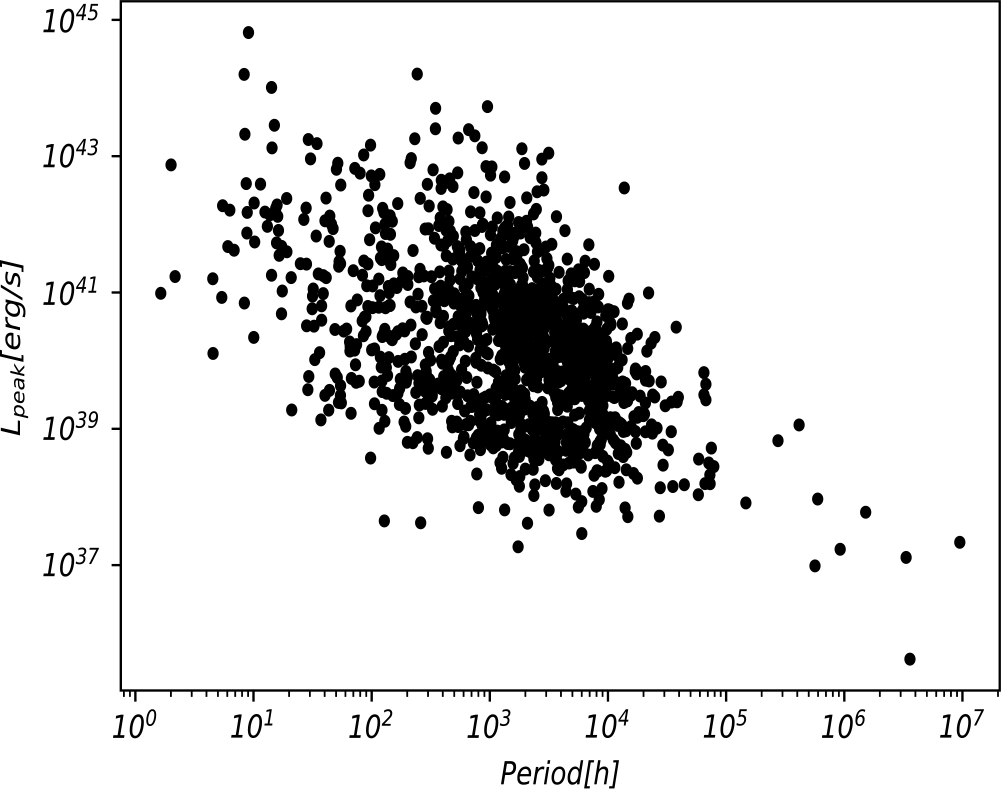
The multimessenger signals of WD-IMRIs in GCs. The electromagnetic emission from WD-IMRIs is a repeated X-ray flare with luminosities potentially reaching
 $\gtrsim 10^{45}$
erg/s as shown in Figure 1. The flare periodicity is directly related to the orbital period and, under a steady-mass-transfer assumption (King Reference King2020; King Reference King2022; Chen et al. Reference Chen, Qiu, Li and Liu2022), roughly 1,700 multimessenger candidates exist across the survey. Stable mass-transfer models predict that these flares can cycle for thousands of orbits before the WD fully disrupts, making it possible to detect the multimessenger signals within the 5 years of operation time of the space-based detectors. Moreover, the detection of the GWs emitted from systems with
 $r_{\rm p} \lesssim 3r_{\rm t}$
can serve as an early warning alert for X-ray telescopes.
Luminosity [erg/s] vs Period [h] of all the IMRIs found in the Survey 1 that generate a periodic multimessenger signal.

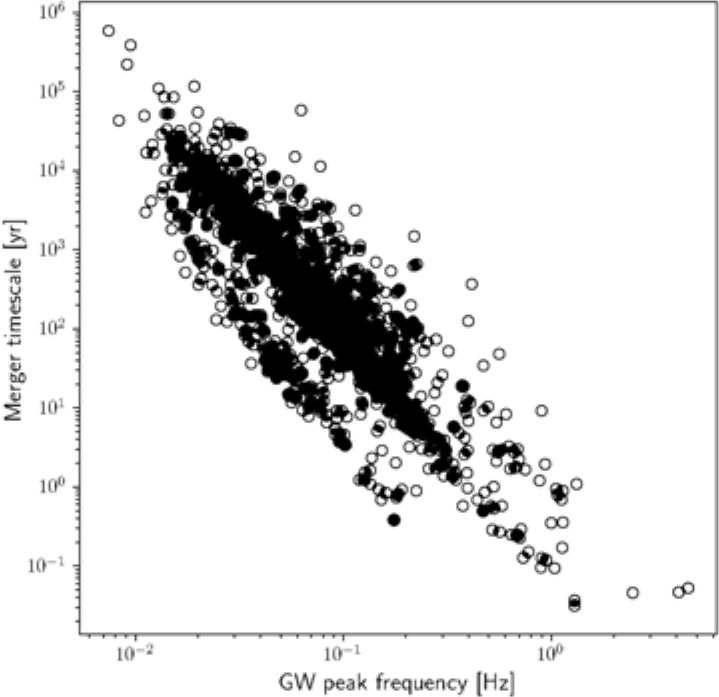
Due to the high eccentricity of the WD-IMRIs, the gravitational radiation is emitted through several harmonics, the peak frequency can be estimated as
 $f_{\rm GW,peak} \approx n_{\rm peak}f_{\rm orb}$
with
 $n_{\rm peak} {\sim} 2.16(1-e)^{-3/2}$
the harmonic through which the GW power is predominantly radiated and
 $f_{orb}$
the orbital frequency of the IMRI. Figure 2 shows the peak frequency of the GWs emitted by the systems at mass transfer onset, i.e., when the pericenter reaches twice the tidal radius, placing them well within the detection band of LISA, TianQin, and Taiji. Moreover, TiaQin is more sensitive towards
 ${\sim} 10^{-1} - 1$
Hz, making these ideal sources for joint detections.
Peak gravitational wave frequencies of the multimessenger IMRIs found in Survey 1.

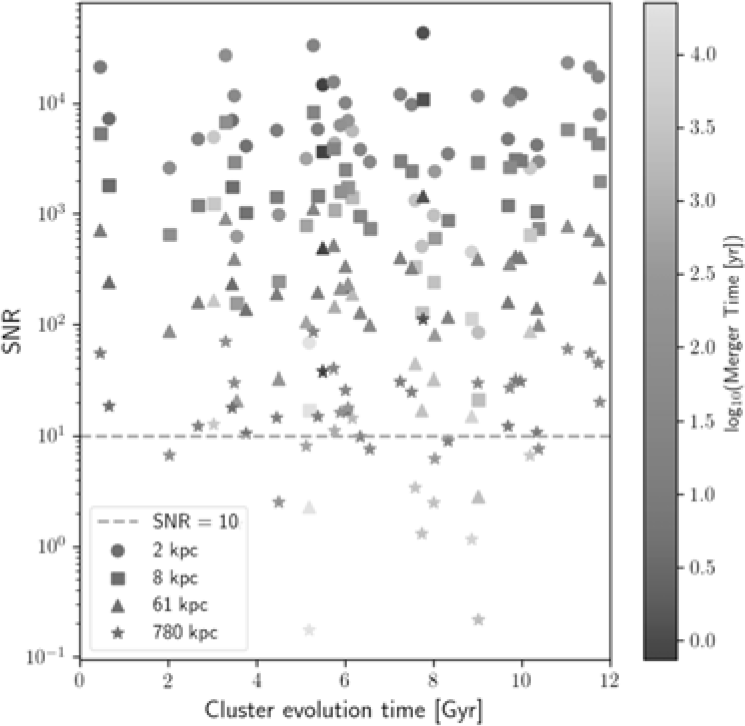
Signal-to-noise ratio (SNR). To compute the SNR, we take a subset of 50 representa-tive sources. The high eccentricities of these sources make their waveform computation computationally expensive, so we restrict the number of harmonics to 60, centered around
 $n_{\rm peak}$
. We compute the waveforms by using Post-Newtonian (PN) corrections up to 2.5 order (Barack & Cutler Reference Barack and Cutler2004; Fang & Huang Reference Fang and Huang2020), and at each pericenter passage, we compute the mass loss caused by the tidal stripping by assuming a stable mass transfer model (King Reference King2020, Reference King2022; Chen et al. Reference Chen, Qiu, Li and Liu2022)
 \begin{equation}-\dot{M}_2 {\unicode{x0098}}\approx 2.2 \times 10^{-7} {M}^{2/3}_5 P^{-8/3}_4 \frac{{m}^2_2}{(1 - e)^{5/2}}{M}_{\odot}\end{equation}
where
 $M_{5} = 10^{5}\ \textrm{M}_{\odot}$
and
 $P_{4} = 10^{4}$
s. If mass transfer is unstable, the WD could lose all its mass in a few tens of orbits (MacLeod et al. Reference MacLeod, Goldstein, Ramirez-Ruiz, Guillochon and Samsing2014), resulting in a different multimessenger signal. However, we restrict ourselves to a stable mass transfer model and compute the SNR of these systems as Barack & Cutler (Reference Barack and Cutler2004); Finn & Thorne (Reference Finn and Thorne2000)
 \begin{equation}({\rm SNR})^{2}= \int \frac{h_{c,n}^2}{5f S_{n}(f)}{\rm d}\, {\rm ln}\, f, \end{equation}
where
 $h_{c,n}$
is the characteristic strain,
 $S_{n}$
is the noise spectral density, and the factor of 5 comes from sky-averaging. We place the sources at four representative luminosity distances,
 $dl = [2, 8, 60, 780]$
kpc, where the first distance is the average distance to a globular cluster, the second, the distance to the Galactic Center, the third, the distance to the Small Magellanic Cloud, and the last, the distance to the Andromeda galaxy. At these distances, the sources still have a relatively high SNR that allows parameter extraction (SNR
 $\gtrsim$
10) as shown in Figure 3. Nevertheless, the GWs coming from all directions within the detection volume of the space-based detectors could create a background similar to the one estimated for QPE (Chen et al. Reference Chen, Qiu, Li and Liu2022).
SNR of multimessenger WD-IMRIs at different luminosity distances as a function of the evolution time of the GC. The horizon-tal line indicates the value SNR=10.

4. Conclusions
Highly eccentric WD-IMRIs are formed in globular clusters mainly due to binary-binary interactions. These systems can undergo mass transfer under the tidal stripping model; at the same time, these systems emit GWs that will be detectable by future space-based GW detectors, making them exciting multimessenger sources. Moreover, it is shown that these multimessenger sources can be found at all times during the evolution of a GC. The event rate of these systems is of the order of
 ${\sim} 0.5{\rm yr}^{-1}$
Gpc
 $^{-3}$
(Vázquez-Aceves et al. in prep). Although this is not an extremely low rate compared with other astrophysical events detected at cosmological distances (e.g. tidal disruption events) (Tanikawa et al. Reference Tanikawa, Giersz and Arca Sedda2022), their EM observation can be challenging. The detection of the GW emission would surely increase the EM observation capabilities.