Introduction
Despite its illegal status, the sex industry in Thailand is notoriously huge. It is a source of employment for countless women (and men), a source of valuable foreign currency for the government, and a source of protection money for the police. According to one study, there are an estimated 150,000 to 200,000 commercial sex workers in the country in any given year, although the estimate varies greatly from report to report.Footnote 1
To date, numerous people—mostly economists, anthropologists, sociologists, and human rights activists—have studied the various dimensions of the sex industry in Thailand, such as the composition, life histories, gender identity, and economic backgrounds of prostitutes; the mechanism and socioeconomic impact of the industry; the government policies toward prostitution; and the commodification of women.Footnote 2 In contrast, however, no research has been done, to my knowledge, on the relationship between prostitution and political change in the countryside, from which most commercial sex workers are recruited. Using the remote rural province of Phayao in northern Thailand as a case, I will examine this little-studied political dimension of prostitution. I will show how prostitution has transformed the character of society and politics in Phayao.
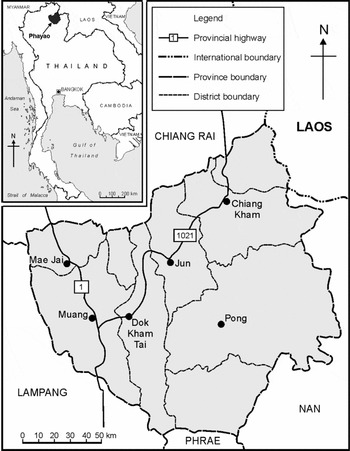
Specifically, I cast light on one ordinary woman from an ethnic minority family of modest economic status—Ladawan Wongsriwong—who came to power by conducting an extensive and effective campaign against prostitution, the most serious social issue in her home province of Phayao. Located about 800 kilometres north of Bangkok and across the border from Laos (see Figure 1), Phayao is a small, predominantly agrarian province with an area of 6,335 square kilometres and a population of less than 500,000. Phayao also has a short history, being upgraded to provincial status only in 1977. Until then, it was part of Chiang Rai Province to the north. Despite its small size and brief history, however, Phayao has been nationally famous as the primary supplier of prostitutes. The major cause of this phenomenon is the perennial poverty among Phayao's vast agricultural population, perpetuated by Bangkok-centred industrialization. From the 1960s onwards, poverty, coupled with a desire to acquire material symbols of ‘modern life’, drove countless Phayao-born girls into the burgeoning sex industry in Bangkok and elsewhere, including foreign countries. The parents benefited handsomely from their daughters’ remittances, but in the early 1990s they started paying a terrible price for it: the explosion of HIV/AIDS. I will show that this dramatic social change paved the way for Ladawan to become Phayao's Member of Parliament (hereafter MP) by virtue of her efforts to combat prostitution. It is the empirical objective of this paper to unravel such consequences of prostitution for local politics in Phayao.
Map of Phayao

I will start by situating Ladawan's case in the broader literature on rural politics and female leadership in democratizing Southeast Asia, including Thailand. This sets a conceptual or theoretical context for the next empirical section, in which I discuss the reasons why Phayao's girls had historically turned to prostitution, and the subsequent cataclysmic impact of HIV/AIDS on Phayao's village society. The next section describes Ladawan's political ascendance in the midst of those profound social changes that have engulfed Phayao. The last section elaborates and reiterates the broad contributions of this paper to our understanding of rural politics and female leadership in Thailand.
Unless otherwise noted, the empirical materials in this paper are based on the fieldwork that I conducted in four villages of Phayao intermittently between 2006 and 2009.Footnote 3 The fieldwork involved informal, unstructured conversations in Thai with former sex workers, their family members and friends, and others. I did not talk to these people with any specific question about prostitution and Ladawan. In many cases, I did not even know whether they had anything, directly or indirectly, to do with prostitution. I found out about it in the course of our open-ended conversations. Due to time constraints (imposed by my teaching duties), I have not been able to live in any of the four villages for an extended period of time in the way that anthropologists typically do. Nonetheless, through my repeated visits and short stays, I established a good rapport with my respondents, and they related surprisingly frank and detailed stories about their own experiences and those of other villagers. I have complemented this fieldwork with information gleaned from newspapers and extensive research done by anthropologists and sociologists on prostitution in Phayao (and in other provinces in northern Thailand). To further supplement these resources, I requested an interview with Ladawan in late 2006 through the Thai Rak Thai (TRT) Party to which she belonged. My request, however, was not granted in light of the extremely delicate political situation that existed after the coup of September 2006. Nonetheless, excerpts of Ladawan's public speeches and statements in the secondary literature and newspapers, as well as her Thammasat University MA paper on prostitution in Phayao,Footnote 4 have proved to be quite valuable sources of information on her viewpoints.
Rural politics and female leadership in Southeast Asia: conventional views
I use this case study to revisit two related kinds of literature. One is the literature on rural Thai politics. As Thailand has become democratized from the 1970s onwards, a growing number of scholars have turned their attention to the pattern of politics in the countryside, where some 90 per cent of the national population resides. Taken individually, the contributions of these scholars are beyond dispute. Cumulatively, however, their scholarship has (inadvertently) perpetuated a stereotyped, negative image of rural Thailand by highlighting the dominance of unscrupulous politicians, many of whom derive their wealth from illegal businesses. These leaders, variously called ‘men of influence’, ‘gangsters’, ‘godfathers’, or ‘mafias’, have come to power by using a combination of money, violence, coercion, and patronage. Rural voters, for their part, are depicted as uneducated, venal, and tradition-bound folk who support any candidate under duress or in return for tangible material inducements.Footnote 5 Social issues or ideologies are, by and large, irrelevant to the question of who assumes a leadership position and why.Footnote 6 The recent rule of Thaksin Shinawatra, who was regarded as buying the votes of poor and uneducated villagers with his money-dumping populist policies, has done much to reinforce this view.Footnote 7
Such portrayals contrast curiously to the situation in the mid-1970s, when several prominent (leftist) leaders, such as Boonsanong Punyodyana, leader of the Socialist Party, emerged in the countryside by addressing important social issues.Footnote 8 However, once these social movements from below died down or were violently suppressed by the state in subsequent years,Footnote 9 rural Thailand has been transformed by the next generation of scholars into a problem-ridden entity, where politically unsophisticated people are perennially at the mercy of – guns, goons, and gold. It is only in recent years that a few critical or revisionist studies have appeared to call this picture into question.Footnote 10
The case of Ladawan adds to this new body of research on rural Thai politics. The fact that she has emerged as a politician by overcoming gender handicaps in male-dominant rural Thai society bears testimony to her successful issue-oriented public campaigns against prostitution. The nature of social issues for which politicians stand up, as well as the effectiveness and consistency with which they pursue those issues, matter a good deal in rural Thailand, as they also do elsewhere.
This paper seeks to contribute to another kind of literature—the nascent literature on the role and character of female political leadership in the democratizing countries of Southeast Asia. Although Indonesia, the Philippines, and Thailand have made a transition to democracy in the last three decades or so, politics remains the ‘turf’ of men. In 2009, female politicians made up only 18.2 per cent, 20.5 per cent, and 13 per cent of the Lower House members in these three countries, respectively.Footnote 11 While some scholars deplore this gender imbalance and analyse the factors that inhibit women's full political participation,Footnote 12 I agree with James Ockey that a more interesting and fruitful line of inquiry would be to explore how the small number of women has become politicians.Footnote 13 Few scholars have examined this question however, and the scant attention given has been directed at a handful of globally prominent and urban-based national-level politicians, such as Corazon Aquino.Footnote 14 As a result, precious little is known about who other female politicians are, how they have come to power, and what kind of impact they have had on the process or quality of democratization. This is especially the case with rural-based female politicians such as Ladawan, who come from non-elite backgrounds. The fact that such women remain a numerical minority does not justify academic neglect.
Another deficiency in the literature is that it tends to explain the types of female leadership in quite limited or pessimistic terms. It identifies four factors as crucial to the rise of female politicians. The first factor is an elite family background, which gives female members a host of politically useful resources—for example, money, connections, and fame.Footnote 15 A prime example is Corazon Aquino, who was born into the powerful landowning Cojuangco clan in Tarlac Province and married into another powerful landowning family from the same province. No matter how she tried to project herself as a woman of humble origin, the fact is she belonged to the upper class that had historically dominated Filipino politics.Footnote 16 Imee Marcos, the daughter of the late President Ferdinand Marcos and a congresswoman from Ilocos Norte (1998–2007), is another case in point. A similar example in Thailand is Supatra Masdit, an MP from the southern province of Nakhon Sithammarat. She is from a politician's family—her father was once a prominent MP from the same province. She simply took over his role after his retirement. She owed her first election to Parliament in 1979 to ‘the respect that people had for her father’. In other words, she did not win entirely on her own merit.Footnote 17
Mina Roces entertains the possibility that women from non-elite families may be able to attain political posts, but only through marriage or an ‘alliance with powerful and wealthy families’. Marrying into such families and receiving support from their husbands is a ‘typical pattern’ for women who become politicians in the Philippines.Footnote 18 Thus, Linda Richter concludes: ‘There are very few female political leaders without links to politically prominent male relatives’.Footnote 19 The rise of female leadership, then, represents merely a continuation of the elite rule that had long characterized the politics of Southeast Asia. Put crudely, only women from rich and well-connected families can become politicians.
A second factor that explains the rise of female politicians is martyrdom. These women had fathers or husbands who were assassinated, imprisoned or tragically deposed from power. The legacies of these male kin members enable women to win public sympathy, to stand on high moral grounds, and to galvanize civilian opposition against repressive authoritarian rule. Corazon Aquino and Megawati Sukarnoputri are obvious examples.Footnote 20 Put in cynical terms, however, a familial tragedy must befall women first, before they can become eligible for leadership. This body of literature thus depicts female leaders as subordinate to, or dependent on, male kin members. They did not have any notable political agenda of their own; they simply carried on with what their husbands or fathers had wanted to do. They are passive political actors in that sense.
Third is physical beauty or sex appeal. In the Philippines, many prominent female politicians, including Imelda Marcos, are former beauty queens. Because of their beauty, they were noticed and courted by male politicians. Having established kinship ties to prominent political clans through marriage, the former beauty queens then embarked on their own political careers. In countries such as the Philippines and Thailand, where women are often regarded as ‘commodified products’ (as exemplified by the large sex industry and the enormous popularity of beauty contests),Footnote 21 physical beauty, or a willingness to project it in public, is an important ‘source of power’ for politically disadvantaged women.Footnote 22 The female politicians who fit this type, no matter how successful they may be, only reinforce the already strong gender stereotypes.
Fourth is the adoption of quintessentially ‘male’ characters. To the extent that women are perceived as too weak and unfit for the ‘rough’ world of politics, successful female politicians have readjusted, deemphasized, or neutralized their ‘womanlike’ personalities to enter and survive in this world. These women have thus contributed to the masculinization of politics. Typical examples are Thailand's ‘godmothers’ (jaomae), who have attained enormous wealth and power by appropriating the abrasive, ruthless, violent, and fearless characteristics of male gangsters or godfathers (jaopho). This is how women from ordinary backgrounds, which many godmothers are, have been able to achieve upward social mobility in male-dominant Thai society. It is no surprise, then, that female politicians with interests in gambling, prostitution and other illicit businesses have increased in number, and that violence perpetrated by those female criminals has become common occurrences.Footnote 23 This analysis reinforces the conventional grisly image of rural Thai politics.
According to the literature surveyed above, the circumstances or causes of women's entry into politics are such that they have failed to have much positive impact on the quality or substance (as opposed to the form) of democratization. Once they were in power, these leaders were constrained by their familial or personal interests from undertaking the much-needed political, economic, and social reforms that they had promised. Thus Aquino failed dismally in carrying out land reforms.Footnote 24 Instead of pursuing reformasi, Megawati formed a ‘party cartel’ to monopolize spoils of office.Footnote 25 In short, these women have turned out to be little different from their male predecessors. Thompson was thus led to conclude that the female leaders played an important role in achieving democratic transition from dictatorship, but not in the process of democratic consolidation.Footnote 26 They have not played a role that male politicians have not played. Gender has not made much difference in enhancing the quality of democracy, at least in Southeast Asia.
Ladawan, a gentle-mannered daughter from a non-elite ethnic minority family in Phayao, defies these less-than-positive descriptions. What brought her to power is not any of the factors enumerated above but her moral stance against prostitution—the most serious social issue that had afflicted Phayao's village society for several decades. Once in office, she continued to pursue her agenda aggressively. In an important sense, she fits one type of ‘good’ politicians for many voters in rural Thailand. As Anek Laothamatas and Andrew Walker have shown, rural voters, whose socioeconomic interests have long been neglected by the central state, have come to possess different interests, values, and expectations from those of urban-based voters.Footnote 27 While the latter support politicians who champion the lofty yet abstract ‘national interests’ of Thailand, rural voters define politicians’ value in much more concrete terms: They prefer politicians who ‘address their immediate grievances effectively’ (among other things).Footnote 28 Thus, these scholars note that rural-based politicians do not always buy their way into the corridors of power, as is often believed; those who address and resolve specific social issues at the local level get elected, simply because they have the voters’ support.
The importance of social issues to the success of female leadership is inadequately emphasized in the literature, however. Roces does discuss the case of Miriam Defensor Santiago, a Filipino congresswoman, whose moral crusade against corruption and prostitution were crucial to her rise to power. Her social activism, however, was not enough to clinch her success. She also had to publicize her cause by wearing a bathing suit and by showing her legs for the camera. Only by playing this physical ‘trump card’ was she able to attract much attention and support. At the same time, she cultivated a ‘tough image’ by adopting the abusive language of male politicians in her campaign—for example, ‘Shut up or I'll knock your teeth off!’. That is how she overcame the prevailing stereotyped image of female candidates as weak and unfit for ‘dirty’ politics.Footnote 29 Thus, Roce's discussion of Santiago, while recognizing the importance of social issues, reinforces the afore-mentioned point that physical beauty and (dissimulated) masculinity are of key importance to the success of female politicians.
Likewise, in his valuable study of female leadership in Thailand, Ockey spotlights a few women—Chodchoy Sophonpanich, Pratheep Ungsongtham, and Arunee Sito—who have taken up worthy social issues.Footnote 30 But one of these women, Chodchoy, is from Thailand's super-elite family: She is the daughter of Chin Sophonpanich, whose Bangkok Bank Group constitutes one of the largest conglomerates in Thailand. Thus, Chodchoy's case underscores the importance of elite family ties. In addition, although Ockey categorizes Chodchoy as a ‘social activist’ and ‘environmentalist’, his analysis is so general that the reader does not get a clear sense of the specific social issue(s) she has taken up. Moreover, Chodchoy, Pratheep, and Arunee are all based in Bangkok. Ockey unfortunately does not discuss the case or possibility of any like-minded female leader emerging in rural Thailand. The case of Ladawan makes up for this weakness.
What follows is an empirical elaboration of the points sketched above. I detail the historical circumstances in which Ladawan attained a position of political leadership in Phayao, how she did that, and with what effect.
Prostitution in Phayao: historical background
Prostitution has a long recorded history in Thailand. It dates back as far as the 1680s, when the ruling court of the Ayutthaya Kingdom started the ‘tradition of drawing significant state revenue from prostitution’.Footnote 31 In Phayao, however, it was not until the late 1960s that prostitution emerged as a major ‘profession’. An important catalyst for this change was the rise of the ‘developmental authoritarian state’, which undertook massive export-oriented industrialization under the military leadership of Sarit Thanarat (Prime Minister, 1957–1963) and his successor, Thanom Kittikachon (1963–1973).
The problem with this industrialization was that it was concentrated in Bangkok and its vicinity without benefiting far-off agrarian provinces, such as Phayao. The new economic strategy squeezed surplus from the vast rural agricultural sector into urban industries. An example of this surplus extraction was ‘rice premium’, a unique and oppressive form of taxation imposed in 1955, which effectively depressed the rural income by taking away 25–35 per cent of the value of rice exports. Consequently, the already skewed distribution of wealth between Bangkok and the countryside became all the more skewed. Exacerbating the situation was the rapid population growth, the attendant evaporation of land frontiers, and the introduction of new agricultural technology, which all increased the number of land-poor or landless farmers.Footnote 32
The ‘developmental’ state did little to address these mounting problems. Although it initiated massive road construction in rural areas, the primary purpose of this infrastructure development was to extend the reach of the state to contain growing communist insurgency.Footnote 33 If anything, the roads facilitated the more systematic surplus extraction by incorporating formerly isolated, self-subsistent villages into the national and global capitalist economy. Thus, while Thailand achieved rapid economic growth at the aggregate national level, more and more rural dwellers sank into poverty.
Located on the geographical margin of Thailand, Phayao was adversely affected by this pattern of uneven economic development. At the time of becoming a province in 1977, Phayao had a per capita gross provincial product (GPP) of 3,121 baht—the seventh lowest figure amongst the then 72 provinces in Thailand. All other provinces in the north had a higher GPP. Moreover, agriculture accounted for nearly 64 per cent of Phayao's GPP in 1977. No other province in Thailand was more heavily dependent on agriculture.Footnote 34 The economic structure was such that very few employment opportunities were available outside agriculture. Phayao was at or near the bottom of the economic heap in Thailand.
Meanwhile, the sex industry emerged and thrived in Bangkok in response to several interrelated developments: the rapid industrialization which produced a large middle class with disposable income; the influx of male migrant workers from the countryside; the Vietnam War which brought American soldiers to Thailand; and the arrival of foreign tourists and businessmen. A growing number of sex establishments sprang up to cater for the needs of these people. Most notable were massage parlours, which became the largest employers of girls from Phayao. First introduced to Thailand from Japan in 1951, massage parlours were legalized under the Entertainment Places Act of 1966.Footnote 35 They caught on. The Anti-Prostitution Act of 1960, passed by Sarit to establish social order, existed only in name. The police reaped enormous profits from protecting and expanding the officially illegalized sex industry. By 1980, at least 120 massage parlours had appeared in Bangkok.Footnote 36
This growing demand for sex workers pushed a huge number of young girls in Phayao to leave their poverty-stricken villages and to migrate to Bangkok to sell their bodies—an act euphemistically called ‘going south’ (long tai).Footnote 37 Phayao-born girls, noted for their beauty, fair skin, gentle manners, and soft-spoken speech, became highly coveted in the flesh trade. One study conducted in 1992 showed that 35 per cent of the prostitutes in Bangkok were from Phayao and Chiang Rai, out of the more than 70 provinces in Thailand.Footnote 38
Typically, the parents sold, or were forced to sell, their daughters out of economic necessity, especially after a bad harvest year. In some cases, girls as young as 11 or 12 were sold soon after they finished four years of compulsory education.Footnote 39 Economic imperatives overrode the parents’ moral compunction about their actions. For their part, most girls justified their entry into the socially stigmatized profession as an act of filial piety (katanyu kataweti), an act intended to repay (torp thaen) their parents for having raised them and to look after their younger siblings.Footnote 40 Behind this painful decision was a stark reality: The preponderant majority of village girls in Phayao had no more than six years of education.Footnote 41 The major source of employment for such girls was agriculture, where the already depressed income was highly susceptible to vagaries of the weather. But they could expect to get easily ten times more money and fulfil their filial obligations, only if they sold their bodies. Thus, they made a rationalized choice—a choice that they made appear rational by invoking their moral obligations as dutiful daughters. For both parents and daughters, the end justified the means.
In the course of the 1970s and 1980s, the motives behind prostitution became more complex. At the basic level, a desire to escape poverty or to stay afloat economically continued to be the biggest ‘push’ factor. During this period, the price of rice, the most important source of income for Phayao's farmers, steadily decreased, as the major importers of Thai rice, notably Indonesia, achieved self-sufficiency in rice.Footnote 42 Also, the subsidy granted to American rice farmers under the Farm Act of 1986 further pushed the rice price down.Footnote 43 Under these circumstances, prostitution remained a viable economic strategy for indigent families in Phayao. Insofar as this was the case, the situation in Phayao was little different from other spatiotemporal cases of prostitution.Footnote 44 In Phayao (and other parts of northern Thailand), however, another important motive behind prostitution surfaced by the 1980s: a desire to acquire visible material symbols of ‘modernity’.
This change arose from the increasingly pronounced disparity in material comfort between the households that sold their daughters and those that did not. The former regularly received huge remittances—totalling 76 million baht in 1979 in Dok Kham Tai District aloneFootnote 45 —from their daughters. The parents used the remittances, less to invest in long-term capital goods (for example, agricultural machinery) than to buy and flaunt consumer goods—television sets, refrigerators, irons, jewellery, motorcycles, cars, and ultimately houses. In one village after another, these formerly unthinkable luxurious material goods appeared in rapid succession, bringing with them formerly unthinkable styles of living.Footnote 46 Thus, what Max Weber would call ‘visible social status stratification’ or ‘prestige hierarchy’, as opposed to purely economic class stratification in a Marxist sense,Footnote 47 appeared within the more or less egalitarian agriculture-based village society.
It was an open secret that the ‘nouveaux riches’ owed their wealth to the sale of their daughters, but their conspicuous consumerist lifestyles became the objects of many villagers’ admiration, envy, or jealousy, generating powerful demonstration effects. The moral quality of daughters came to be judged on whether they could buy such lifestyles for their parents.Footnote 48
The homecoming of ‘successful’ prostitutes (for instance, during the Thai New Year in mid-April) became the centre of envious attention, too. The girls who had left for Bangkok less than a year earlier with unkempt hair and wearing worn-out clothes and sandals now strutted back with new blouses, jeans, shoes, make-up, earrings, and a stylish haircut.Footnote 49 These material possessions gave the girls self-esteem and enabled them to forge their new identity as ‘modern girls’ (phuying thansamai). The village-born girls in Phayao sought to become ‘modern’ through prostitution in the same way that their counterparts in the north-eastern region of Thailand did through factory work in Bangkok.Footnote 50 Some villagers gossiped or made cynical comments in secret about these girls’ ‘artificial’ beauty,Footnote 51 but it was still envied in secret.
As villagers came to be impressed with how prostitution could change their lifestyles, their perceptions started to change. A profession that used to be disdained gradually appeared more attractive and even desirable.Footnote 52 Sex workers gained a measure of respect. The social stigma attached to prostitution began to diminish, if not disappear. As a clear indication of this change, prostitutes could find marriage partners. Formerly, they had little hope of marrying; very few men wanted to marry them. But now men came to prefer (former) prostitutes because they were richer, more beautiful, better dressed, and more ‘skilful in bed’.Footnote 53 In Village A, as one middle-aged son from a rice-cultivating family recollects, every time one of the district's former beauty queens returned home from Bangkok, where she worked at a high-class massage parlour in the late 1980s, several unattached men, both young and old, ‘scrambled’ (yaeng) to court her. (Their courtships all failed, however, when she became a mistress for a Sino-Thai businessman in Bangkok.)
As former prostitutes set ‘good’ examples to follow, more and more families sold their daughters without much moral inhibition in their eagerness to climb up the status hierarchy measured in terms of material possessions. Even relatively well-to-do families did so.Footnote 54 They found it humiliating that poorer households that used to ask for assistance from them were now getting richer.Footnote 55 In one village of Dok Kham Tai District, which a well-known Thai-language study dubbed a ‘prostitution community’ (chumnum kankha praweni), virtually all households that had daughters ended up selling them.Footnote 56 One resident in Village A recalled:
It was a senseless competition, but the villagers were serious back then. Everyone wanted to lead a modern life. Everyone was greedy. If I got jewellery, you want to get bigger one. If you get a Korean TV set, I want to get a Japanese set.
Stoked by a deluge of flashy commercial advertisements on television and in magazines and newspapers, this endless spiral of materialism, which Ladawan calls ‘bottomless consumerism’ (kan boriphok thi mai ruujak pho),Footnote 57 dulled many villagers’ sense of morality. One woman, aged 45 (in 2007) and one of the few girls not sold in Village A, recalls that her father, a primary school teacher, was called ‘stupid’ by his fellow villagers for refusing to sell her on strictly moral grounds. Similarly, a middle-aged female civil servant from Village D recounted what is an extremely common story:
Twenty years ago, if a farmer's family had a baby girl, they would celebrate by giving a big party, not because they had a baby but because it was a girl. They thought, ‘We will raise her for 12 years and sell her. We will be rich then.’Footnote 58
Such households took extremely good care of their daughters. The daughters, for example, were allowed to do only minimal farming because continual exposure to sunlight would damage their fair skin. This kind of special treatment was regarded as a necessary investment in future wealth. Although we cannot jump to crude generalizations—there are some conspicuous exceptions (to be discussed later)—it is nonetheless true that many cases conformed to the pattern described here.
Girls, for their part, often ‘volunteered’ (samakjai) their services to help their parents ‘keep up with the Joneses’. An elderly farmer in Village A explains how her niece from a rice-growing family, NN (a pseudonym), entered the business:
NN's friends would tell her, ‘Look. WW [a girl who had ‘gone south’ three years earlier] built a house for her parents. They are so proud of her. She is not so beautiful, but even she could earn enough to build a house. You are more beautiful. If you go south, you could build a house twice as big. Don't you want to see your parents smile? If you stay in this village, what could you do for your parents?’.
NN could not refute this ‘logic’ couched in the powerful language of filial piety. She entered a massage parlour in Bangkok in 1988 at age 18. Five years later, she built a brand-new house for her parents. She did not want her parents to be ‘ashamed’ (aai) or ‘inferior’ (noi naa) to their neighbours. In Villages A–D (and others), modern big houses built by girls such as NN kept popping up year after year. One street in Dok Kham Tai District is nicknamed ‘Millionaires’ Street’ for having many such houses.Footnote 59 Not all girls, to be sure, were as successful and fortunate as NN, but the point is that they all left with the same motive. This kind of situation may be hard for uninitiated outsiders to fathom, but it was part of the ‘culture’ in rural Phayao. The village girls faced enormous pressure, whether overt or unspoken, to conform to the social norms or expectations that had developed over the decades. Deviating from these norms would have incurred the label of ‘ungrateful’ daughters, and as Cook aptly says, the fear of ‘the stigma of. . .ingratitude to parents’ was greater than ‘the stigma of prostitution’.Footnote 60 Contrary to the picture depicted by many social activists and feminist groups,Footnote 61 this is not entirely a story of social injustice perpetrated against poor, helpless girls and their families in rural Thailand. They were not innocent victims coerced or tricked into the exploitative flesh trade. Many (if certainly not all) girls and their parents were voluntary and even active participants in, and grateful beneficiaries of, the expanding sex industry.
Some Buddhist monks—the spiritual leaders in predominantly Buddhist Phayao—were complicit, if unwittingly, in this change. Sex workers and their families would make copious donations to temples in their respective communities to compensate for their demerit of being involved in prostitution. Many monks used these donations to renovate their dilapidated temple buildings in a splendid fashion. According to one study conducted in 1996, 20 of the 41 high-ranking monks in Phayao admitted to having received donations from the girls engaged in prostitution.Footnote 62 The monks initially felt ‘strange’ about receiving donations from prostitutes.Footnote 63 But, as donations mounted over the years, they came to ‘praise’ the girls, at least in public, as unselfish and dutiful daughters, in effect condoning and legitimating the girls’ otherwise morally condemnable acts. The names of those numerous ‘dutiful’ girls are written—and immortalized—on the walls of the renovated temples in various villages I visited in Phayao. The girls were thus able to defend and even value themselves as ‘good pious Buddhists’.Footnote 64 The monks were of course against prostitution in principle and in secret,Footnote 65 but many of them were constrained by the institutional need to maintain their temples in good condition.
Over the years, the process of recruiting girls became more systematic with the advent of ‘professional’ agents. To survive in the increasingly competitive industry, sex establishments needed to recruit ‘the cream of the crop’. This produced a ‘mad scramble’ for pretty girls in Phayao. Consequently, a system of girl-hunting, called tok-khiew (green harvest), was introduced and took deep root. Originally, the expression meant the act of farmers selling their green paddy in return for money.Footnote 66 Applied to the flesh trade, the expression referred to the practice of agents buying underage girls or booking them in advance for later purchase. Such girls were compared with agricultural products which, although still unripe, would turn ‘delicious’ if they were allowed to mature. As these girls approached graduation from primary school, agents would visit their homes to offer a deal. In the case of very pretty girls, for whom competition was fierce, various agents would offer an advance contract a few years before graduation. The highest bidder would win. The agents consisted mostly of current or former prostitutes who recruited new girls by recounting enticing stories of their ‘success’.Footnote 67 Thanks to this tok-khiew system based on village-level social networks, young girls were ‘rounded up’ each year, recalls one man in Village A, ‘as if they were small fish in a big net cast over our entire village’. As one partial measure of the effectiveness of the system, among the 5,620 girls aged 16 in Phayao in 1980, only 1,002 (or 17.8 per cent) were attending school.Footnote 68
The construction of a 75-kilometer asphalt provincial highway—Highway 1021 (see Figure 1)—further accelerated the migration of girls from Phayao. Formerly made of gravel and dirt, this road was called ‘one of the worst roads in Thailand’ by one researcher who lived in Phayao between 1959 and 1961. ‘Even during the dry season, it would take eight hours to reach the nearest paved road’.Footnote 69 In September 1972, the Highways Department initiated the project of paving this road with asphalt by channelling more than 101 million baht. Completed in July 1978, the new road connected various parts of Phayao to the National Highway No. 1, which extends all the way to Bangkok.Footnote 70 The road facilitated the unprecedented mobility of girls from Phayao. It is no coincidence that the districts through which this road runs—Dok Kham Tai, Chiang Kham, and Jun—have produced the largest number of prostitutes in Phayao. As one indication of the massive migration of prostitutes, a 55-year-old petty merchant living near the provincial bus terminal recalls that the long-distance buses between Bangkok and Phayao were usually packed with young girls, and the companies that operated those buses reaped enormous profits. During the Thai New Year in April, when most sex workers in Bangkok returned home, these companies more than doubled the number of bus services.Footnote 71
If the state of Phayao's agrarian economy, the allure of materialist culture, and the construction of a road network ‘pushed’ more and more girls into the sex industry, the Bangkok-based economic boom from the late 1980s onwards became the biggest ‘pull’ factor. The affluent middle-class men flocked to a range of glitzy sex establishments—not only massage parlous, but also karaoke bars, high-class cocktail lounges, and others—which popped up in the capital city. Such behaviour was the status symbols of their increasing wealth.Footnote 72 After the Thai government's successful promotion of ‘Visit Thailand Year’ in 1987, foreign tourists, too, poured in each day in search of ‘exotic’ Thai girls.Footnote 73 To cash in on such abundant opportunities for wealth, one girl after another in Phayao became a sex worker. Young girls simply disappeared from villages. As a man in Dok Kham Tai recalled to one anthropologist, ‘only the ugly ones [were] left behind’.Footnote 74 After making the same statement to me, one motorcyclist in Mae Jai District added half-jokingly: ‘Actually, even ugly ones went [south]!’ The United Nations International Decade for Women (1976–1985), widely hailed by feminists as a big step forward for oppressed women, proved to be completely hallow, leaving no positive impact at the ground level in Phayao. The massive and eager entry of many Phayao girls into prostitution flew in the face of what vociferous feminists were standing up for on the world stage.
As the number of Phayao-born prostitutes proliferated, their destinations widened to include other Thai cities, notably Hadyai and Sungai Kolok in southern Thailand across the border from Malaysia. Since the early 1980s, the destinations extended to foreign countries, including Singapore, Hong Kong, and, most importantly, Japan—the ultimate ‘dream’ country for Phayao girls. The Plaza Accord of 1985, which sharply appreciated the value of yen (from US$1 = 240 yen in 1985, to US$1 = 79 yen in 1995), and the subsequent economic boom in Japan, accelerated this transnational movement. The devaluation of baht, enforced in 1981 and 1984 to redress Thailand's worsening balance of payments, made Japan all the more attractive as a destination. A popular Thai movie made in 1989, Twilight in Tokyo (Thai title: Kon kam haeng khwam rak), also conveyed a powerful message that millions of baht could be earned in the Japanese sex industry in just a few years.Footnote 75 About one-third of the sex workers from Villages A and B headed for Japan in the 1980s-1990s with fake passports (which were quite easy to make) and without visas. Two sisters I interviewed in Village A worked in Shinjuku of Tokyo and Ibaragi Prefecture (located northeast of Tokyo), respectively, for two years in the early 1990s. Their ‘successes’ enticed their two friends to go to Japan in subsequent years, too. According to one account, an estimated 17,000 Thai prostitutes worked illegally in Japan between 1991 and 1994.Footnote 76 Many of them were from Phayao. One Japanese who served as a Thai interpreter in court recalls that, as early as 1982, the Thai sex workers arrested in Japan included a good number of girls from Phayao.Footnote 77 Similarly, according to the Thai Embassy in Tokyo, of the Thai prostitutes who worked in Japan between November 1993 and February 1996, almost 28 per cent were from Phayao alone, and Dok Kham Tai, Muang, Jun, and Chiang Kham Districts accounted for 35.4 per cent, 26 per cent, 18.8 per cent, and 14.8 per cent of those girls, respectively.Footnote 78 These Japan-bound girls earned far more money than Bangkok-based workers. The money enabled their families in Phayao to build spacious concrete houses equipped with modern facilities. These houses, simply called ‘Japanese Houses’, became alluring symbols of what prostitution in Japan could do.Footnote 79 Villages A and B are studded with such houses, confounding the stereotyped images of ‘poor’ Thai villages.
Phayao thus established itself as a major supplier of prostitutes in Thailand. By the 1990s, at the mention of Phayao, ‘prostitution’ would ‘invariably’ come to mind.Footnote 80 Within Phayao, Dok Kham Tai became particularly famous as ‘the mill producing prostitutes’.Footnote 81 In 1972 even a movie, entitled Monrak Dok Kham Tai (Love Spell of Dok Kham Tai), was made about the sad life of a young prostitute from this district. A song with the same title and motif also became a hit, further diffusing Dok Kham Tai's (and Phayao's) reputation throughout the country.Footnote 82 Given the attendant popularity of girls from Dok Kham Tai, even those from outside the district sold themselves on the market as ‘born in Dok Kham Tai’—a story that many of my respondents in Village A proudly recalled.
In sum, the massive entry of Phayao girls into the sex industry resulted from a confluence of interrelated forces at the local, national, and international levels. These forces pushed and pulled a generation of girls in Phayao to migrate to Bangkok and elsewhere to sell their bodies—the most marketable commodities they possessed. Viewed from a broad—and rather polemical—historical perspective, one might say that prostitution contributed substantially to institutionalizing the Thai capitalist state in the 1960s and 1970s. During this time, the Communist Party of Thailand (CPT) was quite active in the countryside, having infiltrated nearly half the provinces of Thailand, including Chiang Rai (of which Phayao was a part).Footnote 83 This took place against the backdrop of the escalating Vietnam War and the eventual US military withdrawal from the region. Moreover, university students in Bangkok, inspired by Marxist writings, mounted increasingly vociferous attacks on Japanese economic imperialism, as manifested by their public campaign for boycotting Japanese products. The communist threat was palpably on the rise, leading the conservative political and economic elite (most notably King Bhumibol, the nation's foremost ‘capitalist’ with stakes in joint ventures with JapanFootnote 84) to organize ultra-rightist movements such as the Village Scouts.Footnote 85 While most scholars view the state-sponsored violence as defusing the leftist threats, prostitution arguably performed the same function in Phayao by integrating more and more peasants—the CPT's main targets—firmly into the Bangkok-based national and transnational capitalism. What was ironic about this is that capitalism was responsible for reproducing Phayao's economic marginality—the root cause of prostitution—in the first place. But given their limited opportunities, peasant families in Phayao had to rely on that system for income. The capitalist economy, in short, was at once the cause of, and solution to, Phayao's poverty.
The scourge of AIDS
The villagers’ ‘bumper years’ did not last long. In the early 1990s, they started suffering profoundly serious consequences of their actions: the high incidence of HIV/AIDS. The official data give glimpses of the veritable pandemonium caused by the HIV/AIDS epidemic. In 1990, Phayao had only five reported cases of HIV infection. By 1994, however, the number had skyrocketed by 15,540 per cent to 782 cases. Over the next year, the number doubled to 1,598, before peaking at 1,819 in 1997 (Figure 2).
Number of HIV Infections in Phayao, 1989–2006.

Infection routes were varied. A common route was through former prostitutes who returned to Phayao. Not knowing they had been infected, many of them married local men. Another route was through local brothels (congregated behind the central bus terminal in Phayao), where relatively old ‘washed-up’ prostitutes offered sex for as little as 20–30 baht (about US$1). With cash gained from their daughters’ or sisters’ remittances, male farmers and workers patronized these brothels, contracted HIV (for not using condoms which were more expensive than buying sex; they also had a lax attitude towards unprotected sex), and transmitted it to their wives or girlfriends. Many of these people had babies, further spreading the virus. In 1993, an alarming 10 per cent of pregnant women in Phayao were HIV positive. HIV thus spread to the general public. Between 1994 and 1997, Phayao had by far the highest HIV-infection rate amongst the 76 provinces in Thailand.Footnote 86 It was only in the late 1990s that the rate dropped, thanks to extensive campaigns by the government and non-governmental organizations (NGOs) regarding the use of condoms.
Deaths from AIDS also jumped precipitously in the early 1990s, reaching a peak in 1995. A ‘lull’ in the next few years was followed by another big wave (Figure 3). By 1994, AIDS became the leading cause of death in Phayao. The main victims were the young. In the decade 1986–1996, the death rate among people aged between 20 and 34 increased by 700–800 per cent. Infant mortality also tripled between 1991 and 1992. Accordingly, the rate of population growth declined to almost nil in 1997, and the proportion of the aged increased.Footnote 87 The rapid spread of AIDS pushed up the death rate (per 1,000 people) in Phayao from 5.39 in 1990 to 11.17 in 1996, turning Phayao into a province with the highest death rate in Thailand.Footnote 88 The official statistics above are quite conservative, as they are based on reported cases only; the actual figures are probably several times higher. The data does indicate, however, that AIDS took a horrifyingly heavy toll on Phayao's small population.
Number of Deaths from AIDS in Phayao, 1989–2006.

Hidden in the aggregate data are devastating social, economic, and psychological effects on the ground. Socially, infected people were discriminated against or ostracized in their villages, even by their own family members. If AIDS patients had a meal at a food stall, for example, the stall owner would throw their spoons and forks into a dustbin before their eyes to send a silent yet unmistakably clear and cruel message: ‘Don't come here again’. The girls who had been ‘praised’ as dutiful daughters were now despised and condemned for bringing an evil epidemic to their villages. It is only in the last several years that due to the enhanced knowledge of HIV/AIDS, infected people and AIDS patients have come to receive emotional support from their fellow villagers and the wider community.
Psychological effects have been just as severe. A case in point—a quite pitiful case—concerns a 9-year-old girl in Village C. She has been orphaned by her farming parents, both of whom died of AIDS shortly after she was born. Her mother had worked as a prostitute in Bangkok. Like many other orphans, she is too young to remember either parent. What is even sadder is that she was born with HIV. When I accompanied her schoolteacher and two fellow villagers—all women—during their regular visit to her small, dimly lit wooden house (which indicated that her mother did not meet with much success in Bangkok), the girl looked dejected and frail without any smile and any word. She is old enough to know what AIDS means and what fate awaits her. Since her parents’ death, her skinny grandmother, a farmer aged over 60, has looked after her. Most tragically, the grandmother herself is also HIV positive. She contracted it from her husband who died five years earlier ‘AIDS has destroyed our whole family’, she said with tears welling up in her eyes. The plight of the family was appalling indeed. The family, however, is hardly atypical. ‘You must be shocked’, the schoolteacher told me as we left the house, ‘but there are some more families like this around here’.
Uninfected villagers, too, felt much psychological pain—the pain of seeing AIDS taking the lives of their family members, friends, neighbours, and relatives. ‘I have seen young men and women die [of AIDS] like leaves falling from trees’, an 85-year-old female farmer in Phayao sadly lamented in 1996.Footnote 89 With much of the reproductive population gone, the number of students at some primary schools has decreased by half over the last decade. A female civil servant (born 1962) in Village A gave another grim account:
The year 1997 was horrible, really horrible. So many people died in this village—sometimes, five persons a day. Just incredible. I went to one funeral for my classmate one day. On the way back home, I saw funerals for another two villagers. I was speechless. Can you believe how frightening it was to see so many villagers I had known, the people I went to school with, the friends I used to play with, die one by one every week, every month? I wondered, ‘What is our village coming to? At this rate, our entire village will be gone.’Footnote 90
This civil servant had lost half her primary school classmates to AIDS by the year 2000. And her four neighbouring households have all lost at least one family member to the epidemic in the decade since. ‘Frightening’ is probably an understatement to describe how she felt.
The epidemic has also dealt a terrible economic blow. Over the short term, the various costs related to looking after infected people—e.g., medicine, transportation to hospitals—have made heavy demands on the caretakers’ income and savings. These costs are all the more onerous if more than one family member is infected, which is hardly uncommon. Opportunity costs that arise from looking after AIDS patients are also considerable. Funeral expenses are another big burden. To meet all these expenses, many villagers have been forced to sell the very material goods that they had acquired from their daughters’ remittances. AIDS has brought them back to square one.
More crippling are the long-term costs of losing economically productive young adults. Aging parents must worry about how to support themselves and surviving family members.Footnote 91 An example is a 60-year-old widow in Village D, a farmer whose average monthly income is 900 baht. Her daughter, a former sex worker in Hadyai, married a local man and gave birth to a son. She and her husband, however, had both contracted HIV and died a few years after their son was born. Luckily, the son was not infected, and he is now in the custody of the 60-year-old grandmother. But as she said bleakly, ‘I can barely support him. And I can't live forever. I just hope I will live long enough to see this boy finish school and get some kind of job. If I die before that, who will look after him?’ She and many other ageing parents gained short-term economic stability and material comfort at the expense of their long-term economic well-being.
Thus, to countless people in Phayao, the ravage of HIV/AIDS is not something they read about in newspapers or hear about on television. The plague directly hit their families, friends, relatives, classmates, and neighbours. So many people were forced to confront head-on this raging deadly epidemic, which posed a real menace, not just to the survival of their individual households but to the survival of their village communities as a whole. Plainly, the epidemic turned their lives upside down.
Accordingly, many villagers in Phayao have been compelled to engage in a sober soul-searching reappraisal of their past actions. They have learned a lesson the hard way about the fatal pitfall of relying myopically on prostitution for income and material comfort. Even before King Bhumibol announced his famous and didactic ‘self-sufficient economy’ concept—a concept that attacked unbridled greed as the cause of the financial crisis of 1997 and called for restoration of ‘good old’ local communities based on traditional Buddhist valuesFootnote 92— the encroaching AIDS peril had forced many farmers in Phayao to reflect on their materialistic attitudes and behaviour. The farmers have been joined by middle- and upper-class people. AIDS has taken the lives of many young people who belong to these classes, too.Footnote 93 Moreover, the people from these classes are concerned about the profoundly negative nationwide image or reputation of Phayao as ‘the birthplace of prostitutes’.
The rage of HIV/AIDS has thus made the bulk of Phayao's population painfully realise that prostitution is a socially and economically destructive profession in the long run. There is a growing consensus on the need to prevent young girls from entering the flesh trade. This has become the most important social issue that transcends the otherwise divisive differences of social class, gender, and age in Phayao. There has been a dramatic seismic shift in the moral universe of Phayao's village societies.
This shift has accelerated, and has been accelerated by, the rise of civil society in Phayao. A large number of domestic and international NGOs, medical doctors, foreign government institutions (especially the Japan International Cooperation Agency—JICA), and Thai government officials from the Ministries of Public Health and Education have penetrated deep into Phayao. These people and organizations that possess expert scientific knowledge of HIV/AIDS collectively make up what might be called the sub-national ‘epistemic community’, which has done a lot to educate the public on the epidemic and to eliminate bias against its victims. In addition, a large number of philanthropic individuals, both Thai and foreign, have sacrificed their time and money to set up various schemes aimed at stamping out prostitution and helping out children from disadvantaged families.Footnote 94 At the same time, many villages have also taken the initiative from the bottom up to organize their own grassroots self-help activities, whereby HIV-infected people and AIDS patients meet regularly to exchange information, provide moral support to each other, and have fun together by singing and performing plays.Footnote 95
One important element of this emerging civil society is the rise of Ladawan as a prominent anti-prostitution female leader. In fact, she has contributed, perhaps more than any other Phayao-born individual, to the growth of the civil society in the province. As a pioneering social activist, she put herself in the vanguard of extensive issue-oriented public campaigns against prostitution in the late 1980s, well before HIV/AIDS became a serious issue in Phayao.
Ladawan on the rise
Ladawan was born on 16 May 1956, into a Thai-lue family in the idyllic Chiang Kham District. Numbering over 100,000 and engaged mainly in agriculture and (petty) commerce,Footnote 96 Thai-lues—descendants of the migrants from Yunnan Province in southern China—reside in several upper provinces of northern Thailand—mostly Phayao, Chiang Mai, Chiang Rai, and Nan. Within Phayao, they are concentrated in the mountainous and less developed districts, notably Chiang Kham, Pong, and Chiang Muan. Of these, Chiang Kham, where Ladawan was born, has the largest population of Thai-lues. Like other ethnic minority groups in Thailand, Thai-lues have faced many kinds of discrimination. Being classified variously as ‘legal immigrants’, ‘legal aliens’, and ‘illegal immigrants’, many (if not all) Thai-lues did not have Thai citizenship in previous decades, which meant that they were denied equal opportunities in education, employment, and social welfare. They were one kind of the ‘others within’ Thailand.Footnote 97 As a result, as is the case with many daughters born into poor ‘Thai’ families in rural Phayao as a whole, one major economically viable occupation left for disadvantaged Thai-lue women was prostitution. Their exceptionally fair skin—one trademark of Thai-lues—was much sought after in the sex industry.
Ladawan grew up in this social context, seeing and hearing about many Thai-lue women turning to prostitution. She was able to steer clear of that fatal path, however. Her parents were among the more fortunate ‘assimilated Thai-lues’ who had been granted Thai citizenship. Accordingly, Ladawan acquired Thai citizenship at birth.Footnote 98 Her father (named Bunpeng), a strict man of high moral principles who abhorred prostitution, was a teacher—the only teacher—at a small local primary school. As a civil servant, he brought steady, if not much, income to the family. At one point, he also started a small business as a petty merchant. Ladawan's mother, Buajant, supplemented his income by weaving fabrics. Their combined incomes and moral support enabled Ladawan to pursue advanced education. Her two elder sisters, Phensri and Phojana, extended financial help, too. Thus Ladawan attended Chiang Kham Withayakhom, one of the best secondary schools in Chiang Kham, after which she went to two teachers’ colleges in Bangkok—Suan Dusit and Phra Nakhon. In 1977, she obtained a B.A. degree in education from Sukhotai Thammathirat University in Nonthaburi Province. In 1995, she obtained another degree, a M.A. in political science, from Bangkok's elite Thammasat University. These are extremely rare achievements for a Thai-lue or Phayao-born woman of her age at the time. As one approximate indicator of this, amongst the 24,195 women aged 40–44 in 2000 in Phayao—the age bracket to which Ladawan belonged—the sizeable majority (over 87 per cent) received no more than primary school education (13 per cent of them received no education at all), while only 1.6 per cent had university degrees.Footnote 99
Although her initial goal was to become a teacher, Ladawan changed tracks after receiving a B.A. degree in 1977, when she got a job as a proof-reader at the Thai News Agency, a state-owned media enterprise under the control of the Mass Communications Organisation of Thailand (MCOT). To her own admission, she got the job through personal ‘connections’ (sen), although it is not clear who arranged it for her—perhaps her university teacher. A year later, she passed the examination to become an announcer at a MCOT-controlled radio station. Then, in 1983, she was promoted to ‘anchorwoman’ for Channels 9 and 11—two of the largest MCOT-controlled broadcasting stations in Thailand—which made her well known throughout the country.Footnote 100 Thus, although she was born into a non-elite Thai-lue family that was far from wealthy, Ladawan became one of the very few successful women from Phayao. She achieved upward social mobility without recourse to prostitution.
These educational and career experiences broadened Ladawan's horizon and made her acutely aware of Phayao's disadvantaged social and economic position in Thailand, the rights of Phayao's women (especially Thai-lue women), and the evil of selling daughters. Over the years, she took an increasingly strong moral stance against prostitution, which she repeatedly espoused in public. She once said in a speech whilst in Japan, the most popular destination for Phayao-born prostitutes:
I was born in Phayao. I come from the same region as many [Thai] prostitutes. I cannot help but turn my attention to the problem of prostitution. My feelings get spoiled every time I hear someone talking about girls or child prostitution. The most important task in my life is to find ways for preventing northern girls from being driven into prostitution.Footnote 101
Ladawan was particularly committed to this cause, probably because Chiang Kham, her home district with a population of only 77,692 (as of 2007), had produced the largest number of AIDS patients amongst all the nine districts in Phayao.Footnote 102 She was also concerned about the adverse image of Phayao in Thailand, as exemplified by her public statement: ‘I don't want my province to be known as the supplier of young girls for child prostitution’.Footnote 103 Likewise, in another interview in 1995, she said, ‘I want to improve the image of the girls from the north that they sell their bodies. . . . I want the girls from the north to enjoy a new image’.Footnote 104 She felt so strongly about resolving the prostitution problem in Phayao that she even wrote a seminar paper on the topic at Thammasat University, where, as mentioned above, she had enrolled in a M.A. programme in political science in her late-thirties.
Ladawan recognized that prostitution in Phayao was a structural problem that stemmed fundamentally from the vicious cycle of poverty and lack of education.Footnote 105 Therefore, she launched several projects in the late 1980s, which aimed to enhance job and educational opportunities for the girls in Phayao. The first project started in 1987, when Ladawan, then a television anchorwoman, placed 74 young girls in a local textile company. In addition, she persuaded a local pharmaceutical company to offer a scheme by which 15 to 20 scholarships are awarded annually to students in Phayao. She also started a radio programme to raise popular awareness of the danger of AIDS.Footnote 106
The villagers’ initial reactions were nonchalance or cynicism. The AIDS epidemic had yet to hit Phayao at the time, and the villagers did not see much point in Ladawan's actions. It was a time when so many village girls turned to prostitution as ‘a matter of course’, and it was unusual for anyone to try to wean them away from that profession. However, the bulk of middle- and upper-class people in urban areas of Phayao, especially the Phayao Association of Housewives, extended moral support to Ladawan. Like Ladawan, they were repulsed by the negative image that women in Phayao in general had to tolerate, ‘just because of what those girls [from poor families] did, which had nothing to do with us’, as one member of the association, a middle-aged civil servant in central Phayao, said to me.
A big and totally unexpected break came in early 1991, when Ladawan was appointed a government spokesperson—the first female spokesperson in Thailand's history—by Prime Minister Anand Panyarachun, a widely respected businessman who had served as ambassador to the United Nations and the United States Anand was an interim civilian prime minister appointed by the military following the coup of February 1991, but he proved to be no puppet of the military. In vigorously pushing for all sorts of reforms, often against the wishes of the military, he appointed many individuals of good character and credentials to key political posts on the basis of merit. Ladawan, a 35-year-old woman without any political experience, was one of his surprising appointees.Footnote 107 The fact that Channel 11, for which she was an anchorwoman, is owned by the Public Relations Department of the Prime Minister's Office may have influenced Anand's appointment, too.
Ladawan used her new position to advance her cause against prostitution in government circles. First, she pleaded with then Minister of Education Ko Sawatphanit, another reform-minded appointee of Anand,Footnote 108 to establish a vocational school in Phayao in an attempt to break the vicious cycle of poverty, low education, and prostitution. Ko, as well as Anand, granted the request in March 1992. Assisting Ladawan's cause was the unprecedented economic boom in the early 1990s, which made state resources more widely available for socially worthy (as well as wasteful) projects throughout Thailand. Ladawan also helped draft and submit a new anti-prostitution bill in early 1992. Although the formation of a new government in April that year thwarted her move, the bill was resubmitted and approved four years later (as will be detailed later). Furthermore in March 1992, she pushed for the passage of a law that granted Thai citizenship to an estimated 100,000 Thai-lues in northern Thailand, including 20,000 in Phayao, who had previously been classified and discriminated against as ‘non-Thai citizens’. The Thai citizenship enabled these formerly disadvantaged Thai-lues to gain suffrage, as well as enhanced access to education, jobs, and social welfare services.Footnote 109 The relatively liberal political environment provided by the reform-oriented Anand administration was propitious for the initiation and success of these actions. It was rather ironic that the military coup that ousted a democratically elected civilian regime helped provide such a liberal political context. She was lucky in a way, for she would have found it extremely difficult to do what she did in any other context.
Ladawan's activities were not confined to Bangkok. In 1992, she launched a project in Phayao, under which young girls from poor families would acquire clothes-sewing (yep-pha) skills. These skills earned them jobs at many garment factories that were being built in Bangkok and its vicinity during the economic boom (see below for details). In the same year, she also started a village-level campaign against tok-khiew in various parts of Phayao. Initially, the campaign encountered resistance. Many villagers criticized her for being overly moralistic, judgemental, and insensitive to the material needs of poor farmers. As Ladawan herself recalls, she ‘often met with a hostile reception from certain families who [were] getting rich from selling their daughters’.Footnote 110 Quite likely, she may also have received warnings or threats from the ‘influential people’ who had vested interests in prostitution. Nonetheless, she continued to stand up for what she believed in, winning more admiration and support from the segments of Phayao's population who shared her ideals. Moreover, as the HIV/AIDS epidemic broke out in the early 1990s, and its gravity sank into the minds of the Phayao population at large, resistance to her anti-tok-khiew campaign diminished rapidly.
All these actions, widely reported on television and in the print media and also spread by word of mouth, boosted Ladawan's reputation in Bangkok and Phayao as a vocal and courageous public-spirited activist serious about fighting prostitution. This produced another big break for her in mid-1992. Having heard about her reputation, the Democrat Party led by Chuan Leekpai recruited Ladawan to run for office in Phayao in the parliamentary election of September 1992. Chuan, reputedly one of the most honest politicians in Thailand, is another reform-minded individual who was at the time speaking up in public against child prostitution.Footnote 111 Knowing this, Ladawan joined the Democrat Party, the oldest existing political party in Thailand.Footnote 112
The election result was astonishing. Despite the fact that she was a political novice aged only 36, Ladawan was elected by a landslide. Of all the candidates in Phayao (n = 18), she received the largest number of votes (130,225). The candidate who came in second garnered only 43 per cent of the votes that Ladawan had received.Footnote 113 In fact, she received the fifth largest number of votes amongst all the candidates in Thailand.Footnote 114 Thus, Ladawan became one of the 15 female MPs in a 360-member Parliament (see below for more details).
The Young Northern Women's Development Foundation
Whilst she was Phayao's MP, Ladawan refused to sit on her laurels, taking one action after another aimed at rooting out prostitution. First, she established the Foster Parents Scholarship Fund in 1993. The project originated in May 1993, when she received a survey report from the Provincial Office of Primary School Education, which showed that 1,577 students (of whom 863 were girls) in Phayao stopped studying after finishing primary school education in the previous academic year. Of these students, 116 (58 boys and 58 girls) actually wanted to further their education, but their parents could not afford it. The report disturbed Ladawan, because more than 90 per cent of the girls who failed to go beyond primary school for financial reasons had historically ended up in prostitution.Footnote 115 On receiving the report, she persuaded the Ministry of Education to provide all 116 students with free textbooks and daily lunch over the course of their 3-year secondary school education. She then founded the Foster Parents Scholarship Fund to solicit donations for other school expenses. Donations poured in from civil servants, companies, NGOs, and philanthropists in Phayao and elsewhere. Ladawan used these donations to award an annual scholarship of 1,000 baht to each of the 116 students, until they graduated from secondary school.Footnote 116
In subsequent years, thanks to extensive media exposure, the Fund received a growing sum of donations from all quarters. In 1994, even Princess Mother Sangwal donated 1 million baht. Receiving royal patronage, the Fund was renamed and registered as the Young Northern Women's Development Foundation (Munnithi Phatthana Yawasatri Phak Nuea) in 1995, with Ladawan as its president. The Foundation is located in Chiang Kham District, just a few kilometres from Ladawan's home. In 1997 the royal family donated an additional 2.3 million baht to Ladawan's cause. Between 1993 and 1999, these and other donations enabled the Foundation to award a total of 3,988 scholarships (or a yearly average of 570) worth nearly 12 million baht, to young girls from ‘needy families’ (defined as earning an annual income of less than 10,000 baht) in Phayao, and seven other provinces of northern Thailand—Chiang Rai, Chiang Mai, Phrae, Nan, Lampang, Lamphun, and Mae Hong Son.Footnote 117
In addition to the scheme of scholarships, the Foundation has built a two-storey dormitory on its premises to house disadvantaged children, notably AIDS orphans, in Phayao. The dormitory was built with subsidies of nearly 20 million yen (4 million baht) provided in 1996–1997 by the Japanese Ministries of Foreign Affairs and Postal Service, two ministries that financially support various NGO activities each year. The project started in July 1995, when Ladawan sent a plea for financial help to Caspar (The Campaign to Stop the Prostitution of Asian Children and Protect their Rights), a Japanese NGO dedicated to fighting child prostitution in Asia. A month later, Caspar's representatives visited Phayao to see the conditions that Ladawan had described.Footnote 118 Then, Caspar invited Ladawan to visit Japan in November 1995. During her eight-day stay in Japan, she held talks with various MPs from the Liberal Democratic Party on her activities in Phayao. She also gave a seminar in various parts of Japan, including Kyoto and Osaka, on the plight of child prostitutes in northern Thailand including Phayao. Caspar thereafter submitted a request for the abovementioned subsidies to the Japanese government. Caspar donated an additional 10.8 million yen to Ladawan's cause between 1995 and 1999.Footnote 119
Completed in 1999, the dormitory currently accommodates 70 children. Room and board is free. The children study at a nearby primary school during the weekdays. The Young Northern Women's Development Foundation pays for their uniforms, shoes, bags, and other necessities. Virtually all fostered children have gone on to study beyond primary school, receiving financial aid from the foundation. An outstanding example is a young doctor, still in her twenties, who obtained her university degrees in Chiang Mai and Australia. She now works at a district hospital near the foundation. She regularly visits the foundation to look after the children who are in the same ‘boat’ that she was in until only ten years ago. Popularly called ‘Ladawan School’ (rongrian Ladawan), the foundation is a source of pride for the local villagers.
Ladawan also used the subsidies and donations from Japan to build a small centre for manufacturing handicrafts at the Foundation. Some 200 local housewives, aged between 20 and 40 years, work there for a daily wage of 100 baht. Their products are exported to Japan and Europe. The jobs constitute a valuable source of income for formerly unemployed women in Phayao.
Educational development
Ladawan has also helped build schools to enhance educational opportunities in Phayao. A good example is Rat Prachanukro School in Jun District. The school provides free education for needy students from ages 7–18. Students also live and eat at the school dormitories free of charge. Put under royal patronage, this type of boarding school had been built in 23 provinces of Thailand by the early 1990s. On becoming an MP, Ladawan proposed that its twenty-fourth school be built in Phayao. Her request was approved in November 1993. Crucial for this approval was the support of Chuan, then Prime Minister and leader of the Democrat Party, who agreed fully with Ladawan's anti-prostitution cause. The fact that the minister of education was Samphan Thongsamart, a veteran Democrat Party MP from Nakhon Sithammarat Province in the south, and Chuan's associate, also favoured Ladawan's initiative. It is also likely that political calculations affected Chuan's decision to approve the project. He probably saw much potential in Ladawan to build up a strong base of support for the Democrat in the upper north, including Phayao—a region where the party had traditionally been weak. Thus approved, the construction of the school, 286,400 square metres in size, started in December 1993, and was completed in 1996.Footnote 120 Between 1994 and 2005, Ladawan helped channel nearly 32.7 million baht into the school from the Ministry of Education.Footnote 121
As of January 2007, 920 students lived and studied at the school. Admission priority is given to AIDS orphans, hilltribes, and children from families with an annual income of less than 10,000 baht a year. Seventy-five per cent (n = 686) of the students study at the secondary school level. Another noteworthy feature is that female students far outnumber males. At the upper secondary school level, for example, there are 163 girls and only 64 boys. The girls who might have become prostitutes 15–20 years ago are now receiving higher education. Any student with a grade point average (GPA) of 3.5 or higher is awarded a royal scholarship to pursue university education.Footnote 122 Of the ten girls who graduated from a small primary school in Village B in 2007, three, all from low-income farming households, now attend Rat Prachanukro, located less than five kilometres from their homes.
Another example is Chiang Kham Vocational College. This is the college that Ladawan had successfully lobbied for in 1991 while in the position of government spokeswoman (see above). Opened in 1996, the college, occupying a vast area of 112,000 square metres, has offered job training in five fields to a yearly average of 872 students. Between 1993 and 2004, Ladawan channelled a state fund of more than 61.4 million baht into the college.Footnote 123 Most students are from farming families in Phayao. Moreover, people from hilltribe families comprise 10–20 per cent of the students. Since the college emphasizes training in electricity and engineering, girls are outnumbered by boys, but girls nevertheless represented 41 per cent of the student body in 2005. In the fields of computers and accounting, the girls actually make up the vast majority of students.Footnote 124 One 15-year-old girl from Village B, whose mother had worked in Japan as a sex worker, has entered this college to deepen her knowledge of computers. The college gives this kind of girl an incentive and provides hope to aspire for a life unrelated to prostitution. In the late 1990s, Ladawan helped found a similar vocational college in Dok Kham Tai District by channelling almost 32.2 million baht from the Ministry of Education.Footnote 125
Ladawan also helped to establish Naresuan University in Phayao. In the early 1990s, the Ministry of University Affairs proposed establishing a new university in northern Thailand. Several provinces expressed a strong interest. Ladawan, however, conducted a successful ‘sales pitch’ for a hitherto disadvantaged Phayao. She likely received Chuan's support again. The school, built in 1999 on 2,291 acres, was initially called the Information Technology Campus of Phayao, but later it was upgraded to be a branch of Naresuan University, a public university that had been established in Phitsanulok Province in 1990. Between 1996 and 2006, Ladawan channelled a state fund of nearly 1,174 million baht into the university.Footnote 126
Although the official aim of the new university is to widen educational opportunities in northern Thailand in general, its chief beneficiaries are undoubtedly the people in Phayao. A few dozen hilltribe girls and farmers’ daughters have entered this university on graduation from the aforementioned Rat Prachanukro School.Footnote 127 Similarly, a 36-year-old woman from Dok Kham Tai District, who had previously worked as a sex worker in Bangkok and Japan (and now resides in Japan with her Japanese husband), has a younger sister who studies accounting at Naresuan University. The likes of these girls are not uncommon—a phenomenon that one elderly petty merchant in Village C described as ‘unthinkable until just recently’. He then despondently remembered a former prostitute in his neighbourhood, who had died of AIDS in the 1990s: ‘Her school grades were very good. But she stopped studying after finishing lower secondary school education. If she had been born 10 years later, she could be at the university now’.
Job creation
Ladawan has also enhanced job opportunities for villagers in Phayao. In 1994, for instance, with the approval and support of the Ministry of Agriculture, Ladawan initiated an agribusiness project, under which a local company, Grand Asia Food, produces canned baby corn for sale throughout Thailand and abroad. Many farmers (n = 420) have joined the project to grow baby corn on 672,000 square metres of land. This project has raised their annual income by 6,000–15,000 baht.Footnote 128
In addition, in 1994 and 1995, Ladawan channelled a state fund of 250,000 baht to build six mini-factories in Chiang Kham District that manufacture Thai-lue woven fabrics (pha Thai-lue)—a traditional handicraft for which Thai-lues are famous. This project has brought a monthly income of 2,000 baht–3,800 baht to the employees.Footnote 129 The project was a follow-up to the Centre for Weaving Thai-lue Fabrics, which Ladawan had established before becoming an MP in 1992.Footnote 130
Furthermore, in 2003 Ladawan wooed a Thai-Japanese joint venture, Chiengcom Leather Co. Ltd., to invest in Chiang Kham District of Phayao, just about five kilometres from the aforementioned Young Northern Women's Development Foundation. The company, one of the biggest manufacturing companies in predominantly agrarian Phayao, employs upwards of 200 people to produce and export leather bags and shoes abroad. Virtually all these employees are Chiang Kham-born young women, especially Thai-lues, aged between 18 and 30.Footnote 131
Legal reforms
In 1995, Ladawan played an important part in enacting a new law on prostitution. She had been disaffected with the Anti-Prostitution Act of 1960 all along because it unfairly imposed heavier penalties on prostitutes than on adults who lured or deceived young girls into prostitution. She believed that the latter should be punished more severely, and so, as briefly mentioned earlier, she helped Anand's cabinet propose a new law in early 1992. She was not the first person to make such a move; other politicians, including Supatra Masdit, a prominent female MP from Nakhon Sithammarat Province, had made five similar attempts since 1971, but to no avail. Ladawan's initiative in 1992, too, bore no fruit, as a new (short-lived) government led by General Suchinda Krapayoon came into being after the election of March 1992. In May 1995, she submitted the anti-prostitution bill again, only to find that Prime Minister Chuan was forced to dissolve Parliament and to call a new election shortly thereafter.Footnote 132 However, on 2 August 1995, within a month after being re-elected as Phayao's MP, the undeterred Ladawan resubmitted the bill to the male-dominated Parliament, along with five other female Democrat Party MPs, including Supatra.Footnote 133
During the subsequent parliamentary session, Ladawan gave a long speech, which criticized the government's inaction in the past for causing the problem of child prostitution to reach ‘a serious crisis point’ (khan wikrit runraeng) and to ‘besmirch (yamyi) the honour and glory (kiat lae saksri) [of Thailand] throughout the world’. She continued: ‘I was born in Phayao, and I have witnessed the problem of one generation of northern girls after another being drawn into the flesh trade. . . .No parents want to sell their children. No girl wants to sell her body’. After talking for about 20 minutes, she ended her emotional and passionate plea by urging 24 female MPs to cooperate in tackling child prostitution, so that ‘Thai women won't have to be stared at from head to toe [as if they were prostitutes] when they go abroad’.Footnote 134
Ladawan faced an uphill battle, for the Democrat Party, to which she belonged, went into opposition after the general election of 1995, and the new government led by the Chart Thai Party consisted of several prominent MPs with alleged links to the sex industry. The external environment, however, was propitious for Ladawan's move. A powerful international regime of human rights (especially women's rights) had developed by this time, as exemplified by the holding of a fourth United Nations World Conference on Women in Beijing in September 1995, and the attendant adoption of the Beijing Declaration and Platform for Action. In the face of this worldwide momentum for human rights protection and the mounting pressure on Thailand to conform to international standards, the government approved Ladawan's anti-prostitution bill in 1996. Also, Prime Minister Banharn Silpa-archa, whose coalition government had been heavily criticized for being self-serving and for including many rural-based godfathers, was intent on shoring up his sagging legitimacy by passing the bill.
Called the ‘Prevention and Suppression of Prostitution Act’, the new law, which took effect on 21 December 1996, imposes stringent penalties on all the people involved in the supply and demand of child prostitutes—customers, agents, and owners of sex establishments, and even parents who sell their daughters. The penalty for customers includes an imprisonment of 1–6 years and a fine of 20,000–120,000 baht, depending on the age of the girls involved. Agents, sex establishment owners, and parents are punishable by imprisonment of 4–20 years and a fine of 80,000–400,000 baht.Footnote 135 As Ladawan explained by using a Thai proverbial analogy, these clauses aim at ‘drawing (the picture of) a tiger to make buffaloes fear’ (khian suea hai wua klua).Footnote 136 The law has become the basis on which social norms against child prostitution have taken root. To enforce the law, the new National Committee for the Eradication of Commercial Sex, was set up within the Office of the Prime Minister. Thus, Ladawan has connducted the anti-prostitution campaign not just at the local-level in Phayao but also at the national-level.
Admittedly, the new anti-prostitution law has not been successful in rooting out prostitution. There are still some legal loopholes. Also, the law does not tackle the biggest problem on the enforcement side: the collusive ties between the police and the sex industry. Furthermore, the law excludes from its scope prostitutes of age 18 and over—an apparent compromise to the huge sex and tourist industries that constitute two major sources of tax revenues and foreign currency for the state. With that noted, however, the effects of the law are not negligible. Within just a few months after the new law took effect, many angry brothel owners and agents felt so much ‘heat’ that they called and/or wrote to Ladawan, threatening to kill her in retaliation.Footnote 137 Invoking the new law, Chuan, the leader of the Democrat Party who made a comeback as prime minister in 1997, made a series of well-publicized arrests of the people involved in child prostitution, providing a good deal of deterrence. As a result of these clampdowns, the blatant prostitution of children has considerably diminished over the years. A myriad of cheap, sleazy brothels in Bangkok and elsewhere, where child prostitution had previously gone unchecked, have now gone out of business. Also, tok-khiew agents have all but disappeared in Phayao, as many villagers confidently testified to me. Ladawan's research in Phayao lends support to the villagers’ accounts. In 1994, there were an estimated 19 tok-khiew agents in Dok Kham Tai District, but after 1995 they were all forced to switch to other legitimate professions, such as petty commerce and fish farming, because of the ‘fear that they would be arrested’ and ‘the lack of girls to sell’.Footnote 138 In due recognition of her role in containing child prostitution, Prime Minister Thaksin appointed Ladawan deputy minister of labour and social welfare in 2001. While holding this post, Ladawan worked further to protect the overall rights of Thai women in concert with various individuals and institutions, including the International Labour Organisation.Footnote 139
Discussion
Ladawan's campaigns have contributed to a gradual yet perceptible change in the number and composition of prostitutes. First, the number of Phayao-born prostitutes, especially those under the age of 18, has dropped considerably. As a good indication of this change, the rate of school attendance for Phayao-born girls aged 13–18 increased from 27 per cent in 1980 to 98 per cent in 1999.Footnote 140
The decrease in the number of Phayao-born prostitutes has caused an important change in the provincial and national demography of prostitution in Thailand. Now the majority of prostitutes are drawn from the northeastern and central regions. Girls from these regions are not noted for their fair skin, but the sex establishments have no choice but to recruit them to make up for the rapidly dwindling number of girls from Phayao (and other parts of the north). The sex industry has also turned increasingly to China and Burma as alternative sources of cheap sex labour.
Ladawan, of course, does not take the whole credit for all this change. As briefly noted earlier, the various individuals, civil service institutions, and NGOs, which comprise an increasingly robust and dense civil society in Phayao, also deserve credit. The Provincial Office of Public Health, for example, visits every school in Phayao each year to preach on the danger of AIDS. The drop in the number of prostitutes must be put in the context of this overall social change. That said, there is no question that the contributions of Ladawan as a trailblazing anti-prostitution activist are quite substantial. Since the late 1980s, she has done her share, bit by bit, to nurture social norms against the vice and to build a brighter future for many girls in Phayao. She has built up what John Kane calls ‘moral capital’ or ‘moral reputation’Footnote 141— a nonmaterial virtue or asset that enables politicians to establish legitimate authority without resorting to ‘hard’ or coercive power.
An outstanding illustrative example of Ladawan's contributions at the micro-level concerns JJ (a pseudonym), a beautiful and spunky woman (born 1977) from a typical rice-cultivating family in Village A.Footnote 142 Shortly before or after she graduated from a primary school in 1989, a local tok-khiew agent, a relatively well-to-do farmer from the same village, approached her parents, trying to persuade them to sell her. Her father, however, was one of the few villagers who vehemently opposed prostitution, so he chased away the agent, hitting him in the face. Her parents, however, did not have enough money to support JJ's education beyond the primary school level, so she stayed back in Village A to help them with farming. Her ‘best friend’ in the village was KK (a pseudonym), a primary school classmate who was one year older. She was exactly in the same boat as JJ. After graduating from the school, she engaged in full-time agriculture to help her parents, also rice-cultivating farmers, who could not afford her secondary school education. KK's parents, like JJ's, were against prostitution, so they declined several agents’ repeated offers to buy their daughter.
When KK turned 15 in 1991, however, she decided to ‘go to Bangkok’, the meaning of which JJ immediately understood. Another girl from Village A, who had become a prostitute a year earlier, talked KK into it. KK's parents opposed, initially. But reality soon set in. They were among the poorest in the village, being tenant farmers engaged in sharecropping, a repressive form of agriculture whereby half the harvest had to be paid to the landowner. Over the years, they got deeper and deeper into debt. KK could not bear seeing them mired in poverty forever, while many of their neighbours did not only pay off debts, but also kept acquiring one fabulous material good after another, ‘simply’ by selling their daughters. Thus, KK decided to enter the sex industry out of her own volition. In the end, her parents complied grudgingly, after many days of dispute.
Subsequently, JJ felt more and more silent pressure to follow suit. Once KK left the village, so did ten other former classmates over the next several months. Every time they returned home, they would ask JJ to follow them to Bangkok, saying, ‘You can make much money there’. JJ was one of the few teenage girls left in the village, and she started feeling ‘bad’ and ‘suffocated’ about it. She sometimes felt as if the other villagers were giving her a disapproving look for staying behind and for not doing much for her poor parents. Such was the ‘normal’ social context in many villages of Phayao at the time.
Thus, JJ started spending many days debating with herself on what to do, when something that was to change her life happened: Ladawan initiated the afore-mentioned clothes-sewing project in 1992. Although the project targeted the whole province of Phayao, the bulk of resources were channelled into the districts, where prostitution was a particularly serious problem. Dok Kham Tai, of which JJ's village is a part, was one of those districts. At a temple near JJ's home, Ladawan hired a few professional instructors to organize an intensive course on clothes-sewing, for which about ten teenage girls, including JJ, signed up. The initiation of this project, in retrospect, marked the critical juncture, at which the paths of JJ and KK, two young girls born into similar peasant families in the same small village of Phayao, diverged markedly and irreversibly.
JJ excelled in the clothes-sewing course. In fact, she did so well that Ladawan dispatched her, plus ten other girls from five other districts of Phayao, to Bangkok for further training. For the first two weeks in the capital city, which none of the girls had ever visited before, Ladawan let them stay at her office-cum-house in Ladprao District. Some of these girls got so homesick that they returned to Phayao after a few days. The rest, including JJ, stayed on and spent two years honing their clothes-sewing skills—first in Saphan Khwai District and then in Suriwong, near Royal Orchid Sheraton Hotel. Following this, they spent another year learning pattern-designs in Huay Khwang, another district of Bangkok. During these three years, their Sino-Thai manager provided free accommodation. In addition, they were paid a monthly salary of 2,500 baht each for sewing clothes, which the manager sold on the domestic and foreign markets. Thus, the relatively uneducated girls from poor peasant households in Phayao acquired quite marketable skills, comparable with those possessed by vocational school graduates. Ladawan then arranged jobs for these girls at various garment factories in and near Bangkok. JJ's job was at Thai Yamaki, a Japanese company established in 1989 in Nakhom Pathom Province, located about 60 kilometres west of Bangkok. She was 17.
In the following year (1995), Thai Yamaki, seeing much talent in JJ, selected her among the dozens of Thai workers to be dispatched to its parent factory in Sasebo City, Nagasaki, Japan. Having heard about this, Ladawan personally asked Thai Yamaki's president to see to it that JJ (as well as the other Thai girls) would never be enticed or conned into getting into the sex industry in Japan. Knowing that Ladawan was worried, JJ called her on arriving in Japan (although she was not at home, and her husband, Suwit, answered the phone). After completing two-month intensive Japanese language training, JJ worked in Japan for nineteen months until 1997, earning a monthly salary of 16,500 baht—a time she fondly recollects as ‘much fun’ and ‘eye-opening’ (perd huu perd taa).
Meanwhile, her best friend KK, who had been working as a sex worker in Bangkok (and Chonburi Province for a while), realised her lifetime dream in 1996: She used her savings to buy her parents a brand-new house in Village A—a big house built on an 800-square-metre plot of land. The then 20-year-old KK was so proud of herself and her achievement. She was not aware, however, of the tragedy that was soon to befall her. Only a year after she built the house, she was diagnosed as suffering from AIDS. She was in Bangkok at the time. As her health rapidly deteriorated, she pleaded with her friends and hospital staff to let her die in her home village in Phayao. They scraped together what little money they had to send her back to Village A in a car, granting her the last wish in her life. Two days later, she died, with her totally devastated parents looking on. She was 21. JJ, then in Japan, heard this story from her parents over the telephone. She could do nothing but ‘cry for several days in a row’. Later, she saw KK's photo taken shortly before her death. She described KK's physique graphically by forming a small circle with her fingers: ‘There was nothing left, except just skin and bones. She was so skinny, just this much’. Out of JJ's eleven school classmates who became prostitutes in Bangkok, eight, including KK, died of AIDS in the late 1990s.Footnote 143
On returning to Thailand from Japan in the second half of 1997, JJ was appointed a section chief at Thai Yamaki's factory in Nakhon Pathom Province. She also started studying part-time at a local secondary school named Si Khao, which the government set up to make higher education more accessible to people from underprivileged families. An opening ceremony for the school was held in 1998. By total coincidence, Ladawan, whom JJ had not seen or talked to for a few years, was invited as the guest of honour. JJ walked up to Ladawan after the ceremony, telling her that she had recently returned from Japan. JJ answered the question that Ladawan seemed eager to ask: ‘Please don't worry. Thanks to you, I've never had anything to do with prostitution all this while. I'm still working at Yamaki’. Pleasantly surprised at JJ's appearance and words, Ladawan hugged her while sobbing in public. At that point, JJ realised all the more how much Ladawan cared for girls like her from rural Phayao.
Several years later, JJ quit the job at Thai Yamaki. After a brief stint as a well-paid guide for Japanese tourists in Bangkok, she returned to Village A, where she ‘always feels at ease’. Aged 32 (as of 2009), she now makes a living by selling bus tickets. She also teaches elementary Japanese part-time to about 20 people from Village A and its surrounding villages. Her first marriage to a fellow worker at Thai Yamaki ended in disaster, as he squandered her regular remittances from Japan on his secret mistress. After divorcing him, she married a fellow villager, whom she has known since childhood. The husband, a rice farmer (who works as a construction worker during the off-season), ‘doesn't make much money, but is hardworking and is not a womaniser’. So JJ is ‘very happy’ now. They cultivate rice on 5,000 square metres of farmland, which JJ bought shortly after she returned to Phayao. She has also bought a ‘small but OK’ house for her ageing parents with the money she had saved over the years. Some villagers gossip that it is just another ‘Japanese House’ built with the money earned from prostitution in Japan. To dispel such unfounded rumours and to protect the honour of her parents, JJ has put up a certificate from Yamaki at the front door, which specifies the period and place of the job training she went through in Japan.
Every time she reflects on what happened to KK (and her other friends), JJ cannot help considering herself ‘lucky’. In this connection, the normally cheerful JJ made a comment in a depressing tone of voice:
No girl in Phayao was born to become a prostitute. But we cannot choose our birthplaces and birthdates. Those who were born poor in Phayao thirty, forty years ago had little choice but to become prostitutes. If she [KK] had been born in Japan, she would not have had to sell her body, and she would be alive now.
What saved JJ from following KK's tragic path is clear: Ladawan's modest yet extremely important local project. If she had not implemented the project in Village A at the time she did, JJ, too, could very well have caved in to the social pressure to become a prostitute in the way KK did. That is why JJ says she is ‘grateful’ (katanyu) to Ladawan. She even calls herself ‘Ladawan's child (dek)’. The other girls who signed up for Ladawan's course with JJ probably feel the same way. Like JJ, none of them turned to prostitution. Three of them now teach clothes-sewing to young girls in various parts of Dok Kham Tai. Also, all three are now pursuing university education by receiving financial help from the Provincial Office of Phayao. These are among the many concrete examples of the enormous difference that Ladawan has made in the lives of ordinary girls in rural Phayao.
Not surprisingly, JJ has been a strong supporter of Ladawan. As exemplified by this case, Ladawan has attracted support and respect from a wide spectrum of people in Phayao by virtue of her actions in social welfare, education, job creation, and legal reform. Her actions have appealed to the needs, expectations and sentiments of these people. As one elderly farmer said to a newspaper reporter in admiring Ladawan's achievements, MPs ‘should help people to stay home and provide reasonable. . .jobs, so there will be no more migration which leads to the death of our children’. Likewise, in praising Ladawan, a Yao tribe girl said that MPs ‘should not only build roads and buildings. They should also pay attention to the problems we have right now. For example, we minorities need more secure jobs and opportunities for higher education’.Footnote 144 One schoolteacher in Village B made a similar comment: ‘When male MPs talk about development, they just mean roads. But development also means enhancing the rights of women, too, and Ladawan has taken up the issue that male MPs have ignored’. The parents with young daughters are particularly appreciative of Ladawan's actions. One voter spoke for many, when she said before the 1995 election that she ‘would certainly vote [for Ladawan] because she had fought so hard to alleviate the plight of northern young women lured into prostitution’. She continued: ‘The prostitution problem is so serious here, [but] she [Ladawan] has strong determination to tackle the problem’.Footnote 145
Ladawan's supporters are not confined to women; many men show just as strong support. One rice-cultivating farmer in Village C, a father of two teenage daughters (who has recently adopted an AIDS orphan as a third daughter), said: ‘I don't care if an MP is a male or a woman, as long as the MP fights prostitution’. Of course, not all the people in Phayao have shown support for her from the beginning. As mentioned earlier, many villagers initially thought of her as too moralistic and idealistic, and her actions met with much resistance. But now that AIDS has destroyed so many village families in Phayao, even those who had criticized Ladawan before have now come to support her.
Comparative cases
Cynics might simply attribute Ladawan's first electoral success in 1992 and her subsequent political ascendance to her name-recognition as a former anchorwoman on a national television channel and a government spokeswoman. This factor was undoubtedly important. Indeed, since about 1990, many candidates in Thailand have run for office by relying on their name-recognition as actresses, (sisters of) former beauty queens, television personalities, and so forth. But name-recognition alone does not explain Ladawan's success. Far more important was her social activism against prostitution, an issue that affected the people in Phayao as a whole. This becomes clear, when Ladawan is compared with a few other female politicians in and outside Phayao.
One is Malika Bunmitrakul (born 1973), another Phayao-born, beautiful television anchorwoman (for Independent Television, on ITV, in Thailand), who has achieved as much name-recognition as Ladawan. Using this reputation (and the vote-canvassing network of her father, a former village head) to her advantage, Malika ran for office in Phayao in the election of 2005 under the banner of Mahachon Party. She was 32 years old at the time—roughly the same age as Ladawan when she ran for office in 1992. Malika failed to win, however, receiving only 22,156 (25.4 per cent) of the votes cast. In 2007, she ran for office again, this time by receiving endorsement from the Democrat Party, the main opposition party to which Ladawan once belonged. Yet she lost again, receiving only 11 per cent of the votes cast.Footnote 146 One big difference between Ladawan and Malika is that the latter has never been involved in any socially worthy activity in Phayao.
An even more contrasting case is Phuanglek Bunchiang (born 1950), another female MP who represented Phayao continuously between 1979 and 1992. She comes from the extremely powerful Tanbanjong family in the Pong District of Phayao.Footnote 147 The family, noted for its ‘dark influence’ (itthiphon muet) in Phayao, owns Mae Suai Tobacco Leaf, a company that has developed extensive economic interests in construction, tobacco, logging, and rice milling and trading.Footnote 148 On the basis of their economic power, the clan expanded into politics in 1976, when Phuanglek's father, Phiao (born 1925), was elected MP of Chiang Rai Province (of which Phayao was a part at the time).Footnote 149 When Phiao retired from politics in 1979, Phuanglek followed in his footsteps, serving as Phayao's MP for the next 13 consecutive years. This dominance was attributable to the extensive network of vote canvassers that Phiao possessed and mobilized on Phuanglek's behalf. The network further expanded in 1985, when Phuanglek married a high-ranking local police officer named Sunthon. She therefore did not (have to) deal with prostitution (or any other social issue) to attract votes. She let prostitution go uncurbed, causing HIV/AIDS to become widespread later. This had been a source of profound disaffection among some middle-class people in Phayao. As one local businesswoman criticized in 1996, Phuanglek ‘has not done a thing concerning the rights of women’.Footnote 150 Several people in Villages A, B and C even accused her, albeit without any concrete evidence, of having vested interests in prostitution. One of them, a female civil servant in Village A, said: ‘A rumour that has been around for a long time has it that she [Phuanglek] was an agent for selling girls in Bangkok. It is only a rumour. But if it were not true, there wouldn't be such a rumour’. In short, Phuanglek resembles a ‘typical’ rural-based MP as depicted in much of the existing literature on Thai politics. This set a historical and social context for the rise of Ladawan as a distinctive reformist campaigner against prostitution.
The parliamentary election of September 1992, in which Ladawan challenged Phuanglek, produced sharply divergent outcomes. Although elected as one of the three MPs from Phayao, Phuanglek came in third, receiving only 54,691 of the 212,976 votes cast—less than half the votes for Ladawan who came in first.Footnote 151 Ladawan, a Thai-lue daughter of an ordinary schoolteacher and a first-time ‘greenhorn’ candidate without extensive political connections and material resources,Footnote 152 routed an older veteran politician from a well-heeled and well-connected family. Phuanglek fought a ‘revenge match’ against Ladawan in the 1995 election, but could garner only 54 per cent of the votes cast for Ladawan.Footnote 153 These humiliating defeats prompted Phuanglek to quit politics in 1996. She attempted a political comeback in the senatorial election of 2000. She won a ‘victory’, but the Electoral Commission nullified it on the grounds that she engaged in vote-buying—a strategy that she ‘had always used’, according to many of my respondents. Phuanglek's political career thus came to a complete end. The onslaught of HIV/AIDS has brought about a fundamental change in the nature of politics in Phayao by ushering in the rise of a new type of MP. Few people could have foreseen this significant political change.
After Phuanglek's fall from grace in 1995, her younger brother, Phairot (born 1954), challenged Ladawan in the election of 1996. However, he, too, proved to be no match for Ladawan for all the resources he had at his disposal. For one, he had inherited Mae Suai Tobacco Leaf from his father. In 1992, his younger brother, Phairat (born 1957), established another local construction firm called Ratananuphat, which reaped profits of over 41 million baht between 1993 and 2006.Footnote 154 Phairat has also been president of the Provincial Administrative Organisation of Phayao, which consists mostly of influential contractors. In addition, Phairat's wife, Aree, is a well-connected bureaucrat who had previously served as deputy chief of the Provincial Office of Public Health in Phayao.Footnote 155 Phairot used these resources—his family wealth and connections—in running for office in 1996. Rumours of vote-buying haunted his campaigns. Quite brazenly, he defended vote-buying in public, saying: ‘Name. . .one place on earth where there is no vote buying. What party has never bought a single vote?’Footnote 156 Furthermore, in describing Phairot's other covert election tactics, one middle-aged worker in Jun District silently formed a ‘gun’ with his fingers and pointed it at me in the chest, as if to say that voters were coerced or that Phairot threatened his political rivals. Despite (or perhaps because of) all these unsavoury tactics, however, Phairot received 35,000 fewer votes than Ladawan, who garnered 140,133 votes.Footnote 157 Coming in second after Ladawan, Phairot was still elected as one of Phayao's MPs, but his image is generally ‘dirty’ and ‘not good’ (just like his sister Phuanglek), as several villagers confided to me. As one indication of the voters’ frustration, he lost in the subsequent parliamentary election of 2001, although he made a comeback in 2005 and 2007.
Ladawan also differs from Siriwan Prasartjarksatru (born 1955), another female MP in the neighbouring province of Phrae. In the parliamentary election of 1995, Siriwan, then only 39 years old, shocked many observers by unseating from power Narong Wongwan (born 1925), a wealthy tobacco tycoon and a suspected drug trafficker who had won resounding electoral victories in Phrae since 1979. Unlike Ladawan, however, Siriwan, locally known (and feared) as mae liang Tik,Footnote 158 did not attain office by addressing any social issue. Her rise to power can be attributed solely to her kinship or patronage ties: Her father (Sanit Supasiri), an influential provincial police chief who had worked as Narong's vote canvasser for years, mobilized votes on her behalf after defecting from Narong's camp. In addition, Siriwan's husband, Police Colonel Tha-ngai, a well-known senior provincial policeman in Phrae, mobilized his personal patronage network to drum up votes for her.Footnote 159 Although Siriwan won the next two elections through these means, she eventually suffered an electoral loss in 2005 to the Thai Rak Thai Party candidate, Anuwat Wongwan—Narong's son.
One major cause of this defeat was Siriwan's lack of social activism. Phrae is another northern province that had been hit seriously by the AIDS epidemic (although not to the same extent as Phayao), but Siriwan, while serving as Phrae's MP for ten years between 1995 and 2005, did not take any serious action to address this problem. The contrast between Siriwan and Ladawan becomes all the more striking, when we consider the fact that the two are about the same age and that they belonged to the same party, the Democrat. The voters in Phrae punished Siriwan, in part, for her inaction or negligence by withdrawing votes for her in 2005. A 32-year-old woman (as of 2007), a beauty saloon employee from Den Chai District of Phrae, took Siriwan to task on this score, while telling me about her neighbour, a former prostitute, who was dying of AIDS. Totally unprompted, this respondent then started praising Ladawan's activism. When I asked her, ‘If you were in Phayao, or Ladawan ran for office in Phrae, would you vote for her?’ she gave an instant and emphatic reply: ‘Of course! Thailand needs more female MPs like her’. Thus, Ladawan's achievements are fairly well known and admired outside Phayao, too.
Siriwan's (and her family's) image was irreparably tarnished in October 2007, when she was suspected of being behind the murder of Dr Charnchai Silapauaychai, a locally respected president of the Provincial Administrative Organisation (PAO) of Phrae. Pongsawat Supasiri, Siriwan's younger brother and PAO member, reportedly clashed with Charnchai over the use of a 120-million-baht loan from the Krung Thai Bank. Siriwan was also reported to be offended when Charnchai, a former supporter of the Democrat Party, betrayed her and avowed his support for her rival candidates from the People's Power Party.Footnote 160 Although Siriwan, as well as Suphasiri, was cleared of suspicion, this murder case severely reduced her chances of re-election. In the parliamentary election held two months later (December 2007), Siriwan was squarely defeated again.
These contrasting cases of female leaders are not meant to suggest that Ladawan is the only woman in Phayao who has combated prostitution. A few other women have done the same. One prominent example is Mookda Intrasarn (born 1959), a secondary school teacher in Dok Kham Tai District. Teased in her schooldays for coming from ‘an area whose chief “export” was prostitutes’,Footnote 161 she created a foster home, the Home for Quality of Life Development (Ban phak phattana khunnaphap chiwit), in 1982 to take in girls from impoverished families in Dok Kham Tai. She has also awarded scholarships to these girls. In recognition of these and other deeds, the Thai-Rat Foundation awarded her the prestigious ‘Good Person of Society’ Award in 1994. In 1999, she also received a United Nations Development Programme Award from Kofi Annan in New York City.Footnote 162 Mookda's activities, however, are confined to Dok Kham Tai alone, whereas Ladawan's have encompassed the whole province of Phayao. Therefore, Mookda is not very well known outside her district. This sets Ladawan apart from other like-minded female leaders in Phayao.
Ladawan since 2001
The preceding discussion does not mean that Ladawan enjoys unchallenged authority in Phayao, as if she were a ‘pure saint’. She has her share of severe critics. This is particularly the case after 2001, when Ladawan switched from the Democrat Party to the Thai Rak Thai (TRT) Party led by former prime minister and telecommunications tycoon Thaksin Shinawatra. She subsequently got elected on the basis of the proportional ‘party list’ system—a new electoral system introduced in 1997. In other words, she did not run for office in Phayao after 2001. This upset some voters in Phayao, because she ceased to be ‘close to the people’ (klai chit prachachon). Such perceptions have been reinforced since she lost her MP status as the result of the coup in 2006. She ‘doesn't come back to her hometown as often as she used to’, lamented several voters in Chiang Kham District. To the extent that rural voters interpret ‘good politicians’ as those who ‘stay close to the electorate’,Footnote 163 Ladawan no longer lives up to their ideal image.
Another common complaint I heard is that throughout her political career, Ladawan focused mainly or even solely on prostitution at the expense of other local development issues. For example, while appreciative of her achievements in fighting prostitution, several villagers complained that they could have used more funds for building feeder roads and irrigation facilities. To these villagers, Ladawan's greatest strength was her greatest weakness. Some people attribute her failure or inability to channel state construction funds to her gender. As one male civil servant said to me bluntly, ‘She is a woman. She is weak. She couldn't push for funds the way male MPs can do’. This kind of man simply cannot accept a woman as an MP. Gender bias lingers on. In this regard, many civil servants, mostly male, resent the way Ladawan, a woman from an ordinary family background, came to push them around, telling them, ‘Do this and that, or you won't get a budget next year’. According to these people, her character has changed for the worse. She used to be humble before, but later she became ‘arrogant’ (ying), ‘acted big’ (tham tua yai), and ‘wielded her power’ (chai amnant) a little too overtly.
Some other people assert that Ladawan could have done even more to weed out prostitution; she has not met the very high expectations they had set for her. One female civil servant claimed that now that prostitution was no longer prevalent and the AIDS pandemic had subsided, Ladawan had lost her zeal for tackling these issues. Such a suspicion has been reinforced by her recent assumption of duty as managing director of U-Star, a Bangkok-based cosmetics company that falls under the purview of Thailand's largest entertainment conglomerate.Footnote 164 Cynics interpret such a move as pointing to Ladawan's growing interest in money-making in urban cities, rather than working tirelessly for the welfare of underprivileged people in her home province. Thus, critics express varying degrees of dissatisfaction with Ladawan on many grounds. It appears, indeed, that the level of popular support for her is generally on the wane, although it is difficult to gauge.
On the other hand, Ladawan does continue to enjoy support from a good many people who remember and appreciate her activities in the 1990s. The extent of their support is reflected, in part, in the vote garnered by the People's Power Party (PPP) in the recent election of December 2007. Ladawan was ineligible to run for office in this election, since the Constitutional Court ruling of May 2007 had barred her (and other top-ranking TRT members) from politics for five years. However, given the widely held perception that Samak Sundaravej, leader of the PPP, was a proxy of Thaksin, the bulk of the electorate in Phayao voted for the PPP in the expectation that its victory would pave the way for the return of Thaksin and, by extension, Ladawan. Thus, the PPP swept all the three seats in Phayao. In the party-list election, too, the PPP won a landslide victory, receiving 58.2 per cent of the vote, compared with 30.7 per cent for its main rival, the Democrat Party.Footnote 165
To conclude with a few speculative comments on the future: Ladawan has not succeeded in eradicating prostitution in Phayao. Her daunting crusade is far from over. The fundamental cause of prostitution in Phayao—poverty—remains unresolved. For example, in 2006 Phayao, along with Nan and Phrae, had the lowest minimum wage (140 baht/day), of all the provinces in Thailand.Footnote 166 Thus, the economic problem that had pushed many girls into prostitution still afflicts Phayao. This is an intractable problem deeply rooted in the fundamental structure of capitalism in Thailand, and there is little that Ladawan (or any other politician) could do to solve it at the individual level. The scholarships she hands out, while certainly important, provide only temporary economic relief. In a similar vein, the schools she has built certainly help to raise the level of educational attainment among the girls in Phayao, but if they cannot find well-paying jobs after graduation, they might be compelled to turn to prostitution to repay their parents for all the time they had spent in school. The higher the daughter's educational attainment is, the higher the parents’ expectation is of her ability to bring much income.Footnote 167 To meet this expectation, prostitution might re-emerge as a last-resort option. In this connection, the very success of anti-AIDS campaigns might ironically revive prostitution by disseminating the knowledge that condoms can effectively prevent HIV infection.
Another worrisome development is that Ladawan, one of the leading TRT members identified by the Constitutional Court, is prohibited from running for office until 2012. Simply, she is no longer an MP. This means that she is unable to allocate state funds for her anti-prostitution projects as she had done before, although she could continue to play an activist role informally. In the meantime, the fact that Phairot, the afore-mentioned man from the influential Tanbanjong clan, came in first in the most recent 2007 election might signify the resurgence of unsavoury patronage politics in Phayao. Also, his younger brother and president of the Provincial Administration Organisation of Phayao, Phairat, has boosted his popularity by sponsoring local festivities and welfare charities, as reported in local newspapers.Footnote 168 In Ladawan's legally imposed absence, politics in Phayao has come again to be increasingly controlled by this family.
None of these developments, however, diminishes Ladawan's contributions to date in reducing the prevalence of prostitution. As one merchant in Village B summarized in one succinct, powerful statement, ‘Without Ladawan, Phayao would be worse off’. His wife continued: ‘[Without her], more people would have become prostitutes, and more people would have died’.
Concluding comments
I have told a story of how Ladawan, a woman from a non-elite, ethnic minority family in Phayao Province, emerged as a prominent politician amidst a whirlwind of social change caused by years of uncontrolled prostitution. Her rise to power, however, is not simply a phenomenon that occurred solely as a result of local-level social change; it must be situated in the wider context of Thailand's industrial economy, the glamour of materialism, and the booming sex industry tied to the global market. Unbridled prostitution arose out of these structural forces that severely constrained the economic positions, outlooks, and opportunities of village households in Phayao, and Ladawan emerged as a strong advocate against the vice. In the process, she knocked down a godmother-type female politician who had long dominated politics in Phayao. This is an unexpected yet momentous political change that stemmed from the prostitution practice that had gone unchecked for decades.
Viewed from another angle, however, the case of Ladawan, extraordinary as it may seem, actually contains little that should be surprising. The villagers in Phayao are not any different from other human beings. We all struggle to make ends meet within the limited means that are available to us; make silly and terrible mistakes along the way; come to terms with the consequences of those mistakes; learn a bitter lesson; and grope for alternative ways to improve our lives and communities. And we support a politician who offers any such viable alternative. For many villagers in Phayao, Ladawan was such a politician.
Stated more broadly, the empirical findings of this paper call into question the commonly held view that rural Thai politics is ‘dirty’. In this view, social issues are deemed as of marginal importance to the question of who attains power in rural Thailand. As stated in the introduction, a handful of recent works have taken issue with such views, but they are still a minority, and their influence seems minimal. Most other scholars seem to agree or assume that democracy, when introduced in a context where political institutions are weak, only enables immoral politicians to come to power by using violence, vote-buying, family connections, patronage, and other fraudulent means. Such politicians, it is further assumed, are found predominantly in rural areas. This is the view that provided a powerful rationale for the passage of the 1997 Constitution, which contained several clauses that discriminated against rural-based MPs. The military invoked the same view to justify the coup of 2006 and the removal of Prime Minister Thaksin who had allegedly established a huge rural base of support with his scheming money-dumping policies.Footnote 169 I certainly do not deny that there are politicians who fit the typical descriptions of ‘dirty’ rural-based politicians. But there are others who do not. Ladawan is one of them. Her rise to power as Phayao's MP had nothing to do with the illegal stratagems that are commonly associated with rural Thai politics. She came to power by addressing and championing a social issue that had long escaped the attention of her predecessors. Social issues do matter in rural Thai politics.
This study also has some broad implications for the slowly emergent literature on the relationship between democratization and female politicians in Southeast Asia—an aspect of democratization that has received relatively little scholarly attention to date. As surveyed at the outset, this body of literature identifies four interrelated factors of central importance to the rise of female leadership:
(1) elite family backgrounds and a host of political assets that such backgrounds confer—e.g., money, personal connections, and fame;
(2) legacies of political martyrdom bequeathed by male kin members;
(3) beauty and other physical attributes;
(4) the adoption of male characteristics, including violent and belligerent nature.
Again, social issues do not assume much importance in these accounts, except that of Ockey.Footnote 170 Therefore, women, once in power, have made minimal impact on the quality of social life under democracy. Many of them actually have ended up being indistinguishable in behavioural patterns from male politicians.
Ladawan represents a clear departure from such images of female leadership. She is not from an elite family; she did not marry into a politically-influential family, either. The man she married, Suwit, was an ordinary man working in the media industry. While many female politicians have attained power by depending on their husbands who had previously become politicians,Footnote 171 Ladawan did not take this ‘typical’ route to power. On the contrary, it is Suwit who became a politician by depending on Ladawan. The Bangkok-born Suwit won the senatorial election of 2006 in Phayao by using Ladawan's reputation to his advantage (although he failed in the parliamentary election of 2007). Moreover, none of Ladawan's male family members has ever sacrificed his life or career for a noble public cause. Also, she has never made conscious efforts to use her physical attribute to her advantage in seeking political office. Neither has she ‘neutralized’ her gender to adopt masculine characteristics of violence-prone godfathers. Far from it, she retains the characteristics of ‘typical’ Thai women: gentle, soft-spoken, unassuming, graceful, and polite. ‘Femaleness’ does not necessarily get in the way of becoming a leader in a male-dominant Thai society.
What explains Ladawan's ascendance as a politician is what we might call her ‘advocacy politics’. To be sure, the ‘advocacy politics’ alone does not explain her success. As shown earlier, a combination of fortuitous factors—the political and moral support that she received from reform-minded politicians such as Anand and Chuan, plus the economic boom—was particularly important at the initial stage of her political career. Nonetheless, what lies at the core of her success is her own beliefs that drove her actions. Even before becoming a politician in 1992 and before the AIDS crisis hit Phayao, she had started advocating the cause of anti-prostitution. And once in office, she consistently and aggressively promoted the same cause, serving as an outspoken defender of women's rights not only in Phayao but also over the whole country. She thus played an important role in putting women's issues on the national agenda—issues that male politicians had failed to take seriously. Gender matters in politics. In 1989, Prawese Wasi, a leading intellectual and proponent of political and social reforms in Thailand, deplored:
The heavy influx of businessmen into politics naturally makes the government overly concerned with commerce and private businesses. . .and hardly appreciate. . .the humanitarian, social and environmental sides of development.Footnote 172
Ladawan brought to popular attention some sides of development that had long been neglected in Thailand's inexorable, fast-track race towards industrialization. In so doing, she provided a hitherto sorely lacking gendered perspective to Thailand's effort to enhance the quality of democracy. She did so, moreover, as an independent actor; she set her own political agenda without having it supplied by her husband or any other male-kin member. She was certainly not one of the ‘ghost candidates’ hired by political parties, which most female candidates in Thailand are, according to Richter.Footnote 173
In his paper on political leadership styles in Thailand, Ockey discusses two sharply contrasting types of leaders: phudi (morally good people) and nakleng (tough guys). The former, represented by the likes of Chuan and Anand, are mostly well-educated elites in urban areas, where the level of political consciousness is high. The latter, in contrast, are poorly educated, rural-based gangster-type politicians, adept in the use of patronage and violence.Footnote 174 Several female leaders in rural Thailand fit this type, as exemplified by a murderous ‘radio station godmother’ who ‘appropriated’ the characters of nakleng.Footnote 175 While certainly not arguing that godmothers can be found only in rural areas, Ockey unfortunately does not discuss the possibility that phudi-type female leaders might exist in rural Thai society. Ladawan is one example of such women. The transition to democracy in the post-1973 period has brought, not just violent ‘bad women’, but also ‘good women’ to power in rural Thailand. Ladawan, moreover, is not simply the passive product of democratization. Through her unrelenting issue-based social activism, she has shaped, albeit in a modest way, the character of Thai society under democracy.
Ladawan is akin to Elang Santa Ana, a Filipino woman whose life and rise to a position of leadership Benedict Kerkvliet describes in detail in his paper—one of the rare studies that depict a sanguine picture of female leaders in democratizing Southeast Asia. Like Ladawan, Elang, a woman from a modest economic background, established her reputation for her strong stance on social issues (e.g., land reforms) that concern ordinary people in her home province of Nueva Ecija. Kinship connections, much less violence, have been of little importance to her political career.Footnote 176 In many respects, Ladawan is the Thai version of Elang. The existing literature on rural politics in Southeast Asia does not give sufficient attention to the values, aims, motivations and activities of women like Elang and Ladawan.
Final questions that might be asked are: To what extent is Ladawan's case representative of rural Thai politics? Is she an aberrant case? Or is a female politician like her more common than the literature has us believe? Not having conducted systematic research on all the provinces of Thailand, I cannot give any unequivocal answers to these questions. However, a cursory survey suggests that Ladawan may be an exception rather than the rule. A good number of female politicians, such as the afore-mentioned Phuanglek and Siriwan, fit the prevailing, less-than-positive descriptions of rural politics and female leadership in Thailand. The wives of Newin Chidchob, Sanoh Tienthong, and Somsak Thepsuthin—the typical rural-based male bosses from Buriram, Sakaew, and Sukothai Provinces, respectively—are other examples of women who have relied on their husbands to attain political posts. I concede that Ladawan may be an anomalous case. Certainly, I do not mean to make any kind of generalization about all female leaders in Thailand on the basis of Ladawan's case alone, further research may reveal that there are actually several other female politicians who fit Ladawan's type. If they are a minority—again, I am quite open to that possibility—I would argue that it is still an important minority, about which much more should be written in order to present a more balanced picture of rural politics and female leadership in Thailand, or in democratizing Southeast Asia more broadly.