Introduction
Amongst old collections by Rolf Santesson, P. G. I. discovered an abundant, lichenicolous fungus with some characteristics indicating the material should be referred to the Hyaloscyphaceae. He then contacted S. H. and D. L. H., and also learned that T. Tønsberg had apparently collected similar material in the USA and Canada. In all, the large amount of material generously placed at our disposal revealed two glassy-haired species, both of which had not been formally described at that time. However, while we were in the process of describing them as new species, we learnt that one of them had also been discovered and described by Zhurbenko & Zavarzin (in Zurbenko 2007) as Unguiculariopsis nephromae. That species does, however, require transferring to a more appropriate genus. Here we make that new combination in the genus Protounguicularia and provide an emended description and discussion of the variability of the species and also comment on the generic placements of the glassy-haired, lichenicolous discomycetes. During this study, Olla transiens was found to be more appropriately referred to Protounguicularia and is also formally transferred here to that genus. The second undescribed glassy-haired species discovered in this study is described here as Hyalopeziza rapax.
Material and Methods
The material was studied with an Olympus BX40 research microscope using bright field optics. All measurements and critical observations were made using a ×100 Olympus UPlanFl objective. Drawings were made to a ×2500 scale using a drawing tube. Media and staining procedures used were those given in Huhtinen (Reference Huhtinen1990) and their abbreviations are: MLZ (Melzer's reagent), IKI (1% Lugol's solution), CR (ammoniacal Congo red), KOH (5% aqueous solution). Colour standards used follow Cailleux (1981). Means of measurement ranges are placed in italics, and atypical extremes in parenthesis; similarly for the Q value (= length : breadth ratio).
Taxonomy
Protounguicularia nephromatis (Zhurb. & Zavarzin) Huhtinen, D. Hawksw. & Ihlen, comb.nov.
MycoBank no.: 512448.
Basionym: Unguiculariopsis nephromae Zhurb. & Zavarzin, in Zhurbenko, Mikol. Fitopat. 41: 126 (2007); grammatical error, to be changed (Art. 32.7.)
Corticifraga nephromae R. Sant., in Santessonet al., Lich. Lichenic. Fungi Fennoscand.: 107 (2004); nom. inval. (Art. 32.1).
(Figs 1 & 2)
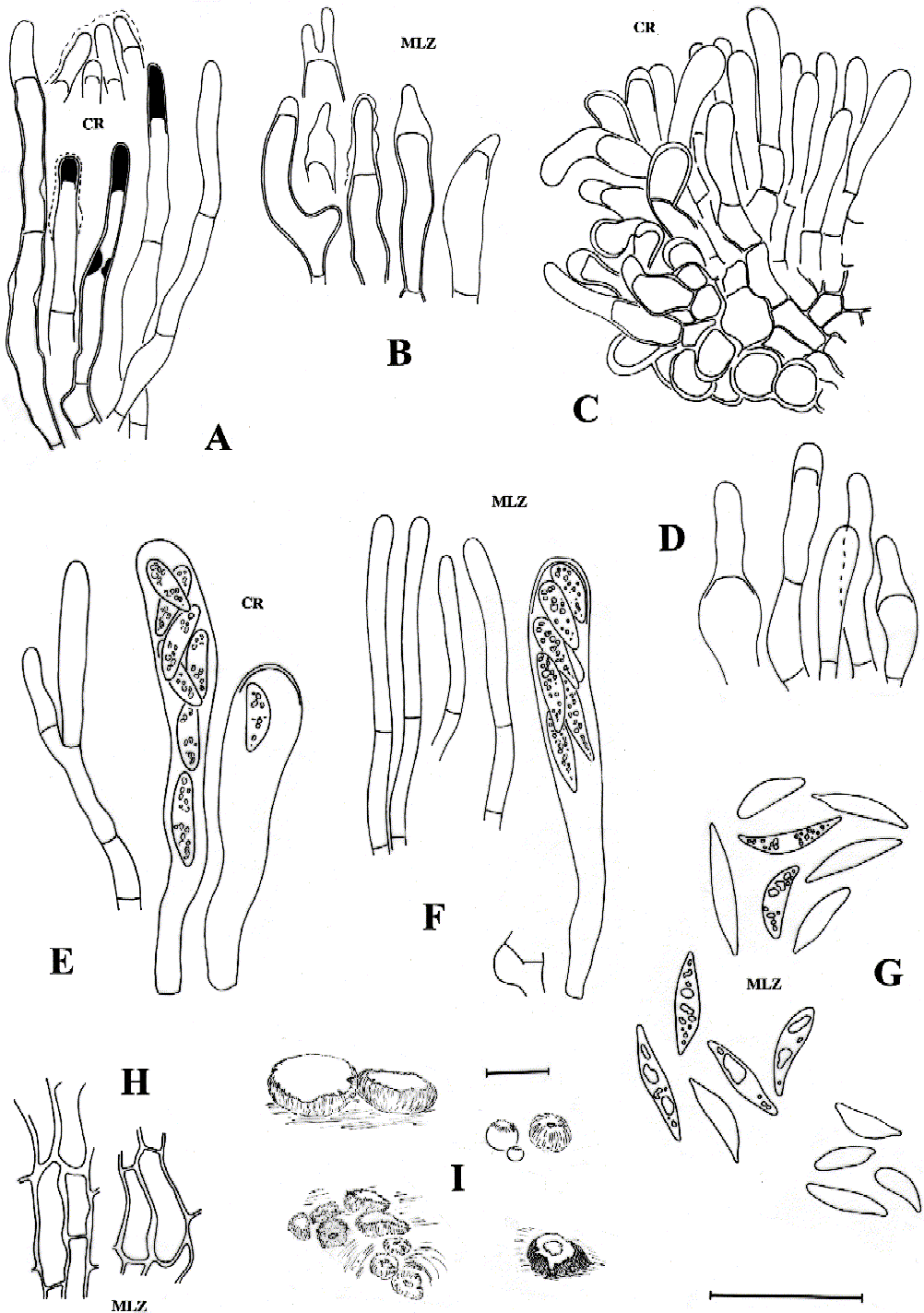
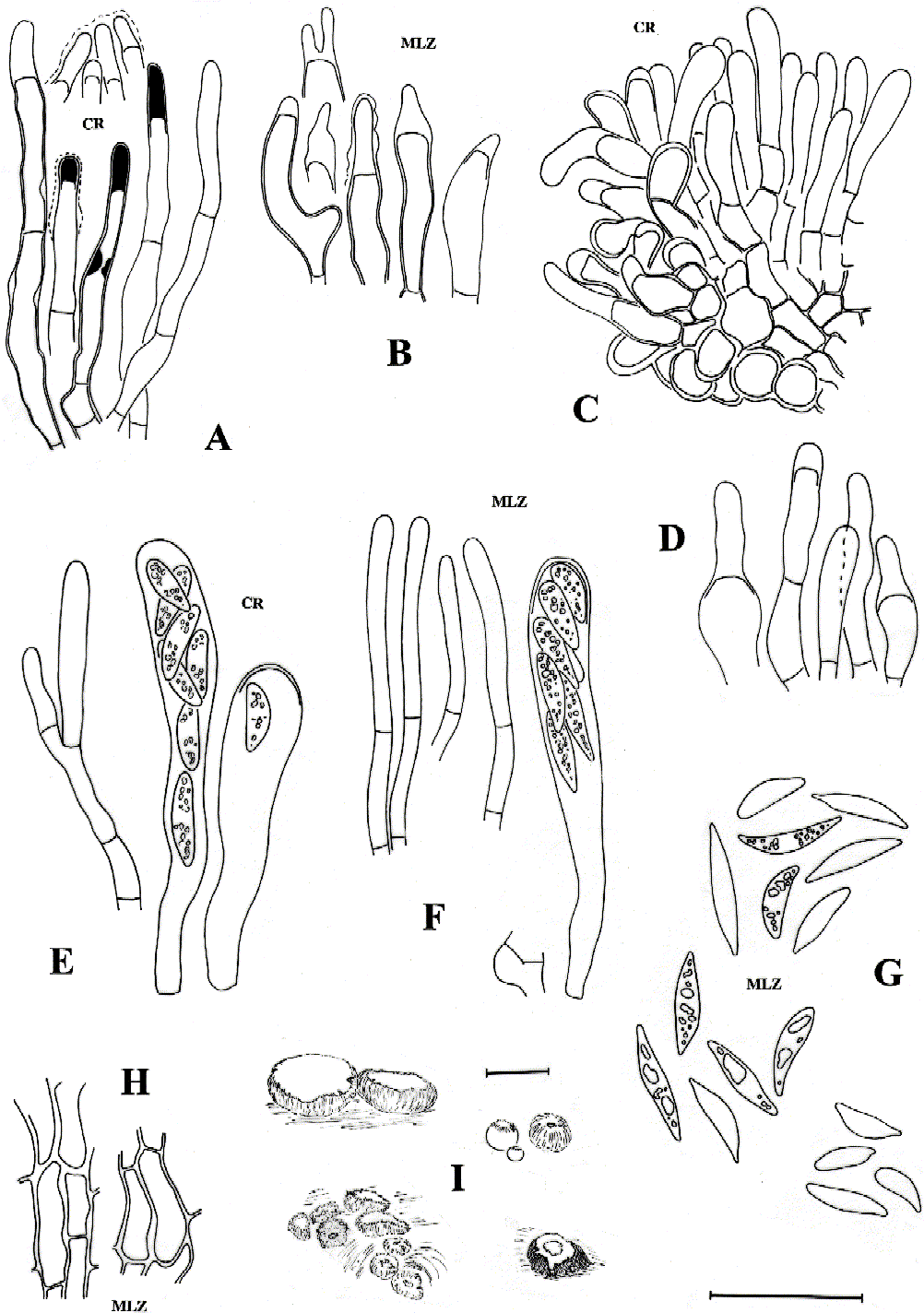
Protounguicularia nephromatis. A, hairs (Tønsberg 15496b); B, hairs (Santesson 12516a); C, detail from exciple (Tønsberg 20731); D, hairs (Santesson 32676); E, asci and paraphyses (M. Laurila, s.n).; F, asci and paraphyses (Tønsberg 15495); G, ascospores [Tønsberg 15495 and Tønsberg 20730a (lowermost four s.n.)]; H, ectal exciple (Tønsberg 15495); I, variability in dry apothecia. Scales: A–H = 20 μm; I = 200 μm.
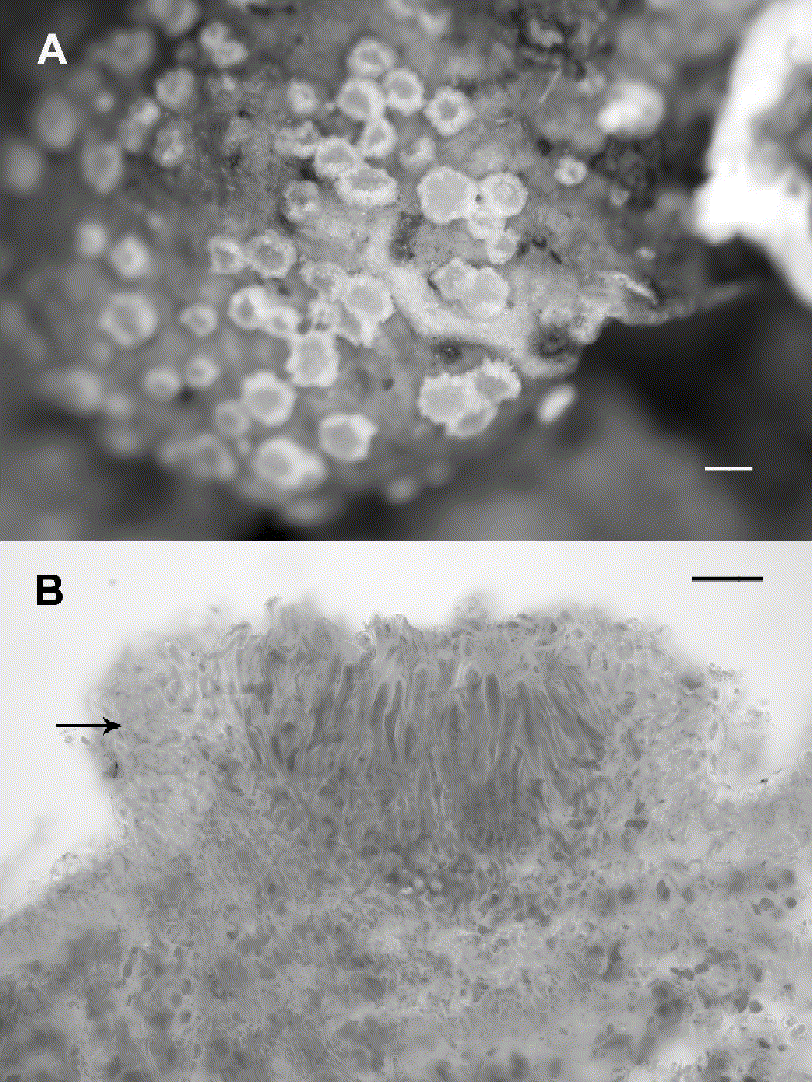
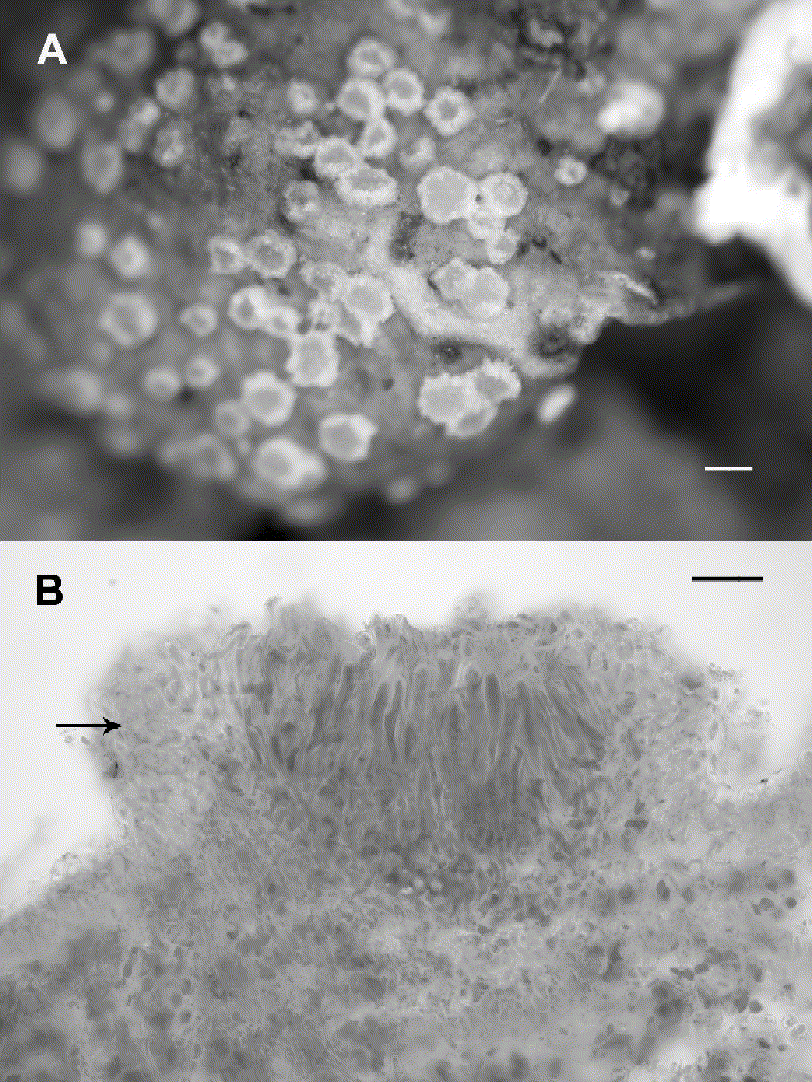
Protounguicularia nephromatis (Santesson 12516a). A, dry apothecia; B, section of an apothecium (arrow points to exciple with only stunted hairs). Scales: A = 200 μm; B = 20 μm. Photo: P.G. Ihlen.
Apothecia typically densely gregarious, sunken and erumpent on the upper side of the host lichen, in one collection only superficial when on the upper side, always superficial when growing on the lower side, discoid to cupulate, up to 330 μm diam. when dry, in most collections up to only 200 μm diam., disc faint yellowish to faint brownish (Cailleux K75, M77), margin whitish. Ectal exciple composed of textura prismatica to textura angularis depending on the growth habit, cells 9–16 × 2·5–4·0 μm to c. 4–5 × 5–6 μm, firm-walled, true wall hyaline, 0·5–1·0 μm thick, MLZ–, IKI–, CR–, except for those areas where the glassy, solidifying substance forms clear CR+ thickenings. Marginal hairs always present, very variable in size and abundance between populations, best developed in apothecia on the lower surface of the host thallus, from minute and aseptate up to 140 μm long and 2-septate, cylindrical to slightly tapering, to 4 μm wide, apex blunt, 1·5-4·0 μm wide, smooth, hyaline, often apically covered with a hyaline layer sometimes gluing the hairs together, this substance CR–, MLZ–; walls mostly slightly thickened, more rarely thin throughout, CR–, MLZ– but inside most of the hairs with apical glassy material MLZ– and CR+, occasionally such material is also present in the lower parts forming irregular thickenings; glassy material inert in 5 % KOH. Paraphyses cylindrical or slightly clavate, to 3 μm wide, simple to apically branched, devoid of pigments. Asci cylindrical-clavate, 37–58·9–74 × 8–6·7–9 μm in MLZ (n= 10, from three populations), 36–44–61 × 7–8·3–9·5 μm in CR (n= 10, from two populations), eight-spored, firm-walled in MLZ, apex rounded, wall of even thickness, MLZ–, IKI–; asci arising from croziers. Ascospores fusoid-subfusoid to hirudoid [leech-shaped], 8·5–11·5–16 (–17·5) × 2·5–2·9–3·2 μm, Q = 3·1–4·0–5·3 in MLZ (n = 50, from six populations), smooth, hyaline, aseptate, apically often beaked, with or without guttulae in MLZ, typically guttulate in CR.
Ecology. So far the species has been found on at least three species of Nephroma, viz. N. bellum, N. laevigatum, and N. resupinatum, as well as undetermined specimens of the genus. In all but two collections the apothecia are formed only on the upper surface. Zhurbenko (Reference Zhurbenko2007) found apothecia on both sides of the thallus, but with most growing on the lower side. Our material showed the opposite; one collection only (Tønsberg 15495) had apothecia on the lower side. In the majority of collections, the apothecia are sunken and erumpent through the upper cortex. They fruit typically in large swarms and do not seem to cause any damage to the host. In one abundant collection only (Tønsberg 37035) all the apothecia were superficial on the upper surface. When on the lower surface, the apothecia are sparser. Well-developed, separate, long hairs were seen only in these superficial apothecia, whereas the erumpent apothecia have a wide, furry margin where individual hairs do not stand out when viewed under a dissecting microscope. The overall difference between these two apothecial types is of such magnitude that without strong microscopical evidence and their co-occurrence it would be easy to conclude that they were different species.
Holien & Tønsberg (Reference Holien and Tønsberg1996) suggested that P. nephromatis (as “Corticifraga nephromae”) might be confined to boreal rain forest. Its presence in such ‘better’ habitats could, at least in Finland, be due to the association between Nephroma spp. and old forest stands (Kuusinen & Siitonen Reference Kuusinen and Siitonen1998). A study of 42 old-growth forests in Finland showed that N. bellum occurred in 41, and N. resupinatum in 38, showing they are excellent indicators of such forests (Kuusinen et al. Reference Kuusinen, Jääskeläinen, Kivistö, Kokko and Lommi1995).
Distribution. The species seems to be widespread in boreal regions of the Northern Hemisphere, and is known from Canada, Finland, Norway, Russia, Sweden, UK and the USA. It might be common since additional material was found with ease in collections of Nephroma in TUR.
Notes. The overall agreement of our observations with the original description by Zhurbenko (Reference Zhurbenko2007) is good. The excipular hairs were reported as up to 35 μm long only and aseptate; the additional material examined here adds markedly to the range of variability of the hairs. The ascus size range and chemical reactions are similar. However, the ascospore mean width was given as 3·5 μm in the type. This could be due to measuring the spores in KOH. Especially noteworthy is the characteristic shape of the ascospores; Zhurbenko's illustration shows the same rare hirudoid shape so we are confident that our material is conspecific with that described by Zhurbenko & Zavarzin (in Zhurbenko Reference Zhurbenko2007).
The immersed to erumpent apothecia led Santesson (in Santesson et al. Reference Santesson, Moberg, Nordin, Tønsberg and Vitikainen2004) to propose placing this species in Corticifraga D. Hawksw. & R. Sant. 1990. However, the presence of the excipular hairs, the evenly thin-walled asci, simple ascospores, and the sometimes superficial apothecia indicate that Corticifraga is not an appropriate genus for this species. Indeed, that genus may be most closely related to the Lecanoromycetes, although its position remains obscure. The solidified, blunt, KOH-insoluble hairs indicate that the most logical genus in which to place this species is Protounguicularia Raitv. & R. Galán Reference Raitviir and Galán1986 or Olla Vel. 1934. These hairs make a placement in Unguiculariopsis Rehm 1909 impossible as the principal diagnostic character in both the fungicolous and lichenicolous species of that genus is the aseptate ascomatal hairs with swollen bases, and narrow, curved glassy apices, with or without a lumen (Zhuang Reference Zhuang2000). Zhuang did not comment on newly added lichenicolous species, all of which lack the typical hairs of Unguiculariopsis, and require re-examination, also using the stains employed here.
Raitviir & Galán (Reference Raitviir and Galán1986) established Protounguicularia for three species, all of which had long, cylindrical, blunt and septate hairs. Two of the species were soon transferred to Arachnopeziza Fuckel 1870 by Huhtinen (Reference Huhtinen1987c) because of a lack of glassy material in the excipular hairs. The remaining species was characterized by septate, apically solidified hairs, inside which the glassy material was KOH-insoluble, dextrinoid, and congophilous. In a separate paper (Huhtinen Reference Huhtinen1987a) the type species, Protounguicularia brevicapitata Raitv. & R.Galán Reference Raitviir and Galán1986, was placed in synonymy under an earlier name introduced by Velenovský (Reference Velenovský1934) and the new combination, P. barbata (Vel.) Huhtinen Reference Huhtinen1987 was made. However, that placement did not remain in use for long as Engel & Svrček (Reference Engel and Svrček1983) had reported the same taxon under the name Pezizellaster transiens Höhn. 1918. Subsequently, Svrček (Reference Svrček1987) hinted at the possible synonymy of P. brevicapitata and Höhnel's species, and this was later verified by Baral (Reference Baral1993) who combined Höhnel's name into the genus Olla.
Baral's (Reference Baral1993) transfer of Pezizellaster transiens to Olla was commented on a year later (Baral Reference Baral1994). As had Svrček, he stressed the urn-like apothecial shape, and also the short, aseptate, totally glassy hairs of species belonging to Olla. The discoid apothecia and only shortly and apically glassy hairs of Olla transiens were considered satisfactory for the genus, but the solution was admittedly somewhat tentative (Baral Reference Baral1994).
A third species was transferred to Protounguicularia by Svrček (Reference Svrček1991), Chrysothallus vandae Vel. 1934 the lectotype of which was collected on a twig of Quercus; the same collection has also been studied by S. Huhtinen Svrček (loc.cit) illustrated typical Protounguicularia hairs with an apical, dextrinoid, solidifying substance. He considered the hairs to be smooth, but mentioned large crystals on the margin. Based on studies of the same specimen, Galán & Raitviir (Reference Galán and Raitviir1994) came to a different conclusion and combined this species name into Graddonidiscus Raitv. & R. Galán 1992, but failed to mention the solidifying substance in the hair apices.
These contrasting conclusions arose from the use of different methods. The surface crystals are lost in both heated Cotton blue mounts and in 10 % KOH. Crystals partly persist in MLZ mounts, which were apparently used by Svrček, but are dissipated by heavy tapping to reveal naked hair apices. Because of the short, aseptate and totally to heavily crystal-covered hairs, Chrysothallus vandae should not be accepted in Protounguicularia.
We consider that Protounguicularia is sufficiently different from Olla to merit reinstating its generic status. The long hairs are cylindrical and septate, in contrast to the short and aseptate hairs in Olla. The hairs also have a slightly thickened true proper wall, and are histochemically different in the nature of the solidifying material. They differ from the typical hairs of Olla in not having just a thin membrane surrounding the glassy hair material. In mounts of, for example, O. scrupulosa (P. Karst.) Svrček Reference Svrček1986 or O. millepunctata (Libert) Svrček Reference Svrček1986, the hairs are frequently fractured, holding their basic shape apparently by a very thin true wall covering the glassy part. The solidifying material does not stain in ammoniacal Congo red (contrary to the erroneous indication in Huhtinen Reference Huhtinen1987b: table 1).
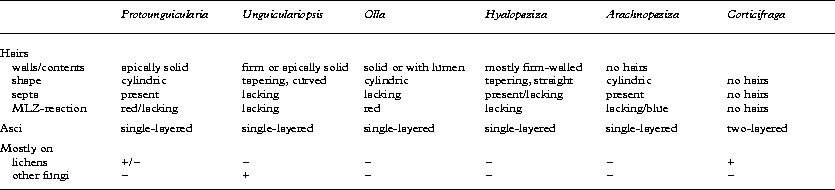
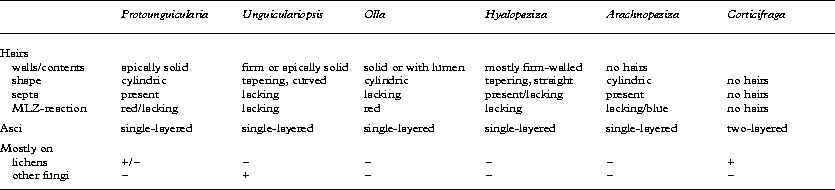
The hairs of the present species differ in their MLZ reaction from both genera in being non-dextrinoid, but the hair morphology and the CR+ reaction of the solidifying substance seem to bring it closer to Protounguicularia than Olla. Although the totally sunken and then erumpent apothecia seem to be distinct from either genus, when much more material became available it was clear that the apothecia could vary from erumpent (mostly on the upper surface) to totally superficial (mostly on the lower surface). In the sunken apothecia, the hairs remain short and the margin becomes broad, while in superficial apothecia the hairs are longest and morphologically identical to those of Protounguicularia, possibly reflecting the more favourable growth environment. Although the appearance of the fruit bodies is totally different, all other microscopical features are identical and we have no doubt that they represent a single species. For comparison of the genera treated see Table 1.
In both O. transiens and P. nephromatis, well-developed hairs have solidifying CR+ matter located locally at the apex, or more rarely as infrequent thickenings in more basal parts. The hairs are tougher and keep their basic shape, and no fracturing usually occurs as the glassy substance is encapsulated by the CR– true wall. The apothecia are discoid when fully mature, whereas in Olla they are typically urceolate. We therefore also transfer O. transiens to Protounguicularia below.
Some typical distinguishing characteristics of the genera, Protounguicularia, Unguiculariopsis, Olla, Hyalopeziza, Arachnopeziza and Corticifraga
Material of P. nephromatis examined. Canada: British Columbia: N of Hazelton, 10 km WNW of Kispiox, N of Date Creek, 55°23.4′N, 127°49.3′, alt 720 m, on Nephroma sp., 1994, T. Tønsberg 20730, 20731 (BG L-71898, 71900). —Finland: Pohjois-Karjala: Pielisjärvi, Louhivaara, Kirkisenvaara, on N. bellum, M. Laurila (TUR 178812). —Norway: Hordaland: Fjell, Sotra, Steinland, on N. laevigatum, 1967, R. Santesson 19286 (UPS). Nordland: Brønnøy, 3·5 km SE of Hommelstø, Holmarklia, alt. 150, on N. bellum, 1995, T. Tønsberg 23558 (BG L-43904); Brønnøy, 3·5 km SE of Hommelstø, Holmarklia, alt. 150 m, on N. bellum on base of trunk of Sorbus aucuparia, 1995, T. Tønsberg 23558 (BG); Rana, Olderlia, alt 120–160, on N. bellum on trunk of Salix caprea, 2006, T. Tønsberg 37034, 37035 (BG). Nord-Trøndelag: Snåsa, c. 1 km N of Hammer, alt. 60–140 m, on N. bellum on trunk of Salix in brook ravine in spruce forest, 1993, R. Santesson 33586 (UPS); Grong, W of river Gartlandselva, alt. 100 m, on N. bellum on twigs of Picea abies, 1995, H. Holien 6863 (TRH). —Russia: Republic of Karelia: Korpiselkä, Hirvasvaara, on N. bellum, 10 ix 1901, K. J. Ehnberg (TUR 178813). —Sweden: Härjedalen: Tännäs parish, Hamrafjället, SW slope E of Hotel of Hamrafjället, alt. 800–850 m, on N. bellum, 1958, R. Santesson 12516a (UPS); Tännäs parish, valley of the river Ljusnan, Ramundberget, alt. 700 m, on N. bellum in the subalpine birch forest, 1962, R. Santesson 14873b (UPS); Tännäs parish, valley of the river Ljusnan, c. 2·5 km SSE of Ramundbergets Fjällgård, alt. 700 m, on N. bellum, 1987, R. Santesson 31910 (UPS); Tännäs parish, Hamrafjället, southwestern slope E of Hotel Hamrafjället, alt. 800–850 m, on N. bellum on a mossy boulder in the birch forest, 1958, R. Santesson 12516 (UPS); Tännäs parish, Ljusnan, slope of Mt. Gruvvålen, alt. 800 m, on N. bellum, 1989, R. Santesson 32676 (UPS). Värmland: Dalby parish, Norra Brattmoviken, on N. bellum on twigs of Picea abies, 1956, R. Santesson 11225d (UPS). Lycksele Lappmark: Tarna parish, Ume river, Bredviken, on N. bellum, 1960, G. E. Du Rietz 2211b (UPS L-121463). —Great Britain: Scotland: V.C.96 Easterness: Inverfarigaig SSSI, Pass of Inverfarigaig, alt. 60m, on N. laevigatum on Corylus, 2008, B. J. Coppins 22629 (e). —USA: Alaska: Kodiak Island Borough, Kodiak Island E, S of Isthmus Bay, bank of Roslyn Creek, 57°37′N, 152°19.4′W, alt 0–10 m, on Nephroma sp., 1991, T. Tønsberg 15495, 15496b (BG L-66114, 66116).
Protounguicularia transiens (Höhn.) Huhtinen, comb. nov.
MycoBank no.: 572449.
Basionym: Pezizellaster transiens Höhn., Sber. Akad. wiss. Wien, Math.-nat. Kl., Abt. 1, 127: 608 (1918). — Olla transiens (Höhn.) Baral, Z. Mykol. 59: 9 (1993).
Protounguicularia barbata (Vel.) Huhtinen,Beitr. Kenntn. Pilze Mitteleur. 3: 457 (1987).—Hyaloscypha quercina var. barbata Vel., Monogr. Discom. Bohem. 1: 276 (1934).—Hyaloscypha barbata (Vel.) Svrček, Česká Mykol. 39: 216 (1985).
Protounguicularia brevicapitata Raitv. & R. Galán, Int. J. Mycol. Lichen. 2: 222 (1986).
Hyaloscypha quercina var. resinacea Dennis, Kew Bull. 30: 353 (1975).—Protounguicularia barbata f. resinacea (Dennis) Huhtinen, Beitr. Kenntn. Pilze Mitteleur. 3: 458 (1987).
Ecology. Saprobic on wood; not lichenicolous.
Distribution. Europe (Austria, Czech Republic, Denmark, Finland, France, Germany, Norway, Poland, Spain, Sweden, Switzerland, The Netherlands, and the UK) and South America (Argentina).
Notes. This species has identical excipular hairs to those of well-developed Protounguicularia nephromatis, but differs in that the solidifying apices are both CR+ and MLZ+ (i.e. dextrinoid) whereas those of P. nephromatis are only CR+.
Hyalopeziza rapax Huhtinen, sp. nov.
MycoBank no.: 512450.
Apothecia pallide grisea vel pallide ochracea, ad usque 0.2 mm diametro, cupulata, margine minute puberula. Excipulum ectale ex cellulis prismaticis compositur. Pili cylindraceo-angustati, aseptati, hyalini, in basi tenuiter tunicati, sursum crassotunicati vel valde crassotunicati sed lumen habentes, in iodo non colorati, leves. Paraphyses filiformes, 1·5–2·0 μm in diametro, sine guttulae. Asci 25–33 × 6–7·5 μm, octospori, non amylodei, in basi non uncinati. Ascosporae 7–11 × 1·5–2·0 μm, cylindraceo-ellipsoideae, saepe subfusoideae, hyalinae, aseptatae.
Typus: USA, Alaska, Kodiak Island Borough, Kodiak Island E, S of Isthmus Bay, bank of Roslyn Cr., 57°37′N, 152°19.4′W, alt 0–10 m, on the lower side of Pseudocyphellaria crocata on twigs of Picea sitchensis in rain forest, 16 May 1991 T. Tønsberg 15496a (BG L-66115—holotypus).
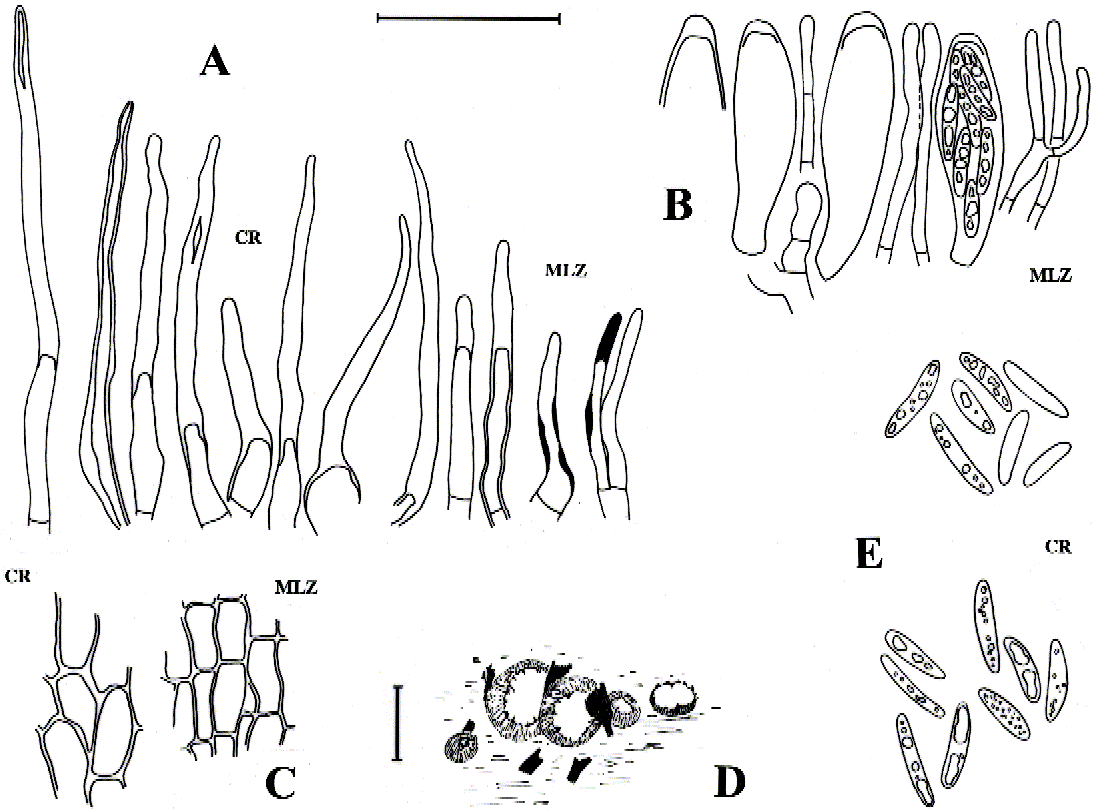
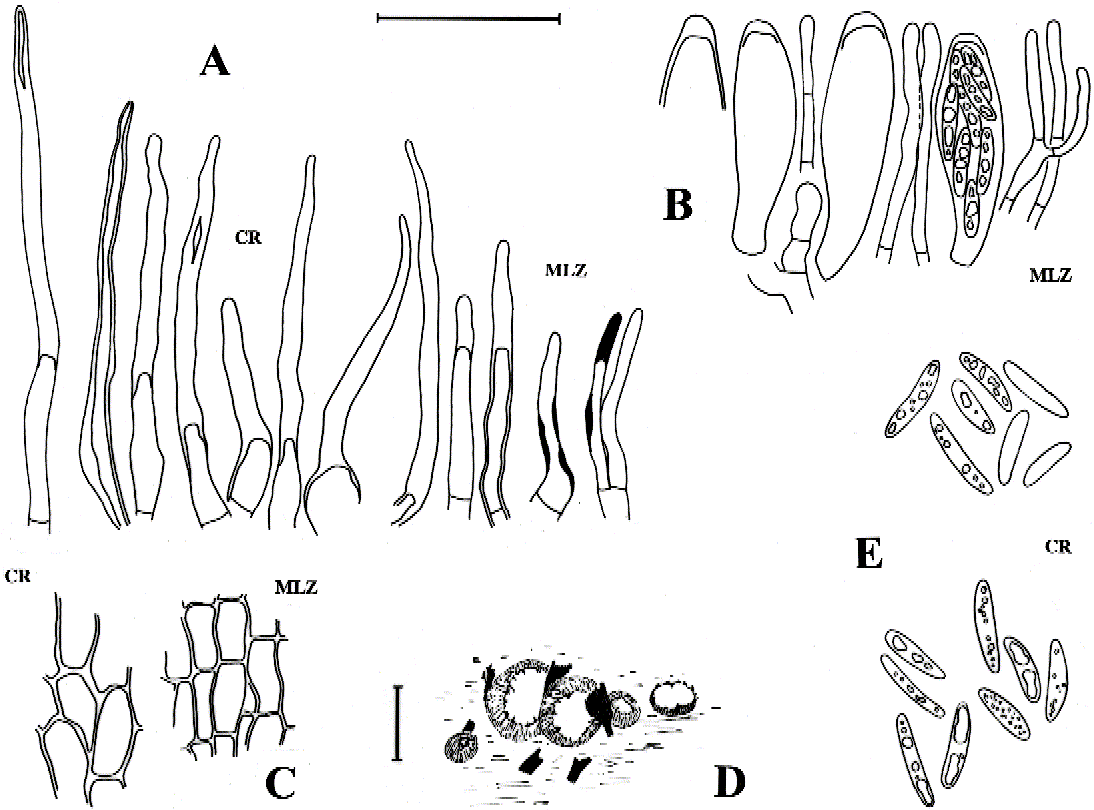
Hyalopeziza rapax (holotype) A, marginal hairs; B, asci and paraphyses; C, ectal exciple; D, dry apothecia; E, ascospores. Scale A–C & E = 20 μm; D = 200 μm.
(Fig. 3)
Apothecia gregarious, discoid, minute, to 200 μm diam. when dry, broadly sessile; watery greyish (Cailleux L92) to straw-coloured (K79), margin hairy, whitish. Ectal exciple composed of textura prismatica, cells 6·5–8·5 × 3–6 μm, walls firm, 0·5–1·2 μm thick, IKI–, MLZ–, CR–; lower parts of the exciple with firm-walled textura angularis. Hairs numerous, at the margin 20–43(–57) × 2–4 μm, tapering, more rarely cylindrical, smooth, aseptate, very rarely 1-septate, typically apically glassy and without a lumen, more rarely with a discontinuous lumen or walls only slightly glassy and thus with a continuous lumen; hairs with irregular, glassy thickenings very rare; glassy material MLZ–, CR+. Paraphyses cylindrical, 1·5–2 μm wide, simple to apically branched, devoid of prominent guttulae in KOH and MLZ. Asci cylindrical-clavate, 25–33 × 6–7·5 μm, eight-spored, MLZ–, IKI–, arising from simple septa. Ascospores 7–8·7–11 × 1·5–2 μm, Q= 3·5–4·6–5·2, (n=27, in MLZ and CR) elongate-subfusoid, smooth, aseptate, with prominent guttulae in MLZ and CR.
Etymology. Rapax, referring to the seizing or catching habit.
Ecology. On the thallus of Pseudocyphellaria crocata.
Distribution. North America (USA); known only from the holotype collection.
Notes. The KOH inert, tapering, and glassy hairs place this species in Hyalopeziza Fuckel 1870. The genus was recently treated by Raitviir (Reference Raitviir2004) who included 16 species. Of those only H. latispora Raitv. and H. niveocincta (Graddon) Raschle have pale apothecia, MLZ– asci and short, aseptate to basally septate hairs. The former differs clearly in having wide spores, the latter in having non-glassy hairs (Baral & Galán Reference Baral and Galán1999). In addition to the shape of the hairs, the strong CR+ reaction is also indicative of a relationship to Hyalopeziza. In some of the hairs there is a tendency for a continuous lumen to also be seen, a character also present in the genus. The character combination and ecology clearly separate the present species from other species in the genus.
We thank T. Tønsberg for placing his many collections at our disposal and A. Puolasmaa for his efforts in going through Finnish material of Nephroma until he found the species as new to Finland. We also acknowledge the first observations of the new species on Nephroma by R. Santesson. This work was supported by the Ministry of the Environment, Finland, as a part of the research programme of deficiently known and threatened forest species (PUTTE).