INTRODUCTION
Toxoplasma gondii is one of the most common parasites, which can cause severe consequences in animals and humans (Torda, Reference Torda2001). The incidence rate of T. gondii infection worldwide is approximately 22·5% (Centers for Disease Control and Prevention, 2015). Currently, there is still no effective candidate vaccine against Toxoplasma gondii infection in human.
Proteases encoded by T. gondii could be possible targets to develop chemotherapeutic agents to control this disease. Aminopeptidases are exopeptidases, which hydrolyze substrates derived from the protein degradation pathway (Taylor, Reference Taylor1993). In addition, they also contribute to a wide range of biological processes, including cell skeleton assembly, protein maturation and modulation of gene expression in vivo (Ajioka and Soldati, Reference Ajioka and Soldati2007).
X-prolyl aminopeptidase (APP) is a proline-specific metallo aminopeptidase that specifically catalyzes the removal of N-terminal amino acid present adjacent to a penultimate proline residue (Cunningham and O'Connor, Reference Cunningham and O'Connor1997; Turner et al. Reference Turner, Hyde, Lim and Hooper1997). It has been suggested that APP is important for the maturation and degradation of peptide hormones, neuropeptides and tachykinins, as well as in the final stage of protein catabolism, particularly during the biosynthesis and degradation of collagen (Viglio et al. Reference Viglio, Annovazzi, Conti, Genta, Perugini, Zanone, Casado and Cetta2006; Phang et al. Reference Phang, Liu and Zabirnyk2010).
APP has been characterized from diverse sources including bacteria, parasites and tissues from several mammalian species. In the human malaria parasite, Plasmodium falciparum, the structure of aminopeptidase P (PfAPP) was similar to the mammalian cytosolic aminopeptidase P, that has three-domains, homodimeric organization and biochemical characteristics, and displays activity in the presence of Mn2+ and Co2+ as cofactors (Ragheb et al. Reference Ragheb, Bompiani, Dalal and Klembal2009). The cytosolic pool of PfAPP probably fulfils a role in peptide turnover and amino acid recycling that is orthologous to those of the cytosolic enzymes (Dalal and Klemba, Reference Dalal and Klemba2007). PfAPP appears to be important for intraerythrocytic growth, because parasites with a disrupted PfAPP gene could not be obtained in previous study. In contrast, there are relatively few reports to our knowledge of an aminopeptidase P homolog functioning. Here, we first report the functional analysis of a recombinant APP from T. gondii and its enzymatic activity against synthetic substrates for aminopeptidase, as well as cellular localization. The role of this gene for parasite growth was evaluated by using the CRISPR/Cas9 knockout method.
MATERIALS AND METHODS
Parasite culture and purification
The RH strain of T. gondii was passaged as tachyzoites in monolayers of vero cells. The cells were cultured in Dulbecco's modified Eagle's medium (DMEM; GIBCO, Invitrogen) with 10% fetal bovine serum (HyClone) and penicillin-streptomycin (Gibco) at 37 °C in 5% CO2 environment. To purify T. gondii tachyzoites, the host cells were passed through a 27-gauge needle and strained through filters with 5·0 µm pores (Millipore, USA).
Expression pattern and sequencing analysis
TgAPP specific primers (forward primer, 5-CGCGGATCCATGGCGCGAGATGGCCAG AGTAG-3; and reverse primer, 5-CCCAAGCTTCTAGTGGAGAGGCAAAGGA GCTGTG-3) were designed based on the TgAPP sequence in ToxoDB (accession number, TGGT1_261600). The underlined sequences indicate the BamH I site in the forward primer and the Hind III site in the reverse primer, respectively. The full length TgAPP cDNA was amplified by using the RT-RNA kit (Takara, Tokyo, Japan) and cloned into the PGEM-T vector (Promega, USA). The GENETYX version 7.0 software (Software Development, Tokyo, Japan) and BLAST search at the NCBI database were used for nucleotide acid sequence analyses. Then the protein sequence was sent for analysis with the NCBI/BLAST program. Comparison of the translated TGGT1_261600 cDNA sequence with the primary sequences of APP from other organisms was performed using CLUSTALX. A phylogenetic tree was generated from homologs of the full-length APP amino acid sequences using MEGA6 software. The SIGNALP 3·0 server was used to search for signal peptide sequences.
Expression of the recombinant TgAPP (rTgAPP) in Escherichia coli and preparation of mouse anti-serum
The TgAPP cDNA was cloned into the prokaryotic expression vector, pCold™ III (Takara) with a GST tag and transformed into an E. coli BL21 strain. One litre culture of transformed E. coli cells was grown at 37 °C to an OD600 of 0·5, then switched to 18 °C and induced isopropyl-β-D-galactoside (IPTG 1·0 mm final concentration). Purification of the rTgAPP was performed with Glutathione Resin (GenScript, USA) according to the manufacturer's instructions. The rTgAPP fused with GST was eluted with 20 mm reduced glutathione (GE Health care, Piscataway, USA). The protein concentration was quantified with the BCA protein assay kit (Pierce, USA). The protein purity was evaluated on 10% sodium dodecyl sulphate poly-acrylamide gel electrophoresis (SDS-PAGE) and stained with Coomassie Brilliant Blue R-250.
Female ICR mice (6 weeks old) were immunized intraperitoneally with purified rTgAPP emulsified with an equal volume of Freund's adjuvants (Difco Laboratories, Detroit, USA) to prepare a polyclonal serum. Sera were collected 14 days after the last immunization. These animal experiments were approved by the Animal Ethics Committee of Harbin Veterinary Research Institute.
Immunofluorescence assays (IFAT)
For immunofluorescence assays, RH control parasites were fixed in suspension with 4% paraformaldehyde (PFA) for 30 min in PBS. After permeabilizing with 0·3% Triton X-100 in PBS for 10 min, the cells were blocked with 4% bovine serum albumin (BSA) in PBS for 1 h. Then, cells were incubated with primary antibodies (Abs) diluted in BSA for 60 min followed by PBS washes for three times. Goat anti-mouse Alexa 488 antibody (Molecular Probes) was used as the secondary antibody. Where appropriate, DAPI (4,6-diamidino-2-phenylindole) staining was performed to stain parasite and vero nuclei by incubating cells with the vector shield mounting medium with DAPI (Vector Laboratory). Images were collected using a confocal laser microscope (TCS NT, Leica, Wetzlar, Germany).
Enzyme assays and kinetics analysis
The peptide, lysyl (Nε-2-aminobenzoyl)-prolyl-proline-4-nitroanilide (Lys(Abz)-Pro-Pro-NA, Bachem, Switzerland CAS Number 219138-18-8), 2-aminobenzoic acid as fluorophore and 4-nitroaniline as quencher are very useful in the development of internally quenched proteases substrates. APP cleaves the Lys-Pro peptide bond separating the fluorogenic aminobenzoyl residue and the internal quenching residue 4-nitroanilide. Lys(Abz)-Pro-Pro-NA was dissolved in water at 25 °C to prepare 10 mm stocks and stored at −20 °C. Assays were carried out in 96-well black plates (Corning, USA) using an EnSpire Multimode Plate Reader (PerkinElmer, Turku, Finland) at a wavelength of 340–430 nm for both emission and excitation. The total reaction volume was 200 µL in Tris-HCl containing 1 mm MnCl2 in the presence of Lys(Abz)-Pro-Pro-NA fluorogenic substrates (0·1 mm) at 37 °C. One unit of activity was defined as the amount of enzyme hydrolyzing 1 µ m substrate min−1. To assay the native TgAPP activity in knockout and control lines, total protein was extracted from the parasites using lysis buffer and quantitated using a BCA protein assay kit (Pierce, USA). Parasite protein (10 µg) was added to 200 µL of Tris-HCl buffer (50 mm) before the specific substrate (0·1 mm) was added to measure enzyme activity. The relative fluorescence levels were assessed for 36 min. For pH optimization, 50 mm Tris buffer over a pH range from 4·0 to 11·0 containing 1 mm MnCl2, rTgAPP (4 µg) and 0·1 mm Lys(Abz)-Pro-Pro-NA was used at 37 °C. Cation sensitivity was investigated by assaying the rTgAPP activity after pre-incubating the enzyme at 37 °C for 30 min in 50 mm Tris-HCl (pH 8·0) containing a metal chloride. The K m (Michaelis constant) and V max (maximum velocity) values of rTgAPP were determined by incubating the enzyme in the reaction mixture in the presence of increasing different fluorogenic substrate concentrations. The k cat was determined from k cat = V max/[E]. The initial velocity was calculated from the slope of the linear range of fluorescence vs the time curve. Activity was measured under the same conditions as described above and expressed as the mean of three different experiments. Bestatin is a potent aminopeptidase inhibitor for cytosol aminopeptidases. To check the effect of this inhibitor, rTgAPP was pre-incubated with bestatin and metal ion at 37 °C for 15 min before substrate addition. Relative inhibition of rTgAPP was assessed using bestatin at various concentrations.
Construction of knockout parasite
A knockout vector targeting TgAPP, designated pGCD-TgAPP was first constructed (Supplementary Fig. 2). The backbone sequence except the single guide RNA (gRNA) cassette was modified from pSAG1::CAS9-U6::sgUPRT (addgene, #54467) (Shen et al. Reference Shen, Brown, Lee and Sibley2014) and self-ligated with Pme I. Then a DHFR cassette was inserted into the Kpn I site. Finally, a gRNA cassette targeting TgAPP (gRNA sequence: AAGCTGAGTCTTTTACTGAG) under the regulation of the TgU6 promoter was cloned into the Pme I site. Transfection of T. gondii tachyzoites was performed by electroporation as previously described (Zheng et al. Reference Zheng, Jia and Zheng2014). The pGCD-APP vector was used to prepare ΔTgAPP parasites and the vector without gRNA cassette was used to prepare control parasites expressing GFP. Selection based on pyrimethamine (1 µ m, prepared in ethanol) was performed as described earlier. Stable clones were isolated using serial dilutions in 96-well plates and confirmed by western blot analysis.
Growth rate of TgAPP deficient parasite
To measure the growth rates of the ΔTgAPP parasites, knockout parasites and control (Cas-9 control) were collected, filtered and inoculated on vero monolayer of cells in 6-well culture plates (Costar, USA) (106 parasites per well). Parasites were allowed to attach and invade for 2 h, after which extracellular parasites were washed away and the culture was continued for another 70 h. Then, the cells were trypsinized and washed two times with PBS. Finally, FACS buffer (1% FCS prepared in PBS supplemented with 1 mm EDTA) was added to achieve a final concentration of 106 parasites per ml. In a total of 10 000 events, the percentage of GFP cells was measured using FACS (Calibur Becton Dickinson LSRII). The growth of ΔTgAPP and Cas9-control were also determined by observing the areas of parasite infection using a fluorescence inverted microscope.
RESULTS
Identification and sequence analysis of the TgAPP gene
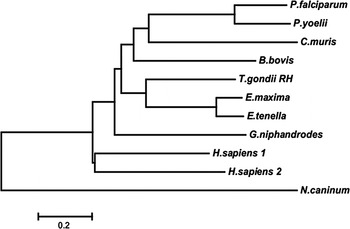
The full-length TgAPP cDNA contains an open reading frame with 2175 bp in Chromosome VII. Four functional domains, including two conserved N-terminal domains (residues 17–153, 187–400) and two conserved catalytic C-terminal domains (residues 406–625, 636–721) were identified using the Pfam protein search algorithm in the SMART program (http://smart.emblheidelberg.de/). Active sites (residues 472, 492, 504, 572, 604, 618) were identified in TgAPP using BLAST. Although the identity of these sites was relatively low, their positions were similar, especially in the conserved C-terminus. We assessed the phylogenetic relationship between TgAPP and the homologs of known APPs (Fig. 1). The results indicated that the amino acid sequence of TgAPP was significantly similar to those encoded by homohexamers, such as APP from P. falciparum 3D7 (32% identity), Gregarina niphandrodes (36% identity) and Cryptosporidium muris RN66 (34% identity), as well as Eimeria tenella (41% identity) (Supplementary Fig. 1).
Phylogenetic tree. The scale at the bottom measures the distance between sequences. Sequences used in this study are as follows: T. gondii RH (accession number RH_261600) was from ToxoDB (http://toxodb.org/toxo/), Plasmodium yoelii YM (accession number PYYM_13 18900), Babesia bovis (accession number BBOV_III008370), Neospora caninum (accession number NCLIV_033100), Plasmodium falciparum 3D7 (accession number F3D7_1454400), Cryptosporidium muris RN66 (accession number CMU_018020), Gregarina niphandrodes (accession number GNI_026520), Eimeria tenella (accession number ETH_00029300), Eimeria maxima (accession number EMWEY_00008150) was from GeneDB (http://www.genedb.org/), Homo sapiens 1 (accession number XP _011538435·1) and Homo sapiens 2 (accession number NP_003390·4).

Polyacrylamide gel electrophoresis of rTgAPP expressed in E. coli
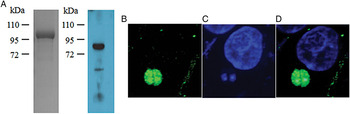
The rTgAPP fused with GST at the N-terminus was expressed as expected. The molecular weight of the rTgAPP monomer was ~105 kDa as observed in SDS-PAGE. The anti-TgAPP sera produced in mice recognized a band with molecular mass of 78 kDa in the T. gondii lysate as expected (Fig. 2A).
Purified rTgAPP and localization of native TgAPP. (A) Electrophoresis of purified rTgAPP on SDS-PAGE; (B) IFAT of native TgAPP. Indirect immunofluorescence to detect TgAPP in cytoplasm. Intracellular RH parasites stained with anti-rTgAPP polyclonal antibodies. (C) DAPI; (D) an overlay of Panel B on Panel C.

Localization of TgAPP
The intracellular parasites were stained with anti-TgAPP polyclonal mouse antibodies and observed through a confocal laser scanning microscope. The results revealed a diffuse staining characteristic of TgAPP localization in the parasite cytosol (Fig. 2B).
Enzyme activity of rTgAPP
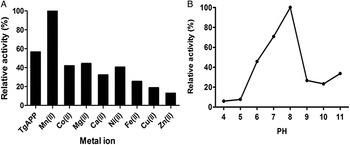
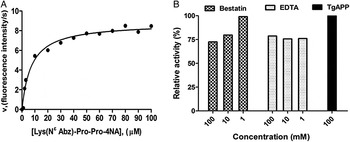
To characterize the enzyme properties of rTgAPP, its activity was measured by a fluorescence assay as reported previously (Ragheb et al. Reference Ragheb, Bompiani, Dalal and Klembal2009). The synthetic substrate Lys(Abz)-Pro-Pro-NA was efficiently hydrolyzed by rTgAPP with a K m value of 0·255 µ m, k cat values of 35·6 s−1and k cat /K m of 139·6 × 105 M−1 s−1 (Fig. 4A). Activity of the recombinant enzyme was tested in the pH range from 4 to 11, and optimum activity was observed at pH 8·0 (Fig. 3B). The activity of rTgAPP was influenced by the addition of metal ions to the reaction mix. Activity was markedly enhanced in the presence of Mn2+ (Fig. 3A). Other divalent ions than Mn2+ showed a decrease in activity of this enzyme, which is consistent with the data of its orthologues in a previous report (Ragheb et al. Reference Ragheb, Bompiani, Dalal and Klembal2009). However, the activity of rTgAPP was significantly low in the absent of metal ions. Similar results were also reported in Lactococcus lactis (Mars and Monnet, Reference Mars and Monnet1995). Bestatin is a dipeptide antibiotic that has been reported in Bacteria, Parasites and Streptomyces (Abe et al. Reference Abe, Alvord, Koyama, Matsuda and Talmadge1989; Schorlemmer et al. Reference Schorlemmer, Bosslet and Sedlacek1983), and is known as the inhibitor of cytosolic aminopeptidases (Cunningham and O'Connor, Reference Cunningham and O'Connor1997). The enzymatic activity of purified rTgAPP was also investigated with different concentrations of bestain. Almost no inhibitory effect was found against the activity when the concentration was less than 10 mm. Inhibitory effects were observed slightly when EDTA was used as an inhibitor (Fig. 4B).
Cation sensitivity and pH of rTgAPP. (A) Cation sensitivity of the rTgAPP; (B) the pH-dependence of rTgAPP.

Kinetics and inhibitors of rTgAPP. (A) rTgAPP exhibits Michaelis–Menten enzyme kinetics. One unit was defined as micromoles of fluorogenic aminobenzoyl residue released per milligram of recombinant protein; (B) inhibition of rTgAPP activity by bestatin and EDTA against Lys(Abz)-Pro-Pro-NA. Data represent mean activity ± s.d. (n = 3).

Construction and generation of TgAPP-knockout parasites
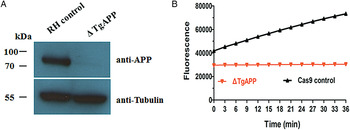
We used the CRISPR/Cas9 system to generate a knockout mutant of TgAPP. The TgAPP-deficient parasites were selected with pyrimethamine, and screened by western blotting using mouse anti-TgAPP serum (Fig. 5A). In order to investigate if other enzyme could compensate the activity of this enzyme in T. gondii, the Lys(Abz)-Pro-Pro-NA was also used to test the hydrolysing ability of whole protein extracts from the ΔTgAPP parasites (Fig. 5B). The results indicated that the enzyme activity of TgAPP was completely lost against the substrate in ΔTgAPP parasites, which probably suggested the enzymatic activity of TgAPP is not essential for the parasite growth.
Identification of APP knockout (ΔTgAPP) in parasites. (A) Identification of ΔTgAPP-deleted line and Cas9 control by western blotting. TgAPP was detected using mouse anti-TgAPP serum. Tg-Tubulin was detected using mouse anti-α-tubulin serum as a loading control; (B) enzyme activity assay of ΔTgAPP parasites.

Loss of TgAPP affects the growth of parasites
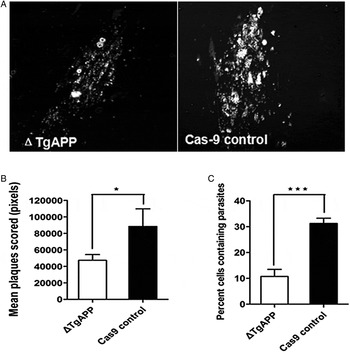
The growth ability of ΔTgAPP parasites were determined by flow cytometer. The average infection area of both ΔTgAPP and wild type parasites were also calculated (Fig. 6A). The results indicated that the growth rate was reduced by the absence of TgAPP gene in T. gondii (Fig. 6B and Supplementary Fig. 3).
Growth evaluation of ΔTgAPP parasites. (A) Comparison of infection area between ΔTgAPP and wild type parasites. All images were taken at 200 × magnification; (B) the area of at least 60 infection foci from each strain was measured and the pixels of mean area was calculated by photoshop software; (C) flow cytometry analysis. Cas9 control or ΔTgAPP parasites were grown for 72 h and then flow cytometric analysis was performed. All results are the mean of three independent experiments. Error bars indicate s.e.m.

DISCUSSION
We report here the cloning, genetic analysis and biochemical characterization of a novel X-prolyl aminopeptidase from T. gondii. Consistent with its classification as a member of the M24 prolyl aminopeptidase family, the activity of rTgAPP was enhanced by Mn2+ at micromolar concentrations and slightly affected by EDTA. A previous report indicated that bestatin could only affect the activity of an aminopeptidase P from pig kidney at 10 µ m (Hooper et al. Reference Hooper, Hryszko and Turner1990). In our data, the activity of this inhibitor could not be observed even at 10 mm. Most APPs show optimum activity at pH 7·0–9·0 (Lee et al. Reference Lee, Kim, Lee and Bae2006). The pH optimum of rTgAPP was in a mildly alkaline condition (pH 8·0). The substrate Lys(Nε-Abz)-Pro-Pro-NA was synthesized by standard procedures of peptide chemistry and has been used to test the enzymatic activity of APP in several studies. There were no reports that indicated the instability of the substrate in different pH ranges. Therefore, the activity of APP influenced by pH could be the consequence of protein stability is affected over time, which was also suggested in previous studies (Rusu and Yaron, Reference Rusu and Yaron1992).
The cytosolic role for APP in peptide turnover in eukaryotes has been well established in diverse organisms ranging from plants, fruit flies, nematodes and plasmodium. The cytosolic localization of TgAPP indicated that this enzyme might play a role in the cytoplasm. The likely substrates for this aminopeptidase could be peptides from proteasomal protein degradation pathways (Rosenthal, Reference Rosenthal2004). On the other hand, it was reported that T. gondii could uptake proteins from host cells and digest them in a vacuole (Dou et al. Reference Dou, McGovern, Cristina and Carruthers2014). Therefore, this enzyme might also be involved in such protein degradation.
APP is a hydrolase that cleaves N-terminal amino bonds normally protected from the attack by other known aminopeptidase. We observed a complete loss in hydrolase activity against the synthetic substrate in ΔTgAPP parasites, which likely reduced the growth of ΔTgAPP. However, our current data could not reflect which step (invasion, proliferation or egress) was affected when TgAPP is deleted. Further investigation of the exact function of this enzyme is still needed. At the same time, complementary expression of APP gene is important to further solidify the phenotype of ΔTgAPP parasites.
In conclusion, we successfully expressed TgAPP, analysed the enzymatic characteristics of the rTgAPP and explored the function of this gene using the CRISPR/Cas9 knockout method. Our findings indicated that TgAPP functions at an optimal pH of 8·0, and its deletion was deleterious to the growth of T. gondii. Based on our data, we concluded that TgAPP could be an adjunct drug target against Toxoplasmosis. Such characterization of TgAPP expands the knowledge of aminopeptidases and protein metabolism of T. gondii.
SUPPLEMENTARY MATERIAL
The supplementary material for this article can be found at http://dx.doi.org/10.1017/S0031182016000986.
ACKNOWLEDGEMENTS
We thank Dr Jia, Chinese Academy of Agricultural Sciences, for providing vectors for experiments studies. Thanks are due to the Northeast Agricultural University, for providing in-frastructural facilities for the work.
FINANCIAL SUPPORT
This work was supported by a grant awarded to Honglin Jia from the National Natural Science Foundation of China (no. 31101811) and a grant from Natural Science Foundation of Heilongjiang Province of China (no. C2015063).