The COVID-19 pandemic profoundly transformed the manner in which people work, collaborate, and learn. Although asynchronous learning had been increasing, Reference Chang, Gütl, Ebner, Voogt, Knezek, Christensen and Laie1 COVID-19 pandemic lockdown measures triggered unprecedented growth in online training and educational resources. 2–Reference Krohn, Sundberg and Quadri4 Web searches for online learning courses increased fourfold in the first month of the pandemic. 5
Just-in-time training is a well-established tool to equip disaster management professionals with critical knowledge and skills. Reference Weiner and Rosman6 The pandemic necessitated widespread dissemination of new and existing knowledge and skills for the public health and health-care workforce. Web-based training platforms such as the World Health Organization (WHO) OpenWHO platform (openwho.org) and the TRAIN Learning Network (train.org) disseminate key information on topics such as infection control, personal protective equipment, and contact tracing, while maintaining necessary social distancing for trainees. Reference Utunen, George and Ndiaye7
The aim of this study was to evaluate and describe the trends in online disaster health course use on the TRAIN Learning Network during the COVID-19 pandemic. TRAIN is a not-for-profit, open-access online training platform developed by the Public Health Foundation (PHF) in 2003. It provides online learning opportunities to more than 3.7 million health professionals on topics related to disaster preparedness and response, public health, and other health-related topics. Affiliate partners include professional and non-profit organizations as well as local, state, tribal and federal health agencies, including the US Centers for Disease Control and Prevention (CDC). To date, health professionals have used TRAIN to access online training courses over 18 million times.
This study analyzed the rate of expansion of the TRAIN platform during the first year of the pandemic, quantified emphasis on pandemic-related training content, and compared uptake of COVID-19 courses with other recent infectious disease outbreaks, including Zika virus and Ebola virus.
Methods
TRAIN offers over 20,000 training courses. The platform is powered by a database that contains data on course content (eg, title, description, objectives, etc), registered users (eg, employment sector, geographic location, job role, etc), and course use (eg, registration dates, completion dates, etc). The database was queried for the period from January through December 2020 for aggregate numbers of registered users, newly added courses, and courses completed related to the study objectives. Descriptive statistics were calculated on deidentified search results.
This study compared the annual number of new registered users, percent increase in registered users, and number of training courses with the average values of these variables for the preceding 5 y (2015-2019). The comparison time period included the evolving online educational landscape, the Zika virus outbreak in the Americas, portions of the West African Ebola epidemic, and subsequent sporadic Ebola virus outbreaks.
This study used the keyword term “COVID-19” within the title or course description to determine the number of new courses added to the TRAIN platform related to COVID-19 and to tabulate COVID-specific courses completed by registered users each month during 2020. Because “COVID-19” did not exist in the database until February 2020, the existing, standard term “Infection Control” was used to assess the change in uptake of training courses related to infectious disease outbreaks from 2015 to 2019. Finally, to highlight the magnitude of COVID-19 training relative to prior infectious disease outbreaks, this study compared COVID-specific course uptake to Zika virus courses during the peak public health interest in that disease (2016). T-tests and Z-tests were used to compare the averages and proportions, using R statistical software (R Core Team). A P < 0.05 was considered significant.
Results
Growth of the Train Learning Network
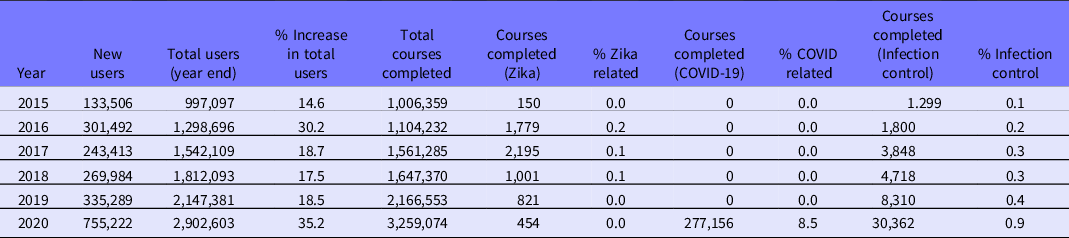
Table 1 includes the numbers of new and total registered users and training courses completed on TRAIN from 2015 to 2020. The numbers of new registered users, total registered users and training courses completed increased annually over this period (Table 1). The growth rates of each of these variables increased during the first year of the COVID-19 pandemic (2020) relative to average baseline rates over the preceding 5-y period (2015-2019). In 2020, a total of 755,222 new users joined the TRAIN Learning Network (Table 1). This is 2.94 times the annual average number of new users added to the network between 2015 and 2019 (avg = 256,737; P < 0.001). The number of total registered users increased 35.2% from 2019 to 2020, compared with an average annual increase of 19.9% over the preceding 5-y period (1.76 times the annual average; P = 0.005; Table 1). In addition, users completed a total of 3,259,074 disaster and public health training courses in 2020, compared with an annual average of 1,497,160 training courses completed over the preceding 5-y period (2.18 times the annual average; P = 0.001; Table 1).
Change in use of the TRAIN Learning Network, 2015-2020

Change in Use Patterns Related to the Covid-19 Pandemic
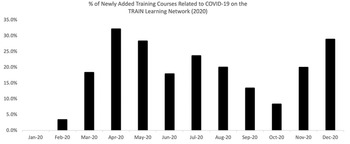
In 2020, a total of 857 individual courses were added to the network that were specific to COVID-19 (ie, had the keyword “COVID-19” in the course title or description). This figure is 17.8% of all new training courses added to the online learning platform for the year. Tabulated by month, the proportion of newly added courses specific to COVID-19 peaked early in the pandemic (April 2020) as the global public health and medical community grappled with the first wave of the pandemic and again in December 2020, when the US Food and Drug Administration (FDA) issued the first Emergency Use Authorization (EUA) for newly developed COVID-19 vaccines (Figure 1).
Percentage of newly added training courses related to COVID-19 on the TRAIN Learning Network (2020).

Users completed a total of 277,156 training courses specific to COVID-19 in 2020, representing 8.5% of all disaster and public health training courses completed on the platform that year (Table 1). For comparison, at the peak of public concern over Zika-related illnesses in 2016, only 0.2% of all courses completed on TRAIN were specific to Zika virus (Table 1). Because a database search for the keyword “COVID-19” may not capture the total number of pandemic-related training courses completed unless “COVID-19” was explicitly referenced in the course title or description, the keywords “Infection Control” were used as 1 proxy to assess the change in uptake of pandemic-related training across the network. Users completed 30,362 training courses on the topic of “Infection Control” in 2020, 7.6 times the annual average for the preceding 5-year period (avg = 3995; P < 0.001; Table 1).
Discussion
The COVID-19 pandemic caused unprecedented disruption to education, learning, and training throughout the world. During the initial phase of the pandemic, a significant portion of the world’s students were affected by school closures and many non-essential workers were under stay-at-home orders. On April 14, 2020—1 mo after COVID-19 was declared a global pandemic—over 1.1 billion preprimary, primary and secondary students worldwide were directly impacted by school closures. 8 In response to such widespread closures and mandatory stay-at-home orders, schools and employers pivoted from in-person to online and remote learning and work arrangements. This transition impelled a dramatic increase in use of video conferencing applications. For example, Zoom (www.zoom.us), a commonly used video conferencing platform, experienced an increase from 10 million daily participants in December 2019 to over 300 million daily participants in April 2020. Reference Iqbal9 Similar trends were noted across multiple platforms offering Massive Open Online Courses (MOOCs). Two popular MOOC platforms, Coursera and Udemy, experienced 640% and 400% increases in enrollment, respectively, over a similar timeframe. Reference Impey10
The spread of the severe acute respiratory syndrome coronavirus 2 (SARS-COV-2) virus created unique challenges for the disaster medicine and public health community. Health professionals needed to rapidly acquire new knowledge and skills related to the epidemiology, diagnosis, and treatment of the novel virus, all while protecting the health and safety of the disaster and public health workforce. To keep pace with this new and ever-changing environment, critical just-in-time training needed to be effectively deployed on an unprecedented scale for a variety of topics, including proper use of personal protective equipment, infection control, contact tracing, and vaccine administration, among others. Online learning platforms such as TRAIN have been vital for providing just-in-time training related to these topics during this evolving public health crisis.
Our results demonstrate a remarkable increase in uptake of online and asynchronous disaster and public health education on the TRAIN Learning Network during the first year of the pandemic. In 2020, TRAIN added nearly 3 times as many new users as the annual average over the preceding 5 y. Such rapid growth of the online training platform is unsurprising given the requisite scale of just-in-time training as well as the prevalence of work-from-home arrangements, particularly in the early stages of the pandemic. For disaster medicine and public health professionals operating under mandatory stay-at-home orders, online platforms provided an important means of professional training and collaboration. In addition, voluntary online training activity likely increased as individuals used extra time at home to fill knowledge gaps and strengthen professional credentials.
Several interesting findings emerged regarding use patterns on the TRAIN platform. Although there was a dramatic increase in the number of registered users and courses completed, courses specific to COVID-19 comprised a relatively modest portion of the total number of new courses added to the platform. Only 17.8% of all newly created training materials in 2020 were specific to COVID-19. This total may be an underestimate if courses related to COVID-19 did not use the term COVID-19 in the course title or description. Overall, however, this finding underscores the fact that, although COVID-19 dominated world headlines and usurped a significant amount of health-care and disaster resources, TRAIN is an important resource for a large number of other disaster and public health related topics. These topics include general disaster preparedness and response, hazardous materials handling, response to the US opioid addiction crisis, reproductive health, and many others.
Unsurprisingly, the COVID-19 pandemic spurred a substantial increase in training related to epidemiology and infection control—users completed nearly 8 times as many courses categorized as “infection control” in 2020 than the baseline level over the prior 5 y that included portions of the Ebola and Zika virus outbreaks. Additionally, when directly compared with course completion during the Zika outbreak in 2016, COVID-19 accounted for 8.5% of all training courses in 2020, while only 0.2% of courses completed in 2016 were specific to Zika virus (Table 1).
This study has several potential limitations. First, this study may underestimate the number of training courses related to COVID-19 if this keyword did not appear in the course title or description. Second, the search term “Infection Control” is a standard category for TRAIN courses related to infectious diseases and was used as a proxy to describe the changing use patterns during COVID-19, but alone does not necessarily capture all the nuances of training effort related to infectious disease outbreaks. Additional keyword searches (eg, epidemiology, PPE, epidemic, contact tracing, infectious disease, etc.) could more accurately describe the change in uptake of infection-related training courses. Similarly, COVID-19 may have prompted additional training in related topics (eg, mechanical ventilation, mental health, etc.) that were not captured or analyzed here. Finally, this study does not assess the quality of training materials offered on TRAIN, trainee satisfaction with course offerings, or whether training courses produced meaningful alterations to health professional’s behaviors, skills, and knowledge.
Conclusions
Online learning platforms such as the TRAIN Learning Network play a critical role in disaster preparedness and response, both for just-in-time training during or after a disaster event and for ongoing training under evolving circumstances such as the COVID-19 pandemic. The rapid expansion of the TRAIN platform during the COVID-19 pandemic reflects the growing reliance of the disaster medicine and public health community on the online training modality. However, further research is needed to determine the effectiveness of online training for these events, evaluate trainee satisfaction with online learning activities and identify crucial information gaps requiring additional attention.
Author contributions
Trent R. Malcolm, Ilya Plotkin, Norma Quintanilla, Kelly Schuitema, and Thomas D. Kirsch contributed to the study design, data analysis, and manuscript preparation. Keke Schuler contributed to the data analysis and manuscript preparation.
Funding
Award Number HU00012020043. The Uniformed Services University of the Health Sciences (USU), 4301 Jones Bridge Rd., A1040C, Bethesda, MD 20814-4799 is the awarding and administering office; and This project was sponsored by the Uniformed Services University of the Health Sciences (USU); however, the information or content and conclusions do not necessarily represent the official position or policy of, nor should any official endorsement be inferred on the part of, USU, the Department of Defense, or the US Government
Conflicts of interest
No financial interest exists in any commercial product, service, or organization providing financial support for this research.
Ethical standards
Protocol DBS.2021.308, entitled “Utilization of the TRAIN Learning Network for Online Disaster Medicine and Public Health Training During the COVID-19 Pandemic” was reviewed on December 10, 2021, by the Uniformed Services University’s Human Research Protections Program Office and determined to be considered research not involving human subjects per 32 CFR 219.102(e)(1), and applicable DoD policy guidance. As such, this protocol does not require Institutional Review Board (IRB) review.
Disclaimer
The opinions and assertions expressed herein are those of the author(s) and do not reflect the official policies or positions of Jefferson Health New Jersey, the Rowan School of Medicine, the Henry M. Jackson Foundation for the Advancement of Military Medicine Inc., the Public Health Foundation, the Uniformed Services University or the United States Department of Defense.