Introduction
Schizophrenia is a disease with a complex genetic aetiology. Although several genetic models have been proposed for the disease (Reference Gottesman and Shields1–Reference Fanous and Kendler3), none can explain all the patterns of occurrence within families. Moreover, the schizophrenia illness exists in both familial and non-familial (sporadic) forms Reference Bleuler(4,Reference Malaspina, Corcoran and Fahim5). It is worth noting, however, that an increase in schizophrenia risk comes with advancing paternal age, recently showed by Malaspina et al. Reference Malaspina, Harlap and Fennig(6), Zammit et al. Reference Zammit, Allebeck and Dalman(7) and Sipos et al. Reference Sipos, Rasmussen and Harrison(8). This association is present in patients with no family history of schizophrenia, but not in those with a family history, supporting the hypothesis that de novo mutations in germ cells of older fathers could play an important role in the aetiology of sporadic, non-familial schizophrenia Reference Malaspina, Corcoran and Fahim(5,Reference Sipos, Rasmussen and Harrison8). By taking this new finding into account in the search strategy for possible genes involved in schizophrenia, this study was undertaken to search for somatic factors that discriminate between familial and non-familial schizophrenia. We examined whether the occurrence of somatic diseases and alcohol and/or substance abuse differs between schizophrenia patients with and without a family history and between their relatives. Additionally, some basic characteristics of the patients with or without a family history were compared.
Patients and methods
Patients
Consecutive out-patients (n = 102) from psychiatric polyclinics in the region of Stockholm, Sweden, and with the diagnosis of schizophrenia according to Diagnostic Statistical Manual (DSM)-IV criteria (9) were asked to participate in the study. Seven patients declined participating, and consequently, a total of 95 patients, 48 males and 47 females, came to be included. The study was approved by the Ethics Committee of the Karolinska Institute, Stockholm, Sweden, and all patients who participated gave their written informed consent.
All patients (including their relatives) were Caucasian individuals. The patients’ mean (SD) age was 44 (9) years, and their duration of disease ranged from 0.5 to 40 years [mean (SD) = 18 (9) years]. They were in full or partial remission regarding psychotic symptoms and were all receiving long-term therapy with either first-generation antipsychotics (n = 33), second-generation antipsychotics (n = 50) or both types of antipsychotics (n = 12).
Interview procedure
The interviews took place at the psychiatric polyclinics and were conducted by a psychiatrist (K. M.) as part of a genetic study. The patients were structurally interviewed by means of a questionnaire devised for this study. Questions covered the patients’ mental and physical health, current medication, cigarette smoking habits and current and former alcohol and substance abuse. The patients were also asked questions about the occurrence in their relatives (i.e. children, siblings, father, mother, paternal uncles and aunts, maternal uncles and aunts, grandparents and other relatives) of the psychiatric disease schizophrenia or probable schizophrenia [diagnosis was made by the patient’s report or by searching a description from the patient and using DSM-IV criteria (9)] and the somatic diseases (a) cancer, (b) cardiac infarction, (c) cerebrovascular disease, (d) diabetes mellitus type 1 or 2, (e) hypertension, (f) other somatic disease and of alcohol and/or substance abuse. Besides this, complementary information was obtained from the patients’ case records. When current weight and height of the patients were not available in the case records, weight and height were measured. The patients who had one or more first-degree relatives, second-degree relatives, third-degree relatives and fourth-degree relatives (except children and siblings) with schizophrenia or probable schizophrenia were classified as patients with a family history (= familial schizophrenia), and the other patients were classified as patients without a family history (= non-familial schizophrenia).
Statistical methods
Continuous normally distributed data were analysed using a two-way factorial analysis of variance (ANOVA) with two between-groups factors, group (with family history, without family history) and gender (male, female). Data measured on a nominal scale were analysed by Fisher’s exact test or with logistic regression analysis. The independent variables in the logistic regression were group and gender. The group × gender interaction was also investigated. When the group × gender interaction was significant, simple effects were examined, that is effects of one factor holding the other factor fixed. For these analyses, Fisher’s exact test was used. p ≤ 0.01 was considered statistically significant as many variables were investigated Reference O’Keefe(10,Reference O’Keefe11). All calculations were made with the statistical program Statistica for Windows (Statsoft, Inc., Tulsa, Oklahoma, USA).
Results
Occurrence of family history of schizophrenia
After excluding 2 patients (1 man and 1 woman) who were adoptees and lacked knowledge of their relatives, data were available for 93 schizophrenia patients. Of these 93 patients, 38 (41%) had a family history of schizophrenia (n = 32) or probable schizophrenia (n = 6). Family history was found just as often in the male as in the female patients. However, more female patients had affected relatives on the maternal side than on the paternal side [14/19 (74%) vs. 3/19 (16%), p = 0.001] as opposed to the male patients who had affected relatives almost equally often on the maternal side as on the paternal side [7/19 (37%) vs. 11/19 (58%), p = 0.33]. Moreover, 2 (10%) of the 19 female patients and 1 (5%) of the 19 male patients had affected relatives on both maternal and paternal sides.
Characteristics, somatic diseases and alcohol and/or substance abuse in patients with or without a family history of schizophrenia
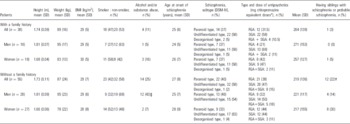
The patients (n = 93) were subgrouped into patients with a family history of schizophrenia (probable schizophrenia included) (n = 38) or patients without a family history (n = 55) and then compared. Mean age (corrected for gender) of the patients without a family history tended to be slightly higher than that of the patients with a family history [45.7 (95% CI 43.2–48.1) vs. 41.6 (95% CI 38.6–44.5) years, p = 0.04], whereas no significant difference was found in duration of schizophrenia illness between the two subgroups.
Table 1 shows the characteristics studied of the patients in the two subgroups. There was a tendency towards that more of the patients without a family history had one or more siblings with schizophrenia or probable schizophrenia compared with the patients with a family history [12/55 (22%) vs. 1/38 (3%), p = 0.03]. For current or former alcohol and/or substance abuse, the interaction group × gender was almost significant (p = 0.018), indicating more commonly such problems in the male patients without a family history compared with the male patients with a family history [12/28 (43%) vs. 1/19 (5%), p = 0.01]. However, no statistically significant differences between the two subgroups could be showed regarding height, weight, body mass index (BMI), cigarette smoking habits, age at onset of schizophrenia, subtypes of schizophrenia or types or daily dose of antipsychotics (Table 1).
Characteristics of the patients with or without a family history of schizophrenia

FGA, first-generation antipsychotics; SGA, second-generation antipsychotics.
* Calculated as previously described Reference Melkersson, Hulting and Rane(12,Reference Woods13).
† Tendency towards a significant difference to the patients with a family history (p = 0.03) but not significant at 0.01 level.
‡ Significantly different to the men with a family history, p = 0.01.
Table 2 describes all kinds of somatic diseases and operations that occurred in more than three patients. Central nervous system (CNS) abnormalities were found only in the patients without a family history (p = 0.08), and conversely, operation for inguinal hernia was reported only in the patients with a family history (p = 0.03), whereas the occurrence of diabetes mellitus type 2 and operation for appendicitis did not differ between the two subgroups (Table 2).
Somatic diseases and operations* in the patients with or without a family history of schizophrenia

* Only somatic diseases or operations that occurred in more than three patients are described.
† Congenital hearing impairment (n = 2), epilepsy (n = 2), mental retardation (n = 1) or status post encephalitis (n = 1).
‡ Drug-induced (n = 2) or type 1 (n = 1) diabetes mellitus or latent autoimmune diabetes in the adult (n = 1) are not included.
§ Only male patients.
¶ Tendency towards a significant difference to the patients without a family history (p = 0.03) but not significant at 0.01 level.
Somatic diseases and alcohol abuse in the relatives of patients with or without a family history of schizophrenia
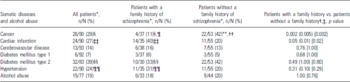
Table 3 addresses the number of schizophrenia patients having one or more relatives (excluding siblings and children) with cancer, cardiac infarction, cerebrovascular disease, diabetes mellitus type 1 or 2, hypertension or alcohol abuse. Other somatic diseases or substance abuse in the relatives were reported only by three or fewer patients and are not described. Figures are given both for all patients as well as for patients with or without a family history of schizophrenia separately. Fewer patients with a family history compared with patients without a family history had relatives with cancer (p = 0.002). Conversely, there was a tendency towards that more patients with a family history compared with patients without a family history had relatives with cardiac infarction (p = 0.05). However, no significant differences in number of patients with or without a family history having relatives with cerebrovascular disease, diabetes mellitus type 1 or 2 or hypertension were found. No significant difference was found in number of patients with or without a family history having relatives with alcohol abuse (Table 3).
Number of schizophrenia patients having one or more relatives (excluding siblings and children) with cancer, cardiac infarction, cerebrovascular disease, diabetes mellitus type 1 or 2, hypertension or alcohol abuse

* Only patients not having the respective somatic disease or alcohol abuse themselves are included.
† p Values in brackets refer to patients with a family history vs. patients without a family history when the patients having relatives with both schizophrenia and somatic disease are included.
‡ p Values in square brackets refer to patients with a family history vs. patients having neither siblings nor other relatives with schizophrenia.
§ One patient having one relative with both schizophrenia and cancer is excluded.
¶ Cancers of brain, intestine, prostate, stomach or unknown type of cancer.
** Cancers of brain, breast, cervix, intestine, larynx, liver, lung, prostate, stomach, testis, urinary bladder, uterus, leukaemia, myeloma or unknown type of cancer.
†† Corresponding figure for a group of 59 healthy control subjects with mean (SD) age 45 (11) years, no family history of psychotic disorder and from the same geographic area in Sweden was 21/59 (36%).
‡‡ Three patients having one or two relatives with both schizophrenia and cardiac infarction are excluded.
§§ Three patients having one or two relatives with both schizophrenia and diabetes mellitus type 2 are excluded.
¶¶ Three patients having one relative with both schizophrenia and hypertension are excluded.
Discussion
Findings related to the inheritance pattern of schizophrenia
Three main findings related to the inheritance pattern of schizophrenia came out of this study. First, it was found that 41% of schizophrenia patients had, and 59% had not, a family history of the disorder. By comparison, although this proportion of family history to no family history is higher than that reported in first-episode schizophrenia spectrum disorder patients Reference Norman, Manchanda, Malla, Harricharan and Northcott(14), it is almost the same as those earlier reported in chronic schizophrenia patient populations (Reference Bleuler4,Reference Malaspina, Corcoran and Fahim5,Reference Malaspina, Goetz and Yale15). Second, family history for schizophrenia was found to occur just as often in male as in female patients, which also agrees with previous results (Reference Malaspina, Corcoran and Fahim5,Reference Malaspina, Goetz and Yale15,Reference Byrne, Agerbo and Mortensen16). Third, female patients, but not male patients, more often had affected relatives on the maternal side. Although this latter finding as yet is difficult to explain, it might suggest that the inheritance pattern of schizophrenia at least in part is a result of genomic imprinting – an epigenetic event that arises because some sequences of DNA are differentially methylated in male and female germ cell lines Reference Strachan, Read, Strachan and Read(17). The finding is also in line with a study by Byrne et al. Reference Byrne, Agerbo and Mortensen(16) showing a significantly higher schizophrenia risk associated with a maternal psychiatric history of the illness compared with a paternal history. However, in contrast to this study, no gender difference in this respect was found in that study Reference Byrne, Agerbo and Mortensen(16).
Findings related to the familial and non-familial forms of schizophrenia
In this study, a tendency was found towards that more patients without a family history compared with patients with a family history had siblings with schizophrenia. If this is a ‘true’ finding, it supports the hypothesis that schizophrenia may be associated, in part, with de novo mutations arising in paternal germ cells (Reference Malaspina, Corcoran and Fahim5,Reference Malaspina, Harlap and Fennig6,Reference Sipos, Rasmussen and Harrison8). It also would seem to suggest that siblings of patients with non-familial, sporadic schizophrenia are at a greater risk of developing schizophrenia than are siblings of patients with familial schizophrenia.
Moreover, it was only the group of patients without a family history of schizophrenia that might be divided into subgroups depending on possible aetiology of the schizophrenia disorder [e.g. schizophrenia related to CNS abnormalities, to current or former alcohol and/or substance abuse or to de novo mutation(s); Tables 1 and 2]. Thus, patients with non-familial, sporadic schizophrenia seem to be a more heterogeneous patient group from an aetiological view than is the case for patients with familial schizophrenia. However, height, weight, BMI, smoking habits, age at onset of schizophrenia, subtype of schizophrenia and type or dose of antipsychotics did not significantly differ between patients with familial and non-familial schizophrenia in this study, which also concurs with most earlier studies (Reference Malaspina, Corcoran and Fahim5,Reference Malaspina, Goetz and Yale15,Reference Kendler and Hays18–Reference Roy, Flaum, Arndt, Crowe and Andreasen20).
Findings related to the genetic predisposition to schizophrenia
Comparing patients’ relatives (except siblings and children) on the basis of familial and non-familial forms of schizophrenia allows a comparison between individuals with and without the genetic predisposition to the disorder Reference Malaspina, Harlap and Fennig(6). Studying the relatives also makes it possible to study individuals not having the schizophrenia illness themselves, thereby avoiding schizophrenia-related factors other than genetic factors (such as poor diet, smoking, physical inactivity and use of antipsychotic medications) that may influence the risk of developing concomitant somatic diseases (Reference Jones21–Reference Joukamaa, Heliövaara, Knekt, Aromaa, Raitasalo and Lehtinen24).
In this study, the majority of relatives with somatic diseases had no parallel diagnosis of schizophrenia. Of the patients having relatives with cancer, only one relative also had schizophrenia. However, even when excluding this relative from the statistical analysis, a clearly significant difference between patients with and without a family history having relatives with cancer was found (Table 3). In addition, the frequency of patients without a family history having relatives with cancer was similar to that of healthy control subjects [22/53 (42%) vs. 21/59 (36%), p = 0.56; Table 3]. Taken together, these findings strongly suggest that a genetic predisposition to schizophrenia entails a protection against cancer. It agrees with two earlier population-based studies Reference Lichtermann, Ekelund, Pukkala, Tanskanen and Lönnqvist(25,Reference Levav, Lipshitz and Novikov26) showing that parents of patients with schizophrenia are less likely than the general population to develop cancer but differs with another such study Reference Oksbjerg Dalton, Munk Laursen, Mellemkjaer, Johansen and Mortensen(27) reporting no reduced risk for cancer in parents of schizophrenia patients compared with parents of offspring not affected by schizophrenia. However, neither of these three studies (Reference Lichtermann, Ekelund, Pukkala, Tanskanen and Lönnqvist25–Reference Oksbjerg Dalton, Munk Laursen, Mellemkjaer, Johansen and Mortensen27) took into account that a relative (except sibling or child) of a patient with schizophrenia may be expected to have a genetic predisposition to schizophrenia only if the patient has a familial form of the disorder Reference Malaspina, Corcoran and Fahim(5,Reference Sipos, Rasmussen and Harrison8). For patients with schizophrenia compared with the general population, increased, equal or decreased overall risk of cancer has been reported (Reference Lichtermann, Ekelund, Pukkala, Tanskanen and Lönnqvist25,Reference Barak, Achiron, Mandel, Mirecki and Aizenberg28–Reference Grinshpoon, Barchana and Ponizovsky30), probably reflecting differences in schizophrenia-related cancer risk factors other than genetic factors between different schizophrenia-patient populations.
Of the patients having relatives with cardiac infarction, three patients had one or two relatives with both cardiac infarction and schizophrenia. When these three patients’ relatives were excluded from the statistical analysis, there was a tendency towards a significant difference (p = 0.05) in number of patients with or without a family history having relatives with cardiac infarction; otherwise, a significant difference (p = 0.01) was found (Table 3). Thus, it seems that individuals having a genetic predisposition to schizophrenia might have a concurrent genetic predisposition to cardiac infarction. Interestingly, this finding is in line with the genetic-inflammatory-vascular theory of schizophrenia recently described by Hanson and Gottesman Reference Hanson and Gottesman(31). The existence of an increased risk for cardiovascular disease as such among schizophrenia patients is also supported by the fact that other studies show a greater risk for cardiovascular morbidity and mortality in these patients compared with the general population and compared with matched controls Reference Brown(32,Reference Goff, Sullivan and McEvoy33).
The finding that there was no significant difference in number of schizophrenia patients with or without a family history having relatives with diabetes mellitus type 2 argues against a strong genetic association between these two disorders. The consistency of this result was also strengthened in that no difference between the patient groups was found when the three patients having relatives with both diabetes mellitus type 2 and schizophrenia were excluded from the statistical analysis (Table 3). The finding was, however, somewhat unexpected because previously it has been reported that the rate of type 2 diabetes in parents of schizophrenia patients unaffected by diabetes is 12%, that is twice as high as that expected in people of corresponding age in the normal population Reference Mukherjee, Schnur and Reddy(34) (to compare, the rate in this study was 9%). However, more significant from a genetic angle, Mukherjee et al. Reference Mukherjee, Schnur and Reddy(34) reported in the same study that 19% of schizophrenia patients with no diabetes had at least one parent and 31% had at least one parent and/or one grandparent with type 2 diabetes (in this study, the corresponding figures were 16% and 35%, respectively). Given that most studies so far have reported that up to 15% of non-diabetic and 25 to 50% of type 2 diabetic individuals have a positive family history of type 2 diabetes as regards first-degree relatives Reference Rotter, Vadheim, Rimoin, Rifkin and Porte(35), it seems reasonable to claim that the 16% in this study and the 19% in the study by Mukherjee et al. Reference Mukherjee, Schnur and Reddy(34) of non-diabetic schizophrenia patients having at least one parent with type 2 diabetes should be interpreted as expected ‘normal’ rates.
It might be argued that factors such as incomplete penetrance and polygenic nature of an illness can explain why a genetic disorder skips generations and that therefore the presence of schizophrenia in sibling should not be considered as being a sporadic schizophrenia case. However, even if excluding the patients having siblings with schizophrenia but no family history in previous generations (n = 12) from the analyses, the results remained unchanged (Table 3).
Putting these findings together (also described in Table 3), the genetic risk associated with schizophrenia seems to cosegregate into a factor(s) that protects against cancer and possibly also predisposes to cardiac infarction but does not heavily influence the risk of developing type 2 or type 1 diabetes, hypertension, cerebrovascular disease or alcohol abuse. Even if the genetic loading in schizophrenia, which is known to be associated with schizotypal personality disorder and cognitive abnormalities Reference Faraone, Seidman, Kremen, Toomey, Pepple and Tsuang(36), means that relatives are atypical with respect to their exposure to environmental risk factors, this does not dismiss the possibility of a common genetic aetiology for schizophrenia, cancer and cardiac infarction.
Strengths and limitations of the study
This clinical study that was based on patient interviews and case records included family history information from first-degree relatives, second-degree relatives, third-degree relatives and fourth-degree relatives in contrast to many population-based register studies. It was also narrowed to a diagnostic homogeneous patient group in which only patients with the diagnosis of schizophrenia and not with diagnoses of other related psychoses were included. Likewise, the group of relatives with schizophrenia or probable schizophrenia studied was diagnostically homogeneous. All these three advantages of the study strengthen the consistency of its results. The study has, however, limitations. First, only patients were interviewed, not any relatives, which may have limited the accuracy of the information obtained. Second, the small numbers of patients reporting somatic diseases and/or operations, described in Table 2, may have resulted in insufficient statistical power to detect in some of these subgroup analyses ’true’ significant differences.
Future research
A gene variant(s) that protects against cancer and possibly also increases the risk for cardiac infarction seems to be a promising candidate gene(s) in the future search for genes involved in schizophrenia.
Acknowledgements
This study was supported by grants from Capios Research Foundation, Magnus Bergvalls Foundation and the Swedish Society of Medicine.