Over the course of the last decade our understanding of the Preclassic period in the Northern Maya Lowlands has begun to change dramatically. The region was initially thought to have been only lightly inhabited during the Preclassic (e.g., Ball Reference Ball and Adams1977; Ringle Reference Ringle, Grove and Joyce1999:189), but recent archaeological projects have found that materials dating to both the Middle and Late Preclassic periods are widespread and pervasive throughout the Northern Lowlands (Gallareta Negrón and May Ciau Reference Gallareta Negrón and Ciau2007; Robles Castellanos and Andrews Reference Robles Castellanos and Andrews2003; Robles Castellanos et al. Reference Robles Castellanos, Aguilar and Rosales2006; Robles Castellanos and Ligorred Perramon Reference Robles Castellanos, Perramon, Castellanos and Perramon2008). Among these recently reported finds is the site of Xtobo. Located in far northwest Yucatan, Mexico, Xtobo was a complex Preclassic settlement of approximately 1,500 people that appears to have served as a cultural/sociopolitical center for the local region. The data collected from Xtobo, as well as the data collected by numerous other archaeology projects in the region, require a reexamination of our assumptions about cultural development in the Maya Lowlands. We, as scholars studying the pre-Columbian Maya, have long been conditioned to think of the Southern Maya Lowlands as both the core and the origin place of Maya civilization (e.g., Estrada-Belli Reference Estrada-Belli2011; Hansen Reference Hansen and Powis2005; Rathje Reference Rathje and Leone1972; Sharer Reference Sharer, Danien and Sharer1992). The many recent discoveries in the Northern Lowlands demonstrate, however, that the region was an integral part of the Maya world as early as the Middle Preclassic period.
Despite the region's low profile, Preclassic materials have long been known from the Northern Lowlands. George Brainerd (Reference Brainerd and Tax1951, Reference Brainerd1958) identified Preclassic pottery from many sites throughout Yucatan in his foundational studies of Maya pottery. The earliest report of settlements with Preclassic materials in far northwest Yucatan was made by Edwin M. Shook (Reference Shook1955) following a brief survey of the region. In the late 1950s and early 1960s, E. Wyllys Andrews IV's project at Dzibilchaltun encountered concentrations of Preclassic architecture throughout the site, most notably at the Mirador Group and at Komchen (Andrews and Andrews Reference Andrews IV and Andrews V1980; Kurjack Reference Kurjack1974). During the same period, ongoing work at the site of Mayapan encountered a small sample of Preclassic pottery buried under layers of successive reoccupation (Smith Reference Smith1971:137). In 1980, E. Wyllys Andrews V began a new project at Komchen, focusing on the site's Preclassic occupation (Andrews 1988, 1989; Andrews et al. Reference Andrews V, Crespo and Ringle1980; Andrews and Ringle Reference Andrews V and Ringle1992; Ringle Reference Ringle1985; Ringle and Andrews Reference Ringle, Andrews V, Culbert and Rice1990). Andrews’ work at Komchen, together with that of William M. Ringle, has come to define our understanding of the Preclassic period in the North and is frequently cited as representative of the region (e.g., Hammond Reference Hammond1986:405–406; Henderson Reference Henderson1997:107–108; Sharer and Traxler Reference Sharer and Traxler2006:277). More recent studies have focused on Preclassic occupation at Yaxuna (Stanton Reference Stanton2000, Reference Stanton2005; Stanton and Ardren Reference Stanton and Ardren2005). These projects are exceptions to most archaeological work in the Northern Lowlands, which has focused on the Classic and Postclassic periods. Nevertheless, much of this work has produced small samples of Preclassic materials (Bey et al. Reference Bey III, Bond, Ringle, Hanson, Houck and Lope1998:107; Bond-Freeman Reference Bond-Freeman2007; Bond-Freeman and Brown Mansell Reference Bond-Freeman, Mansell, Rubio and Gubler2006:63; Eaton Reference Eaton, Brown and Andrews V1978:62; Forsyth Reference Forsyth1983:16–33; Kurjack Reference Kurjack1974:47; Quiñones Cetina Reference Quiñones Cetina2006:53–55; Robles Castellanos Reference Robles Castellanos, Rice and Sharer1987:101, 1990:55, 1997:255; Stanton and Ardren Reference Stanton and Ardren2005; Suhler et al. Reference Suhler, Ardren and Johnstone1998:172–173).
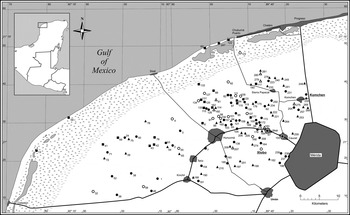
Starting in 1999, a regional survey of far northwest Yucatan was carried out by the Proyecto Costa Maya (PCM), under the direction of Fernando Robles Castellanos and Anthony P. Andrews (Reference Robles Castellanos and Andrews2000, Reference Robles Castellanos and Andrews2001, Reference Robles Castellanos and Andrews2003; Andrews and Robles Castellanos Reference Andrews and Castellanos2004). Over the course of four field seasons the project documented a large number of Preclassic sites. Prior to the survey, only eight sites with Preclassic occupations had been known within the survey zone (Andrews and Andrews Reference Andrews IV and Andrews V1980:16; Eaton Reference Eaton, Brown and Andrews V1978:34–37; Shook Reference Shook1955:291–292), but by the end of the final season PCM had documented 140 Preclassic sites—116 with Middle Preclassic occupations and 92 with Late Preclassic occupations (Figure 1). The settlement survey exposed several unexpected features, including the site of Xtobo and 23 examples of ballcourt architecture (Anderson Reference Anderson, Andrews and Castellanos2003; Medina Castillo Reference Medina Castillo, Castellanos and Andrews2003). Other contemporary investigations have found a similar abundance of Preclassic remains throughout the Northern Lowlands. In the northeast corner of the peninsula, the Yalahau Regional Survey Project documented a multitude of Middle and Late Preclassic materials (Glover and Amador Reference Glover, Amador, Shaw and Mathews2005; Glover et al. Reference Glover, Rissolo, Ball and Amador2011; Rissolo Reference Rissolo2001; Rissolo et al. Reference Rissolo, Rodríguez, Ball, Shaw and Mathews2005). Large Preclassic centers have been identified at the sites of Poxila (Robles Castellanos et al. Reference Robles Castellanos, Aguilar and Rosales2006) and Xocnaceh (Gallareta Negrón and May Ciau Reference Gallareta Negrón and Ciau2007). Additional Preclassic ballcourts have been reported for the Puuc site of Paso de Macho (Gallareta Negrón et al. Reference Gallareta Negrón, Ringle, Ciau, Pacheco and Sánchez2005) and the northwest Yucatan site of Xanila (Robles Castellanos and Ligorred Perramon Reference Robles Castellanos, Perramon, Castellanos and Perramon2008). Salvage projects conducted by archaeologists at the Instituto Nacional de Antropología e Historia (INAH) have also encountered sites with significant Preclassic remains throughout the state of Yucatan, including Caucel (Hernández Hernández Reference Hernández Hernández2001), Tipikal (Peraza Lope et al. Reference Peraza Lope, Delgado and Escamilla2002), Tamanche (Santiago Lastra and Acevedo Chin Reference Santiago Lastra and Chin2003), Quintas del Mayab (Maldonado Cardenas and Echeverria Castillo Reference Maldonado Cardenas and Castillo2004), El Mameyal (Uriarte Torres Reference Uriarte Torres2004), Tzubil (Boucher and Palomo Carrillo Reference Boucher and Carrillo2005), Serapio Rendon (Hernández Hernández and Ceballos Gallareta Reference Hernández Hernández and Gallareta2006), Nohol Caucel (Uriarte Torres Reference Uriarte Torres2007), and Xaman Susula (Peniche May Reference Peniche May2009, 2010). Even salvage work within the modern city of Merida, traditionally associated with the Postclassic Maya center T'ho, has produced more Preclassic pottery than that of any other time period (Quiñones Loría Reference Quiñones Loría and Guerrero2006). Also, E. Wyllys Andrews V (personal communication 2010; see also Andrews et al. Reference Andrews V, Bey and Gunn2008) has recently reanalyzed the materials from Komchen, suggesting that the site had a significant occupation in both the Middle and Late Preclassic. A region once thought to have only limited Preclassic settlement now suffers from an excess of data.
Preclassic sites recorded by the Proyecto Costa Maya in northwest Yucatan. Triangles represent Middle Preclassic sites; squares represent Late Preclassic sites; circles represent Middle and Late Preclassic sites. Hollow symbols represent ballcourt sites. Based on INEGI maps and project data. Drawing by the author.

Research began at Xtobo in 2002, when the Proyecto Costa Maya carried out a series of initial investigations of the site, including the creation of a tape-and-compass map of the site center and the excavation of three test pits (Anderson Reference Anderson, Andrews and Castellanos2003). In 2004, the Proyecto Arqueológico de Xtobo (PAX) was inaugurated by the author, with a foot survey attempting to document the extent of the settlement (Anderson Reference Anderson2005b). Topographic mapping of the site began in 2005 (Anderson Reference Anderson2006), and was finished during the 2007 season (Anderson Reference Anderson2009). A program of test pit excavations was also carried out during the 2007 season and the artifacts recovered from those excavations were analyzed in 2008. The results of the work carried out by PAX portray a large and complex settlement that interacted not only with the immediate surrounding area, but also with the Southern Maya Lowlands and other parts of Mesoamerica.
Many questions and topics of interest have developed out of the work at Xtobo. The settlement represents a previously unknown complex sociopolitical center; as a result we must reassess our interpretations of the region's culture history to answer what role Xtobo played. The presence of certain features within the Xtobo settlement pattern, such as a ballcourt and Triadic Groups, a large mound flanked by two inward facing smaller structures, all three of which are typically built upon a basal platform (Hansen Reference Hansen and Houston1998:77–80; Valdés and Fahsen Reference Valdés and Fahsen1995:199), raise questions about the significance of these features within the Maya region and Mesoamerica. Negative evidence has also raised certain questions. Despite the growth in known Preclassic materials—particularly from the Middle Preclassic—at Xtobo and elsewhere in the Northern Maya Lowlands, there have been few to no reported finds that can be associated with the Formative Horizon Style (Lesure Reference Lesure, Hendon and Joyce2004). This lack of material suggests that complexity emerged in the Northern Lowlands without significant influence from the otherwise pervasive Preclassic Mesoamerican symbol/ideological system. This paper presents new data recovered from Xtobo and utilizes them to explore these issues.
FIELD WORK: METHODOLOGY AND PRACTICE
Xtobo is accessable by dirt roads connecting the nineteenth-century Rancho Xtobo, from which the ruins take their name, with nearby pueblos. Unlike much of northwest Yucatan, the Xtobo lands appear to have never been cleared for henequen production and, as a result, the local scrub-forest (monte alto) is thicker than typical for the region, aiding in the preservation of the archaeological site. In order to systematically survey in this environment it was necessary to cut trails as part of a 100 m grid system. Trails were cut from the site center to the suspected edges of the site, as determined by earlier survey work (Anderson Reference Anderson2005b), though structures encountered at the edges of the grid system suggested that settlement extended beyond our estimates of the site limits in almost all directions. The grid trails allowed surveying and mapping to proceed in a systematic fashion, and provided access to the remote regions of the site. Each grid square was systematically examined for structures; when structures were encountered they were minimally cleared of vegetation to provide increased visibility of the architecture, but some vegetation was left in an attempt to not completely disrupt the current natural environment. Once all of the structures within a grid square had been cleared, one final search of the square was made to ensure complete coverage.
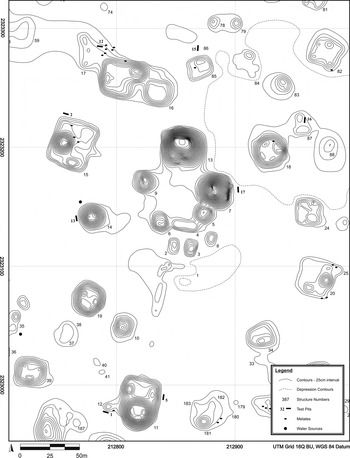
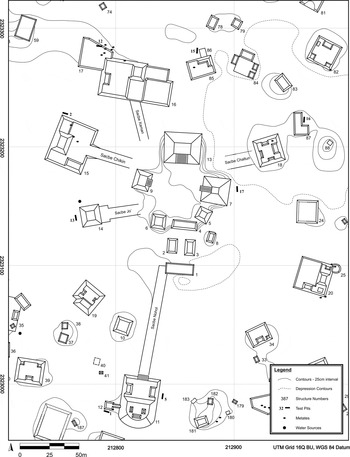
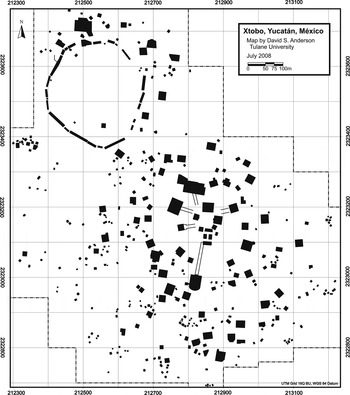
In order to best document and represent the site of Xtobo, both a topographic map and a reconstruction map of the site were created using a Total Station system (Figures 2 and 3). Topographic data points were recorded for each structure by the “Spot Height” method where data points are taken in association with changes in slope, in contrast to a regular grid of points covering the entire area; this method allows more efficient mapping of structures with less redundant data (Wheatley and Gillings Reference Wheatley and Gillings2002:110). Additional data points were recorded where necessary to document architectural features. Once the contour map was completed, the reconstruction map was drawn taking into account additional notes recorded for each structure and using the standard conventions introduced to the field by Teobert Maler to represent Maya architecture. In those cases where the current condition of architectural preservation created doubts as to the building's original form, dashed lines were used to represent the hypothetical building extent. A total of 67 ha of solid settlement were mapped, recording 387 structures, 116 metates, 12 pozos (ground-water wells), and two caves (Figure 4).
Topographic map of the central regions of Xtobo.

Reconstruction map of the central regions of Xtobo.

Reduced version of the Xtobo reconstruction map.

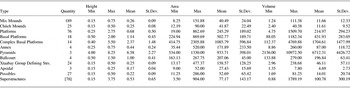
As a complement to the mapping program, an architecture registration was also carried out. The registration provided informational depth to the map by recording attribute data for each structure. The attributes recorded highlight differences in construction materials, technique, and the relative levels of energy expenditure behind each structure; attributes included form, condition, construction material type, dimensions, number of superstructures, and number of levels. Using these data, an architecture typology was created based on shared attributes among structures. The resulting 12 architecture types (see Table 1) present a notable degree of architectural diversity found across the site, which will be explored further below.
Architecture types present at Xtobo, as derived from attribute data collected during architecture registration

The final stage of fieldwork carried out by the PAX was a systematic program of test pit excavations. Structure excavations were not possible due to both permit and budgetary restrictions; thus, all excavations had to be carried out “off mound;” as a result, architectural sequences and the detailed information that they entail were not encountered. In an attempt to make up for this deficit, a stratified sample excavation program was developed based on the architecture typology. The variations in architecture are assumed to represent variations in the social, economic, and political landscape of the community, along with potential chronological variation in architecture style. Excavations were designed to test a wide variety of social and/or temporal contexts at the site. When possible, at least three test pits were excavated in association with each architecture type encountered at Xtobo. In an attempt to encounter midden deposits and other artifacts associated with the building's occupation, the test pits were placed as close to each building as possible and the more traditional 2 × 2 m units were replaced by 1 × 4 m units oriented along the edge of the building. Buildings from within each architecture type were chosen at random for excavation and the exact location of each test pit was chosen in the field with an eye for placing the units on the backside of structures as well as in locations where bedrock was not already visible on the surface. In total, 32 test pits were excavated to bedrock by natural stratigraphic levels, with all materials being passed through ¼ inch screens. One of the excavated test pits produced no material culture remains, while a second test pit produced only three eroded unidentifiable pottery sherds. The remaining 30 test pits recovered a relatively small but informative artifact collection.
THE SETTLEMENT PATTERN OF XTOBO
The center of Xtobo is defined by a well-organized plaza flanked on the north and east sides by two 8 m-tall pyramids (Structures 7 and 13) (Figure 3). On the south and west sides, smaller platforms define the plaza edge. One of these buildings (Structure 4) also forms the northern closing mound of the site's ballcourt. The ballcourt playing alley is defined by Structures 2 and 3. The confirmation of these buildings as a ballcourt has been demonstrated by the identification of multiple features of ballcourt architecture (Taladoire Reference Taladoire1981, Reference Taladoire and Whittington2001), including benches, taluds, and upper walls (Anderson Reference Anderson, Andrews and Castellanos2003, Reference Anderson2009). To the south, Structure 1 forms a second closing mound giving the ballcourt an I-shaped form. The Xtobo ballcourt is relatively small in comparison to the examples documented by PCM, but it does fit within the range of observed variation (see Medina Castillo Reference Medina Castillo, Castellanos and Andrews2003, Reference Medina Castillo2005).
Radiating out from the plaza are five sacbes, or causeways, each leading to structures of notable size and complexity. The buildings connected to the plaza by these sacbes are presumed to have held particular importance in the community, given that they could claim priority access to the sociopolitical and/or ritual center of the site (Kurjack and Garza Tarazona de González Reference Kurjack, de González and Ashmore1981:301; Shaw Reference Shaw2008:116). Three of the sacbes lead to complex platforms that appear to have served as high-status residences (Structures 15, 16, and 18). While these structures are quite large, several of their associated superstructures are comparable in scale to the residential structure foundations found elsewhere at the site. Metates were found in association with each of these structures, suggesting food preparation occurred at these structures. Further bolstering the residential argument are preliminary soil tests conducted in association with Structures 15 and 16, which revealed elevated levels of phosphorous, a probable indicator of food preparation and/or disposal activities (Anderson et al. Reference Anderson, Bair and Terry2012). If each of these buildings represents a residence for high-status families or social groups, more than one such group could identify itself with the plaza. There may be chronological variation in the prominence of these buildings, but even so it implies that new social groups claimed power without completely supplanting older groups.
The two remaining sacbes connect with non-residential architecture. Structure 14 is the only pyramid at the site not located directly on the plaza. Looting of the building's construction material has heavily damaged Structure 14 and for now it is difficult to posit a function for this structure other than to suggest a generic sociopolitical/ritual role. Finally, Structure 11 presents a notable form in Preclassic Maya archaeology best described as a double Triadic Group (after Graham Reference Graham1967:46; Hansen Reference Hansen and Houston1998:77). Triadic Groups are prominent features at many Preclassic Maya sites and are best known from examples at sites in the Mirador Basin of Guatemala. The potential significance of this building, as well as two other Triadic Groups at Xtobo, will be further explored below.
The sacbe leading to Structure 11 forms the central portion of a notable constructed pathway at Xtobo. From the steps of Structure 11, the sacbe leads to—and connects with—the southern closing mound of the site's ballcourt (Structure 1). Structure 4, the northern closing mound, has been observed to have steps on both its playing alley side and its plaza side. As a result, there is a direct pathway created from Structure 11, along Sacbe Nohol, through the ballcourt, and into the plaza (see Figure 3). This arrangement creates a pathway through the heart of Xtobo linking a majority of the site's most prominent structures, although detailed construction sequences for these buildings are currently lacking. This pathway may represent the physical manifestation of a processional ritual (Ringle Reference Ringle, Grove and Joyce1999:207; Shaw Reference Shaw2008:119), but the particular significance of such a ritual is uncertain. The pathway also represents an early example of the association between ballcourts and sacbes, a pattern frequently seen at later Maya sites (Ringle Reference Ringle, Grove and Joyce1999:209; Taladoire Reference Taladoire and Whittington2001:114).
Outside of the elite-ceremonial core, Xtobo had a dense residential settlement (Figure 4). Of the 387 recorded structures approximately 75% are within the architecture types Mound, Chiich Mound, and Platform (see Table 1). These architecture types are generally the smallest and least complex structures encountered at the site. The two mound types represent little more than minimal stone foundations presumably used to support perishable architecture (Kurjack Reference Kurjack1974:50; Ringle and Andrews Reference Ringle, Andrews V, Culbert and Rice1990:218; Wauchope Reference Wauchope1934), although other possible functions have been proposed for such buildings (see Kepecs and Boucher Reference Kepecs, Boucher and Fedick1996). The Platforms are somewhat larger and generally rectilinear in form but still likely served as basic building foundations. The dimensions and forms of these structures are comparable to residential architecture documented at other Maya sites (Cartwright Gerhardt and Hammond Reference Cartwright Gerhardt, Hammond and Hammond1991:Table 5.1; McAnany Reference McAnany and McAnany2004; Ringle and Andrews Reference Ringle, Andrews V, Wilk and Ashmore1988:178–186), and as the most abundant architecture types at Xtobo, Mounds and Platforms are interpreted here as having been residential in nature (after Ashmore and Willey Reference Ashmore, Willey and Ashmore1981:6; Bullard Reference Bullard1960:357; Thompson Reference Thompson1886).
It should be noted that the correlation of buildings with metates, used to support a residential function for structures within the site center, does not hold for these residential structures. The majority of metates encountered at Xtobo were found in association with large buildings. Specifically, 77% of the metates were associated with buildings that covered areas greater than 250 m2; buildings larger than any observed Mix Mound or Chiich Mound and larger than the mean Platform area (Table 1). Additionally, metates tended to be found in clusters, with 75% of metates found in groups of two or more. Small Mounds and Platforms were rarely associated with metates, but this does not negate the possibility of residential functions (Ashmore Reference Ashmore and Ashmore1981). The observed distribution of metates could suggest a cultural system in which the grinding of maize was a communal activity, or an activity that was normally carried out in the homes of higher status, or more economically prosperous, families.
Overall, Xtobo (with 67 ha mapped) has an architectural density of 5.8 structures per hectare. Practical crowding would have been even higher, as this figure does not take into account several vacant zones within the site, particularly the large open space to the northwest of the site center. This number also does not account for “invisible structures” (perishable structures without stone foundations, or structures not otherwise visible on the modern ground surface) (Bullard Reference Bullard1960:359; Haviland Reference Haviland, Harrison and Wauchope1970:32). Excavations at other Maya sites have often encountered trace remains of Preclassic—particularly Middle Preclassic—perishable architecture built directly at ground level (Hansen Reference Hansen and Grube2001:52; McAnany Reference McAnany1999:154; Wilk and Wilhite Reference Wilk, Wilhite and Hammond1991:126; Willey et al. Reference Willey, Bullard, Glass and Gifford1965:279), and it has been suggested that there was a preference for such surface architecture in the Middle Preclassic period (Ringle and Andrews Reference Ringle, Andrews V, Wilk and Ashmore1988:172). It is likely that the actual structure density of Xtobo during its Preclassic occupation was significantly higher. Nevertheless, the observed structure density of 5.8 structures per hectare is identical to that recorded at Komchen, which Ringle and Andrews (Reference Ringle, Andrews V, Culbert and Rice1990:220) noted as being higher than that encountered at many large sites from the Late Classic period. The higher structure densities observed at Komchen and Xtobo may be the result of the greater visibility of masonry foundations in the shallow soils of the Northern Maya Lowlands but, regardless, Xtobo represents a dense settlement in terms of visible architecture. Greater settlement density is often tied to factors such as methodological and/or technological improvements in subsistence strategies. For example, Ringle (Reference Ringle1985:186) has suggested that the population boom observed at Late Preclassic Komchen could be due to the introduction of a more productive strain of maize. While a similar causative force could lie behind the settlement density at Xtobo, it could also be the result of sociopolitical changes or developments that encouraged increased production and population growth or concentration (Stanish Reference Stanish, Feinman and Nicholas2004).
One final aspect of the Xtobo settlement pattern requires attention here. During the mapping process, a remarkable feature was revealed in the northwest corner of the site, which has been dubbed the Xtaabay Group (Figure 4). The inhabitants of the site chose to mark off an area covering approximately 5 ha with a series of long, rectangular structures that generally resemble sacbes. The length of each of these structures is variable, but most of the structures are between 5–6 m wide and 25–50 cm tall. Construction materials ranged from pure chiich (approximately fist-sized stones) to a mix of large stones and chiich. Occasionally the long edges of the buildings were defined by alignments of large stones, but often the original structure edges were not visible. In their arrangement, there are frequent breaks between these structures and at each break they change orientation slightly resulting in a roughly circular plan. This layout is completely atypical of Maya sacbes, thus despite the resemblance these structures could not be defined as such. Instead, they were given the classification of “Xtaabay Group Defining Structures” (Table 1). The area defined by these structures was largely devoid of other stone architecture, thus creating a well-defined open space of approximately 5 ha. Despite their odd appearance, the Xtaabay Group Defining Structures are presumed to be contemporaneous with the main settlement at Xtobo. The structures bear no similarities to the Colonial period walls and platforms built at the neighboring Rancho Xtobo, but they do resemble the prehistoric structures built at the site due to their similar construction techniques. The unusual nature of this Group makes it difficult to ascertain its role within the site's settlement pattern, but some speculations will be offered at the end of this paper.
THE MATERIAL CULTURE OF XTOBO
The excavations at Xtobo recovered a small but informative artifact collection. Artifacts encountered include pottery sherds, lithics, and marine shell manuports. The following description of this material culture largely takes the form of a typological classification, but was created with the understanding that the cultural significance of such classificatory units has been vigorously debated for quite some time (e.g., Ford Reference Ford1954; Gifford Reference Gifford1960; O'Brien and Lyman Reference O'Brien and Lyman2002; Spaulding Reference Spaulding1953), and will likely never be resolved to everyone's satisfaction. As such, the artifact types forwarded here, as well as those previously discussed for the site's architecture, are intended as etic descriptions. It is, however, hoped that patterns identified from such a classification can be considered to some degree reflective of the culture of Xtobo's inhabitants.
Pottery
Pottery was by far the most prevalent artifact type encountered in the excavations with a total of 10,012 sherds recovered. In general, the condition of the recovered sherds was very poor and fragmentary, making analyses of the material difficult, but much of the collection could be subjected to basic attribute analysis and classification, including a stylistic classification based on surface treatments. The predominant method for stylistic classification of pottery in Maya archaeology has long been the Type-Variety system (Smith et al. Reference Smith, Willey and Gifford1960). Type-Variety classification has essentially become the lingua franca of Maya pottery studies, with an aim toward inter-site comparison (Foias Reference Foias, Golden and Borgstede2004:144). However, the use of the Type-Variety system presents many well-known problems expounded upon by numerous scholars (e.g., Chase Reference Chase, Chase and Chase1994:157–160; Culbert and Rands Reference Culbert and Rands2007; Dunnell Reference Dunnell1971:33; Forsyth Reference Forsyth1989:4–10; Hammond Reference Hammond1972; Pendergast Reference Pendergast1979; Shepard 1966, cited in Rands Reference Rands, Bishop and Lange1991:167; Smith Reference Smith1979).
In an attempt to move forward within the existing system, but also to avoid known problems, the classification of pottery sherds from Xtobo was carried out in a modified system that amounted to a Ware-Group classification supplemented with an attribute data collection program. The Ware concept has a long history in Maya ceramic studies (Vaillant Reference Vaillant1927), and has frequently been incorporated into traditional Type-Variety studies, often as a supra-hierarchical unit defined by similarities in attributes associated with pastes and manufacture (see Sabloff Reference Sabloff1975:27–28; Smith Reference Smith1971:13). Ware is taken here to represent a classificatory unit defined by patterning in attributes that are the result of procedural modes, or manufacturing techniques, as defined by Rouse (Reference Rouse1960:315). The Group concept also has a long history in Maya ceramic studies (Smith and Gifford Reference Smith, Gifford and Willey1965:501, Note 3), and serves as a hierarchical stylistic unit incorporating all related Types and Varieties. Groups therefore serve in this study to identify stylistic modes (Rouse Reference Rouse1960:315). As a broader stylistic category, the Group allows us to identify general similarities in style across a pottery corpus, but avoids the problems inherent in the Type and Variety units, most prominent of which are the inconsistent standards used to define different Types and Varieties. For example, in many instances the presence of an incised line on a pot sherd has resulted in the creation of either a new Type or a new Variety, while an otherwise identical sherd lacking incisions, possibly from the same pot, is classified as a different Type and/or Variety. The Group category helps to avoid some of these vagaries and has a better chance of classifying sherds from the same vessel in the same stylistic category. Conversely, as lumping categories, Groups incorporate a great deal of variation and can result in a loss of data (Adams Reference Adams1996). In an attempt to alleviate this problem, an independent attribute data collection was carried out on the pottery recovered from Xtobo. A basic set of attributes was collected from all sherds, including weight, thickness, surface treatment, level of preservation, and presence of incisions or striations; while more detailed attributes were recorded from a sample of the sherds, including paste hardness and color, core type, inclusion attributes, and detailed slip characteristics. Together, the classification scheme and attribute collection provided a detailed descriptive data set for the pottery collected at Xtobo.
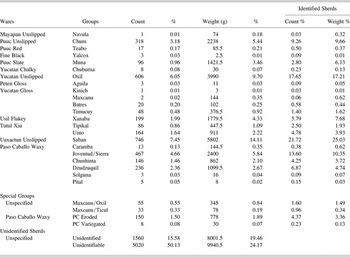
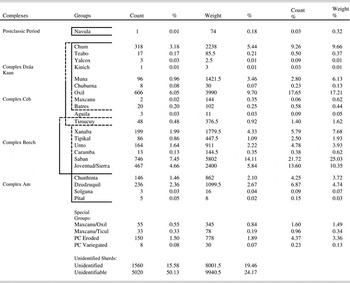
The classification resulted in the identification of 13 Wares and 22 Groups that are typical of Northern Lowland Maya archaeological sites (see Ceballos Gallareta and Jiménez Álvarez Reference Ceballos Gallareta, Álvarez, Carrión and Cook2006; Hernández Hernández Reference Hernández Hernández, Carrión and Cook2005; Jiménez Álvarez et al. Reference Jiménez Álvarez, Gallareta, Sosa, Carrión and Cook2006; Martos López Reference Martos López, Carrión and Cook2007; Ochoa Rodríguez Reference Ochoa Rodríguez, Carrión and Cook2006; Robles Castellanos Reference Robles Castellanos, Carrión and Cook2006), along with the identification of four special Groups that could not be fully classified (Table 2). Full descriptions of the Wares and Groups are available in the author's dissertation (Anderson Reference Anderson2010:233–486). These descriptions, however, are too lengthy to present here, as such only a summary for the results will be given. Unfortunately, the overall poor level of preservation encountered in the pottery resulted in over half of the collection being classified as either unidentified or unidentifiable.
Ware-Group classification of the recovered pottery sherds at Xtobo and their frequency

The most prominent Ware was Paso Caballo Waxy Ware (Smith and Gifford Reference Smith, Gifford, Harrison and Wauchope1967:167). Examples from this Ware make up 30% of the identifiable pottery collection (found in all 30 of the productive test pits) and are primarily identified by the presence of a slip that has a waxy feel and a coarse paste. The slips were thickly applied and adhered well to the surface of the vessel. The waxy feel of the slip seems to be an invasive result of the slip manufacturing process as those areas of a sherd where the slip had eroded often retained a waxy feel while unslipped surfaces lacked the feeling entirely. Slips were recorded on 83% of exterior surfaces, while another 15% had no visible slip but retained a waxy feel. Interior surfaces were slipped less often, with 43% showing a slip and 24% retaining a waxy feel. The paste of Paso Caballo Waxy sherds was found to be noticeably course. Sherd bodies were typically composed of 10–15% inclusions, with the inclusions ranging in size from 0.5 to 2.0 mm. Traditionally, Preclassic waxy pottery has been separated into two Wares, Flores Waxy and Paso Caballo Waxy, seen as dating to the Middle and Late Preclassic respectively (Smith and Gifford Reference Smith, Gifford, Harrison and Wauchope1967). Due to what the author sees as definitional problems in distinguishing between these two Wares (Anderson 2010:274–276), no division was made between them in this study and, following Forsyth (Reference Forsyth1983:17), all such waxy pottery was termed Paso Caballo Waxy.
Uaxactun Unslipped Ware (Smith and Gifford Reference Smith, Gifford, Harrison and Wauchope1967:169) was the next most common Ware encountered at Xtobo. Examples from this Ware make up 25% of the identified pottery collection (found in 22 of the 30 productive test pits) and are primarily identified by a moderately smoothed unslipped surface and a moderately coarse paste. Surface treatment of these vessels appears to have been minimal; the surfaces of the sherds had clearly been smoothed, but not burnished or polished. In 34% of examples, narrow striations were observed on the exterior surfaces. Sherd bodies were typically composed of 15–20% inclusions, with the inclusions ranging in size from 0.5 to 1.5 mm. Other prominent Wares at the site included Usil Flakey (Smith Reference Smith1971:30–31) and Tutul Xiu (Brainerd Reference Brainerd1958:48), which were found in almost half of the productive test pits. The Yucatan Unslipped Ware (Varela Torrecilla Reference Varela Torrecilla1998:55) also makes up a large percentage of the overall pottery collection, but has an extremely limited distribution at Xtobo. More than 99% of these sherds came from just two test pits, both of which were located in the site's margins, far away from the central architecture.
Overall, production of pottery seems to have been relatively uniform at Xtobo. Across all Wares, inclusions were restricted almost exclusively to calcite fragments. Firing was relatively uniform with more than 60% of sherds showing complete oxidation. Testing the hardness of sherds, 41% were found to be moderately hard and 47% were rated as hard. Only a very few sherds were found to have a soft or very hard paste. It is hoped that future fabric analyses can aid in reconstructing the process of pottery manufacture at the site.
Turning to the stylistic Groups recovered at Xtobo, the most prominent Group observed was the Saban Group (Smith Reference Smith1971:31). Examples of the Saban Group make up 25% of the identified pottery sherds and were found in 22 of the 30 productive test pits. The smooth unslipped surface of the pottery sherds showed notable variation in Munsell color; 23% of sherd surfaces were Reddish Yellow (5YR 6/6, 6/8, 7.5YR 7/6, and 6/6), and 19% were Yellowish Red (5YR 5/6, 5/8, and 4/6). The remaining 58% was divided among a large range of colors. Aside from slight smoothing the only general decoration of the surface was light striation. The sherds were generally too small, however, to identify any patterning in the striations.
The Joventud/Sierra Group (Smith and Gifford Reference Smith, Gifford, Harrison and Wauchope1967:158, 163) also formed a prominent Group at Xtobo, examples made up almost 14% of the total identified pottery collection and were found in 22 of the 30 productive test pits. The Joventud/Sierra Group is easily identified by its waxy red slip. The slip showed a high level of consistency in Munsell color; 69% of the slips were Red (2.5YR 5/6, 5/8, 4/6, 4/8, 10R 4/6, and 4/8), and 13% of the slips were Dark Red (2.5YR 3/6 and 10R 3/6). Incised lines were only rarely observed in association with Joventud/Sierra pottery sherds, less than 3% of the Group, but are a widely observed decorational mode within the Group at other sites. This Group represents a merging of two groups, Joventud and Sierra, which are traditionally kept separate (Smith and Gifford Reference Smith, Gifford, Harrison and Wauchope1967). Like the Flores Waxy and Paso Caballo Waxy Wares, the author feels there are definitional problems in distinguishing between these two Groups (Anderson 2010:289–291). Under the conditions of a well-preserved stratigraphic sample, many scholars have been able to distinguish changes in waxy red-slipped pottery from Middle to Late Preclassic contexts, but lacking such stratigraphy at Xtobo, chronological variations could not be distinguished from variations in production quality and/or preservation. So, for this study, the two Groups were merged into one.
Other prominent pottery Groups at Xtobo include Dzudzuquil (Ball Reference Ball1979; Andrews Reference Andrews V1989:52) and Chunhinta (Smith and Gifford Reference Smith, Gifford, Harrison and Wauchope1967:170), both of which were found in more than half of the productive test pits. The Groups Xanaba (Smith Reference Smith1971:30–31), Tipikal (Smith Reference Smith1971:30), and Unto (Ball Reference Ball, Brown and Andrews V1978:110, Reference Ball1979), were also found relatively widespread across the site. Two other Groups found at Xtobo, Oxil (Varela Torrecilla Reference Varela Torrecilla1998:55) and Chum (Smith Reference Smith1971:28), appear to be common due to their numerical frequency in Table 2, but virtually all of these pottery sherds were recovered from the same two peripheral test pits mentioned above. One ‘Special Group’ deserves a mention here. The Group Paso Caballo Eroded was found in 26 of the 30 productive test pits. The sherds in this Group had pastes identical to Paso Caballo Waxy Ware sherds and all were notably waxy to the touch despite the fact that no slip could be observed with the naked eye. It was hypothesized during the pottery analysis that these sherds represent eroded examples of either Joventud/Sierra or Dzudzuquil pottery.
Most of the Wares and Groups recovered at Xtobo were relatively evenly dispersed across the site. The main exception is those Wares and Groups that can be associated with the Classic Period, which had an extremely limited distribution. The relatively even distribution of the remaining Preclassic pottery Wares and Groups suggests that these categories were not used to express social or economic differences among Xtobo's inhabitants. One possible exception would be the Caramba Group (Adams Reference Adams1971:28), which was identified by a decorative bichrome slip and found in only two test pits associated with buildings found in the center of the site. This may suggest that Caramba was a high status decorative class of pottery. Regrettably, the preservation of sherds was too poor to collect reliable data on vessel forms, and thus we cannot document any variance in the distribution of vessel forms across the site.
Lithics
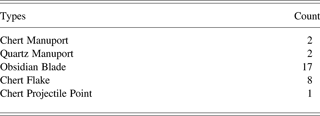
The small collection of 30 lithic artifacts recovered at Xtobo allowed for much less in the way of analysis. Attribute data on material type, dimensions, and condition, along with notes on manufacturing technique, were recorded for each specimen, and used to create a basic typology. Those artifacts recovered made of obsidian were also subjected to visual sourcing methods (Braswell et al. Reference Braswell, Clark, Aoyama, McKillop and Glascock2000) by Nancy Peniche May, the lithicist for the Proyecto Salvamento Arqueológico Ciudad Caucel.
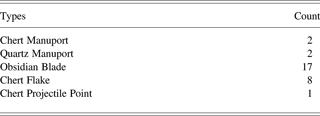
The lithic types identified were Chert Flake, Chert Projectile Point, Obsidian Blade, Chert Manuport, and Quartz Manuport (Table 3). As chert is a locally available resource found across the Yucatan peninsula (Perry et al. Reference Perry, Velazquez-Oliman, Socki, Gómez-Pompa, Allen, Fedick and Jiménez-Osornio2003), the presence of chert flakes is in no way surprising, but it does confirm that the inhabitants of Xtobo were making stone tools. The only actual chert tool encountered was a small projectile point, but it seems safe to assume that a standard array of chert tools was made and used by the people of Xtobo. The obsidian prismatic blades imported from both the Guatemalan highlands and central Mexico indicate that Xtobo was taking part in long-distance Mesoamerican exchange networks. The majority of obsidian recovered at Xtobo was determined to originate from the Chayal source located in highland Guatemala. Two blades were judged to be from San Martin Jilotepeque, and one blade was thought to be generally of Guatemalan origin. One other obsidian blade was judged to be from either the Ucareo or Saragosa source, in central Mexico. As no obsidian waste flakes or blade cores were recovered, obsidian prismatic blades may have been imported already manufactured, or an on-site manufacturing location has yet to be discovered. This latter explanation may also explain the general lack of chert tools. The standard use and production areas for stone tools may have been located in very different contexts than those tested by the PAX. With those lithic artifacts that were recovered, however, we can say that both chert and obsidian were relatively evenly dispersed across socio-economic contexts within the site, thus suggesting access to these resources was not restricted. Obsidian blades were more commonly found with larger buildings at the site, but one example was found in association with a small Mound structure. In the end, however, the size of the sample is too small to draw firm conclusions.
Lithic artifact types encountered at Xtobo and their frequency
Marine Shell
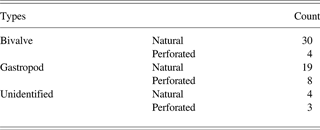
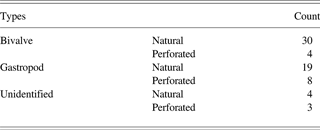
Only 68 examples of marine shell manuports were recovered at Xtobo. Xtobo is located approximately 30 km from the nearest point of the Gulf coast, a distance too great to walk from the coast and return in one day, but access to the coast would not have been excessively difficult. The marine shells found at the site were divided into three main types: bivalve, gastropod, and unidentified, each of which was in turn divided into natural and perforated sub-types (Table 4). Some of these perforations are likely artificial but others may be “kill holes” (Rebecca Hill, personal communication 2009), i.e., the result of natural predatory behavior of other mollusks (Reitz and Wing Reference Reitz and Wing2008:122–123). Regardless of whether the holes are natural or artificial, perforated shells could have been used for ornamentation, likely in the form of jewelry or textile attachments, a practice of later Maya artisans (Andrews Reference Andrews IV1969). Marine shell was relatively evenly dispersed across socio-economic contexts within the site, but more than 90% of the perforated examples were found in just two test pits, one associated with an elite residence in the site center and the other associated with a building within the Xtaabay Group. Such a restricted distribution may imply social constraints on who could wear or display marine shell, but again the collection is too small to draw firm conclusions.
Marine shell types encountered at Xtobo and their frequency
THE COMMUNITY OF XTOBO
With this set of descriptive data we can begin to build a further understanding of the community of people that once inhabited the ruins of Xtobo. Much has been made of the community concept in recent works of archaeological theory (e.g., Kolb and Snead Reference Kolb and Snead1997; Owoc Reference Owoc2005; Yaeger and Canuto Reference Yaeger, Canuto, Canuto and Yaeger2000). For the sake of this argument, community is held to refer to a cultural interaction sphere based around a social institution, traditionally a human settlement but extendable to other institutions. In order to elucidate the community that once existed at Xtobo, the settlement pattern and material culture documented at the site will be analyzed below to address three principal topics: chronology, population size/community scale, and sociopolitical complexity.
Dating the Occupation of Xtobo
Direct data for dating the occupation of Xtobo were largely lacking from the work carried out by the PAX. The excavations did not encounter contexts with depositional stratification, thereby ruling out the possibility of creating artifact seriations or identifying architectural sequences for any given context. In addition, these contexts would not allow for interpretable results from radiometric dating. In order to identify the period of occupation for the settlement, the site data had to be carefully compared to data from other excavations in the Maya region.
Comparison of the pottery sherds recovered at Xtobo to pottery from sites in Yucatan, Quintana Roo, Campeche, and Chiapas, Mexico, as well as sites in Guatemala and Belize,Footnote 1 was the single most important source of data for identifying the site's period of occupation. Through comparative seriation it was possible to define a series of Ceramic Complexes for the occupation of Xtobo (see Anderson Reference Anderson2010:492–498); however, due to the lack of stratigraphic contexts there is some uncertainty and a fair amount of overlap in the identified Complexes (Table 5). The Am Ceramic Complex consists of several solidly Middle Preclassic Groups, including Dzudzuquil and Solguna, along with some Groups that may represent Middle or Late Preclassic occupations, such as Joventud/Sierra and Saban. The Beech Ceramic Complex consists of these overlapping Groups and several Groups that have traditionally been placed in the Late Preclassic (e.g., Xanaba, Tipikal, and Unto), but these Groups may also extend back into the Middle Preclassic (Ceballos Gallareta et al. Reference Ceballos Gallareta, Castellanos, Loría, Castellanos and Perramon2008). The extensive overlap between the Am and Beech Ceramic Complexes creates a great deal of difficulty in dating the Preclassic occupation of Xtobo. Classic period Ceramic Complexes identified at the site—the Ceh and Dzaa Kan Ceramic Complexes—also show a great deal of overlap. Some solidly Early Classic Groups, such as Aguila and Maxcanu, have been noted, as well as some solidly Late Classic Groups, including Chum, Teabo, and Muna, but a majority of the Groups could date to either the Early or Late Classic. A single sherd from the Navula Group, which dates to the Postclassic period, was recovered from the surface of Structure 30. The comparative seriation of pottery Groups found at Xtobo demonstrates occupation of the site from the Middle Preclassic through the Classic. A single Postclassic sherd likely represents an intrusion as opposed to a full occupation.
Pottery complexes derived for the Xtobo data, and the frequency of the representative pottery groups

The periods of occupation at Xtobo can be narrowed by examining the frequency and distribution of the Complexes and their respective pottery Groups. Together, Am and Beech Ceramic Complex sherds make up more than 60% of the identified pottery sherds collected at Xtobo, while Ceh and Dzaa Kan Ceramic Complex sherds make up between 31% and 33%. Preclassic pottery sherds are thus in a clear majority, but the contrast is even stronger when looking at the distribution of these Complexes. Combined Am and Beech Ceramic Complex sherds were recovered from all 30 of the productive test pits, whereas 96–99% of the Ceh and Dzaa Kan Ceramic Complex sherds were found in just two test pits, depending on the affiliation of the Timucuy Group. This distribution data indicates the Preclassic period was the primary phase of occupation at Xtobo, but narrowing down when within the Preclassic period the site was occupied is more difficult. Additional chronological information can be derived from the obsidian found at Xtobo, as the exploitation of various obsidian sources in Mesoamerica has been found to vary over time. As noted above, the majority of the obsidian blades recovered at Xtobo originated from the Chayal source in highland Guatemala. Two other examples were found to be from the San Martin Jilotepeque source, also in highland Guatemala. San Martin Jilotepeque obsidian is particularly common at Maya sites during the Middle Preclassic, while Chayal obsidian predominates during the Late Preclassic and Classic periods (Andrews Reference Andrews V, Clancy and Harrison1990; McKillop and Jackson Reference McKillop, Jackson, McKillop and Healy1989). Visual inspection suggested that another obsidian blade at Xtobo originated from either the Ucareo or Saragosa source in central Mexico, neither of which are widely distributed during the Preclassic period; however, this blade was recovered from one of the test pits that included substantial quantities of Classic period pottery.
Further evidence for Xtobo's period of occupation comes to us from the architecture found at the site. As previously mentioned, Structure 11 forms what can be termed a double Triadic Group. The Triadic Group form is found in many Late Preclassic contexts in the Maya Lowlands (Hansen Reference Hansen and Houston1998:77–80; Valdés and Fahsen Reference Valdés and Fahsen1995:199). The simplicity of the triadic layout, a large mound flanked by two inward facing smaller structures, can sometimes lead to doubts of whether the form was intentionally being evoked by a building's architects. The repetitive nature of the double Triadic Group at Xtobo suggests the form was intentionally being reproduced. In addition, three other potential Triadic Groups were identified at Xtobo (Structures 19, 39, and 82). Together these buildings leave little doubt that architects at Xtobo were intentionally reproducing a form from the wider Late Preclassic Maya architectural tradition. Additionally, the ballcourt found alongside Xtobo's plaza also suggests a period of occupation for the settlement. While ballcourt architecture is ubiquitous throughout the history of Maya settlement, of the 25 ballcourts encountered by PCM in the region surrounding Xtobo, 23 were dated to the Middle Preclassic period (Medina Castillo Reference Medina Castillo, Castellanos and Andrews2003, Reference Medina Castillo2005). Thus, based on local settlement history, Xtobo's ballcourt is suggestive of a Middle Preclassic occupation.
Another issue to be considered is that some data from the site suggest that Xtobo experienced a relatively short occupation. The artifact collection resulting from the excavations at Xtobo is quite small when compared to what has been found at other Maya sites. The situation is even more drastic if we look at the distribution of the pottery among the test pits. Of the 10,012 pottery sherds recovered at Xtobo, more than 50% of the pottery was recovered from just three test pits, and two of these three test pits produced almost entirely Classic period pottery sherds. Of the remaining test pits, more than half produced fewer than 100 sherds each. There are many possible reasons for this small collection size, including the location of the test pits, but one probable explanation is that the Preclassic occupation of the site did not last long and therefore a limited quantity of material refuse accumulated at the site. The settlement pattern observed at Xtobo can also be considered to be reflective of a short occupation. The organization of the large structures at the site shows a unified constructive plan centered on the site's plaza. The plaza focus is most evident in the five sacbes radiating out to neighboring structures, but in addition to having a sacbe connecting them to the plaza, each of the structures is also directly facing the plaza. This pattern of orientation continues throughout the site, where virtually all large buildings are oriented towards the plaza. This suggests that the majority of the site's construction activities occurred during a time in which the plaza was the site's main sociopolitical and/or ritual center and inhabitants of the site wanted to reaffirm a connection to it. When settlements have been occupied for longer periods of time we see multiple sociopolitical foci emerge (e.g., multiple plazas and/or groups of monumental architecture), and changes in subsidiary architecture as modifications are made to accommodate new preferences in focal points (Marcus Reference Marcus, Feinman and Marcus1998:64–65; Renfrew Reference Renfrew, Marcus and Sabloff2008:41). If one can assume that these sociopolitical fluctuations inevitably occur over time within a society, then the fact that Xtobo never saw such modifications is suggestive of a short period of occupation.
One final piece of evidence for a short occupation can be found in the Xtaabay group. The unique nature of this group implies that it does not represent an established cultural tradition, but rather the influence of a small group of agents. In such a situation, the restriction on building within the group would likely last only as long as the influence of those agents remained strong. That the restriction appears to have held relatively firm suggests that construction occurred at Xtobo primarily during this period of influence. If we can again assume that sociopolitical power will fluctuate overtime, the survival of the Xtaabay group is suggestive of a short period of occupation that did not include multiple building programs.
In summary, the physical data from Xtobo all support the site's principal occupation as having occurred during the Preclassic period, with distinct signs of both Middle Preclassic and Late Preclassic occupation at the site. This combined with the evidence for a short period of occupation at the site suggests that the peak florescence at Xtobo occurred during a transitional phase between the two periods, likely lasting no more than a few hundred years. Low level occupation occurred at the site both before and after this period of florescence, and a minimal reoccupation of the site occurred during the Classic period, currently known to be associated with only two structures (Structures 150 and 341). These two structures were associated with materials from both the Ceh and Dzaa Kan Ceramic Complexes suggesting they were occupied during the Early and Late Classic periods. A continuous occupation between these two periods is the most likely scenario, considering that it is improbable that these two buildings alone would have been reoccupied twice. The two test pits associated with these buildings were, as stated above, also two of the three most productive test pits at the site. This high density of sherds further supports the idea of a prolonged reoccupation. The preponderance of evidence strongly suggests that the Xtobo community's florescence occurred during a transitional period between the Middle and Late Preclassic.
Population Estimate
There are understandable problems with estimating the former population of an archaeological site, but such estimates provide a necessary baseline for assessing the size of the community under study, as well as for comparative purposes. The most commonly used method of population estimation for the Maya Lowlands involves the tallying of domestic residences and multiplying by a hypothesized number of inhabitants per residence (Rice and Culbert Reference Rice, Culbert, Culbert and Rice1990:13). In order to make such an estimate the number of domestic structures must be tallied, the issue of how many of those structures were occupied at a given time must be addressed and, finally, the number of people living in each residence must be estimated. For the moment an estimate will only be made for the population of Xtobo during its Preclassic period florescence. The data regarding the Classic period reoccupation of Xtobo are currently too limited to make an informed population estimate.
To tally the number of domestic structures at Xtobo, we must first determine what structure types would have been used for domestic occupation. Previously in this paper, Mounds, Chiich Mounds, and Platforms were argued to represent the primary domestic structures of the site, as identified by their form and frequency, but other architecture types at the site also appear to be associated with the residential occupation. As argued above, some examples of Complex Basal Platforms appear to represent high status residences (e.g., Structures 15, 16, and 18). Other examples of this structure type, as well as Basal Platforms, likely held a similar residential function, albeit with a lesser degree of social status, in a majority of cases. The architecture type Apsidal Structures was only rarely noted at Xtobo, but apsidal-shaped architecture is widely considered to be a traditional domestic architecture form in the Maya region (Kurjack and Garza Tarazona de González Reference Kurjack, de González and Ashmore1981:289; Wauchope Reference Wauchope1938:16). During the mapping process, 27 structures were identified as “Possible Structures,” as there was doubt regarding whether they were artificially constructed or natural accumulations of rock. Based on excavations carried out in association with these features, it has been estimated that approximately half represent artificial structures resembling poorly preserved Mounds, and thus are presumed to be residential in function. Of all the structures included in the above mentioned architecture types, 30 do not meet the minimum areal standards established for residential architecture (Ashmore Reference Ashmore and Ashmore1981:47), and so should not be considered in the population estimate. This assessment results in a tally of 308 domestic structures at Xtobo.
All 30 of the productive test pits excavated at Xtobo included evidence for a Preclassic occupation, thus the excavations suggest that all structures at the site were occupied during the Preclassic period. As the excavation sample was limited, and the probability of a contemporaneous occupation of all structures is low, it will instead be suggested that 90% of structures at Xtobo were occupied during the site's peak occupation. Using this figure, it can be estimated that there were approximately 277 domestic structures at the height of Xtobo's Preclassic period occupation.
In calculating population totals Maya archaeologists have traditionally employed an average of 5.6 people per domestic structure (Rice and Culbert Reference Rice, Culbert, Culbert and Rice1990:17), a number which is derived from Redfield and Villa Rojas’ (Reference Redfield and Rojas1934) ethnographic study of the Yucatec Maya village of Chan Kom. It should be noted though that 5.6 people was reported by Redfield and Villa Rojas as the average size of a household, which is a social concept not equivalent to the architectural unit of a house. Historically, Yucatec Maya households have been shown to reside in domestic compounds, which represent a multifunctional space often involving ancillary structures in addition to residences (Redfield and Villa Rojas Reference Redfield and Rojas1934; Restall Reference Restall1997; Terán Contreras and Rasmussen Reference Terán Contreras and Rasmussen2005). However, the discounting of structures that do not meet minimum residential unit standards, and the likelihood that many ancillary structures were not built upon stone foundations, suggests that the count of domestic structures should closely mirror a count of households and not just houses. Using Redfield and Villa Rojas’ number results in an estimate of 1,552 people living at Xtobo during its maximal Preclassic period occupation. This estimate does not include the likely existence of invisible domestic structures, or the likely extension of settlement past current mapped boundaries. In addition, many other contemporaneous settlements have been identified in the immediate vicinity (Anderson Reference Anderson, Andrews and Castellanos2003, Reference Anderson2005b; Peniche May Reference Peniche May2010; Robles Castellanos and Ligorred Perramon Reference Robles Castellanos, Perramon, Castellanos and Perramon2008). These settlements were likely part of the larger mental community of Xtobo. Thus, the population estimate of 1,552 people reflects those living at the mapped Xtobo settlement, but the site would have been a focal point for a larger Preclassic community.
Sociopolitical Complexity at Xtobo
Covering at least 67 ha and having a estimated population great than 1,500 people, Xtobo was one of the largest known communities in the Northern Lowlands during the Preclassic period. In a community of this size, we would expect to find signs of sociopolitical complexity (hierarchical and/or heterarchical divisions among society members and institutions). The high status residences observed in the site center represent a classic indicator of social stratification (Feinman and Neitzel Reference Feinman and Neitzel1984:57; Wason Reference Wason1994:137). When a subset of the population can construct notably larger dwellings directly associated with the community's principal public architecture, there is little doubt that a degree of social differentiation has developed within that society. The residential structures found at Xtobo, however, cannot be dichotomized into a simple categorization of high status and low status structures; instead a continuum of scale and complexity exists throughout the site. Many buildings are intermediary in size and elaboration between the smallest house mounds and the largest elite residences in the site center. This variation undoubtedly relates in part to the established system of social differentiation within the community, but the continuous variation suggests that agency-based motivation impacted the choices made in the elaboration of domestic architecture.
Returning to the center of the site, the existence of an organized plaza flanked by pyramid architecture is reflective of sociopolitical complexity and control of labor (Grove and Gillespie Reference Grove, Gillespie, Demarest and Conrad1992:18; Miller Reference Miller and Houston1998; Rathje Reference Rathje, Masson and Freidel2002:35). Mesoamerican plaza architecture is often characterized as space used for public display of political and ritual performance carried out by a site's social elites (Demarest Reference Demarest, Demarest and Conrad1992:147–148; Inomata Reference Inomata2006), and it is likely that Xtobo's plaza fulfilled a similar role. Ballcourts are often associated with elite performances (Colas and Voss Reference Colas, Voss and Grube2006), and the ballcourt next to Xtobo's plaza could further indicate the development of elite culture at the site; however, other Preclassic ballcourts found in northwest Yucatan are located at very small sites lacking other signs of sociopolitical stratification. This would seem to indicate that the ballgame in local Preclassic Maya culture may not have been firmly wed to elite culture.
Sacbes have also traditionally been associated with complex Maya social organization (Bullard Reference Bullard1960:361; Kurjack and Garza Tarazona de González Reference Kurjack, de González and Ashmore1981:300; Shaw Reference Shaw2008:125), thus the presence of five examples at Xtobo is cause for note. The sacbes at Xtobo additionally serve to highlight the overall radial site plan discussed above. The pervasiveness of this pattern suggests Xtobo's plaza dominated social life at the site, such that virtually everyone who built a large structure wished to associate themselves with the site's sociopolitical/ritual center. Finally, although the function of the Xtaabay Group remains in question, the fact that a large deliberately-defined space was maintained suggests a managerial force likely associated with sociopolitical complexity.
These data all suggest that a notable degree of sociopolitical complexity existed within the Preclassic Xtobo community. High status residences, dedicated public/ritual architecture, and an organized site plan indicate the existence of a group of people who could command labor and other economic resources. Other traditional indicators of sociopolitical complexity, such as rich burials and prestige goods, have not yet been identified at the site but, regardless, the evidence from Preclassic Xtobo suggests a stratified—rather than egalitarian—sociopolitical system. The scale of Xtobo and its society is smaller than what is traditionally seen in state-level organizations (Manzanilla Reference Manzanilla, Feinman and Price2001), placing Xtobo in the nebulous zone between an egalitarian community and a bureaucratic state, traditionally referred to as a chiefdom (Service Reference Service1962; see also Carneiro Reference Carneiro, Jones and Kautz1981; Earle Reference Earle and Earle1991; Peebles and Kus Reference Peebles and Kus1977; Stanish Reference Stanish, Feinman and Nicholas2004; Whalen and Minnis Reference Whalen and Minnis2001:3–24).
We can draw further conclusions about the nature of sociopolitical complexity within the regional context of northwest Yucatan. The Preclassic settlements documented by PCM in the surrounding region are mostly hamlets and villages. Only a few sites within the region are of a size and complexity that warrant them being considered as regional centers; these sites include both Xtobo and Komchen. It has been previously hypothesized that Komchen served as the apex settlement of a three-tiered regional hierarchy during the Late Preclassic (Ringle Reference Ringle1985:226; Ringle and Andrews Reference Ringle, Andrews V, Culbert and Rice1990:229). The data collected by PCM confirm this hypothesis and also suggest that Xtobo similarly served as a Preclassic period regional center of a three-tiered hierarchy (Anderson Reference Anderson2005a). Three-tiered settlement hierarchies have been widely tied to sociopolitical systems with moderate levels of complexity, such as chiefdoms or mid-level societies (Carneiro Reference Carneiro, Jones and Kautz1981:54; Flannery Reference Flannery1999:4; Wason Reference Wason1994:131; Wright Reference Wright and Earle1984), corroborating the data from Xtobo itself. When this three-tiered hierarchy developed has yet to be determined, but Xtobo may have emerged as a regional center as early as the late Middle Preclassic.
DISCUSSION AND CONCLUSIONS
The impact of these new data from Xtobo on our understanding of the cultural history of northwest Yucatan is great. The existence of a previously unknown complex regional center forces us to reconsider the development and character of sociopolitical organization within the region. E. Wyllys Andrews V's (personal communication 2010) redating of the history of occupation of Komchen also seriously alters our understanding of these issues. If the settlement at Komchen had reached a large size during the Middle Preclassic, as Andrews now contends, then there is strong argument for the emergence of a chiefdom-like level of sociopolitical complexity in northwest Yucatan by the end of the Middle Preclassic period. In this situation, we must ask what the nature of the relationship was between Xtobo and Komchen. Both sites were clearly occupied in the Middle and Late Preclassic periods, and both served as regional centers; nevertheless, there are many notable differences between them. The most striking difference comes from their respective settlement patterns. Komchen has a rectangular plaza flanked by two nearly identical long range structures, which E. Wyllys Andrews V (personal communication 2010) has compared to the architecture present at Preclassic sites in highland Chiapas (see Clark and Hansen Reference Clark, Hansen, Inomata and Houston2001; Lowe Reference Lowe and Adams1977). Xtobo, in contrast, is more comparable to the Preclassic sites in the Southern Maya Lowlands due to its square plaza, radial sacbes, and Triadic Groups (see Hansen Reference Hansen and Grube2001). Xtobo and Komchen, however, have very similar material cultures when it comes to pottery and lithic collections. The differences in settlement patterns may be the result of the two sites competing for supporters in the surrounding hinterland, or perhaps more simply represent varying stylistic preferences.
Some features found at Xtobo demonstrate the existence of cultural activities previously unknown from the region. The most striking example is the presence of a ballcourt, not only at Xtobo, but also at 22 other Middle Preclassic sites in the region. Prior to the reporting of these 23 ballcourts by the PCM (Medina Castillo Reference Medina Castillo, Castellanos and Andrews2003), no examples of Preclassic ballcourt architecture had been known in the Northern Maya Lowlands. In fact, in all of Mesoamerica, only eight other Middle Preclassic ballcourts had been reported (Agrinier Reference Agrinier, Scarborough and Wilcox1991; Hill et al. Reference Hill, Blake and Clark1998; Schieber de Lavarreda Reference Schieber de Lavarreda1994; Velásquez Reference Velásquez1993; Weigand Reference Weigand, Scarborough and Wilcox1991). The northwest Yucatan ballcourts raise questions about the nature of the game during this early period. Following traditional interpretations of the Classic period ballgame, the Preclassic ballgame is often interpreted as an activity associated with the elite class (e.g., Hill et al. Reference Hill, Blake and Clark1998; Hill and Clark Reference Hill and Clark2001), but in northwest Yucatan, the ballcourt at Xtobo is the exception. All other ballcourts in the region were found at small settlements lacking other indicators of social stratification. This context suggests the ballgame in Preclassic northwest Yucatan may have been a commoner tradition—more akin to sport and accessible regardless of social status—rather than political theater appropriated by elite segments of society.
The presence of Triadic Groups at Xtobo also extends the known geographical distribution of this architectural form. The significance of these groups is less clear than that of ballcourts, but scholars have generally equated them with elite political and ritual culture (Freidel et al. Reference Freidel, Schele and Parker1993:140; Hansen Reference Hansen and Houston1998:80; Taube Reference Taube and Houston1998:467–468; Tokovinine and Fialko Reference Tokovinine and Fialko2007; Valdés and Fahsen Reference Valdés and Fahsen1995). While the majority of known examples are found in the Southern Lowlands (Hansen Reference Hansen and Houston1998:77–80; Valdés and Fahsen Reference Valdés and Fahsen1995:199), the number of known Triadic Groups in the north is steadily growing (Matheny et al. Reference Matheny, Gurr, Forsyth and Hauck1980:Map 8; Mathews Reference Mathews, Fedick and Taube1995:81; Roys and Shook Reference Roys and Shook1966; Stanton and Ardren Reference Stanton and Ardren2005:217). The cultural institution attached to Triadic Groups was widespread throughout the Maya Lowlands.
The radial plan of Xtobo's plaza and sacbes is unusual for a Preclassic site, but it resonates with Mesoamerican iconographic themes (Carlson Reference Carlson and Benson1981). Many Preclassic Maya and Mesoamerican sites were arranged along a single orientation or linear axis (Clark and Hansen Reference Clark, Hansen, Inomata and Houston2001; Lowe Reference Lowe and Adams1977; Rice Reference Rice2007:152–153). The lack of such an axis at Xtobo is therefore striking, and could be taken to suggest the site was less connected to the larger Mesoamerican world, but there are several other points of evidence that establish direct material connections to other areas of Mesoamerica. The presence of obsidian at Xtobo has already been presented as evidence of interregional trade. Additional evidence of such trade has been found in excavations carried out at sites located only a few kilometers away from Xtobo where numerous artifacts made of basalt were recovered in Preclassic contexts (Peniche May Reference Peniche May, Castellanos and Perramon2008). Although the source of this basalt has not yet been determined, the material most likely comes from highland Guatemala, central Mexico, or the Tuxtla mountains of the Gulf coast, Veracruz. Another line of evidence comes from the Gulf coast itself; pottery sherds indentified as originating from the Northern Maya Lowlands have been recovered at the Olmec site of La Venta and several of its smaller neighbors (Andrews Reference Andrews V and Andrews V1986:36; von Nagy Reference von Nagy2003:291). Although this pottery cannot be tied directly to Xtobo, together with the above data, it clearly indicates that the Preclassic Northern Maya Lowlands were interacting with the Mesoamerican world.
There is, however, a noteworthy difference between the Middle Preclassic period in the Northern Maya Lowlands and much of the remainder of Mesoamerica. At a time when the majority of Mesoamerica is making prolific use of the Formative Horizon style to decorate both monuments and portable artifacts (Lesure Reference Lesure, Hendon and Joyce2004), there are very few known examples of this artistic tradition from the Northern Lowlands (Andrews Reference Andrews V and Andrews V1986, Reference Andrews V1987; Metcalf and Flannery Reference Metcalf and Flannery1967; Pérez Suárez Reference Pérez Suárez, Schmidt, Garza and Nalda1998; Proskouriakoff Reference Proskouriakoff1974; Rathje et al. Reference Rathje, Sabloff and Gregory1973). In addition, the majority of these objects have come from either questionable contexts (see Andrews Reference Andrews V and Andrews V1986, Reference Andrews V1987), or contexts appearing to represent Classic period curation of earlier objects (Proskouriakoff Reference Proskouriakoff1974). The lack of objects exhibiting the Formative Horizon style could be a problem of sampling, but as work continues at Xtobo and other northern sites, examples of such artifacts continue to be few and far between. The Formative Horizon style is traditionally interpreted as material representations of ideological concepts (Grove Reference Grove1987; Joralemon Reference Joralemon, Benson and Fuente1996; Reilly Reference Reilly, Guthrie and Benson1995). As such, the lack of such representations in the Northern Maya Lowlands may indicate a difference in ideological systems or, at a minimum, that the Preclassic Maya of the north had a different manner of expressing such concepts.
Before closing this paper, some speculation should be offered on the Xtaabay Group. This group presents a particular problem for archaeological study, which thrives upon documenting patterned behavior. To the author's knowledge no similar features have been encountered at other Maya archaeological sites and, as a result, it is difficult to make comparisons and draw significant conclusions. When initially mapped, the open space of the group called to mind an open space at the neighboring site of Chunchucmil that had been proposed as a marketplace (Dahlin et al. Reference Dahlin, Jensen, Terry, Wright and Beach2007). In an attempt to prove the marketplace hypothesis at Chunchucmil, Dahlin and colleagues carried out geochemical analyses on soil samples collected from the feature, and compared these to soil samples collected from a modern Maya marketplace. Strong correlations between the distribution of phosphorous and zinc were noted at both locations, thereby strengthening the argument. Thinking that the Xtaabay Group may also have served as a marketplace similar soil analyses were carried out, but virtually no phosphorous was recovered from within the group (Anderson et al. Reference Anderson, Bair and Terry2012). For this reason, as well as due to the scale of the group, it is unlikely that the Xtaabay Group ever served as a marketplace. Many other speculations as to the group's function are being entertained, discussed and debated, but for now the Xtaabay Group remains an unexplained anomaly.
Xtobo and northwest Yucatan were home to a substantial and complex Preclassic Maya occupation, mirroring similar recent findings throughout the Northern Lowlands. The Preclassic Northern Maya Lowlands can no longer be considered a minimally occupied region. Instead, it was home to a large and vibrant population of which we still have much to learn. Similarities and ties to the Mesoamerican world establish the region as belonging to the same cultural system, while at the same time interesting cultural differences are readily apparent. The radial settlement pattern of Xtobo, along with the lack of artifacts executed in the Formative horizon style suggest the existence of local cultural identity that did not subvert itself to the dominant Mesoamerican tradition. However, the presence of Triadic Group architecture at Xtobo points to inclusion in a larger Maya regional tradition. The Preclassic inhabitants of Xtobo and the Northern Lowlands deserve recognition as an important—yet unique—part of the larger cultural dynamic of Preclassic Mesoamerica.
RESUMEN
Por mucho tiempo los mayas preclásicos de las tierras bajas norteños no han recibido mucha atención de escolares. Aparte de unos sitios arqueológicos, como Komchen, Dzibilchaltun, Yaxuna, etc., no había mucho conocido sobre la ocupación del región durante de este época. Pero, en años recientes muchos proyectos arqueológicos han encontrado una gran cantidad de restras de la época preclásico. El Proyecto Costa Maya hico un reconocimiento en el noroeste de Yucatán y encontró un asentamiento incluyendo 140 sitios con ocupaciones preclásicos. Unos de los centros regionales encontrado en la zona era el sitio de Xtobo. El sitio estaba notado por sus rasgos arquitectónicos, como pirámides, sacbes y un juego de pelota, y también el sito nunca estaba reocupado después del preclásico. Con estos factores el sitio era un buen selección para mejorar nuestra conocimiento del preclásico en las tierras bajas norteños de los mayas. El autor empiezo el Proyecto Arqueológico de Xtobo, con los objetivos de levantar un plano topográfico de las ruinas y excavar una muestra de pozos de prueba. Los resultados de estés trabajos están presentado acá. 67 hectáreas de asentamiento eran levantados por el plano, y encontró 387 estructuras. Aparte de la plaza y sus pirámides notado durante del Proyecto Costa Maya, muchos más rasgos interesantes estaban encontrado, como unos grupos tríadicos, residenciales elites, y un patrón de asentamiento bien densa. El sito muestra muchas señales de una organización sociopolítica muy complexa, y que también estaba interactuando con otras zonas del mundo maya y Mesoamérica. Las resultas del trabajo en Xtobo indican que las tierras bajas norteños eran un parte importante y integral del mundo preclásico.
ACKNOWLEDGMENTS
The work at Xtobo was funded by a grant from the Middle American Research Institute of Tulane University under the direction of E. Wyllys Andrews V. Permissions for fieldwork were granted by the Instituto Nacional de Antropología e Historia, Mexico, and the people of Ucu who collectively own the land on which the archaeological site of Xtobo is located. Fernando Robles Castellanos and Anthony P. Andrews assisted in the development and execution of the project, as well as directed the initial fieldwork carried out at Xtobo by the Proyecto Costa Maya. My own fieldwork at Xtobo was made possible with the assistance of Dan Griffin, Scott Johnson, Emmett Luty, Dylan J. Clark, Emily Wash, Edgar Medina, and Esteban de Vicente Chab. Additional logistical, political and scholarly support was provided by E. Wyllys Andrews V, Teresa Ceballos Gallareta, Josep Ligorred Perramon, and Nancy Peniche May. The development of this paper was significantly aided through commentary from T. Kam Manahan as well as anonymous reviewers. Last, but far from least, I owe great thanks to my parents, Stephen and Mary Ann Anderson and my wife, Leslie Anne Warden; this research would not have been possible without their unfailing support.