Multidrug-resistant organisms (MDROs) cause ~5%–10% of infections in hospitalized children.Reference Hidron, Edwards and Patel 1 Although there is no standard definition, an MDRO is generally an organism resistant to 1 or more classes of antibiotics to which it has been traditionally susceptible.Reference Magiorakos, Srinivasan and Carey 2 Such organisms have long been associated with increased risk of mortality, longer hospitalizations, and additional costs when compared with non-MDRO infections with the same species.Reference Cosgrove 3
Over the past 2 decades, the prevalence of MDROs has been increasing, particularly among children. Researchers examining Pseudomonas aeruginosa found a 4% increase each year in multidrug-resistant strains beginning in 1999, and more than one-quarter of isolates were multidrug resistant by 2012.Reference Logan, Gandra and Mandal 4 Similarly, studies of Enterobacteriaceae have shown significant increases in carbapenem resistance, an emerging strain that was not consistently identified in children until 2011.Reference Logan, Renschler and Gandra 5 In the United States, pediatric multidrug-resistant gram-negative enteric Enterobacteriaceae infections in hospitalized children increased 7.5-fold between 2007 and 2015.Reference Meropol, Haupt and Debanne 6 Similarly, the rate of children hospitalized with vancomycin-resistant enterococcal infections increased from 53 per million in 1997 to 120 per million 2012, resulting in an average 2 day longer hospitalization and an additional USD $8,233 in hospital costs per case.Reference Adams, Eberly, Goudie and Nylund 7
Approximately one-third of children with MRSA bacteremia experience treatment failure. The odds of a serious complication (eg, need for extracorporeal membrane oxygenation or death) for every additional day of bacteremia duration increase an estimated 50%.Reference Hamdy, Hsu and Stockmann 8 For hospitalized children who are critically ill, the consequences are more severe; their odds of death are twice as great if they have an infection with an MDRO as opposed to a non-MDRO.Reference Folgori, Bernaschi and Piga 9 Furthermore, critically ill children are at increased risk for an infection with an MDRO due to increased invasive device use and procedures, antibiotic exposure, and longer hospital stays.Reference Milstone, Song, Coffin and Elward 10 – Reference Gerber, Newland and Coffin 12
Although it is well established that antibiotic exposure is highly correlated with MDRO acquisition, there is no general consensus on which drugs and dosages lead to resistance, especially in children.Reference Anderson, Jenkins and Evans 13 – Reference McDonald 15 Infections in children differ from those in adults and therefore often require different antibiotic management,Reference Foster and Sabella 16 which may lead to varying resistance patterns in children as compared to adults. Individual studies have examined the relationship between antibiotic use and acquisition of MDROs in hospitalized children, but the data from these studies have not been synthesized. To address the emergence of MDRO in critically ill children, it is necessary to understand the specific role of antibiotic use. Therefore, we conducted a systematic review of the research literature to examine the relationship between antibiotic use and subsequent healthcare-associated infection or colonization with an MDRO in hospitalized children.
Methods
Inclusion and exclusion criteria
This systematic review was conducted using the Preferred Reporting Items for Systematic Reviews and Meta-Analysis (ie, PRISMA) guideline.Reference Moher, Liberati, Tetzlaff, Altman and Group 17 The following inclusion criteria were used: (1) study was conducted only in children hospitalized at an acute-care facility, (2) study predictor was a measure of antibiotic use, (3) study outcome was a healthcare-acquired infection (HAI) or healthcare-associated colonization (HAC) with a bacterial MDRO as defined by the study authors, (4) study was published in English, and (5) research was original. HAI and HAC were considered hospital-associated if they occurred >48 hours after admission and before discharge. Tuberculosis and case studies were excluded from this review.
Search strategy
An initial search of 2 biomedical literature databases, Embase and PubMed, was conducted in November 2017, and subsequent searches were conducted through September 2018. Search terms included combinations of keywords and/or Medical Subject Headings, when appropriate, which were linked with Boolean operators. Embase and PubMed search terms are described in the Appendix online.
Study screening and quality assessment
Throughout the screening and quality assessment, 2 reviewers (M.M. and M.B.) evaluated each article. Any discrepancies between reviewers were discussed with a third reviewer (E.L.) until consensus was reached. The following process was employed to evaluate articles for inclusion in the study. Firstly, articles were screened for duplication. Second, the titles and abstracts were reviewed for relevance. Third, appropriate articles were retrieved and the full texts were assessed to determine whether they met the inclusion criteria. Fourth, references of included studies were hand searched to identify additional studies not identified during the original database search.
The final included articles were reviewed using the Newcastle and Ottawa tools for quality assessment for cohort and case-control studies.Reference Wells, O’Connell, Peterson, Welch, Losos and Tugwell 18 Although both tools have a maximum score of 9, not all items were relevant for each of the included studies. To address the variance in denominators, scores were presented as percentages. Studies were determined a priori to be of high quality if they scored >75%, unclear quality if they scored 50%–75%, and of low quality if they scored <50%.
Results
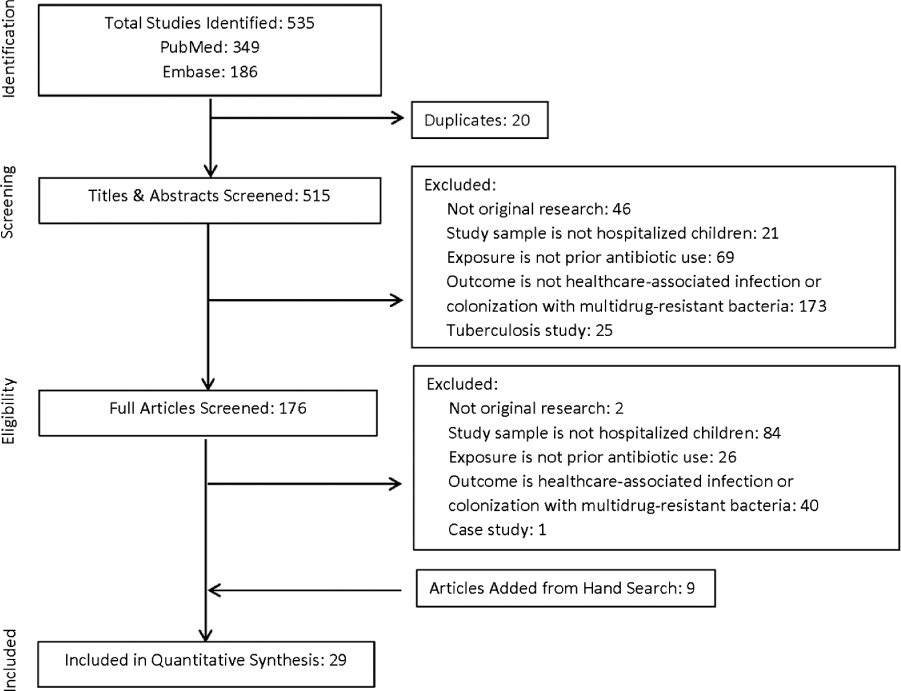
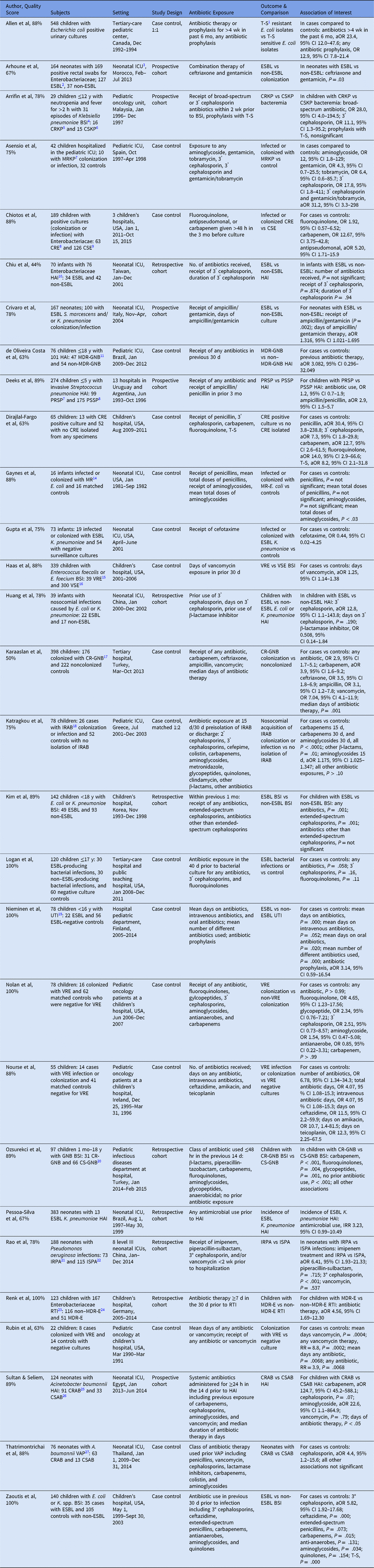
Overall, 535 studies were identified during the initial database searches; 20 articles were duplicates, which resulted in 515 articles to be assessed for relevance. After title, abstract, and full-text review, 20 studies met the inclusion criteria. An additional 9 articles were identified during a manual search of the 20 studies, bringing the total number of articles in the review to 29. The screening process and exclusion criteria are summarized in Figure 1. The studies included 4,598 hospitalized children in whom there were 4,606 HAIs and/or HACs, of which 34% (n = 1,577) were due to an MDRO. A detailed description of each study is provided in Table 1.
Flow diagram of study selection for comparison of prior antibiotic use and subsequent healthcare-associated infection or colonization with multidrug-resistant bacteria.

Description of Studies Comparing Prior Antibiotic Use and Subsequent Health Care-Associated Infection or Colonization With Multidrug-Resistant Bacteria in Hospitalized Children

Note. aOR, adjusted odds ratio; BSI, bloodstream infection; CI, confidence interval; CRAB, carbapenem-resistant Acinetobacter baumannii; CRE, carbapenem-resistant Enterobacteriaceae; CRE, carbapenem-sensitive Enterobacteriaceae; CR-GNB, carbapenem-resistant GNB; CRKP, ceftazidime-resistant Klebsiella pneumoniae; CSAB, carbapenem-susceptible Acinetobacter baumannii; CS-GNB, carbapenem-susceptibility GNB; CSKP, ceftazidime-susceptible K. pneumonia; ESBL, extended-spectrum β-lactamase producing; HAI, healthcare-associated infection; ICU, intensive care unit; IRAB, imipenem-resistant Acinetobacter baumannii; IRPA, imipenem-resistant Pseudomonas aeruginosa; ISPA, imipenem-susceptible P. aeruginosa; MDR-E, multidrug-resistant Enterobacteriaceae; MDR-GNB, multidrug-resistant gram-negative bacteria; MR, multidrug-resistant; MRKP, multidrug-resistant K. pneumonia; OR, odds ratio; PRSP, penicillin-resistant Streptococcus pneumoniae; PSSP, penicillin-susceptible S. pneumonia; RTI, respiratory tract infection; T-S, trimethoprim-sulfamethoxazole; UTI, urinary tract infection; VAP, ventilator-associated pneumonia; VRE, vancomycin-resistant Enterococcus; VSE, vancomycin-susceptible Enterococcus.
Study designs, sample, and association between antibiotic use and MDROs
The articles included in this review were all observational studies: 12 were cohort studies (7 retrospective studiesReference Chiu, Huang, Lien, Chou and Lin 19 – Reference Rao, Ren and Zhong 24 and 5 prospective studiesReference Deeks, Palacio and Ruvinsky 25 – Reference Sultan and Seliem 29 ) and 17 were case-control studies.Reference Costa Pde, Atta and Silva 30 – Reference Huang, Zhuang and Du 47 The study sample for all articles were hospitalized children, although their ages differed among the studies. Seven studies included specific age ranges,Reference Ozsurekci, Aykac and Cengiz 20 , Reference Kim, Pai and Lee 23 , Reference Deeks, Palacio and Ruvinsky 25 , Reference Ariffin, Navaratnam and Mohamed 27 , Reference Costa Pde, Atta and Silva 30 , Reference Logan, Meltzer and McAuley 41 , Reference Nieminen, Korppi and Helminen 42 10 studies included only neonates,Reference Chiu, Huang, Lien, Chou and Lin 19 , Reference Pessoa-Silva, Meurer Moreira and Camara Almeida 21 , Reference Rao, Ren and Zhong 24 , Reference Arhoune, Oumokhtar and Hmami 26 , Reference Crivaro, Bagattini and Salza 28 , Reference Sultan and Seliem 29 , Reference Thatrimontrichai, Techato and Dissaneevate 32 , Reference Gaynes, Simpson and Reeves 37 , Reference Gupta, Della-Latta and Todd 38 , Reference Huang, Zhuang and Du 47 and 12 studies did not provide an age range for the children included.Reference Renk, Stoll and Neunhoeffer 22 , Reference Haas, Zaoutis, Prasad, Li and Coffin 31 , Reference Allen, MacDonald, Fuite, Chan and Stephens 33 – Reference Dirajlal-Fargo, DeBiasi, Campos and Song 36 , Reference Karaaslan, Soysal, Altinkanat Gelmez, Kepenekli Kadayifci, Soyletir and Bakir 39 , Reference Katragkou, Kotsiou and Antachopoulos 40 , Reference Nolan, Gerber and Zaoutis 43 – Reference Zaoutis, Goyal and Chu 46
Organisms included in the articles were Enterobacteriaceae (n = 10),Reference Chiu, Huang, Lien, Chou and Lin 19 , Reference Renk, Stoll and Neunhoeffer 22 , Reference Arhoune, Oumokhtar and Hmami 26 , Reference Chiotos, Tamma and Flett 35 , Reference Dirajlal-Fargo, DeBiasi, Campos and Song 36 , Reference Logan, Meltzer and McAuley 41 – Reference Rubin, Tucci, Cercenado, Eliopoulos and Isenberg 45 Klebsiella pneumoniae (n = 8),Reference Pessoa-Silva, Meurer Moreira and Camara Almeida 21 , Reference Kim, Pai and Lee 23 , Reference Ariffin, Navaratnam and Mohamed 27 , Reference Crivaro, Bagattini and Salza 28 , Reference Asensio, Oliver and Gonzalez-Diego 34 , Reference Gupta, Della-Latta and Todd 38 , Reference Zaoutis, Goyal and Chu 46 , Reference Huang, Zhuang and Du 47 Escherichia coli (n = 5),Reference Kim, Pai and Lee 23 , Reference Allen, MacDonald, Fuite, Chan and Stephens 33 , Reference Gaynes, Simpson and Reeves 37 , Reference Zaoutis, Goyal and Chu 46 , Reference Huang, Zhuang and Du 47 gram-negative bacteria (n = 3),Reference Ozsurekci, Aykac and Cengiz 20 , Reference Costa Pde, Atta and Silva 30 , Reference Karaaslan, Soysal, Altinkanat Gelmez, Kepenekli Kadayifci, Soyletir and Bakir 39 Acinetobacter baumannii (n = 3),Reference Sultan and Seliem 29 , Reference Thatrimontrichai, Techato and Dissaneevate 32 , Reference Katragkou, Kotsiou and Antachopoulos 40 Enterococcus faecalis or E. faecium (n = 1),Reference Haas, Zaoutis, Prasad, Li and Coffin 31 Pseudomonas aeruginosa (n = 1),Reference Rao, Ren and Zhong 24 Serratia marcescens (n = 1),Reference Crivaro, Bagattini and Salza 28 and Streptococcus pneumoniae (n = 1).Reference Deeks, Palacio and Ruvinsky 25 For HAIs, 8 studies included all types of infections,Reference Chiu, Huang, Lien, Chou and Lin 19 , Reference Pessoa-Silva, Meurer Moreira and Camara Almeida 21 , Reference Rao, Ren and Zhong 24 , Reference Deeks, Palacio and Ruvinsky 25 , Reference Sultan and Seliem 29 , Reference Costa Pde, Atta and Silva 30 , Reference Logan, Meltzer and McAuley 41 , Reference Huang, Zhuang and Du 47 5 studies focused on bloodstream infections (BSI),Reference Ozsurekci, Aykac and Cengiz 20 , Reference Kim, Pai and Lee 23 , Reference Ariffin, Navaratnam and Mohamed 27 , Reference Haas, Zaoutis, Prasad, Li and Coffin 31 , Reference Zaoutis, Goyal and Chu 46 1 study focused on urinary tract infections (UTIs),Reference Nieminen, Korppi and Helminen 42 1 study focused on ventilator-associated pneumonia (VAP),Reference Thatrimontrichai, Techato and Dissaneevate 32 and 1 study was respiratory tract infections (RTIs).Reference Renk, Stoll and Neunhoeffer 22 All HAIs were specified as occurring during the hospitalization, however only 6 studies provided HAI case definitions.Reference Chiu, Huang, Lien, Chou and Lin 19 – Reference Pessoa-Silva, Meurer Moreira and Camara Almeida 21 , Reference Costa Pde, Atta and Silva 30 – Reference Thatrimontrichai, Techato and Dissaneevate 32 Furthermore, 5 studies examined HACs only,Reference Arhoune, Oumokhtar and Hmami 26 , Reference Asensio, Oliver and Gonzalez-Diego 34 , Reference Karaaslan, Soysal, Altinkanat Gelmez, Kepenekli Kadayifci, Soyletir and Bakir 39 , Reference Nolan, Gerber and Zaoutis 43 , Reference Rubin, Tucci, Cercenado, Eliopoulos and Isenberg 45 and 8 studies did not distinguish between HAIs and HACs.Reference Crivaro, Bagattini and Salza 28 , Reference Allen, MacDonald, Fuite, Chan and Stephens 33 , Reference Chiotos, Tamma and Flett 35 – Reference Gupta, Della-Latta and Todd 38 , Reference Katragkou, Kotsiou and Antachopoulos 40 , Reference Nourse, Murphy and Byrne 44
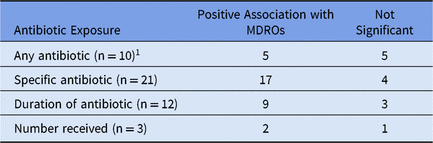
Ascertainment of antibiotic exposure differed across studies: 86% (n = 25) abstracted antibiotic use from the medical record,Reference Chiu, Huang, Lien, Chou and Lin 19 , Reference Ozsurekci, Aykac and Cengiz 20 , Reference Renk, Stoll and Neunhoeffer 22 – Reference Rao, Ren and Zhong 24 , Reference Arhoune, Oumokhtar and Hmami 26 – Reference Sultan and Seliem 29 , Reference Haas, Zaoutis, Prasad, Li and Coffin 31 – Reference Chiotos, Tamma and Flett 35 , Reference Gaynes, Simpson and Reeves 37 – Reference Huang, Zhuang and Du 47 3% (n = 1) utilized both parental recall and the medical record,Reference Deeks, Palacio and Ruvinsky 25 and 10% (n = 3) did not explicitly state how antibiotic exposure was ascertained.Reference Pessoa-Silva, Meurer Moreira and Camara Almeida 21 , Reference Costa Pde, Atta and Silva 30 , Reference Dirajlal-Fargo, DeBiasi, Campos and Song 36 Each study varied in its definitions of antibiotic use and HAI and/or HAC with an MDRO. For antibiotic exposure, measures of use included previous receipt of particular antibiotic classes or drugs (n = 21),Reference Chiu, Huang, Lien, Chou and Lin 19 , Reference Ozsurekci, Aykac and Cengiz 20 , Reference Kim, Pai and Lee 23 – Reference Ariffin, Navaratnam and Mohamed 27 , Reference Sultan and Seliem 29 , Reference Thatrimontrichai, Techato and Dissaneevate 32 , Reference Asensio, Oliver and Gonzalez-Diego 34 – Reference Logan, Meltzer and McAuley 41 , Reference Nolan, Gerber and Zaoutis 43 , Reference Rubin, Tucci, Cercenado, Eliopoulos and Isenberg 45 – Reference Huang, Zhuang and Du 47 receipt of any antibiotics (n = 10),Reference Ozsurekci, Aykac and Cengiz 20 , Reference Pessoa-Silva, Meurer Moreira and Camara Almeida 21 , Reference Kim, Pai and Lee 23 , Reference Deeks, Palacio and Ruvinsky 25 , Reference Costa Pde, Atta and Silva 30 , Reference Allen, MacDonald, Fuite, Chan and Stephens 33 , Reference Karaaslan, Soysal, Altinkanat Gelmez, Kepenekli Kadayifci, Soyletir and Bakir 39 , Reference Logan, Meltzer and McAuley 41 , Reference Nolan, Gerber and Zaoutis 43 , Reference Rubin, Tucci, Cercenado, Eliopoulos and Isenberg 45 duration of antibiotic therapy (n = 11),Reference Chiu, Huang, Lien, Chou and Lin 19 , Reference Renk, Stoll and Neunhoeffer 22 , Reference Crivaro, Bagattini and Salza 28 , Reference Sultan and Seliem 29 , Reference Haas, Zaoutis, Prasad, Li and Coffin 31 , Reference Allen, MacDonald, Fuite, Chan and Stephens 33 , Reference Karaaslan, Soysal, Altinkanat Gelmez, Kepenekli Kadayifci, Soyletir and Bakir 39 , Reference Nieminen, Korppi and Helminen 42 , Reference Nourse, Murphy and Byrne 44 , Reference Rubin, Tucci, Cercenado, Eliopoulos and Isenberg 45 , Reference Huang, Zhuang and Du 47 and number of antibiotics received (n = 3).Reference Chiu, Huang, Lien, Chou and Lin 19 , Reference Nieminen, Korppi and Helminen 42 , Reference Nourse, Murphy and Byrne 44 In 14 studies, the period of exposure varied from 2 weeks to 6 monthsReference Ozsurekci, Aykac and Cengiz 20 , Reference Renk, Stoll and Neunhoeffer 22 – Reference Deeks, Palacio and Ruvinsky 25 , Reference Ariffin, Navaratnam and Mohamed 27 , Reference Sultan and Seliem 29 – Reference Haas, Zaoutis, Prasad, Li and Coffin 31 , Reference Allen, MacDonald, Fuite, Chan and Stephens 33 , Reference Chiotos, Tamma and Flett 35 , Reference Katragkou, Kotsiou and Antachopoulos 40 , Reference Logan, Meltzer and McAuley 41 , Reference Zaoutis, Goyal and Chu 46 ; 15 studies did not provide any specific period.Reference Chiu, Huang, Lien, Chou and Lin 19 , Reference Pessoa-Silva, Meurer Moreira and Camara Almeida 21 , Reference Arhoune, Oumokhtar and Hmami 26 , Reference Crivaro, Bagattini and Salza 28 , Reference Thatrimontrichai, Techato and Dissaneevate 32 , Reference Asensio, Oliver and Gonzalez-Diego 34 , Reference Dirajlal-Fargo, DeBiasi, Campos and Song 36 – Reference Karaaslan, Soysal, Altinkanat Gelmez, Kepenekli Kadayifci, Soyletir and Bakir 39 , Reference Nieminen, Korppi and Helminen 42 – Reference Rubin, Tucci, Cercenado, Eliopoulos and Isenberg 45 , Reference Huang, Zhuang and Du 47 MDROs were limited to a specific bacteria (n = 12)Reference Pessoa-Silva, Meurer Moreira and Camara Almeida 21 , Reference Rao, Ren and Zhong 24 , Reference Deeks, Palacio and Ruvinsky 25 , Reference Ariffin, Navaratnam and Mohamed 27 , Reference Sultan and Seliem 29 , Reference Haas, Zaoutis, Prasad, Li and Coffin 31 – Reference Asensio, Oliver and Gonzalez-Diego 34 , Reference Gaynes, Simpson and Reeves 37 , Reference Gupta, Della-Latta and Todd 38 , Reference Katragkou, Kotsiou and Antachopoulos 40 or grouping of bacteria (n = 17).Reference Chiu, Huang, Lien, Chou and Lin 19 , Reference Ozsurekci, Aykac and Cengiz 20 , Reference Renk, Stoll and Neunhoeffer 22 , Reference Kim, Pai and Lee 23 , Reference Arhoune, Oumokhtar and Hmami 26 , Reference Crivaro, Bagattini and Salza 28 , Reference Costa Pde, Atta and Silva 30 , Reference Chiotos, Tamma and Flett 35 , Reference Dirajlal-Fargo, DeBiasi, Campos and Song 36 , Reference Karaaslan, Soysal, Altinkanat Gelmez, Kepenekli Kadayifci, Soyletir and Bakir 39 , Reference Logan, Meltzer and McAuley 41 – Reference Huang, Zhuang and Du 47 The summary of findings of the impact of antibiotic exposure measures and subsequent MDRO acquisition is presented in Table 2.
Summary of Findings from Systematic Review Evaluating the Relationship Between Antibiotic Exposure and Subsequent Infection or Colonization with a Multidrug-Resistant Organism Among Hospitalized Children

1 n is the number of studies that evaluated the antibiotic exposure category; each study evaluated 1 or more categories of antibiotic exposure.
Quality assessment of included articles
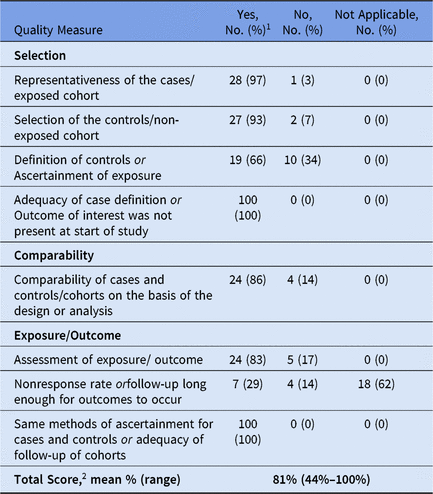
Most studies had quality scores >50% (mean score 81%, range 44%–100%) (Table 1): 66% were of high quality (n = 19), 31% were of unclear quality (n = 9), and 3% were of low quality (n = 1). Overall, case-control studies were of marginally higher quality than the cohort studies (mean scores, 82% and 79%, respectively). For case-control studies, all had adequate case definitions and the same method of ascertainment for cases and controls. Because all case-control studies were medical record reviews, the nonresponse rate was not applicable nor reported. For cohort studies, all were representative of the exposed cohort, all had proper selection of nonexposed cohort, the outcome of interest was not present at the beginning of the study, and all had adequate follow-up. The most common low-quality measure was lack of definition of controls or ascertainment of exposure; 10 of the studies had either incomplete or no appropriate controls in their analysis. The overall quality assessments for each quality measure are presented in Table 3.
Assessment of Study Quality Using the Newcastle-Ottawa Scale for Case Control and Cohort Studies

1 For each category of Yes, No, and Not Applicable, N is the number of studies and % is out of 29, which was the total number of studies evaluated in the systematic review.
2 Total score is percentage of met criteria for the Newcastle Ottawa tool.
Discussion
Overall, previous antibiotic use was significantly associated with MDRO colonization and/or infection in hospitalized children. Half of the included studies reported a significant relationship between prior exposure to any antibiotic and subsequent HAI or HAC with an MDRO,Reference Ozsurekci, Aykac and Cengiz 20 , Reference Kim, Pai and Lee 23 , Reference Allen, MacDonald, Fuite, Chan and Stephens 33 , Reference Karaaslan, Soysal, Altinkanat Gelmez, Kepenekli Kadayifci, Soyletir and Bakir 39 , Reference Rubin, Tucci, Cercenado, Eliopoulos and Isenberg 45 and most of the studies examining the association between a particular antibiotic or antibiotic class reported a positive association.Reference Ozsurekci, Aykac and Cengiz 20 , Reference Kim, Pai and Lee 23 – Reference Ariffin, Navaratnam and Mohamed 27 , Reference Sultan and Seliem 29 , Reference Thatrimontrichai, Techato and Dissaneevate 32 , Reference Asensio, Oliver and Gonzalez-Diego 34 – Reference Dirajlal-Fargo, DeBiasi, Campos and Song 36 , Reference Karaaslan, Soysal, Altinkanat Gelmez, Kepenekli Kadayifci, Soyletir and Bakir 39 , Reference Katragkou, Kotsiou and Antachopoulos 40 , Reference Nolan, Gerber and Zaoutis 43 , Reference Rubin, Tucci, Cercenado, Eliopoulos and Isenberg 45 – Reference Huang, Zhuang and Du 47 Many of the agents evaluated were broad-spectrum, highlighting the importance of narrowing antibiotics to targeted therapy when possible. These findings are in line with previous research, which has shown that the continued use of broad-spectrum antibiotics increases the risk of MDRO development.Reference Paterson and Rice 48 Yet despite the growing concerns over antibiotic resistance, there is evidence that broad-spectrum antibiotics are increasingly being used.Reference Baggs, Fridkin, Pollack, Srinivasan and Jernigan 49 Therefore, given the findings in this systematic review in addition to prior research, antibiotics for which there is concern for the development of drug resistance (ie, broad-spectrum agents) should be a main focus of antimicrobial stewardship programs.
Duration of antibiotic use was also consistently significantly associated with MDRO infection and/or colonization in hospitalized children, even though variations in duration varied widely. Of the studies that evaluated antibiotic duration, 75% linked days of therapy to HAC or HAI with an MDRO.Reference Renk, Stoll and Neunhoeffer 22 , Reference Crivaro, Bagattini and Salza 28 , Reference Sultan and Seliem 29 , Reference Haas, Zaoutis, Prasad, Li and Coffin 31 , Reference Allen, MacDonald, Fuite, Chan and Stephens 33 , Reference Gaynes, Simpson and Reeves 37 , Reference Nieminen, Korppi and Helminen 42 , Reference Nourse, Murphy and Byrne 44 , Reference Rubin, Tucci, Cercenado, Eliopoulos and Isenberg 45 These findings are consistent with similar studies in adults. Ruhe et alReference Ruhe and Hasbun 50 found that prolonged β-lactam use increased the risk of penicillin-resistant S. pneumoniae bacteremia. Similarly, longer courses of imipenem and ciprofloxacin have been associated with higher rates of HAI caused by drug-resistant Pseudomonas aeruginosa.Reference Miliani, L’Heriteau, Lacave, Carbonne and Astagneau 51 Additionally, prolonged antibiotic duration is associated with increases in adverse drug reactions.Reference Tamma, Avdic, Li, Dzintars and Cosgrove 52 Given research showing that an estimated 12%–30% of antibiotic days of therapy in hospitalized patients is inappropriate,Reference Ingram, Seet, Budgeon and Murray 53 – Reference Tamma, Avdic and Keenan 55 duration of therapy represents another important target for antibiotic stewardship initiatives.
The importance of pediatric considerations in antimicrobial stewardship is warranted. Limited antibiotics exist for the treatment of MDRO infections, and current efforts to develop new antibacterial drugs are lacking, especially for children.Reference Talbot, Jezek and Murray 56 Additionally, children exposed to antibiotics who subsequently develop MDROs may have long-term sequelae related to the exposure and infection. Recent research on the effect of early exposure to antibiotics on the microbiome has linked antibiotic use to wide range of negative health outcomes including obesity, metabolic disease, and autoimmune disorders.Reference Neuman, Forsythe, Uzan, Avni and Koren 57 Furthermore, antibiotic-resistant organisms have been shown to persist in the microbiome of children exposed to antibiotics,Reference Langdon, Crook and Dantas 58 increasing not only the individual child’s risk of infection with an MDRO but also increasing the potential risk of spread throughout their communities.Reference Wang, Foxman, Mody and Snitkin 59
Although important insights can be gained from the studies appraised here, this systematic review has several limitations. All of the studies included were observational, and most were case-control studies followed by retrospective cohort studies. Therefore, ascertainment of antibiotic exposure may be subject to observation bias, especially for studies that relied on recall of exposure. Although most studies cited the use of the medical record for determining antibiotic exposure, it was not clear whether the included courses were limited to those received during the hospital admission or if they also included other clinical settings, potentially based on parental recall. Parents of children with an infection, particularly if the infection is difficult to treat, that is, caused by an MDRO, may be more likely to recall past antibiotic courses. For those studies that used the medical record to determine antibiotic exposure, they may have been limited to only antibiotics prescribed within the hospital or healthcare system. However, the most common prescription drug provided to children in the outpatient setting is antibiotics,Reference Chai, Governale, McMahon, Trinidad, Staffa and Murphy 60 which may lead to an underrepresentation of antibiotic exposure in studies that relied solely on ascertainment from the medical record.
Also, we observed wide variation in how antibiotic exposure was defined. Only 52% of studies provided a defined window of antibiotic exposure, for example, within 30 days prior to infection onset and less than half evaluated a specific measure of antibiotic use, for example, duration of therapy. Additionally, none of the studies examined antimicrobial dosing. One systematic review of antimicrobial dosing in adults identified low antibiotic dosing as a significant contributor to antibiotic resistance.Reference Roberts, Kruger, Paterson and Lipman 61 In children, the provision of appropriate antibiotics is complicated by a variety of factors including weight-based dosing and limited antibiotic choices due to concerns about safety.Reference Di Pentima, Chan and Hossain 62 , Reference Principi and Esposito 63 Inappropriate dosing of antibiotic courses may partly drive the development of MDROs in this population.
Research on the relationship between antibiotic use and MDRO infection in hospitalized children is limited and of mixed quality. Antibiotic stewardship programs are considered a mainstay of MDRO prevention in childrenReference Milstone, Bryant, Huskins and Zerr 64 ; however, research evaluating the effectiveness of these programs have either not evaluated their impact on MDRO acquisition or have had little to no effect.Reference Araujo da Silva, Albernaz de Almeida Dias and Marques 14 Because hospitalized children represent a unique and vulnerable population and the impact of MDRO infections in this group of patients is likely to have long-lasting effects,Reference Ramphal and Ambrose 65 additional studies are needed to further elucidate the relationship of antibiotic exposure and subsequent MDRO HAI and to determine the best targets for intervention in antibiotic stewardship programs.
Acknowledgments
None.
Financial support
No financial support was provided relevant to this article.
Conflicts of interest
All authors report no conflicts of interest relevant to this article.
Supplementary material
To view supplementary material for this article, please visit https://doi.org/10.1017/ice.2019.215