Introduction
Epidemiological and experimental data strongly suggest that cardiovascular disorders can originate from a poor nutritional environment during early-life development.Reference Nuyt 1 – Reference Gluckman, Hanson and Spencer 4 The demonstrated ability of foetal nutrient deprivation to act as a strong programming stimulus has prompted the development of experimental animal models using controlled maternal calorie, protein or macronutrient deficiency during key periods of development. The maternal low-protein model (MLP) is widely used in the rodent and has been shown to result in adverse cardiovascular outcomes in the offspring, which can be transmitted across generations.Reference Langley-Evans 5 , Reference Torrens, Poston and Hanson 6 An MLP diet is well known to result in increased systolic blood pressure (SBP) in offspring, and these changes have been reported to manifest as early as 4 weeks of age.Reference Jackson, Dunn, Marchand and Langley-Evans 7 – Reference McMullen and Langley-Evans 10 An MLP diet has been shown to result in vascular dysfunction and changes in renal function including an altered rennin–angiotensin system and reduced nephron number.Reference Torrens, Brawley and Anthony 8 , Reference Langley-Evans, Langley-Evans and Marchand 9 Further, an MLP diet throughout gestation significantly impairs recovery of the 6-month-old adult rat heart to ischaemia–reperfusion-induced injury.Reference Elmes, Gardner and Langley-Evans 11 It has been reported that supplementation to MLP-fed dams with dietary cofactors such as glycine and folate can ameliorate the increases in blood pressure (BP) observed in offspring, although the mechanisms are yet to be clearly defined.Reference Jackson, Dunn, Marchand and Langley-Evans 7 , Reference Torrens, Brawley and Anthony 8 It has also recently been reported that maternal supplementation with antioxidants can prevent cardiovascular abnormalities associated with an MLP diet.Reference Cambonie, Comte and Yzydorczyk 12
Choline, discovered by Strecker in 1862,Reference Strecker 13 is a dietary component essential for normal function of all cells and has been used in the treatment of human disease for more than 50 years. In addition, choline is an essential nutrient for mammals when excess methionine and folate are not available in the diet. Choline is required for the maintenance of the structural integrity and signalling function of cell membranes, for neurotransmission, for transport of lipids and as a source of methyl groups for methylation and epigenetic programming.Reference Sanders and Zeisel 14 , Reference Zeisel 15 Choline plays a critical role during foetal development, and rats exposed to transient periods of choline deficiency develop irreversible hypertension, changes that are attributed to alterations in renal and cardiovascular function.Reference Zeisel 15 , Reference Zeisel 16 Thus, choline (in addition to glycine and folate) has been demonstrated to have an important role in the development and/or maintenance of the cardiovascular system. Maternal dietary choline deficiency is able to induce hypertension in offspring at a young age, which persists even in the presence of postnatal choline supplementation.Reference Kratzing and Perry 17 Choline is also known to play a role in the regulation of homocysteine levels by acting as the immediate precursor of betaine. Plasma homocysteine is an established risk factor for cardiovascular disease and shows a positive relation to a variety of cardiovascular disease risk factors.Reference Konstantinova, Tell and Vollset 18 Recent studies have also demonstrated that plasma homocysteine increases with the number of components of metabolic syndrome.Reference Meigs, Jacques and Selhub 19
The low-protein (LP) diet, as used in the present trial and by others,Reference Jackson, Dunn, Marchand and Langley-Evans 7 , Reference Torrens, Brawley and Anthony 8 is not a choline-deficient diet per se. However, studies have suggested that phosphatidylcholine, required for the de novo synthesis of choline to supplement dietary choline intake, is reduced in offspring of maternally undernourished dams.Reference Gardner, Bell and Symonds 2 , Reference Cambonie, Comte and Yzydorczyk 12 Thus, reduced endogenous maternal choline production may have functional consequences related to the aberrant BP observed in offspring of protein undernourished dams and may potentially be corrected by dietary choline supplementation. The present study therefore investigated the effect of maternal dietary supplementation with choline on BP in male and female offspring of LP-fed dams and the relationship with plasma choline, phosphatidylcholine and homocysteine concentrations.
Methods
Animal model
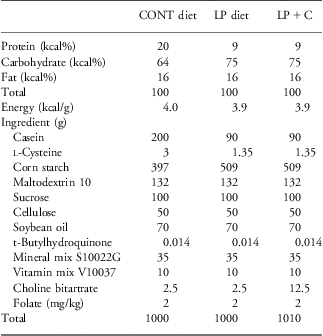
Male and female Wistar rats were acquired at a weaning age (22 days) and housed under standard conditions with a 12:12 light–dark cycle and free access to water. At postnatal day 120, 24 females were time-mated using an oestrus cycle monitor (Fine Science Tools, USA). Upon confirmation of mating, three maternal dietary groups were established and during pregnancy dams were fed either (1) a standard control (CONT) diet (AIN93G, 20% protein, Research Diets, NJ, USA), (2) an LP diet (9% protein), or (3) an LP diet supplemented with choline bitartrate (LP + C). Diets were isocaloric and a detailed diet composition is presented in Table 1. Diets were fed ad libitum throughout pregnancy, and dams were returned to the standard CONT diet on the day following birth. Litter size was randomly adjusted to eight pups (four males and four females) to ensure standardized nutrition until weaning. At weaning (day 22), male and female offspring were housed two per cage (2/litter/gender/maternal background) and fed the CONT diet ad libitum for the remainder of the trial. All animal work was approved by the Animal Ethics Committee at the University of Auckland.
Experimental diet composition

CONT, control; LP, low protein; LP + C, low protein supplemented with choline.
Isocaloric semi-purified diets were sourced commercially from Research Diets (New Jersey, USA) under formulation codes D10012G (CONT, AIN93G), D08071501 (LP) and D08071505 (LP + C), respectively. Diets were fed ad libitum throughout pregnancy.
BP measurements
SBP at day 150 was recorded by tail-cuff plethysmography according to the manufacturer's instructions (Model 179 with an automatic cuff inflation pump (NW20), IITC, Life Science, Woodland Hills, CA, USA) as previously described.Reference Vickers, Ikenasio and Breier 20 , Reference Vickers, Ikenasio and Breier 21 The IITC system has been validated against both telemetry and direct BP measurements via cannulation in the rodent and allows recording at lower ambient temperatures compared with other systems.Reference Whitesall, Hoff, Vollmer and D'Alecy 22 Rats were restrained in a clear plastic tube in a prewarmed room (25–28°C). After the rats had acclimatized (10–15 min), the cuff was placed on the tail and inflated to 240 mmHg. Pulses were recorded during deflation at a rate of 3 mmHg/s, and reappearance of a pulse was used to determine SBP. A minimum of three clear SBP recordings per animal were taken, and the coefficient of variation for repeated measurements was <5%. At postnatal day 160, animals were fasted overnight and killed by decapitation following anaesthesia with sodium pentobarbitone (60 mg/kg, intraperitoneal). Body weights and kidney, heart, adrenal and fat pad weights were recorded.
Plasma analysis
Plasma choline and phosphatidylcholine were assayed in plasma of dams (at the time of weaning) and offspring at postnatal day 150 using commercially available kitsets (Biovision Inc., California, USA; kits K615-100 and K652-100, respectively). All samples were assayed in a single run with intra-assay coefficients of variation <5%.
Plasma homocysteine concentrations in dams and adult offspring were measured using an automated fluorescence polarization immunoassay on the Abbott AxSYM System as described previouslyReference Lonati, Novembrino and Ippolito 23 (assay reference #5F51-20). All samples were assayed in a single run with intra-assay coefficients of variation <4%.
Plasma insulin and leptin were measured using commercially available ELISAs (Crystal Chem, IL, USA, Catalogue numbers 90060 and 90040, respectively). All samples were measured within a single assay and intra-assay coefficients of variation were <5%.
Statistical analysis
Statistical analysis was performed using the StatView statistical software (Version 5, SAS Institute, Cary, NC, USA). Data were tested for normality and analysed via two-way factorial analysis of variance (ANOVA) with maternal diet and sex as factors, and post hoc multiple comparisons were made using Fisher's least significant difference analysis. Caloric intake data were analysed via repeated-measures ANOVA. Significance was accepted at the P < 0.05 level. Data are presented as means ± s.e.m. unless otherwise stated.
Results
Maternal body weights and offspring characteristics
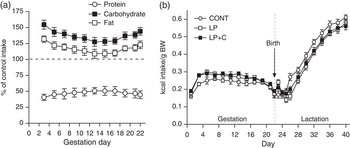
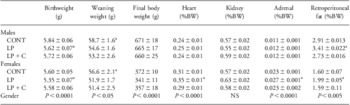
Maternal weight gain during pregnancy was not significantly different between any of the dietary groups (% change in body weight from day 1 of pregnancy: CONT 54.6 ± 2.2, LP 59.4 ± 3.2, LP + C 57.1 ± 2.3). As expected, relative protein intake in LP dams was ∼40% of that of controls (Fig. 1a). However, carbohydrate and fat intake were significantly increased in LP-fed dams, with carbohydrate and fat intake being up to 50% and 30%, respectively, above that of CONT dams (Fig. 1a). Total caloric intake (kcals consumed per gram bodyweight) during pregnancy was slightly but significantly (P < 0.05) increased in LP and LP + C dams compared with CONT dams (Fig. 1b). Following birth, when all dams were returned to the standard CONT diet, caloric intake during lactation was slightly but significantly (P < 0.05) increased in CONT animals compared with LP- and LP + C-fed dams (Fig. 1b). There was no difference in caloric intake between LP- and LP + C-fed dams. It is noteworthy that there was a significant difference in body weight change during lactation, with LP dams having significantly diminished body weight gain over this period compared with CONT and LP + C dams (CONT −0.47 ± 1.9% change, LP −7.3 ± 0.9%, LP + C −0.4 ± 1.9%, P < 0.005 for LP v. CONT and LP + C). There were no significant differences in litter size or male:female ratios (data not shown). Offspring of LP mothers were slightly but significantly lighter at birth compared with all other groups, and males were significantly heavier than females at birth across all maternal dietary groups (P < 0.0001; Table 2). Weaning weights were significantly reduced in LP and LP + C males and females compared with CONT offspring (Table 2). Final adult body weights (day 150) were not different across any of the maternal dietary groups (Table 2).
(a) Maternal intakes of protein, carbohydrate and fat in low protein (LP)-fed dams during gestation. Data are expressed as a percentage of control (CONT) diet intake. Relative intakes to controls were not different between LP and LP supplemented with choline (LP + C) dams (data not shown). Effect of LP diet v. CONT diet P < 0.001, P < 0.001 and P < 0.05 for protein, carbohydrate and fat, respectively; (b) total caloric intake during gestation and lactation (kcals consumed per gram body weight), P < 0.05 for CONT v. LP and LP + C. Data are means ± s.e.m., n = 8 per group.

Birthweight, weaning weight, final body weight and heart, kidney, adrenal and retroperitoneal fat pad weights (expressed as percentage of body weight) of male and female offspring from CONT, LP and LP + C supplemented dams

CONT, control; LP, low protein; LP + C, low protein supplemented with choline.
Analysed by two-way factorial analysis of variance with gender and maternal diet as factors.
Data are means ± s.e.m., n = 8 per group.
aDenotes significantly different from all other groups.
BP
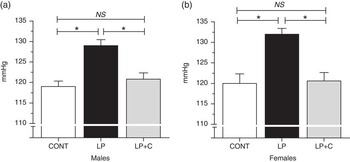
SBP was significantly increased in male and female offspring of LP dams compared with controls (Fig. 2a and 2b). The elevation in SBP was prevented in offspring of LP + C dams where SBP was not different from that of controls. At day 150, there was no significant effect of gender on SBP.
Systolic blood pressure at postnatal day 150 in (a) male and (b) female offspring from control (CONT), low protein (LP) and LP supplemented with choline (LP + C) dams. Data were recorded using tail-cuff plethysmography with three recordings per rat, with coefficient of variation of repeated measurements <5%. Data are means ± s.e.m., n = 8 per group. *P < 0.005; NS, not significant.

Plasma analysis
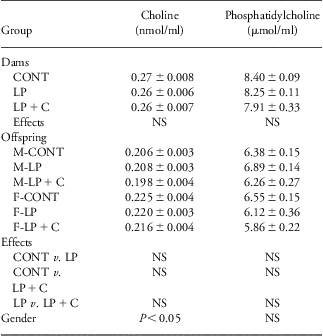
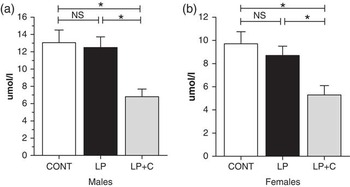
Maternal choline, phosphatidylcholine and homocysteine plasma concentrations at the time of weaning were not different across any of the treatment groups (Table 3; maternal homocysteine: CONT 8.4 ± 0.6 μmol/l, LP 8.1 ± 0.6, LP + C 7.4 ± 0.9). Plasma choline and phosphatidylcholine concentrations in adult offspring were not different between any of the treatment groups, although choline concentrations were significantly higher in females than males (P < 0.05; Table 2). Plasma homocysteine concentrations in adult male and female offspring were significantly reduced in LP + C offspring compared with CONT and LP animals (Fig. 3a and 3b).
Plasma choline and phosphatidylcholine concentrations in dams (at the end of lactation) and in male and female offspring at postnatal day 150

CONT, control; LP, low protein; LP+C, low protein supplemented with choline; NS = not significant.
Data are means ± s.e.m., n = 8 per group.
Plasma homocysteine concentrations in (a) male and (b) female offspring at postnatal day 150. *P < 0.05; NS, not significant. Data are means ± s.e.m., n = 8 per group.

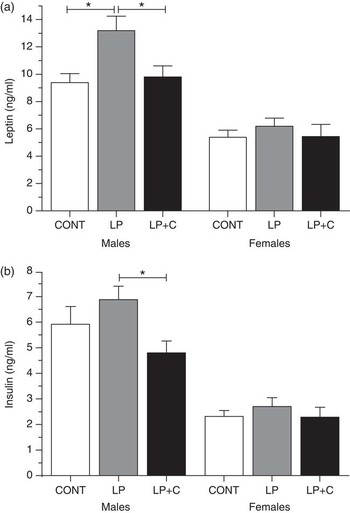
Plasma leptin levels were significantly increased in male LP offspring compared with CONT and LP + C animals (P < 0.001; Fig. 4a). Plasma insulin levels were not different between CONT and LP offspring, although there was a significant decrease in plasma insulin levels in LP + C male offspring compared with the male LP group (P < 0.05; Fig. 4b).
Plasma leptin (a) and insulin (b) concentrations in male and female offspring at postnatal day 150. *P < 0.05; NS, not significant. Data are means ± s.e.m., n = 8 per group.

Tissue weights
Retroperitoneal fat pad mass (expressed as a percentage of body weight) was significantly increased in LP male and female offspring compared with CONT offspring but was not different between LP + C and CONT offspring (Table 2). Relative heart weight was slightly but significantly increased in LP females compared with all other female groups, but there were no differences between any of the male groups. There were no differences in relative kidney weights across any of the treatment groups. Relative adrenal weights were not different in any of the male groups but were significantly increased in the female LP animals compared with CONT and LP + C offspring (Table 2).
Discussion
This study is the first to report the normalization of MLP-induced increases in SBP and fat mass in adult offspring via maternal choline supplementation. These effects were not gender specific and the decrease in BP and fat mass was similar in males and females.
Choline is an essential nutrient for mammals when excess methionine and folate are not available in the diet as occurs during MLP exposure. It is difficult to directly identify a deficiency syndrome for choline in healthy mammals because of its interrelation with methionine, folic acid and vitamin B12.Reference Pinotti, Baldi and Dell'orto 24 Torrens et al.Reference Torrens, Brawley and Anthony 8 have previously shown that maternal folate supplementation during pregnancy prevented elevations in SBP in male offspring associated with maternal protein restriction. The range in SBP changes was similar to those observed in the present trial. Work by Jackson et al.Reference Jackson, Dunn, Marchand and Langley-Evans 7 has shown that the increase in SBP induced by LP exposure can be prevented by dietary supplementation with glycine. The role of methionine in the development of hypertension in LP models has also been reported and has been used to explain the lack of consistency in BP effects across some LP models.Reference Langley-Evans 25
Maternal undernutrition has been linked to altered renal development in offspring including reduced nephron number and dysregulation of the renin–angiotensin system.Reference Puddu, Fanos, Podda and Zaffanello 26 , Reference Woods 27 Whereas global maternal undernutrition has been shown to result in reduced kidney size,Reference Vickers, Ikenasio and Breier 20 , Reference Vickers, Breier, Cutfield, Hofman and Gluckman 28 previous studies using the LP model in the rat have shown either noReference Sahajpal and Ashton 29 or small reductions in kidney mass.Reference Langley-Evans, Langley-Evans and Marchand 9 , Reference Woods, Ingelfinger, Nyengaard and Rasch 30 Thus, it has been suggested that although prenatal undernutrition may programme renal structure in later life, renal programming is not one of the primary mechanisms leading to hypertension.Reference Langley-Evans, Langley-Evans and Marchand 9 In the present study, no significant differences were observed in renal mass across any of the treatment groups, although this does not preclude any aberrations of renal function per se. There were small but significant increases in relative heart and adrenal weights in female MLP offspring but not in males, and as MLP-induced increases in SBP were similar in both genders it is difficult to ascribe these changes directly to the observed alterations in BP. A maternal LP diet resulted in an increase in retroperitoneal fat mass in male and female offspring. Maternal choline supplementation normalized fat mass in LP + C offspring to that of controls. Reductions in fat mass in LP + C offspring as compared with LP animals may have had some direct effect on altering BP as reported by others, but it is unlikely that the level of increased adiposity in the LP animals would be sufficient to exert compression-type hypertension.Reference Hall 31
It must also be noted that despite similar effects of choline on reducing BP and retroperitoneal fat mass in both males and females there were sex-specific effects on plasma leptin and insulin concentrations. Male LP offspring displayed significant hyperleptinemia, which was normalized in LP + C animals, and fasting plasma insulin was also significantly decreased in LP + C males but not females compared with LP animals. McMullen and Langley-EvansReference McMullen and Langley-Evans 10 , Reference McMullen and Langley-Evans 32 have shown that MLP-induced programming of increased BP in offspring occurs through two independent mechanisms acting in a sex-specific manner. Thus, it is possible that the BP-lowering effects of choline in the current study are elicited via different mechanisms between males and females.
MLP diets are known to induce profound deleterious effects on fatty acid metabolism in rat pups.Reference Marin, De Tomas, Serres and Mercuri 33 Phosphatidylcholine levels have been shown to be reduced in tissues and plasma of rat progeny at birth following maternal undernutrition.Reference Marin, De Tomas, Serres and Mercuri 33 , Reference Chen, Wang and Su 34 The LP diet, as used in the present trial and by others,Reference Jackson, Dunn, Marchand and Langley-Evans 7 , Reference Torrens, Brawley and Anthony 8 , Reference Desai, Crowther, Lucas and Hales 35 is not a choline-deficient diet per se, but the data suggest that adjunct deficiencies, for example, reduced de novo synthesis of choline from phosphatidylcholine, caused directly by MLP exposure, have been corrected by supplementation of choline in the maternal diet. Plasma choline and phosphatidylcholine concentrations were not different in the dams following choline supplementation. Maternal plasma samples could not be collected at the time of birth (i.e., directly at the end of the choline supplementation period) because of the need to avoid stressors, and thus may represent the effects of a washout period during lactation.
Maternal choline supplementation resulted in significantly reduced plasma homocysteine concentrations in male and female offspring compared with both LP and CONT. Choline is the immediate precursor of betaine, which serves as a methyl group donor in a reaction converting homocysteine to methionine. Previous observations have shown that homocysteine-lowering therapies with folic acid-based treatments have been followed by decreases in BP, possibly mediated via alterations in endothelial function and nitric oxide bioavailability.Reference Ashfield-Watt, Moat, Doshi and McDowell 36 The data from the present trial also suggest that the increased BP observed in LP offspring compared with CONT offspring is independent of homocysteine per se, as plasma homocysteine concentrations were not different between LP and CONT animals.
The MLP diet during pregnancy resulted in a reciprocal highly significant increase in carbohydrate and fat intakes. This is not unexpected as rats have been shown to regulate for protein intake thereby will passively over-consume fat and carbohydrate to meet protein requirements.Reference Sorensen, Mayntz, Raubenheimer and Simpson 37 , Reference Simpson and Raubenheimer 38 It is noteworthy that there was a marked effect on body weight change during lactation in LP dams, which was not observed in controls or LP + C dams. LP dams showed a highly significant decrease in body weight from the time of giving birth until the end of lactation, whereas control and LP dams showed a minimal change in body weight over the same period. Moreover, this was independent of changes in food intake as caloric intake was similar between LP and LP + C dams. It can be speculated that this is a result of altered nutrient partitioning due to maternal choline supplementation as has been shown for choline intermediates following foetal growth restrictionReference Fernandez-Figares, Wray-Cahen and Steele 39 and carnitine:choline administration.Reference Hongu and Sachan 40
An MLP diet is associated with reduced global methylation, and it may be that it is deficiency of specific amino acids required to generate methyl donors, that underlie such changes.Reference Bogdarina, Welham, King, Burns and Clark 41 , Reference Davison, Mellott, Kovacheva and Blusztajn 42 Thus, the hypomethylation that occurs in key metabolic genes following MLP exposureReference Lillycrop, Slater-Jefferies and Hanson 43 , Reference Lillycrop, Jackson, Hanson and Burdge 44 may have been normalized with maternal choline supplementation as has been shown previously with folic acid.Reference Lillycrop, Phillips, Jackson, Hanson and Burdge 45 Recent work has also shown a possible link between foetal insults to epigenetic modification of genes and the resultant alteration of gene expression in adult life leading ultimately to the development of hypertension.Reference Bogdarina, Welham, King, Burns and Clark 41 , Reference Nuyt and Szyf 46 Work by Bogdarina et al. Reference Bogdarina, Welham, King, Burns and Clark 41 describes epigenetic modifications of the renin–angiotensin system following MLP exposure with reduced methylation of the angiotensin AT1b gene promoter in the adrenal gland. Although beyond the scope of the present study, it is possible that maternal choline supplementation corrected epigenetic changes in AT1b gene expression.
Although the role of choline has been reported widely in direct modulation of BP, the present study demonstrates for the first time that maternal choline supplementation during LP dietary manipulation can normalize postnatal BP in adult male and female offspring. Although not examined in the present trial, choline supplementation to dams during normal pregnancies to establish possible hypotensive effects in offspring is worthy of further investigation. Although the mechanisms may be mediated in part by the observed changes in homocysteine, future studies are required to understand the role of choline in early-life programming of BP regulation. Tail-cuff plethysmography has been reported to result in an exaggerated stress response and not necessarily basal BP due to heat stress.Reference Tonkiss, Trzcińska, Galler, Ruiz-Opazo and Herrera 47 However, the measurements in the present study were recorded at ambient temperature using photoelectric sensors and utilized a validated method/data analysis of tail-cuff BP measurements in rodents as compared with both telemetry and direct BP.Reference Whitesall, Hoff, Vollmer and D'Alecy 22 These data provide further evidence for the role of dietary cofactors in reversing or ameliorating the effects of suboptimal maternal nutrition in the paradigm of developmental programming.
Acknowledgements
This work was funded by the Foundation for Research, Science and Technology (FRST), New Zealand, the Health Research Council of New Zealand and the National Research Centre for Growth and Development, University of Auckland, New Zealand.