Introduction
Broomrapes (Orobanche spp. and Phelipanche spp.) are parasitic weeds and have significantly damaged Iranian crops from the Solanaceae and Cucurbitaceae families. These include cropping systems with sunflower (Helianthus annuus L.), safflower (Carthamus tinctorius L.), eggplant (Solanum melongena L.), tomato (Solanum lycopersicum L.), potato (Solanum tuberosum L.), tobacco (Nicotiana tabacum L.), lentil (Lens culinaris Medik.), bean (Phaseolus vulgaris L.), almond [Prunus dulcis (Mill.) D.A. Webb], cantaloupe (Cucumis melo L. var. cantalupo Ser.), melon (Cucumis melo L.), watermelon [Citrullus lanatus (Thunb.) Matsum. & Nakai], canola (Brassica napus L.), cucumbers (Cucumis sativus L.), and carrot [Daucus carota L. ssp. sativus (Hoffm.) Arcang.] (Baghestani et al. Reference Baghestani, Behrouzi, Rahimian and Mohammad2009; Saeidi et al. Reference Saeidi, Torabi and Aghabeygi2010; Teimoury et al. Reference Teimoury, Karimmojeni, Ehtemam and Mehri2012; Torabi and Hadizadeh Reference Torabi and Hadizadeh2014; Yousefi et al. Reference Yousefi, Jamshidi, Oveisi, Karimojeni and Pouryosef2013). The annual loss caused by broomrape infestation in Iran is estimated to be 15% to 40% in tobacco, tomato, and potato, depending on crop cultivar, level of infestation, and environmental conditions (Nezamabadi and Minbashi Moeini Reference Nezamabadi and Minbashi Moeini2016). Crop yield reduction by broomrape depends on the level of infestation, crop type, and climate conditions (Pérez-de-Luque et al. Reference Pérez-de-Luque, Flores and Rubiales2016). Tomato is highly sensitive to all three important broomrape species present in Iran, Egyptian broomrape (Orobanche aegyptiaca Pers.), hemp broomrape (Orobanche ramosa L.), and nodding broomrape (Orobanche cernua Loefl.), with O. aegyptiaca inflicting the most damage. In Iran, tomato is produced on an area of 400,000 ha (Nosratti et al. Reference Nosratti, Sabeti, Chaghamirzaee and Heidari2017), with nearly 40% of the fields heavily invaded by O. aegyptiaca, with lesser infestations of O. ramosa and O. cernua also present (Nezamabadi and Minbashi Moeini Reference Nezamabadi and Minbashi Moeini2016).
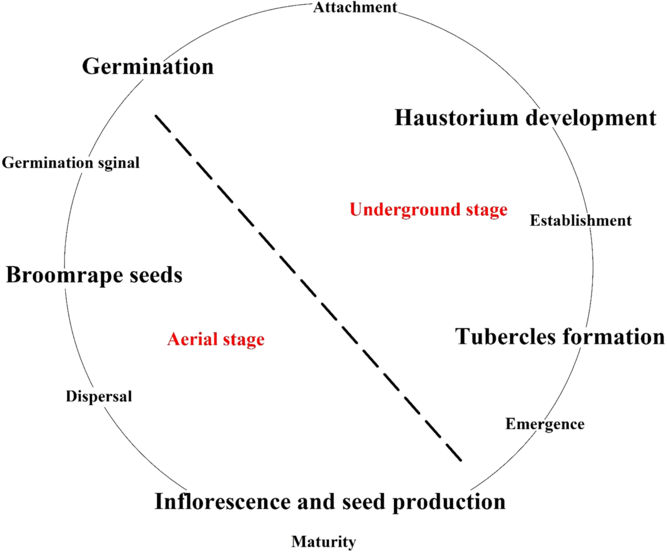
The broomrape’s seed may remain physiologically dormant for more than a decade, its germination only triggered by the presence of a host-root germination stimulant (Westwood et al. Reference Westwood, dePamphilis, Das, Fernández-Aparicio, Honaas, Timko, Wafula, Wickett and Yoder2012). Several intercellular biological mechanisms, along with low germination stimulant production, may induce resistance in host crops (Labrousse et al. Reference Labrousse, Arnaud, Serieys, Bervillé and Thalouarn2001; Louarn et al. Reference Louarn, Boniface, Pouilly, Velasco, Pérez-Vich, Vincourt and Muños2016; Pérez-de-Luque et al. Reference Pérez-de-Luque, Jorrín, Cubero and Rubiales2005). The germination stimulant compounds are plant hormones with strigolactone structure and play an important role in host specificity in broomrape species (Yoneyama et al. Reference Yoneyama, Ruyter-Spira, Bouwmeester, Joel, Gressel and Musselman2013). The host specificity among broomrape species is attributed to the response of these species to qualitative and quantitative differences of germination stimulant compounds (Awad et al. Reference Awad, Sato, Kusumoto, Kamioka, Takeuchi and Yoneyama2006; Ruyter-Spira et al. Reference Ruyter-Spira, Al-Babili, Van der Krol and Bouwmeester2013). The broomrape seedling is completely dependent on its host for all nutritional requirements and attaches directly to a crop’s root via a specialized structure, the haustorium, and creates a tight physiological relationship with the host plant (Fernández-Aparicio et al. Reference Fernández-Aparicio, Reboud and Gibot-Leclerc2016), decreasing the crop yield. After the formation of the haustorium, the parasite develops storage tissue called a tubercle, and the flowers and seeds that develop from this tissue appear on the soil surface (Figure 1) (Duca et al. Reference Duca, Glijin and Acciu2013; Joel et al. Reference Joel, Hershenhorn, Eizenberg, Aly, Ejeta, Rich, Ransom, Sauerborn, Rubiales and Janick2007).
Broomrape life cycle.

Broomrape development occurs underground, making its detection difficult and its management problematic. To date, efforts to find an effective, economical, and applicable management strategy to control broomrape in economically important crops have been unsuccessful (Fernández-Aparicio et al. Reference Fernández-Aparicio, Reboud and Gibot-Leclerc2016; Joel Reference Joel2000). Hence, the aims of the current review are to (1) understand the extent of broomrape damage to crops, (2) give an overview of the existing literature for the biology and management of broomrape in Iran, (3) determine any knowledge gaps, and (4) identify opportunities for further research in the management of broomrape to be done in the future.
Broomrape Species and Their Geographic Distribution
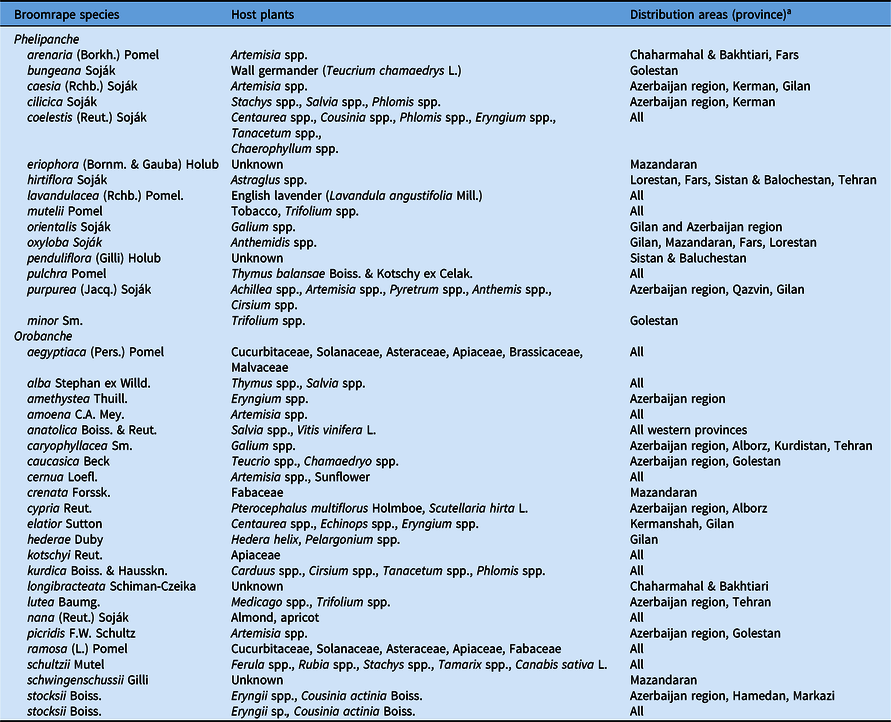
In Iran, the genera Phelipanche and Orobanche have 15 and 23 species, respectively (Iranshahr Reference Iranshahr2008) (Table 1). The majority of broomrapes are found in the warm and temperate parts of the country, while the broomrape population is low in more northern regions (Iranshahr Reference Iranshahr2008). It has been reported that Orobanche angustelaciniata Gilli, Phelipanche pulchra Pomel, Phelipanche eriophora (Bornm. & Gauba) Holub, Phelipanche penduliflora (Gilli) Holub, Orobanche schwingenschussii Gilli, Orobanche cistanchoides Beck, and Orobanche longibracteata Schiman-Czeika are exclusive to Iranian flora (Schiman-Czeika Reference Schiman-Czeika1964; Torabi and Hadizadeh Reference Torabi and Hadizadeh2014). Orobanche aegyptiaca, O. ramosa, O. cernua, Orobanche kotschyi Reut., and P. nana are described as the country’s important broomrape species.
Broomrape species and their important host plants and distribution in Iran.

a All includes all provinces except northern provinces. Azerbaijan region includes Azerbaijan-e Sharghi, Azerbaijan-e Gharbi, and Ardabil provinces.
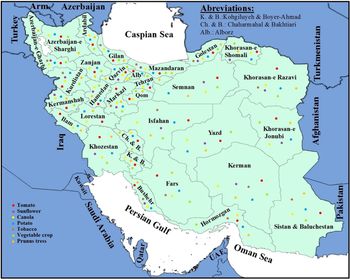
Broomrapes are found in all parts of Iran, except in the northern provinces, which have acidic soil and high water content (Figure 2 and Table 1) (Bahrami et al. Reference Bahrami, Emadodin, Ranjbar Atashi and Rudolf Bork2010). Broomrapes are widely distributed across the provinces of the Azerbaijan region (Azerbaijan-e Sharghi, Azerbaijan-e Gharbi, and Ardabil), Hamedan, Chaharmahal & Bakhtiari, Kurdistan, Tehran, Lorestan, Bushehr, Fars, the Khorasan regions (Khorasan-e Shomali, Khorasan-e Razavi, and Khorasan-e Jonubi), and Kermanshah (Figure 2 and Table 1) (Nezamabadi and Minbashi Moeini Reference Nezamabadi and Minbashi Moeini2016). Orobanche aegyptiaca and O. ramosa are widely distributed, while others such as Orobanche cypria Reut., Orobanche kurdica Boiss. & Hausskn., Orobanche hansii Kerner, O. penduliflora and O. Schwingenschussii are much less distributed (Iranshahr Reference Iranshahr2008; Saeidi et al. Reference Saeidi, Torabi and Aghabeygi2010). Furthermore, O. cypria and O. kurdica are considered as rare species that have been collected from Kohgiluyeh & Boyer-Ahmad Province (Dena Mountain, 3,200 m above sea level) and Lorestan Province (Oshtrankuh, Ghaleh of Rostam to Gohar, 2,400–2,700 m above sea level) (Iranshahr Reference Iranshahr2008), respectively. Orobanche crenata is an important parasitic weed in faba bean (Vicia faba L.), chick pea, and carrot across neighboring countries in the region (Parker Reference Parker2017). Reports of infestation of broomrape in chick pea, which is produced across 600,000 ha in Iran annually, are limited (Hosseini et al. Reference Hosseini, Ahmadvand, Sirwan and Minbashi2015).
Map of Iran showing the positions of its provinces, and major host crop for parasitic broomrape including tomato, sunflower, canola, potato, tobacco, vegetable crops (Cucumis sativus, Cucumis melo), and almond, apricot, and peach trees.

Orobanche aegyptiaca
Orobanche aegyptiaca is a noxious broomrape species (obligate root parasite), which infests a wide range of crops, particularly those from the Solanaceae family due to specific germination stimulant compounds and unique intercellular associations with this genus (Torabi and Hadizadeh Reference Torabi and Hadizadeh2014). It is widespread in areas with a Mediterranean climate, including western, central, and southern Iran. In recent years, the extent and intensity of O. aegyptiaca infestation have increased rapidly in tomato and other susceptible crops. Increased water stress may also be exacerbating broomrape invasion of susceptible crops (Karkanis et al. Reference Karkanis, Bilalis and Efthimiadou2007). It has been reported that water deficit induces abscisic acid (ABA) synthesis by host plant roots, a factor that may be involved in broomrape infection (Torres-Vera et al. Reference Torres-Vera, García, Pozo and López-Ráez2016; Zhang and Outlaw Reference Zhang and Outlaw2001). Similar to some strigolactone compounds, ABA induces broomrape germination (Torres-Vera et al. Reference Torres-Vera, García, Pozo and López-Ráez2016; Zhang and Outlaw Reference Zhang and Outlaw2001).
Orobanche ramosa
The host ranges of O. aegyptiaca and O. ramosa both comprise potato, tomato, eggplant, and faba bean, while O. aegyptiaca also invades carrot (Nezamabadi and Minbashi Moeini Reference Nezamabadi and Minbashi Moeini2016; Torabi and Hadizadeh Reference Torabi and Hadizadeh2014). Orobanche ramosa has also severely affected tomato and other Solanaceae crop production (Torabi and Hadizadeh Reference Torabi and Hadizadeh2014). As O. ramosa is commonly mistaken for O. aegyptiaca, there is no precise estimation of crop yield loss due to O. ramosa. In other countries such as France, O. ramosa has now increasingly invaded canola (Parker Reference Parker2009). However, there are no reports of its presence in Iranian canola production systems. Further research is required, as the area of land allocated for canola cultivation has increased and broomrape may be present in this crop (IN, personal observation).
Orobanche cumana Wallr
Orobanche cumana (formerly known as O. cernua) has been identified as the main weed problem in sunflower for nearly a century (Fernández-Martínez et al. Reference Fernández-Martínez, Pérez-Vich, Velasco, Martínez-Force, Dunford and Salas2015) and has become a major barrier to production in recent years due to rapid intensification and spread. Sunflower cultivation has been abandoned in Kermanshah Province because of this problem (IN, personal observation). Presumably, O. cumana will thrive in many areas of Iran where sunflower is cultivated because of the monocropping of sunflower for oil production. However, it is not well documented, and the degree of sunflower loss is not clear.
Orobanche cernua is morphologically similar to O. cumana (Katzir et al. Reference Katzir, Portnoy, Tzuri, Joel and Castejón-Muñoz1996). Differences in response to germination stimulant compounds cause host specificity between these species. The emergence of O. cernua is only stimulated by strigolactones (orobanchol, 5-deoxystrigol, 2′-epiorobanchol, and GR24), but O. cumana responds to dehydrocostus lactone and GR24 (Dor et al. Reference Dor, Plakhine, Joel, Larose, Westwood, Smirnov, Ziadna and Hershenhorn2020). While O. cernua is a significant component of the Orobanche complex in solanaceous crops (particularly tomato, tobacco, and eggplant) in other countries (Parker Reference Parker2009), there are no reports of its occurrence in Iran. In Iran, based on the host range, it could be concluded that O. cumana is predominant rather than O. cernua, as it is exclusively found in sunflower. This discrepancy clearly shows that broomrape species are not well identified. Usually, morphological differences are used to identify various broomrape species (Parker and Riches Reference Parker and Riches1993). However, these differences are not clear enough, and the use of molecular markers such as simple sequence repeats (SSR) of nuclear and plastid genomes has been suggested (Dor et al. Reference Dor, Plakhine, Joel, Larose, Westwood, Smirnov, Ziadna and Hershenhorn2020; Westwood et al. Reference Westwood, dePamphilis, Das, Fernández-Aparicio, Honaas, Timko, Wafula, Wickett and Yoder2012).
Phelipanche nana (Reut.) Beck
Phelipanche nana is a problem in almond, peach [Prunus persica (L.) Batsch], and apricot (Prunus armeniaca L.) cropping systems (Baghestani et al. Reference Baghestani, Behrouzi, Rahimian and Mohammad2009), with heavy infestations first reported in Chaharmahal & Bakhtiari Province, alongside the Zayandeh Rood region (Isfahan Province). It is estimated that up to 72% of almond plants were parasitized by P. nana in the investigated area. The highest infestation for this parasitic weed was observed on almond roots of 9- to 11.9-mm diameter (Esfandiari Reference Esfandiari1999). The reason behind this observation is probably that the young roots of the host are soft, so the haustorium easily penetrates the vascular systems of roots (Habimana et al. Reference Habimana, Murthya, Hattia and Nduwumuremyib2013). Maximum almond root infestation by P. nana has been observed at depths of 9 to 12 cm, as a high percentage of parasitic seeds would not germinate in deeper soil layers (López-Granados and García-Torres Reference López-Granados and García-Torres1996).
Orobanche kotschyi
Orobanche kotschyi, also known as Southern broomrape in Iran, particularly parasitizes vegetables from the Apiaceae family (Table 1). It is perennial, 30- to 60-cm tall, with almost all of its aerial parts densely covered with white villi (Iranshahr Reference Iranshahr2008). This species is morphologically similar to Orobanche clavata Schiman-Czeika. However, the presence of long bracts and a pale brown corolla in O. clavata differentiates it from O. kotschyi (Athar et al. Reference Athar, Chaudhary, Yousaf and Shabbir2007; Schiman-Czeika Reference Schiman-Czeika1964). It is widely distributed throughout Iran and frequently found in dicot vegetables, primarily in Bushehr Province (Iranshahr Reference Iranshahr2008). Despite its heavy infestation in the region, there is no documentation of its damage to crop production.
Management of Broomrape
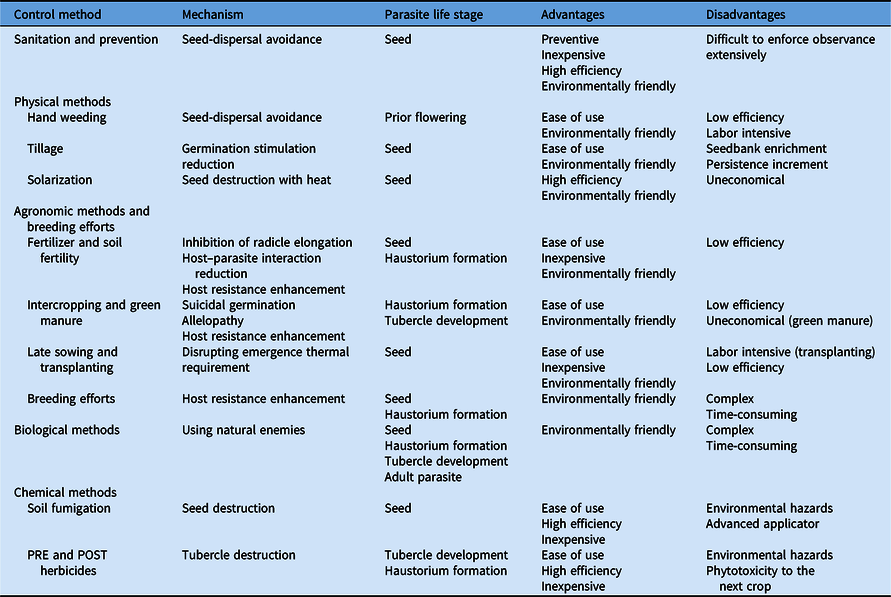
The management and reduction of the harmful effects of broomrape are of significant concern. The very small seeds and prolific (10,000 to 500,000 seeds plant−1) and persistent seedbank (more than a decade), complex and multiple physiological seed dispersal, a unique host–parasite intercellular interaction, and underground growth make the broomrape species hard to manage (Joel et al. Reference Joel, Hershenhorn, Eizenberg, Aly, Ejeta, Rich, Ransom, Sauerborn, Rubiales and Janick2007). Therefore, in addition to the integration of all weed management strategies such as physical, agronomical, chemical, and biological strategies, social and legal considerations are required to manage the broomrape species (Table 2).
The diverse methods of broomrape control applied in Iran.

Sanitation and Prevention Measurements
The continued introduction of broomrape to noninfested areas still presents a great threat to crop production. Seeds of broomrape are as small as a dust particle and persist in soil for many years (Osterbauer and Rehms Reference Osterbauer and Rehms2002). Broomrape infestation spreads to neighboring fields by diverse means such as machinery traffic, non-fermented manure application, grazing animals, plant material (crop seed source), wind, and water (Ginman et al. Reference Ginman, Prider, Matthews, Virtue and Watling2015; Secomb Reference Secomb2006). Hence, the new input of seeds to the seedbank and further introduction to new areas should be prevented. Indeed, keeping broomrape management under the no-seed threshold and observing diverse means of prevention plays an integral role in broomrape management. Tomato, as the main host of different broomrape species, is typically propagated in permanent and conventional nurseries before being transplanted into the field. Although farmers generally use certified seeds, small infestations in nurseries quickly aggravate the problem. In recent years, adopting drip irrigation and filtered water contributed to lower weed seed dispersal, but more consideration of water sources in broomrape dissemination is required. Extensive extension programs to enhance farmers’ awareness of using clean machinery, restricting grazing on and movement of livestock from contaminated areas, and the implementation of strict quarantine to reduce new introduction are crucial. Dust storms are a general phenomenon, particularly in western regions, in which particles of field soil are able to cover vast distances (Cao et al. Reference Cao, Liu, Wang, Yang and Luo2015; Hojati et al. Reference Hojati, Khademi, Cano and Landi2012). Some efforts have been made to combat desertification and reduce dust storms, as they may lead to the failure of all other quarantine means and other broomrape management strategies. Increased temperatures and reduced rainfall across Iran during recent years (Amiri and Eslamian Reference Amiri and Eslamian2010; Tabari et al. Reference Tabari, Somee and Zadeh2011) may have facilitated the invasion of broomrape, probably by increasing ABA synthesis in roots of susceptible crops in noninfested areas (Torres-Vera et al. Reference Torres-Vera, García, Pozo and López-Ráez2016; Zhang and Outlaw Reference Zhang and Outlaw2001). Therefore, rigorous phytosanitary operations are required to prevent the possible future distribution of broomrape.
Physical Methods
Although physical practices such as hand weeding, tillage, and solarization are not effective in reducing losses in the current crop, they can be used to minimize further additions to the seedbank and therefore should be integrated with other weed management strategies.
Hand Weeding
Hand weeding is a valuable method for small farms or minor infestations and could be effective for avoiding further parasite seed production and dispersal before flowering (Goldwasser and Rodenburg Reference Goldwasser, Rodenburg, Joel, Gressel and Musselman2013). In most regions of Iran, low availability of labor at the appropriate time for control may reduce the applicability of hand weeding for broomrape management.
Tillage
Seedbeds are commonly prepared using a moldboard plow in Iran, which buries broomrape seeds at 40 to 50 cm in the soil profile. While this may reduce germination stimulation, it ultimately results in seedbank enrichment, as broomrape seeds are viable for more than a decade (Goldwasser and Kleifeld Reference Goldwasser and Kleifeld2004; Habimana et al. Reference Habimana, Murthya, Hattia and Nduwumuremyib2013). Furthermore, protecting the seeds from aging, predation, and induced dormancy due to lower oxygen in deep soil layers may result in a higher seed persistence level (Chauhan et al. Reference Chauhan, Gill and Preston2006; Long et al. Reference Long, Gorecki, Renton, Scott, Colville, Goggin, Commander, Westcott, Cherry and Finch-Savage2015). Hence, shallow tillage followed by deep tillage is required to avoid bringing the buried seeds back into the host root growing zone (Goldwasser and Kleifeld Reference Goldwasser and Kleifeld2004; Habimana et al. Reference Habimana, Murthya, Hattia and Nduwumuremyib2013). Shallow tillage alone should be avoided to prevent further seed dissemination (Goldwasser and Kleifeld Reference Goldwasser and Kleifeld2004; Habimana et al. Reference Habimana, Murthya, Hattia and Nduwumuremyib2013). Although the no-tillage system is not common in Iran, it is highly recommended after deep tillage to avoid seedbank enlargement (Goldwasser and Rodenburg Reference Goldwasser, Rodenburg, Joel, Gressel and Musselman2013). In contrast, in the no-tillage system, seeds remain on the soil surface, where they are prone to a higher risk of seed dispersal (López-Bellido et al. Reference López-Bellido, Benítez-Vega and López-Bellido2009).
Solarization
Solarization is a highly efficient technique for eliminating the broomrape seedbank as well as other soil-borne pests in countries such as Iran with extreme temperatures and adequate sunny days during summer (Ashrafi et al. Reference Ashrafi, Hassan, Mashhadi and Sadeghi2009; Haidar and Sidahmed Reference Haidar and Sidahmed2000; Jacobsohn et al. Reference Jacobsohn, Greenberger, Katan, Levi and Alon1980; Mauromicale et al. Reference Mauromicale, Monaco, Longo and Restuccia2005). In this practice, pre-irrigated soil is sealed with a layer of transparent polyethylene film for up to 8 wk (Jacobsohn et al. Reference Jacobsohn, Greenberger, Katan, Levi and Alon1980). The temperature is elevated 5 to 15 C from depths of 0 to 15 cm by trapping solar energy under polyethylene film, and the temperature may then exceed 50 C (Haidar and Sidahmed Reference Haidar and Sidahmed2000; Jacobsohn et al. Reference Jacobsohn, Greenberger, Katan, Levi and Alon1980; Mauromicale et al. Reference Mauromicale, Monaco, Longo and Restuccia2005). In many studies, a high reduction (up to 100% control) in the emergence and tubercle biomass of broomrape species following solarization has been reported (Ashrafi et al. Reference Ashrafi, Hassan, Mashhadi and Sadeghi2009; Haidar and Sidahmed Reference Haidar and Sidahmed2000; Mauromicale et al. Reference Mauromicale, Monaco, Longo and Restuccia2005). The loss of seed viability and seed dormancy induced by extreme temperatures and temperature fluctuation during the day and night could explain the high reduction in seedling emergence of broomrape species (Jacobsohn et al. Reference Jacobsohn, Greenberger, Katan, Levi and Alon1980; Jain and Foy Reference Jain and Foy1989). The seedbed should be prepared before solarization to avoid disturbing the nontreated soil layer through cultivation of shallow root crops or tolerant crops and thereby germinating dormant broomrape seeds (Joel et al. Reference Joel, Gressel and Musselman2015; Kleifeld et al. Reference Kleifeld, Goldwasser, Plakhine, Eizenberg, Herzlinger and Golan1999). Despite the high efficiency of such an approach, it is not economically feasible for low-income farmers to let fields lie fallow during the summer season.
Agronomic Methods and Breeding Efforts
Agronomic and breeding practices such as soil fertility improvement, farming techniques, and resistant crop cultivars play an important role in all weed management strategies and have received increased attention due to their ease of implementation and reduced environmental impacts.
Fertilizer and Soil Fertility
In fertile soil, lower broomrape infestation and injury have been reported in many locations around the world (Goldwasser and Kleifeld Reference Goldwasser and Kleifeld2004; Habimana et al. Reference Habimana, Murthya, Hattia and Nduwumuremyib2013; Parker Reference Parker2009). Among synthetic and organic fertilizers, nitrogen is highly effective in reducing broomrape injury (Haidar and Sidahmed Reference Haidar and Sidahmed2006; Jain and Foy Reference Jain and Foy1992). Ammonium is an effective form of nitrogen to reduce germination by direct inhibition of radicle elongation (Parker and Riches Reference Parker and Riches1993; Westwood and Foy Reference Westwood and Foy1999). The inhibitory effect of ammonium is attributed to lower activity of glutamine synthetase in ammonia assimilation and detoxification (McNally et al. Reference McNally, Orebamjo, Hirel and Stewart1983a, Reference McNally, Orebamjo, Hirel and Stewart1983b). A single application of nitrate ammonium at 200 kg ha−1 (68 kg ha−1 N) resulted in a 34% reduction in biomass of O. aegyptiaca in a tomato field in the province of Shiraz (Ghaznavi et al. Reference Ghaznavi, Kazemeini and Naderi2019). Moreover, the application of some elements such as silicone may enhance host resistance to biotic stresses through increased activity of plant antioxidants (Al-aghabary et al. Reference Al-aghabary, Zhu and Shi2005; Pérez-de-Luque et al. 2005). For example, in a pot study, a susceptible tomato cultivar (‘Varamin’) treated with silicon nitrogen at 1.7 mM resulted in a 61% reduction of the number of tubercles in O. aegyptiaca (Karimmojeni et al. Reference Karimmojeni, Ehtemam, Javadimoghadam, Shahbazi and Bazrafshan2017). The addition of nutrients (manure or chemical fertilizer) alters the soil chemical conditions (e.g., decreases pH), which may affect the osmotic potential of host cells, thereby potentially limiting host–parasite interaction (Al-Khateeb et al. Reference Al-Khateeb, Hameed and Shibli2005; Drennan Reference Drennan1979). Furthermore, the application of fertilizer compensates somewhat for the adverse effects of parasites and may reduce the amount of germination stimulants produced by the host (Habimana et al. Reference Habimana, Murthya, Hattia and Nduwumuremyib2013).
Intercropping and Green Manure
In crop rotation, the implication of intercropping, green manure, and broomrape-tolerant crop cultivars are contributing agronomic methods to manage broomrape species. Two key mechanisms of suicidal germination and avoidance of stimulated germination are involved in the depletion of the broomrape seedbank in the cultivation of allelopathic crops, trap crops, and non-host intercrops (Habimana et al. Reference Habimana, Murthya, Hattia and Nduwumuremyib2013). For example, Fernandez-Aparicio et al. (Reference Fenández-Aparicio, Sillero and Rubiales2007, Reference Fernández-Aparicio, Emeran and Rubiales2008) reported the emergence inhibition of O. crenata due to the release of allelopathic compounds from cereals and fenugreek (Trigonella foenum-graecum L) intercropping in faba bean and red pea (Lathyrus cicera L.) fields. Intercropping, in addition to improving broomrape species management, may stimulate host-crop production, incrementally increase soil fecundity, and reduce soil erosion (Oswald et al. Reference Oswald, Ransom, Kroschel and Sauerborn2002).
While broomrape emergence was stimulated by trap crops (root exudate emergence-stimulated compound), subsequent suicidal germination occurred due to no host attachment (Joel et al. Reference Joel, Hershenhorn, Eizenberg, Aly, Ejeta, Rich, Ransom, Sauerborn, Rubiales and Janick2007; Parker and Riches Reference Parker and Riches1993). Babaei et al. (Reference Babaei, Alizadeh, Jahansouz, Mashhadi and Moeini2010) reported that the cultivation of trap crops such as black-eyed pea (Vigna unguiculata L.), brown Indian hemp (Hibiscus cannabinus L.), common flax (Linum usitatissimum L.), and sesame (Sesamum orientale L.) reduced the biomass of O. aegyptiaca more than 74% and, consequently, tomato yield increased by more than 62%, compared with the control plot.
The inclusion of green manure and cover crops in crop rotation has several ecological benefits in integrated weed management strategies (Riches et al. Reference Riches, Mbwaga, Mbapila and Ahmed2005). The catch crop is a true host plant, which induces seed germination and should be killed (harvested or plowed) after parasite attachment (Parker and Riches Reference Parker and Riches1993; Oswald et al. Reference Oswald, Ransom, Kroschel and Sauerborn2002). The cultivation of trap crops, catch crops, and tolerant crops to stimulate parasite germination and killing the green manure after parasite attachment resulted in a reduction in seedbank through the suicidal germination and mortality of the new tubercles (Parker and Riches Reference Parker and Riches1993; Oswald et al. Reference Oswald, Ransom, Kroschel and Sauerborn2002). Although using catch crops as green manure could kill the emerged parasite, it is not economically viable in fields with a high infestation or for low-income farming (Goldwasser and Kleifeld Reference Goldwasser and Kleifeld2004).
Late Sowing and Transplanting
It has been reported that altering the sowing date reduces broomrape emergence by disrupting the broomrape thermal requirement (Goldwasser and Kleifeld Reference Goldwasser and Kleifeld2004; Habimana et al. Reference Habimana, Murthya, Hattia and Nduwumuremyib2013). Most Iranian host crops are grown in the summer season, and early cultivation of these crops is not technically possible due to cold stress and frequent rain in spring. Some Iranian farmers gain an advantage by transplanting tomato and other summer vegetables and experience a lower broomrape infestation compared with direct-seeded planting (IN, personal observation). There is no evidence for the benefits of transplanting to manage broomrape species, and further research should be conducted in this area.
Breeding Efforts
Screening and breeding programs are aimed at finding and developing crop cultivars with lower germination stimulant production and finding resistant genes to use in developing broomrape-tolerant crops. Tolerant cultivars could act as false host crops and contribute to reducing broomrape infestation. Louarn et al. (Reference Louarn, Boniface, Pouilly, Velasco, Pérez-Vich, Vincourt and Muños2016) found several quantitative resistance mechanisms that control infection by O. cumana and that can be used in sunflower breeding. Crop varieties and wild plant species are the main resources of genes needed for developing broomrape-resistant crops (Cvejić et al. Reference Cvejić, Radanović, Dedić, Jocković, Jocić and Miladinović2020). Different breeding approaches, such as conventional breeding, marker-assisted selection, omics (genomics, transcriptomics, and metabolomics), and gene-editing techniques, could aid in development of broomrape-resistant cultivars (Bari et al. Reference Bari, Nassar, Kheredin, Gal-On, Ron, Yoder and Aly2019; Cvejić et al. Reference Cvejić, Radanović, Dedić, Jocković, Jocić and Miladinović2020). Screening programs have been introduced for several Iranian tomato varieties to be either resistant or tolerant to broomrape attack. For example, Tokasi et al. (Reference Tokasi, Bannayan Aval, Mashhadi and Ghanbari2014) evaluated the sensitivity of 29 tomato cultivars to broomrape infection and reported that the degree of sensitivity of studied cultivars to infection varied. Tomato cultivars ‘Caligen 86’, ‘Cal-jN3’, ‘Hyb PS6515’, ‘Hyb Petopride5’, and ‘Viva’ were more tolerant, and ‘Kimia-Falat’, ‘Hyb.petopride2’, and ‘Hyb.AP865’ cultivars were more susceptible. Molecular markers linked to the gene(s) controlling broomrape resistance can be used in breeding programs to develop broomrape-resistant crops. Darvishzadeh (Reference Darvishzadeh2016) identified five SSR markers in tobacco for broomrape resistance. The strigolactone is produced via the carotenoid cleavage dioxygenase 8 (CCD8) pathway (Fauser et al. Reference Fauser, Schiml and Puchta2014). It has been reported that gene-editing through mutagenesis (CRISPR/Cas9) could disturb the CCD8 pathway and subsequently contribute to developing broomrape-resistant cultivars by reducing strigolactone production (Bari et al. Reference Bari, Nassar, Kheredin, Gal-On, Ron, Yoder and Aly2019). Furthermore, introducing herbicide-tolerant host crops such as chlorsulfuron-tolerant tobacco, glyphosate-tolerant canola, asulam-tolerant potato, and imidazolinone-tolerant sunflowers in Iran could contribute to using a broader spectrum of herbicides (Surov et al. Reference Surov, Aviv, Aly, Joel, Goldman-Guez and Gressel1998; Tan et al. Reference Tan, Evans, Dahmer, Singh and Shaner2005).
Biological Methods
Biological control strategies using natural enemies attempt to maintain broomrape infestation below the economic threshold (Amsellem et al. Reference Amsellem, Barghouthi, Cohen, Goldwasser, Gressel, Hornok, Kerenyi, Kleifeld, Klein and Kroschel2001; Gressel Reference Gressel, Joel, Gressel and Musselman2013). In such strategies, although the weeds are not eradicated, control of the parasitic weed within a few years should reduce damage to the host crops in early development stages (Ghosheh Reference Ghosheh2005; Gressel Reference Gressel, Joel, Gressel and Musselman2013; Stoddard et al. Reference Stoddard, Nicholas, Rubiales, Thomas and Villegas-Fernández2010). The identification of potential virulent biological agents based on host–parasite biology is the first step in the biological control method (Gressel Reference Gressel, Joel, Gressel and Musselman2013). In addition to identification of potential biological agents, practitioners of weed biocontrol must evaluate the potential for damage to non-target plants, suitable formulation, determining the accurate time of application, and, finally, evaluation of economic feasibility (Amsellem et al. Reference Amsellem, Barghouthi, Cohen, Goldwasser, Gressel, Hornok, Kerenyi, Kleifeld, Klein and Kroschel2001; Goldwasser and Kleifeld Reference Goldwasser and Kleifeld2004; Gressel Reference Gressel, Joel, Gressel and Musselman2013; Habimana et al. Reference Habimana, Murthya, Hattia and Nduwumuremyib2013). Inadequate host-specificity testing and evaluation of challenges encountered frequently lead to the early termination of the use of potential biological agents (Fernández-Aparicio et al. Reference Fernández-Aparicio, Yoneyama and Rubiales2011). In addition to the previously mentioned challenges, social concerns and legal and quarantine requirements reduce the use of biological control (Karimi et al. Reference Karimi, Dara and Arthurs2019; Moosavi and Zare Reference Moosavi, Zare, Singh, Sarma and Keswani2016; Ragsdale and Sisler Reference Ragsdale and Sisler1994).
In Iran, the application of different virulent strains of Fusarium oxysporum Schlectendahl and Fusarium solani Link has been evaluated to control broomrape at laboratory, greenhouse and field scales (Mazaheri et al. Reference Mazaheri, Moazami and Vaziri1991; Mohammadi Reference Mohammadi2014; Nazer Kakhaki et al. Reference Nazer Kakhaki, Montazeri and Naseri2017). Despite the reduction in the number of parasite seedlings and tubercle biomass, no occurrence of disease due to the use of these strains was observed in the host crops.
High temperatures and water-stress conditions are major constraints in biological control, and soil inoculation may protect these strains from harsh environments (Habimana et al. Reference Habimana, Murthya, Hattia and Nduwumuremyib2013; Hershenhorn et al. Reference Hershenhorn, Eizenberg, Dor, Kapulnik and Goldwasser2009). Although several potential biological agents have been identified in Iran, studies on biological insect agents or other microorganisms for control of broomrape are rare. There is a huge information gap surrounding biological control strategies, and none of these attempts has led to a successful large-scale broomrape control program in Iran.
Chemical Methods
Although few herbicides are available for Orobanche and Phelipanche management, chemical control is very popular among Iranian farmers due to ease of use and the high economic benefit compared with other methods. The timing of herbicide application is the key factor in improving chemical control effectiveness. In early herbicide application, herbicide efficacy will be reduced due to low parasite attachment, and late herbicide application is not economically viable due to significant crop yield loss (Goldwasser and Kleifeld Reference Goldwasser and Kleifeld2004). Hence, predictive phenological models could help to reduce herbicide rate and introduce more precise timing (Eizenberg et al. Reference Eizenberg, Colquhoun and Mallory-Smith2005; Grenz et al. Reference Grenz, Manschadi, DeVoil, Meinke and Sauerborn2005). Hosseini et al. (Reference Hosseini, Ahmadvand, Oveisi, Morshedi and Gonzalez-Andujar2017) predicted the initial emergence of O. aegyptiaca in a potato field using the hydrothermal model. Such models need to be location based to address specific crop–parasite interactions in each cropping region of Iran. In general, phenological predictive models require many phenological and meteorological data points, and in the absence of these inputs, chemical control should be preventative. Research on chemical control for these weeds includes fumigant, PRE, and POST herbicides.
Soil Fumigation
Fumigants are used to eliminate pests, terricolous pathogens, and weed seeds, including those from Orobanche spp. and Phelipanche spp. Herbicides such as methyl bromide, metham sodium, dazomet, and 1,3-dichloropropene greatly reduce contamination from these weeds (Foy et al. Reference Foy, Jain and Jacobsohn1989; Goldwasser et al. Reference Goldwasser, Kleifeld, Golan, Bargutti and Rubin1995; Prider and Williams Reference Prider and Williams2014). Only metham sodium is currently available in Iran, and other fumigants have been banned due to environmental hazards and healthcare issues. Metham sodium liquid is injected a few months before planting in well-watered soil or it is used in a herbigation followed by covering the soil surface with a plastic sheet. In laboratory conditions, application of metham sodium at 111 mg L−1 resulted in complete inhibition of O. aegyptica seedling emergence (Goldwasser et al. Reference Goldwasser, Kleifeld, Golan, Bargutti and Rubin1995). In Australia, the seedling emergence of O. ramosa was reduced by >40% with application of metham sodium at 205 kg ai ha−1 in the field condition in comparison with no-herbicide treatment (Williams et al. Reference Williams, Virtue, DeDear and McInerney2006). In Iran, compared with no-herbicide treatment, the highest tomato yield was observed after the application of this fumigant at 196 kg ai ha−1, and O. aegyptiaca biomass was reduced by >50% (Zamanzadeh et al. Reference Zamanzadeh, Nabavi and Norouzzadeh2011). Despite the high efficiency of metham sodium, due to economic reasons and the need for an advanced applicator, its use is generally limited to greenhouses with severe infestations.
PRE and POST Herbicides
Sulfonylurea and imidazolinones are selective herbicides with acropetal and basipetal translocation (systemic herbicide) in the tolerant crop that contributes to the control of these weeds (Gressel Reference Gressel, Joel, Gressel and Musselman2013; Schloss Reference Schloss1990, Reference Schloss and Stetter1994). These herbicides are applied before planting or after the emergence of crops. Despite physical dissipation and microbial degradation of herbicides in soil, the incorporation of the high-persistence herbicide in sufficiently deep soil may control the multiple flashes of emergence of these parasites and reduce the cost of further weed control practices during the growing season (Kleifeld et al. Reference Kleifeld, Goldwasser, Plakhine, Eizenberg, Herzlinger and Golan1999). In many overseas studies, high performance of sulfonylurea and imidazolinone herbicides such as imazethapyr, imazapyr, imazapic, imazaquin, chlorsulfuron, sulfosulfuron, triasulfuron, nicosulfuron, and rimsulfuron to control these weeds have been reported (Eizenberg et al. Reference Eizenberg, Goldwasser, Achdary and Hershenhorn2003; Hershenhorn et al. Reference Hershenhorn, Goldwasser, Plakhine, Ali, Blumenfeld, Bucsbaum, Herzlinger, Golan, Chilf, Eizenberg and Dor1998; Jurado-Expósito et al. Reference Jurado-Expósito, García-Torres and Castejón-Muñoz1997). Despite the high performance of these herbicides, some farmers refuse to incorporate this high-persistence herbicide into the soil to avoid phytotoxicity on the next crop. Imazethapyr, sulfosulfuron, and nicosulfuron are available in Iran. Double POST application of sulfosulfuron at 35 g ai ha−1 resulted in >60% reduction in O. aegyptica biomass in a tomato field (Shirdel et al. Reference Shirdel, Amani and Jawnshir2015); in another study, this treatment resulted in a potato yield increase of >70% in comparison with the heavy O. aegyptica–infested plot (Motazedi et al. Reference Motazedi, Jahedi and Farnia2010).
Glyphosate at low doses acts as a systematic selective herbicide to control Orobanche spp. and Phelipanche spp. in Apiaceae, Brassicaceae, and Fabaceae crops (Goldwasser and Kleifeld Reference Goldwasser and Kleifeld2004; Habimana et al. Reference Habimana, Murthya, Hattia and Nduwumuremyib2013), and it may stimulate (via hormesis) the growth of some weeds and crops (Calabrese Reference Calabrese2008; Duke et al. Reference Duke, Cedergreen, Velini and Belz2006). In Iran, compared with the no-herbicide treatment, O. ramosa biomass was reduced by >75% in a sunflower field with glyphosate application at 0.225 to 0.350 kg ae ha−1 (Filizadeh and Sadidi Reference Filizadeh and Sadidi2007). In the future, the introduction of glyphosate-tolerant crops in Iran could be very promising in the management of these weeds. Although glyphosate is the best option for prevention of seed production in these parasites, the application of reduced doses of glyphosate could exacerbate the development of other herbicide-resistant weeds (Owen and Zelaya Reference Owen and Zelaya2005).
Conclusion
Integrated management approaches could be more effective, as no single method provides complete control of broomrape. However, the results of current research in these cases are variable and inconsistent, particularly with respect to the reality of farming in Iran. The success of such methods in controlling broomrape is highly dependent on the use of recent advances in molecular genetics and crop breeding. Factors such as climate change, as well as the prevalence of monoculture farming systems, will expose more areas to broomrape infestation in Iran in the near future. Furthermore, due to the small size of broomrape seed and the abundant number of hosts available to this parasitic weed, the implementation of quarantine laws is not effective enough to prevent its spread. In Iran, obstacles such as lack of facilities for cellular and molecular studies, lack of coherent research groups with specific and targeted work programs, and lack of access to accurate and applied information sources in advanced countries are the most prominent challenges in broomrape management.
Acknowledgments
This research received no specific grant from any funding agency or the commercial or not-for-profit sectors. No conflicts of interest have been declared.