The seeds of vulnerability and resilience to mental health problems are planted in early life (Cicchetti & Walker, Reference Cicchetti and Walker2003; Pine & Fox, Reference Pine and Fox2015; Wakschlag et al., Reference Wakschlag, Roberts, Flynn, Marino, Norton and Davis2019). Indeed, for the common emotional and behavioral problems of childhood, broadly captured within the internalizing/externalizing (INT/EXT) spectrum, the vast majority of all children who will manifest severe and chronic problems show some self-regulatory difficulties before the age of 5 (e.g., Trentacosta & Shaw, Reference Trentacosta and Shaw2009). Over the past decades, there has been substantial effort to alter early life INT/EXT trajectories in early childhood (toddlers/preschoolers) via prevention efforts drawing from and/or embedded in naturalistic settings to achieve the broadest influence on population health (Perrin, Leslie, & Boat, Reference Perrin, Leslie and Boat2016). At the same time, a burgeoning science base suggests that some neurodevelopmental markers of mental health risk are evident even earlier, beginning in the first year of life. These efforts to identify infants and toddlers at risk for later psychopathology have been aided by the application of developmental measurement science (Biedzio & Wakschlag, Reference Biedzio, Wakschlag and Zeenah2019; Bosl, Tager-Flusberg, & Nelson, Reference Bosl, Tager-Flusberg and Nelson2018; Hay et al., Reference Hay, Waters, Perra, Swift, Kairis, Phillips and Van Goozen2014; Luby et al., Reference Luby, Estabrook, Rogers, Krogh-Jespersen, Norton, Allen and Wakschlag2019; Rogers et al., Reference Rogers, Sylvester, Mintz, Kenley, Shimony, Barch and Smyser2017). As neurodevelopmental and mechanistic understandings of developmental psychopathology have deepened, it has also become increasingly clear that transdiagnostic approaches are a powerful tool for the most effective identification and prevention at the earliest phases of the clinical sequence, particularly with an eye towards population health (Kessel, Meyer, et al., Reference Kessel, Meyer, Hajcak, Dougherty, Torpey-Newman, Carlson and Klein2016; McGorry & Nelson, Reference McGorry and Nelson2016; Nolen-Hoeksema & Watkins, Reference Nolen-Hoeksema and Watkins2011; Sonuga-Barke, Cortese, Fairchild, & Stringaris, Reference Sonuga-Barke, Cortese, Fairchild and Stringaris2015; Wakschlag et al., Reference Wakschlag, Choi, Carter, Hullsiek, Burns, McCarthy and Briggs-Gowan2012; Wakschlag et al., Reference Wakschlag, Estabrook, Petitclerc, Henry, Burns, Perlman and Briggs-Gowan2015; Wakschlag et al., Reference Wakschlag, Perlman, Blair, Leibenluft, Briggs-Gowan and Pine2018; Walkup et al., Reference Walkup, Barlow, Mullany, Pan, Goklish, Hasting and Reid2009; Walkup, Mathews, & Green, Reference Walkup, Mathews and Green2017; Wiggins, Mitchell, Stringaris, & Leibenluft, Reference Wiggins, Mitchell, Stringaris and Leibenluft2014). In this paper, we begin to weave these diverse streams of work together within a developmental framework by examining the transdiagnostic effects of a well-validated early childhood prevention program, the Family Check-Up (FCU; Breitenstein, Fogg, Ocampo, Acosta, & Gross, Reference Breitenstein, Fogg, Ocampo, Acosta and Gross2016; Dishion et al., Reference Dishion, Brennan, Shaw, McEachern, Wilson and Jo2014; Dishion et al., Reference Dishion, Shaw, Connell, Gardner, Weaver and Wilson2008; Morgan, Rapee, & Bayer, Reference Morgan, Rapee and Bayer2016; Perrin, Sheldrick, McMenamy, Henson, & Carter, Reference Perrin, Sheldrick, McMenamy, Henson and Carter2014).
Internalizing/externalizing spectrum syndromes are among the most common causes for concern for parents of young children and their caregivers (Sheldrick, Neger, & Perrin, Reference Sheldrick, Neger and Perrin2012). For mental health screening measures to be useful in real-world systems of care, they must be brief and they must target modifiable and ideally, transdiagnostic risk—that efficiently captures the likelihood of developing INT/EXT problems via a single risk dimension. We previously have suggested that irritability is an ideal candidate risk marker because it is a transdiagnostic indicator of decrements in self-regulation that have lifelong implications for health and disease (Moffitt et al., Reference Moffitt, Arseneault, Belsky, Dickson, Hancox, Harrington and Caspi2011; Wakschlag et al., Reference Wakschlag, Roberts, Flynn, Marino, Norton and Davis2019). Traditionally, irritability has been considered most centrally as a component of externalizing problem behavior syndromes that include aggression, noncompliance, impulsivity, and irritability as “hot temper or tantrums.” Thus, the more reactive component of irritability has been an essential feature of EXT. A chronically irritable mood state has been considered as a component of depressive syndromes, which are a core feature of INT. Thus, the present transdiagnostic conceptualization of irritability, which is our central focus here, integrates these various components into a single dimension of behavioral and mood features of angry/irritable affectivity. In young children, clinically salient irritability is dysregulated and symptoms include a tendency to respond to frustration with intense and prolonged tantrums as well as to have a chronic angry/cranky mood state (Wakschlag et al., Reference Wakschlag, Perlman, Blair, Leibenluft, Briggs-Gowan and Pine2018). Dysregulated irritability is one of the best transdiagnostic indicators of INT/EXT psychopathology—a pattern that extends through adulthood (Charach, Bélanger, McLennan, & Nixon, Reference Charach, Bélanger, McLennan and Nixon2017; Stringaris & Goodman, Reference Stringaris and Goodman2009a; Vidal-Ribas, Brotman, Valdivieso, Leibenluft, & Stringaris, Reference Vidal-Ribas, Brotman, Valdivieso, Leibenluft and Stringaris2016; Wakschlag et al., Reference Wakschlag, Roberts, Flynn, Marino, Norton and Davis2019). In fact, irritability is represented in more than a dozen psychiatric disorders in the 5th Edition of the Diagnostic and Statistical Manual of Mental Disorders (DSM-5; American Psychiatric Association, 2013).
Broadly considered, problems in self-regulation (a complex construct that includes affective, cognitive, and behavioral elements) are substrates of both INT and EXT. In DSM-5, irritability is one of the three core dimensions of oppositional defiant disorder (ODD), is a core feature of the new disruptive mood dysregulation disorder (DMDD), and is present in pediatric depression as well as a central presenting problem and treatment target of a host of other pediatric mental health and neurodevelopmental problems that do not include it as a defining feature (e.g., ADHD, autism, language problems) (e.g., Faraone et al., Reference Faraone, Rostain, Blader, Busch, Childress, Connor and Newcorn2018; Hawks, Marrus, Glowinski, & Constantino, Reference Hawks, Marrus, Glowinski and Constantino2018; Roberts et al., Reference Roberts, Curtis, Estabrook, Norton, Davis, Burns and Wakschlag2018). According to DSM-5, a diagnosis of disruptive mood dysregulation disorder (DSM-5's transdiagnostic irritability syndrome) requires both reactive irritability (i.e., tantrums/outbursts) and irritable mood, with increasing evidence of its validity in early childhood (Copeland, Angold, Costello, & Egger, Reference Copeland, Angold, Costello and Egger2013; Dougherty et al., Reference Dougherty, Smith, Bufferd, Carlson, Stringaris, Leibenluft and Klein2014; Kessel, Dougherty, et al., Reference Kessel, Dougherty, Kujawa, Hajcak, Carlson and Klein2016; Wiggins et al., Reference Wiggins, Briggs-Gowan, Estabrook, Brotman, Pine, Leibenluft and Wakschlag2018). Irritability is an easily measurable component of self-regulatory problems that is a major driver of psychopathology risk, and it lends itself to brief measurement via survey-based screening tools (Murray, Rosanbalm, Christopoulous, & Hamouidi, Reference Murray, Rosanbalm, Christopoulous and Hamouidi2015; Wakschlag et al., Reference Wakschlag, Roberts, Flynn, Marino, Norton and Davis2019). Irritability holds particular promise for the early identification and prediction of broad INT/EXT risk because it is measurable beginning in infancy (Wakschlag et al., Reference Wakschlag, Roberts, Flynn, Marino, Norton and Davis2019) and it is the chief indicator of dysregulation and mental health risk in pediatric infant screenings (Sheldrick, Merchant, & Perrin, Reference Sheldrick, Merchant and Perrin2011). Also, multiple large cohort studies have demonstrated the lifespan transdiagnostic importance of irritability (Burke, Reference Burke2012; Burke et al., Reference Burke, Boylan, Rowe, Duku, Stepp, Hipwell and Waldman2014; Burke, Hipwell, & Loeber, Reference Burke, Hipwell and Loeber2010; Stringaris & Goodman, Reference Stringaris and Goodman2009a, Reference Stringaris and Goodman2009b).
Recent research using the irritability (“Temper Loss”) scale of the Multidimensional Assessment Profile for Disruptive Behavior (MAP-DB), a developmentally-based, dimensional parent survey, has identified irritability features that differentiate typical and atypical expression within early childhood and their transdiagnostic utility (Wakschlag et al., Reference Wakschlag, Choi, Carter, Hullsiek, Burns, McCarthy and Briggs-Gowan2012; Wakschlag et al., Reference Wakschlag, Perlman, Blair, Leibenluft, Briggs-Gowan and Pine2018). This work has shown that probabilistic risk for INT/EXT (including disruptive behavior, ADHD, depression, and anxiety) occurs at levels of irritability typically defined as within the normal range on traditional checklist ratings (Wakschlag et al., Reference Wakschlag, Estabrook, Petitclerc, Henry, Burns, Perlman and Briggs-Gowan2015). Using this MAPS sample, evidence from ROC analyses has demonstrated that just two MAP-DB irritability items (i.e., “is easily frustrated” and “has destructive tantrums”) have good sensitivity/specificity (>70%) for concurrent and subsequent INT/EXT. In particular, preschoolers scoring high on irritability were likely to score high at two subsequent assessment points over a 16-month period. Of the preschoolers sampled, 23% of the children were persistently high on irritability across time. Secondly, high scores were associated with later irritability-related syndromes—58% meeting criteria for ODD, DMDD, and/or a depressive disorder. Conversely, of those preschool-age children with elevated irritability scores at baseline, 97% had a clinical disorder at school-age. This type of developmentally-based, dimensional approach is also proving fruitful for mechanistic studies, perhaps because narrow-band constructs can be more closely tied to underlying processes. For example, we have demonstrated prefrontal disruptions in frustration-related activation among preschoolers (aged 3–5 years), including increased conflict monitoring (larger N2 amplitude) and atypicality thresholds on the MAP-DB that map to neural thresholds of atypicality in lateral prefrontal cortex (LPFC) responding (Deveney et al., Reference Deveney, Briggs-Gowan, Pagliaccio, Estabrook, Zobel, Burns and Wakschlag2019; Grabell et al., Reference Grabell, Li, Barker, Wakschlag, Huppert and Perlman2017; Li, Grabell, Wakschlag, Huppert, & Perlman, Reference Li, Grabell, Wakschlag, Huppert and Perlman2017).
Can Interventions Improve Irritability?
Although irritability is increasingly prominent in transdiagnostic phenomenological studies, it has received far less attention in prevention science (Biedzio & Wakschlag, Reference Biedzio, Wakschlag and Zeenah2019). Limited transdiagnostic phenomenological research occurs in part because of the absence of a diagnostic profile in DSM-5 to describe chronic irritability before DMDD was added. In a secondary data analysis study by Derella, Johnston, Loeber, and Burke (Reference Derella, Johnston, Loeber and Burke2017) of a randomized controlled effectiveness trial of the Stop Now and Plan (SNAP) Program for school-aged boys (a multicomponent intervention program focused on problem-solving and emotion regulation, and parenting practices; Chorpita et al., Reference Chorpita, Daleiden, Ebesutani, Young, Becker, Nakamura and Starace2011), the influence of the intervention on irritability symptoms was tested. Path analysis showed significant indirect effects on irritability symptoms via improvements in child emotion regulation skills (e.g., flexibility and emotion modulated). In another trial of a parenting-based home visiting intervention for American Indian mothers with young children (age 0 at study entry), compared with controls, Barlow et al. (2009; Reference Barlow, Mullany, Neault, Compton, Carter, Hastings and Walkup2013; Reference Barlow, Mullany, Neault, Goklish, Billy, Hastings and Walkup2015) found intervention effects on dysregulation—which included many items indicative of irritability—by age 36 months, alongside reducing both INT/EXT problems.
Although irritability is now recognized as a transdiagnostic construct, the large majority of prevention programs that have encompassed irritable behaviors fall within the externalizing syndromes. There is a long and robust literature on the efficacy of parenting-based approaches, such as FCU, Parent Management Training, and Triple P, all of which have been primarily focused on the prevention of externalizing problems (Piquero et al., Reference Piquero, Jennings, Diamond, Farrington, Tremblay, Welsh and Gonzalez2016; van Aar, Leijten, de Castro, & Overbeek, Reference van Aar, Leijten, de Castro and Overbeek2017; Van Ryzin, Roseth, Fosco, Lee, & Chen, Reference Van Ryzin, Roseth, Fosco, Lee and Chen2016) and treatment of clinical syndromes such as ODD (Burkey et al., Reference Burkey, Hosein, Morton, Purgato, Adi, Kurzrok and Tol2018; Comer, Chow, Chan, Cooper, & Wilson, Reference Comer, Chow, Chan, Cooper and Wilson2013; Sawyer, Borduin, & Dopp, Reference Sawyer, Borduin and Dopp2015). More recently, modalities have been expanded to focus on emotion development as a preventive intervention for preschool depression (Luby, Barch, Whalen, Tillman, & Freedland, Reference Luby, Barch, Whalen, Tillman and Freedland2018) and for anxiety (Barlow et al., Reference Barlow, Mullany, Neault, Goklish, Billy, Hastings and Walkup2015). Because broadband INT/EXT and DSM syndromes are not mechanistically oriented and represent heterogeneous sets of behaviors, irritability per se has not been directly examined as an intervention target or mechanism in these evidence-based parenting programs. However, some studies have shown influences on component features of disruptive behavior and self-regulation, suggesting that parsing is possible. For example, the FCU has demonstrated intervention effects on externalizing behaviors (e.g., Dishion et al., Reference Dishion, Shaw, Connell, Gardner, Weaver and Wilson2008; Shelleby, Shaw, Dishion, Wilson, & Gardner, Reference Shelleby, Shaw, Dishion, Wilson and Gardner2018; Smith et al., Reference Smith, Dishion, Shaw, Wilson, Winter and Patterson2014) and inhibitory control in early childhood (Lunkenheimer et al., Reference Lunkenheimer, Dishion, Shaw, Connell, Gardner, Wilson and Skuban2008), self-regulation from early childhood into school age (Chang, Shaw, Dishion, Gardner, & Wilson, Reference Chang, Shaw, Dishion, Gardner and Wilson2014; Shelleby et al., Reference Shelleby, Shaw, Cheong, Chang, Gardner, Dishion and Wilson2012), and ODD symptoms in school-age children and adolescence (e.g., Dishion et al., Reference Dishion, Brennan, Shaw, McEachern, Wilson and Jo2014; Shaw et al., Reference Shaw, Galán, Lemery-Chalfant, Wilson, Elam, Gardner and Dishionin press; Shaw et al., Reference Shaw, Sitnick, Brennan, Choe, Dishion, Wilson and Gardner2016; Shelleby et al., Reference Shelleby, Shaw, Dishion, Wilson and Gardner2018; Smith et al., Reference Smith, Dishion, Shaw, Wilson, Winter and Patterson2014). Additionally, the FCU has demonstrated direct and indirect effects on internalizing problems in school-age children after intervening in early childhood (Lemery-Chalfant, Clifford, Dishion, Shaw, & Wilson, Reference Lemery-Chalfant, Clifford, Dishion, Shaw and Wilson2018; Reuben, Shaw, Brennan, Dishion, & Wilson, Reference Reuben, Shaw, Brennan, Dishion and Wilson2015). While the influence of the FCU on both INT/EXT pathways has been demonstrated, in light of the salience of irritability as a broad indicator of neurodevelopmental vulnerability to mental health problems and its salience for targeted prevention at even earlier ages (i.e., beginning in infancy), it is useful to examine whether there are distinct effects of prevention programs on irritability per se, and whether it adds incremental utility for prediction of later psychopathology on INT/EXT above and beyond baseline INT/EXT.
Research Objectives and Hypotheses
The first objective of this study was to derive a “dysregulated irritability” score from standard parent-checklist measures of early childhood emotional and behavioral functioning. The dimensional Temper Loss scale from the MAP-DB, which has been extensively validated to characterize irritability within a developmental context (Biedzio & Wakschlag, Reference Biedzio, Wakschlag and Zeenah2019; Wakschlag et al., Reference Wakschlag, Choi, Carter, Hullsiek, Burns, McCarthy and Briggs-Gowan2012) was used to crosswalk items that would be included in the new dysregulated irritability score. Wakschlag and colleagues (Kaat et al., Reference Kaat, Blackwell, Estabrook, Burns, Petitclerc, Briggs-Gowan and Wakschlag2019) showed that modern psychometric methods can be used to link the commonly used Child Behavior Checklist (CBCL; Achenbach & Rescorla, Reference Achenbach and Rescorla2001) to the developmentally-specified MAP-DB scores. We began with the CBCL and included items from the Eyberg Child Behavior Inventory (Robinson, Eyberg, & Ross, Reference Robinson, Eyberg and Ross1980). Next, we sought to evaluate the effects of the FCU on dysregulated irritability in early childhood, accounting for nonirritable broadband externalizing and internalizing symptoms to ensure unique variance contributed by dysregulated irritability. Last, we analyzed long-term transdiagnostic correlates of improving dysregulated irritability in early childhood with the FCU, the net effects of baseline INT/EXT. To do so, dysregulated irritability was treated as an intervening variable on caregiver-reported symptoms of ODD, depression, and anxiety assessed when the child was 10.5 years of age. Based on prior research, we hypothesized that participation in the FCU would lead to improvements in dysregulated irritability that would in turn predict fewer symptoms of internalizing and externalizing disorders in middle childhood.
This study builds on Tom Dishion's interest in early preventive interventions targeting the substrates of coercive dynamics and psychopathology later in life (Dishion & Patterson, Reference Dishion, Patterson and Cicchetti2016). Tom recognized that these dynamics began very early in life and sought to disrupt the cascade toward deleterious outcomes by intervening with caregivers when they were normative but had the potential to persist without intervention. Tom's insight led to the FCU's being applied to families of toddler-aged children with sociodemographic and behavioral risk. Dysregulated irritability is one such risk factor that could aid in identifying those children and families in need of the FCU due to the risk of establishing coercive dynamics via the intense emotional expression of a child's irritable behaviors that trigger a caregiver's suboptimal response.
Method
Participants
This study involved the 731 families (49% female children) in the Early Steps study, a randomized trial of the FCU in early childhood. Caregivers with children between ages 2 years 0 months and 2 years 11 months were recruited from the Women, Infants, and Children Nutrition Program (WIC) in three geographically and culturally diverse US regions near Charlottesville, Virginia (188 dyads), Eugene, Oregon (271), and Pittsburgh, Pennsylvania (272). Those who indicated socioeconomic, family, or child risk factors on screening measures were invited to participate in the study (367 were randomly assigned to the intervention condition and 364 families to WIC services as usual). The caregivers who participated in the assessment were predominantly biological mothers at study entry (96%). The sample is culturally diverse with European American (50.1%), African American (27.9%), and Latino/Hispanic (13.4%) families.
Procedures
Assessment and intervention schedule
Caregivers and children who agreed to participate in the study were scheduled for a 2.5-hour home visit to complete the assessment at age 2. At the end of the age 2 assessment, families were randomized to either the FCU condition or to WIC services as usual. Families in both arms of the trial were then assessed each year using caregiver completed questionnaires from ages 2 to 5 years and from ages 7.5 to 10.5 years. Beginning at age 7.5, the child's primary teacher was contacted to complete a questionnaire via mail. Families and teachers received a monetary incentive.
Family Check-Up
The FCU is an ecological approach to family intervention and treatment that was designed to improve children's adjustment by motivating positive behavior support and other family management practices. The FCU is a brief, three-session intervention that is individually tailored to the needs of the family. Typically, the three meetings include an initial contact session, a home-based multi-informant ecological assessment, and a feedback session (Dishion & Stormshak, Reference Dishion and Stormshak2007). Feedback emphasizes parenting and family strengths, yet draws attention to possible areas of change. Each year of the study, families in the FCU condition were offered feedback, which occurred after the in-home assessment for research purposes. Engagement in the FCU, defined as receipt of feedback, from ages 2 to 4 were as follows: age 2, 76%; age 3, 69%; age 4, 70%. In total, 86% of the families in the FCU condition received at least one feedback by age 4 and 44% of families received feedback in all 3 years. Previous research found that intervention effects increase as a function of the number of feedback sessions received from ages 2 to 4 (Dishion et al., Reference Dishion, Brennan, Shaw, McEachern, Wilson and Jo2014). Overall, engagement varied highly over the course of the trial with a total of eight opportunities for feedback for those families in the FCU condition (see Smith, Berkel, Hails, et al., Reference Smith, Berkel, Hails, Dishion, Shaw and Wilson2018). Following feedback each year for engaged families, parent training sessions that focused on positive behavior support, monitoring and limit setting, and family relationship building were offered in an individualized manner. Among those families participating in at least one FCU feedback session during the trial (n = 343), the majority (82.8%) received an annual average of less than three hours of follow-up intervention services, while 10.2% averaged greater than five hours per year of follow-up intervention services (Smith, Berkel, Hails, et al., Reference Smith, Berkel, Hails, Dishion, Shaw and Wilson2018).
Measures
Irritability in early childhood
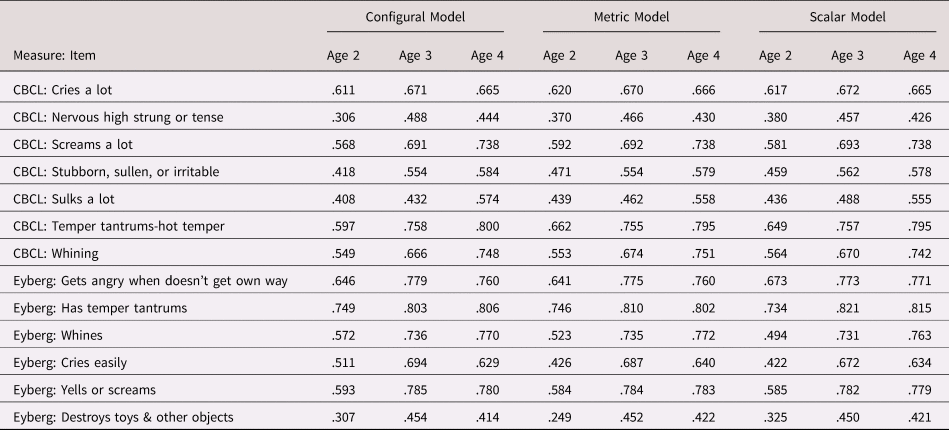
Two measures were used to derive an irritability scale that aligns with the MAP-DB. First, the Child Behavior Checklist (CBCL) parent version (Achenbach & Rescorla, Reference Achenbach and Rescorla2001) was administered during the age 2, 3, and 4 home visits. Respondents were asked to rate the applicability of several statements regarding child behaviors by using a 3-point Likert scale in which 0 = not true; 1 = somewhat, sometimes true; and 2 = very true, often true. Second, items were drawn from the Eyberg Child Behavior Inventory, a widely used 36-item measure of early childhood problem behavior (Robinson et al., Reference Robinson, Eyberg and Ross1980). Because the Intensity factor of the Eyberg is similar in content and structure to the CBCL, we used items on the Intensity scale, on which caregivers report the eextent to which the behavior is a problem for the parent using a 7-point scale. In total, 13 items comprise the scale; 7 from the CBCL (e.g., cries a lot, temper tantrums-hot temper) and 6 from the Eyberg (e.g., has temper tantrums, yells or screams) (see Table 1).
Standardized factor loadings for CFA models

Note: All factor loadings significant (p < .01).
Broadband internalizing and externalizing in early childhood
Given that all of the items from the CBCL that were included on the irritability scale are included in either the broadband internalizing or externalizing scale, we created new scores for the broadband internalizing and externalizing scales for further analysis. The newly computed broadband scores included 33 items in the internalizing scale and 21 items in the externalizing scale. Internal consistencies were good at α = .81 and α = .84, respectively.
Oppositional and defiant behavior in later childhood
Caregiver reported child symptomatology was captured using the Disruptive Behavior Disorders Rating Scale (DBD; Pelham, Gnagy, Greenslade, & Milich, Reference Pelham, Gnagy, Greenslade and Milich1992). During the age 10.5 home assessments, primary and alternate caregivers completed the DBD, a 45-item measure keyed to DSM-IV child symptoms of ODD and other externalizing disorders. All items were rated on a 4-point scale (0 = not at all; 3 = very much), and items rated as very much were scored as a symptom's being present. The total number of ODD symptoms endorsed, derived from eight items (e.g., “often argues with adults”; “is often spiteful or vindictive”), was used. Internal consistencies of the primary caregiver (n = 561; α = .84 and alternate caregiver reports were acceptable (n = 402; α = .86).
The CBCL Teacher Report Form (TRF; Achenbach & Rescorla, Reference Achenbach and Rescorla2001) was used to assess behavior problems in the classroom. As has been reported in prior studies with this sample, a measure of child oppositional and aggressive (Opp/Agg) behaviors was created from items of the CBCL, which was administered to the primary teacher of study participants at the age 9.5 and age 10.5 assessments. Response options are the same as those listed above for the early childhood version of the CBCL. Eight items that map onto DSM-IV (American Psychiatric Association, 2000) criteria for ODD and conduct disorder, including their aggressive hallmarks, were selected, and a composite variable was computed by averaging the values for these items. Internal consistency of the Opp/Agg scale was acceptable at both ages (9.5: α = .90; 10.5: α = .87). Because of the high level of missing data for the teacher reports (53% available at age 9.5; 49% available at age 10.5), either report was used as the outcome when only 1 year was available. A mean of the two scores was used when data were available at both time points (66% available for 9.5/10.5).
Depression and anxiety symptoms in later childhood
Symptoms of depression and anxiety were assessed using the National Institute of Mental Health Diagnostic Interview Schedule for Children—IV (Shaffer, Fisher, & Lucas, Reference Shaffer, Fisher and Lucas1998; Shaffer, Fisher, Lucas, Dulcan, & Schwab-Stone, Reference Shaffer, Fisher, Lucas, Dulcan and Schwab-Stone2000), a structured psychiatric interview for children ages 6 years and older. Caregiver responses are “Yes” or “No” for most questions, and follow-up questions are determined by previous answers in the module. The interrater reliability (r = .93) and test–retest reliability (r = .64) of the past-year diagnoses have been well established and are moderately related (k = .52) to diagnoses generated from symptom ratings made after a clinical interview. The generalized anxiety disorder and major depression modules were used for analysis of disorder-specific symptom counts.
Covariates
Primary caregivers’ depressive symptomatology was assessed at child age 2 using the 20-item Center for Epidemiological Studies on Depression Scale (Radloff, Reference Radloff1977). Ratings are provided on a scale ranging from 0 (less than a day) to 3 (5–7 days) and are summed. Internal consistency was acceptable (α = .74). Child gender and child race/ethnicity were also included as both covariates and moderators. Two versions of the child race/ethnicity variable were used: 1) African American (n = 202) compared with all others (n = 529, 72%) and 2) three-group model comparing, African American, White (n = 341), and Latino/Hispanic (n = 98).
Data Analysis
To address our hypotheses, an iterative model-building process was conducted using confirmatory factor analysis (CFA) and path modeling in a structural equation modeling framework. Thirteen items were selected from the Eyberg and CBCL (see Table 1), and multigroup CFA models were fitted across ages 2, 3, and 4, with each age treated as a separate group. The loading of one item (CBCL: “cries a lot”) on a factor was fixed to one and factor variance was freely estimated. Configural, metric, and scalar models with varying degrees of factor invariance were fitted. In the least restrictive configural model, item loadings, item thresholds, and factor variances were freely estimated across ages; factor means were fixed to zero, and item scaling factors were fixed to one. In the metric model, thresholds for CBCL item, “cries a lot,” were constrained equally across age groups while other items across age groups were freely estimated. Factor loadings for all items were constrained equally across age groups. In the age 2 model, factor means were fixed to zero and item scaling factors were fixed to one, whereas in the two other age groups, factor means and item scaling factors were freely estimated. In the scalar model, loadings and thresholds were constrained equally across the age groups and factor variances were freely estimated. In the age 2 group, factor means were fixed to zero and item scaling factors fixed to one, while in the other age groups factor means and item scaling factors were freely estimated. Finally, factors scores were obtained for inclusion in the path analysis.
To test hypotheses regarding intervention effects, we began with an unconditional model testing direct effects on irritability at ages 3 and 4 using an intention-to-treat approach. Next, we added caregiver-reported broadband externalizing and internalizing scores, with items included in the irritability construct removed and baseline (age 2) covariates that are conceptually and theoretically linked to irritability: child gender, racial/ethnic status of the child, and caregiver depressive symptoms. This analysis served to determine whether the effects of the intervention on irritability are robust. We then added the later psychiatric outcomes that were hypothesized to be correlates of irritability and tested for indirect effects. That is, the extent to which intervention effects on irritability in early childhood were predictive of long-term improvements in behavioral and emotional syndromes. These included behaviors consistent with ODD, reported by primary caregiver, alternate caregiver, and teacher, and symptoms of generalized anxiety and major depression (reported by primary caregiver) assessed at age 10.5. Finally, tests of moderation were performed using a multiple-group analysis approach. Child gender and racial/ethnicity status, the living location of the family, and age 2 and age 4 child irritability scores were tested.
Confirmatory factor analysis and path modeling were conducted in Mplus 8.1 (Muthén & Muthén, Reference Muthén and Muthén2018). Confirmatory factor analysis was run using the weighted least squares estimator with delta parameterization, while path models used maximum likelihood estimation with robust standard errors to account for missingness in the data (see Table 1 for valid Ns of each variable). Maximum likelihood estimation with robust standard errors has been shown to provide more valid estimates of standard errors in regression analysis when dependent variables are nonnormally distributed (Little & Rubin, Reference Little and Rubin2002). The fit of each model was examined using the chi-square statistic, comparative fit index (Bentler, Reference Bentler1990), root mean square error of approximation (Steiger, Reference Steiger1990), and standardized root mean square residual Hu & Bentler, Reference Hu and Bentler1999). Small chi-squares correspond to better fit to the data. Comparative fit index values greater than .95 indicate good fit to the data (Bentler, Reference Bentler1992). Root mean square error of approximation values less than .05 indicate good model fit, and values up to .08 represent reasonable errors of approximation (Browne & Cudeck, Reference Browne, Cudeck, Bollen and Long1992). Standardized root mean square residual values less than .08 are generally considered good fit (Hu & Bentler, Reference Hu and Bentler1999). The model fits of the multigroup models were compared using the chi-square difference testing procedure.
Results
Concerning the 13-item irritability scale, the factor loadings for the configural, metric, and scalar models of the CFA are provided in Table 1. Factor loadings were significant and ranged from .31 to .75 for age 2, .43 to .82 for age 3, and .41 to .82 for age 4. Model fit was acceptable for all models. Multigroup analysis indicated invariance across ages for all three models. The configural model factor score was selected for analysis as it is the least restrictive model.
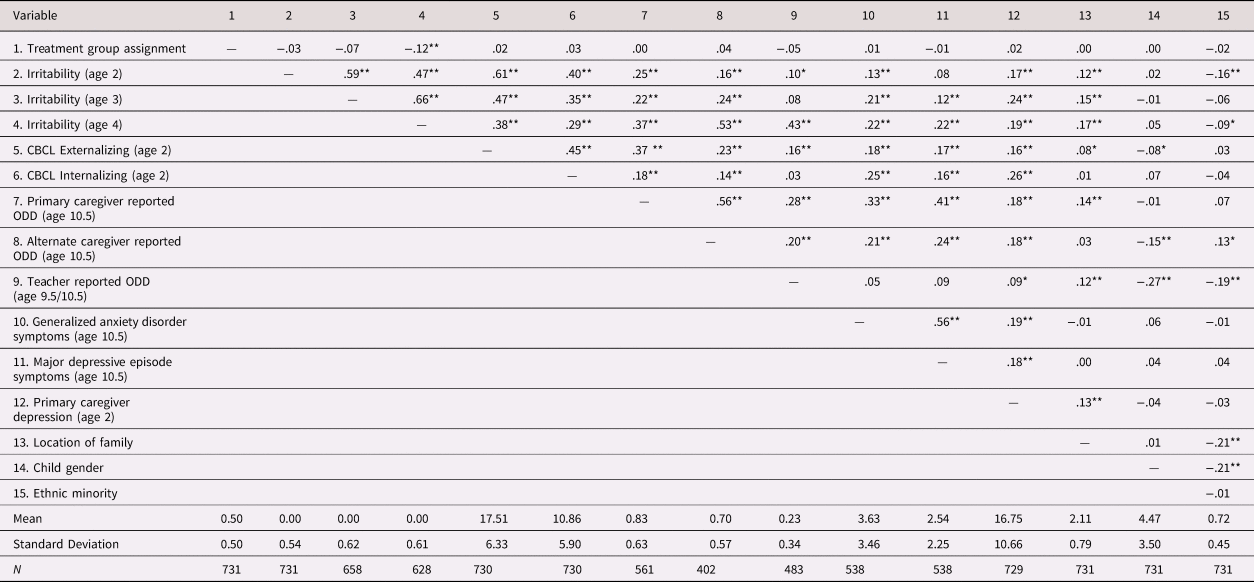
Table 2 contains the intercorrelations and descriptive statistics of the variables included in the path analysis. Of note, the irritability score was significantly (p < .001) and modestly intercorrelated amongst the three measurements (r = .15–.30) and with the living location of the child (r = .12–.17) and ethnic minority status at ages 2 (r = –.16) and 4 (r = –.09) but not at age 3 (r = –.06). Irritability was not significantly correlated with child gender at any age (r = .03– .07) and showed strong temporal correlations with major depressive and generalized anxiety symptoms and with ODD ratings by caregivers and teachers. Teacher ratings of ODD were correlated with the living location of the family, such that children in Pittsburgh were rated higher than those in Eugene or Charlottesville, child gender, such that boys were rated higher than girls, and child racial/ethnic minority status, such that African American children were rated higher than other children. Primary caregiver depressive symptoms were significantly correlated with all other variables in the model with the exception of treatment group assignment and teacher-reported ODD behaviors.
Intercorrelations between study variables

Note: *p < .01. **p < .001.
Intervention effects on irritability
The unconditional model testing effects of the intervention on irritability showed a small nonsignificant effect at age 3 (β = –.06, SE = .039, B = –.05, p > .05, d = –0.12) and a medium significant effect at age 4 (β = –.14, SE = .043, B = –.12, p ≤ .001, d = –0.28). These results indicate that assignment to the FCU was related to lower subsequent irritability, as reported by primary caregivers, and that effects grew over time. After adding covariates to the model, effects on irritability remained significant and effect sizes improved slightly at age 3 (β = .08, SE = .037, B = –.06, p ≤ .05, d = –0.16) and age 4 (β = –.16, SE = .042, B = –.13, p ≤ .001, d = –0.32). Of the covariates, caregiver depressive symptoms, child internalizing and externalizing, and location of the family were related to irritability. All covariates were retained for the next step of model building, which was to add later outcomes on ODD behaviors, and symptoms of anxiety and depression (age 10.5). Fit statistics were not reported as the above models were saturated.
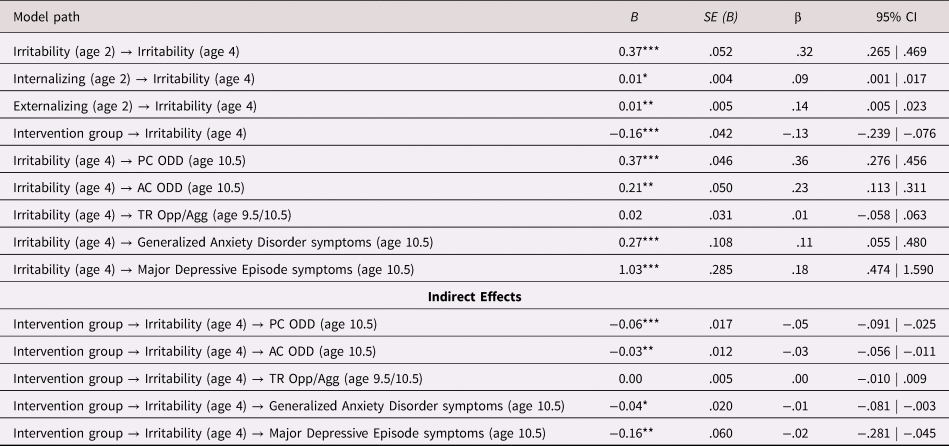
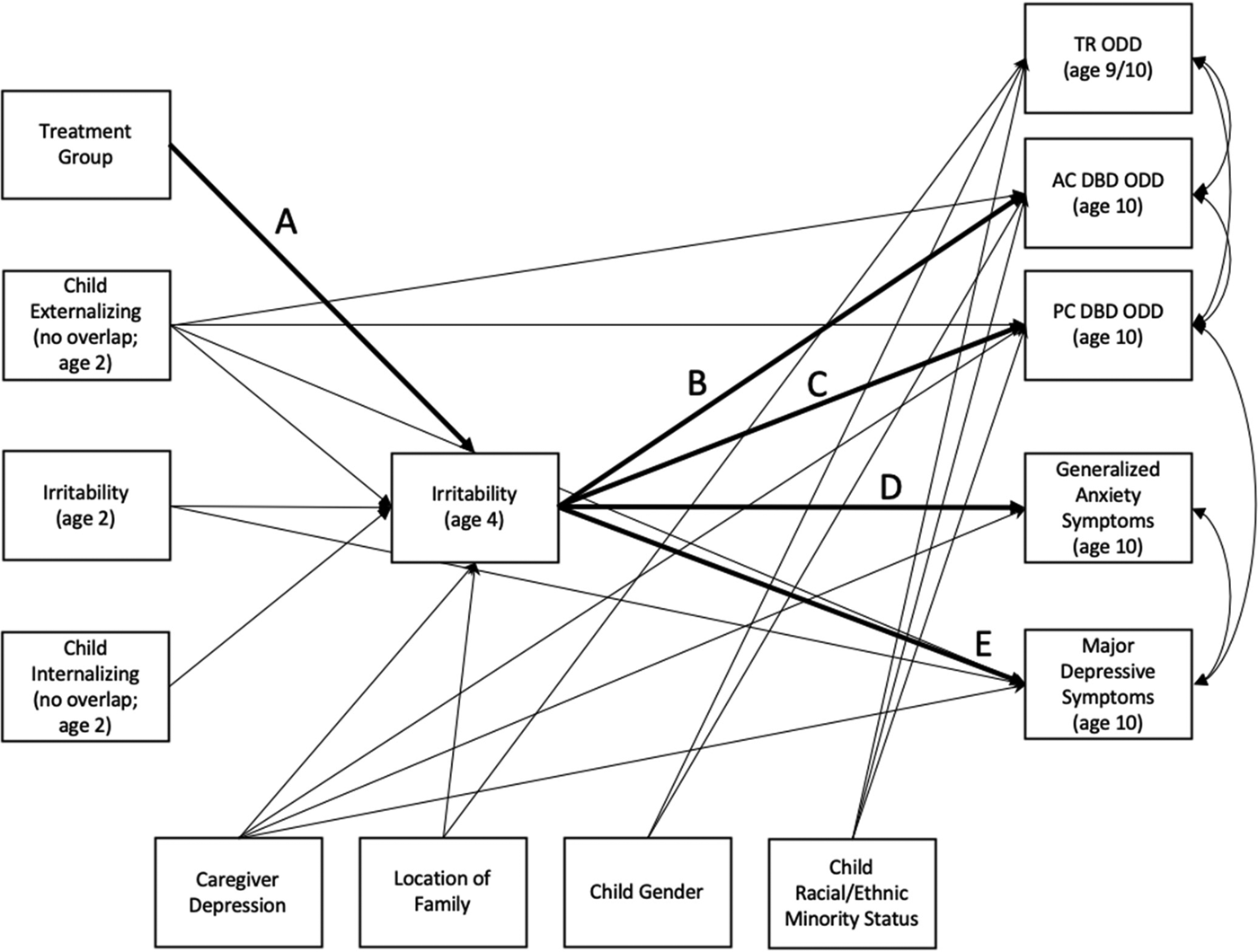
The coefficients for the paths in the final model related to the hypotheses of this study—presented in Figure 1 in darker weight lines—are provided in Table 3. All paths presented in Figure 1 were significant. The final model was saturated and thus provided good fit to the data. Comprehensive results are available by request from the first author. As suggested by bivariate correlations, caregiver depressive symptoms were significantly associated with all primary caregiver-reported endogenous variables in the model as shown. Significant associations were found between baseline levels of irritability and irritability at age 4 and depressive symptoms at age 10.5; child externalizing (age 2) and irritability at age 4, primary and alternate caregiver reported ODD at age 10.5, and depressive symptoms at age 10.5; and child internalizing (age 2) and irritability at age 4, above and beyond baseline INT/EXT.
Primary results of final path analysis

Note: *p < .05. **p < .01. ***p < .001. Effect is considered significant if the 95% confidence interval does not contain zero. PC = primary caregiver report. AC = alternate caregiver report. TR = teacher report. Opp/Agg = Oppositional/Aggressive score derived from the Child Behavior Checklist. Only paths in Figure 1 related to the study hypotheses are provided. Indirect effects and notable significant regressions from covariates on endogenous variables are provided in text. Comprehensive results of the path model are available by request from the first author.
Path model. All paths shown are significant. Path labels correspond to tests of indirect effects presented in Table 3. All covariates at bottom of figure were assessed at study entry (child age 2).

All but one of the hypothesized intervention effects were significant: 1) intervention effects on irritability (age 4), controlling for age 2 levels and other externalizing and internalizing behaviors; 2) indirect intervention effects on ODD, both on primary and alternate caregiver reports, and on symptoms of generalized anxiety and major depression, through reductions in irritability at age 4. The only indirect effect not observed was on teacher reported ODD. Effect sizes of the significant indirect effects were small and ranged from d = .02–.14. Relatedly, with irritability in the model at age 4, there were no direct intervention effects on the other endogenous variables. In the final model, mean differences were found for irritability (age 4) by location of the family. Analysis of variance indicated that living in an urban location was associated with higher irritability scores (M = .17, SD = .639) than living in suburban (M = –.09, SD = .547) or rural locations (M = –.08, SD = .623). Rural and suburban did not differ from one another. The final model accounted for 29% of the variance in irritability at age 4, and the model accounted for 25% and 13% of primary and alternate caregiver-reported ODD symptoms at age 10.5, respectively; 15% of teacher-reported ODD behaviors; 8% of major depression symptoms; and 6% of generalized anxiety symptoms (net effects of INT/EXT). All R-square estimates were significant at p ≤ .001 except for the estimate for generalized anxiety (p = .016).
Last, tests of moderation based on child gender, ethnic minority status, living location of the family, and levels of age 2 and age 4 irritability did not reveal significant structural invariance. Each variable was removed as a covariate from the model one at a time to conduct a multiple group analysis for moderation. Two models were tested for moderation by child racial/ethnic status: African American compared to all others and a three-group model comparing, African American, White, and Latino/Hispanic. Concerning irritability, results indicated that intervention effects were not restricted to certain levels of baseline (age 2) irritability or certain levels of irritability at age 4.
Discussion
This study advances Tom Dishion's interests in understanding the underpinnings of the transdiagnostic effects of the FCU. We focus on the influence of the FCU on dysregulated irritability. Early childhood irritability has been linked to long-term psychopathology across the INT/EXT spectrum (Vidal-Ribas et al., Reference Vidal-Ribas, Brotman, Valdivieso, Leibenluft and Stringaris2016; Wakschlag et al., Reference Wakschlag, Perlman, Blair, Leibenluft, Briggs-Gowan and Pine2018). This study is the first to test the effects of an early childhood parenting intervention, the FCU, on irritability and its downstream transdiagnostic correlates. After creating an irritability score using items from common caregiver-report measures, results of path analyses indicated that the FCU has a direct effect on reducing irritability compared with families receiving services as usual, and that these changes are related to lower externalizing (oppositional and aggressive) and internalizing (anxiety and depression) symptomatology eight years later. These effects were found while controlling for broadband INT/EXT problems at study entry and other relevant covariates, and they were robust across child gender, race/ethnicity, and location of the family in this multisite trial. Additionally, ratings of problem behavior provided by other caregivers of the child also indicated that irritability effects are not merely a reflection of correlated parental perspective across domains. However, there appears to be a contextual difference between the home and school environments, as teacher-reported oppositional and defiant behaviors at school-age were not related to caregiver-reported irritability in the home during early childhood. This finding needs further examination as we did not have teacher reports of child irritability ratings in early childhood, and we must test for method variance.
These findings support the contention that irritability in early childhood is a meaningful transdiagnostic risk indicator that can be used to identify children and families in need of selective interventions, namely parent training programs such as the FCU. There is a tremendous need for transdiagnostic selective interventions to be delivered in nonspecialty settings (Walkup et al., Reference Walkup, Mathews and Green2017). In this study, the FCU was delivered as home visitation, but it has been shown to be feasible for delivery in public schools, preschools (e.g., Head Start), in conjunction with other home visiting programs (e.g., Early Head Start), at family support centers, and in pediatrics (Shaw, Reference Shaw2017; Smith, Berkel, Rudo-Stern, et al., Reference Smith, Berkel, Rudo-Stern, Montano, St George, Prado and Dishion2018). Regarding integration into pediatrics, some implementations of the FCU have been coordinated with, but not delivered in the pediatric primary care system. Disorder specific intervention protocols are often complex, requiring intensive training in multiple protocols to address common presenting problems (Walkup et al., Reference Walkup, Mathews and Green2017). The promise of a parenting intervention that effectively alters the course of critical mechanisms of action for later INT/EXT psychopathology is important to achieving population-level effects because it increases scalability. As developmental methods and advances in developmental neuroscience increasingly indicate that INT/EXT risk at brain and behavioral levels can be identified as early as the neonatal period, and persistent irritability in the first year of life has been linked to lifespan psychopathology risk (Biedzio & Wakschlag, Reference Biedzio, Wakschlag and Zeenah2019; Bilgin et al., Reference Bilgin, Baumann, Jaekel, Breeman, Bartmann, Bauml and Wolke2018; Graham et al., Reference Graham, Buss, Rasmussen, Rudolph, Demeter, Gilmore and Fair2016; Hay et al., Reference Hay, Waters, Perra, Swift, Kairis, Phillips and Van Goozen2014; Lorber, Del Vecchio, & Slep, Reference Lorber, Del Vecchio and Slep2015; Rogers et al., Reference Rogers, Sylvester, Mintz, Kenley, Shimony, Barch and Smyser2017), prevention programs initiated even prior to the first year of life hold promise. Focusing on irritability is highly relevant towards advancing this goal because it is measurable from birth and does not rely on higher order capacities (e.g., language, effortful control) to emerge, although its typical and atypical expression varies as maturation occurs.
The mechanisms for this intervention effect were not tested as part of this initial inquiry into the mediating role of early childhood irritability on intervention effects between the FCU and later INT/EXT psychopathology. However, the nature of the FCU and prior research with the FCU and related parenting programs provide some hypotheses to be tested in subsequent research. Intermediate mechanisms that may explain the link between irritability and later psychopathology likely include reduced rate of escalation of irritability and impairment, and improvements in self-regulation, including executive function supported by optimal functioning of prefrontal regions (e.g., more typical recruitment of neural resources during frustration; Grabell et al., Reference Grabell, Li, Barker, Wakschlag, Huppert and Perlman2017). Improved self-regulation, measured as reductions in children's externalizing behaviors, including irritability, is the key mechanism of life span health improvements resulting from early intervention (Heckman, Pinto, & Savelyev, Reference Heckman, Pinto and Savelyev2013). Strengthening children's capacity to adaptively manage emotions and behavior is the essential shared element of virtually all evidence-based preventions for common emotional and behavioral problems of early childhood (Dishion et al., Reference Dishion, Brennan, Shaw, McEachern, Wilson and Jo2014). Tom Dishion was keenly interested in understanding the common processes through which all parenting interventions work to improve child outcomes and family processes, primarily through the lens of the FCU and related behavioral parenting programs (Dishion, Forgatch, Chamberlain, & Pelham, Reference Dishion, Forgatch, Chamberlain and Pelham2016).
Parenting programs, especially parent training programs, target core caregiver skills that help children gain self-regulatory capacity. Smith and Dishion (Reference Smith, Dishion, Ehrenreich-May and Chu2013) provide a summary of the evidence for the transdiagnostic effects of parent training interventions and argue that improving caregiver skills in three areas—positive behavior support, monitoring and limit setting, and family relationship building—lead to improved regulation for both the caregiver and the child, which in turn leads to downstream prevention of INT/EXT psychopathology and improved family functioning. Healthy family functioning serves as protective factor for the development or escalation of INT/EXT symptoms (Coatsworth, Duncan, Greenberg, & Nix, Reference Coatsworth, Duncan, Greenberg and Nix2010). Future trials should consider a dismantling approach to determine the intervention elements and parenting targets that drive improvements in childhood irritability early in life. There is evidence indicating the broad salience of positive behavior support strategies being particularly important for toddler-age children (Dishion et al., Reference Dishion, Shaw, Connell, Gardner, Weaver and Wilson2008; Smith, St George, & Prado, Reference Smith, St George and Prado2017), but focusing exclusively on this parenting skill has not yet been tested. Subsequent research should also test the effectiveness of the intervention earlier in life (e.g., 12–18 months) because adverse parent–infant patterns are less entrenched and behavior is malleable during this period of high neuroplasticity (Campbell et al., Reference Campbell, Conti, Heckman, Moon, Pinto, Pungello and Pan2014). Neuroscientific research suggests that earlier (Wakschlag et al., Reference Wakschlag, Perlman, Blair, Leibenluft, Briggs-Gowan and Pine2018)—before age 2—would lead to greater long-term prevention effects. Rigorous testing of this hypothesis on both neural and behavioral outcomes are needed. However, several initial efforts to examine this question at the behavioral level have demonstrated inconsistent findings (e.g., Gardner et al., Reference Gardner, Leijten, Melendez-Torres, Landau, Harris, Mann and Scott2019; Heckman et al., Reference Heckman, Pinto and Savelyev2013), perhaps because of the relative instability of child behavior in general and irritability in particular before the second half of the second year.
Intervention effects of the FCU have been shown on children's self-regulation and related constructs, including inhibitory control (Chang et al., Reference Chang, Shaw, Dishion, Gardner and Wilson2014; Lunkenheimer et al., Reference Lunkenheimer, Dishion, Shaw, Connell, Gardner, Wilson and Skuban2008), behavioral control (Shelleby et al., Reference Shelleby, Shaw, Cheong, Chang, Gardner, Dishion and Wilson2012), and effortful control (Chang, Shaw, Shelleby, Dishion, & Wilson, Reference Chang, Shaw, Shelleby, Dishion and Wilson2017). The effects on children's self-regulation have been attributed to improvements in caregiver-child interactions (Chang et al., Reference Chang, Shaw, Shelleby, Dishion and Wilson2017) and caregiver's use of positive behavior support skills (Shelleby et al., Reference Shelleby, Shaw, Cheong, Chang, Gardner, Dishion and Wilson2012). Additional research is needed to elucidate the precise causal pathway from parent training interventions to irritability and subsequent INT/EXT symptoms. Improvements in parenting likely precede improvements in irritability, which would help to explain the growing effect on irritability between age 3 and 4 that we observed in this study. Self-regulatory capacity might then occur as a result of reducing irritability. Irritability is highly salient and aversive to parents, and can undermine their sense of parental competence. To the extent that prevention focuses on the development of a parental toolkit for managing irritability behavior, a prevention focus is likely to have a strong reverberating influence on interactional cycles and bolster self-regulatory skill. There are strong conceptual overlaps between irritability and capacity to self-regulate, meaning that improvements in one are likely to be seen simultaneously in the other. The distinctiveness of the two constructs, and not simply measurement and method (caregiver report versus observation) differences, is another area for future research.
Conclusions
This study builds on an emerging body of research on the salience of early childhood irritability as a potent risk factor for psychopathology in later childhood. These findings open the door to the assessment of irritability as a primary screening tool that can be feasibly administered in real-world service systems and connected to parenting programs such as the FCU. As the behavioral markers of irritability, namely tantrums and/or dysregulated fussiness, are highly salient to parents and providers alike, these are likely to be meaningful targets that are highly motivating for engagement. Accordingly, greater attention now needs to be given to implementation in real-world systems of care for both the FCU and screening for irritability as an entry mechanism. This study indicates that the FCU produces significant effects on irritability during early childhood and has high engagement of families over long periods (Smith, Berkel, Hails, et al., Reference Smith, Berkel, Hails, Dishion, Shaw and Wilson2018). This delivery strategy meshes well with the pediatric primary care environment among other service contexts. Efforts are currently underway to implement parenting interventions in, or in coordination with, primary care. These include the FCU (Shaw, Reference Shaw2017; Smith, Berkel, Rudo-Stern, et al., Reference Smith, Berkel, Rudo-Stern, Montano, St George, Prado and Dishion2018) and a host of other evidence-based programs (e.g., Breitenstein, Shane, Julion, & Gross, Reference Breitenstein, Shane, Julion and Gross2015; Molleda et al., Reference Molleda, Bahamon, George, Perrino, Estrada, Herrera and Prado2017). Fulfilling Tom Dishion's vision of embedding FCU in real-world systems is critical to realizing the full potential of this transdiagnostic intervention.
Acknowledgments
This research was supported by grant P30DA016110 from the National Institute on Drug Abuse grant to Thomas Dishion, Daniel Shaw, and Melvin Wilson. Justin D. Smith was supported by grant R01DA027828 from the National Institute on Drug Abuse, awarded to C. Hendricks Brown. Laurie Wakschlag and Sheila Krogh-Jespersen were also supported by U01MH082830 and R01MH107652 awarded to Wakschlag. The authors gratefully thank the Early Steps team in Eugene, Pittsburgh, and Charlottesville, and the families who have participated in the study.