INTRODUCTION
Knowledge, experience and learning are fundamental for effective environmental management. Irrespective of its origins, knowledge shapes decisions and implementation, while the learning that occurs through research and practice influences future action (Lee Reference Lee1999; Salafsky et al. Reference Salafsky, Margoluis, Redford and Robinson2002; Fazey et al. Reference Fazey, Fazey and Fazey2005a). Over the last two decades there has been an acceleration of research in environmental management to guide theory and practice (Fazey et al. Reference Fazey, Fischer and Lindenmayer2005b; Lawler et al. Reference Lawler, Aukema, Grant, Halpern, Kareiva, Nelson, Ohleth, Olden, Schlaepfer, Silliman and Zaradic2006). But accumulation of knowledge and information is not enough: the effectiveness of environmental management depends greatly on how knowledge is exchanged, with whom it is exchanged, and how it is used (Pullin & Knight Reference Pullin and Knight2001; Cash et al. Reference Cash, Clark, Alcock, Dickson, Eckley, Guston, Jäger and Mitchell2003; Francis & Goodman Reference Francis and Goodman2011). The importance of knowledge exchange (KE) is increasingly being recognized as key to facilitating social, environmental and economic impact of research. This is seen in requirements for funding applications to identify potential beneficiaries and strategies and pathways to impact (Phillipson et al. Reference Phillipson, Lowe, Proctor and Ruto2012). Yet KE is often seen as a tool rather than a complex and dynamic process with many interpretations and uncertainties about what makes the process effective and under what circumstances. This paper therefore highlights KE as a research topic in its own right that is highly relevant to environmental management and identifies a research agenda aimed at improving understanding of KE.
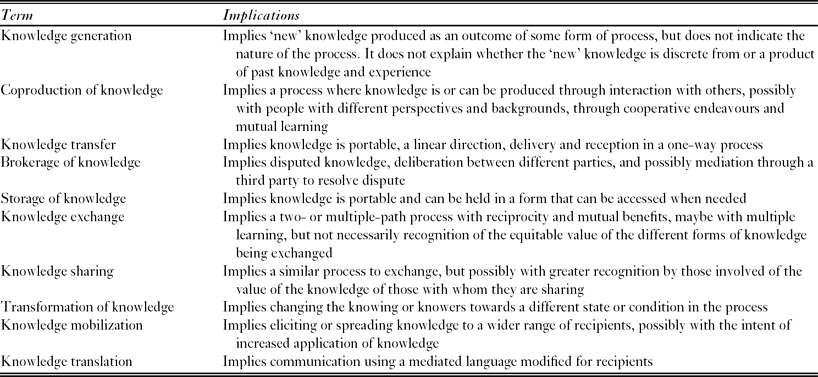
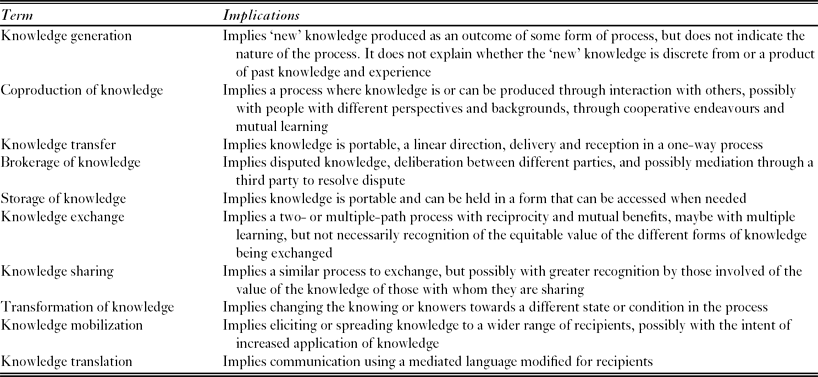
There are many definitions of knowledge and KE (Bierly et al. Reference Bierly, Kessler and Christensen2000; Nonaka et al. Reference Nonaka, Toyama and Konno2000; Duchelle et al. Reference Duchelle, Biedenweg, Lucas, Virapongse, Radachowsky, Wojcik, Londres, Bartels, Alvira and Kainer2009) and many different terms used to describe KE processes. These include knowledge sharing, generation, coproduction, comanagement; transfer, brokerage, storage, exchange, transformation, mobilization, and translation (Ward et al. Reference Ward, House and Hamer2009; Best & Holmes Reference Best and Holmes2010). Use of these terms is not arbitrary, with most involving metaphors with different underlying propositions that lead to different practices (Table 1, Lakoff & Johnson Reference Lakoff and Johnson1980; Cortazzi & Jin Reference Cortazzi, Jin, Cameron and Low1999). A single concept or definition is unlikely to adequately encompass all of these terms. Nevertheless, for the purposes of this paper, they are generally referred to as knowledge exchange, which we define as a process of generating, sharing, and/or using knowledge through various methods appropriate to the context, purpose, and participants involved.
Some of the many terms used to describe processes of KE and implied meanings of these terms.
There is extensive research on KE relevant to environmental management in a wide range of fields and disciplines, including business and organizational management (Bierly et al. Reference Bierly, Kessler and Christensen2000; Argote et al. Reference Argote, McEvily and Reagans2003; Dwivedi et al. Reference Dwivedi, Venkitachalam, Sharif, Al-Karaghouli and Weerakkody2011), health studies (Graham et al. Reference Graham, Logan, Harrison, Straus, Tetroe, Caswell and Robinson2006; Davies et al. Reference Davies, Nutley and Walter2008), international development (Blaikie et al. Reference Blaikie, Brown, Stocking, Tang, Dixon and Sillitoe1997; Campbell & Vainio-Mattila Reference Campbell and Vainio-Mattila2003; Cash et al. Reference Cash, Clark, Alcock, Dickson, Eckley, Guston, Jäger and Mitchell2003), political science (Nutley et al. Reference Nutley, Morton, Jung and Boaz2010), environmental science, agriculture and natural resource management (for example Reed Reference Reed2008; Blackstock et al. Reference Blackstock, Ingram, Burton, Brown and Slee2011; Sanchez & Morrison-Saunders Reference Sanchez and Morrison-Saunders2011). Education, linguistics, psychology, sociology and the diffusion of innovations also provide highly relevant insights into processes relating to KE, such as how people learn, communicate, make decisions, and form beliefs and cultures (Bloom et al. Reference Bloom, Englehart, Furst, Hill and Krathwohl1956; Rogers Reference Rogers1995; Valente Reference Valente1996; Entwistle Reference Entwistle2001; Bennett & Bennett Reference Bennett and Bennett2003). Despite increasing recognition of the importance of social practices, interventions, and decision-making processes to enhance KE, environmental management has had little engagement with research on KE from other fields. Many aspects of KE are also still poorly understood, such as how KE functions in different contexts, which approaches are most effective, the kinds of skills and processes required to facilitate them (Entwistle & Smith Reference Entwistle and Smith2002; Dwivedi et al. Reference Dwivedi, Venkitachalam, Sharif, Al-Karaghouli and Weerakkody2011) and how knowledge can be best mobilized to encourage transitions towards sustainability and environment related outcomes (Cash et al. Reference Cash, Clark, Alcock, Dickson, Eckley, Guston, Jäger and Mitchell2003).
This paper has three main aims: (1) to provide a review of existing literature from a wide range of academic disciplines on KE; (2) to identify key research questions for addressing key gaps in understanding about KE; and (3) to define an integrated research agenda for enhancing understanding about KE. To achieve these aims academics from different disciplines and diverse backgrounds were brought together to review and develop a shared interdisciplinary understanding of the state-of-the-art of KE. This involved a number of iterative steps, including a professionally facilitated workshop. This paper describes the methodology, and then presents a review of key focal research areas and associated research questions, followed by an integrated research agenda for enhancing understanding about KE in environmental management.
METHODS
Participant selection
KE is a complex field of research that requires interdisciplinary approaches to identify meaningful research questions and research agendas. Given the challenges of working with multiple perspectives and backgrounds, a moderately sized group of 20 academic experts was chosen to explore the complexities of KE, with the size of the group aiming to provide a balance of a diversity of perspectives and ability to examine in-depth a range of material. ‘Expert’ knowledge was chosen over ‘lay’ knowledge because this was an exercise to clarify and understand a complex issue (in this case KE) rather than being an exercise of public engagement aiming to make decisions about ways forward to address an issue (Fazey et al. Reference Fazey, Fazey, Salisbury, Lindenmayer and Dovers2006).
Many of the participants had extensive experience in the practice of KE and some had primary roles as KE professionals. Nevertheless, the primary focus was selecting participants with academic expertise for three key reasons. First, there has been no comprehensive overview of research requirements and gaps in the academic literature on KE, and academic expertise was considered to be the most relevant to addressing this issue. Second, it was important to take a conceptual and strategic standpoint, where broad questions across disciplines and application areas were defined rather than identifying research questions for a specific context, location or management issue to which practice-based expertise would have been appropriate. Finally, the approach needed to be manageable and balance interdisciplinary breadth versus depth of investigation. The approach was therefore bounded around academic expertise to ensure that a meaningful research agenda could be developed.
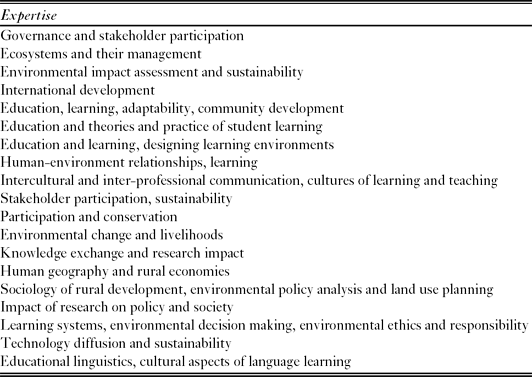
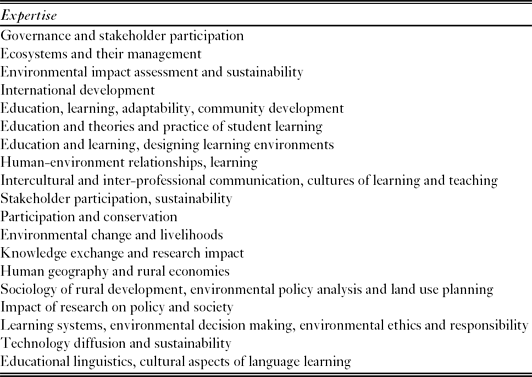
The 20 participants involved in this study were identified through a review of published literature which discussed different concepts about and research on KE (Evely et al. Reference Evely, Fazey, Reed and Stringer2012). Selection criteria for participants were: (1) that they needed to be directly involved in research and practice of KE; and (2) have a minimum of 10 years of experience in their respective fields, which is approximately the amount of time it takes to develop characteristics typically displayed by an expert (Bransford et al. Reference Bransford, Brown and Cocking2000). The initial literature review identified around 30 potential participants. Final decisions about inclusion were therefore also based on ensuring a breadth of expertise, mix of career seniority and gender, the capacity of individuals to be able to work in an interdisciplinary group and their availability (Table 2). All participants are coauthors of this paper.
Expertise (in addition to KE) of each of the twenty participants involved in the elicitation process.
Eliciting expertise
In general, the methodology built on other approaches used for setting research agendas in other fields of research (see for example Hoffman Reference Hoffman1998; Steffen et al. Reference Steffen, Sanderson, Tyson, Jäger, Matson, Moore, Oldfield, Richardson, Schellnhuber, Turner and Wasson2004). An iterative process using ideas from Delphi methodologies (Glass et al. Reference Glass, Scott and Price2012) was used to elicit the expertise of participants. This process ensured sufficient exploration of the complexities, nuances and varied perspectives of KE before research questions were identified. ‘Cold calling’ approaches (for example, using questionnaires rather than face to face dialogue and discussion) were unlikely to have provided sufficient context, background, and opportunities for participants to explore the many issues involved.
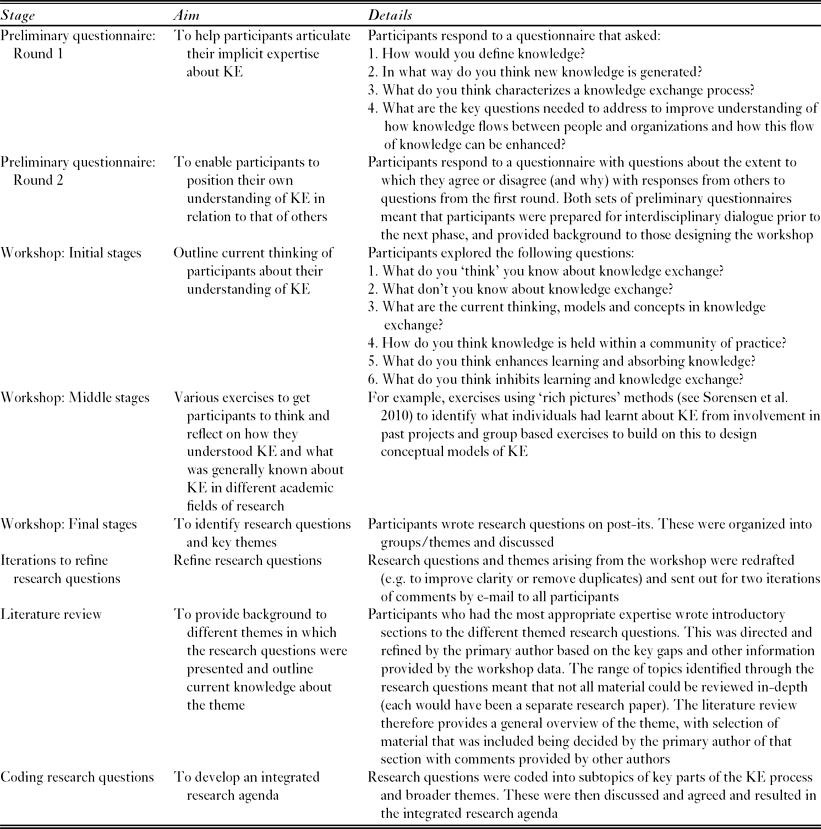
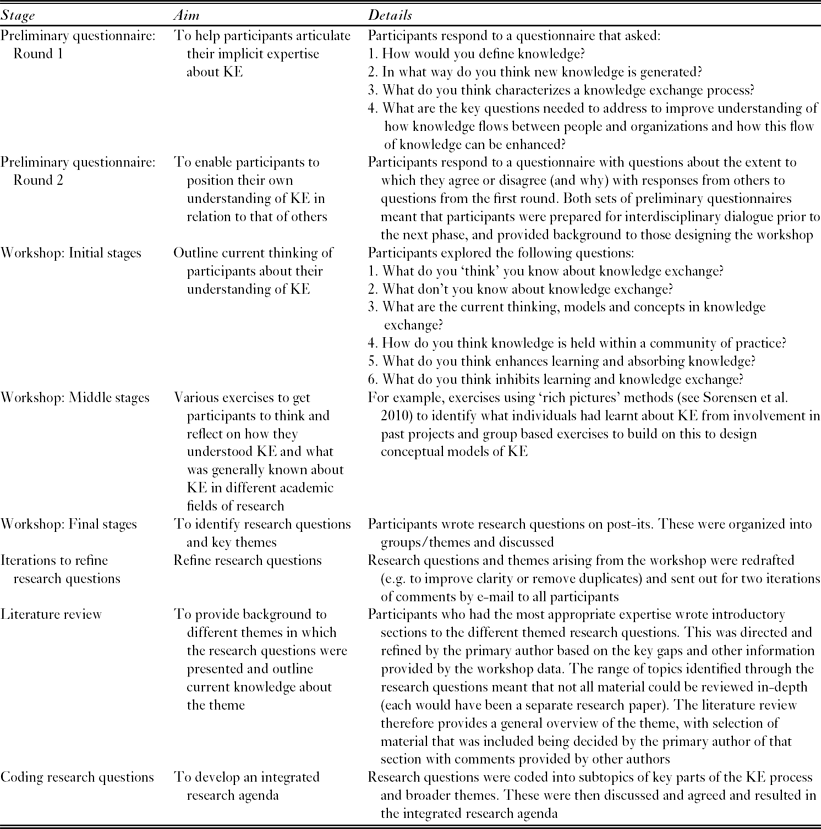
The methodology included a number of steps (Table 3). First, two iterative rounds of preparatory questionnaires were sent to participants prior to a two-day workshop with the aim of helping them articulate their implicit expertise and to position their own perspectives in relation to that of others. Participants were then well prepared for engaging in interdisciplinary discussions during the next stage, which consisted of a two-day workshop led by professional facilitators. In this workshop participants outlined their current thinking about KE, explored concepts and shared their experiences of KE in various exercises, including a range of commonly used participatory techniques, supplemented with the use of rich pictures from soft systems modeling (Checkland Reference Checkland1998). These exercises aimed to help participants explore in-depth what they understood KE to be and the limits to knowledge about how KE works in order to provide background thinking before they identified the research questions. The exercises were also designed to elicit information to address aims that were beyond the scope of this paper (for example, to produce a conceptual model of KE). During the workshop, results from exercises were collated in different ways, such as through direct writing of information by participants on sheets/post-its, through written short reports, or diagrams/schemes.
Key stages of the research to elicit expertise and develop the research agenda.
Towards the end of the workshop, participants were asked to identify key research questions. These were sorted into themes. The list was refined and finalized by participants in two additional iterations by e-mail. Participants then contributed to writing short reviews of each theme under direction of the primary author. The themes to be reviewed emerged inductively from the questions, but the literature reviewed was influenced by the expertise of those who contributed to different sections, with moderation and direction by the primary author to ensure that it focused on the key issues that emerged from the workshop. The literature presented in this paper is therefore a guide or preface to the themes rather than specifically a ‘result’ of the process. Finally, to develop a more specific research agenda for KE, the research questions were coded into subtopics and in relation to four different stages of a KE process and to two additional broader themes. The end result was a list of specific sub-topics of research under six focal research areas.
RESULTS
Experts’ perspectives of what constitutes KE
It was clear during the workshop that the way participants perceived knowledge and KE influenced the kinds of research questions elicited. It is therefore helpful to understand the general ways participants conceptualized and framed KE. Participants’ perspectives about KE highlighted the multi-faceted nature of KE with a diverse range of social process, contextual influences and challenges to effective implementation. Despite different views about some of the details, there was considerable general agreement about what it involved. Conceptualizations were similar to how KE was often defined in the literature (for example Bierly et al. Reference Bierly, Kessler and Christensen2000; Nonaka et al. Reference Nonaka, Toyama and Konno2000) with participants’ responses to the questions in the initial stages of the workshop often expressing the following:
• KE is generally a process of individual or social learning within or between groups of individuals;
• the process of KE can be unidirectional, but to be more effective, KE needs to be seen to be a multidirectional process that involves the coproduction of knowledge;
• viewing knowledge as something that can be passed around in inert form through traditional processes of ‘transfer’ is outmoded and does not reflect what is known about how knowledge is constructed and shared;
• viewing knowledge as fixed or inert, no matter who exchanges it, how it is exchanged, or in whichever context is problematic. Such a view does not reflect relatively common and accepted understandings of researchers on knowledge about how it is constructed and shared;
• KE is very significantly influenced by a range of contextual factors including political and social considerations, power relationships, the status of individuals, and what the process aims to achieve;
• outcomes of KE can be wide ranging, from the generation of information that can be shared, individual learning, enhanced cohesion and trust, empowerment, participation, ownership and responsibility for decision-making, and flattening of hierarchies between individuals and groups;
• outcomes depend on a range of individual factors, such as how people internalize knowledge, the skills of facilitators of KE, and past experience, expertise and background; and
• outcomes depend greatly on how KE is defined, how goals are identified, and projects implemented.
Key research themes and questions
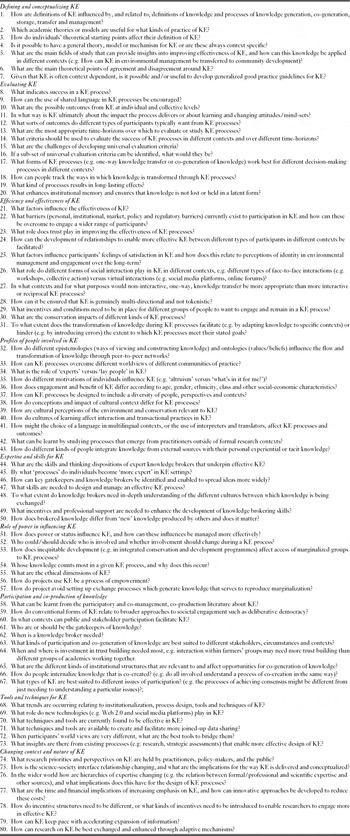
Participants identified a wide range of research questions and themes (Table 4). We reviewed each research theme's relationship to the associated research questions.
Key research questions about KE identified by the experts.

Defining and conceptualizing KE
There is a multitude of definitions, perspectives, concepts and models of knowledge and how people acquire knowledge (Bierly et al. Reference Bierly, Kessler and Christensen2000; Hofer Reference Hofer2000; Nonaka et al. Reference Nonaka, Toyama and Konno2000; Evely et al. Reference Evely, Fazey, Pinard and Lambin2008; Trevitt Reference Trevitt2008; Evely et al. Reference Evely, Fazey, Reed and Stringer2012)). Such perspectives have profound impacts on a whole range of individuals’ activities, such as reasoning, perspectives on what counts as evidence, how people relate to and manage complex problems, and their capacities for learning (Hofer Reference Hofer2000; Fazey Reference Fazey2010). Importantly, how people perceive or define ‘knowledge’ also influences how KE processes are designed and implemented (Evely et al. Reference Evely, Fazey, Reed and Stringer2012). Understanding the relationship between such perspectives and their implications for effective implementation of KE is therefore important.
For example, viewing knowledge as something explicit that can be passed between people tends to result in traditional processes of dissemination where the ‘facts’ are communicated to different groups. ‘Transmissive’ perspectives of knowledge tend to maintain the existing status of those involved (for example external conservation expert versus indigenous knowledge) and fails to recognize the complexities of the learning processes in knowledge sharing (such as how cultural background influences what is understood, learnt and shared). At the other extreme, viewing knowledge as a more complex, iterative process of reflection, experiential learning, making implicit knowledge explicit and internalizing the results of a process of sharing knowledge with others, tends to lead to approaches that emphasize the coproduction of knowledge and more adaptive forms of learning (see for example Armitage et al. Reference Armitage, Marschke and Plummer2008; Sheate & Partidário Reference Sheate and Partidário2010). Such approaches recognize the existence of multiple perspectives and different forms of knowledge, and require continuous attempts to learn from and understand others; these approaches are more likely to lead to adaptive forms of environmental management and longer lasting or more effective outcomes (Reed Reference Reed2008; Evely et al. Reference Evely, Fazey, Reed and Stringer2012). Therefore, while all models of knowledge and KE will be useful in some contexts, important questions about how perspectives of knowledge and KE influence the process and outcomes of KE and environmental management remain (Questions 1–7, Table 4).
Evaluating KE
Environmental research and practice almost always involves some form of exchange of knowledge or information, whether this is a presentation at a conference or more sophisticated and extensive processes of community engagement and decision-making. Whatever the form of KE, specific approaches are usually employed to achieve specific outcomes. For example, the Wensum Alliance, a catchment management programme in the UK (http://www.wensumalliance.org.uk/), aimed to reduce impacts of agricultural diffuse water pollution on ecosystem function while maintaining food security. Multiple on-farm measures were implemented across whole river catchments using local expertise to solve local problems. A key aspect of the work aimed to engage the wider public, and thus open day events were used as an approach to demonstrate progress and the inclusive nature of the alliance. In another project, research to identify trajectories of change and vulnerability in remote communities in the Solomon Islands also aimed to enhance social learning and capacity building at local levels. In this case KE was fully embedded in the research processes by using participatory methods and by explicitly designing data collection as an iterative and multi-scaled mechanism that enhanced learning of researchers, local research assistants and community members (Fazey et al. Reference Fazey, Kesby, Evely, Latham, Wagatora, Hagasua, Reed and Christie2010).
These examples highlight the increasing recognition of the need to identify desired KE outcomes and then design processes in ways that are likely to achieve them. Very few projects, however, evaluate the outcomes of KE and even fewer constructively align outcomes, project design and evaluation. Continual examination of what is understood or known is an inherent component of adaptive environmental management to deal with uncertainty (Salafsky et al. Reference Salafsky, Cauley, Balachander, Cordes, Parks, Margoluis, Bhatt, Encarnacion, Russell and Margoluis2001; Allan & Stankey Reference Allan and Stankey2009). Adaptive management requires effective KE mechanisms to ensure that knowledge is shared and preconceptions challenged; the KE process itself also needs to respond flexibly to new insights that may achieve more effective results. Thus evaluation of the KE component is also essential to achieve more effective adaptive management.
There are many different approaches to evaluation, but all generally emphasize the importance of explicitly assessing the desired outcomes of an intervention (European Communities 2006; Shufflebeam & Shinkfield Reference Shufflebeam and Shinkfield2007). Evaluating KE, however, is particularly challenging because it is difficult to demarcate the scope and spatial/temporal boundaries of a KE programme and to consider the broader issues of nested and hierarchical scales of governance and organizational or political scales (Cundill et al. Reference Cundill, Fabricius and Marti2005; Marshall Reference Marshall2008; Phillipson et al. Reference Phillipson, Lowe, Proctor and Ruto2012) that generate multiple variables, objectives and outcomes. For example, there may be much longer-term legacies, such as continued development of relationships, new insights and the wider exchange of knowledge that would not have occurred without the initial KE project (Phillipson et al. Reference Phillipson, Lowe, Proctor and Ruto2012), and there are challenges of linking or understanding how KE processes operating at community levels influence higher levels of governance and management of common pool resources (Marshall Reference Marshall2008).
Evaluation is also challenging because it is difficult to define what is considered a successful outcome of KE. For example, volunteers in conservation projects with high levels of engagement, greater sharing of knowledge and involvement in making decisions learn more about conservation and working as a team than volunteers in projects who have less engagement (Evely et al. Reference Evely, Pinard, Reed and Fazey2011). This research indicates the kinds of processes that are most effective for delivering learning among the participants of KE. But it does not reveal whether the projects with high engagement were necessarily more effective in achieving a specific conservation outcome, such as the conservation of target species, or whether learning outcomes give rise to more successful but different projects in the future. Projects therefore need to carefully consider whether their evaluations should include the intended environmental outcomes and/or other aspects that relate to the delivery of the KE process per se, such as whether the learning of participants or team cohesion are enhanced.
Some approaches to evaluation emphasize the need for participatory engagement of stakeholders in the process of setting goals and objectives and implementing the evaluations (Zukoski & Luluquisen Reference Zukoski and Luluquisen2002; Fetterman & Wandersman Reference Fetterman and Wandersman2005). These participatory evaluation approaches are particularly relevant to KE in environmental contexts because they simultaneously enable evaluators to work with stakeholders and project managers to identify the objectives and scope of KE interventions, while also embedding evaluation in projects in ways that encourage adaptive comanagement (Fetterman & Wandersman Reference Fetterman and Wandersman2005). Participatory evaluation is therefore likely to be one of the most fruitful approaches to developing KE evaluation methodologies. Overall, these kinds of issues raise fundamental questions over the evaluation of KE and its wider impact (Questions 8–20, Table 4).
Efficiency and effectiveness of KE
In addition to questions about the framing of evaluation of KE, there are also important questions about what influences the effectiveness and efficiency of KE (Dobbins et al. Reference Dobbins, Hanna, Ciliska, Manske, Cameron, Mercer, O'Mara, DeCorby and Robeson2009). Effectiveness relates to the extent to which the desired outcome of a process or intervention matches the actual outcome, while efficiency refers to how easily an outcome is achieved given a set of resources, such as time or funding. Thus two different approaches to KE might result in similar outcomes, and have similar effectiveness, but one of them may be less costly to deliver and therefore more efficient. In environmental management both effectiveness and efficiency are important (Laycock et al. Reference Laycock, Moran, Smart, Raffaelli and White2009; Laycock et al. Reference Laycock, Moran, Smart, Raffaelli and White2011). However, as indicated above, it can often be difficult to define success in KE. For example, in some circumstances, a one-day conservation conference with presentations between academics and practitioners may be sufficient to meet a desired outcome of KE, but this may miss additional benefits provided by a three-day facilitated workshop, or a series of iterative workshops, that potentially enable deeper discussion and the building of trust and relationships essential for long-term collaboration and the emergence of important new insights at a later date. A one-day conference may also be disempowering, resulting in some of those who need to be involved most becoming demotivated and disengaged.
This suggests that KE effectiveness might need to consider ‘satisfaction’: an insight which comes from intercultural communication research (Ting-Toomey Reference Ting-Toomey1999: 265). Satisfaction can be defined as the extent to which all participants develop positive feelings about the KE process and outcomes and, at a deeper level, the extent of their feelings of positive affirmation about how their desired identity is elicited or validated (namely the degree to which participants feel engaged and involved, patronized or bypassed, and how these feelings affect their perceptions of themselves and roles as environmental practitioners and researchers, or as being part of KE). A reasonable level of satisfaction may mean that participants are willing to continue to share and exchange knowledge, which is vital for viable longer-term sustainability of a project.
The effectiveness and efficiency of KE also depend on the context in which it operates (Entwistle & Smith Reference Entwistle and Smith2002). It is usually easier, for example, to achieve exchange of knowledge when people are from similar backgrounds, such as researcher to researcher, compared to working with people who have very different goals, languages, pressures, needs and career paths, such as policy-makers and researchers (Choi et al. Reference Choi, Pang, Lin, Puska, Sherman, Goddard, Ackland, Sainsbury, Stachenko, Morrison and Clottey2005). Yet if processes are well-designed, then the sharing of knowledge from more disparate backgrounds can result in much more profound transdisciplinary insights (Tress et al. Reference Tress, Tress and Fry2005). What works best will therefore usually depend on the desired outcomes of a KE project and a range of contextual factors. Many questions remain about aspects that influence the effectiveness of KE (Questions 21–31, Table 4).
Profiles of people and cultures involved in KE
A particular challenge for effective KE is managing the different kinds of people involved. People have different experiential and cultural backgrounds that affect their interpretation of new information (Alcorn Reference Alcorn1993; Reid et al. Reference Reid, Williams and Paine2011). Several important and often overlooked aspects are the cultural values, beliefs and practices towards the environment, processes of learning, and social interaction and language (Lansing Reference Lansing1991; Fischer et al. Reference Fischer, Dyball, Fazey, Dovers, Ehrlich, Gross, Brulle, Christenson and Borden2012). These aspects of culture affect interpretations of knowledge and its exchange in different ways. For example, perspectives of nature, environment and landscapes are usually embedded in a cultural community's heart, mind and memory. In Apache culture in Arizona, place names are linked with stories, which in turn evoke moral concepts and ideas about wisdom. For members of these communities, places are visual symbols of cultural norms and place names are used to socialize children into community values (Basso Reference Basso1996). Such cultural norms can then translate into fundamentally different ways of knowing about and approaches to managing the environment (for example Lansing Reference Lansing1991; Berkes et al. Reference Berkes, Colding and Folke2003). Failing to understand or incorporate cultural senses of place can significantly hinder KE.
Culture also influences learning. This includes the cultural beliefs, values and practices regarding teaching, learning, getting and using knowledge, and how these affect interactions between learners. For example, many learners in China prioritize deep knowledge and the moral behaviour of an expert much more than most British learners. Chinese participants avoid asking or postpone questions to show respect, or wait for the knowledge to be transmitted or processed, enabling them to ask themselves more questions. British participants, however, prefer to ask questions more spontaneously and consider interactive participation to be a key part of their own on-going learning process (Cortazzi & Jin Reference Cortazzi, Jin and Li2002).
The cultural ways of speaking, or discourse structures of a community, also affect how knowledge is exchanged. For instance, in formal, academic or professional settings, many Chinese speakers provide substantial background of history or theory before leading up to a main point, which may be briefly expressed. This ensures common ground and that, given the background, the hearer may easily appreciate the main point, which therefore needs little elaboration and if understood can be applied by implication. Conversely, many American or British speakers prefer explanations where the main idea is briefly expressed as a signal of what is coming, then background or theory given briefly (since the main point is already known) and the main idea repeated, elaborated and applied. Because such practices lead to different expectations in listening, the main point may be missed if people are unaware of the different ways of communicating (Scollon & Scollon Reference Scollon and Scollon2001). Crucially, any misunderstanding of the ‘content’ in KE can be because of a misperception of either or both the person giving and receiving the message (Scollon & Scollon Reference Scollon and Scollon1981).
Finally, cultural differences are also mediated through language. In multilingual contexts where several languages are available for participants (including first, second or other languages), there may be a tendency to use English as the obvious choice of language for KE. However, language choices can affect participants’ feelings about interaction and the content of discussions (Cortazzi et al. Reference Cortazzi, Pilcher and Jin2011). The use of interpreters and translation is also not straightforward, since this usually involves mediation between different cultures.
Overall, environmental management involves exchange of knowledge between people with different backgrounds and cultures, such as between practitioners and indigenous people or between researchers and policy makers. However, consideration is rarely given to cultural and individual differences of participants involved in KE. Many questions remain about the way different backgrounds, experience, values and perspectives affect KE (Entwistle Reference Entwistle2001; Evely et al. Reference Evely, Fazey, Pinard and Lambin2008) (Questions 32–43, Table 4).
Expertise and skills for KE
KE is based on an assumption that expertise and knowledge, and sources of knowledge production, are distributed widely among scientists, practitioners, businesses, land managers and other stakeholders and the public (Phillipson et al. Reference Phillipson, Lowe, Proctor and Ruto2012). A key set of intermediaries between sources of expertise are knowledge brokers (Gould & Fernandez Reference Gould and Fernandez1989; Klerkx & Leeuwis Reference Klerkx and Leeuwis2008; Ward et al. Reference Ward, House and Hamer2009). Knowledge brokering is undertaken by a range of organizations and individuals who absorb complex ambivalent messages from diverse sources including technical, commercial and legislative developments and translate them into terms that can be understood and acted upon (Gerrish et al. Reference Gerrish, McDonnell, Nolan, Guillaume, Kirshbaum and Tod2011; Verbeke et al. Reference Verbeke, Dietz and Verwaal2011). They rely heavily on social networks and links within and across institutions (Reiche et al. Reference Reiche, Harzing and Kraimer2009). Within the arena of environmental management, there are many individuals who perform key roles in acting as formal knowledge brokers (Hogan Reference Hogan2002; Reed Reference Reed2008). Recent work on farm advisors underlines the importance of understanding the expertise and skills underpinning brokerage activities (Proctor et al. Reference Proctor, Phillipson, Lowe and Donaldson2011). Advisors act as intermediaries bringing scientific, regulatory and professional knowledge to the farm. However they are not simply conduits of knowledge. They also generate their own knowledge from their experiences in the field and their interactions with other experts, including other advisors and farmers. Knowledge is therefore not only exchanged by brokers but is also developed and modified as a result of such interaction (Meyer Reference Meyer2011). Effective KE is therefore not just about the brokerage of abstracted scientific knowledge generated by research; it is also about the interaction of different types of experts and, through this, the exchange of socially distributed, embodied, contextualized and skilful expertise (Gerrish et al. Reference Gerrish, McDonnell, Nolan, Guillaume, Kirshbaum and Tod2011). Effective brokerage also relies on target groups, such as national organizations, to optimize their capacities to absorb new knowledge (Lane & Rogers Reference Lane and Rogers2011). There is therefore a need to address a range of research questions about the kinds of skills and expertise needed to encourage KE and how to identify key gatekeepers of knowledge in different settings (Questions 44–50, Table 4).
The role of power in influencing KE
Power dynamics, including the relative position or status of those generating and using knowledge, may significantly affect who has access to knowledge and how it is transformed and used in KE (Ingram & Stern Reference Ingram and Stern2007; Garnett et al. Reference Garnett, Crowley, Hunter-Xenie, Kozanayi, Sithole, Palmer, Southgate and Zander2009; Brugnach & Ingram Reference Brugnach and Ingram2012). Status and ‘positional’ power or social, personal or transpersonal power can be mediated in a number of ways, such as through the activities of special interest or pressure groups; differences in formal educational status, and resources and skills, and through cultural barriers that prevent equal participation of certain (often disadvantaged) groups (Ingram & Stern Reference Ingram and Stern2007; Whiteley et al. Reference Whiteley, Ingram and Perry2008). Power dynamics influence whose voices get heard in decision-making (Williams et al. Reference Williams, Veron, Corbridge and Srivastava2003; Reed Reference Reed2008), which is clearly important in, for example, local environmental decision-making (Partidário & Sheate Reference Partidário and Sheate2013). One of the most significant ways that power can influence KE is the power to choose who and what information is included or excluded from a KE process.
These considerations of ‘who has power over whom’, or the ‘power to’ exclude knowledges or voices from an exchange process are derived from a view where power is seen to be an aspect of the capacity to bring about or influence an outcome (Barnes Reference Barnes1988). However, power can also be viewed as a ‘distribution of knowledge’ which operates through both individual and collective action, rather than residing in any particular individual (Foucault & Gordon Reference Foucault and Gordon1980; Barnes Reference Barnes1983). This view suggests that social order is achieved because people act in accordance with accepted, shared knowledge rather than through coercion by a ruler and enforcement through an overwhelming power of personal authority. One example of this kind of power is money (Barnes Reference Barnes1988). Money has, strictly speaking, no empirical existence as it is simply a promise to pay the recipient the equivalent sum of money in goods. Nevertheless, shared beliefs about and common acceptance of money shapes and structures social life in fundamental ways, and facilitates countless kinds of individual and collective actions, including those relating to environmental management. ‘Power’ therefore comes from acceptance of beliefs about what money is and the way in which this shapes actions.
There is general acceptance in these kinds of perspectives that power is inseparable from knowledge. However, there are different views on what kind of social order results from this inseparability. Foucault's take on power as a distribution of knowledge tends to highlight negative (undesirable) instances of power operating through institutions (such as those of the state) that render people as individuals that can be subject to analysis and control (Foucault & Gordon Reference Foucault and Gordon1980). Foucault and Gordon (Reference Foucault and Gordon1980) did not insist that power must always operate in this way, but one of the aims of their analysis of power was to identify points of resistance to current operations of oppressive power. Others, however, suggest that power relations can have positive, as well as negative effects (Barnes Reference Barnes1988). For example, the inequitable distribution of money across a given society can be seen as a negative power dynamic, in normative terms. Yet, even in such a society, many forms of collective action deemed beneficial by members of that society also occur: for example, goods or payments for ecosystem services may encourage conservation outcomes if these programmes are delivered appropriately (Cranford & Mourato Reference Cranford and Mourato2011; Prager et al. Reference Prager, Reed and Scott2012). In this view, the power of money comes from collective acceptance of it as a mechanism of exchange, rather than because certain individuals have more of it than others.
Viewing power as a distribution of knowledge has three important implications for understanding KE. First, it highlights KE as a process of empowerment or disempowerment, where sharing and exchanging knowledge is inseparable from the dynamics of power. Second, viewing power as a distribution of knowledge focuses attention on the need for appropriate theoretical lenses for understanding the conditions for and the workings of empowerment and disempowerment. Third, differences in the views of key thinkers, such as Foucault and Barnes, on power as the distribution of knowledge, are driven by attempts to understand why people believe what they do, rather than establishing what is ‘true’ or ‘false’ in their beliefs. This leads to approaches where no one in a a KE process is assumed to have privileged ‘true’ knowledge and where knowledge claims are treated ‘symmetrically’ regardless of their origin or how credible they may seem (Bloor Reference Bloor1991; Barnes et al. Reference Barnes, Bloor and Henry1996). This then requires processes that facilitate consensus through negotiation and inclusion and respect for the knowledge claims of all involved.
Taking on board the implications of viewing power as a distribution of knowledge, or as individuals or groups having power over others, is likely to lead to a more appropriate and carefully designed KE process. Effective facilitation and careful process design can reduce the influence of power, such as that of dominant or reticent individuals (Hogan Reference Hogan2002), while investigation using tools such as social network analysis, discourse analysis or participant observation can inform participant selection as a way of managing power dynamics (Reed et al. Reference Reed, Graves, Dandy, Posthumus, Hubacek, Morris, Prell, Quinn and Stringer2009). This raises a number of ethical questions about the design and implementation of KE, such as consideration of intellectual property rights, the ethical issues of including or excluding marginalized groups, and how power is used to influence what is considered by some to be ‘valid’ knowledge. In general, there is a wide breadth of research questions about the relationship between power and KE (Questions 51–67, Table 4).
Participation and the coproduction of knowledge
Participation is often defined as a process where stakeholders (namely individuals, groups and organizations) are actively involved in making decisions that affect them (Webler et al. Reference Webler, Tuler and Krueger2001; Rowe & Frewer Reference Rowe and Frewer2004; Hage et al. Reference Hage, Leroy and Petersen2010). Participatory processes typically refer to direct face-to-face contact between stakeholders, but may also include other forms of interaction, such as using social media. Most researchers argue that participation involves ensuring the knowledge and views of people are more equitably incorporated in decisions, such as using approaches that flatten hierarchies to reduce the influence of powerful individuals or groups that can skew decisions (Gaventa et al. Reference Gaventa, Hickey and Mohan2004; Hickey & Mohan Reference Hickey and Mohan2004). As such, participation requires the management and reformation of power-relationships and the creation of spaces for empowerment (Chambers Reference Chambers1997; Williams et al. Reference Williams, Veron, Corbridge and Srivastava2003), and is closely related to understanding how knowledge is exchanged and used. In particular, given the inseparability of knowledge and power (Foucault & Gordon Reference Foucault and Gordon1980; Barnes Reference Barnes1983), knowledge sharing, learning and participation are closely intertwined (Partidário & Sheate Reference Partidário and Sheate2013).
The related concepts of coproduction of knowledge and comanagement both view different forms of knowledge (such as indigenous, lay, expert or formal) as having an important role in decision-making and implementation (Raymond et al. Reference Raymond, Fazey, Reed, Stringer, Robinson and Evely2010). These approaches to management emphasize the importance of codesign, analysis and evaluation in ensuring that both the outcomes of a KE process (for example, what is learnt or understood) and outcomes of action (such as implementation of conservation projects) are more readily accepted, reducing the potential for conflict with or disengagement of disillusioned stakeholders. Such approaches are distinctly different from the fortress approaches to environmental conservation of the past, which placed a greater emphasis on the exclusion of some groups (and thus, their knowledge) through restricted one-way processes of communication combined with top-down regulatory enforcement of rules and laws (Adams et al. Reference Adams, Hulme and Murphree2001; Brockington Reference Brockington2002).
While there are many benefits to participation, such as improved and more sustained outcomes, avoidance of litigation costs, enhanced education and learning, empowerment of marginalized groups, and breaking gridlock and conflict (Irvin & Stansbury Reference Irvin and Stansbury2004; Fetterman & Wandersman Reference Fetterman and Wandersman2005; Armitage et al. Reference Armitage, Berkes, Dale, Kocho-Schellenberg and Patton2011; Evely et al. Reference Evely, Pinard, Reed and Fazey2011), there are also potential challenges. These include higher financial, time and resourcing costs, potential for domination of strongly partisan groups, possibile creation of greater hostility toward governments, and decisions that can be unduly influenced by economic interests (for example when there is inadequate representation of environmental interests) (Irvin & Stansbury Reference Irvin and Stansbury2004). Much of these challenges emerge through processes that maintain or strengthen existing power relations (Kapoor Reference Kapoor2002; Irvin & Stansbury Reference Irvin and Stansbury2004), and greatly depend on how participatory approaches are conceptualized and implemented rather than simply being a result of fundamental flaws in ideas about participation (Parfitt Reference Parfitt2004).
Overall, there is much that KE practitioners and researchers can learn from participatory and coproduction processes, the role of facilitators used in participatory dialogue, and the influence of formal and informal institutional structures and cultures on processes of KE and participation (Questions 58–67, Table 4).
Tools and techniques for KE
The way people define knowledge and KE processes not only determines how these processes are designed and implemented (Evely et al. Reference Evely, Fazey, Reed and Stringer2012), but also the tools and techniques used. For example, coproduction and participation can be viewed as a specific approach to KE with an associated toolkit of methods (such as stakeholder identification and analysis, and facilitated deliberative workshops). A specific example has been the application of ‘object world’ tools, developed with insights from anthropology and semiotics, to understand and improve technology diffusion (Bucciarelli Reference Bucciarelli1988; Kruijsen Reference Kruijsen1999). These tools recognize the importance of seeing through the different backgrounds of stakeholders created by factors such as education, upbringing and culture, to improve the understanding of participants’ perceptions and motivations. Such tools would, for example, be useful in discussions to develop nature conservation strategies between stakeholders that perceive nature as ‘a park’ (who are more likely to choose a ‘strict taking care’ interventionist type of strategy) and those perceiving nature as ‘untouched wildlife’ (who would support a ‘do not interfere’ or more laissez-faire strategy).
Tools for analysis of perceptions are only a small part of a wide range of techniques available to KE practitioners and researchers (Cribb & Hartomom Reference Cribb and Hartomom2002; Hogan Reference Hogan2002; Sheate & Partidário Reference Sheate and Partidário2010). There are also many mechanisms that may not initially be considered to be a specific tool for KE, but can be used to enhance it. This includes participatory and deliberative research methods (Chambers Reference Chambers1997). For example, deliberative approaches to environmental valuation using choice experiments can enhance KE and learning while also increasing the validity of the results (Kenter et al. Reference Kenter, Hyde, Christie and Fazey2011). Similarly, strategic assessments (for example vulnerability or environmental impact) where KE takes place (such as between communities and assessors or scientists and policy-makers) can also be used as tools for enhancing KE (Fazey et al. Reference Fazey, Kesby, Evely, Latham, Wagatora, Hagasua, Reed and Christie2010; Sheate & Partidário Reference Sheate and Partidário2010). Irrespective of whether it is a specific tool, strategic assessment, or participatory and deliberative research, the potential to promote KE depends on a conscious effort to introduce genuine opportunities to facilitate KE in initial process designs (Chambers Reference Chambers1997; Fazey et al. Reference Fazey, Kesby, Evely, Latham, Wagatora, Hagasua, Reed and Christie2010; Sheate & Partidário Reference Sheate and Partidário2010). There are therefore a plethora of as yet unanswered questions about the different tools and techniques related to KE (Questions 68–73, Table 4).
Changes in how KE is understood and implemented
Emphasis and implementation of linkages and knowledge sharing have been changing in environmental management over the last three decades in three key ways. First, knowledge sharing has traditionally been viewed as a one way process of transfer from researchers to practitioners (Schneider et al. Reference Schneider, Ledermann, Rist and Fry2009). Increasingly, however, there has been greater recognition of the value of different forms of knowledge, from indigenous to local, from science to practice, and the need to engage with a whole range of groups to make decisions and achieve desired outcomes (Cash et al. Reference Cash, Clark, Alcock, Dickson, Eckley, Guston, Jäger and Mitchell2003; Aswani & Hamilton Reference Aswani and Hamilton2004; Pretty Reference Pretty2011). Knowledge sharing is now increasingly seen as multidirectional, with learning opportunities and insights to be gained for all involved through a process of the sharing and coproduction of knowledge (Armitage et al. Reference Armitage, Marschke and Plummer2008; Schneider et al. Reference Schneider, Ledermann, Rist and Fry2009).
Second, researchers, policy-makers, agencies, practitioners, non-governmental organizations (NGOs), businesses and communities have traditionally been seen as disparate groups with distinct cultures, priorities and needs (Schneider et al. Reference Schneider, Ledermann, Rist and Fry2009; Francis & Goodman Reference Francis and Goodman2011). This has made the sharing and translation of knowledge and innovation difficult. Yet, it is now much more common to have scientists working on policy, communities leading practice, practitioners and communities contributing to research, knowledge brokers and organizations that cross traditional boundaries facilitating the sharing of knowledge, and so on (Hahn et al. Reference Hahn, Olsson, Folke and Johansson2006; Lukman et al. Reference Lukman, Krajnc and Glavič2009; Johnson Reference Johnson2011; Sheikheldin et al. Reference Sheikheldin, Krantzberg and Schaefer2011). Differences and barriers remain (Choi et al. Reference Choi, Pang, Lin, Puska, Sherman, Goddard, Ackland, Sainsbury, Stachenko, Morrison and Clottey2005; Francis & Goodman Reference Francis and Goodman2011), but the boundaries across groups and between science and society are becoming less distinct.
Third, even though environmental management has for some time been conceived as interdisciplinary, the field was initially dominated by the natural sciences (Soulé Reference Soulé1985). The natural sciences still play a major role (Fazey et al. Reference Fazey, Fischer and Lindenmayer2005b), but there has been a shift towards viewing environmental management as a process involving complex and dynamic relationships between people and the environment (Aswani & Hamilton Reference Aswani and Hamilton2004; Bienabe & Hearne Reference Bienabe and Hearne2006; Ballinger & Stojanovic Reference Ballinger and Stojanovic2010; Blackstock et al. Reference Blackstock, Ingram, Burton, Brown and Slee2011). This has led to recognition of the need to include and integrate knowledge and perspectives from a much wider range of disciplines (Evely et al. Reference Evely, Fazey, Pinard and Lambin2008; Pretty Reference Pretty2011).
These trends have been occurring in a context where the relationship between science and society is also changing (Beck Reference Beck1992; Funtowicz & Ravetz Reference Funtowicz and Ravetz1993; Nowotny et al. Reference Nowotny, Scott and Gibbons2001). Greater recognition of the inherent uncertainties and complexities of scientific knowledge (Gallopin et al. Reference Gallopin, Funtowicz, O'Connor and Ravetz2001), increasing demand for research to inform solutions to rapid global change (Funtowicz & Ravetz Reference Funtowicz and Ravetz1993), and increasing moves towards participatory and deliberative forms of governance (Reed Reference Reed2008) are being influenced by, and are themselves influencing, changes in applied research fields (Bradshaw & Borchers Reference Bradshaw and Borchers2000; Francis & Goodman Reference Francis and Goodman2011). Some of the trends in knowledge production and sharing in environmental management are also being directly driven by new funding mechanisms and incentives (UNESCO 1998);, such as in the UK, where there is growing emphasis on directed research programmes, projects being required to identify potential beneficiaries, and for researchers to develop strategies for KE (Shove & Rip Reference Shove and Rip2000; Research Councils UK 2009; Phillipson et al. Reference Phillipson, Lowe, Proctor and Ruto2012). Together, these trends and changes raise a wide range of research questions, such as implications for the way KE is delivered and conceptualized, and the kinds of incentives needed to help researchers to increase involvement in KE (Questions 74–80, Table 4).
An integrated research agenda on KE
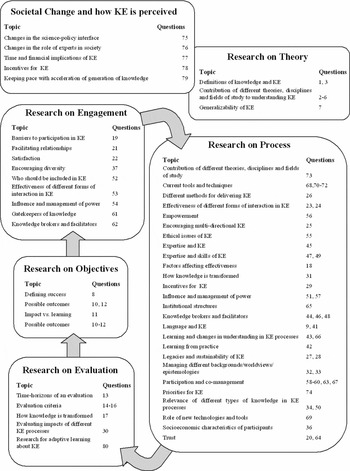
Further analysis of the 80 research questions led to the identification of 45 subtopics within four themes about stages of the KE process and two broader generic themes (Fig. 1). These themes, subtopics and questions provide strategic focus for targeting funds and effort in an integrated fashion. The themes of the integrated research agenda include research questions on: setting objectives and goals; how participants could or should be engaged in KE; how KE should be implemented or what happens during KE (namely the process of KE); and evaluating KE. The two broader themes were understanding the theory of KE, and how societal changes (for example the relationship of society with science) affect and influence how KE is understood and implemented (Fig. 1).
Key research areas and questions that require additional attention identified by experts under four themes relating to the KE cycle and broader, generic themes relating to understanding the theory of KE and how societal changes (such as the relationship of society with science) affect and influence how KE is understood and implemented. Each research of the research questions (see Table 4) is only identified once in the figure.

DISCUSSION
This paper provides the first and, so far, the most comprehensive framework for guiding research on KE. The process of expert elicitation and further review provided a comprehensive overview of the breadth of topics and research areas and questions (Table 4) and an integrated research agenda for improving understanding of KE (Fig. 1). The list of topics and questions are not definitive, as other experts are likely to identify additional questions, while the final summary of reviewed sections was necessarily selective. For example, if the participants had consisted predominantly of ecologists or environmental managers, issues of interacting geographical scales (such as the problems of transferring knowledge across different spatial scales based on limited site-specific or experiment-specific information) are likely to have been at the forefront of their concerns. In our workshop, the participants did raise the importance of defining outcomes at both individual, group and more collective levels, hierarchies of expertise, and issues around temporal scale and especially in the context of knowledge (for example, see questions 10,13,14, 17 and 19), but did not focus specifically on scale in the sense ecologists might have. Nevertheless, despite some potential limitations of our approach, which are inevitably a reflection of the participants involved, we provide a robust analysis of the current knowledge of academic experts focused on studying and practising KE, who also have an interest in how the information they produce is exchanged and used.
Overall, the agenda highlights five main issues. First, there is a wide range of questions relating to KE that require further research. Second, 44 of the 80 research questions were related to understanding the ‘process’ of KE. Given that the majority of questions related to this theme, further research should be devoted to improving understanding of the process of KE. Third, particular emphasis is required on how KE should or could be evaluated. This is not only because evaluation of KE projects and programmes is currently lacking, but also because developing effective evaluation methodologies and implementing them is key to addressing many of the other research questions. Fourth, many of the research questions cannot easily be addressed without addressing others. For example, to address questions about evaluating KE, some of the questions about identifying objectives and how KE is conceptualized also need to be considered. This highlights the need for those setting research agendas to simultaneously encourage in-depth and robust investigations of KE in ways that also ensure work is integrated across research themes. Finally, the wide range of questions and the strong dependence of answers to one question on how other questions are answered means that prioritization of questions is difficult and inappropriate. This again highlights the importance of an integrated and interdisciplinary approach to enhancing understanding of KE.
Implementing the integrated research agenda on KE also needs to consider many of the other key messages that emerge from material reviewed in this paper. KE is an interdisciplinary applied field involving a multitude of topics that requires input from researchers, practitioners and beneficiaries and consideration of diverse epistemological and ontological perspectives and needs. Addressing research gaps will not be a linear process, and research and practice in KE need to develop alongside one another in an iterative manner. Incentives are therefore required to help facilitate research that establishes and uses appropriate action research methodologies, that makes best use of the learning opportunities provided by existing KE projects, and embeds evaluation as a normal part of KE research and practice. By doing so, an adaptive learning approach where continual learning about KE will be encouraged.
Understanding about KE can also be enhanced by exchange of the findings and outcomes of the research. That is, state of the art knowledge of KE needs to be used to enhance effective exchange of knowledge about KE. This paper provides a vast array of ideas and considerations needed for effective KE. Importantly, KE is a complex and dynamic process and it is naïve to view knowledge as something that can be extracted and passed on in inert form. This view leads to simplistic approaches of ‘dissemination’ and ‘communication’ that do not take into account the complex ways in which individual experience and values influence the way people engage with knowledge and ideas, the role of other people, cultures and society in the process, and the wide contextual factors that influence knowledge generation and sharing. Thus, like researchers in other fields, those wanting to exchange knowledge about KE need to employ principles of best practice that take into account some of these complexities (see Sustainable Learning et al. 2011). Greater consideration of these complexities will be facilitated by emerging networks of those interested in doing and learning about KE (see http://sustainable-learning.org/ and http://learningforsustainability.net/).
CONCLUSION
Many research areas in environmental management demand greater attention. This paper, however, highlights the importance of KE as a research area in its own right. Understanding and implementing KE underpins much of what environmental researchers and practitioners aim to achieve. As the relationship between science and society continues to change, demands for researchers to consider KE more deeply will increase. Research projects in environmental management will also increasingly be required to deliver engagement with stakeholders, consider the diversity of understandings and perspectives involved, encourage cogeneration of knowledge, and bridge science, decisions, policy and practice. The integrative research agenda outlined in this paper provides the focus needed for funders and researchers to direct research towards enhancing understanding of KE. It also highlights the need for environmental researchers and practitioners to engage more deeply with, and to think more explicitly and carefully about, the design of KE projects and programmes in ways that acknowledge the complexities of KE processes.
ACKNOWLEDGEMENTS
This work was conducted as part of the project Transforming Knowledge for Sustainable Uplands funded though the Rural Economy and Land Use (RELU) which is a collaboration between the UK's Economic and Social Research Council (ESRC), the Biotechnology and Biological Sciences Research Council (BBSRC) and the Natural Environment Research Council (NERC). P. White is also grateful to the NERC BESS programme for funding. We thank two anonymous reviewers who provided insightful comments that improved the manuscript.