Introduction
Electoral support for far-right parties (FRPs) in Europe has attracted substantial scholarly attention, especially since the so-called ‘third-wave’ of 1980s (Kitschelt, Reference Kitschelt2007; Mudde, Reference Mudde2013). The far-right family is considered one of the most successful party families in recent Europe, though the parties included in this grouping display considerable ideological heterogeneity (Mudde, Reference Mudde2007; Ennser, Reference Ennser2012; Golder, Reference Golder2016; Carter, Reference Carter2018). Specifically, scholars distinguish radical from extreme-right parties (ERPs), based on parties’ relationships with liberal democracy, fascism and violence (Mudde, Reference Mudde2007; Vasilopoulou and Halikiopoulou, Reference Vasilopoulou and Halikiopoulou2015; Golder, Reference Golder2016). Despite acknowledging the ideological differences of parties under the far-right umbrella, the literature does not take these differences into account in empirical analyses, with few exceptions (Ignazi, Reference Ignazi1992; Golder, Reference Golder2003; Ignazi, Reference Ignazi2003; Ford and Goodwin, Reference Ford and Goodwin2010; Goodwin, Reference Goodwin2011). When such ideological differences are considered, the literature is biased toward explanations of electoral support for European radical-right parties (RRPs). This is understandable as the radical variants are more successful, especially in Western Europe, compared to the extreme right; at the theoretical level, no theory has expected ERPs to achieve electoral success in post-war Europe, due to their anti-democratic and anti-systemic stance Footnote 1 (Betz, Reference Betz1994; Kitschelt and McGann, Reference Kitschelt and McGann1995). In recent years, and especially after the severe economic crisis that engulfed the European Union (EU) after 2008, electorally successful ERPs emerged in several European countries, including in Greece (Golden Dawn (GD)), Slovakia (People’s Party Our Slovakia) or Hungary (Jobbik) Footnote 2 . Golder (Reference Golder2003) found that the electoral success of ERPs (‘neofascist’ for Golder) cannot be explained from the various mainstream theories, such as economic (unemployment) or cultural (immigration) competition, that explain the electoral support for radicals. Complicating matters, countries such as Spain, Italy, Portugal and Ireland suffered from economic crises and mass immigration similar to those expected to explain ERPs’ successes; however, the failure of ERPs in these countries undermines such explanatory factors. In short, the cross-national variation of electoral support for ERPs in Europe remains unexplained, and more importantly, conventional theories of far-right support does not seem to explain this variation, so we need to look beyond them (see Golder, Reference Golder2003). This article aims to address that gap. While there are a few scholars who focussed on the extreme variants of the far-right such as Ignazi (1992, Reference Ignazi2003), Ford and Goodwin (Reference Ford and Goodwin2010), Goodwin (Reference Goodwin2011) or Golder (Reference Golder2003), their studies do not explain cross-national variation in the electoral support for ERPs in Europe. According to the best of our knowledge, this is the first research which aims to systematically explain cross-national variation in ERPs’ (and not RRPs’) electoral success.
Considered unelectable due to their anti-democratic stance, ERPs require favourable demand and supply to be electorally successful. This article understands ERP’s success partly as a ‘normal pathology’ (Mudde, Reference Mudde2010). ‘Normal pathology’ thesis suggests that ERPs require non-normality in order to be electorally attractive, due to the fact that their ideology is alien to European values (Mudde, Reference Mudde2010). As Mudde (Reference Mudde2010) showed, this is in fact not true for RRPs, but the anti-democratic stance of ERPs requires a different approach. As mainstream theories and explanatory factors do not explain variation in the electoral support for ERPs, we need to look beyond them. This article argues that, to increase the likelihood of being electorally successful, ERPs require a form of non-normality, which would politically normalize their anti-democratic stance. Building on the existing literature on the effects of the quality of government (QoG) on support for democracy, and an extension on voting for anti-system parties (Agerberg, Reference Agerberg2017; Boräng et al., Reference Boräng, Nistotskaya and Xezonakis.2017), this article expects that poor QoG, is a form of non-normality that politically normalizes anti-system parties, and ERPs are anti-system by definition. However, a ‘normal pathology’ approach is not enough to explain cross-national variation in the electoral support for ERPs, as not every country with poor QoG saw an increase in ERP vote share Footnote 3 , and also, as Agerberg (Reference Agerberg2017) showed, QoG explains voting for populist parties (left and right), as well. This article assumes that demand side needs to meet favourable supply side for ERPs to be electorally successful.
This article argues that ideological normalization of ERPs is the missing step. The effect of mainstream-right parties’ (MRPs) ideological positions on the electoral success of FRPs is debated in the existing literature (Eatwell, Reference Eatwell2000; Arzheimer and Carter, Reference Arzheimer and Carter2006). There are two conflicting hypotheses; first, the more centrist the MRPs, the more successful the ERPs, due to limited competition; second, the more conservative the MRPs, the more successful the ERPs, as the latter’s ideological positions are legitimized by their proximity to mainstream figures. Both expectations are plausible, and the existing literature is inconclusive. We argue that those conditions interact: QoG is a moderating factor for the relationship between the ideological positions of MRPs and the electoral support for ERPs in Europe. In countries with poor QoG, the more conservative the MRPs, the more successful the ERPs, as this creates political legitimacy and ideological normalization for the latter. However, the effect of MRPs’ positions on the electoral support for ERPs has the opposite (or no) effect when QoG improves.
The article proceeds as follows. The next section discusses the classification of the extreme-right parties. Next, we present the main hypothesis of the article in the context of the existing literature on the topic. The following sections discuss the statistical model and the data, present the results from the statistical analysis, and discuss the implications of the findings.
Classifying extreme right parties
Existing literature broadly defines the features that a party should meet in order to be considered as far right (Mudde, Reference Mudde2007; Vasilopoulou and Halikiopoulou, Reference Vasilopoulou and Halikiopoulou2015). However, this party family is one of the most diverse in European party politics (Ennser, Reference Ennser2012; Halikiopoulou and Vlandas, Reference Halikiopoulou and Vlandas2016). The broad definition of the FRP family, emphasizes nativism, populism, authoritarianism (Mudde, Reference Mudde2007), and typically includes parties like GD from Greece or Jobbik from Hungary. However, such parties resemble the traditional ER position of hostility toward liberal democracy and willingness to countenance violence against their internal or external enemies in order to impose their ideology. On the other hand, the category includes parties like FPÖ from Austria and True Finns from Finland, which are ideologically more moderate. The diversity raises questions of the comparability of the involved parties.
This article seeks to account for this problem of party comparability. It suggests, based on Mudde’s (Reference Mudde2007, Reference Mudde2019) and Vasilopoulou and Halikiopoulou’s (Reference Vasilopoulou and Halikiopoulou2015) definition, that under the far-right umbrella category, there are two, distinct, sub-party families: the extreme right and the radical right, that are different in kind, not only in their extremeness (Golder, Reference Golder2016). The main differences between these two sub-party families are the hostility to liberal democracy, the acceptance of violence as a political means (either physical or verbal) (Mondon and Winter, Reference Mondon and Winter2020) Footnote 4 , and the relation to fascism. In this article, we focus on explaining the electoral success of parties from the extreme-right only Footnote 5 . This is theoretically and empirically crucial, as no theory has expected the electoral success of ERPs, and also, as there is no research which focuses on ERPs only, there are no theoretical, and empirical, explanations with regards to their success,.

Theorising the political and ideological normalization of the extreme right
ERPs, as predicted by various theories (see Betz, Reference Betz1994; Kitschelt and McGann, Reference Kitschelt and McGann1995), are usually unelectable in post-war Europe due to their anti-system/anti-democratic stance. To be electorally attractive, they need a form of non-normality, as ‘normal pathology’ thesis suggests (Mudde, Reference Mudde2010). Many studies argue that this non-normality exists in periods of crisis, such as economic or immigration crises (Arzheimer, Reference Arzheimer2009; Mudde, Reference Mudde2010). However, this is empirically falsified as ERPs were not electorally successful in countries which faced either economic or immigration crises, such as Portugal, Ireland or Italy, but also from Golder’s (Reference Golder2003) findings. This article therefore, looks beyond the conventional theories, and argues that for ERPs to be electorally successful, they require conditions which create demand for anti-democratic parties (political normalization of ERPs) and also favourable supply-side conditions through party competition (ideological normalization).
QoG and ERPs political normalization
QoG and quality of institutions are two factors that create demand for anti-democratic parties (Rothstein, Reference Rothstein2009; Magalhaes, Reference Magalhaes2014; Boräng et al., Reference Boräng, Nistotskaya and Xezonakis.2017). As a concept, QoG has attracted recent attention from political economy scholars (Mauro, Reference Mauro1995; Knack and Keefer, Reference Knack and Keefer1997; Evans and Rauch, Reference Evans and Rauch1999; Hall and Jones, Reference Hall and Jones1999; Easterly and Levine, Reference Easterly and Levine2003; Rodrik et al., Reference Rodrik, Subramanian and Trebbi2004), with ongoing debate over how to define this term (Teorell and Rothstein, Reference Teorell and Rothstein2008; Holmberg et al., Reference Holmberg, Rothstein and Nasiritousi2009). For Teorell and Rothstein (Reference Teorell and Rothstein2008) and Rothstein (Reference Rothstein2009), QoG should not violate the principle of impartiality; corruption and clientelism are the opposite of the term. Though plausible, there are theoretical problems with this definition. First, there could be poor QoG without corrupt politicians, as politicians can be impartial but also produce bad governance. Second, assuming that corruption automatically violates the principle of impartiality is problematic because if corrupt politicians are equally corrupt with every citizen, then they are not partial (Sparling, Reference Sparling2018). Instead, we adopt the World Bank’s influential definition of governance as ‘the traditions and institutions by which authority is exercised. This includes (1) the process by which governments are selected, monitored and replaced, (2) the capacity of the government to effectively formulate and implement sound policies, and (3) the respect of citizens and the state for the institutions that govern economic and social interactions among them’ (Kaufmann et al., Reference Kaufmann, Kraay and Zoido1999, p.1).
Studies associate QoG with support for the existing regime (Dahlberg and Holmberg, Reference Dahlberg and Holmberg2014; Boräng et al., Reference Boräng, Nistotskaya and Xezonakis.2017). Starting with the relationship between QoG and support for democracy, the former varies across different states, so scholars suggest that it should be treated as an independent driver for support for the regime (Bäck and Hadenius, Reference Bäck and Hadenius2008; Charron and Lapuente, Reference Charron and Lapuente2010; Fukuyama, Reference Fukuyama2013). Moreover, Rothstein (Reference Rothstein2009) challenges the idea that electoral democracy is the key to political legitimacy and argues that the latter largely depends on QoG. The theoretical expectation that QoG is key for the legitimacy of the regime and support for democracy has also been confirmed by Dahlberg and Holmberg (Reference Dahlberg and Holmberg2014). It is expected, therefore, from the existing literature that QoG, and more specifically poor QoG, creates a support for anti-democratic forces within states, as it reduces the political legitimacy of the regime, and thereby reduces support for democracy. In other words, it serves to legitimize the political existence of anti-democratic parties.
On the other hand, one might argue that it is plausible to assume that individuals in countries with poor QoG, instead of an alternative regime type and support for anti-democracy, or different forms of representation, might want to enhance their democratic institutions and practices. This is indeed a plausible alternative way in which QoG might affect voting behaviour. However, and despite the alternative explanation that in countries with poor QoG individuals might want to enhance the democratic institutions and practices in their country, there are good theoretical and empirical reasons to argue that poor QoG politically normalizes anti-democratic or anti-system parties due to the decline in diffuse support for democracy. This can be explained by various causal mechanisms that relate poor QoG with support for democracy, party system collapse and social contract. Starting with support for democracy, we look at the two different types of regime support; ‘specific’ support, which focuses on ‘outputs and performance of the political authorities’ (Easton, Reference Easton1975, p. 437), and ‘diffuse’ support which is ‘evaluations of what an object is or represents – to the general meaning it has for a person – not of what it does’ (Easton Reference Easton1975: 444). Several studies have shown that there is no, or weak, relationship between QoG and ‘specific’ support for a regime, but there is a strong relationship between QoG and ‘diffuse’ support for democracy (see Magalhaes, Reference Magalhaes2014; Boräng et al., Reference Boräng, Nistotskaya and Xezonakis.2017). This is in line with Lipset’s (Reference Lipset1959), Linz’s (Reference Linz, Linz and Stepan1978), and Dahl’s (Reference Dahl1971) reasoning who argue that government effectiveness, or governability, and the regime’s ability to offer successful solutions to basic societal problems, affects the stability of the regime and the latter’s legitimacy.
Moreover, scholars who have investigated democratic representation or party system collapse in regions such as Latin America, have theorized and supported with empirical findings that when QoG is poor, then it is not only the legitimacy of party systems that are affected (mainstream parties lose their legitimacy, party systems collapse and new parties, including anti-system, are more likely to be electorally attractive), but also the legitimacy of the system itself (see Mainwaring et al., Reference Mainwaring, Bejarano and Pizarro Leongomez2006; Seawright, Reference Seawright2012; Halikiopoulou and Vasilopoulou, Reference Halikiopoulou and Vasilopoulou2018). More specifically, in countries with poor QoG/governability, state capacity to meet its social contract obligations and provide the basic needs to their citizens is or is perceived as, limited. This weakens democratic institutions and leads to party system collapse but also delegitimizes the system of governance and democracy. This is therefore linked with the earlier discussion about the relationship between QoG and diffuse support for democracy, or the legitimacy of the regime.
So, despite that it is plausible to assume that voters, or a significant proportion of them, in countries with poor QoG, or where governments are inefficient, might want to strengthen democratic institutions and practices, and thus support democratic political parties, it is equally plausible to assume that individuals in these countries will develop negative attitudes towards democracy (the ideals of it) based on the outputs that regimes produce. Empirical findings of studies which have systematically tested the causal mechanisms discussed above, show that poor QoG has a negative relationship with support for democracy and a positive relationship with support for anti-democratic or anti-system parties.
Linking the previous discussion with the electoral support for ERPs, the latter have tended to gain support because of the anti-democratic attitudes in newly democratized European states (Bustikova, Reference Bustikova2009; Just, Reference Just2017). There are some scholars, however, who have tried to link QoG with the electoral support for ERPs in Europe through different causal mechanisms. Halikiopoulou and Vasilopoulou (Reference Halikiopoulou and Vasilopoulou2018) suggest that, in times of economic crisis, poor QoG will lead to a decline of trust in democratic institutions, so, ERPs are more likely to succeed. They confirmed this suggestion by carrying out a controlled comparison of three South European states, namely Greece, Portugal and Spain; all suffered from the economic crisis but electoral support for ERPs in these countries varied, and only in Greece, where QoG is poor compared to the rest, ERP (GD) was successful. Bustikova (Reference Bustikova2009) hypothesized that QoG in Eastern European countries is associated with higher support for ERPs. She suggested that poor QoG leads to less satisfaction with democracy, and those individuals who are dissatisfied with democracy are more likely to vote for ERPs. Agerberg (Reference Agerberg2017) associates low QoG with higher support for populist parties through the mechanism of ‘failed expectations’ from democratic systems and the anti-elite supply of populist parties. So, various studies link QoG with support for democracy, and with support for anti-system parties due to their ideology and supply for alternative forms of representation, or even regime type. However, the relationship between the QoG and ERP support deserves further investigation. Firstly, those studies which link QoG with far-right support are regional specific (Halikiopoulou and Vasilopoulou (Reference Halikiopoulou and Vasilopoulou2018) focus on South Europe, and Bustikova (Reference Bustikova2009) on Eastern Europe). Secondly, Agerberg (Reference Agerberg2017) showed that low QoG is associated with higher support for both left- and right-wing populist parties. So, from the findings of the studies above, it is fairly safe to assume that low QoG is associated with ERP support, however, it is unclear under what conditions low QoG leads to higher ERP support, as not in every country with poor QoG, are ERPs successful.
The importance of party competition and ideological normalization of the ERPs
As briefly discussed earlier, in countries with low QoG, such as in Greece, the most successful challenger/anti-system parties following the eruption of the crisis (2008–2009) were the left-wing SYRIZA and GD, an ERP. On the other hand, in Spain only Podemos, on the left, was electorally successful, and also in Portugal, only far-left parties increased their vote share, while a significant part of the population abstained (Pinto and Raimundo, Reference Pinto and Raimundo2014). So, ERPs find political opportunities due to poor QoG in some countries but not in others. There is a need, therefore, to look not only on demand-side factors, but also to discuss supply-side factors that potentially create political opportunities for ERPs as well, and make the latter electorally attractive. We expect that ideological normalization of ERPs is the factor, accompanied by low QoG, that creates fertile grounds for ERPs. Mainstream party positions have attracted substantial attention as a potential explanatory factor for the emergence of FRPs and niche parties (Meguid, Reference Meguid2005; Arzheimer and Carter, Reference Arzheimer and Carter2006; Pardos-Prado et al., Reference Pardos-Prado, Lancee and Sagarzazu2014; Pardos-Prado, Reference Pardos-Prado2015; Gidron and Ziblatt, Reference Gidron and Ziblatt2019). Indeed, the logic of strategic voting suggests that FRPs’ electoral success is conditional on MRPs’ positions (e.g., Arzheimer and Carter, Reference Arzheimer and Carter2006). If MRPs adopt positions close to the far right on issues that are important for the latter, then why should individuals vote for smaller parties?
To operationalize the above, some studies expect that, when MRPs distance themselves from the far right, then FRPs (extremes included) are more likely to succeed, mainly because they will find political opportunities in the absence of a mainstream competitor (Eatwell, Reference Eatwell2000; Arzheimer and Carter, Reference Arzheimer and Carter2006). This expectation is plausible in a sense that when MRPs are liberal, they may adopt positions on immigration, multiculturalism, religion or gay and minority rights, that are further away from those of FRPs, creating space in the political system for parties with tougher stances on the above issues (Arzheimer and Carter, Reference Arzheimer and Carter2006). FRPs, by definition, are anti-immigration, nationalists, authoritarian, xenophobic, so if no other party represents these ideas, then they are more likely to be electorally successful (Eatwell, Reference Eatwell2000). This discussion led MRPs to adopt positions closer to the far right in order to weaken the latter’s electoral support (Pardos-Prado et al., Reference Pardos-Prado, Lancee and Sagarzazu2014; Pardos-Prado, Reference Pardos-Prado2015).
At the same time though, as Arzheimer and Carter (Reference Arzheimer and Carter2006), Eatwell (Reference Eatwell2000) and Down and Han (Reference Down and Han2020) correctly identify, a very conservative MRP can have the exact opposite result, compared to the above, with regards to the electoral success of FRPs as well. This second theoretical expectation suggests that when MRPs converge with the far right, the latter are more likely to be successful (Eatwell, Reference Eatwell2000; Arzheimer and Carter, Reference Arzheimer and Carter2006; Pirro, Reference Pirro2014). The basic idea behind this expectation is that a very conservative MRP normalizes the ideological positions of FRPs, due to the fact that more voters are exposed to these positions (Eatwell, Reference Eatwell2000; Arzheimer and Carter, Reference Arzheimer and Carter2006; Arzheimer, Reference Arzheimer2009). So, FRPs would not be considered, ideologically, as alien or outsiders of the party competition. Down and Han (Reference Down and Han2020) tested the same theory on the electoral success for RRPs in Europe. They found that when mainstream parties adopt positions close to the radical right this increases the likelihood of voting for the latter, through FRPs’ normalization. Lastly, Bale (Reference Bale2018) found that the British Conservative Party’s ideological repositioning closer to anti-EU and populist ideas created fertile grounds for UKIP.
Both theoretical expectations, therefore, are plausible. On the one hand, FRPs can find breeding grounds for success if mainstream-right parties are very liberal, as there is no competition. On the other hand, they can find fertile grounds if their ideology is legitimized through the conservativeness of the mainstream right. Both hypotheses have support in the existing literature (Arzheimer and Carter, Reference Arzheimer and Carter2006; Arzheimer, Reference Arzheimer2009; Dahlström and Sundell, Reference Dahlström and Sundell2012; Dahlström and Esaiasson, Reference Dahlström and Esaiasson2013; Bale, Reference Bale2018) and are plausible.
Political and ideological normalization of ERPs
In a nutshell, this article argues that for ERPs to be electorally attractive, both demand and supply sides should create fertile grounds for them. Specifically, political and ideological normalization should interact to explain variation in the electoral support for ERPs. The logic behind this argument is that there are two different types of support for democracy: one is the support for the ideal type of democracy and the second is the support based on what democracy offers to its citizens (Easton, Reference Easton1975). QoG measures what democracy offers and how it works. If we then accept the premise that QoG is a proxy for what regimes (in this case democracies) offer to their citizens, then it is a good indicator about satisfaction or dissatisfaction with the democratic system more broadly Footnote 6 . So, poor QoG increases dissatisfaction towards democracy, which in turn creates fertile grounds for anti-system parties. This article assumes that as ERPs are by definition anti-system, due to their anti-democratic stance, poor QoG creates fertile grounds for ERPs. Political normalization is necessary for an ERP’s electoral support, but is, however, not sufficient. Poor QoG may lead to the electoral success of anti-systemic and/or populist parties from the left or from the right wing (see Agerberg, Reference Agerberg2017), so ERPs’ electoral success is underdetermined Footnote 7 .
We argue that ideological normalization of ERPs is required as well. MRPs, as key ERPs’ competitors, can either close or create political opportunities for ERPs. Studies have shown that when MRPs adopt positions close to ERPs, then the latter cannot find space in party competition and therefore cannot be electorally successful (see Eatwell, Reference Eatwell2000). Other studies though suggest the opposite; when MRPs adopt positions close to ERPs, then the latter becomes ideologically normalized and eventually electorally successful. The existing literature on party competition does not specify the conditions under which one of the two hypotheses above will prevail. We expect the crucial condition to concern the political normalization of the ERPs through low QoG. As such, in those countries with poor QoG, the more conservative the MRPs on social or cultural issues, the more successful the ERPs. At the same time, in those countries with good QoG, highly conservative positions of MRPs are associated with either reduction in the electoral support for ERPs, or will be insignificant. The logic is that in countries with poor QoG and a highly conservative MRP, ERPs can find both the demand for anti-democracy, due to poor QoG, and the supply through their ideological normalization, due to the positions of MRPs. We therefore expect that:
H1: The effect of mainstream right ideology on ERP support is moderated by the quality of government
Operationalization
Dependent variable
This article investigates cross-national variation in electoral support for ERPs in national elections from 2004 to 2015 in every EU member state. Many previous studies exclude countries where FRPs were absent (Knigge, Reference Knigge1998; Givens, Reference Givens2005). However, this creates selection bias (Arzheimer, Reference Arzheimer2009). In order to solve this issue, and as a result of the classification of the ERPs used in this article, all the 28 European Union members are included, following Golder’s (Reference Golder2003) and Jackman and Volpert’s (Reference Jackman and Volpert1996) assumptions that, even if ERP parties do not exist, we can assume that the demand for these parties exists; there are ER movements almost everywhere in Europe, even in countries without formal ERPs (Caiani et al., Reference Caiani, della Porta, Wagemann, della Porta and Wagemann2012), demonstrating the demand for these parties. In countries where ERPs are absent, the vote share has been coded as zero (0).
This article concentrates on national elections, despite European Parliamentary (EP) elections providing some very useful controls, such as the electoral systems or the time of the elections (Halikiopoulou and Vlandas, Reference Halikiopoulou and Vlandas2016). However, because EP elections are second-order elections (Reif and Schmitt, Reference Reif and Schmitt1980; Hix and Marsh, Reference Hix and Marsh2007), the electoral support for ERPs might be over-represented. Voters are more likely to express their dissatisfaction by supporting smaller parties.
Measuring QoG
We use data from the Worldwide Governance Indicators from the World Bank (Kaufmann et al. Reference Kaufmann, Kraay and Zoido1999) Footnote 8 to measure QoG, which other studies have used to test the effects of QoG on far-right support (e.g., Bustikova, Reference Bustikova2009; Halikiopoulou & Vasilopoulou, Reference Halikiopoulou and Vasilopoulou2018). Others have used data from the Quality of Government Institute, and more specifically, from the European Quality of Government Index dataset (i.e., Agerberg, Reference Agerberg2017), however this dataset has some limitations. First, the proxy for the QoG is perceptions based, and second, this dataset includes only 3-year points, 2010, 2013 and 2017. Governance for the World Bank is defined as ‘the traditions and institutions by which authority in a country is exercised. This includes the process by which governments are selected, monitored and replaced; the capacity of the government to effectively formulate and implement sound policies; and the respect of citizens and the state for the institutions that govern economic and social interactions among them’ (Kaufmann et al. Reference Kaufmann, Kraay and Mastruzzi2010, p. 4). By using this definition, the World Bank created six different variables to capture the three different aspects of the definition Footnote 9 . In order to capture and measure the process by which governments are selected, monitored and replaced, they created two variables, namely voice and accountability and political stability. To capture the capacity of the government to effectively formulate and implement sound policies, they created another two different variables, government effectiveness and regulatory quality. Last but not least, to capture the respect of citizens and the state for the institutions that govern economic and social interactions among them, the variables they created are control for corruption and rule of law. All these variables are scales which range from −2.5, which indicates the lowest QoG, to 2.5, which indicates the highest QoG (Kaufmann et al., Reference Kaufmann, Kraay and Mastruzzi2010, p.12) Footnote 10 .
To measure QoG as a whole and to address multicollinearity Footnote 11 , we created a new variable, which is the average of all the six variables from the World Bank (a = 0.96) Footnote 12 . Studies associate QoG with corruption, so as robustness checks, we use the Bayesian Corruption Indicator (Standaert, Reference Standaert2015), which is a scale from 0 to 100, and higher values indicate less corruption, as well as the political corruption index from Varieties of Democracy (V-Dem) (Coppedge et al., Reference Coppedge, Gerring, Knutsen, Lindberg, Teorell, Altman, Bernhard, Fish, Glynn, Hicken, Luhrmann, Marquardt, McMann, Paxton, Pemstein, Seim, Sigman, Skaaning, Staton, Wilson, Cornell, Alizada, Gastaldi, Gjerløw, Hindle, Ilchenko, Maxwell, Mechkova, Medzihorsky, von Römer, Sundström, Tzelgov, Wang, Wig and Ziblatt2020; Pemstein et al., Reference Pemstein, Marquardt, Tzelgov, Wang, Medzihorsky, Krusell, Miri and von Römer2020), where higher values indicate more corruption. Last, as this study argues that low QoG creates fertile grounds for ERPs through low satisfaction with democracy, we test the direct effect of the latter by using a satisfaction with democracy index (Klassen, Reference Klassen2018), which is a range from 0 to 100 where 0 indicates the lowest satisfaction with democracy and 100 the highest.
Measuring mainstream-right parties’ positions
The second important explanatory factor for the argument of this article is the positions of the MRPs. In order to measure this, we collected data from the Chapel Hill Expert Survey (CHES) trend file from 1999 to 2014 (Bakker et al., Reference Bakker, de Vries, Edwards, Hooghe, Jolly, Marks, Polk, Rovny, Steenbergen and Vachudova2015). Despite the shortcomings when using CHES to explain electoral outcomes (e.g., the data do not line up with elections), as this article is primarily interested in parties’ positions, rather than saliency, CHES data is still the best available source. As the time frame of this research is from 2004 to 2015, we rely on three (3) different years of the data collection, 2006, 2010 and 2014 Footnote 13 . To measure the ideology of the mainstream-right parties, we created two variables that capture the parties’ positions on social issues and immigration, multiculturalism and ethnic minorities, respectively. Firstly, we sum the values of the variables that the Chapel Hill Expert Survey includes in order to capture the parties’ positions, namely the authoritarian–libertarian position, the positions on law and order, social lifestyle (which includes the positions on issues such as gay rights), religious principle, immigration, multiculturalism and ethnic minorities (alpha = 0.89) Footnote 14 . All these variables are scales from 0 to 10. The higher the number the more conservative the party, with smaller numbers indicating more liberal positions Footnote 15 . Moreover, we disaggregated this variable further and we created an alternative variable that captures the mainstream-right parties’ positions on immigration issues only. This latter variable was created by combining the variables on immigration position, multiculturalism and position on ethnic minorities (alpha = 0.85) Footnote 16 . We employ this variable to test the effect of mainstream-right ideological positions on the issues of immigration, multiculturalism and ethnic minorities—key for ERPs (Pirro, Reference Pirro2014). We also use data from the Manifesto Project (Volkens et al., Reference Volkens, Krause, Lehmann, Matthieß, Merz, Regel and Weßels2019), as a robustness check. We calculated MRPs positions on the national way of life (for more details about the calculation, see Appendix A, Table A2), as a robustness check for the CHES variable. We also tested the effect of saliency of MRPs on issues FRPs own, but also MRPs’ positions on the same issues. We tested the effect of MRPs’ positive mentions on national ways of life, which captures issues such as nationalism, and support for established national ideas, and also we created a proxy which captures the saliency of MRPs on both multiculturalism (negative mentions) and national way of life (positive).
Control variables
We also control for other factors that scholars connect to the electoral success of the right-wing extremist parties Footnote 17 . To control the effect of the economy on the electoral support for ERPs, we control for unemployment (%), real GDP growth and also the effect of the economic crisis by introducing a dummy variable with values 1 for every election after 2009 and 0 for every election from 2004 to 2008. We also control for the effect of immigration-related variables by controlling the asylum seekers as percentage of the population. We also tested a series of supply-side variables by controlling for the electoral rules, effective number of parties on votes level, voting turnout, electoral threshold and the extent to which MRPs were incumbent prior the elections. Last, we controlled for the effect of potential historical contexts in different regions (e.g., authoritarian past) by creating three dummy variables; firstly, a dummy which takes the value of 1 when countries are from south and eastern Europe, and 0 otherwise, secondly, a dummy variable which takes the value of 1 when countries are postcommunist and 0 otherwise, and lastly, a dummy which takes the value of 1 when countries are from south Europe and 0 otherwiseFootnote 18 .
Model
The dependent variable is the vote share of the ERPs in every European Union member-state national election from 2004 to 2015. This timeframe allows us to test the effect of the economic crisis (2004–2008 pre-crisis and 2009–2015 crisis). The dependent variable is left-censored as it cannot be negative. Also, as this article aims to overcome the issue of selection bias and include countries with no ERP, the data includes many zeros on the dependent variable. It is problematic to use ordinary least squared (OLS) regression analysis when the dependent variable is censored or includes many zeros because of violations of the linearity assumption. Secondly, despite the absence in some countries of ERPs, one cannot assume that no support for such parties exists (Golder, Reference Golder2003; Coffé et al., Reference Coffé, Heyndels and Vermeir2007). However, the OLS regression cannot take into account latent support for the ERPs in countries where these parties are absent.
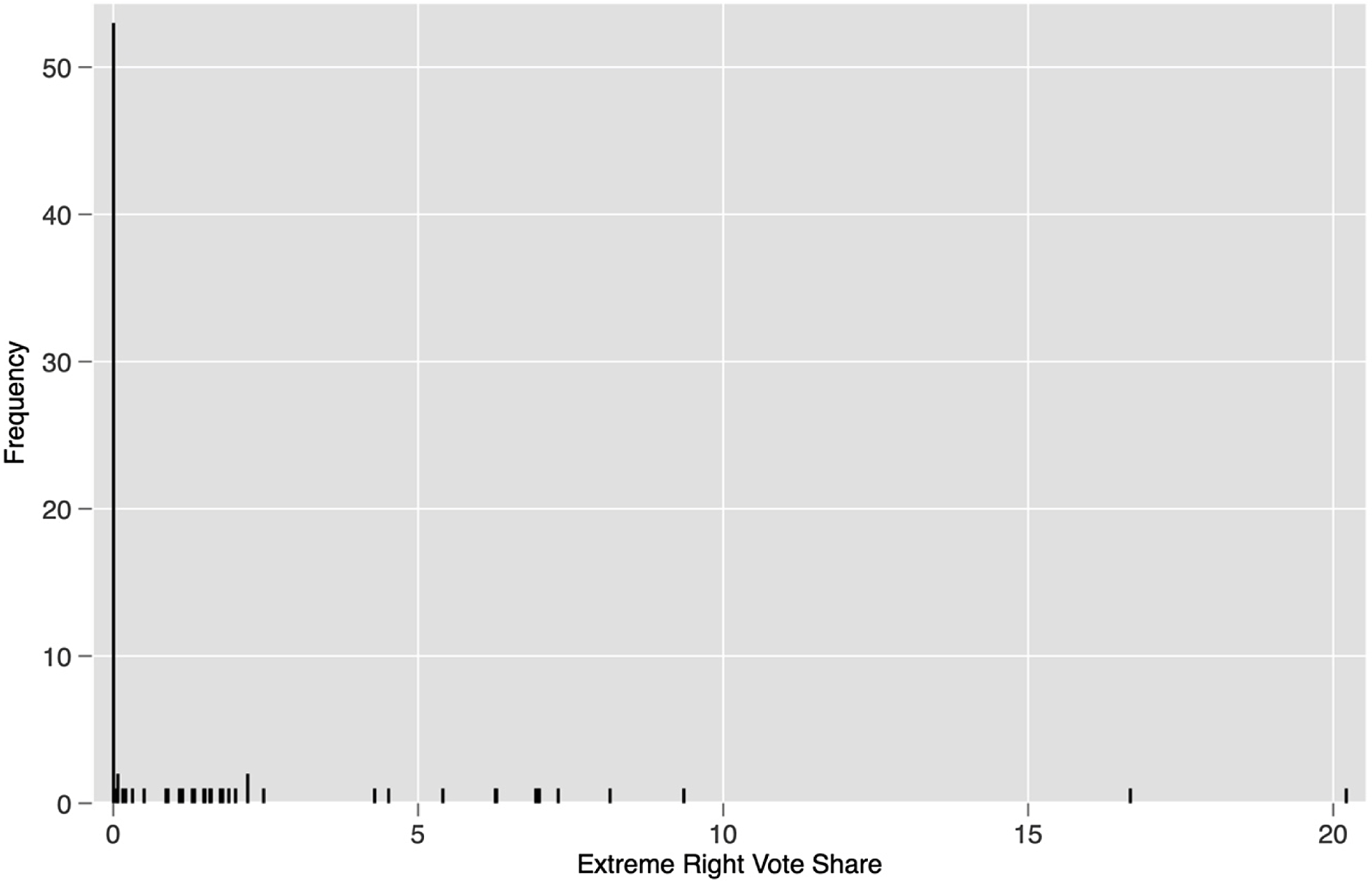
Instead, following Golder’s (Reference Golder2003), Jackman and Volpert’s (Reference Jackman and Volpert1996) and Jesuit et al’s (Reference Jesuit, Paradowski and Mahler2009) suggestions, we utilize a type I Tobit model. Tobit models, initially proposed by Tobin (Reference Tobin1958), are mostly applied to data-censoring problems (Jesuit et al., Reference Jesuit, Paradowski and Mahler2009, p.284); however, as Wooldridge (Reference Wooldridge2002) suggests, these models can be applied for corner solutions to data with many zeros in the dependent variable. As the dependent variable of this research has many zeros (see Figure A3, Appendix A, page 11), a Tobit model is the most appropriate statistical model as it utilizes the maximum-likelihood for left-censored variables (Golder, Reference Golder2003). Footnote 19
Despite the many advantages of the Tobit model for corner solutions issues, this statistical model could face some potential issues. To start with, the Tobit model assumes that there is no heteroskedasticy and non-normality in the distribution of the error term (Jesuit et al., Reference Jesuit, Paradowski and Mahler2009; Wooldridge, Reference Wooldridge2002). As the data for this article is panel or cross-national time series, we cannot use panel-corrected standard errors Footnote 20 (Golder, Reference Golder2003). However, the test for heteroskedasticity Footnote 21 shows that this exists, and we should take this into account. A way to do this is to run a fixed-effect model by using country dummies in order to account for potential heterogeneities among the countries (see Golder, Reference Golder2003; Swank and Betz, Reference Swank and Betz2003). Another way to account for the issue of autocorrelation is to transform the dependent variable using the inverse hyperbolic sine (IHS) function that approximates a logarithm, following Jesuit et al’s (Reference Jesuit, Paradowski and Mahler2009: 286) suggestion Footnote 22 . After the transformation of the dependent variable using the above formalization, the dependent variables show much less variance (See Table A8, Appendix A). Also, Tables A5 (test before transformation) and A6 (after transformation) in Appendix A show that after the transformation of the dependent variable, autocorrelation is not an issue. The formalization of IHS is as follows:
 $$si{n^{ - 1}}y = ln\left( {y + \sqrt {1 + {y^2}} } \right) \approx 2 + l$$
Model formalization
After considering the solution that the Tobit model offers to this analysis, as well as potential issues and how we take them into account, we present the formal models used. The standard Tobit model’s equation when the data is left-censored at 0 is that:
 $$y_i^* = {x_i}\beta + {\varepsilon _i},{\varepsilon _i} \sim N\left( {{\sigma ^2},0} \right)\,i = 1, \ldots ,n \to y_i^*\sim N\left( {{x_i}\beta ,{\sigma ^2}} \right)$$
 $${y_i} = y_i^*\ if\ y_i^* \gt 0$$
 $${y_i} = 0\ if\ y_i^* \le 0$$
where
 $y_i^*$
is the latent-dependent variable and
 ${y_i}$
is the observed-dependent variable (e.g., Amemiya, Reference Amemiya1984; Golder, Reference Golder2003; Jesuit et al., Reference Jesuit, Paradowski and Mahler2009; Wooldridge, Reference Wooldridge2002). Additionally,
 ${x_i}$
is the vector for the independent variables and β is the vector for the coefficients. We present the coefficients, which are the marginal effects on the latent dependent variable
 $y_i^*$
for the issues of comparability as all the studies which utilized tobit models presented these coefficients (Golder, Reference Golder2003; Jackman and Volpert, Reference Jackman and Volpert1996; Jesuit et al., Reference Jesuit, Paradowski and Mahler2009; Swank and Betz, Reference Swank and Betz2003)
Footnote 23
. For the purpose of this article, the standard Tobit model will be transformed as:
 $${\rm{DV}}_{i,t}^* = {\beta _0} + {\beta _1}{\rm{Qo}}{{\rm{G}}_{i,t}} + {\beta _2}{\rm{MRPsPosition}}{{\rm{s}}_{i,t}} + {\beta _3}{\rm{QoG*MRPsPosition}}{{\rm{s}}_{i,t}} \\+ {\beta _4}{\rm{Unemployment}}{\left( \% \right)_{i,t}} + {\beta _5}{\rm{Real\ GDP\ Growt}}{{\rm{h}}_{i,t}} + {\beta _6}{\rm{Asylum\ Seekers}}{\left( \% \right)_{i,t}}\\+ {\beta _7}{\rm{Electoral\ HouseRu}}{{\rm{e}}_{i,t}} + {\beta _{n - n}}{\rm{Country\ Dummie}}{{\rm{s}}_{i,t}} + {e_{i,t}}$$
 $${\rm{D}}{{\rm{V}}_{i,t}} = {\rm{DV}}_{i,t}^*\ if\ {\rm{DV}}_{i,t}^* \gt 0$$
 $${\rm{D}}{{\rm{V}}_{i,t}} = 0\ if\ {\rm{DV}}_{i,t}^* =0 $$
The two baseline models include as key independent variables the proxy for QoG, the two proxies for the ideology of mainstream-right wing partiesFootnote 24 , their interaction terms, and the controls for unemployment, real GDP growth, asylum seekers and electoral rules. All the baseline models include country-fixed effects (inclusion of country dummies) in order to account for heteroskedasticity Footnote 25 . This could absorb cross-national variation, however, all the country dummies are statistically insignificant, Footnote 26 showing that the models capture cross-national variation well.
Results
We ran a series of cross-sectional time-series Tobit regression models in national parliamentary elections from 2004 to 2015. For this time period, there were 90 observations-elections points for most regression models, given missing data. As the key argument of this article includes an interaction term, and also due to the fact that interaction effects cannot be evaluated from tables (Brambor et al., Reference Brambor, Clark and Golder2006; Halikiopoulou and Vlandas, Reference Halikiopoulou and Vlandas2016), we plot the interaction terms; however, we have included the regression tables in Appendix A.
The upper left panel of Figure 1 plots the average marginal effects of the MRPs’ positions on immigration, multiculturalism and ethnic minorities on ERPs’ support conditional on the two key independent variables on QoG, after the baseline model Footnote 27 . It shows that in countries where QoG is 0.8 or below, the more conservative the MRPs, the more successful the ERPs. However, when QoG increases the effect of MRPs’ positions becomes insignificant. The upper right panel plots the average marginal effect of MRPs’ positions on social issues on ERPs’ support conditional on QoG. The results are similar to the left panels. When QoG is 0.8 or below, when MRPs move towards the right on social issues, support for ERPs is increasing. But when QoG is above 0.8, then the effect of MRPs’ positions on ERPs’ support loses its significance. The lower left panel plots the average marginal effect of MRPs’ positions on national way of life conditional on QoG. The results are fairly similar with the two interaction terms with the key IVs from CHES data. When QoG is poor (below 0.5), the more conservative the MRP, the more likely for ERPs to increase their vote share.
ERP's Vote Share (2004–2015).

These findings shed light to why the re-emergence of ERPs did happen in some countries with poor QoG such as Greece, Hungary and Slovakia, but not in others such as Portugal, and is explained by the MRPs’ positions and the extent to which ERPs are ideologically normalized. Also, in countries with good QoG, such as Western European or Scandinavia, ERPs will remain electorally as they are not politically legitimized.
Robustness checks
We have run a series of robustness checks in order to test the sensitivity of the results. We started by testing the baseline model with the transformed DV, and the two CHES variables as key IVs for MRPs’ positions, but with Front National coded not as an ERP Footnote 28 . We ran the same models with key independent variables, the MRPs positions on immigration, multiculturalism and ethnic minorities and QoG by using firstly, a tobit model with the non-transformed-dependent variable, and also, two OLS regression models one with and another without fixed effects Footnote 29 . The results of the baseline models hold after these robustness checksFootnote 30 .
We also ran several tobit models starting by controlling for MRPs’ positions on immigration saliency to control for Meguid’s (Reference Meguid2005) findings. Secondly, we added several control variables to control for the effect of supply-side factors. Thirdly, we excluded from the sample only Greece, only Hungary and then both countriesFootnote 31 . Fourthly, we controlled for the effect of the 2008 economic crisis. Fifthly, we added time dummies to control for potential time effects. Sixthly, we added three dummy variables to control for the effect of historical contexts in (a) Postcommunist countries, (b) South European countries and (c) Postcommunist and South European countries. Last, we controlled for the effect of RRPs’ vote shares. The results of the interaction terms hold even after these robustness checksFootnote 32 .
In the fourth step of robustness checks, we disaggregated the QoG variable, and added as key independent variables the six variables created from the World Bank, plus three own calculated variables that capture the three aspects of QoG as defined by the World Bank Footnote 33 . The results hold even after the disaggregation of the QoG variable, especially for when QoG is poor Footnote 34 .
As a fifth step, instead of the QoG variable, we used three other key IVs, starting with satisfaction with democracy index, and we continued with the Bayesian corruption index, and political corruption index from V-DEM. The results of the interaction terms show the same patterns even after we used different proxies for the QoG Footnote 35 .
For the last set of robustness checks, we run the baseline model for the years after 2006 to control for endogeneity. The CHES dataset collects data on positions on immigration and other new politics from 2006 onwards. As mentioned earlier, we used the coding from the CHES trend-file to attach MRPs’ positions to each election year, however, sometimes the election year is prior to the data collection. This might create some methodological issues (endogeneity). To control for the validity of our statistical findings, we excluded all the election years prior to 2006. Even after the exclusion of the elections prior to 2006, and with the total sample dropped to 70, the results holdFootnote 36 .
For the last step of our analysis, we run two tobit models with two three-way interaction terms. We started by including the interaction term between QoG without political stability, MRPs’ positions on immigration, multiculturalism and ethnic minorities, and the extent to which the MRP competitor was incumbent or not. Someone could say that ERPs will be electorally successful in countries with poor QoG and highly conservative MRP positions, only if MRPs were incumbent in the previous elections. This is plausible, however, the results from Figure A4 (Appendix A for the regression table see, Table A16, model 1) show that in countries with poor QoG, the more conservative the MRPs, the more successful the ERPs, independently of the incumbency status of MRPs. However, when MRPs were not incumbent, in countries with good QoG, the accommodation strategy harms ERPs, but when MRPs were incumbent, the effect of their positions in countries with QoG above 0.7 is statistically insignificant.
Secondly, we tested the interaction term between our key IVs with MRPs’ salience of national way of life, and issues that FRPs, usually, own. Figures A5 and A6 (Appendix A) show that when MRPs’ salience increases on national way of life, and/or on issues FRPs own in countries with poor QoG, the more conservative the MRPs, the more successful the ERPs, which further confirms the ideological normalization hypothesis. It also shows that in countries with good QoG, when the salience increases, ERPs are less successful when MRPs adopt accommodative strategies.
Illustrative cases
The findings of the statistical analysis of this article show that ERPs are more likely to increase their vote share when QoG is poor, which normalizes ERPs’ political presence, and MRPs adopt highly conservative positions, especially on immigration, multiculturalism and ethnic minorities, through normalization of ERPs’ ideology. These findings explain why traditional ERPs tend to be electorally successful only in South or Eastern Europe, where QoG tends to be significantly worse than in Western Europe or Scandinavia. Taking into consideration the limited number of observations (90) of the statistical analysis, and despite that the results hold a bevy of robustness checks, it is important to discuss some illustrative cases (successful and unsuccessful) to strengthen the plausibility of the argument of this article. This will also allow us to control for potential endogeneity or the alternative explanation that MRPs shift towards the right after ERP electoral support. We will focus then at the two cases which mostly drive the statistical findings, Greece and Hungary, to show that the qualitative stories of these countries confirm the findings of our statistical analysis.
Starting with Greece, the rise of GD shows how the political and ideological normalization of ERPs works. Greece is a country with poor QoG Footnote 37 . There is a clear significant drop in QoG from 2005 onwards and this drop is even clearer after 2008. As a result, the political normalization of the FR in Greece exists since 2008. However, ERPs remained completely electorally marginalized in national elections until 2012 or, as discussed above, until 2010, in mayoral elections in Athens, as GD received only 0.3% in the 2009 national elections. After the 2009 national elections, when New Democracy lost to the Panhellenic Socialist Movement, the former changed leadership. Under the then-new leadership of Antonis Samaras, New Democracy changed its positions. The party became more conservative on social issues, and even more clearly so on issues such as immigration, multiculturalism and rights of ethnic minorities Footnote 38 . Only after the transformation of New Democracy did GD manage to be electorally successful and enter the Greek parliament.
The same pattern can be found if we look at Hungary, and the rise of Jobbik. Jobbik, became electorally successful in the 2010 national elections. The party gained 16.67% of the total votes and became the third largest party in the Hungarian parliament, similar to GD in the 2015 Greek national election. Fidesz, the MRP in Hungary, initially formed as a civic youth movement (1988) and transformed to a liberal party (in terms of economy and cultures) in 1990 (Pytlas, Reference Pytlas2016). The transformation of the party to a highly conservative MRP started initially in 1994, with a party split when liberal members of the party left, and continued further from 1995 onwards. In 2001, Fidesz moved further towards the far right (Bozóki Reference Bozóki2008: 210)Footnote 39 . Fidesz continued to be highly conservative, especially on social issues, which resulted in the normalization of far-right ideas. It is not surprising that individuals in Hungary show the highest anti-immigration sentiments across Europe (Messing and Ságvári, Reference Messing and Ságvári2019). Jobbik took advantage of the normalization of FR ideas in Hungary, and as the QoG was declining from the mid-2000s onwardsFootnote 40 , normalized politically the agenda of the ERP. The normalization of the far-right continued even after 2010, and the transformation of Fidesz to a FRP, continues to normalize far-right ideas in Hungary. Most crucially though, the transformation of Fidesz did not happen as a response to Jobbik’s electoral support, but started much earlier.
The two illustrative cases show that in Greece and Hungary, ERPs were politically and ideologically normalized, and also that the transformation of the MRPs happened prior to the electoral success of ERPs in these countries.
Conclusion
This article aimed to explain variation in the electoral support for ERPs in European Union member states, contributing to the wider literature on far-right success. Though scholars (Ignazi, Reference Ignazi1992; Golder, Reference Golder2003; Ignazi, Reference Ignazi2003; Ford and Goodwin, Reference Ford and Goodwin2010; Goodwin Reference Goodwin2011) accounted for the differences of the parties under the far-right umbrella, their studies did not explain cross-national variation in the electoral support for ERPs. This article theorized and showed that political and ideological normalization of the ER creates political opportunities for ERPs’ success.
Building on studies on the relationship between QoG and voting behaviour, we expected that in countries with poor QoG, anti-system parties would find fertile grounds for electoral success through various mechanisms, such as dissatisfaction with democracy, or ‘failed expectations’ (Agerberg, Reference Agerberg2017). This article also expected that the positions of mainstream-right parties can create or close the political space for ER competitors. The existing literature proposes two competing hypotheses; MRPs’ accommodation strategy, firstly, legitimize ERPs’ ideology, so the latter are more likely to succeed, and secondly, close the political space for ERPs, the latter therefore are electorally unsuccessful. The findings regarding the effects of MRPs’ positions on ERPs’ support are conflicting. After running several regression models, this article shows that QoG moderates the effect of the MRPs’ positions, on the electoral support for ERPs. More specifically, as hypothesized, ERPs are more likely to succeed in countries with poor QoG and a highly conservative MRP. However, as the QoG improves, the effect of MRPs’ positions on ERPs’ support loses its significance, and is some cases even reduces ERPs’ support (mainly when QoG is extremely good). We also show that MRPs’ salience on far-right issues mitigates the size of the effect of MRPs’ positions and QoG on ERPs’ success. The last key finding of this article shows that in countries with poor QoG, highly conservative MRPs are associated with higher support for ERPs, independently of the fact they were part of the government in the previous elections or not. The findings of this article are particularly important as they show that under specific conditions, party competition, and more specifically, the ideological positions of MRPs, could have different effects on voting for ERPs. The findings of this study correspond closely to the existing literature about the effectiveness of political ostracism, as a strategy to combat anti-immigration parties’ support (see van Spanje and and Weber, Reference van Spanje and Weber2019), as they show that contextual characteristics, in this case QoG, might explain cross-national variation in the electoral support for ostracized anti-immigration parties.
The contribution of this article is therefore twofold. First, it is the first article that focuses solely on explaining the variation in electoral support for ERPs across Europe. Second, by demonstrating the interaction with QoG, we reconcile two competing hypotheses in the existing literature, which suggest that MRPs’ positions have conflicting effects on the electoral success of ERPs. This article showed that demand-side conditions, QoG in this case, moderate the effect of the ideological positions of the mainstream right.
By combining demand- and supply-side factors, this article opens avenues for further research. More specifically, by showing that QoG moderates the effect of the positions of MRPs, this article creates fertile grounds for further research on how demand-side factors moderate or mitigate the effect of supply side and vice versa. This article derived macro-level hypotheses; however, the micro-level implications of these findings deserve attention. Also, this article found that party competition, in this case the relationship between the mainstream and the far-right helps us to explain variation in the electoral support for the latter. Despite that it is beyond the scope of this article, it is equally important to test the effect of party competition across the left-right spectrum on ERP support. Also, as this article’s sample is rather small, with the availability of data on QoG and parties’ positions, scholars can test the hypothesis of this study by expanding the temporal coverage. Last, the same framework can be applied to other party families, such as the far right as whole or the far left.
Supplementary Material
To view supplementary material for this article, please visit https://doi.org/10.1017/S1755773921000308.
Acknowledgments
We would like to thank the anonymous reviewers and the journal editors for their excellent comment. We are also grateful to Daphne Halikiopoulou, Tim Vlandas, Christoph Arndt, Tom Long, and colleagues from the University of Reading and University of Bath for feedback on earlier versions of the article.