1. INTRODUCTION
John Beattie has shown that the types of property that were commonly stolen by people who were indicted for theft in eighteenth-century Surrey varied significantly between the county's rural and urban parishes.Footnote 1 Beattie also suggests that there were ‘real differences’ in the levels of property crime which were seen in these areas. In his view, such differences can to a significant extent be explained by the fact that there were different opportunities for theft and for the sale of stolen goods in each location.Footnote 2 The assertion that life in the countryside was ‘likely to be more restrictive for all’, with disruptive behaviour being met with an ‘immediate, personal and formidable’ response from the local community, offers an additional explanation.Footnote 3 In London, the plethora of pawnbrokers, publicans, shopkeepers and street traders meant that any ill-gotten item could be sold.Footnote 4 A commonly held opinion in the eighteenth century was that receivers of stolen goods in London acted with impunity, thereby stimulating crime on a vast scale in the capital.Footnote 5 In 1793, for example, the Honest London Spy described the ‘unconscionable pawnbroker’ as:
… Old Nick's warehouse-keeper, an English Jew, that lives and grows fat on fraud and oppression, as a toad on filth and venom. His practice outvies usury as far as highway-robbery does petit-larceny … He is the treasurer of the thief's exchequer, and the common tender of all booth-heavers and shop-lifters in the town.Footnote 6
The magistrate Henry Fielding described the huge number of places in London where stolen goods could be sold, and argued that it was almost as if the city had been intentionally designed for the concealment of thieves.Footnote 7 While historians have emphasised the importance of not accepting such contemporary views uncritically, the question of whether it really was very easy to sell stolen goods in London and other cities has not received sustained investigation. As this article argues, markets for stolen goods were more complex than has previously been recognised, and certainly were not as free from constraint as contemporaries imagined. Shedding further light on the nature of these markets is a worthwhile end in itself, in that it can reveal valuable information about the place of stolen goods in a broader ‘informal economy’ in which second-hand trading was of great importance.Footnote 8 Furthermore, examining the ways that stolen goods were sold can tell us a great deal about how crime was both facilitated and constrained by the nature of the eighteenth-century city.
This article does not take issue with the view that urban and rural settlements experienced crime in different ways. Moreover, it is important to recognise the nuanced nature of Beattie's argument, which acknowledges that prosecution practices could also shape the picture of urban criminality that is presented to us by indictment records.Footnote 9 The problem is, however, that so much of the examination of the ‘urban’ side of this equation has involved research using sources pertaining to London, meaning that we cannot adequately assess the value of the rural and urban as categories for analysis on a national scale.Footnote 10 Beattie's work was initially concerned with the comparison of London and the ‘urban parishes’ in its hinterland with rural Sussex and Surrey. He has subsequently contributed magisterial studies of policing in early modern London, and of the operation of London's judicial system.Footnote 11 The nature of policing in London has also been carefully investigated by other historians, as have petty crime and summary justice.Footnote 12 These studies have emphasised the ways in which London developed its own innovative forms of policing and its own dynamic judicial system. It is, however, the uniqueness of the capital that calls into question its usefulness as a model for the study of urban crime and justice, unless one is interested in the study of London as an end in itself. As Peter King has argued, some of the locales of England prosecuted and punished crime in ways that were highly divergent from the practices of the capital or the commandments of central government.Footnote 13 We should not assume that the ways in which stolen goods were sold in London were duplicated in England's provincial cities.
Studies of the sale of stolen goods have also often focused on London.Footnote 14 Heather Shore has examined the relationship between poverty and the sale of stolen property in the eighteenth century, and has studied the ways in which ‘juvenile delinquents’ engaged with receiver networks in the early nineteenth century.Footnote 15 Shore has shrewdly urged for caution in the way that urban criminality is depicted, arguing that cities were not entirely anonymous places, with the bonds of community and networks being of continuing importance in London, albeit in ways which had as much to do with neighbourliness and making-shift as they did with organised crime.Footnote 16 How, then, can a study of stolen goods in late eighteenth-century Bristol contribute to this body of work? There were indeed many opportunities for the sale of stolen goods in Bristol, which provides support for the observation that cities were the location of distinctive markets for the sale of stolen property. However, as this article argues, there is evidence to show that people who stole were mindful of the risks associated with selling stolen goods, and that they often modified their behaviour accordingly. There is also evidence that suggests that these risks were genuine: information about stolen property could circulate rapidly, and rewards were often offered for pawnbrokers who ‘stopped’ stolen items. The consequence of this is that more thought is needed about why individuals involved other people in the disposal of stolen goods. After all, there were many disadvantages associated with doing so, such as the reduction of a thief's personal share in a crime's profits, and the risk that an accomplice would – under threat of severe punishment – ‘turn king's evidence’. Previous explanations have focused on the importance of ‘receivers’ and ‘fences’ as individuals who could provide a point of entry into criminal networks, bridging the gaps between thieves, criminal networks and community.Footnote 17 In some instances it is possible to fit the source material into this paradigm, but in a number of other cases in Bristol personal connections played a different role. Associates were often used to deal with the risks associated with selling stolen goods, particularly in relation to pawnbroking. We cannot simply regard pawnbrokers and other second-hand dealers as providing an easy market that allowed people to sell stolen goods with impunity. Terms such as ‘criminal networks’ or ‘fencing’ have a tendency to separate the channels through which stolen goods were sold from other markets for second-hand goods. As this article argues, the evidence for ‘criminal networks’ in Bristol is limited, whereas there is significant evidence to show that the informal economy offered a vibrant market for stolen property. A more nuanced account is, therefore, needed of the opportunities for the sale of stolen goods that existed in the eighteenth-century city, and of the ways that stolen goods markets were used.
This argument will be advanced through the study of reports of property crime that were produced in Bristol between 1770 and 1800. Bristol is an ideal subject for study because, unusually, its corporation was empowered to try all felonies by itself, meaning that the city operated its own courts of both quarter sessions and gaol delivery, and was not (unlike almost all other towns and cities) part of an assize circuit.Footnote 18 An important part of the pre-trial process was the production of depositions: detailed documents, based on the oral testimony of witnesses and victims before a magistrate, which record the key details of an allegation being made against a suspected thief.Footnote 19 It is the testimony of these witnesses, along with the confessions of suspected thieves, which form the body of evidence used in this article. Approximately 1300 depositions concerning property crime survive from both courts from the years covered by this article, pertaining to about 800 accusations. These were produced in a city whose population grew to sixty thousand by the end of the eighteenth century, meaning that Bristol remained one of England's largest cities, despite having lost its status as the nation's ‘second city’.Footnote 20 A number of depositions feature the confessions of alleged thieves, or the testimony of people who were informing against their accomplices. These sources, in particular, offer a close insight into the mindsets of those who committed crime. In many cases, it is possible to reconstruct a narrative of how and when a crime occurred, and of how and when the goods that were stolen were sold. It is by studying these narratives that we can discover a great deal about the ways that stolen goods markets functioned and were used, and the ways in which thieves' behaviour was facilitated and constrained by the nature of the city. It is not the case that every deposition contains material that is relevant to this study. Many suspects were brought before a magistrate before they had had an opportunity to sell the goods that they had stolen. The most common reason why people were arrested was because they were caught in the act of committing an offence, while both the nightwatchmen and members of the public frequently ‘stopped’ people whom they suspected might have committed a theft. However, the cases in which an arrest was not made immediately are among the most interesting, because they sometimes show how victims responded to losing their property. Victims' responses to crime, and thieves' perceptions of risk, may not tell us a great deal about absolute levels of theft, but they do provide extremely revealing evidence about contemporary perceptions of crime.
2. STOLEN GOODS AND THE INFORMAL ECONOMY
The depositions make it clear that many types of stolen property could be sold through informal transactions with apparent ease. Items which were not easily identifiable, and which could be offered to people who used them in the course of their everyday business, were likely to be sold to the final user of that item. When Thomas Pierce stole iron from a wheelwright in 1785, for example, he sold it to Robert Higgins, who was a blacksmith.Footnote 21 Similarly, when Philip Charriton stole some cheeses from a huckster's shop in 1772, he was able to sell them at a public house within a few hours.Footnote 22 Beverly Lemire has argued that when it came to selling stolen clothing ‘specialist receivers were not necessary’, unlike when ‘commodities like lead, plate, tools, or livestock’ were sold.Footnote 23 This view is only partly supported by the Bristolian depositions, which make it clear that many types of commodity could be sold with ease. The evidence for the sale of livestock is limited, but there are examples of chickens and other birds being sold directly to victuallers; woodworking tools were sold to carpenters, and plate stolen from alehouses was sold to other alehouse-keepers and to silversmiths.Footnote 24 Metals such as lead, iron, pewter and copper were sold directly to tradesmen who used them in their work, as were pieces of leather and cloth.Footnote 25 While one could characterise tradesmen such as braziers, blacksmiths and cordwainers as ‘specialist’ buyers in the sense that they had demands for specific items, these kinds of tradesmen were hardly uncommon.Footnote 26 For many types of stolen item, opportunities for direct sale to end-consumers could be easy to find. For example, in 1782 Daniel Morgan was able to sell a bundle of sticks that was not his property to a passer-by on the quayside, combining the act of theft and act of sale into a single event.Footnote 27 Similarly, in 1783 when George Frownes stole some barrel hoops from the Back (Bristol's dockside), he was able to sell them immediately to a hooper working in a nearby street.Footnote 28 Two men employed to load a dray with rope were able to steal and sell some of it during their dinner break.Footnote 29 Contemporaries reported that there were many opportunities for the sale of stolen or smuggled sugar within close proximity to the quayside.Footnote 30
Many buyers did not actively seek out stolen goods, but simply could not avoid purchasing stolen property as part of their everyday business. In 1788, for example, a large quantity of stolen lead was sold by giving the buyer a forged letter which claimed the lead had come from ‘out of the Country’: the fact that the buyer had to be actively deceived with a fake letter indicates that he did not purchase the lead knowing that it was stolen.Footnote 31 Similarly, in 1784 two dockworkers were duped by two sailors into taking iron from a ship to a blacksmith, the dockworkers not realising that the iron did not belong to the sailors.Footnote 32 When stolen goods were purchased informally, the price paid was not necessarily heavily discounted from the market price: indeed, heavy discounting could lead to suspicions of theft.Footnote 33 The diverse range of retailers and traders that could be found in Bristol meant that even fairly luxurious or unusual items could be sold directly to a trader, rather than having to be fenced. When Charles Hobbs stole an ivory pocket case in 1792, for example, he sold it to a toy manufacturer at his shop.Footnote 34
The Bristolian sources are broadly supportive of Lemire's point that a vibrant realm of economic activity existed in which the shop was by no means the only location of trade, and in which second-hand goods could be traded as vigorously as new ones.Footnote 35 It may well have been that for candle-makers who wanted tallow, or braziers who needed copper, casual transactions based on recycling and second-hand sales formed their most important source of supplies. It is important, therefore, to exercise caution in how we think about the ways that stolen goods were sold. The presence of many opportunities for the casual sale of stolen items means that it is not possible to argue that all stolen goods had to be sold through receivers or fences. Nor is it possible to support the view that markets for stolen clothing were in some way easier to use, or more dynamic, than markets for other goods. While ‘popular consumerism’, as Lemire calls it, may have created a great deal of demand for clothing, the depositions show that the everyday economic activity of a large city created a substantial body of demand for a range of other types of item.Footnote 36
It should not be thought, however, that all sales of the materials of everyday business were made in a casual way. Certainly there are examples of quasi-formalised relationships between thieves and buyers: these buyers perhaps come closer to what might be labelled ‘specialist receivers’, in that they demanded large quantities of particular commodities and do not appear to have needed them for their normal work. In the 1780s, for example, George Stanbury was accused of stealing the following very long list of items from his employer:
Twenty three pewter plates, One pewter dish Value Two shillings, One pewter basin value six pence, Four pounds weight of pewter, Four pewter cups Value Two shillings, Six pewter Tea spoons Value six pence, Six Brass Weights Value one shilling, one Iron Hammer Value Two pence, One pair of pinchers Value Six pence, One Brass pair of snuffers Value Six pence, Two pounds and three Quarters of pewter Value One Shilling, Five pounds Weight of Brass Value Two shillings, and Two Brass Candlesticks Value One shilling and six pence.Footnote 37
He took them to a man named Joseph Burroughs, who paid him five pence per pound for the metal before selling it on at a profit to some local braziers.Footnote 38 This crime represents not the casual sale of the perquisites of business to an unsuspecting tradesman, but the systematic sale over time of stolen goods to a person who was clearly able to resell significant quantities of metal. There are similar examples of large quantities of stolen wheat being purchased at wholesale prices, as well as long-term thief–receiver relationships involving other foodstuffs, glassware and candles.Footnote 39 There are few major differences between these activities and the way that stolen clothing was purchased by long-term receivers. Indeed, sometimes both stolen clothing and other stolen items could be sold through the same channels. In 1771, for example, Mary Cottle received a constant stream of stolen handkerchiefs from two boys, promising them a fixed price depending on the number of handkerchiefs that they brought her; when they stole a hundredweight of iron, she was able to sell it too.Footnote 40 Similarly, in 1775 the landlord of an alehouse was accused of receiving stolen clothing from two burglars; he was alleged to have received a variety of other goods.Footnote 41
In these cases, we have seen examples of people who purchased goods that were not obviously related to their trade. It is difficult, for example, to think of many types of work that would have required Mary Cottle to need both large numbers of handkerchiefs and a hundredweight of iron. However, care is needed in relation to how we characterise these relationships. The fact that an individual bought stolen goods on numerous occasions does not necessarily mean that they formed part of a criminal network. As we have just seen in the case of Joseph Burroughs, a receiver of stolen goods did not necessarily sell stolen property to criminal accomplices, but could simply sell it to ordinary consumers himself. Indeed, many of the people who bought stolen goods over an extend period of time were themselves tradesmen or retailers. In 1793, for example, it was reported that Jacob Edwards had bought stolen sugar several times. Edwards was a grocer, so it is likely that he often purchased foodstuffs to sell in his shop.Footnote 42 Similarly, there are reports of braziers and blacksmiths buying metals on numerous occasions, and of victuallers buying numerous cheeses or large quantities of grain.Footnote 43 These people could dispose of stolen goods through their normal trading activities, and therefore represented not ‘fences’ who disposed of conspicuous goods through dubious channels, but simply tradesmen who constantly demanded certain commodities.
3. SECOND-HAND MARKETS AND RISK
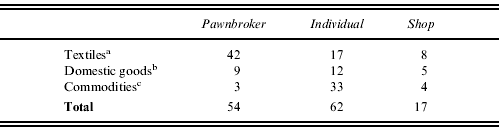
The material discussed in the previous section showed that there were many channels through which stolen goods were sold in eighteenth-century Bristol. Long-term buyers of stolen property could be very much part of mainstream economic activity, rather than serving as ‘middle men’ who allowed thieves to access markets indirectly.Footnote 44 As Table 1 shows, pawnbrokers were the most important market for stolen textiles and clothing among those cases that were reported to the city's magistrates. This reflects pawnbrokers' great importance as retailers of second-hand clothes.Footnote 45 However, it is not possible to argue, as some historians have done, that stolen clothing was particularly easy to sell.Footnote 46 Furthermore, as the following material argues, using pawnbrokers could be a risky activity, and was perceived as such by thieves. This can explain the patterns of activity that we see in the depositions, and reveals some of the constraints on criminal agency that existed in the eighteenth-century city.
Locations of sale of stolen goods in Bristol
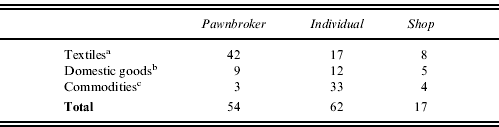
a Includes clothing, household furnishings, hats, handkerchiefs, buttons and ribbons.
b Includes tableware, furniture, valuables, plate.
c Includes metals, building materials, foodstuffs, tobacco, animals.
Source: Database of depositions to courts of quarter sessions and gaol delivery, 1770–1800, Bristol Record Office Quarter Sessions Papers JQS/P/30-167.
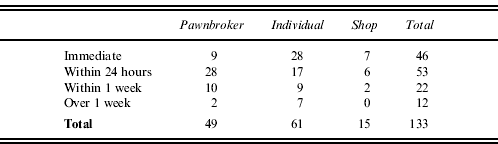
The Bristolian sources present clear evidence that thieves often went to considerable lengths to reduce the risks associated with pawning and selling stolen clothing or textiles. The fact that they did this is revealing of their perceptions of the nature of pawnbroking and the efficacy of responses to crime. Modifying stolen items so that they were difficult to identify is perhaps the best-known example of this. Mary Cottle was careful to unpick monograms from stolen handkerchiefs before selling them, for example, while a lodger who stole some curtains from her landlord turned them into petticoats before taking them to pawn.Footnote 47 Modifying items was not the only way that criminals' behaviour took account of risk, however. As Table 2 shows, a significant number of items were sold within a very short time of being stolen. There are several reasons that can explain this pattern. One is that many thieves appear to have been aware of potential buyers before they committed a crime, and so were able to obtain a quick sale. When two men stole some iron bars from a ship in 1773, for example, they went straight to Sarah Darvill's house in Marsh Street (near to the scene of the crime) and sold them.Footnote 48 Similarly, when Thomas Morgan stole some silver buckles in the same year, he took them straight to a silversmith who bought them from him.Footnote 49
Time of sale of stolen goods in Bristol
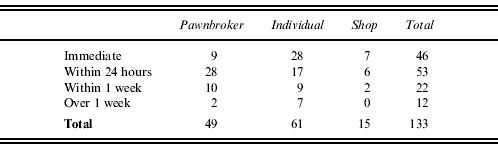
Source: Database of depositions to courts of quarter sessions and gaol delivery, 1770–1800, Bristol Record Office Quarter Sessions Papers JQS/P/30-167, using only sources containing relevant information.
The desire to turn stolen property into cash was not necessarily the only motivation to sell goods quickly. Looking specifically at pawnbrokers, the depositions provide 37 reports in which a pawnbroker was visited within 24 hours of a theft, and only 12 instances in which the duration was longer. The reason for this will partly have been due to the desire to obtain cash for stolen goods as soon as possible – but the desire to pawn an item before pawnbrokers had the chance to hear about it in advertisements may also have been a reason. One way that news about a crime could circulate was through the practice of victims visiting numerous pawnshops in search of their stolen items.Footnote 50 Mary Cottle was arrested in 1785 when a pawnbroker gave a description of her to the victim, as was William Challenger in 1776.Footnote 51 Bristol had several weekly newspapers which often carried advertisements about thefts that had occurred in the preceding days, and the Corporation of Bristol's correspondence shows that handbills were used both to publicise crimes that had occurred and to warn the public when suspected thieves were in town.Footnote 52 The Corporation employed a bellman to spread the word about stolen property, and the nightwatchmen also ‘called’ news about stolen goods on their rounds.Footnote 53 The depositions confirm the speed with which information could circulate. For example, when Mary Ellis was burgled on the night of Friday, 24 February 1786, a clothes dealer reported that:
James Cleaver brought the pair of Cotton stock[ing]s now produced and above deposed to by said Deborah Doyle to the House of these Informants in Broad Mead Bristol where he sold the same together with a Shirt and a Pocket handkerchief and that on the next Day being Sunday they heard sd Ellis's house had been Robbed they sent such stock[ing]s there where they were Owned by sd Deborah Doyle.Footnote 54
In this case, then, it took less than two days for the clothes dealer to find out about the theft. John Styles has found printers who offered handbill-printing at an hour's notice.Footnote 55 Similar printers existed in Bristol: Henry Bright was robbed on Friday night, advertised his stolen watch the next morning, and received information which enabled him to arrest the suspect and retrieve his watch on Saturday evening.Footnote 56 A surviving example of one of these advertisements states that a pawnbroker who stopped the stolen items (in this case, clothing) would receive a reward of three guineas in addition to any reward money received for convicting a burglar.Footnote 57 Potential buyers could, therefore, rapidly become potential prosecution witnesses. Some buyers refused to buy goods immediately, or held them for a few days before issuing payment: this allowed them time to encounter advertisements regarding whether the item was stolen.Footnote 58
While advertising might not always have led to an arrest, there is direct evidence that people would modify their behaviour once they knew that a theft had been advertised. When two men stole a large quantity of linen from a whitening yard in 1783 they sold it to Mary Welsch. The thieves reported that she:
… persuaded them to go there again and get some more, and said that she would buy it of them if it were a thousand yards, for she had a place to carry it to.Footnote 59
The men returned to the whitening yard and stole some more linen, but when they took it to Mary Welsch she:
… said that she had heard of an Advertisement being out offering Twenty Guineas reward for the discovery and was afraid of having her House searched and advised them to carry it to some one else.Footnote 60
When encouraged to steal some more linen, the thieves refused to do so, judging the risk of capture to have become too high.Footnote 61 John Styles has shown that, on the Northern Circuit, printed advertising played an important role in the detection of acts of horse-stealing.Footnote 62 In Bristol, advertising, victim-led investigations and the circulation of knowledge also occurred shortly after acts of crime and led to arrests and prosecutions. These activities were important in another respect: they affected the ways that thieves were prepared to deal with second-hand markets. In the case of Mary Welsch and her acquaintances, advertisements reduced the thieves' willingness to continue stealing and the receiver's willingness to continue buying. In light of this, it is difficult to see the tendency towards rapid sales that is shown by Table 2 as being solely due to the ease with which markets could be accessed. In terms of risk, there were clear benefits to selling stolen goods as quickly as possible.
Timing was not the only important consideration in the sale of stolen items; some thieves went even further in ensuring that it was difficult to link them to an act of crime. The advantage of Bristol as a place to commit theft was not just that there were local opportunities to sell stolen items, but that it also had good links with Bath, London and – by water – Wales and the south-west coast of England.Footnote 63 All of these transport links were used by thieves to remove stolen goods. For example, in 1781 when William Hancock fraudulently obtained 155 deal boards from a Bristol merchant, he had them transported to Bath, making it difficult for the defrauded merchant to find and arrest him.Footnote 64 Similarly, in 1783 a yeoman who had lost two horses in Bristol found that they had been sold at Calne in Wiltshire.Footnote 65 Quitting the city was a strategy used by thieves who feared that they might be captured. When Martha Cambridge sold some stolen goods after a burglary in Bristol, the buyer advised her ‘to go to Bath for fear she should be taken up’.Footnote 66 A gang did the same in 1786, journeying to Bath and then on to Salisbury in a vain attempt to escape prosecution.Footnote 67 Such examples further challenge the view that people could sell stolen goods with impunity, showing that – at least in some cases – thieves were reluctant to remain in Bristol after a crime. Fielding, writing about London in the 1750s, described the capital as a ‘vast Wood or Forest in which a Thief may harbour’.Footnote 68 In Martha Cambridge's view, Bristol was not so large that it provided an entirely safe harbour for those who had committed crime.
4. STOLEN GOODS AND THE USE OF ASSOCIATES
One very noticeable feature among the depositions is the high proportion of cases in which thieves dealt indirectly with second-hand goods markets. As Table 3 shows, almost half of cases where stolen goods were taken to a pawnbroker involved the use of an intermediary to do so. These intermediaries were employed to visit the pawnbroker on behalf of the thief, returning some or all of the proceeds to them. Much emphasis has already been given to the involvement of women in the sale of stolen goods.Footnote 69 While the Bristolian sources do not contradict this view, they do suggest that there were multiple reasons for why this was the case, so that female involvement in the sale of stolen goods cannot solely be attributed to women's better understanding of second-hand clothes markets. As Garthine Walker has written, considering the influence of women's social and economic activity on crime is certainly more satisfying than explaining women's criminality in terms of stereotypes – but, as the Bristolian sources show, the link between female socio-economic activity and crime was complex.Footnote 70 I argue that we should also consider the gendered nature of suspicion as an influence on the way that stolen goods were sold.Footnote 71 In 1782, Bridget Hayes reported that:
… on Wednesday Night she met the man named James Butler at the End of Small Street who produced to this Informant a Gown & Pettycoat and desired this Informant to go and sell it and that he would give her something for her Trouble and shewed her the way to the Shop of Mr Booth in the Pithay and while this Informant went into the shop he remained without.Footnote 72
Why did Butler enlist the help of Hayes when he already knew exactly where the stolen items would be sold? Given that women were the most frequent users of pawnbrokers, and that gowns and petticoats were not normally items of clothing possessed by men, it is likely that the avoidance of suspicion was the crucial factor in this case.Footnote 73 When Timothy Thomas stole tallow from his employer, he got Ann Chew – a widow – to sell it to another tallow chandler for him.Footnote 74 While the kitchen was certainly not a part of the household from which men were excluded, in terms of passing-off stolen tallow as recycled kitchen fat, it is likely that a widow would have been less suspicious than the employee of a tallow chandler.Footnote 75 In 1782, Thomas Kidney stole a new cloak from a warehouse, and then paid Sarah Nelin sixpence to carry it from her lodgings to a house on the other side of Bristol Bridge.Footnote 76 Nelin did this while Kidney walked with her, refusing to take hold of the cloak when she asked him. In this case, it is again possible to isolate the avoidance of suspicion as a motivation for the use of an accomplice. Kidney was prepared to pay Nelin, despite the fact that he was walking the same route anyway. It was not Nelin's ability to sell the cloak that attracted Kidney, since he had already decided where to take it. This indicates that he perceived carrying a woman's cloak through the streets by himself as a risky activity. The use of family members to sell stolen goods also suggests that risk – rather than access to markets, or personal convenience – was sometimes the primary factor motivating the use of personal connections. In 1795, a serial thief named Henry Maids used his 12-year-old son to visit pawnbrokers on many occasions, and, in 1783, John Williams got his wife to pawn goods for him.Footnote 77 It is hard to describe these family members as ‘receivers’ who had specialist knowledge of second-hand markets, since they went to locations at the direction of (respectively) their father and husband.
Use of acquaintances to sell stolen goods in Bristol

Source: Database of depositions to courts of quarter sessions and gaol delivery, 1770–1800, Bristol Record Office Quarter Sessions Papers JQS/P/30-167, using only sources containing relevant information.
The use of female associates was particularly common in relation to selling clothing and textiles, but women were also used to sell other items of high value.Footnote 78 This is not to say that female thieves themselves went to pawnbrokers with impunity. When a well-known thief named Catherine MacClausty stole a large quantity of clothing in 1784, she got Elizabeth Thompson to keep it for her, before asking Martha Reed to pawn it.Footnote 79 MacClausty appears to have been mindful of the fact that women could also be recognised by pawnbrokers and suspected of theft. We have seen an example already in which Mary Cottle was arrested because a pawnbroker was able to give a description of her; advertisements also gave descriptions of the physical features of female suspects.Footnote 80 In addition to this, there were cases when a pawnbroker identified an alleged thief directly. Mary Cleaver, for example, appears numerous times in the Bristolian depositions accused of attempting to sell goods that had been stolen by her brother and his accomplices; her brother was already well known to pawnbrokers.Footnote 81 This helps explain why Mary Cleaver eventually tried to persuade the woman with whom she lodged to pawn items for her, saying that ‘she had them from her Aunt and begg'd this Deponent would not speak of it least her Aunt should be turned out of Doors by her Unkle’.Footnote 82 In this case the Cleaver siblings' avoidance of direct contact with pawnbrokers seems to have been a sensible decision, since the cause of their arrest was that James Cleaver was recognised ‘as a housebreaker’ by a pawnbroker's daughter.Footnote 83
From all of this we can see that it was not just differences in the economic lives of men and women (and also children) which made acquaintanceship an important aspect of the way that stolen goods were handled, but also differences in suspicion. Among the depositions as a whole, it is clear that being ‘out of place’ was a very important way by which suspicion was generated. Carrying a stolen cask of butter through the city at night could raise the suspicions of a nightwatchman, for example, whereas doing the same during the daytime was unlikely to attract attention.Footnote 84 Women's importance as sellers of stolen goods did not stem only from their close association with the production and legitimate sale of clothes, or from their detailed knowledge of the opportunities for sale of second-hand goods. In some cases these factors were important, but women's ordinary involvement in second-hand clothes markets, and their tendency to use pawnshops as part of ‘making shift’, meant that they were less likely to be suspected of selling stolen goods, and this made them appealing as people who could be paid to sell or pawn stolen property. Indeed, in the absence of confirmatory evidence, it should not be assumed that the people who acted as intermediaries for thieves knew that they were being implicated in the sale of stolen property. In 1771, Amelia Moses agreed to sell some stolen silver spoons for Samuel Badcock, who claimed that he had found them on the ground in the market: when Moses found out they were stolen, she had Badcock arrested.Footnote 85 Nor should we think that the thieves and their associates were always particularly well acquainted. Moses was quick to report Badcock's theft, and many of the sources show that it was money – rather than friendship – that motivated associates to help sell stolen goods.Footnote 86 In her work on early modern Wales, Sharon Howard has persuasively emphasised the importance of suspicion as part of the process that led to crimes being investigated and prosecuted.Footnote 87 In the case of stolen goods in late eighteenth-century Bristol, we can see that ‘suspicion’ remains a very useful concept in helping us understand how sales to pawnbrokers occurred.
Certainly there is evidence that personal acquaintances could be used to link a thief with unfamiliar buyers, and it should not be thought that the only reason why acquaintances were used was to manage risk. For example, when Edward Harrington tried to pawn a silver jug and some silver buckles in 1787, he failed to do so despite several attempts. Eventually he paid a six pence commission to Edward Palmer for introducing him to a buyer.Footnote 88 In 1795, William Walter tried to buy some stolen wool from Lawrence Houlder; Houlder was reluctant to admit that he possessed the wool, and only did so when David Powell, a mutual acquaintance, assured him that there was no danger in doing so because Walter had bought stolen wool before.Footnote 89 The benefit of using acquaintances to access unfamiliar markets is seen in a deposition from 1792, in which Robert Edwards confessed that he stole some linen from a ship and:
… went immediately to Pill in the County of Somerset where he delivered all the Linen which he had so taken, except two pieces, to one Hester Avery the wife of Joseph Avery Labourer, to sell for him and the said Hester Avery immediately went out to sell some of the said Linen & returned in about ten minutes to this Examinant with some money.Footnote 90
In addition to Edwards's clear desire for a swift sale outside Bristol, we can see that Hester Avery's understanding of local markets meant that she could sell the linen quickly. It is important not to take an excessively reductionist approach in considering the different reasons why personal acquaintances were used in the sale of stolen goods. As these latter examples have shown, one reason to use associates' assistance was that they could link thieves with unfamiliar buyers. In the case of Edwards, in particular, Hester Avery appears to have been particularly well placed to find places where the stolen goods could be sold. Avery's role is consistent with the way that historians have associated women with the sale of stolen clothes, seeing them as being particularly adept at finding suitable places for their sale.Footnote 91 This was not, however, the only thing that women had to offer when it came to selling stolen goods.
5. CONCLUSION
The picture presented by the Bristolian sources is one in which stolen goods markets were complicated and diverse. It is for this reason that caution is needed with the way that we describe eighteenth-century crime. It is all too easy to describe stolen goods as being circulated through ‘networks’ of thieves and receivers, with women's contribution arising solely from the fact that they were well placed to understand and use these networks. As we have seen, the reasons why associates were used were more complex than simply linking buyers with sellers. Criminals' decision-making involved quite complex considerations of risk and opportunity, and their activities were constrained by factors such as timing, location and appearance. Certainly the Bristolian sources support Shore's argument for the importance of personal connections in the way that stolen items circulated.Footnote 92 However, while personal acquaintances were important in a number of ways, great caution is needed when trying to turn this point into a more complicated model of the way that stolen goods circulated. While there is no doubt that stolen property did circulate rapidly and widely, it should only be with good reason that we replace the simple notion of circulation with more complex concepts relating to networks or notions of organised crime. Perhaps the best way of theorising the way that stolen goods circulated is not in terms of networks of goods and people, but of myriad social and economic connections that were constantly in flux.
The consequence of this is that some aspects of recent conceptualisations of urban crime are, at best, partially supported by the Bristolian sources. Shore has described receivers as people who ‘ran trades or small businesses, at the heart of the community’ and as ‘central players in the interlinking of community and criminal networks’.Footnote 93 In Bristol, the role of community in the sale of stolen goods was complex, and it is difficult to detect the presence of criminal networks which were either stable over time or to a significant degree separated from normal economic activity. It is not clear why we should see Shore's receivers (‘pawnbrokers, old clothes shop keepers, publicans, lodging-house keepers’) as being either part of criminal networks, or part of the communities in which thieves existed.Footnote 94 Many people bought stolen goods directly and anonymously from thieves and used them in their trade or sold them to unsuspecting members of the public, completely bypassing any engagement with networks of criminals or of stolen goods. Unscrupulous pawnbrokers may well have existed, but we have seen that in many cases the pawnbroker's shop was a locus of suspicion. The findings of this article are not, therefore, concordant with the viewpoint advanced by Shore's study of juvenile crime in early nineteenth-century London, which argues for the continuing value of ‘organisation’ and ‘networks’ as analytical concepts.Footnote 95 While Shore takes care to point out that these concepts should not be applied uncritically and that the boundaries between illegal and legitimate activity could often be blurred, in Bristol second-hand markets were so diverse and relationships between buyers and sellers often appear so fragile that such analytical tools have only limited utility.
These differences between the work reported here and that of Shore suggest that studies which are based on London may have only a limited relevance to helping us understand crime in other English cities. The evidence for the kinds of receiver networks that Shore detects in London is not present in Bristol, and we have seen that the ability of information to circulate rapidly in a city of Bristol's size placed significant constraints on criminal behaviour. This does not mean, however, that Bristol can be regarded as sharing more features with the countryside than with the capital. Acquaintanceship was important to the sale of stolen goods, but its significance came from the necessity of negotiating the risks and difficulties that were specifically associated with the urban environment. The constraints on thieves' ability to sell stolen property did not arise from the personal and community-based authority which Beattie has so strongly associated with the rural parish, but from the speed with which information about stolen goods could circulate, and from the suspicious nature of many buyers.Footnote 96 Furthermore, this article has shown that there were many opportunities for the informal sale of stolen property in Bristol, and that buyers for many types of stolen property could be easy to find. In this sense, Beattie's argument that, overall, there were differences in the ways that stolen goods were sold between urban and rural areas is not contradicted by the Bristolian sources.
ACKNOWLEDGEMENTS
I would like to thank Rosemary Sweet and the two anonymous readers who provided such helpful comments on earlier drafts of this article.