Introduction
Ordovician rocks in the North China Craton (NCC) can be subdivided into three major depositional domains (Zhen et al., Reference Zhen, Zhang, Wang and Percival2016a), among which only the western region includes moderately developed Upper Ordovician. The western region of the NCC is essentially equivalent to the marginal area along the northern, western, and southern edges of the Ordos Basin. Fossiliferous calcareous sediments of Late Ordovician age are well exposed in the region (e.g., Chen et al., Reference Chen, Zhou, Lin, Yang, Zou, Wang, Luo, Yao and Shen1984, Reference Chen, Bergström, Zhang and Wang2014; Zhao et al., Reference Zhao, An, Qiu, Wan and Ding1984; Zhou et al., Reference Zhou, Zhou and Zhang1989; Feng et al., Reference Feng, Wang, Zhang, Zuo, Zhang, Zhang, Chen, Wu, Chen, Chi and Yang1990; Fu et al., Reference Fu, Hu, Zhang and Wang1993).
As the most important biostratigraphic tool for Ordovician carbonate strata, conodonts have been extensively studied in this region (An et al., Reference An1983, Reference An, Zhang and Xu1985; Li and Yu, Reference Li and Yu1983; Wang and Luo, Reference Wang and Luo1984; Yu and Wang, Reference Yu and Wang1986; An and Zheng, Reference An and Zheng1990; An, Reference An1993; Wang, Reference Wang2001; Wang et al., Reference Wang, Bergström, Zhen, Chen and Zhang2013a, Reference Wang, Bergström, Zhen and Zhangb; Jing et al., Reference Jing, Zhou and Wang2015, Reference Jing, Zhou and Wang2016, Reference Jing, Zhou and Wang2017a). Strongly endemic Late Ordovician conodont faunas have been recovered in this region, and a conodont biostratigraphic succession mainly based on restrictedly distributed taxa has been established (An and Zheng, Reference An and Zheng1990; An, Reference An1993) and widely used (e.g., Zhen, Reference Zhen2001; Wang et al., Reference Wang, Qi and Wu2011, Reference Wang, Zhen, Zhang and Wu2016, Reference Wang, Zhang, Wu, Zhen, Zhang and Li2017; Zhen et al., Reference Zhen, Zhang, Wang and Percival2016a; Bergström and Ferretti, Reference Bergström and Ferretti2017; Lee, Reference Lee2019; Zhang et al., Reference Zhang, Zhan, Zhen, Wang, Yuan, Fang, Ma and Zhang2019). However, the precise regional and international correlations of the North China conodont zonal succession remain to be elucidated due to endemism of the zonal index conodonts. In the process of establishing a precise biostratigraphic framework for the Late Ordovician in North China, and because proportions of ubiquitous Ordovician conodont species increase from the inner North China platform to the marginal North China platform (e.g., An et al., Reference An, Zhang, Xiang, Zhang, Xu, Zhang, Jiang, Yang, Lin, Cui and Yang1983; Wang and Luo, Reference Wang and Luo1984; An and Zheng, Reference An and Zheng1990; Wang et al., Reference Wang, Zhen, Zhang and Wu2016, Reference Wang, Zhen, Bergström, Zhang and Wu2018), it became apparent that detailed studies of Late Ordovician conodonts from the marginal platform hold the key to advancing our understanding of conodont biostratigraphy of North China.
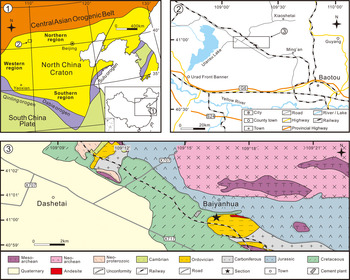
The Upper Ordovician rocks in the Dashetai area, situated in the central Inner Mongolia Autonomous Region (Fig. 1.1), represent the most complete Upper Ordovician series in the northern part of the western region of the NCC. The Ordovician conodont fauna and biostratigraphy of this area were described in several contributions (Lin et al., Reference Lin, Qiu and Xu1984; An and Zheng, Reference An and Zheng1990; An, Reference An1993). A diverse but geographically restrictedly distributed conodont fauna was reported, represented by genera Tasmanognathus Burrett, Reference Burrett1979 and Yaoxianognathus An in An et al., Reference An, Zhang and Xu1985. However, most of this literature was written in the Chinese language, and the latest taxonomic and biostratigraphic views were not integrated, making those studies, which form the basis for understanding the Chinese Ordovician conodonts, not widely available or inaccessible to international researchers. Therefore, we present a taxonomic and biostratigraphic study of this critical area in North China.
Maps of the study area: (1) The North China Craton showing the major tectonic stratigraphic framework of the Ordovician (modified after Zhen et al., Reference Zhen, Zhang, Wang and Percival2016a), and the field area (box 2) in the northern Inner Mongolia region; (2) the field area showing the successive section (box 3); (3) detail map showing the Ordovician successive section (star) in the vicinity of the town of Dashetai.

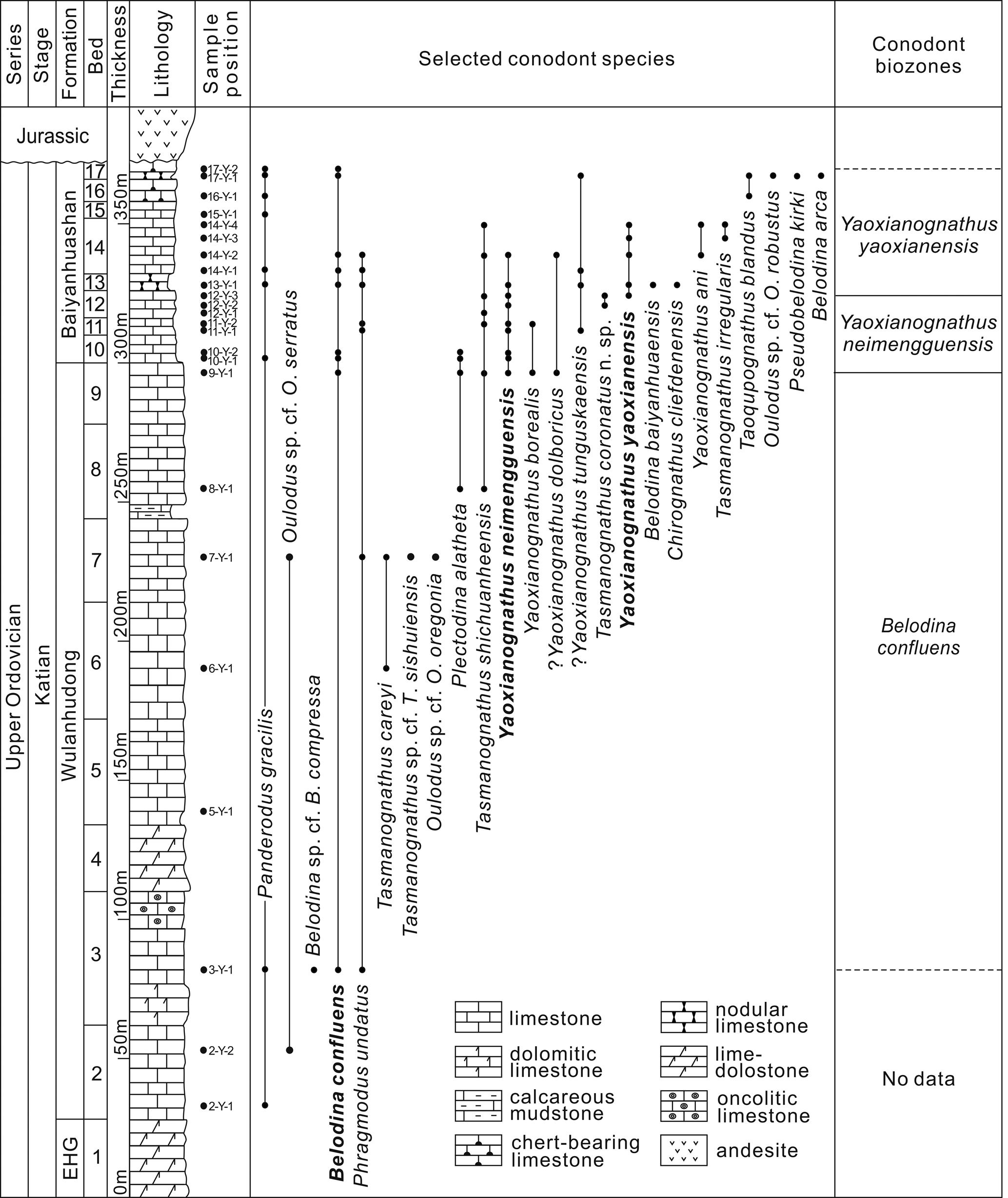
During a field trip in May 2014, 24 limestone samples were collected from the Baiyanhuashan section in the Dashetai area. This contribution documents the conodont fauna from the Baiyanhuashan section, based on the three successive conodont biozones of Katian age here recognized (Fig. 2). This zonation permits detailed biostratigraphic correlations between the Tropical Domain faunas of the Shallow-Sea Realm (Zhen and Percival, Reference Zhen and Percival2003).
Lithologic column, sample locations, and stratigraphical ranges of key conodont species at the Baiyanhuashan section. Stratigraphic distributions of biozonal index species are indicated in bold font. EHG = Er'hagong Formation.

Geological setting and lithostratigraphy
The NCC is one of the three major blocks of China and is also one of the major Archean cratons in the world. This craton is bounded to the north by the Central Asian Orogenic Belt and to the south by the Qinling-Dabie-Sulu Orogenic Belt (Fig. 1.1; Zheng et al., Reference Zheng, Xiao and Zhao2013). Tectonically, it has an Archean to Paleoproterozoic basement that is overlain by the Mesoproterozoic to Cenozoic cover (Zhao and Zhai, Reference Zhao and Zhai2013). During the Ordovician, the NCC was largely confined to the tropical zone near the equator and has been interpreted as a peri-Gondwanan terrane located along the northeastern Gondwanan margin and fringed by subduction-accretion complexes and island arcs (Metcalfe, Reference Metcalfe1996, Reference Metcalfe, Hall and Holloway1998, Reference Metcalfe2006; de Jong et al., Reference de Jong, Xiao, Windley, Masago and Lo2006). The NCC, which is now referred to as the North China Platform, was the site of shallow-water carbonate-dominated deposition, with Ordovician successions attaining 500–1,000 m in thickness (An et al., Reference An1983). The vast area of the interior North China Platform was covered by a shallow epicontinental sea at the beginning of the Ordovician, with deep-water marginal facies only preserved along its southwestern (An and Zheng, Reference An and Zheng1990; Feng et al., Reference Feng, Wang, Zhang, Zuo, Zhang, Zhang, Chen, Wu, Chen, Chi and Yang1990) and northern (Feng et al., Reference Feng, Wang, Zhang, Zuo, Zhang, Zhang, Chen, Wu, Chen, Chi and Yang1990; Zhang et al., Reference Zhang, Wang and Pan1991) margins. Ordovician sedimentation on the NCC was incomplete and significantly disrupted by a regional tectonic uplift, the Huaiyuan Epeirogeny (Zhen et al., Reference Zhen, Zhang, Wang and Percival2016a). In the Late Ordovician, seawater withdrew from nearly all of the North China Platform due to the epeirogeny, and left a large area that became uplifted land, i.e., the North China Land. Marine deposits of the Upper Ordovician occurred only in a narrow C-shaped belt around the northwestern, western, and southwestern margins of the NCC. During the early−middle Late Ordovician, the northwestern margin of the NCC was dominated by slope and marginal platform environments (Feng et al., Reference Feng, Wang, Zhang, Zuo, Zhang, Zhang, Chen, Wu, Chen, Chi and Yang1990, Reference Feng, Bao and Zhang1998, Reference Feng, Bao, Kang, Zhang, Tan, Li, Pang and Zhao1999, Reference Feng, Peng, Jin and Bao2004). During this time interval, a marginal platform environment prevailed in the Dashetai area (Zhang et al., Reference Zhang, Wang and Pan1991). Late Katian to Hirnantian deposits are missing in the study area at which mid-Katian limestones are overlain by andesites of Jurassic age (An and Zheng, Reference An and Zheng1990).
Upper Ordovician rocks are well exposed along the ridge of Baiyanhuashan Hill (i.e., the Baiyanhuashan section, 41˚00′15.61″N, 109˚16′14.05″E), which is 12 km east of Dashetai Township of Urad Qianqi (Urad Front Banner), Inner Mongolia. The Baiyanhuashan section is composed, in ascending and conformable order, of the Er'hagong, Wulanhudong, and Baiyanhuashan formations (Fig. 2). The Er'hagong Formation consists of 28 m thick, grayish, thick-bedded lime-dolostone. The Wulanhudong Formation of 273 m total thickness is a sequence mainly of gray thick-bedded limestone with intercalated oncolitic limestone beds. The Baiyanhuashan Formation is made up of gray thin-bedded limestone interbedded with thin-bedded nodular limestone. Limestone at the topmost part of the Baiyanhuashan Formation is somewhat silicified. Unfortunately, the carbonate-dominated Baiyanhuashan section has being quarried for limestone by the nearby Zhonglian (China-United) Cement Plant and has been almost totally destroyed in recent times (as observed through Google Earth). Material in the present paper is probably the last available for study of the Baiyanhuashan section—such a critical section for the Ordovician of North China.
Conodont biostratigraphy
Previous work
The Ordovician conodonts of the Baiyanhuashan section have been studied since the 1980s. Lin et al. (Reference Lin, Qiu and Xu1984) first reported the conodont fauna of this section and recognized two conodont assemblages in the Wulanhudong Formation and one conodont assemblage in the overlying Baiyanhuashan Formation; unfortunately, the authors did not find any conodonts in the stratigraphically oldest Er'hagong Formation of the section. The three conodont assemblages (authors’ original descriptions) are, in upward order, the Tasmanognathus careyi-Erismodus Assemblage, the Rhipidognathus neimengguensis-Oulodus subundulatus-Protopanderodus insculptus Assemblage, and the Belodina compressa-Panderodus gracilis Assemblage. These conodont assemblages were correlated with Fauna 7, Faunas 8–10, and Fauna 11 of Sweet et al. (Reference Sweet, Ethington and Barnes1971), respectively. Later, An and Zheng (Reference An and Zheng1990) and An (Reference An1993) documented the conodonts of the Baiyanhuashan section in more detail. These authors established six conodont biozones (authors’ original identifications) in the three formations of this section, i.e., from bottom to top, the Scandodus handanensis Biozone in the lower Er'hagong Formation, the Tasmanognathus sishuiensis-Erismodus typus Biozone ranging from the upper Er'hagong Formation to the lower Wulanhudong Formation, the Tasmanognathus shichuanheensis Biozone in the middle Wulanhudong Formation, the Tasmanognathus gracilis-Tasmanognathus multidentatus Biozone appearing in the upper Wulanhudong Formation, the Yaoxianognathus neimengguensis Biozone spanning the top part of the Wulanhudong Formation, and the Yaoxianognathus yaoxianensis Biozone covering the entire Baiyanhuashan Formation.
The previously published conodont biostratigraphic results have importance in regional correlations of the Ordovician strata. However, their zonal species are dominated by warm-water forms displaying strong endemism, making zonation rather difficult to globally correlate with well-established North American Midcontinent and Baltoscandian zonations. Furthermore, there are still some taxonomic uncertainties and debates arising from the earlier work. For example, Protopanderodus insculptus (Branson and Mehl, Reference Branson and Mehl1933), illustrated by Lin et al. (Reference Lin, Qiu and Xu1984, pl. 2, fig. 10), lacks any distinctive characters of that species, except for a superficially similar outline. The erect posterior denticle of the specimen figured by Lin et al. (Reference Lin, Qiu and Xu1984) is obviously different from those of the type specimens of Protopanderodus insculptus (Branson and Mehl, Reference Branson and Mehl1933, p. 124, pl. 10, figs. 32, 33), in which the posterior denticle is normally inclined.
Biozones in this study
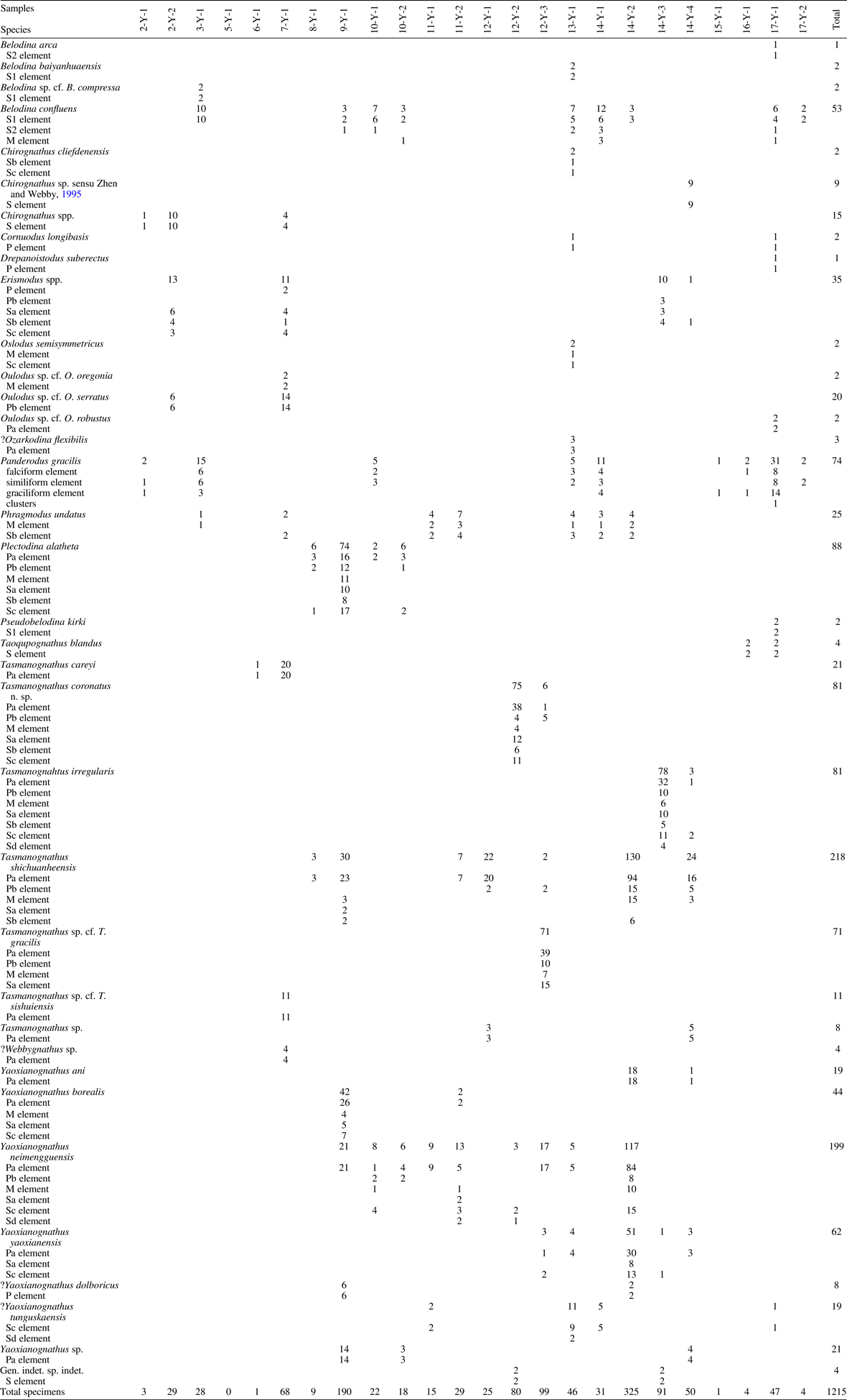
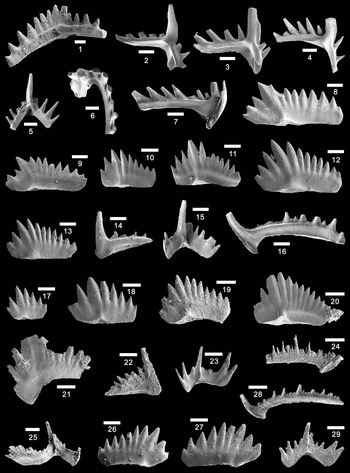
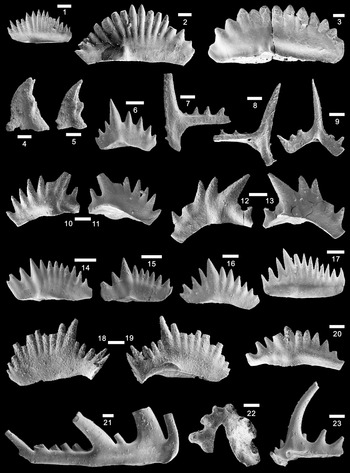
A total of 1,215 conodont specimens were obtained from the Wulanhudong and Baiyanhuashan formations, but conodonts were remarkably unevenly distributed in the samples (Table 1). Wulanhudong samples yielded an average of 16.3 specimens/kg, whereas the Baiyanhuashan samples yielded an average of 22.1 specimens/kg. The two most productive samples were from the topmost Wulanhudong Formation (sample 9-Y-1, 74.2 specimens/kg) and the upper part of the Baiyanhuashan Formation (sample 14-Y-2, 125 specimens/kg). Most of the obtained conodont specimens are in splendid state of preservation (Figs. 3–7); 36 species belonging to 17 genera (Table 1) were identified and three conodont biozones documented (Fig. 2). The biostratigraphic sequence concluded here includes, in ascending order, the Belodina confluens Biozone, the Yaoxianognathus neimengguensis Biozone, and the Yaoxianognathus yaoxianensis Biozone. This zonal succession is identical to the North China conodont biozones of Zhen et al. (Reference Zhen, Zhang, Wang and Percival2016a) and Bergström and Ferretti (Reference Bergström and Ferretti2017), except that the lower boundary of the B. confluens Biozone and the upper boundary of the Y. yaoxianensis Biozone are yet to be further defined due to data limitation (Fig. 2).
Conodont specimens from the Baiyanhuashan samples.

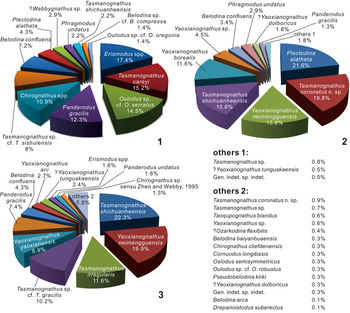
Relative abundances of conodont taxa in the Baiyanhuashan section: (1) the Belodina confluens Biozone; (2) the Yaoxianognathus neimengguensis Biozone; and (3) the Yaoxianognathus yaoxianensis Biozone.

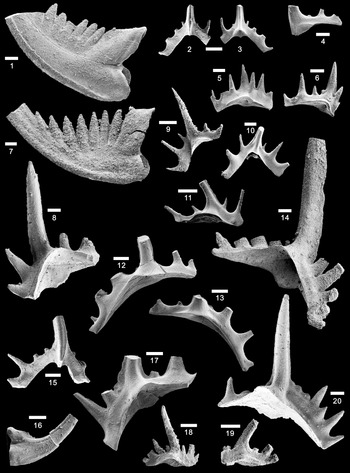
Katian conodonts of the NCC: (1–7) Plectodina alatheta An, Reference An1993: (1) Pa element, lateral view, sample 8-Y-1, CUGB_jxch 4008108; (2, 3) Pb elements, lateral views, sample 9-Y-1, CUGB_jxch 4009161, 4009183; (4) M element, lateral view, sample 9-Y-1, CUGB_jxch 40091115; (5) Sa element, posterior view, sample 9-Y-1, CUGB_jxch 4009182; (6) Sb element, oral view, sample 9-Y-1, CUGB_jxch 4009103; (7) Sc element, lateral view, sample 9-Y-1, CUGB_jxch 4009185. (8, 9) Yaoxianognathus ani Zhen et al., Reference Zhen, Webby and Barnes1999: Pa elements, lateral views, sample 14-Y-2, CUGB_jxch 4014287, 4014206. (10, 11) Yaoxianognathus sp.: Pa elements, lateral views, sample 9-Y-1, CUGB_jxch 4009171, 4009170. (12–16) Yaoxianognathus borealis (An in An et al., Reference An, Zhang and Xu1985): (12, 13) Pa elements, lateral views, sample 9-Y-1, CUGB_jxch 4009116, 40091120; (14) M element, lateral view, sample 9-Y-1, CUGB_jxch 4009184; (15) Sa element, posterior view, sample 9-Y-1, CUGB_jxch 4009188; (16) Sc element, lateral view, sample 9-Y-1, CUGB_jxch 4009138. (17–25) Yaoxianognathus neimengguensis (Qiu in Lin et al., Reference Lin, Qiu and Xu1984): (17–20) Pa elements, inner lateral views, samples 11-Y-2, 9-Y-1, 11-Y-2, 9-Y-1, CUGB_jxch 4011268, 40091126, 4011271, 4009104; (21) Pb element, outer lateral view, sample 10-Y-1, CUGB_jxch 4010108; (22) M element, lateral view, sample 11-Y-2, CUGB_jxch 4011262; (23) Sa element, posterior view, sample 12-Y-2, CUGB_jxch 4012248; (24) Sc element, inner lateral view, sample 10-Y-1, CUGB_jxch 4010109; (25) Sd element, posterior view, sample 11-Y-2, CUGB_jxch 4011257. (26–29) Yaoxianognathus yaoxianensis An in An et al., Reference An, Zhang and Xu1985: (26, 27) Pa elements, lateral views, sample 14-Y-2, CUGB_jxch 4014204, 4014218; (28) Sc element, lateral view, sample 12-Y-3, CUGB_jxch 40123107; (29) Sa element, posterior view, sample 14-Y-2, CUGB_jxch 4014229. Scale bars = 100 μm.

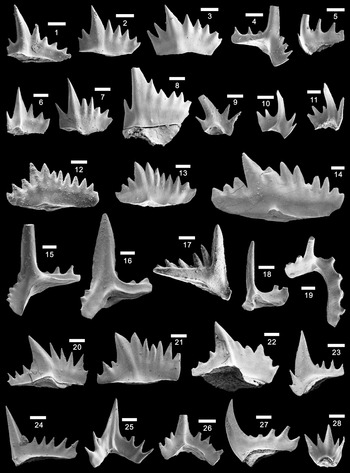
Katian conodonts of the NCC: (1–11) Tasmanognathus coronatus n. sp.: (1–3, 6–8) Pa elements, outer lateral views, sample 12-Y-2, CUGB_jxch 4012245, 4012249 (holotype), 4012221, 4012233, 4012214, 4012250; (4) Pb element, lateral view, sample 12-Y-3, CUGB_jxch 40123105; (5) Sc element, inner lateral view, sample 12-Y-2, CUGB_jxch 4012217; (9) M element, lateral views, sample 12-Y-2, CUGB_jxch 4012218; (10) Sa element, posterior view, sample 12-Y-2, CUGB_jxch 4012213; (11) Sb element, lateral view, sample 12-Y-2, CUGB_jxch 4012212. (12–19) Tasmanognathus shichuanheensis An in An et al., Reference An, Zhang and Xu1985: (12–14) Pa elements, lateral views, samples 14-Y-2, 14-Y-2, 14-Y-4, CUGB_jxch 4014205, 4014232, 4014472; (15, 16) Pb elements, lateral views, samples 12-Y-3, 14-Y-4, CUGB_jxch 40123106, 4014468; (17) M element, lateral view, sample 14-Y-2, CUGB_jxch 40142106; (18) Sa element, posterior view, sample 9-Y-1, CUGB_jxch 4009187; (19) Sb element, lateral view, sample 9-Y-1, CUGB_jxch 40091129. (20–28) Tasmanognathus irregularis (An, Reference An1993): (20–22) Pa elements, lateral views, sample 14-Y-3, CUGB_jxch 4014349, 4014348, 4014346; (23) Pb element, lateral view, sample 14-Y-3, CUGB_jxch 4014363; (24) M element, lateral view, sample 14-Y-3, CUGB_jxch 4014356; (25) Sa element, posterior view, sample 14-Y-3, CUGB_jxch 4014338; (26) Sb element, lateral view, sample 14-Y-3, CUGB_jxch 4014335; (27) Sc element, lateral view, sample 14-Y-3, CUGB_jxch 4014360; (28) Sd element, posterior view, sample 14-Y-3, CUGB_jxch 4014337. Scale bars = 100 μm.

Katian conodonts of the NCC: (1–3) ?Yaoxianognathus dorbolricus (Moskalenko, Reference Moskalenko1973), P elements, lateral views, sample 9-Y-1, CUGB_jxch 4009173, 4009179, 4009178. (4, 5) Taoqupognathus blandus An in An et al., Reference An, Zhang and Xu1985, S elements, lateral views, samples 16-Y-1, 17-Y-1, CUGB_jxch 4016101, 4017191. (6–9) Tasmanognathus sp. cf. T. gracilis An in An et al., Reference An, Zhang and Xu1985: (6) Pa element, lateral view, sample 12-Y-3, CUGB_jxch 40123112; (7) Pb element, lateral view, sample 12-Y-3, CUGB_jxch 40123104; (8) M element, lateral view, sample 12-Y-3, CUGB_jxch 40123108; (9) Sa element, posterior view, sample 12-Y-3, CUGB_jxch 40123103. (10–13) Tasmanognathus sp. cf. T. sishuiensis Zhang in An et al., Reference An, Zhang, Xiang, Zhang, Xu, Zhang, Jiang, Yang, Lin, Cui and Yang1983, Pa elements, lateral views, sample 7-Y-1, CUGB_jxch 4007146, 4007144. (14–17) Tasmanognathus sp.: (14, 15) Pa elements, lateral views, sample 12-Y-1, CUGB_jxch 4012199, 4012181; (16, 17) Pa elements, lateral views, sample 14-Y-4, CUGB_jxch 4014445, 4014477. (18, 19) ?Ozarkodina flexibilis Moskalenko, Reference Moskalenko1973, Pa element, lateral views, sample 13-Y-1, CUGB_jxch 40131127. (20) Tasmanongathus careyi Burrett, Reference Burrett1979, Pa element, lateral view, sample 7-Y-1, CUGB_jxch 4007143. (21, 22) ?Yaoxianognathus tunguskaensis (Moskalenko, Reference Moskalenko1973): (21) Sc element, lateral view, sample 13-Y-1, CUGB_jxch 40131133; (22) Sd element, oral view, sample 13-Y-1, CUGB_jxch 40131112. (23) Chirognathus sp. sensu Zhen and Webby, Reference Zhen and Webby1995, S element, lateral view, sample 14-Y-4, CUGB_jxch 4014446. Scale bars = 100 μm.

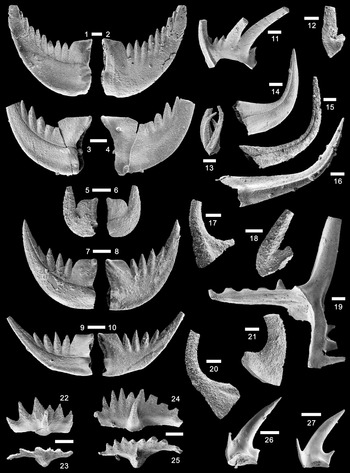
Katian conodonts of the NCC: (1, 2) Belodina sp. cf. B. compressa Branson and Mehl, Reference Branson and Mehl1933, S1 (compressiform) element, lateral views, sample 3-Y-1, CUGB_jxch 4003135. (3–10) Belodina confluens Sweet, Reference Sweet1979: (3, 4) S1 (compressiform) elements, lateral views, sample 3-Y-1, CUGB_jxch 4003126; (5, 6) M (eobelodiniform) element, lateral views, sample 10-Y-2, CUGB_jxch 4010278; (7, 8) S1 (compressiform) elements, lateral views, sample 9-Y-1, CUGB_jxch 4009181; (9, 10) S2 (grandiform) element, lateral views, sample 9-Y-1, CUGB_jxch 4009158. (11, 12) Phragmodus undatus Branson and Mehl, Reference Branson and Mehl1933: (11) Sb element, lateral view, sample 13-Y-1, CUGB_jxch 40131128; (12) M element, lateral view, sample 11-Y-2, CUGB_jxch 4011252. (13–16) Panderodus gracilis (Branson and Mehl, Reference Branson and Mehl1933): (13) clusters consist of graciliform, similiform, falciform and asimiliform elements, lateral view, sample 17-Y-1, CUGB_jxch 40171195; (14) falciform element, lateral view, sample 3-Y-1, CUGB_jxch 4003130; (15) similiform element, lateral view, sample 3-Y-1, CUGB_jxch 4003129; (16) graciliform element, lateral view, sample 3-Y-1, CUGB_jxch 4003127. (17, 18) Oslodus semisymmetricus (Hamar, Reference Hamar1966): (17) Sc element, lateral view, sample 13-Y-1, CUGB_jxch 40131122; (18) M element, lateral view, sample 13-Y-1, CUGB_jxch 40131126. (19) Erismodus sp., Sb element, posterior view, sample 7-Y-1, CUGB_jxch 4007137. (20) Cornuodus longibasis (Lindström, Reference Lindström1955), P element, lateral view, sample 17-Y-1, CUGB_jxch 4017187. (21) Drepanoistodus suberectus (Branson and Mehl, Reference Branson and Mehl1933), P element, lateral view, sample 17-Y-1, CUGB_jxch 4017181. (22–25) ?Webbygnathus sp., Pa elements, lateral and oral views, sample 7-Y-1, CUGB_jxch 4007147, 4007149. (26, 27) Gen. indet. sp. indet, S elements, lateral views, sample 12-Y-2, CUGB_jxch 4012231, 4012219. Scale bars = 100 μm.

Belodina confluens Biozone
The base and top of this biozone are defined by the first occurrences (FOs) of the nominate species Belodina confluens Sweet, Reference Sweet1979 (Fig. 7.3–7.10) and the zonal index species, Yaoxianognathus neimengguensis (Qiu in Lin et al., Reference Lin, Qiu and Xu1984) (Fig. 4.17–4.25), of the overlying biozone, respectively. The B. confluens Biozone covers the interval from 73−298 m above the base of the Baiyanhuashan section (Fig. 2). Besides the zonal species B. confluens, 12 other species co-occur within this biozone (Table 1). The composition of conodont taxa in the B. confluens Biozone is illustrated graphically herein (Fig. 3.1).
As reviewed by Sweet (Reference Sweet1988), some panderodontids with rastrate-element apparatuses had a great geographic range in the tropical zones. As a representative species of this family, Belodina confluens has been reported from North America (e.g., Sweet, Reference Sweet1979; Nowlan et al., Reference Nowlan, McCracken and Chatterton1988, Reference Nowlan, McCracken and McLeod1997; McCracken, Reference McCracken2000; Zhang and Barnes, Reference Zhang and Barnes2007; Zhang et al., Reference Zhang, Tarrant and Barnes2011; Zhang, Reference Zhang2011, Reference Zhang2013), Australia (Savage, Reference Savage1990; Trotter and Webby, Reference Trotter and Webby1994; Zhen and Webby, Reference Zhen and Webby1995; Zhen et al., Reference Zhen, Webby and Barnes1999, Reference Zhen, Percival and Farrell2003, Reference Zhen, Percival and Molloy2015, Reference Zhen, Wang and Percival2016b), North China (Yu and Wang, Reference Yu and Wang1986; An and Zheng, Reference An and Zheng1990; An, Reference An1993; Fu et al., Reference Fu, Hu, Zhang and Wang1993; Wang et al., Reference Wang, Bergström and Lane1996), Tarim (Zhao et al., Reference Zhao, Zhang and Xiao2000; Jing et al., Reference Jing, Du, Zhang, Zhang, Lu and Deng2007), South China (Pei and Cai, Reference Pei and Cai1987; Liu et al., Reference Liu, Wang, Zhang and Du1991; Wang, Reference Wang1993 [sensu his Belodina hongzeensis Duan, Reference Duan1990, p. 165, 166, pl. 38, figs. 13, 14 only]; Mei, Reference Mei1995; Jing et al., Reference Jing, Stouge, Ding, Wang and Zhou2017b), and Baltica (Viira, Reference Viira1974; Bergström, Reference Bergström1997; Männik, Reference Männik2017). It should be noted that the Baltica Paleoplate continued moving toward the equator during the Ordovician and reached low latitudes at the Katian (e.g., Torsvik and Cocks, Reference Torsvik and Cocks2017), therefore B. confluens was able to live in the shallow- and warm-water environments in the Central Baltic (Männik, Reference Männik2017).
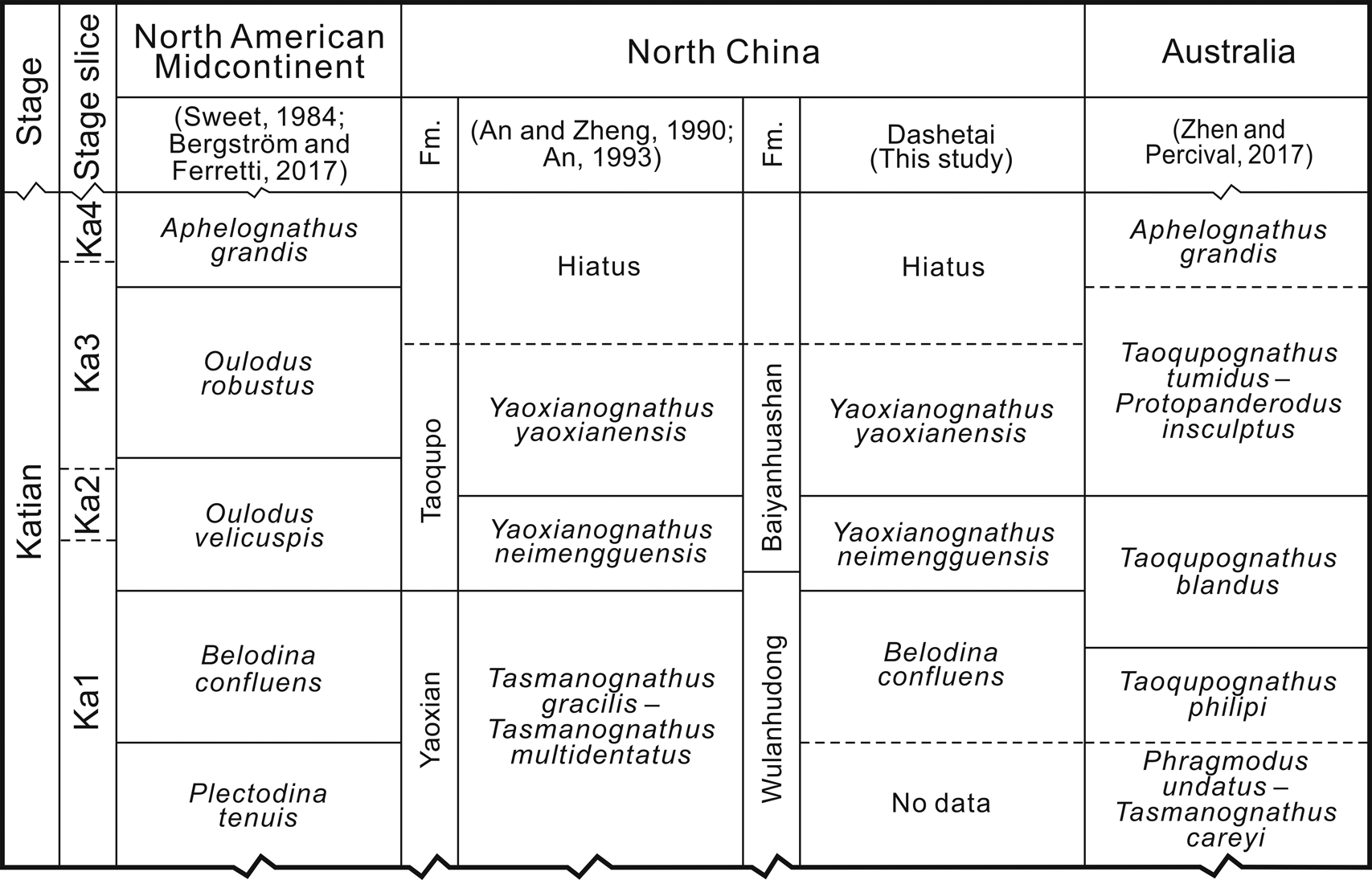
The B. confluens Biozone was first established in a paper on graphic correlation, in which a series of named zone units were introduced (Sweet, Reference Sweet and Bruton1984). Later, Sweet (Reference Sweet1988) referred to these zone units as biozones, and later, the zone units were treated as a standard reference of conodont biostratigraphic succession for the North America Midcontinent Province (Sweet and Bergström, Reference Sweet and Bergström1974, Reference Sweet and Bergström1984) to be widely used (Bergström and Ferretti, Reference Bergström and Ferretti2017). Wang et al. (Reference Wang, Bergström and Lane1996) recognized the Belodina confluens-Yaoxianognathus yaoxianensis Biozone in the Upper Ordovician strata of the western marginal area of the NCC. Whereas B. confluens occurs much lower stratigraphically than Y. yaoxianensis in all Upper Ordovician successions in North China (Wang et al., Reference Wang, Zhen, Zhang and Wu2016) and Tarim (Zhao et al., Reference Zhao, Zhang and Xiao2000; Jing et al., Reference Jing, Du, Zhang, Zhang, Lu and Deng2007). Subsequently, a stratigraphically older B. confluens Biozone and a younger Y. yaoxianensis Biozone were discriminated in the Chinese conodont zonal succession (e.g., Zhen et al., Reference Zhen, Zhang, Wang and Percival2016a; Bergström and Ferretti, Reference Bergström and Ferretti2017; Zhang et al., Reference Zhang, Zhan, Zhen, Wang, Yuan, Fang, Ma and Zhang2019).
In our material, no biostratigraphically useful conodonts were retrieved from the lower 73 m thick strata of the Baiyanhuashan section. An and Zheng (Reference An and Zheng1990) and An (Reference An1993) found Tasmanognathus sishuiensis Zhang in An et al., Reference An1983 and Erismodus typus Branson and Mehl, Reference Branson and Mehl1933 in the interval including the Er'hagong Formation and the lower part of the Wulanhudong Formation of the study section. These authors accordingly established the T. sishuiensis-E. typus Biozone for this stratigraphic interval, however, the correlations of this biozone were rather different. An and Zheng (Reference An and Zheng1990, Chart 4) correlated the T. sishuiensis-E. typus Biozone with the middle part of the Cahabagnathus sweeti Biozone to upper part of the Belodina compressa Biozone of the North American Midcontinent succession, whereas later, An (Reference An1993, Chart 1) compared the biozone with the upper part of the Plectodina aculeata Biozone and the Erismodus quadridactylus Biozone. In either case, it is implied that at least two biozones—the Phragmodus undatus Biozone and the Plectodina tenuis Biozone—of the North American Midcontinent succession were missed somewhere under the B. confluens Biozone (sample 3-Y-1) in the study section. Nevertheless, according to sedimentological (Zhang et al., Reference Zhang, Wang and Pan1991; Jiang, Reference Jiang2015) and paleontological evidence (An and Zheng, Reference An and Zheng1990; An, Reference An1993; this study), no distinct gaps can be observed in the lower part of the study section. Therefore, it can be inferred that the previous correlations were based on the FO of B. compressa in the lower part of the Wulanhudong Formation. In the Baiyanhuashan section, B. compressa has been found in only two levels by previous authors (An and Zheng, Reference An and Zheng1990; An, Reference An1993). Due to the rather short range, the FO of B. compressa in the study section by the previous study is certainly not the First Appearance Datum (FAD), which defines the base of the Interval Biozone (Salvador, Reference Salvador1994). Because E. typus has a similar stratigraphic range as that of E. quadridactylus (Stauffer, Reference Stauffer1935) (Bauer, Reference Bauer1994; Zhang et al., Reference Zhang, Barnes and Cooper2003), the T. sishuiensis-E. typus Biozone can be roughly correlated with the E. quadridactylus Biozone to the P. tenuis Biozone, and the lower 73 m thick strata of the Baiyanhuashan section are of middle Sandbian to most-early Katian age (Cooper and Sadler, Reference Cooper, Sadler, Gradstein, Ogg, Schmitz and Ogg2012).
Yaoxianognathus neimengguensis Biozone
The lower boundary of this biozone corresponds to the FO of Yaoxianognathus neimengguensis, whereas the upper boundary is defined by the FAD of Y. yaoxianensis An in An et al., Reference An, Zhang and Xu1985 (Fig. 4.26–4.29). The Y. neimengguensis Biozone spans the interval from 298−329.3 m above the base of the study section (Fig. 2). In total, 13 species were recorded in this biozone (Fig. 3.2; Table 1).
The Y. neimengguensis Biozone was erected by An and Zheng (Reference An and Zheng1990) to represent the biostratigraphic interval between the FADs of Yaoxianognathus neimengguensis and Y. yaoxianensis at the Taoqupo section in the Yaoxian County of Shaanxi Province, which is one of the most important Katian reference sections in North China. The eponymous species Y. neimengguensis has so far only been reported in the northern part of China, including North China (Lin et al., Reference Lin, Qiu and Xu1984; An and Zheng, Reference An and Zheng1990; An, Reference An1993; Wang et al., Reference Wang, Qi and Wu2011) and Tarim (Zhao et al., Reference Zhao, Zhang and Xiao2000; Jing et al., Reference Jing, Du, Zhang, Zhang, Lu and Deng2007; Wang et al., Reference Wang, Qi and Wu2011). However, the stratigraphical relationship between the B. confluens Biozone and the Y. neimengguensis Biozone is somewhat controversial. The view that the B. confluens Biozone is older than the Y. neimengguensis Biozone has been widely confirmed in North China (Wang et al., Reference Wang, Zhen, Zhang and Wu2016, Reference Wang, Zhen, Bergström, Zhang and Wu2018; Zhen et al., Reference Zhen, Zhang, Wang and Percival2016a; Bergström and Ferretti, Reference Bergström and Ferretti2017; Zhang et al., Reference Zhang, Zhan, Zhen, Wang, Yuan, Fang, Ma and Zhang2019; present study) and Tarim (Zhao et al., Reference Zhao, Tan, Tang and Xiao1999, Reference Zhao, Zhang and Xiao2000, Reference Zhao, Zhao and Huang2006). The opposing view that the B. confluens Biozone is younger than the Y. neimengguensis Biozone (Wang et al., Reference Wang, Qi and Wu2011) was primarily based on the material from the Taoqupo section (Wang and Luo, Reference Wang and Luo1984; An et al., Reference An, Zhang and Xu1985; An and Zheng, Reference An and Zheng1990; An, Reference An1993). It should be noted that in early literature (Wang and Luo, Reference Wang and Luo1984; An et al., Reference An, Zhang and Xu1985), all specimens of Belodina Ethington, Reference Ethington1959 obtained in the Yaoxian and Taoqupo formations of the Taoqupo section were referred to B. compressa and B. sp., but in later papers (An and Zheng, Reference An and Zheng1990; An, Reference An1993), B. spp. from the Taoqupo Formation (upper part) of the Taoqupo section were reassigned to B. confluens. Based on the reassignment, the FO of B. confluens is stratigraphically higher than that of Y. neimengguensis. Therefore, the biostratigraphic controversy of both the B. confluens Biozone and Y. neimengguensis Biozone reflects that there are identification problems for B. confluens and B. compressa in North China (see discussion under Systematic paleontology).
It is difficult to compare the Y. neimengguensis Biozone globally with the well-established North Atlantic and North American Midcontinent conodont zonations, owing to a lack of stratigraphically diagnostic pandemic conodonts and the strong endemism of short-ranging species in this biozone. In such circumstances, age constraints from its stratigraphically contacting conodont biozones become particularly important for paleontologic dating. Based on the age constraints of the datable, underlying B. confluens Biozone (see above) and overlying Y. yaoxianensis Biozone (see below), the Y. neimengguensis Biozone is thus considered correlated with the lower part of the Oulodus velicuspis Biozone of the North American Midcontinent succession.
Yaoxianognathus yaoxianensis Biozone
The base of this biozone is the FAD of Yaoxianognathus yaoxianensis (Fig. 4.26–4.29), but the top of the biozone is not precisely defined by using conodonts. Here, we follow An and Zheng (Reference An and Zheng1990) and An (Reference An1993) in placing the upper boundary of the Y. yaoxianensis Biozone at the top of the Baiyanhuashan Formation. The biozone occupies the interval from 329.3-377 m above the base of the Baiyanhuashan section (Fig. 2). Apart from the nominal species, another 26 species were recovered from this biozone (Table 1). The composition of conodont taxa in the Y. yaoxianensis Biozone is illustrated graphically herein (Fig. 3.3).
The Y. yaoxianensis Biozone was proposed by An et al. (Reference An, Zhang and Xu1985) and was originally considered a long-ranging biozone spanning the entire carbonate-dominated Taoqupo Formation at the Taoqupo section in Yaoxian County of Shaanxi Province, North China. Later, An and Zheng (Reference An and Zheng1990) and An (Reference An1993) identified another stratigraphically older biozone, the Y. neimengguensis Biozone, in the lower part of the Taoqupo Formation, hence the vertical range of the Y. yaoxianensis Biozone was revised to restrict it to the upper part of the Taoqupo Formation. The zonal index Y. yaoxianensis has a very wide geographical distribution inside China, but so far it has only been documented in China. Besides the Taoqupo section, the Y. yaoxianensis Biozone in North China has also been recognized in Longxian County (An and Zheng, Reference An and Zheng1990; An, Reference An1993; Wang et al., Reference Wang, Bergström and Lane1996, Reference Wang, Qi and Wu2011) and in Dashetai Township (An and Zheng, Reference An and Zheng1990; An, Reference An1993). Outside of North China, this biozone has been extensively reported at Tarim (Wang and Zhou, Reference Wang and Zhou1998; Zhao et al., Reference Zhao, Zhang and Xiao2000; Wang and Qi, Reference Wang and Qi2001; Jing et al., Reference Jing, Du, Zhang, Zhang, Lu and Deng2007; Wang et al., Reference Wang, Li, Wang, Ma, Yao, Huang and Zhang2009) and South China (An, Reference An1987; Liu et al., Reference Liu, Wang, Zhang and Du1991).
The Y. yaoxianensis Biozone is the youngest of Ordovician conodont biozones in North China (Wang et al., Reference Wang, Zhen, Zhang and Wu2016; Zhen and Percival, Reference Zhen and Percival2017), nevertheless its global correlations with well-documented successions in North America and Baltoscandia are still unsettled (Bergström and Ferretti, Reference Bergström and Ferretti2017; Zhang et al., Reference Zhang, Zhan, Zhen, Wang, Yuan, Fang, Ma and Zhang2019). The conodont assemblage of the Y. yaoxianensis Biozone in the Baiyanhuashan section shares a few characteristic taxa, e.g., Oulodus sp. cf. O. robustus (Branson et al., Reference Branson, Mehl and Branson1951), Belodina arca Sweet, Reference Sweet1979, and Pseudobelodina kirki (Stone and Furnish, Reference Stone and Furnish1959), with the Katian conodont faunas younger than the B. confluens Biozone in North America (Sweet, Reference Sweet1988), suggesting that the Y. yaoxianensis Biozone is mid-Katian in age (Cooper and Salder, Reference Cooper, Sadler, Gradstein, Ogg, Schmitz and Ogg2012).
Biostratigraphic correlations
As mentioned above, the strong endemism of most Katian conodont faunas on the North China Platform renders their correlations rather difficult and debatable. In comparison, the Baiyanhuashan conodont fauna includes more widely distributed and stratigraphically-diagnostic taxa, which facilitate the biostratigraphic correlations with the coeval conodont faunas inhabiting tropical shallow-water environments. In the current study, several conodonts (e.g., some species of Yaoxianognathus, Tasmanognathus, and Taoqupognathus An in An et al., Reference An, Zhang and Xu1985) are ubiquitous in China and Australia. In addition, the Baiyanhuashan fauna shares a few characteristic taxa, e.g., some species of Belodina, Oulodus Branson and Mehl, Reference Branson and Mehl1933, and Pseudobelodina Sweet, Reference Sweet1979, with contemporaneous faunas in Laurentia. Detailed regional and international correlations of the Baiyanhuashan conodont fauna have been discussed above (under Biozones), and the correlations are exhibited in Figure 9.
Katian conodonts of the NCC: (1) Pseudobelodina kirki (Stone and Furnish, Reference Stone and Furnish1959), S1 (compressiform) element, inner lateral view, sample 17-Y-1, CUGB_jxch4017198. (2–4, 9–11, 15, 17) Erismodus spp.: (2, 3) Sa element, anterior and posterior views, sample 2-Y-2, CUGB_jxch 4002216; (4) Sc element, lateral view, sample 2-Y-2, CUGB_jxch 4002207; (9) Pb element, lateral view, sample 14-Y-3, CUGB_jxch 4014341; (10) Sa element, posterior view, sample 14-Y-3, CUGB_jxch 4014344; (11) Sb element, lateral view, sample 14-Y-3, CUGB_jxch 4014357; (15) P element, anterior view, sample 7-Y-1, CUGB_jxch 4007139; (17) Sb element, lateral view, sample 2-Y-2, CUGB_jxch 4002220. (5, 6, 20) Chirognathus spp.: (5) S element, posterior view, sample 2-Y-2, CUGB_jxch 4002221; (6) S element, later view, sample 2-Y-1, CUGB_jxch 4002103; (20) S element, posterior view, sample 7-Y-1, CUGB_jxch 4007140. (7) Belodina arca Sweet, Reference Sweet1979, S2 (grandiform) element, inner lateral view, sample 17-Y-1, CUGB_jxch 4017196. (8) Oulodus sp. cf. O. oregonia (Branson et al., Reference Branson, Mehl and Branson1951), M element, posterior view, sample 7-Y-1, CUGB_jxch 4007138. (12, 13) Oulodus sp. cf. O. serratus (Stauffer, Reference Stauffer1930), Pb elements, lateral views, sample 2-Y-2, CUGB_jxch 4002204, 4002208. (14) Oulodus sp. cf. O. robustus (Branson et al., Reference Branson, Mehl and Branson1951), Pa element, lateral view, sample 17-Y-1, CUGB_jxch 4017199. (16) Belodina baiyanhuaensis Qiu in Lin et al.,1984, S1 (compressiform) element, lateral view, sample 13-Y-1, CUGB_jxch 40131123. (18, 19) Chirognathus cliefdenensis Zhen and Webby, Reference Zhen and Webby1995: (18) Sc element, lateral view, sample 13-Y-1, CUGB_jxch 40131129; (19) Sb element, lateral view, sample 13-Y-1, CUGB_jxch 40131132. Scale bars = 100 μm.

Conodont-based correlation of the Baiyanhuashan section with other Late Ordovician conodont successions established in North China, Australia, and the North American Midcontinent. Fm. = Formation; Ka = Katian.

Materials and methods
Twenty-four carbonate samples (Table 1) for conodonts were collected from the Wulanhudong and Baiyanhuashan formations through the Baiyanhuashan section. The average weight of the samples was ~2.5 kg. All of the samples were dissolved in a 10% solution of acetic acid. The disaggregate samples were washed through 20 mm and 160 mm mesh sieves, and then separated by inorganic heavy liquid at a density of ~2.84 g/cm3. Conodont specimens were photographed using a scanning electron microscope (SEM). Conodonts from the studied samples show Color Alteration Index (CAI) varying from 4 to 5, indicating a burial paleotemperature between 190°C and 300°C.
Most of the identified species in the present study have been described in previous publications, hence only three biostratigraphically significant taxa and three species (including a new species) are described below. Synonymy lists of the species documented herein emphasize the Chinese literature to provide some additional data for distribution of the species in China.
Repositories and institutional abbreviations
Specimens from the current study are housed in the School of Earth Sciences and Resources, China University of Geosciences (Beijing) (CUGB), Beijing, China. Other cited repositories are CAGSIG = Institute of Geology, Chinese Academy of Geological Sciences, Beijing; OSU = The Ohio State University, Columbus; PUG = Department of Geology, Peking University, Beijing, China; and UM = University of Missouri, Columbia.
Systematic paleontology
Class Conodonta Pander, Reference Pander1856
Subclass Conodonti Branson, Reference Branson1938
Genus Belodina Ethington, Reference Ethington1959
Type species
Belodus compressus Branson and Mehl, Reference Branson and Mehl1933 from the Plattin, Missouri, USA, by original designation.
Belodina sp. cf. B. compressa (Branson and Mehl, Reference Branson and Mehl1933)
Figure 7.1, 7.2
- Reference Branson and Mehl1933
cf. Belodus compressus Branson and Mehl, p. 114, pl. 9, figs. 15, 16.
- Reference An1983
cf. Belodina compressa; An et al., p. 79, pl. 25, figs. 13–15.
- Reference Moskalenko1983
cf. Belodina compressa; Moskalenko, fig. 3Q–S.
- Reference Leslie1997
cf. Belodina compressa; Leslie, p. 921, figs. 2.1–2.20, 3.1–3.4.
- Reference Zhen, Burrett, Percival and Lin2010
cf. Belodina compressa; Zhen et al., p. 49, fig. 3A, B.
Cotypes
UM C 101-4 and 77-5, Plattin, Upper Ordovician; Missouri, USA.
Occurrence
Sample 3-Y-1.
Materials
Two specimens.
Remarks
The difference between S1 (compressiform) elements of Belodina compressa and B. confluens has been fully discussed (Sweet, Reference Sweet1979, Reference Sweet and Ziegler1981; Leslie, Reference Leslie1997; Zhen et al., Reference Zhen, Percival and Webby2004, Reference Zhen, Percival and Molloy2015). That of B. compressa is prominently flattened for a short distance anterior to the anterior basal corner; in comparison, B. confluens is regularly curved near the anterior basal corner at the anterior margin. Although B. compressa has been reported extensively in China (An et al., Reference An, Zhang, Xiang, Zhang, Xu, Zhang, Jiang, Yang, Lin, Cui and Yang1983; Lin et al., Reference Lin, Qiu and Xu1984; Wang and Luo, Reference Wang and Luo1984; Yu and Wang, Reference Yu and Wang1986; Wang et al., Reference Wang, Bergström and Lane1996; Zhao et al., Reference Zhao, Zhang and Xiao2000), most of them cannot be confidently assigned to this species. Our collection morphologically corresponds to the S1 element of B. compressa figured by Leslie (Reference Leslie1997, figs. 2.5, 2.6), except that their short straight segments are less prominent.
Belodina confluens Sweet, Reference Sweet1979
Figure 7.3–7.10
- Reference Bergström and Sweet1966
Belodina compressa (Branson and Mehl, Reference Branson and Mehl1933); Bergström and Sweet, p. 312, pl. 31, figs. 12–19.
- Reference Sweet1979
Belodina confluens Sweet, p. 59, figs. 5.10, 5.17, 6.9.
- Reference Lin, Qiu and Xu1984
Belodina compressa; Qiu in Lin et al., pl. 2, fig. 9.
- Reference Wang and Luo1984
Belodina compressa; Wang and Luo, p. 253, pl. 6, fig. 17.
- Reference Wang and Luo1984
Belodina confluens; Wang and Luo, p. 253, pl. 6, figs. 3, 4.
- Reference Yu and Wang1986
Belodina compressa; Yu and Wang, p. 100, pl. 2, figs. 4, 5, 7, 16, 20.
- Reference Yu and Wang1986
Belodina confluens; Yu and Wang, p. 101, pl. 1, figs. 3, 14, 15, pl. 2, figs. 6, 8, 12.
- Reference An1993
Belodina confluens; An, pl. 7, fig. 17.
- Reference Fu, Hu, Zhang and Wang1993
Belodina confluens; Fu et al., p. 78, pl. 1, fig. 16.
- Reference Fu, Hu, Zhang and Wang1993
Belodina stonei Sweet, Reference Sweet1979; Fu et al., p. 78, pl. 1, fig. 17.
- Reference Trotter and Webby1994
Belodina confluens; Trotter and Webby, p. 481, pl. 2, figs. 18–20, 24, 25, 27–30.
- Reference Zhao, Zhang and Xiao2000
Belodina confluens; Zhao et al., p. 191, pl. 49, figs. 4–13.
- Reference Jing, Du, Zhang, Zhang, Lu and Deng2007
Belodina confluens; Jing et al., pl. 1, figs. 15, 16.
- Reference Zhen, Percival and Molloy2015
Belodina confluens; Zhen et al., p. 92, fig. 4.b–4.g.
Holotype
OSU 27414, Lexington Limestone, Upper Ordovician; Kentucky, USA (Bergström and Sweet, Reference Bergström and Sweet1966, pl. 31, figs. 14–16).
Occurrence
Samples 3-Y-1, 9-Y-1, 10-Y-1, 10-Y-2, 13-Y-1, 14-Y-1, 14-Y-2, 17-Y-1, and 17-Y-2.
Materials
Fifty-three specimens.
Remarks
As noted above in the remarks under Belodina compressa, differentiation between B. compressa and B. confluens in North Chinese material are somewhat confused. Specimens of B. compressa identified by Qiu in Lin et al. (1984, pl. 2, fig. 9), by Wang and Luo (Reference Wang and Luo1984, pl. 6, fig. 17), and by Yu and Wang (Reference Yu and Wang1986, pl. 2, fig. 4, 5, 7, 16, 20) have regularly curved anterior margins, thus are referred to B. confluens herein. Differing numbers of denticles along the posterior margin of the S1 and S2 elements of B. confluens were interpreted as variation (Zhen et al., Reference Zhen, Webby and Barnes1999, Reference Zhen, Zhang, Wang and Percival2015).
Genus Tasmanognathus Burrett, Reference Burrett1979
Type species
Tasmanognathus careyi Burrett, Reference Burrett1979 from the Everlasting Hills, Tasmania, Australia. Zhen et al. (Reference Zhen, Burrett, Percival and Lin2010) revised the species based on a larger collection including the types.
Tasmanognathus coronatus new species
Figures 5.1–5.11, 10
Holotype
CUGB_jxch 4012249 (Fig. 5.2), Baiyanhuashan Formation, Baiyanhuashan section, Katian Stage, Upper Ordovician; Dashetai Township, Inner Mongolia, China.
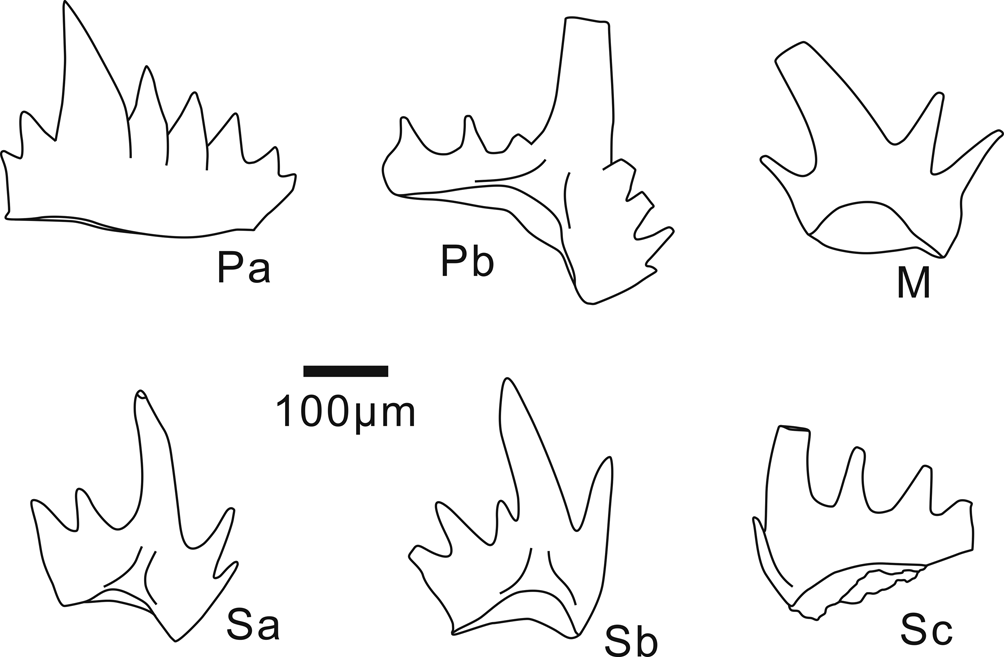
Elements of Tasmanognathus coronatus n. sp.

Diagnosis
A seximembrate apparatus; anterior and posterior processes of all elements relatively short; Pa element cusp stretched and reclined; Pb, M, and S elements bearing widely spaced denticles.
Occurrence
Samples 12-Y-2 and 12-Y-3.
Description
Pa element carminate and crown-shaped in lateral view. Cusp proclined with laterally compressed cross section, approximately twice as large as adjacent anterior denticle. Anterior process relatively long, bearing 3–6 basally confluent denticles; posterior process rather short with one or two discrete denticles. Basal cavity shallow and open, flared laterally and extended toward distal end of anterior and posterior processes, forming shallow tapering groove.
Pb element angulate. Cusp prominent and suberect; anterior and posterior processes subequal in length; anterior process extending downward. Angle between anterior and posterior processes ~110°. Basal cavity expanded under cusp but narrowly extending underneath the anterior and posterior processes forming two shallow grooves.
M element angulate. Cusp anterolaterally compressed and slightly proclined. Two separated slender denticles on anterior process and one small denticle on posterior process. Basal cavity open and expanded beneath cusp.
Sa element alate. Cusp recurved with two sharp lateral edges. Lateral processes with two or three widely-spaced denticles. Basal cavity open but small.
Sb element bipennate. Anterolateral process short with one denticle. Posterolateral process relatively long, bearing three denticles.
Sc element bipennate. Cusp recurved, with sharp costa on anterior edge. Anterior process laterally bent, bearing one small denticle. Posterior process long and straight, with at least three widely spaced denticles. Basal cavity narrow and small.
The ratio between these elements is ~10:2:1:3:2:3 in the apparatus.
Etymology
From the Latin coronatus meaning crown.
Materials
Eighty-one specimens.
Remarks
The apparatus of this species is morphologically similar to that of Tasmanognathus sishuiensis. Elements of both species have short processes and widely spaced peg-like denticles. The main difference between them is that the Pa element of Tasmanognathus coronatus n. sp. has a prominent separated cusp and relatively straight basal margin, whereas processes of the Pb element of Tasmanognathus coronatus n. sp. are much longer than those of Tasmanognathus sishuiensis. M and S elements of Tasmanognathus coronatus n. sp. and Tasmanognathus sishuiensis are closely similar, suggesting that the new species has obvious affinities with the latter.
Tasmanognathus irregularis (An, Reference An1993)
Figures 5.20–5.28, 11
- Reference An1993
Leptochirognathus irregularis An, p. 106, pl. 8, fig. 15.
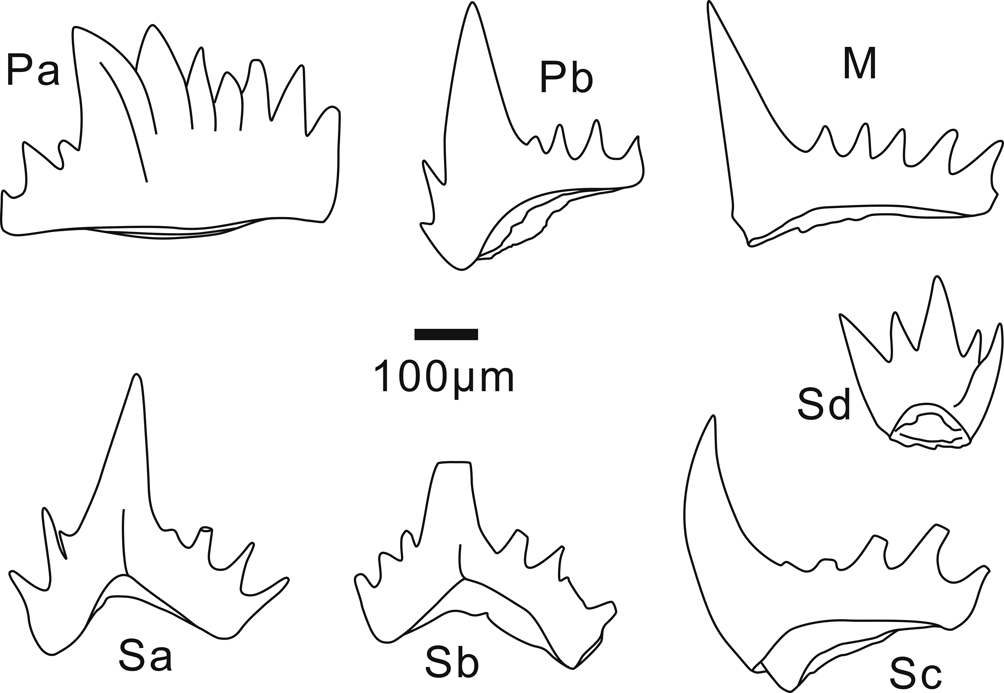
Elements of Tasmanognathus irregularis (An, Reference An1993).

Holotype
PUG 85815, Badou Member, Fengfeng Formation, Upper Ordovician; Handan City, Hebei Province, China (An, Reference An1993, pl. 8, fig. 15).
Diagnosis
A septimembrate apparatus; Pa element bearing robust, closely-spaced, irregularly-sized denticles on anterior process. Denticles widely spaced on posterior processes of all seven elements.
Occurrence
Samples 14-Y-3 and 14-Y-4.
Description
Pa element with prominent, erect, robust cusp. Anterior process long and high, bearing 4–6 closely-spaced, irregularly-sized denticles. Posterior process short and low, with 1–3 widely spaced denticles. Basal cavity strongly flared beneath cusp and narrowly extended below anterior and posterior processes. Most speciemens of this element with basal funnel attached (Fig. 5.20, 5.22). Strong carina developing at inner side of cusp in senile specimens (Fig. 5.22).
Pb element with erect, robust, laterally compressed cusp, and short anterior process bearing two or three discrete, fragile denticles. Posterior process straight, bearing three or four widely-spaced denticles. Cusp approximately four times as large as adjacent denticles.
M element with proclined robust cusp and denticulate posterior process. Denticles on posterior process discrete and gradually larger distally, varying from five to six in number.
Sa element with strong cusp with broad carina on anterior face and narrow carina on posterior face. Two lateral processes bearing three or four widely spaced denticles. Significantly assymetrical with short anterolateral process bearing three denticles and relatively long but slender posterolateral process bearing at least four denticles. With a suberect to recurved cusp, and denticulate posterior process bearing 5–7 denticles. Size of denticles gradually increasing distally, but terminal denticle getting smaller again.
Sd element asymmetrical, with inconspicuous cusp and two denticulate lateral processes bearing two or three denticles on each side. Denticles on lateral processes becoming gradually larger distally.
Ratios among these elements ~ 8:3:2:3:1:3:1 in the apparatus.
Materials
Eighty-one specimens.
Remarks
The species was originally assigned to the genus Leptochirognathus Branson and Mehl, Reference Branson and Mehl1943 based on a single fragmentary specimen of a Pa element (An, Reference An1993, pl. 8, fig. 15; holotype). Our specimens of the Pa element resemble the holotype in having a robust cusp and irregular anterior denticles. Based on a large collection of this species in the present study, a septimembrate apparatus can be reconstructed. The species is referred to Tasmanognathus because it has widely spaced denticles on the Pb, M, and S elements and lacks prominent basal rims.
Genus Yaoxianognathus An in An et al., Reference An, Zhang and Xu1985
Type species
Yaoxianognathus yaoxianensis An in An et al., Reference An, Zhang and Xu1985 from the Taoqupo Formation, Yaoxian County, Shaanxi Province, China.
Remarks
An et al. (Reference An, Zhang and Xu1985) proposed a quinquimembrate skeletal apparatus for the type species Yaoxianognathus yaoxianensis. Shortly afterward, Savage (Reference Savage1990) presented a seximembrate skeletal apparatus for Y. wrighti Savage, Reference Savage1990. Zhen et al. (Reference Zhen, Webby and Barnes1999) subsequently recognized a septimembrate apparatus for Y. ani Zhen et al., Reference Zhen, Webby and Barnes1999, including a carminate Pa, an angulate Pb, an angulate M, an alate Sa, a bipennate Sb, a dolabrate Sc, and a digyrate Sd element. Besides a close relationship with Tasmanognathus, this genus shares several morphological characters with Ozarkodina Branson and Mehl, Reference Branson and Mehl1933, but the latter normally lacks hindeodellid denticles on the processes of the S elements.
Yaoxianognathus neimenguensis (Qiu in Lin et al., Reference Lin, Qiu and Xu1984)
Figure 4.17–4.25
- Reference Lin, Qiu and Xu1984
Rhipidognathus neimengguensis Qiu in Lin et al., p. 102, pl. 2, figs. 1, 4, 5 (non 2, 3).
- Reference Zhao, An, Qiu, Wan and Ding1984
Rhipidognathus neimengguensis; Qiu in Zhao et al., p. 234, pl. 94, figs. 23–27, pl. 95, figs. 4–7, 10, 14, 15, 18, 19, 31.
- Reference An and Zheng1990
Yaoxianognathus neimenguensis; An and Zheng, p. 213, pl. 11, fig. 5, text-fig. 10.3.
- Reference An1993
Yaoxianognathus neimenguensis; An, p. 166, pl. 3, figs. 9, 10, 13–15 only.
- ?Reference Zhao, Zhang and Xiao2000
Yaoxianognathus lijiapoensis (Wang and Luo, Reference Wang and Luo1984); Zhao et al., p. 231, pl. 47, fig. 22 only.
Holotype
CAGSIG Bai 11–4, Wulanhudong Formation, Upper Ordovician; Dashetai Township, Inner Mongolia, China (Qiu in Lin et al., Reference Lin, Qiu and Xu1984, pl. 2, fig. 1).
Occurrence
Samples 9-Y-1, 10-Y-1, 10-Y-2, 11-Y-1, 11-Y-2, 12-Y-2, 12-Y-3, 13-Y-1, and 14-Y-2.
Materials
One hundred and ninety-nine specimens.
Remarks
Qiu (in Lin et al., Reference Lin, Qiu and Xu1984) coined Rhipidognathus neimengguensis from the Baiyanhuashan section based on a single Pa (ozarkodiniform) element. Later, An and Zheng (Reference An and Zheng1990) and An (Reference An1993) added the Pb (prioniodiniform) element to the apparatus and reassigned the species to the genus Yaoxianognathus. They further demonstrated that Y. neimengguensis can be discriminated from other Yaoxianognathus species by the number of small denticles between regularly arranged large denticles on the posterior process of the Pb element (see An and Zheng, Reference An and Zheng1990, text-fig. 10). The Pa element of Y. lijiapoensis from Tarim (Zhao et al., Reference Zhao, Zhang and Xiao2000, pl. 47, fig. 22) is rather short with a small and slightly inclined cusp, and is closely related to the type of Y. neimengguensis. The Pa, Pb, M, Sa, and Sd elements obtained in the Baiyanhuashan section were described in detail by Yang et al. (Reference Yang, Jing, Wang, Zhou and Ren2019).
Yaoxianognathus yaoxianensis An in An et al., Reference An, Zhang and Xu1985
Figure 4.26–4.29
- Reference Wang and Luo1984
Spathognathodus dolboricus Moskalenko, Reference Moskalenko1973; Wang and Luo, p. 284, pl. 10, figs. 4, 5, 8, 20.
- Reference An, Zhang and Xu1985
Yaoxianognathus yaoxianensis An in An et al., p. 106, pl. 2, figs. 1–7.
- Reference Yu and Wang1986
Spathognathodus dolboricus; Yu and Wang, p. 103, pl. 1, figs. 21, 24, pl. 2, figs. 9, 13.
- Reference An1987
Yaoxianognathus yaoxianensis; An, p. 196, pl. 28, figs. 1–6.
- Reference Wang, Li, Wang, Ma, Yao, Huang and Zhang2009
Yaoxianognathus yaoxianensis; Wang et al., p. 109, pl. 2, figs. 17–20.
- Reference Wang, Qi and Wu2011
Yaoxianognathus yaoxianensis; Wang et al., p. 266, pl. 128, figs. 2–14, pl. 168, fig. 8.
- Reference Jing, Stouge, Ding, Wang and Zhou2017b
Yaoxianognathus yaoxianensis; Jing et al., p. 25, figs. 21–15.
Holotype
PUG 84524, Taoqupo Formation, Upper Ordovician; Yaoxian County, Shaanxi Province, China (An in An et al., Reference An, Zhang and Xu1985, pl. 2, fig. 4).
Occurrence
Samples 12-Y-3, 13-Y-1, 14-Y-2, 14-Y-3, and 14-Y-4.
Materials
Sixty-two specimens.
Remarks
An's (in An et al., Reference An, Zhang and Xu1985) original definition suggests that Yaoxianognathus yaoxianensis is characterized by an upturned basal curve at the posterior part of the Pa element in lateral view, and by hindeodellid denticles on the processes of the S elements. In the present collection, only Pa, Sa, and Sc elements were obtained. The Sc element shows the main features of Y. yaoxianensis as defined by An (in An et al., Reference An, Zhang and Xu1985). The cusp and denticles of the present specimens assigned to the Pa elements are not as reclined as those of the holotype (An et al., Reference An, Zhang and Xu1985, pl. 2, fig. 6), but closely resemble those illustrated by Wang et al. (2009, pl. 2, figs. 17–20). The present material likely represents a primitive form of Y. yaoxianensis.
Conclusions
Katian conodonts and conodont biostratigraphy of the Wulanhudong and Baiyanhuashan formations in the Baiyanhuashan section were investigated. A new species and a poorly-known species are described in detail, and four biostratigraphically diagnostic species are discussed. The Baiyanhuashan conodont fauna is composed mainly of endemic species, but is associated with a few cosmopolitan and widespread taxa. The widely distributed conodonts in the present collection facilitate a precise interregional biostratigraphic correlation of the Baiyanhuashan succession.
Three conodont biozones—in ascending order, the B. confluens Biozone, the Y. neimengguensis Biozone, and the Y. yaoxianensis Biozone—are recognized in the study section. The conodont sequence can be correlated with the biostratigraphic intervals from the P. tenuis Biozone to the Oulodus robustus Biozone of the North American Midcontinent succession, from the Taoqupognathus philipi Biozone to the Taoqupognathus tumidus-Protopanderodus insculptus Biozone of the Australian succession.
Acknowledgments
This study was supported by the National Natural Science Foundation of China (grant 41502026, 41702023), the ‘973-Program’ project of China (grant 2011CB403001), State Key Laboratory of Palaeobiology and Stratigraphy (Nanjing Institute of Geology and Palaeontology, Chinese Academy of Sciences; grant 173122) and the Fundamental Research Funds for the Central Universities (grant 53200759040). Z.T. Wang, C.P. Bian, C.F. Gao, B. Jiang, and Q. Fang from China University of Geosciences (Beijing) are warmly thanked for assistance during the field trip and the subsequent acid leaching of samples. We are indebted to S. Agematsu from University of Tsukuba (Japan) and S.X. Zhang from Natural Resources Canada for providing important conodont literature. Y.Y. Zhen, A. Ferretti, and S.A. Leslie are gratefully acknowledged for constructive criticism and comments that improved the manuscript significantly. This paper is a contribution to the International Geoscience Programme (IGCP) Project 653, ‘The onset of the Great Ordovician Biodiversification Event.’