


The summer of 1617 severely tested the limits of diplomatic accord between Venice and England. Antonio Foscarini, former Venetian ambassador to England, was languishing in a Venetian prison on charges of treasonous and otherwise criminal conduct. Also imprisoned and awaiting trial was Foscarini's former secretary, Giulio Muscorno, accused of equally serious transgressions. Foscarini's former valet, Ottavio Robbazzi, had likewise been arrested and tried for treasonous acts against the Republic. The English ambassador to Venice, Henry Wotton, had been entrusted to recover a debt that Muscorno owed to an Englishman, but in August both Italian and English magistrates were dismayed to discover Wotton attempting to pocket the sum for himself and accepting secret bribes from foreign governments. Never more ironic was Wotton's 1612 declaration to the Venetian ambassador in Savoy: ‘I swear to God, we are all good Venetians.’Footnote 1 Perhaps unbeknownst to Foscarini, Wotton and their employees, each of these diplomatic disasters could be traced back to one ‘good Venetian’ in particular: Angelo Notari (1566–1663), a singer, lutenist and composer from Padua who had immigrated to England about a decade earlier. Notari had shown no loyalty to his Italian compatriots in London. He had sold them out to the Venetian government for 50 ducats and a new source of income.
In musicological scholarship, Notari is credited with introducing a great deal of Italian music into seventeenth-century England, from early violin sonatas to theorbo-accompanied monody and madrigals. Studies on Notari have centred on his autograph music manuscripts and Prime musiche nuove (London: Engraved by W. Hole, 1613), only occasionally venturing into speculation that he might have been a spy for Spain in the early 1620s. These studies do not detail any of Notari's intelligence activities.Footnote 2 Thanks to a robust collection of Venetian counterintelligence papers in the Archivio di Stato di Venezia (henceforth ASV) previously neglected by musicologists, I here confirm that Notari was indeed employed as an intelligencer. More specifically, between 1616 and 1619 he served as an informant for the State Inquisitors of Venice, a small but powerful governing body that investigated threats to state security.
Documents giving evidence of Notari's intelligence work for Venice are gathered within three buste in the ASV: Inquisitori di Stato 155, 156 and 442. These have been studied almost exclusively by political historians, a few of whom have mentioned, to quote the historian Paolo Preto, ‘Angelo Nodari, a musician from Padua recommended by the Inquisitors as “very willing to render good services” but in fact poor, devious, and too friendly with the Spanish ambassador’.Footnote 3 No explicit connection has been drawn between this ‘Nodari’ – as his name is spelled in the Venetian sources – and Notari, the well-known composer and performer active in the English court of King James I. Until now ‘Nodari’ has never been closely studied, and the little information that political historians have gleaned about him comes directly from Venetian state papers. Meanwhile Notari's musicological biographers, who have prioritised archival materials in the United Kingdom, have been unable to account for his activities between approximately 1613 and 1618. The main Venetian counterintelligence affair that occupied Notari during this time, the Foscarini–Muscorno trial, was steeped in music at every turn and involved a number of different musicians as both suspects and witnesses, but the significance of music-making to the case has never been analysed.Footnote 4 A comprehensive study of the trial's roughly 1,000 pages of legal documentation remains to be written.Footnote 5
In examining the events of the Foscarini–Muscorno case and Notari's participation in the affair, I contend that Notari's identity as an intelligencer and former Venetian citizen should be taken into greater account in scholarship on his work as a musician. I also argue that during Foscarini's embassy to England and subsequent trial in Venice, Italian musicians in London were a remarkably prominent voice in their expatriate community and exerted a high degree of influence over international relations. Music-making was a means to acquire intelligence and forge powerful political connections, and yet, it could also be reported as a criminal offence. The Foscarini–Muscorno case is more than a chapter in Anglo-Venetian diplomatic history: it is also a story about unreliable musical patronage, music-making as a transgressive political act and friction between both professional and amateur musicians. In addition, I suggest that Notari probably encountered the one Spanish canzonetta printed in Prime musiche nuove as a result of his association with the Spanish embassy in London.
Consideration of music's role in the Foscarini–Muscorno trial reveals new biographical information on Notari, but it also offers valuable insights into early modern surveillance and mobility. Notari's deep involvement in the case attests to how thoroughly London's musical and diplomatic communities intermingled, as well as the general interconnectedness of the city's foreign inhabitants. Foreign musicians in London regularly passed through embassies to socialise, obtain information or seek out employment. A portrait emerges of a complex, close-knit group of Italian residents in London who juggled multiple occupations and orbited the Venetian embassy, vacillating between supporting and sabotaging one another. Accomplished foreign musicians could primarily serve as government employees, their allegiances shifting quickly according to the promise of personal gain. As a result, the actions of – and rivalries between – musicians could bear greatly upon international criminal proceedings in the highest echelons of government.
Notari's intelligence activities also demonstrate how early modern immigrants could retain a tangible connection to their place of origin in spite of their physical displacement. Through continued interaction with fellow Italians abroad, Notari opened up a mutually advantageous stream of communication between himself and the Venetian government, turning to the Republic for financial support that he was struggling to find in England. Notari is typically studied by scholars of English music, but he spent about half of his life in the Veneto before emigrating for unknown reasons. Next to nothing is known about the earlier years of his career. These lacunae, along with Notari's later work for the Venetian embassy and secret services, complicate his traditional relegation to histories of English music. He may have relocated to England and set his sights on employment at the Jacobean court, but he never truly severed ties with Venice. While Notari was transporting the sounds of his musiche nuove from the Veneto to London, he was also sending something else back home.
MUSICIANS, EMBASSIES AND ESPIONAGE
Notari was in good company when he volunteered his services as an informant for Venice in 1616. Intelligence work was integral to the careers of many musicians and other artists at the turn of the seventeenth century. Political upheaval and fluctuating networks of patronage drove musicians to pursue employment as intelligence operatives or at least cultivate the skills needed to qualify for such work. Since they could enter exclusive spaces inhabited by political elites and tap into far-reaching professional networks, musicians were optimal candidates for employment in intelligence.Footnote 6
Musicological studies of early modern musician-intelligencers tend to track the movements of well-known professional composers who moonlighted as intelligence operatives.Footnote 7 Though I focus on Notari, records of his intelligence work move beyond this composer-as-spy paradigm in that some government officials involved in the Foscarini–Muscorno case were musicians themselves. From high-profile diplomats to freelance agents, intelligencers of all varieties made music as part of their daily lives. Wotton played the viola da gamba, and a few of his embassy staffers were musicians as well.Footnote 8 Foscarini might have played the guitar. Most relevant to Notari, Muscorno was an exceptionally talented singer, lutenist and possibly guitarist. The musical activities of such dilettanti are critical to the histories of both musical transculturation and international relations.
In taking seriously the music-making of politicians, I follow the lead of recent interdisciplinary studies that establish intersections between cultural and political brokerage as vital to early modern diplomacy, surveillance and artistic production. My examination of the embassy as a site of musical production responds to recent calls for a ‘new diplomatic history’ that have opened up more extensive dialogue between cultural and diplomatic historians. This shift has begun to recognise official state representatives and their more independent intermediaries as equally significant to the history of diplomacy.Footnote 9 The Venetian embassy to England extended far beyond Foscarini as a singular political figure; no aspect of his mission was untouched by the many people and material objects that filtered through his ambassadorial household.
Most scholarship on Elizabethan and Jacobean musician-intelligencers concerns the English secret service, but Notari answered to the Venetian State Inquisitors and Council of Ten, albeit indirectly through the Venetian embassy in London. In contrast to English aristocratic spy rings, the Venetian secret service was centrally organised by the government. Founded in 1310, The Council of Ten oversaw all Venetian intelligence operations and handled some diplomatic and military affairs as well. Along with the Collegio, the Ten maintained almost complete control over the Republic. The Ten was made up of seventeen voting members: the doge, six ducal councillors and ten senators. Originally named the ‘Inquisitors against the Disclosures of Secrets’, the Inquisitors of State were a subordinate counterintelligence committee founded in 1539 and composed of two senators and one ducal councillor, all drawn from the Ten.Footnote 10
By Notari's time the Venetian empire had developed into a global information centre that promoted secrecy and counterintelligence as state virtues. ‘Spying’ in early modern Venice encompassed all forms of information-gathering for the sake of state security. Most Venetian politicians were obligated to acquire intelligence for the Republic, while ordinary citizens were invited and occasionally incentivised to speak up about any potential threats to the Serenissima. Ambassadors like Foscarini were expected to manage their own rings of informants and submit regular reports back home. Venetian civilians of various backgrounds and occupations were likewise encouraged to report any suspicious activity that they encountered. These amateur snoops could convey their findings to the Venetian authorities by dropping notes into designated postboxes shaped like lions’ mouths, known as bocche di leone. At times, civilians inundated the secret service with so many baseless reports that the influx of intelligence grew too heavy for the government to manage. In keeping with the Venetian empire's history as a nexus of global trade, the Ten also solicited information from the public by treating intelligence as a commercial transaction. They promised a select number of private citizens financial compensation and other rewards in exchange for information.Footnote 11
As Ioanna Iordanou has argued, by engaging civilians in government surveillance, Venice's spy chiefs entered into a mutually beneficial rapport with their subjects built on notions of reciprocal confidence and trust. The Ten's projection of intelligence-gathering as a righteous civic duty inspired among the Venetian citizenry an idealised, collective sense of identity as custodians of the Republic's serenity. This generated both a highly sophisticated state intelligence apparatus and widespread loyalty to those at its helm, which continually reinforced the Ten's stringent control over the Republic. Considering that Notari hailed from this culture of what Iordanou has called ‘skilled tattlers’ and ‘self-appointed spooks’, his employment as an informant for the State Inquisitors would have been unexceptional for any Venetian citizen of his rank; it was, in fact, a quintessentially Venetian exploit.Footnote 12
ANGELO NOTARI: MUSICIAN FOR THE CROWN AND SPY FOR SPAIN?
Notari was born in Padua in 1566. Before immigrating to England, he was a member of the Venetian Accademia degli Sprovisti (‘Academy of the Unexpected [or “of the Improvisers”]’), where he received the nickname ‘Il Negligente’ (‘The Careless One’). Little is known about the history of the Academy, though its other members included Pietro Lagi, Alberto Fabrizio and the author Antimo Galli. It is possible that Notari first set off for England with Galli in 1608–9. In 1608 Notari contributed the canzonetta Io ardo e gl’occhi miei to Nicolò Legname's Libro secondo di canzonette a tre voci (Venice: A. Raverii, 1608). When he was middle-aged, Notari left the Italian peninsula for unknown reasons. He arrived in England in approximately 1610, where he was employed as a household musician for the Italophile Prince Henry Stuart until the prince's death in November 1612.Footnote 13
After the young prince's sudden passing, Notari was granted arrears of his pension and severance pay. He was also one of the musicians given mourning livery at the prince's funeral in December 1612. Notari would not reassume a formal position at court for the next five years. The Venetian state papers examined below reveal that during this period of instability for Notari, he was probably employed at the Venetian embassy in London, where he began his intelligence work for the State Inquisitors in 1616. Notari's only known book of printed music, Prime musiche nuove (1613), was issued during this time as well, probably his attempt to maintain a relationship with the English court. Notari published the volume in Prince Henry's memory and dedicated it to Robert Carr, Earl of Somerset, who was a favourite of James I. By 1615, however, Carr had fallen out with the king and retired from court, dashing any chance that Notari might have had to enter into the king's good graces by way of the earl.Footnote 14
Musicologists have identified Notari's Prime musiche nuove as crucial in the transmission of Italian musical practices to Jacobean England. The volume sets Italian poetry in several different musical styles, including monody, canzonette, chamber duets, strophic romanesca variations and divisions on the Cipriano de Rore madrigal Ben quì si mostra. One of the book's duets, Cosi di ben amar, is the earliest datable English musical source to include violin parts, aside from repertoires associated with dance music. Notari's bilingual preface to Prime musiche nuove is one of few seventeenth-century sources describing proper execution of the trillo, a popular vocal ornament in Notari's time. Scholars have also argued for Notari's importance in the emergence of theorbo-accompanied continuo song in seventeenth-century England.Footnote 15
Notari was appointed in 1617 as a musician for Prince Charles Stuart and would continue in service to the royal family for over twenty more years, with one interruption: he and three other colleagues were temporarily dismissed in early 1623 for having sung in a Catholic Mass on Christmas Day (1622) in the chapel of the Spanish ambassador to England, Diego Sarmiento de Acuña, Count of Gondomar. Notari was a Catholic, and a few authors have touched on allegations that he worked as a spy for de Acuña between 1621 and 1623. In 1621 the Venetian ambassador to England, Girolamo Lando, alleged that Notari was an enemy of the Republic and trafficked with the Spanish ambassador. According to Lando, it was through Notari that de Acuña was arranging for the Dalmatian ecclesiastic Marco Antonio de Dominis to make his infamous departure from England in 1621. During this process, de Dominis unsuccessfully attempted to smuggle a chest of gold and silver treasures out of the country, and in 1622 the Privy Council designated that Notari receive the items for his own use.Footnote 16
Stanley Matthew Henson has hinted that there may be a connection between the Spanish embassy and Notari's only non-Italian piece in Prime musiche nuove, a three-part Spanish canzonetta entitled Con esperanças espero, with a text by an anonymous author. Con esperanças also seems to be the same Spanish song that Notari referenced in the book's preface. As he explained: ‘There came lately to my handes à Spanish songe of two partes, which seemeinge to me very delightfull and pleasant, I have for my owne particular gust’ added to it a third part, altering only in some sort the Bassus …’.Footnote 17 The Venetian correspondence cited below reveals that Notari was regularly visiting the Spanish embassy as early as June 1616. Given this earlier date and Notari's statement that he had only recently acquired the Spanish piece in 1613, it is highly probable that Notari first came across a two-part version of Con esperanças thanks to his involvement with the Spanish embassy.
Notari remained among the king's ‘Lutes and Voices’ until 1639. From 1622 he was also entrusted with training two male vocalists in the prince's household. In March 1623 Notari requested permission to sing in de Acuña's chapel again for the coming Easter, but the king refused. From 1642 Notari probably worked as a household musician for the Herbert family of Cherbury and followed them to Oxford. He may also have travelled to the Continent during the Interregnum. After the Restoration of King Charles II in 1660, Notari was reappointed to his earlier post at the English royal court. Notari (by then in his 90s) was no longer able to perform his duties without the help of another musician, so he shared his position with Henry Purcell the Elder, who continued on after Notari's death in 1663.Footnote 18
Notari was also a copyist, compiling manuscript anthologies of Italian music by Claudio Monteverdi, himself and other monodists of his time. A few of the anonymous pieces in these collections may also be Notari's own compositions. Musicologists have closely studied two such manuscripts: British Library, Additional MS 31440 and Oxford, Christ Church MSS 878–80. Notari's autograph scores were probably used as performance manuscripts in Oxford in the 1640s and may have significantly influenced the work of Henry Purcell the Younger.Footnote 19
Like extant traces of Notari's employment in Venetian counterintelligence, his surviving printed and scribal publications typically date from years when he did not secure formal royal patronage. In view of these circumstances, Prime musiche nuove and Notari's other notated musical works seem to have been inspired more by financial difficulties than artistic inspiration. Indeed, Notari's superiors in the Venetian secret service did remark upon his apparent resourcefulness.Footnote 20 On the other side of the coin, we shall see that Notari also may have contacted the State Inquisitors out of ill will towards an Italian musical competitor in London.
NOTARI AND THE FOSCARINI–MUSCORNO QUARREL, 1612–1617
Long before Notari officially involved himself in Antonio Foscarini's affairs, Foscarini's embassy to England had plummeted into misfortune because of the ambassador's wrangling with a different musician, his secretary Giulio Muscorno. Foscarini embarked on his mission to England in 1611 and Muscorno joined him in 1612 – the same year in which Notari lost his principal royal patron. Notari frequented Foscarini's home and is reported to have worked there at one point; one account finds Notari there at dinner with Muscorno's predecessor, Moderante Scaramelli, and another places Notari at Mass in the embassy chapel.Footnote 21 Once Muscorno had arrived, it took no time for the secretary to charm the royal family and the entire court with his skills as a singer and lutenist, although he was not a salaried court musician.Footnote 22 Christopher Page has also conjectured that both Muscorno and Foscarini might have been guitarists.Footnote 23 In January 1613 the Italian diplomat and writer Giovanni Francesco Biondi reported from London that Muscorno was ‘in this Court highly esteemed for his exceptional abilities, in particular by those who love the Muses’.Footnote 24 Foscarini's successor, Gregorio Barbarigo, wrote to the Inquisitors of State that the royal family had warmly welcomed Muscorno largely owing to the secretary's talents in music, ‘in which he excelled more than anyone else in this kingdom, he believes in the world’.Footnote 25 Muscorno's successor, Giovanni Rizzardo, learned that the secretary's skills in singing and playing had allowed him to cultivate close friendships ‘with many ladies of the court, and in particular, he was favoured by the wife of Lord Hay [Lady Honoria Hay, Countess of Carlisle], worth more than thirty-thousand [crowns per year] … a favourite and dear lady of the Queen …’.Footnote 26
Things quickly turned sour between the Venetian ambassador and his secretary. While Muscorno was becoming the darling of the English court, Foscarini was starting to lose the king's favour. The ambassador also suffered from poor health, homesickness and loneliness, not to mention strained relationships with many of his diplomatic colleagues. Foscarini repeatedly implored the Venetian government to grant him leave to return home, but these desperate appeals were denied.Footnote 27 The initial source of contention between Foscarini and Muscorno remains a mystery. Both Foscarini and Notari may have grown envious of Muscorno's popularity at court. At a certain point Foscarini refused to grant Muscorno an unknown favour. Muscorno then beat one of Foscarini's servants, a Scotsman named William Lumsden, for using disrespectful language. After Lumsden threatened to kill Muscorno, the secretary moved out of Foscarini's residence and accused the ambassador of, among other offences, inciting the Scotsman to murder him. Foscarini alleged that Muscorno had neglected his duties at the embassy and had conspired with the Spanish ambassador to assassinate the king. Foscarini pressed formal charges against Muscorno, but the king responded to their dispute with little concern. Muscorno reportedly threatened on several occasions to have Foscarini decapitated. A libellous manuscript publication against Foscarini surfaced in London at this time, entitled ‘Sayings and Doings of Antonio Foscarini’ and attributed to Muscorno and Biondi.Footnote 28
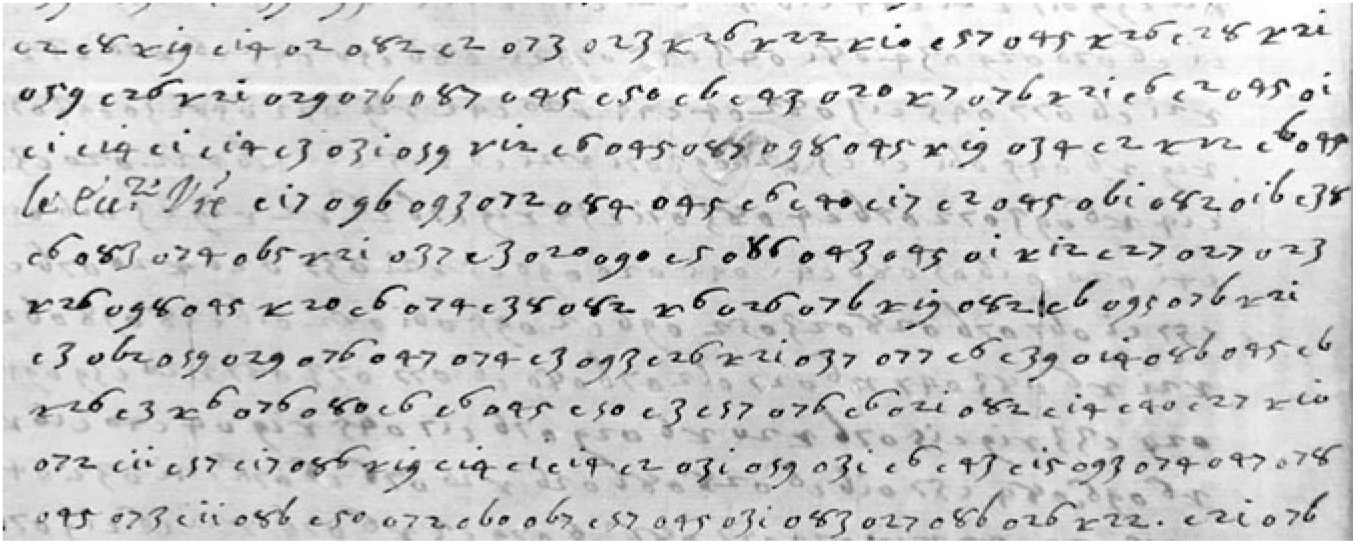
This dramatic chain of events split the English court into two camps, one half siding with Foscarini and the other with Muscorno. Even so, it seems that Muscorno's musical prowess usually gave him the upper hand. According to Rizzardo, Muscorno had ingratiated himself with Queen Anne and her ladies to such a degree that the queen always supported him, much to the chagrin of Foscarini, who lacked comparable representation at court.Footnote 29 Rizzardo later informed the State Inquisitors that the queen had repeatedly refused to see Foscarini until after Honoria Hay's death in 1614. Muscorno explained that Foscarini had spoken disrespectfully of the queen to one of her servants and this had infuriated the queen, but as Rizzardo speculated (see Figure 1),
I believed more that the efforts of the secretary against the ambassador, abetted by Lady Hay … led the queen to decide to welcome the secretary, as she did multiple times, to play and sing before her for her recreation and to refuse audience to the ambassador, which seems apparent given that since the death of Lady Hay, Her Majesty has always admitted the Signor Ambassador whenever he has sought her.Footnote 30
Rizzardo's letter to the Inquisitors of State (extract in cipher), 25 June 1615. Archivio di Stato di Venezia, Inquisitori di Stato, Busta 442. Photo: author

Like Foscarini, Muscorno repeatedly petitioned to return to Venice. The Venetian ambassador heartily endorsed Muscorno's requests, eager to see his secretary go. Their letters claim that Muscorno desired to see his family and had been plagued many times with life-threatening catarrh; Foscarini even included a physician's note. The Council of Ten disregarded their entreaties until February 1615, when Muscorno sent the Ten another letter containing incriminating information about Foscarini. The Ten then ordered that Muscorno return to Venice to be arrested, questioned and searched upon arrival, supposedly on charges of calumny against Foscarini and conspiracy with the Spanish ambassador. Foscarini was told only that Muscorno would be leaving England for personal reasons. In April the Ten selected Rizzardo as Muscorno's replacement and sent him to London with secret instructions to gather intelligence on Muscorno's accusations against Foscarini. Rizzardo began his covert investigation as soon as he arrived in June, essentially spying on Foscarini until departing that winter.Footnote 31
Muscorno was immediately detained when he reached Venice in August 1615. Just days after his arrest and presumably his examination, the Council of Ten ordered that Foscarini also return to the Republic to be apprehended upon arrival. Foscarini appears to have received no notice of this decree except that he had finally been granted permission to go home and that Barbarigo would become his successor in London.Footnote 32 Barbarigo began his mission to England that October and Foscarini left in late December, his departure delayed by various bureaucratic obstacles and yet another severe cold. As ordered, Foscarini was arrested once he arrived in Venice, and in May 1616 the Ten voted that he be quarantined in the torture chamber because of his prolonged illness.Footnote 33 Barbarigo himself fell ill in May 1616 and died in England that June. Barbarigo's secretary, Giovanni Battista Lionello, would serve as the embassy's chargé d’affaires until October 1617.Footnote 34
Notari had been entangled in this conflict since at least January 1616. On 7 January Barbarigo informed the State Inquisitors that although no one would admit to owning a copy of the disparaging book allegedly co-authored by Muscorno, it had become very famous, and ‘Signor Angelo Nodari already told me that it had been translated into French and into English, and that the Clarissimo Signor Luca Tron had a copy to bring to Venice, and that it was to be printed in Frankfurt and a copy of it had also gone to Spain’.Footnote 35 Shortly thereafter Barbarigo began to gather evidence on the Foscarini–Muscorno case by questioning numerous witnesses, one of whom was Notari.Footnote 36 The multitude of depositions accumulated by Barbarigo and other embassy officials (ASV, Inquisitori di Stato, Busta 155) portray Foscarini and his secretary as bizarrely unprofessional at best – at worst, treasonous and violent. Witnesses claimed, for example, that Foscarini had made heretical remarks, lied in his dispatches, stolen from his employees, incautiously handled sensitive documents and ciphers, spread falsehoods about his diplomatic peers, spoken derisively about the Republic and disrespected various monarchs and other eminent persons. Even more damning, he had allegedly begged the Archbishop of Canterbury for a blessing, proclaiming the Anglican faith to be the true religion. The ambassador was accused of other transgressions as outlandish as making indecent bodily noises in church, sexually harassing a cleric during Good Friday Mass, having indiscreet relations with the queen and Flemish ambassador's wife and plotting to murder Muscorno and escape to the East Indies.Footnote 37
References to music are threaded throughout the many testimonies recorded for the case, but only when music-making constituted uncouth behaviour. One article of accusation against Foscarini claims that he rode through the most crowded part of London in a carriage pulled by eight to ten horses and had ‘a clown with him, and he played a guitar, and he made him sing in a loud voice, and children followed him’.Footnote 38 It is unclear from this excerpt whether Foscarini or the jester (possibly Lumsden) was playing the guitar, though one deposition by a witness named Lunardo Michielini suggests that the jester was the instrumentalist: in yet another grammatically ambiguous passage, Michielini stated that this was a clown ‘who was employed by that Signore whom he was going to visit, who loved to sing, and to play …’.Footnote 39
Beyond Foscarini's own charges against Muscorno, the secretary was also accused of misdemeanours such as inducing witnesses to make false depositions against the ambassador, slandering the ambassador at court, fabricating evidence against the ambassador and making secret negotiations with foreign officials. He was allegedly wont to present comedies in mockery of Foscarini at court, in the Exchange and before the nobility and various royal ministers.Footnote 40 Multiple testimonies mention Muscorno's musical pursuits, for instance that by Michielini, which states that the secretary ‘introduced himself into the queen's [household] by way of singing and playing with her ladies’.Footnote 41 The queen's chamberlain, Robert Sidney, Earl of Leicester, recalled that the queen had once given Muscorno the opportunity to sing for her in the company of a Mantuan musician.Footnote 42 One article in defence of Foscarini indicates, however, that Muscorno's musical performances at court were no longer so beloved in the last few days before the secretary's departure from London. Witnesses reported that Muscorno's playing, singing and buffoonery against Foscarini had angered the queen and driven Sidney to leave the gallery in disgust.Footnote 43 Barbarigo's interpreter, Odoardo Guaz, recounted that Muscorno had stayed in London for two or three months after being discharged from the embassy, ‘begging, and procuring gifts from different places where he had sung and acted a buffoon’, speaking ill of Foscarini.Footnote 44 Several examinees also claimed that Muscorno had sung in Protestant churches on many occasions, namely St Paul's Cathedral.Footnote 45 Guaz, for example, heard that ‘Muscorno went to sing the music of the Anglican rite in Protestant churches along with Protestant ministers, being without a cap, and having a book before him in the presence of the entire congregation’.Footnote 46
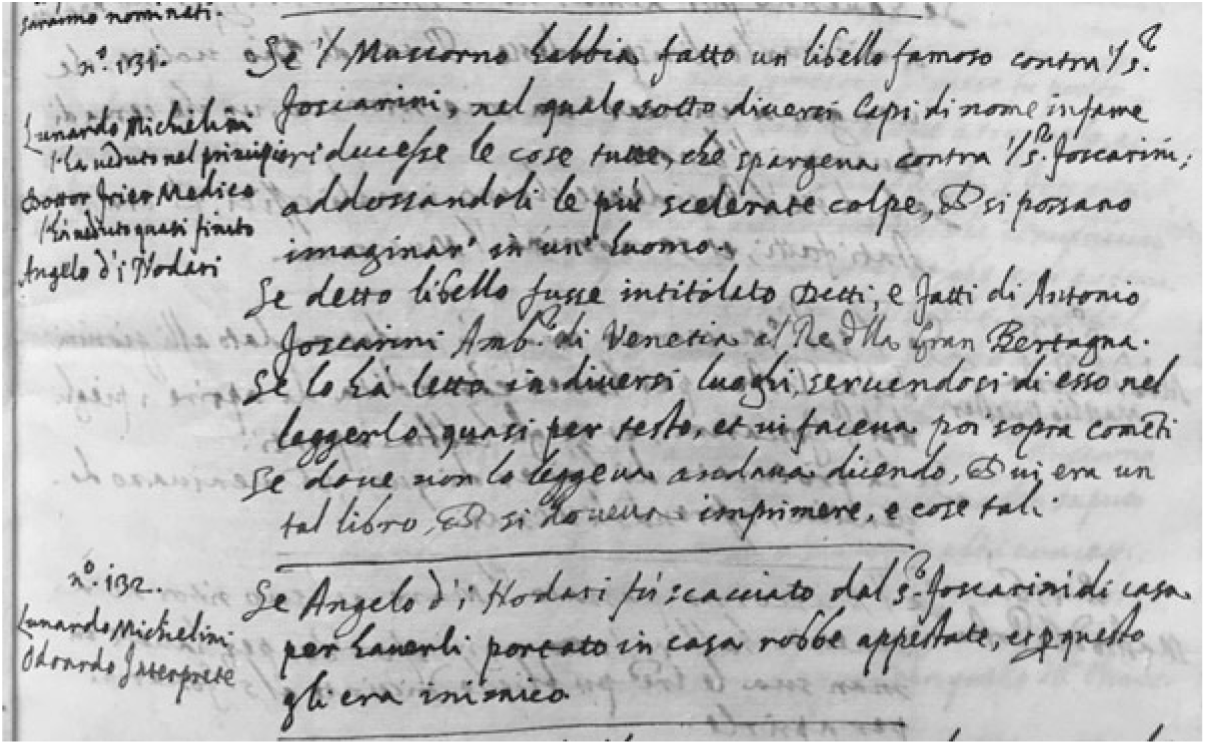
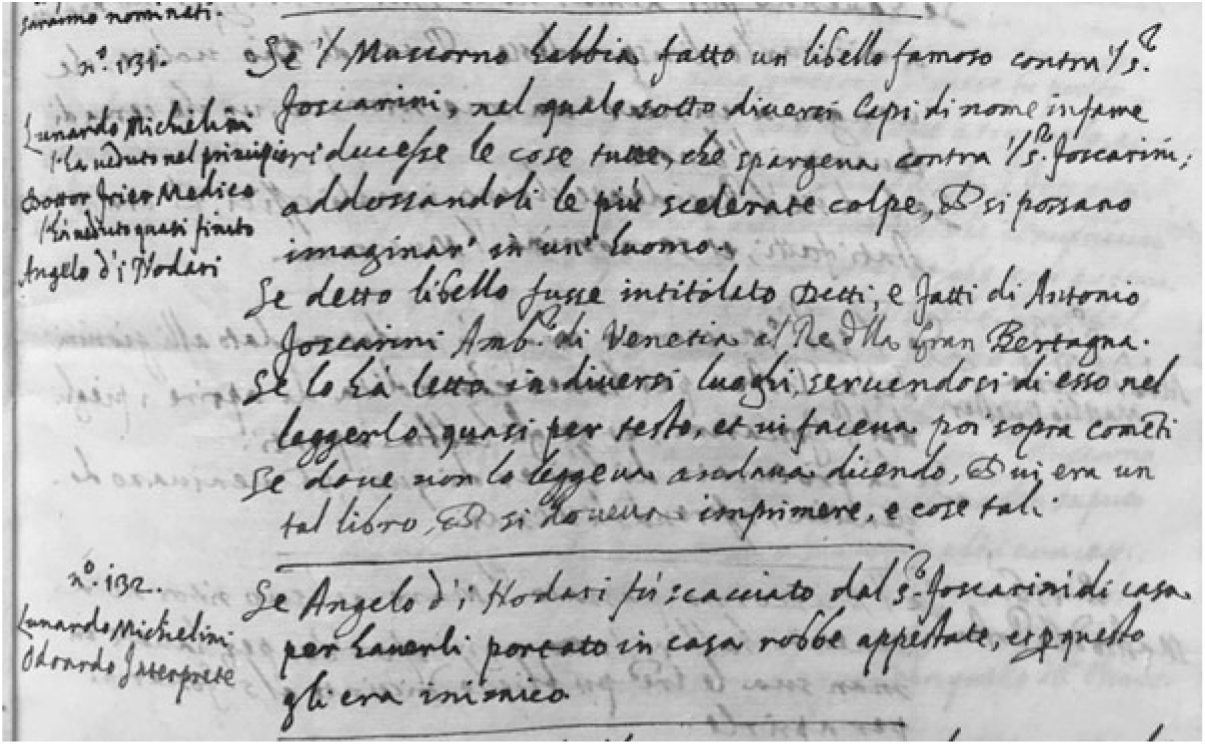
Notari was examined multiple times in London and made a number of serious accusations against both Foscarini and Muscorno. He spared neither one in his testimonies, possibly out of personal animosity towards them, as mentioned by Lionello below. In his efforts to regain formal royal patronage after 1612, Notari probably sought to eliminate any potential musical competition at court. Muscorno's success may have threatened Notari's ability to market himself as a leading importer of the Italian musiche nuove to England. Guaz recalled that Notari and Muscorno had been friends at one point, and Michielini alleged that Muscorno had even turned Notari, Biondi and others against Foscarini by stirring up discord between them and the ambassador. According to Guaz and Michielini, Notari and Foscarini had become enemies after the ambassador had fired and banished Notari for bringing plague-infected items into his home (see Figure 2).Footnote 47 It is tempting to wonder whether Notari might have had something to do with the Venetian embassy's unlucky succession of deadly illnesses. In any case, paranoia about deliberate plague-spreading pervaded northern Italian city-states in the early seventeenth century, particularly Milan. Suspected intentional plague spreaders (untori) regularly faced criminal prosecution for their alleged biological attacks on unwitting innocents, such as smearing pestilential ointment on doorknobs or scattering plague-infected powder on the ground.Footnote 48
Accusations made by and against Notari in the Foscarini–Muscorno case (extract). Archivio di Stato di Venezia, articles in defence of Foscarini, Inquisitori di Stato, Busta 155. Photo: author
During his first interrogation by Barbarigo in February 1616, Notari corroborated allegations that after Mass in the embassy chapel, Foscarini had brought two Catholic women back to his home for dinner, where he and his footmen had intoxicated and sexually assaulted them. Notari recalled that Muscorno had told him about the incident in a joking, disdainful manner. Notari also testified that Foscarini had made similarly inappropriate advances towards two other Catholic noblewomen who had dined at the embassy. Notari identified one as Isabella Fosch and the other as a daughter of Lewes Lewknor, though the latter was later said to be Dorothea Hastings. Fosch is listed as having affirmed this report, though no transcript of an examination survives. Both Notari and Michielini also recounted that on Easter Day a few years earlier, Foscarini had scandalised his chapel priest during Mass by insisting that an agent of Savoy receive communion before him since the agent was ‘superior to himself on all counts’. Finally, Notari accused Foscarini of calling ‘the Palatine’ a swineherd and giving such demeaning nicknames to everyone.Footnote 49 Notari claimed to have learned of this nickname when Muscorno came to him one day repeating it and laughing.Footnote 50 In May of that year, Notari reported that Muscorno had talked with him about Foscarini's careless manner of letter-writing.Footnote 51 Upon further examination in April 1617, Notari reiterated that Muscorno had indeed written and advertised a libellous text against Foscarini. He also testified that Muscorno had vilified Foscarini in public. Notari stated that he had seen Muscorno remove his shoes, get up on a stool and make a crowd of about two dozen people laugh at the ambassador's expense.Footnote 52
Four years earlier, Notari's former colleague from the Accademia degli Sprovisti, Antimo Galli, dispatched his own unfavourable report on Foscarini to the Florentine secretary of state. Galli wrote in August 1613 that Foscarini had furtively visited a seedy playhouse in London called the Curtain, where he had debased himself and had been publicly scorned. According to Galli, Foscarini decided to save money by standing with the groundlings below the stage. At the end of the performance an actor permitted Foscarini to invite the audience to the next day's play, but the public began to shout, demanding a different play than the title that Foscarini had stated. Foscarini then joined them in their cries of protest until the audience mistook the Venetian ambassador for a Spaniard and started to whistle at him disdainfully.Footnote 53 Galli and Notari appear to have stayed in touch after arriving in England and may have communicated directly about Foscarini. Notari listed Galli as one of the Italian witnesses to Foscarini's questionable actions during Easter communion, and he also named Galli as one of the Italians who had been present when Muscorno spoke with him about Foscarini's letter-writing habits.Footnote 54
Notari was not the only musician examined over the course of the trial. Also questioned, for example, was Giovanni Maria Lugaro, a Genoese singer and multi-instrumentalist who served as the queen's valet.Footnote 55 As an intimate member of the queen's entourage, Lugaro may have been especially wary of Italian musical competitors in the gallery. Prior to his official examination, Lugaro had already volunteered a great deal of information to Rizzardo and Barbarigo on Muscorno's alleged publication against Foscarini. Lugaro claimed to have seen the book himself and that the queen even had her own copy.Footnote 56 In his 1616 testimony against Foscarini, Lugaro asserted that when Foscarini had dined in the queen's chamber, the ambassador had made a degrading joke about her and Lugaro had ordered him to hold his tongue.Footnote 57 The Council of Ten, however, voted in February 1617 that this accusation not be brought against Foscarini in trial.Footnote 58 Lugaro also supported Notari's statement about Foscarini's behaviour at Easter communion, though he could not recount any further details of the incident.Footnote 59
In his 1617 examination against Muscorno, Lugaro described Muscorno's poorly received musical performance before the queen and corroborated more general accusations about the secretary's public defamation of Foscarini. Lugaro also testified that according to Foscarini, Muscorno had procured letters and presents from the queen via the king's physician and the physician's sister. Lugaro, Guaz and others insisted that the two women who had dined with Foscarini after Mass were in fact Protestants and ‘loose women’ but Muscorno had disseminated rumours that the women were respectable Catholics who had been raped: one was purportedly the ‘harlot’ of another witness named Niccolo Dolfino and the other a ‘presenter’ married to a comedian.Footnote 60 Multiple examinees testified that Lugaro had been present that evening.Footnote 61 One witness by the name of Angelo degli Angeli reported that Lugaro, drunk on wine with a towel on his head and a full chamber pot in one hand, had approached Foscarini and one of the women and sprinkled urine on them with a brush.Footnote 62
Witnesses were divided in their accounts of Foscarini's sordid post-Mass dinner party, and as with most other depositions in this case, it may never be possible to untangle truth from fiction. Foscarini's sexual comportment was certainly kept under close scrutiny throughout the trial, and Venetian authorities considered sexual assault of high-born Catholic women a grave criminal offence. However, counter-assertions that the two women were low-born Protestants had the potential to absolve Foscarini and his employees of blame by diminishing the severity of their alleged sexual misconduct. The fate of heretics, entertainers and sex workers was more easily dismissed in Venetian legal proceedings. Irrespective of social class or religious affiliation, women are generally represented as little more than pawns in the Foscarini–Muscorno case files. Relatively few interviews with women were recorded, and reports of sexual violence served more to incriminate alleged perpetrators than bring justice to their victims.Footnote 63
NOTARI AS PAID INFORMANT FOR VENICE, 1616–1619
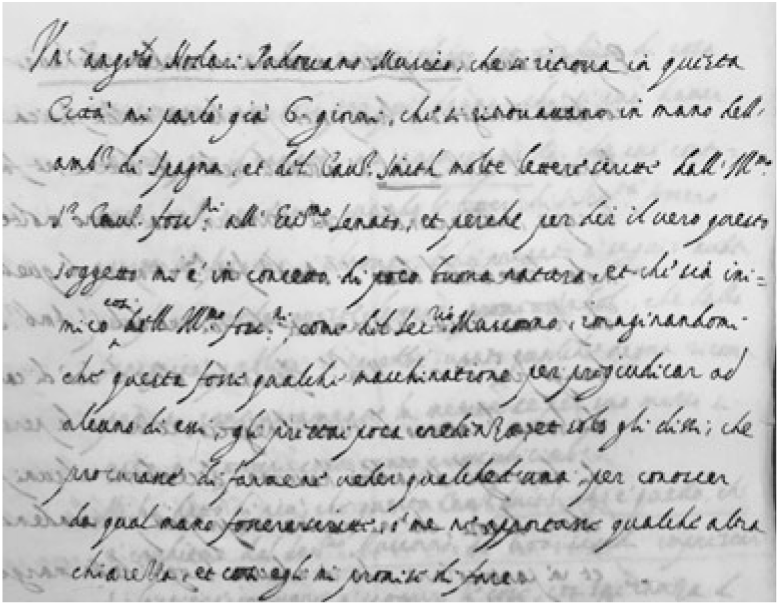
Notari formally offered his intelligence services to the Venetian government in June 1616, after both Muscorno and Foscarini had returned to the Republic. On 24 June Lionello wrote to the Inquisitors of State (see Figure 3):
One Angelo Nodari, a musician of Padua who is in this city, told me six days ago that the Spanish ambassador and Sir [William] Smith possess many letters written by the Illustrissimo Signor Cavalier Foscarini to the Eccellentissimo Senate, and because to tell the truth this matter seems to be of a questionable nature and he is as much an enemy of the Illustrissimo Foscarini as of the Secretary Muscorno, supposing that this was some scheme to prejudice one of them, I gave him little credence, and I told him only that he should contrive to show me one of the letters so that I might ascertain in whose hand they were written, or that he should bring me some other evidence of them, and this he promised me that he would do.Footnote 64
Lionello's letter to the Inquisitors of State (extract), 24 June 1616. Archivio di Stato di Venezia, Inquisitori di Stato, Busta 442. Photo: author

Notari returned two days after this discussion and offered to bring Lionello the letters in exchange for some kind of compensation, to which Lionello agreed. On 23 June Notari notified Lionello that William Smith had allowed him to copy a great number of the letters, since Muscorno still owed Smith a debt of 600 crowns and Smith hoped that the Inquisitors of State might facilitate the recovery of that debt in return for the Englishman's service to Venice.Footnote 65 Smith had been a close friend of Muscorno and had been inquiring after this debt for some time.Footnote 66 Muscorno had initially borrowed the money to make purchases on commission from Robert Carr, to whom Notari dedicated his Prime musiche nuove.Footnote 67 Notari told Lionello that the letters were in Foscarini's hand (with some written jointly by Barbarigo) and contained marginalia in cipher plus descriptions of the Savoyard ambassador's audiences with the king. Lionello was inclined to believe Notari, as the French ambassador, Gaspard Dauvet, Sieur des Marets, had mentioned seeing such letters before. Notari also informed Lionello that when he had dined in the Spanish ambassador's home, de Acuña had complimented Foscarini's diplomatic work and stated that Foscarini ‘wrote well, as he could see from copies of his public letters, which he kept with him, purchased at a high price’.Footnote 68
Alarmed that Venetian state papers might make their way into the wrong hands, Lionello promised Notari that if he could procure the letters from Smith, Notari would receive a substantial reward. Lionello also assured Notari that the Republic would help Smith however possible.Footnote 69 The State Inquisitors responded to Lionello's dispatches in July, urging him to continue with his investigation. They authorised the secretary to promise Smith that Muscorno would pay off his debt if it could be clearly proven. They also agreed that Notari could be paid up to 400 ducats should his services prove useful, the exact amount being at Lionello's discretion.Footnote 70
By 1 July Notari had brought Lionello a register of the thirty-two letters in question, which dated from 28 August to 20 November 1615. At Lionello's behest, Notari asked the Spanish ambassador how he had obtained Foscarini's letters. De Acuña replied that they had been sold to him directly at the Spanish embassy, but on another occasion a Frenchman had given them to de Acuña's interpreter. Lionello surmised that the Frenchman in question was François de La Forêt, who had frequented Foscarini's household and conducted covert business at many different embassies in London. Lionello deduced that the register of letters was indeed in de La Forêt's hand. The secretary then determined that a member of Foscarini's household must have procured the letters for the Frenchman, specifically an employee who had access to Foscarini's personal belongings. Lionello's main suspect was Foscarini's former valet, Ottavio Robbazzi. Robbazzi was a friend of de La Forêt and had kept keys to Foscarini's bedchamber. Lionello informed the Inquisitors of this and sent them fragments of the letters and a separate sample of de La Forêt's handwriting. In the same dispatch, Lionello reiterated Smith's wish to recover Muscorno's debt and that these efforts be kept secret, ‘as the discovery of it would be his ruin’. Smith went so far as to request that Lionello only communicate with him indirectly via Notari so that Smith could truthfully swear that he had never dealt with Lionello.Footnote 71 Lionello also wrote that Notari had requested regular employment as an intelligencer for the Republic,
offering to bring much information to the ambassadors from time to time about important matters at Court and about more recondite affairs. As he frequents the homes of magnates and ambassadors, he could truly provide many services, but he would like to be known for this by the ambassadors who come here and recognised with some annuity from Your Excellencies …Footnote 72
The State Inquisitors were open to this possibility and replied that Notari would be welcomed by the next resident ambassador in England, Antonio Donato. They instructed Lionello to reassure Smith that Muscorno's debt would be handled in due time and that the Englishman's involvement in other affairs would remain a secret.Footnote 73 On 28 July they summoned Muscorno before them so that he might acknowledge his debt to Smith. Muscorno admitted that Smith had indeed loaned him 600 crowns during Foscarini's embassy and that he had not been able to reimburse Smith before his abrupt departure from London. The former embassy secretary claimed that he had implored Foscarini to pay the debt to Smith on his behalf, but to no avail. Upon learning this information, the Inquisitors of State began to arrange for Smith's repayment.Footnote 74
In early August Lionello offered de La Forêt 100 ducats in exchange for more information, and the Frenchman confessed that Robbazzi had allowed him to copy the letters for 12 crowns plus another small sum at a later date. De La Forêt insisted that Robbazzi had assumed that he had only wanted to read the letters out of curiosity and pleaded that the valet be spared from harsh punishment. De La Forêt also mentioned showing the register of letters to one other person, whom Lionello knew to be the Spanish ambassador. Lionello wrote to the State Inquisitors on 5 August: ‘As for the recognition of Nodari, I believe that he has done everything that can be expected of him without my having made any particular promise; thus, I hope that he will be satisfied with fifty ducats.’Footnote 75 This amounted to about eight months of wages for a skilled tradesman in London.Footnote 76
On 17 August the Council of Ten resolved that Foscarini remain in prison on existing charges against him and in the light of the new scandal that Notari had exposed.Footnote 77 Muscorno, who had since been released, was also arrested again later that month.Footnote 78 Robbazzi was taken into custody as well, though the outcome of his trial remains ambiguous.Footnote 79 On 7 September the Ten voted on a series of potential sentences for Robbazzi, but their final decision is unclear. They first proposed that Robbazzi serve ten years as a galley slave with shackles on his feet. Should he be unfit for that, he would have his best hand amputated between the columns of St Mark's and would be incarcerated in a dark prison for twenty years. Should he escape, he would be outlawed and hanged. The Ten rejected this proposition. Their second proposition suggested that Robbazzi be strangled in prison on the following Saturday. This received a tied vote and was also shot down. Third, the Ten proposed that Robbazzi be condemned to five years in the galleys or ten years of imprisonment without amputation of his hand. This final proposition received the fewest votes and was removed from the ballot. No other outcome is indicated.Footnote 80
Despite the brutality of these proposed sentences, the Ten most likely granted Robbazzi a full pardon. In February 1617 they resolved that he be excluded as a witness in Foscarini's case, an early indication that Robbazzi was still alive months after his trial.Footnote 81 Moreover, Robbazzi would later serve as English consul in Venice from 1631 to 1633, a respected position that he probably could not have held with a significant criminal record.Footnote 82 In all likelihood, the Ten went through the motions of a formal procedure in order to leave an imposing paper trail of their deliberations but ultimately spared Robbazzi so as to avoid a public diplomatic incident. Robbazzi's case involved French and Spanish dignitaries and might have risked further upsetting recently re-established diplomatic relations with England. For all of their ruthlessness in punishing disobedience to the Republic, the Ten were also a calculating political organisation. The administration of justice in early modern Venice was subject to the Ten's imperative to project a powerful image of governmental secrecy and control. The mere illusion of state security could be prioritised over just consequences for criminal conduct, as the Ten made strategic decisions to conceal state conflict as much as possible. In the case of Robbazzi's files, the Ten's harsh propositions for his sentencing may have been written propaganda rather than an accurate representation of their deliberations. If there truly is no record of Robbazzi's pardon, perhaps the Ten never wanted to leave one in the first place.Footnote 83
Notari spent August and September 1616 in the English countryside, while Lionello continued to make progress on his investigation in London. A French servant of de La Forêt by the name of Pietro revealed to Lionello that de La Forêt had in fact bought the Venetian letters from Robbazzi for gold. De La Forêt had then sold copies of those letters to the Spanish and French ambassadors. De Acuña in particular had paid de La Forêt about 20 ducats each month for the letters and had also employed him to spy on Dauvet and other ambassadors in London. The servant showed Lionello a few copies of the letters in de La Forêt's handwriting. Lionello compensated the servant with 2 crowns, later complaining to the State Inquisitors that he had wasted 150 ducats on Notari and de La Forêt for nearly the same information. At this time Lionello also discovered a hefty volume of Venetian state papers in ‘the public library of Oxford’, which gave him further cause for concern.Footnote 84
Notari had returned to London and received his payment by 16 September, when Lionello reported to the Inquisitors of State:
I have talked with Nodari and satisfied him with fifty ducats for his work, expended on this business, adding that the Eccellentissimo Signor Ambassador Donato will be given orders to keep aware of his person, and that every service he will provide in public affairs will always be valued and rewarded as is suitable … [H]e declared that he wants always to serve you faithfully as he is indebted as your good subject, and that he will be satisfied with any indication of your favour, serving entirely according to your will, telling me that he hopes to have the ability to show his devoted affection in a matter of moment, as he has already been appointed a servant to the Prince of England in the new formation of his Court.Footnote 85
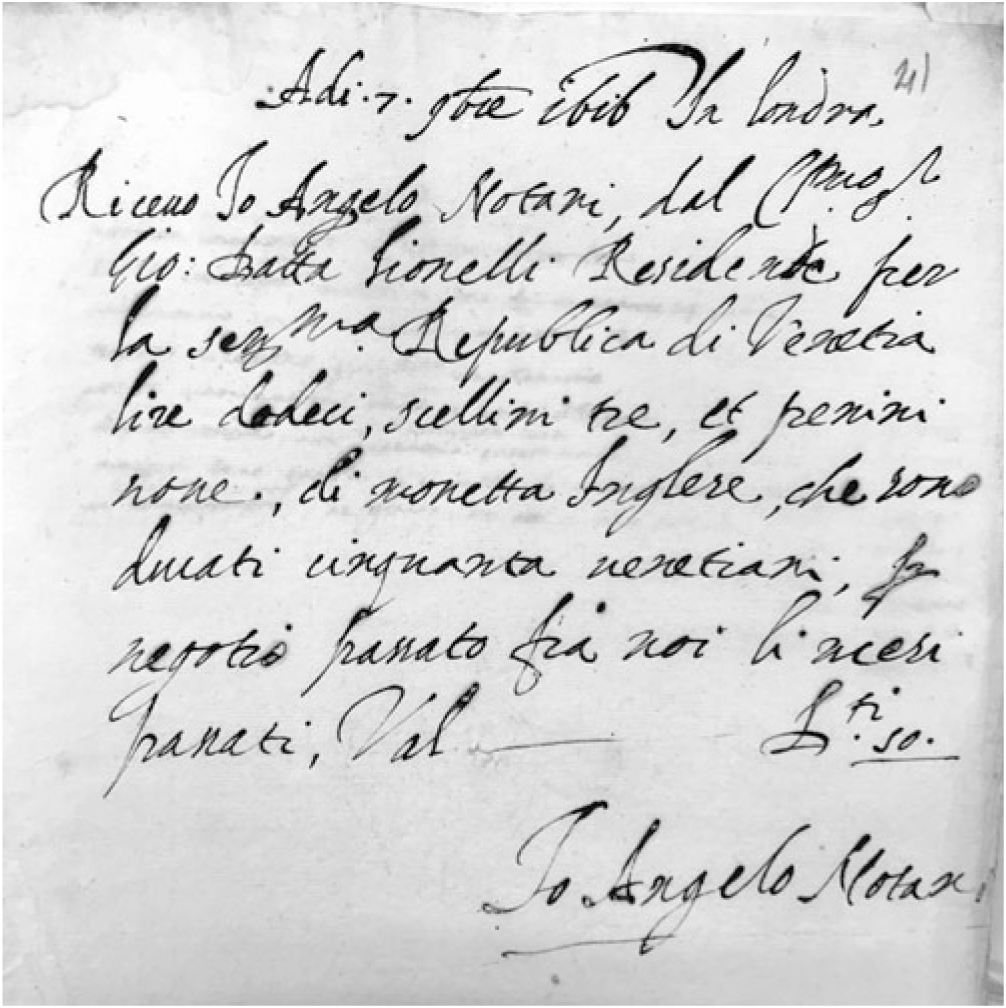
Busta 155 of the fondo Inquisitori di Stato (see Figure 4) contains Notari's autograph receipt of payment for 50 ducats, confirming that he was indeed the same ‘Nodari’ described in Lionello's dispatches.Footnote 86 Lionello asked Notari to thank Smith for his helpful contribution and to reiterate to the Englishman that the Republic was continuing to resolve Muscorno's debt. Notari replied that the original deed of the loan had been given to Henry Wotton and that Smith needed only instructions on how to proceed in the matter.Footnote 87 Receiving this news, the State Inquisitors ordered that Lionello's father be repaid the money that his son had given to his informants. They also notified Lionello that Muscorno had paid them his full debt and they were facilitating its repayment to Smith. Finally, they promised, ‘When the Illustrissimo Ambassador Donado's time comes, we will do the duty that Nodari has proposed so that he will likewise, with great satisfaction, come to know his services as they are merited’.Footnote 88 Lionello replied in November that he had spoken of this to Notari, who had promised devoted service to Donato in the future.Footnote 89
Notari's autograph receipt of payment, 7 November 1616. Archivio di Stato di Venezia, Inquisitori di Stato, Busta 155. Photo: author

Notari may have fulfilled his own promises, but the issue of Muscorno's debt remained unresolved. In November 1616 Smith appointed as his proctor Henry Parvis, a high-profile English merchant in Venice who was to receive Muscorno's payment on Smith's behalf. Parvis was given limited information and ordered to handle the transaction discreetly. Lionello wrote to the State Inquisitors that Parvis was willing to serve them ‘with the rest of his property and with his life itself’.Footnote 90 Three months passed. On 3 March 1617 the Inquisitors of State reiterated to Lionello their eagerness to settle the matter, but two weeks later they contacted him again to explain that although they had received Muscorno's 600 ducats, Parvis wished for extra time to translate his commission out of English and track down the paper for the loan, which was in Wotton's possession. The State Inquisitors also noted to Lionello that Wotton had seemed annoyed to find out that Parvis was also tasked with handling Smith's debt, since the English ambassador had been working on the matter himself.Footnote 91 Lionello, presumably still communicating with Smith via Notari, conveyed to the State Inquisitors Smith's desire that Wotton handle the transaction from that point forward.Footnote 92
At the end of the month, Parvis called upon the Inquisitors of State to receive the payment in the presence of Wotton's secretary, who brought a receipt. The transaction was once again postponed, however, when Parvis requested that the amount be equivalent to 150 pounds rather than exactly 600 ducats, since Smith had originally lent the money to Muscorno in English currency. After Smith conveyed his approval that this be done, Muscorno's debt was at long last settled on 12 April 1617. Parvis, once again accompanied by Wotton's secretary, was paid 631 ducats and 13 grossi.Footnote 93 All appeared to be well until Smith complained to Lionello two weeks later that Wotton still had not given the deed to Parvis. The English ambassador apparently intended to keep the money for his own use and eventually reimburse Smith through the royal exchequer. Lionello assured Smith that despite potential complications in transporting the money from Venice to London, Parvis had already received the sum and Wotton would not be able to keep it.Footnote 94 Smith was satisfied with this and continued to wait for his reimbursement.Footnote 95
By August 1617 the reasons behind Wotton's strange behaviour had become clear. The English Secretary of State, Ralph Winwood, disclosed to Lionello that Wotton had found himself in great debt and was resorting to suspicious dealings out of financial desperation. Winwood confirmed what Lionello already suspected; rumours of Wotton's shady activities had been circulating among Venetian magistrates for some time, which had heightened already volatile diplomatic tensions between England and the Republic on the eve of the Thirty Years War. Wotton had been taking secret bribes from Florence and Spain and borrowing money from the merchant and banker Filippo Burlamacchi. As for Smith's money, the English ambassador had appropriated it in an attempt to pay off some of his own debts. Wotton had kept the deed for himself, and I was unable to determine whether Smith eventually received what he was owed.Footnote 96 Wotton had also been consigned a gold chain and a number of rings that the king and others had given to Muscorno before the secretary's departure from London. The Council of Ten voted in April 1618 that Muscorno's wife or another person on his behalf be permitted to retrieve the items from Wotton and deposit them in the Mint until further decision by the Ten.Footnote 97
The Foscarini–Muscorno trial dragged on until July 1618. Though the letter scandal brought to light by Notari had even further damaged Foscarini's reputation, the former ambassador was acquitted on 30 July and promptly resumed his position in the Senate. The 1616 proceedings against Robbazzi appear to have hurt Muscorno's case as well, since the former embassy secretary was accused of introducing the corrupt valet into Foscarini's London household. Muscorno was ultimately sentenced to be incarcerated in an unlit prison for two years, with the threat of ten years’ banishment from the Republic should he escape.Footnote 98 As promised, the Inquisitors of State contacted Donato on 21 September 1618, recommending
one Angelo Nodari, a musician of Padua; as he has already been employed in an important affair over the past two years for our Magistrate, beyond some recognition for his services, he had grand intentions that he should be recommended to Signoria Vostra Illustrissima for when you begin your present Legation, for which he has been intended until now; and he was told, on our orders, by the Secretary Signor Giovanni Battista Lionello that he would be recognised, assigned to this position by us …Footnote 99
Their dispatch continues on to inform the ambassador that Notari seemed apt to render good services to the embassy and Donato would be able determine the specifics of Notari's employment as a secret informant.Footnote 100 Donato arrived in England that November and responded on 10 December:
In accordance with the instructions of Your Illustrissime Excellencies … I have recognised that Angelo Nodari, Musician of Padua, who had occasion to serve Secretary Lionello well, and continues in the same manner unto other public Representatives. He is a person of poor condition, but of great ingenuity, he is received familiarly in the house of the Ministers of Spain, and he knows how to take advantage of opportunities for his profit …Footnote 101
Notari receives no further mention in the Venetian state papers until Lando's 1621 dispatches about Notari's involvement with the Spanish ambassador. If Donato did avail himself of Notari's intelligence services, there is no known record of it. Donato was recalled from England only seven months after his arrival, charged with embezzlement of public funds.Footnote 102 It was perhaps after this point, May 1619, that Notari turned to de Acuña for patronage in intelligence. Muscorno was released from prison approximately one year early in June 1619.Footnote 103 In 1622 Foscarini was executed in Venice on further charges of treason, though he was posthumously exonerated by the Council of Ten.Footnote 104
CONCLUSIONS
The counterintelligence papers contained in Inquisitori di Stato 155, 156 and 442 shed new light on Notari's life in Jacobean London and, in a certain sense, before he arrived in England as well. They show that he forged lasting contacts in Venice prior to emigrating and remained linked to the Veneto through frequent interaction with other Italians in London. These documents also reveal that Notari probably worked at the Venetian embassy for a time, perhaps in a moment of financial need after the death of his first Stuart patron. At the very least, he was fully entrenched in the embassy's domestic imbroglios and knew how to benefit from his intrigues there. He was more than willing to tell incriminating tales about his Italian colleagues in exchange for financial or other, less immediate rewards, and he welcomed new musical patronage as a source of potentially profitable information. These accounts portray Notari as a shrewd, abrasive character who showed little mercy towards his adversaries. He might have shifted his loyalties towards Spain after Donato's departure, but Lionello's correspondence with the State Inquisitors establishes that by 1616 Notari had already been playing the field, making strategic connections to both the Venetian and Spanish embassies in London. This strongly suggests that Notari obtained the one Spanish canzonetta printed in Prime musiche nuove through his association with the Spanish embassy.
More broadly, attention to the Foscarini–Muscorno trial as a distinctly musical affair reveals the Venetian embassy to have been a hub for diverse Italian residents in London, a household riddled with internal conflict and frequented by foreign agents. Musicians are well represented in documentation on the Foscarini–Muscorno trial, indicating that they held an unusually prominent place in their Italian expatriate community. Music was, after all, a major Italian export to Stuart England, no less sought after than material goods such as silk, glass, currants or olive oil.Footnote 105 Music could also buy valuable information and contacts, enabling those who made it to enter powerful political networks. Endowed with such a high degree of influence over Venetian politics in London, musicians could drastically alter the state of international diplomatic relations. Muscorno's musical talents, for example, gave him the ear of English political elites, garnering their sympathy in his relentless campaign against Foscarini. Other facets of Muscorno's music-making were held against him in trial as evidence of heretical or unlawful behaviour. It seems no coincidence that both Lugaro and Notari so eagerly volunteered evidence against Muscorno before Barbarigo had launched his official investigation. Even prior to Prince Henry's death, the Jacobean court sustained only a handful of salaried foreign musicians.Footnote 106 As a highly skilled Italian dilettante, Muscorno infringed upon the territory of professional musicians whose livelihoods depended on a demand for their services at court.
There remain significant gaps in knowledge about Notari's life, and the social dynamics between Italian residents in seventeenth-century London are hazy to say the least. Witnesses examined in the Foscarini–Muscorno trial constantly contradicted one another, most of their testimonies evidently founded upon a combination of hearsay, personal vendetta and opportunistic truth-bending. A systematised analysis of all examinees questioned in the case – and what stake each of them had in it – could expose a more accurate picture of Foscarini's ill-fated embassy to England. These issues may be best addressed through multi-national archival research itineraries and greater communication between disciplines. Notari was unquestionably significant to the history of English music, but documents in the ASV reveal an entirely different aspect of his existence. They could very well have more stories to tell about his time in the Veneto. Untapped sources in Spanish repositories might clarify the nature and duration of Notari's work for de Acuña in the 1620s. Any number of archival sites on the Continent could hold information on Notari's movements during the Interregnum; perhaps he continued his intelligence work in Venice or elsewhere. Notari's foray into Venetian counterintelligence has been hidden in plain sight for over a century, disguised under the variant name ‘Angelo Nodari’ in secondary literature produced by political historians. More extensive interdisciplinary dialogue could have – much in anticipation of my own research – enabled musicologists to account for Notari's activities in England after 1612, and it could have helped historians to understand the motivations behind ‘Nodari's’ work as a government informant.
The Foscarini–Muscorno trial comes more clearly into focus with each new detail uncovered about music's role in the affair, just as musicological study of the trial incorporates new plots and players into the history of Anglo-Italian transculturation.Footnote 107 English patrons may have been quick to ‘acknowledge the Italians the greatest Masters of Musick’ (to quote Henry Lawes), but most Italian musicians in Stuart England still could not sustain themselves on music-making alone and turned to other sources of income.Footnote 108 These alternative enterprises deserve closer study, as does their function within the international political networks that transmitted music and musicians across borders. Peering into less overtly ‘musical’ pockets of early modern life turns up enlightening and perhaps unexpected tales about the multifaceted, complicated and unmistakably human actors behind the nuove musiche of the seicento.
Postscript: Further research on Notari has been published since the completion of this article. See P. A. Rismondo, ‘Angelo Notari, Antonio Foscarini e Giulio Muscorno: Musica, diplomazia e informazione tra Venezia e Inghilterra’, Studi Musicali, 10 (2019), pp. 193–232, and J. P. Wainwright, ‘Angelo Notari‘s Music for the English Court’, in J. Cunningham and B. White (eds.), Musical Exchange between Britain and Europe, 1500–1800: Essays in Honour of Peter Holman (Woodbridge, 2020), pp. 313–43.