We present here a novel method that helped in the successful removal of a fractured stent fragment from the aorta during cardiac catheterisation.
Case presentation
A 9-month-old infant (5800 g) with hypoplastic left heart syndrome after the Norwood procedure and percutaneous balloon plasty with stent implantation into the aortic arch was qualified for catheterisation because of stent fracture and dislocation of its distal portion observed on routine X-ray and re-coarctation observed on echocardiography. Stent implantation was performed 1 month before the current procedure because of significant stenosis in the aortic arch, with a peak gradient of 41 mmHg on direct measurement. The patient had a contraindication, which prevented open heart surgery with extra corporeal circulation – heart failure and pneumonia. The presence of the fracture with dislocation was confirmed before catheterisation by means of fluoroscopy.
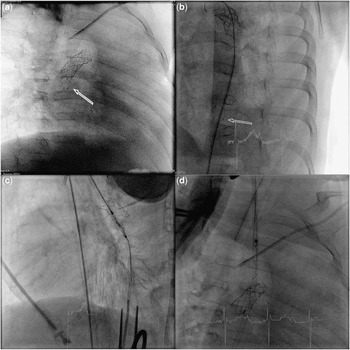
Catheterisation was performed under general anaesthesia with intubation. Via the femoral artery, aortography and pressure measurements were performed using a 4.1 Fr NIH catheter (Cook Medical Inc., Bloomington, Indiana, United States of America) (Fig 1a). We confirmed that the small distal part, a simple cell of an implanted Palmaz–Genesis 8 × 24 mm stent, with only one circuit wire, was fractured and positioned perpendicular to the long axis of the stent. Its fractured part was connected with the main part of the stent by only a single stitch (Fig 1a). We decided to re-dilate the main part of the stent with the distal fragment to stabilise both parts on the aortic wall, but during the procedure the stent fractured completely and the distal part migrated to the descending aorta (Fig 1b). After shifting it back and re-dilatating the distal fragment using a Tyshak II 10 × 30mm balloon (NuMED Canada Inc., Cornwall, Canada), we observed that the dislocated part of the stent had not been adequately fixed, and still tended to change position in the direction to the descending aorta. We considered stent-in-stent implantation to stabilise both parts of the fractured stent, but because of the small size of its distal part there was a risk entry into the aortic wall. We decided to attempt removal of the distal fragment of the fractured stent.
( a ) Fractured stent (Palmaz–Genesis 8 × 24 mm) in the descending aorta. White arrow shows the fractured stent part positioned perpendicular to the long axis of the stent; ( b ) fractured stent with migration of its distal part to the descending aorta (white arrow); ( c ) fragmented stent part stabilised by two forceps from the carotid and femoral approach; ( d ) removal of the stretched distal stent part through the 6 Fr sheath.

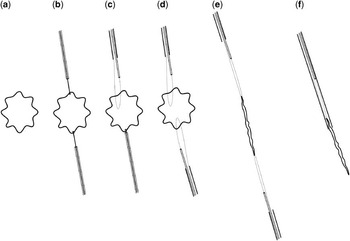
At this point of the procedure, we performed an experiment in vitro – invited and planned by T.M. – in which we cut a similar round part of the same Palmaz–Genesis stent and tried to stretch it using forceps and an Amplatz GooseNeck lasso device (eV3 Inc., Plymouth, Minnesota, United States of America) lasso device in order to remove this small part of the stent via the 6 Fr sheath (Fig 2).
Stretching of the distal part of the fractured stent schema. ( a ) fragmented, distal part of the stent; ( b ) stent's distal part stabilised by two forceps introduced from the carotid and femoral approach; ( c ) replacing the forceps by the loop made of 0.014 coronary wire caught by 10 mm Amplatz GoosNeck from carotid and femoral ( d ) approach. ( e ) Stretching the stent fragment into linear shape, suitable for removing through 6 Fr sheath ( f ).

This trial proved successful, and thus we surgically prepared a right carotid artery and introduced a 6 Fr catheter in an attempt to stabilise and stretch the stent by pulling it simultaneously from the femoral and carotid sides.
We stabilised the fractured part of the stent using two 3 Fr Cook forceps (Fig 1c; Fig 2b), but the grip strength of the forceps was too weak to stretch the stent's part, and thus we decided to use an Amplatz GoosNeck lasso device. While stabilising the separated round part of the stent with a forceps – 5 Fr femoral artery approach – we introduced a 0.014 coronary wire through the 6 Fr sheath placed in the right carotid artery side by side with a 10 mm Amplatz GoosNeck lasso device. We put the coronary wire through the separated round part of the stent, and then we moved the lasso part behind the fractured stent and put the distal end of the coronary wire in the lasso device. We pulled out the lasso device with a distal part of the coronary wire so it made some kind of reins with a loop on a fractured stent fragment. That allowed to catch the fractured stent fragment from one side (Fig 2c). We repeated this procedure from the femoral artery approach (5 Fr sheath; Fig 2d) and then the proper stretching of the stent was possible. The circular part of the stent changed into a linear shape during stretching and pulling into sheath (Fig 2e), and thus we removed the second loop (femoral) and pulled out the fractured part of the stent via the 6 Fr sheath placed in the right carotid artery (Fig 1d; Fig 2f).
Next, we re-dilated the main part of the stent in the aortic arch using Tyshak 9 × 30 mm balloon. After the procedure, there was no pressure gradient through the aortic arch and descending aorta, and there was proper flow, as shown by angiography. There were also no signs of damage to the aortic wall.
On control echocardiography, there was laminar flow through the stent, with no signs of aortic wall damage. There were also no local complications and flow disturbances in the punctured vessels. After the procedure, the child was in good condition without any complications; 2 months later, a bi-directional cavopulmonary shunt was done.
Discussion
Stent fractures are common in the paediatric population. This may result from metal fatigue caused by shear force and mechanical stress of the local tissues.Reference Chakravarty, White and Buch 1 Rarely does stent fracture lead to fragmentation and dislocation of the fractured part. In such a case, there is always a possibility of embolisation or that the fractured part will serve as a site for thrombus formation.Reference Alexiou, Kappert, Knaut, Matschke and Tugtekin 2 In the event of such a complication, percutaneous catheterisation is preferable to open heart surgery, as it is a less invasive method. During percutaneous interventions, there is also a possibility of a change in the position of the fractured stent, and re-dilatation or connection with the main part via stent-in-stent implantation may be required.Reference Won, Oh and Yang 3 , Reference Moszura, Michalak and Sysa 4 In the case of our patient, the attempt to stabilise the fractured part was unsuccessful, and thus the described method let us avoid open heart surgery.
Conclusion
The described method may be useful in cases in which the distal, fractured part of the stent is small and consists of a single or double wire, and it is a valuable alternative to open heart surgery when an attempt at an interventional stabilisation of the fractured parts proves to be unsuccessful.
Acknowledgement
None