INTRODUCTION
The petate, from the Nahuatl word petlatl, is a woven mat made from lacustrine reed. These plants, known under the generic name of tule in Spanish, include a large variety of species belonging to the Cyperaceae family (Ludlow-Wiechers and Diego-Pérez Reference Ludlow-Wiechers and Diego-Pérez2002). In the pictographic codices from the Mesoamerican Central Highlands, the Nahuatl expression petlatl in Icpalli (mat-seat) designates both the woven reed throne and the locus where authority was exercised. This figure of speech, called diphrasism (a form of synecdoche), was also applied to the mats on which individuals exercising power were seated (e.g., Alcina Reference Alcina Franch1995:12; Códice Mendocino 1980; Jansen Reference Jansen1997:91; López Austin Reference López Austin2003:146; Sahagún Reference Sahagún and Garibay1981). At the same time, however, these sources describe or illustrate a much broader sphere of functions, showing that the petate was an ordinary household item that was present in everyday life.
In the early 1970s, when there was no longer any question about the symbolization of power through the petate, López Austin noted, nonetheless, that the metaphorical sense of the diphrasism petlatl in Icpalli was applied without distinction to woven seats and simple mats (López Austin Reference López Austin1973). Pointing out the grid-like pattern created by the interlacing of the tule stems, he suggested that the petate embodied, above all, the earth's surface and its four parts.
This article discusses the symbolism of the petate in light of an unprecedented archaeological discovery. Excavations carried out in a residential Classic context in northern Michoacán revealed the impression of a petate marking the location of a grave. In addition, the lower section of the burial pit was covered over with slabs in andesite, including one that was incised with grid-like and spiral motifs.
After a brief overview of the ancient and modern uses of the petate, based on ethnohistorical, ethnographic, anthropological data, and relevant archaeological evidence, I present the contextual data that allow the testing of hypotheses about its symbolic meanings: the link with power and the incarnation of the four parts of the earth's surface. To address these points, this approach is based on a detailed description of the archaeological context, including the spatial distribution of its features, and a sequential chronology of the cultural and natural deposits. The contextual interpretation and the understanding of how petate remains were formed and preserved are based on an upstream intra- and supra-site geoarchaeological approach, including a micromorphological study (Solleiro et al. Reference Solleiro-Rebolledo, Darras, Sedov, Vargas-Rodríguez and García-Zeferino2021). Several different methods were used to study the archaeological remains discussed in this article: traditional bioarchaeological tools for bone remains and the application of the Bruzek method for sexual diagnosis (Bruzek Reference Bruzek2002); chemical analyses of floors and ceramic residues with the method developed by the Archaeological Prospecting Laboratory of the Universidad Nacional Autónoma de México (Barba and Ortiz Reference Barba Pingarrón and Butrón1992; Barba et al. Reference Barba Pingarrón, Suárez and Córdova Frunz1991). Finally, the interpretations are supported by a reconstitution of the sequence of funerary gestures that could be identified in fieldwork, including the digging of the pit, the placement of the funerary deposit, and the final filling of this pit. The concept of the chaîne opératoire is used to understand the succession of the different actions and bring out their consistency with the funeral process (Duday et al. Reference Duday, Courtaud, Crubézy, Sellier and Tillier1990; Valentin et al. Reference Valentin, Rivoal, Thevenet and Sellier2014). This approach enables a consideration of the presence of this petate beyond a strictly domestic and utilitarian perspective.
Thanks to this contextual approach, I can infer that the reed mat deposit constituted the last perceptible gesture that could be recognized after filling the pit. I assume that it had a direct correspondence with the Burial UA 12 and was deposited intentionally with regard to the funerary process. Likewise, I assume that the petate had a specific role relating to the worlds of the living and the dead. The contextual analysis suggests that both the petate and the incised slab served as thresholds, if not barriers, between the world of the living and the underworld. I propose that the petate was placed over the grave to serve as a regulator, ensuring that entities were properly separated and that they remained in their respective places. As such, it was an object protecting the cosmic order. I further suggest that the petate may have acted as a temporal gate, guaranteeing the continuous exercise of authority. And more generally, the petate is brought back to the center of the debate by arguing that the object itself was endowed with power.
A PETATE OF ALL TRADES
A host of sources, whether they come from the pre-Hispanic, colonial, or modern periods, treat the petate as a centerpiece of the Mesoamerican political, religious, and domestic space. More than a symbol of authority, the petate appears, above all, as the quintessential attribute of the everyday, an object that is in contact with the earth's surface and accompanies individuals in the decisive stages of their lives—birth, marriage, death (e.g., Códice Magliabechiano Reference Anders, Jansen and García1996; Códice Mendocino 1980; Durán Reference Durán and Garibay Kintana1967; Lumholtz Reference Lumholtz1904; Motolinia Reference Motolinia1984; Sahagún Reference Sahagún and Garibay1981)—and in their multiple ordinary activities (e.g., Aguirre et al. Reference Aguirre Anaya, Sánchez, Yamamoto and Yamamoto1998, García Reference García Sánchez2008; Sugiura and Serra Reference Sugiura Yamamoto and Serra Puche1983). Used for sleeping and sitting, it also constitutes a defined space for daily domestic and craft tasks, such as preparing food, drying and storing foodstuffs, or making pottery. Petates could be used as interior separators of household spaces (e.g., García Reference García Sánchez2008:146; Ward Reference Ward1828:vol. 2, chap. 5). Ethnographic work on the lake regions of central Mexico shows that the different varieties of tule have always been a strategic resource for the family economy (e.g., Aguirre et al. Reference Aguirre Anaya, Sánchez, Yamamoto and Yamamoto1998; García Reference García Sánchez2008; Gibson Reference Gibson1964; Parsons Reference Parsons2006; Williams Reference Williams2014a, Reference Williams2014b), especially for the manufacture of petates and other woven reed objects, such as seats. These studies, which describe in detail the harvesting of the aquatic plant and the making of petates with tule redondo, highlight the diversity of methods and dimensions, depending on whether the resulting products were intended for common, ornamental, or religious use (Aguirre et al. Reference Aguirre Anaya, Sánchez, Yamamoto and Yamamoto1998:209–220).
But many of these documents also describe them as an essential element of religious life. Robicsek's studies on the symbolic system of petates among the Maya show that they could be used as ceremonial objects during human sacrifices, as portrayed on Stela 11 at Piedras Negras (Robicsek Reference Robicsek1975:22). Idols were often placed on a reed mat and could be wrapped in the same kind of mats when they were transported (see, among others, Robicsek Reference Robicsek1975). This practice continued during the colonial period throughout the indigenous world because the petate was ubiquitous in religious spaces, where it could serve, for example, as a separation between interior areas, a table, a base for altars, or a covering for religious figures (e.g., in Cancuc at the beginning of the eighteenth century; Robicsek Reference Robicsek1975; Viqueira Reference Viqueira2002:211, 226). Even today, church floors are covered with petates, as seen in San Juan Chamula (Chiapas) or San Cristóbal Verapaz (Alta Verapaz, Guatemala). In the Tzeltal community at Cancuc, the saints are wrapped in petates before being transported and then deposited on other mats at the end of the processions (Pitarch Reference Pitarch2000:136). According to Pitarch, the petates would reduce the saints’ power over humans. Once they are used, moreover, they are buried at some depth, far from the inhabited area (Pitarch Reference Pitarch2000:136), probably because they have absorbed some of the saints’ energy. Among the Nahuas of Guerrero, the petate also plays an important role as a ritual deposit, commonly called a mesa (table) in Spanish (Dehouve Reference Dehouve2013). For Dehouve, the petate represents a quadrilateral cosmogram and is perceived as a sacred area. The xochimesa (or xochitlammanalli) described by Hémond (Reference Hémond2013:7), meanwhile, is a petate on which ritual dishes are placed as offerings to the celestial powers in religious buildings; moreover, it is spread out along the eastern wall, oriented to the rising sun. In fact, petates are still used everywhere as a table to deposit offerings for the feast of the dead (Aguirre et al. Reference Aguirre Anaya, Sánchez, Yamamoto and Yamamoto1998:223).
These selected examples show that the petate was and remains an essential part of the material necessary for religious holidays and, in particular, patron saint celebrations. Furthermore ethnohistorical and ethnographic data bring out its role in funeral ceremonies. First of all, it is used as a shroud or bedding for the deceased, even if the petate shroud is rarely the only container. We can cite, for example, the case of San Luis Jilotepeque (Guatemala), where the deceased is first wrapped in a white cotton shroud (mortaja) and then displayed on the petate. This same petate will be carefully sewn together with an agave needle, so as to tightly enwrap the mortaja (Maldonado Reference Maldonado Cano, Ruiz, Ruz and Ponce de León2005:466). It generally replaces a casket, but when the deceased is buried in a wooden coffin, the petate wrapped around the bundle (bulto) is still deposited (Maldonado Reference Maldonado Cano, Ruiz, Ruz and Ponce de León2005:466), which demonstrates its symbolic role in the funeral ritual beyond any functional utility. The petate was commonly used as a shroud until the mid-twentieth century within indigenous communities or for the burial of the poor; indeed, this custom was so widespread that the Spanish verb petatearse is popularly used to refer to a recently deceased person (Garduño Reference Garduño1997).
Last of all, during funeral ceremonies, the petate is generally perceived as a sacred space with multiple uses. It can receive the body of the deceased before its placement in the casket, as well as the offerings involved in the ceremony, the cross that will accompany the deceased to the cemetery, or the people who kneel on it to pray (Maldonado Reference Maldonado Cano, Ruiz, Ruz and Ponce de León2005).
IN SEARCH OF ARCHAEOLOGICAL PETATES
It is difficult to confirm with archaeological data all of the uses cited above, but if we set aside the numerous visual representations indirectly demonstrating the pre-Hispanic utilization of petates (bas-reliefs, wall paintings, petroglyphs, ceramic decoration, codices), we can distinguish three kinds of traces (direct, imprinted, and indirect), two likely contexts (domestic and funerary), and, in the case of the latter context, three main forms of use (container, bedding, and element of grave architecture).
The direct traces refer to clearly identifiable organic remains. In general, stable humidity and temperature conditions within dry contexts are necessary for vegetal fibers to survive over the centuries without disintegrating (Sánchez Reference Sánchez Valenzuela, Bjerregaard and Peters2017:405). This condition is why the desert regions of northern Mexico are the most favorable for their conservation, although the central or southwest highland regions of Mesoamerica occasionally reveal such treasures as well (e.g., Barba de Piña Chan Reference Barba de Piña Chan1956; Kidder et al. Reference Kidder, Jennings and Shook1946; Thomas and Campbell Reference Thomas and Campbell2008).
The remains of reed mats are therefore found primarily in the north, especially in the states of Chihuahua, Coahuila, and Tamaulipas, and come from rock shelters. The early eighteenth-century descriptions of Juan Agustín Morfi thus give evidence that the deceased in the burials of the Comarca Lagunera in Coahuila were wrapped in finely woven petates (Morfi Reference Morfi1935:263). The burials found in Cuatro Ciénegas—in particular, those of the cave known as Cueva de la Paila—also follow this practice (González Reference González Arratia, Quintanal and Pérez-Taylor2004). Another similar case, recently exhumed, is also worth mentioning: the funerary bundle from la Cueva de las Escondidas (Tamaulipas) is composed of the remains of a child accompanied by numerous organic remains, all of which are wrapped in a remarkably well-preserved petate (Dirección de medios de comunicación del INAH 2018).
While these examples show that the petate was used directly as a shroud, there are other traditions demonstrating that it could play a different role within the funerary sequence. In the case of Candelaria (Coahuila), the deceased were wrapped in a shroud composed of several layers of cotton cloth and held together with vegetal fibers (González Reference González Arratia1998, Reference González Arratia, Quintanal and Pérez-Taylor2004). The petate was part of the funerary furniture, but also served to receive the bundle (González Reference González Arratia, Quintanal and Pérez-Taylor2004:378; Sánchez Reference Sánchez Valenzuela, Bjerregaard and Peters2017). Analysis and restoration of the bundle from the rock shelter in Zimapán (Hidalgo), meanwhile, have shown that the deceased was enclosed in several layers of fabric strips before being wrapped in a petate (Gómez and Mainou Reference Gómez González and Mainou2017; Gómez et al. Reference Gómez González, Mainou, Romero, Hernández, Beramendi Orosco, Mainou and López Ortiz2019).
In the Basin of Mexico, petate remains are mentioned for archaeological sites mainly dated from the Formative period. In Tlapacoya, Barba de Piña Chan (Reference Barba de Piña Chan1956:109) reported that the organic residues littering the surface under the bone remains of tomb no. 2 could correspond to the remains of a petate, since clearly identifiable portions of a woven mat have been recovered on a nearby wooden bark. In this case, the petate could have been used as bedding. In Terremote-Tlaltenco, Serra Puche also recovered fragments of mats and basketry in waterlogged levels related to domestic occupation (McLung de Tapia et al. Reference McLung de Tapia, Serra Puche and Limón Dyer1986:105; Serra Reference Serra Puche1988:121). These reed mats are believed to have covered the floors and walls (McLung de Tapia et al. Reference McLung de Tapia, Serra Puche and Limón Dyer1986:105).
The Maya region has also provided some direct archaeological remains in funerary contexts, most of which date from the Early Classic period. At Kaminaljuyu, Kidder indicates the presence of petate fragments in at least three burials of Mound A (Kidder et al. Reference Kidder, Jennings and Shook1946). These petates would have been used in two ways: as bedding for the body of the deceased (Burials A-II and A-III) and as a covering for the walls of the burial (A-IV). Also worth mentioning is a burial from Rio Bec (Unit 1, Room D), containing an adult in a flexed position who was still partially covered with a petate (Thomas and Campbell Reference Thomas and Campbell2008:142). A final example comes from Tikal, where Burial 196 contains an individual resting in supine position on a large reed mat along with part of the funerary objects (Hellmuth Reference Hellmuth1967).
The Maya region has also provided some direct archaeological remains in household or funerary contexts, most of which date from the Classic period. Thanks to the volcanic eruption that destroyed the village of Joya de Cerén (El Salvador) in a.d. 660, exceptionally remains of petates were recovered on the roofs and floors of the houses, testifying to their central role in daily life, as a bed to sleep on or to carry out domestic activities (Sheets Reference Sheets2002). At Kaminaljuyu, Kidder indicates the presence of petate fragments in at least three burials of Mound A (Kidder et al. Reference Kidder, Jennings and Shook1946). These petates would have been used in two ways, as bedding for the body of the deceased (Burials A-II and A-III) and as a covering for the walls of the burial (A-IV). Also worth mentioning is a burial from Rio Bec (Unit 1, Room D), containing an adult in a flexed position who was still partially covered with a petate (Thomas and Campbell Reference Thomas and Campbell2008:142). A final example comes from Tikal, where Burial 196 contains an individual resting in supine position on a large reed mat along with part of the funerary objects (Hellmuth Reference Hellmuth1967).
Notwithstanding the scarcity of petate remains in an archaeological context, several publications record their presence through explicit indicators, such as impressions on sedimentary deposits, most often in a funerary context. In these cases, we can speak of “imprinted” traces of direct evidence.
The earliest indications are mentioned by Vaillant for the Ticomán and El Arbolillo sites, located in the Basin of Mexico and occupied during the Middle and Late Formative periods. Such discoveries in the form of imprints in the sediment seem to have been fairly common (Vaillant Reference Vaillant1935:250). For the Ticomán site, petate impressions were found in the sediment covering at least eight of the burials (Vaillant Reference Vaillant1931:317). At El Arbollilo, seven cases are singled out, but unlike what was observed at Ticomán, it is rather the bodies of the deceased that seem to have been wrapped in a mat (Vaillant Reference Vaillant1935:168–169, 170). Unfortunately, Vaillant does not say anything about the exact nature of these remains. Were they fleeting impressions on loose sediment, resulting from the disintegration of the petate and destroyed during the excavation, or were they impressions permanently fixed in the sedimentary deposits?
Indeed, there are some examples of petate impressions that have been immobilized in solidified sediment. At Teotihuacan, for example, Linné indicates the presence of a hardened clay fragment bearing such an impression in the filling of a floor (Linné Reference Linné and Cowgill2003:154–155). A similar discovery was made in Burial 1 at Calakmul, where, in addition to impressions corresponding to different vegetal artifacts (e.g., ropes), small fragments of clay showed imprints of a petate, although their origin and function could not be determined (Schneider Reference Schneider2008:56).
Other archaeological sites have provided similar kind of evidence. De Lucia, for example, mentions mat prints on clay floors in Xaltocan, in the Basin of Mexico as well as on ceramic vessels (De Lucia Reference De Lucia2021). Pollard's excavations in the Basin of Patzcuaro (Michoacán) likewise yielded this kind of vestige. In a residential context on site ER-22, two samples of hardened sediment with a smooth surface are marked by the very clear imprint of a grid-like pattern of 2 cm strips forming right angles (Adkins Reference Adkins2002:2, 6; Pollard Reference Pollard, Williams, Weigand, Mestas and Grove2005). The characteristics of the samples (thickness, white coating) may indicate that they came from a floor rather than a wall. At present, these pieces of evidence come closest to our context, in terms of geography, time frame, and morphology.
Alongside these vestiges, which leave no doubt about the nature of the remains, but sometimes pose problems of interpretation concerning the context of their use and the way they were employed, it is possible to draw on other means, this time indirect, for tracking down the presence of petates in domestic or funerary contexts. McLung de Tapia's work on paleobotanical remains at several sites in the Basin of Mexico reveals different varieties of the Cyperaceae family (e.g., McLung de Tapia and Martínez Reference McLung de Tapia, Iryzar and Brumfiel2005). The search for phytoliths corresponding to the Cyperaceae family can also be useful for envisioning the presence of woven reed products on the site, even if it is not possible to go further, since these phytoliths can correspond to other types of manufactured products or to remnants of tule stems (reeds). Indeed, remains of tule stems are sometimes found in archaeological contexts in the Basin of Mexico, such as Terremote-Tlaltenco (Serra Reference Serra Puche1988), Zohapilco (Niederberger Reference Niederberger1979), or Xaltocan (Brumfiel Reference Brumfiel2005). This information might indicate that these places produced basketry, including petates, but, as Parsons (Reference Parsons2006:307) points out, these remains could just as well have been used as filling material to build artificial platforms in swampy areas. They could also be used to make walls or roofs for small houses, as observed in the Alto Lerma (Albores Reference Albores1995).
In a different category of evidence, some stone tools can provide indirect information about the possible manufacture of basketry in archaeological contexts. At Xaltocan, tools found in Operation Z3 present morphological analogies with those described for the current production of petates in Michoacán (de Lucia Reference De Lucia2021; Williams Reference Williams2014a, Reference Williams2014b).
Last, the methods of funerary anthropology sometimes help in suggesting the existence of a container; the deformation of certain parts of the skeleton (e.g., collarbones or foot bones) often reflect physical pressure that might be due to the narrowness of a pit or the confining of the body in a shroud (Pereira Reference Pereira1999). However, in the absence of more explicit indications, the findings remain limited because it is impossible to determine the nature of the shroud.
In sum, these archaeological examples attest to a variety of uses. Those found in a funerary context show that the petate can serve as a simple container and may also be used to enclose a first shroud composed of other materials such as cotton. It was further observed that the petate was frequently employed as a covering or bedding for the body of the deceased, without excluding the possibility that the body was first wrapped in another petate.
The impressions found in household contexts seem to confirm the use as floor coverings and interior walls of houses. However, some imprints on fragments of solidified sediment say little about the context of their use, and it would be necessary to understand the conditions in which they were produced and preserved.
THE ARCHAEOLOGICAL DATA
Regional Context
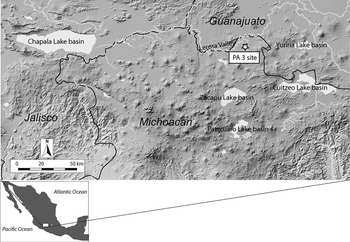
The case study presented here comes from operations carried out by the Tres Mezquites project in the Lerma Valley, situated in northern Michoacán and the extreme southwest of the Bajío, Mexico (Figure 1). Established in 2012, the project had two main objectives: (1) evaluating the archaeological potential with regard to the environmental characteristics, and (2) understanding the pre-Hispanic settlement pattern in relation to what was known of cultural developments in the Bajío and Michoacán. Several field seasons, including archaeological surveys carried out over 20 km2, led to the registration of 192 sites. The chronological ordering of these sites was based primarily on ceramic typology, but also on architectural characteristics, when possible (Castañeda et al. Reference Castañeda, Darras and Déodat2020; Darras et al. Reference Darras, Castañeda and Déodat2018). To obtain more accurate chronological and cultural information, tests pits and extensive excavations were carried out at several sites, which allowed them to be dated through comparative analysis of several indicators: ceramics, chrono-stratigraphy, and absolute dating (27 radiocarbon dates were obtained from bone and charcoal samples). The results show that the valley foothills, as well as the floodplain, were densely occupied from the Terminal Formative (a.d. 100–250) to the Epiclassic (a.d. 600–900), although the Classic period is considered to have been the apogee of occupation (a.d. 250–600). The typo-morphological classification displays a predominance of residential sites, with many of the isolated dwellings in the plain and along the river. At 21 sites there are monumental platforms and structures, occasionally a ball court, which are supposed to have served a civic-ceremonial function. The spatial distribution of pre-Hispanic locations is interpreted as a dispersed rural settlement, organized around civic-ceremonial centers in a continuous and dense settlement pattern (Castañeda et al. Reference Castañeda, Darras and Déodat2020).
Location map of the study area. Map by the author.

The Tres Mezquites works carried out in the Lerma Valley provide an ideal context for understanding interactions between the Bajío and the lacustrine regions of Michoacán during the first millennium. During the Classic period, we observed strong interactions with the lacustrine regions (Zacapu, Pátzcuaro, Cuitzeo, Querendaro) and, to a lesser degree, with the Bajío, Guanajuatense, Acámbaro, and the San Juan Valley (Queretaro). The similarities between the Classic occupations of the Lerma Valley and those of the lacustrine regions of Michoacán are so strong that we can propose they were part of the same politico-territorial network, and that their elites adhered to the Teotihuacan ideology through the consumption of prestige goods (Darras and Faugère Reference Darras and Faugère-Kalfon2018; Filini Reference Filini2010; Jiménez Betts Reference Jiménez Betts2018).
The PA3 El Pitayo Site
Between 2015 and 2019, extensive excavations were conducted on the PA3 El Pitayo site, located in the foothills of Cerro El Arco, at 1,703 m.a.s.l. (228304/2240550). The site dominates the Lerma floodplain and is characterized by a marked topographic deformation produced by successive anthropogenic structures. The excavations carried out in the highest part of the prominence covered an area of 435 m2 and revealed structures and stone platforms separated from each other by narrow passageways and surrounding a rectangular structure called UC 1–2. The platform located to the north of the UC 1–2 structure corresponds to a residential space, but the poor state of preservation of the other architectural remains does not allow us to determine their use. Fieldwork also revealed stratigraphic deposits more than 2.5 m thick, including seven occupation surfaces associated with archaeological remains. The typology of the ceramics and 12 radiocarbon dates situate the main occupation during the Classic period, between cal. a.d. 387 and 542 (95 percent phd; two-sigma ranges; calibration with the ChronoModel application; Lanos et al. Reference Lanos, Chauvin, Darras and Pereira2018). However, the last level of occupation, which was entirely destroyed by recent levelling for agricultural activities, was characterized by three monumental platforms and ceramic materials dating from the Epiclassic period. Excavations of the Classic occupation levels revealed the presence of black clay sediment covering most of the sectors studied and signs of brutal destruction (Darras et al. Reference Darras2017; Solleiro et al. Reference Solleiro-Rebolledo, Darras, Sedov, Vargas-Rodríguez and García-Zeferino2021).
The PA3 El Pitayo site is one of the three most important ones identified on the Cerro El Arco foothills. It is part of a network of fairly dense habitatation sites on the southern slope and the plain (Castañeda et al. Reference Castañeda, Darras and Déodat2020). Its extent, position, and architectural features led us to consider that it must have been a center playing a civic-ceremonial role within the area studied.
The Building UC 1–2
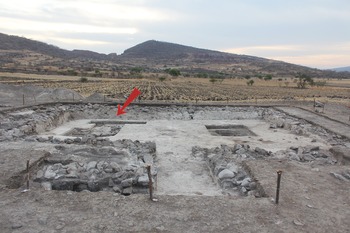
Among the architectural features recovered, the operations brought to light a rectangular structure measuring 13 × 9 m, oriented east–west, with an entrance corridor at the west opening onto a very large interior room (Darras et al. Reference Darras2017; Figure 2). As indicated above, this single-cell edifice, measuring 110 m2, is contained within an elaborate architectural complex composed of platforms and buildings separated by narrow passageways. Bench seats along the outside of its west façade line the long entry corridor that becomes increasingly narrow. Indeed, the access to the interior was clearly restricted: the end of the corridor was blocked by a wall and in order to enter or leave, it was necessary to use the lateral passages along the bench seats. The edifice had a masonry foundation of about 70 cm high, topped by adobe walls. The roof would have been made of perishable materials. Both the exterior and interior walls were covered with a white coating (tepetate) painted with red motifs, whose fragmentary state did not permit further identification.
View of the excavated structure with location of Burial UA 12. Photograph by the author.

The excavation of this interior space revealed two successive occupation surfaces, the older averaging 10 cm thick and the most recent 20 cm thick. Both were made with white materials extracted from tepetate, the vernacular name referring to volcanic indurated horizons, mainly composed of pyroclastic materials and compacted or cemented (Gama-Castro et al. Reference Gama-Castro, Solleiro-Rebolledo, Flores-Román, Sedov, Cabadas-Báez and Díaz-Ortega2007; Zebrowski Reference Zebrowski1992).
Different indicators found on the older occupation surface, including the partial destruction of the north wall and its covering, traces of a fire, large quantities of broken ceramic vessels, and food remains, suggest that the building was destroyed by a violent event (Darras et al. Reference Darras2017). The nature of these indicators and the geoarchaeological approach, which included micromorphological analysis of black clay sediment found over the occupation surface, permit the hypothesis that the destruction of the building was caused by a landslide (Solleiro et al. Reference Solleiro-Rebolledo, Darras, Sedov, Vargas-Rodríguez and García-Zeferino2021). The seven radiocarbon dates associated with the occupation, destruction, and reconstruction of the edifice show that the successive events occurred within a very short period, some time between cal. a.d. 460 and 550 (95 percent phd; two-sigma ranges; calibration with the ChronoModel application; Lanos et al. Reference Lanos, Chauvin, Darras and Pereira2018).
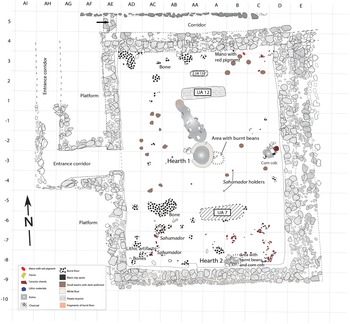
The occupation surface (Figure 3), which had been covered over by the collapse of the adobe walls and the black clay deposit, revealed many remains: two hearths, one of which was carefully modeled with white materials identical to those used to shape the floor and placed in the center of the room, two graves located in the northern part (UA 12 and UA 13), large quantities of semi-complete or complete ceramic (jars, bowls, censer), lithic (obsidian and andesitic artifacts, mano), and organic artifacts (corn cobs, beans), mainly concentrated in the southern part of the construction and the corners. An imprint of a petate was discovered on the northern part of this surface, which coincides perfectly with the location of Burial UA 12.
Plan of the rectangular structure (UC 1-2) with the surface occupation and its two burials (UA 12 and UA 13). Original drawing by the author; computer drawing by Sylvie Eliès.

Burials Associated with Building UC 1-2
Four graves were found inside the construction, while none were found in the other areas excavated. It is in the northern section of the older occupation surface, an area somewhat apart from most of the activities, that two individuals, an adult female (UA 12) and a young child (UA 13), were buried side by side, although we cannot determine whether the burials took place at the same time. The two graves nonetheless share common features: a narrow rectangular morphology and east–west orientation, and their considerable depth. The UA 12 grave, which is the focus of this article, will be described in detail below. As for UA 13, it was characterized by a pit 96 cm long, 34 cm wide, and 81 cm deep. The pit contained the remains of a child placed against the base of the north wall, in a left lateral flexed position, with the head toward the west and facing south. Two funerary items were associated with these remains: a ceramic bowl and a shell pendant. After the catastrophe that led to the sudden covering of the floor, a temporary construction made of perishable materials was set up inside the building, pending construction work. A pit containing the remains of a newborn individual was recovered inside this provisional structure (UA 2). No funerary furniture was associated with it.
Last of all, the reconstruction effort resulted in the rapid arrangement of an identical new occupation surface where another burial (UA 7) was identified, this time in the southern part of the edifice. As in the two previous cases, it consisted of a deep pit of disproportionate dimensions relative to the funerary deposit. The pit, along an east–west axis, contained the remains of an adult placed in supine position, with the head oriented toward the west. The individual from UA 7 (probably female) was buried with pectoral adornments, mainly made of green glass (nacrite and amazonite; Robles-Camacho Reference Robles-Camacho2018) and shell tesserae and pearls, as well as a pyrite mirror placed under the 11th and 12th vertebrae. No ceramic vessels were recovered in this grave.
Some Remarks on the Uses and Function of Building UC 1-2
The characteristics of this unicellular building raised the question of its function and uses. The UC 1–2 structure occupied a central location with protected access within a compact and unified architectural ensemble. The remains found on the oldest interior floor relate to domestic and ritual activities alike. The main hearth shows an orange-colored induration several centimeters thick, which attests to regular and intensive use. Chemical analysis of the residues in the floor and ceramic vessels (Pastrana et al. Reference Pastrana, Barba, Ortiz and Darras2018) confirm the observations established on the basis of the archaeological remains (Darras et al. Reference Darras2017): the occupation surface underwent considerable use; food was stored, prepared, and cooked in the two hearths, and consumed there (jars, cooking pots, bowls, beans, corn); and incense was burned in a censer. The analysis also revealed traces of pigment grinding, probably related to the painting of the walls (mano with red pigment).
The presence of adult burials in residential spaces is not often documented in west central Mesoamerica, although it is reported in Classic contexts of the Basin of Pátzcuaro (Helen Pollard, personal communication 2020), but it was common during the Formative and Classic periods in other regions of the central Highlands, such as Tetimpa (Uruñuela and Plunket Reference Uruñuela, Plunket and Plunket2002) and Teotihuacan (Manzanilla Reference Manzanilla, Silverman and Small2002; Manzanilla and Serrano Reference Manzanilla and Serrano1999; Sempowski and Spence Reference Sempowski and Spence1994).
According to the typology established by Pereira (Reference Pereira2013:458), the UC 1–2 graves could be considered as “occupation burials.” This author defines two patterns of deposits in Río Bec residential contexts: (1) the transitional burials that are accompanied by major transformations of the architectural spaces in which they are placed, thus marking the end of one stage and the beginning of a new one; and (2) the occupation burials that are installed in a structure already in use and that continues to be used after the mortuary deposit, without any subsequent change. The latter fits perfectly with the UC 1–2 context. Indeed, once the pits were filled again, the corresponding section of the floor was simply patched over to allow the resumption of activities there. However, in the absence of comparative elements for our area of study, it is difficult to draw more inferences, especially since the funerary contexts known for the same situation and region reflect fairly diversified practices (Pereira Reference Pereira1999).
The morphological features of the building, meanwhile, are close to the unicellular structures found in the Middle and Late Postclassic in the Zacapu region; these were known as the “Great House” in the Relación de Michoacán (Reference Tudela1977). According to Forest's (Reference Forest2014) research in the site of Malpais Prieto, in some of the cases, they seem to have been elite residences, and in others, communal houses where domestic activities were carried out, as the Relación de Michoacán seems to indicate.
The example described here, which dates from the fifth century a.d., shows other distinctive features: it is contained within a compact, unified architectural ensemble, and it contains burials with specific attributes. All available data put together lead to the hypothesis that this structure fulfilled a specific role within the site. On the one hand, the evidence of domestic activity is strong enough to suggest it was inhabited on a daily basis. On the other, it is likely that some of the activities identified in this space correspond to domestic rituals. Because people were buried there, this living space was necessarily also a place of commemoration, where incense was burned and ancestors were fed, as has been widely observed in the Maya region (e.g., McAnany Reference McAnany1995:33), Teotihuacan (Manzanilla Reference Manzanilla, Silverman and Small2002), or Tetimpa (Uruñuela and Plunket Reference Uruñuela, Plunket and Plunket2002). These domestic rituals, related to the worship of the dead, may have involved a community role.
In short, indices converge to consider structure UC 1–2 as an elite residence where people were buried and where domestic and ritual activities were carried out. Let us now examine the characteristics of the petate impression recovered on its occupation floor, which was part of these activities.
The Petate Impression
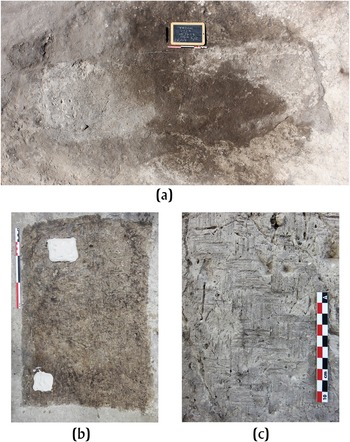
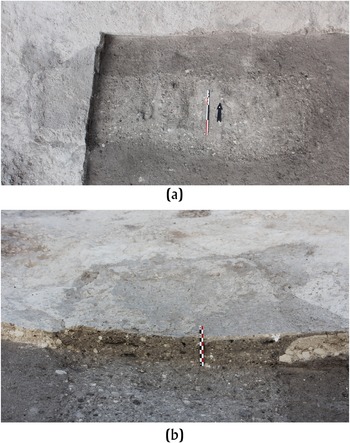
Once the occupation floor was completely cleared away, the impression revealed a rectangular shape with slightly curved angles, measuring 2.1 m long by 0.6 m wide (Figure 4a). Forming a slight protuberance relative to the rest of the surface, it was perfectly oriented east–west. The fairly pronounced sinking of the surface where the impression was discovered somewhat distorted its contours.
The petate impression. (a) General view; (b) detail; (c) removal of the imprint. Photographs by the author.

The quality of the preservation of this trace (Figure 4b) permits a detailed description of the morphology of the mat: its grid-like pattern results from the interlacing of strips measuring 3 cm wide in a 4:4 rhythm, without visible changes in the stems (Medina-González et al. Reference Medina-González, Espinoza-Pesqueira, Montufar and Darras2018). It is noteworthy that the strips are oriented perpendicularly rather than diagonally, as is the case for the majority of traditional petates. The absence of a folded and sewn border around the edges can be observed; this apparent anomaly might indicate that the original dimensions of the petate were larger, and only the area in contact with the sediment sealing the grave was preserved because of specific taphonomic processes. However, the micromorphological contextual analysis supports the idea that the absence of borders is due to a particular manufacturing technique. Recent ethnographic observations show that petates can be made without folded and sewn borders (Isabel Medina-González, personal communication 2019).
The preservation of the impression was possible because the catastrophe causing the accidental destruction of the structure occurred shortly after the burial of the deceased. As we will see below, the petate was placed on top of the mixture used to repair the floor while it was still moist, which means that the mat was intentionally cast in that compound to lock it in place. Four conditions thus led to its preservation: (1) the fixing of the petate in a moist mass of white material; (2) the rapid covering of the grave shortly after the end of the burial ritual that sealed the floor and interrupted the drying of the newly repaired part; (3) the very compact deposit used to cover the grave, which acted as a waterproof barrier; and (4) the weight of the deposit, which limited lateral displacements. The catastrophe that led to the collapse of the adobe walls and the landslide thus created the conditions for the sealing and preservation of the petate and its impression.
The Underside of the Petate
When the petate imprint was removed for purposes of restoration and conservation, supervised by Isabel Medina-González and Karla Martínez López from the Escuela Nacional de Conservación, Restauración y Museografía (ENCRyM, Mexico), it became clear that its edges coincided with those of a pit and that the floor underneath was fairly thin, about 1–2 cm (Figures 5a and 5b), unlike other sectors of the building, where the white floor was thicker (Darras et al. Reference Darras2016). This pit corresponded to burial UA 12.
Appearance of the burial pit limits when the white floor is removed. (a) General view toward the west; (b) detail revealing the original thickness of the white floor occupation on the sides and the repaired floor sealing the top of the pit. Photographs by the author.

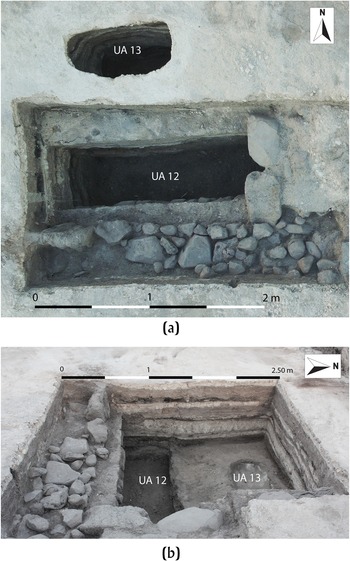
Its excavation, carried out in 2017, revealed a deep, narrow, rectangular cavity (2.00 m long × 0.60/0.65 m wide × 1.60 m deep), with regular vertical walls, except for the east wall, which was a little more irregular due to the presence of earlier stone foundations (Darras et al. Reference Darras2017; Figures 6a and 6b). The width and length coincided with the area taken up by the imprint, except at the western edge, where white materials used to repair the floor, as well as the imprint, spilled over by about 10 cm. The pit was filled in with a heterogeneous material of varying compactness; as indicated by a highly compact surface in the two-thirds part of the filling that attests to an interruption, this operation was carried out at two separate times.
Burial UA 12 being excavated. (a) Orthophoto; (b) view toward the west. Note that the burial pit has perforated several white occupation floors. Photograph by the author.

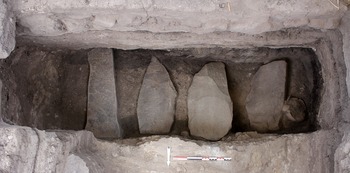
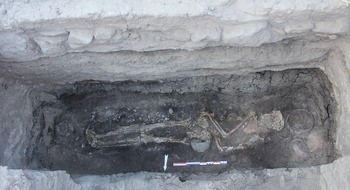
In the lower section of the pit, this sediment rested on a covering of four andesite slabs, which, in turn, covered the remains of an adult (Barrientos et al. Reference Barrientos, Darras, Castañeda, Glère and Darras2017). The level where the slab covering was detected corresponded to the beginning of a natural deposit of black soil. Here, the walls of the pit were enlarged to 0.75 m, and a narrower pit (0.55 m on the average) was then dug in the black sediment to the level of the bedrock consisting of tepetate (Figure 7). The difference in width thus allowed the four slabs to rest at regular intervals on the parts that were not hollowed out. The underside of the slab at the level of the tibias disclosed many carvings. The skeletal remains corresponded to an individual primary deposit identified as that of an adult (Barrientos et al. Reference Barrientos, Darras, Castañeda, Glère and Darras2017:46; Figure 8). The poor condition of the skeleton did not permit the determination of its age, but the morphology of the ischiatic incision and other morphological traits, such as the lower part of the coxal bone, made it possible to identify it as a female (Isaac Barrientos, personal communication 2021). The skeleton rested on the tepetate in a straight, lateral position (Grégory Pereira, personal communication 2020), with the skull placed at the west and perhaps oriented toward the south (it was quite fragmented). The upper limbs and condyles were twisted toward the south, probably because of the sinking of the body during its decomposition (Grégory Pereira, personal communication 2020). The distortion of certain skeletal remains, in particular at the level of the foot bones, might indicate that it was enclosed in a shroud at the moment it was deposited. While the overall dimensions of the pit were oversized relative to the height of the individual, the reduction of the space in the lower part and the considerable depth could have limited movements at the time of the burial, and thus interfered with the positioning of the body (Grégory Pereira, personal communication 2020).
Andesite slab cover with the limits of the lower part of the burial pit. Photograph by Alejandra Castañeda.

Bone remains with the funerary furniture. Photograph by Alejandra Castañeda.

The grave was provided with burial furnishings that included six ceramic monochrome bowls, four of which were deposited at the west end and one at the east. A large obsidian flake, a miniature bowl, and a spindle were placed on the south side of the body, with the obsidian flake at the level of the tibias. Some of these objects might have been deposited before the placement of the body in the pit and others afterward (Barrientos et al. Reference Barrientos, Darras, Castañeda, Glère and Darras2017).
The Hidden Face of the Slab
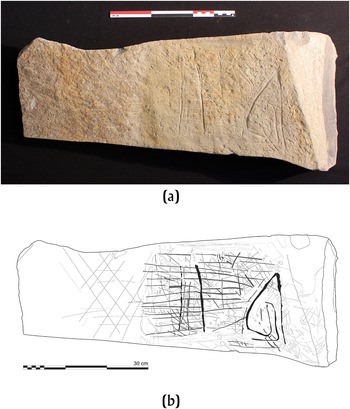
The engraved slab is sub-rectangular in shape and measures 0.73 m long, 0.34 m at its widest part, and between 6 and 8 cm thick (Figures 9a and 9b). Its lateral edges are perpendicular and the ends tapered. The entire carved side is covered with a yellowish-white cortical surface (Figure 9a). This side underwent several types of modifications that can be attributed to different techniques. The first two are related to the preparation of the surface to be incised. One of these consisted of rubbing a little more than half of the slab surface with a dampened tool, which produced a polished or lightly polished surface that was fairly homogeneous. The perimeter was subject to more pronounced rubbing in a straight line; this created a hollow defining a frame that stands out rather distinctly because of the difference in texture and location. The other half of the slab surface seems to have been prepared by stippling and has a rougher appearance. The third modification can be recognized by the presence of tiny round indentations scattered over the polished surface and visibly obtained by striking. The final modification, which is the most important, consists of the carving of lines of greater or lesser depth and width. These incisions represent two kinds of geometric motifs: grid-like forms that are sometimes superimposed and a spiral (Figure 9b).
(1) The grid-like patterns are spread over the entire surface of the slab. In the roughest section, a first motif incised with long diagonal lines that are quite narrow and not very pronounced was observed. The other section includes many grid-like motifs that are superimposed in an order that is difficult to determine. The most visible pattern is formed by deep incisions along a perpendicular axis. These vary in width and depth, with one north–south line measuring 0.7 cm wide and 0.3 cm deep. The frame is incised with lines forming a diagonal grid motif. Many other grid-like incisions are scattered over the perimeter of the frame and the slab.
(2) The spiral motif is found on the north side of the frame, which was prepared by rubbing. It was obtained through repeated, discontinuous linear incisions forming a more or less regular line that tends to be wide and deep.
(a) Engraved slab; (b) drawing of motifs. Photograph by the author; drawing by Sylvie Eliès.

The morphological diversity of the incisions implies several different tools, but also a variety of gestures and degrees of physical force. This diversity probably reflects the intervention of several hands, although the conditions (context, chronology) cannot be determined with precision. The appearance of the incisions suggests, however, that they were all produced within a short period of time, probably for a single event.
The Sequence of Funerary Gestures
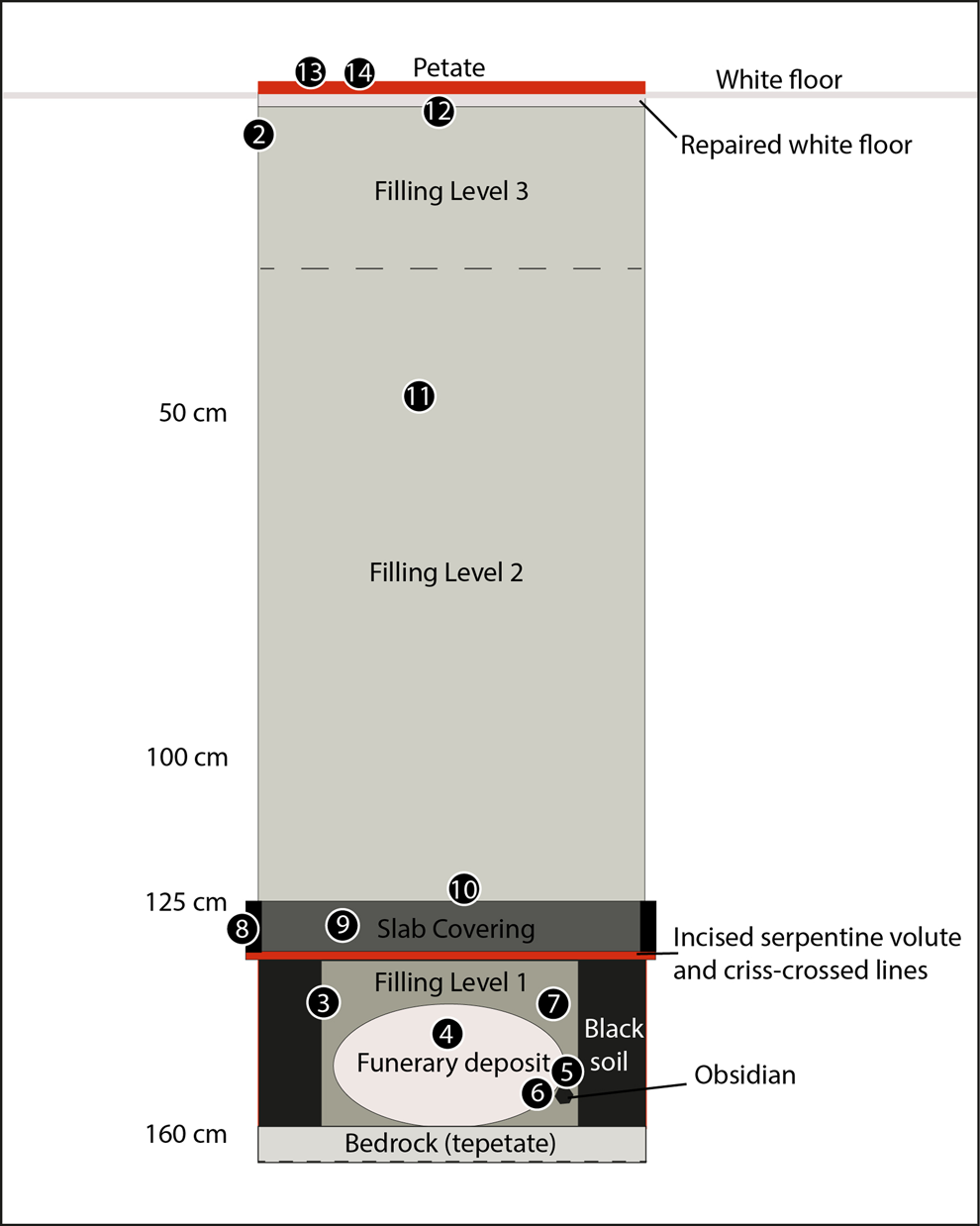
The distinctive morphological features of Burial UA 12 were immediately apparent when the pit was opened. In order to understand how the petate and the incised slab entered into the chaîne opératoire, it is necessary to consider the sequence of gestures we were able to reconstitute for the preparation of the pit, the burial, and the filling of the grave (Figure 10).
(1) The orientation of the pit along an east–west axis.
(2) The piercing of the occupation surface and digging of a very deep, narrow, rectangular pit with vertical sides. The pit perforates several earlier occupation surfaces, all of which were treated with a white material. The southern side is aligned along a constructed east–west axis.
(3) The digging of a narrower pit from the layer of black sediment corresponding to a natural deposit over the bedrock.
(4) The depositing of the body, perhaps within a wrapping, placing the head to the west. The lateral reclining position could be the result of the contortions due to the narrowness and depth of the pit.
(5) The distribution of certain burial furnishings around the body. A large obsidian flake was placed at the tibia level and a spindle at the pelvis, both on the south side. A miniature ceramic was also placed at the level of the rib cage on the south side.
(6) The placing of a ceramic bowl at the level of the pelvis on the north side.
(7) The filling the pit to the level of the enlargement (approximately 30 centimenters).
(8) The enlarging of the walls to facilitate the arrangement of four slabs at regular intervals, with the extremities resting on the black sediment.
(9) The placing of the incised slab at the level of the tibias, with the carved face down.
(10) The possible depositing of other burial furnishings at the edges of the pit (the ceramic object may have been placed before the placing of the body because it lies outside the lowermost section of the pit, on the black sediment).
(11) The filling of the pit in at least two steps, with marked packing in the last third in order to create a compressed surface. It is unknown if the filling was disturbed for practical reasons (to pack the filler) or if it was accompanied by gestures and deposits that can no longer be detected.
(12) The local restoration of the white floor, with the superposition of several thin layers of white material for a total thickness of roughly 2–3 centimeters.
(13) The depositing of a reed mat corresponding to the dimensions of the pit along a north–south axis. This petate was placed on the white mixture while it was still moist.
(14) The pressing and fixing of the mat in the white mixture.
Schematic diagram (north–south section) of the burial pit, including the different levels, as explained in the text. Drawing by the author.

The collapse of the adobe walls and the landslide subsequently created the conditions for the sealing and preservation of the petate and its impression.
The reconstruction of the sequence of gestures for the preparation of the pit, the deposit of the funerary items, and the filling and sealing, shows that the positioning of the engraved stone and the reed mat were planned beforehand and corresponded to a clear intention. These features lead us to rule out a uniquely commonplace purpose in favor of a use with symbolic dimensions. It is therefore appropriate to examine the meaning behind this intention by recalling the symbolism of the motifs formed by the interlacing of the tule stem.
THE TULE, THE PETATE AND THE GRID-LIKE MOTIF
In her 1985 study, Heyden describes the mechanisms that metamorphosed the tule, an ordinary aquatic plant used for a variety of craft and medicinal purposes, into a sacred plant that was “the very essence of the supreme god, of life and death,” symbolizing power and earthly paradise (Heyden Reference Heyden1985:140, 141–153). According to Sahagún, the name Tollan (“place of the tules”) designated a site of fertility and abundance, and even the divine site of the Creation, where the petlatl and icpalli personified the supreme god Tezcatlipoca (Olivier Reference Olivier1997; Sahagún Reference Sahagún and Garibay1981:vol. 1, bk. III, chap. II, pp. 308–309). For some researchers today, Tollan represents the origin of all peoples and designates the major urban centers concentrating power (Davies Reference Davies1977, cited in López Luján and López Austin Reference López Luján and Austin2007; Heyden Reference Heyden1985:144). For others, it is an abstract concept situated within the imaginary of the afterlife (López Luján and López Austin Reference López Luján and Austin2007). But regardless of the interpretations of Tollan, textual and iconographic sources agree on the association of the tule and the petate (as mat or seat) in the exercise of divine and earthly power (e.g., the Popol Na of Copan, Honduras; Fash et al. Reference Fash, Fash, Lane, Larios, Schele, Stomper and Stuart1992). As for the grid-like pattern formed by the interlacing (entretejido, reticulado) of the tule stems, it is one of the most widespread motifs in Mesoamerica, from the Early Preclassic and in most material production, including ceramics, fabrics, architecture, bas-reliefs, sculptures, wall frescoes, and codices, among other things.
The association of these motifs with the generic plant is frequent in the codices, especially in glyphs representing Tollan (e.g., Historia Tolteca-Chichimeca Reference Kirchhoff, Güemes and Reyes1976:Plate 16v). Moreover, the grid-like motif is most often interpreted at the schematized representation of the serpent's undulating movement, which can also take other stylized and sometimes emblematic forms, such as the spiral or the greca escalonada (Greek stepped motif; Carot Reference Carot2001; Escoto Reference Escoto Cortés2009). From the Preclassic on, the serpent appears as a key element of the Mesoamerican cosmovision, where it serves as a theriomorphic symbol. Representations of the serpent are frequent, whether realistic, stylized, or abstract, and the intention here is not to discuss its different meanings because its polysemic character is closely tied to the contexts of its appearance and associations. Depending on its attributes, the serpent can symbolize the celestial or earthly worlds, but also the underworld. It is recognized that it incarnates regeneration and rebirth and that it is often associated with aquatic and subterranean elements (Miller and Taube Reference Miller and Taube1993), and contributes to the life cycle involving the vertical circulation of water between the underground world, the earth and the sky (de la Garza Reference de la Garza1984:151–152). As a cold-blooded animal living part of the time in the bowels of the earth, the serpent belongs to the bestiary symbolizing the underworld, which is itself cold, dark, female, and aquatic (e.g., López Austin Reference López Austin1973).
But the serpent is also associated with the earth's surface (e.g., Freidel et al. Reference Freidel, Schele and Parker1993; López Austin Reference López Austin1973; Luckert Reference Luckert2001; Schele et al. Reference Schele, Miller and Kerr1986). Its slithering movements place its entire body in contact with that surface. Moreover, the grid-like or meander patterns ornamenting the foundations and facades of buildings, like those of Mitla or Tajín, might be a personification of the “mountain-serpent” diphrasism and are sometimes interpreted as a metaphor for the earth's surface (Luckert Reference Luckert2001; McDonald and Stross Reference McDonald and Stross2012). In the Maya region, the serpent's jaws placed at the entrance of certain buildings have been taken to represent the threshold between the world of the living and the watery underworld (McDonald and Stross Reference McDonald and Stross2012). The connection between the grid-like motif and the earth's surface, meanwhile, is suggested by López Austin (Reference López Austin1973) in a remarkable demonstration, developing a hypothesis advanced by his colleague Pohorilenko—namely, that the woven pattern of the petate would symbolize multiple cross-shaped motifs. López Austin recalls that the god Nappatecuhtli, “the lord of the four quarters of the earth's surface,” was depicted with a four-petal shield and was the protector of the craftspeople, weaving the grid-like motifs appearing on their reed mats. In his view, the connection between Nappatecuhtli and the entire surface of the earth divided into four parts would be perfectly illustrated in the association of cross and grid motifs evoking an abstract schematization of the serpent's movement.
These examples serve to demonstrate the existence of a close relationship between the grid-like motif, the cross, and the serpent as a polysemic symbol, crystallizing the interaction between subterranean, terrestrial, and celestial worlds. In the remarks that follow, we consider these different interpretations in light of our archaeological data.
THE PETATE AS A SYMBOL OF THE DECEASED'S AUTHORITY?
The characteristics of the graves found in the building raise the question of the social status of their occupants. To recapitulate: a body of evidence (the location and morphology of the burial, the construction quality, the nature of the furnishings) seems to indicate that the woman buried in UA 12 enjoyed a particular status, during her lifetime and after her death. Alongside these material indicators of status, the petate quite obviously adds a strong symbolic message, perhaps related to the exercise of power.
The petate from UA 12 covered the exact dimensions of the burial and was intended to be visible to the living. Did its presence mark the burial place of a powerful woman so that she would be remembered as an ancestor? While it is tempting to associate the idea of the ancestor with that of the site's founder, the data do not permit such a hypothesis because the structure where UA 12 is located is not the earliest within the occupation sequence, and the explorations did not provide an overall vision of its history. It is unknown whether there are other graves associated with earlier constructions or whether there were links between them. However, in addition to the child's burial nearby, we know that there are two other, slightly later burials, including one deliberately placed elsewhere in the structure, probably to avoid interfering with UA 12 and UA 13.
Ancestor veneration has been extensively studied in Mesoamerica, especially in the Maya world, where individuals are frequently buried under the floors of their houses (e.g., Goudiaby Reference Goudiaby2018; Hageman Reference Hageman, Hill and Hageman2016; McAnany Reference McAnany1995). McAnany's work demonstrates how ancestor veneration structured all sectors of Maya society and that the Maya maintained proximity to their dead in order to recall their genealogy by ensuring physical continuity in residential spaces (McAnany Reference McAnany1995:8). Through this physical connection and through oral memory and domestic rituals, descendants could maintain the link with the past, and thus legitimize their claims, particularly over land and local resources, according to the principle of first occupancy (McAnany Reference McAnany1995:96).
In this case study, the idea of a founding ancestral tradition is thus difficult to demonstrate, especially since there is no work on the subject for this region of Mesoamerica. Nothing precludes the idea of an “ancestralization” independent of the deceased woman's position within the genealogy of the site. Indeed, this hypothesis can be considered in the context of Goudiaby's research in the Maya lowlands. In his view, ancestor status depends on three criteria: (1) the family tie; (2) the deceased's ability to take action; and (3) the permanence of his or her memory (Goudiaby Reference Goudiaby2018:163–164).
(1) Concerning the family tie, it is clear that the four graves had a direct connection with the edifice and thus contributed to the site's genealogy. It is also likely that a family tie existed between the different individuals.
(2) Following traditional interpretations, we can attempt to associate the petate with the exercise of power, but it is also necessary to raise the question of the deceased's ability to take action in the world of the living. Could this object serve to mark a locus of the active power she exercised? Possibly through intermediaries from the world of the living? If we accept Goudiaby's premise, the petate's presence on the burial would thus recall the occupant's status and her ability to intervene among the living. But in this case, what would distinguish the status of UA 12 from that of the other two graves, which also received special treatment and occupied a specific location? Theoretically, the petate should suffice to distinguish UA 12 from the others. But it must be remembered that the mechanism permitting the preservation of the impression was exceptional, and if it is possible to suggest that UA 13 did not benefit from a similar covering, since its traces would probably have survived because of the same rapid sealing process; this is not true for UA 7, which is slightly later. This third grave might have been closed by the same kind of woven mat whose trace has been lost. Moreover, if we assume that the petate marked a locus of power, it reinforces our hypothesis that the building fulfilled a special function for the inhabitants of the site, regardless of whether it was residential.
(3) As for Goudiaby's third criterion, the fact that the petate was pressed directly into the wet surface to anchor it permanently corresponds to a clear intention to indicate the grave's location to the building's occupants. It is thus legitimate to deduce that the petate would have served as a reminder, sustaining the collective memory.
Goudiaby's proposed criteria therefore seem to have been sufficiently met to permit the deduction that UA 12 reflects a desire for ancestralization. A final argument in support of this hypothesis would be the choice to deposit the deceased in the black soil and on top of the bedrock, both of which constituted the ground where the site's first occupants had settled. Burying this person under the very first occupation would then indicate the desire to place her at the origins, as a founding ancestor after the fact. Such an intention would thus be consistent with the principle of first occupancy described by McAnany (Reference McAnany1995:96).
We shall now describe a slightly different, but not antithetical, scenario, which is suggested by the symbolism of the grid-like pattern.
THE PETATE AND THE COSMIC ORDER
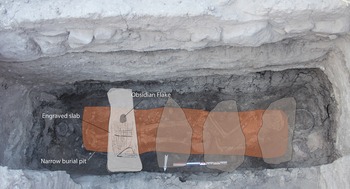
Burial UA 12 reveals at least two instances of grid-like motifs corresponding to the two different levels of covering of the pit. The first level consists of the slabs, which were arranged just after the placement of the body and its accompanying artifacts (Figures 10 and 11). The installation of this partial covering reveals a specific intention: to create a physical boundary, a limit between the lower part of the pit and the filling above. This is the level where the first visible grid motifs appear. The multiple criss-crossed lines and the spiral are found on the lower face of the slab and thus rest against the tibias of the deceased. The most pronounced motif, which has the deepest incisions and is inscribed within a frame, forms a grid of perpendicular lines aligned with the cardinal points. The spiral motif is placed to the north of these criss-crossed lines, while a large flake of black obsidian lies opposite, to the south of the deceased's tibias, so that these two elements frame the grid-like motifs.
Montage showing the incised motifs in transparency on the tibias and obsidian flake. Photograph by Alejandra Castañeda; montage by the author.

The second level corresponds to the ground surface once the pit was sealed. As already indicated, we can see the actual placement of a petate on the floor once it was repaired, in alignment with the cardinal points that also correspond to the corners of the grave.
How are we to interpret this spatial arrangement from the standpoint of the grid-like motif? I suggest, first of all, that the criss-crossed lines of the incised slab embody a petate and that the spiral is the schematic representation of an ophidian. Both the impression and the carving depict a woven mat aligned with the cardinal points and evoke multiple cross-shaped motifs. It is possible that these motifs correspond to a metaphor of the ophidians’ undulations and thus echo the clearer symbolism of the spiral. In all three cases, these are schematized representations of the snake's movement.
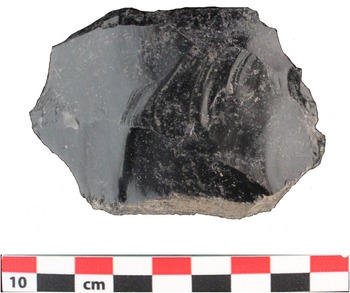
We know, moreover, that obsidian, like the serpentine form, can be associated with the underworld (Recinos Reference Recinos1950) because it comes from the entrails of the earth (Darras Reference Darras, Levine and Carballo2014), and because of its black color and smooth, cold appearance (Graulich Reference Graulich1982). The placing of a large black fragment in the grave is therefore not insignificant and gives rise to several observations (Figure 12). First of all, the Lerma floodplain where site PA3 is situated lies some 30 km from the vast obsidian deposits of Zináparo-Varal and Pénjamo. One of the surprises of the Tres Mezquites project was the discovery of the particularly small amounts of obsidian used by the pre-Hispanic populations in the region, not to mention the limited quantities of debris and tools, which suggested that obsidian was perhaps not an easily accessible resource. In light of this, the dimensions of the flake deposited in UA 12 (7.5 cm × 5.5 cm × 1 cm) are exceptional, making it by far the largest specimen found in the course of the project. Its alignment with the grid-like motifs is certainly deliberate because it contributes to the overall composition formed by these patterns and the spiral (Figure 11). It is thus argued that it is a unique object fulfilling a specific function.
The obsidian flake. Photograph by Alejandra Castañeda.

Given its oval, fairly flat shape, is it possible to go a step further and imagine that it is an obsidian mirror associated with divination? This is a risky question to answer and it is suggested, more cautiously, that this obsidian fragment, like the serpentine motif, is present as a symbol of the underworld.
The grid-like motif appearing on two levels constitute clear physical limits: the covering of the slab is a first level intended to be covered over, with its petroglyphs facing downward—in other words, toward the deceased and the bedrock (the tepetate)—while the white ground surface and its petate were intended to be shown.
How should we interpret these features in the context of the grave and, more broadly, the edifice where it is found? As we have seen, the building served for intense domestic and ritual activities. It was a place of comings and goings, a living environment. As indicated above, the petate would seem to have been a marker designating the location of the grave, which had been introduced without any transformations of the living area. We have also seen that all the graves within the building were very deep—in this case, 1.6 m. I propose two hypotheses to explain such depth: (1) the intention to reach the bedrock, which was at the origin of the site's occupation (or quite simply the origin); and (2) concerns for hygiene: since the installation of the graves was not followed by major reconstruction works permitting them to be tightly sealed, it was necessary to deposit the deceased far below the surface where the building's occupants pursued their normal activities. This physical distance was perhaps a necessary condition for tolerating the dead.
Whatever the case, one thing is clear, the exceptional depth of UA 12 and the covering made of slabs served to delimit the different spaces: it was necessary to confine the deceased in her own world. It is further suggested that the two grid-like motifs, and perhaps the spiral, reinforced this effort, acting at once as threshold and boundary between the earth's surface, marked by the four cardinal points and the underworld. The reminder provided by the two levels where the grid patterns appear (the slabs and the white floor surface) gives rise to two observations: first of all, that it was crucial to notify the deceased of her new place, and second, that this notification was necessary because the deceased was likely to come back to the world of the living. And in this context, we might ask whether the placing of the carved slab over her tibias and the presence of the spiral and the obsidian fragment were related to the idea of keeping her in the underworld.
The two grid-like motifs can therefore be interpreted as the personification of the earth's surface and its four parts, as López Austin (Reference López Austin1973) has proposed. In other words, the petate would not have been a symbol of the deceased's authority, but rather, would have had the power to restrain her ability to act. It is in fact the petate itself, as a finished object, that exerts power, at once through the plant used to make it, the criss-crossed motifs created by the interlacing of the stems, and its quadrilateral shape.
As Dehouve suggests in the case of Tlalpan rituals, the petate is a sacred space that can be seen as a cosmogram (Dehouve Reference Dehouve2013). In our context, it is placed above the grave and thus seals the underground world, the world below, both physically and symbolically. As a protector of the cosmic order, the petate is a regulator guaranteeing that things remain in their rightful places. By separating the worlds, it thus protects the living from the deceased's ability to act.
CONCLUSION
The exceptional circumstances leading to the preservation of this impression, along with the features of the grave, provide an extraordinary opportunity for discussing the role of the petate in mortuary practices and, on a broader scale, within Mesoamerican cosmovision. Furthermore, the contextual analysis and comprehension of the sequence of funerary gestures based on the concept of the chaîne opératoire has made it possible to establish spatial and functional connections between the different features of UC 1–2 and Burial UA 12, and to give the petate a symbolic meaning surpassing a strictly material and utilitarian use. Should we therefore say that the petate symbolizes the rulers’ authority, or does it represent the earth's surface and its four parts? In fact, the foregoing analyses demonstrate that its attributes are multiple and intertwined.
The petate from UA 12—and its carved (re)incarnation—contribute to the cosmic order by keeping things in their place. It acts, first of all, as part of the sequence of elements marking spatial discontinuities to order the temporalities: the bedrock, the black soil, the funerary deposit, the incised serpentine volute and petate motifs, the slab covering, the two levels of filling, the white occupation surface, and the petate made of tule (Figure 10). The active powers of the culminating element—the petate—complete the overall device and reinforce it. In this sense, it works as a veritable interface, with its lower side meant for the deceased and its visible side, which personifies the earth's surface, addressed to the living. This interface function thus allows the petate to serve as a closed gate between different space–time continua, in order to control interactions between the world of the living and that of the ancestors. It seals the grave, but also makes the location visible, and as such, can serve as a support for the collective memory.
It then becomes plausible that the petate constituted a sanctified space, possibly to be avoided or, on the contrary, to be occupied in certain circumstances (funeral rituals, for example, but perhaps also to invest the person seated on it with an authority conferred at once by the petate itself and the ancestralized deceased to whom it granted symbolic access). In other words, the petate may have combined two powers: that of regulator, separating the worlds as an incarnation of the earth's surface and its four parts, and that of temporal gate, guaranteeing the continuous exercise of authority. In any event, the elements assembled around the deceased demonstrate that she was probably a powerful woman whose potential intervention in the world of the living merited being channeled, if not contained or even neutralized.
We can go even further, however, by expanding the traditional interpretation that makes the petate a symbol of rulers’ authority as the “seat” of their power. As we have seen, it possessed its own powers, which rulers could capture to assert their authority. And indeed, these powers allow us to suggest that the petate served to give order to both the most ordinary activities of daily life and the most important moments of the lives of individuals and those who organized the community's destiny.
RESUMEN
El petate, del término náhuatl “petlatl”, es una estera de cestería hecha de plantas lacustres que se conocen con el término genérico de tule y abarcan una amplia variedad de especies pertenecientes a la familia de las ciperáceas. En los códices mesoamericanos del centro de México, el difrasismo náhuatl “petlatl in Icpalli” (estera-silla) se refiere al trono y al lugar donde se ejercía la autoridad. Esta sinécdota también se aplica a las esteras sencillas en las que se sientan las personas ejerciendo un poder. Al mismo tiempo, estas fuentes gráficas y etnohistóricas describen o ilustran una esfera de uso mucho más amplia, mostrando que el petate era un objeto ordinario, parte del mobiliario doméstico que acompañaba la vida de todos los individuos.
El objetivo de este artículo es discutir el simbolismo del petate a la luz de un descubrimiento arqueológico inédito. Las excavaciones realizadas en un contexto del clásico en el norte de Michoacán han evidenciado una impronta de petate que marcaba la ubicación de un entierro. La fosa, muy profunda, presentaba en su parte inferior una tapa de lajas cubriendo los restos humanos, una de las cuales estaba grabada con motivos reticulados y en espiral.
Tras un repaso de los usos antiguos y modernos del petate, basado en datos etnohistóricos, etnográficos y antropológicos, así como en evidencias arqueológicas relevantes, presentamos el estudio de caso que permite discutir las hipótesis sobre el significado simbólico del petate: la simbolización del poder por el petate y el de la encarnación de las cuatro partes de la superficie terrestre. Para abordar estos puntos, el enfoque del artículo se basa en una descripción escrupulosa del contexto arqueológico, teniendo en cuenta la distribución espacial de todos sus hallazgos, así como en un acertado análisis cronoestratigráfico para comprender la sucesión de los depósitos culturales y/o naturales. La interpretación contextual y la comprensión de cómo se formaron y conservaron los restos de petate se basaron en un enfoque geoarqueológico intra- y suprasitio, que incluyó análisis micromorfológicos de los sedimentos (Medina et al. Reference Medina-González, Espinoza-Pesqueira, Montufar and Darras2018; Solleiro et al. Reference Solleiro-Rebolledo, Darras, Sedov, Vargas-Rodríguez and García-Zeferino2021). Los vestigios arqueológicos discutidos en este artículo fueron estudiados siguiendo diferentes enfoques: las herramientas bioarqueológicas tradicionales para los restos óseos y la aplicación del método Bruzek para el diagnóstico sexual (Bruzek Reference Bruzek2002); y análisis químicos de pisos y de residuos en cerámicas con el método desarrollado por el Laboratorio de Prospección Arqueológica de la Universidad Nacional Autónoma de México (Barba y Ortiz Reference Barba Pingarrón and Butrón1992; Barba et al. Reference Barba Pingarrón, Suárez and Córdova Frunz1991). Finalmente, este estudio se basa en una reconstitución de la secuencia de gestos funerarios que se pudieron reconocer en campo, incluyendo la excavación de la fosa, la colocación del depósito funerario y el relleno final de esta fosa. Utilizamos el concepto de chaîne opératoire para comprender la sucesión de las diferentes acciones y para destacar su coherencia en el proceso funerario (Duday et al. Reference Duday, Courtaud, Crubézy, Sellier and Tillier1990; Valentin et al. Reference Valentin, Rivoal, Thevenet and Sellier2014). Es este tipo de enfoque el que nos permite discutir la presencia del petate más allá de una perspectiva estrictamente doméstica y utilitaria.
Este análisis contextual lleva a proponer que el depósito de petate constituyó el último gesto que pudimos reconocer tras el relleno de la fosa. Proponemos que tuvo un vínculo directo con la sepultura UA 12 y que se depositó intencionalmente en relación con el proceso funerario. También proponemos que el petate cumplía una función específica relacionada con el mundo de los vivos y el de los muertos. El análisis contextual sugiere que tanto el petate como la laja incisa sirvieron de umbrales, si no de barreras, entre el mundo de los vivos y el inframundo. Proponemos que el petate, como garante del orden cósmico, se colocó sobre la tumba para actuar como regulador, asegurando que las cosas estuvieran debidamente separadas y que permanecieran en sus respectivos lugares. También sugerimos que el petate puede haber actuado como una puerta temporal que garantiza la continuidad del ejercicio de la autoridad. Ponemos el petate en el centro del debate al argumentar que el propio objeto estaba dotado de poder.
ACKNOWLEDGMENTS
This research was carried out through the archaeological project Tres Mezquites funded by the Commission des fouilles of the Ministry of Foreign Affairs of France. It could also be carried out thanks to the logistic support of the research laboratory UMR 8096 (CNRS/ Université Paris 1 Panthéon-Sorbonne) and the Centre d'études mexicaines et centraméricaines (CEMCA) in Mexico City. I am very grateful to the persons who took part in the fieldwork or laboratory studies as students and/or researchers, and local workers. The translation of this article from French to English was done by Miriam Rosen.