In recent years, clinicians and researchers have shown increasing interest in the personality construct of perfectionism. Among those who study perfectionism, standard setting has been emphasised as one of the core characteristics of the trait (Frost, Marten, Lahart, & Rosenblate, Reference Frost, Marten, Lahart and Rosenblate1990), and numerous researchers have agreed on the assumption that perfectionists are those marked by the setting of excessively high standards for personal performance (Burns Reference Burns1980; Frost et al., Reference Frost, Marten, Lahart and Rosenblate1990; Hamachek, Reference Hamachek1978; Shafran & Mansell, Reference Shafran and Mansell2001). However, beyond this consensus, issues in relation to the definition, dimensionality, and maintenance of perfectionism remain highly debated; including the various cognitive, affective, and behavioural factors argued to be significant in the study of perfectionism. Researchers who are new to this field are therefore confronted with many different conceptualisations of perfectionism (Flett & Hewitt, Reference Flett, Hewitt, Flett and Hewitt2002).
Perfectionism as a Multidimensional Construct
Early conceptualisations of perfectionism portrayed the construct from both a unidimensional and pathological perspective (Ganske & Ashby, Reference Ganske and Ashby2007). Among the first theorists to provide an account of people with perfectionism include Hollender (Reference Hollender1965), who defined the construct as an essentially negative personality trait involving an unjustifiable demand on oneself or others for a superior quality of performance that is in excess to what is required in any situation. Hollender also emphasises the significance of cognitive processes in the maintenance of perfectionism, such as ‘selective attention’, in which the individual is constantly focused on actual or perceived failures in performance, while successes are often ignored or discredited. In defining perfectionism, Burns (Reference Burns1980) also highlights the self-defeating nature and cognitive aspects of the construct, noting the importance of a ‘highly dependent on success’ self-evaluation process that characterises perfectionistic people. According to Burns, perfectionists can be described as ‘those whose standards are high beyond reach or reason, people who strain compulsively and unremittingly toward impossible goals and who measure their own worth entirely in terms of productivity and accomplishment’ (p. 34).
However, conceptualisations of perfectionism have evolved significantly in the last two decades (Ganske & Ashby, Reference Ganske and Ashby2007), with a growing body of research demonstrating that perfectionism is best studied using a multidimensional approach (e.g., Dunkley, Zuroff, & Blankstein, Reference Dunkley, Zuroff and Blankstein2003; Frost et al., Reference Frost, Marten, Lahart and Rosenblate1990; Hewitt & Flett, Reference Hewitt and Flett1991a; Slaney, Rice, Mobley, Trippi, & Ashby, Reference Slaney, Rice, Mobley, Trippi and Ashby2001). Specifically, earlier work (e.g., Hewitt & Flett, Reference Hewitt and Flett1990; Hewitt & Flett, Reference Hewitt and Flett1991b) proposed that perfectionism is multidimensional, with both intrapersonal and interpersonal content (Flett & Hewitt, Reference Flett, Hewitt, Flett and Hewitt2002), as measured by the two Multidimensional Perfectionism Scales (MPS) (FMPS, Frost et al., Reference Frost, Marten, Lahart and Rosenblate1990; HMPS, Hewitt & Flett, Reference Hewitt and Flett1991b). Both measures have supported the notion that perfectionism is multifaceted and that conceptualisations focusing exclusively on the personal aspects of the construct (e.g., high personal standards) are inadequate for understanding perfectionistic behaviour (Flett & Hewitt, Reference Flett, Hewitt, Flett and Hewitt2002; Flett, Russo, & Hewitt, Reference Flett, Russo and Hewitt1994). The HMPS therefore includes two subscales designed to assess the interpersonal dimensions of perfectionism (i.e., Other-Oriented Perfectionism — perfectionism directed towards others; and Socially-Prescribed Perfectionism — perception or belief that others are enforcing high standards on oneself) along with the third subscale that assesses aspects of perfectionism directed towards the self (i.e., Self-Oriented Perfectionism). The FMPS places greater emphasis on the intrapersonal dimensions of perfectionism as measured by the Personal Standards, Doubts About Actions, Concern Over Mistakes, and Organisation subscales and also incorporates two subscales that assess aspects of perfectionism associated with the perceived presence of parental demands on the self (i.e., Parental Expectations and Parental Criticism).
Recent empirical work (e.g., Slaney, Ashby, & Trippi, Reference Slaney, Ashby and Trippi1995; Slaney et al., Reference Slaney, Rice, Mobley, Trippi and Ashby2001) has not only provided support for the idea of understanding perfectionism as a multidimensional construct but has also challenged the psychological literature for mainly focusing on the problematic aspects of the construct. Further ways of conceptualising perfectionism have arisen from attempts to challenge this bias. The idea that perfectionism is a multidimensional construct comprised of both adaptive and maladaptive components stems from the early work of Hamachek (Reference Hamachek1978), who identified the distinction between normal and neurotic forms of perfectionism. Normal (or adaptive) perfectionists are described as those who strive for high standards, yet retain the ability to feel accomplished and satisfied when those standards are met. They allow for minor mistakes in their work and are flexible in their pursuit for success. Conversely, neurotic (or maladaptive) perfectionists are those who set unrealistically high standards and allow relatively little margin for error. They are constantly concerned about disappointing others and hold the perception that they ‘never seem to do things good enough’ (Hamachek, Reference Hamachek1978, p. 27).
The Almost Perfect Scale (APS; Slaney & Johnson, Reference Slaney and Johnson1992) is one of the first measures developed to examine both adaptive and maladaptive facets of the perfectionism construct. Its current version, the Almost Perfect Scale–Revised (APS-R; Slaney, Mobley, Trippi, Ashby, & Johnson, Reference Slaney, Mobley, Trippi, Ashby and Johnson1996; Slaney et al., Reference Slaney, Rice, Mobley, Trippi and Ashby2001) is composed of three subscales (i.e., Standards, Discrepancy, and Order). According to Slaney et al. (Reference Slaney, Rice, Mobley, Trippi and Ashby2001), the Discrepancy subscale represents the more maladaptive components of perfectionism and measures the extent to which one perceives their own performance as failing to meet expected standards. This subscale is also considered critical in determining whether perfectionism is adaptive or maladaptive. In contrast, the Standards and Order subscales are believed to reflect aspects of adaptive perfectionism. More specifically, Slaney and colleagues have defined adaptive perfectionists as those with high Standards and low Discrepancy scores, while maladaptive perfectionists are those with high Standards and high Discrepancy scores.
Perfectionism as a Transdiagnostic Construct
Perfectionism has been implicated in the aetiology, maintenance, and course of a wide variety of psychopathology (Shafran, Cooper, & Fairburn, Reference Shafran, Cooper and Fairburn2002; Shafran & Mansell, Reference Shafran and Mansell2001). For the past two decades, researchers have continued to demonstrate clear associations between perfectionism and personal adjustment problems, including depression (Flett, Besser, Davis, & Hewitt, Reference Flett, Besser, Davis and Hewitt2003; Flett, Hewitt, Blankstein, & Mosher, Reference Flett, Hewitt, Blankstein and Mosher1991b; Hewitt & Flett, Reference Hewitt and Flett1991a), anxiety disorders (Antony, Purdon, Huta, & Swinson, Reference Antony, Purdon, Huta and Swinson1998; Flett, Hewitt, Endler, & Tassone, Reference Flett, Hewitt, Endler and Tassone1995), and eating disorders (Halmi et al., Reference Halmi, Sunday, Strober, Kaplan, Woodside, Fichter and Kaye2000; Sutandar-Pinnock, Woodside, Carter, Olmsted, & Kaplan, Reference Sutandar-Pinnock, Woodside, Carter, Olmsted and Kaplan2003). More recently, Egan, Wade, and Shafran (Reference Egan, Wade and Shafran2011) conducted a review of evidence supporting the conception that perfectionism is a transdiagnostic process, that is, ‘one which occurs across different diagnoses but also one that is either a risk factor for the disorder or a maintaining mechanism’ (p. 204). Egan and colleagues note the accumulation of evidence suggesting that perfectionism is not only elevated across many disorders when compared to healthy controls but also a risk factor and maintaining factor for a wide range of problems, and that targeting perfectionism in treatment results in better psychological outcomes (see Egan et al., Reference Egan, Wade and Shafran2011, for a review).
Adaptive and Maladaptive Dimensions of Perfectionism
Many of the studies investigating perfectionism have only directed their attention towards the negative components of the construct, without considering the potential positive aspects of the construct (Slaney et al., Reference Slaney, Ashby and Trippi1995). In support of Hamachek's (Reference Hamachek1978) delineation between adaptive and maladaptive perfectionism, there has been a mounting body of evidence to suggest a two-dimensional, higher-order factor structure for the construct. Although having been labelled differently (e.g., Positive Striving — Frost, Heimburg, Holt, Mattia, & Neubauer, 1993; Adaptive Perfectionism — Rice, Slaney, & Ashby Reference Rice, Slaney and Ashby1998; Positive Perfectionism — Terry-Short, Owens, Slade, & Dewey, Reference Terry-Short, Owens, Slade and Dewey1995), the first factor has been suggested to capture the more adaptive and positive facets of perfectionism related to perfectionistic striving and having high personal standards (Stoeber, Chesterman, & Tarn, Reference Stoeber, Chesterman and Tarn2010; Stoeber, Hutchfield, & Wood, Reference Stoeber, Hutchfield and Wood2008). This ‘positive’ dimension has been shown to be related to positive affect and unrelated to depression (Frost et al., Reference Frost, Heimberg, Holt, Mattia and Neubauer1993). While the second factor (e.g., Maladaptive Evaluation Concerns — Frost et al., Reference Frost, Heimberg, Holt, Mattia and Neubauer1993; Maladaptive Perfectionism — Rice et al., Reference Rice, Slaney and Ashby1998; Negative Perfectionism — Terry-Short et al., Reference Terry-Short, Owens, Slade and Dewey1995) represents the negative and pathological facets of perfectionism related to critical self-evaluations of one's performance and feelings of discrepancy between one's performance and one's expectations (Stoeber et al., Reference Stoeber, Chesterman and Tarn2010; Stoeber et al., Reference Stoeber, Hutchfield and Wood2008). This factor has been found to be inversely associated with self-esteem and positively associated with depression and negative affect (Frost et al., Reference Frost, Heimberg, Holt, Mattia and Neubauer1993; Rice et al., Reference Rice, Slaney and Ashby1998).
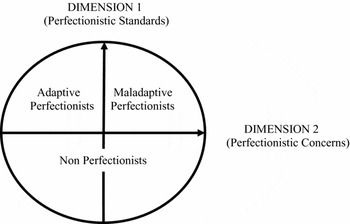
Factor analysis of the items comprising the FMPS and HMPS has demonstrated evidence of a two-factor solution manifesting an adaptive-maladaptive model of perfectionism (Frost et al., Reference Frost, Heimberg, Holt, Mattia and Neubauer1993). Frost and colleagues found Self-Oriented Perfectionism and Other-Oriented Perfectionism on the HMPS and Personal Standards and Organisation from the FMPS to load on the factor representing the positive dimensions of perfectionism (e.g., Perfectionistic Strivings — Stoeber & Otto, Reference Stoeber and Otto2006), while Concern Over Mistakes, Doubts About Actions, Parental Expectations, and Parental Criticism on the FMPS and Socially-Prescribed Perfectionism from the HMPS loaded on the negative dimension (e.g., Perfectionistic Concerns — Stoeber & Otto, Reference Stoeber and Otto2006; see Figure 1).
Adaptive perfectionists, maladaptive perfectionists, and non-perfectionists and their relation to the positive dimension of perfectionistic strivings and the negative dimension of perfectionistic concerns. Note: Adapted from Stoeber and Otto, Personality and Social Psychology Review, 10, 295–319, Figure 1, © 2006. Reprinted by Permission of SAGE Publications.

Among the empirical studies conducted to investigate the differences between Hamachek's (Reference Hamachek1978) distinct groups of perfectionists, maladaptive perfectionists have been found to have significantly greater feelings of inferiority, lower self-esteem, and increased negative affect and anxiety when compared to adaptive perfectionists (Ashby & Kottman, Reference Ashby and Kottman1996; LoCicero & Ashby, Reference LoCicero and Ashby2000; Rice & Slaney, Reference Rice and Slaney2002). In keeping with these findings, adaptive perfectionists have been shown to report significantly higher levels of self-efficacy, positive wellbeing, self-esteem, greater life satisfaction, and higher internal locus of control than maladaptive perfectionists and non-perfectionists (Ashby & Rice, Reference Ashby and Rice2002; Ganske & Ashby, Reference Ganske and Ashby2007; Grzegorek, Slaney, Franze, & Rice, Reference Grzegorek, Slaney, Franze and Rice2004; LoCicero & Ashby, Reference LoCicero and Ashby2000; Rice & Slaney, Reference Rice and Slaney2002; Periasamy & Ashby, Reference Periasamy and Ashby2002). Collectively, these findings provide support for early Alderian explanations of healthy and unhealthy ways of striving for perfection, in which adaptive perfectionists are proposed to experience less distress in their striving for high standards as their pursuit for superiority is conducted in a realistic and appropriate manner (Alder, 1956, as cited in Slaney, Rice, & Ashby, Reference Slaney, Rice, Ashby, Flett and Hewitt2002). In contrast, maladaptive perfectionists are conceptualised as experiencing greater levels of distress as they strive to meet unrealistic standards and unattainable goals, which is driven by a fear of failure and criticism and attempts to escape feelings of inferiority.
There is a growing interest in clarifying whether the perfectionism construct does indeed consist of an adaptive component. However, Flett and Hewitt (Reference Flett, Hewitt, Flett and Hewitt2002) contend that the more important question to ask is: How do individuals characterised by ‘adaptive perfectionism’ respond when they come across stressful situations that imply that their high standards and perfectionistic demands are not being met? Specifically, Flett and Hewitt question whether adaptive perfectionists might exhibit the same levels of distress and maladjustment as maladaptive perfectionists if they were subjected to the same degree of stress or the same sort of unfavourable circumstances. Thus, empirical investigations assessing how adaptive perfectionists react under conditions in which their efforts do not result in the achievement of their standards, is greatly warranted.
Perfectionism and Negative Affective States
Theoretical explanations of perfectionism and research suggests that negative affective mood states act both as a cue for, and as an outcome of, perfectionism (Egan et al., Reference Egan, Wade and Shafran2011; Shafran & Mansell, Reference Shafran and Mansell2001). It has been generally hypothesised that negative affective states occur in association with irrational cognitions related to fear of failure and self-critical thinking, triggered by an unrealistic demand for a superior quality of performance (Ellis, Reference Ellis1962; Shafran et al., Reference Shafran, Cooper and Fairburn2002; Shafran & Mansell, Reference Shafran and Mansell2001). In the short term, individuals who set unrealistically high standards and who strive relentlessly towards attaining them, will continue to do so as a means of coping with negative affective states (e.g., anxiety related to the threat of failure in the future). However, in the long term, such perfectionistic tendencies will also intensify feelings of inadequacy and concerns about failure, and thus increase the likelihood of experiencing future negative affective states. A growing body of correlational research has demonstrated support for these theoretical arguments, revealing significant correlations between dimensions of perfectionism and constructs related to negative affectivity, including worry, shame, guilt, anxiety, and depression (e.g., Flett et al., Reference Flett, Hewitt, Blankstein and Mosher1991b; Flett et al., Reference Flett, Hewitt, Endler and Tassone1995; Pacht, Reference Pacht1984).
Although there has been evidence to support the link between perfectionism and negative affective mood states, the majority of research conducted in this area has largely focused on trait measures of negative affectivity. For example, Frost et al. (Reference Frost, Heimberg, Holt, Mattia and Neubauer1993) examined the relation between dimensions of perfectionism and trait measures of positive and negative affect in general. Correlational analyses showed that elevated levels of trait positive affect was significantly positively related to the self-oriented dimension of perfectionism and high standards. Conversely, trait negative affect was positively associated with socially prescribed perfectionism. Similarly, in a study investigating how psychological functioning differed across dimensions of adaptive and maladaptive perfectionism, Chang, Watkins, and Banks (Reference Chang, Watkins and Banks2004) found a significant positive correlation between trait negative affect and maladaptive perfectionism. Nonetheless, these studies have been criticised for their use of trait measures in assessing affect, which fails to take into account of the state changes that may occur in affective reactions during performance situations.
To clarify understanding of the role that negative affective states may hold in perfectionism, empirical investigations have utilised state measures of affective states to assess the situation specific nature of the relationship (Besser, Flett, & Hewitt, Reference Besser, Flett and Hewitt2004; Bieling, Israeli, Smith, & Antony, Reference Bieling, Israeli, Smith and Antony2003; Flett et al., Reference Flett, Hewitt, Endler and Tassone1995). The results of these studies demonstrate that state measures of negative affect assessed in relation to performance contexts correlated significantly with perfectionism, and in some cases, the findings appear to capture relationships with perfectionism not often found using trait measures of affectivity. For instance, Flett et al. (1995) reported stronger correlational relationships between HMPS dimensions of perfectionism and state anxiety, as assessed by the Endler Multidimensional Anxiety Scales (EMAS; Endler, Edwards, & Vitelli, Reference Endler, Edwards and Vitelli1991; Endler, Edwards, Vitelli, & Parker, Reference Endler, Edwards, Vitelli and Parker1989), than the associations between dimensions of perfectionism and a trait measure of anxiety. Additionally, Flett et al. (1995) sought to evaluate state anxiety under performance conditions of low versus high ego involvement. The results revealed significant positive associations between socially prescribed perfectionism and the EMAS state anxiety measures, but only under conditions involving high ego threat.
In summary, findings in this area provide support for the hypothesised links between perfectionism and negative affective states. However, the strength of the relationship between these constructs remains modest. As such, these findings imply that although negative affectivity may arise in association with perfectionism, it is not likely to denote the primary explanation of persistence and striving in perfectionism. Furthermore, these findings appear to suggest the existence of other variables important in understanding perfectionism.
Overview of Theoretical Models of Perfectionism
Dual Process Model of Perfectionism
The dual process model of perfectionism was proposed by Slade and Owens (Reference Slade and Owens1998) based on principles from Skinner's (Reference Skinner1968) reinforcement theory. This model stipulates that the pursuit of perfection for adaptive perfectionists is underpinned by an emphasis on achieving positive outcomes and success (i.e., positive reinforcement), whereas maladaptive perfectionists pursue perfection as a function of avoiding negative consequences and failure (i.e., negative reinforcement). According to Slade and Owens’ (1998) model, adaptive perfectionists tend to set realistic and attainable standards, are satisfied when they achieve success, and therefore remain optimistic about achieving success in the future. Conversely, maladaptive perfectionists are more likely to set unachievable goals and are claimed to hardly ever experience feelings of satisfaction when goals are achieved due to their fear of failing in the future. Furthermore, adaptive perfectionists are driven by the pursuit towards their ideal self, while maladaptive perfectionists are motivated by the desire to avoid their feared self (Slade & Owens, Reference Slade and Owens1998).
The Cognitive Behavioural Model of Clinical Perfectionism
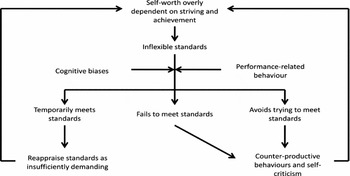
The cognitive behavioural model of clinical perfectionism was devised by Shafran et al. (Reference Shafran, Cooper and Fairburn2002) to describe how psychopathology might be maintained by perfectionism (see Figure 2). Based on clinical observations, this model provides a cognitive-behavioural explanation of clinically significant perfectionism, classifying the behaviour as an emotional disturbance resulting from ‘the overdependence of self-evaluation on the determined pursuit of personally demanding, self-imposed, standards in at least one highly salient domain, despite adverse consequences’ (Shafran et al., Reference Shafran, Cooper and Fairburn2002, p. 778). These consequences include emotional (e.g., depression and anxiety), social (e.g., social withdrawal), physical (e.g., insomnia), cognitive (e.g., concentration difficulties), and behavioural (e.g., excessive checking of work) outcomes (Shafran et al., Reference Shafran, Cooper and Fairburn2002). The authors argue that personally demanding self-imposed standards and the evaluation of self-worth solely on achievement and success leads to a heightened fear of failure, critical evaluation of performance, and a greater level of doubt to meet inferred standards. As a result, failure to achieve such standards becomes more likely. For the perfectionist, actual or perceived failure results in self-criticism, further negative self-evaluation, and reinforcement of the association between the pursuit and achievement of their standards.
The Revised Cognitive-Behavioural Model of Clinical Perfectionism. Note: Diagram from Overcoming perfectionism: A self-help guide using cognitive behavioural techniques, by Shafran, Egan, and Wade (Robinson, an imprint of Constable & Robinson Ltd, London, Reference Shafran, Egan and Wade2010) by permission of the publisher.

Another key maintaining factor of clinical perfectionism suggested by Shafran and colleagues is the perfectionist's biased evaluation of their own standards and performance. Such information-processing biases include dichotomous thinking, selective attention, and overgeneralisation (Antony & Swinson, Reference Antony and Swinson1998). For example, the endorsement of dichotomous thinking involves perceiving outcomes as either ‘all right’ or ‘all wrong’, in which the continuum between the two extreme choices is often overlooked by the perfectionist. The authors specify that these biased evaluations interact with one another and subsequently increase the likelihood that the perfectionist will fail to meet their standards (Shafran et al., Reference Shafran, Cooper and Fairburn2002). Furthermore, interpreting standards and performance in this way is suggested to maintain self-criticism and negative self-evaluation. The perfectionist thereby finds themselves in a negative cycle in which they continue to anticipate that they will fail to achieve their standards, which further reinforces their critical and biased way of evaluating performance outcomes (Shafran et al., Reference Shafran, Cooper and Fairburn2002).
According to this model, for some perfectionists, the fear of failure and pursuit for success becomes so overwhelming that they avoid trying to meet their standards altogether, through counterproductive behaviours such as procrastination (i.e., delaying initiation of tasks because to complete the task perfectly is assumed to be impossible, difficult or unpleasant) and abandonment or premature cessation of tasks (Antony & Swinson, Reference Antony and Swinson1998; Frost et al., Reference Frost, Marten, Lahart and Rosenblate1990; Shafran et al., Reference Shafran, Cooper and Fairburn2002). Such avoidant behaviour is claimed to provide little relief for the perfectionist as the evaluation of their self-worth still remains dependent on striving to meet unrealistically high performance standards (Shafran et al., Reference Shafran, Cooper and Fairburn2002). The authors argue that further avoidance is likely to increase the chance of failure, thereby maintaining the perfectionist's self-critical thinking and vulnerability to criticism.
The model also stipulates that occasionally, perfectionists are able to successfully meet their personally demanding standards in a way that temporarily improves evaluation of the self while reinforcing the pursuit and attainment of these standards (Burns, Reference Burns1980, as cited in Shafran et al., Reference Shafran, Cooper and Fairburn2002). Additionally, standards are reappraised in response to goal attainment by perfectionists as being set too low and considered insufficiently demanding as they were able to achieve set standards. This reappraisal of standards then becomes responsible for the resetting of standards, which as a consequence increases the likelihood that the perfectionist will experience perceived failure, thereby maintaining high levels of self-criticism and an overdependence on task ability and performance to determine one's sense of self (Shafran et al., Reference Shafran, Cooper and Fairburn2002). A number of studies relating irrational beliefs with perfectionism have supported the role of negative cognitions in understanding perfectionistic behaviour (e.g., Flett, Hewitt, Blankstein, & Koledin, Reference Flett, Hewitt, Blankstein and Koledin1991a).
Evidence for Cognitive-Behavioural Explanations of Perfectionism
Irrational Thinking
Central to theoretical explanations is the conception that perfectionism is derived from dysfunctional thinking patterns (Beck, Reference Beck1976; Pacht, Reference Pacht1984; Shafran et al., Reference Shafran, Cooper and Fairburn2002). Earlier work by Ellis (Reference Ellis1962) identified irrational thinking processes as the primary cause of emotional and behavioural disturbance. Specifically, perfectionism is perceived as a core irrational belief that emphasises the importance of perfect performance (e.g., ‘I must be perfect in everything I do’; Ellis, Reference Ellis1962). These irrational beliefs are considered self-defeating because of the excessive self-expectations the perfectionist sets and the unlikely possibility of meeting such standards. Furthermore, inflated irrational thoughts are purported to mediate a vulnerability to emotional distress (e.g., feelings of anxiety about performing) which subsequently interferes with one's ability to perform (Ellis, Reference Ellis, Flett and Hewitt2002). In line with theoretical hypotheses, previous studies have shown that various dimensions of perfectionism are significantly related to irrational cognitions (Flett et al., Reference Flett, Hewitt, Blankstein and Koledin1991a; Flett, Hewitt, Blankstein, & Gray, Reference Flett, Hewitt, Blankstein and Gray1998).
Flett and colleagues’ (1991a) research was one of the first to establish an empirical link between irrational thinking and perfectionism. Using a sample of university students, Flett and colleagues reported statistically significant correlations between irrational thinking as measured by the Irrational Beliefs Test (IBT; Jones, Reference Jones1969) and self-reported perfectionism scores on the HMPS. In addition to a global score of irrational thinking, the IBT also provides individual subscale scores for 10 unique irrational thinking patterns relating to demand for approval, high self-expectations, blame proneness, frustration reactivity, emotional irresponsibility, anxious overconcern, problem avoidance, dependency, helplessness, and the need for perfect solutions to problems. The study found moderate to strong significant positive correlations between all three HMPS dimensions (i.e., self-oriented, other-oriented, and socially prescribed perfectionism) and the IBT high self-expectations subscale. Moreover, results showed significant positive correlations between self-oriented perfectionism and the IBT subscales of low frustration tolerance, need for perfection solutions, and demand for approval. In addition, socially prescribed perfectionism was found to have significant positive associations with the IBT subscales of demand for approval, dependency, blame proneness, and anxious overconcern. While their results provided support for the hypothesised link between irrational cognitions and perfectionism, the authors concluded the need to interpret their findings with caution due to possible limitations of the IBT. That is, the use of the IBT may have adversely impacted the nature and strength of the relationship between perfectionism and irrational thinking, given that the IBT subscales contain content that not only refers to thought processes (i.e., personal beliefs), but also to affective processes (Smith, Reference Smith1982; Smith, Boaz, & Denney, Reference Smith, Boaz and Denney1984).
In response to the limitations of the IBT, Flett et al. (Reference Flett, Hewitt, Blankstein and Koledin1991a) conducted a follow-up study and administered an improved measure of irrational thinking to a sample of university students. The Survey of Personal Beliefs (SPB; Demaria, Kassinove, & Dill, Reference Demaria, Kassinove and Dill1989; Kassinove, Reference Kassinove1986) yields an overall irrational beliefs score, and five subscale scores (i.e., self-directed shoulds, other-directed shoulds, awfulising beliefs, low frustration tolerance, and self-worth), each representing a distinct irrational thinking pattern. Results showed statistically significant correlations between other-oriented perfectionism and all of the SPB measures. Similarly, there was a significant relationship between socially prescribed perfectionism and all of the irrational belief measures. Additionally, self-oriented perfectionism was correlated significantly with self-directed shoulds, other-directed shoulds, and total rationality.
Collectively, these findings provide support for the hypothesis that perfectionism is associated with irrational thinking constructs, and also support the validity of investigating particular subsets of irrational beliefs that may be specific to the different dimensions of perfectionism. Accordingly, a number of studies have examined the particular irrational beliefs and fears identified as being specific to perfectionism, namely, fear of failure, fear of negative evaluation, high self-expectations, and low self-worth (Blankstein, Flett, Hewitt, & Eng, Reference Blankstein, Flett, Hewitt and Eng1993; Conroy, Kaye, & Fifer, Reference Conroy, Kaye and Fifer2007; Hewitt & Flett, Reference Hewitt and Flett1991b).
Fear of Failure
Prominent in cognitive-behavioural conceptualisations of perfectionism is an emphasis on the perfectionist's excessive concern with failure and intolerance with disapproval from others (Burns, Reference Burns1980; Hamacheck, 1978; Pacht, Reference Pacht1984), as in Shafran et al.'s (Reference Shafran, Cooper and Fairburn2002) model of clinical perfectionism in which the perfectionist's vulnerable sense of self is thought to stem from an irrational and morbid fear of failure. Moreover, this fear of failure is purported to motivate and maintain the behavioural components of perfectionism that are responsible in helping the perfectionist achieve their high standards (e.g., repeated checking of work; Shafran et al., Reference Shafran, Cooper and Fairburn2002; Shafran & Mansell, Reference Shafran and Mansell2001). In light of these ideas, studies have demonstrated significant relationships between dimensions of perfectionism and cognitions associated with fear of failure (Blankstein et al., Reference Blankstein, Flett, Hewitt and Eng1993; Conroy et al., Reference Conroy, Kaye and Fifer2007; Flett et al., Reference Flett, Hewitt, Blankstein and Mosher1991b).
Preliminary support for these cognitive-behavioural explanations is claimed in an earlier study by Flett et al. (Reference Flett, Hewitt, Blankstein and Mosher1991b) investigating the association between perfectionism and self-actualisation. The study found significant negative relationships between the self-actualisation component measuring tolerance of failure and all three HMPS dimensions (i.e., self-oriented, other-oriented, and socially prescribed perfectionism). Furthermore, results highlighted that inability to tolerate failure and disapproval was most strongly related to socially prescribed perfectionism and least strongly to other-oriented perfectionism.
Similarly, Blankstein and colleagues (1993) examined the relationship between dimensions of perfectionism and specific irrational fears as measured by the Fear Survey Schedule-III (FSI-III; Wolpe & Lang, Reference Wolpe and Lang1964). Results demonstrated that both self-oriented and socially prescribed perfectionism were significantly correlated with specific fears related to performance outcomes (i.e., fears about failure, making mistakes, loss of control, and feeling angry). Not surprisingly, socially prescribed perfectionism was also found to be significantly correlated with irrational fears about negative social evaluation (i.e., fears about being criticised and looking foolish). The study, however, did not establish any significant associations involving other-oriented perfectionism and specific fears.
In a more recent study investigating the hypothesised links between perfectionism and fear of failure, Conroy and colleagues (2007) reported statistically significant positive correlations between fear of failure-related beliefs as measured by the Performance Failure Appraisal Inventory (PFAI; Conroy, Willow, & Metzler, Reference Conroy, Willow and Metzler2002) and all three HMPS subscales. As found in earlier studies, results indicated that fear of failure was most strongly associated with socially prescribed perfectionism than either of the other forms of perfectionism. Moreover, analyses revealed that socially prescribed perfectionism was predominantly associated with beliefs about the negative interpersonal consequences of failure.
Taken together, results in this area support a small to moderate relationship between perfectionism and irrational beliefs about failure. In particular, investigations using multidimensional conceptualisations of perfectionism highlight a significant positive link between a fear and inability to tolerate failure and the socially prescribed dimension of perfectionism.
Perfectionism Cognitions
Automatic perfectionistic thoughts (e.g., the need to attain perfection) have also been hypothesised as being an influential cognitive construct in the explanation of perfectionism (Flett et al., Reference Flett, Hewitt, Blankstein and Gray1998). Based on Beck's (1976) cognitive model that emphasises the role of a presence of negative automatic thoughts in emotional distress, a number of studies have similarly demonstrated associations between perfectionistic cognitions and psychological distress (Flett et al., Reference Flett, Hewitt, Blankstein and Gray1998; Flett, Madorsky, Hewitt, & Heisel, Reference Flett, Madorsky, Hewitt and Heisel2002; Flett, Hewitt, Whelan, & Martin, Reference Flett, Hewitt, Whelan and Martin2007). In this conceptualisation, perfectionists are posited as being driven by the experience of frequent automatic thoughts reflecting perfectionistic themes (e.g., the attainment of high standards). As such, perfectionists who possess high levels of perfectionistic cognitions are purported as being more likely to experience negative affect in the form of depression about perceived failure to have met expected standards in the past, and in the form of anxiety about fear of failing to meet expected standards in the future (Flett et al., Reference Flett, Madorsky, Hewitt and Heisel2002).
In an earlier study investigating the role of automatic perfectionistic thoughts, Flett et al. (1998) examined individual differences in the frequency of perfectionistic cognitions and the association between frequent perfectionism cognitions and psychological distress using a more psychometrically sound measure of automatic perfectionistic thoughts. The Perfectionism Cognitions Inventory (PCI; Flett et al., 1998) is based on the premise that perfectionists, who feel greater discrepancies between their actual self and the ideal self, are more likely to experience high levels of automatic thoughts comprising themes of perfection and imperfection (Flett et al., Reference Flett, Hewitt, Blankstein and Gray1998). The study found significant positive correlations between persistent ruminative thoughts about perfectionism and depressive symptomalogy and anxiety. Moreover, results demonstrated that frequent perfectionistic thinking accounted for unique variance in psychological distress. Flett and colleagues concluded that activation of the cognitive component of perfectionism involving persistent ruminative thoughts leads to psychological distress.
Flett et al. (Reference Flett, Madorsky, Hewitt and Heisel2002) conducted a similar study examining the relationship between dimensions of perfectionism and ruminative responses to psychological distress. It was hypothesised by the researchers that individuals with frequent perfectionistic thoughts would also be characterised by ruminative tendencies when distressed. Consistent with the findings of Flett et al. (Reference Flett, Hewitt, Blankstein and Gray1998), Flett and colleagues (2002) found that scores on the PCI were positively correlated with measures of depression, anxiety, as well as anxious arousal. Furthermore, results from the study revealed that rumination was positively correlated with the PCI, socially prescribed perfectionism, and self-oriented perfectionism. In addition, Flett and colleagues reported that many of the correlations found between perfectionism measures and distress were no longer significant after controlling for rumination, which suggests that the relationship between perfectionism and psychological distress may be mediated by ruminative tendencies. Taken together, these results demonstrate that frequent ruminative thinking about the attainment of perfection increases the likelihood that perfectionists will experience distress.
To further examine the psychometric properties of the PCI and to clarify the role of automatic perfectionistic cognitions in perfectionism, Flett et al. (2007) assessed correlates of the PCI in clinical samples. Correlational analyses confirmed that frequency of perfectionism cognitions was associated with elevated levels of negative affectivity and deficits in cognitive self-management. Moreover, the PCI was shown to be a more robust predictor of psychological distress relative to measures of trait perfectionism. In light of such findings, the authors concluded that the PCI is particularly useful in understanding the cognitive characteristics of perfectionists. As such, Flett and researchers emphasise the need to consider automatic perfectionistic thoughts as an important cognitive construct that is involved in the understanding of perfectionism. Furthermore, Flett et al. (2007) argue the significance of incorporating a component that entails frequent automatic thoughts about perfection in Shafran et al.'s (Reference Shafran, Cooper and Fairburn2002) cognitive-behavioural model.
Overall, results in this area support the identification of perfectionistic cognitions as a key variable associated with the persistence of perfectionism. However, despite the consistency of these findings, relationships between perfectionism and automatic perfectionistic thoughts still remain moderate which indicates the existence of other constructs important for the explanation of perfectionism (e.g., ruminative tendencies).
Negative Self-Evaluation
Shafran et al. (Reference Shafran, Cooper and Fairburn2002) present one of the primary maintaining processes of perfectionism as negative self-evaluation, implying the existence of underlying self-critical thinking in perfectionists. Shafran and Mansell (Reference Shafran and Mansell2001) argued that by setting personally demanding standards, perfectionists maintain a negative view of themselves due to the likelihood of failing to achieve such high standards. Investigations of the self-view of perfectionists have largely focused on the role of self-esteem (defined as a global positive or negative evaluation of the self; Rosenberg, Reference Rosenberg1965), as a key factor in understanding the nature of perfectionism. As proposed theoretically, studies have consistently shown significant relationships between dimensions of perfectionism and self-esteem (Flett, Hewitt, Blankstein, & O'Brien, 1991c; Preusser, Rice, & Ashby, Reference Preusser, Rice and Ashby1994; Rice et al., Reference Rice, Slaney and Ashby1998).
Of particular note, Flett et al. (Reference Flett, Hewitt, Blankstein and O'Brien1991c) reported significant associations between self-esteem and dimensions of perfectionism in their analysis of individual differences in personal adjustment across self-oriented, other-oriented, and socially prescribed perfectionism. The Rosenberg Self-Esteem Scale (RSES; Rosenberg, Reference Rosenberg1965) demonstrated small, yet significant negative associations with scores on the socially prescribed dimension of perfectionism. Additionally, greater other-oriented perfectionism was associated significantly with increased self-esteem, suggesting that individuals who direct their perfectionistic standards towards others possess relatively positive self-views.
Other researchers using the RSES have demonstrated similar correlational relationships between self-esteem and self-report measures of perfectionism, and in particular, socially prescribed perfectionism (Preusser et al., Reference Preusser, Rice and Ashby1994). Specifically, Rice and colleagues’ (1998) demonstrated that items representing ‘maladaptive’ perfectionism on the APS (Slaney & Johnson, Reference Slaney and Johnson1992) correlated negatively with self-esteem and positively with depression. The study, however, failed to establish any significant association between ‘adaptive’ perfectionism and self-esteem. Contrary to theoretical hypotheses and the earlier findings of Preusser et al. (Reference Preusser, Rice and Ashby1994), analyses failed to reveal any mediation effects of self-esteem on the association between perfectionism and depression (Rice et al., Reference Rice, Slaney and Ashby1998). Furthermore, high self-esteem was found to buffer against the adverse effects typically associated with high maladaptive perfectionism.
In support of Shafran et al.'s (Reference Shafran, Cooper and Fairburn2002) view that people with perfectionism are highly self-critical as a result of perceived or actual failure to meet their standards, studies have demonstrated deficits in perfectionists’ self-esteem in a variety of performance feedback situations (Besser, Flett, Hewitt, & Guez, Reference Besser, Flett, Hewitt and Guez2008). Specifically, Besser and colleagues examined the relationship between state self-esteem and perfectionism and found that people with elevated socially prescribed perfectionism had greater reductions in self-esteem following the receipt of failure feedback about performance or after experiencing a relatively poor performance. In addition, the study also showed that individuals with high socially prescribed perfectionism reported significantly lower levels of confidence about their ability to perform after receiving negative feedback.
Collectively, these findings support the proposition of self-esteem as a key cognitive variable linked with perfectionism. Moreover, they suggest that self-esteem is important in buffering the impact of perfectionism on depression (Rice et al., Reference Rice, Slaney and Ashby1998). However, despite the consistent link found between socially prescribed perfectionism and low self-esteem, the link between self-oriented perfectionism and self-esteem has been inconsistent across studies. Furthermore, the relationships established between the socially prescribed dimension of perfectionism and low self-esteem have only been moderate suggesting the importance of other cognitive variables in understanding the nature of perfectionism.
Self-Efficacy
Another cognitive construct implicated in the literature as being significant in the study of perfectionism is self-efficacy (i.e., the belief in one's capabilities to carry out inferred actions that will lead to successful accomplishment of a particular task; Bandura, Reference Bandura1997, as cited in Seo, Reference Seo2008). Bandura's (Reference Bandura1977) self-efficacy theory postulates that the beliefs we possess about our ability to succeed at a task has an important impact on our level of motivation, effort, initiation, and persistence on a task. In particular, Bandura suggests that strong efficacy beliefs lead to greater levels of task initiation and persistence, whereas poor levels of self-efficacy contributes to task avoidance and lower levels of persistence. Moreover, Bandura (1986, as cited in LoCicero & Ashby, Reference LoCicero and Ashby2000) contends that high self-efficacy has been proposed to prompt a greater level of control over difficult tasks and a better ability in coping with adverse events (Schwarzer & Jerusalem, Reference Schwarzer, Jerusalem, Weinman, Wright and Johnston1995; Stoeber et al., Reference Stoeber, Hutchfield and Wood2008).
Given the significant role that self-efficacy plays in task performance behaviours, it would follow that an individual's level of confidence about their ability to perform may be important in understanding how perfectionists strive to meet their expected standards and goals. It is suggested in early conceptualisations of perfectionism that perfectionists’ excessive standards and self-critical evaluations lead to diminished levels of self-efficacy (Burns, Reference Burns1980). On the contrary, Bandura (1986, as cited in LoCicero & Ashby, Reference LoCicero and Ashby2000) contends that perfectionists’ high expectations may in fact enhance their performance accomplishments and thereby contribute to high self-efficacy. A number of studies have attempted to address this issue and have demonstrated support for a hypothesised relationship between self-efficacy and perfectionism (Ganske & Ashby, Reference Ganske and Ashby2007; Hart, Gilner, Handal, & Gfeller, Reference Hart, Gilner, Handal and Gfeller1998; LoCicero & Ashby, Reference LoCicero and Ashby2000; Martin, Flett, Hewitt, Krames, & Szanto, Reference Martin, Flett, Hewitt, Krames and Szanto1996).
In an early study using multidimensional assessment measures of perfectionism, Martin et al. (1996) found that self-oriented and other-oriented dimensions of perfectionism on the HMPS were positively correlated with general self-efficacy, whereas socially prescribed perfectionism correlated negatively with self-efficacy.
Using the APS-R, LoCicero and Ashby (2000) reported similar relationships between perfectionism and self-efficacy in college students. Specifically, analyses showed that adaptive perfectionists reported significantly higher levels of self-efficacy than both maladaptive perfectionists and non-perfectionists on the Self-Efficacy Scale (SES; Sherer et al., Reference Sherer, Maddox, Mercandante, Prentice-Dunn, Jacobs and Rogers1982). In light of such findings, LoCicero and Ashby identify information processing biases as the reason maladaptive perfectionists show lower self-efficacy compared to adaptive perfectionists. That is, because maladaptive perfectionists are more inclined to selectively attend to experiences related to failure and to attribute their success to external sources, and perceived failures to themselves, their level of perceived self-efficacy remains low and unlikely to improve even after noteworthy performance achievements (Bandura, 1986, as cited in LoCicero & Ashby, Reference LoCicero and Ashby2000). Conversely, Hart et al. (1998) found opposite relationships to previous findings, in which high self-oriented and other-oriented perfectionism scores were associated to low self-efficacy, while high socially prescribed perfectionism was associated with high self-efficacy. Hart and researchers therefore concluded that because standards are being imposed onto the individual by external sources in socially prescribed perfectionism, the individual is able to disregard the standards as being unrealistic, and thus able to preserve their level of self-efficacy.
On the whole, these studies provide support to the hypothesised relationship between self-efficacy and perfectionism. These findings, however, remain inconsistent across dimensions of perfectionism; hence, the direction and mechanisms underlying the relationship still remain speculative. Moreover, as most of these findings are based on correlational data, no causal attributions can be established between the two constructs. As such, it is necessary that further investigations be made into the nature of the relationships between self-efficacy and dimensions of perfectionism, and in particular, state changes in self-efficacy during task performance.
Perfectionism and Expected Standards of Performance
Central to the perfectionism literature is the notion that people with perfectionism set personally demanding standards, and will evaluate their performance in a stringent and repetitive manner (Burns, Reference Burns1980; Frost et al., Reference Frost, Marten, Lahart and Rosenblate1990; Shafran et al., Reference Shafran, Cooper and Fairburn2002; Pacht, Reference Pacht1984). Shafran et al.'s (Reference Shafran, Cooper and Fairburn2002) cognitive-behavioural model hypothesises that standard setting is the key factor that maintains the cycle of clinical perfectionism. In addition, numerous cognitive and behavioural processes are implicated as being involved in reinforcing the setting of personally demanding standards. However, the role of affect is not specified in this model, although it has been suggested that perfectionists are likely to experience high levels of stress when placed in performance situations that require them to meet challenging expectations (Besser et al., Reference Besser, Flett, Hewitt and Guez2008). Despite the emphasis on standard setting in the literature, few studies have examined how perfectionists set their goals and respond to the expected standards of a task.
To examine the relationship between perfectionism and the expected standards of task performance, Frost and Marten (1990) asked a group of undergraduate students with differing levels of perfectionism to complete a writing task under conditions of high versus low evaluative threat (i.e., expected standards). Consistent with previous findings (e.g., Hewitt, Mittelstaedt, & Wollert, Reference Hewitt, Mittelstaedt and Wollert1989), Frost and Marten (Reference Frost and Marten1990) found that perfectionists experienced significantly higher levels of negative affect than non-perfectionists when the evaluative components of the task were emphasised (i.e., high evaluative threat condition). In addition, the quality of the work produced by perfectionists in the high evaluative threat condition was significantly lower than that of non-perfectionists. However, it is important to note that in this study, participants were selected based on their overall perfectionism scores on the FMPS. Hence, Frost and Marten's study does not take into account of the differences in how each of the FMPS subscales may be related to expected task standards and affect.
Flett et al. (Reference Flett, Hewitt, Endler and Tassone1995) carried out similar experiments that examined how different types of perfectionists (i.e., self-oriented, other-oriented, and socially prescribed perfectionists) responded to an anagram task that was either high or low in ego involvement. Flett and colleagues revealed that socially prescribed perfectionism was positively correlated with state anxiety, but only in the condition that involved high evaluative standards (i.e., high ego involvement). In contrast, no significant associations were established between the other dimensions of perfectionism (i.e., self-oriented and other-oriented perfectionism) and state anxiety in either of the two experimental conditions. Individuals with high socially prescribed perfectionism were also found to perceive a greater level of threat in both high and low ego involvement conditions. The fact that these findings were most consistent across the socially prescribed dimension of perfectionism is not particularly surprising, given that pressures exerted in Flett and colleagues’ study were more focused on the attainment of socially imposed standards. It would be important then, for future research to reassess the relationship between dimensions of perfectionism and state anxiety in conditions of ego involvement that includes a specific focus on the attainment of self-standards (i.e., standards of self-evaluative nature; Flett et al., 1995).
Despite the paucity of research in this area, theoretical models of clinical perfectionism and previous empirical findings have indicated a strong relationship between performance standards and perfectionism. Based on findings from these previous studies, there is evidence to suggest that the way in which perfectionists set and strive towards performance standards may be important in maintaining other maladaptive cognitive, behavioural, and affective variables involved in the study of perfectionism. However, the impact of manipulating the expected standards of a task across dimensions of perfectionism, and in particular adaptive and maladaptive dimensions, remains inconsistent and speculative at present.
Perfectionism and Reappraisal of Performance Standards
In direct assessment of the reappraisal and resetting of performance standards for perfectionists, as purported in Shafran et al.'s (Reference Shafran, Cooper and Fairburn2002) model of clinical perfectionism, a recent study by Kobori, Hayakawa, and Tanno (Reference Kobori, Hayakawa and Tanno2009) used a goal selection task to assess how students with self-imposed (i.e., self-oriented) perfectionism would revaluate their standards after receiving feedback of success. Participants completed self-report measures of perfectionism and general affect, followed by a cognitive task with a specified goal, and then received feedback of success. Following feedback, participants were then given the option to either select (a) the same goal or (b) a more difficult goal for the next task. The results from Kobori and researchers’ study show that individuals with high self-oriented perfectionism were more likely to select the difficult goal for a subsequent task, and thereby ‘raise the bar’ following the achievement of their goals. Such findings provide support to the cognitive processes posited as being significant in maintaining clinical perfectionism (Shafran et al., Reference Shafran, Cooper and Fairburn2002). That is, individuals with perfectionism are proposed to revaluate their standards as being insufficiently demanding after successfully meeting them which leads them to raise their standards (Shafran et al., Reference Shafran, Cooper and Fairburn2002), rather than ‘taking the credit for their achievement’ (Kobori et al., Reference Kobori, Hayakawa and Tanno2009, p. 519). While the results of Kobori et al. (Reference Kobori, Hayakawa and Tanno2009) appear promising, they are limited by having solely focused on self-oriented perfectionism.
Perfectionism and Performance Feedback
Central to the premise of research and theory on perfectionism is the idea that an individual's self-concept (i.e., beliefs about the attributes or qualities that one actually possesses — the ‘actual self’) ‘can either match or be discrepant from personally relevant self guides (standards)’ (Frost & Marten, Reference Frost and Marten1990, p. 560). The two self-guides commonly referred to in the perfectionism literature are the ‘ideal self’ (i.e., beliefs related to the attributes or qualities that one would like to possess) and the ‘ought self’ (i.e., beliefs related to the attributes or qualities that one believes as being their responsibility to possess). According to Higgins’ (Reference Higgins1987) self-discrepancy theory, discrepancies that develop between the self-concept and self-guides can cause emotional distress and thereby motivate individuals to reduce such discrepancies. The motivational drive and emotional distress that often accompanies the attainment of personally demanding standards may therefore be thought of as the perfectionist's attempt to reduce the discrepancy or conflict between their actual-self and their ideal-self or ought-self. Moreover, the emotional distress that perfectionists experience is suggested as being significantly greater when having to tolerate or accept ‘less than perfect’ performance (Flett & Hewitt, Reference Flett, Hewitt, Flett and Hewitt2002). The way in which perfectionists respond to less than perfect performance has been examined in empirical studies that involve the delivery of performance feedback, and in particular, negative performance feedback.
Hewitt et al. (Reference Hewitt, Mittelstaedt and Wollert1989) were one of the first to investigate the way in which perfectionists and non-perfectionists respond when in receipt of feedback on their performance in a task. Participants were provided with negative feedback about their performance on a series of cognitive tasks to examine its effects on mood. The study found that perfectionism was associated with elevated levels of depressed mood, but only under conditions of when the ego importance of feedback was made salient (i.e., when participants were led to believe that good performance was relatively important).
Besser et al. (Reference Besser, Flett and Hewitt2004) and Besser et al. (Reference Besser, Flett, Hewitt and Guez2008) reported similar experiments in which participants with differing levels of perfectionism performed laboratory tasks of varying levels of difficulty. Unlike Hewitt et al. (Reference Hewitt, Mittelstaedt and Wollert1989), participants in both studies either received negative or positive performance feedback, all of which was independent to their actual level of performance. Besser et al. (Reference Besser, Flett and Hewitt2004) found that self-oriented perfectionists who received negative feedback for their performance on the task were more likely to report a decline in positive affect. In addition, self-oriented perfectionists in the negative performance feedback condition were more likely to report increases in performance dissatisfaction, cognitive rumination, irrational task importance, and an increase in negative affect after performing the task. Using the same experimental task and procedure as that of Besser et al. (Reference Besser, Flett and Hewitt2004), Besser et al. (Reference Besser, Flett, Hewitt and Guez2008) found that socially prescribed perfectionists in the negative performance condition reported elevated levels of anxiety and dysphoria, and lower levels of state self-esteem. Measures of systolic blood pressure was also shown to be much higher among socially prescribed perfectionists who had received negative performance feedback and among self-oriented perfectionists who exhibited poorer performance on the task.
Collectively, these findings suggest that individuals high on specific dimensions of perfectionism may be more vulnerable to emotional and physiological distress, as well as the endorsement of dysfunctional thinking following experiences related to failure. Such failure experiences appear to increase the discrepancies between the self-concept and self-guides, supporting the view that the self-worth of perfectionists’ is contingent upon achievement and success (Burns, Reference Burns1980; Shafran et al., Reference Shafran, Cooper and Fairburn2002). However, it is important to note that previous findings may have been compromised by the researchers’ failure to include a condition providing positive feedback about task performance, which could also have an impact on the way perfectionists respond to the expected standards of a task. Further research is therefore necessary to clarify how the evaluation of self-worth may be impacted by the delivery of task performance feedback across adaptive and maladaptive dimensions of perfectionism.
Treatment Studies and Clinical Implications
Shafran et al. (Reference Shafran, Cooper and Fairburn2002) use a cognitive-behavioural approach for treating clinical perfectionism and outline four key treatment components, including: (1) helping the individual recognise perfectionism as a problem within a cognitive-behavioural formulation; (2) establishing the goal of treatment (e.g., broadening the individual's means of self-evaluation by reducing their dependency on perfectionism and increasing the number of domains that contributes to their sense of self-evaluation); (3) utilising behavioural experiments to test competing hypotheses; and (4) employing cognitive-behavioural techniques (e.g., cognitive restructuring) to address cognitive distortions or biases such as dichotomous thinking. However, implementation of such structured cognitive-behavioural methods in previous intervention studies have primarily focused on treating perfectionism in individuals from clinical populations who have extreme levels of dysfunction and comorbidity of conditions.
While there has been a growing body of research and many self-help texts directed to assist individuals with the problems associated with perfectionism, there have been few published studies examining perfectionism as a presenting problem in non-clinical settings. Recent intervention studies that have been specific to the treatment of perfectionism in academic settings have demonstrated the use of cognitive-behavioural approaches to be particularly effective in reducing levels of perfectionism. For example, Kutlesa and Arthur (Reference Kutlesa and Arthur2008) assessed the effectiveness of an 8-week group intervention designed for perfectionistic university students and found that strategies targeted at changing the attitudes, beliefs, and feelings associated with negative perfectionism helped to significantly reduce levels of depression, anxiety, and perfectionism. Similarly, Arpin-Cribbie et al. (Reference Arpin-Cribbie, Irvine, Ritvo, Cribbie, Flett and Hewitt2008) found that a web-based intervention incorporating stress management and cognitive-behavioural techniques aimed at modifying perfectionistic cognitions and related effects on mood was significantly effective in reducing levels of perfectionism and psychological distress in university students with elevated perfectionism. Collectively, findings from these previous studies highlight the significance of targeting the maladaptive cognitive processes related to the individual's perfectionistic beliefs and attitudes in the treatment of perfectionism. Specifically, these cognitive processes include ruminative response style, the frequency of perfectionistic thoughts, and the core irrational beliefs that underlie the development of perfectionism (Flett & Hewitt, Reference Flett and Hewitt2008). However, given the paucity of research on the treatment outcomes of interventions for perfectionism, more work is needed to empirically validate the impact of treatment on key cognitive processes and symptoms. Furthermore, it is unclear as to whether there is a difference in the cognitive factors of interest in treatment across dimensions of perfectionism. Further research is therefore needed to determine how such cognitive-behavioural approaches could be used to address the adaptive and maladaptive facets of perfectionism.
Conclusion
The present article describes the processes underlying adaptive and maladaptive dimensions of perfectionism and highlights potential areas for future research and treatment interventions. It is suggested that maladaptive perfectionist students will experience greater emotional and cognitive maladjustment related to difficulties in attaining the standards they set for themselves therefore, emphasising the importance of targeting maladaptive perfectionists for counselling and psychological interventions within academic settings. Future cognitive-behavioural interventions for perfectionism in student populations may consequently benefit from focusing on the cognitions related to the attainment of performance standards, negative self-perceptions, and contingencies about the self. Moreover, as the majority of research in this field is of a correlational nature, no causality can be inferred. Future research involving experimental and longitudinal designs are therefore necessary for clarification of the cognitive, affective, and behavioural variables related to clinical perfectionism.