

The core feature of social anxiety disorder (SAD) is the fear of negative evaluation or embarrassing oneself around others (Heimberg et al., Reference Heimberg, Horner, Juster, Safren, Brown, Schneier and Liebowitz1999). The lifetime prevalence of SAD among adults in the United States is 12.1% and it is associated with significant impairment across multiple life domains such as relationships, social situations, work, and home (Stein et al., Reference Stein, Lim, Roest, de Jonge, Aguilar-Gaxiola and Al-Hamzawi2017). Indeed, situations which trigger social anxiety are widespread and can include public speaking or performance, initiating or maintaining a conversation, approaching a group of people, attending parties, and dating. People with SAD may cope with the anxiety by avoiding such situations or enduring them with intense distress.
Intolerance of Uncertainty (IU) is a cognitive vulnerability factor that has been defined as ‘an individual's dispositional incapacity to endure the aversive response triggered by the perceived absence of salient, key, or sufficient information, and sustained by the associated perception of uncertainty’ (Carleton, Reference Carleton2016, p. 31). This definition is aligned with that by Ladouceur, Gosselin, and Dugas (Reference Ladouceur, Gosselin and Dugas2000), in which IU was defined as ‘a predisposition to react negatively to an uncertain event or situation, independent of its probability of occurrence and of its associated consequences’. The two definitions both delineated IU as a trait-like disposition and emphasised the subjective appraisal of uncertainty. Namely, a person with high IU would evaluate an uncertain situation as more disturbing than one with low IU. Furthermore, a person with high IU may find her/his intuitive aversive response elicited by the perceived uncertainty more unbearable as compared to a person with low IU.
IU has been recognised as an underlying risk factor across mood, anxiety, and obsessive-compulsive disorders (Carleton et al., Reference Carleton, Mulvogue, Thibodeau, McCabe, Antony and Asmundson2012; Gentes & Ruscio, Reference Gentes and Ruscio2011; Hebert & Dugas, Reference Hebert and Dugas2019; Holaway, Heimberg, & Coles, Reference Holaway, Heimberg and Coles2006; Shihata, McEvoy, & Mullan, Reference Shihata, McEvoy and Mullan2017). A theorised relationship between IU and SAD is reasonable, as there are uncertainties inherently involved throughout social situations. There are uncertain elements before (ambiguity about what will happen), during (ambiguity about stimuli present during the event) and after (interpreting ambiguous elements of what happened; Antony & Rowa, Reference Antony and Rowa2008) across social situations.
There is growing evidence of an important role of IU in SAD similar to other well-established cognitive variables such as fear of negative evaluation and neuroticism (Boelen & Reijntjes, Reference Boelen and Reijntjes2009; Carleton, Collimore, & Asmundson, Reference Carleton, Collimore and Asmundson2010). IU has also been found to be more strongly related to SAD than other well-established variables such as negative affect (Boelen, Vrinssen, & van Tulder, Reference Boelen, Vrinssen and van Tulder2010). There is also evidence that the role of IU may be stronger in SAD than in other anxiety disorders (Carleton et al., Reference Carleton, Mulvogue, Thibodeau, McCabe, Antony and Asmundson2012). IU has been thought of as a transdiagnostic risk factor, but its subcomponents have been found to predict SAD diagnosis more specifically (Allan et al., Reference Allan, Cooper, Oglesby, Short, Saulnier and Schmidt2018). Similarly, Counsell et al. (Reference Counsell, Furtado, Iorio, Anand, Canzonieri, Fine and Katzman2017) found that IU scores did not differ between generalised anxiety disorder (GAD) and SAD diagnoses, but that the IU subcomponents affected GAD and SAD differentially. Uncertainty that was perceived as unfair was more related to worry, while uncertainty that has negative behavioural results and implications surrounding self-reference were more strongly associated with social anxiety than with worry. Therefore, it appears that uncertainty about situations relevant to social anxiety more specifically brings up the relationship between IU and SAD. The authors also noted that this strong relationship between IU and negative behavioural outcomes may partly explain the avoidant nature of SAD. However, self-report, cross-sectional measures were used to assess avoidance and it would be interesting to examine whether the avoidance can be observed in behaviour prospectively. Furthermore, Hezel, Stewart, Riemann, and McNally (Reference Hezel, Stewart, Riemann and McNally2019) found that those with SAD showed higher IU in situations involving uncertainty as compared to those with OCD and other comorbid anxiety disorders. In addition, those with SAD preferred certainty of a negative outcome in the present to uncertainty in the future. These studies show more specificity of IU and its subcomponents with SAD than general psychopathology. It appears that IU has a significant role in social anxiety and has unique pathways to it which are not very well understood.
IU has emerged as an overarching cognitive factor in SAD severity (Boelen & Reijntjes, Reference Boelen and Reijntjes2009) and as a predictor of social avoidance behaviours (Carleton et al., Reference Carleton, Collimore and Asmundson2010). In their 2010 study with a community sample, Carleton et al. found that IU predicted social avoidance and distress in social anxiety, but again, this was based on self-report rather than a behavioural measure. In a review of research on IU and anxiety disorders, the authors concluded that further research examining the role of IU in behavioural avoidance is needed; and that varying the uncertainty of the situation in disorder-specific situations is required (Shihata, McEvoy, Mullan, & Carleton, Reference Shihata, McEvoy, Mullan and Carleton2016). Finally, IU predicted distress following social situations in addition to the more obvious anxiety that uncertainty would produce prior to social situations (Shikatani, Antony, Cassin, & Kuo, Reference Shikatani, Antony, Cassin and Kuo2016).
As noted previously, most research has been focused on comparing the role of IU in SAD versus other disorders and versus other cognitive variables. Therefore, despite evidence of an important role of IU in social anxiety, there is not much known about how exactly IU impacts the emotional experiences, thought processes, and behaviours among those with high social anxiety. Furthermore, research examining IU specifically in those with high social anxiety is still relatively scant.
Finally, evidence is limited by the reliance on ‘trait’ measures of IU assessed cross-sectionally, which prevents inference of a cause–effect relationship. IU has been insufficiently examined as a causal factor in SAD using an experimental approach. The few experimental studies of IU and anxiety (Hebert & Dugas, Reference Hebert and Dugas2019; Reuman, Jacoby, Fabricant, Herring, & Abramowitz, Reference Reuman, Jacoby, Fabricant, Herring and Abramowitz2015) have not focused on social anxiety specifically or have not manipulated uncertainty in a social situation specifically (Chen, Yao, & Qian, Reference Chen, Yao and Qian2018).
Oglesby and Schmidt (Reference Oglesby and Schmidt2017) were among the first to use an experimental approach to manipulate the uncertainty level in a social situation and to study its impact on anxiety. They used a speech task and manipulated the certainty that participants would be asked to give a speech. They found that IU, but not the uncertainty of the speech task itself, was related to anticipatory anxiety. However, this study was not conducted specifically with a SAD sample as participants with a higher trait IU score were selected, and not those with higher scores on social anxiety. Furthermore, in this study, only the certainty of the speech task was manipulated, which may not have been enough to distinguish the conditions and produce differential anxiety. In fact, the difference can be conceptualised as threat versus no threat for the two conditions, as opposed to uncertainty related to the task itself. The variables of uncertainty and threat as predictors of anxiety have been distinguished in previous work, although the variables are closely related (Reuman et al., Reference Reuman, Jacoby, Fabricant, Herring and Abramowitz2015).
If IU is found to be significantly causally related to SAD using a relevant situation, it could be used to develop more targeted treatments for SAD. Treatment research in adults has highlighted the potential benefit of focusing on IU; treatments that target tolerating uncertainty have been found to reduce symptoms of GAD (Dugas & Ladouceur, Reference Dugas and Ladouceur2000; Dugas et al., Reference Dugas, Ladouceur, Léger, Freeston, Langolis, Provencher and Boisvert2003; van der Heiden, Muris, & van der Molen, Reference van der Heiden, Muris and van der Molen2012), and social phobia (Mahoney & McEvoy, Reference Mahoney and McEvoy2012). Knowledge of the casual nature of IU, relevance to social situations, and identifying specific aspects of social anxiety that are affected, would be very beneficial clinically. If certain cognitive, emotional, or behavioural aspects of social anxiety are found to be predicted by IU, then interventions could be tailored to target increasing tolerance of uncertainty and measure change in those outcome variables.
The current study
To address these gaps in the literature on IU and social anxiety, we wanted to study this relationship among those with high social anxiety, to look for a causal relationship, and to study impact of IU on emotional, cognitive, and behavioural aspects of social anxiety. Therefore, we conducted the study with a sample of participants reporting clinical levels of social anxiety. Selecting a sample high in social anxiety ensured that the task was salient for the participants and elicited relevant emotions. In addition to examining IU as a trait variable cross-sectionally as most previous research has done, we experimentally manipulated levels of uncertainty to enable casual inferences. That is, we created uncertainty about a task to induce differences on that variable between two groups, regardless of their trait IU levels. We conceptualised the experimental levels of uncertainty as a ‘state’ variable of uncertainty. In keeping with recommendations from previous research (Shihata et al., Reference Shihata, McEvoy, Mullan and Carleton2016), we used a socially relevant situation in manipulating the levels of uncertainty. That is, we used a speech task which is a social performance situation and varied the level of certainty related to it in the two conditions. As stated previously, Oglesby and Schmidt (Reference Oglesby and Schmidt2017) used a speech task but the uncertainty may not have been sufficient to produce. Therefore, we expanded on the factors within the speech task that may make the uncertainty more obvious and prominent. Finally, we examined the role of trait and state uncertainty on specific aspects of social anxiety, including emotional, cognitive, and behavioural aspects. The emotional aspect included anticipatory distress (before the speech task), and distress experienced during the speech task. We hypothesised that high state uncertainty would lead to higher levels of anxiety prior to and during the task, while controlling for their trait IU levels. The cognitive aspect included willingness to engage in the current task or a future similar task, which would be indicative of cognitive avoidance.
Therefore, we hypothesised that those in the high uncertainty condition would express less willingness to perform the speech task and less willingness to perform another similar task following the initial task, while controlling for their trait IU levels. Finally, the behavioural aspect studied was the actual behavioural avoidance of the speech task in terms of the refusing to do the task or ending earlier than allotted time. We hypothesised that those in the high uncertainty condition would shorter speech times (and therefore greater avoidance of task) than those in the low uncertainty condition, while controlling for their trait IU levels.
Method
Participants
Participants were 110 undergraduate students (80% female, 19.1% male, 0.9% others) aged 18–21 (M = 18.89, SD = 0.88). In terms of race, 44.4% identified as White, 34.7% as Asian, 9.7% as others, 7.3% as African American, and 4% as American Indian. A majority (75%) identified as Non-Hispanic/Latino. All participants completed the Social Phobia Inventory (SPIN; Connor et al., Reference Connor, Davidson, Churchill, Sherwood, Foa and Weisler2000) and those who scored equal to or greater than 19 (indicative of experiencing a clinical level of social anxiety symptoms) were considered eligible for the study and invited to participate. Participants were recruited online and received partial course credit for participating in the study. We complied with APA ethical standards in the treatment of the participants and Institutional Review Board approval was obtained for the study.
Measures
Anxiety and Related Disorders Interview Schedule for DSM-5: Adult and Lifetime Version (ADIS-5L; Brown & Barlow, Reference Brown and Barlow2014). The ADIS-5L is a structured interview designed to diagnose current and past anxiety, mood, and related disorders and to permit differential diagnoses among these disorders according to DSM-5 criteria. The interview allows for dimensional ratings of the key and associated features of the diagnoses and for severity of each diagnosis. It is a diagnostic tool used for clinical and research purposes. All three research assistants (RAs) were individually trained in the administration of this interview by a licensed clinical psychologist who had been trained to fidelity by the developer of this instrument. Two RAs were enrolled in undergraduate programmes and one in a master's programme. The RAs were allowed to independently administer the SAD section of the ADIS-5L to participants once they demonstrated that they could match ratings ±1 on each of the social situations and interference and distress ratings, with the expert.
Demographics. Basic demographic questions were asked including age, race, year of study, and familial income.
Depression Anxiety Stress Scales (DASS-21; Lovibond & Lovibond, Reference Lovibond and Lovibond1995). This 21-item scale was used to measure baseline levels of depression, anxiety and general tension, and stress experienced over the prior week. This measure has been found to have good internal consistency and concurrent validity (Antony, Bieling, Cox, Enns, & Swinson, Reference Antony, Bieling, Cox, Enns and Swinson1998). In this study, the internal consistency coefficients were as follows: full scale α = 0.92, depression subscale α = 0.85, anxiety subscale α = 0.81, and stress subscale α = 0.83.
Intolerance of Uncertainty Scale (IUS; Freeston, Rhéaume, Letarte, Dugas, & Ladouceur, Reference Freeston, Rhéaume, Letarte, Dugas and Ladouceur1994). IUS measures intolerance of uncertainty using 27 items that pertain to uncertainty, reactions to ambiguous circumstances, costs associated with uncertainty, and efforts to exert control over future events. Items include ‘Uncertainty makes life intolerable’ and ‘When I am uncertain, I can't function very well’. The IUS shows good internal consistency α = 0.94 and test–retest reliability r = 0.74 (Buhr & Dugas, Reference Buhr and Dugas2002). The internal consistency in this study was high (α = 0.91).
Positive and Negative Affect Scale (PANAS-State; Watson, Clark, & Tellegen, Reference Watson, Clark and Tellegen1988). PANAS-state is a 20-item measure, asking participants to identify how much they identified with certain emotions ‘in the present moment’, including items such as ‘jittery’ and ‘proud’. In this study, the internal consistency coefficients were as follows: full scale α = 0.80, negative subscale α = 0.84, and positive subscale α = 0.87.
Social Phobia Inventory (SPIN; Connor et al., Reference Connor, Davidson, Churchill, Sherwood, Foa and Weisler2000). This is a 17-item scale that measures fear, avoidance, and physiological symptoms related to SAD. All items referred to symptoms that had occurred over the past week. The SPIN has been shown to have good test–retest reliability and internal consistency, as well as convergent and divergent validity (Connor et al., Reference Connor, Davidson, Churchill, Sherwood, Foa and Weisler2000). The internal consistency in this study was high (α = 0.83).
Visual Analogue Scale (VAS). A visual analogue scale (100 mm in length) is a line drawing used to obtain a rating visually. Participants are asked to rate on the scale by making a mark on the line. This is then scored by measuring the distance of the mark from the starting point, using a ruler. For instance, if a participant made a mark at 85 mm, their score would be considered to be 85. In this study, we used a VAS to obtain multiple ratings. Each of these are detailed below and will be referred using the abbreviation in parentheses for the rest of the paper for ease in reading.
VAS for baseline anxiety (ANX1). For this anxiety rating, participants were given the prompt – Please make a mark on the line below to best represent your current anxiety level. The scale ranges from 0 = ‘no anxiety’ to 100 = ‘extreme anxiety’.
VAS for anxiety prior to speech task (ANX2). For this anxiety rating, participants were given the prompt – Please make a mark on the line below to best represent your current anxiety level. The scale ranges from 0 = ‘no anxiety’ to 100 = ‘extreme anxiety’.
VAS for anxiety during the speech task (ANX3). For this anxiety rating, participants were given the prompt – Please make a mark on the line below to best represent your highest anxiety level during the speech task. The scale ranges from 0 = ‘no anxiety’ to 100 = ‘extreme anxiety’.
VAS for willingness to do upcoming speech task (willingness1). For this rating, participants were given the prompt – Please make a mark on the line below to best represent how willing you are to give the upcoming speech. The scale ranges from 0 = ‘not at all willing’ to 100 = ‘extremely willing’.
VAS for willingness to do a future speech task (willingness2). For this rating, participants were given the prompt – Please make a mark on the line below to best represent how willing you would be to give another speech on a different topic. The scale ranges from 0 = ‘not at all willing’ to 100 = ‘extremely willing’.
Procedure
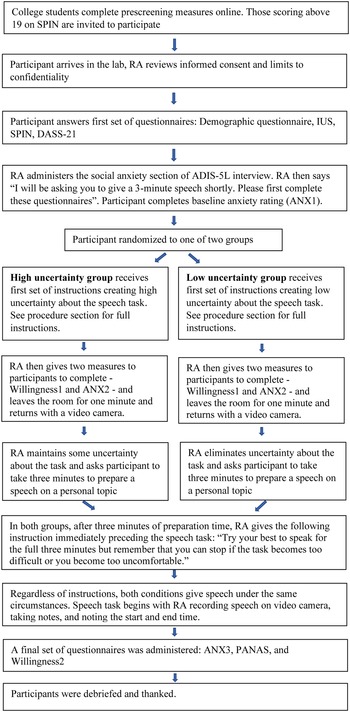
Undergraduate students answered a set of questionnaires as part of pre-screening procedures at their educational institution in order to take part in research for course credit. This set included SPIN, which was used for this study to screen participants such that those scoring equal to or greater than 19 on the SPIN were invited to participate in the study, as this is the clinical cut-off on this measure of social anxiety (Connor et al., Reference Connor, Davidson, Churchill, Sherwood, Foa and Weisler2000). After arriving at the lab, participants were greeted by the RA and underwent the process outlined in the flowchart (Figure 1).
Flowchart of study procedures.

After providing informed consent, participants completed a series of questionnaires (Demographic Questionnaire, IUS, SPIN; DASS-21; see above). Additional questionnaires were administered that have not been used for this study and hence not reported. Following this, participants were administered the SAD section of the ADIS-5L clinical interview, to determine whether their social anxiety symptoms reached a clinical threshold. Participants then completed a VAS measuring state anxiety level at baseline (ANX1).
Participants were randomly assigned to one of two conditions using a random number generator. The two conditions differed in terms of the information they received about the speech task, including exact length, topic, location, and who would be in attendance. Participants in the high uncertainty condition were given the following instructions: ‘The way the speech task goes varies a lot — we will just have to wait and see what happens. We don't know how many people will attend. It's possible that psychology faculty or postdoctoral associates will attend, or it may just be students, but we don't know. The audience tends to vary a lot with regard to what speech topic they want to hear about, and sometimes you can have a lot of time to prepare for the speech but sometimes you don't. We will videotape the speech if we can get the video camera back from the other lab in time. Also, the audience varies a lot in terms of whether they take notes, how friendly they are, if they ask questions. Depending on the room that is available, it could be a more formal speech in which you will stand by the podium and use a microphone, if the boardroom is available; or else it could be more informal and you can sit if only a small office is available’. Participants in the low uncertainty condition were given the following instructions: ‘The way the speech task goes can vary a lot, but today it will be as follows: no other audience members are available to come and so you will perform the speech in front of just myself and the video camera. You will be asked to speak about a personal experience — any personal experience you want — such as your favourite movie, your field of study, a special person in your life. You will have three minutes to prepare for the speech. I will take notes while you talk, and I will not ask you any questions after the speech. We will just use this room, so the speech will be more informal and you will sit down while delivering it’.
The RA left the room after providing instructions, and participants were asked to complete two additional measures — VAS assessing their anticipatory anxiety before giving the speech (ANX2); and VAS assessing their willingness to give the upcoming speech (willingness1).
Afterwards, participants were given three minutes to prepare a speech. Before beginning, all participants were given the following instruction: ‘Try your best to speak for the full three minutes but remember that you can stop if the task becomes too difficult or you become too uncomfortable’. Participants then gave a three-minute speech in front of the RA. Despite the difference in instructions provided across the two conditions, both conditions gave the speech under the same circumstances, that is, in the same room, with only the RA being present. The RA video-recorded the speech, noted the beginning and ending times for the speeches, and took notes in order to increase anxiety during the task. Finally, participants completed a final set of measures — the PANAS; VAS assessing the highest level of anxiety experienced during the speech (ANX3); and VAS assessing their willingness to give another speech (willingness2). Afterwards, participants were debriefed and given course credit online.
Planned Analyses
Our first hypothesis was that those in the high state uncertainty condition will experience higher anxiety after receiving the speech instructions (ANX2) and during the speech (ANX3, PANAS negative total score), regardless of their trait IUS levels. To test this, we conducted separate hierarchical regression analyses for each outcome variable with IUS scores and condition as the first and second steps, respectively.
Our second hypothesis was that those in the high state uncertainty condition would show lower willingness to give the upcoming speech after receiving instructions (willingness1) and to give another speech after giving the first speech (willingness2), regardless of their trait IUS levels. We conducted separate hierarchical regression analyses for each outcome variable with IUS scores and condition as the first and second steps, respectively.
Our third hypothesis was that those in the high state uncertainty condition would show greater avoidance of the speech task in the form of less time spent performing the task. The participants were asked to give a speech for three minutes and the RA recorded the exact time spent on the task. It was calculated in seconds, with a maximum possible value of 180 s. To test this hypothesis, we conducted a hierarchical regression analysis with speech time as outcome and with IUS scores and condition as the first and second steps, respectively.
Results
Handling of Missing Data
Missing value analysis was conducted, and three cases were deleted due to missing more than 5% of the data. No variables were deleted due to missing data. Ten participants missed an anxiety rating (ANX2) due to its location on the questionnaire. Due to this being a variable of interest, the variable was not deleted. Little's MCAR test revealed that data were missing completely at random (χ2 (140, N = 100) 163.60, p = .08). Therefore, the recommended best-practice approach of multiple imputation was used to deal with the missing data. This method is recommended above listwise and pairwise deletion methods, and single value imputation for data that are MCAR (Enders, Reference Enders2010; Pedersen et al., Reference Pedersen, Mikkelsen, Cronin-Fenton, Kristensen, Pham, Pedersen and Petersen2017). The multiple imputation method generates multiple possible values for missing values, creating multiple complete datasets to be used for analyses. SPSS 20 was used to generate five imputed datasets by imputing missing values for the variables considered central to answer study questions. This included items on the IUS scale, the two VAS willingness rating scales, all three VAS anxiety rating scales, SPIN, and speech time. The item level imputed values were then used to calculate total scores for each scale. Statistical analyses on the data provides results taking into account the original dataset and the five imputed datasets for selected procedures (IBM, n.d.). Of note, the multiple imputation performed through SPSS yields complete analysis results for each individual dataset but does not yield certain pooled values. Therefore, for the results below, we were unable to report certain values such as pooled standard deviations, degrees of freedom, complete ANOVA output related to regression analyses, pooled R 2 values, and standardised Beta coefficients.
Descriptive Data
The average score on the DASS subscales indicate that participants scored in the mild range for depressive symptoms (M = 13.13), in the moderate range for stress (M = 20.04), and in the severe range for anxiety symptoms (M = 15.29) (Lovibond & Lovibond, Reference Lovibond and Lovibond1995). The average score on the SPIN was 37.16, which is within the mean range of the clinical standardisation sample (Connor et al., Reference Connor, Davidson, Churchill, Sherwood, Foa and Weisler2000). The average IUS score in this study was 77.18, which is comparable to a clinical sample used by Khawaja and Yu (Reference Khawaja and Yu2010).
The average anxiety ratings (on a 0 to 100 scale) reported were ANX1 = 44.74, ANX2 = 63.47, and ANX3 = 68.88, indicating increase in anxiety as the study proceeded. PANAS scores were obtained after the speech task and the average negative and positive scores were 22.88 and 20.75, respectively. These scores indicate that the sample reported higher negative affect and lower positive affect than the standardisation sample (Watson et al., Reference Watson, Clark and Tellegen1988). Therefore, the sample experienced significant levels of social anxiety and the social stressor of the speech task elicited high levels of anxiety. Willingness was rated low in general, about the immediate speech task (willingness1 M = 38.03), and about a similar future speech (willingess2 M = 28.61). Participants spent an average of 156.3 s on the speech task, of the 180 s assigned.
Differences Between Conditions at Baseline
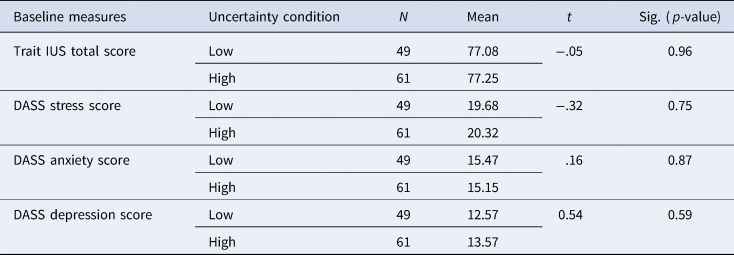
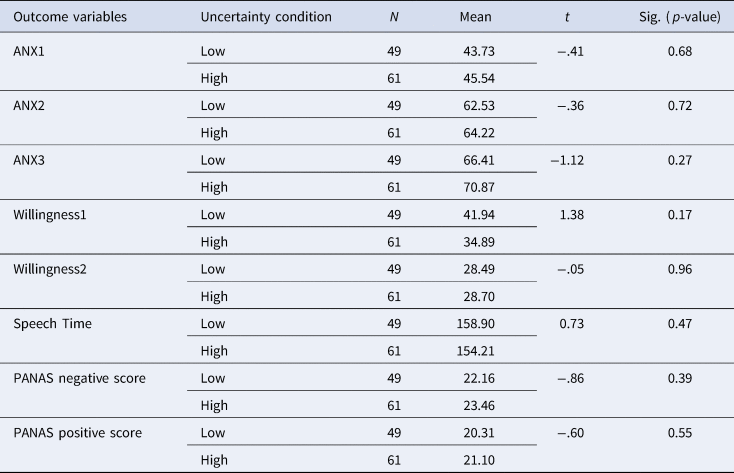
The two groups did not differ in demographic characteristics including sex [χ2 (2, n = 110) = 0.86, p = 0.65], race [χ2 (4, n = 110) = 2.60, p = 0.63], and ethnicity [χ2 (1, n = 108) = .20, p = 0.66]. The two experimental conditions showed significant differences in proportion of individuals diagnosed with SAD as assessed by the ADIS-5L, while not differing significantly on their SPIN scores (t = 0.56, p = 0.58). Specifically, there were more individuals meeting criteria for SAD in the low uncertainty group than in the high uncertainty group [χ2 (1, n = 110) = 8.15, p = .004]. Of the 49 participants in the low uncertainty condition, 35 (71.4%) met SAD criteria using the ADIS-5L, whereas 27 out of 61 participants (44.26%) met criteria for SAD in the high uncertainty condition. However, as stated above, the high uncertainty group (M = 36.69) did not differ significantly from the low uncertainty group (M = 37.76) on their total SPIN scores, which is also a measure of clinical levels of social anxiety. Furthermore, t-tests revealed that the conditions did not differ significantly on other key indices of current functioning such as DASS subscale scores (see Table 1) or key outcome variables such as anxiety ratings (see Table 2).
Differences in the Groups at Baseline

IUS = Intolerance of Uncertainty Scale; DASS = Depression Anxiety Stress Scale.
Group Differences on Outcome Variables Related to Social Anxiety

PANAS = Positive and Negative Affect Scale.
State Intolerance and Anxiety
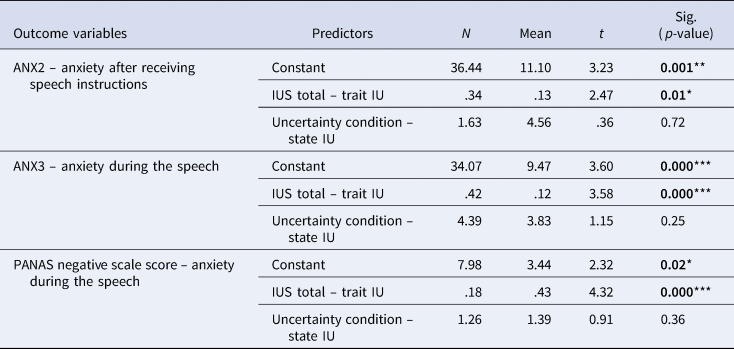
We had hypothesised that those in the high state uncertainty condition would experience higher anxiety after receiving the speech instructions and prior to the speech (ANX2) and during the speech (ANX3, PANAS negative total score), regardless of their trait IUS levels. To test this, we conducted separate hierarchical regression analyses for each outcome variable with IUS scores and condition as the first and second steps, respectively. For all three outcomes, the model with both predictors for the pooled data was not significant, with only IUS scores being a significant predictor (see Table 3). Therefore, our hypothesis about the role of state uncertainty beyond that of trait IU in anxiety about the speech was not supported.
Uncertainty Predictors and Anxiety

Note. *p < .05. **p < .01. ***p < .001.
IUS = Intolerance of Uncertainty Scale; PANAS = Positive and Negative Affect Scale.
We conducted post hoc analyses to understand these results better. To test whether the tasks were sufficiently anxiety-provoking, we looked at the differences in VAS measures of anxiety at the three time points. There was a significant increase for all participants from ANX1 to ANX2 (t = 7.03, p < .001) and from ANX2 to ANX3 (t = 2.28, p = .02), indicating that the task was sufficiently anxiety-provoking. Yet, it seems that both conditions did not differ in the level of increase in anxiety at ANX2 (t = .02, p = 0.98) and ANX3 (t = −0.58, p = 0.56). Furthermore, we looked for differences in baseline anxiety and found that higher IU significantly predicted ANX1 (B = 0.50, t = 4.02, p < .001).
State Intolerance and Willingness to Perform Task
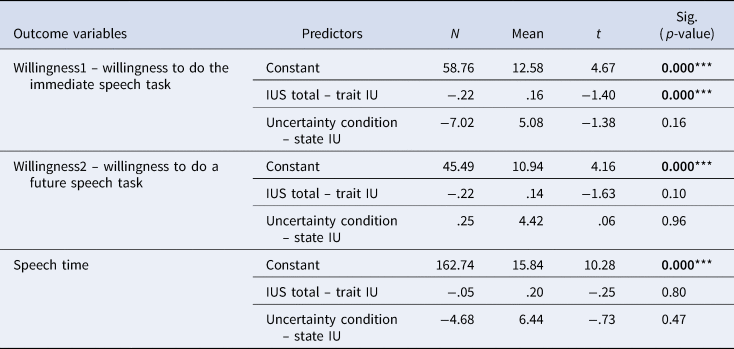
Similar to the above hypothesis, we predicted that those in the high state uncertainty condition would show lower willingness to give the speech after receiving instructions and during the speech, regardless of their trait IUS levels. Hierarchical regression analyses showed that both IUS and condition were not significant predictors of willingness at both time points (see Table 4).
Uncertainty Predictors, Willingness to Perform Task, and Avoidance of Task

Note. ***p < .001.
IUS = Intolerance of Uncertainty Scale.
State Intolerance and Avoidance of Task
We hypothesised that those in the high state uncertainty condition would show greater avoidance of the speech task in the form of less time performing the task. We found that the model with both predictors was not significant, and IUS scores and condition did not significantly predict speech time (see Table 4).
We conducted further exploratory analyses to find predictors of speech time to help explain variability in this important behavioural measure. Speech time was significantly predicted by ANX1 (B = .34, t = 2.26, p = .02) and PANAS negative total (B = −.88, t = −2.21, p = .03). That is, higher anxiety at baseline was related to significantly longer speech time. On the other hand, higher PANAS negative total score predicted shorter speech times.
Discussion
As previously stated, IU is an important transdiagnostic cognitive variable across anxiety disorders (e.g. Carleton et al., Reference Carleton, Mulvogue, Thibodeau, McCabe, Antony and Asmundson2012) and there is emerging evidence of its relationship with SAD (e.g. Boelen & Reijntjes, Reference Boelen and Reijntjes2009). However, as reviewed before, previous research suffers from several limitations including a lack of experimental research in this area which prevents causal inferences; few studies using a sample of high social anxiety or on uncertainty related to a social stressor; reliance on self-report and cross-sectional measures of avoidance behaviours in social anxiety; and little research on relationship of IU to specific aspects of social anxiety. Therefore, our goal was to address the gaps in the research by using an experimental design to vary the levels of uncertainty and explore its causal impact on the emotional, cognitive, and behavioural aspects of social anxiety, in a sample with clinical levels of social anxiety using a socially relevant task. To do this, we manipulated levels of uncertainty related to a social performance situation or stressor (speech task) in a sample with clinical levels of social anxiety and used this as a state measure of IU. Controlling for trait IU levels, we examined the effect of state IU on different aspects of social anxiety. The emotional, cognitive, and behavioural aspects of social anxiety were conceptualised as anticipatory anxiety, anxiety during the task, willingness to do the speech task in the present and the future, and behavioural avoidance of the task. We hypothesised that state uncertainty would predict all outcomes while controlling for the effect of trait IU levels. Specifically, it was expected that those in the high uncertainty condition would show higher anxiety, express less willingness to perform the task, less willingness to perform another similar task, and greater avoidance of the task, regardless of their trait IU levels.
Contrary to our hypotheses, we found that after controlling for trait IU levels, the state uncertainty about a social stressor did not predict anticipatory anxiety or anxiety during the task, avoidance of task, or willingness to perform another similar task. In contrast, trait IU played a significant role, but only in the prediction of anticipatory anxiety and anxiety during the task as measured by two different instruments. Furthermore, support was only found for the role of trait IU in the experience of anxiety, but both trait and state IU did not predict willingness for tasks or behavioural avoidance. Therefore, it may be that trait IU is related uniquely to the experience of anxiety, but not to other cognitive or behavioural symptoms of SAD. This finding is in contrast with other research relating IU to social avoidance (Carleton et al., Reference Carleton, Collimore and Asmundson2010; Counsell et al., Reference Counsell, Furtado, Iorio, Anand, Canzonieri, Fine and Katzman2017). However, it is important to note that while most studies measure avoidance using self-report measures, we used a behavioural measure in the form of speech time. This measure may be more similar to avoidance in real life. These findings highlight the important role of trait IU in the experience of anxiety among socially anxious individuals.
Consistent with previous literature, it appears that IU is a strong transdiagnostic cognitive variable that predicts clinical symptoms. The results may indicate that notwithstanding the specific uncertainties in the current social situation, trait IU levels significantly impact the experience of anxiety in social anxiety, as with other anxiety disorders. Therefore, treatment targeting IU may help improve the emotional experience and reduce distress in social anxiety, even if impact on cognitive processes and behavioural avoidance is low. An individual can receive a diagnosis of SAD with the presence of clinically significant distress even if there is low avoidance of social situations. In fact, avoidance of social situations may often be difficult because these situations are pervasive in our lives. Therefore, treatment targeting the experience of anxiety is likely to be meaningful. Indeed, cognitive behavioural therapy has been effective in decreases in IU which were related to a reduction in social anxiety, regardless of the SAD severity pretreatment (Mahoney & McEvoy, Reference Mahoney and McEvoy2012).
The lack of significant relationship between the uncertainty variables and behavioural avoidance in our study may indicate that other variables predict avoidance in SAD. We conducted exploratory analyses to examine other potential predictors of speech time. We found that anxiety during the speech task (PANAS) predicted shorter speech times. These results indicate that anxiety in a social situation is directly related to avoidance behaviour in the situation. This may speak to the role of emotional factors above cognitive factors, such as IU, in predicting behaviour in SAD. This supports the conceptualisation of avoidance behaviour as an emotion-driven behaviour (Barlow et al., Reference Barlow, Farchione, Fairholme, Ellard, Boisseau, Allen and Ehrenreich-May2011), which may respond to emotion-focused treatment strategies. Therefore, exposure strategies targeting these behaviours may be more important in reducing avoidance, rather than cognitive strategies aimed at challenging need for certainty in a general or specific manner.
An additional exploratory analysis revealed that higher baseline anxiety (ANX1), predicted longer speech time. This finding seems counterintuitive but may indicate that the participants were acting in socially desirable ways by agreeing to complete the task and meet the expected time frame. Participants would have had to be assertive to refuse the task or to stop the task before the stipulated time. In this case, other measures of avoidance, such as offering an explicit choice to refuse the speech task or obtaining ratings of willingness anonymously, may have yielded different results. In addition, in real-life settings, there may be more time available to make decisions about performance situations, such as prior to giving presentations at work or school. Therefore, allowing more time between providing the instructions and performance of the speech task may have led to different behaviours. This may have been inherently difficult for the participants who had significant levels of social anxiety. On the other hand, avoidance may also have been more subtle by perhaps impacting the quality or the content of the speech. It is possible that using different variables to study avoidance, such as nonverbal behaviours of not making eye contact or talking using a low volume, may have yielded different results. Further study of this relationship in varied contexts and using different tasks is warranted.
There are other potential alternative explanations for these findings. It is possible that the manipulation of uncertainty did not work and that limited the differences that were observed between the groups. The absence of the manipulation check significantly limits the conclusions that can be drawn from the study. This can be addressed in future research by obtaining ratings of the degree of uncertainty about the task from the participants to ensure that those in the high uncertainty condition for instance, did perceive higher uncertainty. In addition, in our study, we manipulated the uncertainty about the number of people in the audience, their authority level/status, friendliness, as well as the time provided to prepare, formality of the setting, and possibility of video-recording the speech. It may be that these factors did not specifically target the self-referential and consequential thoughts that are specific to SAD (Counsell et al., Reference Counsell, Furtado, Iorio, Anand, Canzonieri, Fine and Katzman2017), but reflected more general uncertainties. Manipulating the uncertainty related to SAD specifically, including the possibility that negative judgements will be made, may yield different results as there is evidence that disorder-specific cognitions may influence IU in SAD.
It is also possible that the time between receiving the uncertainty-inducing instructions and receiving the real instructions (one minute between the two interactions) was not long enough for the anxiety to encode and affect cognitions and behaviours. It may be helpful to include a five-minute filler task in future research of this nature.
Furthermore, whereas the SPIN cut-off was used to identify individuals with high social anxiety symptoms, it is possible that they were not especially anxious about performance situations and were not affected by uncertainty related to this stressor. This makes sense in that the specific uncertainty in the social situation may not be as important, but the overall task of giving a speech was enough to increase anxiety as the study progressed. As such, if the IU is unaffected by uncertainty in a given situation, perhaps it instead represents a general tendency to interpret events as uncertain. Another possibility is that the participants in the low uncertainty group still experienced significant uncertainty due to being in a novel setting with an unfamiliar person (the RA).
Furthermore, although we used a sample with high social anxiety scores, results may be different if a clinical treatment-seeking sample was used to study these relationships. Similarly, the participants were randomly assigned to the conditions based on the SPIN cut-off score, but the groups differed significantly in the number of participants meeting ADIS-5L criteria for SAD. The study would have been strengthened by using both measures to determine SAD status to ensure clinically significant symptoms. Also, although the participants met clinical cut-off for SAD, it is not known whether this was the primary diagnosis of participants. Furthermore, it is not known whether participants were receiving pharmacological treatment or therapy, which could have affected anxiety levels during the study.
Overall, the current study did not yield results supporting the role of increased uncertainty related to a social stressor increasing the anxiety levels in socially anxious individuals. However, it did reinforce the role of trait IU as a more important factor in the experience of anxiety. Our findings bolstered previous research highlighting IU as a transdiagnostic cognitive variable that can be targeted in the treatment of anxiety disorders. Furthermore, it highlighted the role of emotions in avoidance behaviours, besides the cognitive factors emphasised with IU. The study also contributed to the literature by using an experimental methodology to explore the cause–effect relationship between this important cognitive variable in the prediction of SAD symptoms. Further experimental research is needed to clarify the relationship between the important variable of IU and SAD.