Introduction
Sexual dimorphism, the expression of marked differences of characteristics between sexes in the adult stage, is widely known among decapod crustaceans. Particularly in brachyuran crabs, large chelipeds used as weapons or tools for courtship behaviour are present in males of many species. A large abdomen, which is useful for bearing embryos, is common in females. These characteristics can be detected using analysis of relative growth pattern (Hartnoll, Reference Hartnoll1974). Morphometric analysis of sexual traits has been conducted on various brachyuran species. Their morphological characteristics indicated by their growth patterns are essential to understand their maturity process and life history (Conan & Comeau, Reference Conan and Comeau1986; Vannini & Gherardi, Reference Vannini and Gherardi1988; Pinheiro & Fransozo, Reference Pinheiro and Fransozo1993; Sampedro et al., Reference Sampedro, González-Gurriarán, Freire and Muiño1999; Hirose et al., Reference Hirose, Fransozo, Tropea, Lopez-Greco and Negreiros-Fransozo2013; Spani & Scalici, Reference Spani and Scalici2016).
Sexual dimorphism has been explained by the theory of sexual selection in many animals (Darwin, Reference Darwin1871; Andersson, Reference Andersson1994; Davies et al., Reference Davies, Krebs and West2012). Thus research on specific mating behaviour is useful for the explanation of development of their organs. Reproductive strategies and mating systems vary among brachyuran crabs (Hartnoll, Reference Hartnoll1969; Salmon, Reference Salmon, Rebach and Dunhum1983; Christy, Reference Christy1987; Diesel, Reference Diesel, Bauer and Martin1991; Asakura, Reference Asakura, Martin, Crandall and Felder2009). Allocation of their energy investment to reproductive organs including gonads may also vary according to their strategy. In order to increase their fitness, high-energy investment into the organs which are useful for their mating success may be favoured by sexual selection.
Leucosiidae includes many species inhabiting temperate and tropical seas (Ng et al., Reference Ng, Guinot and Davie2008). Although detailed reports are absent, some species exhibit marked sexual traits and adult male chelipeds are elongated (e.g. Persephona lichtensteinii, P. mediterranea and P. punctate; Almeida et al., Reference Almeida, Hiyodo, Cobo, Bertini, Fransozo and Teixeira2013). These traits may be sexual dimorphism expressed under sexual selection. However, their ecology is poorly known compared with other families of brachyuran crabs. Information on reproductive ecology of brachyuran crabs, particularly on mating strategy, has been accumulated in many species (Hartnoll, Reference Hartnoll1969; Salmon, Reference Salmon, Rebach and Dunhum1983; Christy, Reference Christy1987; Diesel, Reference Diesel, Bauer and Martin1991; Asakura, Reference Asakura, Martin, Crandall and Felder2009). Detailed data are mainly limited to some families, such as Ocypodidae, Dotillidae, Varunidae, Sesarmidae, Grapsidae, Portunidae and Majidae. These reproductive strategies have been discussed from several viewpoints including physiological constraints related with moulting and conditions of exoskeleton, interactions between sexes and between competitors and particularity according to habitat utility (terrestrial or underwater, presence of territorial burrows). In contrast, there have been few species studied by detailed analysis of these characteristics among leucosiid crabs, except some studies on Ebalia tuberosa (Pennant) (Schembri, Reference Schembri1981, Reference Schembri1982, Reference Schembri1983).
Therefore, in order to accumulate information as an example for leucosiid crabs, we selected Pyrhila pisum (De Haan), which is found in the tidal flats of Japan. Pyrhila pisum is distributed in eastern Asia, including the continental coastal zone of the Yellow Sea and East China Sea, and temperate and subtropical Japan, from Aomori Prefecture to Amami Island (Galil, Reference Galil2009; Suzuki, Reference Suzuki2012). This crab is commonly found in the intertidal areas of some tidal flats in temperate Japan. Although their occurrence in tidal flats is limited to the warmer season in western Japan (Kobayashi & Vazquez Archdale, Reference Kobayashi and Vazquez Archdale2017), observation and collection of P. pisum is comparatively easy in their natural habitat. They are found during the daytime actively wandering for long distances on sandy or muddy substrates along the shoreline, and often exhibit their mating behaviour without using shelters or burrows. Thus we have studied the ecology of this crab and recently reported its feeding habit, occurrence pattern in the intertidal area, reproductive ecology and mating behaviour (Kobayashi Reference Kobayashi2013; Kobayashi & Vazquez Archdale, Reference Kobayashi and Vazquez Archdale2017, Reference Kobayashi and Vazquez Archdale2020). We have revealed that the mating behaviour of P. pisum is not elaborate. Males cannot recognize receptive mates until they directly contact each other. Males guard females during mating, but their guarding behaviour is not always effective. From the viewpoint of sexual selection and evolution, it is of interest to know why this crab maintains such a primitive and ineffective mating behaviour. In the present study, we are searching for any reproductive characteristics which are adjusted to compensate for this ineffectiveness in their mating strategy.
Here we morphologically categorize both sexes of P. pisum into juveniles (immature stages) and adults (reproductive stage), as shown in other brachyuran species (Hartnoll, Reference Hartnoll1974, Reference Hartnoll and Abele1982); we have observed that male large chelipeds are essential for their guarding behaviour associated with mating, and the female swollen abdomen is also essential for their incubation of embryos (Kobayashi & Vazquez Archdale, Reference Kobayashi and Vazquez Archdale2017, Reference Kobayashi and Vazquez Archdale2020). Juvenile crabs without these developed organs cannot commence reproductive activities. In the present study, we conducted a detailed morphological measurement of P. pisum, and confirmed its morphological and growth pattern differences. Furthermore, development of gonads in each sex and bloating of seminal receptacles in females were investigated, and sexual differences of energy investment allocated to reproductive organs are discussed associated with their reproductive strategy.
Materials and methods
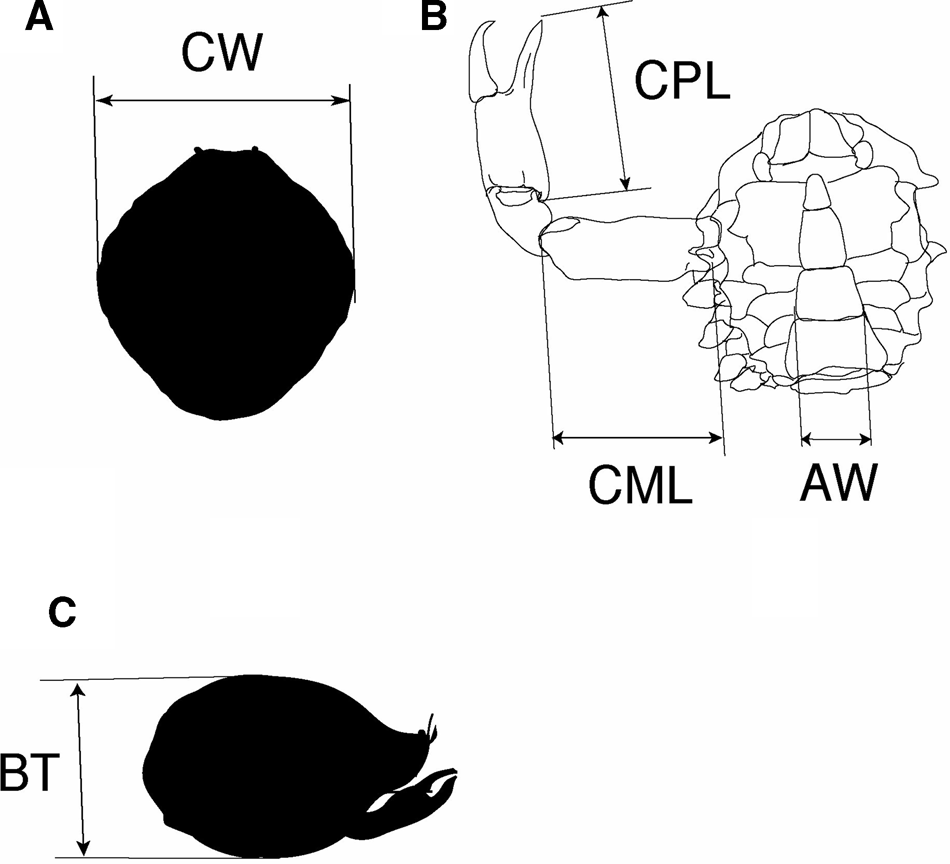
Pyrhila pisum were collected from June to August 2017 in a tidal flat in Fukuoka, Kyushu, western part of Japan. This was a tidal flat along the river channel of the west side of the Tatara River at the Hakozaki pier, located in south-eastern Hakata Bay (33°38′N 130°25′E, nearly 3000 m2). Within Hakata Bay, P. pisum abundantly occurs in the tidal flats which are widely distributed in the coastal areas and lower tidal river areas. All collected crabs were sexed and their greatest carapace widths (CW) were measured. Some of these crabs were used for the analysis of relative growth patterns to measure the length of propodus (CPL) and merus (CML) of the chelipeds, and width of the 5th abdominal segment (AW) and body thickness (BT) (Figure 1). Pyrhila pisum is homochelous, and CPL and CML were measured from their right chelipeds. All measurements were conducted using Vernier callipers to the nearest 0.1 mm. Co-relationships between carapace width (CW) and each length (CPL, CML, AW and BT) were analysed after log transformation for each stage of both sexes, and their regression lines were fitted using the least-squares method for obtaining the average total wet body weight in these conditions: Log Y = a Log X + b; X = CW, Y = CPL, CML, AW and BT. Allometric growth type can be categorized by the value of a; negative allometry (a < 1), isometry (a = 1) and positive allometry (a > 1) after the method reviewed by Tessier (Reference Tessier1935) and Hartnoll (Reference Hartnoll and Abele1982). Therefore, the differences from isometry (a = 1.000) were tested using the Student's t-test in each regression line, and the growth rules of each organ were confirmed in both sexes. When the distribution of values in each category did not show single regression and changed their tendency at some breakpoint, segmented linear regressions were applied for the regression analysis, and the value of the breakpoint was calculated. R package ‘segmented’ was used for the calculation of the regression (Muggeo, Reference Muggeo2008).
Position of measurement, (A): carapace (silhouette), (B) ventral view, (C) lateral view (silhouette). CW, carapace width; CPL, chela propodus length; CML, chela merus length; AW, width of 5th abdominal segment; BT, body thickness.

Gonads (ovaries and seminal receptacles separately for the females; testis and vas deferens together for males) were dissected out from adult crabs. Before dissection, total body weight was measured for the crabs without limb loss to the nearest 0.01 g, and gonads were weighed for all categories to the nearest 0.001 g in their wet condition using digital balances. Ratio of gonad weight to body weight (%) was calculated for these crabs. Co-relationships between carapace width (CW) and wet body weight (BW) of crabs without limb loss were analysed after log transformation for non-ovigerous females and males, and their regression lines were fitted using the least-squares method for obtaining the average total wet body weight in these conditions: Log Y = a Log X + b; X = CW, Y = BW. In order to compare the weight ratio of gonads to total body weight in all conditions (including limb loss) and all categories (including ovigerous ones), 5% values of their estimated BW against CW were calculated for both sexes.
Results
Relative growth patterns of the chelipeds of Pyrhila pisum
Among males, adults could be distinguished from juveniles by their elongated chelipeds with which the adult males embrace females (Figure 2A, B). In addition, large adult males tended to have relatively larger chelipeds compared with the smaller males.
Photographs of whole body of Pyrhila pisum from the ventral side view. (A) juvenile male; (B) adult male; (C) juvenile female; (D) adult female.

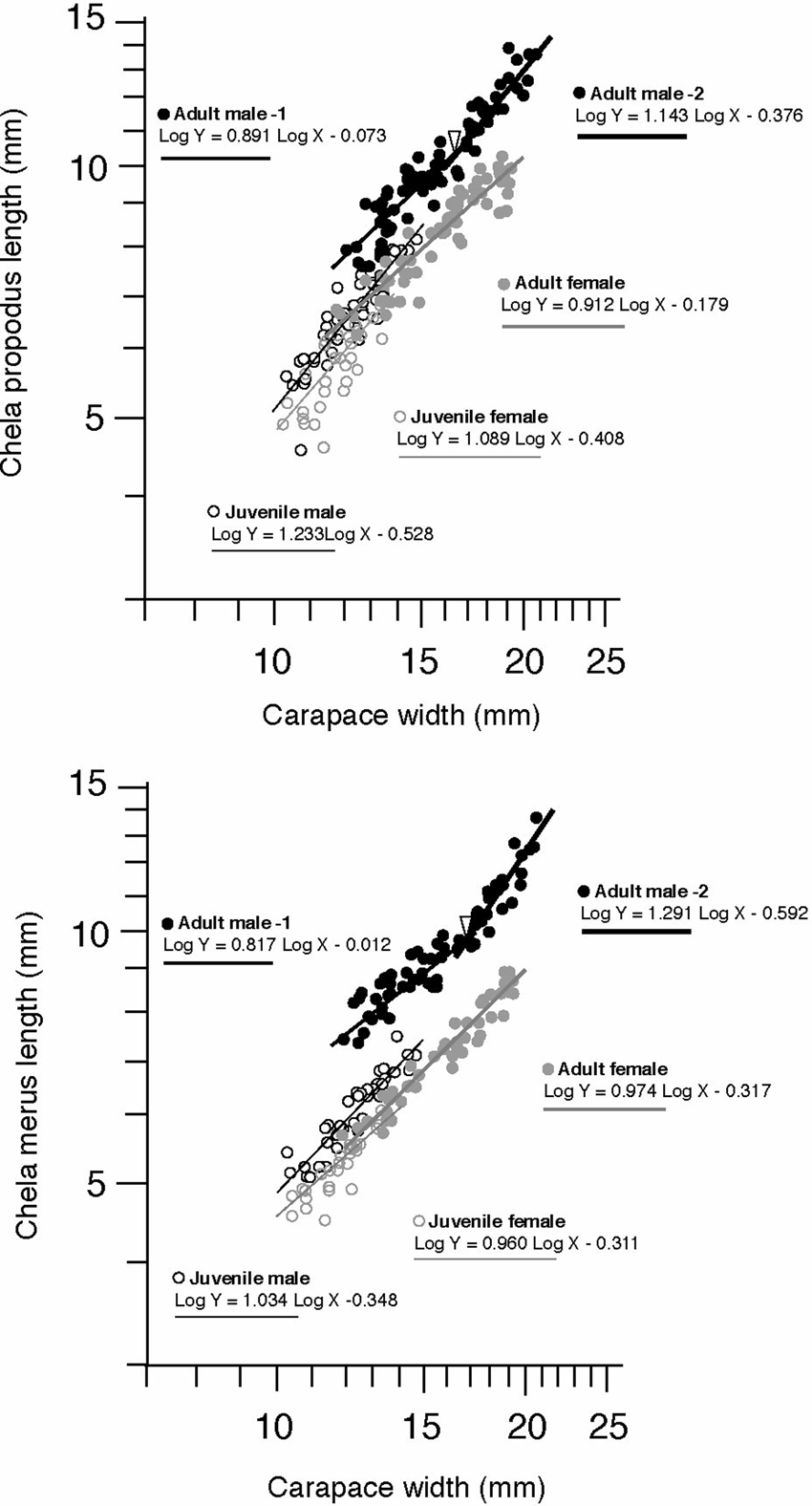
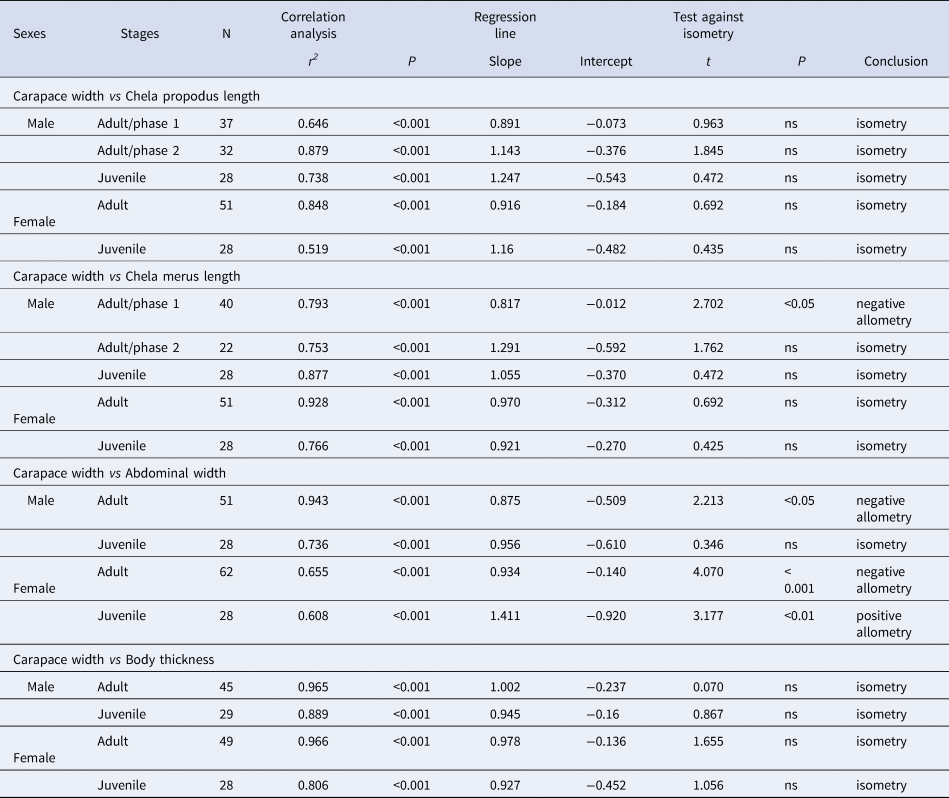
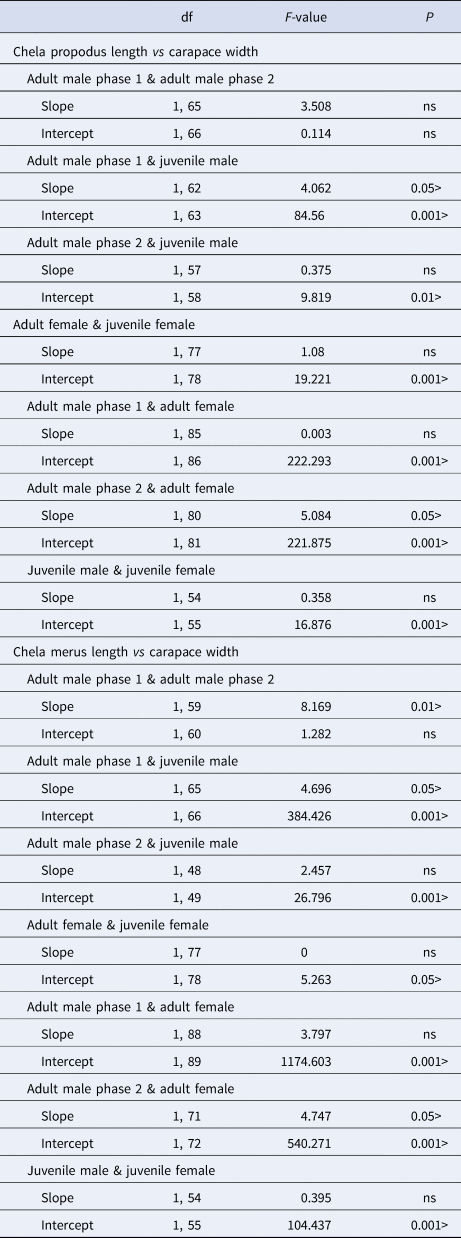
Growth patterns and regression lines of propodus length (CPL) and merus length (CML) of chelipeds relative to carapace width (CW) are shown in each stage of both sexes (Figure 3, Tables 1 & 2). Male adults had longer chelipeds compared with juvenile males and females of both stages. Among male adults, two phases which have different slopes could be found from the scattered diagram, and different regression lines were applied to these phases for both relationships, by segmented line regression. The intersection points of the two lines were detected in 16.4 mm CW for CPL and 17.0 mm CW for CML, suggesting that male adults changed their chelipeds growth pattern in this size range and developed longer chelipeds as large adults. All regression lines were significant (P < 0.001), and regression lines were significantly different between adults and juveniles of the same sexes and between same stages of the two sexes, in their slopes and/or interceptions (P < 0.001, <0.01 and <0.05, ANCOVA). However, between the two adult male phases, significant difference was detected only in the CW–CML relationship (P < 0.01 in slope). Most regression lines have isometric slopes which are not significantly different from 1.000, and only the line of the adult male phase 1 in the CW–CML relationship showed significantly negative allometry (P < 0.05, t-test). This suggested that male adults exhibited a slight change in slopes from negative to positive (from 0.891 to 1.143 in CPL and from 0.817 to 1.291 in CML) in their growth pattern of chelipeds, but this change was too small to be significantly detected in the chela size, and was mainly documented in the total length of the chelipeds. This pattern also suggests that cheliped growth is evident in the length of the chelipeds rather than their size.
Relationships between carapace width (CW) and propodus length (CPL) and merus length (CML) of chelipeds of juvenile and adult Pyrhila pisum, with regression line relative to CW of each phase. Axes are normal logarithmic.

Allometry analysis between pairs of transformed morphological variables (independent variable vs dependent variable): log (carapace width, CW), log (chela propodus length, CPL), log (chela merus length, CML), log (abdominal width, AW), log (body thickness, BT)

Results of analysis of covariance between regression lines fitted for each growth phase of chela propodus length (CPL) and chela merus length (CML) of Pyrhila pisum

Relative growth patterns of the abdomen of Pyrhila pisum
Juvenile females showed nearly flattened bell-shaped abdomens and exposed edges of the thoracic sterna similar to males, while in adult females their abdomen was spherically swollen, nearly oval and all parts of their thoracic sterna were covered (Figure 2C, D). The whole body of the adult females was almost spherical, while those of juvenile females and males were nearly semi-spherical.
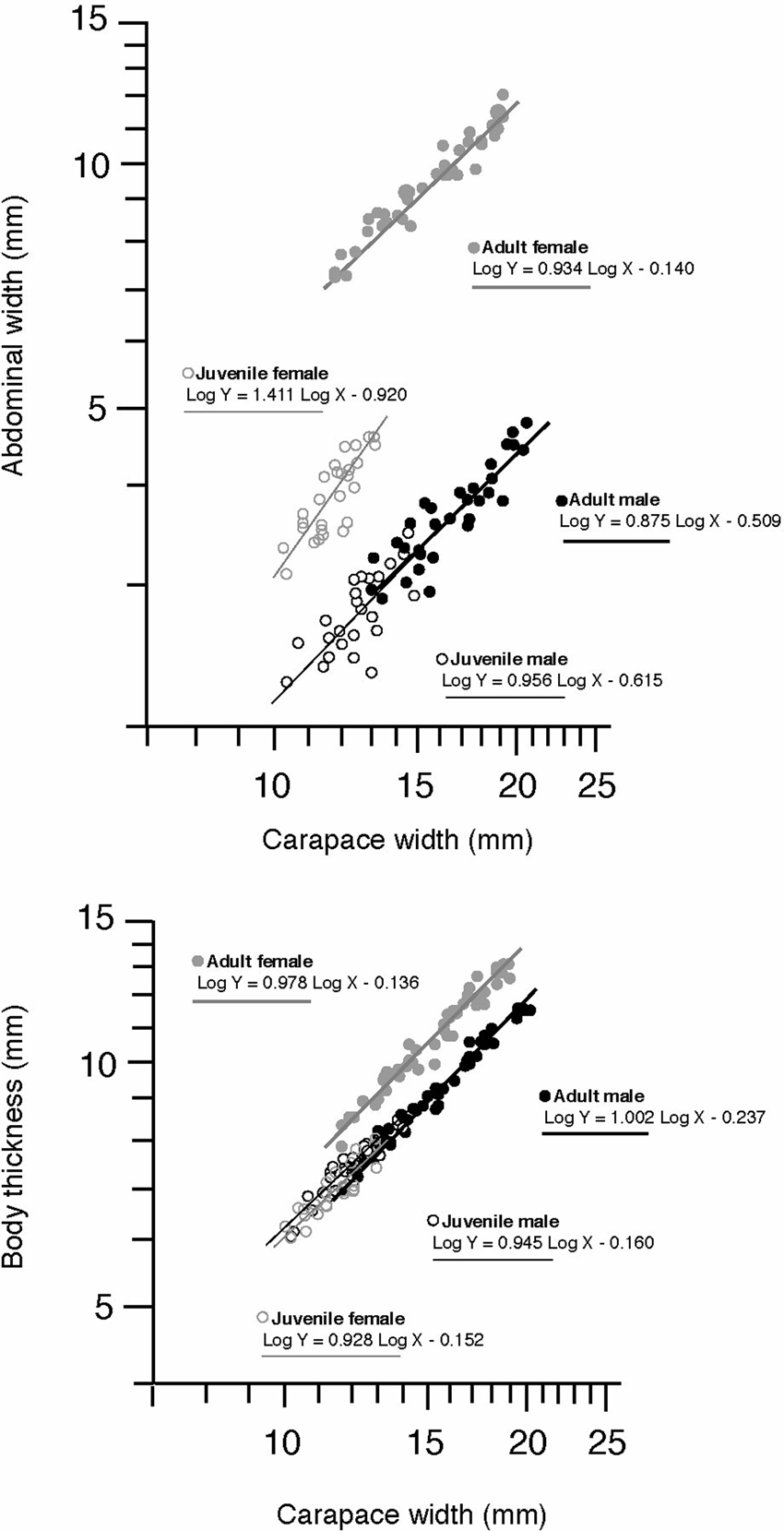
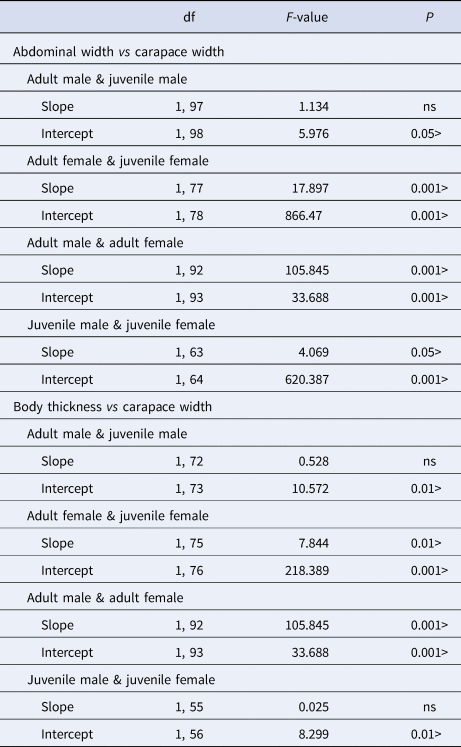
Growth patterns and regression lines of abdominal width (AW) and body thickness (BT) relative to carapace width (CW) are shown in each stage for both sexes (Figure 4, Tables 1 & 3). All regression lines were significant (P < 0.001), and regression lines were significantly different between adults and juveniles of the same sexes and between the same stages of the two sexes, in their slopes and/or their interceptions (P < 0.001, <0.01, and <0.05, ANCOVA). The slope of the regression lines in the CW–AW relationship varied: adult stages showed negative allometry in both sexes (P < 0.001 and P < 0.05), and juveniles were positive in females (P < 0.01) and isometric in males (P > 0.05). While in the CW–BT relationships, all categories were isometric (P > 0.05). Female adults had remarkably wide abdominal segments and a thicker body compared with juvenile females and males of both stages. As the secondary sexual characteristics, females gradually developed their abdomen during the juvenile stages, and drastically enlarged their width and thickness by a puberty moult from juvenile to adult. After attaining maturity, females reduced the growth rate of their abdomen. As for males, juveniles did not relatively develop their abdomen, and after attaining maturity adults reduced their abdominal growth rate.
Relationships between carapace width (CW) and width of 5th abdominal segment (AW) and body thickness (BT) of juvenile and adult Pyrhila pisum, with regression line relative to CW of each phase. Axes are normal logarithmic.

Results of analysis of covariance between regression lines fitted for each growth phase of abdominal width (AW) and body thickness (BT) of Pyrhila pisum

Gonad development of adult Pyrhila pisum
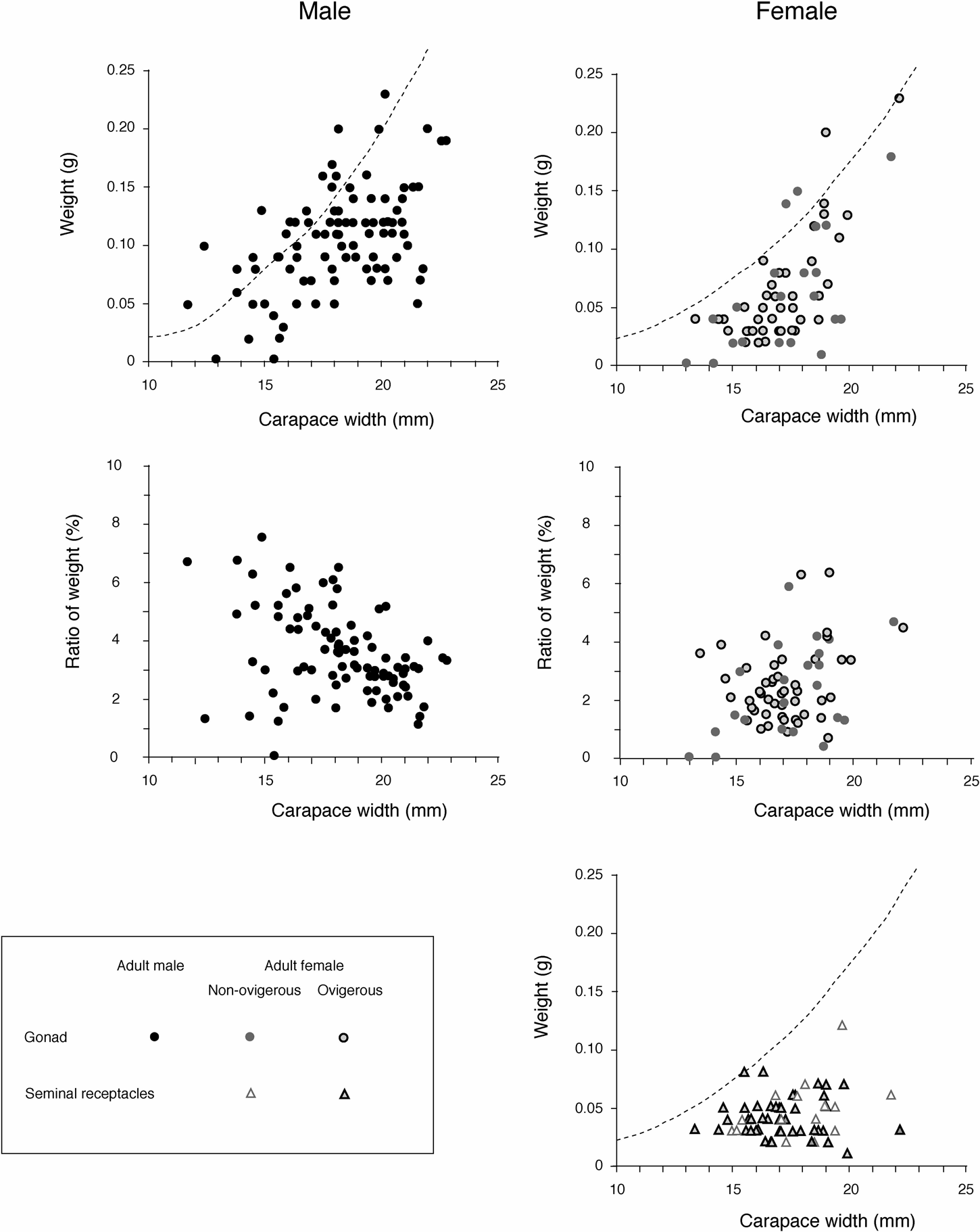
The appearance of the reproductive organs of adult Pyrhila pisum, with the dorsal part of the carapace cut away, are shown in Figure 5, and the relationships between carapace width and weight of the gonads and their ratio to body weight for both sexes, and weight of seminal receptacles of females are shown in Figure 6. There was a significantly positive regression between Log CW and Log BW of non-ovigerous adult females and males (female r 2 = 0.926, male r 2 = 0.974, both were P < 0.001). The regression line fitted for each sex was Log BW = 2.910 Log CW −3.246 for females and Log BW = 3.158 Log CW −3.657 for males. The values of 5% of the estimated BW are shown in these graphs (curved broken lines).
Photographs of reproductive organs of Pyrhila pisum. (A) male; (B) female; (C) female (ovary removed). 1: testis, 2: ovary, 3: seminal receptacle.

Relationship between carapace width (CW) and weight of gonads and its ratio to body weight (%), and seminal receptacles of Pyrhila pisum. Broken lines indicate 5% of body weight estimated for each carapace width.

Male adults tended to have well-developed gonads, as did female adults (Figure 5A, B), and the weights of male gonads were often heavier than those of females of the same body size, especially in smaller sizes (CW < 18 mm) (Figure 6). For adult males, significant negative correlation was detected between carapace width and the weight ratio of the gonad (Spearman's rank-correlation test, ρ = −0.336, n = 90, F = 3.349, P < 0.001), but no significant relationship was detected for adult females (n = 66, F = 1.505, P > 0.05).
Females tended to have large and well-bloated seminal receptacles, and often their weight was nearly equal to their gonad weight (Figures 5C and 6). No significant correlation was detected between carapace width and the weight of seminal receptacles (N = 60, F = 0.7044, P > 0.05). This suggested that there was little difference in the amount of semen received and accumulated in the seminal receptacles of the females of various sizes.
Discussion
Sexual dimorphism and reproductive traits of Pyrhila pisum
Sexual dimorphism is dominant among many taxa of decapod crustaceans (e.g. carid shrimps, prawns, crawfish, thalassinid shrimp, hermit crabs, aeglid crabs and brachyuran crabs) (Stein, Reference Stein1976; Kuris et al., Reference Kuris, Ra'ana, Sagi and Cohen1987; Abello et al., Reference Abello, Pertierra and Reid1990; Pinn et al., Reference Pinn, Atkinson and Rogerson2001; Bueno & Shimizu, Reference Bueno and Shimizu2009; Mantelatto & Martinelli, Reference Mantelatto and Martinelli2010; Ida & Wada, Reference Ida and Wada2017; Prakash et al., Reference Prakash, Ajith Kumar, Subramoniam and Baeza2017). Their patterns vary widely and it is necessary to consider the reproductive strategy and allocation of energy investment under specific environmental conditions of each species, in order to understand the background of sexual dimorphism. The dimorphism is markedly expressed particularly in body size, cheliped size and morphology. In many species chelipeds are utilized for fighting as a weapon, and guarding behaviour by males is accompanied with mating. Thus large males with large chelipeds have an advantage when competing with other males and securing females, and these traits are favoured by sexual selection. In some other cases, courtship behaviour is performed by males, and often conspicuous large chelipeds are used for attracting females (e.g. ocypodoid crabs including fiddler crabs Uca spp.; Salmon & Atsaides, Reference Salmon and Atsaides1984). Thus conspicuous males with large chelipeds are favoured by sexual selection in these species. A large widened abdomen is an attribute of adult female brachyuran crabs and other crab-like anomurans among decapod crustaceans. Their laterally widened body and folding of abdomen enable the development of abdomen and wide cavity between thoracic sternum, resulting in an abdomen that can hold a large number of embryos.
The present results of the morphometric analysis showed marked sexual dimorphism of adult Pyrhila pisum; large chelipeds in males and a large abdomen in females. Expression of these adult sexual traits indicated by separated growth phases showed the presence of a puberty moult with marked growth of these traits, similar to many other crabs (Hartnoll, Reference Hartnoll and Abele1982). Growth of male chelipeds are more markedly expressed in the merus than in the propodus. These characteristics can be explained by the mating strategy of this crab, presumed from their mating behaviour.
The process of copulation and guarding behaviour of P. pisum was confirmed in our previous paper (Kobayashi & Vazquez Archdale, Reference Kobayashi and Vazquez Archdale2020). Female adult P. pisum copulated during their intermoult phase including in ovigerous condition. Both pre- and post-copulatory guarding by males were observed, but the duration of the latter was generally much longer than the former. Both sexes of P. pisum copulated multiple times with various mates. Their timing of copulation may not be fixed. In the tidal flat, wandering males frequently contacted with other individuals, but without distinguishing conspecific females from males or other species. Male P. pisum approached their mates relying only on vision, without using any attractive cues from females. In cases in which males encountered pairing crabs, they successfully stole the females when the guardians were smaller than the challengers, suggesting that effectiveness of guarding depends on male size. The present results may be closely related to these comparatively primitive mating behaviours found in this species.
Large chelipeds of male crabs are essential for the guarding behaviour. Both large chelae and long chelipeds may be advantageous for males to hold females even when competing with other males. Propodus length reflects the size of chelae, which are used as weapons for grasping competitors. The tendency that growth is more markedly expressed in the merus than in the propodus may suggest their importance for securing mates rather than for fighting with competitors in their mating strategy. More precisely, males did not contact competitors for a long time and spent much more time guarding their mates (Kobayashi & Vazquez Archdale, Reference Kobayashi and Vazquez Archdale2020).
Marked abdominal growth by puberty moult of adult females has been reported in many brachyuran species, but in P. pisum the abdomen grows markedly and gets hemispherically swollen as well as their carapace, and their whole body becomes like a spherical cobblestone. They place embryos within the wide inside gap. Their exoskeleton is thick and very hard, but an additional effect may be present by adopting such a spherical shape that is advantageous in the protecting of their body and embryos. Probably their habitat environment, which is composed of soft sediments into which their whole bodies can be buried, favours these shapes.
Male adults of P. pisum tended to have well-developed gonads, as did female adults, and male gonads were often heavier than those of females of the same body size. Probably this characteristic has evolved under strong sperm competition. Theory predicts that sperm competition should favour increased male allocation to sperm production (Parker, Reference Parker, Birkhaed and Møller1998). Actually male gonads tend to become larger in many animals under strong sperm competition (Weddel et al., Reference Weddel, Gage and Parker2002). Female adults of P. pisum can copulate at any time and multiple times, and they can store large amounts of semen within their large seminal receptacles. In addition, post-copulatory guarding of males cannot guarantee fertilization by their own sperm. There are probabilities of sperm competition in the large seminal receptacles after copulation. The amount of testis is considered to reflect the number of spermatozoa produced for mating. Capability of producing a large volume of sperm contributes to increase potential times of mating and the possibility of fertilization after sperm competition. Among many brachyuran crabs, male crabs can guarantee mating success because of the short duration of the receptive female condition and avoidance of sperm competition using pre- or post-copulatory guarding (Hartnoll, Reference Hartnoll1969; Salmon, Reference Salmon, Rebach and Dunhum1983; Christy, Reference Christy1987; Diesel, Reference Diesel, Bauer and Martin1991; Asakura, Reference Asakura, Martin, Crandall and Felder2009). Thus energy investment into gonads is not so important for males compared with females, whose fitness is directly reflected by fecundity, and male gonads are much smaller than those of females (Kyomo, Reference Kyomo1988; Kobayashi & Matsuura, Reference Kobayashi and Matsuura1995; Omori et al., Reference Omori, Shiraishi and Hara1997; Tsuchida & Watanabe, Reference Tsuchida and Watanabe1997; Chu, Reference Chu1999; Liu & Li, Reference Liu and Li2000; Swiney & Shirley, Reference Swiney and Shirley2001; Wong & Sewell, Reference Wong and Sewell2015). Only a potamid crab Potamon fluviatile (Herbst) has been reported as an exceptional case in which male gonads develop larger than female gonads (Michelli et al., Reference Michelli, Gherardi and Vannini1990). Therefore, the present results in P. pisum may also be a rare case among brachyuran crabs. There surely exists strong sperm competition due to their promiscuous mating system. According to the structure of the seminal receptacles of crabs (relative position to oviduct), the order of copulation mostly determines the probability of insemination in some species; either first or last copulation have an advantage in the competition. Leucosiidae crabs are considered to use the sperm from the last male to mate, according to their structure (Diesel, Reference Diesel, Bauer and Martin1991). If this is also applicable for P. pisum, their post-copulatory guarding functions well only when the timing of copulation matches the time of ovulation. However, males cannot recognize the best timing and probably their guarding behaviour is not effective in many cases. In addition, it is still unclear to what extent the semen from other males mixes within the seminal receptacles. Although mating behaviour of P. pisum is comparatively primitive, how the male mating success is determined is an important factor for understanding the evolution of guarding behaviour in their mating strategy.
Large seminal receptacles suggest that females copulate multiple times and accumulate semen. Under rearing conditions for about a month, females copulated at most six times with six mates (Kobayashi & Vazquez Archdale, Reference Kobayashi and Vazquez Archdale2020). No significant correlation between carapace width and the weight of the seminal receptacles means that the times of copulation varied irrespective of the female's body size. It may be adaptive to increase fitness by increasing probability to acquire sperm from stronger mates. But if the females receptively copulate at any time and use the sperm dominantly from the last male to mate, it is not effective for the females to excessively store a large amount of semen. Probably females have to continue accumulation of semen because they cannot control the timing of mating. In their natural habitat, females were cryptic and did not wander as actively as males. Even when females contacted approaching males, they often separated from each other quickly (Kobayashi & Vazquez Archdale, Reference Kobayashi and Vazquez Archdale2017, Reference Kobayashi and Vazquez Archdale2020). Females repeatedly copulate, but may regulate the times of copulation to some degree.
Polymorphism of adult male among decapod crustaceans
Polymorphism in adult males related to cheliped size has been reported in some species among decapod crustaceans, and this may be favoured by sexual selection.
Among crawfish species (Astacidae), generally adult males have larger chelipeds than adult females, but male chela size changes between reproductive and non-reproductive seasons (Form I and Form II) (Stein, Reference Stein1976; Hamasaki et al., Reference Hamasaki, Osabe, Nishimoto, Dan and Kitada2020). These sizes reduced in the non-reproductive season. Laboratory experiments suggested that males with large chelipeds are more likely to survive predation, occupy positions of dominance and copulate with females. Among these functions, use for reproductive activities is probably the most important. Males with larger chelae can interact more successfully with larger more fecund females. The reduction of chela size during the non-reproductive season strongly suggests that very large chelae are only essential for reproductive activities and males can change allocation of restricted energy to cheliped growth. This type is reversible and different from the present case of P. pisum.
Polymorphism with alternative strategies according to their growth phases, similar to P. pisum, is reported in some species. Palaemonid prawns of the genus Macrobrachium has male polymorphism (Kuris et al., Reference Kuris, Ra'ana, Sagi and Cohen1987). In the giant river prawn Macrobrachium rosenbergii De Man, three male morphotypes which have different cheliped length and colours are present; blue claw (BC) males which are the largest males with relatively longest chelipeds, orange claw (OC) males of medium body size and chelipeds, and small ones (SM) with small clear chelipeds. The adult males change the types as they grow larger. There is a hierarchy in the reproductive-dominance, and they perform different mating strategies. BC males are dominant, territorial and sexually active and successfully mate a large number of females. OC males are sub-dominant and non-territorial. SM males are not territorial but highly mobile and strongly attracted to females (Ra'anan & Sagi, Reference Ra'anan and Sagi1985).
A freshwater anomuran crab Aegla franka Hale (Aeglidae) has two adult male morphotypes (morphotype I and morphotype II) (Bueno & Shimizu, Reference Bueno and Shimizu2009). Morphotype II has a large and more robust pair of chela and is advantageous in reproductive competition. Both types can join in reproduction within a same season, but the proportion of the type II increases with the appearance of fully mature females, suggesting that type I males transform to the other type as they grow.
Among brachyuran crabs, adult male dimorphism with different chela size has been reported in some species. In the snow crab Chionoecetes opilio (O. Fabricius) (Majidae), both small males with small chelae and large males with large chelae can participate in reproduction (Elner & Beninger, Reference Elner and Beninger1995). The small-chela (morphologically immature) males can grow to the large-chela (mature) stage, which becomes advantageous in mating. However, during the period when larger ones become scarce by fishing, small males have opportunities to mate, and their mating success can dynamically change. The Japanese mitten crab Eriocheir japonica (De Haan) (Varunidae) also has adult male dimorphism with different chela size (Kobayashi, Reference Kobayashi1999). This species is a catadromous species and different from the case of marine species; individuals do not grow larger after reproducing, and the small type cannot change to a different type after migration from freshwater rivers (growth area) to marine coast (reproductive area). The large ones with markedly large chelae have the advantage for mating, but they need to spend a long time in fresh water in order to grow larger.
The morphological dimorphism pattern of P. pisum detected from the slight change of slope of the regression lines may be minor compared with other cases, but such a case within the adult stage has not been reported in decapod crustaceans so far. This pattern became visible by using segmented linear regressions. Not only for the growth process from juvenile to adult, this method is available for the division of different growth phases within adult stages.
Dimorphism and allocation of energy investment of adult male Pyrhila pisum
Adult Pyrhila pisum of both sexes during the reproductive season include two age groups; the young and small-size group reproducing in the first year and the old and large-size group in the second year. The reproductive season of the young group starts 1–2 months later than that of the older one, but they overlap for ~3–4 months (Kobayashi & Vazquez Archdale, Reference Kobayashi and Vazquez Archdale2017). The detected relative growth patterns of chelipeds of adult male P. pisum showed their tendency to invest energy towards organs as their reproductive strategy. Two segmented regression lines for the chelipeds of adult males match the two age groups, and these tendencies are explained by the difference of importance of chelipeds as weapons and tools for female guarding. The negative regression during the young stage suggests that the growth of chelipeds is less important, but after growing into the old stage, the regression changed to positive and the chelipeds function was more important. This is shown in their mating behaviour. Although males of both groups guard females after copulation, the larger challengers with large chelipeds win during combat and successfully steal the females (Kobayashi & Vazquez Archdale, Reference Kobayashi and Vazquez Archdale2020).
As for gonad development, the weight ratio of gonads tended to decrease with the increase of male body size. This suggests that large adult males relatively reduce their energy investment towards gonads compared with small ones. The significance of the amount of sperm produced may be different between small males and larger ones. The young males invest a high ratio of energy for their gonads to produce a larger volume of sperm and the older males decrease this ratio.
In total, adult males may use different mating strategies in their first year and in their second year, by changing the allocation of energy investment. There is a trade-off relationship in the development between chelipeds and gonads. Probably young males compensate for the disadvantageous condition of guarding with smaller chelipeds by increasing their volume of sperm, and old males invest more energy to enlarge their chelae as weapons and tools for female guarding while decreasing the ratio of investment used to produce sperm. Although the mating behaviour of P. pisum is not so elaborate and their guarding behaviour is not so effective, male crabs may use alternative strategies according to their growth phases to maximize their mating success.
There has been no information of such a trade-off relationship among decapod crustaceans, but a similar trend between male gonads and weapons has been reported in horn beetles (Simmons & Emlen, Reference Simmons and Emlen2006). Development of horn as a weapon shows negative correlation with their amount of testis. The difference between horn beetles and P. pisum is in the process of the expression of these traits. The case of the horn beetle is phenotypic plasticity expressed within same age adults, whereas that of P. pisum is ontogenic change of traits expressed in each individual and genetically fixed. This derives from the difference in the general characteristics of the life history between insects and brachyuran crabs. However, this is a case in which adult males effectively utilize restricted resources expressed in common with different taxa.