Introduction
Wars leave lifetime scars, scores to settle, and intense emotions to deal with. They are historically important, not least because they act as markers of meaning for the societies they bring into being. Telling such stories is rarely the preserve of academic historians. The insights of professional historians usually impinge less on popular interpretations than do the views of politicians, the claims of victims seeking justice, or the war stories that parents tell their children. It is only with the passing of time—as those who have experienced the war fade away and, with them, the scars, emotions, myths, and self-justifications that were part of their mental make-up—that professional analyses come to play a more prominent role. This pattern is clearly visible in writings on the war that broke out in East Pakistan in March 1971. Nine months later the state of Pakistan had ceased to exist. Its eastern wing became the independent state of Bangladesh; its western wing turned into a new state that continued under the name of Pakistan.Footnote 1
Writing the history of the war: first-generation historiographies
Immediately after the war three complementary but incompatible genres of history writing sprang up: the war as a national triumph, the war as betrayal and shame, and the war as a glorious campaign. These became the dominant ‘first-generation historiographies’.
Story 1: a national triumph
This approach to the war has been the most influential, right from 1971. It is centred on the idea that the best way of understanding the war is to see it as a Bengali war of emancipation. It constructs a straight historical trajectory from initial unease about the notion of Urdu as Pakistan's state language in 1947Footnote 2 to a series of events and incidents grouped as the Language Movement, and from there to the crackdown by Pakistan armed forces on a popular movement in March 1971. The war itself is a story of sacrifice, suffering, and valour for the Bengali nation in the face of a vicious attack on a helpless people. The focus is on the brutality of war and the suffering it caused. The Mukti Bahini (Bangladesh Freedom Fighters) are the principal heroes. It is a story that legitimizes the existence of Bangladesh, and consequently it has been near unassailable.
Story 2: betrayal and shame
The counterfoil to this interpretation is Story 2, which denies the legitimacy of Bangladesh. It sees the war as the outcome of a process of radical provincialism in which East Pakistani politicians sought power at the expense of the Pakistan state—and with help from Pakistan's archenemy, India. Using their influence over an emotional and ill-informed populace, these politicians swayed some to engage in anti-Pakistan activities. This betrayal could not be curbed by political negotiation, so swift military intervention became unavoidable to rescue the nation. This was done rather successfully between March and May 1971. The authorities reasserted order, and East Pakistan would have been saved were it not for India's interference. This country used the pretext of disturbances in East Pakistan to break Pakistan's back, first by international propaganda and the provision of military support to the rebels, and then by illegally invading East Pakistan. This story focuses on another betrayal as well: the failure of Pakistan's allies, China and the United States, to come to the rescue. It was India's military force, not the Mukti Bahini, which triumphed over Pakistan's valiant armed forces. It is a story that legitimizes the actions of the Pakistan authorities during 1971. It portrays Pakistan as the ultimate victim of the conflict.
Story 3: a glorious campaign
A third reading stresses the role of India as a benevolent intervener in domestic violence next door. It organizes itself around the last weeks of the war, when India stepped in and deftly removed the abusive spouse from the scene. The previous eight months are presented as a moral justification of this invasion, highlighting Pakistan's obstinacy and the international community's cowardice in the face of immense human rights abuses and refugee suffering. This is a kick-ass story with Indian generals and politicians as heroes and the Mukti Bahini in a supporting role. The war was a glorious campaign, which entitles India to everlasting Bangladeshi gratitude.
Each of these first-generation historiographical traditions constructs a perspective that clearly distinguishes between good guys and bad guys. Each has its code words and taboos.Footnote 3 For example, Story 1 talks about ‘Bangladesh’, Story 2 about ‘East Pakistan’, and Story 3 about ‘East Bengal’.Footnote 4 Are we to talk about a liberation war, a civil war, or foreign-instigated secession? Do we refer to the war as the Bangladesh Liberation War or the Indo-Pakistan War? The ‘freedom fighters’ and ‘aggressors’ (hanadar) of Story 1 are the ‘mischief-makers’ and ‘authorities’ of Story 2. Those who study the war understand these semantic minefields, but we need to map these more critically and systematically. And beyond the minefields are the unexplored deserts of silence where few have ventured at all.Footnote 5
There are good reasons for this reticence. Take Story 1. It has the full force of the Bangladesh state behind it and has been the main ideological prop of all post-war governments.Footnote 6 It has become a state narrative that highlights the unity of the people under the guidance of the middle class. It seeks to inflate and legitimize the wartime heroism of post-war power holders (and members of their families who claim to have inherited their charisma). As a result, over 40 years of accretions have added layers of emotion and obfuscation to this interpretation. These make it hard for academic researchers to play their role as myth-busters.Footnote 7
The first-generation narratives of the war formed a hermetic universe: complementary, contradictory, and unflinching. For some 25 years historians were happy to work within the parameters set by these narratives, or, if they were not, they found their room for manoeuvre to be very restricted.Footnote 8 In Bangladesh the war became the centrepiece of nation-building. Its foundational and legitimizing role became coded in the name by which the conflict is known: the Bangladesh Liberation War. By contrast, in Pakistan the war was elided. A generation of historians shied away from its particulars, reflecting public sentiments in Pakistan that considered the war to have been a painful episode in which the country's allies (China and the United States) had let it down, thereby contributing to Pakistan's ignominious defeat at the hands of India. The Indian invasion of East Pakistan and the last two weeks of the war overshadowed all other aspects—hence the name that the war received here: the (Third) Indo-Pakistan war.Footnote 9
Second-generation historiographies
It was only a matter of time, however, before inquisitive minds would begin to nibble away at the first-generation historiography, looking for a more usable past and fresh perspectives. Creative writers, film-makers, and journalists took the lead, and from the late 1990s academics followed suit. They began to produce what can be called second-generation historiographies of the war. Most of the war literature that is now available, in Bengali and English, takes the form of memoirs, creative writing, compilations, and media commentary. Scholarly contributions form only a minute fraction of this voluminous literature, but their impact is not marginal. Research-based studies are important because they have moved war narratives beyond the main themes that continue to dominate public discussions in Bangladesh: heroism, betrayal, war crimes, and victimhood. More than anything, scholarly analyses demonstrate the need to rise above attempts to impose a single hegemonic reading of the war.Footnote 10 What is emerging is the conviction that earlier interpretations have been too reductive and monolithic—and that trying to package the war as a single master narrative amounts to misrepresenting it.
For this article, two strands of these second-generation studies are of special interest. The most dynamic and influential strand approaches the war through memory.Footnote 11 It insists on the multiplicity of experiences as told by those involved and on decentring state narratives, and it highlights the relationship between history, memory, and forgetting, as well as the ethical issues concerning representation.Footnote 12 Nayanika Mookherjee and Yasmin Saikia are prime examples. Both are concerned with freeing the narratives they study from the stultifying national framework of the first generation. Whereas Mookherjee seeks to nuance Story 1, Saikia also takes on Story 2. The main themes through which they approach these issues are sexual violence, gender, and public memory, although other themes and contexts (perpetrators’ recollections, communal and state violence in post-colonial South Asia, and ethical issues in representing oral history narratives) are also developed.Footnote 13
A second strand of special relevance to this article is what we could call ‘getting the fighting sorted’. Military men and administrators have provided many accounts of the actual fighting that took place during the war.Footnote 14 These memoirs are firmly couched in first-generation rhetoric and they tend towards the self-glorifying. It is only recently that more impartial military historians have begun to piece together how the war was actually fought. Studies by Gill (2003) and Mohan and Chopra (2013) concentrate on the endgame and should be followed by detailed studies on the previous, even more chaotic, guerrilla phase of the war, including the role of many independent groups of local fighters and the fact that there were considerable regional differences in the levels of fighting and destruction.Footnote 15 This is much harder to reconstruct, but still possible on the basis of oral evidence and local written and visual source material.Footnote 16
Second-generation narratives have begun to loosen the stranglehold of the old narratives, despite political pressure to fall in with the parameters set by power holders. The future success of the new narratives depends on several factors: their historical accuracy and critical attitude to source material, proper training in oral and visual history methods, and international teamwork.Footnote 17
Beyond the national frame
The history writing of the second generation has demonstrated that the Bangladesh Liberation War (as we shall call it from now on)Footnote 18 is best understood as a multi-layered nexus of processes and experiences. The way forward is to analyse this great human tragedy—which directly affected tens of millions of lives—from many different angles. In this article I present one such angle. I take up a small thread in the vast tapestry of the war to challenge a number of biases in the historiography. I am especially concerned with exploring three of these: the national context, the apportioning of blame, and the ethnic framing of the conflict.
First, the Bangladesh Liberation War has been understood overwhelmingly in national terms. The protagonists are the states of ‘Pakistan’, ‘India’, and ‘Bangladesh’; national political leaders are credited with abundant agency; and the high politics of nation-states are the focus of attention. In this article I seek to demonstrate that we need to take into account other realities of the war that blur the borders between national units, highlight cross-border dynamics, and involve actors that do not fit the national container concepts. This approach also points to another interpretation of the international aspects of the war, one that does not concentrate merely on statesmen and -women playing on a global chessboard, but also considers the agency of non-state transnational actors. Such an approach requires us to use other sources of historical evidence.
Second, most history writing on the Bangladesh Liberation War remains hostage to moral narratives separating ‘heroes’ from ‘villains’. Such narratives satisfy the urge to apportion blame and to legitimize political choices during and after the war—but they are not particularly helpful in explaining the huge range of human actions, dilemmas, and strategies that powered the conflict. The case that I present in this article challenges the overly familiar good/bad dichotomy by focusing on a group that defies easy categorization.
Third, the historiography of the Bangladesh Liberation War is habitually framed in ethnic terms: this was a revolt by Bengalis against an oppressive regime and it resulted in their emancipation under a Bengali state. In this article we will see that thinking of the war in terms of a single ethnic group is unhelpful, not only because Bengalis took various positions with regard to the war, but also because there were regional war scenarios in which Bengalis played no obvious role.
Visual sources from Mizoram
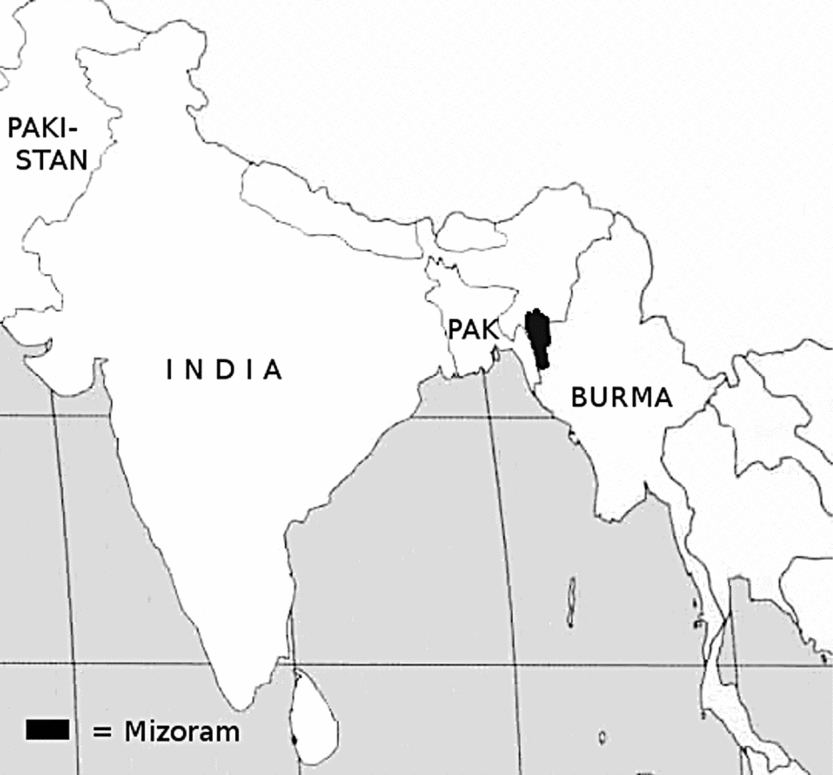
This article presents historical evidence on the war that has not been explored before. This material is from Mizoram, the Indian state wedged between Bangladesh and Burma (Myanmar). It refers to guerrilla fighters from Mizoram who had sought refuge in East Pakistan and who became embroiled in the Bangladesh war and its aftermath. Although some written sources on their experiences are available, these are mostly ex post facto, in the form of memoirs. In this article I present visual sources that were created during the war. In the course of a larger research project, Joy Pachuau and I collected thousands of photographs from over a hundred, mostly private, collections in Mizoram.Footnote 19 Among these are hundreds of photographs that evoke the events of the Mizoram Independence War (1966–86) and the Bangladesh Liberation War (1971). Here I present only a small selection from the collections that ex-combatants have shared with us.Footnote 20
The importance of this visual record is manifold. It provides a uniquely contemporaneous entry point into the life of military migrants from Mizoram in East Pakistan and Bangladesh, and it complements and complicates the limited written source material. It is well known that visual sources come with their own challenges. The problematic veracity of photographic images is the subject of important debates among historians, anthropologists, and scholars of cultural studies, but these are beyond the scope of this article.Footnote 21 Here I employ photographs to explore a subplot of the Bangladesh Liberation War for which few other contemporaneous sources are available. Together these images highlight some of the complexities of grasping what war is—an enormously multifaceted jumble of processes at a variety of levels that takes historians generations to disentangle and interpret.
A Mizo revolt
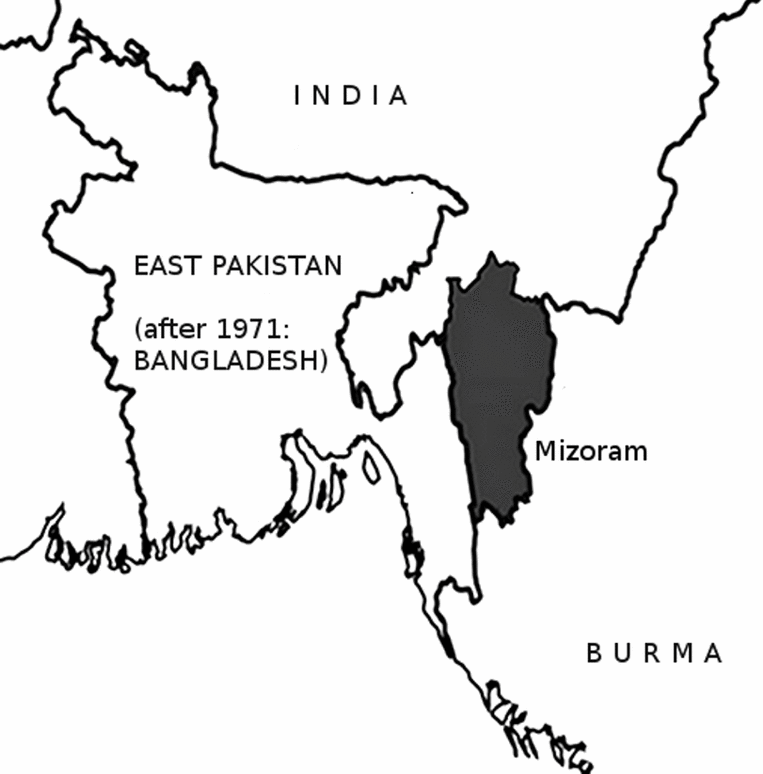
Five years before the Bangladesh Liberation War began, another war had broken out in the mountainous region of Mizoram in India, just across the eastern border of East Pakistan (Maps 1a and 1b). At that time the region was known as the Mizo Hills of Assam, and before that as the Lushai Hills.Footnote 22 It was home to various ethnic groups, among which the Mizos formed the clear majority.
The location of Mizoram in India.

Bangladesh and Mizoram.
In 1966 a rebellion against Indian rule rocked Mizoram. A combination of grievances against the Indian authorities had accumulated there over the 1940s and 1950s. At the time of decolonization in 1947, the inhabitants of Mizoram had been divided in their hopes for the future. There was a strong lobby to retain British rule in Mizoram and the other mountainous regions of northeast India and Burma, and to form a ‘Crown colony’ that eventually would become an independent state.Footnote 23 A second lobby was in favour of joining Burma, which became independent in early 1948. A third lobby favoured incorporation into independent India. This strategy was championed by a new political party, the Mizo Union, mainly with a view to ridding Mizoram of the colonial system of chiefly rule. Even this party stated, however, that their choice was ‘subject to revision according to the future trend of events to the extent of seceding [from India] after ten years’.Footnote 24 As it turned out, Mizoram had no choice in the matter. Decisions in faraway Delhi simply allocated it to India, leading to intense local frustration.Footnote 25 On Independence Day, 15 August 1947, the Indian flag was not raised there, and many inhabitants considered the merger to be both conditional and reversible.
Post-independence policies did little to appease Mizo sentiments. Vexation turned into indignation when the Assam authorities ignored warnings from Mizoram in 1958 that a ‘bamboo famine’ was looming. Ignorant of conditions in Mizoram, the Assam government scoffed at the idea of predicting a famine, and completely failed to prepare. ‘Such a rejection not only betrayed the Assam government's total lack of understanding of the society and the environment of one of its constituent districts, it also reflected the basic lack of empathy with its tribal population.’Footnote 26 In 1959 the crops were doing well—and yet, as expected, famine struck the land. All over Mizoram a specific bamboo variety came into flower and produced fruit. Bamboo rats proliferated by feeding on the fruits, and then they started ravaging human crops and food stocks. The result was widespread starvation. Estimates of the number of deaths suggest that 5 per cent of the population of Mizoram perished.Footnote 27 The Assam authorities had no idea how to respond to the calamity. Many in Mizoram questioned anew the wisdom of joining India: what was the point of being under a state that treated you with disdain and took no account of your needs? Adding insult to injury, the Assam government introduced a law making Assamese—a language not spoken in Mizoram—the state language. This led to demands for administrative separation from Assam. Some advocated the creation of a new ‘hill state’ within India, but others began to prepare for complete independence.Footnote 28
In 1966 this dream was put to the test. After a long period of planning, the Mizo National Front, a political party that had evolved from a voluntary famine relief association, took the decision to defy the Indian state.Footnote 29 They launched Operation Jericho, a name that one of the leaders explained as follows: ‘The operation was called Jericho, because we were kept oppressed within the fortress of Indian governance and administration and we wanted to fight it with righteousness, faith and hope.’Footnote 30 The military wing of the Mizo National Front, the Mizo National Army,Footnote 31 occupied the main towns and declared the region independent from India.Footnote 32 The name they chose for the envisioned independent country was Mizoram (Maps 1a and 1b).
The Indian armed forces were taken completely by surprise. In the words of the army general in charge: ‘We were caught with our pants down.’Footnote 33 They retaliated massively, memorably bombing Mizoram's main town and villages, which remains the only time that the Indian Air Force has attacked its own citizens. The rebels were in shock: ‘The government sent jet fighters. We never quite imagined that the government would do such a thing [and we realized that] the people we were fighting were not normal human beings but evil spirits inhabiting the earth.’Footnote 34 Thus began a 20-year period—remembered as Buai (The Troubles)—in which Mizoram became completely militarized. The Indian armed forces made it a policy to target civilians, most notoriously by driving over 80 per cent of the population into military-controlled settlements and destroying their villages and townships.Footnote 35
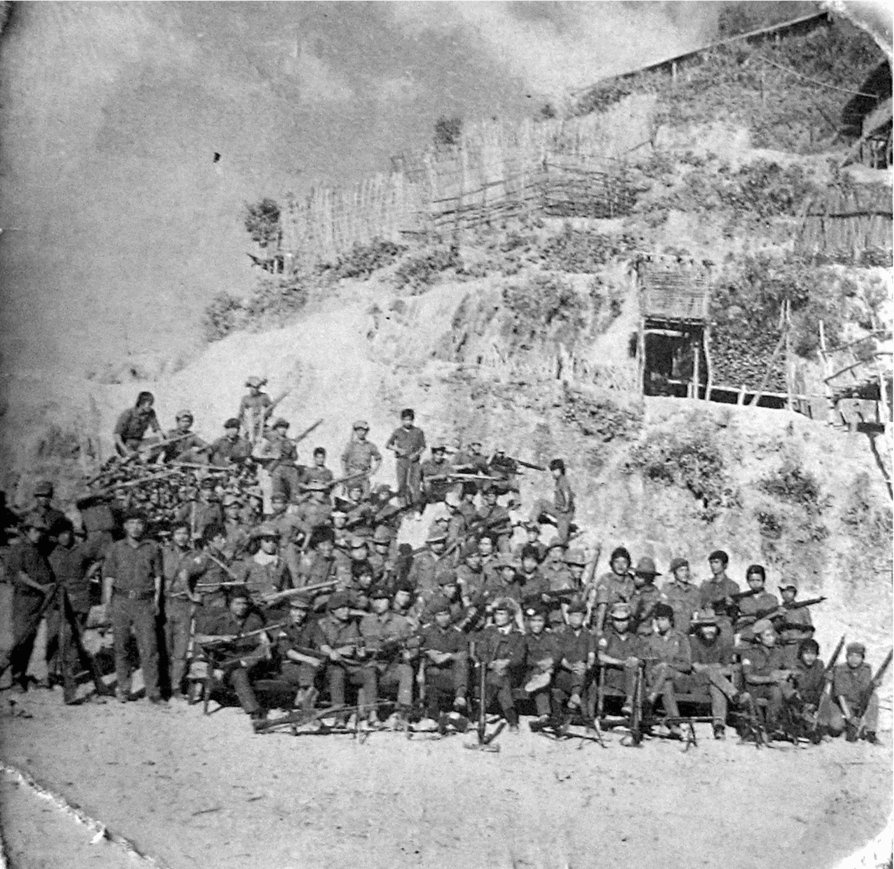
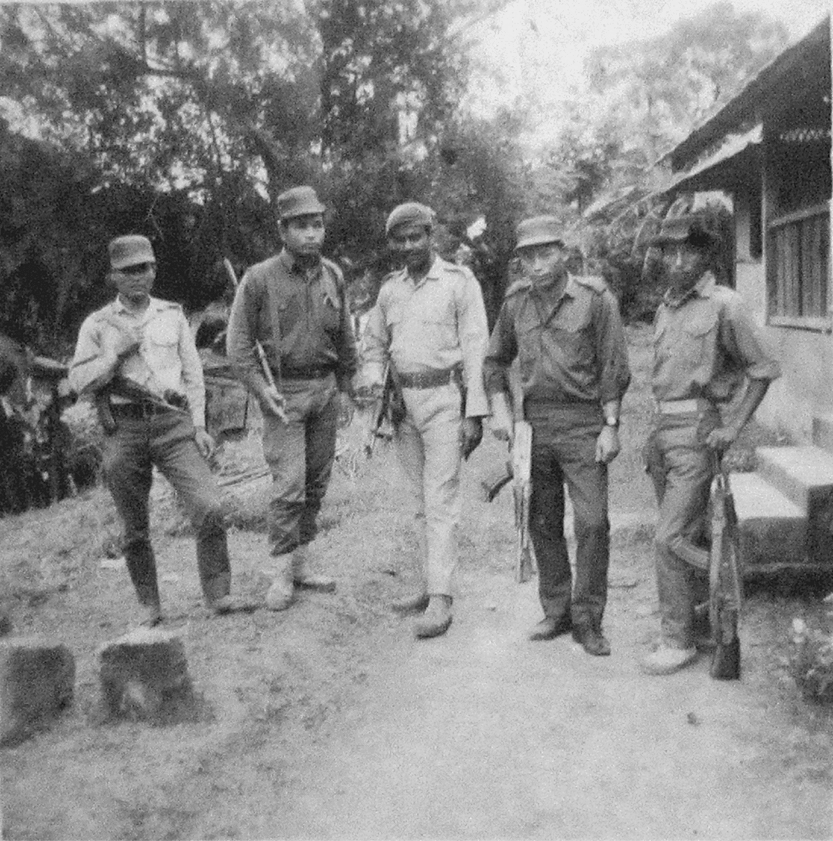
These extreme measures did not, however, quash the rebellion; it soon turned into protracted guerrilla warfare that would continue for 20 years.Footnote 36 The Mizo National Army was active all over Mizoram, and it documented its prowess visually. Figure 1, a war-weathered photograph of a unit posing with their arms, provides an example.
A group of Mizo guerrilla fighters lined up in front of their cave hideout in rural Mizoram in 1967.
The Mizoram government in East Pakistan
As fighting in Mizoram continued, the Mizoram government (Mizoram Sawrkar) found it difficult to stay on. The leaders crossed the border and established their capital and military headquarters in the Sajek region (the Chittagong Hill Tracts) in East Pakistan.Footnote 38 By 1969 most Mizo fighters had also crossed the border and they launched their attacks on Indian troops from there. The Pakistan authorities welcomed the Mizo rebels and supported them with funds, arms, training, and advice. The Pakistanis had supported the Mizo insurgency from its earliest stages because it fitted their policy of destabilizing India's northeastern region; providing shelter to the rebels was a logical step.Footnote 39
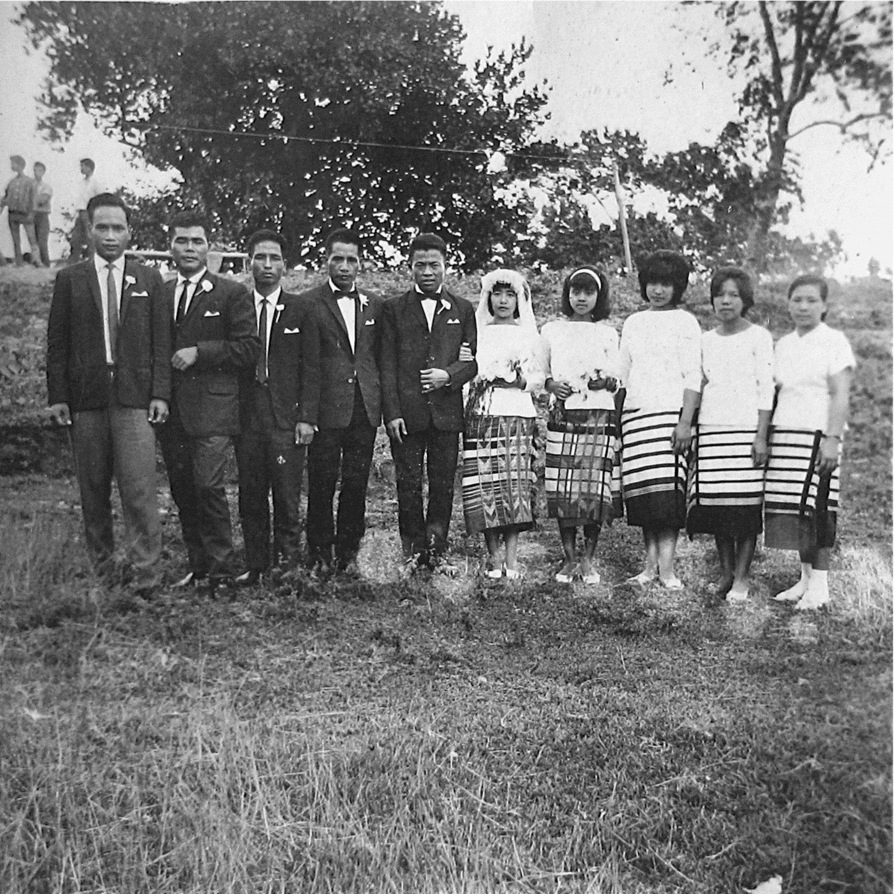
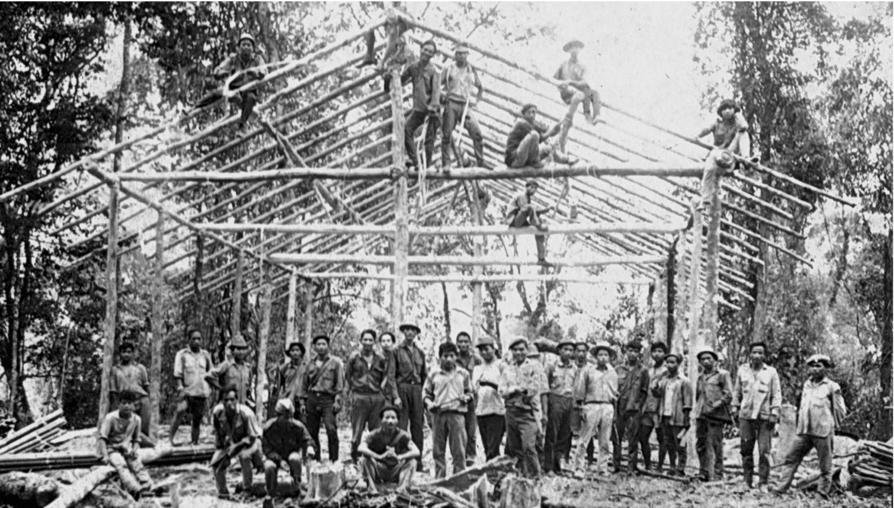
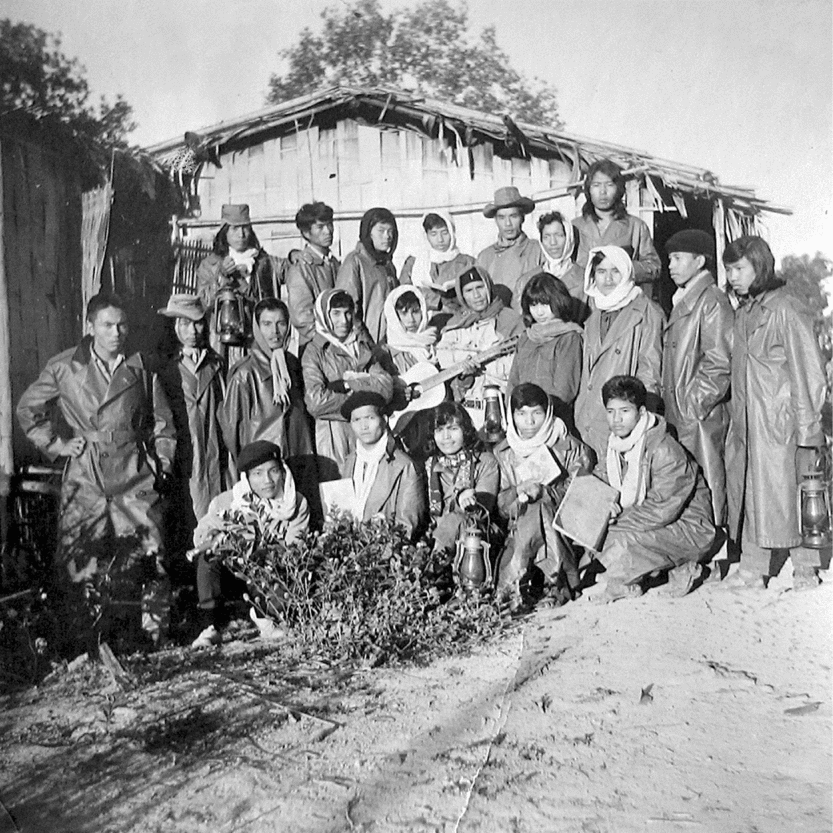
The Mizo settlements in East Pakistan were anything but temporary military encampments. They soon developed into established communities with complex social relations. Thus the photographs in our collection document everyday events: sports matches, weddings, births, funerals, group singing, communal labour service, and so on. Figures 2, 3, and 4 exemplify this genre. Residents took photographs both to memorize social events and to inform relatives and friends back home that they were doing well. All three figures can be read as visual markers of Mizo-ness. Figure 2 shows a wedding that is instantly recognizable as Mizo because of the customary line-up of the bridal couple flanked by four bridesmaids in Mizo sarongs and four best men in business suits. Figure 3 also presents an image that is fairly standard in Mizoram. The construction of village churches is a community effort and it is sometimes captured on camera in this way, with some neighbourhood volunteers posing up in the rafters. In Figure 4 we see a group of young men and women, wrapped in warm clothes against the winter mountain air, ready to engage in an established tradition. During the Christmas season, back home in Mizoram, ‘carol parties’ visited houses in their neighbourhood at night to sing carols and bring good cheer. Note the oil lamps—essential night-time equipment in a settlement without an electricity supply.
Mizo exiles’ wedding party in Mahmuam (East Pakistan), the capital headquarters of the Mizoram government-in-exile, in 1969.Footnote 40
A group of Mizo volunteers constructing a church in Chhantlang (East Pakistan) in 1970.Footnote 41
Armed with a guitar and songbooks, young Mizos get ready to go carolling around Mahmuam (East Pakistan), Christmas 1970.
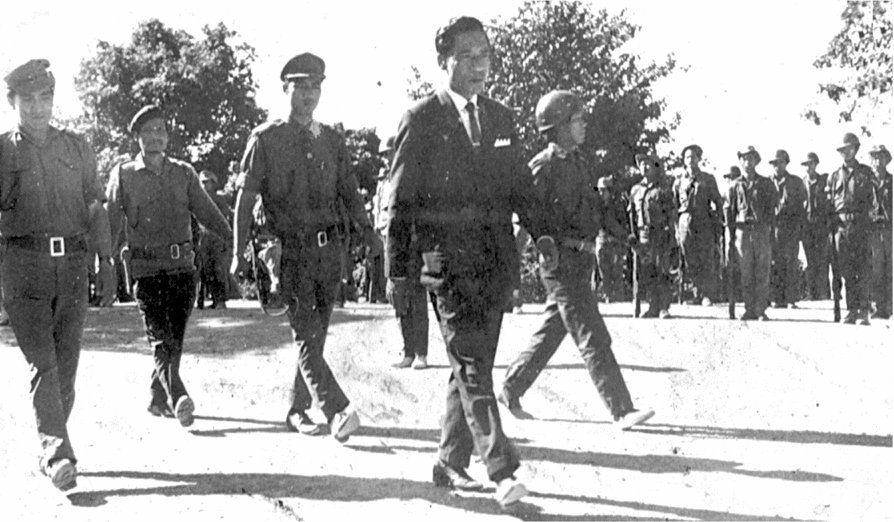
Importantly, exile in East Pakistan created a space to elaborate the notion of an independent Mizo nation-state and develop the trappings of state power. State symbols (for example, the national flag) and ceremonies (for example, the installation of the cabinet, elections, state funerals) gave independent Mizoram more substance across the border than back home. Figure 5 exudes the gravitas required of a function celebrating the birthday of a state at war. Military men of different rank protectively surround the president, who is wearing civilian clothes.
Mizoram Independence Day (1 March) commemorated the beginning of the Mizo revolt in 1966. Here we see the president of Mizoram, Laldenga, inspecting the national guard of honour in Mahmuam (East Pakistan) on 1 March 1969.
The Mizoram government and the Bangladesh Liberation War
Under the protection of Pakistan's military, the Mizoram government flourished and it engaged India's armed forces across the border on a regular basis. It was still operating from East Pakistan when this region descended into war in March 1971. The Mizo rebels were very concerned. The Pakistan authorities moved their leader, Laldenga (who had been given a residence in Dhaka,Footnote 42 the capital of East Pakistan), back to the Chittagong Hill Tracts. ‘The upsurge in East Pakistan troubled the MNF [Mizo National Front] chief deeply. What would happen to them? The Pakistani Military Intelligence had assured the Mizos in Dacca that things would never get out of control. The Mizos could remain where they were and continue their movement.’Footnote 43
This assurance proved correct. Surprisingly, at first the hostilities in East Pakistan hardly affected the Mizos who were ensconced in the northern borderlands of the Chittagong Hill Tracts. There were no Bengalis in their part of the country and the Pakistan armed forces were in firm control. The Chittagong Hill Tracts were home to a number of ethnic groups that had been administratively separated from the Bengali population of the lowlands since the mid nineteenth century.Footnote 44 Very few Bengalis had been allowed to settle there. During the Bangladesh Liberation War, Bengali rebels did seek refuge in the area and engaged in clashes with Pakistani troops—but the Sajek region, where the Mizos were established, remained largely outside their orbit.Footnote 45
Thus, for the time being, the Mizoram War of Independence and the Bangladesh Liberation War remained contemporary but unconnected struggles. The process of their entanglement is of particular interest with regard to how we conceive of the layering of armed conflict. To this end, we will look at three distinct phases: business as usual, flight, and the return to Bangladesh.
Phase 1: business as usual
It was easy for the Mizos to carry on as before, secure under the protection of the Pakistan Army. Bizarrely, despite the bloodshed around them, this phase lasted until the very end of the war (26 March–16 December 1971). Photographs from that period contrast sharply with the usual images of carnage and despair that we associate with the Bangladesh Liberation War. The Mizo photographs exude a carefree attitude and no sense of impending danger.
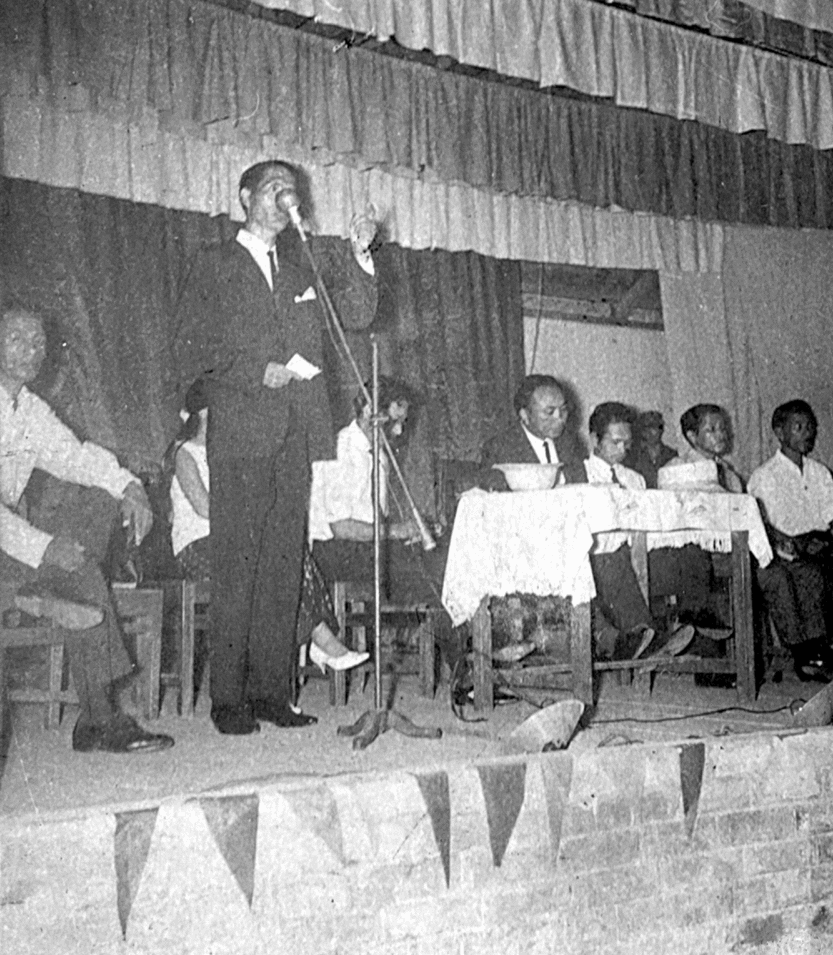
Figure 6 shows this business-as-usual attitude. In an image that reveals nothing about the storm raging all around, it presents a quite remarkable spectacle: democratic procedure in a war-ravaged country under military rule. Here we see the new Mizoram parliament-in-exile being sworn in after elections.
Newly elected members of parliament giving the oath of allegiance to V. L. T. Muana, the election commissioner, in the Mizoram government's headquarters in New Chhantlang (Chittagong Hill Tracts, East Pakistan), 9 April 1971.
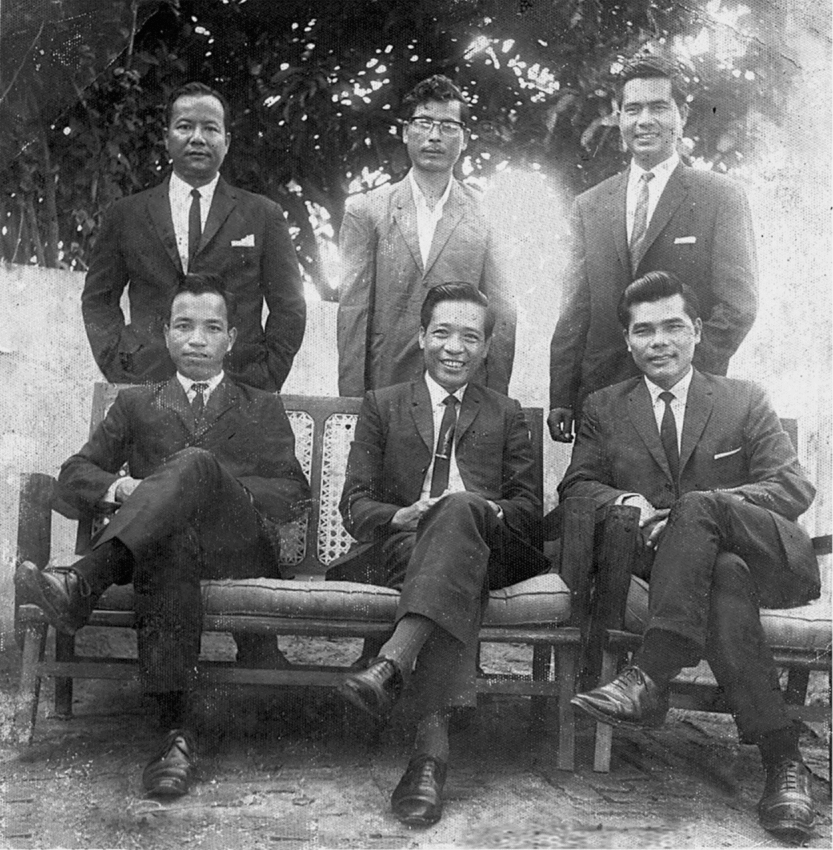
Six months later, the Mizoram government celebrated its tenth National Day in style with a ceremony in Rangamati, the district headquarters of the Chittagong Hill Tracts.Footnote 46 Smartly dressed and looking relaxed and confident, the highest officials addressed the meeting and had their photographs taken (Figures 7 and 8).
Mizo National Day celebration in the town hall of Rangamati (Chittagong Hill Tracts, East Pakistan), 21 October 1971.
The leaders of the Mizoram government pose for a state portrait in Rangamati, 22 October 1971.Footnote 47
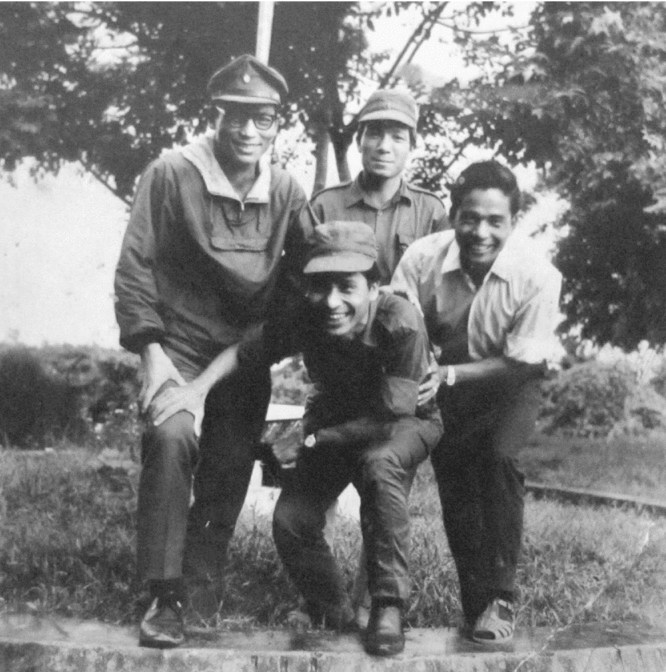
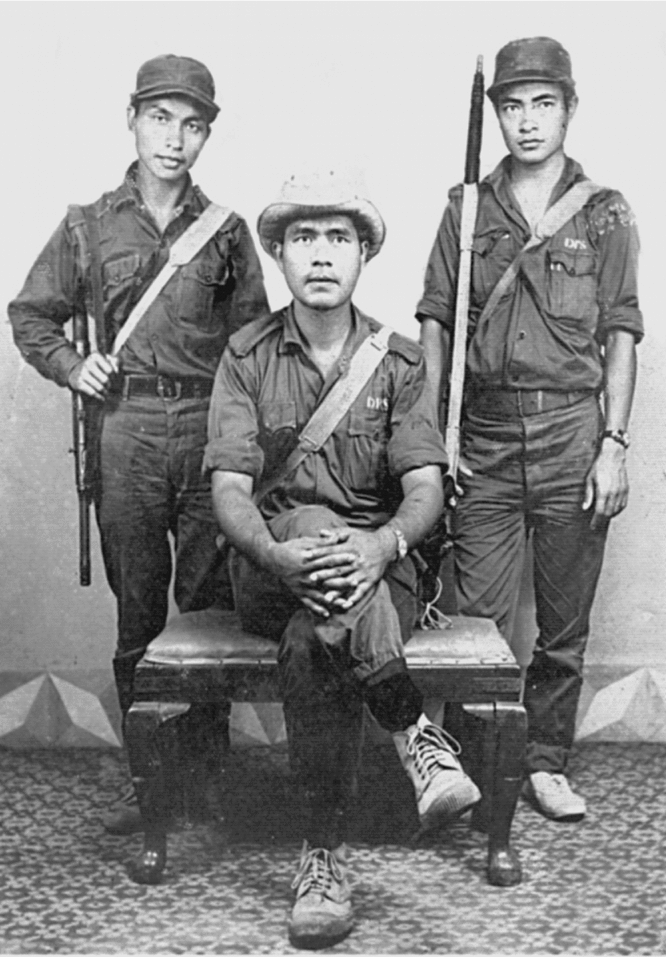
These photographs present the civilian face of the Mizoram government—but the Mizo National Front was almost indistinguishable from its military machine, the Mizo National Army. Mizo leaders donned military outfits as easily as statesman's attire, and the rank and file usually had themselves portrayed in uniform. In two images from the middle of 1971 we see them in happy circumstances. A cheerful group of friends smile at the camera in Rangamati in July (Figure 9), and three self-confident Mizo police officers solemnly pose for a studio portrait in the city of Chittagong the following month (Figure 10).
Four officers of the Mizo National Army during a light-hearted moment at Rangamati College, 23 July 1971.Footnote 48
Mizo police officers pose in a photo studio in the city of Chittagong, 30 August 1971.Footnote 51
These images may convey the impression of exiles living in their own political bubble, completely detached from the war that was raging around them.Footnote 49 But this was not the case. During this phase the Mizos did become more actively involved in the Bangladesh Liberation War. They had been under the protection of the Pakistan Army from their first arrival in 1967 and they kept in close contact during the war. They received most of their information, arms, and cues from Pakistani officers (Figure 11).Footnote 50 Not surprisingly, these officers tried to use the Mizos in their struggle against the Bangladesh Freedom Fighters who aimed to turn East Pakistan into independent Bangladesh.
A Pakistan Army man surrounded by Mizo fighters clad in various uniforms in Barkal (Chittagong Hill Tracts, East Pakistan), 29 September 1971.
The military role of Mizos in the war in East Pakistan appears to have been restricted. The Pakistan Army considered their expertise in guerrilla tactics an asset and employed them as porters and guides in Rangamati during the early stages of the war.Footnote 52 The Mizo intelligence unit, the State Security Agency, cooperated with the Pakistan Army's commando unit the Special Services Group, in an operation on 1 July 1971. They attacked a Bangladesh Freedom Fighters’ camp in the eastern Chittagong Hill Tracts, capturing 28 rifles and 3 Bren guns.Footnote 53 State Security Agency–Special Services Group cooperation also took Mizos beyond the Chittagong Hill Tracts, to lowland settings (Figure 12). They acted as advisors to the army commander in the district of Sylhet and had their photographs taken with Pakistani soldiers. One of these is Figure 13, an icon of martial camaraderie and prowess. To what extent their advice actually played a role in the hostilities in Sylhet is unclear. Throughout the Bangladesh Liberation War most of their activities continued to be directed across the border, against Indian armed forces. In that sense, too, it was very much business as usual for the Mizos in East Pakistan.
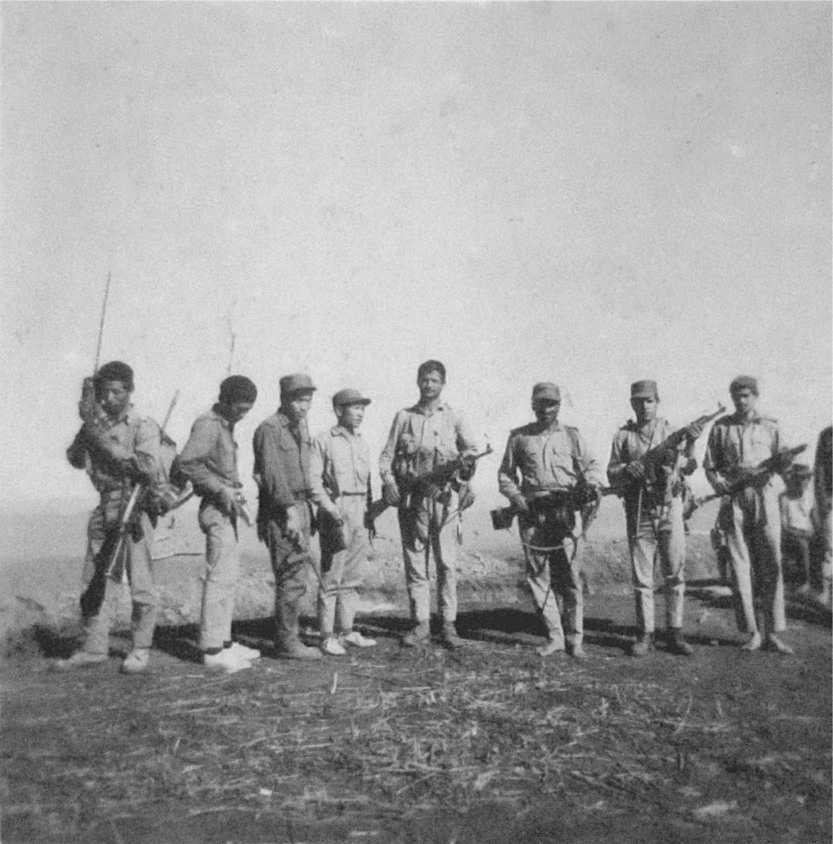
Mizo rebels (State Security Agency) and Pakistani commandoes (Special Services Group) with their arms and a transmitter, East Pakistan, 1971.Footnote 54
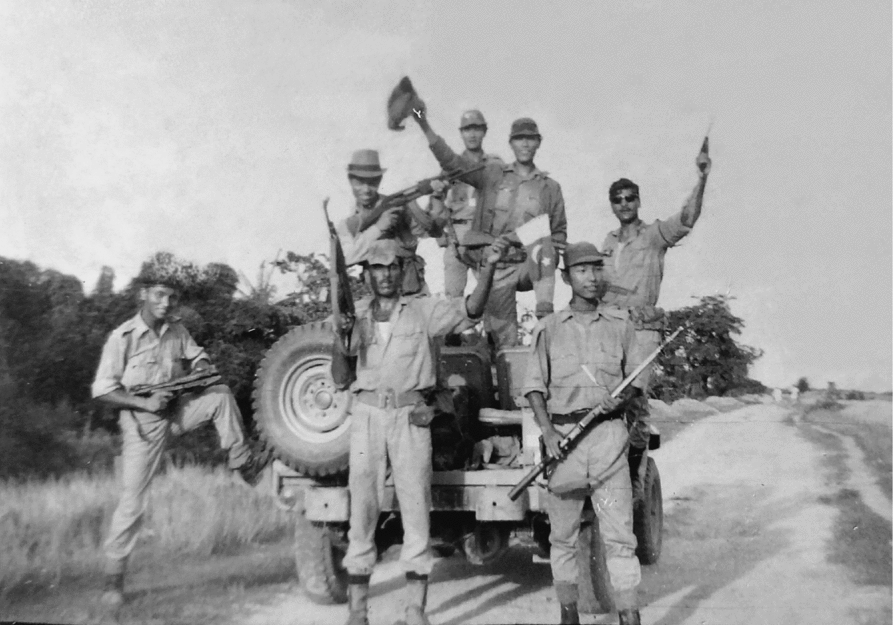
Mizo advisers and Pakistan Army men in Sylhet, 1971.Footnote 55
According to Brigadier Uban, who headed the Indian invasion into the Chittagong Hill Tracts at the end of the war, Mizo fighters played a small role in the final skirmishes. They joined Pakistani soldiers in their attempts to thwart the Indian advance; his troops killed four Mizos.Footnote 56
Phase 2: flight
The end of the Bangladesh Liberation War signalled a new phase for the Mizo rebels. Indian soldiers had entered East Pakistan in November 1971.Footnote 57 In early December India formally declared war on Pakistan and a large-scale invasion crushed the Pakistan Army, which surrendered on 16 December 1971. Now Bangladesh emerged as an independent country.
Suddenly, the tables had been turned on the Mizos in the Chittagong Hill Tracts. They found themselves in an extremely perilous situation. Their military and political protection had vanished and they faced two hostile and heavily armed forces: the Indians and the Bangladesh Freedom Fighters.Footnote 58 On the afternoon of the surrender, Mizos living in the city of Chittagong scrambled to join their fellows in the hills. One of them recalled: ‘There were shootouts on the way as some [Indian] paratroopers had landed near [the road to Rangamati]. But we got through all right. None was hurt.’Footnote 59 That night in Rangamati they debated whether to surrender or flee. After heated deliberations a plan emerged to try and reach Arakan (Burma)Footnote 60 to the south. Here they were sure to be out of reach of both Indian and Bangladeshi armed forces. For tactical reasons, they decided to split up. The main guerrilla force of about a thousand fighters was to cross the border into India. They would surreptitiously make their way to the southern tip of Mizoram and enter Burma. There they planned to rendezvous with the entourage of the president, a smaller group that could not risk travelling across Indian territory but had to remain on the Bangladesh (which had until the day before been the East Pakistan) side of the border. This group was to leave Rangamati by river in a convoy of motor launches.
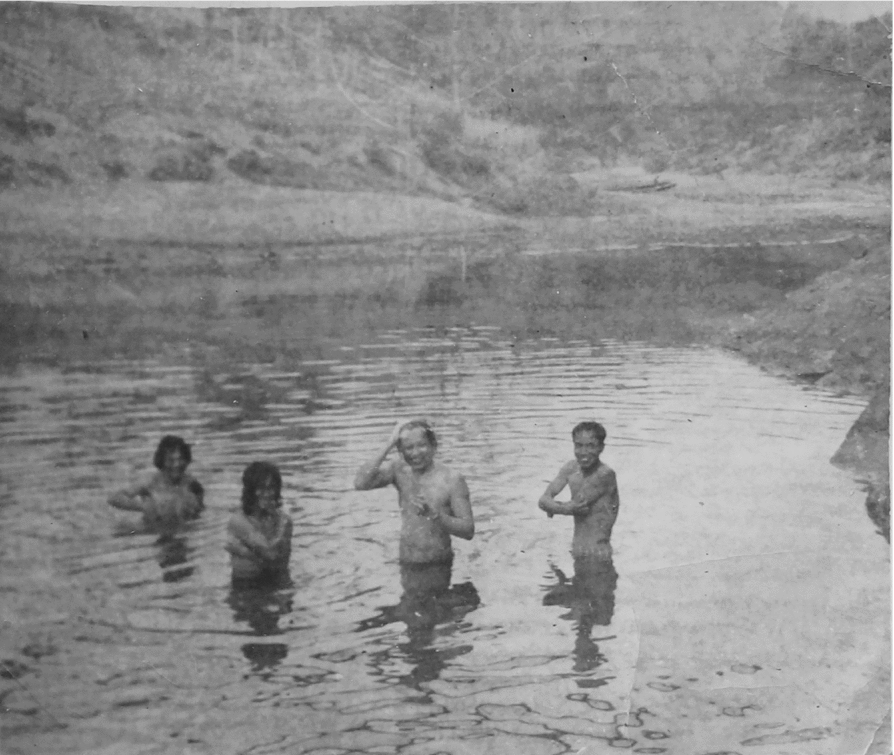
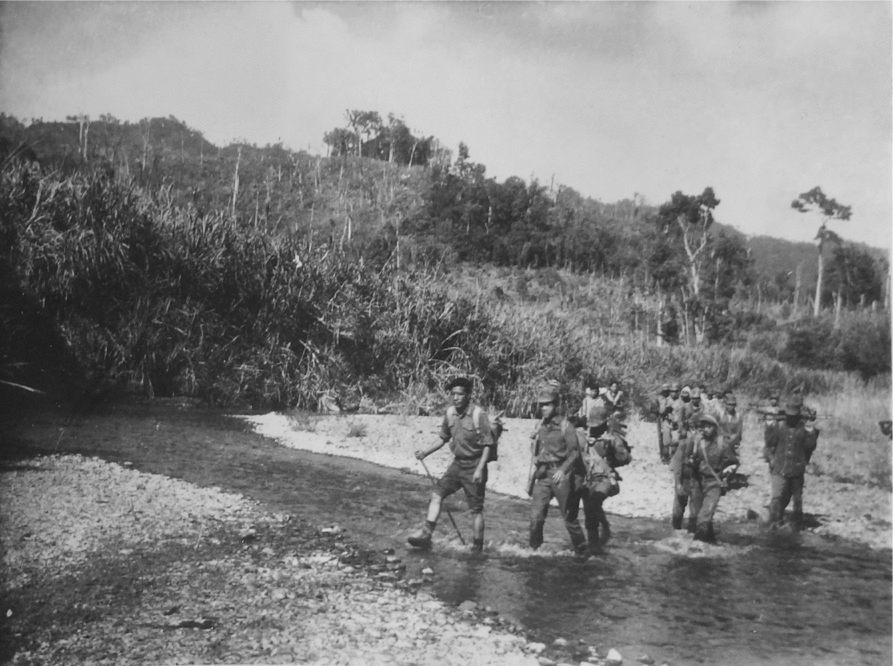
The main guerrilla force was lucky. After re-entering India they moved southward through Mizoram with great speed and little obstruction and crossed the Indo-Burmese border into Arakan. The president's party was not so lucky. They travelled south in seven motor launches on the RainkhyangFootnote 61 river, on the Bangladesh side of the border, and had to fight their way through several ambushes.Footnote 62 They made the final stretch on foot until they reached the ungoverned trijunction point where the territories of India, Burma, and Bangladesh meet. Despite their distress they took some photographs of the march, although they hardly convey the intense pressure that they were under during this fraught episode.Footnote 63Figures 14 and 15 can be said to portray the notion of pasal-tha, manly bravery, a mind set that is highly valued among Mizos.
Mizo men bathing in the Rainkhyang (Tatkawng) river in the southern Chittagong Hill Tracts (Bangladesh) during their flight to Burma, circa 18 December 1971.
President Laldenga and his entourage marching towards Burma in the southern Chittagong Hill Tracts (Bangladesh), circa 18 December 1971.
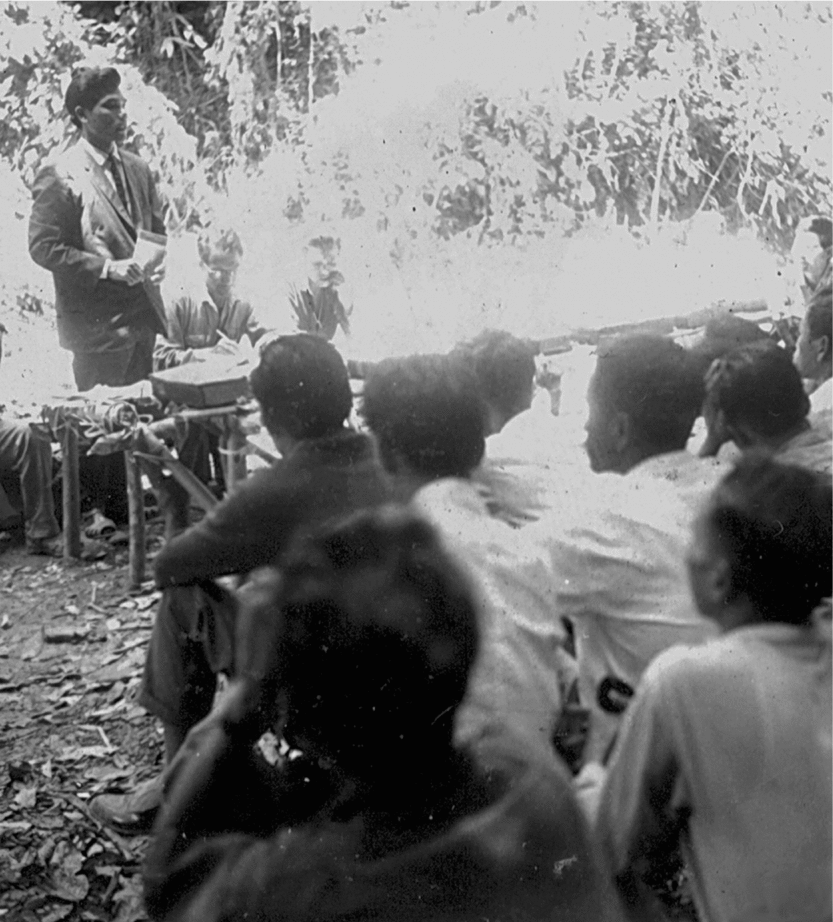
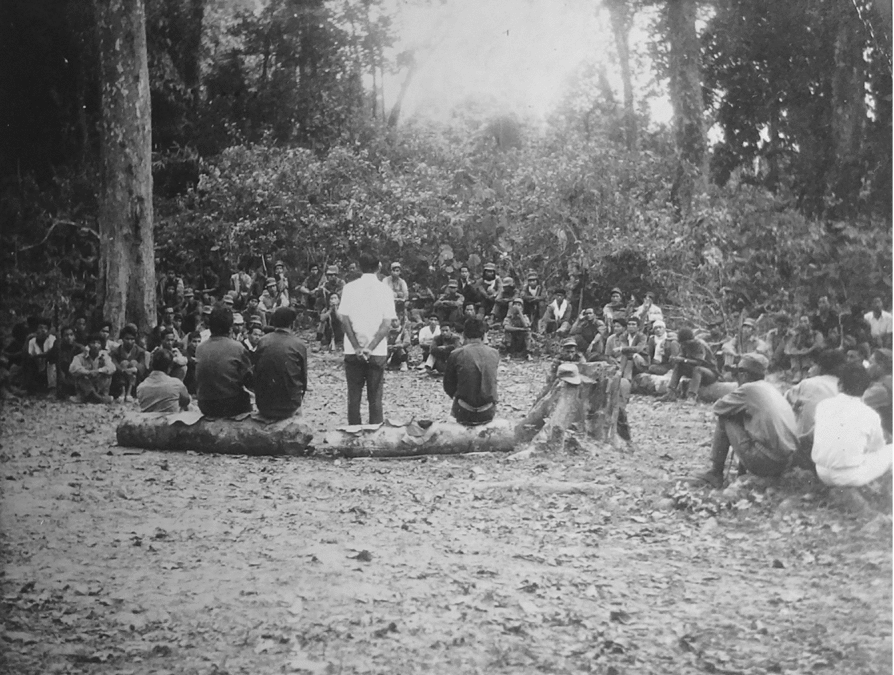
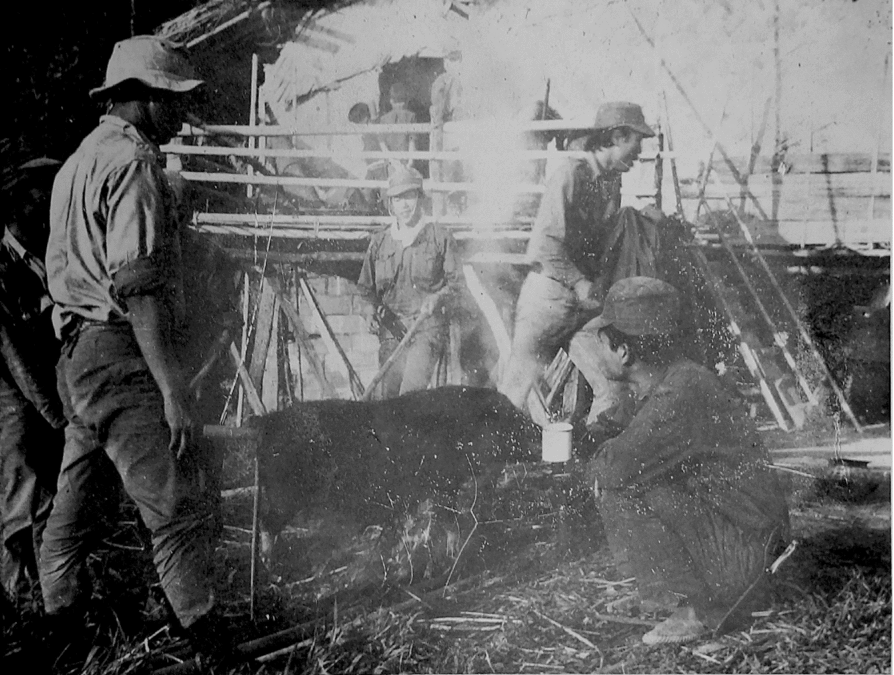
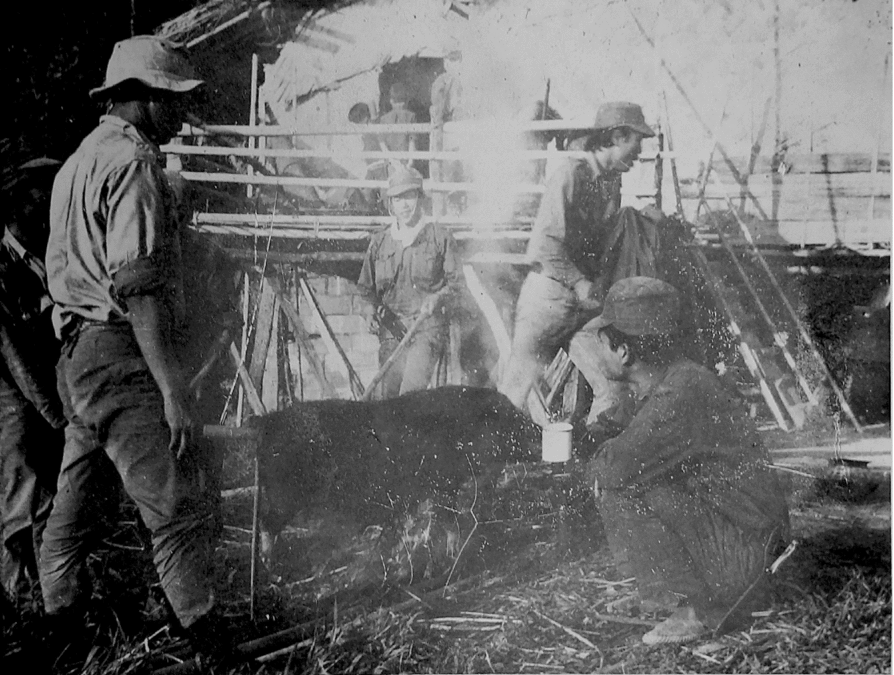
Reunited, the Mizos regrouped in the village of Salopi on the Bangladesh side of the trijunction point. Unknown to them, Indian and Bangladeshi armed forces had now occupied their old camps in the north.Footnote 64 But, for the time being, they were safe in Salopi. Two images testify to their time there. Figure 16 shows the leader addressing his team, and Figure 17 gives us a glimpse of Christmas celebrations that year.
President Laldenga addressing his cadres in Salopi village (Bangladesh) during the flight to Burma, late December 1971.
Mizos roasting a pig in Salopi village (Bangladesh), Christmas 1971.
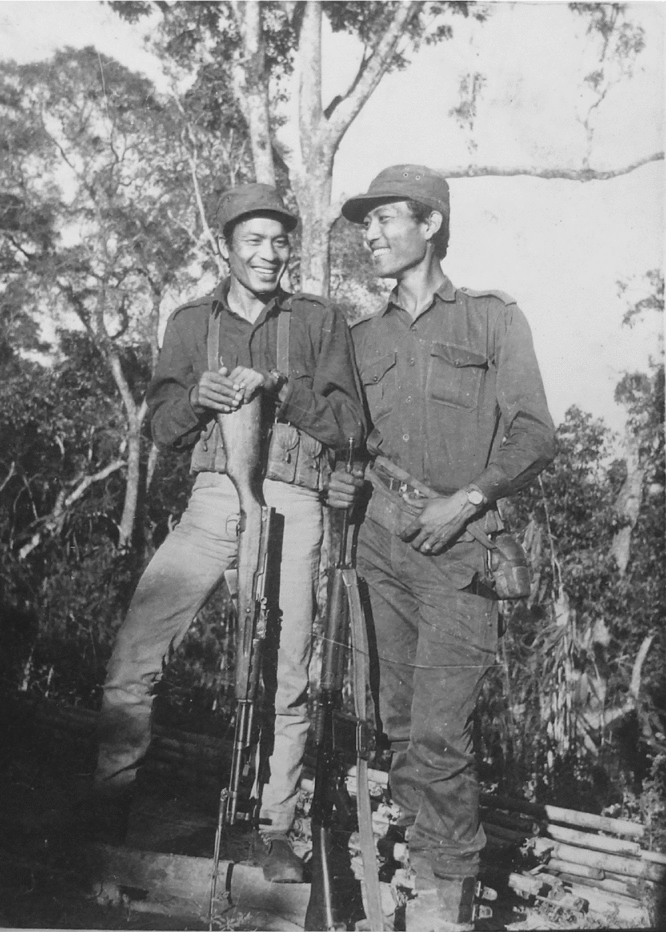
The Mizos knew that for now the heavily forested mountains of the southern Chittagong Hill Tracts would keep them beyond the reach of their foes, but they also knew that it was only a matter of time until the infant Bangladesh government would extend its control. Therefore, they moved further south, just across the Burmese border. Here they were safe because they could count on protection from the Burmese Communist Party, an insurgent militia that controlled the borderland. With foresight, the Mizo National Front had concluded an agreement of mutual support with this party in 1970.Footnote 65 The smiles on the faces of the two men in Figure 18 betray little about their doubts as they left behind the dangers of Bangladesh and stepped into an unknown new world.
Captains Lalthlana and Lalsangliana Sailo on their way to Arakan (Burma), January 1972.
Phase 3: return to Bangladesh
In early 1972 the Mizo movement was in disarray. Not only had they been uprooted from their sanctuaries in Bangladesh, but Burmese troops also attacked them in their hideouts in the Chin hills, east of Mizoram. Those who were in northern Arakan were safe, however, because the Burmese Communist Party, and not the Burmese Army, controlled that part of the borderland. In fact, in May and June 1972, Mizo fighters joined the Burmese Communist Party in forays within Burma, overwhelming the Burmese army post in Bathidaung (Arakan) and the police post in Tanthaung (Chin State).Footnote 66
At the same time the Mizoram rebellion faced a political challenge back home in India. The Indian government made a move intended to frustrate the rebels by detaching the Mizo hills from Assam and upgrading them from a district to a union territory, administered directly from Delhi. The new union territory was officially named ‘Mizoram’.
Meanwhile, not all Mizo fighters had left Bangladesh, and their relationship with local Bangladesh security forces was not all hostile. Clashes certainly occurred: in March 1972 small Mizo units attacked police stations in the southern Chittagong Hill Tracts in order to capture arms and ammunition. They were successful in Ruma, killing 11 people in the process.Footnote 67 But the Bangladesh authorities soon had a new use for the Mizo armed presence in the area. After 1971 the local population of the Chittagong Hill Tracts—overwhelmingly non-Bengali and non-Muslim—became disillusioned with the way the Bangladesh state elite treated them. Their grievances fuelled an insurrection.Footnote 68 In a replay of the scenarios across the border in both Mizoram (India) and Arakan (Burma), the national armed forces of Bangladesh now turned against regional insurgents but also targeted the entire civilian population. The Chittagong Hill Tracts War had started, and it would last until 1997.Footnote 69
By 1974 units of the Mizo National Army, operating from Arakan and Bangladesh, had once again become very active in Mizoram.Footnote 70 Such operations became even easier in 1975 after a series of coups-d’état had rocked Bangladesh. The upshot was the emergence of a military government that saw political advantage in needling India. This new government saw Mizos as convenient allies in the Chittagong Hill Tracts War.
As we have seen, the relationship between Mizos and their ethnic affiliates in the Chittagong Hill Tracts (especially Lushai and Pangkhua) was good—but these were only small minorities in the region. It was larger groups who led the revolt. Mizos shared a history of distrust with these groups, the result of nineteenth-century Mizo raids into the Chittagong Hill Tracts. The well-armed Mizo rebels hiding in the Chittagong Hill Tracts from the late 1960s had only deepened this distrust by stealing paddy from the fields; displacing thousands of local families in the northern Chittagong Hill Tracts; extorting money, paddy, and medicines—and even massacring the men of a village that refused to pay.Footnote 71 There was no love lost between the Mizo rebels and the rebels of the Chittagong Hill Tracts.
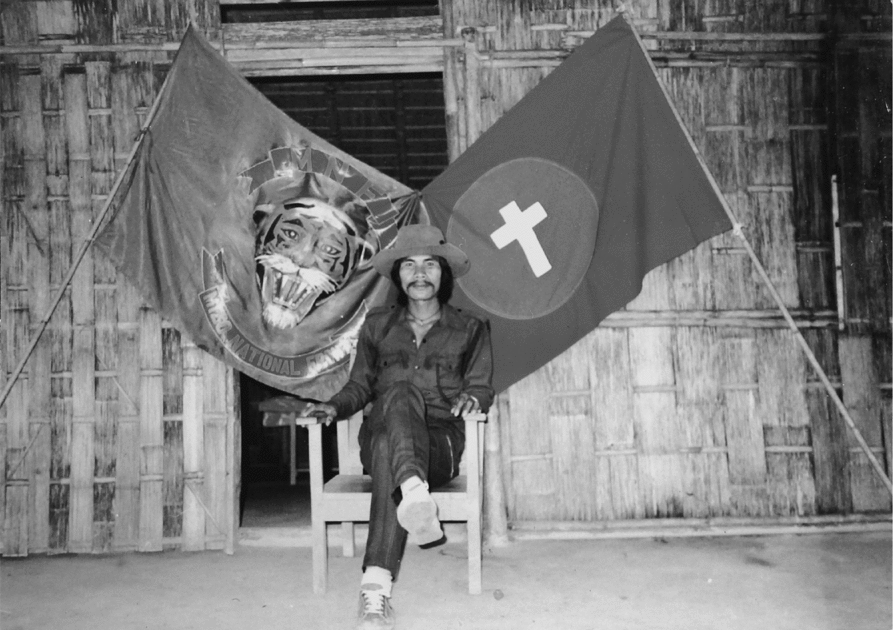
Thus the Mizo government-in-exile was doubly useful to the Bangladesh government: as a tool of foreign policy directed against India and as a tool of domestic policy directed against the Chittagong Hill Tracts uprising. Once again the Mizos received state support in their fight for Mizoram's independence, and they were quite safe in their re-established headquarters in Bangladesh (Figure 19 ).
Arms instructor H. Zoramliana poses with two flags (of the Mizo National Front and Independent Mizoram) in the Mizo military training school, Sunsawng (Chittagong Hill Tracts, Bangladesh) in 1979.
It was only a decade later that the Mizoram War of Independence came to an end. After negotiating a peace accord with the Indian government in return for full statehood within India, the Mizo rebels returned to a heroes’ welcome in Mizoram in 1986. Their life in the Chittagong Hill Tracts was over.
A war within a war
We can use this little-known story from the Bangladesh Liberation War to assess a number of common assumptions about that war. First, as anyone familiar with the historiography will notice, this story fits none of the three master narratives that were elaborated in the aftermath of the war. As we have seen, Bangladeshi writers understood the war as the triumph of the nation, Pakistanis as betrayal and shame, and Indians as a glorious campaign. The Mizo angle cannot be accommodated into any of them, hence its importance: it forces us to push beyond these ‘first-generation’ historiographies.
Second, the Mizo story challenges the framing of the war in terms of national and state units. ‘Bangladesh’, ‘Pakistan’, and ‘India’ (as well as ‘China’ and the ‘United States’) are container concepts that may help organize a narrative at the highest level of abstraction, but they conceal much of the reality of warfare on the ground. By foregrounding smaller organizations, such as the Mizo government, war dynamics come to light that national narratives disregard. The Mizo story forces us to consider two dimensions in particular: territorial thinking and regional variation.
The involvement of this cross-border group in the Bangladesh Liberation War is not compatible with the assumption of territorial exclusivity that is inherent in analyses that take states to be the only actors on the war stage. Here we are confronted with a group of Indian citizens who had renounced their citizenship by claiming independence. Even though Pakistan did not officially recognize the Mizoram government, Pakistani officials had given the Mizos sanctuary in defiance of Pakistan's own very strict rules regarding the presence of Indian citizens in its territory. After the war the Bangladesh authorities initially pursued the Mizos as accomplices of a defeated enemy (and not because of their illegal entry) but soon welcomed them back, once again with complete disregard of their own laws restricting the acceptance of foreign nationals in their territory. The Mizos themselves disregarded territorial boundaries all the time, crossing with ease from Pakistan (later Bangladesh) and Burma into India, and vice versa, without the required passports and visas. Here state boundaries cannot contain the story: territories bled into one another, insurgents were mobile across several national domains, and state agents were encumbered by their spatial confinement within state borders.
Third, the Mizo story calls attention to the fact that the war meant different things in different regions of the country. ‘Bangladesh’ cannot be treated as a uniform entity. Unlike other parts of Bangladesh—in which liberated zones burgeoned during the war—the area in which the Mizos had settled remained firmly in Pakistani hands until the very end. Nuanced analyses of the Bangladesh Liberation War should move beyond the celebration of zones of early liberation to take into account regional differentiation, including zones of unchallenged Pakistani control.
A fourth feature of the historiography of the Bangladesh Liberation War is its concern with apportioning blame and distinguishing between good and bad. Historians have distanced themselves from the ideals that inspired the combatants—be it liberating the motherland (Bangladesh), defending the fatherland (Pakistan), or invading for humanitarian and geopolitical reasons (India)—and from the incompatible ‘truths’ of the first-generation historiography.Footnote 72 The Mizo story forces us to re-examine the judgementalism of historical accounts that divide war actors into good and bad guys. Those who did not support the cause of Bangladesh are usually portrayed as traitors to Bangladesh and as collaborators with its enemies. Mizos do not fit that picture. They were sojourners who had no stake in the war, or in the territory that was being contested. Although they depended on their Pakistani patrons and were enlisted by them in some ways, they were basically disinterested in the conflict. Their eyes were turned east, to their home across the border. Where do they figure in the pantheon of war heroes and villains?Footnote 73
A fifth challenge is ethnic. The most influential historical writings on the Bangladesh Liberation War are still dominated by the ‘Bengali gaze’: they present the war as an episode of Bengali emancipation and they base themselves primarily on Bengali sources, whether in the Bengali language or in foreign languages. It goes without saying that the war was a struggle in which large groups of Bengalis—the overwhelming majority of East Pakistan's population—tried to rid themselves of Pakistani oppression. But a closer look brings out distinctions that qualify the ethnic labelling. First, as in any conflict, many people tried to ride it out by sitting on the fence. Many Bengalis (no one knows how many) took sides only when it was safe to do so, at the very end of the war. Other Bengalis (again, no one knows how many) actively supported the Pakistan side, and among them were armed militias. It is misleading to portray the war as ‘the Bengalis’ confronting the Pakistani enemy. Moreover, there were dozens of other ethnic groups in East Pakistan/Bangladesh. All of them were numerically far smaller than the Bengali majority, but individuals from these groups showed the same range of stands regarding the war, some supporting the Freedom Fighters, some the Pakistan armed forces, some avoiding taking sides.
This was especially significant in the area in which the Mizos happened to find themselves. The Chittagong Hill Tracts was the only region of East Pakistan that had a population that was over 90 per cent non-Bengali, and it had long been administered separately. Not surprisingly, the local population had a variegated response to the movement for Bangladesh and its ethnic framing, which ignored and excluded them. Their preferred position was non-involvement in the conflict, but this was not an option that all could choose. They based their political choices on calculations of the advantages and disadvantages that a Bengali-dominated state might bring them. Many thought that such a state would be even less favourable to them than the Pakistan state—misgivings that they saw confirmed in the post-1971 period. Some local leaders supported the movement for Bangladesh, and they and their followers were later categorized as ‘good guys’. Others sided with the Pakistan authorities; post-war, they and their followers were painted as traitors to the nation.Footnote 74 The war's ethnic framing meant that not only these leaders and their followers, but also all who belonged to the various ethnic groups of these leaders—and by extension, all non-Bengalis in the region—were generally categorized as having been against Bangladesh. This misreading set the stage for callous post-1971 state policies that would trigger the Chittagong Hill Tracts War in the mid 1970s.Footnote 75 The ‘Bengali gaze’ has proved to be particularly unhelpful in understanding the dynamics of the Bangladesh Liberation War in the Chittagong Hill Tracts. These regional dynamics, distinctly different from those in Bengali-dominated parts of Bangladesh, require another perspective.
A final challenge of the Mizo story is that it points to the need for historians to reconsider their practice of constructing the war as a distinct period of extraordinary and incomparable violence, bracketed between March and December 1971. War is politics by violent means, but obviously political violence is not restricted to war. State formation always involves force and coercion, and the consolidation of Pakistan after 1947 certainly was no exception.Footnote 76 It makes sense to analyse the Bangladesh Liberation War as straddling a longer period. Violence figured prominently in the politics and administration of East Pakistan; it altered during the war, and those who won the war employed it to establish their hold over the new state of Bangladesh. For example, state-created militias—Ansars (1940s–60s),Footnote 77 Peace Committees and Razakars (the 1971 war),Footnote 78 Jatiyo Rokkhi Bahini (1972–75),Footnote 79 and Rapid Action Battalions (2004–present)Footnote 80—all served the same function of intimidation and extrajudicial state terror. By the same token, the Mizos’ entanglement in the Bangladesh Liberation War is best understood in a longer time perspective, as an intermezzo between two phases of military sanctuary and struggle, one preceding the war and one following it. Thus the Mizos’ experiences allow us to discern hitherto unexplored links between the Mizo War of Independence (1966–86), the Bangladesh Liberation War (1971), and the Chittagong Hill Tracts War (1975–97).Footnote 81
An unsettling story
The Mizo story is unfamiliar in Bangladesh. This is partly because it is contained in memories, writings, and images that have not been available within Bangladesh.Footnote 82 But more importantly, this story is an uncomfortable one. Even though it is only a very minor thread in the immense tapestry of war events, it unsettles the structure of current understandings of the Bangladesh Liberation War. The concepts that conventionally frame the historiography—national units, ethnic categories, and heroism versus villainy—do not suffice here.
Crucially, the Mizos were waging a war of emancipation that actually mirrored the Bangladesh Liberation War in many respects. Both had their roots in the partition of British India, which had not taken into account their interests, and in their allocation to post-colonial states whose elites were impervious to their needs. Both dreamed of secession and, to this end, took on a much more powerful national army. Both used guerrilla tactics and shared the experience of non-combatant populations being attacked by their respective national armed forces. The Indian government turned the Indian Air Force and Army loose on the inhabitants of Mizoram in much the same way as the Pakistan government unleashed the Pakistan armed forces on the inhabitants of East Pakistan. The two historiographies also mirror each other: like its Bangladeshi counterpart, the historiography of the Mizoram War of Independence also leans heavily on national units, ethnic categories, and heroism. Thus the Mizos’ emancipation struggle could have earned them the sympathy and support of Bangladeshi Freedom Fighters and, later, war historians. But the way in which their struggle became intertwined with the Bangladesh war made this impossible. Identifying with their cause became awkward: Mizos were fighting another state (India), they were non-Bengalis (and many Bengalis look down upon Mizos as ‘less civilized’ than themselves), and, worst of all, they sided with the Pakistani enemy and therefore fell into the category of villains.
But the very awkwardness of how these two struggles coincided, meshed, and produced a war within a war can be productive. More than 40 years after the event, the narrative of the Bangladesh Liberation War is still dominated by the raw emotions, traumatic experiences, and political splits that it produced. This is bound to change, because such a war narrative cannot be sustained by generations who did not experience that war. Three quarters of the current population of Bangladesh was born after 1971. Historians among them are producing more nuanced readings of the calamity, and these delve into variation rather than uniformity. In dialogue with colleagues abroad they reach beyond the first-generation historiographies and promote more inclusive interpretations of the war. The Mizo story is one of many wartime accounts that can contribute to this endeavour.