

I
This article examines the determinants of investment returns in the Swedish fire insurance industry between 1903 and 1939 – a period of turbulent economic and political conditions in Sweden and elsewhere. Several researchers (Fairley Reference Fairley1979; Cummins and Grace Reference Cummins and Grace1994; Adams Reference Adams1996) have noted that in more modern times investment income makes a significant contribution to the annual profits of insurance companies and often cross-subsidises loss-making underwriting activities. For stock insurers, the contribution of investment returns to operating results can enhance value for shareholders, while for mutual insurers investment income can supplement reserves, alleviate capital constraints and help increase returns for policyholders holding participatory rights policies (Oppenheimer and Schlarbaum Reference Oppenheimer and Schlarbaum1983). These views are also reflected in studies of the historical development of insurance markets such as those of the United States (US) and United Kingdom (UK) (e.g. see Clayton Reference Clayton1951; John Reference John1953; Treble Reference Treble1980; Pearson Reference Pearson2004). For example, Clayton (Reference Clayton1951, p. 86) notes that UK insurance companies have long retained an important investment function and are major institutional contributors to capital formation in the national economy. In fact, John (Reference John1953) observes that in the UK the investment function of insurance companies has been important since the early days of the insurance industry in the eighteenth century. Over the period of our analysis, 1903 to 1939, Swedish insurance companies also played an important role in the development of domestic capital markets and the promotion of institutional investment in the economy (Waldenström Reference Waldenström2002).
Our study extends the extant literature in at least three principal regards. First, prior research has not specifically examined investment performance in Sweden's property fire insurance industry in a historical context. This is in spite of the major contribution made by insurance companies' investment activities to the growth of the Swedish insurance market (Lindmark, Andersson and Adams Reference Lindmark, Andersson and Adams2006), and indeed, the national economy more generally (Adams, Andersson, Andersson and Lindmark Reference Adams, Andersson, Andersson and Lindmark2009). Additionally, Pearson (Reference Pearson2004, p. 346) states that in the economic and business history literature ‘discussions of profitability in existing (insurance) company histories have focused largely on underwriting (rather than investment) performance’. Accordingly, our study contributes potentially new and important insights into the investment behaviour of insurance firms in an important European insurance market over historical time. Second, our panel data design enables us to conduct a robust test of the persistency of underwriting performance over time by controlling for (within-period/sub-period) time-specific factors (e.g. changing macroeconomic conditions) that might influence investment patterns in the Swedish fire insurance market. Third, historical evidence linking investment returns to the characteristics (e.g. organisational form) of insurance companies might help present-day insurance market participants (e.g. policyholders, shareholders and so on) to make better-informed insurance and investment decisions.
We consider that Sweden is an interesting jurisdictional environment within which to conduct our study for various reasons. For example, the country has a long tradition of writing property fire risk insurance that dates back to at least the eighteenth century (Lindmark et al. Reference Lindmark, Andersson and Adams2006; Adams et al. Reference Adams, Andersson, Andersson and Lindmark2009; Lindmark and Andersson Reference Lindmark and Andersson2010). Additionally, during our period of analysis Sweden had large numbers of generally local mutual fire insurers operating alongside larger national stock insurance (Larsson Reference Larsson1991). This situation increased competition among Swedish fire insurers while economic uncertainty, particularly following the 1929 stock market crash, placed downward pressure on underwriting margins (Adams, Andersson, Jia and Lindmark 2011). This gave added emphasis to the investment function in maintaining levels of profitability in the Swedish property fire insurance market during the period of our analysis (Lindmark and Andersson Reference Lindmark and Andersson2010). Such economic pressures were also experienced in other European fire insurance markets like the UK (e.g. see Westall Reference Westall1988). This institutional feature further enables us to more clearly identify variations in investment activity between insurance companies according to their firm-specific characteristics such as organisational form and firm size, thereby enabling us to potentially conduct more refined tests of our research hypotheses. Focusing on the Swedish insurance market is also potentially interesting as during the period of our analysis the organisational structure of the insurance market changed in favour of mutual organisational forms. Moreover, between 1903 and 1939 regulatory and other statutory controls (e.g. tax rules) regarding investment activities did not significantly distinguish between mutual and stock insurance companies in Sweden. These attributes enable us to ascertain if investment managers in insurance companies with different characteristics (e.g. organisational form and size) responded differently under changing market conditions, thereby providing insights into the relative effect of a less regulated environment on patterns of investment. What is more, a country-specific study such as ours further helps to mitigate the complications that different institutional conditions (e.g. variations in regulations, tax policies and macroeconomic climate) can produce in interpreting the results of transnational studies. This attribute should also enable us to derive potentially cleaner tests of our research hypotheses than would otherwise be the case.
The remainder of our article is structured as follows. Section II derives and specifies determinants of insurers' investment earnings drawn from finance theory, while Section III describes our research design, including the sources of data, modelling procedure and the variables used. Section IV analyses our empirical results and Section V concludes our article.
II
A substantial academic literature contends that the different corporate ownership structures in insurance markets create different contracting incentive conflicts between policyholders, shareholders and managers (Mayers and Smith Reference Mayers and Smith1981, Reference Mayers and Smith1988, Reference Mayers and Smith1994; Adams Reference Adams1995, Reference Adams1996; Harrington and Niehaus Reference Harrington and Niehaus2002). In policyholder-owned mutual insurers, the main contracting problem is to ensure that policyholders' fixed claims are fulfilled. However, because policyholders in mutual insurance firms do not have a well-developed secondary market in which they can trade their ownership rights their managers are not subject to the disciplinary effects of changes in corporate control (Mayers and Smith Reference Mayers and Smith1981). Moreover, because policyholders are a disparate ownership group in mutual organisations they are not effective monitors of managerial decision-making (Mayers and Smith Reference Mayers and Smith1988). Therefore, managers in mutual insurers could engage in investment activities that do not maximise returns and/or dissipate investment returns through frivolous expenditure (e.g. perquisite consumption). Furthermore, managers of mutual insurers may not have such a need to maximise investment returns. This is because they may admit less risky types to the insurance pool and/or are able to meet policyholders' expectations by allocating bonuses to policies from better than expected surpluses emerging on the insurance pool and/or drawing from accumulated reserves (Smith and Stutzer Reference Smith and Stutzer1990). In addition, Mayers and Smith (Reference Mayers and Smith1994) suggest that managers of stock insurance companies will be granted more discretion over investment decisions than their counterparts in mutual insurers in order to maximise shareholders' utility and increase share prices. Managers in stock insurers may also be motivated to act in accordance with shareholders' interests through the payment of regular and competitive annual dividends and the disciplinary effect of a possible change in corporate control in the event of sustained poor financial performance. Pearson (Reference Pearson2002) further acknowledges that in the UK fire insurance industry of the nineteenth century the greater ability of managers in stock insurance firms to exercise their discretion over investment as well as underwriting activities helped them to cope better with periodic fluctuations in market premiums and to steal a competitive advantage over their counterparts in mutual insurers. Therefore, we put forward the hypothesis that:
H1: Other things being equal, the investment returns of stock insurers are likely to be higher than for mutual insurers.
Prior studies (e.g. Boose Reference Boose1993; Mayers and Smith Reference Mayers and Smith1994; Adams Reference Adams1996) have recognised the scale economy benefits that can arise in the corporate investment function of insurers due to increased firm size. For example, large insurance companies are able to avoid volatility in investment returns by holding large and well-diversified assets portfolios, and have sufficient resources to employ specialist fund managers who should have the necessary expertise to maximise investment returns. In contrast, small insurers are less likely to benefit from these organisational attributes. Indeed, contemporary empirical evidence from the US life insurance industry (Boose Reference Boose1993) and New Zealand (NZ) life insurance industry (Adams Reference Adams1996) supports a positive firm size effect on investment returns. Pearson (Reference Pearson1993) further reports that in the early nineteenth century the inability to generate sufficient investment income inhibited new (often small) start-ups from entering the UK fire insurance market and competing effectively with larger established insurance companies. Accordingly, our second hypothesis is that:
H2: Other things being equal, the investment returns of large insurers are likely to be proportionately higher than for small insurers.
Investment returns could be influenced by the capital structure of insurance companies in that cash flows generated from invested assets can help to increase accumulated reserves, reduce the potential costs of financial distress and bankruptcy, and obviate the need for raising potentially costly external capital (Pearson Reference Pearson2002, 2004). These attributes can help to protect the value of the fixed claims of debtholders (policyholders) from opportunistic (speculative) behaviour by shareholders and managers, thereby reducing agency costs (Jensen and Meckling Reference Jensen and Meckling1976).Footnote 2 Jensen (Reference Jensen1986) also contends that debt can force managers to focus on free cash flow generation in order to meet their commitments under debt contracts (e.g. to make regular payments of capital and interest) thereby binding their agency relationship with debt providers (policyholders). In insurance companies, internal rules could require managers to maximise investment returns in order to ensure that policyholders' fixed claims under insurance policies are met. This situation is likely to be particularly evident in cases where the leverage position of insurance firms is high (Adams Reference Adams1996). Thus:
H3: Other things being equal, the investment returns of highly levered insurers are likely to be higher than for lowly levered insurers.
Fama and Jensen (Reference Fama and Jensen1983) acknowledge that firms that engage in risky business activities are likely to have uncertain future cash flows. Their reasoning, shared by others (e.g. Fairley Reference Fairley1979), suggests that insurance companies that engage in risky underwriting are likely to have a greater need to maximise investment returns than insurance companies whose managers are more prudent in their underwriting function. Adams (Reference Adams1996) adds that because increased investment returns helps to mitigate underwriting risks, insurers engaged in more risky lines of insurance are likely to grant their managers more discretion in key areas such as investment strategy than insurers writing more predictable lines of insurance. Indeed, the use of investment income to cross-subsidise high risks in the fire insurance market in the UK in the nineteenth century is noted in Pearson (Reference Pearson2004). Consequently:
H4: Other things being equal, the investment returns of insurers with greater underwriting risk are likely to be higher than for insurers with low underwriting risk.
As investment returns can vary across insurance firms as a result of other factors we included three main firm-specific control variables – the length of time a fire insurer has been operating in the market, the geographical spread of operations, and asset type (liquidity) – in our analysis. Our motivation for including these variables is as follows. Longer-established fire insurers are expected to have developed an effective investment function and thus we expect investment returns to be positively related to the age of an insurance firm. National insurers are likely to be better placed to effectively diversify underwriting risks and potentially obviate the need to generate investment returns than local insurers. However, such diversified and nationally focused insurance firms may also realise scale economy benefits from a wider spread of operations and so increase their investment returns. Hence, the predicted relation is not clear. In addition, to control potential endogeneity issues with regard to investment returns period lags for firm size and underwriting risk are included in our regression analysis (e.g. see also Abdul Kader, Adams, Andersson and Lindmark Reference Abdul Kader, Adams, Andersson and Lindmark2010).
Due to changing financial fortunes and emergent risks, the composition of, and returns from, financial assets in the balance sheets of insurance companies may differ across firms and over time. The proxy employed in this study to control for asset type is liquidity (which we measure as the annual amount of bank deposits divided by current liabilities – see below).
III
Our data set comprises an unbalanced panel of 3,780 firm/year observations for the 37 years, 1903 to 1939, comprising both national property fire insurance companies and local (mutual) fire support funds. All financial and economic data for the Swedish property fire insurance market for our period of analysis were obtained from the Swedish Official Statistics Series (SOS) for Private Insurance (1903–39). In total, 407 firms have minimum and maximum yearly observations ranging from two to 37 years. For the smallest local parish-based companies a sample has been drawn covering 30 per cent of companies during the time period. For the other organisational forms almost all domestic companies are included (companies with only a minor business in fire have been excluded from the analysis). Foreign companies are not included due to the lack of investment data.
During the period of analysis the composition of the Swedish property fire insurance market changed as a result of market exits and corporate consolidation. Since most of the variables that we use in the present study are measured on a ratio basis, our data set is given at current prices. The exception is firm size (which is the log of price-adjusted total assets).
The variables used in our regression models are defined as follows. (i) The dependent variable Investment returns is defined as the return on assets, defined as net earnings divided by the book value of total assets; (ii) Organisational form is a (time-invariant) dummy variable that is used to separate stock and mutual insurer; (ii) Firm size is measured as the natural logarithm of business in force (total value of property insured). This approach alleviates the possible effects of extreme values; (iii) Leverage is represented by the premium-to-surplus (P-S) ratio, namely net annual premiums (written) divided by surplus (equity + reserves) as a proxy for the leverage (solvency) position of fire insurance firms; (iv) Underwriting risk is measured as the claims-to-business ratio, namely total value of annual incurred claims divided by the business-in-force. Liquidity is, as noted earlier, measured as the annual amount of bank deposits divided by total assets.
In this study we use an unbalanced panel of data. By allowing entrants and exits into the panel over our period of analysis we help to mitigate the problem of survivorship bias. Greene (Reference Greene2003) argues that a major advantage of using a panel data design is that it controls for omitted (unobservable) company-specific effects (e.g. differences in risk profiles and inter-company risk management expertise) and/or time-specific (annual) effects that might influence the level of claims (e.g. macroeconomic effects). As such, a panel data research design helps produce more informative and robust parameter estimates than a separate single period and/or simple pooled regression analysis.
To examine the linkages between investment returns and the firm-specific factors and control variables noted above, we use a dynamic panel data procedure applying Generalised Method of Moments (GMM) estimation. GMM estimation is a form of ‘instrumental variable’ regression which mitigates the effects of correlation between the independent variables and the residuals, such as that caused by heteroscedasticity and endogeneity among the explanatory variables (Greene Reference Greene2003). The explanatory variables are also lagged by one period to further mitigate potential endogeneity between the error term and explanatory variables. However, the use of lagged variables will only be valid as long as the vector zit-1 is uncorrelated with uit. The ‘investment model’ that we estimate can thus be written as:
 $$r_{it}=\beta _0 + \beta _1 x_{it - 1} + \mu _{it}$$
In the above equation r is the investment return for firm i at time t; x is a vector of firm-specific explanatory variables at time t-1. By lagging the explanatory variables, the model is essentially testing the degree to which past investment performance affects current period investment returns. The rationale is that investment returns ex post are the outcome of the investment decisions ex ante. For robustness reasons, the same model is also estimated using a fixed-effects (FE) panel data model. Both the GMM and FE models are estimated for the full sample and a sub-sample of mutual and stock companies respectively. As organisational form is time-invariant, the dummy variable is omitted to mitigate the potentially confounding effects of multicollinearity.
IV
In the second half of the nineteenth century, capital formation in industrial buildings, machinery equipment along with building, spurred the growth of fire insurance. The high demand was met by the entry and growth of both stock and mutual insurers. Being the primary industrial insurers, stock companies gained a dominant position in the Swedish property fire insurance market. At the turn of the twentieth century, stock insurers, nationwide mutual insurers, local mutual insurers and foreign companies held 71, 10, 12 and 7 per cent of the local property fire insurance market (measured as gross premium income) respectively. Most of the companies were small local mutual insurers. Over the period, between 300 and 400 local insurers operated and between 10 and 20 nationwide stock and mutual companies respectively.
The fire insurance market in Sweden changed markedly from the beginning of our period of analysis compared with hitherto partly as a result of the 1903 Insurance Act introducing more stringent licensing and solvency monitoring by the Swedish insurance industry regulator – the National Private Insurance Inspectorate (Lindmark et al. Reference Lindmark, Andersson and Adams2006; Lindmark and Andersson Reference Lindmark and Andersson2010; Adams et al. Reference Adams, Andersson, JIA and Lindmark2011). Also, the introduction of common tariffs and regulation of insurance industry practices following the establishment of the Swedish Fire Tariff Association in 1873 imposed more explicit ‘rules of the game’ for Swedish insurers to follow. Members of the fire tariff, domestic stock insurers and foreign stock and mutual insurers could address such issues as risk-sharing with higher access to reinsurance and risk co-ordination through a more standardised national system of pricing tariffs. Although organised more effectively, domestic stock and foreign insurers lost market shares during the interwar period. The growth of old and the entry of new nationwide insurance mutuals resulted in increasing market shares. In 1939, mutual insurers (local and nationwide) held 33 per cent of the market (in terms of gross premiums written) with stock insurers retaining 61 per cent and foreign companies the residual 6 per cent.
The market for fire insurance developed slowly in the interwar period compared to the industrialisation period (1870–1913). This was due to a retarded rate of growth in building (physical) capital formation (2.5 per cent) compared with the preceding period (3.7 per cent) (calculations based on Krantz and Schön Reference Krantz and Schön2007). In this process it may be that some segments were more promising than others. Looking at the building capital formation, divided between dwellings and manufacturing industry, it can be shown that the patterns of growth were approximately similar except during World War I, when there was heavy investment in Sweden's manufacturing sector (Johansson Reference Johansson1967). Changes in risk assessment strategies among mutual insurers, such as the growing share of reinsurance, tended to reduce the relative competitive position between stock and mutual insurers. Sharing more of the same risk assessment strategy across forms of insurance organisation tended to spill over in intense competition across market segments. Therefore, over our period of analysis local mutual insurers seem to have been relatively more successful than their stock counterparts in securing an increasing share of business in the property fire segment of Sweden's insurance market.
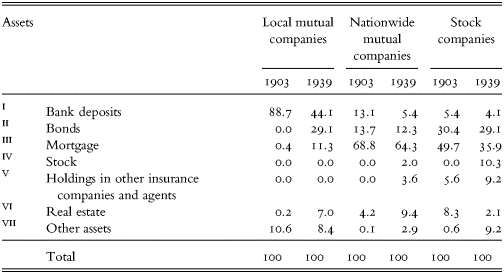
Also the investment side of the business underwent substantial changes. As seen in Table 1, the period witnessed a general decline in investments/assets governed by interest rate (e.g. bank deposits, bonds, mortgages) and a subsequent increase in assets mainly governed by other mechanisms (e.g. stocks, real estate and other holdings). The share of ‘interest-dependent’ assets (i.e. the sum of I, II, III, VI in Table 1) declined from 90 to 85 per cent in local mutual companies, from 96 to 82 per cent in nationwide stock companies and from 86 to 67 per cent in joint-stock companies.
Asset structure (per cent shares) for Swedish fire insurance companies, 1903–39
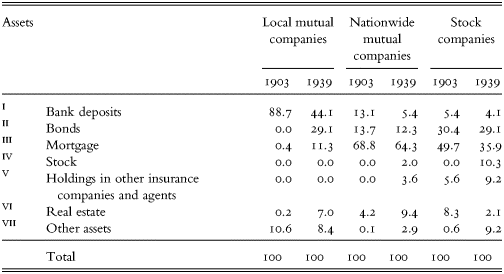
Among the interest-dependent assets, the share bank deposits decreased across all organisational forms. The share of bonds (issued mainly by the state and municipalities) and mortgages increased among local mutual companies but declined among nationwide mutual and stock insurance companies. Within the non-interest related asset group (assets V, VI and VII in Table 1) the share of holdings in other companies increased for both stock and nationwide mutual insurers. Additionally, the holdings of corporate equities increased in both forms of organisation, but most notably amongst stock insurers. In contrast, real estate became a more important asset class in mutual insurers, but less so in stock insurance firms.
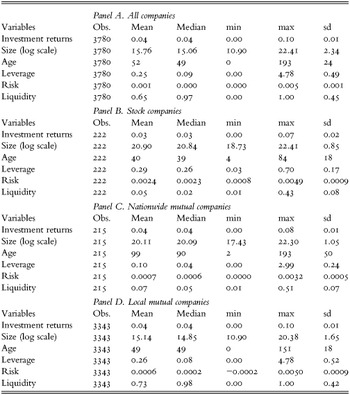
The income share contributed by investment earnings was more substantial among mutual insurers than it was with stock insurers. Local mutual insurers earned on average 31 per cent (median = 25 per cent) from investment, nationwide mutuals earned 37 per cent on average (median = 40 per cent). In contrast, stock insurers earned only 3 per cent on average from their invested assets (median = 4 per cent).Footnote 3 Therefore, given the asset structure of mutual insurers, a significant impact of interest rate on overall business performance may be expected.
Although stock insurers insured a majority share of the fire risks on industrial and commercial buildings over our period of analysis, Table 2 indicates that the number of stock insurance companies operating in Sweden was relatively few (i.e. an annual average of n = 6 firms). Proportionately most Swedish-owned insurers operating in the property fire insurance segment of the Swedish market between 1903 and 1939 were local mutual insurers (88 per cent) with the remainder divided equally between national mutual insurers (6 per cent) and stock companies (6 per cent). None of the companies changed their organisational form in the period under consideration, confirming that organisational form is time-invariant. In contrast to mutual insurance firms, the stock insurers in our sample were slightly younger operatives (with a median of 39 years compared with a median of 49 years for their local mutual counterparts). These observations are consistent with previous research (e.g. Lindmark et al. Reference Lindmark, Andersson and Adams2006; Adams et al. Reference Adams, Andersson, JIA and Lindmark2011), which suggests that small mutual insurers have survived in Sweden's insurance market up to the present day because they are able to realise economic advantages over their stock company rivals by operating in specific localities and specialising in well-established niche lines of insurance business (e.g. fire coverage on rural buildings).
Descriptive statistics of the Swedish fire insurers, 1903–39
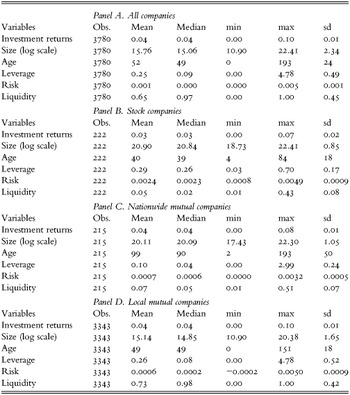
Table 2 also shows that the returns on invested assets were higher in mutual forms of organisation compared with stock fire insurance companies during the period 1903 to 1939. Stock and nationwide mutual fire insurers operating in Sweden in the period before World War II were of a similar size on average, although the variation was larger among the mutual group of fire insurance firms. To establish whether or not investment returns were significantly smaller in stock fire insurance companies compared with mutual fire insurers we conducted a t-test between the sample means of our two investment returns proxies. Our t-test confirms that investment returns were indeed significantly lower in stock fire insurers than in small mutual fire insurers (t = −7.78, p ≤ 0.01, one tail) and nationwide mutual fire insurers (t = −6.067, p ≤ 0.01, one tail) respectively.
The local mutual fire insurance companies in our data set are substantially smaller than other fire insurers. One intrinsic advantage of being a small insurer could be the ability to select lower risk types and control moral hazard problems such as fraudulent or excessive claims (Smith and Stutzer Reference Smith and Stutzer1990). If such an informational advantage existed for small local mutual fire insurers in Sweden in the first four decades of the twentieth century then those entities should have experienced a lower claims-to-insured assets ratio compared with national (mutual and stock) fire insurance firms. As Table 2 makes clear, the local mutual insurers in our data set indeed appeared to have lower claims in relation to the aggregate value of assets insured (RISK), while nationwide mutual fire insurers and larger stock fire insurance companies experienced slightly larger claims-to-assets insured ratios on average. Although the mean value of claims was generally low for small local fire insurance mutuals, occasionally extreme loss events could cause such insurers to suffer periodic capital constraint problems (Lindmark and Andersson Reference Lindmark and Andersson2010).
Table 2 also illustrates that corporate leverage exhibited relatively high levels of volatility over our period of analysis and varied substantially between organisational forms – with small local mutual fire insurers having the greatest variation in leverage (std dev. = 0.49 compared with a std dev. = 0.17 for stock fire insurance companies). The nationwide mutual companies retained the most substantial reserves amongst insurers operating on the Swedish property fire insurance market between 1903 and 1939 with their share of net premium written in relation to the reserves being significantly lower than in both the stock fire insurance companies (t = −10.37, p ≤ 0.01, one tail) and in the small fire insurance mutuals (t = −19.05, p ≤ 0.01, one tail). Nonetheless, the stock fire insurers in our sample tended to compensate for smaller average levels of retained reserves by purchasing reinsurance. In contrast, small mutual fire insurers covered ad hoc severe losses by subsequently increasing premium rates and/or taking out short-term bank loans (e.g. see Abdul Kader et al. Reference Abdul Kader, Adams, Andersson and Lindmark2010).
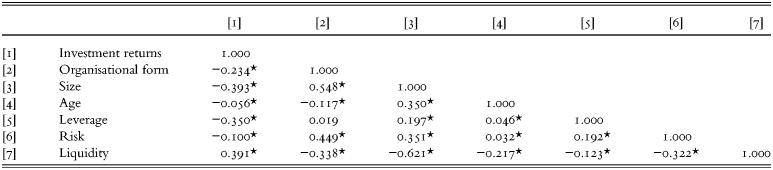
Table 3 presents the correlation coefficient matrix for our variables. The correlation analysis supports the findings of the t-tests that mutual fire insurers are associated with higher investment returns than stock fire insurers between 1903 and 1939. A related feature is the observation that for the full sample firm size was inversely associated with investment earnings and that a significant positive correlation exists between stock organisational form and firm size. In addition, firm size is positively and significantly correlated with stock insurance firms, and the length of time such firms have been operating in the market. This observation is expected since larger Swedish fire insurers are more geographically diversified and tend to have been present in the market for a longer period of time than smaller fire insurers (Lindmark et al. Reference Lindmark, Andersson and Adams2006).
Correlation coefficient of Swedish fire insurers, 1903–39
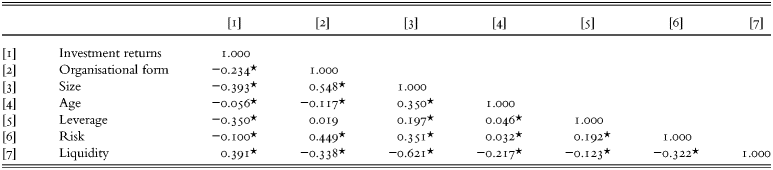
Note: * denotes significance at the 1% level (two tail).
A number of financial factors can also impact on the investment returns of insurance firms. For example, in the present study leverage has a statistically significant association with investment earnings, implying that, all else being equal, insurers with limited invested assets generate lower returns than insurers with larger asset portfolios. In addition, liquidity can be an important determinant of insurers' investment earnings as entities with greater liquidity (i.e. more bank deposits in relation to all other assets) are likely to be associated with higher investment returns. This implies that interest rates correlate positively with the investment earnings and liquidity positions of insurance firms.
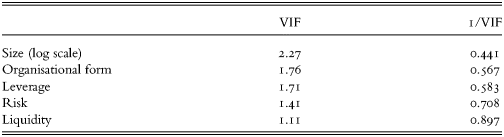
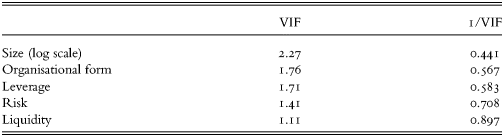
High values of the pair-wise correlation coefficients illustrated in Table 3 could, however, reflect the presence of multicollinearity. Therefore, to test for multicollinearity, we computed variation inflation factors for the main explanatory variables of interest (see Table 4). Table 4 indicates that as VIFs are less than 10, multicollinearity is unlikely to be problematical in the present study (e.g. see Kennedy Reference Kennedy2003, p. 213).
Variance inflation factors
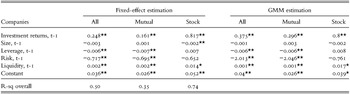
As noted earlier (Section III), to more fully examine the determinants of investment returns of Sweden's property fire insurers between 1903 and 1939 we employed a dynamic panel data research design that takes into account the past performance of the insurance firms in order to explain current investment earnings performance. Estimates are generated by both a GMM and FE estimation with the results for the entire sample and a sub-group of stock and mutual organisational forms presented in Table 5. Table 5 indicates that the lagged ‘investment model’ produces a fairly good approximation of fire insurers' current investment returns, with R2 values ranging from 35 to 74 per cent. The coefficient estimates show that insurers with higher historical investment returns are more likely to produce future higher returns. Moreover, for both mutual and stock insurance companies, we find a positive and significant impact of the lagged investment return on current investment returns.
Coefficient estimates from the dynamic and fixed-effect panel data estimation for Swedish fire insurers, 1903–39
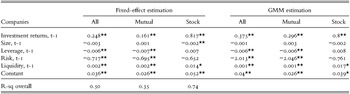
*, **represents statistically significant at the 10% and 5% levels (1 tail) respectively.
The impact of firm size on investment returns is statistically significant and negative for stock insurance companies in the FE model, but not in the GMM estimation. Mutual insurers' investment earnings, however, are not affected by firm size in both the GMM and FE models. These results are inconsistent with what we hypothesised in H2 and the results of some contemporary studies (e.g. Boose Reference Boose1993), which find that large fire insurance firms tend to generate higher investment returns than their smaller competitors.
We also find that leverage has a negative and statistically significant effect in both specifications for the mutual companies, but not for the stock companies. This implies that mutual insurers with greater levels of reserves (low leverage) in relation to their underwriting business are likely to have higher returns on their investments. The result is contrary to the results of contemporary insurance industry-based research (e.g. Adams Reference Adams1996), which finds that highly levered insurance firms tend to place more reliance on investment returns in order to meet statutory minimum levels of solvency compared with insurers with lower leverage.
Furthermore, we observe that underwriting risk is negatively and statistically significant for mutual insurers but not for their stock insurance company counterparts. This suggests that between 1903 and 1939 Swedish fire insurers that took on greater amounts of underwriting risk generated lower returns on their invested assets than fire insurers that assumed less risky business. Additionally, fire insurance companies with greater levels of liquidity gained higher returns on investments. The positive effect of liquidity remains statistically significant for all organisational forms in both the GMM and FE models. This result therefore implies that insurance firms that relied more on interest-based financial assets, in line with a more precursory portfolio strategy, tended to realise higher investment returns during both the pre-World War I years and the interwar period.
V
In this study we examined the determinants of investment returns using archival data for Swedish property fire insurers from 1903 to 1939. This period covered years of great economic and political turbulence, but it was also a period when insurance companies in Sweden played an increasingly important role in the national economy as institutional investors. Our results indicate that contrary to expectations mutual fire insurers generated systematically higher investment returns than stock fire insurers over our period of analysis. Additionally, investment yields are found to be inversely related to leverage but positively related to liquidity. Based on these findings, we conclude that fire insurance firms operating in Sweden between 1903 and 1939 adopted a precautionary investment strategy based on low leverage, the maintenance of high liquidity and the use of interest-related assets (e.g. bank deposits, bonds and mortgages) in order to realise their strategic investment goals. We also contend that the realisation of ‘healthy’ investment returns could be a major reason for the market expansion of mutual fire insurers in Sweden during the first half of the twentieth century.