Radioactive materials are widely used in medical clinics, research centers, nuclear power plants, nuclear reactors, and other industries. Although radiation safety regulations and procedures are implemented at all stages, the risk of accidental or intentional contamination of personnel remains. Any radiation incident could result in potentially exposing and/or contaminating personnel to greater than permissible limits.Reference Tazrart, Beard, Leiterer and Menetrier 1 , Reference Reeves 2
Usually, uncovered body parts (eg, face, neck, hands, and wrists) are more likely to become contaminated during the release of radioactive material in the environment.Reference Koenig, Goans and Hatchett 3 For medical management of a mass casualty event involving radioisotopes, skin decontamination is one of the most important steps. The health consequences of skin contamination with radioactive materials are mostly radiation damage to the skin (local injury) and possible secondary internal (systemic) uptake of radionuclides.Reference Lokobauer, Franić, Bauman, Maračić, Cesar and Senčar 4 – Reference Meineke, Van, Sohns and Fliender 6 The stratum corneum functions as a reservoir for radionuclides and as a medium for percutaneous absorption. The rapidly dividing germinativum layer of epidermal cells is particularly vulnerable to absorbed energy of beta and gamma emissions, depending on the total radiation dose absorbed.Reference Schulte 7 – Reference Schofield 9 Skin provides 3 routes for the entry of radioisotopes into systemic circulation: intercellular, transcellular, and appendageal (hair follicles, sweat ducts, sebaceous glands), if they remain for an extended time. The relatively high absorption rate of radionuclides is predominantly due to their penetration through hair follicles and sebaceous and sweat gland ducts.Reference Moudler 10 – Reference Covens, Berus, Caveliers, Struelens and Verellen 13
International agencies for radiation emergency management recommend washing radiocontaminated skin with soap and water as soon as possible, 14 – Reference Stajić, Milovanović, Stojanović and Ralević 18 using an acid soap or a 25% solution of diethylene triamine pentaacetic acid (Ca-DTPA), regardless of the contaminants.Reference Stajić, Milovanović, Stojanović and Ralević 19 European training for health professionals participating in rapid response to health threats recommends the use of 0.1% bleach or saline solution. It is generally agreed that skin decontamination can be achieved with soap and water, but contaminants will remain on exposed surfaces. Stripping the dermal layer of skin with acid or surgically excising contaminated tissues may be necessary as the last resort to remove residual radionuclides.Reference Rana, Dutta and Soni 20 – Reference Houston and Hendrickson 24 Available liquid decontamination alternatives commonly target a limited set of radiocontaminants. None is expected to decontaminate the whole spectrum of radioactive agents. In addition, some of these products are harsh, irritating, and even toxic, possibly damaging the skin barrier. In some emergency situations, in which clean water is in short supply, most of the current products cannot be used.
The present study was intended to develop a topical decontamination lotion that could ultimately sequester the radiometal ions present on body surfaces of contaminated persons. The formulated lotion was assessed for different pharmaceutical parameters. Decontamination efficacy (DE) was evaluated employing commonly used medical radioisotopes (ie, 99mTc and 201Tl) as radiological contaminants. Gamma scintigraphy was used to measure the radioactivity (initial and residual). Subsequently, a study was undertaken using limited radioactivity to minimize radiation exposure and deleterious health effects to the experimental animal model.
Materials And Methods
Diethylene triamine pentaacetic acid (DTPA) (Merck Ltd), sodium carboxymethyl cellulose (CDH Ltd), methyl paraben sodium, propyl paraben sodium (Titan Biotech Ltd), and propylene glycol (CDH Ltd) were purchased from vendors. Hair-removing cream (Jolen Inc) was used as a chemical depilatory. Other chemicals or reagents used were analytical grade. All of the ingredients selected for the study were generally regarded as safe (GRAS category).
Radiocontaminants
99mTc in the form of sodium pertechnetate salt mixed in saline solution was obtained from the Regional Centre for Radiopharmaceuticals, Board of Radiation and Isotope Technology Institute of Nuclear Medicine and Allied Sciences. 201Tl in the form of thallium chloride salt was provided for free from the Nuclear Medicine Department, All India Institute of Medical Sciences.
Equipment
A single photon emission computed tomography (SPECT) gamma camera (Symbia True point) was used for whole body imaging and static counts. Static counts of the 2-dimensional images over contaminated boundaries were analyzed using region-of-interest (ROI) software. A statistical software package (PASW Statistics 18) was used for analysis of the study data.
Experimental Models
The optimal formulation of the lotion was used in a rat model after consent was obtained from the Institutional Animal Ethics Committee. Experiments were performed on 2- to 3-month-old healthy male Sprague Dawley rats weighing 180 ± 15 g each. Animals were allowed to acclimate for 1 week before experiments were started. They were kept in a central air-conditioned environment with 100% fresh air replacement at an ambient temperature of 22 ± 3 °C, a relative humidity of 50% ± 10%, and a 12-hour light/dark cycle.
The synthetic equivalent of human tissue was made of solid oil gel (density, 1.03 g/mL); it was homogeneous and uniform in size (30 × 30 cm) and thickness (0.3 cm). This tissue model was used to optimize the different decontamination parameters such as duration of contaminant exposure; number of required decontamination attempts; duration of decontamination procedure; reaction time between formulation and radiometal ion exposure; volume of formulated lotion needed; and reaction of animal versus human tissue model.
Preparation of the Lotion Formulation
Sodium carboxymethyl cellulose polymer was allowed to hydrate and swell with continuous stirring by a magnetic stirrer in purified water. Methyl and propyl paraben sodium were added until the solution became clear and solubilized. DTPA dissolved into 1 M sodium hydroxide was then added to the solution. All of the ingredients were carefully mixed using the magnetic stirrer to obtain a homogeneous distribution in the formulated solution. Propylene glycol was added as a humectant to decrease the hydration effect on the skin. Different batches of the formulation with varying concentrations of DTPA were prepared and placed in lacquered plastic containers that were stored at room temperature until the evaluation.
Characterization of the Lotion
The prepared lotion was evaluated for the following pharmaceutical parameters: pH, spreadability, extrudability, and viscosity. To determine pH, 1.0 g of lotion was accurately weighed and dispersed in 100 mL of purified water. The pH of the dispersion was measured using a digital pH meter, which was calibrated before use with a standard buffer solution at pH 4.0, 7.0, and 9.0. The measurements of pH were done in triplicate, and average values were calculated.
To determine the spreadability of the formulation, 1.0 g of lotion was placed within a 1.0-cm diameter circle that was premarked on a 20 × 20 cm glass plate, over which a second glass plate was placed. A 500-g weight was allowed to rest on the upper glass plate for 5 minutes. The increase in the diameter due to spreading of the lotion was recorded.
To determine extrudability, a closed collapsible tube containing the formulated lotion was pressed firmly at the crimped end. When the cap was removed, the lotion extruded until the pressure dissipated. The weight in grams required to extrude a 0.5-cm ribbon of the formulation in 10 seconds was determined. The average extrusion pressure in grams was reported.
The viscosity of the formulations was determined without dilution by a controlled stress rheometer (R/S CPS Plus, Brookfield Engineering Laboratory, Inc), using a spindle #C 50-1 with a 50-mm diameter, and RHEO3000 software.
Evaluation of Decontamination Efficacy
Animal Preparation
Rat hairs were clipped off close to the skin using paired scissors or chemical depilatory 24 hours before the experiments. Skin was visually observed for cuts or damage, and rats with completely intact skin were selected for the study.
Contamination of the Experimental Models
Saline solution was used to dilute each isotope to a specific activity of approximately 300 ± 5 μCi/100 μL of 99mTc and 100 ± 5 μCi/100 μL of 201Tl in a plastic syringe. The diluted radionuclides were allowed to contaminate the rat's thoracoabdominal region (5 × 5 cm2) to assure homogeneously contaminated surfaces. The contaminated area was either outlined completely or the corners were marked with permanent markers to indicate the area of contamination. The experimental models were then allowed to air dry at room temperature at a predefined time period (5, 15, 30, 45, and 60 minutes), as applicable. Each contaminant was applied separately.
Decontamination Procedure
Before decontamination, levels of radioactivity (static counts) over the contaminated areas were recorded. Decontamination was performed using cotton swabs (4×3 cm) soaked in 5.0 mL of the lotion with a swirling motion, starting from the periphery of the contaminated area toward the center. When the swab was lifted, the residual activity was measured. Five consecutive decontamination attempts were performed, and radioactivity (kilo counts per second) along with whole body scintigraphs were recorded with a gamma camera. The camera was set for the study at zoom level 2 using detectors, 256×256 matrix size, and 3 minutes of image acquisition time. ROI software was used to analyze count statistics. Decontamination was performed using 5 consecutive attempts to observe the extent of the contaminants removed for each of the studied radionuclides.
Data analysis
Decontamination studies for each of the studied radioisotopes were performed in triplicate. Mean values were determined and error bars were calculated from the standard deviations. All data were presented as mean ± standard deviation. Data were statistically analyzed using 1-way ANOVA and Student t test applied for comparison between groups. The evaluations were made using the statistical software, and results were considered statistically significant at 95% CI (P < .05).
Determination of Decontamination Factor
DF was calculated by the using the following formula:
 $${{\rm{DF}}\, = \scale125%{{\frac{\rm{ Static}\,{\rm{counts}}\,{\rm{of}}\,{\rm{contaminants}}\,{\rm{before}}\,\atop{\rm{applying}}\cr &#x0026;\,{\rm{formulation}}\,{\rm{(}}{{{\rm{C_0}}}}{\rm{)}}}{{\rm{ Static}\,{\rm{counts}}\,{\rm{of}}\,{\rm{contaminants}}\,{\rm{after}}\,\atop{\rm{applying}}\cr &#x0026;\,{\rm{formulation}}\,{\rm{(}}{{{\rm{C_t}}}}{\rm{)}}}\eqno\rm$$
where DF = decontamination factor, C0 = measurement of the initial contamination counts, and Ct = measurement of counts following decontamination attempt.
Decontamination efficacy (DE %) was expressed in terms of a percentage of the removed contaminants and arrived at by using the following formula:
 $$DE = (1{\rm{ - }}1/DF)\times 100\eqno\rm$$
Results
Characterization of Lotion
The prepared lotion was a light-emollient, nongreasy liquid that appeared clear and transparent, with uniform consistency. Its organoleptic properties were ranked as excellent. The pH value of the topical lotion was 7.3 ± 0.2. Spreadability of the formulation was recorded as 13.4 ± 0.2 cm. The extrudability of the formulation was 0.30 g, which implied its ease of application. Its viscosity of 95 to 100 P ensured its application over the skin without runoff or waste.
Decontamination Efficacy
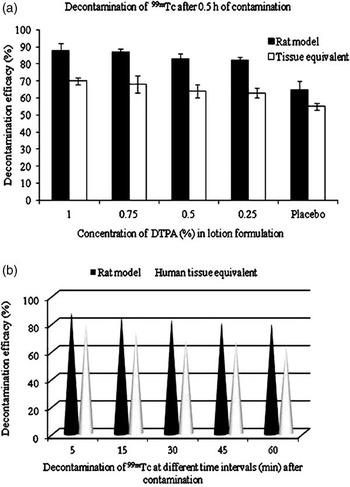
The DF was 9.0% ± 0.5% at the end of the fifth consecutive decontamination attempt. The DE of the lotion containing 1.0% DTPA after 30 minutes of contamination with 99mTc, as compared with water as placebo, was 85% ± 5% (Figure 1). The DE of the formulation for up to 1 hour of the contamination was recorded as efficacious and required no other product for further decontamination. The DE for 15 to 60 minutes ranged from 80% to 85%. Maximum chelation of the applied radiometal ions was observed with the 1.0% DTPA-containing formulation. Prepared formulation was more efficacious and statistically significant (P < .05), as compared with the placebo (without DTPA).
Decontamination Efficacy (DE) of the Formulated Lotion After Contamination With 99mTc on Sprague Dawley Rat Skin and Human Tissue Equivalent Models. Models were decontaminated using lotion at different concentrations of diethylene triamine pentaacetic acid after 0.5 hour (A) and at different time intervals after contamination (B). DE was calculated and found to be 85% ± 5% for both models.

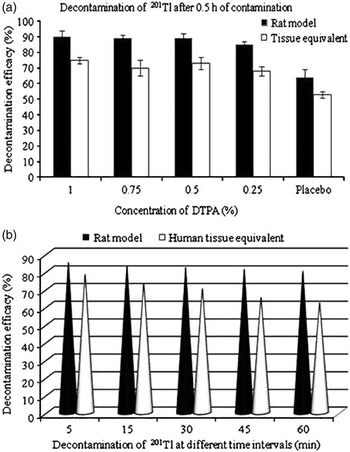
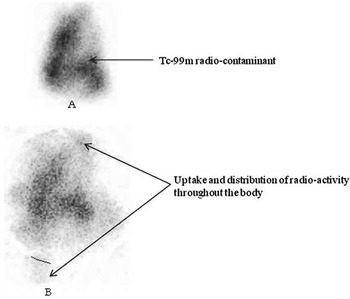
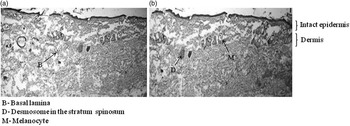
The DE of the lotion formulation at different concentrations and at different time intervals after contamination with 201Tl was 88% ± 2% for both experimental models at 1.0% DTPA formulation (Figure 2). The formulation effectively bound with the 201Tl and facilitated its removal from the contaminated areas. Scintigraphs of the entire body of the rat recorded after 30 minutes of 99mTc contamination (hair removed with chemical depilatory) resulted in lower DE (40%-65%) (Figure 3). Quick dermal uptake of the 99mTc contaminant was observed where contaminants were distributed on the nostril and tail. The histologic findings of the rat model treated with the lotion formulation were comparable with those of the controls (Figure 4 ).
Decontamination Efficacy (DE) of the Formulated Lotion After Contamination With 201Tl on Sprague Dawley Rat Skin and Human Tissue Equivalent Models.Models were decontaminated using lotion at different concentrations of diethylene triamine pentaacetic acid (A) and at different time intervals after contamination (B). DE was analyzed and found to be 88% ± 2% for both models.

Whole Body Scintigraphs of Sprague Dawley Rat Skin Contaminated With 99mTc After Treatment With Chemical Depilatory. Immediately (A) and 15 minutes (B) after contamination of the rat's skin where hair was removed using chemical depilatory. Direct absorption of the radionuclide through the skin may have been due to removal of stratum corneum by chemical depilatory, resulting in opening of the hair follicles.

Histology of male rat skin: Representing no cellular damages or changes in epidermal or dermal layer. a: Treated with saline, b: Treated with formulation containing 1% DTPA.

Discussion
Skin stratum corneum serves as a reservoir for the delivery of substances to other parts of the skin through 3 separate stages: (1) a relatively rapid filling of hair follicles and sweat gland ducts with radionuclides; (2) penetration to glandular and follicular walls and further radial spreading; and (3) diffusion of radionuclides across the stratum corneum matrix and epidermis. When radionuclides enter into gland ducts, they immediately react with the skin constituents, which are primarily composed of proteins, and permeate the entire skin depth. Serial washing with or without soapy water is the conventional method to remove the contaminants. In addition, dressings or hydrogels have also effectively removed external contaminants.Reference Koprda, Harangozo and Kassai 11
A decontamination procedure should be easy and fast, and it should remove the deposited contaminants without producing dermal abrasion or irritation, thus limiting cutaneous systemic exposure and absorption of the contaminants. Potential formulation characteristics such as delipidation and membrane fluidization and skin irritation may affect skin barrier integrity and ultimately increase the uptake of contaminants.Reference Gregory 25 – Reference Merrick, Simpson and Liddell 27 Radionuclides on skin could penetrate the barrier in the form of ions and preferentially bind to micelles, proteins, and membranes to limit their removal from the body. Cations such as 201Tl and 99mTc are hydrophilic in nature and do not penetrate skin immediately after contamination, but their penetration may be facilitated by a long duration of deposition. Decontamination of radionuclides must be done as soon as possible to minimize internal exposure to the targeted area and surrounding tissues.Reference Domingueez-Gadea and Cerezo 28 – Reference Felton and Rozas 31
Decontamination Efficacy
Evaluating DE was accomplished by determining the differential mean reduction of contamination from a radionuclide relative to the original contamination. Radiation measurements were corrected for radioisotope decay so that decontamination data could be compared with initial contamination levels. Duration of exposure to contaminants also was recorded to ensure that the measurements could be referred back to the initial contamination levels. Multiple readings were taken and the average was used as the background level and subtracted from all measurements. Results of DE were calculated for each radioisotope at different time intervals and compared with placebo (untreated water).Reference Rana, Bhatt and Dutta 32
It is important to note that DTPA solution (≥25%) has been approved for skin decontamination. The concentration of DTPA was reduced to 0.5% to 1.0% in the present study and found to be effective and safe. Formulations prepared at these concentrations of DTPA (0.5%-1.0%) were efficacious as well. Good spreadability of lotion allowed coverage over greater surface areas of contaminated skin than the controls, thereby increasing the effective complexation between DTPA and radioactive metal ion present on the skin of the rat and human tissue equivalent.
In addition, the first and second consecutive decontamination attempts were most efficacious in removing more than 80% of the applied active contaminants. This finding was presumably due to the reaction between loosely bound radiocontaminants and the chelating agent added to the formulated lotion. Thus, the third, fourth, and fifth decontamination attempts provided the best comparative values of the decontamination attempts for assessment. The prepared lotion was found to be an efficacious decontaminant for all radionuclides applied (85%-90%). Our findings clearly showed that decontamination with use of the formulated lotion within 1 hour of contamination could remove 85% ± 5% of the applied 99mTc and 201Tl radioactivity.
Further, the prepared lotion added no hydrating properties to the skin. Thus, partitioning between the formulated lotion and the skin was not increased, precluding systemic penetration of formulated ingredients. Also, the dosages of formulated lotion were shown to be safe and effective for dermal application.
Conclusions
The widespread application of radioisotopes in biomedical science and other industries increases the risk of accidental contamination. Our findings showed that the assessed formulation was found to be a safe, effective, and nonirritating decontaminant. Further studies will be conducted to develop its use in self-decontaminating body wipes, which have potential use during institutional or accidental contamination.
Funding and Support
The Council of Scientific and Industrial Research, New Delhi, India, provided financial support (S.R.) for this study. The Institute of Nuclear Medicine and Allied Sciences provided the laboratory facility; the Defence Research and Development Organization Life Sciences Research Board (LSRB), DRDO Bhawan, Rajaji Marg, New Delhi, India, approved the formulation work for this project; and the Animal House Facility at the Institute of Nuclear Medicine and Allied Sciences, Delhi, India, provided animals for use in this study.