Military conflicts may be ongoing and encompass multiple medical facilities and require provision of routine care parallel to treatment of those involved in the disaster. Training is a critical component of preparation for mass casualty incidents (MCIs) and simulation exercises have become state of the art for such training. However, simulation exercises must be grounded on realistic needs to identify the barriers to delivery of quality care. While combat surgery lessons may be used to enhance civilian surgeon preparedness for MCIs occurring on the home front, Reference Remick, Shackelford and Oh1 the effect of ongoing military conflict on the function of the emergency department (ED) and on patient outcomes remains unclear.
Many hospitals perform periodic simulations within the framework of a concerted regional or national effort to streamline triage and treatment processes both outside and inside the hospital. Reference Copper, Mayigane and Yingxin2,Reference Anan, Otomo and Kondo3 Because the patient burden imposed on the ED is expected to be high, simulation training and examination of preparedness for MCIs is often focused on EDs alone. Reference Waxman, Chan and Pillemer4,Reference Park, Jeong and Song5 However, prior studies have shown that while EDs undoubtedly bear the brunt of MCI surge during the first golden hours, the effects of patient overload actually extend far beyond the ED. Reference Einav, Aharonson-Daniel and Weissman6 Of the same importance, the surge capacity required during a singular MCI differs greatly from that required during a prolonged military conflict, or during a medical ongoing emergency.
Previous studies have suggested that a constant state of military alert leads to a reduction in the number of surgical procedures performed in the operating theater. Reference Hadary, Schecter and Embon7
During the 50 d of Protective Edge military conflict, more than 320 rockets were launched at the Be’er Sheva region. The hospital where the study was conducted, located in the center of the Be’er Sheva region, served at this time as the frontline and referral center for those injured, while continuing to cover the regular needs of its catchment population. Both wounded soldiers and civilians were treated in the same ED during the military conflict.
The hospital has 1173 admission beds and admits approximately 745,000 patients annually. The 65 beds of the ED serve 145,000 patient visits annually, and 28% of these visits lead to hospital admission. The SMC is the largest hospital owned by Clalit Healthcare, the sick fund covering approximately 52% of the population of Israel. It is important to note that, in the hospital where the study was conducted, the activities of the surgical emergency room and the internal emergency room are not integrated, and are different complexes with separate medical staff.
During the periods discussed in the study, there was no indication of a major migration either into the area or out of it. As for staffing levels during the military conflict, these ranged from 1.6% absence in July 2014 to 0.2% in August 2014, while the corresponding figures for nursing staff were 0.9% and 0.4%, respectively.
Longer waiting times were noted for medical and surgical cases, but not for obstetric or pediatric cases. We do not have a definitive explanation for this finding; however, it can be assumed that overload of the emergency department by relatively few cases of severely wounded soldiers could have contributed to prolongation of waiting times. As these cases were not referred to the obstetric and pediatric emergency departments, these sites were unaffected in terms of waiting times.
The aim of the current study was to study the mortality rate, characteristics, ED waiting times and admission rates from the ED to hospital wards of patients arriving at the ED during a military conflict vs. during comparable times in the years before and after.
Methods
Following Institutional Review Board of Soroka Medical Center (SMC) approval (protocol number 0173-19-SOR) a retrospective analysis of data collected in real-time at SMC was conducted. All methods were performed in accordance with the relevant guidelines and regulations.
Setting
The SMC is a tertiary care medical center that serves as the only regional hospital in southern Israel. The SMC is located approximately 40 kilometers from the Gaza strip in the center of the city of Be’er Sheva. Covering the city and vicinity of Be’er Sheva as well as the southernmost regions in the country, it serves an estimated population of 1,000,000.
For the purpose of the current study, all patients who visited the ED of the SMC during military conflict PE (July-August 2014) were included and compared with all patients who visited the ED in the equivalent periods in the year before (2013) and the year after (2015). Patients were followed throughout admission to the time of hospital discharge.
Study Population
Relevant data were extracted from the files of all the patients that had been registered for treatment in the ED of the SMC during the study period, regardless of age. Repeat visits were treated as separate cases.
Variables
The primary outcome measure was the mortality rate of patients during the military conflict vs. the mortality rate of patients during comparable times in other years. Secondary outcome measures included a comparison of the characteristics of the patients and their ED waiting times and the rates of admission from the ED to hospital wards. Data were collected on patient demographics (age, sex), timing of admission to, and discharge from, the ED (day of week, hour of day, waiting times), indication for referral (injury vs a medical condition), type of admission (medicine, surgical, obstetric/gynecological, and pediatric), readmission to the ED within 48 h and 30-d mortality. For the outcome of 30-d mortality, each patient was counted only once (the first visit during the study period).
Data Source/Database Description
All data presented in the current study were extracted from the database of the SMC, which includes data going backward approximately 20 y. Clalit Healthcare uses several functional databases (administrative, medical, and logistic). All Clalit data are imputed in real time by the administrative, medical, and logistical staff. The data are all stored on a central Structured Query Language (SQL)-based platform and SAP Business Objects software is used to pull the full data for reports.
Study Size
The research hypothesis of interest was that, during the study period, there would be an increase in mortality of 5-10% over previous years. Based on administrative data extracted from SMC database for the years 2013-2022, the baseline 30-d mortality for the calculation was estimated as approximately 1%. Based on the same data, an annual sample size of 35,000 visits was assumed as the baseline rate. It was hypothesized that a 5-10% decrease in admissions during the military conflict would be noted, yielding 30,000 cases during PE and 70,000 cases during the comparison periods. For a significance level of 5%, the study would have a power of over 99% to detect a 10% difference in mortality (ie, 1% vs 1.1% or higher).
Bias
Cases with ID numbers that could not be validated against the national population registry were excluded from the multivariate analysis as they were missing vital data (eg, age). These constituted approximately 1.5% of the cases.
Quantitative Variables
To determine admission due to physical trauma, all potentially relevant categories were classified as trauma. All other admissions were classified as non-trauma related. Civilian cases were separated from military cases (either trauma or nontrauma) by identifying the paying party, as the Israeli Defense Force pays the hospital for treatment of soldiers, while the health funds pay for civilians.
Statistical Methods
All data analyses were performed using SPSS Statistical Software (IBM Corporation) version 26. Descriptive statistics were carried out using frequencies for categorical data and means and standard deviations for continuous data. Univariate analyses were performed using parametric tests (ie, analysis of variance [ANOVA], t-test) for normally distributed continuous data. The chi-squared test was used for the associations between categorical variables. Significance of statistical results in a 2-sided test was defined as <5%. The fragility index was used to determine the chances of differences in mortality being due to chance findings. The fragility index is a measure of the robustness (or fragility) of the results of an epidemiological study. The fragility index is a number indicating how many patients would be required to convert a statistically significant finding to a nonsignificant one. The larger the fragility index the better (more robust) are the findings. Multivariable analyses for the dichotomous outcomes of admission and mortality was performed using logistic regression (Enter method). A P-value of <0.1 was determined as the threshold for model inclusion in all models. Because only a small number of variables (age, sex, reason for visit, shift, and destination at discharge), all unrelated, were included in the models, there was no reason to assume the presence of interactions. Quantile regression was used for the median waiting time, because a linear regression usually models the mean, rather than the median. For sensitivity analysis, the effect of adding the daily number of visits to the specific ED (ie, medicine, surgery, obstetrics and gynecology, or pediatrics) to the multivariable analyses on the stability of both models was tested. The daily number of visits to the ED during military conflict PE and the comparison period was plotted against the date. A 3-d moving average was used to smooth the curve describing the daily number of visits, limited to the period of medical conflict.
Results
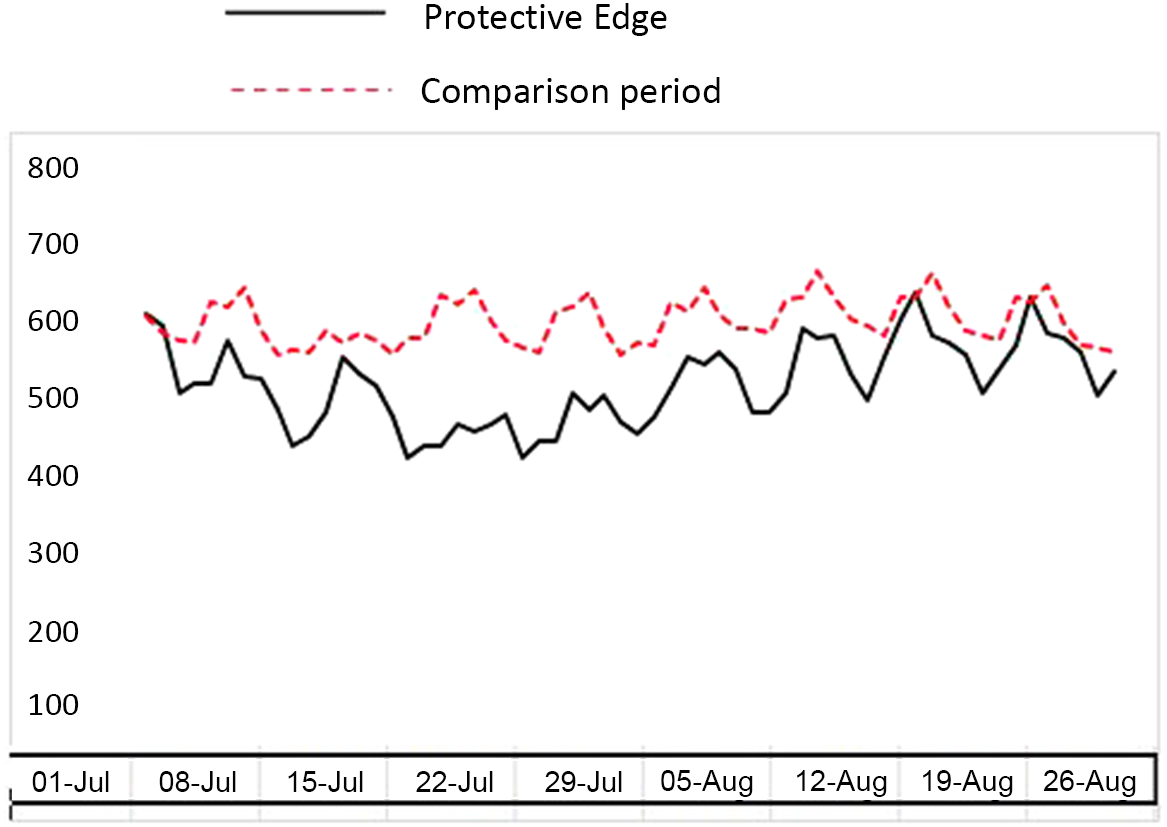
In total, 32,343 visits to the ED took place between July 1, 2014, and August 31, 2014. In comparison, 74,279 visits took place during the corresponding months of 2013 and 2015. This translates into a daily average of 522 visits during PE, versus 599 in 2013 and 2015 (the comparison period), that is, a 13% decrease (Figure 1). During PE, 32,148 civilians and 195 military personnel were treated in SMC. The corresponding figures in 2013 and 2015 were 73,870 and 409. Therefore, military personnel comprised 0.6% of ER visits in both periods. None of the military personnel died either during PE nor in 2013 and 2015. Thirty-day mortality for civilians was 1.3% during PE versus 1.0% in the comparison period (P < 0.001). During PE, 30.7% of civilians were admitted, compared with 28.9% during 2013 and 2015 (P < 0.001). The corresponding figures for military personnel were 9.2% during PE and 10.3% during 2013 and 2015 (P = 0.690). Median length of stay for civilians increased from 2.9 h to 3.5 h (P < 0.001). For military personnel median length of stay increased from 2.7 h to 3.5 h (P = 0.007).
Daily number of visitors to the emergency department during “Protective Edge” military conflict (July-August 2014) and the comparison periods (July-August 2013 and 2015), smoothed using 3 d moving average.

Primary Outcome Measure
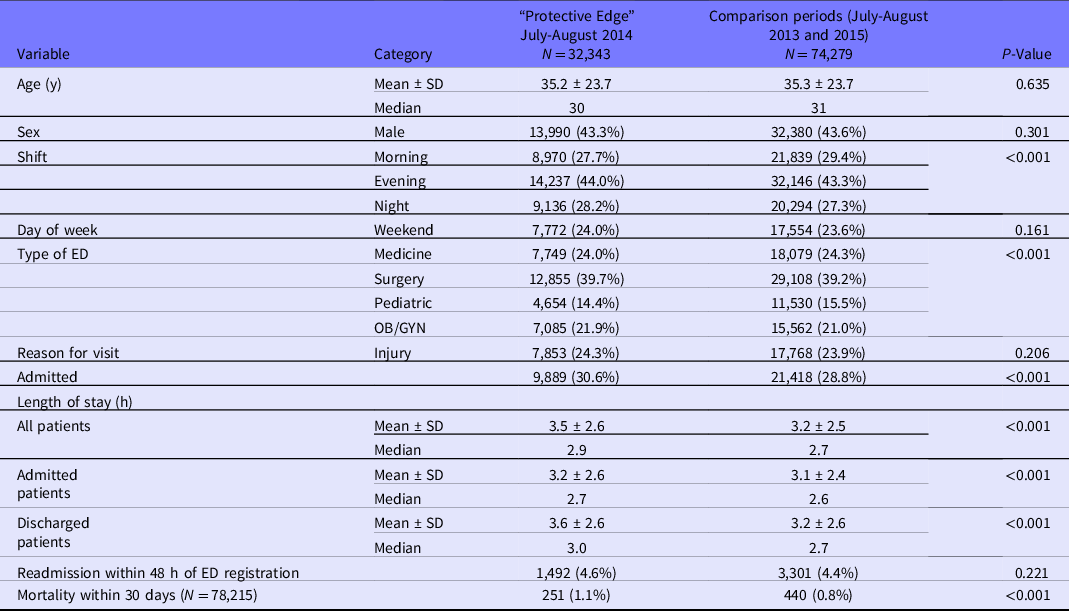
The unadjusted 30-d mortality rates were 1.1% (n = 251) among study patients versus 0.8% (n = 440) among patients in the comparison periods (P < 0.001) with a fragility index of 39 (Table 1). The adjusted 30-d mortality rate was also significantly higher during PE (Table 2) (odds ratio [OR] = 1.47; 95% confidence interval [CI] 1.24-1.73, adjusted for age, sex, reason for visit [trauma or medical condition], destination at discharge from the ED [admitted or discharged]). This difference remained stable when also controlling for the daily number of visits. However, the ORs for mortality during PE were significantly higher only among medical visits with a fragility index of 26 (OR = 1.53; 95% CI: 1.25-1.86 without controlling for the daily number of visitors and 1.22, 95% CI: 1.03-1.81 with controlling for the number of visitors) and among pediatric visits (OR = 1.83; 95% 0.70-4.74 and OR = 4.40; 95% CI: 1.33-14.5, respectively). Due to the high OR for mortality in the pediatric population, causes for death were further explored for these cases. Overall, there were 9 cases of mortality during PE and 14 cases of mortality during the comparison years.
ED visits during “Protective Edge” military conflict compared to the summer of 2013 and 2015

Thirty-day mortality rates in ED patients during “Protective Edge” military conflict compared to summer 2013 and 2015 (multivariable logistic regression model, n =78,215)

Note:
a Controlled for age, sex, reason for visit (injury vs. illness), and destination (admitted vs. discharged).
b Controlled for the same variables as in Model 1 plus daily number of patients.
Of pediatric patients who died, most died either from sepsis or complications of congenital diseases (44% and 35%, respectively), with no significant difference between the 2 periods (during PE, 7 children died of infection and 1 from a congenital disease, whereas in the comparison period, 4 children died from infection and 3 from congenital disease). However, the fragility index for these findings was 1, which raises the possibility that this finding may be incidental.
Secondary Outcome Measures
The characteristics of ED visits during PE and during the comparison periods are presented in Table 1. In general, visits to the ED during PE were similar to those occurring during the comparison periods in terms of patient age, sex, day of week, and reason for visit. During PE, there were slightly fewer visits during morning shifts, fewer admissions overall, and significantly longer ED delays (especially for patients eventually discharged from the ED).
The unadjusted waiting times in the ED were 3.5 ± 2.6 h for visits during PE versus 3.2 ± 2.5 h among controls. In the adjusted multivariable model for waiting times in the ED (controlled for age, sex, reason for the visit, and destination at discharge), ED visits during PE were statistically significant longer by an average of 0.25 h (Table 3). However, waiting times in medical and surgical EDs were almost 1 h longer, whereas waiting times in pediatric ED were 0.12 h shorter and waiting times in the obstetrics and gynecology ED were 0.28 h shorter. When the daily number of visits was included in the model, the adjusted waiting time in the ED was even longer, on average 0.5 h longer during PE, and ranged from 0.1 h shorter in obstetrics and gynecology to 0.8 h longer in medicine.
Length of stay in the ED during “Protective Edge” military conflict compared to the summer of 2013 and 2015 (multivariable quantile regression model for the median length of stay, n = 105,022)

Note:
a Controlled for age, sex, reason for visit (injury vs. illness), shift, and destination (admitted vs. discharged).
b Controlled for the same variables as in Model 1 plus daily number of patients.
The unadjusted admission rates were 30.6% (n = 9889) among study patients versus 28.8% (n = 21,418) among controls (P < 0.001; Table 1). The multivariable model for the odds of admission in all patients (Table 4) demonstrated a 10% increase in the likelihood of admission (OR = 1.10; 95% CI: 1.06-1.13). When the daily number of visits was incorporated into the model the difference decreased to a 7% (OR = 1.07; 95% CI: 1.03-1.11). This difference ranged from a 12% increase in surgery to 15% increase in obstetrics and gynecology. In contrast, admission rates did not materially change among pediatric visits (OR = 1.00; 95% CI: 0.93-1.09) during PE.
Admission rates from the ED during “Protective Edge” military conflict compared to the summer of 2013 and 2015 (multivariable logistic regression model, n = 105,022)

Note:
a Controlled for age, sex, and reason for visit (injury vs. illness).
b Controlled for the same variables as in Model 1 plus daily number of patients.
Limitations
This study has several limitations. The external validity should be based on other hospitals and the impact they have encountered by a military conflict.
First, referral bias may have been an issue as patients may have preferred to be treated in a hospital further from the area of military conflict (ie, less likely to be involved in treatment of those injured). This possibility was probably exacerbated by the awareness that prolonged travel during ongoing bombardment incurs additional risk. Second, information bias may also be a study limitation as the classification of the indication for ED admission is determined by administrative rather than medical staff. Finally, only the initial ED designation of the patient was documented (eg, medical/surgical). However, these classifications were not outcomes and if classification errors exist, they are not expected to be systematic and nondifferential.
Discussion
The current study was designed to examine whether prolonged ED strain (in this case, a nearby military conflict) is associated with an increase in the 30-d mortality of civilian patients visiting the ED. An increase in mortality specifically among patients visiting the ED for reasons unrelated to the military conflict (medical and pediatric cases) was identified. Surgical and medical visits had longer waiting times in the ED. Surgical and obstetric visits had higher rates of admission from the ED to the wards.
It was previously shown that older patients injured in MCIs have an increased risk of complications and death. Reference Ashkenazi, Einav and Olsha8 The increased mortality specifically in medical and pediatric cases (controlled for age) suggests that populations at extremes of age should be considered particularly vulnerable when routine medical care is disrupted. Recent literature similarly supports the present finding concerning potential vulnerability of the pediatric population. Reference Kostopoulou, Gkentzi and Papasotiriou9 Nonetheless, as the fragility index for the present finding of increased mortality in pediatric cases was 1, this finding may be incidental. In contrast, the increased mortality among medical cases had a fragility index of 26, and the increased mortality for the entire cohort had a fragility index of 39. Similar reductions in referral of medical cases with accompanying increased mortality have been observed with COVID-19. Reference Lesi, Igho-Osagie and Walton10,Reference Tam, Qiu and Manoragavan11
This finding may have several causes. Disruption of common referral pathways, such as reduced availability of pharmaceutical services, primary care physicians and outpatient testing and may have led to a reduction of the quality of care for chronic diseases and even decreased or late disease detection. Even when referred, vulnerable patients may be reluctant to visit hospital at a time during which travel is unsafe and the medical system may be inundated. A recent meta-analysis based mainly on retrospective data showed that, while increased ED length of stay was inconsistently associated with patient outcomes, older people seem to have a higher likelihood of prolonged ED stays and experience higher mortality. Reference Burgess, Ray-Barruel and Kynoch12 Ensuring the availability of safe transport and using the media for increasing awareness regarding the positive aspects of timely referral to hospital may be as important as ensuring that quality of care continues to be delivered.
Finally, the emphasis placed on resource deployment within the hospital may have also affected patient outcomes. During PE, there was no change in medical/nursing staff or in shift length in the medical wards, and the attendance of the hospital staff was exemplary (approximately 0.9% of medical staff and 0.7% of nursing staff abstained during PE period). At the same time, much of the logistical and administrative support was directed to emergency preparedness and the treatment of casualties. In addition, the media was constantly present on location, backup surgical teams (including senior surgeons) were present at all times (which may have also contributed to maintaining the quality of care), and volunteer surgeons who come of their goodwill to assist the surgical teams require attention. The SMC hospital administration are already examining means of overcoming these challenges in the future.
Waiting time for PE was chosen for analysis as this military conflict demonstrated the impact of a prolonged overload on a tertiary medical center. The availability of routine medical services in the community was challenged. Patients tended to avoid coming to the hospital for presumably unnecessary reasons, perhaps to the extent of overly delaying their arrival. Transportation was challenged and there were some challenges in staff availability.
Conclusions
The current study provides unique data on the 30-d mortality of patients visiting the ED of a frontline referral center during a military conflict while providing the regular needs of its catchment population.
An increase in mortality specifically among patients visiting the ED for reasons unrelated to the military conflicts (medical and pediatric cases) was found. Obstetric visits had shorter ED waiting times and the highest increase in admission rates with no change in mortality. The present findings require additional validation but seem overall aligned with phenomena occurring during the pandemic. The SMC hospital administration are already examining means of overcoming these challenges in the future.
Author contributions
J.D.: data extraction, analysis, data interpretation and writing of the manuscript. S.E.: conceptualization, data analysis and interpretation, writing. S.C.: review and editing, supervision. A.F.: writing – original draft preparation. Doctors Dreiher and Einav contributed equally to this work.
Competing interests
The authors declare no conflicts of interest.