Implications
Piglets reared in group lactation (GL) are less aggressive after being mixed into groups with unfamiliar piglets at weaning than piglets reared in farrowing crates (FCs). In aggressions occurring immediately after mixing at weaning, there are no additional benefits to GL housing from 7 rather than 14 days of age. The expression of piglet aggression post-weaning is but one factor affecting the ethical and economic viability of GL for commercial production. Thus, research to determine whether mixing before 14 days postpartum has implications for other indicators of animal welfare and productivity is required.
Introduction
The cumulative effects of an abrupt separation from the sow, a transition from a milk to a grain based diet, mixing with unfamiliar pigs for the first time and a change of the physical environment make weaning a particularly stressful time in the life of the commercially farmed pig. The fact that these physical and social stressors are experienced simultaneously exacerbates their detrimental effects on piglet welfare and productivity (Telkänranta and Edwards, Reference Telkänranta and Edwards2018). By removing or temporally shifting some of the stressors pigs experience at weaning the negative impact of the weaning process may be reduced (Telkänranta and Edwards, Reference Telkänranta and Edwards2018).
Mixing of unfamiliar piglets post-weaning results in high levels of aggression which increases risks of injuries and stress (Verdon and Rault, Reference Verdon and Rault2018). The frequency and severity of aggression associated with the formation of a dominance hierarchy appears to depend on a balance between social experience and individual differences, such as size (Hsu et al., Reference Hsu, Earley and Wolf2006). However, to simplify management processes commercial pig producers attempt to keep the size of pigs within a group as uniform as possible. Under conditions where differences in the size of pigs is minimised, the ontogeny of the dominance hierarchy may depend increasingly on the previous social experience of group members (Hsu et al., Reference Hsu, Earley and Wolf2006).
Group housing of lactating sows and their litters improves animal welfare by increasing freedom of movement for sows and piglets, increasing opportunities to express behaviours (e.g. sow–piglet and sow–sow interactions) and supporting social development of piglets (van Nieuwamerongen et al., Reference van Nieuwamerongen, Bolhuis, van der Peet-Schwering and Soede2014). Increased maternal (Curley and Champagne, Reference Curley and Champagne2016) and peer (Sachser et al., Reference Sachser, Kaiser and Hennessy2013) interactions, as well as experiencing an enriched environment (Telkänranta and Edwards, Reference Telkänranta and Edwards2018), during the early phases of life can shape the developing brain with short- and long-term implications. For example, piglets that were born in GL pens (Li and Wang, Reference Li and Wang2011), or transferred to GL at 14 days of age (Verdon et al., Reference Verdon, Morrison and Hemsworth2016), are less aggressive after being mixed with unfamiliar conspecifics post-weaning. In their review of the literature, van Nieuwamerongen et al. (Reference van Nieuwamerongen, Bolhuis, van der Peet-Schwering and Soede2014) identified improved social development of piglets as one of the major strengths of GL housing; however, this comes at a cost. Piglet mortality is higher in GL compared with FCs (Wattanakul et al., Reference Wattanakul, Sinclair, Stewart, Edwards and English1997; Kutzer et al., Reference Kutzer, Bünger, Kjaer and Schrader2009). Thus, transferring sows and their litters to GL after housing in FCs is one option to protect piglets when they are at the greatest risk of crushing.
The age at which piglets first experience unfamiliar conspecifics may be an important factor influencing the development of social behaviour (e.g. Clark and D’Eath, Reference Clark and D’Eath2013). Under natural conditions, sows begin to integrate their piglets into the social group between 7 and 14 days postpartum (Jensen and Redbo, Reference Jensen and Redbo1987). The early post-natal (i.e. from birth until weaning) brain is highly plastic, and animals seem to be particularly susceptible to external influences in this phase of life (Sachser et al., Reference Sachser, Kaiser and Hennessy2013; Taborsky, Reference Taborsky2016). Considering that GL housing resembles the pigs’ natural social environment, it is possible that piglets are predisposed to derive developmental benefits from GL housing starting between 7 and 14 days of age.
This experiment examined the effects of a two-stage lactation system, in which sows and their litters were transferred from FCs to a multi-litter lactation system at days 7 or 14 postpartum, on piglet aggression following mixing with unfamiliar conspecifics at weaning, compared to piglets raised in FCs throughout lactation. The effects of lactation housing treatment on aggression between familiar and unfamiliar dyads was also examined.
Material and methods
Animals and housing
This experiment was conducted over 1 month in a farrowing and lactation unit at a large commercial piggery in southern New South Wales (NSW), Australia. The experimental building had a galvanised roof and thermostatically controlled blinds that maintained an optimum internal shed temperature at a target of 21°C. The maximum and minimum mean daily ambient temperatures for the region during the experimentation period were 26.1°C and 8.5°C, respectively.
A total of 378 piglets from 36 multiparous (parity range 1 to 7) sows (Large White×Landrace; PrimeGroTM Genetics, Corowa, NSW, Australia) were recruited so that 198 piglets from 30 litters could be studied post-mixing at weaning (see Animals and housing: Post-weaning for selection criteria). Sows were selected on the basis that they had farrowed in the same shed within 4 days of each other, were healthy (not injured, sick or lame) and had approximately 10 healthy piglets (piglets were not excluded based on size but piglets that were not thriving, sick or lame were excluded from the experiment).
Pre-weaning
Pregnant sows were moved from group gestation housing to FCs 7 days before expected parturition. The bottom bars of FCs (crate 2.3×0.6 m, total area 2.3×1.7 m) operated on a hydraulic ram so that the sides swing in when the sow stands and slowly slide out when the sow lies down. Farrowing crates contained a creep area that was heated using a mat below (1.1×0.40 m) and a lamp overhead. Piglets were tail docked and received an iron injection within 24 h of birth, as per standard commercial practices in Australia. Minimal cross-fostering was conducted, and, when it was required, mostly occurred within 24 h of birth.
Sows and their litters were allocated to one of three lactation housing treatments at day 7 postpartum and these treatments were applied until weaning. The three lactation housing treatments were (1) FCs, (2) GL housing from day 7 postpartum (GL7) and (3) GL from day 14 postpartum (GL14), as described in the ‘Experimental design and procedures’ section . Housing treatments were balanced for sow parity (mean±SD, 3.0±1.9), sow weight (mean±SD, 274±40.2 kg) and litter size (mean±SD, 10.4±1.5 piglets/sow).
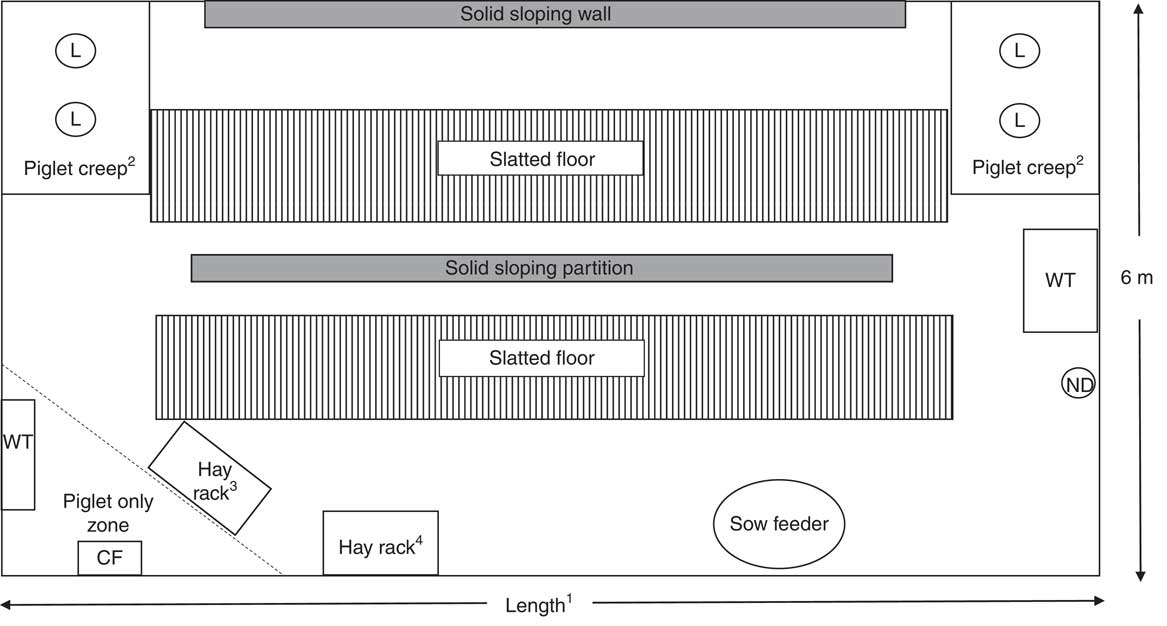
The four GL pens were located in a single room and in the same shed that contained the FCs. Two of the GL pens had the capacity to house five sows and their litters at 8.4 m2/sow (6.0×7.0 m), while the other two GL pens had the capacity to house seven sows and their litters at 8.1 m2/sow (6.0×9.5 m), with GL treatments balanced across these pens. Each GL pen had a solid partition with sloped walls, two heated creep areas with lids and rice hulls for bedding, with a zone only accessible to piglets that contained creep feed and a water trough (Figure 1). The creep area prevented sow access by using vertical bars along the entrance (approximately 20 cm distance between bars allowing piglets to pass through) and a horizontal anti-crush bar along the bottom of the entrance (10 to 15 cm from ground level). The flooring of the GL pens was partially slatted and rice hulls were scatted on the solid portion of the flooring weekly.
Layout of group lactation pens. 1Length was 9.5 m for pens of seven sow and litter units and 7 m for pens of five sow and litter units. 2Creep dimensions were 2.0×1.2 m for pens of seven sow and litter units and 2.1×0.85 m for pens of five sow and litter units. Position of hack rack in pens of 3five sow and litter units and pens of 4seven sow and litter units. L=heat lamp; CF=creep feed; WT=water trough; ND=nipple drinker.

Cool drippers over the FC as well as over the dunging area of the GL pens were activated (3 min on and 15 min off) when the internal temperature exceeded 26°C. Creep heat lamps automatically turned off when the temperature exceeded 24°C. During lactation, sows were fed a standard pelleted lactation diet ad libitum (14.9 MJ DE/kg and 16.2% crude protein). For sows in FC, this was provided up to three times daily, based on individual sow intake. The GL pens were fitted with a single ad libitum feed hopper. Water was supplied ad libitum via one nipple drinker and one water trough per GL pen. Piglets in all housing treatments were offered creep feed from 14 days of age. Animals in FC and GL pens were managed by the same stock people, who had previous experience managing sows and piglets under both housing systems.
Post-weaning
The average age at weaning was 26.7 days (range 22 to 29 days). Each weaning group comprised two unfamiliar litters from the same lactation housing treatment (see the ‘Experimental design and procedures’ section for details of treatments). Selection of litters (and pigs within litters) was conducted so that the two unfamiliar litters were balanced for average piglet weight at weaning (mean±SD, 6.5±1 kg/piglet), CV in piglet weight at weaning (mean±SD, 17±6.7%), litter age (mean±SD, 26.8±1.5 days) and sex ratio (mean±SD male to female sex ratio, 1.3±0.82/litter). All piglets were weighed on the day before weaning allowing for the selection of 198 piglets. There were (mean ± SD) 13.2±1.4 piglets allocated to each post-weaning pen with a floor space allowance of 0.41±0.33 m2/piglet.
The 15 post-weaning pens (3.6×1.5 m) were located over two rows in a weaning shed. Pens had 75% slatted flooring and included a feeding trough with five feeding spaces located on the solid flooring and a nipple drinker over the slatted flooring. Both water and food were provided ad libitum. A manipulable chain was shared between adjacent pens and fence line contact was permitted. No bedding or other materials were provided.
Experimental design and procedures
All sows farrowed in standard FC. At 7 days postpartum (mean±SD, 6.9±1.2 days), 12 sows (and their litters) were transferred from their FC to one of two GL pens (one pen of five sow/litter units and one pen of seven sow/litter units). Similarly, at 14 days post-partum (mean±SD, 13.9±1.1 days), 12 sows (and their litters) were transferred from their FC to one of the remaining two GL pens (one pen of five sow/litter units and one pen of seven sow/litter units). After mixing, GL sow and litter units remained in their respective group pens until weaning. The remaining 12 sows (and their litters) remained in their FC until weaning.
Thus, from day 7 postpartum until weaning, three housing treatments were applied. These were (1) FC; sows and litters in single-litter pens with confined sow until weaning, (2) GL7; FC followed by GL housing from 7 days postpartum; and (3) GL14; FC followed by GL from 14 days postpartum. Within time replicates, GL pens were balanced for sow parity, sow weight and litter size.
Mixing of GL treatments proceeded as follows. First, piglets were transferred from FC and confined in one of the two creeps located in the allocated GL pen. The lid of the creep was left open to prevent over-heating. The transfer of sows from their crates to GL pens commenced after all GL7 or GL14 litters had been relocated. Mixing of sows and their litters into GL pens occurred between 0730 h and 0930 h, and was completed within approximately 30 min. Sows could manipulate the timber blocking the exit of the creep meaning that attempts to confine piglets to the creeps for 1 h post-mixing were unsuccessful, so piglets and sows were mixed simultaneously. Animals were monitored for 1 h post-mixing although interventions to prevent piglet injury or death due to crushing in this period were not required. Researchers did not interrupt aggressive interactions between sows.
During weaning, sows were removed from FC or GL pens and taken to dry sow housing. The 198 piglets selected for post-weaning observations of aggression (see Animal and housing: post-weaning) were then transferred to the weaning facility that were located in a neighbouring shed (~50 m) via a walkway. Pens of piglets were transferred and sorted sequentially so that unfamiliar litters were not mixed before being introduced to the weaning pen. At the weaning facility, groups of 10 to 14 piglets from the same treatment were formed by mixing five to seven piglets from each of two unfamiliar litters. For GL7 and GL14 treatments, five to seven piglets of a litter from one GL pen was mixed with five to seven piglets of a litter from the other GL pen. Piglets from one of the two litters were marked with stock paint immediately before mixing to allow differentiation between interactions involving familiar and unfamiliar pigs in the pen. It took approximately 30 min to move, sort and complete the mixing of each treatment. Pens were randomly assigned to treatments and treatments were mixed in the following order and approximate times: FC 0900 h, GL14 0930 h, GL7 1000 h.
The number of piglets mixed into each post-weaning pen, and the number of pens of piglets mixed for each treatment, were determined by the number of healthy piglets per litter available at weaning and the number of litters available in the smaller of the GL pens (i.e. that housed five sow/litter units), respectively. Verdon et al. (Reference Verdon, Morrison and Hemsworth2016) advised against the confounding of treatment with familiarity when studying the effects of lactation housing on post-weaning aggression. Thus, the present study preferenced experimental control over familiarity rather than group size. The FC treatment mixed piglets into five pens of 14 animals; the GL14 treatment mixed piglets into two pens of 14, two pens of 12 and one pen of 10 animals; and the GL7 treatment mixed piglets into four pens of 14 and one pen of 10 animals. While this meant that group size (10 to 14 piglets per pen) and space allowance (0.39 to 0.54 m2/piglet) varied between pens, importantly, an equal proportion of piglets in each pen were familiar (i.e. familiar meaning that piglets were from the same litter and crate or pen).
Data collection
Piglet aggression post-weaning
GoPro cameras (GoPro model Hero 3 white edition; GoPro Inc., San Mateo, CA, USA) were fixed above weaning pens and recorded piglet behaviour for 3.5 h commencing immediately following addition of the final piglet to the weaning pen. The focal area of each camera captured the entirety of two adjacent weaning pens. From video records, the aggressive behaviour of piglets was continuously observed, at the pen level, for seven consecutive 30 min periods (a total of 3.5 h). This period of time was deemed suitable because, when young pigs are mixed, the majority of aggression associated with the formation of a hierarchy occurs within 2 h of mixing (Verdon and Rault, Reference Verdon and Rault2018).
For each pen, the frequency of aggressive bouts, and the frequency and duration of fights and bullying events, were recorded, and these included any one or combination of pushes, head knocks and bites (see Samarakone and Gonyou, Reference Samarakone and Gonyou2009). Bouts of aggression delivered were defined as reciprocal and/or non-reciprocal bouts that did not exceed 5 s duration. One bout of aggression delivered was separated from the next by a criteria of 5 s non-agonistic activity. Fights were defined as reciprocated aggression that exceeded 5 s duration, during which both piglets in the fight were delivering aggression. Bullying events were defined as non-reciprocal aggression that exceeded 5 s duration. A criteria of 5 s was used to separate one bout of fighting or bullying from the next (Hemsworth et al., Reference Hemsworth, Rice, Nash, Giri, Butler, Tilbrook and Morrison2013; Verdon et al., Reference Verdon, Morrison and Hemsworth2016). Measurements were conducted at the level of the pen, and then averaged per piglet.
Dyadic familiarity and aggression
Whether each bout of aggression delivered, fight or bully event involved familiar or unfamiliar piglets was also recorded. A ratio of interactions involving unfamiliar piglets to those involving familiar piglets was calculated for the following variables: frequency of aggressive bouts, fights and bully events; the total time fighting, bullying; and the average fight duration. A ratio >1 indicates that aggressive interactions involved more unfamiliar than familiar dyads and vice versa. The closer the ratio is to 1, the more evenly the aggressive behaviour is distributed between unfamiliar and familiar dyads.
Statistical analysis
Statistical analyses were carried out using the SPSS statistical software package (SPSS 22.0; SPSS Inc., Chicago, IL, USA). Variables were assessed for normality using visual methods (quantile–quantile plots and histograms) in combination with Shapiro–Wilks normality tests. Data that were not normally distributed were transformed before analysis so that residual variation was homogenous between weaning pens and treatments. Specific transformations are indicated in the results. Non-parametric tests were used when data could not be normalised.
The frequency of aggressive bouts, fights and bullying events, as well as the total duration fighting or bullying and the average fight or bully duration, over the seven consecutive 30-min time blocks (total of 3.5 h) were analysed using linear mixed modelling. Treatment (GL7, GL14 or FC), time (seven 30-min periods) and their interaction were fitted to the model as fixed factors. Repeated observations on the same pen over time were accounted for using an auto-regressive correlation structure. When there were significant main or interactive effects (P⩽0.05) the LSD test determined where least square means differed.
The relationships between dyadic familiarity and post-weaning piglet aggression were examined using a univariate ANOVA or Kruskal–Wallis (specific test indicated in the results). Both sets of analysis included GL7, GL14 or FC lactation housing treatment as a fixed factor. No bullying events were recorded in six of post-weaning pens (3 GL14, 1 FC, 2 GL7), so the relationship between familiarity and bullying behaviour was not analysed.
Results
Distribution of aggressive behaviour
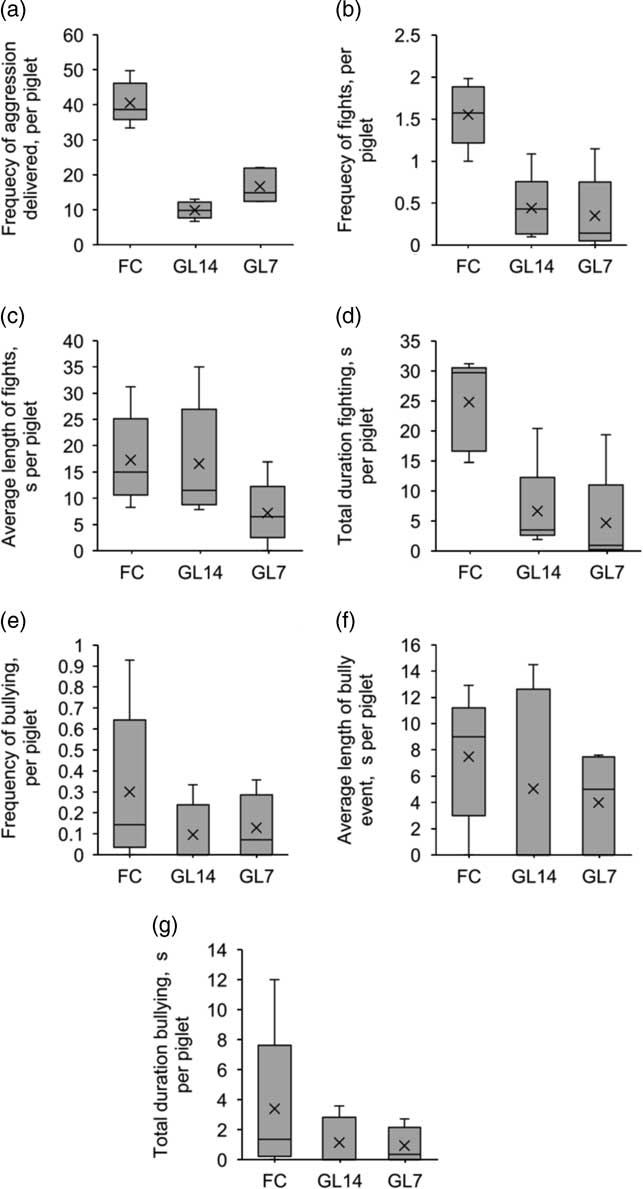
Aggressive bouts were approximately 3.1 and 1.4 times more frequent in the FC pens than in the GL14 and GL7 pens, respectively, over the first 3.5 h post-mixing at weaning but variability around the mean was roughly comparable between treatments (Figure 2a). Similarly, fighting was more frequent in the FC pens than GL7 (3.6 times more frequent) or GL14 pens (2.5 times more frequent; Figure 2b). The frequency of fights was relatively low in GL7 and GL14 pens, with no fights recorded in one GL7 pen, but both GL treatments contained one pen of pigs that fought at least twice as often as the treatment average. The maximum number of fights recorded in the most aggressive GL pens was equivalent to the minimum number of fights recorded in the FC pens (Figure 2b). All three housing treatments contained at least one pen in which no bullying events were recorded, but bullying was observed in more FC pens than GL7 and GL14 pens (Figure 2e). The maximum number of bullying events recorded in a FC pen was at least 1.6 times higher than that the maximum number recorded in GL7 or GL14 pens (13, 5 and 4 maximum bullying events, respectively). As a result, the distribution of data for the frequency of bullying is much more variable for the FC than the GL7 and GL14 pens (Figure 2e).
Boxplots representing the (a) frequency of aggressive bouts, the (b) frequency, (c) average duration and (d) total duration of fights, and the (e) frequency, (f) average duration and (g) total duration of bullying over 3.5 h immediately following mixing at weaning, for piglets reared in farrowing crates throughout lactation (FC), or in group lactation from 7 (GL7) or 14 (GL14) days of age until weaning. Boxplots show the median and the 1st and 3rd quartiles (25% and 75% of data), with whiskers extending to the lowest and highest values. Means (×) are also presented.

Effects of lactation housing treatment and time
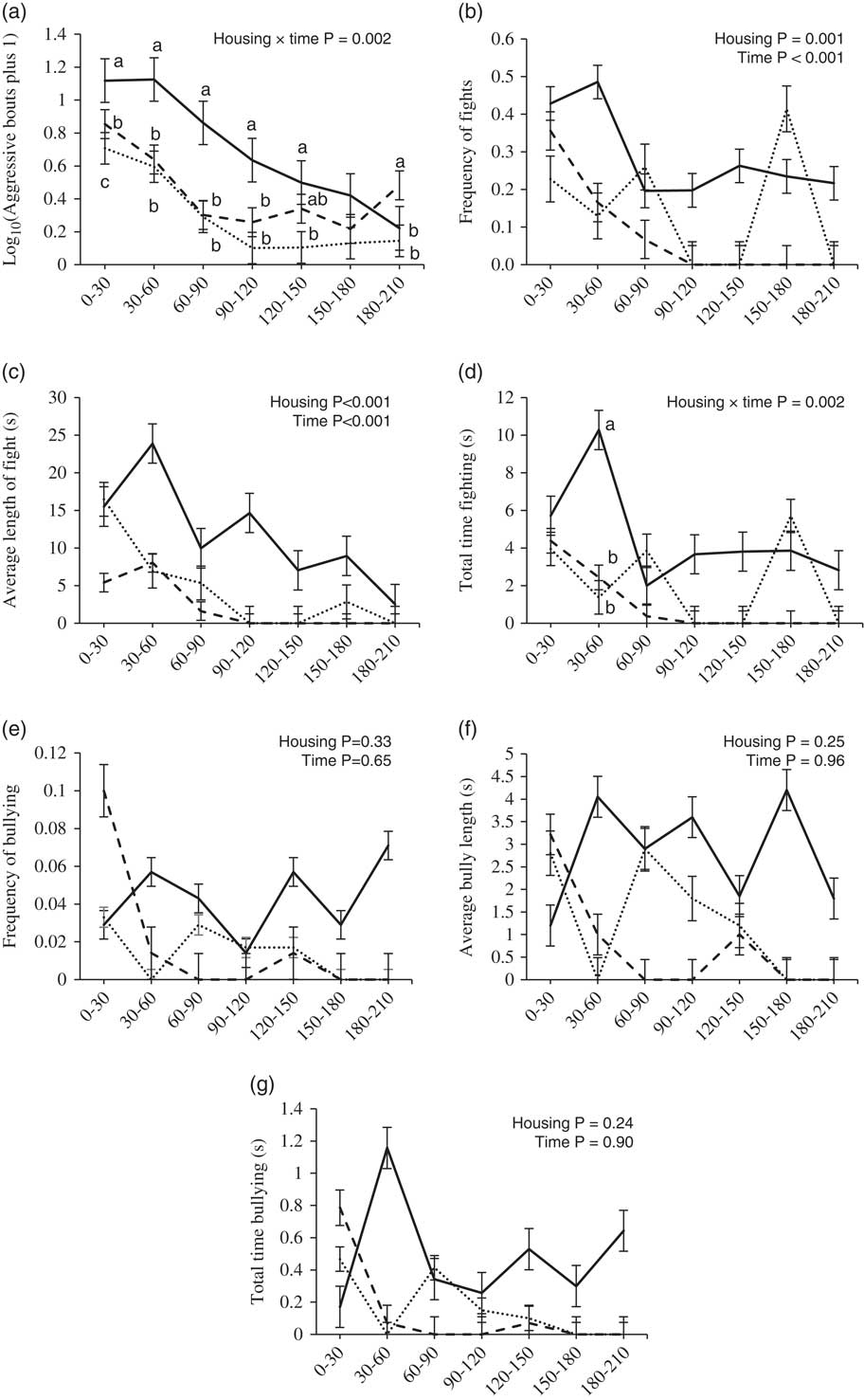
There was a significant lactation housing×time interaction for the number of aggressive bouts delivered post-weaning (F 12,53=3.1, P<0.05; Figure 3a). Aggressive bouts delivered by all piglets declined over time, but that delivered by GL7 and GL14 piglets were less frequent and reached baseline levels more quickly than that delivered by FC piglets.
The effects of time post-mixing at weaning (x-axis) and lactation housing treatment (piglets reared in group lactation from 7 (GL7;  ) or 14 (GL14; ··
 ) days of age until weaning, or in farrowing crates (FC;
 ) throughout lactation) on the (a) frequency of aggressive bouts, the (b) frequency, (c) average duration and (d) total duration of fights, and the (e) frequency, (f) average duration and (g) total duration of bullying. a,bWithin time periods, means with different superscript letters differ (P⩽0.05).

Farrowing crate piglets fought more frequently (Housing: F 2,84=11, P<0.001; Figure 2b) and fights were longer (Housing: F 2,84=9.3, P<0.001; Figure 2c) than GL7 or GL14 piglets, while the group housing treatments did not differ (P>0.05). The frequency of fights was higher (Time: F 6,84=6.0, P<0.001) and the average duration of fights was longer (Time: F 6,84=4.1, P<0.001) for all piglets in the first 1 h post-mixing than for the remaining 2.5 h (Figure 2b and c). Piglets reared in FC spent more time fighting than GL7 and GL14 piglets between 30 and 60 min post-mixing, but there were no differences between the housing treatments at any other time period (Housing × time: F 12,84=2.2, P<0.05; Figure 2d).
There were no effects (P>0.05) of housing or time post-mixing on bullying frequency (Figure 2e), average duration (Figure 2f) or total duration (Figure 2g).
Familiarity
Aggressive bouts were delivered to unfamiliar and familiar conspecifics at similar frequencies, as indicated by a ratio close to 1, and there were no effects of lactation housing on this ratio (P>0.05; Table 1). Farrowing crate piglets had almost three times as many fights with unfamiliar than familiar conspecifics (P<0.05, Table 1), however, GL7 and GL14 piglets had a similar number of fights with unfamiliar and familiar piglets. There were no effects of lactation housing on the ratio of total time fighting or the average duration of fights involving unfamiliar dyads to familiar dyads (P>0.05).
The effect of housing piglets in farrowing crates (FC) or in group lactation pens from 7 (GL7) or 14 (GL14) days of age on the ratio of aggressive interactions involving unfamiliar piglets to those involving familiar piglets (U : F) when mixed post-weaning

1 SEP=pooled standard error of the mean.
2 Analysed with a univariate ANOVA. Data presented as least square means.
3 Analysed with Kruskal–Wallis. Data presented as mean rank with raw means presented in parentheses.
a,bWithin a row means with different superscript letters differ (P ⩽0.05).
Discussion
Group lactation housing
The present experiment offers support to previous research that piglets reared in GL pens are less aggressive after mixing with unfamiliar piglets at weaning than piglets reared in FCs (Li and Wang, Reference Li and Wang2011; Verdon et al., Reference Verdon, Morrison and Hemsworth2016). A significant body of research on mice reared in communal nests, which consist of a single nest where three or more mother mice keep their pups together and share care giving behaviour, demonstrates the positive effects of housing that resembles the natural social environment on early development for a range of social behaviours through to adulthood, via profound effects on the neurobehavioural profile (reviewed by Curley and Champagne, Reference Curley and Champagne2016). Like communal nests, GL housing offers a multi-faceted enriched rearing environment to piglets by providing greater opportunities for a wider range of interactions with peers, their dam and other sows, as well as increased space, substrate and larger group sizes. It is impossible to deduct which of these factors contribute to the reduced aggressive behaviour of GL piglets, but the likely contribution of each are considered below.
First, and perhaps most importantly, direct experience from social interaction is likely the major means by which immature animals acquire social skills (see Taborsky, Reference Taborsky2016). Piglets that interact with unfamiliar litters during lactation while the sow remains confined in the FC are less aggressive after being mixed into groups with unfamiliar conspecifics around weaning (Ledergerber et al., Reference Ledergerber, Bennett, Diefenbacher, Shilling and Whitaker2015; Salazar et al., Reference Salazar, Ko, Yang, Llonch, Manteca, Camerlink and Llonch2018) and in the growing-finishing stage of production (D’Eath, Reference D’Eath2005). Verdon et al. (Reference Verdon, Morrison and Hemsworth2016) found that piglets reared in FCs were more aggressive post-mixing at weaning than those reared in GL pens, but did not differ from those reared in PigSAFE pens (i.e. pens enriched with a loose-housed sow, increased space and provision of straw but in single litter). A short-term increase in aggression is reported when unfamiliar piglets are mixed during lactation (D’Eath, Reference D’Eath2005; Ledergerber et al., Reference Ledergerber, Bennett, Diefenbacher, Shilling and Whitaker2015). As demonstrated through modelling (Fawcett and Johnstone, Reference Fawcett and Johnstone2010) and experimental research on various species (e.g. fish: Chen and Hsu, Reference Chen and Hsu2016; rats: Lehner et al., Reference Lehner, Rutte and Taborsky2011; pigs: Coutellier et al., Reference Coutellier, Arnould, Boissy, Orgeur, Prunier, Veissier and Meunier-Salaün2007; Camerlink et al., Reference Camerlink, Turner, Farish and Arnott2017), the experience of aggressive interactions with unfamiliar peers provides valuable information regarding the strength of an individual relative to others. Experience of winning aggressive contests raise, while losing experiences lower, an individuals perceived fighting ability and thus willingness to engage in future aggressive interactions (reviewed by Hsu et al., Reference Hsu, Earley and Wolf2006). Rather than affecting actual fighting ability, this social experience modulates how animals assess prospective competitors before engaging in aggression (Hsu et al., Reference Hsu, Earley and Wolf2006; Chen and Hsu, Reference Chen and Hsu2016; Camerlink et al., Reference Camerlink, Turner, Farish and Arnott2017). If prior experience with aggression has the most profound effect on behaviour in the pre-escalation phase of a contest, this could explain why there were no effects of treatment on bullying behaviour in the present experiment, although some shorter bullying events (<5 s duration) may not have been identified with the 5 s threshold utilised in this research.
Second, loose-housed sows interact with piglets more frequently in both single litter (e.g. Singh et al., Reference Singh, Verdon, Cronin and Hemsworth2017) and GL (Verdon et al., Reference Verdon, Morrison and Rault2017) housing systems compared to sows confined in FCs. The frequency and nature of care offspring receive from their mother can have long-term implications for behavioural and brain development (see reviews by Sachser et al., Reference Sachser, Kaiser and Hennessy2013; Curley and Champagne, Reference Curley and Champagne2016). Interactions between piglets and non-related sows in GL pens may also be important in the development of appropriate social behaviours, as has been demonstrated in rats (reviewed by McCarty, Reference McCarty2017) and horses (Bourjade et al., Reference Bourjade, Moulinot, Henry, Richard‐Yris and Hausberger2008). In comparison to the evidence for the effects of peer–peer interactions on the development of the aggressive phenotype, however, there is less research demonstrating that increased maternal interactions per se lead to reductions in aggressive behaviour. While research in rodents suggests that early maternal or peer–peer interactions independently shape-specific facets of adult social behaviour, only adult mice that receive both high levels of maternal care and peer interactions during infancy display rapid social learning and social plasticity (Branchi et al., Reference Branchi, Curley, D’Andrea, Cirulli, Champagne and Alleva2013).
Third, enrichment of the GL pen with space and rootable substrate may also have affected the development of behaviour of piglets in the present research. However, enrichment of the lactation environment (i.e. one or a combination of the following: hanging objects, rootable substrates, branches, lick block, increased space) does not appear to affect piglet aggression post-weaning (Chaloupková et al., Reference Chaloupková, Illmann, Bartoš and Špinka2007; Oostindjer et al., Reference Oostindjer, van den Brand, Kemp and Bolhuis2011; Verdon et al., Reference Verdon, Morrison and Hemsworth2016). The effects of pre-weaning environmental enrichment on the development of social behaviour may be evident in the longer term (Chaloupková et al., Reference Chaloupková, Illmann, Bartoš and Špinka2007), or alternatively be of less importance than (Bolhuis et al., Reference Bolhuis, Schouten, Schrama and Wiegant2006) or interact with (Oostindjer et al., Reference Oostindjer, van den Brand, Kemp and Bolhuis2011) the post-weaning environment. While research on laboratory rodents show that social or physical enrichment have different and distinct effects on behavioural development, combining social and physical enrichments has the most marked effect on brain development and aggression in the adult mouse (Pietropaolo et al., Reference Pietropaolo, Branchi, Cirulli, Chiarotti, Aloe and Alleva2004). Indeed, in pigs, enrichment of the lactation pen in itself had few effects on post-weaning piglet behaviour, but when provided in conjunction with a loose-housed sow produced positive effects on the development of social behaviour in piglets (Oostindjer et al., Reference Oostindjer, van den Brand, Kemp and Bolhuis2011).
Age at mixing into group lactation
Mixing piglets into GL at 7 or 14 days of age did not affect aggressive behaviour in the hours following mixing at weaning in the present research. Salazar et al. (Reference Salazar, Ko, Yang, Llonch, Manteca, Camerlink and Llonch2018), who socialised pairs of unfamiliar litters at 7 or 14 days postpartum while the sows remained confined in FCs, reported similar results. The timing or duration of social experience may be less important to the expression of the aggressive phenotype in pigs than the occurrence and significance of the experience. A brief and relatively mild experience can be meaningful enough to affect the development of mutual assessment in pigs (Camerlink et al., Reference Camerlink, Turner, Farish and Arnott2017), and provoke epigenetic changes to the neuronal function and behaviour of fish (Bukhari et al., Reference Bukhari, Saul, Seward, Zhang, Bensky, James, Zhao, Chandrasekaran, Stubbs and Bell2017).
Further investigation is required to determine whether there are long-term positive effects of GL housing. The early post-natal (i.e. from birth until weaning) brain is highly plastic, and animals seem to be particularly susceptible to external influences in this phase of life (Sachser et al., Reference Sachser, Kaiser and Hennessy2013; Taborsky, Reference Taborsky2016). Li and Wang (Reference Li and Wang2011) found that piglets from a multi-litter lactation pen fought less when mixed at 8 weeks of age than piglets from FCs, even though piglets from FCs were housed in groups of nine from 5 to 8 weeks of age. On the other hand, brain circuits involving the prefrontal cortex and parts of the limbic system (i.e. the hippocampus and amygdala) retain plasticity into adulthood (Sachser et al., Reference Sachser, Kaiser and Hennessy2013), and pigs can improve their social skills with increased experience of mixing aggression (e.g. Puppe, Reference Puppe1998; Coutellier et al., Reference Coutellier, Arnould, Boissy, Orgeur, Prunier, Veissier and Meunier-Salaün2007).
Familiarity
The effects of lactation housing on piglet aggression post-weaning has been confounded with familiarity in previous experiments; piglets from GL systems have been moved to post-weaning pens with pen mates whereas a proportion of piglets from single-litter lactation systems are unfamiliar when mixed at weaning (Wattanakul et al., Reference Wattanakul, Sinclair, Stewart, Edwards and English1997; Kutzer et al., Reference Kutzer, Bünger, Kjaer and Schrader2009; Bohnenkamp et al., Reference Bohnenkamp, Traulsen, Meyer, Müller and Krieter2013). Although still present, aggression between familiar dyads is substantially lower than that between unfamiliar dyads when young pigs are mixed into groups (Puppe, Reference Puppe1998; Li and Wang, Reference Li and Wang2011). To the best of our knowledge, Li and Wang (Reference Li and Wang2011) and the present research are the only two experiments to have mixed the same proportions of familiar and unfamiliar piglets into GL and FC treatment pens post-weaning (33% and 50% familiar piglets per pen, respectively). In the present research, unfamiliar piglets reared in FCs engaged in almost three times as many fights with unfamiliar than familiar pen mates, but the ratio of fights involving unfamiliar to familiar pigs was close to 1 : 1 for GL piglets. Li and Wang (Reference Li and Wang2011) found that unfamiliar pigs from GL had shorter and less frequent fights than those from FCs, but there was no difference between familiar pigs from GL or FC housing. When familiarity cannot be controlled, such as during mixing at weaning on commercial pig farms, previous experience of mixing with unfamiliar piglets during lactation may improve the social abilities of piglets and reduce fighting.
Conclusion
This experiment confirms the benefits that a period of GL housing during early life has for the social development of pigs. Piglets reared in GL pens from 7 or 14 days of age had fewer non-fighting aggressive bouts, and fewer and shorter fighting aggressive bouts at weaning compared to piglets reared in FCs. However, piglets mixed into GL at 7 or 14 days of age did not differ in their aggressive behaviour at weaning.
By shifting the experience of a new social (i.e. mixing with unfamiliar piglets) and physical environment from weaning to lactation, a period of GL housing may reduce the negative impacts of the weaning process on piglet welfare. However, the expression of piglet aggression post-weaning is but one factor affecting the ethical and economic viability of GL for commercial production. The results of the present experiment therefore need to be considered in the context of other possible benefits (e.g. increased freedom of movement for sows and piglets, opportunities to express behaviours), disadvantages (e.g. piglet mortality, disease management, disrupted nursing behaviour) and practicalities (farmer preference, infrastructure and management capabilities) of two-stage GL housing. Thus, while there are no benefits to GL housing from 7 rather than 14 days of age on piglet aggression post-mixing at weaning, more research is required to determine whether mixing before 14 days postpartum has implications for other indicators of welfare and productivity in both sows and piglets.
Acknowledgements
This work was partially funded by Australian Pork Cooperative Research Centre (Pork CRC; grant 1A-113). The authors are grateful to Rivalea Australia, and particularly to Brian McLeod, for technical support and use of their facilities and animals.
Declaration of interest
The authors declare that the research was conducted in the absence of any commercial or financial relationships that could be construed as a potential conflicts of interest.
Ethics statement
All animal procedures were conducted with prior institutional ethical approval (approval 15B048C from committee SPPL111) under the requirement of the New South Wales Prevention of Cruelty to Animals Act (1979) in accordance with the National Health and Medical Research Council/Commonwealth Scientific and Industrial Research Organisation/Australian Animal Commission Australian Code of Practice for the Care and Use of Animals for Scientific Purposes (NHMRC, 2013).
Software and data repository
None of the present data were deposited in an official repository.