Introduction
In recent years, an increasing number of people have been affected by natural disasters.Reference Guha-Sapir, Vos, Spence, So and Scawthorn1 Earthquakes, a significant type of sudden onset disaster (SOD), have caused extensive damage to infrastructure with death and severe injuries to humans.Reference Guha-Sapir, Vos, Below and Ponserre2 The number of foreign medical teams (FMTs) sent to earthquakes to care for injured victims has also been increasing.Reference Bremer3
A major problem facing FMTs in disasters is how to adapt to the medical needs of victims. Studies have shown that FMTs are focused primarily on trauma care and, to a large extent, neglect normal health care needs such as public health, essential obstetrical care, and pediatrics.Reference Guha-Sapir, Vos, Below and Ponserre2–Reference Miller and Arquilla8
It is a challenge for local governments and international organizations to regulate the type and quantity of FMTs, and to coordinate their arrival and response.Reference de Ville de Goyet9–Reference Hsu, Ma, Lin, VanRooyen and Burkle14 Common terminologies, definitions, frameworks, and quality standards are needed to facilitate the process of improving the use of FMTs in earthquakes.Reference Redmond, O’Dempsey and Taithe15 In this report, a conceptual health system framework is presented that captures two essential components of healthcare response by FMTs after earthquakes: time and level of care.
Materials and Methods
For this field focused study, expert panels were formed and interviewed, and a literature search was conducted. The study was designed to produce practical, simple and useful results that would be applicable in the difficult field setting of earthquake events.
Expert Panels
A preliminary health system framework was developed based on the experience of three of the co-authors (AW, JvS, KL), all of whom have personal FMT earthquake experience.
The preliminary framework was presented for discussion at two international meetings of disaster experts. The first meeting, organized by Karolinska Institutet and the Pan American Health Organization/World Health Organization (PAHO/WHO), brought together 26 experts in Cuba in December 2010 to discuss how to update the 2003 PAHO/WHO guidelines for foreign field hospitals.Reference Bulut, Fedakar and Akkose16 The experts were medical professionals representing agencies specializing in humanitarian health assistance. The second meeting took place in April 2011 in Stockholm; a total of 20 surgeons, anesthesiologists, and emergency doctors met to develop standards for providing surgical care in SODs.
The preliminary framework was discussed in detail at these meetings using a participatory approach. The framework was revised according to the feedback from these expert panel discussions.
Literature Review
The framework was compared with evidence from a secondary literature review. The electronic database PubMed (US National Library of Medicine) was searched for articles describing how the burden of disease varies in association with significant time delineations following earthquakes, and how changes in workload, burden of disease, or other factors significantly influence the response. The following combination of search terms was used: earthquake AND (injury OR disease OR outbreak OR injuries OR outcome OR epidemiology) AND (earthquake and foreign field hospital). Only articles with abstracts in English were included. Abstracts specifying timing or level of care after earthquakes were reviewed. Standard medical dictionaries were also searched.
A total of 1,116 abstracts were identified and screened for relevance. Of this total, 69 articles were selected for in-depth analysis. The framework was finalized after it had been circulated among members of the expert panels from the Cuba and Stockholm meetings.
Results
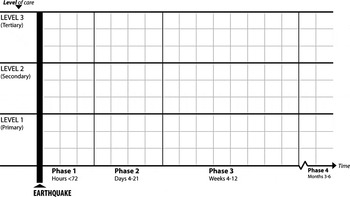
The health system framework is shown in Figure 1. The expert panels highlighted time phases and level of care as essential building blocks for the framework structure.
Proposed framework

Time Phases
An important component of any disaster response framework is the definition of time phases. Based on professional experience, four phases delineated by the changing burden of trauma injuries over time following earthquakes were proposed. For clarity, Phase 1 is defined in terms of hours, Phase 2 in days, Phase 3 in weeks, and Phase 4 in months.
The expert panels agreed that Phase 1 lasts approximately 72 hours. This duration is also widely referred to in the literature.Reference Hsu, Ma, Lin, VanRooyen and Burkle14,Reference Bulut, Fedakar and Akkose16–Reference Zhao, Wang and Wang24 However, in the expert panel discussions and in the literature review, it was highlighted that FMTs are not on-scene during this phase.Reference von Schreeb, Riddez, Samnegard and Rosling5 Thus, Phase 1 is beyond the scope of any significant contribution from FMTs.
Phase 2 lasts for two to three weeks. It is during this phase that most FMTs arrive, establish their services, and carry out trauma-related interventions. Eight articles describe a change in the health-seeking behavior and type of medical problems presenting during the first weeks after a SOD; the trauma case load gradually decreases while the number of non-trauma patients increases.Reference Bozkurt, Ocguder, Turktas and Erdem6,Reference Kazzi, Langdorf, Handly, White and Ellis19,Reference Kreiss, Merin and Peleg20,Reference Tanaka, Oda and Iwai23,Reference Bar-On, Lebel and Kreiss25–Reference Zhao, Shi, Hu and Li28
Phase 3 is characterized by a slow return to the usual burden of disease in the affected community. It is during this phase that FMT services are fully established and more advanced trauma care can be made available, but normal health care needs start to dominate. Phase 3 has a duration of three weeks to three months. Based on expert panel opinions and personal experience, the inclusion of a Phase 4 that begins about three months post-disaster and continues until the function of health services within the disaster zone has returned to pre-disaster levels was suggested. The length of phase 4 will vary significantly depending on factors such as the pre-earthquake context and the magnitude and severity of the earthquake.
Levels of Care
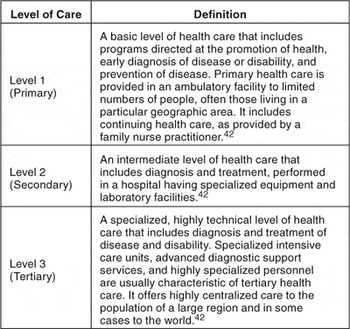
In addition to relevant phases, a common terminology to refer to levels of health care is proposed (Table 1). “Primary” health care was defined at a 1978 WHO conference in the Alma Alta declaration.29 “Secondary” and “tertiary” levels of care are referenced in several articles and documents but are not well defined;Reference Bremer3,Reference Bozkurt, Ocguder, Turktas and Erdem6–Reference Miller and Arquilla8,Reference Missair, Gebhard and Pierre21,Reference Zhang, Liu, Liu and Zhang27,Reference Zhao, Shi, Hu and Li28,Reference Atef-Zafarmand and Fadem30–Reference Salimi, Abbasi, Khaji and Zargar41 therefore, definitions from Mosby’s Medical Dictionary are used for these terms.42 Primary, secondary, and tertiary levels are referred to as Levels 1, 2, and 3, respectively.
Levels of health care

Discussion
The results of this paper provide a simple and easily understandable framework. The framework provides a tool that allows consistent discussion about key SOD medical response challenges during different time phases, and highlights the difference between hospitals providing secondary care and those providing tertiary care. The expert panels agreed on the need for such a framework to facilitate coherent discussions on improving coordination of FMTs. The proposed framework can lay the foundation for the ongoing process of updating WHO guidelines for foreign field hospitals after SOD events, and serve as the foundation for a process to register agencies sending FMTs to SOD events.Reference Redmond, O’Dempsey and Taithe15
For this process, defining an FMT by the level of health services provided, ranging from basic Level 1 services to advanced Level 3, is proposed. Given this definition, a recipient government may, in its initial needs assessment, specify the capacity of Level 2 and 3 services needed to: (1) cover the trauma needs of the population; (2) substitute for the potentially collapsed health care system; and (3) ensure that referrals between hospitals representing different levels is possible.
The study framework fits well with the WHO Health Resources Availability Mapping System (HERAMS) framework that suggests what type of service should be available at different levels of care.43 This system will greatly facilitate the implementation of the intended function of flash appeals as stated in the revised guidelines from 2010.44 A flash appeal is a document issued in response to a disaster that is beyond the capacity of the government plus any single agency. It is designed to structure a coordinated humanitarian response for the first three to six months of a disaster. A flash appeal has three main parts: (1) an analysis of the context and the humanitarian needs; (2) response plans; and (3) information on roles and responsibilities. It should also identify the best allocation of resources.44
For each level of care and time phase, quality indicators should be developed. When more advanced care is made available, it is important to highlight the difference between Level 2 and Level 3 services. For example, after the Haiti earthquake in 2010, internal fixations of femur fractures requiring strict hygiene and protocols beyond the scope of units providing Level 2 service were performed. Specialized burn care is an example of a service that should be provided only under Level 3 care. Assigning the various injury types to specific levels of care should ensure best practices and facilitate coordination of FMT services. This framework can help policymakers develop a coherent approach to planning which type of service to provide, and allow for better coordination and referral among FMTs.
Abbreviations:
FMT = foreign medical team
HERAMS = Health Resources Availability Mapping System
PAHO = Pan American Health Organization
SOD = sudden onset disaster
WHO = World Health Organization