For both philosophers and psychologists, being lonely represents a fundamental failure to achieve one’s necessary sense of belongingness with others in the world (e.g., Heidegger, 1927/1962). According to Russell, Peplau, and Cutrona (Reference Russell, Peplau and Cutrona1980), loneliness is defined by feelings and thoughts of being isolated and disconnected from others. Noteworthy, findings from large scale studies around the world have indicated that many adults across the lifespan experience loneliness (e.g., Victor & Yang, Reference Victor and Yang2012; Yang & Victor, Reference Yang and Victor2008, Reference Yang and Victor2011). For example, in a large US sample of 8,932 elderly adults (65–100 years old), Theeke (Reference Theeke2009) found that 19% of the sample reported loneliness. Results from a survey of European countries have also pointed to loneliness as an important social problem. For example, in a large sample of 1,876 Spanish adults, Yang and Victor (Reference Yang and Victor2011) found that rates of loneliness varied from 4.4% in young adults (18–29 years old), 6.5% in adults/middle-aged adults (30–59 years old), to 11.5% in elderly adults (60+ years old). Despite variations in global prevalence rates (Yang & Victor, Reference Yang and Victor2011), what is clear from these findings is that loneliness represents a universal dimension of being human around the world. Unfortunately, loneliness, as an individual differences variable, has been found to be a central risk factor for a wide range of maladaptive outcomes.
Studies on loneliness over the past 30 years have indicated that it is a robust correlate and predictor of a wide range of negative psychological and physical conditions in adults (for reviews, see Hawkley & Cacioppo, Reference Hawkley and Cacioppo2010; Heinrich & Gullone, Reference Heinrich and Gullone2006; Holt-Lunstad, Smith, Baker, Harris, & Stephenson, Reference Holt-Lunstad, Smith, Baker, Harris and Stephenson2015). For example, findings from studies have shown that loneliness is associated with greater stress experiences in young and elderly adults (e.g., Chang, Sanna, Hirsch, & Jeglic, Reference Chang, Sanna, Hirsch and Jeglic2010; Lee & Goldstein, Reference Lee and Goldstein2016). Moreover, loneliness has also been linked to greater suicide risk in young adults (e.g., Chang et al., Reference Chang, Lian, Yu, Qu, Zhang, Jia and Hirsch2015; Chang et al., Reference Chang, Sanna, Hirsch and Jeglic2010). Indeed, loneliness has also been associated with increased risk for early mortality among adults (Holt-Lunstad et al., Reference Holt-Lunstad, Smith, Baker, Harris and Stephenson2015). Beyond these important patterns, perhaps the most robust association identified in adults has been the one between loneliness and depressive symptoms. As findings from studies have shown, loneliness has not only been consistently correlated with greater depressive symptomatology in adults (e.g., Cacioppo, Hughes, Waite, Hawkley, & Thisted, Reference Cacioppo, Hughes, Waite, Hawkley and Thisted2006; Chang, Reference Chang2017; Jaya, Hillmann, Reininger, Gollwitzer, & Lincoln, Reference Jaya, Hillmann, Reininger, Gollwitzer and Lincoln2017), but it has also been found to predict increases in depressive symptomatology over time (e.g., Holvast et al., Reference Holvast, Burger, de Waal, van Marwijk, Comijs and Verhaak2015). Noteworthy, in a study of middle-aged to elderly adults (50–68 years old), Cacioppo, Hawkley, and Thisted (Reference Cacioppo, Hawkley and Thisted2010) found that across a five-year period of assessment, initial loneliness predicted greater depressive symptomatology five years later, but initial depressive symptomatology did not predict greater loneliness five years later. Although most of the studies published on loneliness have been based on studies of North American adults (Hawkley & Cacioppo, Reference Hawkley and Cacioppo2010; Heinrich & Gullone, Reference Heinrich and Gullone2006), the pattern linking loneliness to depressive symptoms has also been identified in elderly adults from Spain (Losada et al., Reference Losada, Márques-González, García-Ortiz, Gómez-Marcos, Fernández-Fernández and Rodríguez-Sánchez2012). For example, based on a large representative sample of 3,535 elderly adults from across Spain, Domènech-Abella et al. (2017) found that Spanish elderly adults who reported greater loneliness were more inclined to be depressed. Yet, what is not clear from the presence of this relationship between loneliness and depressive symptomatology is not only the relevance of loneliness in Spanish young adults, but also how loneliness, as a major vulnerability factor, might lead to greater depressive symptoms in Spanish young adults.
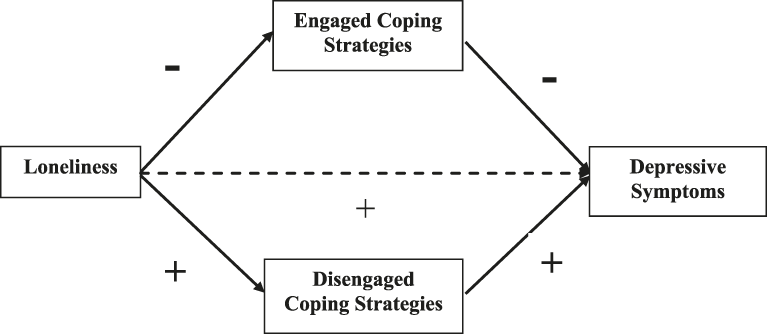
Coping strategies as a mechanism. Identifying processes that might mediate the association between loneliness and depressive symptoms is important. One potentially important process variable that is worth considering is coping. Within Lazarus and Folkman’s (Reference Lazarus and Folkman1984) transactional framework, the relationship that exists between personality and adjustment can be attributed to how people cope with stressful situations. Importantly, coping refers to the cognitive and behavioral strategies one uses to manage the internal and external demands associated with a stressful situation (Lazarus & Folkman, Reference Lazarus and Folkman1984). Although a number of different models and measures of coping have emerged in the extant literature over the past three decades (e.g., Carver, Scheier, & Weintraub, Reference Carver, Scheier and Weintraub1989; Folkman & Lazarus, Reference Folkman and Lazarus1980; Stemmet, Roger, Kuntz, & Borrill, Reference Stemmet, Roger, Kuntz and Borrill2015), Tobin, Holroyd, Reynolds, and Wigal (Reference Tobin, Holroyd, Reynolds and Wigal1989) developed a measure of coping based on a hierarchical functional model, namely, the Coping Strategies Inventory (CSI). Based on their findings for the CSI, Tobin et al. (Reference Tobin, Holroyd, Reynolds and Wigal1989) identified two general engaged and disengaged coping strategy dimensions that could be broken down further to reflect facets of problem-focused and emotion-focused dimensions. Specifically, problem solving and cognitive restructuring were found to reflect facets of problem engagement, whereas express emotions and social support were found to reflect facets of emotion engagement. Similarly, problem avoidance and wishful thinking were found to reflect facets of problem disengagement, whereas self criticism and social withdrawal were found to reflect facets of emotion disengagement. Thus, unlike using other coping measures, the CSI allows researchers to generate more specific hypotheses (e.g., Chang & Strunk, Reference Chang and Strunk1999). For example, in the present context, one might hypothesize that the positive association found between loneliness and depressive symptoms in adults can be accounted for by their greater use of disengagement coping strategies and their less use of engagement coping strategies (see Figure 1). To date, however, no study has examined for the role of specific coping strategies as mechanisms that might help account for the association between loneliness and depressive symptoms in adults. For example, because past studies have focused on general assessments of coping in adults (e.g., passive vs. active coping; Vanhalst, Luyckx, Teppers, & Goossens, Reference Vanhalst, Luyckx, Teppers and Goossens2012; Schultz & Moore, Reference Schultz and Moore1984), it becomes difficult to clarify the role of any specific coping strategies in the context of loneliness in adults.
A Hypothesized Model of how Engaged and Disengaged Coping Strategies May Mediate the Association between Loneliness and Depressive Symptoms

Purpose of the Present Study
Based on these considerations, the purpose of the present study was to: a) examine the relations between loneliness, coping strategies, and depressive symptoms in Spanish young adults; and b) determine if coping strategies might account for the association between loneliness and depressive symptoms in Spanish young adults.
Consistent with past research findings of adults (e.g., Cacioppo et al., Reference Cacioppo, Hughes, Waite, Hawkley and Thisted2006; Chang, Reference Chang2017; Jaya et al., Reference Jaya, Hillmann, Reininger, Gollwitzer and Lincoln2017; Holvast et al., Reference Holvast, Burger, de Waal, van Marwijk, Comijs and Verhaak2015; Losada et al., Reference Losada, Márques-González, García-Ortiz, Gómez-Marcos, Fernández-Fernández and Rodríguez-Sánchez2012), we expected loneliness to be positively correlated with depressive symptoms in Spanish young adults. Additionally, given Tobin et al.’s (Reference Tobin, Holroyd, Reynolds and Wigal1989) hierarchical model of engaged and disengaged coping, we expected loneliness to be negatively associated with engaged coping strategies (e.g., problem solving) and positively associated with disengaged coping strategies (e.g., problem avoidance). Moreover, consistent with past research findings linking coping strategies with psychological adjustment, including depressive symptoms (e.g., Chang & Strunk, Reference Chang and Strunk1999; García-Alberca et al., Reference García-Alberca, Cruz, Lara, Garrido, Gris, Lara and Castilla2012), we expected engaged coping strategies to be negatively associated with depressive symptoms, and disengaged coping strategies to be positively associated with greater depressive symptoms.
Finally, consistent with our hypothesized mediation model, we expected to find preliminary evidence consistent with the notion that the positive association between loneliness and depressive symptoms in Spanish young adults would be partly or fully accounted for by the greater use of disengaged coping strategies and less use of engaged coping strategies. However, given the lack of studies examining for the role of specific coping strategies associated with loneliness in young adults, we did not have any basis to make a strong case for the robust role of any specific engaged or disengaged coping strategy.
Methods
Participants
A total of 364 college students attending social education classes were recruited from a large public university in Basque Country in northern Spain. Two hundred and seventy-five (75.5%) indicated being “female”, eighty (22.0%) indicated being “male”, and nine (2.5%) did not provide a response regarding their sex. Ages ranged from 18 to 57 years, with a mean age of 21.6 years (SD = 4.4 years).
Measures
Loneliness. Loneliness was measured by the revised UCLA Loneliness Scale (R-UCLA; Russell et al., Reference Russell, Peplau and Cutrona1980). The original scale consists of 20 items, with 10 items (reverse scored) describing non-lonely thoughts (e.g., “There are people I feel close to”), and 10 items characterizing feelings of loneliness (e.g., “I feel isolated from others”). Respondents are asked to rate the statements on the frequency in which they experienced these feelings using a 4-point scale, ranging from 1 (never) to 4 (often). We used an adapted Spanish version of the R-UCLA (Borges, Prieto, Ricchetti, Hernández-Jorge, & Rodríguez-Naveiras, Reference Borges, Prieto, Ricchetti, Hernández-Jorge and Rodríguez-Naveiras2008). Importantly, unlike the original R-UCLA, the Spanish adaptive version is made up of 9 positive items and 11 negative items (Vázquez & Jiménez, Reference Vázquez and Jiménez1994). Higher scores on the R-UCLA indicate greater levels of loneliness.
Coping strategies. Coping strategies were measured by the Coping Strategies Inventory (CSI; Tobin et al., Reference Tobin, Holroyd, Reynolds and Wigal1989). The scale consists of 72 items and is based on a functional model of coping that involves four engaged or constructive coping strategies (e.g., Problem Solving; “I worked on solving the problem”) and four disengaged or dysfunctional coping strategies (e.g., Problem Avoidance; “I avoided thinking/doing anything about the situation”). Respondents are asked to describe a recent stressful event and then to report the extent to which they used specific coping strategies, using a 5-point scale, ranging from 0 (none) to 4 (very much). We used a shortened adapted Spanish version of the CSI in which each of the eight coping strategies was assessed by five items (Jauregui, Herrero-Fernández, & Estévez, Reference Jauregui, Herrero-Fernández and Estévez2016). Higher scores on each CSI scale indicate greater use of that coping strategy to manage stress.
Depressive symptoms. Depressive symptoms were measured using the Beck Depression Inventory–II (BDI–II; Beck, Steer, & Brown, Reference Beck, Steer and Brown1996). The BDI–II is a commonly used 21-item self-report measure of depressive symptomatology. Respondents are asked to rate the extent to which they have experienced specific depressive symptoms in the past week, across a 4-point Likert-type scale (e.g., “0 = I do not feel sad” to “3 = I am so sad or unhappy that I can’t stand it”). We used an adapted Spanish version of the BDI–II (Sanz & Vázquez, Reference Sanz and Vázquez2011). Higher scores on the BDI–II indicate greater depressive symptoms.
Procedures
Volunteer student participants were recruited from social education classes at a public university in Basque Country, Spain. A paper-and-pencil survey containing the R-UCLA, CSI, BDI-II, and basic demographic questions was distributed. Participants completed the survey in a single session in small groups. Written informed consent was obtained from participants, indicating that all responses would be kept confidential. No identifying information was collected. All procedures for this study were approved by the local ethics committee of the university where the study was conducted.
Results
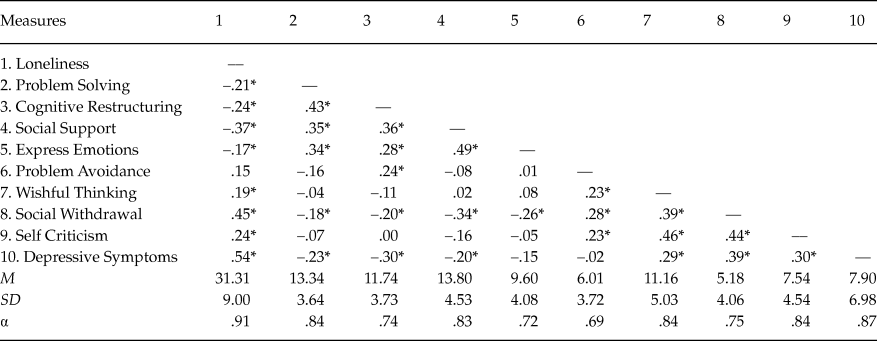
Given that the primary goal of the present study was not focused on examining gender, all analyses control for gender given that findings from past studies have sometimes pointed to gender differences in the present variables (e.g., coping; Ptacek, Smith, & Dodge, Reference Ptacek, Smith and Dodge1994). Partial correlations controlling for gender between all measures are presented in Table 1. However, given the high number of correlations computed, we adjusted significance levels accordingly using a Bonferroni adjustment. Thus, to reach a significance level of p ≤ .05 with 45 correlations computed, a significance level of p ≤ .001 would need to be reached.
Correlations between Loneliness, Coping Strategies, and Depressive Symptoms among Spanish Young Adults, Controlling for Gender

Note: N = 364.
*p ≤ .001.
As this table shows, R-UCLA scores were negatively correlated with scores on the four engaged CSI scales (rs = –.17 to –.27, ps ≤ .001) and positively correlated with scores on three of the four disengaged CSI scales (rs = .19 to .45, ps ≤ .001). Moreover, R-UCLA scores were positively correlated with scores on the BDI–II (r = .54, p ≤ .001). Similarly, scores on three of the four engaged CSI scales (exception was Express Emotion scale) were negatively correlated with scores on the BDI–II (rs = –.20 to –.30, ps ≤ .001), and scores on three of the four disengaged CSI scales (exception was Problem Avoidance scale) were positively correlated with scores on the BDI–II (rs = .29 to .39, ps ≤ .001).
Examining Specific Coping Strategies as a Potential Mediator of the Link between Loneliness and Depressive Symptoms in Spanish Young Adults
To examine for the potential role of coping strategies as potential mediators, we tested a hypothesized multiple mediation model, involving the four engaged and four disengaged coping strategies as potential mediators of the link between loneliness and depressive symptoms. We used Preacher and Hayes’ (Reference Preacher and Hayes2008) bootstrapping methods for detecting total indirect effects and specific indirect effects when multiple mediators are involved in the prediction model. Bootstrapping with 10,000 resamples was used to obtain parameter estimates for both total and specific indirect effects. If the 95% bias-corrected confidence interval does not contain a zero, then the indirect effect is considered statistically significant and mediation is demonstrated (Preacher & Hayes, Reference Preacher and Hayes2008). Finally, to determine if the full model involving loneliness and coping strategies accounted for a small, medium, or large amount of the variance in depressive symptoms, we used the following conventions for small (f 2 = .02), medium (f 2 = .15), and large effects (f 2 = .35).
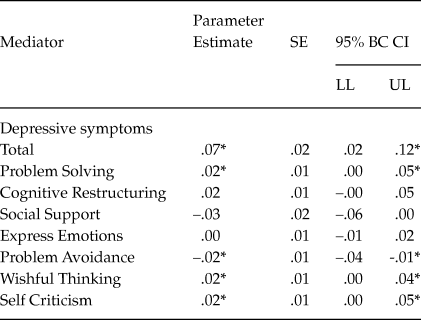
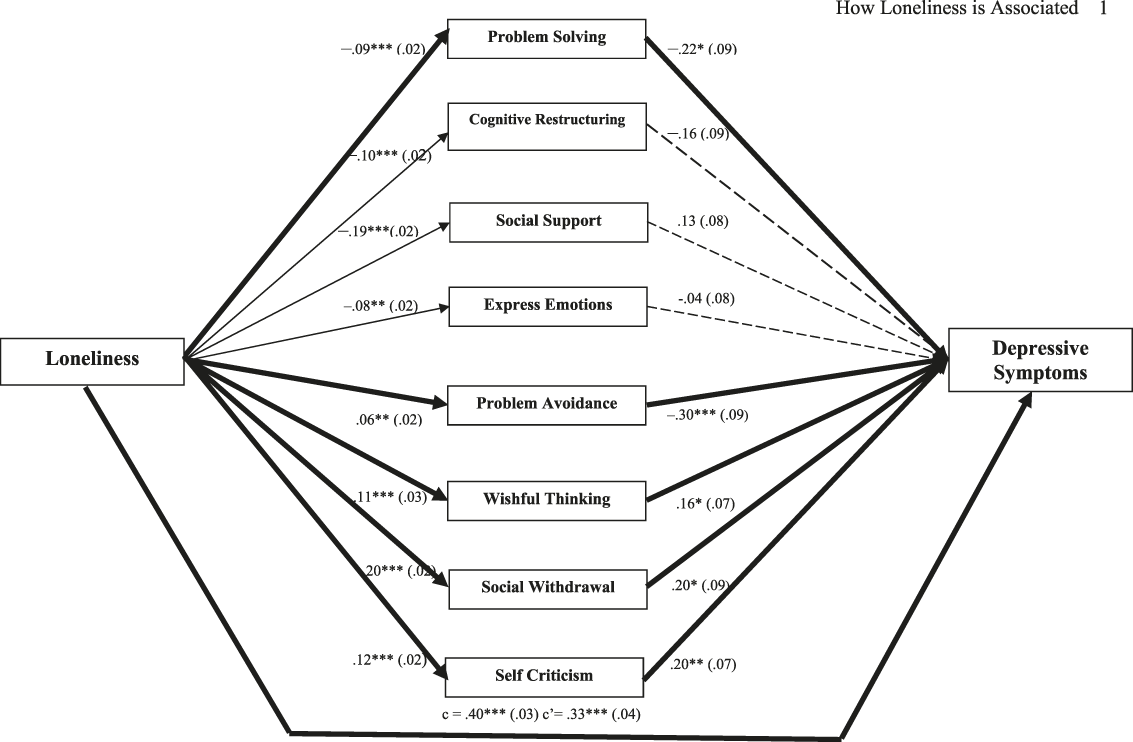
Results of computing parameter estimates for detecting total and specific indirect effects (controlling for gender) on the relation between loneliness and depressive symptoms as mediated by coping strategies are presented in Table 2. As the table shows, the total indirect effect, as well as the specific indirect effects involving one engaged coping strategy, namely, problem solving, and all four disengaged coping strategies, namely problem avoidance, wishful thinking, social withdrawal, and self-criticism, were found to be significant (p < .05). As shown in Figure 2, we found evidence for partial mediation. Specifically, the hypothesized effects of mediation for the one engaged coping strategy was significant, as problem solving was negatively related to loneliness (B = –.09), as well as negatively related to depressive symptoms (B = –.22). As noted above, the indirect effect involving the other three engaged coping strategies, namely, cognitive restructuring, social support and express emotions, were not found to be significant. Additionally, hypothesized effects of mediation for all four disengaged coping strategies were significant, as problem avoidance, wishful thinking, social withdrawal, and self-criticism were positively related to loneliness (Bs = .06, .11, .20, and .12, respectively). Noteworthy, wishful thinking, social withdrawal, and self-criticism were positively related to depressive symptoms (Bs = .16, .20, and .20, respectively). In contrast, problem avoidance was negatively related to depressive symptoms (B = –.30). The overall model involving loneliness and coping (controlling for gender) was found to account for a large (f 2 = .68) 40.5% of the variance in depressive symptoms, F(10, 353) = 23.69, p < .001.
Indirect Effects of Loneliness by Coping Strategies, on Depressive Symptoms in Spanish Young Adults, Controlling for Gender

Notes: N = 364. BC CI = Bias-corrected confidence interval.
*p < .05.
Results of Analysis Testing for Coping Strategies as Potential Mediators of the Relation between Loneliness and Depressive Symptoms in Spanish Young Adults. N= 364. *p < .05. **p < .01. ***p < .001.

Discussion
Given that most studies on loneliness have been based on elderly adults and the lack of studies examining for specific coping mechanisms that might help account for the association between loneliness and depressive symptoms, we conducted the present study to examine the relationship between loneliness, coping strategies, and depressive symptoms in young adults from Spain. Apart from the expected finding of a positive correlation between loneliness and depressive symptoms, our other correlational findings were consistent with our hypotheses. Specifically, we found that loneliness was associated with less use of engaged coping strategies, namely, problem solving, cognitive restructuring, social support, and express emotions, and with greater use of disengaged coping strategies, namely, problem avoidance, wishful thinking, social withdrawal, and self-criticism. Thus, these correlational patterns point to how loneliness is broadly involved in both engaged and disengaged types of coping strategies in Spanish young adults.
Coping Strategies as a Mediator of the Link between Loneliness and Depressive Symptoms in Spanish Young Adults
As discussed previously, although a positive association has been reliably found between loneliness and depressive symptoms in past studies of adults (e.g., Cacioppo et al., Reference Cacioppo, Hughes, Waite, Hawkley and Thisted2006; Chang, Reference Chang2017; Jaya et al., Reference Jaya, Hillmann, Reininger, Gollwitzer and Lincoln2017; Losada et al., Reference Losada, Márques-González, García-Ortiz, Gómez-Marcos, Fernández-Fernández and Rodríguez-Sánchez2012), little work has been done to examine for specific coping mechanisms that might help account for this important relationship (cf. Vanhalst et al., Reference Vanhalst, Luyckx, Teppers and Goossens2012). Based on the notion that coping represents an important transactional process by which individuals try to manage stressful situations encountered in their environment (Lazarus & Folkman, Reference Lazarus and Folkman1984), we tested a hypothetical mediation model in which the expected positive association to be found between loneliness and depressive symptoms might be accounted for by heightening the use of disengaged coping strategies and reducing the use of engaged coping strategies (Tobin et al., Reference Tobin, Holroyd, Reynolds and Wigal1989). In contrast to expectations, we found limited support for partial mediation involving engaged coping strategies. Specifically, only problem solving, but not cognitive restructuring, social support, nor express emotions, was found to mediate the association between loneliness and depressive symptoms in Spanish young adults. Thus, our findings suggest that being lonely might hamper the use of adaptive coping behaviors in Spanish young adults primarily by thwarting their ability to engage in efforts to directly solve their problems (e.g., not initiating a plan of action), which in turn enhance their risk for experiencing depressive symptoms.
Although it is not clear from the present findings why the other three engaged coping strategies did not serve to partially mediate the association between loneliness and depressive symptoms, there are a few possibilities that might be worth considering here. First, given that problem solving processes appear to be present in varying degrees in the other three engaged coping strategies (as indicated by our correlational findings), our findings might be taken to simply underscore the centrality of deficient problem-solving processes that can lead to depressive symptoms in young adults. Indeed, a number of studies examining problem-solving ability in adults have shown that problem-solving deficits are reliably associated with greater depressive symptoms (e.g., Bell & D’Zurilla, Reference Bell and D’Zurilla2009; D’Zurilla, Chang, Nottingham, & Faccini, Reference D’Zurilla, Chang, Nottingham and Faccini1998). Second, and relatedly, our findings might simply highlight how loneliness is involved in depressive symptoms through an asymmetrical pattern of behavior. That is, our findings indicate that loneliness involves the use of greater disengaged coping strategies, more than the use of less engaged coping strategies, in accounting for depressive symptoms in young adults. However, whether this asymmetrical pattern of behavior associated with loneliness is unique to the use of coping strategies in predicting depressive symptoms, relative to other negative affective conditions (e.g., anxiety, stress, & suicidal ideation; Chang, Reference Chang2017) remains to be clarified in future research.
Alternatively, consistent with our hypothesized model, we found support for partial mediation involving all four disengaged coping strategies. Specifically, problem avoidance, wishful thinking, social withdrawal, and self-criticism, were found to mediate the association between loneliness and depressive symptoms in Spanish young adults. These findings for wishful thinking, social withdrawal, and self-criticism are consistent with the notion that being lonely might facilitate the use of maladaptive coping behaviors in Spanish young adults by encouraging efforts to think away the problem (e.g., wishing the problem would just disappear), withdraw from others (e.g., not seeking support from others to help resolve the problem), criticize themselves (e.g., blame themselves for having a problem), which in turn also adds to their greater risk for experiencing depressive symptoms. Thus, these preliminary findings are consistent with the notion that loneliness leads to depressive symptoms, in part, by activating the use of maladaptive coping strategies, specifically, wishful thinking, social withdrawal, and self-criticism, and by deactivating the use of one specific adaptive coping strategy, namely, problem solving.
One interesting finding, however, involved problem avoidance. Specifically, as noted above, although loneliness was associated with greater use of this disengaged form of coping, problem avoidance was in turn found to be associated with less depressive symptoms. One possible explanation for this unexpected finding is that problem avoidance might not always represent a maladaptive form of coping for Spanish young adults, and thus, may not always lead to incurring negative outcomes. Indeed, there is some evidence to suggest that in some contexts, avoidance-based coping, rather than approach-based coping, might be more effective when dealing with certain volatile conditions or situations (e.g., interpersonal violence; Weiss, Duke, & Sullivan, Reference Weiss, Duke and Sullivan2014). Relatedly, in a recent study of avoidance coping, Stemmet et al. (Reference Stemmet, Roger, Kuntz and Borrill2015) showed that avoidance coping can be parsed down to components involving general behavioral avoidance, emotional avoidance, and conflict avoidance. Given that items tapping into problem avoidance as measured on the CSI do not distinguish between these different components (e.g., “I didn’t let it get to me; I refused to think about it too much”), it would be useful in future studies to determine if different types of avoidance coping (e.g., emotional avoidance vs. conflict avoidance) might prove to be more or less adaptive in accounting for the relationship between loneliness and depressive symptoms in Spanish young adults.
Finally, our findings suggest some possible implications for practice. Specifically, our findings suggest that in addition to working with Spanish young adults to directly reduce their experiences of loneliness (e.g., treatments targeting maladaptive social cognitions; Cacioppo, Grippo, London, Goossens, & Cacioppo, Reference Cacioppo, Cacioppo, Capitanio and Cole2015), our mediation results point to, for example, the added usefulness of helping lonely Spanish young adults work on changing their ways to manage stressful situations, namely, helping Spanish young adults improve their skills at problem solving (e.g., problem-solving skills training; D’Zurilla & Nezu, Reference D’Zurilla and Nezu2006), as well as helping them learn to avert from being socially withdrawn, self-critical, or harboring fantasies that drain motivation for action (Kappes & Oettingen, Reference Kappes and Oettingen2011). Future studies that help clarify the potential interplay between external processes (e.g., coping behaviors) and internal processes (e.g., HPA axis activity; Cacioppo, Cacioppo, Capitanio, & Cole, Reference Cacioppo, Cacioppo, Capitanio and Cole2015) would be useful in developing a more comprehensive understanding of how loneliness is related to greater mortality and morbidity in adults.
Despite these important findings pointing to how coping strategies account for some of the variance in the relationship between loneliness and depressive symptoms in young adults, it is important to note some limitations. First, given our focus on young adults, it remains unclear if coping strategies represent an important mediator of the link between loneliness and depressive symptoms in younger populations (e.g., children & adolescents). Second, in the present study we focused on the study of the relationship between loneliness and depressive symptoms. Because loneliness has been implicated in a wide range of negative affective conditions (e.g., anxiety & mental disorders), it would be useful to test the explanatory power of our hypothesized mediation model in predicting other important outcomes in young adults. Third, given that the present sample was based on young adults attending college in Spain, it would be important to determine if similar findings would emerge when studying young adults from other Western or European countries (e.g., USA, Germany, & Hungary) as well as Eastern or Asian countries (e.g., China, Korea, & Japan). Lastly, given the cross-sectional design of the present study, it would be useful in the future to conduct longitudinal studies to determine if loneliness is prospectively associated with changes in coping strategies, which in turn are associated with changes in depressive symptoms.
Overall, the present findings are the first to not only implicate the role of loneliness in the coping strategies used by Spanish young adults, but also point to the usefulness of coping strategies as possible mechanisms by which loneliness might lead to greater risk for depression in Spanish young adults. In general, independent of gender, our findings highlight how the use of less problem solving, and the use of greater disengaged coping strategies, namely, greater wishful thinking, social withdrawal, and self-criticism, account for part of the relationship between loneliness and depressive symptoms in Spanish young adults. Building on these preliminary, but important findings, future studies should continue to investigate the importance of transactional processes (e.g., social problem solving, interpersonal behavior, & stress appraisal) that might be involved in the link between loneliness and other negative affective conditions in Spanish young adults.