Introduction
Deep-water shrimps are one of the foremost high-priced groups of invertebrates in the global fishery sector, and they are widely distributed throughout the tropics. These marine shrimps occupy a prominent position in the economy of the South-east Asian region due to their high export value (Shanis, Reference Shanis2014). Deep-water shrimps landed at India's south-west coast are an assemblage of various families, the prominent being Pandalidae, Aristeidae, Solenoceridae and Penaeidae. In 2019, the landings of 64,840 tonnes of crustacean resources constituted 10% of the total marine fish landings of the Indian subcontinent. About 77.8% of these constituted penaeid shrimps, and non-penaeid shrimps about 12.1% (CMFRI, 2019).
Deep-water shrimps contain lower amounts of saturated fatty acids (SFA) and higher amounts of C 20–22 n-3 polyunsaturated fatty acids (PUFAs), principally docosahexaenoic acid (22:6n-3, DHA) and eicosapentaenoic acid (20:5n-3, EPA). These particular fatty acids function as precursors for anti-inflammatory prostaglandins and resolvins (E and D-types) (Chakraborty et al., Reference Chakraborty, Chakkalakal and Joseph2014a). Deep-water shrimps and other shellfish species also have antithrombotic effects, and play important pathophysiology roles in preventing hypertension, inflammation, diabetes and cancer (Ramezani-Fard et al., Reference Ramezani-Fard, Kamarudin, Arshad, Goh and Ebrahimi2016; Chakraborty et al., Reference Chakraborty, Krishnan and Joy2020; Krishnan et al., Reference Krishnan, Chakraborty and Dhara2021). Hence, deep-water shrimps have gained greater acceptance as human food due to their nutritional qualities, principally C 20–22 n-3 PUFAs (Chakraborty et al., Reference Chakraborty, Krishnan, Chakraborty and Vijayagopal2021, Reference Chakraborty, Krishnan, Chakraborty and Vijayagopal2022). But despite their importance as a major fishery resource in the Arabian Sea and off the Indian coast, very little is known about the fatty acid constituents of the commonly available deep-water shrimps and their seasonal variation. In the present study, the differences in the fatty acid profile of the edible parts (muscle) of five commonly available deep-water shrimps Aristeus alcocki, Solenocera choprai, Heterocarpus chani and Plesionika quasigrandis are analysed during the months spanning from September 2018–April 2019.
Both season and seawater temperature have predominant roles in determining the fatty acid composition and lipids in crustaceans (Tziouveli & Smith, Reference Tziouveli and Smith2012). For instance, greater contents of short-chain PUFAs were found in Palaemon serrutus cultured at higher water temperature (Martin & Ceccaldi, Reference Martin and Ceccaldi1977) and Litopenaeus vannamei harvested in warmer months of the year contain greater amounts of SFA and linoleic acid (18:2n-6) (Montano & Navarro, Reference Montaño and Navarro1996). The specific aim of the study was therefore to assess the comparative fatty acid profiles during the months spanning from September 2018–April 2019. As sexual and seasonal variations could affect the fatty acid composition (Sriket et al., Reference Sriket, Benjakul, Visessanguan and Kijroongrojana2017), the rationale of this study was furthermore to establish the effects of season and sex on the fatty acid composition.
Materials and methods
Study area and samples
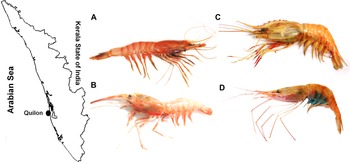
Three deep-water shrimp samples were collected by commercial shrimp trawlers operated along the Arabian Sea (9–11°N 72–76°E) (Figure 1). The deep-water shrimps were caught at depths between 200–400 m, while those residing at comparatively lesser deep-water were caught at depths of 100–150 m during the period of peak availability between September 2018 and April 2019. The samples were collected on the 15th day of each month. In order to obtain information on the seasonal variations, the monthly data were grouped as pre-monsoon (March–April), post-monsoon (September–November) and winter (December–February). There were no landings of shrimp during May–August. The samples were cleaned, and the shells removed, whereafter the whole-body muscles from the body were minced to acquire a homogeneous sample. The studied shrimps were identified as consistent with the characteristics delineated by Pérez Farfante & Kensley (Reference Pérez Farfante and Kensley1997).
Representative photographs of the commonly available deep-water shrimps, Aristeus alcocki (A), Solenocera choprai (B), Heterocarpus chani (C) and Plesionika quasigrandis (D) collected by commercial deep-sea trawlers operating off Quilon (Kerala State), along the south-west coast of peninsular India.

Fatty acid analysis
The fatty acid composition was evaluated by a previously described process (Chakraborty et al., Reference Chakraborty, Joseph and Chakkalakal2014b). The edible part of each species (total of 30 g) was used for extraction of lipids and further analysis of fatty acid compositions. Briefly, the lipid fraction was extracted by chloroform:methanol mixture (1:2, v/v) before saponification and trans-esterification to obtain fatty acid methyl esters (FAMEs). FAMEs were extracted with n-hexane/water (1:2, v/v). The resultant mixture was separated using a separating funnel; the aqueous layer was removed and the n-hexane layer was collected. The n-hexane layer was dried through anhydrous sodium sulphate before being concentrated. The esterified fatty acids were analysed in a gas-liquid chromatograph (HP 5890 Series II; AutoSystemXL Perkin-Elmer, USA) fitted with a SP®2560 capillary column (cross-bond 95% dimethyl-polysiloxane with 5% diphenyl substitution, 100 m × 0.25 mm, 0.50 μm, Supelco, Bellfonte, USA) by a flame ionization detector (FID) containing a split/splitless injector that was utilized in the split (1:15) mode. The temperature was ramped as 140 °C for 1 min, going up at 30 °C min−1 to 250 °C, where it was retained for 1.0 min, trailed by an increase of 25 °C min−1 to 285 °C, where it was retained for 2.0 min, up until entire peaks were observed. The detector and injector were retained at 290 and 280 °C, respectively. Nitrogen (ultra-high purity > 99.99%) and hydrogen were utilized as the carrier gas at 25 cm s−1 flow rate and at a head pressure of 20 psi, respectively. FAMEs were analysed by comparing to retention times of known standards (SupelcoTM 37 FAME Mix). Results were designated as a per cent of total identifiable fatty acids (% TFA).
Fatty acid nutritional indices
Various fatty acid ratios signifying nutritional standards of deep-water shrimps, viz. DHA/EPA, n-3/n-6 and PUFA/SFA were assessed and compared with the UK Department of Health recommendations (HMSO, 2001). The mean value of individual fatty acids was utilized to determine the summation of SFA, MUFA and PUFA.
Indices of thrombogenicity (TI) and atherogenicity (AI) were calculated as (Ulbricht & Southgate, Reference Ulbricht and Southgate1991; Chakraborty et al., Reference Chakraborty, Joseph, Chakkalakal and Stephy2015, Reference Chakraborty, Chakkalakal, Joseph and Joy2016):


Data analyses
Fatty acid data of the species and months was tested for normality assumption and outliers were removed before further analysis. Two-way MANOVA was performed to examine any significant differences between the fatty acid compositions between the species and months. The interaction effect of months on species was also assessed along with the main effect using MANOVA. MANOVA post-hoc analysis was performed using linear discriminant analysis (LDA) to visualize the separation in fatty acid profile among the species and months by plotting the LDA scores of observations in the bivariate space of LD 1 and LD 2 and by visual discrimination of groups through 85% confidence ellipses. All the statistical analysis was performed using R statistical software package, Boston, MAR Studio, Version 1.4.1106, release name: Tiger Daylily (Reference Team2021).
Results
General
Seasonal differences of fatty acid constituents in A. alcocki, S. choprai, H. chani and P. quasigrandis are shown in Tables 1–4 and Figures S1–S2. Noticeably, the dominating fatty acids were the saturated fatty acid 16:0, the mono-unsaturated oleic acid (18:1n-9), and the two polyunsaturated fatty acids EPA (20:5n-3) and DHA (22:6n-3). Also, EPA and DHA topped in December–January for both females and males in all species.
Seasonal variability of fatty acid composition of the edible tissues of A. alcocki

a Individual fatty acids were expressed as percentage of total identifiable fatty acids (TFA).
b ΣSFA, total saturated fatty acids.
c ΣMUFA, total monounsaturated fatty acids.
d ΣPUFA, total polyunsaturated fatty acids. Data were presented as mean values of three samples (mean ± standard deviation).
Saturated fatty acids
16:0 constituted 13–17% TFA (total fatty acids) in the males, and 12–20% TFA in the females of A. alcocki, 13–16% TFA in the males and 13–20% TFA in the females of S. choprai, 10–21% TFA in the males and 14–22% TFA in the females of H. chani, and 15–18% TFA in the males and 14–17% TFA in P. quasigrandis females. In A. alcocki and S. choprai mean total content of 16:0 was lower during December–February (11–17% and 13–20% TFA, respectively), and slightly higher during the pre-monsoon months of March and April (15–20% and 15–17% TFA, respectively) (Tables 1 and 2). Correspondingly, the mean total content of 16:0 in H. chani was significantly higher in those captured during March and April in the females (17–22% TFA) than in males (10–20% TFA). Results of statistical tests of total content of SFA among the studied species showed significant difference of this fatty acid between those caught during the months of April and November through February (P < 0.0001), whereas those captured during the month of March displayed significant difference with those collected in November through January (P < 0.0001). The male of H. chani exhibited significant difference of the SFA content with the same sex of S. choprai (P < 0.0001) through the study period.
The samples collected during March and April exhibited the highest content of total SFA in the studied species, wherein the females contained comparatively more SFA (32–43% TFA) than the males (29–36% TFA) during these pre-monsoon months (Tables 1–4). In females of A. alcocki caught during January–April, as well as September to November, the content of 16:0 was considerably greater than those of the males. Likewise, 16:0 was considerably higher in females (13–20% TFA) than males (up to 16% TFA) of S. choprai during all sampling months with a peak in January–February. The samples collected during the pre-monsoon months recorded a peak (8–17% TFA) of 16:0 in H. chani. Stearic acid (18:0) was the second most abundant SFA, and as in 16:0, the samples collected during the pre-monsoon months had a higher content: A. alcocki (7–10% TFA), H. chani (8–17% TFA) and P. quasigrandis (7–11% TFA). However, in S. choprai, the content of 18:0 was higher during September–December and March–April (5.45–8.50% TFA) of the studied year.
Monounsaturated fatty acids
The MUFAs exhibited a similar trend as the SFA, showing a decreased presence (<40% TFA) in the samples of A. alcocki and S. choprai caught during the winter months (December and February), and thereafter, a continuous increase (40–45% TFA) during the pre-monsoon season (Figure S1). Females collected during the pre-monsoon months of March and April contained considerably higher levels of MUFA (~ 44% TFA) than males (~ 40% TFA). The amount of total MUFAs was greater during the months of January–April (33–43% TFA) and February (~ 45% TFA) in H. chani and P. quasigrandis, respectively. As in A. alcocki and S. choprai, MUFAs decreased (<30% TFA) in H. chani caught during the winter months (December–January), and thereafter, continuously increased (30–42% TFA) during February–April. Males caught during February had considerably higher MUFA levels (45% TFA) than females (44% TFA) in P. quasigrandis.
Oleic (18:1n-9) and palmitoleic acid (16:1n-7) were the main fatty acids in both sexes of four species. The contents of these fatty acids were noticeably higher during summer (March and April), in A. alcocki and S. choprai, respectively, while the concentrations were highest in the months of January–April in both sexes of H. chani and P. quasigrandis. Notably, female A. alcocki, S. choprai and H. chani showed increasing levels of MUFA, as well as 18:1n-9 during the pre-monsoon months (March and April), and also during September–November, even though their contents were gradually decreased in the females, and displayed an increasing occurrence in the male population during the winter months (December–February). Results of statistical tests of total content of MUFA among the studied species showed its significant difference between those caught during March to February and December (P < 0.0001), whereas those captured during the month of December displayed significant difference with those caught in April and October (P < 0.001). The males of H. chani displayed significant difference in the total MUFA content with S. choprai females (P < 0.001) and males (P < 0.001) through the study period.
Polyunsaturated fatty acids
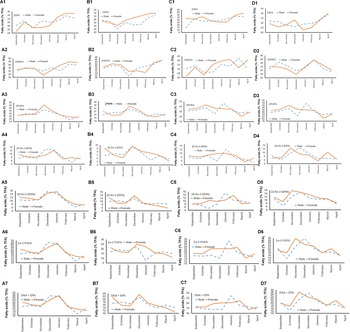
n-3 fatty acids followed by n-6 constituted the largest fraction of the PUFAs, regardless of sexes and seasons, the fatty acid composition of these species thus making them a source of high-health food (Figure 2).
Seasonal trends in variability of total saturated fatty acids (∑SFA), total monounsaturated fatty acids (∑MUFA), total polyunsaturated fatty acids (∑PUFA), EPA (20:5n-3), DHA (22:6n-3), total n-3 PUFAs (∑n-3 PUFAs), cumulative EPA (20:5n-3) and cumulative DHA (22:6n-3) in the edible tissues of Aristeus alcocki (A1–A7), Solenocera choprai (B1-B7), Heterocarpus chani (C1–C7), and Plesionika quasigrandis (D1–D7).

The mean total PUFA of A. alcocki and S. choprai captured during the winter months (December–February) was up to 46% and 27–34% TFA, respectively, 18–25% TFA in those caught during March and April and 22–30% TFA in those caught during September–November. The mean total PUFA of H. chani and P. quasigrandis caught during the winter months (December–January) were up to 29–35% TFA, 20–27% TFA during the pre-monsoon (March and April) and 19–28% TFA during (20–27% TFA), and also September–November. In all species, females caught during December–February showed considerably higher total PUFA content (29–46% TFA) than males (≤37% TFA).
The total n-3 PUFAs were considerably higher in A. alcocki and S. choprai captured during December and January (18–28% TFA), than those in September to November (≤22% TFA), whereas the lowest was recorded during March and April (11–17% TFA). In H. chani and P. quasigrandis they were considerably higher during November–January (19–29% TFA) than September–November (13–22% TFA), whereas the lowest was recorded during March and April (≤21% TFA). Results of statistical tests of total PUFA among the studied species showed a significant difference between those caught in March/April and November–January, whereas those captured during the month of December displayed significant difference with those collected in February–March (P < 0.0001). However, no significant difference in total PUFA content was apparent between different sexes (male and female) of the deep-water shrimp species through the study period.
DHA was higher than EPA in all four species, independent of season and sex. Mean DHA content of A. alcocki during December–February (up to a peak of 15.5% TFA) were considerably greater values than in other months. Notably, the DHA contents in the females during September and October were considerably higher (~12% TFA) than in males (~10% TFA). However, the DHA contents in the females exhibited a comparative reduction during November and December (10.5 and 14.5% TFA, respectively) than those in the male population (up to 15.6% TFA). Thereafter, this C 20 n-3 fatty acid exhibited an increasing trend in the females (15.5% TFA in January) compared with that in the males (14.5% TFA). The reduction in the content of DHA was observed in the edible part of the studied species during the period spanning during November–December. Additionally, female S. choprai captured during December had a higher amount of DHA (~14% TFA) than that in males (12% TFA). The male samples of S. choprai captured during February–April recorded the presence of a higher level of DHA than the females. In P. quasigrandis, the mean DHA content was considerably higher during the winter months (up to a peak of 11–16% TFA). Results of statistical tests of DHA and EPA among the studied species showed its significant difference between those captured during March/April and December/January, whereas those caught during the month of December displayed significant difference with the deep-water shrimp species captured in March and October (P < 0.0001). The males of H. chani exhibited significant difference with the females of P. quasigrandis (P < 0.05) and females of the same species (P < 0.01) through the study period.
The content of EPA remained constant during September–November (<10% TFA) until a considerable increase during the winter season (December–February) in A. alcocki, S. choprai and H. chani. Likewise, the EPA was higher during December–February in both sexes of P. quasigrandis (10–13% TFA). During December–February, male A. alcocki had a conspicuously greater level of EPA than the females. Likewise, during September–October, male S. choprai had considerably higher levels of EPA than females. This was also the case in A. alcocki captured during November–December. The highest contents of n-3 PUFAs in females of A. alcocki and S. choprai were found during November–January. However, no significant difference in the EPA content was apparent between different sexes (male and female) of the deep-water shrimp species caught through the study period.
Linoleic acid (18:2n-6) was the most important n-6 PUFA in A. alcocki during the studied period irrespective of the sexual differences (1–2% TFA) (Figure 2). Considerably higher content of this critical fatty acid was perceived in the females (~ 6% TFA) than in the males (0.8–5% TFA) of S. choprai caught during the study period. Linoleic acid was also the most important n-6 PUFA in H. chani and P. quasigrandis caught during the studied seasons (2–4% and 0.7–2.5% TFA, respectively). There were no notable differences in concentrations of linoleic acid in the edible part of A. alcocki, S. choprai, H. chani and P. quasigrandis. Arachidonic acid was one of the major n-6 PUFAs in P. quasigrandis.
Variability of fatty acid indices
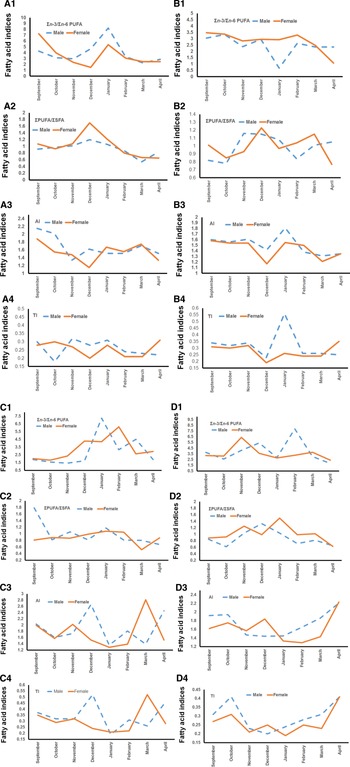
The n-3/n-6 ratio, which is an indicator of biomedical importance, was in the range 2–8 in A. alcocki throughout the study period. Among the studied deep-water shrimps. A. alcocki was found to possess considerably greater amount of n-3 fatty acids, such as DHA and EPA along with optimal n-3/n-6 polyunsaturated fatty acid ratio. Thus, this deep-sea species, often termed as ‘red ring’ of the ocean, could be more highly beneficial for human nutrition than other common shrimp species. The n-3/n-6 ratio showed no noticeable difference in the samples of male and female sexes and was considerably higher during September–November (~3–4 in males and 2–7 in females) as well as in the months of December–February (~3–8 in males and 2–5 in females; Table 1). The n-3/n-6 ratio was also in the range of 2–8 in S. choprai throughout different seasons, showed no remarkable differences between the samples of either sex and was considerably higher during December–February (3–3.3 in males and 3.4–3.5 in females) (Table 2). In this species, the PUFA/SFA ratio was higher during December–February (0.8–1.2) owing to the considerably greater contents of PUFAs. The n-3/n-6 ratio was 1.5–7.3 in H. chani throughout different months of the study period showed no conspicuous difference in males and females, but was considerably higher during the colder months (2.5–7.3 in males and 2.4–6.1 in females) (Table 3). The n-3/n-6 ratio was 2–8 in P. quasigrandis throughout the studied period. A greater content of the n-3/n-6 ratio was recorded in the males during December (5.41), whereas for females the n-3/n-6 ratio was higher during November (6.38), even though either males or females displayed a larger n-3/n-6 ratio during the winter months (Figure 3, Table 4).
Seasonal variability of fatty acid composition of the edible tissues of S. choprai

The notations and abbreviations are as those indicated in the footnote of Table 1.
Seasonal variability of fatty acid composition of the edible tissues of H. chani

The notations and abbreviations are as those indicated in the footnote of Table 1.
Seasonal variability of fatty acid composition of the edible tissues of P. quasigrandis

The notations and abbreviations are as those indicated in the footnote of Table 1.
Seasonal trends in variability of fatty acid indices in Aristeus alcocki (A1–A4), Solenocera choprai (B1–B4), Heterocarpus chani (C1–C4), and Plesionika quasigrandis (D1–D4). TI is thrombogenicity index and AI is atherogenicity index.

The PUFA/SFA ratio was maximum during December–February in A. alcocki (0.9–1.2 and 0.8–1.7, in males and females, respectively), S. choprai (0.8–1.2), H. chani (0.68–1.79 and 0.52–1.08 in males and females, respectively) and P. quasigrandis (0.6–1.5) owing to the considerably greater contents of PUFAs during the colder period, and thereafter, exhibited a gradual decline through March and April.
Indices of atherogenicity (AI) and thrombogenicity (TI) were 1.15–2.15 and 0.18–0.31, respectively in A. alcocki and 1.2–1.8 and 0.2–0.6, respectively, in S. choprai (Tables 1 and 2). Likewise, the AI and TI indices of the edible parts of P. quasigrandis (1.3–2.2 and 0.2–0.4, respectively) were also optimal (Table 4).
Fatty acid cluster analysis using two-way MANOVA
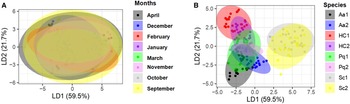
The fatty acid composition using two-way MANOVA showed statistically significant differences between the species and months. Furthermore, there were significant interaction effects of months with the species (sps) (Wilk's lambda = 0.000001; F = 187.8, P < 0.0001). Moreover, the output of two-way ANOVA (using species and months as independent nominal factors) for each of the dependent variables (fatty acid) also designated significant differences in fatty acid composition. Further post hoc analysis showed the overlapping of all the species in all the months as depicted in the linear discriminant analysis (LDA) plot (Figure 4a, 4b). Detailed analysis of the LDA plot to elucidate month and species-wise variation in fatty acid profile revealed that the first linear discriminant (LD1) explained 59.5% while the second linear discriminant explained 21.7% of the total variance with higher significance (P < 0.0001; Wilks value = 00009). The plot displayed the overlapping of all the analysed species in one cluster except for S. choprai, which is a penaeid deep-sea shrimp available at a different depth compared with other deep-water species. The fatty acid composition of A. alcocki and H. chani showed greater variance compared with that in P. quasigrandis. The variation was mainly attributed to the major five fatty acids (DHA + EPA 26.5% of explained variances, 22:6n-3 16.9%, n-3 PUFA 13%, 20:5n-37.3%, PUFA 5.7%), particularly in the A. alcocki female (Aa2), P. quasigrandis female (Pq2), and H. chani male (Hc1) species (Kruskal–Wallis test, P > 0.05) (Figure S3). However, the fatty acid profile in different months showed a homogeneous cluster with significant variations during the months of January, March, October and December.
Linear discriminant analysis (LDA) score plots with 95% confidence ellipses presenting the classification of fatty acid composition and months (A); classification of fatty acid composition and species (B). Abbreviations used: Aa1, A. alcocki (male); Aa2, A. alcocki (female); Hc1, H. chani (male); Hc2, H. chani (female); Pq1, P. quasigrandis (male); Pq2, P. quasigrandis (female); Sc1, S. choprai (male); Sc2, S. choprai (female).

Discussion
Deep-water shrimps are considered delicious seafood, and they constitute an important part of the diet. Apart from their delicacy, they are considered rich sources of long-chain C 20–22 n-3 PUFAs, which have significant value for human health (Ramezani-Fard et al., Reference Ramezani-Fard, Kamarudin, Arshad, Goh and Ebrahimi2016). Lipids and fatty acids are crucial to maintain the physiological integrity of cellular membranes and carriers of lipid-soluble vitamins (Bhavan et al., Reference Bhavan, Devi, Shanti, Radhakrishnan and Poongodi2010). The fatty acid composition is affected by differences in species, spawning cycle, sex and water temperature (Sriket et al., Reference Sriket, Benjakul, Visessanguan and Kijroongrojana2007). The palmitic acid (16:0) is recognized to be a major source of metabolic energy during formation of eggs in the females (Ramezani-Fard et al., Reference Ramezani-Fard, Kamarudin, Arshad, Goh and Ebrahimi2016). In the present study, the major fatty acids were 16:0, stearic acid (18:0), palmitoleic acid (16:1n-7), oleic acid (18:1n-9), arachidonic acid (20:4n-6), EPA (20:5n-3) and DHA (22:6n-3) comparable with other species (Yanar & Celik, Reference Yanar and Celik2005). These fatty acids are reported to be the principal constituents in the muscle of shrimp species, such as Penaeus kerathurus, Penaeus semisulcatus and Palinurus vulgaris (Saglik & Imre, Reference Saglik and Imre1997; Tsape et al., Reference Tsape, Sinanoglou and Miniadis-Meimaroglou2010). Long-chain n-3 PUFAs, such as EPA and DHA are recognized for their role to improve cardiovascular health, and are critical for foetal growth (Swanson et al., Reference Swanson, Block and Mousa2012). DHA is a component of the phospholipid membrane of the retina and brain needed for the development of the visual and cognitive structures, whereas EPA is the precursor of anti-inflammatory prostaglandins and leukotrienes (Chakraborty et al., Reference Chakraborty, Chakkalakal and Joseph2014a). Dietary intake of DHA and EPA can also be associated with a lower risk of depression, whereas the ratios of n-3/n-6-PUFA and PUFA/SFA are used to evaluate the nutritional value of lipids, as well as consumer's health (McNamara, Reference McNamara2016). Amount of DHA and EPA required to meet daily requirement for healthy children, adolescents and adults from the edible tissues of the studied deep-water shrimps are illustrated in Tables S1–S4.
Among the penaeid shrimps, females of A. alcocki and S. choprai exhibited higher content of total SFA during March and April than males. A comparable tendency was seen in Paleomon serratus, Penaeus semisulcatus and Metapenaeus monoceros during similar seasons (Soriguer et al., Reference Soriguer, Serna, Valverde, Hernando, Martín-Reyes, Soriguer, Pareja, Tinahones and Esteva1997; Yanar & Celik, Reference Yanar and Celik2005). Spawning-associated variations of fatty acid 16:0 in female marine fish were previously reported (Huynh et al., Reference Huynh, Kitts, Hu and Trites2007), which might be correlated with the comparatively greater amount of C16-saturated fatty acid in the edible part of female deep-water penaeid shrimps (A. alcocki and S. choprai) than those of males in the same sampling months. Studies of ovarian maturation have shown that A. alcocki displays year-round spawning, with a peak during January–April (Chakraborty et al., Reference Chakraborty, Purushothaman, Maheswarudu, Kuberan, Sreesanth and Ragesh2018; Paramasivam et al., Reference Paramasivam, Chakraborty, Gidda, Ganesan, Ponnathara Kandankoran, Laxmanan and Nadakkal2018). The predominant source of energy for growing marine fishes and crustaceans were SFAs, particularly 16:0 owing to considerably higher caloric values (Henderson et al., Reference Henderson, Sargent and Hopkins1984; Chandrani et al., Reference Chandrani and and Wattavidanage2016). Notably, the concentration of SFA has been reported to increase through periods of greater feeding activity (Shirai et al., Reference Shirai, Terayama and Takeda2002). On the contrary, the SFAs were lesser during September–January in A. alcocki, indicating that these storage fatty acids might be degraded to supply energy to the crustacean during this period of lesser feeding activity. A greater content of SFA was found in H. chani in the summer season, which is in accordance with the higher share of SFAs in Penaeus vannamei post-larvae during this period (Montaño & Navarro, Reference Montaño and Navarro1996). A greater 16:0 content in the females of deep-water non-penaeid shrimp H. chani in the same sampling months could be associated with the occurrence of spawning. Alteration in SFAs between different seasons in this study can be described by the variability of the lipid content that depends on the period of the year, species, reproduction period and dietary fatty acid composition.
Among the MUFAs, oleic acid has been recognized for energy metabolism during the development of gonads (Huynh et al., Reference Huynh, Kitts, Hu and Trites2007). The deep-water shrimps possessed oleic acid as the major MUFA, and these findings were in accordance with the previous records that the most important MUFA in marine lipids typically contains 18 carbon atoms (Zlatanos & Laskaridis, Reference Zlatanos and Laskaridis2007). The amount of 18:1n-9 in the muscle of deep-water shrimps was higher than 16:1n-7, which was in agreement with earlier studies on penaeid shrimps (Montaño & Navarro, Reference Montaño and Navarro1996; Yanar & Celik, 2005; Ouraji et al., Reference Ouraji, Shabanpour, Kenari, Shabani, Nezami, Sudagar and Faghani2009).
As in other marine decapods, the n-3 series was dominated by EPA and DHA, whereas γ-linolenic acid, linoleic acid and arachidonic acid were the prominent n-6 series of PUFAs (Yanar & Celik, Reference Yanar and Celik2005). The total PUFA was considerably higher in the colder months as observed in Penaeus semisulcatus, P. vannamei, P. kerathurus and Metapenaeus monoceros (Montaño & Navarro, Reference Montaño and Navarro1996; Soriguer et al., Reference Soriguer, Serna, Valverde, Hernando, Martín-Reyes, Soriguer, Pareja, Tinahones and Esteva1997; Yanar & Celik, Reference Yanar and Celik2005). Similarly, the content of EPA + DHA in the edible part of the studied deep-water shrimps was maximum during the winter months of December–February, apparently on account of the comparatively reduced temperature leading to the up-regulation in the desaturase/elongase to biosynthesize greater contents of C 20–22 n-3 PUFAs.
Further, the LDA plot showed the overlapping of the fatty acids derived from all the shrimps in a single cluster except that in S. choprai in all the months except for January, March, October and December, which can be correlated with the spawning period of these shrimps during these months. Data used for two-way MANOVA to find significant differences in fatty acid composition among species and months other than mean fatty acid data (expressed as percentage of total identifiable fatty acids) to determine the significant variation among the studied species, sex, and months are shown in the Supplementary material (Tables S5–S7). The results of ANOVAs of total PUFA, DHA plus EPA, DHA and EPA individually, besides MUFA and SFA among the studied species, sex and months are illustrated in Supplementary Tables S8–S13. Generally, fatty acid profiles show variation during their spawning and breeding period, which in turn, can be correlated with their specific feeding activities (Chakraborty et al., Reference Chakraborty, Joseph, Chakkalakal and Stephy2015, Reference Chakraborty, Chakkalakal, Joseph and Joy2016). The results of the LDA plot with fatty acid profiles and species indicated the formation of single cluster in all the species analysed except for S. choprai forming a separate cluster with greater distances. The reason can be attributed to the habitat differences between the species. Noticeably, S. choprai is fished at lower depths in comparison to other species, whereas the greater variability in the diet composition at this depth could lead to the variability in the fatty acid composition of the edible part acquired from this particular species (Dineshbabu & Manisseri, Reference Dineshbabu and Manisseri2009).
The selected species, analogous to other shrimps, contained lesser linoleic acid (Tsape et al., Reference Tsape, Sinanoglou and Miniadis-Meimaroglou2010; Turan et al., Reference Turan, Kaya and Erdem2011). According to an earlier report, a higher nutritional intake of marine n-3 fatty acids inhibits the progress of thrombosis and atherosclerosis (Calder, Reference Calder2004). Despite the fact there are varied metabolic functions of n-3 and n-6 PUFAs, a precise balance between them in the human diet has been advocated. It has been reported that higher levels of n-6 PUFA in the diet results in several health ailments, whilst n-3 PUFAs adjust the negating effects of n-6 PUFA (Rathod et al., Reference Rathod, Pal, Chakraborty and Gudipati2013). Alteration in the n-3/n-6 ratio between different seasons in this study could be described by the variability of the lipid content that depends on the season, species and dietary fatty acid composition (Li et al., Reference Li, Sinclair and Li2011). The n-3/n-6 ratio is critical for the well-balanced synthesis of eicosanoids (Steffens, Reference Steffens1997). Several health problems are associated with an adverse overproduction of inflammatory eicosanoids, the majority of which could originate from arachidonic acid (Steffens, Reference Steffens1997), whereas the n-3 PUFAs, particularly long-chain 20:5n-3 and 22:6n-3 could decelerate the overproduction of inflammatory eicosanoids. In this study, the n-3/n-6 ratio was within the recommended range, and hence, could possess prospective biomedical significance. Consistent with the UK Department of Health, an n-3/n-6 ratio within 1–5 would constitute a high-health food (HMSO, 2001), whereas a lesser n-3/n-6 (<0.67) would be unwanted, and may kindle cardiovascular illnesses. The present study demonstrated that the studied deep-water shrimps were endowed with optimal PUFA/SFA values (higher than the suggested minimum of 0.45) (HMSO, 2001). Notably, a higher level of PUFA/SFA (>0.45) in the diet might lessen cardiovascular mortality. Acceptable indices of atherogenicity (AI) and thrombogenicity (TI) of the edible part of A. alcocki and S. choprai (~ 1–2 and 0.2–0.6, respectively) were observed, and thus these deep-water species could be considered as a candidate health food. Similarly, the optimal AI/TI indices of P. quasigrandis were considered to demonstrate its significance as a candidate health food. AI and TI indices are significant for the reason that they demonstrate the significance of the food items for their usefulness to attenuate atherosclerosis owing to anti-thrombogenic effect of n-3 PUFAs (Ulbricht & Southgate, Reference Ulbricht and Southgate1991). These elements are important because of the fact that they demonstrate the significance of the food items for their utility to mitigate platelet aggregation and atherosclerosis owing to the anti-thrombogenic effects of n-3 PUFAs (Ulbricht & Southgate, Reference Ulbricht and Southgate1991).
Conclusions
Fatty acid compositions of the edible parts of A. alcocki, S. choprai, H. chani and P. quasigrandis caught in the south-west coast of India (Arabian Sea) were not considerably different, with the exception of palmitic acid as well as the long-chain n-3 fatty acids, including DHA and EPA. Among the studied deep-water shrimps, A. alcocki were of nutritionally better quality regarding EPA and DHA contents and other nutritional quality indices than the other studied species, possibly attributable to its habitat at higher depths. The edible parts of deep-water shrimps harvested during colder months, were nutritionally superior with reference to EPA + DHA, n-3 PUFA, PUFA/SFA and n-3/n-6 contents than those collected during other months of the sampling year. For the period of colder months, there was a largely higher degree of fatty acid unsaturation in the studied deep-water shrimp species. The peak spawning period of the deep-water shrimps necessitating the presence of greater amounts of n-3 PUFAs, particularly DHA could be corroborated by the larger amounts of n-3 PUFAs in females during the peak breeding season. Lesser atherogenic and thrombogenicity indices coupled with adequate ratios of PUFA/SFA and n-3/n-6 could conform to the ideal dietetic characteristics of the studied deep-water shrimps, which are of immense commercial significance, and fit into balanced nutritional attributes as a favoured high-health food component.
Supplementary material
The supplementary material for this article can be found at https://doi.org/10.1017/S0025315422000856
Acknowledgements
This work was supported by the Indian Council of Agricultural Research (ICAR), New Delhi, under the Fisheries Science Division Outreach Activity on Nutrient Profiling and Evaluation Fish as a Dietary Component [grant number ICAR-FSD-OA#3]. The authors thank the Director, Central Marine Fisheries Research Institute for guidance and support. Thanks are due to the Heads of Marine Biotechnology Fish Nutrition and Health Division and Shellfish Fisheries Division of Central Marine Fisheries Research Institute for facilitating the research activities. S.K. acknowledges the ICAR, for the award of a scholarship.
Author contributions
Kajal Chakraborty: Funding acquisition, conceptualization, investigation, supervision, resources, methodology, formal analysis, data curation, software, writing – original draft; Soumya Krishnan: methodology, formal analysis, visualization, software, writing – reviewing and editing; Rekha Devi Chakraborty: methodology, formal analysis, visualization, software, writing – reviewing and editing.
Conflict of interest
The authors declare that they have no known competing financial interests or personal relationships that could have appeared to influence the work reported in this paper.