Introduction
Smoking prevalence of pregnant Aboriginal and Torres Strait Islander women (49.3%) is quadruple that of pregnant women in the general population (12.1%) (Li, Zeki, Hilder & Sullivan, Reference Li, Zeki, Hilder and Sullivan2012). Only 9.6% of Aboriginal and Torres Strait Islander women who smoke quit in pregnancy compared with 18.4% of pregnant smokers generally (Li et al., Reference Li, Zeki, Hilder and Sullivan2012). Pre- and perinatal smoking, as well as exposure to second hand smoke in childhood, are major factors associated with adverse outcomes for both mother and child, including miscarriage, stillbirth, low birth weight, birth defects, Sudden Unexpected Death in Infancy, respiratory problems, glue ears, cognitive-behavioural problems, and early smoking initiation (Hofhuis, de Jongste, & Merkus, Reference Hofhuis, de Jongste and Merkus2003). The benefits of quitting on birth weight are maximised with cessation before 20 weeks gestation, but only 3% of pregnant Aboriginal and Torres Strait Islander smokers are reported to achieve this (Wills & Coory, Reference Wills and Coory2008).
Aboriginal and Torres Strait Islander peoples belong to culturally and geographically diverse communities. Local factors need to be taken into consideration when interpreting tobacco control and cessation research in other populations and other Indigenous communities. Translational issues may arise for example if applying findings from an urban population to a remote community, and across different Aboriginal Nations. Prevalence of smoking varies by remoteness in Australia and can be over 80% (Robertson, Conigrave, Ivers, Hindmarsh & Clough, Reference Robertson, Conigrave, Ivers, Hindmarsh and Clough2013), with diverse patterns of use amongst Aboriginal and Torres Strait Islander remote communities (Clough, Guyula, Yunupingu & Burns, Reference Clough, Guyula, Yunupingu and Burns2002).
Despite an overall decrease in daily smoking in Aboriginal and Torres Strait Islander peoples over the last decade from 53% to 43%, there have been no significant changes in rates in remote communities, nor a significant drop in the rates in the peak reproductive age group of 25–34 years for either gender (>50%) (Australian Bureau of Statistics, 2013).
A systematic review on smoking in pregnant Aboriginal and Torres Strait Islander women synthesised seven papers, covering five urban, two rural and two remote communities (Gould, Munn, Watters, McEwen & Clough, Reference Gould, Munn, Watters, McEwen and Clough2013a). The synthesis revealed complex factors that foster maternal smoking such as sociocultural norms, family influences and stressors. Quitting is perceived as hard, and smoking is often justified in the face of challenging life circumstances, and existing anti-tobacco messages lack relevance. Conversely, women express strong protective attitudes to the foetus and look up to positive role models. Women have limited knowledge about harms from tobacco use and treatment options, such as nicotine replacement therapy (NRT) (Gould et al., Reference Gould, Munn, Watters, McEwen and Clough2013a; Gould et al., Reference Gould, Munn, Avuri, Hoff, Cadet-James, McEwen and Clough2013b). Attitudes of Aboriginal and Torres Strait Islander communities to NRT have not been satisfactorily explored (Eades, Sanson-Fisher & Panaretto, Reference Eades, Sanson-Fisher and Panaretto2013; Gould et al., Reference Gould, Munn, Avuri, Hoff, Cadet-James, McEwen and Clough2013b).
Additional systemic barriers have been identified that may affect the health practitioner's ability to provide equitable therapy, such as the lack of subsidy for oral forms of NRT (Gould, McEwen & Munn, Reference Gould, McEwen and Munn2011) and excessive caution in prescribing NRT (Gould & McEwen, Reference Gould and McEwen2013). While the oral forms of NRT are not subsidised by the Pharmaceutical Benefit Scheme (PBS) in Australia, the costs are likely to be prohibitive for low socio-economic smokers, including pregnant Aboriginal and Torres Strait Islander women. NRT is the only option for assisted cessation as other pharmacotherapies, such as Varenicline and Bupropion, are contra-indicated in pregnancy in Australia (Zwar et al., Reference Zwar, Richmond, Borland, Peters, Litt, Bell, Caldwell and Ferretter2011), although a cohort study is underway to explore the effects of these medications in pregnancy (Havard et al., Reference Havard, Jorm, Preen, Daube, Kemp and Einarsdóttir2013).
Guidelines for treatment of smoking in pregnancy vary internationally. The UK NICE guidelines recommend NRT patches for women who cannot quit unaided (NHS, 2010) and NRT (both oral and patches, often combined) are offered to pregnant smokers if they wish to use them. The Australian RACGP guidelines suggest an initial attempt unassisted by NRT, then offering oral forms of NRT if a woman is unable to quit; if this is not successful patches can be used (Zwar et al., Reference Zwar, Richmond, Borland, Peters, Litt, Bell, Caldwell and Ferretter2011).
Health professionals may be reticent to initiate NRT in pregnant smokers, and the issue remains controversial because of the concerns about the use of nicotine on the foetus (Forest, Reference Forest2010; Osadchy, Kazmin & Koren, Reference Osadchy, Kazmin and Koren2009). A recent Cochrane review determined that there is as yet insufficient evidence that NRT is effective or safe in pregnancy (Coleman, Chamberlain, Davey, Cooper & Leonardi-Bee, Reference Coleman, Chamberlain, Davey, Cooper and Leonardi-Bee2012), but the review reported there were no statistically significant adverse foetal outcomes when comparing NRT to controls. Experts however have concluded that using NRT is generally safer than smoking in pregnancy (Bittoun, Reference Bittoun2010; Forinash, Pitlick, Clark & Alstat, Reference Forinash, Pitlick, Clark and Alstat2010). Surveyed UK general practitioners (GPs) reported being unsure about the safety of NRT in pregnancy, and low confidence in their ability to prescribe NRT in pregnancy, despite the majority also believing that NRT in pregnancy was likely to be safer than smoking (Herbert, Coleman & Britton, Reference Herbert, Coleman and Britton2005). Price et al. report the majority of US obstetricians in their study did not prescribe NRT because of a lack of confidence and lack of smoking cessation training (Price, Jordan & Dake, Reference Price, Jordan and Dake2006). In Australia healthcare providers who have better knowledge about NRT were more likely also to assess smoking status in pregnant Aboriginal and Torres Strait Islander clients (Passey, D'Este & Sanson-Fisher, Reference Passey, D'Este and Sanson-Fisher2012).
NRT patches have been shown to produce higher abstinence rates than placebo at one-month follow up (21.3% vs. 11.7%), but in the long-term were not efficacious in pregnancy (Coleman et al., Reference Coleman, Cooper, Thornton, Grainge, Watts and Britton2012): however adherence was a major issue, with most of the women not taking the medication for more than 4 weeks (Oncken, Reference Onken2012).
Another issue is that higher than normal NRT doses may be needed due to increased nicotine metabolism in pregnancy (Dempsey, Jacob & Benowitz, Reference Dempsey, Jacob and Benowitz2002). The Cochrane review recommends using higher doses of NRT in future research (Coleman et al., Reference Coleman, Chamberlain, Davey, Cooper and Leonardi-Bee2012). A recent UK study of over 3000 pregnant smokers showed that when two forms of NRT were used concurrently (i.e. combined NRT patch and an intermittent form) there was a significant increase in abstinence compared with no treatment, (OR = 1.93, 95% CI = 1.13 to 3.29, p = 0.016) while monotherapy with a NRT patch showed no significant benefit (OR = 1.06, 95% CI = 0.60 to 1.86, p = 0.838) (Brose, McEwen & West, Reference Brose, McEwen and West2013). Safety issues of combined NRT could not be addressed in this type of study design, however authors make the case that combination NRT delivers nicotine without carbon monoxide and the multitude of other reproductive toxins absorbed from cigarette smoke.
Comprehensive and often intensive interventions are recommended for pregnant Aboriginal and Torres Strait Islander women (Lumley et al., Reference Lumley, Chamberlain, Dowswell, Oliver, Oakley and Watson2009) but so far evidence to guide successful interventions by health practitioners and policy makers is lacking (Eades et al., Reference Eades, Sanson-Fisher, Wenitong, Panaretto, D'Este, Gilligan and Stewart2012; Lumley, Reference Lumley, Chamberlain, Dowswell, Oliver, Oakley and Watson2009).
In the absence of evidence for approaches to managing smoking in pregnant Aboriginal and Torres Strait Islander women, this paper offers pragmatic guidance for the practitioner to enable the timely initiation of NRT and supportive counselling. The guidance is based on a synthesis of available literature, expert opinion and clinical experience and speculates on how these may be applied in the Aboriginal context. Consideration will be given to some of the issues a GP, obstetrician or other clinician may be likely to encounter during management.
Screening the patient
Practices should pay attention to cultural safety for Aboriginal and Torres Strait Islander clients, so women feel encouraged to attend for follow-up healthcare (Belfrage, Reference Belfrage2007). Access issues are important and financial burdens should not become a barrier to attending.
All pregnant women should be routinely asked about their smoking in a non-threatening way, and nicotine dependence assessed. Smoking may be under-reported in this population. Using a written multiple-choice format aids disclosure in the general population, but literacy issues may need to be taken into account, in this population (Australian Government Department of Health and Ageing, 2012). Box 1 suggests a simplified verbal version. Using a conversational style of history taking has merit in the Aboriginal context, asking the woman to tell her smoking story.
Counselling pregnant Aboriginal and Torres Strait Islander women
-
• Develop your own non-judgemental way of introducing the topic of smoking e.g. “Some things we can do to help you and baby have a healthy pregnancy, like regular check-ups; some things you can do yourself like eating well and resting, and some things we can do together, like helping reduce your and the baby's exposure to tobacco smoke”. To elicit knowledge level you may ask an open ended question “What do you think/know about tobacco smoke and pregnancy?”
-
• Use the ABCD approach to structure counselling:
-
A – Ask about smoking – “I hope you don't mind me asking, but does anyone at home smoke?” Followed by “do you smoke?” then take a smoking history. “Some women smoke more when pregnant, some smoke the same, or some smoke less – what's been your experience?”
-
B – Brief advice to quit and offer all pregnant smokers assistance with quitting. “Have you had a time in this pregnancy or in the past when you tried to go a whole day without smoking? How did you go?” If appropriate suggest a trial of stopping smoking in the next few days for 1–3 days. Emphasise importance of taking one day at a time. Explain withdrawal effects and link with stress (see below).
-
C – Cessation aids. “One of the things we can really help you with is to quit smoking. If you cannot manage it alone, we can use nicotine to help the cravings.” Introduce the idea of NRT and explain risks and benefits. Discuss previous experiences with NRT and address myths. Explain also in context to the other chemicals in cigarettes. Measure CO reading and explain implications. If indicated offer samples of oral NRT for the current or following week, and follow-up in a few days to a week.
-
D – Discuss family, social and cultural context for smoking, and challenges for quitting. It may be helpful to find out what salient others in the family have said about smoking in pregnancy.
General Points:
-
• Encourage quitting early in pregnancy
-
• Encourage quitting rather than cutting down consumption
-
• Provide foundation knowledge by using simple educational materials to explain about smoking in pregnancy, e.g. “what's in a cigarette”
-
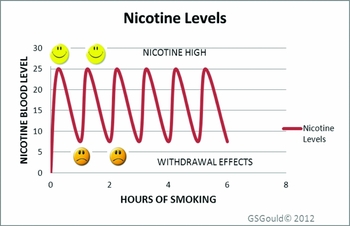
• Stress is a common reason for smoking in Aboriginal and Torres Strait Islander communities, and is cited as a barrier to quitting. The ‘stress’ caused by not smoking may not be understood as a nicotine withdrawal effects. A simple way of educating about this is to use a visual guide.
-
• The patient-education diagram below (figure 1) shows how nicotine levels go up with each cigarette smoked and go down in between cigarettes. This has a yo-yo effect all day on the feel-good chemicals (dopamine) and a smoker is in and out of withdrawal all day. These symptoms of withdrawal are often perceived as ‘stress’. For a full list see DSM V.
Patient education guide for nicotine levels, withdrawal and stress Source: Gould, G. Give Up The Smokes Aboriginal Quit Café - a new concept in intensive quit smoking support for Aboriginal and Torres Strait Islander people. Coffs Harbour: The Mid North Coast (NSW) Division of General Practice, Galambila Aboriginal Health Service and Dr Gillian Gould. 2012, page 35. ISBN 978-0-9873410-0-6. Creative Commons Attribution-NonCommercial-NoDerivs 3.0 Unported License. A more detailed version may also be found in Bittoun R, Stop Smoking - Beating Nicotine Addiction Sydney:Random House,1993, p48. ISBN 0-09-182795-7

Midwifery approaches recommend a sensitive woman-centred dialogue building on trust and a long-term relationship (Ebert, Van Der Riet & Fahy, Reference Ebert, Van Der Riet and Fahy2009). A full smoking and cessation history should be taken. History includes age of initiation, length of smoking history, cigarette consumption, previous quit attempts and duration of smoke-free episodes, and whether cessation aids have been used previously, their effectiveness and any side effects. Cigarette consumption may be hard to quantify if cigarettes are shared and household finances prevent supply for the whole week (Gould et al., Reference Gould, Munn, Avuri, Hoff, Cadet-James, McEwen and Clough2013b). Ask whether other household members smoke and assess smoking locations such as at indoor/outdoor smoking at home, in the car and at work. Initial engagement is vital to encourage the woman to be comfortable to come back and see you a second time, and not feel shamed about her smoking or that she is a ‘bad mother’ for smoking.
Several drugs, including caffeine, interact with the liver metabolism of polycyclic aromatic hydrocarbons (produced by tobacco smoke), resulting in higher bioavailability of the drugs, so the usage of caffeine and other drugs should be assessed. On smoking cessation, caffeine effects may result in increased anxiety and restlessness, and therefore be confused with nicotine withdrawal symptoms (Bittoun, Reference Bittoun2010). This effect is independent of NRT use. A reduction in caffeine intake should be advised, and other drugs may need monitoring.
The question arises as to what is the best measure of nicotine dependence in pregnancy?
-
• Addiction levels are believed to be low in Aboriginal and Torres Strait Islanders during pregnancy (Panaretto, Reference Panaretto, Mitchell, Anderson, Gilligan, Buettner, Larkins and Eades2009; Robertson et al., Reference Robertson, Conigrave, Ivers, Hindmarsh and Clough2013), based on the Fagerström Test for Nicotine Dependence (FTND) or Heaviness of Smoking Index (HSI). However clinical experience suggests the full range of dependence.
-
• As the above measures depend on the number of cigarettes smoked per day and many pregnant women try to reduce their smoking when pregnant, such measures may not accurately reflect their addiction level.
-
• Dependence scales (i.e. FTND and HSI) do not capture the potential for compensatory smoking or the high levels of discomfort from craving that a pregnant woman may experience when reducing.
-
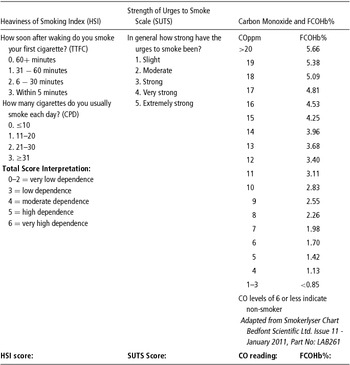
• The Strength of Urges to Smoke (SUTS) scale may therefore give additional information about dependence (Fidler, Shahab & West, Reference Fidler, Shahab and West2011), and should be measured at each visit (Table 1).
Table 1Suggested assessment tools for pregnant smokers

-
• Carbon monoxide (CO) can be measured by the healthcare provider with a hand held expired breath CO monitor, available in Australia, easy to operate and reasonably priced.
-
• The CO monitor can be used to estimate the foetal carboxyhaemoglobin (FCOHb%) in the pregnant smoker and partner (if smoking). These measures may serve as opportunities to educate about the effects of smoking on the foetus (Table 1).
-
• Pregnant women may also be using cannabis and the clinician should ask about and address this issue in a non-judgemental way. Cannabis smoking can cause a high CO reading.

Counselling
Pregnancy is a teachable moment for smoking cessation (Gould et al., Reference Gould, Munn, Avuri, Hoff, Cadet-James, McEwen and Clough2013b; McBride, Emmons & Lipkus, Reference McBride, Emmons and Lipkus2003). Aboriginal and Torres Strait Islander women are conscious about wanting to do the best for their baby and have protective instincts about shielding them from smoke (Gould et al., Reference Gould, Munn, Watters, McEwen and Clough2013a; Gould et al., Reference Gould, Munn, Avuri, Hoff, Cadet-James, McEwen and Clough2013b): they are more likely to reduce cigarette consumption than quit (Gould et al., Reference Gould, Munn, Watters, McEwen and Clough2013a; Gould et al., Reference Gould, Munn, Avuri, Hoff, Cadet-James, McEwen and Clough2013b), however this is similar for pregnant women internationally (Graham, Flemming, Fox, Heirs & Sowden, Reference Graham, Flemming, Fox, Heirs and Sowden2013). A study in regional NSW revealed that some Aboriginal and Torres Strait Islander women may question the importance of the harmful effects from smoking in pregnancy, if others around them have not been seen to be affected by tobacco smoking and may be adverse to an authoritative or judgemental approach (Gould et al., Reference Gould, Munn, Avuri, Hoff, Cadet-James, McEwen and Clough2013b). Counselling techniques based on the stages of change, and motivational interviewing, have been shown to be less effective in pregnancy (Hettema & Hendricks, Reference Hettema and Hendricks2010; Lumley et al., Reference Lumley, Chamberlain, Dowswell, Oliver, Oakley and Watson2009). However several other behaviour change techniques for pregnant smokers have been associated with successful programmes internationally, including increasing self-efficacy and goal-setting, and facilitating coping (Lorencatto, West & Michie, Reference Lorencatto, West and Michie2012). Box 1 shows a recommended approach to counselling. Even brief counselling can have a beneficial effect on cessation in a clinical setting. Understanding the sociocultural context is essential – for an overview of potential factors see Gould et al.'s review (Reference Gould, Munn, Watters, McEwen and Clough2013a).
In preparation for quitting the woman is advised to start extracting herself from environmental cues as this will result in less urges to smoke. It is helpful if she smokes outside even if the household is not yet smoke-free (Mills, Messer, Gilpin & Pierce, Reference Mills, Messer, Gilpin and Pierce2009) Other cues can be separated, such as not smoking with coffee or when on the phone. In areas of very high smoking prevalence, constant cue exposure will be problematic, and should be sensitively addressed.
To capitalise on the teachable moment we recommend encouraging a trial of cessation in the following week, aiming for abstinence of at least 2 days. Make a quit plan with your patient (see Box 2) and encourage her to fill it out with your help (being mindful of literacy issues). The sample quit plan has sections to assist with problem solving of challenges for smoking cessation and encourages the use of self-rewards. It is important to build a sense of self-efficacy, and emphasise choice.
Example of a quit plan for pregnancy

Linkages with local Aboriginal Medical Services and Aboriginal Maternity Services are recommended, if the client wishes to use them. Some Aboriginal communities have Tackling Indigenous Smoking and Healthy Lifestyle teams with Aboriginal smoking cessation counsellors, but these do not cover every remote community. Where available these teams can be accessed for additional support and follow up. The Ministry of Health NSW, through the Aboriginal Maternal & Infant Heath Services (AMIHS) have started the Quit For New Life programme, which provides counselling and free oral forms of NRT, and cessation services for family members. It is recommended to be proactive in helping the woman and her family link in with social and community services, including Aboriginal specific health and community services that can assist in addressing her environmental stressors such as financial or housing issues, and specific problems such as domestic violence, and mental health concerns.
Initiation of NRT
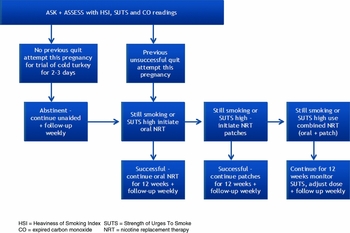
Discuss the potential of using NRT (see Figure 2) from the first visit. Explain the risks and benefits of using NRT replacement in pregnancy, so the client can make an informed decision. Plan to see the pregnant smoker weekly or earlier. If the initial attempt is not successful (i.e. the patient is unable to abstain for 2–3 days), with the client's consent, move swiftly onto pharmacotherapy so as not to lose momentum with the quit attempt (Gould & McEwen, Reference Gould and McEwen2013). Discuss options of different forms of oral NRT. As nicotine metabolism is faster in pregnancy higher doses than usual may be required (Dempsey et al., Reference Dempsey, Jacob and Benowitz2002), and 4mg oral intermittent forms can be used as required for cravings.
Flow chart for initiation of nicotine replacement therapy

As intermittent oral NRT is not subsidised on PBS, it will need to be bought over the counter. Cost may be a prohibitive factor for many Aboriginal and Torres Strait Islander smokers. In remote areas oral forms of NRT may not be available at retail outlets. The argument about costs saved by not purchasing cigarettes may not be so applicable because of the way supplies of cigarettes are purchased and shared as a family (Gould et al., Reference Gould, Munn, Avuri, Hoff, Cadet-James, McEwen and Clough2013b). Consider obtaining your own supplies of oral NRT from sources such as Cancer Council or the local health district who sometimes have funding for low socio-economic populations, or from pharmaceutical companies. Some Aboriginal Medical Services may also have oral NRT supplies to distribute. Clinicians in NSW may consider linking the client in with the Quit for New Life program via AMIHS, to gain access to oral NRT.
If oral forms of NRT are not suitable, move swiftly on to 16-hour patches (removed at night). The 16-hour patch comes in two strengths: 15 mg and a recently released 25 mg: the latter will be included in the PBS this year, and is suitable for those smoking more than 10 cigarettes per day. Although guidelines caution that the NRT dose should be less than smoking, NRT products are not as bio-available as cigarettes, and there are differences between the levels of absorption of the products (Fant, Henningfield, Shiffman, Strahs & Reitberg, Reference Fant, Henningfield, Shiffman, Strahs and Reitberg2000; McEwen, West & Gaiger, Reference McEwen, West and Gaiger2008). Anticipate in this population that there may be some ‘weaning off’ of cigarettes. Although pre-cessation NRT is not recommended in pregnancy, it is suggested that clinicians take a balanced view with individual cases. For example if a woman normally smokes 10 cigarettes a day and is now smoking 2 cigarettes a day and using 6 lozenges, encourage complete cessation within 2 weeks by increasing dose of lozenges, and assisting her to set a definite quit date. Clinicians should consider that it would be worse if she went back to full smoking, and need to continue to build efficacy.
Combination therapy (NRT patch and an oral form) may be required for more dependant smokers. Therapy should be encouraged for 12 weeks, but anticipate adherence may be an issue as encountered in clinical trials (Onken Reference Onken2012). However, even short periods of abstinence in pregnancy may have beneficial effects on foetal growth (Heil et al., Reference Heil, Higgins, Bernstein, Solomon, Rogers and Thomas2008). Women registered under the PBS Closing the Gap Co-payment measure can receive prescribed NRT patches at no cost, providing the prescription is appropriately annotated (Australian Government Department of Human Services - Medicare, 2013).
Follow-up support
Encourage the pregnant smoker to return no matter how successful or unsuccessful the quit attempts have been. Give positive feedback and help build on successes and strengths. Each visit, check SUTS and CO readings. Consider a faxed referral to the Quitline for their call-back service as an adjunct. Most Quitlines have Aboriginal counsellors, and if the woman identifies as Aboriginal or a Torres Strait Islander a culturally appropriate service can be provided.
Partners and family members may not be supportive of the pregnant woman quitting, and may undermine her quit attempts (Gould et al., Reference Gould, Munn, Avuri, Hoff, Cadet-James, McEwen and Clough2013b). Suggest that partners and family may attend with the patient or separately for consultation regarding their own smoking and learning how they can best support the quitter. Encourage smoke-free home and cars. You may promote the notion of preparing the environment for the baby as an additional rationale. Support should be offered for at least 12 weeks and post-partum. Initial sessions may need to be fairly intensive to cover all the issues that are important in the context of smoking in pregnancy. If the clinicians practice does not allow for this then referral options need to be considered. It is recommended to adapt approaches to the individual community and work in partnership with local Indigenous staff and Aboriginal Medical Services especially in rural and remote settings.
Many pregnant mothers relapse or may not intend to stay abstinent after the birth, yet there is currently no evidence-based strategy for relapse prevention (Lumley et al., Reference Lumley, Chamberlain, Dowswell, Oliver, Oakley and Watson2009). However mothers who quit for themselves and not just their baby may have a higher intention to remain abstinent post-partum. As visits with the pregnant mother progress ask her to reflect on what she will gain from remaining smoke-free after the birth.
Ancillary resources
At least half of the Australian programmes aimed at Aboriginal and Torres Strait Islander communities focus on smoke-free pregnancies (Gould et al., Reference Gould, Watt, Stevenson, McEwen, Cadet-James and Clough2014). There may be quit groups at the local Aboriginal Medical Service that you can refer to. Several sources of support that you may pass on to your clients involve new media, although not all ‘smart phones’ operate in remote areas:
-
• Quit for You, Quit for Two phone App for maternal smoking https://itunes.apple.com/au/app/quit-for-you-quit-for-two/id549772042
-
• Blow Away The Smokes DVD – a guide to quitting cigarettes for Aboriginal & Torres Strait Islander smokers www.blowawaythesmokes.com.au
-
• Sticking It Up The Smokes Facebook site http://www.facebook.com/StickinituptheSmokes
Policy changes required
The National Tobacco Strategy, the Closing the Gap strategies and the National Aboriginal and Torres Strait Islander Health Plan all recommend comprehensive approaches (Australian Government Department of Health, 2012; Commonwealth of Australia, 2012; Council of Australian Governments, 2008). These should include Aboriginal and Torres Strait Islander specific smoking cessation and support services, family-based programmes, and strategies to improve delivery of smoking cessation services, including NRT.
Access to oral forms of NRT is essential to effectively initiate treatment for pregnant women. Application needs to be made to the Pharmaceutical Benefits Advisory Committee to place a range of oral forms of NRT on the PBS. Without equitable access to suitable forms of NRT pregnant women from low socio-economic backgrounds are further disadvantaged.
Better education is required for medical professionals and specialists in how to counsel Aboriginal and Torres Strait Islander smokers, initiate NRT and how to work with the smoking cessation guidelines for pregnancy. It is important for training to address both the opportunities and barriers that a clinician may experience in trying to tackle smoking with a pregnant woman. The training needs to include culturally safety issues, and the important role that partners and family members can play in helping support the woman quit smoking.
Conclusion
The prevalence of smoking by pregnant Aboriginal and Torres Strait Islander peoples is slow to decline. There is a clear need for comprehensive approaches which include improved access, culturally safe practices, supportive counselling and the incremental use of NRT. All clinicians should be able to raise the issue of smoking with pregnant Aboriginal and Torres Strait Islander women, and become more familiar with how to initiate NRT in a timely manner for Aboriginal and Torres Strait Islander populations. This paper provides a pragmatic approach to smoking cessation for pregnant Aboriginal and Torres Strait Islander smokers and their families and hopes to address some of the educational needs of health professionals to become more adept at tacking smoking in these disadvantaged and marginalised groups.
Acknowledgements
None
Financial Support
Dr Gillian S. Gould is in receipt of a National Health & Medical Research Council Post-Graduate Indigenous Research Training Scholarship co-funded by the National Heart Foundation (Grant number APP 1039759)
Conflict of Interest
None
Ethical Standards
Not Applicable