1. Introduction
This investigation focuses primarily on the left periphery of main clauses in Kiezdeutsch (KD) and Eastern Yiddish (EY), with brief reference to New York Yiddish (NYY), Bavarian, and Cimbrian.Footnote 1 The data show, I argue, that the interface with Phonological Form (PF) plays a central role in the derivation of verb-second (V2) structures; purely syntactic or semantic accounts are inadequate. The proposal is that three strategies are employed, all of which require PF-tools—primarily prosodic phrasing and phonetic reduction—for complying with the V2-requirement. It has been proposed elsewhere (Kern & Selting Reference Kern and Selting2009, Freywald et al. Reference Freywald, Leonie, Natalia, Ingvild, Toril, Jacomine and Bente2015) that V3-structures are generated in KD when two elements precede the finite verb in a main clause, as shown in 1. In contrast, I argue that when the role of the PF-interface in V2 is considered, these so-called V3-structures actually comply with the requirements of V2. To the extent the data—which are also available from “traditional” Germanic dialects such as Bavarian or Swabian—support this conclusion, they also provide empirical support for Chomsky's (Reference Chomsky1998) proposal that head movement, of which V2-movement is a type, is handled in the PF-component. A caveat with verb raising as a form of head movement required for V2 is that syntactic and semantic requirements also enter into the calculation of V2. Subsuming V2 under head movement as a PF-operation has not remained unchallenged. The reasons for this are addressed briefly here, in the context of a discussion of the nature of V2, the syntax-phonology interface, and the transfer to PF, particularly as it relates to prosodic mapping and phonetic reduction.
The data point to three strategies used by the PF-component of the dialects mentioned:
-
(i) prosodic remapping: creating one phonological phrase (p, or p-phrase) out of two constituents, typically a temporal adverb (TA) and a pronominal subject (both from KD) (bold typeface is used to identify the finite verb here and throughout):
-
(1)
Footnote 2
-
-
(ii) Phonetic reduction and enclisis: a subject pronoun is phonetically reduced and combined with a verbal auxiliary, sometimes also reduced, to form a single constituent in the form of a prosodic word (EY examples 2a and 2b are from Geller Reference Geller2001:165 and 171, respectively).
-
(2)
-

-
(iii) prosodic restart: prosodic marking of the syntactic edge of a main clause that determines where the first constituent of the clause is located and how the V2-requirement should be met, that is, after a left-dislocated element, as in 3 (where ω marks the point of restart).
-
(3)
-
Only the last of these strategies is used, as indicated here, in Standard German (SG) and Standard Dutch; the others appear to be innovations of the dialects, KD using prosodic remapping and EY phonetic reduction. The left-edge elements that allow strategies i) and ii) are always adjuncts, though not adjuncts of any sort but rather TAs (with just a few exceptions addressed in sections 3 and 4). These TAs are merged late and, given their properties as such, relate directly to the TP domain, following Alexiadou Reference Alexiadou2000. By contrast, fronted arguments always occur with “standard V2”, that is, without the use of any one of these strategies for compliance. My analysis in section 4 leads to the conclusion that all three strategies are handled by the PF-component, at least in these dialects. The question of why all varieties of West Germanic (WGmc) do not use all three of the strategies is addressed briefly. It is largely left to further research.
The investigation is organized as follows: Section 2 briefly reviews the highlights of research on V2. I discuss various developments since its inception in the late 1970s and point out some remaining questions. I also compare different accounts of V2. In section 3, I examine more closely Chomsky's (Reference Chomsky1998) proposal for V2, Zwart's (2001) response to it, and Chomsky's recent proposals on feature valuation in the CP domain that involve feature distribution to TP. Then in section 4 I outline the grammar of V2 that forms the basis of my proposal in the remaining sections. In section 5, I focus on the data from the dialects. These data support the idea that the PF-component employs phonetic tools for satisfying V2-requirements that cannot be met in the narrow syntax. This section raises the question of what constitutes a V2-effect: Is it primarily or exclusively a requirement of linearization imposed by the PF-component for speech production? Or does this effect arise from feature valuation in the left periphery, and is, thus, syntactic? Are there semantic requirements that must be met as well? No proposal on the role of the semantic interface is offered here; the primary objective is to investigate particular strategies employed by the PF-interface for complying with syntactic and phonological requirements that manifest themselves as the V2-constraint. Section 6 considers what other factors, such as economy, might play a role in the V2-properties of the dialects considered here. A conclusion and areas for further research form the final section.
2. Accounts of V2: A Brief Review
In this section, I summarize briefly some highlights of past research on V2 for the purpose of setting the stage for a discussion of central issues addressed later. A more comprehensive account of research on V2 can be found in Alexiadou et al. Reference Alexiadou, Elena, Sjef, Hans-Martin, Artemis, Elena, Sjef and Hans-Martin2002 and Holmberg Reference Holmberg and Tibor2015. Generative investigations of V2 began in the 1970s, and, for roughly 15 years thereafter, they approached V2 via the syntax, reflecting the bias of those days.Footnote 3 Theory development had not progressed to the point of exploring the interactions between the PF-component and the syntax. The earliest generative work on German V2 was completed by Thiersch (Reference Thiersch1978) with his MIT dissertation. He proposed that the V2-effect resulted from the movement of the verb to the Comp(lementizer) position, an idea suggested by den Besten in his 1977 paper, published in 1981/1983. The central idea of den Besten's proposal was that the second position is occupied by either a complementizer or the finite verb; that is, these two elements occur in complementary distribution. In 4, two of den Besten's (Reference Besten1981:54–55) examples appear (subscript 1=first element, subscript 2= second element).
-
(4)
This theory has remained insightful to the present day because it is able to account precisely for the main-subordinate asymmetry and for the fact that both clause types are derived from a single underlying structure. It thus satisfies several criteria of a generative approach to V2.
Numerous other related proposals have been made since den Besten's account of the interaction of V-to-C movement with other syntactic operations, such as topicalization, subject-verb agreement, and wh-movement (see Stechow & Sternefeld Reference Stechow and Sternefeld1988 for a survey). Throughout, the central hypothesis that V2 stems from V-to-C movement remained in place. However, further research—for instance, Hoekstra Reference Hoekstra1993—has revealed that the notion of “position C” in a Dutch or German main clause needs to be refined and expanded. Hoekstra (Reference Hoekstra1993:161) points to constructions from Dutch dialects in which there are multiple complementizers (in bold; my translations added):Footnote 4
-
(5)
Hoekstra points out in addition that, because these complementizers may occur with intervening elements (see his examples 5–7), a theory based on the assumption that they form a single head is inadequate. Hoekstra draws the conclusion that each complementizer sits in its own head position and projects its own CP. Bayer (Reference Bayer2004) provides data from Middle English, Middle High German, and German dialects that illustrate similar complexity in the C domain.
The relevant point here is that syntactic accounts alone that explain V2 as uniform V-to-C movement prove inadequate in face of such data. This, in turn, indicates that the linearization and phonetic realization of certain lexical elements—both in the purview of the PF-component—play a role in V2-effects. Rizzi's (Reference Rizzi and Haegeman1997) theory of an expanded CP domain provides a wide array of functional head positions that can potentially host Hoekstra's complementizers. A remaining issue for recent research has been determining how this approach can be adapted to Germanic languages without losing the key insights of earlier work on V2. Frascarelli & Hinterhölzl (Reference Frascarelli and Roland2007) provide interesting data and analysis that address this question.
Realizing the limitations of purely syntactic accounts of V2, numerous theoreticians have proposed semantico-pragmatic accounts, citing differences between embedded and main clauses as measured by illocutionary force and assertiveness (see, among others, Axel Reference Axel2004, Benincà & Poletto Reference Benincà, Cecilia and Luigi2004, and Meinunger Reference Meinunger2006). Research into V2-effects in the Romance languages has shown that a highly articulated left periphery provides solutions that would not otherwise be available under a uniform V-to-C approach. In some accounts, syntactic and morphological tools take the place of this left peripheral articulation. Bayer (Reference Bayer2004) argues that doubly-filled C domains and CP-recursion in various languages result from the activation of force features triggered by verb movement to the C-position; that is, syntactic structure depends on the interface with the semantic component.
A shortcoming of these approaches is their inability to account for the basic fact that almost any element can merge in the position left of the finite verb in main clauses in Dutch and German, some of which have neither illocutionary force nor assertiveness. Thus it is not obvious that semantically based accounts can capture all of the facts. For this and other reasons Roberts (Reference Roberts and Rizzi2004) proposes a syntactic approach using a broad range of non-Germanic data that accounts equally well for Germanic languages. This account has enjoyed wide appeal. It states, in essence, that movement to the pre-Vfin (finite verb) position—which Roberts, drawing on Rizzi Reference Rizzi and Haegeman1997, identified as Fin—is constrained by the simple fact that just one element is needed to value the feature of the Extended Projection Principle (EPP-feature) on Fin. The V2-effect arises from the requirement that Fin be lexically realized. In Dutch and German, Fin is lexically realized by a full lexical verb, whereas other languages may place particles in Fin, such as Welsh fe/mi. As appealing as this theory is, I will argue in section 4 that Zwart (Reference Zwart, den Dikken and Christina2005) offers a better proposal for WGmc.
I return to the role of reduced elements in V2-structures in section 4, where I examine the encliticization of subject pronouns onto auxiliary verbs. In the next section, I review Chomsky's (Reference Chomsky1998) proposal regarding head movement, of which finite verb movement to a functional head position in the C domain, as found in Germanic languages, is a type.
3. Chomsky's (Reference Chomsky1998) Proposal and More Recent Developments
In the previous section, it was pointed out that V2 is derived by movement of a verbal head to some position in the left periphery. Since just the verb moves, nothing more, this is ipso facto a form of head movement, which in Chomsky's (Reference Chomsky1998) minimalist framework is not allowed in the narrow syntax, only in PF-syntax. In this section, I briefly review Chomsky's proposal about head movement and some objections to this proposal in the literature. I show that movement of V-to-C does not have all the properties of head movement, and that this creates a problem for a theory of V2. I then look briefly at two counter-proposals according to which the PF-component does indeed appear responsible for some aspects of V2.
3.1 Head Movement, V2, and the Interfaces
Chomsky (Reference Chomsky1998) proposes that head movement is confined to the PF-component because the typical cases of head movement are local (thus the Head Movement Constraint), purely formal (do not contribute to meaning), and occur by adjunction. They are thus handled best in the PF-component, since this component's function is the linearization of phonemes, an operation for which locality and size are essential, whereas meaning plays no role.
Verb raising, as required for V2 in German and Dutch, appears to be ruled out as a form of head movement in PF because it is not local, and it at least sometimes contributes to meaning. Only one criterion of head movement, adjunction, is arguably fully met. Because the finite verb in German and Dutch must move from a clause-final position to the second position, this movement is not local; furthermore, there is evidence that it contributes to meaning, at least in some constructions. Thus, it seems that V2 can only be partly handled by PF; the semantic effects must be captured at Logical Form (LF), the interface with the semantic component.
Let us now consider nonphonetic, nonlinear requirements of V2. Zwart (Reference Zwart2001) points out that syntactic (not PF) verb movement in Dutch main clauses is essential in certain structures that, for instance, require NP-raising for determining the interpretation; as such they cannot be handled by PF and do more than just create the V2-linearization effect. Meinunger (Reference Meinunger2006) argues that interpretive strategies guide V2; these must satisfy LF-requirements. Both Zwart and Meinunger agree, however, that PF-requirements must also be met. In essence, they both propose a grammar of V2 that involves both interfaces.Footnote 5 In the next section, I consider the implications of data such as 1–3 for the PF-side of V2 and its interactions with narrow syntax. The implications of such data for the semantics of V2 are left for further research.
3.2. Evidence from Yiddish and KD on the Nature of V2
The data in 1, repeated below as 6 with some additional examples, illustrate the prosodic remapping that occurs when a TA is followed by the subject pronoun. These data suggest that prosodic remapping (see discussion and review of research in Truckenbrodt Reference Truckenbrodt1999) is being employed for compliance with the V2-requirement. The remapping occurs when the fronted TA forms a single prosodic phrase when combined with the following subject (details in sections 5 and 6). Note that 6d and 6e come from colloquial German; none of the constructions in 6 is considered grammatical in SG usage (small capital letters indicate pitch accent).
-
(6)
Following Féry Reference Féry2007, I assume that none of the TAs in these structures requires pitch accent for reasons of focus or otherwise, in contrast to fronted arguments. I have added pitch accent on a middle field element either where it was already indicated in the data sources, as in 6d, or where it would occur in the default intonation pattern, again following Féry and much related work. None of the data sources indicate that the TA is accented.
It is possible, however, for an initial TA to have pitch accent. Some data are indicated that way in the sources, such as 7a,b (from KiDKo). These examples can be compared to the case of generic topicalization in 7c, which has pitch accent on a topicalized direct object.
-
(7)
The prosodic property of 7a,b that makes them different than those in 6 is the double pitch accent, setting up a parallelism in the interpretation. In this structure type, pitch accent characteristic of fronted VP-arguments (as in 7c) is required on a left-edge TA. I have nothing to say about the parallelism of this prosodic structure as it does not bear directly on the present discussion of V2. Of significance here is the simple fact that the pitch accent on the left-edge element is not required in 6 because of the properties of this element: i) as a TA, it relates directly to TP, and ii) given its relative phonetic lightness, it can be combined with the pronominal subject on its right into a single prosodic phrase. In section 5, I analyze other constructions that lack the phonetic lightness and consequently require a prosodic restart in order to comply with V2. Because of the phonetic weight of these elements (as in 3), the prosodic remapping that occurs in 6 is not possible. Instead, a prosodic restart is induced (see below).
Phonetic reduction was mentioned in section 1 as another PF-tool used for complying with V2. In 8, I repeat the data in 2a,b and provide some additional examples of phonetic reduction (all EY).Footnote 7
-
(8)
The data in 8 exemplify the following phonetic reductions and the related contractions of functional elements:
-
(i) the reduction of mξn hod (SG man hat ‘one has’) to either m-Ɔt in 8a or m’od in 8b. The transcriptions come from different investigators with different informants, who had not compared their data, possibly leading to some additional variation not actually present at the time the data were recorded. These are the most common forms of reduction and contraction found in EY;
-
(ii) the reduction of mξn is(t) to mξ-t (SG man ist ‘one is’) in 8c (m-Ձt is also occasionally found in the sources used);
-
(iii) the reduction of ji hod zix (SG ich habe mich ‘I have refl’) to jix-Ɔ in 8d, which requires the transposition of hod and zix, since x is the reduced form of zix; hod is even more greatly reduced than in the other contractions, to just Ɔ. These reductions and the transposition serve to bring the phonemes into a sequence that conforms with the preferred, optimal syllable structure of Yiddish, CV(C); for the same reason, the [j] is add to ix. Also playing a role here are rules of hiatus discussed by Geller (Reference Geller2001:129ff.);
-
(iv) the reduction of ix bi (SG ich bin ‘I am’) to x-bi in 8e;
-
(v) the reduction of ix zax (SG ich refl ‘I refl’) to x-zax in 8f.
The third strategy used by these dialects in the PF-component is what I refer to as a prosodic restart. I define a prosodic restart as the syntactic restart of the clause (see discussion in section 5) marked prosodically with a pause; it is preceded by a slight extension of an intonation pattern—usually steady intonation, though a slight rise or fall is also possible. The key property of the prosodic restart is the pause. Unlike the others, this strategy is considered acceptable in SG and Dutch. The SG and Dutch examples in 3 are repeated as 9a,b. EY examples 9c and 9d are from Dyhr & Zint Reference Dyhr and Ingeborg1988:107 and 83, respectively. NYY examples 9e and 9f are from Kahan Newman Reference Kahan2013:2 (ω indicates a pause).Footnote 9
-
(9)
It comes as no surprise that EY and NYY use prosodic restart just like SG does, if one assumes that a prosodic restart is a crosslinguistic information-structural option available in all V2 languages. This strategy is employed for left-dislocating an element so that it provides a bridge to the previous discourse; it can also be used for simply removing an element from the middle field, which would otherwise be quite cluttered. One must keep in mind that EY is a bona fide V2 language; if it were not, one would not expect the left periphery with subject-verb inversion evident in the EY examples in 10.
-
(10)
Note that 10a,d begin with a TA that has induced inversion, and there are many more such examples. Thus, we should keep in mind that the sequence TA-subj-Vfin found in 8a,d–f is not the only possible one, not even the most common one, in main clauses beginning with a TA; this sequence is used only when it allows the easy generation of a single prosodic word out of these two elements.
Why inversion and not reduction is used to comply with the V2-requirement in 10 could be due to one or more factors: i) the preferred syllable structure of EY CV(C), ii) the preferred sound sequence (voiced) fricatives before nasals (zξmξ), but nasals before plosives (m-Ɔt), or iii) the lack of a pronominal subject, as in 10d. The single most important factor is probably phonetic weight, which thus limits reduction and the formation of a single prosodic word (phonological word ω) to auxiliaries and pronouns. The data in 10 raise questions related to the phonology of EY, which go beyond the scope of present research. However, the present proposal argues that the sensorimotor component plays a role in fulfilling the V2-requirement. Therefore, for this proposal to satisfac-torily account for the data, these questions must be addressed at some point. Additional details of the derivations that generate these structures are presented in section 5. I show that the availability of phonetic reduction opens up a new option for economizing the syntactic side of the derivation.
In this section, I have shown that a syntactic theory of V2, stated as the merger of a finite verb in the highest clausal head position, is inadequate. To account for some V2-structures in German dialects such as KD, EY, and NYY, phonetic properties must be considered. The KD data illustrate that the prosodic remapping of a left-edge TA and a pronominal subject as one prosodic phrase (a PF-operation) allows KD to comply with V2-requirements. In EY, the strategy of phonetic reduction, which creates a single (phonological) word out of one or two functional elements and a TA, brings its left periphery in compliance with V2. NYY uses yet another strategy (also found in SG and its dialects), a prosodic restart, whereby a pause marks the syntactic edge of a main clause, left of which a left-dislocated XP appears. In the next section, I turn to the details of a proposal that can account for these data. This proposal addresses the theoretical issues associated with V2 and looks at how the dialects utilize the PF-component to comply with V2.
4. A V2-Grammar for KD, Yiddish, and Colloquial German
Of the proposals for V2 mentioned in sections 2 and 3, Zwart's (Reference Zwart, den Dikken and Christina2005) comes the closest to meeting the requirements of the Strong Minimalist Thesis (SMT, Chomsky Reference Chomsky1998). For that reason—and also because it most straightforwardly and with the fewest modifications accounts for the data I have discussed—it is used as the basis for the analysis here. First, I review what Zwart proposes and then consider revisions to his proposal in light of Chomsky's (Reference Chomsky, Robert and Carlos2008) theory of feature distribution.
4.1 Zwart (Reference Zwart, den Dikken and Christina2005) on V2
In his investigation of WGmc syntax, Zwart presents V2 as the positional marking of a dependency relation between XP and Vfin. Following generative theory and the SMT, he points out that there is only one structure-generating procedure in syntax, Merge, which can be internal (IM) or external (EM) as outlined in Chomsky Reference Chomsky1998. Merge applies iteratively to the output of a previous merge operation:
-
(11)
Merge, as defined in 11, automatically creates a dependency relation where x is invariably the antecedent and y the dependent. In regard to V2 in WGmc, Zwart states that “[…] this dependency marking may be realized in two ways: by inflectional morphology [tense-agreement marking as in subject-verb agreement] or by position […].” In a subject-initial main clause such as 12a, the structure in 12b is generated.
-
(12)
In Zwart's proposal, two positions in 12 become available for the finite verb (the dependent) through the two distinct relations of this verb to other elements fronted to the left edge: i) the agreement relation between the subject Hans and the finite verb küsste ‘kissed’ realized in TP, see 12, and ii) the relation between the Vfin and an element (internally) merged in Spec, CP, requiring Vfin-raising for the valuation of some feature of this element, shown in 13. In 13, some feature of the direct object (DO) den Hans ‘the Hans’ is valued by küsste ‘kissed’ (x = DP den Hans; y = Vfin küsste, both remerged from lower positions).
-
(13)
The type of element that can be moved to the left in WGmc varies considerably. This variation raises doubts about the existence of just one syntactic or semantic trigger for this fronting; it suggests that a pragmatic feature such as [+Force] is not the only one that plays a role in V2.Footnote 10 The important point for the discussion here is that when fronting for feature valuation occurs, Vfin must be raised to value this feature in a local Spec-head relation. Because the dependency relation between the fronted element in Spec and the Vfin in the adjacent head position occurs to satisfy one of various different syntactic requirements, we would expect that the Spec-head relation is not always in the same syntactic domain. That is one of the central claims Zwart makes, and it is supported by the account presented here. In 13, the fronting of the direct object den Hans occurs for discourse reasons, whereas in 12, the fronting of the subject satisfies a syntactic requirement on subject-verb agreement. In 13, the fronting has the effect of creating a left-edge focus, possibly in answer to the question Wen küsste Julie? ‘Who did Julie kiss?’
Zwart's proposal thus accounts derivationally with minimal structures for all of the possible configu13ions in the WGmc left periphery, on the assumption that wh-elements and all other nonsubjects merge in Spec, CP and induce verb raising to C. These relations can also be found in the German dialects discussed earlier, as evident in 10, while Mikkelsen (Reference Mikkelsen2015) argues for the need of subject-initial TP clauses in Danish. A slight expansion of this minimal structure is proposed in section 4, namely, the functional projection TopP, which has become common in accounts of the WGmc left periphery (see Julien Reference Julien2015 for a very recent example, as well as sources cited there).
Since Zwart's proposal, there have been further developments in minimalist theory. Chomsky (Reference Chomsky, Robert and Carlos2008) proposes that the TP domain must inherit features from the CP domain for satisfying feature valuation requirements of Agree. I turn to his proposal next.
4.2 Feature Distribution in the Left Periphery (Chomsky Reference Chomsky, Robert and Carlos2008)
Zwart's (Reference Zwart, den Dikken and Christina2005) account of V2 posits a structural and thus a derivational asymmetry between subject-initial and all other main clauses in Dutch and German (see also Migdalski Reference Migdalski, Lobke, Liliane and Nye2012 for additional arguments for asymmetric V2). Syntactic theory development since 2005 has provided evidence that the degree of asymmetry is somewhat less than what Zwart proposed. More specifically, although feature valuation still occurs in the TP domain for subject-verb agreement, this agreement relies on features of C inherited by T. This feature inheritance is one claim of Chomsky's (Reference Chomsky, Robert and Carlos2008) feature distribution proposal. The reasons for feature inheritance are complex. A theory-internal reason is that all main clauses—with a finite verb as its head—are ideally uniform with respect to the maximal projection: All project CP. If no finite verb is present, as in ECM constructions, no subject-verb agreement occurs; the verb remains in the infinitive form, and the DP in Spec, TP has accusative case morphology. The feature inheritance proposal accounts for the contrast between 14a, where the verb expect has an ECM construction as its complement and the case of the subject him defaults to accusative, and 14b where ‘expect’ has a “full” embedded clause with a finite verb and the subject has nominative case because of features inherited from the CP:
-
(14)
In order to account for the properties of ECM constructions and to add support to his Phase Theory, Chomsky (Reference Chomsky, Robert and Carlos2008) proposes that T in ECM constructions has no ϕ-features because there is no C in the embedded infinitival clause. In finite clauses such as 14b, T inherits these features from C. Feature Inheritance is defined as follows:
-
(15)
-
(16)
In section 5, I consider other V2-structures already mentioned above. I explore the three strategies discussed in the introduction that are used by dialects of German for meeting the syntactic and phonetic requirements of V2. These strategies, it is argued, require an additional functional head at the left periphery: Top˚. This addition to the minimal structure that Zwart proposes enables an account of the dialects that strikes a balance between the rich cartography of the Rizzi Reference Rizzi and Haegeman1997 model and the very spare model that Zwart Reference Zwart, den Dikken and Christina2005 advocates. I show that the insights of Chomsky's (Reference Chomsky, Robert and Carlos2008) feature distribution model can be maintained with the addition of the functional head Top˚ and the domain it projects.
5. PF-Based Strategies Used by the Dialects for Complying with V2
5.1 Prosodic Remapping
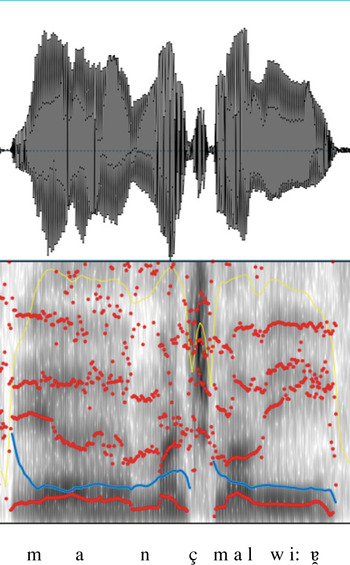
The first strategy, prosodic remapping, is employed when the PF-interface remaps the input from the narrow syntax according to prosodic principles. In section 3, I demonstrated that KD speakers sometimes prefer to combine a left-edge adverb with a pronominal subject, producing strings such as (Manchmal wir) p gehn auch in andre Städte… ‘Sometimes we also go to other cities’, in which the two left-edge elements are remapped as one prosodic phrase. Because KD is a dialect of German and otherwise holds closely to the syntactic parameters and rules of SG, KD structures usually comply with V2-requirements without any additional accommodations or strategies. However, there are exceptions to this kind of purely syntactic compliance. The one I consider here is only an apparent V2-violation, as follows from the analysis offered. The audio that accompanies this data point and others like it provide clear evidence that the TA and the pronominal subject are combined into one prosodic phrase.Footnote 12 Instead of occurring after the first element manchmal, the prosodic break clearly falls after wir.Footnote 13 The waveform and spectrogram of manchmal wir in figu171 indicate that these two elements form a single prosodic phrase.
Waveform and spectrogram of manchmal wir from 6a.

The F0 value for manch-, where the nuclear accent occurs, starts high and drops quickly to a level where it is maintained until the end (with interruption at the fricative [ç]). In other words, manch is the prosodic head, and a clear boundary occurs after wir in the form of a prosodic break. Most significantly, no boundary occurs after manchmal, in contrast to what would be the case if it were a topicalized element followed by the Vfin, as in 7c.Footnote 14 Such constructions are thus markedly different from those investigated by Meinunger (Reference Meinunger2006):
-
(17)
These statements, considered acceptable by speakers of SG, require comma intonation after the left-edge adverbial, pointing to two properties: i) a prosodic break of some sort, and ii) the syntactically tenuous (possibly nonintegrated) status of the adverbial (see Reis Reference Reis, Dürscheid, Ramers and Schwarz1997, Reis Reference Reis, Dürscheid, Ramers and Schwarz2013 for discussion). Neither of these properties can be found in the KD data in 6. I return to the examples in 17 and similar constructions from the dialects in section 5. Here I focus only on left-edge adverbials that do not require any prosodic break. A quick survey reveals that almost all of them are TAs. Leaving exceptions (such as those with a left-edge locative adverbial instead of a TA) to the side for now, let us consider why TAs are different from other adverbials.Footnote 15
Alexiadou (Reference Alexiadou2000) investigates TAs in SG and comes to the conclusion that they are inherent to the TP domain because of the close relation between TAs and the finite verb: Both are required for establishing the temporality of the clause in which they appear. In her analysis, a TA is a verbal argument that enters an agreement relation with the finite verb, just as a subject does. For this analysis, a much finer-grained TP domain is required, building on work of Rizzi (Reference Rizzi and Haegeman1997) and Cinque (Reference Cinque1999). My own analysis maintains a more traditional notion of the category adverb as an adjunct, and it does not require the highly articulated left periphery of Alexiadou's analysis. However, the central insight of her work is upheld: TAs stand in a close relation to the finite verb. This property explains why, for instance, a TA, unlike all other adverbs, does not require pitch accent (see Féry Reference Féry2007 and Fanselow Reference Fanselow, Shinichiro, Michaela and Anne2004 on German, and Bhatt Reference Bhatt1999 on Kashmiri). This property explains why a TA can combine with a pronominal subject to form a single prosodic phrase (a phonological phrase ϕ in auto-segmental terms; see Gussenhoven Reference Gussenhoven2002 for an overview). The examples in 18 illustrate KD main clauses with a left-edge TA that together with a pronominal subject forms a single prosodic phrase. Example 1a/6a is repeated again as 18a; examples in 18b,d are from KiDKo.Footnote 16
-
(18)
The examples in 19 illustrate KD main clauses with the left-edge locative adverbial da ‘there/in this case’. The same prosodic remapping does not occur with this locative adverbial even though its phonetic weight is lighter than that of most TAs; a left-edge da is followed by the finite verb, conforming to “standard” V2 (all the data are from KiDKo).
-
(19)
Out of over 320 structures in KiDKo with an initial da, most of them main clauses, only one, 20a, has V3, and a few moments later the same speaker utters 20b with V2 (from KiDKo).Footnote 17
-
(20)
Even though da ‘there/in that case’ should, from a phonetic standpoint, be a good candidate for prosodic remapping to form a single prosodic phrase with the almost equally light man ‘one’, it does not. The locative hier ‘here’ produces the same results in KiDKo. I argue that the difference between the TAs in 18 and the locatives da and hier stems from the difference in their syntactic relation to the clause and how they assume the left-edge position: TAs are inherently a part of the TP domain and thus can be merged late at the left edge. In contrast, a locative adverb must first be merged in the VP and then internally merged, that is, moved upward, to Spec, CP, according to the analysis in 13. The result of this operation is a chain, headed by the locative, to its base position in the VP. Consider again example 19c repeated below as 21.
-
(21)
By contrast, the TA gestern in 18d can merge late in Spec, TP without forming a chain to any position lower in the structure because it is inherently a TP element:
-
(22)
An alternate analysis, based on work by Julien (Reference Julien2015), is that a locative adverb such as da in 19c and 21 is merged in Spec, TopP where it is checked by the Vfin for its pitch accent [ρ] (ignoring for simplicity the TA immer noch):
-
(23)
The merits of each of these two analyses, namely, internal merge to Spec, TopP versus Spec, CP, are not discussed here; in what follows, I assume that TopP has empirical support.
As studies on fronted elements have shown (for a survey, see Féry Reference Féry2007), all elements except for subjects, TAs, and certain non-nominative arguments (for example, dative arguments of psych-verbs) must have some level of pitch accent and be followed by a boundary. It is the pitch accent on da—assigned in its base position in the VP—along with the chain tying it to its base position, that prevents its late merger to the left of the subject (as in 22), a merger that is necessary for the remapping of da with wir to form a single prosodic phrase. How the informant nevertheless generated 20a is a question that must be examined with access to the audio; it is possible that 20a has the same prosody as the constructions in 17, for which comma intonation is used, and the clause is restarted after da. I return to this type of derivation in section 5.
A general question that arises in connection with the remapping strategy is why SG does not appear to use it. Part of the answer might be found in the prosodic differences between SG and KD, as Kern & Selting (Reference Kern and Selting2009), Wiese (Reference Wiese2012), and Freywald et al. (Reference Freywald, Leonie, Natalia, Ingvild, Toril, Jacomine and Bente2015) have pointed out. KD, with its left-peripheral prosody, can possibly better capitalize on the fact that the pre-Vfin element (almost always a subject in the apparent V3-constructions) is almost never accented when a TA is on its left (in both KD and SG). There are various explanations for this having to do with principles of information structure, as argued in Freywald et al. Reference Freywald, Leonie, Natalia, Ingvild, Toril, Jacomine and Bente2015 (see also Krifka Reference Krifka2008:262–264). What is particularly relevant to this study is that the PF-component of the KD grammar appears to employ a prosodic remapping strategy unavailable in the SG grammar. This option might have been borrowed from another language; however, this is unlikely given the fact that the speakers of KD come from multiple unrelated linguistic backgrounds (mostly Turkish, Arabic, and Slavic). More likely is that this option is available in all of these languages and is compatible with all syntactic parameters of the host language. If one assumes, as I do here, that V2 is dependent on phonetic as well as syntactic (and semantic) principles, then one can also assume that KD is using prosodic principles that differ slightly from those in the PF-component of SG for the derivation of V2-structures. In using this phonetic strategy for V2-compliance, KD also meets the semantic and syntactic requirements of V2 found in SG.
Based on the assumptions about V2 outlined by Zwart (Reference Zwart, den Dikken and Christina2005) and those about feature inheritance outlined by Chomsky (Reference Chomsky, Robert and Carlos2008), the derivation of KD V3-structures such as in 6 proceeds as follows:
-
(24)
When Agree in TP occurs, CP is required for feature inheritance from C, as outlined above. Also required for subject-verb agreement is verb raising to T. When this Agree relation is realized, the derivation is transferred to the PF-interface so that the inflectional features of the verb can be matched with the appropriate phonemes for sensorimotor realization. At the PF-interface, it can be calculated how the late merger of the TA manchmal can be handled most economically (linearity is not yet determined, contrary to what appears in 24c). There are two options at this point: i) create a separate prosodic constituent out of the TA, or ii) remap the syntax so that the TA and the pronominal subject form a single p-phrase. Option i) requires verb raising to C (if the TA has merged in Spec, CP) for checking the features of manchmal from an adjacent head position—assuming it had [+focus], for instance. Option ii) is the remapping of the syntactic structure, combining the TA and the pronominal subject into a single phonological phrase. This choice is available if manchmal lacks any feature, such as [+focus], that must be checked by Vfin. If no feature must be checked—which must be the case for the derivation in 24—it can be calculated that both manchmal and wir are phonetically light and can be combined into a single p-phrase. This prosodic mapping at the PF-interface satisfies the V2-requirement in prosodic terms. The ability of the sensorimotor component to recalculate the V2-requirement in phonological terms is possible because V2, as a requirement on main clauses in German, is more than just a syntactic requirement; it has a phonetic (as well as semantic) component.Footnote 18
This derivation relies crucially on transfer to the PF-interface in the CP phase, which is necessary for subject-verb agreement and the prosodic remapping of the two TP projections, based on phonetic and prosodic input from the sensorimotor component. The input is in the form of both the features for the phonetic realization of verb agreement and the phonetic weight that determines prosodic properties. Thus, the derivation in 24 illustrates how V2, late merge, and prosodic remapping all require the PF-interface, as predicted by the SMT.
Also related to prosodic remapping and the availability of a slightly different prosody in KD is the observation of Wiese (Reference Wiese2009:790) that KD, like other Germanic urban vernaculars, generates “productive linguistic patterns that lead to grammatical elaborations that are based on morpho-syntactic reductions and interact with them.” Such reductions are not a prerequisite, however, for the SG structures in 25. These can be accounted for with the proposal based on prosodic remapping presented here for KD by which two syntactic constituents are remapped onto one p-phrase (data from Winkler Reference Winkler2014, citing Müller Reference Müller2005, among others):
-
(25)
Critical for the acceptability of the structures in 25 is the combining of the two syntactic constituents into one p-phrase. They are markedly unacceptable if this does not happen.
In the next section, I consider the second strategy for complying with the V2-requirement, the one used by EY, namely, the phonetic reduction of left-edge elements. EY shares with KD the strategy of reduction, but as I demonstrate, EY chooses to reduce functional elements to the point of creating one functional word out of two, which then functions as the head of TP.
5.2. Phonetic Reduction at the Word Level
EY, like today's German dialects, makes use of phonetic reduction and cliticization for combining functional elements in the left periphery, thus reducing their phonetic weight. The reduction of phonetic weight offers parsing advantages (as discussed by Zeijlstra Reference Zeijlstra and Kleanthes2009). In this section, I argue that there is an additional motivation for the use of phonetic reduction in EY: This strategy is employed for complying with the V2-requirement (which, in part, concerns phonetic weight, see section 6).
As pointed out by Grewendorf & Poletto (Reference Grewendorf, Cecilia and Michael2011) and Weiß (Reference Weiß2013) for Cimbrian, and Bayer (Reference Bayer2013) for Bavarian, subject pronouns can encliticize onto Vfin. A Cimbrian example of enclisis with a subject pronoun appears in 26 (Grewendorf & Poletto Reference Grewendorf, Cecilia and Michael2011:307).Footnote 19
-
(26)
In 27, Bavarian and KD subject (and object) pronouns encliticize onto the finite verb.
-
(27)
-
(28)
In EY, by contrast, reduced subjects can attach as proclitics to an auxiliary, as shown in 28. Note that reduction also affects the auxiliary itself.
Based on the lack of subject-verb inversion, these data might give the impression that EY is not a V2-language. However, that would be an incorrect conclusion, as the data in 28 are not highly representative (see 10; also Bayer's Reference Bayer2013 discussion of Cimbrian as a V2-language despite the lack of subject-verb inversion except with clitics). More representative of EY are structures such as those in 29, which follow the SG pattern. Note that in these examples, reduced subjects undergo enclisis (the transcriptions are as they occur in the sources, that is, the use of hyphenation with some clitics).Footnote 21
-
(29)
Comparing the data in 28 and 29, one can conclude that EY has retained the V2-requirement in declarative main clauses, and a V1-requirement in interrogatives. These requirements were undoubtedly inherited from (early) Middle High German (MHG), and their presence in EY today underscores the degree of syntactic alignment between EY and SG still in existence today. Of interest here is the evidence that phonetic reduction is being used to comply with V2-requirements: The contracted forms m-Ɔt ‘one-has’ (m < mξn, Ɔt < hƆt), mξ-t ‘one-will’ (mξ < mξn, t < wird), x-bi ‘I am’ (x < ix/ikh, bi < bin) and x-zax ‘I have.refl’ (x < ix/ikh, zax < hƆb zix) each constitutes one lexical item that merges in T˚, where Vfin merges and remains in subject-initial main clauses in SG and Dutch, following Zwart Reference Zwart, den Dikken and Christina2005. A process of phonetic reduction reduces a p-phrase to a p-word: (ω + ω)p – (σ + F)ω (σ = syllable, F = foot). For instance, m-Ɔt consists of the nasal onset /m/ and the nucleus and coda /Ɔt/. As Geller (Reference Geller2001) states, EY prefers the syllable structure CV(C). The same analysis applies to the other contractions above, with the result that a complex word derived from two monosyllabic words functions as a single lexical item in the derivation.
Some insight into the nature of the phonetic reduction operation can be gained from the fact that the components of these contractions do not lose their status as individual words. This conclusion can be drawn from the following evidence (Kiefer Reference Kiefer1995:128):
-
(30)
In other words, the reductions evident in 29 follow a morphosyntactic rule that applies only for a very specific syntactic purpose: The merger of a lexical item morphosyntactically derived from two words, without the need for a new lexical item (that is, the reductions do not require additional phonemes or morphemes). It applies only when a TA has merged late in Spec, TP.Footnote 22 Instead of merging in a second TP projection as illustrated in 22, TAs in EY undergo phonetic reduction, as described above, to avoid the extra structure, following an economy principle that could be stated roughly as in 31.
-
(31)
Because EY has the morphosyntactic tools for reducing the phonetic weight of the functional elements subject pronoun and verbal auxiliary and creating a single functional element out of them, it is able to apply the rule in 31 to avoid the extra TP projection.
The details of the derivation of structures such as those in 28 bring to light the necessity of the late merger of the TA. First, subject-verb agreement must be established before the TA nƆx lεɲgiεrε tsa:t ‘after some time’ can be merged, triggering the phonetic reduction operation (t = copy of coindexed item):
-
(32)
The step economize consists of two linked operations: i) the phonetic reduction described earlier, and ii) the elimination of the TP projection rendered unnecessary by the reduction operation outlined in 32c-d. In a minimalist grammar, the linking of these operations requires the interface of the syntax and phonology: The PF-component provides the tools for phonetic reduction, without which the morphosyntactically generated lexical item could not be merged in a syntactic head position, nor could the second projection of TP be eliminated. These operations economize the derivation because fewer syntactic features need to be processed by PF after the operations are complete. These operations are proposed here to underscore the complex nature of V2: i) it is neither purely syntactic nor purely phonological, a conclusion reached also by Zwart (Reference Zwart2001) and Meinunger (Reference Meinunger2006) based on completely different data, and ii) it constitutes a syntactic effect realized at the interface between narrow syntax and PF, as predicted by a minimalist approach.
To conclude the discussion of phonetic reduction, I discuss some structures that require a somewhat different derivation. In those examined so far, the initial element in the structures is a TA. This supports the hypothesis outlined in section 5 that TAs have an advantage over other adjuncts because of their inherent relation to TP. There are exceptions, however, as shown in 33.
-
(33)
The manner adverbial efŠe ‘maybe’ in 33a and the direct object vξmՁn ‘the ones’ in 33b are not inherently related to the TP. Therefore, they must target Spec, TopP, where their features are valued by the Vfin in Top˚. In order for the Spec-head relation between the Vfin in Top˚ and the element in Spec, TopP to be generated, the timing of the derivation can be essentially the same as in 32, where subject-verb agreement precedes late Merge. In 34, the derivation of vξmՁn m’ od gՁšosn is shown: Subject-verb agreement must precede the merger of the element in Spec, TopP, as is the case in any derivation involving topicalization. However, in 34 this fronting operation has the option of inducing the reduction of the subject-verb complex to a single lexical item, which can in turn raise to Top˚.
-
(34)
In order for this derivation to proceed, that is, to avoid a crash, the narrow syntax must interact with PF through the interface; otherwise phonetic reduction needed for verb raising (with the reduced subject) to Top˚ could not be induced. A derivation cannot crash until it meets the interfaces. Thus, this derivation does not crash because reduction and raising for the valuation of the features of vξmՁn in Spec, TopP occur prior to transfer to the interfaces. In other words, feature valuation must also be an interface operation. This is consistent with the assumption that lexical (as well as inflectional) morphemes represented by features in narrow syntax are realized at the PF-interface.
5.3 Prosodic Restart
Prosodic restart is the third strategy used by dialect speakers, as well as by speakers of colloquial German (CG) and Dutch. They manipulate the sentence prosody to mark the syntactic beginning of a V2-clause, if it does not begin at the left edge.Footnote 24 Example 35 shows prosodic features for marking the syntactic edge of a V2-clause (ω indicates prosodic break; the hyphens in 35f are as in the original transcription and do not imply a syntactic analysis).Footnote 25
-
(35)
In addition to simple adverbs and adverbial prepositional phrases, full embedded clauses can be followed by a prosodic restart, though these classify as intonation phrases and are set off (followed) by an intonation boundary (for discussion, see te Velde Reference Velde2013 and works cited there). On the one hand, given the widespread use of these so-called V3-structures—they can be found in published works of German literature, in public speeches given by politicians, etc.—it is doubtful that principles of German grammar underlying the V2-effect are being ignored or simply violated. On the other hand, such constructions do not occur in great frequency. It is not my intent here to explore all of the discourse, syntactic, and phonological reasons for their occurrence; this would require a separate study with audio resources at its disposal. Without such resources, all that can be said with any certainty about the phonology of the left periphery of structures such as 34 is that the left-edge element constitutes a single p-phrase, in contrast to an intonation phrase, as discussed by Gussenhoven (Reference Gussenhoven2002). A p-phrase has only one nuclear pitch accent and is not followed by a boundary tone (the intonation remains steady or drops just slightly, along with a cessation of sound, the prosodic break), whereas a fronted, embedded clause constitutes an intonation phrase and is followed by an ι-boundary.Footnote 27
This discussion of the phonology of the left-dislocated elements in 34 is intended to underscore that these structures make use of phono-logical tools, and thus that their derivation requires the interface of narrow syntax and the PF-component along with core operations in the narrow syntax. More research, including analysis of audio samples, is required for a precise description. The bottom line is that these structures should not be analyzed as violations of V2 but rather as the grammar's exploitation of PF-tools for complying with V2. In both SG and its dialects, the default mode for the derivation of V2-structures relies on the narrow syntax, as outlined in section 4.1: When the EPP features of TP and CP have been checked, no more internal merge operations may front elements left of the finite verb (adapting Roberts Reference Roberts and Rizzi2004 and Zwart Reference Zwart, den Dikken and Christina2005 to Chomsky Reference Chomsky, Robert and Carlos2008). When the narrow syntax transfers its output to the PF-interface, the rules of prosody determine whether there is a way to remap the syntax, as outlined above.
This remapping could be motivated by reasons of economy or even by the need to satisfy requirements of the PF-interface. Zeijlstra (Reference Zeijlstra and Kleanthes2009) and Richards (Reference Richards2010) show that structures with fewer prosodic boundaries are preferred and sometimes required, for which syntactic movement can be induced. I turn to these points in the next section.
6. What Else is There to V2-Compliance?
Many of the derivations proposed here illustrate the need for a syntax-phonology interface. They also require an interface with the semantic component to account for the discourse properties in which the structures are embedded. My assumption has been that the left-edge constituent in a V3-structure with a restart is merged late and is handled by the PF-interface as a nonsyntactically integrated discourse element; hence the prosodic break described above. This constituent may have a clearly distinct discourse function. There is, in fact, a set of TAs in SG, including the most common dann ‘then’ and danach ‘afterward’, that are used in KD and other dialects to connect the structure they are associated with to the discourse. As such, they occur on the left of the pre-Vfin element (usually the subject), thus creating what appears, again, as a V3-structure. Schalowski (Reference Schalowski, Fried and Lehečková2016) addresses the properties of these elements and proposes the functional category discourse connective. Further research on the semantic aspect of V3-derivations must address questions such as: i) What merge operation generates a left-dislocated adverbial? ii) What syntactic position is targeted in this operation? Both of these questions and others they imply are beyond the scope of this study.
What must yet be addressed here is the set of rules used by the PF-interface for bringing the left periphery of German main clauses into compliance with V2, that is, for creating the V2-effect. The question is, what requirements must be met in this case. One can use Féry Reference Féry2007 and Zeijlstra Reference Zeijlstra and Kleanthes2009 as a basis. Féry shows that German does not allow two pitch accents in the left periphery. To capture this property of German, she formulates the NoClash constraint. This constraint accounts for the fact that in KD, a TA must be combined with an unaccented subject. It also explains why the structures in 25 are ungrammatical if both of the syntactic elements have pitch accent.
This constraint can be made more precise using Zeijlstra's proposal. He shows that light prosodic structure is preferred over rich prosodic structure for reasons of economy. To formalize this property, he states the following:
-
(36)
Applying this metric to the German left periphery, structures left of Vfin, such as those in 25, are ungrammatical if two p-phrases are created because they have too many prosodic boundaries. Also relevant is the stress principle of the dialect/language: Whether the language is stress-timed (isochronous), like SG and its dialects, or syllable-timed, like Spanish or Japanese (on the latter see Beckman & Pierrehumbert Reference Beckman and Janet1986). A more precise formulation might be the one in 37.
-
(37)
Linguistic variation affecting 37 could involve rules of stress and syllable structure, including strategies allowing reduction, depending on whether dialect α is isochronous like German, or whether it reduces pronouns like EY.
Linguistic variation also includes rules of sentence structure. Most relevant here is, of course, the V2-constraint: German and its dialects, as well as all of WGmc, may have just one prosodic phrase left of Vfin.Footnote 28 This rule, as I have shown, not only constrains merge operations in the left periphery; it can also modify, through prosodic remapping, what has been realized there in the narrow syntax. This prosodic constraint could be formulated as follows:Footnote 29
-
(38)
Principles 37 and 38 thus summarize and make more precise what has been referred to here as V2-compliance attained through the narrow syntax–PF interface.
7. Conclusion and Areas for Further Research
This investigation falls under the category of those that in recent years have provided evidence of the variety of constructions that have V2-effects; it argues that these effects result from interactions in the grammar between the narrow syntax and PF. The aim of the present study was to gain insight into those constructions by directing a closer look at the tools available in the PF-component. This study, like others, does not adequately address a more fundamental question: Do languages retain or develop V2-effects in their historical evolutions to gain processing advantages (a form of economy) that manifest themselves in V2-effects, or do the interfaces have formal requirements independent of processing limitations that result in V2-effects? I have argued that the narrow syntax with its formal properties of Merge typically dictate the force of compliance, while the phonological component, where proces-sing limitations play a role, is only responsible for rather minor modifications. Further investigation may reveal that V2 offers processing advantages that go hand-in-hand with formal interface requirements, and that the two together create the striking V2-effects.
Other more specific questions are: i) Where is the left-dislocated element in a main clause with a prosodic restart located? If it is not syntactically integrated, it could still be pragmatically integrated, which requires that it must meet requirements of the semantico-pragmatic interface. What are these requirements? Do they relate to Pesetsky's (Reference Pesetsky and Reuland1987, Pesetsky's Reference Pesetsky2000) theory of D(iscourse)-Linking for Bulgarian and Polish? ii) Is it possible that some of the syntactic features of V2 in EY were maintained from early MHG? For example, EY allows both, proclitics and enclitics, whereas in the SG dialects within Germany, only enclitics are available. Early MHG represents a stage in the development of SG when the parameters responsible for V2 were more in flux than they are today.
Not yet mentioned is an interesting study by Grewendorf & Poletto (Reference Grewendorf, Cecilia and Michael2011) on varieties of Cimbrian. These varieties maintain V2 only marginally, in, for instance, constructions with subject clitics. Otherwise V3 and even V4 constructions are preferred, though only with the clitic-doubling of a left-dislocated XP. Grewendorf & Poletto conclude that this V2 linear restriction is not a direct consequence of V-to-C movement. Diesing (Reference Diesing and Werner2004), in a similar vein, concludes that Yiddish (she does not distinguish between varieties of Yiddish) has V2 in constructions that do not require V-to-C. Instead, V2-effects arise within the IP domain, whereas the CP domain is used only for multiple wh-fronting in main clauses and single wh-fronting in embedded clauses. These studies could make a fruitful contribution to further research of V2 properties found in the dialects investigated here.