Introduction
The recent wave of regulations targeting the burgeoning digital innovation industry is reinvigorating scholarly interest in how institutional change over time shapes innovation (e.g., Chari & Banalieva, Reference Chari and Banalieva2015; Dai, Hitt, Huo, & Chan, Reference Dai, Hitt, Huo and Chan2025; Gao & McDonald, Reference Gao and McDonald2022; Ran, Rau, & Ziegler, Reference Ran, Rau and Ziegler2025). As governments around the world grapple with how to regulate rapidly evolving digital technologies, institutional environments across countries are transitioning over time – often unpredictably and at varying speeds (Autio, Mudambi, & Yoo, Reference Autio, Mudambi and Yoo2021; Meyer, Li, & Brouthers, Reference Meyer, Li and Brouthers2023; Nambisan & Luo, Reference Nambisan and Luo2021). Unlike earlier nascent industries, which typically emerged from the relatively stable institutional environments of advanced economies (Chan, Isobe, & Makino, Reference Chan, Isobe and Makino2008; Vernon, Reference Vernon1979), firms in digital nascent industries now emerge from vastly different institutional contexts by ‘plugging and playing’ into global innovation ecosystems (Brouthers, Chen, Li, & Shaheer, Reference Brouthers, Chen, Li and Shaheer2022; Coviello, Kano, & Liesch, Reference Coviello, Kano and Liesch2017; Wormald, 2022). As a result, the institutional environments in which these firms operate are not only varied but also in flux, particularly in emerging markets like China, where institutional transitions are both fast-paced and opaque (Chen, Li, Wei, & Yang, Reference Chen, Li, Wei and Yang2022; Young, Welter, & Conger, Reference Young, Welter and Conger2018). Thus, it is important to understand how diverse institutional contexts associated with nascent industries shape product innovation, and how firms can manage the frequency and pace of iterative actions to navigate heterogeneous institutional landscapes.
In addressing these questions, we investigate how varying institutional uncertainty – shaped by the temporal unpredictability of institutional change – across countries affects firm product innovation in nascent industries. Existing theoretical perspectives have contrasting implications for how institutional uncertainty may affect firm innovation. Institutional theorists maintain that firms have a strong preference for a predictable institutional environment to engage in innovation (Peng, Reference Peng2003; Xu & Meyer, Reference Xu and Meyer2013; Young et al., Reference Young, Welter and Conger2018). When institutional environments are highly uncertain, firms face significant challenges to make long-term commitments like innovation (Banalieva, Eddleston, & Zellweger, Reference Banalieva, Eddleston and Zellweger2015; Makino, Isobe, & Chan, Reference Makino, Isobe and Chan2004). Conversely, from opportunity logic (e.g., Alvarez & Barney, Reference Alvarez and Barney2007; Eisenhardt, Reference Eisenhardt2002; Eisenhardt & Bingham, Reference Eisenhardt and Bingham2017), the more uncertain the external environment, the greater the room for a firm to discover opportunities and to innovate new products. Combining these contrasting theoretical perspectives, we propose that there is a U-shape relationship between institutional uncertainty and product innovation in nascent industries.
Furthermore, we examine how firms can temporally align design iterations to capitalize on fleeting opportunities in uncertain environments. Opportunity logic suggests that firms must take actions of iterative search to capture the fleeting innovation opportunities in nascent industries (Eisenhardt & Bingham, Reference Eisenhardt and Bingham2017; McDonald & Eisenhardt, Reference McDonald and Eisenhardt2020; Ott, Eisenhardt, & Bingham, Reference Ott, Eisenhardt and Bingham2017). In particular, we focus on firms’ use of design iteration, conceptualized as a series of temporally distributed micro-experiments that enable firms to sense and seize shifting opportunities in real time (Chen, Wang, Cui, & Li, Reference Chen, Wang, Cui and Li2020; Chen, Zhang, Li, & Turner, Reference Chen, Zhang, Li and Turner2022; Eisenhardt & Tabrizi, Reference Eisenhardt and Tabrizi1995). We argue that the newly created knowledge through iteration will help firms develop innovative solutions to address changing needs in an uncertain market. Thus, we propose that firms frequently iterate on product designs can better navigate high institutional uncertainty to create product innovations.
We conduct our study in the context of the mobile application industry, where firms around the world can develop and release mobile apps through access to globalized digital platforms, such as the iOS system and Apple App Store. This nascent industry is characterized by a fast-changing, uncertain institutional environment, where regulations and norms regarding the use of mobile apps frequently shift unexpectedly (Brouthers et al., Reference Brouthers, Chen, Li and Shaheer2022; European Commission, 2014; Wormald, 2022). It is also recognized that mobile app publishers competing in this nascent industry pay tremendous attention to design iteration (e.g., app updates), which revamps extant product designs and collects up-to-date market feedback (Chen et al., Reference Chen, Wang, Cui and Li2020; Miric & Jeppesen, Reference Miric and Jeppesen2020; Yoo, Boland, Lyytinen, & Majchrzak, Reference Yoo, Boland, Lyytinen and Majchrzak2012). Using a sample of 4,619 firms from 50 countries in the mobile app industry, our empirical results provide support for all our hypotheses.
Our study extends institutional theory by emphasizing the temporal dimension of institutional uncertainty, moving beyond static comparisons of institutional development. Drawing upon such institutional variation, we theorize and examine how varying levels of institutional uncertainty affect firm innovation and how firms should contextualize their actions (i.e., design iteration) to capture fleeting opportunities under institutional uncertainty. These insights reveal the opportunity aspect of institutional uncertainty. While extant IB literature mostly treats institutional uncertainty as a challenge to overcome, we theorize that the influence of institutional uncertainty in nascent industries is twofold, in which opportunities and challenges for innovation coexist. By fleshing out institutional uncertainty as the unpredictable portion of institutional changes, we find a curvilinear relationship between institutional uncertainty and product innovation.
Our study also offers insights particularly salient for emerging economies, like China, where rapid and inconsistent institutional transitions demand new temporal strategies for innovation. In doing so, we respond to recent calls to advance temporal research in Chinese and comparative management (Zhong, Zhang, Li, Jiang, & Chan, Reference Zhong, Zhang, Li, Jiang and Chan2022) by showing how the timing, rhythm, and sequence of both institutional change and design iterations contribute to innovation. These findings shed light on how digital entrepreneurs can iterate to innovate, as well as how policymakers can better develop institutional environments to nurture digital innovation. These insights are critical as governments around the world are seeking to regulate nascent industries without curtailing innovation, while digital entrepreneurs are seeking cost-effective ways to address uncertainty in their institutional environments.
Theoretical Background and Hypotheses Development
An Institutional Perspective on Uncertainty
Prior research recognizes that the level of institutional development plays an important role in shaping firm actions and outcomes (Acemoglu & Johnson, Reference Acemoglu and Johnson2005; Armanios, Eesley, Li, & Eisenhardt, Reference Armanios, Eesley, Li and Eisenhardt2017; Chan et al., Reference Chan, Isobe and Makino2008; Peng, Wang, & Jiang, Reference Peng, Wang and Jiang2008; Young et al., Reference Young, Welter and Conger2018). Recently, researchers moved beyond this static view to adopt a dynamic view of institutions, developing concepts such as institutional transition (Peng, Reference Peng2003), institutional fragility (Chauvet & Collier, Reference Chauvet and Collier2004; Shi, Sun, Yan, & Zhu, Reference Shi, Sun, Yan and Zhu2017), political uncertainty (Henisz & Delios, Reference Henisz and Delios2001), reform unpredictability (Chan & Du, Reference Chan and Du2021), and institutional change speed (Banalieva et al., Reference Banalieva, Eddleston and Zellweger2015) to capture the heterogeneity of institutional dynamics across countries. Since institutions are considered the source of stability and order (e.g., Scott, Reference Scott2001: 181), a basic premise is that any changes to the institutional environment are considered rare and unpredictable. These studies have significantly enhanced our understanding of how institutional dynamics may affect firm behaviors and performance.
While a dynamic view of institutions focuses on the likelihood and speed of institutional changes, it does not directly capture the extent of uncertainty in an institutional environment. This is an important gap, because extant literature simply equates uncertainty with frequent institutional changes, without recognizing that firms competing in turbulent markets may well predict and preempt future institutional changes based on past patterns (Chan & Du, Reference Chan and Du2021). As Knight (Reference Knight1921) explained, ‘change according to a known law does not give rise to uncertainty’. For instance, despite the frequent changes in copyright laws to regulate digital content, Australia was considered to have a relatively predictable and stable institutional environment for digital startups. This is mostly because these regulatory changes followed the established precedents to reduce potential uncertainties (Deloitte, 2018). Hence, it is important to flesh out the role of institutional uncertainty in affecting product innovation in nascent industries.
Variation of Institutional Uncertainty in Nascent Industries
We define institutional uncertainty as the extent to which changes in an institutional environment do not exhibit consistent patterns. As Chan and Du (Reference Chan and Du2021) suggest, institutional uncertainty reflects the extent to which firms can anticipate future changes based on past changes. The prevalence of such uncertainty in nascent industries is well-documented in extant literature. In nascent industries, the lack of precedents gives rise to an emerging organizational field permeated with substantial uncertainty (Aldrich & Fiol, Reference Aldrich and Fiol1994; Moeen, Agarwal, & Shah, Reference Moeen, Agarwal and Shah2020). Even basic assumptions about how firms should be regulated have not been settled yet (Benner & Tripsas, Reference Benner and Tripsas2012). Firms competing in nascent industries must deal with ill-defined legitimacy (Aldrich & Fiol, Reference Aldrich and Fiol1994; Rao, Reference Rao2004), regulatory ambiguities (Langlois, Reference Langlois2003; Marcus, Reference Marcus1981), and fuzzy intellectual property scope (Merges & Nelson, Reference Merges and Nelson1994; North, Reference North1990). Thus, institutional uncertainty prevails in nascent industries where the institutional environment is still formative and unsettling.
Insightful as the extant literature is, it largely assumes a homogeneous institutional environment in which nascent industries are embedded. Traditionally, most industries emerged from advanced economies, as suggested by the product lifecycle theory (Vernon, Reference Vernon1979). For example, the home computer industry started in the US in the 1980s and gradually matured and migrated to other countries over two decades. Due to the advancement of information technologies, innovation in nascent industries is no longer the privilege of firms in a few advanced economies, but could bloom simultaneously around the world. In the newly emerged mobile application industry, the presence of globalized digital platforms (e.g., iOS) enables firms around the world to ‘plug and play’ in developing mobile apps (Deng, Liesch, & Wang, Reference Deng, Liesch and Wang2021; Gupta & Auerswald, Reference Gupta and Auerswald2019; Sibanda & Leke, Reference Sibanda and Leke2019). Thus, firms from different countries may deal with varying levels of institutional uncertainty in nascent industries.
Probing into the digital sector, Chakravorti, Tunnard, and Chaturvedi (Reference Chakravorti, Tunnard and Chaturvedi2015) depicted the diverse changing trajectories of the digital-related institutional development across 50 major countries and found that some countries experience significantly higher uncertainty than other countries. For example, the reform of the cybersecurity laws in China made it difficult for firms to make predictions about the future. As the expert of China Cyber policy described: ‘There is an ever-shifting gray line’, and ‘it is not really clear what constitutes personal data, what should be localized or what the process is’ (Voo, Reference Voo2020). Such uncertainty raised confusion and was expected to make it increasingly difficult for firms to operate a digital business in China (Yan, Reference Yan2017). In comparison, Australian digital startups face less institutional uncertainty, even though copyright laws are constantly shifting.
Moreover, there is increasing appreciation that the significant variation of institutional uncertainty in nascent industries has important implications for innovation. Extant literature has long recognized that institutional differences may give rise to an uneven opportunity landscape and therefore shape firms’ entrepreneurial actions across different countries (Chen et al., Reference Chen, Li, Wei and Yang2022; Reuber, Knight, Liesch, & Zhou, Reference Reuber, Knight, Liesch and Zhou2018; Young et al., Reference Young, Welter and Conger2018; Zhang, Yi, Niu, Zhao, & Li, Reference Zhang, Yi, Niu, Zhao and Li2024). For example, firms are found to take advantage of innovation opportunities presented by heterogeneous levels of intellectual property rights protection across countries (Zhao, Reference Zhao2006). As suggested by Chakravorti et al. (Reference Chakravorti, Tunnard and Chaturvedi2015), the varying levels of institutional uncertainty across the global digital marketplace deserve significant attention: firms have to innovate by customizing their approaches to this digital planet with various institutional uncertainty. Next, we elaborate on how we investigate these issues in the global mobile application industry.
Institutional Uncertainty and Digital Product Innovation: A U-Shape Relationship
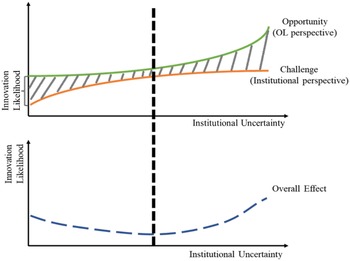
In developing our hypotheses, we extend both the institutional perspective and opportunity logic to simultaneously consider the challenges and opportunities of institutional uncertainty for firm innovation. As shown in Figure 1, the orange line represents the challenges to action, which depicts the negative effect of institutional uncertainty on digital product innovation from the institutional perspective. The green line, from an opportunity logic, illustrates the positive effect of institutional uncertainty on digital product innovation. The difference between the two lines represents the combined effect (the dotted blue line in Figure 1). The higher (lower) gap between orange and green lines, the higher (lower) the innovation activity. Taken together, we argue that the interplay between the challenges and opportunities results in a U-shape relationship between institutional uncertainty and digital product innovation.
Effects of institutional uncertainty on digital product innovation

On one hand, the institutional perspective suggests that institutional uncertainty could function as challenges that deter innovation, given the considerable difficulties in foreseeing future outcomes of product innovations in absence of patterns in institutional changes (Chan & Du, Reference Chan and Du2021; Henisz & Delios, Reference Henisz and Delios2001). When institutional changes follow a pattern, firms may find it easier to predict future institutional environment, and therefore are more likely to engage in digital product innovation. As institutional uncertainty increases, the absence of patterns raises severe concerns regarding future institutional environment (Kim, Kim, & Hoskisson, Reference Kim, Kim and Hoskisson2010; Xu & Meyer, Reference Xu and Meyer2013). Such an inability to predict institutional changes may prevent firms from interpreting the future support for a product innovation (Dacin, Goodstein, & Scott, Reference Dacin, Goodstein and Scott2002). Consequently, firms may prefer to wait until the uncertainty is resolved, possibly stalling or withdrawing the development of new digital products rather than recklessly proceeding. However, as the extent of institutional uncertainty increases, firms may reach a threshold level where they preserve a certain level of innovation activity and become insensitive to the increasing uncertainty (Aragón-Correa & Sharma, Reference Aragón-Correa and Sharma2003; Carrera, Mesquita, Perkins, & Vassolo, Reference Carrera, Mesquita, Perkins and Vassolo2003; Hoffmann, Trautmann, & Hamprecht, Reference Hoffmann, Trautmann and Hamprecht2009). At this point, firms may realize the need to maintain a reasonable number of innovations to deal with unexpected changes in their institutional environments (Chan & Du, Reference Chan and Du2021). They may find opportunities for institutional entrepreneurship and institutional arbitrage to innovate in the face of uncertainty (Doh, Rodrigues, Saka-Helmhout, & Makhija, Reference Doh, Rodrigues, Saka-Helmhout and Makhija2017; Newenham-Kahindi & Stevens, Reference Newenham-Kahindi and Stevens2018). As a result, the marginal challenge of institutional uncertainty may decline in highly uncertain environments. Hence, as the blue line in Figure 1 represents, the challenge to innovation initially increases but flattens at high levels of institutional uncertainty.
On the other hand, opportunity logic implies that institutional uncertainty can be a source of opportunities, where a slight increment in uncertainty may open up numerous possibilities for developing new products. Institutional uncertainty blurs the boundary between the digital sector and established industries, creating tremendous interactions among known and unknown elements across different industries and social settings, as well as innovation opportunities that are previously non-existent or unfavorable (Alvarez & Barney, Reference Alvarez and Barney2005; Rindova & Courtney, Reference Rindova and Courtney2020). Since there exists no clear clue how regulators, standard-setting bodies, and business ethics would impose constraints on new products (Alvarez, Young, & Woolley, Reference Alvarez, Young and Woolley2015), the increase in the number of elements that can possibly interact with each other results into an exponential escalation in the number of possible combinations and resulting innovations (Anderson, Reference Anderson1999; Brown & Eisenhardt, Reference Brown and Eisenhardt1997; Davis, Eisenhardt, & Bingham, Reference Davis, Eisenhardt and Bingham2009; Eisenhardt & Martin, Reference Eisenhardt and Martin2000). As noted by Eisenhardt (Reference Eisenhardt2002), ‘managers must jump into uncertain situations because that is where the opportunities are most abundant’. Conversely, when institutional changes are more predictable, innovation opportunities can be scarce. For instance, extensive digital regulations in European Union countries substantially enhance predictability in institutional environment by offering a relatively stable set of rules about acceptable innovations and setting clearer expectations about future changes (Downes, Reference Downes2018). Nevertheless, scholars suspect such well-defined specifications about design choices may limit innovation canvas for digital firms and stifle digital product innovations in Europe (Cennamo & Sokol, Reference Cennamo and Sokol2021; Chakravorti, Bhalla, & Chaturvedi, Reference Chakravorti, Bhalla and Chaturvedi2017). Hence, as the orange line in Figure 1 represents, high institutional uncertainty may lead to an exponential increase in innovation opportunities.
The interplay between challenges and opportunities should result in the smooth dotted U-shape curve in Figure 1. As Figure 1 suggests, the challenges of institutional uncertainty increase at a decreasing rate, whereas opportunities rise quickly. As a result, digital product innovations may initially decrease with institutional uncertainty as the gap between challenges and opportunities narrows, but then increase as the gap between challenges and opportunities widens. Hence,
Hypothesis 1 (H1): There is a U-shape relationship between institutional uncertainty and digital product innovation.
Moderating Effect of Design Iterations
While institutional uncertainty plays an important role in shaping firm innovation, opportunity logic suggests that firms that actively engage in trial-and-error initiatives are better at capturing opportunities in uncertain environments (Eisenhardt & Bingham, Reference Eisenhardt and Bingham2017; Ott et al., Reference Ott, Eisenhardt and Bingham2017). This is mostly because innovations in nascent industries rely much less on experience-based but more on creating situation-specific new knowledge to find out what works in novel market contexts (Eisenhardt & Martin, Reference Eisenhardt and Martin2000).
Our study takes a granular look at firms’ iteration of product designs to explore how firms should strategize design iteration to navigate varying levels of institutional uncertainty. Particularly, we focus on a salient form of iterative search – design iteration, through which firms repetitively test and tune their product designs based on market feedback (MacCormack et al., Reference MacCormack, Verganti and Iansiti2001). In contrast, when firms do not frequently engage in design iterations, they need to turn to existing experience to develop new products (Chen et al., Reference Chen, Wang, Cui and Li2020; Eggers, Reference Eggers2012).
We suggest that design iterations are more likely to accelerate digital product innovations when institutional uncertainty is higher. Mainly, design iteration functions as a powerful learning device to identify alternative technological solutions and business models that help firms develop new innovations to deal with likely future scenarios (Chen et al., Reference Chen, Wang, Cui and Li2020). Such learning may help firms innovate more when they face considerable difficulties in foreseeing future institutional changes, particularly regulatory approval or opposition to their innovations (Moeen et al., Reference Moeen, Agarwal and Shah2020). In such contexts, frequent design iterations provide a viable way for firms to discover and capture new opportunities created by a changing regulatory environment. Conversely, not actively engaging in design iteration may hinder firms from testing new ways to improve the fit between their innovations and shifting regulatory requirements (Eisenhardt & Tabrizi, Reference Eisenhardt and Tabrizi1995). Therefore, they could not rapidly develop a new digital product when unexpected opportunities emerge, or their current innovations face regulatory opposition.
However, design iterations are less likely to enhance digital innovations when institutional uncertainty is low. Although frequent design iterations may generate abundant market feedback that mostly supports firms’ projections about future institutional environments, such iterations and the well-aligned market feedback would only strengthen firms’ confidence about their plans to develop new digital products, but add few novel elements to their knowledge base. In addition, considering the potential costs associated with iterations (Li, Guo, Shen, Li, & Huang, Reference Li, Guo, Shen, Li and Huang2017), the benefit of frequent design iteration may be nominal, if not negative, when firms can reasonably predict future institutional contexts. Instead, firms may rely on past experiences to steer through potential institutional changes.
In sum, we argue that frequent iterations may better prepare firms to probe into and capture opportunities to develop new digital products under a highly uncertain institutional environment, steepening the nonlinear trend of opportunity in Figure 1.
Hypothesis 2 (H2): The U-shape relationship between institutional uncertainty and digital product innovation is positively moderated by the frequency of design iteration, making the curvilinear relationship steeper in the end of high institutional uncertainty.
Methods
Research Context
We focus on the country-level institutional contexts of the mobile application industry and study their implications for app publishers’ innovation activities across countries. The mobile app industry has become an increasingly important component of the economy. The revenue of mobile apps from iOS and Google Play has maintained an unprecedented growth rate of 17% since its birth, exceeding $83 billion in 2019 (Nelson, Reference Nelson2020). Importantly, this newly emerged industry allows us to compare institutional contexts across countries. Due to the global reach of digital platforms and app stores, app publishers all over the world can join and compete in this fast-growing sector. It is suggested that about 32.9% of app publishers are in Asia, 29.7% are in Europe, 29.4% are in North America, and the remaining 7% come from the rest of the world (Lee, Reference Lee2017). The varying countries of origin expose publishers to different levels of institutional uncertainty, characterized by unpredictable changes in regulatory and political environments, readiness of digital infrastructure, and acceptance of digital products/services by individuals, businesses, and governments (e.g., European Commission, 2014; Gupta & Auerswald, Reference Gupta and Auerswald2019; Sibanda & Leke, Reference Sibanda and Leke2019). It allows us to examine how the variation of institutional uncertainty may exert implications on new mobile app innovations across countries.
In addition, given the fast-changing nature of the mobile app industry, publishers tend to engage in an iterative and agile approach to develop new products. Nowadays, over 70% of publishers rely on best practices, such as version updates, A/B tests, gray releases, and other iteration activities to keep up with the changing environment (Langley, Reference Langley2017). As a result, the average new mobile app development time is only 6 months (Kapoor & Agarwal, Reference Kapoor and Agarwal2017), which allows publishers to rapidly capture short-lived market opportunities in a dynamic environment. Thus, the global mobile app industry provides an ideal setting to conduct a cross-country comparative study of how institutional uncertainty affects digital product innovation.
Data and Sample Selection
To test our hypotheses, we utilize a sample of mobile app publishers with international coverage. We obtain our data from Apptopia, a leading analyst firm in the mobile apps industry, which tracks the data of Apple App Stores in 58 major countries. This dataset archives comprehensive information about mobile app characteristics for the period from January 1, 2015 to December 31, 2017, including important variables like release dates, categories, descriptions, and in-app purchases, as well as information on publishers’ product portfolios, their downloads and revenue, headquarters location, etc. To supplement this data, we also obtain the Networked Readiness Index (NRI) data from the World Economic Forum (WEF), which captures the institutional conditions of 139 countries in utilizing information and communication technologies. These datasets together allow us to investigate and compare the influence of institutional contexts on the innovation activities of mobile app publishers across countries. We further limit our focus on apps at the Apple App Store to better delineate the impact of institutional uncertainty on digital product innovation. As Apple App Store largely maintains similar technological standards and caters to specific customer segments around the world (Ghose & Han, Reference Ghose and Han2014; Shaheer & Li, Reference Shaheer and Li2020), restricting our sample to Apple App Store may attenuate the influence of extraneous factors to focus our analysis on institutional uncertainty.
Following prior studies using mobile app datasets (Chen et al., Reference Chen, Wang, Cui and Li2020; Ghose & Han, Reference Ghose and Han2014; Kapoor & Agarwal, Reference Kapoor and Agarwal2017), we employ a ‘top segmentation’ approach to construct our research sample. Kapoor and Agarwal (Reference Kapoor and Agarwal2017) argue that the top segmentation approach provides an ideal sampling procedure because the distribution of publisher revenue and downloads is heavily skewed, and the total number of publishers is enormous. As an indication of this distribution, over half (55%) of mobile app revenue is generated by the top 100 publishers, with the rest taken up by the other 1,500,000 publishers. Adopting a random sampling approach with this dataset runs the risk of including a multitude of amateur publishers (Boudreau & Jeppesen, Reference Boudreau and Jeppesen2015), who do not put much emphasis on innovation and profitability. Thus, the ‘top segmentation’ approach is suitable for us to identify publishers who are actively engaged in innovation. For our sample, we select publishers that have developed apps ranked in the top 1,000 in the iOS overall category during January 2015 to December 2017 in any market. Then we keep those publishers that have detailed information about all the key variables. This process leads to a final sample of 4,626 publishers headquartered in 54 countries. Table 1 provides the sample distribution by countries.
Sample distribution

Measures
Dependent variable
Digital product innovation
We conceptualize innovation as firms’ implementation of novel ideas to fulfill specific market needs by introducing new products, in line with previous innovation studies (Brown & Eisenhardt, Reference Brown and Eisenhardt1995; Damanpour, Reference Damanpour1987). In the digital sector, product innovation involves implementing incumbent digital technologies to serve newly emerged product markets, rather than creating new-to-the-market technological solutions. We use the publisher-year count of new mobile app introductions by the focal publisher. For example, although Didi is not the first to introduce the car-sharing service, the fact that it has successfully implemented the car-sharing idea and technologies in the Chinese market qualifies it as digital product innovation in our definition. Similar operationalizations are also used in recent studies focusing on the mobile app industry (Miric & Jeppesen, Reference Miric and Jeppesen2020). Thus, our study focuses on how institutional uncertainty affects app publishers’ efforts to pursue market opportunities with new products.
Independent variables
Institutional uncertainty
We seek to construct a measure of institutional uncertainty that could reflect the unpredictable regulatory changes in a nascent industry. Due to its nascency, the digital economy is undergoing substantial changes in institutional environments, particularly digital-related regulations (Candelon, Di Carlo, De Bondt, & Evgeniou, Reference Candelon, Di Carlo, De Bondt and Evgeniou2021; Fan & Gupta, Reference Fan and Gupta2018). We focus on regulatory changes related to digital industries that include online trading laws, privacy protection, cybersecurity, and copyright laws, among others. These regulations specify the legal arrangements regarding what should or should not be done when doing business in the digital sector, and inconsistent changes in these laws lead to considerable uncertainties for firms innovating digital products.
Specifically, we employ the NRI dataset provided by WEF (Dutta & Lanvin, Reference Dutta and Lanvin2019), which has been extensively used in recent research (e.g., Kumar, Nim, & Agarwal, Reference Kumar, Nim and Agarwal2021; Schade & Schuhmacher, Reference Schade and Schuhmacher2022; Shaheer, Chen, Yi, Li, & Su, Reference Shaheer, Chen, Yi, Li and Su2024). Each year, WEF surveys executives all over the world to construct NRI, a composite index that assesses the extent to which a country’s political, legal, and economic framework supports the development of digital industries in a year. The extensive data collection makes NRI one of the most comprehensive indices evaluating 193 countries based on 53 individual indicators, including digital regulations, digital affordability, digital usage, and digital skills of individual citizens. Overall, this index provides a comprehensive view of each country based on both macro (regulations, the sophistication of digital infrastructure, etc.) and micro (cost, affordability, skills, and the intensity of using digital technologies, etc.) level indicators. The data is available for each year from 2012 to 2016. As our study focuses on regulations, we utilize the index under the ‘Regulation’ component of the ‘Governance’ pillar in the NRI for our measure. This dimension shares a high correlation (coeff. > 0.9) with the composite NRI, indicating that digital regulations generally reflect variations in overall digital institutional environment. We further test the robustness of our results by using the NRI composite index as an alternative measure.
To develop our measure of institutional uncertainty, we extend established research (Claussen, Essling, & Peukert, Reference Claussen, Essling and Peukert2018; Dess & Beard, Reference Dess and Beard1984; Wholey & Brittain, Reference Wholey and Brittain1989) on measuring uncertainty, which stresses the critical need for distinguishing the rate of environmental change and unpredictability of environmental change. Uncertainty is not reflected in the pace of change but in the absence of patterns, which lowers the ability of firms to predict future changes. Accordingly, we measure institutional uncertainty based on the changing trajectories of digital regulations in the past three years to find out how much regulatory variations cannot be explained by historical data. Consistent with prior research, we run a regression for each country in each year, regressing a linear time trend on the ICT laws. Specifically, the ICT laws refer to the ICT Regulatory Environment Indicator, a sub-dimension of the ‘Regulation’ component in the NRI, which captures the current level of ICT-related legal development. The R 2 of this regression represents the part of regulatory variations that can be explained by an overall time trend, whereas 1 − R 2 is the percentage of unpredictable variations. Higher values indicate countries experiencing more abrupt and inconsistent changes in institutional environments that are difficult to anticipate based on historical data. Lower values indicate a gradual and more consistent trend that is easier to predict for firms innovating digital products.
Design iteration
Like any software, mobile apps are technologically flexible and are open to post-introduction adjustments (Nambisan, Majchrzak, Lyytinen, & Song, Reference Nambisan, Majchrzak, Lyytinen and Song2017). In the Apple App Store, after launching a new app, publishers regularly release app updates to refine design specifications and/or add novel features in response to new problems raised by existing users. Each update can be downloaded and installed as a new version of the original app. Information systems research has used updates to examine software evolution (Tiwana, Reference Tiwana2015). In the mobile app industry, publishers are following the semantic versioning standard, which is based on three digits (i.e., Version 1.2.0, 3.7.2), to release new updates. Typically, an increment in the first digit means significant improvements or changes in interface, features, and functionality; an increment in the second digit reflects relatively minor feature changes and/or additions; and an increment in the third digit implies marginal changes or bug fixes (Chen et al., Reference Chen, Wang, Cui and Li2020). Thus, in order to distinguish design iterations from bug-fixing releases, we use the count of new version releases indicated in the first and second digit of the given publishers’ mobile apps in the focal year as the proxy of the frequency of design iterations.
Control variables
We also identify a set of controls that can potentially affect the innovation behavior of mobile app publishers, and we categorize these controls according to publisher, industry, and country attributes. At the publisher level, we control for the influence of product diversification and international diversification on innovation (Hitt, Hoskisson, & Kim, Reference Hitt, Hoskisson and Kim1997). We construct the inverse Herfindahl–Hirschman Index (HHI), represented as 1 – ∑(pi 2), where p is the percentage of downloads for each category i. To measure international diversification, we use the HHI based on downloads for the measure of international diversification (Hitt et al., Reference Hitt, Hoskisson and Kim1997; Kistruck, Qureshi, & Beamish, Reference Kistruck, Qureshi and Beamish2013). We use the number of apps released by the publisher as a measure of portfolio size (Kapoor & Agarwal, Reference Kapoor and Agarwal2017). We also use the average app file size to capture firm technological sophistication (Ghose & Han, Reference Ghose and Han2014). Moreover, to account for the influence of installed base on innovation, we include the number of downloads for publishers’ mobile apps (Schilling, Reference Schilling2002). We also control for publisher experience, calculated as the difference between the maximum and minimum values of the app age released by the publisher. On the industry level, we control for industry competitiveness, assessed using the HHI, calculated at the category level within Apple’s App Store based on app downloads. Finally, at the country level, we follow previous research on institutional dynamics (Banalieva et al., Reference Banalieva, Eddleston and Zellweger2015) to control for the speed of institutional change and the level of institutional development to ensure that we isolate the effect of uncertainty from other characteristics of the institutional environment. The speed measure is the coefficient in the time trend regression when constructing the uncertainty measure; the level of institutional development is the current maturity and development of ICT laws. To avoid potential simultaneity confounds, all independent and control variables are lagged by one year.
Analysis
Our dependent variable is a highly skewed count measure, and its variance exceeds its mean. We thus use a negative binomial model to fit the count data with overdispersion. Furthermore, because there are multiple observations for each publisher in our data, we employ panel count models to account for the nonindependence of these observations. Following previous studies with similar data structures (e.g., Zelner, Henisz, & Holburn, Reference Zelner, Henisz and Holburn2009), we employ the population-averaged rather than fixed effects estimators for several reasons. First, using fixed-effects models may have forcefully dropped publisher samples that do not introduce any new games throughout our observation window. Second, fixed-effects models also neglect between-publisher variation, which is a key focus of our article in comparing publishers with different gamer bases. Therefore, we estimate a population-averaged panel model with negative binomial estimators.
Results
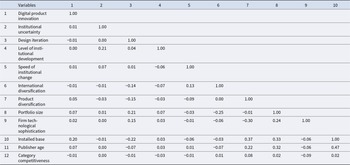
Table 2 presents the descriptive statistics and correlation metrics. The correlation table suggests that bivariate correlations are unlikely to be a concern, given that all are smaller than 0.47 (Kennedy, Reference Kennedy2003). In addition, we calculate the variance inflation factor (VIF) in all models, including all the interaction terms. The average VIF is 1.21, which is below the threshold level of 5 (Neter, Wasserman, & Kutner, Reference Neter, Wasserman and Kutner1990).
Summary statistics and correlation table

Note: Absolute correlations greater than or equal to 0.02 are significant at p < 0.05.
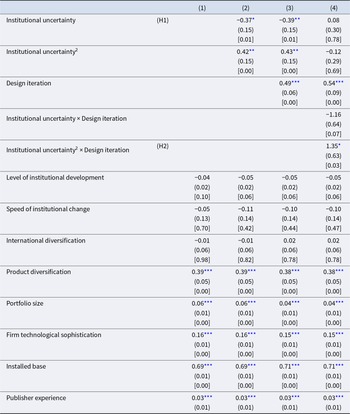
In Model 1 of Table 3, we only include control variables. In Model 2, we include institutional uncertainty and its squared term. The positive and significant coefficient (coeff. = 0.42, p = 0.00) for the squared term of institutional uncertainty supports H1, indicating a U-shape relationship between institutional uncertainty and digital product innovation. This highlights that digital product innovations are prompted when the institutional environment changes in a highly predictable or unpredictable way. In model 3, we add design iteration. The results illustrate that there is a positive and significant relationship between design iteration and digital product innovation (coeff. = 0.49, p = 0.00). It suggests that with one more design iteration every month, the likelihood of introducing a digital product innovation increases by 61.4%. Thus, H2 is well supported.
The relationship between institutional uncertainty and digital product innovation

Notes: Standard errors are included in parentheses. p Values are in square brackets. All tests are two-tailed.
* p < 0.05. **p < 0.01. ***p < 0.001.
To test H2, in Model 4, we find that the interaction between the squared term of institutional uncertainty and design iteration is positive and statistically significant (coeff. = 1.35, p = 0.03 in Model 4). Given that we use the negative binomial model as a typical nonlinear specification, we implement the recommended procedures by Kotha, Zheng, and George (Reference Kotha, Zheng and George2011) and receive consistent support. In addition, to further interpret whether the U-shape moderation effect concerns the shift of the turning point, we use the Stata code nlcom to test whether the derivative of the turning point is indeed significantly different from zero (Haans, Pieters, & He, Reference Haans, Pieters and He2016). The results show that the turning point does not change significantly, while the slope of the U-shape, especially on the high uncertainty side, becomes steeper.
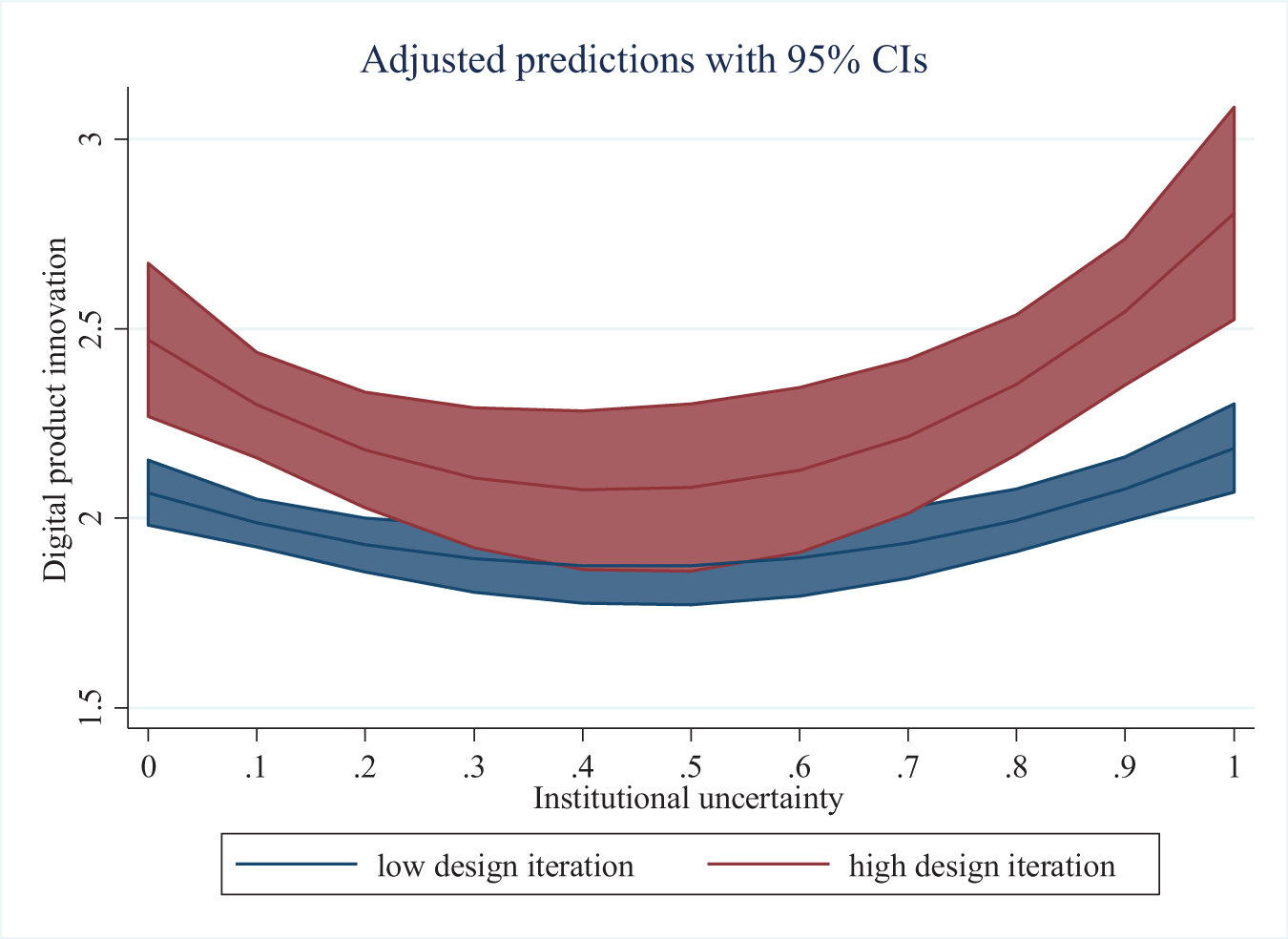
Figure 2 provides visual support to further interpret our results in Model 4 (Criscuolo, Dahlander, Grohsjean, & Salter, Reference Criscuolo, Dahlander, Grohsjean and Salter2017). Figure 2 presents the predicted number of digital product innovations across different levels of moderators, where the high level of design iteration is mean + 1 s.d., and the low level of design iteration is mean – 1 s.d. It shows that high design iteration frequency makes the U-shape curve steeper, especially when institutional uncertainty is high. Put differently, in a highly uncertain institutional environment, the number of digital product innovations created by firms with high design iteration frequency is significantly higher than that of firms with low design iteration frequency. These findings coincide with our theoretical arguments that frequent design iterations enable firms to create more product innovations when institutional uncertainty is high.
The moderating effect of design iteration frequency on the relationship between institutional uncertainty and digital

Robustness Tests
We conduct several sets of sensitivity analyses to examine the robustness of our findings. First, we ascertain that our results are not driven by our measurements of variables. While our focus on the ICT (Information and Communication Technology) related laws captures the critical aspect of digital-related institutional environments, we also conduct robustness tests to illustrate that our results still hold when we adopt a comprehensive index. We reconstruct institutional uncertainty based on the composite score of the Network Readiness Index, which broadly accounts for regulatory and political environments, readiness of digital infrastructure, and acceptance of digital products/services by individuals, businesses, and governments. Moreover, we reconstruct our variable of design iterations by taking a weighted average of first-digit and second-digit updates. To calculate the weighted design iteration, we aggregate the data to count the number of major (first-digit) and minor (second-digit) updates by each publisher for each month. Next, we calculate the overall average for both major and minor updates across all publishers. Afterward, we determine the ratio of each publisher’s monthly average major/minor updates to the overall major/minor updates. Finally, we multiplied these ratios by the overall average and summed the results to obtain the weighted average measure of design iteration. We replace the original institutional uncertainty and design iteration variable with these new variables in our regression analyses, in the same regression analysis as well as in separate regressions. The results of these robustness checks support all the hypotheses presented in the article, demonstrating that our findings are not sensitive to our specific measures.
Next, we assess whether reverse causality can be a concern in our research context. While we have followed a mainstream approach and lagged all the predicting variables by one year, we also reversed the independent and dependent variables to test the possibility of reverse causality (Li et al., Reference Li, Guo, Shen, Li and Huang2017). Specifically, we consider a firm’s digital product innovations in year t – 1 as the focal independent variable, and institutional uncertainty in year t as the dependent variable. We do not find a significant main effect in this direction. This suggests that reverse causality is less likely to be a concern in our research context. However, we also admit the possibility of reverse causality in considering study limitations, as the interplay between institutional changes and actors’ movement can be a potential issue.
Moreover, we include national cultures as control variables. Prior entrepreneurship literature suggests that national cultural dimensions like uncertainty avoidance may directly affect entrepreneurs’ perceptions of institutional uncertainty (McMullen & Shepherd, Reference McMullen and Shepherd2006). We include four well-recognized cultural dimensions as control variables: power distance, uncertainty avoidance, individualism, and feminism. Our main effect still receives relatively strong support with p values less than 0.1.
Finally, we mitigate the concern that our results may be affected by the institutional environment of foreign markets. We include a new control – the ratio of total downloads from foreign markets – into our regression models. We replicate all analyses, and the results largely support all our hypotheses, indicating that our findings are not biased by firms’ exposure to the institutional environments of foreign markets.
Discussion
This study investigates how varying levels of institutional uncertainty across countries shape firm innovation in nascent industries, and how design iteration serves as a temporally adaptive strategy to navigate such uncertainty. By integrating opportunity logic with institutional theory, we develop a dynamic framework that highlights the nonlinear impact of temporally unpredictable institutional change on innovation. Our findings show a U-shaped relationship between institutional uncertainty and digital product innovation, and demonstrate that frequent design iterations help firms seize innovation opportunities when uncertainty is high. These insights are particularly important in the context of Chinese digital firms, which operate in one of the most rapidly evolving and opaque institutional environments in the world. China’s digital sector, marked by swift regulatory interventions, shifting enforcement practices, and overlapping authorities across levels of government, rarely follows a consistent or transparent trajectory. As such, Chinese digital firms face heightened temporal uncertainty, often lacking reliable cues to anticipate future regulatory landscapes. Our study offers valuable theoretical and practical insights into how such firms can navigate institutional uncertainty.
First, our study contributes to a temporal understanding of institutional perspective by showing how the irregular timing and unpredictability of institutional change – not just its speed or direction – affects innovation in nascent industries. Although previous IB studies have explored the relationship between national institutional context and innovation (e.g., Gande, John, Nair, & Senbet, Reference Gande, John, Nair and Senbet2020; North, Reference North1990; Shinkle & McCann, Reference Shinkle and McCann2014; Young et al., Reference Young, Welter and Conger2018), they are mostly focused on traditional industries, where institutional contexts are relatively stable over long term. We highlight the effect of institutional uncertainty – an important feature of institutional conditions in nascent industries – on firm innovation. Institutional uncertainty has been portrayed as the source of innovative ideas and, at the same time, the obstacles that prevent firms from pursuing them (Moeen et al., Reference Moeen, Agarwal and Shah2020). While it is widely acknowledged that nascent industries are characterized with high institutional uncertainty compared to traditional industries, the temporal variations in institutional uncertainty across countries are severely overlooked. We are among the first articles to examine how variation in institutional uncertainty across countries makes a difference for firm innovation activities in nascent industries. Our emphasis on institutional uncertainty is especially relevant for Chinese digital firms. While institutional transitions in China are frequent, they are also difficult to forecast, making them qualitatively distinct from gradual reforms in many other markets. This reinforces the need for scholars studying Chinese management to go beyond static institutional comparisons and focus on how firms interpret and adapt to temporal patterns (or lack thereof) in institutional change.
We are also among the first to theorize and examine the role of institutional context in opportunity logic. Given the importance of the integration between traditional strategic logics and the institutional perspective (Peng, Wang, & Jiang, Reference Peng, Wang and Jiang2008), we see it as an important initiative to channel this emerging strategic logic with the wisdom of institutional theorists. We recognize that various institutional contexts may shape opportunity landscapes in different ways (North, Reference North1990), requiring firms to strategize differently to capture opportunities. Specifically, we examine how firms should contextualize their design iteration strategies to pursue innovation opportunities under different levels of institutional uncertainty. We find that firms should that frequently iterate product designs when they are embedded in a country with high institutional uncertainty, because intensive search efforts keep firms updated about the new situation-specific knowledge, which is necessary to probe into and capture opportunities in an uncertain environment. On the other hand, when the institutional context is less uncertain, firms can better predict and preempt future institutional changes so that there is relatively less need to expend efforts on design iteration.
This finding reveals that learning and innovation processes are shaped by temporal variations in institutional contexts (Levinthal, Reference Levinthal2020). Particularly, firms should pay strong attention to how they arrange learning processes to navigate the constantly shifting business landscape in nascent industries. While this study highlights the frequency of design iteration, future studies could explore the temporal dimensions of a wide array of learning processes (e.g., trial-and-error learning, improvisation, experimentation). For example, Brown and Eisenhardt (Reference Brown and Eisenhardt1997) have noted that high-tech firms tend to use rhythms to arrange their product experimentations. To date, we still know very little about their implications. Furthermore, we call for future research on opportunity logic to direct more attention to the role of other institutional arrangements. Previous research suggests that regulations, such as bankruptcy laws, contribute to a favorable institutional environment that encourages entrepreneurial actions (Lee, Peng, & Barney, Reference Lee, Peng and Barney2007; Reuber, Knight, Liesch, & Zhou, Reference Reuber, Knight, Liesch and Zhou2018). To date, we still lack understanding on what institutional contexts prompt firms to better capture opportunities in this turbulent age. Moreover, as it is increasingly convenient for firms to tap into foreign markets, it is worth exploring a ‘born global’ perspective to understand how opportunities scattered across different countries may simultaneously exert significant influence on innovation (Knight & Liesch, Reference Knight and Liesch2016). While our study focuses on the influence of the domestic institutional environment by controlling for firm’s level of international diversification, we encourage future research to explore how firms seize the heterogeneous opportunities across different institutional contexts. In sum, we think these are exciting venues to pursue. Theoretically, it encourages us to further develop opportunity logic and incorporate perspectives from international business research to address these complex questions. Practically, the findings could also inform latest practices about how high-tech startups should configure business models to create and capture value across countries.
Second, this study extends a dynamic view of institutions by theorizing the role of institutional uncertainty. A dynamic institution-based view is of critical importance to understand how institutional dynamics shape firm’s decision-making (Banalieva, Eddleston, & Zellweger, Reference Banalieva, Eddleston and Zellweger2015). This burgeoning view has a strong focus on how institutional environments change over time, instead of the traditional emphasis on the development level of institutions. Extant literature has shown that a shifting institutional environment induces significant uncertainty that deters firms from making long-term investments (Banalieva et al., Reference Banalieva, Eddleston and Zellweger2015; Chen, Cui, Li, & Rolfe, Reference Chen, Cui, Li and Rolfe2017; Kim et al., Reference Kim, Kim and Hoskisson2010; Shi et al., Reference Shi, Sun, Yan and Zhu2017). However, in nascent industries, the institutional environment is constantly changing, and firms are accustomed to the occurrences of institutional changes (Aldrich & Fiol, Reference Aldrich and Fiol1994; Santos & Eisenhardt, Reference Santos and Eisenhardt2009). Furthermore, firms may well predict and preempt future institutional changes to introduce new products (Tolbert, David, & Sine, Reference Tolbert, David and Sine2011). In other words, a shifting institutional environment does not necessarily incur uncertainty.
In addressing this gap, we capture institutional uncertainty by focusing on the inconsistent patterns of institutional changes. By doing so, we extend a dynamic view of institutions in recognizing that institutional changes could be well preempted if they follow previous changing trajectories. It is an important extension as it departs from the conventional wisdom that institutions are relatively stable over a long period of time and helps create new insights that treat institutional dynamics as the norm. Moreover, we complement the institutional perspective by emphasizing that institutional uncertainty not only induces challenges but also creates opportunities for innovation. This theoretical insight depicts a comprehensive picture of how firms make decisions under uncertainty. While institutional uncertainty may force firms to adopt a ‘wait and see’ approach (e.g., Banalieva et al., Reference Banalieva, Eddleston and Zellweger2015; Henisz & Delios, Reference Henisz and Delios2001), it could also encourage firms to ‘grab’ the opportunities (Rindova & Courtney, Reference Rindova and Courtney2020). We uncover a U-shape relationship between institutional uncertainty and digital product innovation. We argue that low institutional uncertainty reduces the costs of interpreting the appropriateness of a product innovation in the future, while high institutional uncertainty gives rise to new market niches where opportunities emerge for developing products or services. Meanwhile, firms that stay at a moderate level of institutional uncertainty bear the full brunt of the costs and have fewer incentives to develop new products.
Third, our study offers timely insights to the digital innovation phenomenon for policymakers and managers, particularly in the current era where regulators are enacting new laws to incorporate digital innovations without curtailing innovation outputs. We identify the favorable institutional conditions at the country level that foster digital innovation. While extant literature mostly studies the influence of institutional development (Bartholomew, Reference Bartholomew1997; King, Gurbaxani, Kraemer, McFarlan, Raman, & Yap, Reference King, Gurbaxani, Kraemer, McFarlan, Raman and Yap1994; Oxley & Yeung, Reference Oxley and Yeung2001), we find that the dynamics of institutional environments play an important role in explaining firm innovation. This has important implications in the global digital transformation. As we are currently situated in the flux of diverse digital regulatory standards, countries, whether developed or developing ones, are actively experimenting and shifting among these alternative digital-related institutions to find what works for them. The induced institutional dynamics throughout this experimentation process may significantly influence digital innovation and determine the competitiveness of countries in the digital sector. Thus, our study directs more attention from the level of institutional development to the changing trajectory of these institutions. For Chinese digital enterprises, our findings suggest that firm innovation strategies should emphasize speed and responsiveness, rather than long-term stability or reliance on prior experiences, particularly when institutional uncertainty is high. Hence, we imply that Chinese digital firms may excel through high-velocity experimentation, leveraging rapid cycles of design iterations to keep pace with unclear or unpredictably evolving regulations.
For practitioners, our findings offer actionable insights for digital entrepreneurs and policymakers in China. Recently, there has been a heated, ongoing discussion among entrepreneurs regarding agile development and lean startup, both of which emphasize the importance of iteration-related activities to digital product development (Levinthal & Contigiani, Reference Levinthal and Contigiani2019). However, iteration is not a panacea for innovation. It may incur considerable financial costs and employee stress (Li et al., Reference Li, Guo, Shen, Li and Huang2017; Schreier, Reference Schreier2017). Thus, entrepreneurs pay substantial attention to how they should schedule each round of iteration so that they can develop innovative products with high efficiency and low costs. We highlight that an important factor to consider is the institutional contexts in which they are embedded. The benefit of design iteration in countries characterized by relatively low uncertainty may not be comparable to iterating under environments characterized by high institutional uncertainty, like China. Therefore, our findings offer valuable insights for firms to customize their arrangement of iteration activities in or across different country markets. Our findings also offer guidance to Chinese policymakers seeking to balance innovation with regulatory control. While stricter regulations may enhance oversight, they also risk stifling the experimentation necessary for breakthrough innovation. Our study suggests a more nuanced approach to policy clarity and temporal consistency – not just policy content – for fostering innovation.
We also acknowledge that our theorization in this study has important limitations in terms of generalizability. An assumption of a high-velocity market, such as nascent industries, underlies the use of opportunity logic (Bingham & Eisenhardt, Reference Bingham and Eisenhardt2008). Attractive flows of opportunities may result in superior performance in this context because valuable resources and differential positions are short-lived and can be quickly rendered obsolete. Thus, our theoretical arguments can be well applied to industrial environments that are characterized by unpredictable and rapid changes. In relatively stable markets, iteration may still enable firms to learn but should be considered less effective. Moreover, our focus on the digital sector assumes a highly flexible and agile product development process, which greatly enhances firms’ capability to capture fleeting opportunities. For example, new mobile app development takes six months on average (Kapoor & Agarwal, Reference Kapoor and Agarwal2017). In nascent industries where product development takes much longer (e.g., biotech), the U-shape curve of the relationship between institutional uncertainty and innovation may be less likely to be observed because the emerging opportunities are difficult to capture before they become outdated. Nevertheless, with the strong momentum of digitalization, we expect that the product development processes will be transformed in many industries, enabling more firms to capture opportunities rapidly.
Given that this study is among the first to investigate how firms iterate under uncertain institutional environments, the findings and inferences from the study are also subject to a number of empirical caveats that suggest opportunities for future research. As our research context focuses on the nascent phenomenon of digital product innovation, data availability at the firm level is a major concern. For example, the iOS platform mostly collects app-level information, which may constrain our ability to provide a complete data series for firms’ characteristics (e.g., ownership, R&D spending). Despite our efforts to construct firm-level proxies like portfolio size, technical sophistication, and installed base to control for important firm attributes in this setting, we hope that future studies may incorporate more fine-grained firm-level variables to account for firm dynamics.
In addition, while we have identified the home country of each mobile app publisher, we do not have detailed information on the location of product development. Therefore, we could not rule out the possibility that product development may be conducted outside the home country. It is less of a concern in the mobile app industry, as most publishers are startups that cannot afford to set up subsidiaries in foreign countries. Moreover, our focus on the iOS platform may also lead to selection issues and may not account for platform diversification strategies. Although we have controlled for iOS market share in each country to reduce this concern, future studies may integrate observations from both iOS and Android to construct a comprehensive dataset.
Conclusion
This article explores how varying levels of institutional uncertainty associated with nascent industries shape firm innovation across countries. Building upon the institutional perspective and opportunity logic, we find that there is a U-shape relationship between institutional uncertainty and digital product innovation. Furthermore, we investigate the role of design iteration in facilitating firms’ capture of innovation opportunities under high institutional uncertainty. Thus, this study contributes to international business research by highlighting variation of institutional uncertainty in nascent industries, extending a dynamic view of institutions, and offering timely insights to prompt digital innovation across countries. More broadly, our study responds to calls to advance temporal research on Chinese management by offering a framework that centers on temporal irregularity in institutional environments and firm adaptation over time. As China continues to play a leading role in global digital innovation, understanding how its institutional fluidity shapes strategic behavior is essential. Our study also sets a fruitful research agenda, encouraging future researchers to extend our study by examining how different types of institutional actors (e.g., local vs. central regulators) shape the temporal structure of uncertainty, how Chinese firms synchronize product release cycles with regulatory events, or how temporal pacing differs between state-owned and private digital firms. There is also scope to explore how Chinese firms operating internationally adapt their temporally driven innovation strategies across institutional environments with varying predictability. We hope our study will not only advance a better understanding of innovation by Chinese firms but also stimulate future research in this direction.
Acknowledgements
This research is supported by Key Projects of Philosophy and Social Sciences Research, Ministry of Education of China (Grant no. 71873136).
Data availability statement
Data are available on request from the authors.
Noman Shaheer (noman.shaheer@sydney.edu.au) is a Senior Assistant Professor at the University of Sydney Business School. His research focuses on digital globalization and digital entrepreneurship under geopolitical, technological, and sustainability transitions. His work has been published in leading management and international business journals (JIBS), including the Journal of International Business Studies, Journal of Business Venturing, Harvard Business Review, and Management and Organization Review, among others. He also serves as a Special Issue Editor at JIBS.
Jingtao Yi (yijingtao@rmbs.ruc.edu.cn) is a Professor of economics at the School of Business, Renmin University of China. His research interests lie in internationalization strategy, emerging market multinationals, innovation and international business, and international business in the digital economy, with a focus on platform ecosystems, platform competition, and globalization. His work has been published in top management journals, including the Journal of International Business Studies, Journal of Management, and Journal of Management Studies, among others.
Jinqiu He (jinqiuhe@cufe.edu.cn) is an Assistant Professor of Economics in the School of Economics at the Central University of Finance and Economics. Her research interests include global strategy, international entrepreneurship, emerging market multinationals, and international business in the digital economy. She received her PhD from Renmin University of China.