Implications
The energy value of feedstuffs is primarily determined by organic matter digestibility (OMD) and total faeces collection (TFC) is considered as the most accurate method to determine OMD in equines. However, this method is laborious, expensive and from animal welfare perspective debatable. Alternatively, acid-insoluble ash (AIA), ADL, Cr2O3 and TiO2 have been used in equine digestibility studies, but to the authors’ knowledge they have not been thoroughly validated as dietary markers. The results of the current study can be considered a first milestone in the search for a suitable dietary marker.
Introduction
Apparent OMD is a major determinant of the energy value of feedstuffs and diets, and is preferably measured by TFC (Martin-Rosset et al., Reference Martin-Rosset, Andrieu, Vermorel and Dulphy1984). In equines, there is yet no consensus about the required minimum number of days of consecutive faeces collection to obtain an accurate estimate of OMD. Previously, Schaafstra et al. (Reference Schaafstra, van Doorn, Schonewille, Wartena, Zoon, Blok and Hendriks2015) recommended that in equines, faeces should be quantitatively collected for at least 5 consecutive days after a 14-day adaptation period, to obtain an accurate estimation of OMD for grass hay. However, in the latter study, the ponies were fed forage-only diets and it is not known whether this result can be extrapolated to ponies fed diets containing high proportions of concentrates. In general, an increasing proportion of concentrate in the diet of horses will increase OMD of the diet (Martin-Rosset and Dulphy, Reference Martin-Rosset and Dulphy1987; Palmgren Karlsson et al., Reference Palmgren Karlsson, Lindberg and Rundgren2000). The latter will decrease the amount of daily faeces produced and lower defecation frequency of equines. The frequency of defecation may vary between 12 (Tyler, Reference Tyler1972) and 2.4 times per day (Sweeting and Houpt, Reference Sweeting and Houpt1987) and in the latter case the minimum days of faeces collection need to be increased so as to obtain accurate estimates on OMD. Alternatively, indigestible markers may be used to determine OMD of diets. Recently, Schaafstra et al. (Reference Schaafstra, van Doorn, Schonewille, Wartena, Zoon, Blok and Hendriks2015) concluded that the use of internal ADL and externally supplemented titanium (Ti) are preferred as markers over the use of AIA in digestibility trials of equines fed grass-hay diets. Whether internal ADL and externally supplemented Ti are also suitable markers for high-concentrate equine diet remains to be determined. The aim of this study was to determine the duration of TFC required to obtain an accurate estimate of OMD when ponies are fed iso-energetic diets (net energy (NE) basis) formulated using varying amounts of concentrates. In addition, the suitability of AIA, ADL and Ti as indigestible markers in ponies fed varying levels of concentrates were assessed.
Material and methods
Ethical considerations and animal welfare
The experimental protocol was approved by the Animal Experiments Committee of the Faculty of Veterinary Medicine, Utrecht University, Utrecht, the Netherlands (ethic committee approval no. 2010.III.01.002). During the experiment, the ponies were exercised once daily for 1 h in a horse walker at a speed of 4.5 km/h. During this exercise, ponies did not have access to feed or water. In addition, environmental enrichment (jolly balls, ninepins and boots) were provided and the animals were groomed twice daily during sample collection periods. One month before the study, all ponies were clinically examined, dewormed (Equest; Fort Dodge Animal Health Benelux B.V., Weesp, the Netherlands) and vaccinated (Equilis Prequenza TE; Intervet International B.V., Boxmeer, the Netherlands) by a licensed veterinarian.
Animals, experimental design and housing
Four, 4-year-old, Welsh pony geldings with an initial BW of 192 kg (SEM ±9 kg), were assigned to four treatments according to a 4×4 Latin square design (Schneider and Flatt, Reference Schneider and Flatt1975). Each experimental period consisted of a 14-day preliminary feeding period followed by a 10-day sample collection period. During the first 3 days of each preliminary feeding period, the ponies were gradually transferred to the experimental diet.
The ponies were housed individually in 4×4 m stalls on straw during the first 12 days of each experimental period. Then, the boxes were thoroughly cleaned and rubber mats were used to cover the floor during the last 12 days of each experimental period. Ponies had free access to fresh water throughout the experiment. The BW of each pony was measured and recorded weekly in a similar manner throughout the study.
Experimental diets
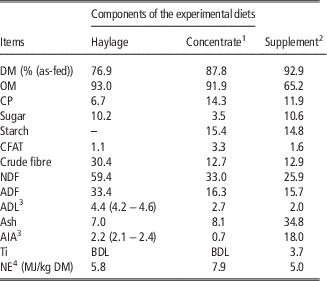
All ponies were fed haylage-based diets with increasing proportions of a pelleted concentrate (Table 1). The pelleted concentrate was produced by Versele-Laga (Deinze, Belgium) and represents a low-energy complementary feed. The haylage used for each experimental treatment originated from the same batch and was provided in different bales. The four experimental diets were iso-energetic (NE basis) and energy intake was calculated to be 22 MJ NE/day (Centraal Veevoederbureau (CVB), 2004) in order to meet the energy requirement for maintenance and exercise (200 kg BW, 1 h at 7.2 km/h). Ponies were fed different forage-to-concentrate ratios (NE basis): 100% of NE requirement provided by haylage (100H); 75% of the NE requirement provided by haylage and 25% by the pelleted concentrate (75H25C); 50% of the NE requirement provided by haylage and 50% by the pelleted concentrate (50H50C) and 25% of the NE requirement provided by haylage and 75% by the pelleted concentrate (25H75C). The daily amounts of feed dry matter (DM) provided to the animals were 4.48 kg haylage (100H), 3.36 kg haylage and 0.73 kg concentrate (75H25C), 2.24 kg haylage and 1.45 kg concentrate (50H50C) and 1.12 kg haylage and 2.17 kg concentrate (25H75C). The rations were formulated to meet or exceed the requirements of protein (CVB, 2004) as well as vitamins, minerals and trace elements (NRC, 2007). The haylage was offered in two equal meals at 0900 and 1800 h, whereas the pelleted concentrate was provided twice per day in two equal portions at 1100 and 1600 h. During the experimental period, the ponies received 100 g of pelleted supplement (Research Diet Services B.V., Wijk bij Duurstede, the Netherlands) per day to provide the animals with 3.7 g Ti/day (Titgemeyer et al., Reference Titgemeyer, Armendariz, Bindel, Greenwood and Löest2001). The supplement (Table 1) was offered once daily at 1100 h by means of a feed bin and intake was monitored by the animal caretaker to ensure the intake of the supplement. During the last 12 days of each experimental period, feed refusals, if any, were collected, weighed and recorded each morning at 0600 h and subtracted from the amount of haylage or concentrate offered to determine actual dry matter intake (DMI).
Chemical composition of the components of the experimental diets and the titanium (Ti) containing supplement (% of dry matter (DM))

OM=organic matter; CFAT=crude fat; AIA=acid-insoluble ash; NE=net energy; BDL=below detection limit of 0.5 g/kg.
1 The pelleted concentrate was provided by Versele-Laga (Deinze, Belgium) and contained: wheat bran, alfalfa, barley, corn grits, cane molasses, wheat, spelt bran, palm kernel expeller, wheat gluten feed, calcium carbonate, sodium chloride, soybean meal, soybean oil, palm oil.
2 The supplement contributed the following (per kilogram, as-fed basis): NaCl, 100 g; CoCO3, 4 mg; Na2SeO3, 9 mg; KI, 20.6 mg; MnO, 2.7 g; CuSO4·5H2O, 1.6 g; ZnSO4·7H2O, 4.45 g; FeSO4·7H2O, 8 g; retinol acetate, 20.64 mg; thiamin, 0.12 g; riboflavin, 0.1 g; cholecalciferol, 0.33 mg; dl-α-tocoferylacetate, 4 g; TiO2, 50 g; molasses, 60 g and alfalfa, 777 g.
3 Values between brackets are ranges of different bales of the same batch fed during the four collection periods.
4 NE of feedstuffs was calculated according to the formula NE (MJ/kg DM)=(k m×(ME–31.3×CFAT)+0.80×31.3×CFAT)/1000, where ME the metabolizable energy (MJ/kg DM) and CFAT (g/kg DM) (CVB, 2004).
Collection of samples
A representative sample of the haylage fed during each individual collection period was obtained before each experimental period. In addition, during each collection period, samples of the pelleted concentrate and supplement fed were taken and pooled at the end of the experiment. During the collection period, voluntarily voided faeces of each pony were collected quantitatively for 24 h a day for 10 consecutive days using a faecal collection harness (SteedAppleCatcher BVBA, Lanaken, Belgium). In total, 2 days before the start of the collection period, the collection harnesses were attached to the ponies to accustom the animals to the collection device. Contamination of feed and faeces with urine was prevented using urine quivers (Genap B.V., ’s-Heerenberg, the Netherlands) designed according to Tasker (Reference Tasker1965). Ponies were continuously monitored from 0600 to 0100 h with faeces of individual ponies collected hourly if present in the harness into a large covered plastic bin. Ponies were not monitored from 0100 to 0600 h with faecal collection occurring at 0600 h. All faeces collected per pony at 0600, 1200, 1800 and 0000 h were weighed and thoroughly mixed by means of a mixing drill (Makita Nederland B.V., Eindhoven, the Netherlands) in the plastic bins. Then, 65% of the content of each of the four fractions were pooled per pony per day and thoroughly mixed using of a concrete mixer (Altrad Lescha GmbH, Burgau, Germany). Thereafter, a 1-kg representative sample was stored at −20°C in a sealed plastic bag until further processing. At the end of the experiment, the stored faecal samples were dried at 60°C for 72 h. The haylage, supplement and faecal samples were ground to pass a 1-mm screen in a cross beater mill (T. Peppink & Zn, Amsterdam, the Netherlands) and stored in sealable containers at room temperature until chemical analysis.
Chemical analysis
Both feed and daily faeces samples were analysed for DM, NDF, ADF, ADL, ash, AIA and Ti. Haylage, concentrate and supplement samples collected during each period were analysed to determine the daily intake of ADL, AIA and Ti for each collection period. Feed refusals were analysed for DM, AIA and ADL. Feed and faecal samples were dried in a forced air oven at 103°C to a constant weight according to ISO 6496 (International Organization for Standardization (ISO), 1983) and incinerated in a muffle furnace at 550°C according to ISO 5984 (ISO, 1978). Fibre fractions (NDF, ADF and ADL) were determined according to methods described by Van Soest et al. (Reference Van Soest1991), AIA according to Van Keulen and Young (Reference Van Keulen and Young1977) and Ti according to the method of Myers et al. (Reference Myers, Ludden, Nayigihugu and Hess2004) with modifications. Titanium was determined using a spectrophotometer (Beckman Coulter Inc., Brea, CA, USA) equipped with sipper module for 408 nm instead of 410 nm as reported by Myers et al. (Reference Myers, Ludden, Nayigihugu and Hess2004). The accuracy of each Ti assay run was monitored using an in-house reference sample, and was found to be within 0.3% deviation from the target values. The combined within and between-run precision of the determinations was ⩽2.5% (CV).
After drying and grinding, the daily faecal samples were divided using a riffle divider tool developed by the mechanical workshop of Wageningen University and one part was pooled per pony per collection period for macronutrient analysis. Haylage, pelleted concentrate and supplement as well as pooled faecal samples, were analysed for CP (N×6.25) (ISO, 2005a and 2005b), crude fat (ISO, 1999), crude fibre (ISO, 1981) and sugar (Nederlandse Norm, 1974).
Calculations
Organic matter (OM; g/kg DM) was calculated as:
 $${\rm OM}\,\left( {{\rm g/kg}\,{\rm DM}} \right){\rm \,{\equals}\,DM}\,\left( {\rm g} \right){\rm\,-\,Ash}\,\left( {{\rm g/kg}\,{\rm DM}} \right).$$
Apparent total tract DMD (%) and OMD (%) determined from TFC were calculated for each pony using mean daily feed intake (I; DM or OM (kg)) and daily faecal output (FO; DM or OM (kg)) as
 $${\rm DMD\,or\,OMD }\left( {\rm \%} \right){\rm \,{\equals}\, }\left[ {\left( {I{\rm\,-\,FO}} \right){\rm /}I} \right]{\times}{\rm 100}.$$
Faecal recovery (R f; %) of each marker was calculated using mean marker intake and faecal marker excretion over 10 consecutive days as
 $$\eqalign{& R_{{\rm f}} \left( {\rm \%} \right)\,{\equals}\,\left( {{\rm Faecal\,marker\,excretion }\left( {{\rm g/day }} \right) / }\right \cr \quad \quad \left{{\rm Marker\,intake}\left( {{\rm g/day}} \right)} \right){\rm {\times}100}.$$
The apparent digestibility of the concentrate alone was calculated from the digestibility coefficients of the haylage and the diets according to Martin-Rosset et al. (Reference Martin-Rosset, Andrieu, Vermorel and Dulphy1984)
 $$d_{{\rm C}} \left( {\rm \%} \right)\,{\equals}\,{{\left[ {{\rm }d_{{\rm D}} {\rm\,-\,}\left( {h{\times}d_{{\rm H}} } \right){\rm }} \right]} \mathord{\left/ {\vphantom {{\left[ {{\rm }d_{{\rm D}} {\rm --}\left( {h{\times}d_{{\rm H}} } \right){\rm }} \right]} c}} \right. \kern-\nulldelimiterspace} c}.$$
where d C is the concentrate digestibility (%), d D the diet digestibility (%), d H the haylage digestibility (%), h the fraction of haylage in the diet and c the fraction of the concentrate in the diet.
The apparent total tract DMD (%) and OMD (%) using the marker method was calculated as
 $${\rm DMD\,or\,OMD }\left( {\rm \%} \right){\rm \,{\equals}}\,\left[ {{\rm 1\,-\,}\left( {A{\rm /}B} \right){\rm {\times}}\left( {{\rm XB/XA}} \right)} \right]{\rm {\times}100}.$$
in which A and B represents the marker concentration (g/kg DM) and XA and XB the DM or OM concentration in the feed and faeces, respectively.
Cumulative apparent OMD (%) over the 10 consecutive days of faeces collection (days 1 to 10) was calculated to assess the duration of faeces collection required for accurate estimation of apparent total tract OMD
 $$\eqalign{&{\Big[ {{{\left( {\mathop{\sum}\nolimits_{i{\rm {\equals}1}}^n {{\rm OM\, intake}_{i} } {\rm -}\mathop{\sum}\nolimits_{i{\rm {\equals}1}}^n {{\rm Faecal\,OM\,excretion}_{i} } } \right)}}\Big}\Big /}\right \cr \quad \mathord{\left {\vphantom {{\left( {\mathop{\sum}\limits_{i{\rm {\equals}1}}^n {{\rm OM\,intake}_{i} } {\rm --}\mathop{\sum}\nolimits_{i{\rm {\equals}1}}^n {{\rm Faecal OM excretion}_{i} } } \right) {\mathop{\sum}\nolimits_{i{\rm {\equals}1}}^n {{\rm OM\, intake}_{i} } }}} \right \kern-\nulldelimiterspace} {\mathop{\sum}\nolimits_{i{\rm {\equals}1}}^n {{\rm OM \,intake}_{i} } }}} \Big]{\times}100$$
where n is the number of faeces collection days with n⩽10.
Based on this equation, a backward calculation of cumulative apparent OMD from days 10 to 1 of sampling (days 10 to 1) was also made in order to determine whether the length of the preliminary period was sufficient.
Statistical analysis
All data were subjected to ANOVA with animal, period and diet as factors (SPSS Statistics 21.0) following the model
 $$Y_{{ijk}} {\rm \,{\equals}\,}\mu {\rm {\plus}}\alpha _{i} {\rm {\plus}}\beta _{j} {\rm {\plus}}y_{k} {\rm {\plus}}e_{{ijk}} ,$$
in which Y ijk is the observed values for the trait, μ the overall mean, α i the effect of the i th diet (i=1 to 4), β j the effect of the j th period, γ k the effect of the k th animal and e ijk the error term. Studentized residuals were generated from Y ijk =μ+α i +β j +γ k +e ijk , and used to test normality. Outliers were removed until the Shapiro–Wilk test reached P>0.05. In case of a significant diet effect, Tukey’s test was used to identify diets with different effects on the variable involved. Differences were considered statistically significant when P<0.05, and trends were declared at 0.05⩽P<0.10.
A broken-line regression analysis (Robbins et al., Reference Robbins, Saxton and Southern2006) was used to identify the timespan of faecal collection needed to achieve a constant OMD. Using the NLIN procedure of SAS software (version 9.3) (SAS Institute Inc., Cary, NC, USA), the broken-line model:
 $$y\,{\equals}\,L{\plus}U{\times}\left( {R{\rm\,-\,}x} \right)$$.
was fitted in which y is the cumulative apparent OMD (%), x the faeces collection days, R the required faeces collection days, L the response at x=R, and U the slope of the curve. In this model, y=L when x>R.
Results
Body weight, dry matter intake and water intake
All ponies remained healthy throughout the experiment and all faeces were collected and no coprophagy was observed during the experiment. Body weights were not affected by dietary treatment (data not shown) with mean (±SEM) BW at the end of the experiment (197±4 kg) not statistically different (P=0.381) to pre-experimental values. No refusals of the pelleted concentrate and supplement were observed on any of the experimental treatments. Experimental diets 50H50C and 25H75 were fully consumed, but when 100H and 75H25C were provided, mean feed refusals were ⩽4.1% of the haylage offered. Based on the comparison of levels of ADL and AIA in feed refusals and the feed offered, the ponies did not show any marked selection within the haylage provided. Mean DMI was 4.39, 4.05, 3.79 and 3.39 kg/day for diets 100H, 75H50C, 50H50C and 25H75C, respectively. Mean water intake when diets 100H and 75H25C were fed were greater (P=0.023) than diet 25H75C, respectively, 14.2 and 13.9 v. 10.5 l/day. The water intake per day of all treatments was not significantly different when expressed per kilogram DM (l/kg DM), that is 3.1 l/kg DM per day (SEM 0.2; n=4).
Duration of faecal collection
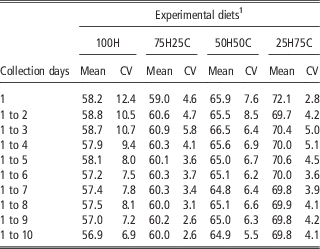
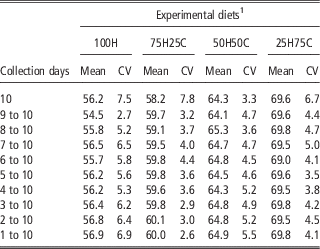
Organic matter digestibility was calculated for a period of 10 consecutive days (days 1 to 10 and 10 to 1) of faecal collection to gain insight into the minimum duration of faecal collection for accurate estimation of apparent total tract OMD of experimental diets according to the method of Schaafstra et al. (Reference Schaafstra, van Doorn, Schonewille, Wartena, Zoon, Blok and Hendriks2015) (Tables 2 and 3). Upon broken-line analysis (Robbins et al., Reference Robbins, Saxton and Southern2006), the data of three individual ponies could not be fitted to the model and were, therefore, omitted from the data. Consequently, 13 individual sets of estimated parameters (L, U, x) were available to calculate the means of L, U and x across diets. The following equation was obtained: y=62.5+1.041×(5.33−x).
Cumulative apparent total tract digestibility of organic matter (%) of haylage diets with increasing proportions of a pelleted concentrate (C) in relation to the haylage (H) determined in ponies by quantitative collection of daily faeces from days 1 until 10 (1 to 10).

1 Experimental diets: 100H: 100% of net energy (NE) requirement provided by haylage; 75H25C: 75% of NE requirement provided by haylage and 25% by a pelleted concentrate; 50H50C: 50% of NE requirement provided by haylage and 50% by a pelleted concentrate; 25H75C: 25% of NE requirement provided by haylage and 75% by a pelleted concentrate.
Cumulative apparent total tract digestibility of organic matter (%) of haylage diets with increasing proportions of a pelleted concentrate (C) in relation to the haylage (H) determined in ponies by quantitative collection of daily faeces from days 10 until 1 (10 to 1)

1 Experimental diets: 100H: 100% of net energy (NE) requirement provided by haylage; 75H25C: 75% of NE requirement provided by haylage and 25% by a pelleted concentrate; 50H50C: 50% of NE requirement provided by haylage and 50% by a pelleted concentrate; 25H75C: 25% of NE requirement provided by haylage and 75% by a pelleted concentrate.
Faecal recovery of markers
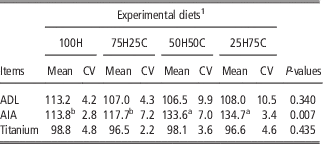
For all treatments combined, mean cumulative faecal recoveries of AIA, ADL and Ti were 124.9% (SEM 2.9), 108.7% (SEM 2.0) and 97.5% (SEM 0.9), respectively. The greatest faecal recovery value (percentage of intake) was observed for diet 25H75C when AIA was used as a digestibility marker, that is 134.7% of intake (Table 4). Mean faecal recoveries of AIA for diets 100H and 75H25C were lower than mean faecal recoveries determined for diets 50H50C and 25H75C (P=0.007) (Table 4). When ADL was used as a digestibility marker, the greatest faecal recovery value (percentage of intake) was observed for diet 100H, respectively (113.2% of intake). For the mean cumulative recovery of ADL there were no differences between diets observed (P=0.340). Mean cumulative faecal recovery of ADL and AIA were systematically >100% with CV of 9.1% and 7.4%, respectively. Across treatments, mean faecal recovery of Ti was close to 100% and the greatest faecal recovery value was observed for diet H (98.8%) (P=0.394). The variation within animals and between treatments for the cumulative faecal recovery was greatest for AIA (CV, 9.1%) compared with ADL (CV, 7.4%) and Ti (CV, 3.7%) (Table 4).
Mean cumulative faecal recoveries (% of intake) and corresponding CV of ADL, acid-insoluble ash (AIA) and titanium over 10 consecutive days when feeding ponies haylage with increasing proportions of a pelleted concentrate (C) in relation to the haylage (H)

a,bMeans within a row with different superscript letters differ (P<0.05).
1 Experimental diets: 100H: 100% of NE requirement provided by haylage; 75H25C: 75% of NE requirement provided by haylage and 25% by a pelleted concentrate; 50H50C: 50% of NE requirement provided by haylage and 50% by a pelleted concentrate; 25H75C: 25% of NE requirement provided by haylage and 75% by a pelleted concentrate.
Digestibility and total faeces collection methods
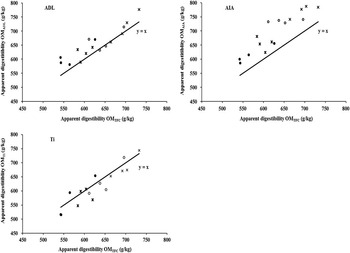
During the experiment, the ponies did not show any marked selection within the haylage provided. The inclusion of pelleted concentrate (75H25C, 50H50C, 25H75C) resulted in a greater (P<0.05) DMD and OMD of these diets in comparison with haylage alone (100H). With increasing proportions of pelleted concentrate in the diet, DMD and OMD increased from 55.4% and 56.9% for the 100H diet to 66.9% and 69.8% for the 25H75C diet (P<0.001; P<0.001), respectively. Assuming additivity, linear regression analysis with OMD (y) and pelleted concentrate inclusion level (x) as the dependent and independent variables, respectively, yielded an OMD of the pelleted concentrate of 73.8% (y=56.4+0.174x, P<0.01). For all treatments combined, significant differences were found for OMD using AIA as well as ADL compared with the value obtained with TFC (P=0.000 and 0.000; n=16). Apparent OMD of experimental treatments determined with Ti were not significantly different to the apparent DMD and OMD determined with TFC (P=0.175 and 0.287; n=16) (Figure 1).
Apparent digestibility of organic matter (OM) (g/kg) determined by total faecal collection (TFC) in individual ponies fed four diets in relation to either apparent digestibility of OM (g/kg) determined with acid-insoluble ash (AIA) (y=1.0696×x+21.137; R
2
adj=0.8339), ADL (y=0.8614×x+111.19; R
2
adj=0.8288) and titanium dioxide (TiO2) (y=1.0462×x−40.175; R
2
adj=0.8468). Experimental diets: 100H ( ), 100% of net energy (NE) requirement provided by haylage; 75H25C (
 ), 75% of NE requirement provided by haylage and 25% by a pelleted concentrate; 50H50C (
 ), 50% of NE requirement provided by haylage and 50% by a pelleted concentrate; 25H75C (
 ), 25% of NE requirement provided by haylage and 75% by a pelleted concentrate.

Discussion
The present study aimed to determine the length of TFC required for an accurate estimation of OMD values of diets containing increasing amounts of pelleted concentrates when fed to ponies. Increasing proportions of concentrate will increase OMD (Martin-Rosset and Dulphy, Reference Martin-Rosset and Dulphy1987; Palmgren Karlsson et al., Reference Palmgren Karlsson, Lindberg and Rundgren2000) and consequently decrease faeces production and defecation frequency of horses, which might result in an extension of the duration of TFC. With increasing pelleted concentrate in the diet, OMD increased in the present study, but the duration of TFC did not need to be extended to obtain accurate OMD values.
As there were no differences and no time×diet interaction between cumulative OMD calculated for 10 consecutive collection days, OMD data were assessed using a broken-line regression analysis (Robbins et al., Reference Robbins, Saxton and Southern2006). The cumulative OMD became constant from day 6 onwards (x⩽5.33). This result is close to the estimate in our previous study of 5 days when ponies were fed forage-only diets (Schaafstra et al., Reference Schaafstra, van Doorn, Schonewille, Wartena, Zoon, Blok and Hendriks2015). However, in the latter study, the minimum collection period was estimated based on a combination of a low CV and a close approximation to the mean OMD. In the current study, the mean CV calculated for diet 100H was greater compared with diets 75H25C, 50H50C and 25H75C (8.8, 3.8, 6.7 and 4.2, respectively). Interestingly, the relative changes of the mean cumulative OMD compared with the cumulative OMD calculated for days 1 to 10 across diets were greatest for the first 3 days of faecal collection and steadily declined afterwards. When the first 3 days of the collection period were removed from the data, the decrease of the mean CV was lower (0.8% v. 3.4% units) when compared with our previous study (Schaafstra et al., Reference Schaafstra, van Doorn, Schonewille, Wartena, Zoon, Blok and Hendriks2015), which indicates that the ponies required more time to adapt to an all forage diet than a diet consisting of both forage and concentrate.
The OMD (y) of the diets in the current study were positively related to the percentage of pelleted concentrate (x) included in the diet (y=56.4+0.17×x, P<0.01). This result is in line with Palmgren Karlsson et al. (Reference Palmgren Karlsson, Lindberg and Rundgren2000) (y=50.7+0.21×x) and Martin-Rosset and Dulphy (Reference Martin-Rosset and Dulphy1987) (y=51.7+0.32×x), who also found a positive relation between OMD and the inclusion of increased proportions of cereals and cereal products in the diet. The lower regression coefficient in the current study compared with those of Palmgren Karlsson et al. (Reference Palmgren Karlsson, Lindberg and Rundgren2000) and Martin-Rosset and Dulphy (Reference Martin-Rosset and Dulphy1987) can be explained by differences in the composition of the concentrate mixture fed, that is wheat bran–barley v. whole oats and maize–barley, respectively. Differences in intercept are caused by differences in the OMD of the forage provided, that is grass hay v. haylage. In the current study, OMD was improved as the percentage of concentrate increased, but the fibre digestibility was either reduced or remained unchanged depending on the proportion of concentrate (data not shown), which agrees with results found by Martin-Rosset et al. (Reference Martin-Rosset and Dulphy1987), Drougal et al. (2001) and Palmgren Karlsson et al. (2000).
Several dietary markers have been used in equine studies, but variation in the recovery of markers has been a distinct disadvantage when using this technique (Sales, Reference Sales2012). In the current study, mean cumulative faecal recoveries of AIA ranged from 113.8% to 134.7% over the four dietary treatments, with the greatest recoveries for the treatments 50H50C and 25H75C. These values are in accordance with data reported by Goachet et al. (Reference Goachet, Philippeau, Varloud and Julliand2009) and Agazzi et al. (Reference Agazzi, Ferroni, Fanelli, Maroccolo, Invernizzi, Dell’Orto and Savoini2011). The high recovery rates (>100%) can probably be explained by an underestimation of the ingested concentration of AIA or an artificial increase in faecal AIA concentration. In the current study, variation in faecal recovery of AIA (CV 9.1) between animals and treatments was lower compared with results of our earlier study (CV 12.4; Schaafstra et al., Reference Schaafstra, van Doorn, Schonewille, Wartena, Zoon, Blok and Hendriks2015). However, in the current study, faecal recovery of AIA significantly differed between treatments, showing that AIA is inadequate to estimate the OMD in ponies.
When ADL was used as an internal marker, mean cumulative faecal recovery was 108.7%. Oliveira et al. (Reference Oliveira, de Almeida, de Filho, Vieira, de Almeida, Corassa, Lopes and Macedo2003) and Siqueira et al. (Reference Siqueira, Gomes, Rodrigues, Fukushima, Lorenzo and Gobesso2009) also reported high-recovery rates for ADL. However, in most equine studies where ADL is used as a digestibility marker, poor faecal recovery of lignin is reported when equines were fed hay-concentrate diets (Miraglia et al., Reference Miraglia, Bergero, Bassano, Tarantola and Ladetto1999; Araújo et al., Reference Araújo, de Freitas Lima, Fiahlo and Miyagi2000; Oliveira et al., Reference Oliveira, de Almeida, de Filho, Vieira, de Almeida, Corassa, Lopes and Macedo2003; Goachet et al., Reference Goachet, Philippeau, Varloud and Julliand2009). Analytical methods, chemical composition (Muntifering, Reference Muntifering1982; Fukushima and Dehority, Reference Fukushima and Dehority2000) and partial digestion as a result of the passage of lignin through the gastrointestinal tract (Fahey and Jung, 1983) may influence the faecal recovery of lignin. The use of lignin as an internal marker is limited to diets containing >5% of lignin in DM (Van Soest, Reference Van Soest, Robertson and Lewis1994). In the current study, the lowest ADL intake was 108.7 g/kg DM for diet 25H75C with a corresponding faecal recovery of 107.0%. The CV of diets 100H and 75H25C were lower than for diets 50H50C and 25H75C, respectively, 4.2 and 4.3 v. 9.9 and 10.5. This suggests that higher levels of ADL in the diet are associated with less variation in faecal recovery.
The mean daily faecal recovery of the external marker Ti was 97.1%, which is identical to the value observed in our previous study when ponies were fed grass hays differing in maturity at harvesting (Schaafstra et al., Reference Schaafstra, van Doorn, Schonewille, Wartena, Zoon, Blok and Hendriks2015). The <100% recovery of Ti may be due to problems associated with the titanium dioxide marker, incomplete feed and faeces collection, uneven distribution of TiO2 in the feed, and its separation from faeces during grinding (Sales and Janssens, Reference Sales and Janssens2003; Smeets et al., Reference Smeets, Nuyens, Van Campenhout, Delezie, Pannecoucque and Niewold2015). Differences in passage rate between marker and nutrients could induce incomplete recovery of Ti. However, no interactions (P=0.441) between concentrate and Ti as a marker for OMD were observed, which was also reported in beef heifers by Pina et al. (Reference Pina, Valadares Filho, Tedeschi, Barbosa and Valadares2009). When the CV was determined for each experimental diet, the mean daily faecal Ti recovery and faecal excretion of Ti were <5%, which suggest that the 14 days adaptation period adopted in this study was sufficiently long for a constant Ti excretion.
Based on the results of Schaafstra et al. (Reference Schaafstra, van Doorn, Schonewille, Wartena, Zoon, Blok and Hendriks2015) and the current study, Ti is the preferred marker to be used in digestibility studies in equines. However, in both studies, grab sampling was not applied. When grab sampling is used, the variation of faecal marker excretion within a day may influence the accuracy of the estimation of the OMD (Dove and Mayes, 1991). It is expected that the flow of internal markers through the digestive tract reflects the digesta flow (Sampaio et al., Reference Sampaio, Detmann, Valente, de Souza, Valaderes Filho and Paulino2011) and may result in a more continuous excretion of the marker. In our previous and the current study, Ti was supplemented and provided as a single pulse dose. A more constant Ti transit through the digestive tract may be achieved by more frequent marker administration (Myers et al., Reference Myers, Ludden, Nayigihugu and Hess2006), which might result in a more accurate estimation of faecal marker excretion. The use of grab samples would be preferred in equine studies as the volume of faecal material limits routine determination of accurate determination of OMD.
A minimum collection period of 6 consecutive days, along with a 14-day adaptation period, is recommended to obtain accurate estimates of OMD in equids fed haylage diets supplemented with pelleted concentrate. Acid-insoluble ash naturally present in the mixed diet is an unsuitable marker for estimating OMD in horses and ponies. The accuracy of prediction of OMD was higher when Ti was used than internal ADL, making external supplementation of Ti the preferred marker in digestibility trials in equines fed diets with increasing proportions of a pelleted concentrate.
Acknowledgements
The authors acknowledge the staff of research facility ‘Tolakker’, Utrecht University, for their assistance in animal care and feeding; the laboratory staff of the Animal Nutrition Group, Wageningen University, for their help in chemical analysis. Marlies van Hof, Marleen Janssen, Rianne Bijwaard and Linda Giosmin are gratefully acknowledged for their help in the execution of the experiment.