INTRODUCTION
Co-opetition[Footnote 1] depicts ‘a combination of cooperation and competition taking place in the context of a relationship, a business strategy, or a business model’ (Ritala, Kraus, & Bouncken, Reference Ritala, Kraus and Bouncken2016: 2). Whereas management scholars recognized the importance of cooperating with rivals only at the onset of the 1990s (Brandenburger & Nalebuff, Reference Brandenburger and Nalebuff1996; Hamel, Reference Hamel1991), co-opetition has recently emerged as an established issue in strategic management (Dagnino & Minà, Reference Dagnino, Minà, Fernandez, Chiambaretto, Le Roy and Czakon2018; Hoffman, Lavie, Reuer, & Shipilov, Reference Hoffmann, Lavie, Reuer and Shipilov2018).
Interestingly, the extant literature shows multiple interpretations of the coexistence of competition and cooperation (Bengtsson, Kock, Lundgren-Henriksson, & Näsholm, Reference Bengtsson, Kock, Lundgren-Henriksson and Näsholm2016). Although some authors acknowledge that competition and cooperation are both separate and independent concepts (Gomes-Casseres, Reference Gomes-Casseres1996; Hoffman et al., Reference Hoffmann, Lavie, Reuer and Shipilov2018), other authors consider these concepts ‘interrelated twins, each serving the purpose of the other’ (Chen, Reference Chen2002: 190). Multiple interpretations visibly emerge when scholars encode situations using different paradoxical frames (Keller, Loewenstein, & Yan, Reference Keller, Loewenstein and Yan2017; Miron-Spektor, Ingram, Keller, Smith, & Lewis, Reference Miron-Spektor, Ingram, Keller, Smith and Lewis2018; Sadler-Smith & Keller, Reference Sadler-Smith and Keller2019; Smith & Tushman, Reference Smith and Tushman2005; Zhang, Waldman, Han, & Li, Reference Zhang, Waldman, Han and Li2015). For instance, Keller and Chen (Reference Keller, Chen and Das2017: 101) underscore that a ‘firm leader who uses paradoxical frames may. . . consider engaging in strategic actions that are both cooperative and competitive’. Similarly, Luo (Reference Luo2004: 20) argues that ‘corporate culture embracing yin-yang philosophy fosters co-opetition’. Interestingly, the adoption of paradoxical frames supports how individuals address contradictions (Hargrave & Van de Ven, Reference Hargrave and Van de Ven2017; Leung et al., Reference Leung, Liou, Miron-Spektor, Koh, Chan, Eisenberg and Schneider2018; Miron-Spektor, Gino, & Argote, Reference Miron-Spektor, Gino and Argote2011).
Since ‘philosophical differences manifest as differences in the proclivity to use paradoxical frames’ (Keller & Chen, Reference Keller, Chen and Das2017: 106), authors have probed into a philosophical inquiry to detect the foundations of co-opetition. For instance, Chen (Reference Chen2002) and Luo (Reference Luo2004) traced the foundation of co-opetition in Eastern philosophy, specifically the cognitive frame of yin-yang balancing (Li, Reference Li2012b). Based on this frame, competition and cooperation cannot exist without the other because they are opposites-in-unity (Li, Reference Li2012a). Competition and cooperation are opposite but integrated elements that, together, form a whole or a totality (Fang, Reference Fang2012). Remarkably, Western philosophy also recognizes dialectical reasoning and the coexistence of competition and cooperation. Nonetheless, based on the key tenets of Western thought, co-opetition appears quite different from the cognitive frame of yin-yang balancing. In fact, the understanding of reality in Western philosophy is intelligible through disjunction, reduction, and abstraction (Li, Reference Li2016). Although the various constructs emerging in the West do not necessarily correspond to those in the East, it is crucial to address two related research questions: How do Eastern and Western philosophies shape the perspectives of scholars and practitioners in framing co-opetition in distinctive manners, and how do such distinctions shape the specific patterns of co-opetition in the East and the West? To address these questions, we conceptualize co-opetition as behavioral in nature, indicating that it refers to ‘publicly observable behavior, rather than mental events per se’ (Moore, Reference Moore2001: 167). Thus, we detect the Eastern (by focusing on Taoism, Confucianism, and Legalism) and Western (by focusing on Kant, Hegel, and Smith) lineages of co-opetition.
We add value to the debate over co-opetition by providing two contributions. First, we extract and discuss four philosophically grounded logics (i.e., either/or, both/and, both/or, and either/and) and their possible East-meeting-West linkages. Second, by applying the East-meeting-West linkages to co-opetition, we identify a set of co-opetition basic arguments and their behavioral patterns to develop a typology of co-opetition strategies.
CONCEPTUAL PILLARS
Unveiling Competition and Cooperation Structures
A competitively structured situation refers to a situation in which the players are willing to achieve a goal that might be personally beneficial but detrimental to all others. Based on the grounding of the previous definition, we recognize two structured competitive situations (Johnson, & Johnson, Reference Johnson and Johnson1989; Stanne, Johnson, & Johnson, Reference Stanne, Johnson and Johnson1999). The first type of competitively structured situation is defined as zero-sum competition. Zero-sum competition occurs when the rewards are distributed according to a ‘winner-takes-all’ basis (Stanne et al., Reference Stanne, Johnson and Johnson1999). The second type of competitively structured situation is labeled appropriate competition and occurs when (a) some rules of the game exist; (b) all players have a chance to win because they are in a position to monitor the other players’ progress as a benchmark; and (c) winning is not very important because the players aim to pursue their interests[Footnote 2] (Stanne et al., Reference Stanne, Johnson and Johnson1999).
Keller (Reference Keller2009) argues that the first type of competition is similar to an attempt to undermine the other. Notably, zero-sum competition does not explain why rivals should consider cooperating with each other; because no player is willing to cooperate with another player who wishes to destroy him or her and vice versa, appropriate competition epitomizes an attempt to out-perform others that emerges when individuals ‘promote a team member's status through increasing his or her own performance relative to other members’ (Keller, Reference Keller2009: 14). Appropriate competition introduces the coexistence of competitive and cooperative situations. Rivals may cooperate with each other to increase private and common benefits (Khanna, Gulati, & Nohria, Reference Khanna, Gulati and Nohria1998) stemming from the competition–cooperation relationship (Chiambaretto, Massé, & Mirc, Reference Chiambaretto, Massé and Mirc2019).
We extend the previous argument in this study and consider players out-performing each other as an instance of competition because players may compete with each other to change their ‘relative standing’ (Keller et al., Reference Keller, Loewenstein and Yan2017: 543). Interestingly, the aim of individual out-performing may lead to situations that are also beneficial to the other team members. Individuals aim to out-perform others without necessarily destroying such others.
A cooperatively structured situation relates to the process in which two players work together to achieve specific goals (Chen, Chen, & Meindl, Reference Chen, Chen and Meindl1998). Actually, ‘cooperatively structured situations create perceptions of a shared fate and promote supportive behavior’ (Beersma et al., Reference Beersma, Hollenbeck, Humphrey, Moon, Conlon and Ilgen2003: 573). Thus, players’ out-helping each other involves other players that attempt ‘to be the most helpful’ (Keller et al., Reference Keller, Loewenstein and Yan2017: 543). This situation may be considered an instance of cooperation because it suggests that players may collaborate with each other and exert joint efforts to achieve a collective gain (Jones & George, Reference Jones and George1998; Keller et al., Reference Keller, Loewenstein and Yan2017). Adopting players’ out-helping each other as an instance of cooperation shows an ‘attitudinal reciprocity that develops as each individual helps’ the others (Tomasello & Vaish, Reference Tomasello and Vaish2013: 236).
Unveiling Co-opetition Structure
Scholars draw on Brandenburger and Nalebuff (Reference Brandenburger and Nalebuff1996) and conceptualize co-opetition as a phenomenon (e.g., Ritala et al., Reference Ritala, Kraus and Bouncken2016) or a mental state incorporating both competition and cooperation (e.g., Keller et al., Reference Keller, Loewenstein and Yan2017). Studies mainly acknowledge the tensions underlying the coexistence of competitive and cooperative actions (e.g., Bengtsson & Kock, Reference Bengtsson and Kock2014; Fernandez & Chiambaretto, Reference Fernandez and Chiambaretto2016). In this regard, differences and cultural implications emerge in managing task- or relational-oriented paradoxical demands (Keller et al., Reference Keller, Chen and Leung2018; Stadtler & Van Wassenhove, Reference Stadtler and Van Wassenhove2016).
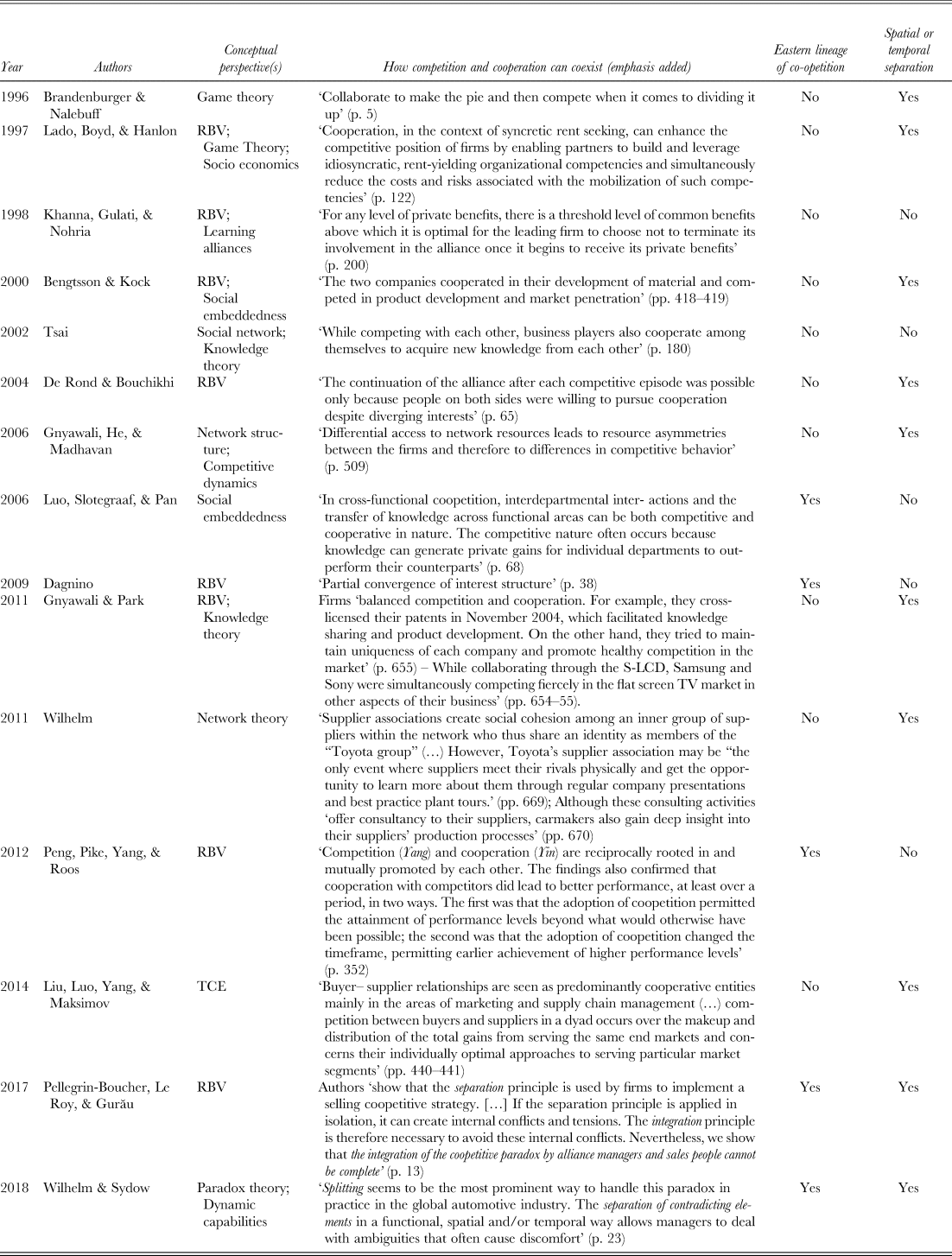
Interestingly, thus far, the literature does not clarify the logic underlying competition and cooperation. Studies emphasize the simultaneous coexistence of competition and cooperation (Luo, Reference Luo2004) but temporally or spatially separate both constructs rather than treating them as strictly intertwined (Ritala & Hurmelinna-Laukkanen, Reference Ritala and Hurmelinna-Laukkanen2013). Therefore, they ‘suppress the tension that ensues by ignoring one element or switching back and forth between two elements’ (Keller & Chen, Reference Keller, Chen and Das2017: 104).[Footnote 2]
Our aim is to understand how cultural influences mold different approaches to address the coexistence of competition and cooperation that leads to plausible distinctions in how managers engage in and scholars conceptualize co-opetition in Eastern and Western contexts (Prashantham & Eranova, Reference Prashantham and Eranova2020). First, we conceptualize co-opetition as behavioral in nature,[Footnote 3] suggesting that co-opetition refers to publicly observable behavior and its link to publicly observable characteristics of the environment that lead to competitive and cooperative actions (Moore, Reference Moore2001). Second, we draw on the notion that ‘the same structural conditions that seed competition also present opportunities for cooperation’ (Ingram & Yue, Reference Ingram and Yue2008: 276) and adopt out-performing and out-helping ‘that can be categorized as both cooperative and competitive’ (Keller et al., Reference Keller, Loewenstein and Yan2017: 543).
EAST-MEETING-WEST: DISTINCTIVE LINEAGE OF CO-OPETITION
Eastern Lineage of Co-opetition
Whereas Taoism, Confucianism, and Legalism share the cognitive frame of yin-yang balancing (Li, Reference Li2016; Lin, Li, & Roelfsema, Reference Lin, Li and Roelfsema2018), they also present philosophical differences that inform the specific patterns of co-opetition.
Taoism
‘According to the yin-yang thinking at the core of Taoism’ (Li & Yang, Reference Li and Yang2017: 913), yin and yang are mutually opposing forces – yang is generated from yin and vice versa. Together, they create the ‘qi’ or vital energy of the universe (Hang, Reference Hang, Liu and Allison1988; Legge, Reference Legge1994). Similarly, out-performing and out-helping (i.e., competition and cooperation) are mutually opposing forces that coexist (Mattsson & Tidstrӧm, Reference Mattsson and Tidström2015). Taoism supports the either/and logical approach to co-opetition that recognizes not only the tension or conflict between cooperation and competition (i.e., ‘either’) but also the synergy of complementarity between cooperation and competition (i.e., ‘and’).
Tactics of co-opetition
Although Sun Tzu underscores that ‘waging war is the last resort; if war is inevitable, the best approach is to win the war without any battle’ (Li & Yang, Reference Li and Yang2017: 918–919), firm leaders inspired by Taoism should not remove competition in the quest for harmony (Yang & Su, Reference Yang and Su2013). Players start co-opetition at a horizontal level through ‘the external environment that may affect the internal movement of the yin-yang duality’ (Jing & Van de Ven, Reference Jing and Van de Ven2014: 32).
Pattern of co-opetition
Taoism argues that ‘harmony does not come from repression but from the expression of every member’ (Lin et al., Reference Lin, Ho and Lin2013: 92). Therefore, managers should focus on their firms’ strengths and weaknesses rather than implement cruel actions against their rivals. Managers should be comprehensive, ‘collaborative, creative and flexible’ (Johnson, Reference Johnson2000: 3). Furthermore, managers should ‘control by means of non-interference’ (Verellen, Reference Verellen1995: 322). Thus, the pattern of co-opetition inspired by Taoism is called implicit co-opetition; whereas cooperation is explicit, competition is only implicit. For instance, managers are conscious that violating such tacit strategies could yield disastrous results, such as price wars.
Confucianism
Confucianism borrows from the cognitive frame of yin-yang balancing (Law & Kesti, Reference Law and Kesti2014) and follows the either/and logic for which: ‘wishing [their firm] to be settled in position, set up others; wishing [their firm] to have access to the powerful, achieve access for others’ (Confucius, Reference Eno2018, Analects, 6.30). Confucianism ‘involves not only finding a compromise between opposing elements, but also analyzing and synthesizing the two elements in a way that optimizes the preferred aspects of both’ (Keller et al., Reference Keller, Chen and Leung2018: 15). Thus, an increment in out-performing behaviors leads to a balance in out-helping (Keller et al., Reference Keller, Loewenstein and Yan2017: 549).
Tactics of co-opetition
Confucianism focuses on reaching harmony among three types of social interactions: (a) horizontal in-group; (b) horizontal out-group, and; (c) vertical in-group (Li, Reference Li2006). When conflict emerges within horizontal in-group relations, the party should ‘give face’ to reach a compromise (Hwang, Reference Hwang2012); when conflict emerges within vertical in-group relations, ‘Confucianism demands the junior's loyalty, filial piety, obedience’ (Fang, Reference Fang2001: 54) and respect for the superior role that should be benevolent and reciprocate (Hwang, Reference Hwang2012).
Pattern of co-opetition
Managers formulate co-opetition and argue that players may compete to out-perform each other. Because harmony between the parties does not imply a perfect agreement between them (Fingarette, Reference Fingarette1979), the Confucian middle-ground approach postulates co-opetition as an explicit instrument to moderate cooperation and competition (Keller & Chen, Reference Keller, Chen and Das2017; Zhou, Li, Zhou, & Prashantham, Reference Zhou, Li, Zhou and Prashantham2019). Cooperation and competition are both explicitly declared. Executives obtain the expected results when they do not focus on satisfying the interests of their shareholders but behave on the ground of justice and rituals (Ma & Tsui, Reference Ma and Tsui2015).
Legalism
Legalism focuses on the immorality of human behavior (Fu, Reference Fu2016) that follows ‘after benefit as water flows downward’ (Shang junshu 23:131; Book of Lord Shang 23.2). According to Han Feizi, individual profit-seeking behavior varies across circumstances (shi) or forces that ‘make sense of the action’ (Moody, Reference Moody2008: 99) and from which military operations emerge. Therefore, the system of incentives should fit the circumstances that progressively emerge as to induce individuals to obey (Shang, Reference Shang and Pines2017). Apparently, Legalism seems to follow the either/or logic for which out-performing and out-helping contradict each other. Nonetheless, Legalism draws on the cognitive frame of the yin-yang balancing and integrates the out-helping and out-performing that may eventually meet because of the constraints imposed by lawmakers and the rules that ‘may serve common ends’ (Winston, Reference Winston2005: 316).
Tactics of co-opetition
Legalism calls attention to hierarchical relationships to induce cooperation among rivals and underscores the role of law and punishment to drive players to obey the defined rules (Pan, Rowney, & Peterson, Reference Pan, Rowney and Peterson2011). Interestingly, Confucianism and Legalism share governmental practices and vertical relationships. However, the Confucian ruling system underlying co-opetition is based on relationalism, mutuality, and reciprocity (Lin et al., Reference Lin, Ho and Lin2013; Pan et al., Reference Pan, Rowney and Peterson2011); in Legalism, co-opetition is induced by the tactics of rewards and severe punishment adopted through the hierarchy (Lin et al., Reference Lin, Li and Roelfsema2018; Ma & Tsui, Reference Ma and Tsui2015).
Pattern of co-opetition
Legalist arguments offer insights for co-opetition also at the interfirm level. Inspired by Legalism, the pattern of co-opetition developed by managers is termed induced co-opetition for which a third party imposes firms in competition to cooperate with each other. Therefore, cooperation is imposed by specific sources of power, such as institutions (Mariani, Reference Mariani2007).
Western Lineage of Co-opetition
Although the general principle of holism emerged in the early works of Western philosophers (e.g., Aristotle's Metaphysics and Plato's holism) and dialectical reasoning (Li, Reference Li2014b), the coexistence of opposites (i.e., competition and cooperation) has long been central in Western philosophy (e.g., Aristotle's Metaphysics and Hegel's Logics), which has traditionally focused on dividing ideas into parts (Fang, Reference Fang2012; Li, Reference Li2012a).
Immanuel Kant
The opposition between out-performing and out-helping in Kant's thought is visible in his Ideas for a Universal History from a Cosmopolitan Point of View (1784), which reports the following: A man ‘expects opposition on all sides because (…) is inclined to oppose others’ (Kant, Reference Kant and Beck1784/1963: IV).
Tactics of co-opetition
According to Kant, ‘Each person is and must be fundamentally either (…) good or evil’ (Sullivan, Reference Sullivan1989: 130). This claim confirms the either/or ‘formal logic (flowing) from Aristotle through Immanuel Kant’ (Wilde, Reference Wilde and Carver1991: 275) in which individuals compete with each other to follow their unsocial tendencies even within a cooperative setting (Wood, Reference Wood, Oksenberg Rorty and Schmidt2009).
Pattern of co-opetition
By denying the coexistence of true opposite elements (Li, Reference Li2016), managers approaching co-opetition by Kantian philosophy epitomize the either/or logic of competition and cooperation in which they choose between either one way or another. The pattern of co-opetition is an emergent strategy that draws on a cooperative setting in which actors operate and identify competitive pressures. Notably, although Kantian philosophy clearly focuses on horizontal interindividual relationships, the either/or logic between competition and cooperation has typically characterized management studies investigating interfirm relationships, especially considering that traditionally ‘one widely adopted view is to consider [competition and cooperation] as distinctly independent’ (Chen, Reference Chen2002: 189). Thus, firms either compete or cooperate for the same activities or with the same rival (Maijoor & Witteloostuijn, Reference Maijoor and Witteloostuijn1996).
Georg Wilhelm Friedrich Hegel
According to Hegel, individuals evolve through a dialectical path formed by the following three levels (Walsh, Reference Walsh1951): family, state, and civil society (which is formed by firms, markets, and other public institutions). Whereas family and state are based on cooperation, recognition, and mutuality (Klikauer, Reference Klikauer2016), civil society is based on competition among members. Juxtaposing out-helping and out-performing according to Hegel's dialectics implies ‘integrating mental opposites by rejecting their inherent conflict and trade-off’ (Li, Reference Li2014a: 329) at any level of social interaction, that is, horizontal in-group level (i.e., within family members, firms, and governments); vertical in-group level (i.e., master-slave relationship); and vertical out-group level (i.e., between firms at different stages of the supply chain or among governments and firms). Therefore, managers adopting the Hegelian's view follow the both/or logic in which no trade-off exists because the possibility of reconciling out-helping with the pursuit of out-performing is maintained.
Tactics of co-opetition
In Hegel's view, the master–slave relationship involves a reciprocal dependence and influence in which parties fight to avoid succumbing. This dual process concludes in a third ‘synthesis of instinctive desire on the part of the individual on the one hand, and his involvement with other individuals on the other’ (Walsh, Reference Walsh1951: 98–99).
Pattern of co-opetition
Managers inspired by the Hegelian logic approach co-opetition as a strategy that temporarily considers both competition and cooperation but finally targets one of the two, that is, either competition or cooperation. Interestingly, ‘Legalism has elements that resemble the Western ideas of rule of law, bureaucracy’ (Pan et al., Reference Pan, Rowney and Peterson2011: 79). However, it assumes that the role of power and influence is one-directional. Conversely, Hegelianism considers the possibility that, over time, the role of power and influence is bidirectional because it features temporal co-opetition.
Adam Smith
Adam Smith is among the Western philosophers who considered that, by nature, individuals both out-perform each other and care for themselves and are sympathetic and prone to out-helping each other. Hence, cooperation among individuals cannot originate from the good feelings, sympathy, pity, or compassion that exist ‘for the help of their brethren’ (Smith, Reference Smith, Raphael and Macfie1759/1976). In fact, the both/and logic that informs the Smithian view ‘is incomplete and insufficient, because it adopts an absolute stance whereby one polarized end is not properly balanced against its opposite end’ (Li, Reference Li2016: 60). Essentially, in Smith's view, out-performing and out-helping are opposites that might eventually coexist, but his ultimate analysis is that individuals must choose between one way or another. Thus, out-performing and out-helping are not conceived as fake opposites and are true opposites. By denying the coexistence of true opposite elements (Li, Reference Li2016), Smith epitomizes the dualism underlying the both/and logic. Interestingly, although the concept of dualism is self-apparent in the either/or logic and the both/or logic, understanding such dualism is challenging in the both/and logic. Thus, Smith temporarily supports the both/and logic but ultimately supports the both/or logic.
Tactics of co-opetition
Notably, Smith emphasizes that coexisting, competition, and cooperation are not integrated elements. The specialization of labor is linked to the human attempt to improve the self, and the out-performing side of human nature emerges for this purpose.
Pattern of co-opetition
Managers inspired by the Smithian argument lead their firms to be competition-oriented and choose to cooperate only if this condition may improve their firm's competitiveness. Consequently, using Smithian thought, managers consider co-opetition a deliberate strategy.
Summary
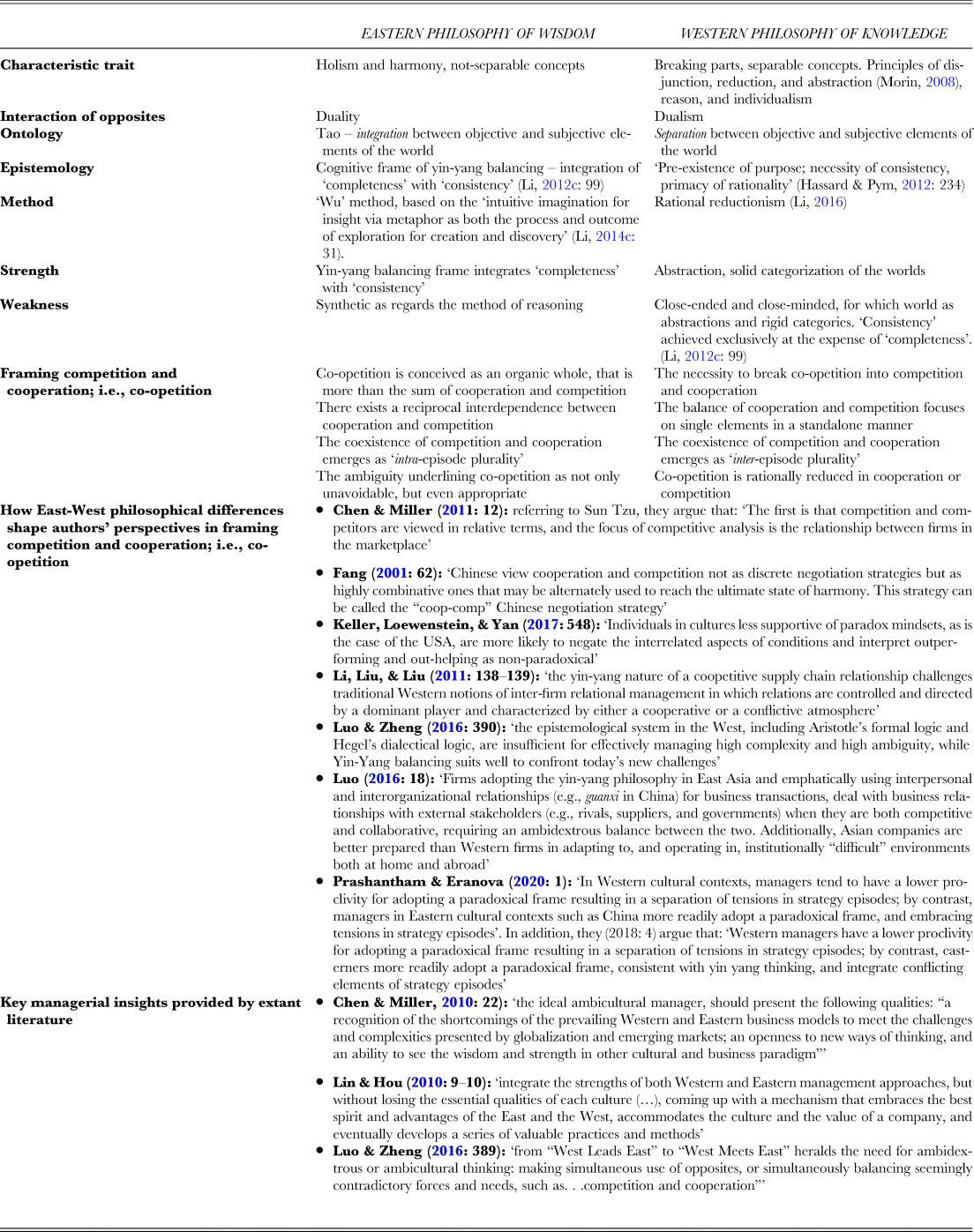
Keller, Chen, and Leung (Reference Keller, Chen and Leung2018: 5) unveil ‘cultural background as an important factor that contributes to variance in individuals’ subjective experience’ with the coexistence of opposites. Similarly, Taggart and Robbey (Reference Taggart and Robey1981: 187) acknowledge that philosophical explanations of human duality help in ‘understanding the decision styles and decision strategies of managers’. As our philosophical inquiry shows (see Table A2 in Appendix I), Eastern and Western philosophies have peculiarities that help with an in-depth exploration of co-opetition (Li, Reference Li2016; Peng & Nisbett, Reference Peng and Nisbett2000).
First, although Western philosophy rejects contradictions as incompatible with the either/or formal logic that requires separation and the Hegelian dialectical logic that requires resolution or synthesis, Eastern philosophy supports the concept that holism and tolerance of contradiction are inevitable in human life; see the yin-yang image (Spencer-Rodgers, Anderson, Ma-Kellams, Wang, & Peng, Reference Spencer-Rodgers, Anderson, Ma-Kellams, Wang, Peng, Spencer-Rodgers and Peng2018). Keller et al. (2017: 555) show a link between out-performing and out-helping in cultural contexts. Specifically, for out-performing, ‘Chinese people are more likely than [people from the West] to respond with high levels of both cooperative and competitive behaviors’ (Keller et al., Reference Keller, Loewenstein and Yan2017: 549). In contrast, Westerners respond with high levels of competitive behaviors because they separate and categorize out-performing and out-helping conditions as competitive or cooperative. A practical implication is that the escalation of conflict within cooperation and the shift from co-opetition to competition is more observable in Western than in Eastern contexts. Conversely, the Eastern perspective requires that executives develop capabilities to accept, holistically understand, and regulate the interdependence between antithetical behaviors (Bengtsson et al., Reference Bengtsson, Raza-Ullah and Vanyushyn2016).
Second, whereas Western philosophy assumes stability, and changes in competition and cooperation follow a linear form (Spencer-Rodgers et al., Reference Spencer-Rodgers, Anderson, Ma-Kellams, Wang, Peng, Spencer-Rodgers and Peng2018), Eastern philosophy assumes dynamism, and changes in competition and cooperation occur in a nonlinear or curvilinear way (Taggart & Robbey, Reference Taggart and Robey1981). There is constant balance in all things (Lin et al., Reference Lin, Li and Roelfsema2018; Smith & Lewis, Reference Smith and Lewis2011), and both competition and cooperation change from dominant to subordinate and vice versa. Managers inspired by Eastern philosophy interpret the coexistence of competition and cooperation as ‘intraepisode plurality’, in which one episode encompasses the coexistence of both actions (Prashantham & Eranova, Reference Prashantham and Eranova2020). Thus, they adopt a ‘becoming’ approach that is ‘interdependent and interactive’ (Li, Reference Li2016: 50). In contrast, managers inspired by Western philosophy interpret the coexistence of competition and cooperation as ‘inter-episode plurality’, for which a sequence of episodes exists in which either cooperation or competition is dominant (Prashantham & Eranova, Reference Prashantham and Eranova2020). Thus, they focus on ‘being’ as a ‘fixed, certain, and complete status’ (Li, Reference Li2016: 50).
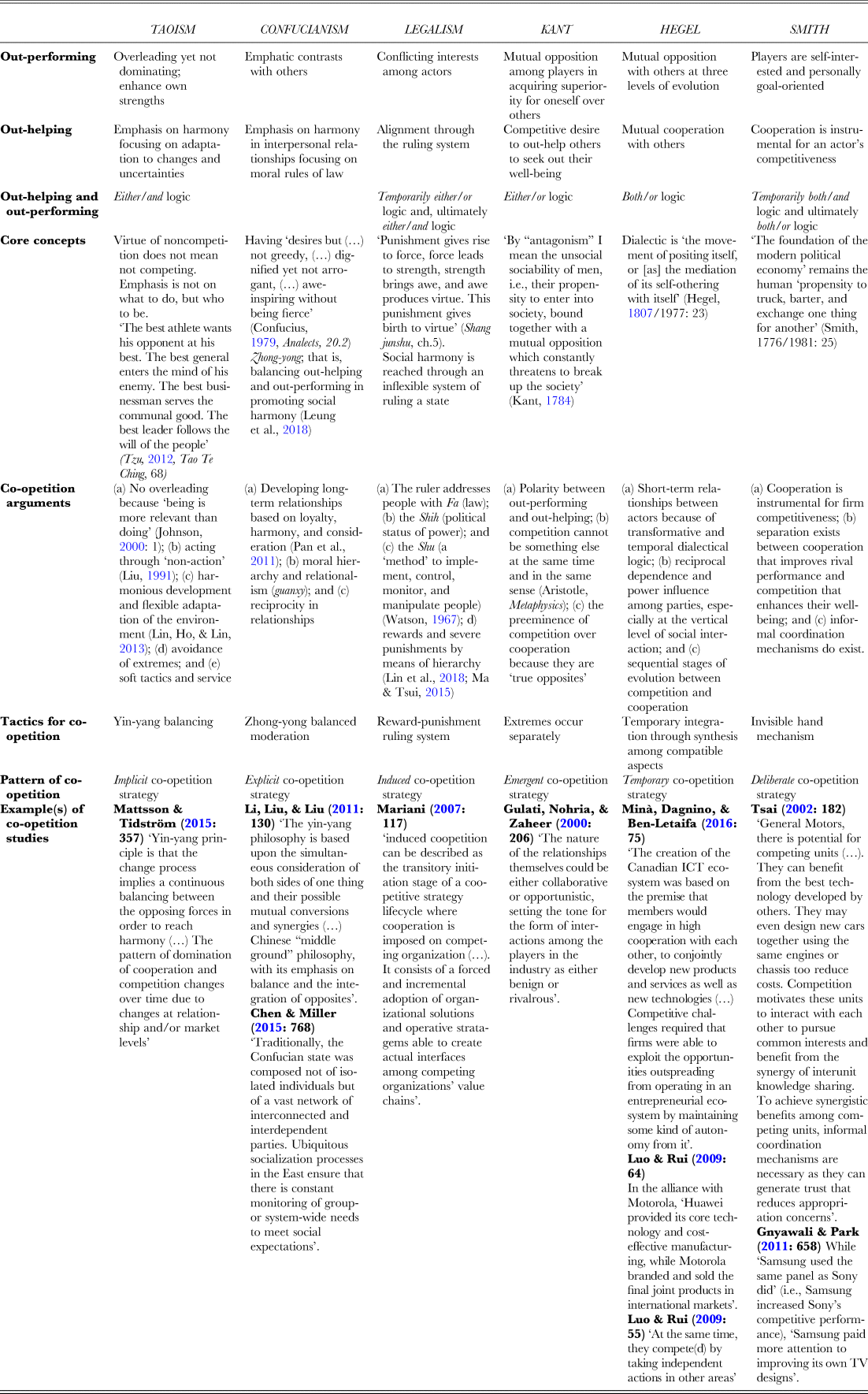
Overall, the coexistence of opposites is present in all societies and cultures. How both academics and executives approach co-opetition depends on the perspective introduced to the analysis (Allison, Reference Allison1969) and the paradoxical frames adopted to understand reality (Keller & Chen, Reference Keller, Chen and Das2017). Table 1 clarifies the connections between Eastern and Western philosophies and co-opetition by considering basic arguments related to co-opetition and its patterns.
Core distinctions between the diverse logics underlying co-opetition in Eastern schools of thought and Western philosophers

TOWARD A NOVEL FRAMEWORK OF CO-OPETITION FROM DIVERSE PHILOSOPHICAL PERSPECTIVES
The comparison performed between Eastern and Western philosophies in general, and Eastern and Western philosophical schools of thought in particular (Nisbett, Reference Nisbett2003), allows us to clarify that out-helping and out-performing should be understood through the lenses of four philosophically grounded logics (see Table 1). Hence, although these logics have identified some features that may explain the ways that opposites interact with each other, the extent to which our understanding of this subject still appears to be dispersed and piecemeal. Accordingly, extant research efforts have been devoted more to examining the differences between East and West (Keller & Chen, Reference Keller, Chen and Das2017; Keller et al., Reference Keller, Loewenstein and Yan2017) and less to their linkages (Chen & Miller, Reference Chen and Miller2015). More importantly, no general framework yet exists that explains why and how the East-meeting-West linkages may turn useful in addressing various typologies of co-opetition strategies.
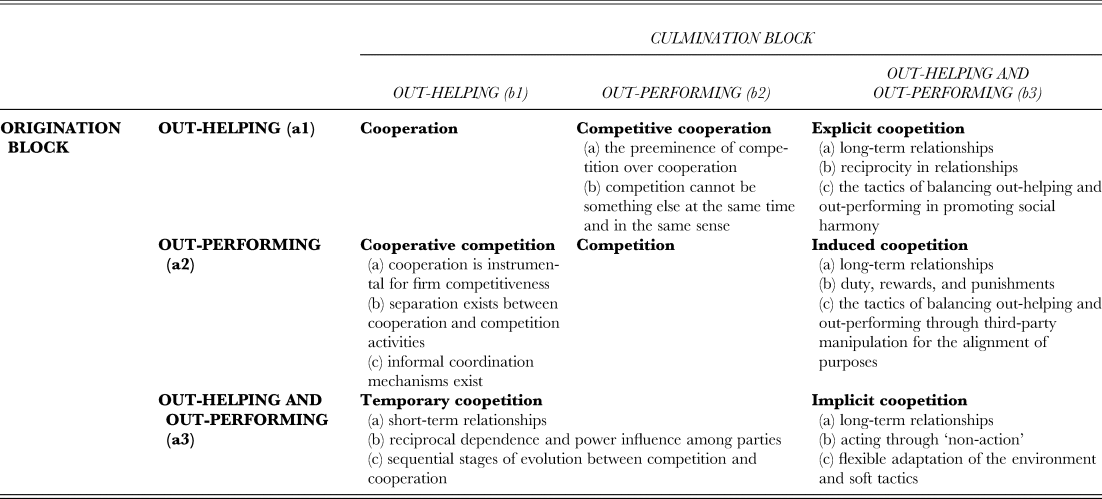
We present a conceptual framework of co-opetition strategies rooted in diverse philosophical perspectives. As we report in Table 2, our framework suggests that the typologies of co-opetition can be traced along with the identification of two main dimensions: (a) origination (that we report in the vertical axis), and; (b) culmination (that we report in the horizontal axis). Coherently with our philosophical investigation, the origination of co-opetition draws on: (a1) out-helping; (a2) out-performing; and (a3) out-helping and out-performing. Similarly, the culmination of co-opetition could unveil in (b1) out-helping; (b2) out-performing; and (b3) out-helping and out-performing. Additionally, Western philosophies share that it is possible to identify a culmination for co-opetition in (b1) out-helping; or (b2) out-performing. Conversely, Eastern philosophies broadly posit that co-opetition occurs simultaneously, for which the culmination is (b3) out-helping and out-performing.
An integrative framework of co-opetition strategies

Along with the two abovementioned edges, the framework depicts the patterns of co-opetition strategies, as suggested by the East-Meeting-West linkages. These patterns consider whether out-helping and out-performing interact with each other and how out-helping and out-performing interact with each other.
The arrows show the combinations of two dimensions (i.e., origination and culmination) that can occur among the quadrants. We depart by showing the case in which the origination is out-helping (a1) and the three culmination blocks are (b1) out-helping; (b2) out-performing; and (b3) out-helping and out-performing. First, if actors are involved in a relationship that originates from out-helping (a1) and that is expected to culminate in out-helping as well (b1), quadrant (a1b1) depicts a situation of cooperation. There is no interaction pattern between out-helping and out-performing, meaning that actors start and continue to collaborate and are fully committed to sharing their resources in the pursuit of a common purpose. In the case of interfirm cooperation, this condition is intended to develop an interfirm cooperative advantage that would be otherwise impossible for a single firm to secure (Das & Teng, Reference Das and Teng2000).
Second, if actors are involved in a relationship that originates from out-helping (a1) and culminates in out-performing (b2), quadrant (a1b2) depicts a type of co-opetition called competitive cooperation. In this case, there is a pattern of interaction between actors of out-helping and out-performing (Khanna et al., Reference Khanna, Gulati and Nohria1998; Lado et al., Reference Lado, Boyd and Hanlon1997) to confirm that ‘the recognition of the importance of cooperation does not mean that strategic alliances are free from competition’ (Das & Teng, Reference Das and Teng2000: 85). This is particularly true in alliances that are naturally involved in learning races (Arslan, Reference Arslan2018; Hamel, Reference Hamel1991; Hamel et al., Reference Hamel, Doz and Prahalad1989) and for which there are ‘many opportunities for inter-partner learning and major competitive consequences of such learning’ (Dussauge, Garrette & Mitchell, Reference Dussauge, Garrette and Mitchell2000: 100). For instance, Bouncken and Kraus (Reference Bouncken and Kraus2013: 2060, italics added) argue that ‘the dualism of competition and collaboration helps SMEs in high-tech industries to share R&D costs’. Nonetheless, although competition and cooperation activities may coexist within a firm, they cannot occur simultaneously because they are conceived as ‘true opposites’ (Li, Reference Li2014a).
Third, if actors are involved in a relationship that originates from out-helping (a1) and culminates in out-helping and out-performing (b3), quadrant (a1b3) depicts a type of co-opetition labeled explicit coopetition. Again, there is a pattern of interaction of out-helping and out-performing between actors that draws on the cognitive frame of yin-yang balancing and supports the idea that actors simultaneously and explicitly out-help and out-perform each other in a co-opetitive relation. In fact, opposite elements are interdependent entities that balance ‘their conflicting and complementary tendencies’ (Li, Reference Li, Wang, Ketchen and Bergh2012c: 100). From such a perspective, a co-opetition strategy implies the coexistence of competition and cooperation in the same place at the same time and acknowledges a ‘partial convergence of actors’ interest’ (Dagnino, Reference Dagnino, Dagnino and Rocco2009: 38). Therefore, although businesses collaborate with various levels of Chinese government institutions with the aim to improve industry competitiveness, ‘competition, of course, inevitably remains at all times because some clashes of interest inescapably exist’ (Luo, Reference Luo2004: 183). Interestingly, very few co-opetition studies systematically examined the overlap with one opposite as having the seed in the other opposite, namely, competition seen as part of cooperation and cooperation as part of the competition (Park, Srivastava, & Gnyawali, Reference Park, Srivastava and Gnyawali2014).
We now consider the case in which the origination is out-performing (a2) and the three culmination blocks are (b1) out-helping; (b2) out-performing; and (b3) out-helping and out-performing. First, if actors are involved in a relationship that originates from out-performing (a2) and culminates in out-helping (b1), quadrant (a2b1) depicts a type of co-opetition called cooperative competition. In this case, there is a pattern of interaction of out-helping and out-performing between actors in competition. However, they acknowledge the relevance of social interaction as ‘to discover what their competitors know so they can benchmark themselves and prepare for the consequences of competition’ (Tsai, Reference Tsai2002: 182). Therefore, actors concur in cooperating and competing, although in different stages, to acquire the required resources to become more competitive (Dussauge et al., Reference Dussauge, Garrette and Mitchell2000).
Second, if actors are involved in a relationship that starts from out-performing (a2) and expect to out-perform each other (b2), as reported in quadrant (a2b2), they will compete. In fact, each actor attempts to gain a higher relative standing through effort and skill (Keller et al., Reference Keller, Loewenstein and Yan2017; Stanne et al., Reference Stanne, Johnson and Johnson1999). Overall, they might experience conflicting interests that should drive them to compete with each other (Bengtsson & Kock, Reference Bengtsson and Kock2000). As reported in quadrant (a1b1), there is no pattern of interaction of out-helping and out-performing, meaning that actors start and continue to compete and are fully oriented to chasing private goals.
Finally, if actors are involved in a relationship that originates from out-performing (a2) and culminates in out-helping and out-performing (b3), quadrant (a2b3) depicts a type of co-opetition named induced strategy. Arguably, the culmination block that includes out-helping and out-performing between actors draws on the cognitive frame of yin-yang balancing. However, co-opetition is induced by a third actor that is entrusted to force cooperation (Castaldo, Möllering, Grosso, & Zerbini, Reference Castaldo, Möllering, Grosso, Zerbini, Yami, Castaldo, Dagnino and Le Roy2010; Fernandez et al., Reference Fernandez, Le Roy and Gnyawali2014). As Mariani (Reference Mariani, Fernandez, Chiambaretto, Le Roy and Czakon2018) underscores, policy makers are in a condition to actually trigger cooperation for coopetition to emerge (Mariani, Reference Mariani2007, Reference Mariani, Fernandez, Chiambaretto, Le Roy and Czakon2018).
Thus far, we have considered out-helping and out-performing as alternative blocks for a co-opetition strategy. Here, we consider that the origination of coopetition is out-helping and out-performing (a3). When this occurs, we need to distinguish whether actors recognize the possibility that the culmination block is, alternatively, out-helping (c1) or out-performing (c2), or the coexistence of out-helping or out-performing (c3). Quadrants (a3c1) and (a3c2) recognize the cases in which actors do not accept that competition and cooperation can coexist simultaneously. Specifically, initially, competition and cooperation are temporarily tolerated (Li, Reference Li2014a) because actors recognize the trade-offs between competition and cooperation ‘via sublation as the solution’ (Li, Reference Li2016: 48). Therefore, temporary co-opetition leads alternatively to cooperation or competition.
Finally, if actors are involved in a relationship that originates from out-helping and out-performing (a3) and culminates in out-helping and out-performing (c3), quadrant (a3c3) depicts a type of co-opetition rooted in the cognitive frame of yin-yang balancing called an implicit strategy. In this case, there is a pattern of a continuous interaction between out-helping and out-performing in which ‘each force cooperates with its counterforce’ (Mattson & Tidstrom, Reference Mattsson and Tidström2015: 3) to show that the seed of out-performing is within the out-helping and the seed of out-helping is within out-performing. Drawing on Taoism, for which there is existence in absence, even if competition is implicit, it does not mean that competition is absent, but that it is present in the seed of cooperation. This condition favors the continuous rebalance of competition and cooperation to reach harmony (Mattson & Tidstrom, Reference Mattsson and Tidström2015).
Implication 1. The Yin-yang Balancing Frame Inspires Three Types of Co-opetition Strategies: Explicit, Induced, and Implicit
As Table 2 shows, the culmination block of co-opetition according to Eastern philosophy is always out-helping and out-performing. From such ground, it is important to understand the value-added contribution of yin-yang balancing in managing co-opetition and, specifically, to shed light on the three mechanisms of yin-yang balancing in terms of asymmetrical balancing, transitional balancing, and curvilinear balancing (Li, Reference Li2016). Specifically, the asymmetrical balancing mechanism of yin-yang allows for the nonequal nature of the relationship between cooperation and competition; that is, cooperation may be dominant, whereas competition is subordinate and vice versa. However, cooperation and competition are opposite poles that tend to change because of the transitional balancing mechanism. Thus, competition changes from dominant to subordinate and vice versa. The ‘shift can be caused by an external shift in a priority status or by the position of a specific subgoal, which may trigger an associated shift from one type of asymmetrical balance to another’ (Gao, Ren, & Miao, Reference Gao, Ren and Miao2018: 26). Finally, the curvilinear balancing mechanism assures that cooperation and competition have a ‘good balance as healthy tension when one opposite element is at a high level, and the other is at a moderate level’ (Li, Reference Li2016: 26). In other words, the asymmetry between the two opposites should be moderate rather than too large or too small.
Within the three abovementioned mechanisms featuring the cognitive frame of yin-yang balancing, our framework shows that it is possible to grasp three different typologies of co-opetition, each related to different perspectives and patterns. For instance, drawing on Taoism, managers develop co-opetition as an implicit strategy, whereas competition is seen as a tacit, and reaching harmony in organizations implies that ‘rulers rule best when they rule least’ (Mattson & Tidstrom, Reference Mattsson and Tidström2015: 3). Because ruling works against reaching harmony, managers that approach co-opetition aim to overcome conflicts, and leverage problem solving and delegations as nonpreference and extreme avoidance (Ma & Tsui, Reference Ma and Tsui2015). In contrast, drawing on Confucianism, managers approach co-opetition as an explicit strategy that addresses normative strategies to balance opposing elements. The extant co-opetition literature typically proposes that both competition and cooperation are explicit (Hoffmann et al., Reference Hoffmann, Lavie, Reuer and Shipilov2018). Nonetheless, as Sun Tzu shows, competition can develop in many forms. For instance, Taoism offers insight into the essence of implicit competition in which rivals focus on their strengths and weaknesses. In fact, Taoism-inspired managers are ‘less likely to believe that conditions that appear contradictory are intrinsically more demanding and challenging than the combined demands from each element’ (Keller et al., Reference Keller, Chen and Leung2018: 12). Similarly, the qualification of implicit and explicit also refers to cooperation (Hoffmann et al., Reference Hoffmann, Lavie, Reuer and Shipilov2018) underlining co-opetition. Co-opetition as an implicit strategy is a ‘ground of analysis’ (Kylänen & Rusko, Reference Kylänen and Rusko2011). This condition is clearly highlighted by Sun Tzu, who stated that ‘an army cannot have constant Shi, similar to water without any constant form or shape; those who are able to adapt and change flexibly in accordance with the competitive context’ (Li & Yang, Reference Li and Yang2017: 918–919). Co-opetition intended as an implicit strategy is observed when it derives from out-helping and out-performing situations to simultaneously out-performing and out-helping with others. Additionally, co-opetition should forestall extremes, and actions should be in harmony with the Zhong-yong. Accordingly, even if both implicit and explicit strategies are rooted in the either/and logic, we infer that the outcomes of these two strategies depend on how managers actually respond to paradoxical tensions (Leung et al., Reference Leung, Liou, Miron-Spektor, Koh, Chan, Eisenberg and Schneider2018).
Finally, in contrast to Taoism and Confucianism, which posit that individuals naturally out-help each other, Legalism assumes that cooperation should be imposed among the players (Lin et al., Reference Lin, Li and Roelfsema2018). Actually, Legalism offers the following original perspective of co-opetition that occurs as an induced strategy in which ‘public sector organizations might exert a very important effect on the way co-opetition is formed’ (Mariani, Reference Mariani, Fernandez, Chiambaretto, Le Roy and Czakon2018: 111). Managers develop co-opetition strategies when forceful incentives drive them to find alternatives to cooperating with rivals (Kylänen & Rusko, Reference Kylänen and Rusko2011). Finally, because of yin-yang epistemology that exemplifies Legalism, cooperation induced by policy makers may activate a balancing mechanism of imposed cooperation in some activities at the same time and in the same space. The notion of induced co-opetition is particularly illuminating in understanding not only horizontal co-opetition but also vertical relations within a firm. For instance, Chiambaretto et al. (Reference Chiambaretto, Massé and Mirc2019) underscore the role of a neutral third party (as the state in Legalism) that is a ‘neutral actor’ that reduces any opportunistic behavior underlying the actions developed by the divisions and acts as a ‘go-between’ by encouraging and facilitating co-opetitive interaction between divisions.
Implication 2. Western Philosophy Allows Discerning Co-opetition as a Deliberate or an Emergent Strategy
As Table 2 shows, shifts along the vertical axis that trace the origination of co-opetition strategies cannot occur because the origination cannot change. In contrast, it is possible to think that actors may change interests and approaches of interaction during the stage of evolution of any relationship, which may lead to different culmination blocks for co-opetition. Nonetheless, drawing on our philosophical inquiry, we argue that shifts among the quadrants of our framework should occur within the contour of the same philosophical system. The fact that Western philosophy rejects contradictions explains why – far from being alternative options – both competitive and cooperative settings may serve as a culmination block for firm strategies.
Interestingly, when external forces stemming from the environment impose a change in a culmination block, as Mintzberg and Waters (Reference Mintzberg and Waters1985) argue, we can observe a shift from a deliberate to an emergent strategy. In this regard, the inquiry of the thinking of Smith and Kant (see Table 1) allowed us to detect the distinction between co-opetition as a deliberate strategy and co-opetition as an emergent strategy (Mintzberg & Waters, Reference Mintzberg and Waters1985). Specifically, through Kantian ideas, co-opetition is an emergent strategy because it is strictly related to conditions that may emerge to craft stable relationships with rivals. Through Smithian ideas, co-opetition is a deliberate strategy for which the market can operate on the grounds of participants’ pursuit of their self-interests (White, Reference White2010), and each specific economic transaction helps define the collective well-being. Drawing on such premises and Dahl, Kock, and Lundgren-Henriksson (Reference Dahl, Kock and Lundgren-Henriksson2016), we identify the following sequences:
1. The shift from quadrant a1b1 to quadrant a1b2, namely, from deliberate cooperation to emergent competitive cooperation: actors in cooperation progressively adopt actions in which they out-perform each other and competitively race for learning faster to terminate the alliance. For instance, De Rond and Bouchikhi (Reference De Rond and Bouchikhi2004: 65) observe that ‘the continuation of the alliance after each competitive episode was possible only because people on both sides were willing to pursue cooperation despite diverging interests’ (Mariani, Reference Mariani2007).
2. The shift from quadrant a1b2 to quadrant a1b1, namely, from deliberate competitive cooperation to emergent cooperation: Actors adopting competitive cooperation may progressively acknowledge that they could no longer compete because external forces stemming from the environment directly impose a pattern of forced cooperation.
3. The shift from quadrant a2b1 to quadrant a2b2, namely, from deliberate cooperative competition to emergent competition: Actors adopting cooperative competition may progressively acknowledge that they are not interested in cooperating anymore because they see competition as the only way to further interact with that partner (Dagnino, Reference Dagnino, Dagnino and Rocco2009).
4. The shift from quadrant a2b2 to quadrant a2b1, namely, from deliberate competition to emergent cooperative competition: Actors adopting cooperative competition may recognize that external forces push to cooperate (Kylänen & Rusko, Reference Kylänen and Rusko2011). In other words, emergent cooperative competition is unintentional in terms of external forces stemming from the environment that directly impose a pattern of forced cooperation between rivals (Castaldo et al., Reference Castaldo, Möllering, Grosso, Zerbini, Yami, Castaldo, Dagnino and Le Roy2010).
DISCUSSION AND RESEARCH AGENDA
‘Bridging ideas from one theoretical domain to address an issue or explain a phenomenon in another domain’ (Floyd, Reference Floyd2009: 1057) may be a rewarding way to enhance the epistemological foundations of strategy research (Durand, Reference Durand2002; Powell, Reference Powell2003). Specifically, this article provides three key building blocks for co-opetition research. First, by comparing Eastern and Western dialectical approaches to addressing opposites, we contribute to the co-opetition literature by shedding light on four logics underlying the intersection of competition and cooperation: either/or, both/and, both/or, and either/and.
Second, by applying the East-meeting-West linkages to co-opetition, we develop a framework of co-opetition strategies that allow the appraisal of co-opetition as stemming from Western and Eastern philosophies. On the one hand, Eastern philosophy allows for the disentanglement of three co-opetition strategies: implicit, explicit, and imposed. On the other hand, Western philosophy allows for the clarification of the separation between competition and cooperation and the related sequences that flow into co-opetition: from cooperation to co-opetition and from competition to co-opetition. Furthermore, it is possible to grasp the rationale for distinguishing between deliberate and emergent co-opetition strategies. Finally, by studying the Hegelian view, it is also possible to recognize a third pattern, which we call ‘temporary co-opetition strategy’. Overall, Western philosophy allows for the disentanglement of deliberate, emergent, and temporary co-opetition strategies.
Limitations and Future Research Implications
At this point, we acknowledge the limitations of the paper and propose a research agenda. First, we scrutinized the insights of Taoism, Confucianism, and Legalism and their impact on co-opetition. However, future studies focusing on Chinese versions of Buddhism may offer distinctive interpretations of co-opetition, such as the one connected to the principles of compassion and non-attachment.
Second, we examined the contributions of Smith, Kant, and Hegel as concerns co-opetition. Nonetheless, further inquiry should extend this investigation to other philosophical inquiry, such as Western Marxist dialectics. In fact, Western Marxist dialectics consider ‘contradiction as real but defines it differently from the Western’ (Peng & Nisbett, Reference Peng and Nisbett2000: 1067). In such a way, it becomes feasible to scrutinize whether and how Western Marxist philosophy shapes the perspectives of scholars and practitioners in framing co-opetition.
Third, we investigated how Eastern and Western philosophies shape the perspectives of scholars in approaching co-opetition by essentially separating the East from the West. Future studies should inspect in further depth the relationship between Eastern and Western thought in exploring co-opetition. This could be done by considering a range of historical periods observed from different perspectives and their reciprocal influences.
Fourth, we considered out-helping others as a proxy of cooperation. Because ‘cooperation is a cultural category, and what it means to cooperate is culturally conditioned’ (Keller & Loewenstein, Reference Keller and Loewenstein2011: 299), future research should probe into how the cultural aspects underlying cooperation may help advance different typologies of co-opetition based on a culturally grounded appreciation of competition and cooperation.
Fifth, except for a few authors who sparingly clarified the philosophical roots of their co-opetition views, by leveraging the expanding body of work on co-opetition in this article, we extracted managers’ and scholars’ ‘internalization of institutionalized logics and practices’ (Keller & Chen, Reference Keller, Chen and Das2017). Notwithstanding that, we recognize that a long road has yet to be traveled to achieve a comprehensive understanding of the philosophical roots of co-opetition. Accordingly, we acknowledge the importance of conducting other studies that may provide first-hand evidence by illustrating how philosophical stances shape managers’ paradoxical frames and co-opetition patterns (Keller & Wu, Reference Keller, Wu, Wang, Ketchen and Bergh2012).
Sixth, this article identified how Eastern and Western philosophies shape specific logics informing the coexistence of cooperation and competition. However, we recognize that the following question remains unanswered: what occurs if firm A interprets its co-opetitive relations with firm B by using a logic that is different from that used by firm B? This aspect calls for additional scrutiny to capture the higher-order value of the yin-yang cognitive framework, that is, ‘its power to incorporate the “either/or” frame and allow it (and other frames) to manage fragmented, static, and consistent (more than simple) issues’ (Li, Reference Li2014a: 330).
APPENDIX I
Selection Criteria
Drawing upon Keller and Chen (Reference Keller, Chen and Das2017), we believe that the multiple interpretations of co-opetition reported in the literature are due to scholars’ differing paradoxical frames originating from Eastern and Western philosophical perspectives. We adopt the term East to identify the geographical areas traditionally influenced by ancient Chinese civilizations. While the Eastern philosophy of wisdom embraces a group of philosophies and religions originating in China, Japan, and Southeast Asia (Li, Reference Li2012a; Li, Reference Li2016), this article focuses primarily on Chinese philosophy and uses the term Eastern philosophy to refer to Chinese philosophy. Obtaining a good understanding of Chinese philosophy requires a fine-grained investigation that cannot be achieved by exploring many philosophical schools of thought (Golden-Biddle & Locke, Reference Golden-Biddle and Locke2007). Specifically, we consider the following three Chinese traditional schools: (a) Taoism, which was founded by Lao Tzu (571-471 BC); (b) Confucianism, which was founded by Confucius (551-479 BC); and (c) Legalism, which was founded by Han Feizi (281-233 BC). Three key reasons lead us to focus on these schools of thought. First, all selected founders lived during the same period of investigation, i.e., the Eastern Zhou dynasty period (Ma & Tsui, Reference Ma and Tsui2015). Second, all three schools of thought ‘are commonly accepted to have had uninterrupted impacts on Chinese society for more than two thousand years’ (Pan et al., Reference Pan, Rowney and Peterson2011: 78). Third, ‘the Taoist perspective of yin-yang balancing is widely shared by all of the other traditional Chinese philosophies, including Confucianism and Legalism’ (Lin et al., Reference Lin, Li and Roelfsema2018: 318). Accordingly, based on these three schools of thought, we can trace the coexistence of opposites, such as out-performing and out-helping, as grasped by the cognitive frame of yin-yang balancing, while simultaneously we can focus on potential differences in reaching the balancing of out-performing and out-helping. Furthermore, we use West to identify the geographical areas historically influenced by ancient Greek civilizations (Li, Reference Li2012a, Reference Li2016). We acknowledge that Western philosophy is historically based in Europe and rooted in the Western philosophical culture, which started in ancient philosophy (i.e., Greek philosophy, such as Socrates, Plato, and Aristotle), followed by early medieval philosophy and modern philosophy. This article refers to Western philosophy (explicitly modern philosophy or ‘philosophy of knowledge’) while using the term ‘Western thought’ to identify key Western philosophical traditions.[Footnote 5] Regarding Western philosophy, we explore a few philosophers (Golden-Biddle & Locke Reference Golden-Biddle and Locke2007). Specifically, we parsimoniously selected (Golden-Biddle & Locke, Reference Golden-Biddle and Locke2007) the thoughts of the following three relevant Western moral philosophers: Adam Smith (1723–1790), Immanuel Kant (1724–1804), and Georg W. F. Hegel (1770–1831). A few reasons led us to study these philosophers. First, the three selected philosophers share the belief that individuals’ choices are the product of ‘mechanisms that check its selfish dimensions and destructive potential by recognizing, preserving, and protecting the rights. . . of individuals’ (Gordon, Reference Gordon and Trentmann2000: 3). Second, the three philosophers emphasize human individuality and the presence of opposite forces. Finally, all authors lived during the same period of investigation (1750–1850).
To interpret the Eastern and Western philosophies, we structure the analysis of each school of thought as follows: (a) definition of out-helping; (b) definition of out-performing; (c) framing the coexistence of out-helping and out-performing; (d) tactics of co-opetition; and (e) patterns of co-opetition. Specifically, to understand how each philosophy frames the coexistence of out-helping and out-performing, we draw on Peter Ping Li's (2016) framework of logical systems. This framework draws upon the idea that ‘cognitive frames or logical systems fall into the domain of epistemology rather than those of both ontology and epistemology’ (Li, Reference Li2014a: 323). Arguably, Li (Reference Li2014a, Reference Li2016) frames the logical system based on two main criteria: (1) whether (or not) the logical systems recognize (or deny) the trade-off or conflict between opposites in paradox and (2) whether (or not) the logical systems recognize (or deny) the synergy or complementarity between opposites in paradox.[Footnote 6]
Synopsis of key studies informing co-opetition development

Main differences between Eastern and Western philosophies