On March 11, 2011, at 2:46 pm, the Great East Japan Earthquake hit a large area of eastern Japan, causing enormous damage. The catastrophic earthquake and its accompanying tsunami devastated the Pacific coast of northeastern Japan. The magnitude of this earthquake was 9.0. The number of dead and missing was reported to be 21 176, and the number of injured was 6217. The economic impact of this earthquake was estimated at 16.9 trillion Japanese yen. In Fukushima prefecture, many people suffered from the consequences of the earthquake, the subsequent tsunami, and especially the Fukushima Daiichi Nuclear Power Plant accident.
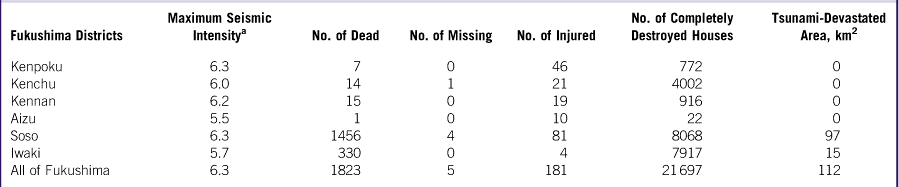
Fukushima prefecture is divided into 6 districts, and the Fukushima Daiichi Nuclear Power Plant is in the Soso district (Figure 1). The extent of damage differed from region to region. Table 1 shows the maximum seismic intensity by the Japanese Meteorological Agency seismic intensity scale (which differs from the modified Mercalli intensity scale); the number of dead, missing, and injured people; the number of completely destroyed houses; and the tsunami-devastated areas resulting from the earthquake in each of the 6 districts. The Soso and Iwaki districts are located along the Pacific coast (Figure 1), and most of the deaths and destroyed houses were due to the subsequent tsunami rather than the earthquake itself.
Map of the Study Area in Fukushima Prefecture. The map on the left shows an outline of Japan. The blue area is Fukushima prefecture, the red line indicates the penetration of the tsunami, and the X marks the epicenter of the earthquake. The map on the right shows the 6 districts of Fukushima prefecture.

Seismic Intensity and Damage Caused by the Great East Japan Earthquake in Fukushima Prefecture
a Maximum seismic intensity measured by the Japanese Meteorological Agency seismic intensity scale.
In the wake of a huge disaster such as an earthquake, the incidence of cardiovascular disease (CVD) has been reported to increase.Reference Katsouyanni, Kogevinas and Trichopoulos1-Reference Watanabe, Kodama and Okura5 We therefore sought to determine whether the incidence of acute myocardial infarction (AMI) increased after this earthquake, using the registry study of AMI in Fukushima prefecture that we have conducted since 2009.
Methods
The study area comprised all 6 districts of Fukushima prefecture (Figure 1). Table 2 shows the residents’ population, gender, and average age in 2011, and the population change from 2011 to 2012 in the 6 districts of Fukushima prefecture, as reported by the Fukushima prefecture municipality. Because the Soso and Iwaki districts border on the Pacific coast, they have a temperate climate year round and received light snowfall. In contrast, the Aizu district has heavy snowfall and cold winters. The Kenpoku, Kenchu, and Kennan districts have an intermediate climate. Most deaths from this earthquake resulted from the tsunami in the coastal area of Fukushima prefecture (Table 1).
Gender, Average Age, and Change of Resident Populations
a From 2011 to 2012.
Figure 2 shows the number of aftershocks with magnitudes higher than 5.0 occurring every 4 weeks after the Great East Japan Earthquake. Aftershocks occurred predominantly in the first 4 weeks, and decreased after 12 weeks. In our preliminary data, the number of AMI patients for 4 weeks and 8 weeks in 2011 did not increase compared with that of the previous 2 years. Based on this finding, we analyzed the incidence of AMI for 1 year and 3 months before and after the earthquake from the Fukushima prefecture AMI registration survey. We defined a year as the anniversary of the earthquake to understand its impact. Therefore, 2011 corresponds to March 11, 2011, to March 10, 2012.
Number of Aftershocks with Magnitudes Higher Than 5.0 Every 4 Weeks after the Great East Japan Earthquake.
The Fukushima Prefecture AMI Registration Survey
The registry study was established to elucidate the status of AMI and to improve treatment outcomes in Fukushima prefecture in 2009. A total of 36 hospitals that accepted AMI patients participated.Reference Nakazato, Yamaki and Kijima6 All AMI patients of Fukushima prefecture were taken or transferred to the 36 participating hospitals and registered in this study. Patients were georeferenced based on the place of their hospitalization.
Diagnosis of AMI was based on the World Health Organization (WHO) multinational monitoring of trends and determinants of cardiovascular disease (MONICA) criteria. Patients needed to be registered within 72 hours after the onset of symptoms if their level of creatinine phosphokinase (CK) or its MB isoform (CK-MB) increased to more than twice the normal range.
This study was conducted in a prospective manner. Each physician filled in the survey form in detail and sent it to the registry office. The survey included coronary risk factors; symptoms; change in electrocardiogram (ECG); CK and CK-MB values; infarction site; reperfusion therapies; duration of hospitalization; and outcomes 30 days after hospitalization. These data were entered into the database and analyzed at the headquarters of the registry study (Fukushima Medical University). This study was continued in spite of the enormity of the disaster. The study protocol was approved by the ethics committee of Fukushima Medical University.
Statistical Analysis
Data are expressed as the number of patients, and the incidence of AMI is shown as the number of patients per 100 000 persons per year. We assessed the differences between the incidence of AMI after the earthquake and during the corresponding period of the previous 2 years in the same area. The incidence of AMI after the earthquake was compared to average incidences of AMI in the previous 2 years, and confirmed using the χ2 test and Fisher exact test.Reference Nozaki, Nakamura and Abe7 These analyses were carried out with SAS software version 9.1 (SAS Institute, Inc). A P value less than .05 was considered statistically significant.
Results
In the present study, we registered a total of 3068 AMI patients who were taken to 36 hospitals between March 11, 2009, and March 10, 2013. The number of AMI patients throughout Fukushima prefecture was 772 in 2011. The number was almost identical to that in 2009, 2010, and 2012 (n = 759, n = 780, and n = 757, respectively; Figure 3A). The average age of the patients in 2011 was identical to those in 2009, 2010, and 2012 (68.4 vs 69.6 [2009], 69.2 [2010], and 68.4 [2012]). The gender of AMI patients in 2011 did not change compared with that of the control years (72% [2011] vs 70% [2009], 73% [2010], and 73% [2012]). Figure 3B shows the incidence of AMI corrected per 100 000 persons. No significant difference was found between 2011 and the previous 2 years, as compared to the incidence of AMI after the earthquake in Fukushima prefecture (n = 38.9 vs 37.9; χ2 = 0.30; P = .58).
Trend of Acute Myocardial Infarction (AMI) in Fukushima Prefecture From 2009 to 2012. A, The graph on the left shows the number of AMIs in the entire prefecture. The graph on the right shows the number of AMIs in each district of Fukushima prefecture. B, The trend in the annual incidence of AMI (per 100 000 persons). *P < .05 compared to the previous 2 years.
Next, those numbers were counted on a regional basis, because Fukushima is the prefecture with the third largest landmass in Japan, and the extent of the disaster damage differed from region to region (Figure 1 and Table 1). In the Iwaki district, the incidence of AMI patients in 2011 increased remarkably compared with those of the previous 2 years (n = 38.7 vs 30.1; χ2 = 4.01; P = .045), as shown in Figure 3B. On the other hand, the incidence of AMI was not increased in the Soso district, although it was most affected by the tsunami and nuclear power plant disaster. No significant changes were observed in the other districts.
To focus on the effect of this disaster on AMI patients, we analyzed data from 3 months before to 3 months after the earthquake (Figure 4). The incidence of AMI patients from March 11 to June 2, 2011, did not increase, as compared with the previous year in the entire prefecture (n = 9.4 vs 10.1; χ2 = 0.54; P = .462). No significant difference was noted in the incidence of AMI from March 11 to June 2, 2011, as compared with the previous year (n = 11.0 vs 12.9; χ2 = 0.03; P = .8634) in the Iwaki district. There was also no significant difference in any other district. Considering the incidence of AMI during 1 year and 3 months after the earthquake in the Iwaki district, the incidence increased from 4 to 12 months after the disaster.
Acute Myocardial Infarction (AMI) Cases From 3 Months Before to 3 Months After the Great East Japan Earthquake in 2011 and Control Years in Fukushima Prefecture. A, Number of AMI patients in Fukushima prefecture. B, The trend in the incidence of AMI (per 100 000 persons/year).
(Continued)
Discussion
The major findings of the present study were that the incidence of AMI did not increase during the first 3 months after the earthquake in Fukushima prefecture compared with the control years, but it did increase in the Iwaki district from 4 to 12 months after the earthquake.
The incidence of intrinsic CVD, which includes acute coronary syndrome (ACS), increases after major disasters.Reference Leor and Kloner2, Reference Leor, Poole and Kloner8, Reference Suzuki, Sakamoto and Koide9, Reference Nakamura, Nozaki, Fukui, Endo, Takahashi and Tamaki10 The mechanisms of inducing ACS entails increased vasomotor reflex response, sympathetic nerve stimulation, worsening of living conditions, and a thrombotic tendency. The physical and psychological stress due to the disaster was assumed to cause AMI. Casualties of the Great East Japan Earthquake were mainly from tsunami damage, which may have affected the incidence of AMI less than an epicentral earthquake.Reference Leor and Kloner2, Reference Suzuki, Sakamoto, Miki and Matsuo3
One study reported no significant increase in the incidence of AMI with an earthquake at less vulnerable circadian periods.Reference Brown11 That report compared the incidence of AMI in the 1989 Loma Prieta earthquake at 5:04 pm with that of the 1994 Northridge earthquake at 4:31 am. Both were similarly intense earthquakes, but the incidence of AMI increased only in the Northridge earthquake. We thought that the Great East Japan Earthquake, which occurred at 2:46 pm, might not have posed as great a risk of AMI as the Northridge earthquake.
Although infection due to worsening environmental conditions might have affected the incidence of AMI, there were no outbreaks of cold or flu in Fukushima prefecture (including Iwaki district) after the earthquake. Also no cold temperature spells were reported after the earthquake in Fukushima prefecture.
A significant increase in the incidence of AMI was observed in the Iwaki district after the earthquake, as compared to the previous 2 years. However, the precise reason for this increase remains unclear. Because victims were severely stressed mentally as well as physically, we speculated that their sympathetic nervous activation and high blood pressure combined with the unavailability of medications, poor nutrition, and lack of hygiene might have triggered major coronary plaque rupture.Reference Yamauchi, Yoshihisa and Iwaya12 Additional studies would be necessary to elucidate the detailed mechanisms of AMI to prevent it in this district in the future.
Limitations
This study has several limitations. First, the tally of the number of AMI patients in Fukushima prefecture may not have been precise, because the study was based on hospital registers. It was not a population-based cohort study, such as the Framingham Heart Study in the United States. Second, we used the place of hospitalization rather than the place of residence to georeference the AMI patients. In future studies, we should use the place of residence. Third, it has been reported that the number of patients with out-of-hospital cardiac arrest increases under stressful situations.Reference Kitamura, Kiyohara and Iwami13 Because this study comprised hospitalized patients, a certain number of AMI cases may have been missed before their admission to the hospital. Fourth, stress cardiomyopathy may have been involved in AMI. However, because a high rate (more than 90%) of the coronary angiograms was performed in the acute stage in our study, most cases of stress cardiomyopathy were distinguished from AMI. Fifth, no changes were found in the average age and gender of the AMI patients in the study period, but the age of the patients was not referenced according to gender. Some studies have reported that younger women may have increased susceptibility to earthquake-induced stress. Further studies would be necessary to clarify this issue. Last, because we analyzed the data for 12 weeks and 1 year in this study, the choice of time-windows may have affected our findings.
Conclusions
The findings of our study demonstrated that the incidence of AMI increased only in limited areas of Fukushima prefecture after the Great East Japan Earthquake.
Acknowledgments
This study was produced on behalf of the Fukushima prefecture acute myocardial infarction (AMI) registration survey investigators. Hospital administration and staff in Fukushima prefecture assisted in the AMI registration survey. Mie Rokkaku and Kumiko Watanabe provided secretarial assistance, and Tetsuya Ohira, MD, assisted with the statistical analysis.
APPENDIX. List of Participating Hospitals and Investigators
Iwaki Kyoritsu Hospital: Masafumi Sugi, MD., Mitsuru Yui, MD., Yoshito Yamamoto, MD., Yutaka Minatoya, MD., Tomohiro Tada, MD., and Yasuhide Asaumi, MD.
Ohta Nishinouchi Hospital: Hiroto Takeda, MD., Nobuo Komatsu, MD., Takeo Niitsuma, MD., Goro Ishida, MD., Akiko Kanazawa, MD., Hiroyuki Yamauchi, MD., Yuichi Nakamura, MD., and Atsuro Masuda, MD.
Takeda General Hospital: Hiroshi Seita, MD., Satoshi Ito, MD., and Mami Sato, MD.
Southern Tohoku Hospital: Masahiro Ono, MD., Mitsuru Muto, MD., Taku Ohsugi, MD., Keiichi Kawamura, MD., and Wakako Naganuma, MD.
Fukushima Red Cross Hospital: Takayuki Owada, MD. and Kenichi Watanabe, MD.
Aizu Chuo Hospital: Michito Kanke, MD.
Hoshi General Hospital: Yoshitane Seino, MD., Eisuke Miura, MD., Keiji Sakamoto, MD., Hironori Kaneko, MD., Yohei Goto, MD., Yasuhiro Shimizu, MD., and Takeshi Shimizu, MD.
Shirakawa Kosei General Hospital: Tomiyoshi Saito, MD., Tsunayoshi Saito, MD., Jiro Izumida, MD., and Takashi Owada, MD.
Fukushima Accident Hospital: Shigebumi Suzuki, MD., Kazuyuki Yoshinari, MD., Yasuyuki Watanabe, MD., Masahito Sando, MD., Hideaki Dairaku, MD., and Kei Haruyama, MD.
Jusendo General Hospital: Masato Iwaya, MD., Toshinori Tanikawa, MD., and Tomohito Suzuki, MD.
Public Soma General Hospital: Masahiko Sato, MD. and Katsuya Ando, MD.
Ohara Medical Center: Yukihiko Abe, MD., Osamu Yamaguchi, MD., Hironori Uekita, MD., and Shunsuke Miura, MD.
Saiseikai Fukushima General Hospital: Hideki Otake, MD., Minoru Mitsugi, MD., and Hirobumi Machii, MD.
Sukagawa Hospital: Akihiro Tsuda, MD. and Jyun Goto, MD.
Fukushima Daiichi Hospital: Katsumi Chiba, MD., Tomohiro Ogawa, MD., and Masatomo Nakao, MD.
Watari Hospital: Tomoyuki Watanabe, MD. and Masaki Sugiyama, MD.
Soma Central Hospital: Yasutoshi Saito, MD.
Shirakawa Hospital: Tsuneo Honda, MD. and Wataru Kuwabara, MD.
Fukushima Prefectural Aizu General Hospital: Kazuaki Tamagawa, MD.
Wakamatsu Intervention Clinic: Wataru Abe, MD.
Fukushima Prefectural Minamiaizu Hospital: Satoshi Abe, MD.
Bange Kosei General Hospital: Junichiro Matsui, MD. and Nobuo Ito, MD.
Northern Fukushima Medical Center: Hiroshi Yoshida, MD. and Yusaku Fukumoto, MD.
Azuma Neurosurgical Hospital: Ryushu Hen, MD. and Yasumori Sodenaga, MD.
Southern Tohoku Fukushima Hospital: Toshio Kobayashi, MD. and Masaki Ando, MD.
Masu Memorial Hospital: Shinichi Hisa, MD.
Ohmachi Hospital: Hiroshi Takahira, MD. and Toshimitsu Sato, MD.
Watanabe Hospital: Ryuzaburo Shineha, MD.
Minamisoma City General Hospital: Fumio Suzuki, MD.
Fukushima Prefectural Ono Hospital: Sakae Suzuki, MD.
Kuwano Kyoritsu Hospital: Masao Tsuboi, MD.
Aizu Nishi Hospital: Naoto Ohara, MD.
Fukushima Prefectural Kitakata Hospital: Tokuo Yui, MD.
Hanawa Kosei Hospital: Keiichi Sagawa, MD.
Jyoban Hospital: Tadami Maeyama, MD.
Department of Health and Welfare, Fukushima Prefecture: Shuichi Nagasawa, MD.
Fukushima Medical Association: Yuzou Takaya, MD.
Fukushima Hospital Association: Kazuhira Maehara, MD.