

I. Introduction
Over the period of 2015–2017, the average profitability of vintage single malt whisky investment was more than three times greater than wine and about ten times greater than gold, with respective rates of return of 102.23%, 30.83%, and 10.20% (Rare Whisky 101, 2017). As a result, whisky is now considered a relevant investment opportunity by individual and institutional investors. However, it can be difficult to choose the right whisky, particularly with the increasing variety of products available on the market. For example, the 2018 edition of Jim Murray's Whisky Bible, which gathers only a sample of total world production, evaluates more than 4,600 whiskies sold at prices that can vary significantly from one whisky to another.
Like wine (Ali and Nauges, Reference Ali and Nauges2007; Roma, Di Martino, and Perrone, Reference Roma, Di Martino and Perrone2013; Castroiata and Delmastro, Reference Castroiata and Delmastro2014), whisky can be considered an experienced good, as defined by Nelson (Reference Nelson1974), that is, a good whose quality is unknown before consumption. Yet, while wine already benefits from an extensive body of literature, with a significant field using the hedonic analysis method (Rosen, Reference Rosen1974) to explain the impact of its characteristics on its price, this does not appear to be the case for whisky, with the exception of Page (Reference Page2019). In his article, Page (Reference Page2019) studies the link between a distillery's size and its ability to influence retail whisky prices, but finds no significant results. Although he does not study the topic, he suggests that distilleries develop an influence through brand recognition. While this specific issue merits examination, we consider whisky to be particularly interesting for hedonic pricing analysis for three main reasons. The first reason is that, as explained earlier, whisky has now become a relevant investment opportunity. The second reason is that, similar to wine, whisky lends itself to hedonic price analysis because of the substantial attribute variation in available products (Murray, Reference Murray2018). Whisky is produced worldwide, with distillers located in Scotland, Ireland, the United States, and more recently in several other countries such as Japan, India, Australia, Sweden, and France. It also includes diverse sub-categories of products, such as vatted malt, rye whiskey, cask strength, etc., and even geographic appellations, similar to vineyards for wine. Scottish whiskies, for example, are subdivided into three protected regions (Highlands, Lowlands, and Speyside) and two protected localities (Campbeltown and Islay). This diversity is also enhanced by the combination of actors who can bottle whisky, since a distiller can bottle its output in-house or sell its barrels to an independent bottler. The latter can then decide to mature the whisky in conditions that differ from those the distiller would have adopted. In this case, the bottle label may display both the distiller's name and the bottler's name. The third reason is that a bottle of whisky, unlike a bottle of wine, has no aging potential: a wine goes on maturing in its bottle whereas a whisky does not. The maturation process of a whisky actually stops once the whisky has been bottled (Mitchell, Reference Mitchell, Russel and Stewart2014) and its age corresponds only to the time it has spent in barrels between its distillation date (i.e., its vintage) and its bottling date. For instance, when the distillery Lagavulin distilled two whiskies, one in 1990 and one in 2000, and matured them for 16 years before bottling, it produced two different bottles of whisky with different vintages, but with the same whisky age.
The study of an alcoholic drink with these characteristics provides a deeper understanding of some of the mechanisms governing the price determination of both spirits and wines. Considering the difference between the age of a whisky and the age of its bottle, our results show that whisky age and, to a lesser extent, bottle age, are positively correlated with price. Other findings included the significant influence of the distiller's reputation with a moderating effect for independent bottling (i.e., not in-house by the distiller itself) and a positive impact for so-called “cask strength” whiskies compared to whiskies diluted with water. From a managerial perspective, these results may enable whisky producers to more efficiently position the price of their products and whisky investors to more accurately anticipate the rate of return of their investments.
Overall, our article makes three main contributions to the literature. (1) It extends the scope of hedonic pricing analysis to an alcoholic drink that has no aging potential once bottled. (2) It contributes to the wine economics literature by emphasizing the relevance of disentangling two effects relating to the vintage: a “weather” effect, linked to a set of specific climatic conditions for a given year, and a “collector” effect, linked to the potentially reduced availability of the product over time. (3) It relates to the literature on reputation issues by offering useful insights into the impact of individual reputation interactions when the production process involves several agents.
The remainder of the paper proceeds as follows. Section II explains the specific characteristics of whisky by comparing them to those of wine. Section III describes our data and provides summary statistics. The empirical model and estimation results are then presented in Section IV. Section V concludes with a discussion of implications and suggestions for further research.
II. Whisky and Wine in the Literature
Hedonic price analyses of wine have employed different approaches to subdivide the characteristics of this good (Fogarty, Reference Fogarty2003; Estrella Orrego, Defrancesco, and Gennari, Reference Estrella Orrego, Defrancesco and Gennari2012). Some of these works distinguish two sets of characteristics, differentiating between objective and sensory attributes (Lecocq and Visser, Reference Lecocq and Visser2006), or between extrinsic and intrinsic attributes (Oczkowski and Doucouliagos, Reference Oczkowski and Doucouliagos2014). Intrinsic or sensory attributes refer to all the characteristics of wine that are related to the tasting experience, including variables such as aroma, visual aspect, and gustative properties. Extrinsic or objective attributes include characteristics that are taste-independent such as the grape variety, climatic conditions, the reputation of the wine, producer or region, or expert ratings. The main interest of studying whisky is that, unlike a bottle of wine, a bottle of whisky has no aging potential as its intrinsic characteristics depend neither on the passing of time nor on climatic conditions. The intrinsic characteristics of a bottle of whisky can be said to be time-independent for two reasons.
First, the production of wine, both in terms of quantity and quality, depends on climatic variables. Several studies have been conducted on wine price variables (Ashenfelter, Ashmore, and Lalonde, Reference Ashenfelter, Ashmore and Lalonde1993; Byron and Ashenfelter, Reference Byron and Ashenfelter1995; Wood and Anderson, Reference Wood and Anderson2006; Chevet, Lecocq, and Visser, Reference Chevet, Lecocq and Visser2011). Ashenfelter, Ashmore, and Lalonde (Reference Ashenfelter, Ashmore and Lalonde1993), for example, investigated the price of Bordeaux wines and show that winter rain and temperature generated a positive effect, while rain in the harvest and pre-harvest periods generated a negative effect. Haeger and Storchmann (Reference Haeger and Storchmann2006) found that, for American Pinot Noir wines, prices were mainly determined by temperature and precipitation. Chevet, Lecocq, and Visser (Reference Chevet, Lecocq and Visser2011),who studied more than two centuries of data from the archives of a Bordeaux château, showed that the influence of temperature on prices has become stronger over time. This literature helps us to understand one of the impacts of the vintage variable on the price of wine: different vintages from the same producer can be sold at different prices only because of the distinctive climatic conditions characterizing these respective vintages. Indeed, for wine, a given vintage is associated with a given set of intrinsic characteristics. This is not the case for whisky. The production process of whisky is such that its intrinsic characteristics do not depend on the climatic variables related to the period of its production (Bringhurst and Brosnan, Reference Bringhurst, Brosnan, Russel and Stewart2014), that is, they do not depend on the vintage. A Lagavulin 16 Year Old bottled in 2006 and a Lagavulin 16 Year Old bottled in 2016 can be expected to share identical intrinsic characteristics: in both cases, the whisky is a Lagavulin 16 Year Old.
Second, the intrinsic characteristics of wine change over time, once bottled. The process of maturing wines extends beyond the bottling day, potentially lasting between 20 and 40 years for some red wines. Furthermore, the proper age for consumption cannot be anticipated but can only be discovered through experimentation (Jaeger, Reference Jaeger1981). As a result, the price of a wine partly depends on its maturation potential (Jones and Storchmann, Reference Jones and Storchmann2001; Roma, Di Martino, and Perrone, Reference Roma, Di Martino and Perrone2013). This characteristic of wine explains the fact that wine can be purchased to be stored, either to be consumed once it has aged, or to be sold at a higher price (Krasker, Reference Krasker1979; Jaeger, Reference Jaeger1981; Burton and Jacobsen, Reference Burton and Jacobsen2001; Ashenfelter, Reference Ashenfelter2008), with the expectation in the latter case that the wine will gain collector value (Byron and Ashenfelter, Reference Byron and Ashenfelter1995). This phenomenon of maturation for wine explains the existence of markets for both young and mature wines (Wood and Anderson, Reference Wood and Anderson2006; Ashenfelter, Reference Ashenfelter2008) with potential investment behaviors similar to those observed in other markets for collectibles such as art (Burton and Jacobsen, Reference Burton and Jacobsen2001; Lucey and Devine, Reference Lucey and Devine2015; Aytaç, Hoang, and Mandou, Reference Aytaç, Hoang and Mandou2016). Nevertheless, although investment behaviors are also observed in the whisky market, they cannot be identical to those observed in the wine market. A wine investor or consumer may expect the intrinsic characteristics of a given bottle to change over time due to the maturation process, which may explain buyers’ increased willingness to pay for wines expected to have a higher aging potential (Wood and Anderson, Reference Wood and Anderson2006; Roma, Di Martino, and Perrone, Reference Roma, Di Martino and Perrone2013). A whisky investor will not have the same expectations because, once bottled, the intrinsic characteristics of a whisky do not change (Page, Reference Page2019; Mitchell, Reference Mitchell, Russel and Stewart2014). A bottle of Lagavulin 16 Year Old purchased in a given year remains the same bottle of Lagavulin 16 Year Old years later: the whisky does not change.
These two differences between wine and whisky lead us to consider the variables of age and vintage differently for these two products. The age of a wine depends solely on its vintage and increases as time passes (Ashenfelter, Reference Ashenfelter2008; Storchmann, Reference Storchmann2012), whereas the age of a whisky depends on the length of its maturation period, regardless of its vintage, and remains unchanged once bottled.
III. Data
For our empirical analysis, we used the data provided by the website www.worldwhiskyindex.com. This website represents a second-hand market where bottles are sold not by the producers themselves, but by the investors. We chose to collect data from this website for two main reasons. First, this online trading platform is specifically tailored for single malt Scotch whisky investors (as explained on its homepage) and it displays an extensive set of extrinsic characteristics of interest to investors, as indicated in the Rare Whisky 101 Annual Investment Report (2017). The website provides a diverse range of information for a given bottle, including its ask price, that is, the selling price offered by its owner; its last transaction price, if any; the name of the distillery; the type of whisky; certain characteristics of its production process (including unchill filtered, coloring, cask strength, etc.); the name of the bottler, bearing in mind that the distillery can bottle its own whisky or sell the cask to an independent bottler; the alcohol content by volume (in %); the volume of the bottle (in liters); the age of the whisky, remembering that certain whiskies are “no age statement” whiskies; the year it was distilled, that is, its vintage year; and the year it was bottled. The second reason we chose this website is that, to the best of our knowledge, it is the only website to reference such a large number of bottles in its database, allowing us to gather a sufficient number of observations (with no missing data) for our empirical analyses.
We collected a first sample comprised of 510 observations of a single type of whisky (single malt), produced by the distillers located in Islay, one of the two protected localities in Scotland, the other being Campbeltown. We chose to focus solely on the bottles produced by the Islay-located distillers because of the locality's specificities. Of the two aforementioned localities, Islay has the greater number of distilleries, including the oldest in the country, Bowmore, established in 1779, the most recent, Kilchoman, established in 2005, and a distillery that has been closed since 1984, Port Ellen. As such, it offers the greatest variability to study the potential effects of a distillery's reputation on prices. It also allows us to control for the possible collective reputation effects of specific locations, such as for vineyards. Furthermore, the data were collected over a relatively short period (January 15–30, 2018) to avoid significant price movements. We chose ask prices as the dependent variable due to the insufficient frequency of transaction prices in the database.
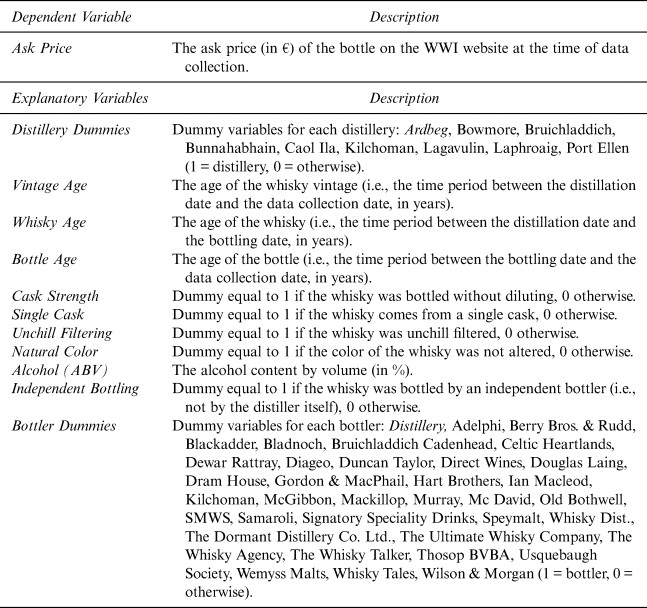
After accounting for missing data, we obtained a final sample comprising 280 observations. The relevant variables used in our analysis are described in Table 1. It is worth noting that we compute a vintage age variable, following Ashenfelter (Reference Ashenfelter2008), as a quantity variable (i.e., the number of years since the whisky was distilled) rather than using dummies for each vintage year because, as mentioned before, we do not expect the specific climatic conditions of a given year to affect whisky characteristics. Vintage age is thus equal to the sum of whisky age (the time spent in the cask) and bottle age (the time spent in the bottle). In addition, when the whisky age was missing but the distilling and bottling years were provided, we attributed an age to the whisky by deducing it from the latter two variables.
Description of Variables

Note: This table lists the variables and their respective descriptions. For “Distillery” and “Bottler” dummies, the respective references used in the regressions appear in italics.
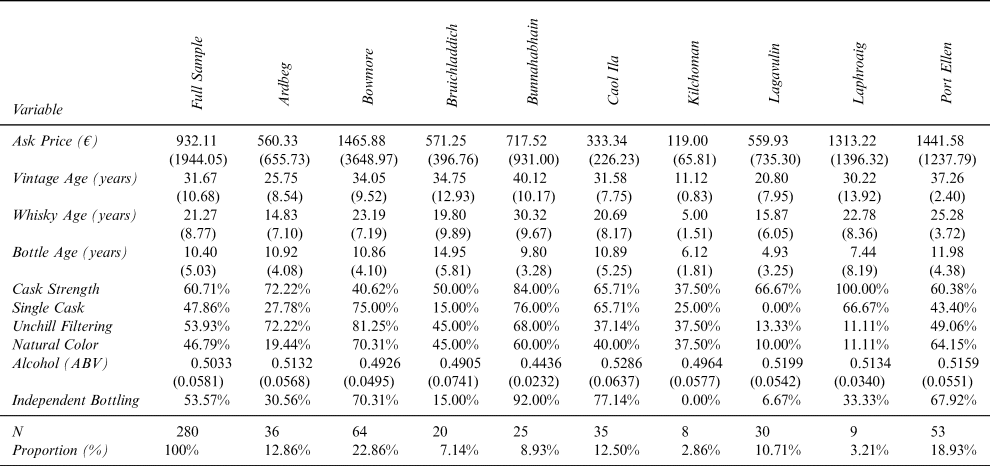
Table 2 presents the descriptive statistics for our dataset. The average ask price for the whole sample is €932.11, with average whisky and bottle ages of 21.27 and 10.40 years, respectively. Among the bottles in our analysis data, 60.71% are cask strength whiskies, 47.86% come from a single cask, 53.93% are unchill filtered, 46.79% are natural colored whiskies, and more than half (53.57%) were bottled by an independent bottler. The most frequently represented distillery is Bowmore with 64 observations, and the least frequently represented is Kilchoman with only 8 observations. Moreover, as expected, since it is the newest distillery in the sample, Kilchoman exhibits the youngest whiskies on average, both in terms of whisky age (5 years) and bottle age (6.12 years), whereas the oldest whiskies come from Bunnahabhain (30.32 years) and the oldest bottles from Bruichladdich (14.95 years). Note that the relatively young age of bottles from Port Ellen (11.98 years), compared to the closing year of that distillery (1984), stems from the fact that about 68% of these whiskies were bottled by independent bottlers, including a significant proportion several years after the distillery closed.
Summary Statistics

Note: This table reports descriptive statistics for the whole sample and across distilleries. Mean (standard deviation) and proportion are displayed for continuous variables and dummies, respectively. N is the number of observations.
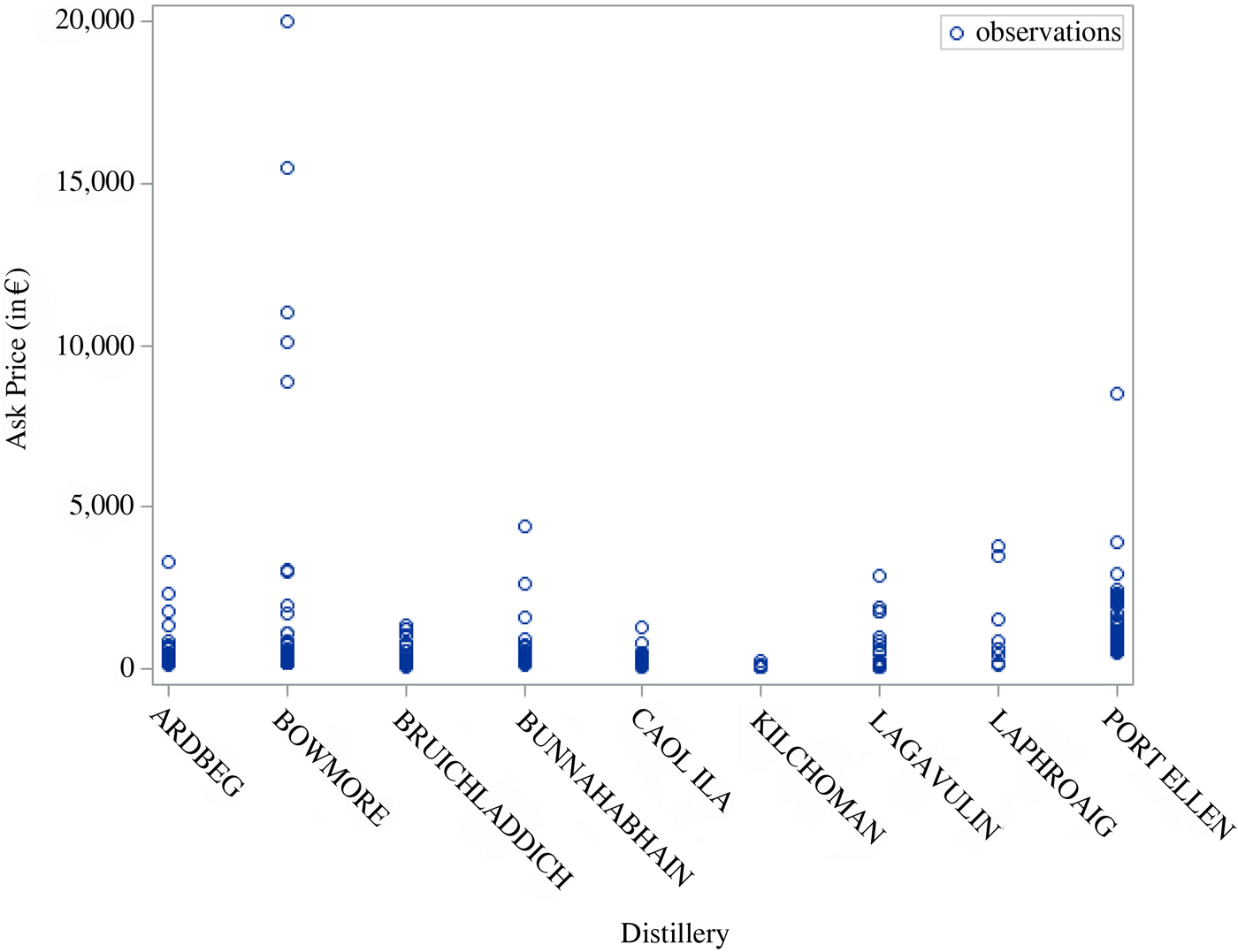
Figure 1 illustrates the distribution of ask prices across distilleries. Two distilleries stand out from the others on the graph for their higher prices: Bowmore, the oldest distillery in the sample, and Port Ellen, the only closed distillery, with average prices of €1,465.88 and €1,441.58, respectively. On the opposite end of the scale, the distillery Kilchoman displays the lowest prices (€119.00 on average) with the lowest variation across bottles.
Distribution of Ask Prices by Distillery

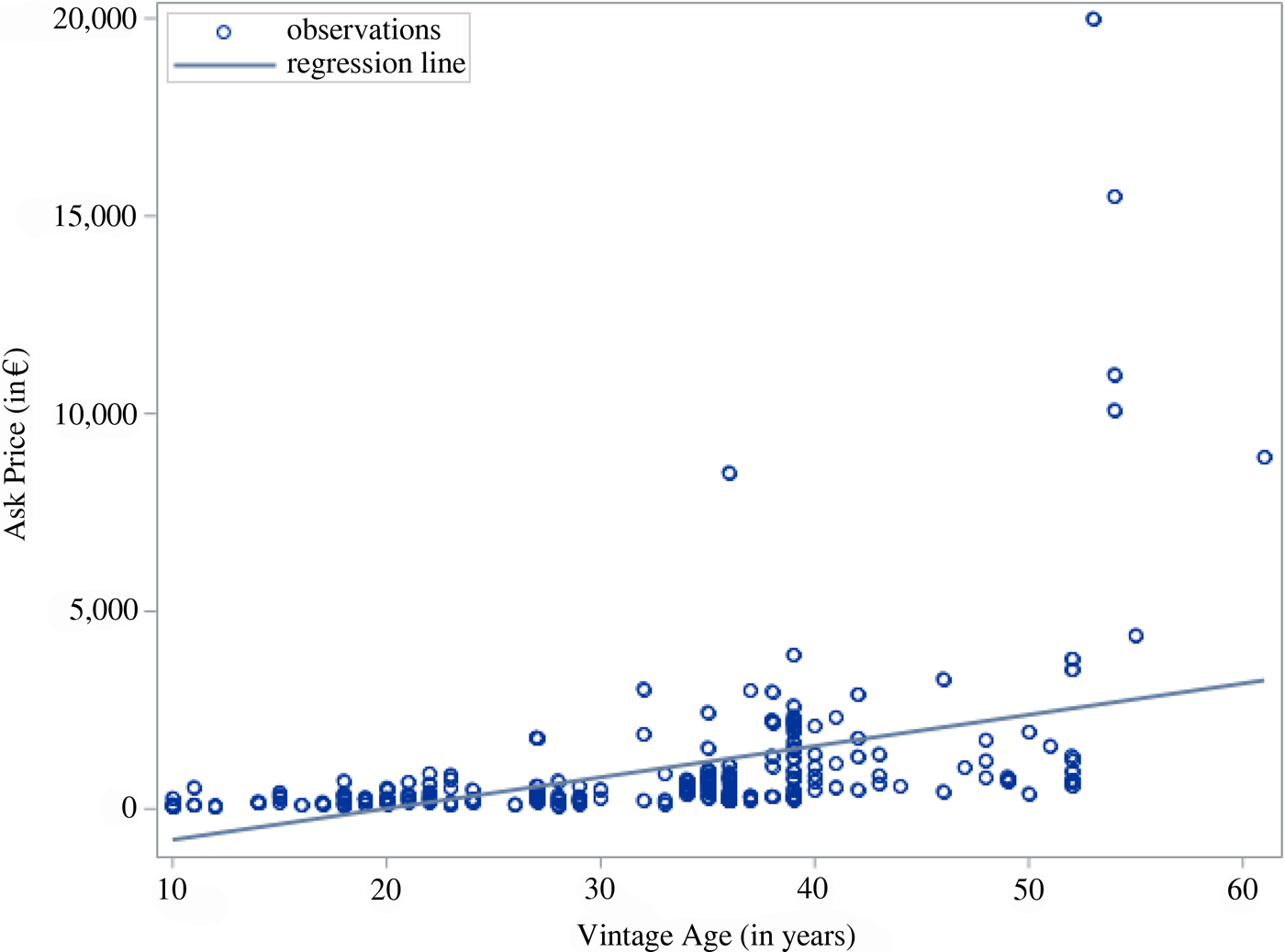
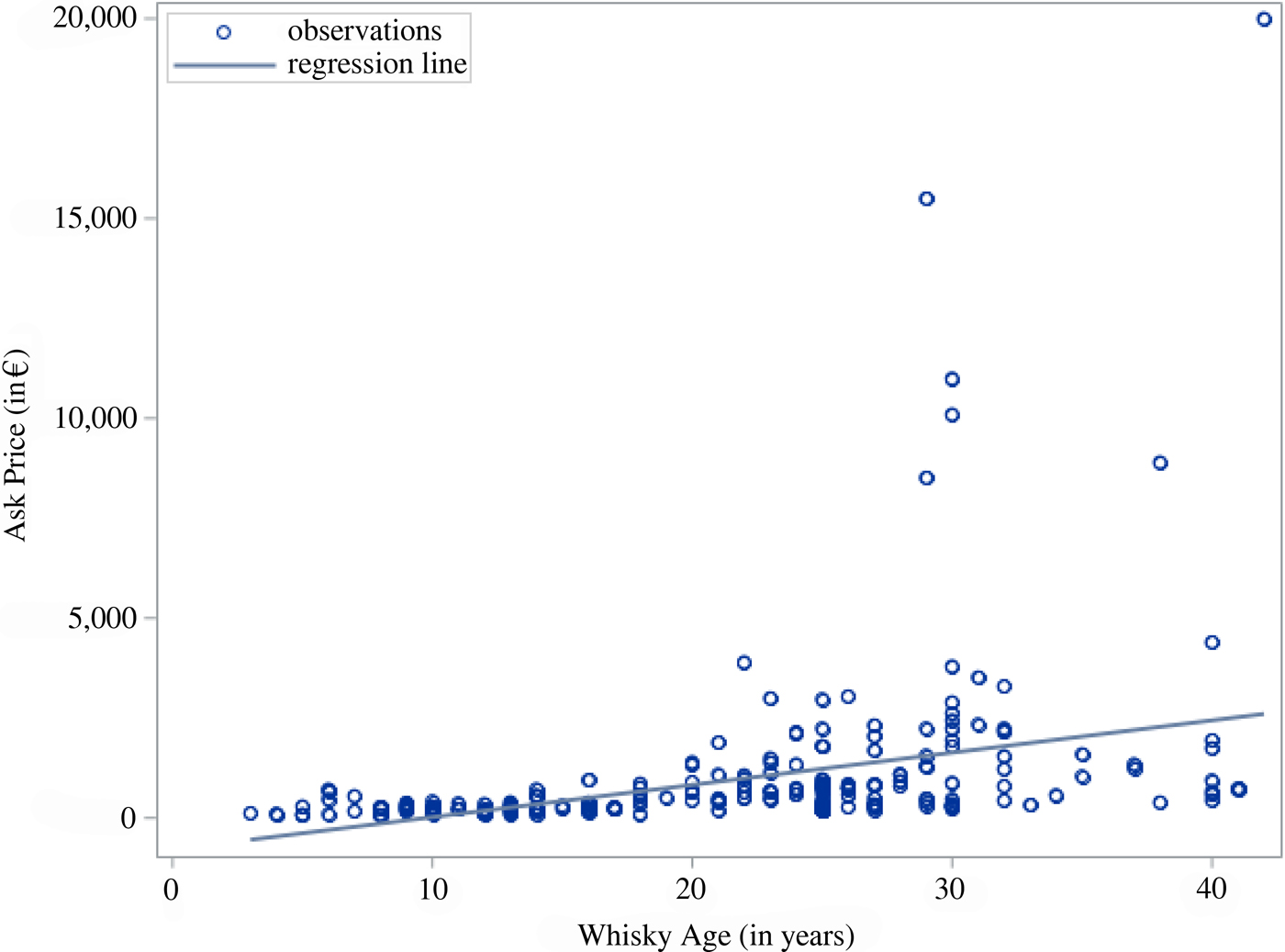
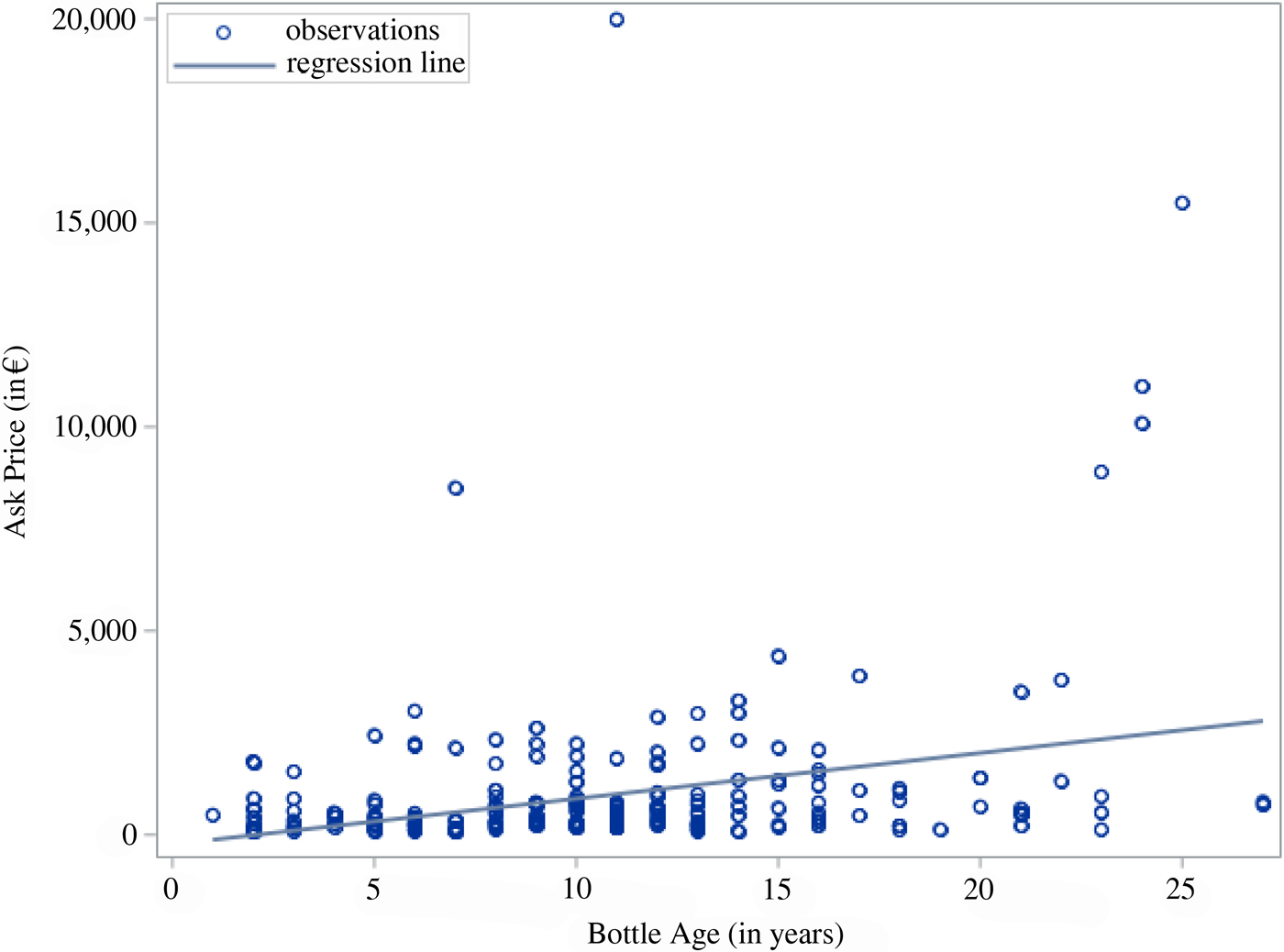
In Figures 2, 3, and 4, we plot the distribution of ask prices by vintage age, whisky age, and bottle age, respectively, including the corresponding regression line for each. It can be seen in Figure 2 that ask prices increase with whisky vintage age. Given the earlier arguments, we would expect this trend to be driven solely by whisky age and not by bottle age. Yet it appears in Figures 3 and 4 that the ask price increases with both whisky age and bottling age in a similar manner. One possible explanation is that a collector effect has an impact on the price that investors ask for the oldest bottles; however, this finding needs further investigation, which is examined in the next section.
Distribution of Ask Prices by Vintage Age

Distribution of Ask Prices by Whisky Age

Distribution of Ask Prices by Bottle Age

IV. Empirical Model and Estimation
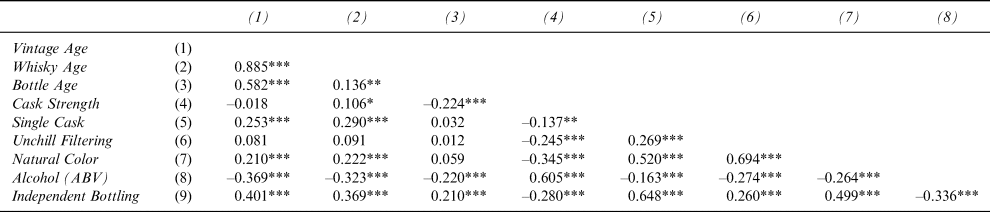
We use a log-linear regression model, traditionally employed in most hedonic regression studies.Footnote 1 In line with Tadelis (Reference Tadelis1999), we assume that distillery names (and thus distillery dummies) capture reputation effects. We employ five different specifications: the base model with dummy variables for distilleries only and four more elaborate specifications obtained by adding variables linked to the production process and bottler fixed effects. It is worth noting that some variables are strongly correlated, as shown in Table 3. In particular, we find a strong correlation between Cask Strength and Alcohol (ABV), which can be explained by the fact that cask strength whiskies tend to have higher ABV than diluted whiskies. Unchill Filtering and Single Cask are also found to be strongly correlated with Natural Color, as well as Independent Bottling and Single Cask. We therefore consider these variables separately in our OLS regressions.
Pairwise Correlation Matrix of Variables

Note: This table reports pairwise Pearson correlations between the different regression variables. Variables are described in Table 1. The superscript asterisks ***, **, and * denote statistical significance at the 1%, 5%, and 10% levels, respectively.
Almost all the explanatory variables are presented as dummies, with the exception of vintage age, whisky age, bottle age, and alcohol by volume, which are quantity variables. The dependent variable is the investor asking price, which means that our hedonic analysis only considers the investor supply side. This approach has been validated in the wine economics literature in cases where transaction prices are unavailable (Schamel and Anderson, Reference Schamel and Anderson2003; Estrella Orrego, Defrancesco, and Gennari, Reference Estrella Orrego, Defrancesco and Gennari2012; Oczkowski and Doucouliagos, Reference Oczkowski and Doucouliagos2014; Oczkowski, Reference Oczkowski2015), where it is assumed that sellers have accurate knowledge of the prices acceptable to potential purchasers. Our empirical base model is
 $$\log Ask\; Price_i = \; \alpha + \beta X_i + \varepsilon _i$$
where Ask Price is the price of bottle i and X i is the vector of explanatory variables related to distilleries (dummies). The residual εi is assumed to be independently and identically distributed. The base model can then be augmented by adding other relevant variables to Equation (1).
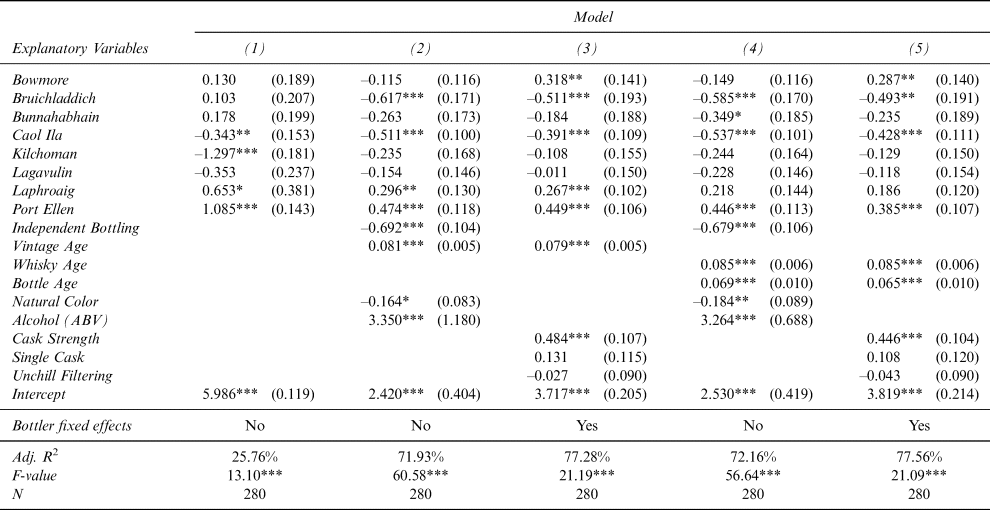
Table 4 presents the results of the OLS regressions for the different model specifications. In Model 1, we merely include the different distilleries as dummies, with Ardbeg as the reference. The model adjusted R 2 is 25.76. As expected, Port Ellen contributes statistically and significantly to the investor asking price, while Kilchoman exhibits a negative and significant impact (at the 1% level for both). Two other distilleries display statistically significant parameters, with negative and positive impacts, respectively: Caol Ila (at the 5% level) and Laphroaig (at the 10% level only). The parameter for Bowmore is positive but not statistically significant.
Estimation Results for Log of Ask Price

Note: This table reports the estimation results for the log of Ask Price OLS regressions. Variables are described in Table 1. N is the number of observations. White robust standard errors adjusted for heteroscedasticity are in parentheses. The superscript asterisks ***, **, and * denote statistical significance at the 1%, 5%, and 10% levels, respectively.
In Models 2 and 3, we add the variables related to the production process, with vintage age as the aging variable. The adjusted R 2 increases to about 71.9 and 77.3, respectively. Models 4 and 5 are similar to Models 2 and 3, except that we split the vintage age variable into whisky age and bottle age in order to disentangle their respective effects, which slightly raises the adjusted R 2. The parameters for vintage age are positive and significant (at the 1% threshold), as are the parameters for whisky age and bottle age, which confirm their positive impact on the ask price. In other words, all other things being equal, the age of a whisky and, to a lesser extent, the age of its bottle, are positively correlated with price. Two other variables related to the production process have a positive and significant impact (at the 1% threshold): cask strength and alcohol by volume, whereas independent bottling exhibits a significant negative parameter, meaning that non-dilution of the whisky and proprietary bottling (i.e., in-house by the distillery itself) appear to be valuable characteristics for investors. Note that when we replace the independent bottling variable of Models 2 and 4 with bottler fixed effects in Models 3 and 5 (the reference being “Distillery”), the parameters (not shown in the table) are significant and negative for 27 bottlers out of 35, and only one parameter is positive and significant (Speciality Drinks).
Regarding distilleries, the parameter for Port Ellen decreases, but it remains positive and significant at the 1% level in Models 2 to 5, whereas the parameter for Kilchoman becomes insignificant. This finding suggests that when we control for production process variables, Kilchoman is not really distinguishable from the other Islay distilleries in terms of reputation and is only disadvantaged in terms of production age since it is the newest distillery in the sample. The parameter for Bowmore becomes significant in Models 3 and 5 (at the 5% threshold) but is not significant in the two other specifications. Finally, when controlling for production process variables and bottler fixed effects in the complete Model 5, two distilleries appear to benefit from a premium compared to Ardbeg: Port Ellen and, to a lesser extent, Bowmore; whereas Bruichladdich and Caol Ila appear to suffer from a weaker reputation, which has a negative effect on their price.Footnote 2
Overall, using the exponential form of related parameters obtained from Model 5 (and from Model 4 for the effect of independent bottling), we can summarize our results and their respective economic interpretations. On average, all other things being equal, each year of whisky aging in the cask increases the ask price by 8.9% and, once the maturing process is complete and the whisky has been bottled, each subsequent year of bottle aging results in a price increase of 6.7%. In addition, a cask strength whisky is expected to be 56.2% more expensive than a diluted whisky. In contrast, independent bottling reduces the ask price by 49.3% on average.
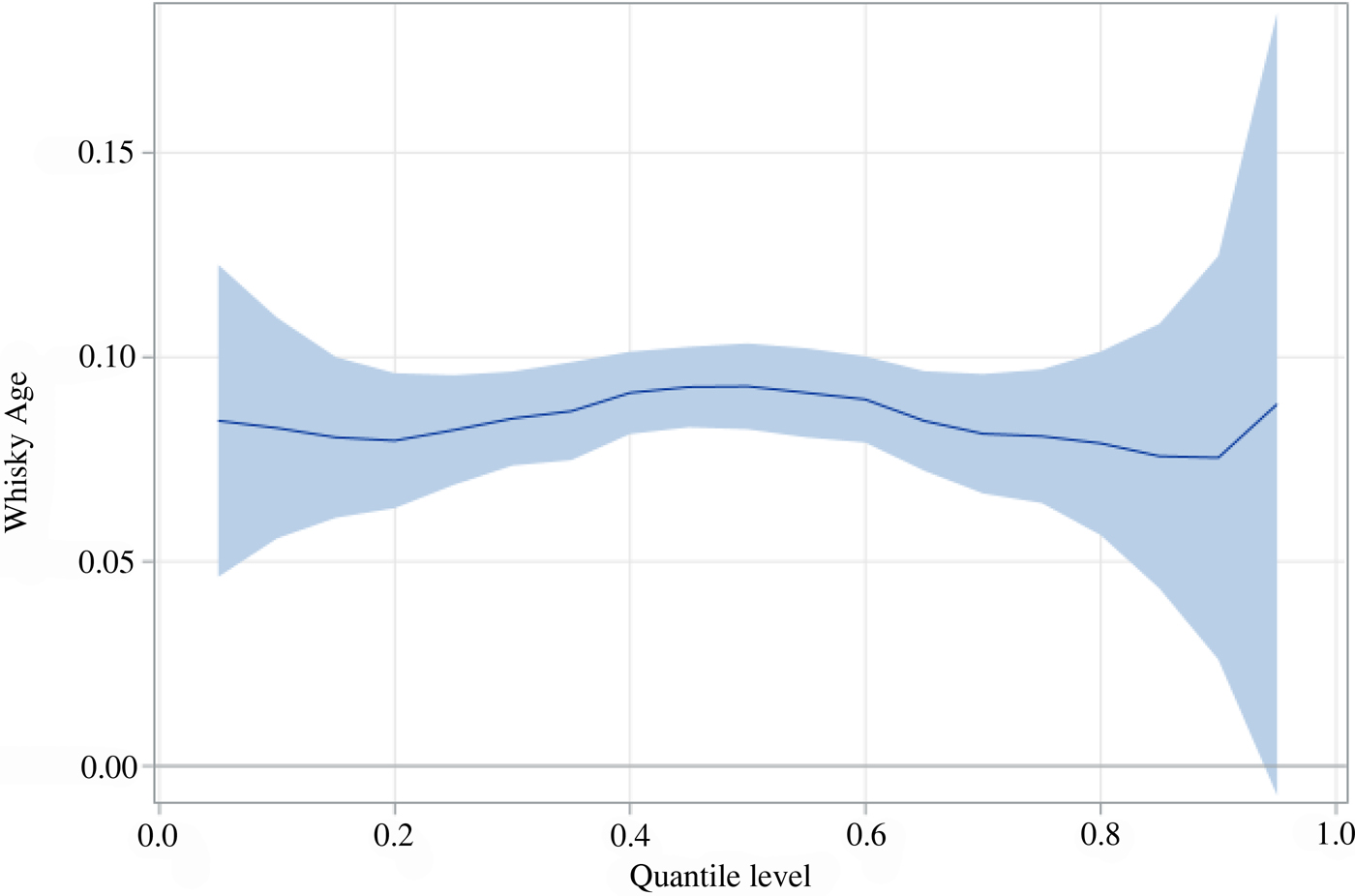
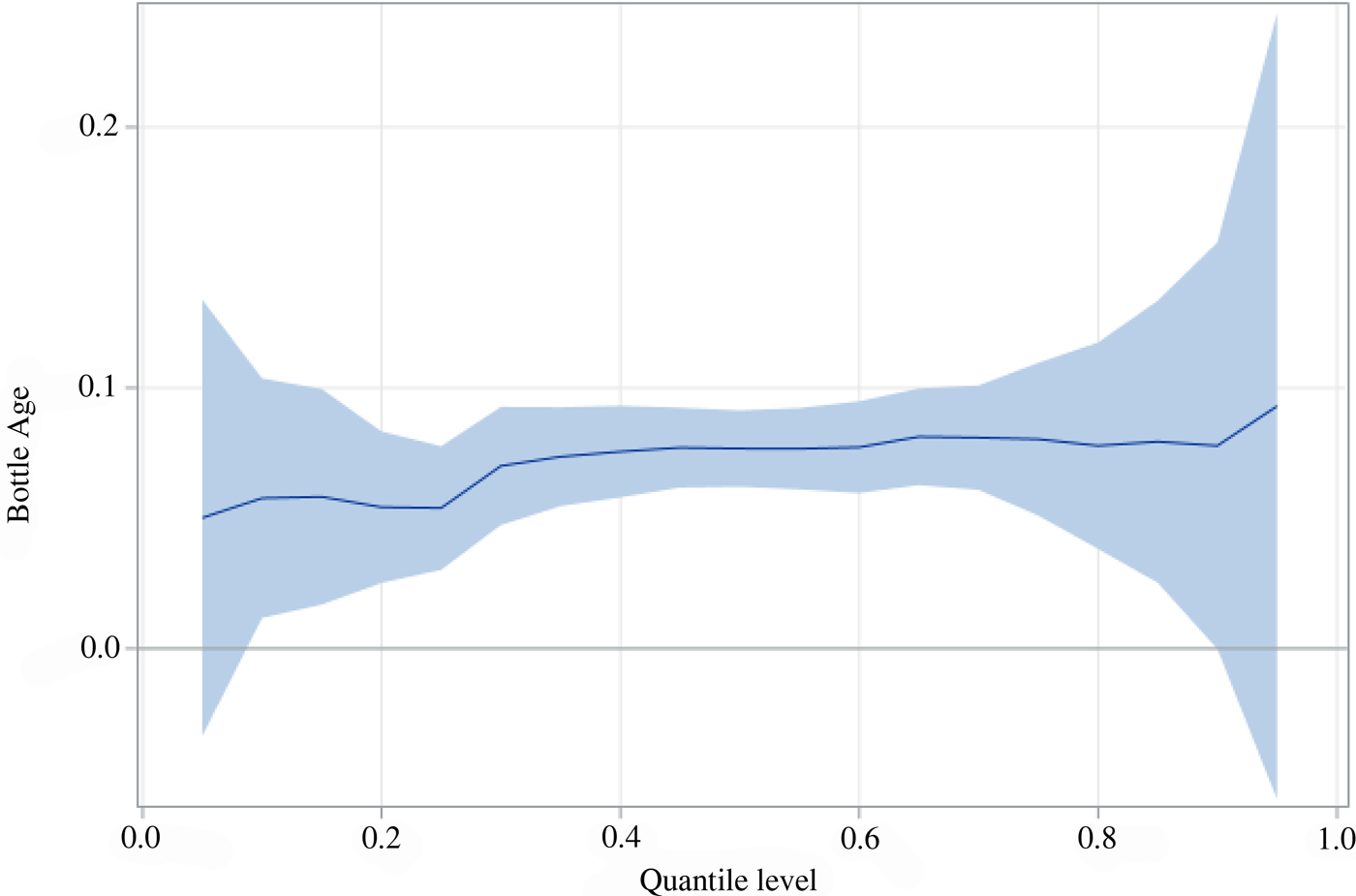
Finally, in order to investigate whether the influence of aging variables changes with price quantiles, Figures 5 and 6 show a graphical summary of quantile regression results for Model 5. For each variable, we plot the 19 distinct quantile regression estimates ranging from 0.05 to 0.95 as a solid curve with filled dots. The shaded area depicts a 95% pointwise confidence band for quantile regression estimates. The impacts of whisky age and bottle age are found to be relatively stable across quantiles, suggesting no significant disparities between lower and higher price whisky bottles in the sample. It is worth noting that the same pattern is observed for other independent variables in the model (results not shown here).
Estimated Parameters by Quantile Level for Whisky Age

Estimated Parameters by Quantile Level for Bottle Age

V. Conclusion
Our results raise some serious issues for the literature that studies spirits and wine as investment assets (Masset and Henderson, Reference Masset and Henderson2010; Lucey and Devine, Reference Lucey and Devine2015; Aytaç, Hoang, and Mandou, Reference Aytaç, Hoang and Mandou2016). First, it is commonly acknowledged for wine that the impact of vintage on price is related to a “weather” effect, that is, a specific set of climatic conditions for a given year that will determine the intrinsic characteristics of the wine and its aging potential. For whisky, the impact of vintage cannot be linked to a weather effect since its intrinsic characteristics do not depend on climatic conditions and a bottle of whisky has no aging potential. It can therefore only be related to a “collector” effect, that is, an effect related to the potential lower availability of the product over time. It is therefore not necessarily the vintage of the spirit that matters but rather the vintage age—the sum of whisky age and bottle age. In other words, the age of the whisky and the age of the bottle are positively correlated with the value of the bottle of whisky, regardless of vintage. This finding highlights the fact that, for wine, vintage may have an impact from both a weather effect and a collector effect.
Second, our results show that some variables related to the production process, in particular cask strength and whisky age, affect the ask price; however, other variables not addressed in this article may also have an influence. For instance, Gergaud and Ginsburgh (Reference Gergaud and Ginsburgh2008) distinguish two kinds of input for wine: technological choices (e.g., the choice of grape varieties, the picking and selection process, the fermentation process, etc.) and natural endowments (e.g., land characteristics, vineyard exposures, etc.). We did not study all of the variables related to technological choices, we focused our attention solely on the variables mentioned on the bottle label. It would be relevant to investigate the impacts of other technological choices made by the master distiller that are not mentioned, such as the type of yeast, the still used, or the identity of the master distiller. Additionally, natural endowments may also partly explain intrinsic whisky characteristics, for example, the spring providing water for the distillation process or a specific geographic location enabling barrels to be stored in a specific place (seaside, mountain, etc.).
Third, the negative impact of independent bottling indicates that investors are sensitive to the distiller's involvement in the overall production process when estimating the price of a bottle of whisky. There may be two possible explanations for this finding: (1) investors might consider that only the distillers themselves can guarantee the authenticity of the whiskies they bottle, unlike independent bottlers who may bottle whiskies from several distilleries; or (2) independent bottlers may make technological choices that differ from those of the distillers, such as finishing the whisky in wine barrels, which affects the intrinsic characteristics of the final product. This relates to the wine economics literature concerning the impact of a producer's reputation on prices (Landon and Smith, Reference Landon and Smith1998; Schamel and Anderson, Reference Schamel and Anderson2003; Cardebat and Figuet, Reference Cardebat and Figuet2004; Haeger and Storchmann, Reference Haeger and Storchmann2006; Ashenfelter, Reference Ashenfelter2008; Carew and Florkowski, Reference Carew and Florkowski2008; Roma, Di Martino, and Perrone, Reference Roma, Di Martino and Perrone2013).
Overall, our results raise several research questions. The growing recognition of producers located in a range of countries featuring different natural endowments suggests it would be relevant to study the impact of technological choices and natural endowments on prices. In addition, it provides interesting research perspectives for studying collective reputation effects similar to those observed in the wine market, with its geographical origins (Combris, Lecocq, and Visser, Reference Combris, Lecocq and Visser1997; Schamel, Reference Schamel2009; Roma, Di Martino, and Perrone, Reference Roma, Di Martino and Perrone2013) and quality classification schemes (Landon and Smith, Reference Landon and Smith1998; Schamel and Anderson, Reference Schamel and Anderson2003). Finally, since the whisky production process involves different agents (distillers and bottlers), it offers a relevant field for further research on the interaction of individual reputations.