Since its golden age at the turn of the century, barbershop quartet singing has become both a symbol of the Victorian era and a successful hobby for men. Its primary organization, the Barbershop Harmony Society, currently has approximately 30,000 members in the United States and affiliate societies in eight other countries, including Germany, Australia, and Great Britain.Footnote 1 This resurgence after a fall from the popular mainstream was sparked by barbershop revivalists, who not only produced the Society, but also revised and codified barbershop's history, racial politics, and musical style.Footnote 2 In so doing, they advanced a mode of white masculinity that combined physical, emotional, and musical closeness.
This article examines the history and cultural work of this distinctive mode of white masculinity in barbershop, which was characterized by closeness between men, during its creation in the early twentieth century and in its struggle for survival in Philadelphia at the end of the last century.Footnote 3 A reading of early writings about barbershop will show how authors racialized the style as originally white, and asserted closeness as a means of performing whiteness in barbershop. Then, an ethnographic account informed by demographic data and musical analysis will document the cultural work that this style of performed white, masculine closeness enacted for barbershop singers in Philadelphia between 2001 and 2003 as they negotiated changing ideals of manhood in the United States and struggled to find a place in their racially divided, postindustrial city.
This study draws on ethnographic fieldwork that I conducted between 2001 and 2003 with the Philadelphia Chapter of the Barbershop Harmony Society. A group of businessmen founded the chapter in 1947, and met regularly in downtown Philadelphia.Footnote 4 The chapter grew rapidly, and helped to organize five new chapters in surrounding suburbs. Its chorus, then named the Quaker City Chorus, staged its annual benefit show at the Academy of Music, then the home of the Philadelphia Orchestra. After 1974, the group withdrew from downtown, and its membership gradually shrank. At competitions, the urban Quaker City Chorus was eclipsed by choruses from larger, suburban chapters, including those in Cherry Hill, New Jersey, and Bryn Mawr, Pennsylvania. An attempt to revitalize the group in 1992 increased membership and enthusiasm, and prompted the Chorus to change its name to The Sounds of Liberty. By the time I began fieldwork with the group, the Philadelphia Chapter numbered forty regular members, the majority of whom were of retirement age.
Although smaller, older, and less musically proficient than its suburban progeny, the Philadelphia Chapter's long history and experienced membership made it a desirable fieldwork site.Footnote 5 Several of its members owned large, personal archives related to the hobby that included recordings, photographs, and memorabilia. Though my status as a white male made my participation easier (only men are allowed to join the Barbershop Harmony Society as singing members, and the organization remains overwhelmingly white for reasons discussed below), my relative youth, professional musical training, and class status set me apart from the other members, most of whom had retired from blue-collar occupations.Footnote 6 This fieldwork experience generated questions about the history of barbershop “closeness” and race in barbershop's cultural work. In particular, I noticed that these aspects of barbershop singing seemed to connect in praxis. As documented by the accounts below, the intimate act of barbershop singing was important for these men in ways they often articulated in terms of both race and gender. Building upon these observations, this article explores how barbershop became such fertile ground for the performance of white masculinity, why Philadelphia's barbershoppers conceive their style in these terms, and what these aspects of barbershop singing offer to the group.
The study of race and gender in barbershop and the use of ethnography to document this musical style build upon previous work. Gage Averill has explored the racial origins of the barbershop style and the continued influence of blackface minstrelsy on barbershop through “blackvoice” performance.Footnote 7 His ethnographic accounts of modern barbershop events have documented and critiqued barbershop nostalgia as well as many of the essential concepts that barbershoppers use to define their hobby, such as “ringing” chords. Drawing on extensive fieldwork, Liz Garnett has theorized the roles of gender and stigma in the identity politics of being “a barbershopper” in Britain.Footnote 8 These studies, however, have tended to conceive race and gender discourses in isolation from each other, and to consider race only where representations or contributions of racial “others” are concerned.Footnote 9 Expanding on these efforts, this article explores how discourses of whiteness and masculinity connect in barbershop musical praxis and their implications for barbershop's place in a specific social and cultural context. It documents how whiteness played an essential role in the creation of the modern barbershop style, and how race impacts white barbershop musicians.
In making whiteness explicit, this article is part of a larger challenge to the general musicological tendency to discuss race only as it relates to commonly raced genres, musicians, composers, or audiences.Footnote 10 Scholars' reluctance to address whiteness has historically preserved its invisible status in American culture: by defining itself as the norm relative to numerous “others,” discourses of whiteness often manage to disappear from view, displacing responsibility for its dominance onto the very groups that it excludes.Footnote 11 Thus, the place of whiteness in music scholarship echoes the normalcy of whiteness in Euro-American culture as a whole and reinforces whiteness as the hegemonic racial identity both in music history and scholarly discourse. Extending the discussion of race in barbershop beyond the contributions and invocations of “others” to performed whiteness reveals how whiteness harnesses class, gender, age, and other discourses to effect changes in its social and cultural context. This critique of barbershop whiteness as a complex, discursive framework is not an apology for race as an ethical or accurate means of identifying cultural groups, or for its legitimacy as a biological “fact.”Footnote 12 Rather, it highlights the cultural work that whiteness accomplishes as a social reality, and how that work is contingent on other discourses. Such an explicit discussion of whiteness can thereby recognize race as a discursive bridge between musical sounds and other social realities in America.
Closeness, Race, and Victorian Masculinity
Victorian masculinity rested not on birthright or successful relationships with women. Rather, it was established in contests and relationships with other men in the public sphere, where the “character” that “self-made” men acquired in overpowering other men marked their true manhood.Footnote 13 However, the heyday of quartet singing between 1890 and 1910 witnessed a crisis in masculinity. With their spheres of work and leisure increasingly open to women, middle-class men began to voice concerns about a perceived “feminizing of America.” In response to these threats, many looked to leisure sports and what was called “the strenuous life” to perform their manhood more forcefully.Footnote 14 The new, more virile man, as embodied by Theodore Roosevelt, could dominate other men through fighting, forceful personality, and athletic ability. Boxing enjoyed a heyday. Men organized successful fraternal organizations, clubs, and hobby groups (including the Boy Scouts of America).Footnote 15 Social Darwinists in particular viewed this struggle to establish gender norms as directly related to the struggle of the Anglo-Saxon race against others and native-born Americans against new immigrants; stronger white men, they argued, would help to ensure the survival of white America.Footnote 16 In this context, race and gender were inextricably linked by the concept of “character,” a quality of manhood, virility, and racial superiority that was developed through competition and close contact with other white men.
Such intimacy between men was not necessarily conceived as a mark of homosexuality—a man could be close with and even have sex with another man without being feminized or labeled “gay,” so long as he performed a dominant, masculine role.Footnote 17 Certain urban, working-class neighborhoods, most notably the Bowery and Times Square in New York, became renowned centers of the bachelor subculture that youth gangs, transient workers, and “fairies,” or effeminate men, created, especially in saloons. These same places would later be celebrated in both barbershop song lyrics and Hollywood movies as the urban homes of rough, carefree young men, whose ties to the others in the gang could only be broken by marriage and domestication.Footnote 18
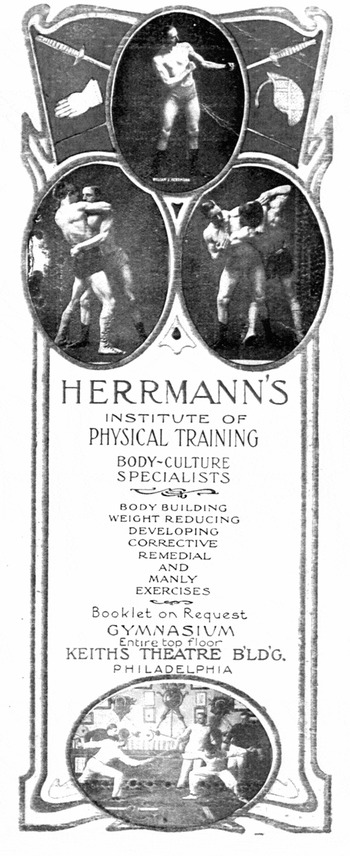
As the name “barbershop” implies, male quartet singing in the golden era likewise enjoyed a strong association with the places and social settings like barbershops that fostered closeness and intimacy between men. For example, many clubs, church groups, professional leagues, and fraternal organizations in Philadelphia featured quartets in their annual banquet celebrations, usually with singers drawn from the ranks of the organization.Footnote 19 The prominence of quartet singing in African American bachelor subculture in particular is evidenced in surviving accounts, such as the oft-quoted statement by James Weldon Johnson that “any four colored boys are a quartet.”Footnote 20 Quartets were also common in most working-class entertainments, including vaudeville, variety shows, and what few minstrel theaters remained. Keith's Vaudeville Theatre in Philadelphia played host to at least twenty-six professional touring quartets and a national quartet contest between 1900 and 1925; its top floor was also home to a gymnasium that specialized in men's physical fitness.Footnote 21Figure 1 shows a playbill advertisement from 1909 that features three photographic images of the bare-chested owner, William J. Herrmann, engaged in the kinds of intimate, forceful, and manly contests that were popular during the period, and invites men to return to the theater's gymnasium after work to wrestle, improve their strength, and demonstrate their manhood through contact with other men. Whereas the vocal quartets that appeared at the Keith sang (and sometimes played) in a diverse range of styles, all of them appeared in a space that was carefully constructed and labeled within the changing discourses of masculinity, leisure, and male community described above.Footnote 22
Program from Keith's Vaudeville Theatre, Philadelphia, week of 31 May 1909, featuring an advertisement for Herrmann's Institute of Physical Training. Courtesy of the Theatre Collection, The Free Library of Philadelphia. Used by permission.

Theorizing the Closeness in “Close Harmony”
Beginning in the 1920s, barbershop revivalists re-created and performed this Victorian mode of masculinity using physical, emotional, and musical closeness.Footnote 23 Their writings emphasized camaraderie and closeness, and often referenced the working-class institutions associated with male intimacy, especially the saloon, the barbershop, and the gang, though they often reconstructed these spaces as rural.Footnote 24 Their musical choices encouraged emotional and physical closeness between singers in ways that reflect the ideals of neo-Victorian masculinity.Footnote 25 I refer not only to the lyrics of the songs they chose to preserve, many of which address topics dear to neo-Victorian hearts, but also to the physical modes of engagement between singers that their arrangements demanded. In paring down the diverse styles and practices that characterized quartet singing around 1900, revivalist authors disciplined their singers' bodies by selectively advocating a single “barbershop style” and repertory, which encoded closeness by eliminating those musical practices, such as instrumental accompaniment and solo verses, that had previously allowed singers to separate physically.
The earliest source for the codification of the barbershop musical style is Barber Shop Ballads by the popular musicologist and “Tune Detective” Sigmund Spaeth (1885–1965).Footnote 26 This book was published in 1925 as a men's practical introduction to the barbershop singing hobby.Footnote 27 Since that time, it has become one of the most widely cited sources for defining the barbershop musical style because of its early date and extensive use of musical examples.
Spaeth's relatively narrow representation of barbershop quartet singing favors sentimental ballads, “coon” songs, and ethnic caricatures while leaving aside the opera choruses and other, more formal quartet genres that were common in vaudeville, variety shows, and recordings twenty years earlier. Indeed, the introduction to the 1940 edition of Barbershop Ballads ridicules the very diversity that had characterized quartet styles earlier in the century:
All over the country the old custom of close harmony has been revived and barber shop [sic] quartet contests are now a recognized form of entertainment and competition. (The Keith theatres held one of the earliest of these contests, but ruined it by admitting mixed [gender] foursomes, with the finals at the New York Hippodrome exhibiting the gruesome sight of two men and two women singing the quartet from Rigoletto!)Footnote 28
This limited barbershop repertory complemented a fictionalized, nostalgic narrative of the genre's amateur, rural, spontaneous origins.Footnote 29 Many of his chosen songs, listed below, celebrated the performance of Victorian masculinity, either with mentions in the lyrics of the places and behaviors associated with developing character (e.g., “The Heidelberg Stein Song”), or by associating the genre with the public, masculine settings (e.g., saloons, minstrel and variety shows) in which amateur and professional groups sang his chosen examples before the turn of the century.Footnote 30
Songs included in the 1925 edition of Barber Shop Ballads by Sigmund Spaeth
In one account of singing “Sweet Adeline” with a quartet, Spaeth asserts that such masculine closeness has long been an essential feature of barbershop singing:
Probably everyone within earshot swooned with emotion. We were elevated. . .. No one except those who have participated in the singing of this immortal quartet will ever know the feeling, close to divinity, that came over us that afternoon. No one, we say? No one, save the countless adventurous bands of men that have similarly gathered, arms upon one another's shoulders, since the siege of Troy.Footnote 31
Spaeth also casts barbershop as a sporting contest or manly competition, the primary forums in which white masculinity was demonstrated during the Victorian era: “The spirit of competition may also enter such a game. Glee Club contests are now regular events in schools, colleges and clubs, and there is no reason why any congenial gathering cannot be divided into rival groups and thus left to work out, harmoniously and musically, the eternal ambitions of human nature toward self-expression.”Footnote 32 Though competition in barbershop singing might produce fellowship, Spaeth cautions singers not to humiliate one another when mistakes are made. Rather, he urges his audience to view quartet singing as a process and to work through places of difficulty with success in mind.
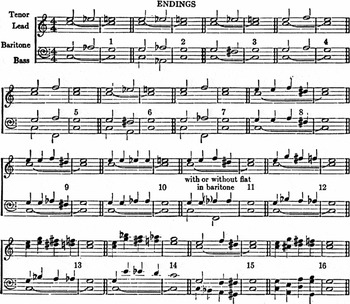
Spaeth's musical directions for barbershop singing further associated quartet singing with male camaraderie. Drawing on the precedent of minstrel, comedy, and recording quartets from the turn of the century, Spaeth in his arrangements placed the melody, or lead voice, below the tenor, creating chord voicings that are “close,” rather than open, and require more careful listening and tuning while singing. Example 1 shows a collection of endings in Spaeth's Barber Shop Ballads. Spaeth discouraged instrumental and hummed accompaniment, female singers, and solo verses, all of which were common in the golden era of barbershop singing even among the quartets that served as his models. Instead, he promoted eye contact, cooperation, and interaction between the singers.
A collection of endings from Barber Shop Ballads: A Book of Close Harmony, ed. Sigmund Spaeth (New York: Simon and Schuster, 1925), 18. Spaeth includes many such abstracted and labeled phrase endings, “swipes” (chords changes around a held pitch), and chords, all of which present close voicing as the norm.

In his 1932 book A Handbook for Sweet Adeline Addicts, C. T. “Deac” Martin, like Spaeth, links the practice of barbershop singing to previously working-class, male spaces. Quoting cartoonist R. V. Cutler, Martin credits the creation of barbershop singing to turn-of-the-century youths who frequented the nostalgically recalled male haven of a small-town barbershop, which he likens to the urban saloon.Footnote 33 His introduction casts barbershop as an outgrowth of blackface minstrelsy.Footnote 34 The second chapter of the book likewise bears the title “Gentlemen, Be Seated,” the famous interlocutor's phrase that would follow the introduction in a minstrel show.
Viewed against the backdrop of quartet singing during the golden era, the revivalist choices made by Spaeth and Martin narrowed style and repertory to create both physical and emotional closeness between men in order to facilitate the performance of Victorian masculinity. They legitimized this closeness by invoking the nostalgically constructed “barber shop,” with references to specific, working-class, urban social institutions—minstrel shows, urban youth gangs, and the saloon—that were widely viewed as havens of masculinity and manly intimacy at the turn of the century. Alluding to the physical and musical closeness that these barbershops fostered, Martin autographed one copy of his book as follows: “What this country needs is more . . . and much closer. . . harmony. Deac Martin” (emphasis in original).
As the Great Depression fueled neo-Victorian sentiment in the United States, revivalist writings about barbershop grew increasingly nostalgic. One of the founders of the Barbershop Harmony Society, O. C. Cash, wrote: “[W]hat this country needs is some good old-fashioned barbershop singing. . .. If we're trying to get back to normalcy, let's go all the way back to handlebar mustaches, horsehair sofas, and bicycles built for two.”Footnote 35 This yearning for a return to Victorian fashion, conveyance, and social mores made Victorian masculinity, performed through closeness, all the more desirable to revivalists. Consequently, barbershop revivalists after Spaeth and Martin emphasized physical and emotional closeness throughout their writings, often giving as much attention to closeness as to singing. For instance, in 1941, Cash wrote the following for one of the chapter bulletins:
There are two things I particularly like—good music and good fellowship. I take the first for granted when I am around Barber Shop Singers, but although I attend several conventions each year, only at our Society Conventions do I find the genuine, old-time, small-town, neighborly affection and fellowship so manifest when our bunch gets together. That's why I like our old scalawags so much, and why I never miss an opportunity of being present when they congregate.Footnote 36
The barbershop movement also mourned the loss of public masculine spaces during the Great Depression, and viewed quartet singing outside the home (and the domestic sphere) as a way to reclaim the vanishing mode of masculinity that they supported. This anti-domesticity was a political reaction to the social reform policies of the New Deal. New Deal reformers had emphasized the domestic sphere as a site for social improvement and the creation of masculinity. Good mothering and an orderly home, liberal experts argued, would produce rugged, productive, active male citizens, who could then improve the public realm. By contrast, “deviant” mothers emasculated both their sons and husbands and thereby fostered racism, criminality, and delinquency. In keeping with this view, New Deal programs attacked the perceived causes of bad motherhood, including poverty and male unemployment.Footnote 37
Conservatives, by contrast, clung to the neo-Victorian notion that manhood was not created by good mothering but by contact with other men. Competition and closeness with other men at the fraternal society, barbershop, boxing ring, or sports field nurtured manly character, while mothering weakened it. This neo-Victorian political stance and sense of loss was clear even from the founding of the Society, as this paragraph from the Society's first invitation attests:
In this age of Dictators and Government control of everything, about the only privilege guaranteed by the Bill of Rights not in some way supervised or directed is the art of Barber Shop Quartet Singing. Without doubt we still have the right of “peaceable assembly” which I am advised by competent legal authority includes quartet singing. The writers of this letter have for a long time thought that something should be done to encourage the enjoyment of this last remaining vestige of human liberty. Therefore we have decided to hold a songfest on the Roof Garden of the Tulsa Club on Monday April 11, at six-thirty p.m.Footnote 38
Such tongue-in-cheek opposition to the reforms of the New Deal was even apparent in the name of the new organization founded at this meeting, the Society for the Preservation and Encouragement of Barbershop Quartet Singing in America, or SPEBSQSA, which parodied the acronyms that were applied to government programs at that time.
Ideally, the barbershop musical style of the late 1930s and 1940s would foster the performance of Victorian masculinity by reviving the physical and emotional closeness that had characterized turn-of-the-century clubs, gymnasiums, and sporting events. Revivalists gathered outside the domestic sphere in hotels and clubs, away from the influence of women. They drew closely together in order to match vowel shape, gesture, facial expression, breath, and timing, and reached for such a level of social and musical harmony that they could improvise together simultaneously. Invocations of “gangs,” “the Bowery,” and “Times Square” in countless barbershop lyrics, along with hyperbolic self-identifications as “scalawags,” likewise memorialized this closeness by referencing the geographic places and social settings that were established homes to the turn-of-the-century bachelor subculture, with its values of mutuality, anti-domesticity, and camaraderie.
Race, Politics, and the Origins of Barbershop
The conservative stance adopted by Cash and other revivalists, however lightly presented, had serious implications for the racialization of the barbershop style. New Deal reformers of the time argued that racial equality and integration were possible in the United States if social reforms could be extended to black homes, where bad motherhood was thought to be rampant.Footnote 39 Reformed black mothers would raise productive, responsible black men, allowing for their integration into American society. By contrast, the early leaders of the Barbershop Harmony Society subscribed to a social Darwinist view in which manhood was defined by “character,” which was a mark of white racial superiority and a means of preserving the white race. Racial integration through social reform was therefore neither possible nor desirable. Since, for revivalists, one of the main purposes of barbershop singing was to foster character through masculine closeness, this opposition to racial integration applied to barbershop singing as well. Barbershop singing became a white genre and, despite objections of some more liberal singers and negative press coverage, the Society retained its policy of accepting only “white men of good character.”Footnote 40 The ideological link in barbershop between masculine closeness and whiteness persisted in the Society past midcentury. A resolution passed by the Society Board in 1959, for example, stated as its first reason for the continued exclusion of African Americans from membership the “involved and close social and fraternal intercourse that became more firmly established year by year and which we have come to recognize as a wholesome, vital and indispensable part of Society activities.”Footnote 41 The Society preserved its racist membership policy until 1963.
Though the revival racialized barbershop singing as white, the style did not become monochromatic in all respects. The barbershop repertory and style retained many symbols of blackness, including black dialect, burnt cork, “blackvoice” mannerisms, “coon” songs, and minstrelsy repertory. Though masculine closeness defined the barbershop style and constituted a primary goal of the Society, the performance of race in barbershop was more complex and regularly ventured into the blackness of minstrelsy.Footnote 42
Early revivalist efforts to document the origins of barbershop supported the process of racialization. Indeed, within the barbershop revival race first appears as an explicit topic in discussions of the origins of barbershop singing.Footnote 43 In the 1940 revision of Barber Shop Ballads, Spaeth advances two hypotheses for the origins of the style that, though casually presented, offer a complicated blend of scholarship and conjecture. His first theory, based on internal evidence, is that quartet singing was, at least in part, an outgrowth of African American culture. Spaeth writes that “in any case, barbershop harmony contains the elements of folk music, particularly in its improvisational character. Its technique is of the naïve and spontaneous type, and its effects may well be associated with the natural music of the Negroes themselves.”Footnote 44 Though a great deal of historical evidence indicates that most key features of the barbershop musical style originated with African American amateur and professional quartets,Footnote 45 Spaeth is the only early historian of the barbershop style to credit African Americans with a role in its creation.Footnote 46
Spaeth's other theory for the origins of barbershop, based solely on the external evidence of the word barbershop, posits the origins of the style in Elizabethan barbers' music. Ironically, though no documentary evidence supports this theory, it was advanced by later writers for decades to the exclusion of the African American origins theory until Lynn Abbott's groundbreaking work in the 1990s.Footnote 47 By offering a theory, however unsubstantiated, for the white origins of barbershop, Spaeth's work supported the racialization of barbershop as a white musical praxis.
Whereas the style of barbershop singing proved to Spaeth the racial otherness of its origins, its capacity to foster closeness and camaraderie between men appeared even more important: “Whatever its origin, [barbershop singing] represents a distinct style, with social values perhaps outweighing those of musical significance.”Footnote 48 Consequently, even though barbershop groups regularly drew on performance practices and repertory from minstrelsy, a primary function of revivalist barbershop was to perform a neo-Victorian mode of white masculinity through closeness.
Fathers, Buddies, and Teammates: Contemporary Barbershop Closeness and the Politics of Manhood
In 2002, barbershoppers continued to re-create the physical closeness that barbershop revivalists codified musically. This physical dimension of barbershop praxis is often accompanied by an emotional closeness described by Averill:
The relationship of the internalizing and externalizing of the self and others in collective musical encounters encourages the production of a powerful, transformative experience of the self as a participant in a community, resulting in a greater sense of unity and solidarity. Collective audition—hearing together—is a persuasive, physical confirmation of connectedness.Footnote 49
Barbershop listening can likewise become embodied. Several barbershoppers described to me in interviews and in conversation their bodily manifestations of Averill's transformation—the physical experience of listening to an outstanding barbershop quartet or recording and “feeling what it would be like” to sing those sounds. Thus the experience of intimacy in contemporary barbershop is not limited to singers but extends to some listeners, particularly those with singing experience. Contemporary barbershoppers use this closeness to perform a range of masculinities that comply with hegemonic modes of masculinity.Footnote 50 The following accounts from interviews and fieldwork experiences represent some of the approaches to barbershop masculinity that emerged repeatedly during my fieldwork.
At thirty-two, David R. was the second-youngest member of The Sounds of Liberty (I was the youngest).Footnote 51 His enthusiasm and fifteen years of experience in barbershop, including several years with the accomplished Alexandria Harmonizers chorus, made him an influential person in the Philadelphia Chapter. He originally joined The Sounds of Liberty to assist with planning choreography, a duty he continued to fulfill throughout most of my fieldwork. David also sang with one of the best quartets in the Philadelphia Chapter and often organized informal quartet singing after rehearsals.
During our interview, David spoke at length about the masculine relationships that barbershop singing facilitates. He ascribed to the barbershop style the power to bring men together physically and emotionally to a degree that would otherwise be impossible for heterosexual men. His chosen example was the tag, or ending of a song, which is often excised and sung informally by four singers.Footnote 52 David explained that successful barbershop singing produces closeness and camaraderie between the singers that lasts well beyond the song itself.
DR: I remember at director's college I sang a tag with this one guy.
RM: What tag?
DR: It was, uh, “falling leaves”—you know that tag.
RM: Yeah, we do that a lot.
DR: I sang “falling leaves” with this one guy . . . and all of a sudden you could hear it building—building—building and then this sound just went through the roof and through the floor just like it was a beam of light, that laser beam that just went forever, and it was that sound—we were standing in a box [formation]. And ever since then I've seen this guy a couple of times at conventions or you know at other environments and we give each other a big hug. When it was done we just tried to hold that chord as long as we could 'til we ran out of breath because it was just so good. And then we gave each other big hugs and it's like every time I see this guy he's like—he's like a buddy, you know? So there's something special about that, and you can't put anything concrete on that, it's just a very special thing that you can have between two, four guys.Footnote 53
In keeping with the observations of Garnett and Averill, David considered emotional closeness a natural aftermath of executing successful tags.Footnote 54 The physical acts of hugging, running out of breath together, and standing “in a box” (all four singers shoulder-to-shoulder in a circle) provided a foundation for this emotional experience. As David explained to me later, the barbershop sound provides an opportunity for physical closeness that would not otherwise have been permissible between men in that time and place, a closeness that makes barbershop one of the most important forces in his life.
By contrast, Ed M., one of the older members of the Philadelphia chapter at age seventy-nine, often referred to the quality of barbershop singing in terms of “each man doing his job.”Footnote 55 Ed was the chapter librarian, editor of the chapter bulletin, and an elder with fifty years of quartet singing experience who often implored the members of the Sounds of Liberty chorus to improve their individual vocal technique and knowledge of barbershop “craft.” His emphasis on teamwork and duty in manly conduct references a mode of masculinity that was promoted among servicemen during World War II, a period that Ed identified as an important transition in his life: “[Being drafted] was sort of a breaking point from being at home all the time. And basically from the time I was in high school, really, I was doing things on my own, very little family involvement.”Footnote 56 This mode of masculinity was the primary lens through which Ed viewed barbershop singing.
Ed was the only openly gay member of the forty-member Philadelphia Chapter, and I asked him later if he felt that his sexual orientation had given him a different perspective on the reasons barbershoppers enjoy their hobby.Footnote 57 He replied:
The only thing that I can think of is that there is something as far as performance is concerned, which doesn't have anything to do with [sexual] orientation. It's the kind of thing that you, in so doing, if it's done nicely, that you get the response and the feedback from your audience. . .. And the pleasure in the fact that you have done some of the musical things. And that's the way I'd sort of look at it. I don't think that there should be any other explanation why you'd do the songs that way.Footnote 58
Ed's response turned the focus of our interview away from the topic of intimacy and homoeroticism in barbershop and back to the mode of masculinity that he performed by “doing his job” and the pleasure that this provided for audiences and singers alike. This indicates the degree to which the barbershop hobby is an overwhelmingly heterosexual space, despite the neo-Victorian intimacy and homoeroticism musically encoded in its close harmony style.
In my own experiences singing with the Corner Notes quartet, the musical structures of barbershop songs often facilitated physical closeness between singers. This novice quartet gathered primarily for fun, but also offered singing telegrams on Valentine's Day. When their tenor stopped singing for health reasons, the remaining members of the quartet—Tom K., Greg B., and Rob H.—reconfigured and invited me to join as their lead in 2002. Greg, who sang baritone, rewrote the words of the nostalgic song “Wedding Bells Are Breaking Up That Old Gang of Mine” to create a quartet theme song: “The Corner Notes Are Singing With That Old Gang of Mine.”
Lyrics of the “Corner Notes Theme Song,” adapted from the lyrics of “Wedding Bells are Breaking Up That Old Gang of Mine.” Used by Permission.
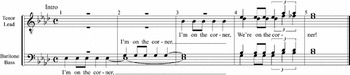
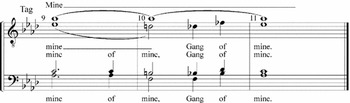
Greg's efforts revitalized the ethos of anti-domestic, street-corner gangs by converting a nostalgic lament into a celebration of the “old gang” and its continued popularity. The new lyrics still invoke common symbols of romanticized bachelor subculture and male intimacy, the gang and the street corner, but they also invite the audience to participate and become “like that old gang of mine.”Footnote 59 With the assistance of the chorus director, Rob wrote a new introduction and tag for the song, given in Examples 2a and 2b, both of which provide compact, useful examples for analysis.
“Corner Notes Theme Song” introduction. Used by permission.

“Corner Notes Theme Song” tag. Used by permission.

Our bodily encounters with the imitative opening of the introduction depended upon the specific circumstances of our singing. In rehearsal, we sang most often in a semicircle or in a “box” format. Entrances in this case usually involved a slight lean inward towards the rest of the quartet. The baritone and I tuned the triad during these three measures by focusing on the bass singer's pitch and vowel placement. The other three parts then watched me in m. 4 to match my rhythmic interpretation of the triplet at the end of the bar, which was free. The box standing configuration made synchronization easier in m. 4 by allowing direct visual communication between me and the other singers.
By contrast, when singing for an audience the quartet became far more involved physically. Individual entrances in the introduction usually featured a small step forward and a hand gesture towards the audience. Because synchronization in m. 4 was more difficult to achieve with the singers facing the same direction, especially between the lead and baritone, the quartet often drew together slightly at that point, the tenor and baritone facing at an angle towards the lead and bass. This measure became the focus of a musical, lyrical, and physical gathering, as bodies turned inward, polyphony became homophony, and pronouns shifted from “I” to “we.”
Ironically, this moment of group “harmony” often took place in spite of the sound of the chords at the beginning of the measure. These first-inversion dominant seventh chords were extremely difficult for this particular group to tune because of a whole-step dissonance between the lead and tenor on one side and a tritone between the lead and bass on the other. After a sour attempt in rehearsal, the group would stop, attempt to find and correct the mistake, and begin again with the hope of better results. The Corner Notes seldom sang this introduction with perfect accuracy, even after spending much rehearsal time working on it, and yet the fourth measure still functioned physically and musically as an introductory moment of closeness for the quartet. We looked at one another, the bass put his hand on my shoulder, and the soloists became an ensemble. Likewise, the tag of this song facilitated a similar kind of closeness between the lower parts. Beginning in the first measure, the bass, baritone, and I drew together, glancing at one another to synchronize our slow glissando into the first chord of the second measure. On several occasions, I recall smelling Tom's breath to my right, and feeling a hand rest on my shoulder as we arrived on the final chord.
The introduction and tag to the Corner Notes theme song provided an effective and balanced combination of closeness and challenge for the members of the quartet. Yet this closeness could be both opportunity and danger, since its homoerotic charge sometimes threatened the heterosexual space of the hobby.Footnote 60 The members of The Sounds of Liberty Barbershop Chorus negotiated this potentially transgressive aspect of their emotive, sentimental musical practice in a variety of ways. On many separate occasions during my fieldwork I saw a barbershopper break this tension during a song by pretending to get carried away, “mistaking” another singer for the female object of the song's lyrics, kissing him, and then recoiling in disgust. The singer thereby policed the heterosexual boundaries of the group by lapsing momentarily into a homosexual role only to reject it. Others employed sports metaphors to represent the virile, heterosexual masculinity of barbershop closeness: during one rehearsal, an accomplished barbershop coach urged the group to “put your hands in, slap each other on the butt and go out there.”Footnote 61
The Sounds of Liberty managed this problem, in part, by casting the sentimental, “emotional” quality of barbershop singing in feminine terms. Leaders of the group praised female barbershoppers, or “Sweet Adelines,” as models for male barbershop singers in terms of stage presence. As one barbershopper explained to me, “The women are better at choreo[graphy], because they're more in touch with their feelings, more in touch with their emotions.” Likewise, the director of The Sounds of Liberty Chorus sometimes mentioned “pulling emotion out” of the singers as difficult or even impossible at times because men are “less emotional.”
This casting of sentimentality as feminine reveals a point of rupture between the neo-Victorian masculinity of the barbershop revival and hegemonic modes of masculinity in contemporary Philadelphia. Whereas the emotionalism and sentimentality of a barbershop ballad like “Sweet Adeline” were cast in feminine terms in 2002, Spaeth took the opposite view in 1925. “Adeline, whoever she may be (and the song is by no means as ancient as some would believe), has unquestionably figured as the flower of your heart for many years, if you are half the man you seem to be. Go ahead and serenade her to your heart's content.”Footnote 62
The Sounds of Liberty often became quite passionate and animated in front of an audience, even winning praise from contest judges in competition for this aspect of their delivery. The demand that barbershoppers perform “with feeling” sometimes served as a liberating force, allowing men to perform heartfelt emotions that might otherwise remain mute within a hegemonic mode of masculinity. While waiting for their turn to compete in October of 2001, experienced members of the chorus shared their strategies for emoting during the ballad “You Keep Coming Back Like a Song,” about the loss of a loved one. One man spoke of his wife, who had passed away four years earlier. Another referenced the 2001 terrorist attacks at the World Trade Center. All emphasized the importance of cultivating and expressing appropriate feelings while singing, because, as one experienced member put it, “then your voice and body will go with it as well.”
Anxiety about emotional performance is compounded by the potentially feminizing position that barbershoppers adopt by wearing makeup and brightly colored clothing when performing onstage. By becoming objects of the masculine gaze they draw attention to what Laura Mulvey calls their “to-be-looked-at-ness.”Footnote 63 This spectacular mode of performance offers a point of contact between barbershop and other forms of entertainment that grew from vaudeville, including Hollywood musical films. As Steven Cohan has noted, many musicals starring Fred Astaire interrupt an otherwise coherent, “straight” narrative with an extradiegetic “showstopper.”Footnote 64 The Sounds of Liberty took this principle to an extreme in their annual shows, using a plot, advanced in brief sections of dialogue, as a pretense for singing otherwise unrelated songs from their repertory as “showstoppers.” Their audiences expected as much; one member noted to me, “People don't pay to hear us act. I mean, we really don't do that very well—they come to hear the music!”
The spectacle of barbershop, even with its makeup and camp costume, does not create androgyny. Rather, it enacts a mode of close masculinity complicit with modes of viewing and performing from prewar popular cinema and, more remotely, from the vaudeville and minstrelsy traditions that barbershop participated in. Put in the terms of R. W. Connell, although the barbershop style commonly references codes of pre-Vietnam-era masculinity that are no longer current, it is “complicit” with hegemonic constructs of masculinity to the extent that it encourages patriotism, masculine sensitivity, and devotion to family.Footnote 65 And yet, barbershop's emphasis on sentimentality, male closeness, and intimacy (not to mention striped vests, armbands, and bow ties) places them outside dominant modes of masculinity in the contemporary United States.
Postindustrial Barbershop and the Cultural Work of White, Male Closeness
Like masculinity and closeness, race has remained a factor in barbershop singing since the revival years. As the formal definition of the barbershop style matured, mainly through the establishment of rules for contests, a racially charged, stylistic opposition grew between barbershop and “modern” musical styles, including “popular” and avant-garde music.Footnote 66 By offering an alternative to jazz, rock, and other sites of profound African American influence on mainstream culture in the twentieth century, barbershoppers defined their position as a white cultural force through musical aesthetics, in addition to closeness. Histories of the genre that neglected to mention the importance of African Americans for its origins bolstered whiteness as a defining feature the barbershop movement. And prior to 1963, this lens was matched by an exclusive membership policy that prevented “non-whites” from joining the Society.
Since the abolition of racist membership guidelines, however, the representation of barbershop as antimodernist, neo-Victorian, and culturally white has persisted. This is not to say that the Society or its chapters continue to exclude singers of color actively. On the contrary, since 2001 the Barbershop Harmony Society as a national organization has become more aware of the racial dimensions of its membership and activities. Articles in the Harmonizer from that period stressed the importance of outreach to communities of color, political sensitivity, and diversity.Footnote 67
Despite these initiatives, however, many of Philadelphia's barbershoppers continued to assert their stylistic and social opposition to contemporary popular music in terms of race. In particular, many barbershoppers defined their style of singing in opposition to rap music, which served an important symbol of blackness and youth.Footnote 68 Riding in the car to a quartet appearance, Jake F. expressed to me his distaste for rap, which he viewed as unmusical and unintelligible: “You can't sing rap music! Half the time I can't understand what they're saying, or don't want to!”
Similarly, another barbershopper contrasted the clarity of barbershop diction with the lack thereof in contemporary popular music generally: “Kids these days mumble. You can't understand what they're singing.”
Rather than prescribing the membership of the group explicitly, whiteness persists as an ethnic marker that informs contemporary barbershoppers' perceptions of their style's cultural work. Whereas rap represents disorder and social decay, the barbershop style represents and promotes clarity, harmony, and good will. Put differently, the style is a social panacea to the members of The Sounds of Liberty. While driving me home from one of my first rehearsals with the chorus, Terry D. explained the social potential of barbershop music.
They sang a song tonight that sort of sums it up: “Keep the Whole World Singing.” That song, the first couple times I heard it I said, “Yeah, that's great. We should keep the whole world singing.” If the whole world was singing there'd be a lot less . . . problems in the world. Because it's kind of hard to stay mad when you're singing. You ever noticed that?Footnote 69
In Terry's view, barbershop singing promised to extend “musical and social harmony,” which Averill and Garnett have identified as essential aspects of barbershop social ideology worldwide.Footnote 70 The Barbershop Harmony Society actively promotes this goal, as evidenced by recent outreach programs in China and Russia, and in the lyrics of “Teach the Children to Sing,” a closing song written by Joe Liles:
In my interviews and conversations with them, barbershoppers often discussed the reluctance of more diverse singers to join this musical and social movement in terms of musical taste. In one interview, I asked John W. for his thoughts about recent efforts of the Society to recruit a more diverse membership and audience.
I often said, and I've been saying this for years, that we've got to get some black fellas in who can sing, and we'll have none of these goofy guys running around destroyin' things or murdering people or—I think that [more diversity] would be a great thing for our society. But they don't seem to like our kind of music! For some reason.Footnote 72
David expressed a similar opinion during a casual discussion of an “open house” membership drive after a Sounds of Liberty rehearsal. However, he argued against the assertions of others that more recent popular repertories are incompatible with the barbershop style, citing “How Do I Say Goodbye to Yesterday” by the quartet Boyz II Men as a good option for barbershop arranging.Footnote 73 “That would be great, ” he added, noting that such arrangements would attract younger and more diverse singers and audience members.
By linking the racial demography of their group with musical taste, The Sounds of Liberty drew attention away from the myriad nonmusical factors that might discourage people of color from joining the chapter, including some potentially offensive repertory, or a lack of strong links between The Sounds of Liberty and communities of color in Philadelphia. Shifting the problem of racial homogeneity to one of musical taste also obscured and normalized the important cultural work that whiteness did for the group by defining its social goals. For many of Philadelphia's barbershoppers in 2003, their style was a dwindling voice of community, unity, good citizenship, and “character” in a city marred by the division and violence embodied in rap and popular music, a distinction they often cast in racial terms. This social outlook gave them power and reason to argue that their music is good, important, and worth preserving in America's landscape.
Consequently, their particular blend of neo-Victorian nostalgia and whiteness also helped to define the group's location, or “home,” in the city of Philadelphia. Between 1947 and 1974, the Philadelphia Chapter of the Society enjoyed free access to Center City rehearsal spaces, including the elegant Bellevue Stratford Hotel ballroom, thanks to the members' personal and business connections.Footnote 74 As Philadelphia transitioned to a postindustrial economy, the group's membership shifted to the northeast section of the city and the personal connections to Center City institutions evaporated. Unable to pay for rehearsal space and Center City parking, the Philadelphia Chapter abandoned its home in 1974.
The displaced Philadelphia Chapter then gravitated towards the traditionally white, working-class neighborhoods of Northeast Philadelphia not only for their reduced cost and convenience, but also because these neighborhoods shared the chapter's racialized view of Philadelphia's economic, demographic, and cultural metamorphosis. This connection first became apparent to me during a Sounds of Liberty appearance in a parade in the urban neighborhood of Port Richmond.
The district was packed with small, two- to three-story row houses, with a few businesses located on corners. Most people were out on their porches and seemed to know their neighbors. Children chased a basketball through the street and onto nearby porches, but no parents seemed worried. Tables were set up on sidewalks and porches with pizza, food, beer, soda, etc., for everyone to share. The people looked happy to be together. And they were all white. I saw not one person of color in two-and-a-half hours of traveling throughout this neighborhood, an experience that I had never had elsewhere in Philadelphia. When I asked other members of the chorus about these striking demographics, they told me: “These folks keep out the undesirables”; “They don't move”; “This is one of the stable neighborhoods in the city”; “Mostly blue-collar”; “They've lived here forever”; “Lithuanians, Poles. . ..”
During this event, I was struck by the strong affinity between the social environment of the neighborhood, with its friendly neighbors and active urban street life, and the sociability and Victorian imagery of barbershop singing.Footnote 75 I also noticed that the barbershoppers I interviewed explained the state of the neighborhood by emphasizing its endurance and persistence in the face of change. This view of sociability and unity as parts of a struggle for preservation, a major theme for the Barbershop Harmony Society, seemed also to connect barbershopping with the Port Richmond neighborhood. Intuitively, it made sense to me that they would hold rehearsals there, as they did from 1991 to 1993.
The history of Port Richmond explains this connection between the worldviews of barbershoppers and the residents of that neighborhood. Like other urban neighborhoods in Northeast Philadelphia, such as Kensington, Northern Liberties, and Bridesburg, Port Richmond entered the twentieth century as a mill district with two thousand factories and the “densest concentration of manufacturing plants and skilled labor in the [Philadelphia] metropolis.”Footnote 76 An active social atmosphere and strong sense of community made the Northeast a good home for the types of fraternal organizations that later served as models for the Barbershop Harmony Society.Footnote 77 They also helped the Port Richmond community to preserve itself through the deindustrialization that shook Philadelphia in the second half of the twentieth century, even though the benefits of economic restructuring have bypassed the community and many of its families as jobs moved to the suburbs or elsewhere.Footnote 78
Unlike some nearby neighborhoods, however, Port Richmond has preserved extensive neighbor and community networks, and church parishes remain the most important social, educational, and architectural structures in the community.Footnote 79 Indeed, the sense of community is so strong in Port Richmond that its residents feel more allegiance to the neighborhood than to the city of Philadelphia as a whole.Footnote 80
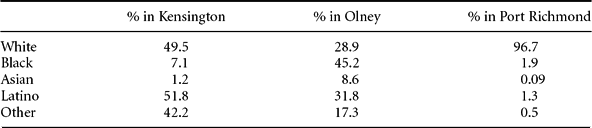
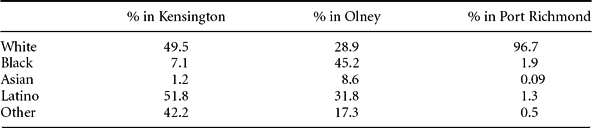
In terms of demography, Port Richmond is unique among Northeast Philadelphia neighborhoods in retaining established, white, working-class residents and maintaining property values despite the loss of manufacturing jobs (see Table 1). Like many of Philadelphia's barbershoppers, residents of Port Richmond view the trends of deindustrialization, decentralization, and migration of African Americans to Philadelphia in racialized terms, seeing “invasion” of the city by black “outsiders” as the primary cause of the city's decline since the 1970s, and fearing “forced integration” of their neighborhood by the city and a “domino effect” of black encroachment and decay from outside their community.Footnote 81
Racial Make-up of the Near Northeast Communities in Philadelphia Based on 1990 Census. Adapted from Judith Goode and Jo Anne Schneider, Reshaping Ethnic and Racial Relations in Philadelphia: Immigrants in a Divided City (Philadelphia: Temple University Press, 1994), 106. (Data drawn from multiple census tables.)
And yet, despite this protectionist, racialized outlook, white residents of Port Richmond take for granted the few established African American and Puerto Rican families within the community. Workplaces in Port Richmond are integrated, as are parochial schools and friendships. This contradiction suggests that community organizations in Port Richmond draw sharp, racialized lines between insider and outsider not out of simple prejudice but in order to define their community in terms of involvement and participation. Racism, in this context, represents a fear of outsiders moving into the neighborhood, and the social or economic change that such migration symbolizes.Footnote 82
Similar contradictions surfaced in an interview with Mike C., when he interpreted the changes to his neighborhood in racial terms while qualifying his statements carefully to ensure that he was not perceived as racist: “It used to be all white, yeah. Like I say, if you have nice class people they're the same as you and I.”Footnote 83 When Philadelphia's barbershoppers invoke nostalgia in their music and work towards their goals of cultural “preservation” and sociability in response to social “decay” they become complicit with local constructions of whiteness in neighborhoods like Port Richmond, where residents see their communities as bulwarks against encroachment by racialized others. Drawing on these claims to entitlement and power in postindustrial Philadelphia gives The Sounds of Liberty a home in their city. When the Port Richmond community invites The Sounds of Liberty to sing in their local parade they, in turn, make barbershop nostalgia a part of their cultural landscape and heritage, adding weight to their bulwark.
•••
For contemporary barbershoppers in urban Philadelphia, whiteness is about more than their personal race affiliations or simple prejudice against other groups.Footnote 84 It does cultural work for The Sounds of Liberty by positioning them geographically, historically, economically, and aesthetically. It binds together race, class, gender, and sound to create belonging and entitlement in a postindustrial city, an important achievement for a group dedicated to the promotion of a musical style that has been largely outside the popular mainstream for nearly a century. The revivalists who encoded whiteness in barbershop singing decades earlier were similarly under siege. Amid the turmoil of a languishing economy, the New Deal threatened their beloved masculine social spaces and gender roles. Through a newly whitened musical style, characterized by closeness, barbershopping promised a return to the vanishing musical and social norms of Victorian America. In both of these contexts, whiteness offered barbershoppers musical ways to respond to economic, demographic, and social change, making discourse about race an important site of contact and exchange between the sound of barbershop and its social significance.
Previous versions of this project were presented at meetings of the American Musicological Society, the Society for Ethnomusicology, and the Society for American Music. I wish to thank my colleagues at those meetings for their thoughtful comments and suggestions, and especially Guy Ramsey, Carol Muller, Kay Norton, Daniel Party, and Carrie Mook for their thoughtful comments on various drafts of this article. This article is dedicated to The Sounds of Liberty Barbershop Chorus.