Most cognitive theories about the conceptualFootnote 1 representation are developed on the basis of studies with concrete items and the empirical and theoretical generalizability to abstract items remains controversial. There is the widely documented phenomenon of the concreteness advantage effect, that is, in comparison with abstract words, concrete ones are processed faster, are more resistant to damage, are acquired earlier, and are easier to recall, other things being equal (e.g., Coltheart, Patterson, & Marshall, Reference Coltheart, Patterson and Marshall1980; Kroll & Merves, Reference Kroll and Merves1986; Walker & Hulme, Reference Walker and Hulme1999; see Paivio, Reference Paivio1991, for a review). In contrast, the reverse concreteness effect has also been reported. Some patients suffering from brain damage exhibited selective impairment of concrete word processing while abstract word processing skills remained intact (e.g., Bachoud-Lévy & Dupoux, Reference Bachoud-Lévy and Dupoux2003; Breedin, Saffran, & Coslett, Reference Breedin, Saffran and Coslett1994; Cipolotti & Warrington, Reference Cipolotti and Warrington1995; Macoir, Reference Macoir2009; Marshall, Pring, Chiat, & Robson, Reference Marshall, Pring, Chiat and Robson1996; Mattioli, Reference Mattioli2008; Papagno, Capasso, & Miceli, Reference Papagno, Capasso and Miceli2009; Sirigu, Duhamel, & Poncet, Reference Sirigu, Duhamel and Poncet1991; Warrington, Reference Warrington1975, Reference Warrington1981; Warrington & Shallice, Reference Warrington and Shallice1984; Yi, Moore, & Grossman, Reference Yi, Moore and Grossman2007). In addition, recent neuroimaging studies have found that abstract and concrete word processing led to the activation of distinct cortical regions, although the results are yet inconsistent (e.g., Noppeney & Price, Reference Noppeney and Price2004; Sabsevitz, Medler, Seidenberg, & Binder, Reference Sabsevitz, Medler, Seidenberg and Binder2005; Tolentino & Tokowicz, Reference Tolentino and Tokowicz2009; Zhang, Guo, Ding, & Wang, Reference Zhang, Guo, Ding and Wang2006).
These observations motivated a variety of theories about the conceptual representations of concrete and abstract words. One school assumes common mechanisms for all words/concepts, attributing the concrete/abstract differences to some quantitative differences, including the number of conceptual features (Plaut & Shallice, Reference Plaut and Shallice1991, Reference Plaut and Shallice1993) or the extent of contextual support (Schwanenflugel & Shoben, Reference Schwanenflugel and Shoben1983; Schwanenflugel & Stowe, Reference Schwanenflugel and Stowe1989). A related theory (Paivio, Reference Paivio1986) assumes richer coding types for concrete words (verbal and imagery) than abstract words (verbal). Such theories provide a ready account for the concreteness advantage effect but cannot explain the reverse concreteness effect. Theories assuming qualitative differences between the concrete and abstract concepts explain the double dissociation profiles more easily. The first such theory was proposed by Breedin et al. (Reference Breedin, Saffran and Coslett1994), postulating that the two types of concepts rely on different types of conceptual features, with concrete concepts containing more perceptual features and abstract ones more functional features. This distinction is rooted in the acquisition process, which is different for the two types of concepts. Sensory experience is a key factor for concrete concepts, and language contexts, such as multiple sentence exposure, is essential for abstract concepts.
Besides potential differences in the representational contents of concrete and abstract concepts, a recent influential theory put forward by Crutch and Warrington (CW), which is the target hypothesis of the current article, has proposed fundamental differences between these two types of concepts in terms of organizational principlesFootnote 2 (Crutch, Reference Crutch2006; Crutch, Connell, & Warrington, Reference Crutch, Connell and Warrington2009; Crutch, Ridha, & Warrington, Reference Crutch2006; Crutch & Warrington, Reference Crutch and Warrington2005, Reference Crutch and Warrington2007). This theory assumes that abstract concepts are organized by semantic association and concrete ones by semantic similarity, with concepts belonging to the same semantic category (e.g., animals) being represented closely. Words with intermediate concreteness involve both types of organizational principles.
The target theory, which will be addressed as the organizational hypothesis, was primarily motivated by the behavioral patterns of patients whose cognitive impairments involved conceptual representation. In the first study of this research series, Crutch and Warrington (Reference Crutch and Warrington2005) evaluated the effects of various semantic contexts on the word comprehension performance of a patient (AZ) whose comprehension impairment originated from the semantic access process due to a refractory deficit. The study employed a spoken word to written word matching task, and the target word in each trial was presented with several other words that were either associatively related or semantically similar to the target. For concrete words, in comparison to unrelated conditions, AZ's matching performance was poorer in the semantically similar condition (categorically related, e.g., goose–crow–sparrow–pigeon), but was not influenced by associative blocking (e.g., farmer–cow–barn–soil). By contrast, her matching performance of abstract words was hindered in the associatively related condition (e.g., exercise–healthy–fitness–jogging), and not in the semantically similar condition (synonyms, e.g., boil–fry–bake–cook). The pattern that performances on concrete items were influenced by semantically similar (categorical) blocking and abstract items by associative blocking was subsequently replicated with another patient with a similar semantic refractory access deficit (Crutch et al., Reference Crutch, Ridha and Warrington2006), a patient with phonological-deep dyslexia (Crutch & Warrington, Reference Crutch and Warrington2007), and a patient with global aphasia (Crutch & Warrington, Reference Crutch and Warrington2010). Furthermore, Crutch (Reference Crutch2006) carried out post hoc analyses of the reading errors of several deep dyslexia cases and observed that the semantic substitution errors for concrete word targets had a higher percentage of being categorically related to the target, and that those for abstract words were more likely to be associatively related. Finally, in a recent study the group has generalized the findings to healthy participants using a semantic odd one out task, where they observed facilitation effects for similarity-based connections with concrete words and for association-based connections with abstract words (Crutch et al., Reference Crutch, Connell and Warrington2009). Consistent with this line of results for the associative results, Duñabeitia et al. (Reference Duñabeitia, Avilés, Afonso, Scheepers and Carreiras2009) found greater and earlier effects of associative concrete words for abstract than for concrete words using the visual world paradigm with eye movement measures.
However, there are reasons to be cautious about the generalizability of the results obtained by Crutch and colleagues (Crutch, Reference Crutch2006; Crutch et al., Reference Crutch, Ridha and Warrington2006; Crutch & Warrington, Reference Crutch and Warrington2005, Reference Crutch and Warrington2007). First, the main results in Crutch and Warrington (Reference Crutch and Warrington2005) were not replicated by a later study with the same paradigm and a patient with the same type of deficit as that of AZ. Hamilton and Coslett (Reference Hamilton and Coslett2008) observed that their patient's matching performance for both concrete words and abstract words was significantly influenced by semantically similar blocking and by associative blocking. They speculated that Crutch et al.'s (2006) failure to observe the associative effect for concrete words and the semantic similarity effect for abstract words might be because their patient was already at floor for these items. Furthermore, a recent study (Papagno et al., Reference Papagno, Capasso and Miceli2009) reported a semantic dementia patient whose profile could not be explained by the organizational hypothesis. The patient showed the reverse-concreteness effect, that is, an advantage with abstract concepts, but she was not better with associative knowledge than semantically categorical knowledge. Therefore, it remains to be assessed to what extent CW's findings can be generalized to other subjects and other semantically related experimental situations.
There are additional caveats to consider in CW's series of studies. The main issue concerns the confounds of the abstract/concrete manipulation with grammatical class. First, in the main experiments in Crutch and Warrington (Reference Crutch and Warrington2005), the concrete words were predominantly nouns (98%) and the abstract words contained nouns (57%), verbs (36%), and adjectives (7%). Therefore, although the results might be explained by the concreteness dimension, it is equally possible that they were caused by the grammatical class difference. Indeed, there is a rich neuropsychological and neuroimaging literature suggesting that nouns and verbs might be processed differently on the semantic level, the morphosyntactic level and/or the lexical level (e.g., Bedney, Caramazza, Grossman, Pascual-Leone, & Rebecca, Reference Bedny, Caramazza, Grossman, Pascual-Leone and Rebecca2008; Caramazza & Hillis, Reference Caramazza and Hillis1991; McCarthy & Warrington, Reference McCarthy and Warrington1985; Rapp & Caramazza, Reference Rapp and Caramazza1998; Shapiro, Shelton, & Caramazza, Reference Shapiro, Shelton and Caramazza2000; see Laiacona & Caramazza, Reference Laiacona and Caramazza2004, for a review of patients showing noun/verb dissociations). The interpretation of these dissociations is still a matter of debate, with some theories assuming distinct representations for noun concepts and verb concepts (e.g., Bedney et al., Reference Bedny, Caramazza, Grossman, Pascual-Leone and Rebecca2008; Huttenlocher & Lui, Reference Huttenlocher and Lui1979) and others assuming the same organizational principle for knowledge of all grammatical classes (e.g., Vigliocco, Vinson, Barber, Druks, & Cappa, in press; Vigliocco, Vinson, Lewis, & Garrett, Reference Vigliocco, Vinson, Lewis and Garrett2004). The point here is simply that the results observed in Crutch & Warrington (Reference Crutch and Warrington2005, Reference Crutch2006) might be explained by a variable orthogonal to the concrete/abstract dimension.
The second issue is more theoretical in nature. For the semantically similar condition in their line of work, concrete items were from the same semantic category (e.g., lemon–banana) and abstract items were near-synonyms (e.g., clean–neat). Different instructions were given in the collection of semantic similarity ratings (“Concrete words, e.g., dog, cat, mouse, horse, sheep—all animals; abstract words, e.g., loud, noisy, blaring, rowdy, deafening—words with a very similar meaning: synonyms or near-synonyms,” see Crutch & Warrington, Reference Crutch and Warrington2007). It is theoretically possible that these two types of semantic relationship are not to be equated, as it has been previously suggested that once the categorical membership was controlled for, the semantic distance (measured by the amount of feature overlap) yields a different type of effect in tasks such as picture naming (Mahon, Costa, Peterson, Vargas, & Caramazza, Reference Mahon, Costa, Peterson, Vargas and Caramazza2007). Note that this issue can potentially also be applied to the associative variable, although it is less extreme. Associated concrete items may not be “connected” in the same way as associated abstract items.
Finally, a methodological note is that in the rating collections for similarity and association strength, an ~−3 (extreme associative) ~0 (unrelated) ~+3 (similarity—category/synonym) rank was used, forcing the participants to choose between associative or similar relationships (Crutch & Warrington, Reference Crutch and Warrington2007). Such a rating system may artificially increase the difference between association and similarity, and cannot reflect truthfully cases where word sets were both associatively and semantically related.
In light of these considerations, the current study aims at evaluating the organizational hypothesis about the abstract and concrete conceptual organizations in healthy subjects, taking into consideration the theoretical and methodological issues outlined above. As Crutch (Reference Crutch2006) suggested, their hypothesis about the conceptual structure should make similar predictions for any semantically mediated processes across different types of subjects. In doing so, we need a task that involves semantic processing and that can be employed with abstract items. The spoken word to written word matching task is not suitable for healthy subjects because it can be achieved with minimum semantic activation, and a task such as picture naming is not feasible because abstract items cannot be depicted. Crutch et al. (Reference Crutch, Connell and Warrington2009) adapted a semantic odd one out judgment task for healthy subjects and observed facilitation effects rather than the interference effects with patients, raising questions whether the same mechanisms apply for both cases. We therefore turned to a paradigm developed by Kroll and Stewart (Reference Kroll and Stewart1994)—the blocked translation—where semantic relationship produced interference effects. In this paradigm, bilingual subjects translate words into another language, and words are arranged into experimental blocks in similar ways to those in Crutch and Warrington (Reference Crutch and Warrington2005). It has been observed that, at least in the first language (L1) to second language (L2) translation version of the paradigm, when the words in a set were from the same semantic category, the translation latencies were prolonged in comparison to those in unrelated sets (see also La Heij, Dirkz, & Kramer, Reference La Heij, Dirkx and Kramer1990; La Heij, Hooglander, Kerling, & Van der Veldon, Reference La Heij, Hooglander, Kerling and Van der Velden1996). More recently, a common task called cyclic semantic blocking, in which a set of pictures were named multiple times in different types of blocks, also demonstrated a similar semantic interference effect (Belke, Meyer, & Damian, Reference Belke, Meyer and Damian2005; Damian, Reference Damian2003; Damian & Als Reference Damian and Als2005; Damian et al., Reference Damian, Vigliocco and Levelt2001; Maess, Friederici, Damian, Meyer, & Levelt, Reference Maess, Friederici, Damian, Meyer and Levelt2002).
Although the exact mechanisms of the translation task and the semantic effects in such blocked settings are still equivocal (e.g., Belke et al., Reference Belke, Meyer and Damian2005; Biegler, Crowther, & Martin, Reference Biegler, Crowther and Martin2008; Damian, Reference Damian2003; Damian & Als, Reference Damian and Als2005; Damian, Vigliocco, & Levelt, Reference Damian, Vigliocco and Levelt2001; Jefferies & Lambon Ralph, Reference Jefferies and Ralph2006; Maess et al., Reference Maess, Friederici, Damian, Meyer and Levelt2002; Schnur, Schwartz, Brecher, & Hodgson, Reference Schnur, Schwartz, Brecher and Hodgson2006), the involvement of the conceptual and word retrieval components in this task make it suitable to elucidate the characteristics of the conceptual structure. Specifically, in different blocks, we asked participants to translate into L2 words small sets of L1 words that were semantically similar (similarity block), associatively related (associative block), or unrelated (unrelated block). The types of words (concrete vs. abstract) were also manipulated. We follow the prevailing notion of semantic effects in blocked naming and speculate the following for the mechanisms underlying the potential interference effects. It is commonly assumed that lexical access in production, either when naming a picture or translating a foreign word, is a competitive process, such that the stronger other candidates are activated, the harder it is to select the target lexical node (e.g., Kroll & Stewart, Reference Kroll and Stewart1994; Levelt, Roelofs, & Meyer, Reference Levelt, Roelofs and Meyer1999; Roelofs, Reference Roelofs1992; but see Mahon et al., Reference Mahon, Costa, Peterson, Vargas and Caramazza2007), which in our current case is the target L2 lexical node. In experimental blocks where words are closely related in their conceptual space (e.g., semantic category coordinates), activation spreads among the (L2) items more strongly than unrelated blocks, leading to greater competition for (L2) target selection.
Besides transferring CW's results to healthy subjects with the blocked-translation task (Experiment 1) using their stimuli (Crutch & Warrington, Reference Crutch and Warrington2005, their experiments 4 and 5), we attempted to address the several methodological issues outlined above in their study. We separated the variable concreteness and grammatical class by carrying out separate experiments using only noun stimuli (Experiment 2) or verb stimuli (Experiment 3). In the noun experiment (Experiment 2), we further included additional conditions varying the degree of semantic similarity within the same categorical relationships to assess the effect of a comparable kind of semantic similarity in concrete and abstract items. Finally, throughout the three experiments, we carried out separate ratings for associative and similarity strength independently, and used an identical procedure and instructions to collect rating values (semantic similarity and association) for concrete and abstract words. If the organizational hypothesis were correct, we would predict in all experiments interference effects for semantic similarity blocking for concrete words but not for abstract words, and associative blocking for abstract words but not for concrete words. The predictions from the alternative theories (e.g., Breedin et al., Reference Breedin, Saffran and Coslett1994), which attribute more weights to the association connections for abstract concepts than for concrete concepts, are less straightforward and will depend on the actual weights being given to various types of semantic features/connections for a particular concept.
EXPERIMENT 1
In this experiment we aimed at assessing whether the findings in Crutch and Warrington (Reference Crutch and Warrington2005) can be generalized to healthy subjects by adapting their stimuli and design to the blocked translation paradigm, incorporating four related experimental conditions (abstract–associative [AA], abstract–semantically similar [AS], concrete–associative [CA], concrete–semantically similar [CS]) and their corresponding unrelated conditions.
Method
Participants. Twenty-four students at Beijing Normal University participated in the experiment and received a small payment. All participants were native Mandarin speakers and had normal or corrected to normal vision. They had English language learning experience beyond 10 years and passed the College English Examination of Grade 6 with a score above 500 out of 710 (M = 500, SD = 70). The test assesses the English language skills comprehensively including the written and spoken comprehension, writing, grammar, and translation.
Design. Combining Experiments 4 and 5 in Crutch & Warrington (Reference Crutch and Warrington2005), our experiment had a design of 2 (Concreteness: Abstract vs. Concrete) × 2 (Semantic Relationship Type: Similar vs. Associative) × 2 (Relatedness: Related vs. Unrelated). The four related conditions were CS, AS, CA, and AA. For each related condition, an unrelated condition was constructed by regrouping items within the related condition. In CS, each array had four concrete words that were semantically similar, that is, they were within the same semantic category (e.g., goose–crow–sparrow–pigeon). In AS, the four words in each array were abstract words that are semantically similar, that is, they are synonyms or near synonyms (e.g., look–peak–glance–see). Each array in CA had four concrete words that are associatively related (e.g., farm–cow–tractor–barn). In AA case, the four abstract words in array were associatively related (e.g., exercise–healthy–fitness–jogging).
Materials. The stimuli from Crutch and Warrington (Reference Crutch and Warrington2005; Experiments 4 and 5) were adapted to Chinese by direct translation, and the task was to orally translate the Chinese words into English (see Appendix A). There were eight arrays in each of the eight conditions (except for the AS and AS-control, which had nine arrays). For each array, the 4 words were repeated four times to form a 16-word set in a pseudorandom order with no identical word on consecutive trials. Therefore, in each condition (block) there were 128 trials (except for the AS and AS-control: 144), leading to a total of 1056 trials to be completed by each participant. The order of the eight conditions (blocks) was counterbalanced across participants using an incomplete Latin square method. An additional array of four words was selected for practice and warm-up purposes.
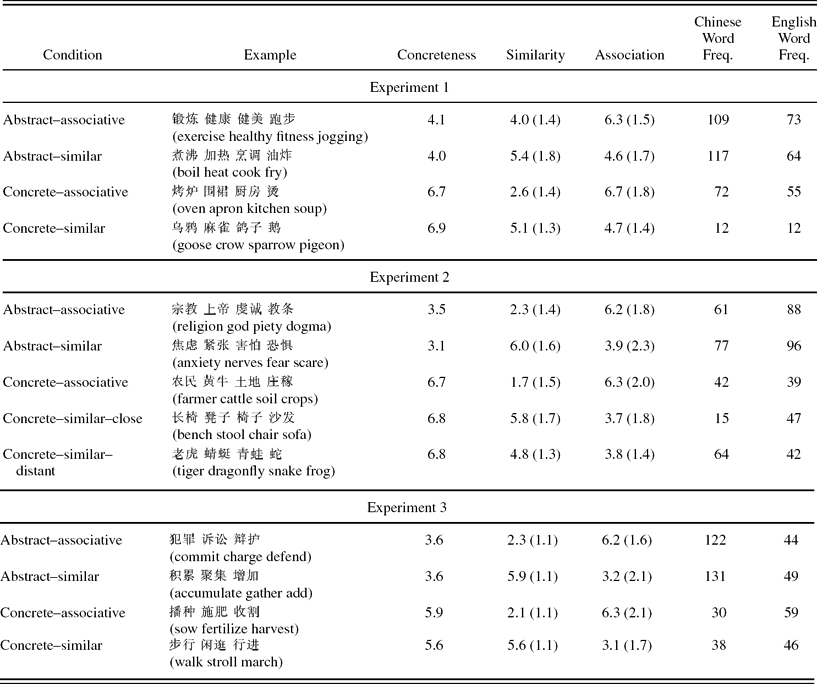
To verify the validity of the concreteness and relationship type manipulation we collected corresponding ratings from eight participants who did not take part in the main experiments. They were required to complete three 7-point scale questionnaires. In the first questionnaire, the subject was asked to rate how concrete each experimental word was, with 7 being the most concrete (items that are tangible, can be directly perceived, e.g., banana) and 1 being the most abstract (items that cannot be directly perceived, e.g., ideas). In the other two questionnaires, all stimuli arrays of four Chinese words were presented individually to be rated about how semantically similar and how associative the words were in the array, respectively. For semantically similarity ratings, 7 denoted the most similar, such that the items share a great proportion of conceptual features (e.g., leader–boss–head–senior) and one denoted completely unrelated, where the items do not share almost any semantic features. For association ratings, seven indicated that the items co-occur extremely commonly in the real world and language contexts without sharing conceptual features (e.g., barbecue–charcoal–sauce–smoke) and 1 indicated that the items co-occur extremely rarely in real world and language contexts. Table 1 shows the results of ratings in related conditions. We further considered the usage of more objective measures for semantic relatedness such as the latent semantic analysis (LSA; Landauer & Dumais, Reference Landauer and Dumais1997; http://lsa.colorado.edu). However, this measure is sensitive to the language context (see Vigliocco, Meteyard, Andrews, & Kousta, Reference Vigliocco, Meteyard, Andrews and Kousta2009), to which both semantic similarity and association may be relevant. The LSA values (highest possible value being 1) of our English targets were high for all related cells: the respective values for AA, AS, CA, and CS (CC) were 0.53, 0.48, 0.52, and 0.45 for Experiment 1; 0.42, 0.42, 0.43, and 0.51 (0.42) for Experiment 2; and 0.46, 0.49, 0.47, and 0.50 for Experiment 3. The values for unrelated arrays were all less than 0.2. Therefore, only our rating data are considered in subsequent analyses. Frequency counts for both English (Kucera & Francis, Reference Kucera and Francis1967) and Chinese words (Yu, Zhu, Wang, & Zhang, Reference Yu, Zhu, Wang and Zhang1998) are also listed in Table 1, and there were no significant differences across four conditions: Chinese, F (3, 128) = 0.76; p = .52; English: F (3, 128) = 1.76; p = .16.
Examples and characteristics of the stimuli in Experiments 1–3: Average rating results and average frequency of each condition

Note: The similarity and association ratings for corresponding unrelated conditions are listed in parentheses.
Procedure and apparatus. The DMDX program (Forster & Forster, Reference Forster and Forster2003) was used to present the stimuli and to collect reaction times and error rates. For the practice block and the experimental blocks, each array had a familiarization phase preceding the actual experimental trials. In the familiarization phase, each written Chinese word in the array was visually presented on the computer screen, with its corresponding English word presented through the headphone. The visual word stayed on the screen until the participants pressed the space bar. The spoken English words were retrieved through the Smart Read software, which generates an audio file for the corresponding English word given a Chinese word input. In the actual experimental blocks, each trial began with a fixation point (+) at the center of the screen for 500 ms, followed by a written Chinese word. Participants were asked to translate the word into English as fast and accurately as possible. The word disappeared once the participant's response triggered the voice key or after a 3-s deadline. The intertrial interval was 1 s. After all trials in an array were completed, the participants initiated the next array by pressing the space bar. The whole experiment lasted for about 1.5 hr by each participant, in two sessions over 2 consecutive days.
Results and discussion
The following types of responses were considered as errors: (a) the responses that differed from those designated by the experimenter, (b) verbal dysfluencies such as stuttering and utterance repairs, (c) recording failures, and (d) reaction times (RTs) that were <200 and >2000 ms. The responses beyond 3 standard deviations of the subject mean were treated as outliers and were eliminated from data analyses along with the errors, which accounted for 4.6% (4.3% errors, 0.3% outliers) of all data points.
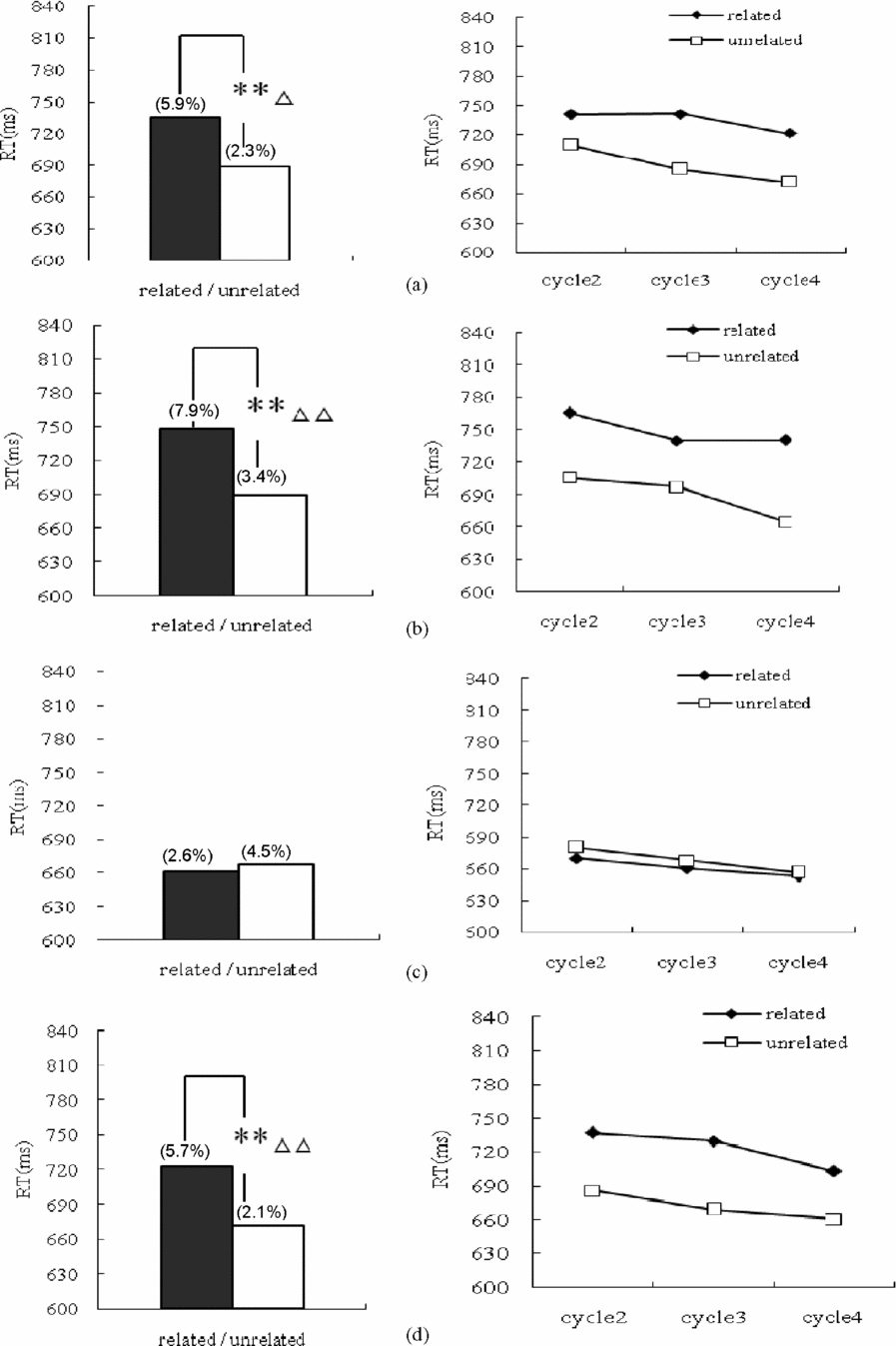
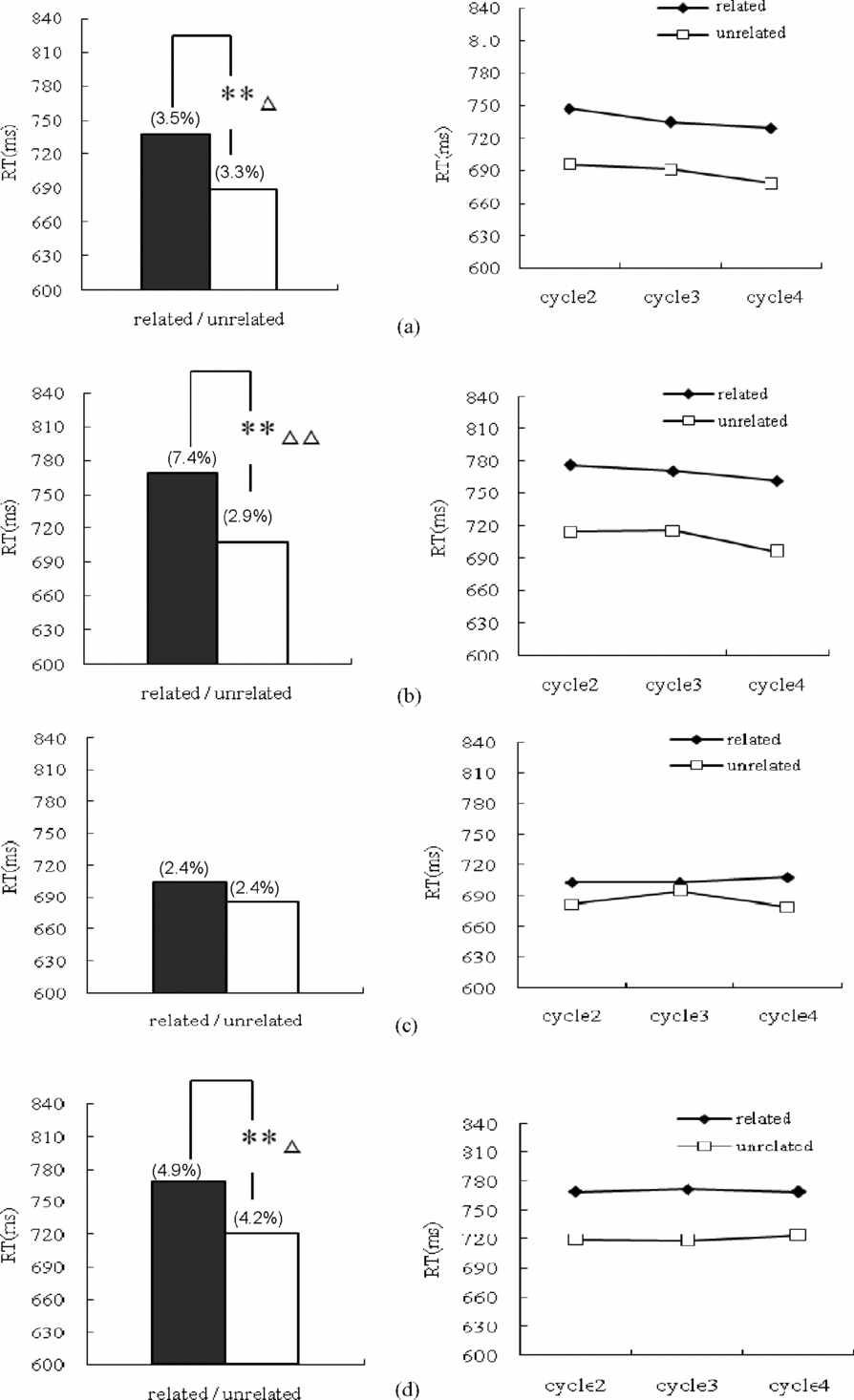
Given that in the first repetition the relationship among the words of an array may not be obviously formed (see Belke et al., Reference Belke, Meyer and Damian2005; Damian et al., Reference Damian, Vigliocco and Levelt2001) and/or that a short-lived semantic facilitation at the beginning of each block may exist (Damian & Als, Reference Damian and Als2005; Wheeldon & Monsell, Reference Wheeldon and Monsell1994), we analyzed responses collapsing the remaining three repetitions. The mean RTs and error rates of the last three repetitions are shown in Figure 1. The figure also displays RTs of each of the last three repetitions, showing that the effects are relatively stable across repetitions. Given that the mean error rates were rather low in the experiment, we only describe the results of error rates analyses if their patterns were in conflict with those of the RTs. Separate analyses of variance (ANOVAs) were carried out by subject (F 1, t 1) and by item (F 2, t 2). Our analyses included three variables: concreteness (concrete vs. abstract), relationship type (semantically similar vs. associative), and relatedness (related vs. unrelated). All variables were within-subject variables in the subject analyses. In the item analyses, concreteness and relationship type were between-item variables, and relatedness was a within-item variable.
Translation latencies and error rates in Experiment 1 for the (a) abstract–associative condition, (b) abstract–semantically similar condition, (c) concrete–associative condition, and (d) concrete–semantically similar condition. Mean reaction times (RTs; ms) for various types of blocking condition and their corresponding controls are presented both collapsing (left) across the last three repetitions and (right) by each cycle. Statistical significance levels are shown in the bar graphs: triangular labels for subject analyses (Δp < .05, ΔΔp < .01) and asterisks for item analyses (**p < .01). The mean error rates of the last three cycles for each condition are in parentheses.
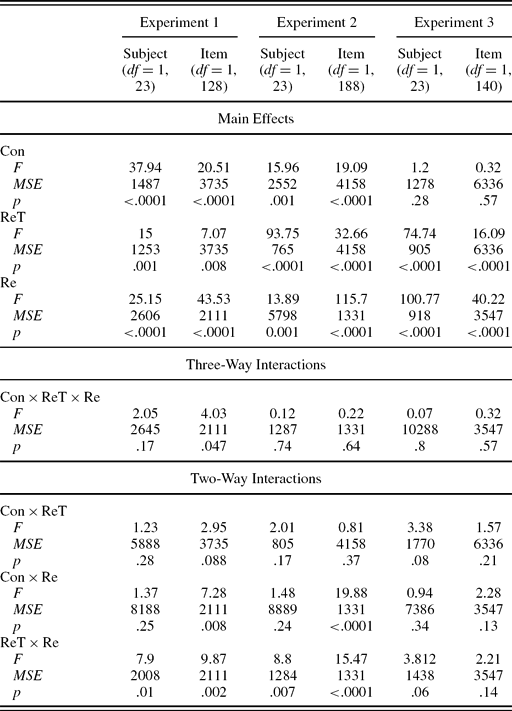
Table 2 presents the complete ANOVA results. The main effects for all variables were significant both by subject and by item. The concrete words were translated significantly faster than abstract words. Words in the related blocks were translated slower than those in the unrelated blocks. Items in the semantically similar blocks were translated slower than those in the associative blocks.
Analysis of variance results of the naming latencies in Experiments 1–3
Note: Subject, subject analysis; Item, item analysis; Con, concreteness (concrete vs. abstract); ReT, relationship type (associative vs. similar); Re, relatedness (related vs. unrelated).
Of particular interest here are the planned paired comparisons for each related condition against its corresponding unrelated condition. Significant interference effects were observed for the abstract associative condition: AA: t 1 (23) = 2.35, p < .05; t 2 (31) = 4.41, p < .001, the abstract semantically similar condition: AS: t 1 (23) = 3.10, p < .01; t 2 (35) = 5.23, p < .001, and the concrete semantically similar condition: CS: t 1 (23) = 3.42, p < .01; t 2 (31) = 3.48, p < .01. The concrete associative condition, however, did not yield any effect: CA: t 1 (23) = 0.40, p = .70; t 2 (31) = 0.94, p = .36.
To summarize, in comparison to corresponding controls, the translation latencies of concrete words were prolonged in the semantically similar (categorical) condition and not in the associative condition. For abstract words, however, both semantically similar blocking and associative blocking produced an interference effect.
EXPERIMENT 2
In this experiment we explored the semantic representation of abstract and concrete words within the noun word class, using the same paradigm as the one in Experiment 1. We included a further contrast between close versus distant relationships for the semantically similar (categorical) condition for concrete items to add a semantic similarity manipulation more comparable between concrete and abstract items. The manipulation was done this way because it is impossible to have clear categorical relationships for abstract items and clear similar but not categorical relationship for concrete items.
Method
Participants. Twenty-four new participants from the same subject pool as in Experiment 1 took part in the current experiment.
Materials. Abstract nouns and concrete nouns were used in this experiment. Because of the prevalence of homonym in the language, we chose words that are more frequently used as nouns than as other grammatical class in Chinese (Chinese word frequency counts; Yu et al., Reference Yu, Zhu, Wang and Zhang1998; see Table 1) and also collected the English surface word frequency (Kucera & Francis, Reference Kucera and Francis1967). The words were arranged in similar ways as in Experiment 1, except that we had two categorically related conditions for concrete words (the CS condition in Experiment 1): categorically related but semantically distant (CS-distant), categorically related and semantically close (CS-close). Each condition was consisted of 12 arrays of 4 words, so 48 words needed to be translated into English within a condition (see Appendix B). The construction of unrelated conditions and the arrangements of blocks across participants were identical to those of Experiment 1 and we balanced the degree of initial phoneme overlap for the L2 (English) responses in the related conditions and control conditions. The semantic similarity and association ratings from eight naïve participants are shown in Table 1. Note that to establish the reliability of the rating results, we have asked eight additional native participants to rate only the related word sets (either associative or similar) and the results paralleled those obtained with the full stimuli set (similarity values: AA = 2.0, AS = 6.2, CA = 1.6, CS = 5.9, CC = 2.5; association values: AA = 6.4, AS = 3.6, CA = 6.6, CS = 3.0, CC = 3.0). The rating results with the full stimuli set were presented and used in the analyses.
Procedure and apparatus. The same procedures and apparatus as the ones in Experiment 1 were used here, with the only exception that the intertrial intervals were 500 ms and there were 10 blocks in total. With the shortened trial interval the whole experiment lasted about 120 min and took three sessions to complete.
Results
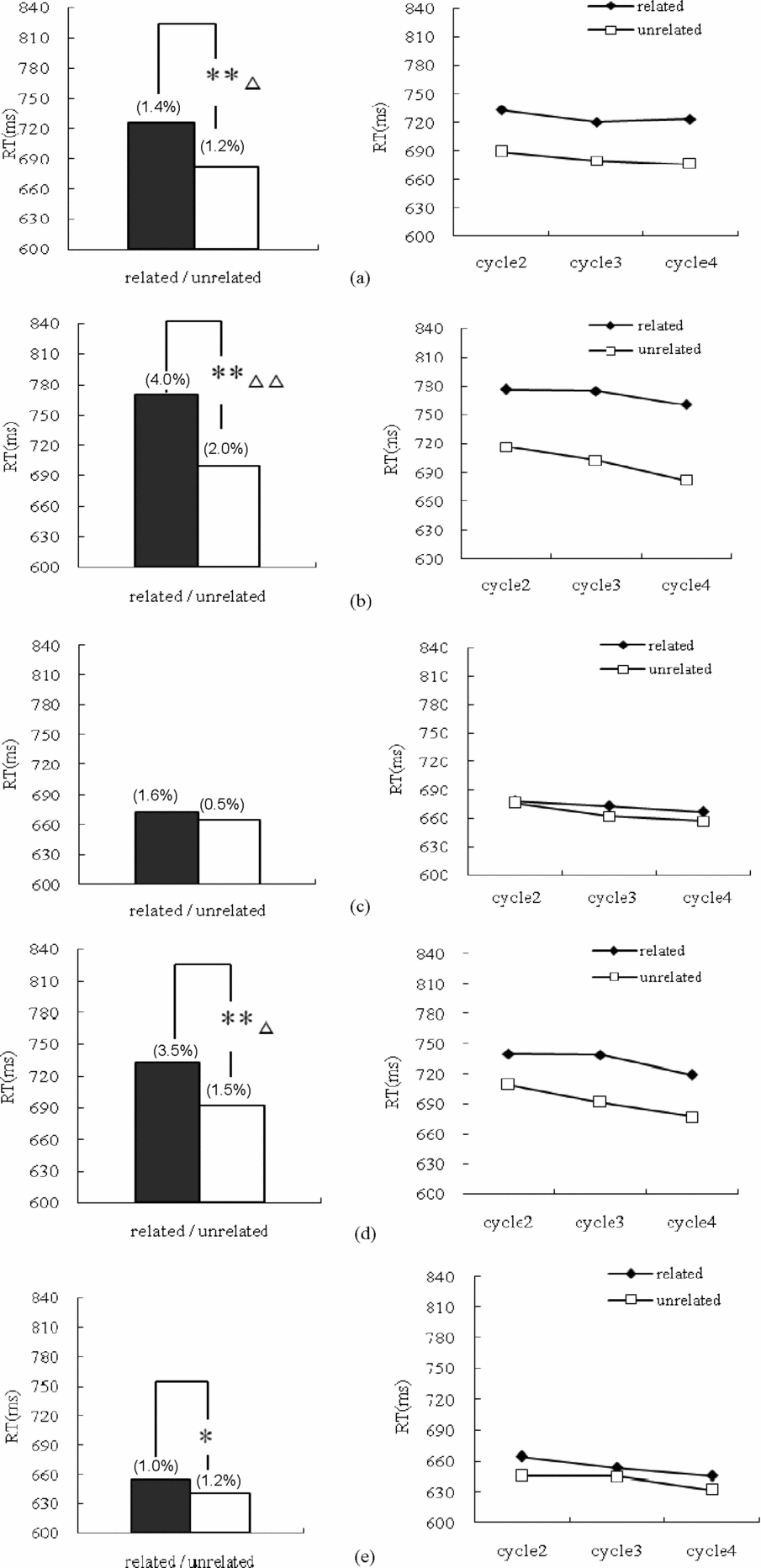
The same data trimming and error coding method as Experiment 1 were used. In total 3.6% of data points, including 1.8% errors and 1.8% outliers were discarded from analyses. The mean RTs of last three repetitions and RTs of the last three cycles are shown in Figure 2.
Translation latencies and error rates in Experiment 21 for the (a) abstract–associative condition, (b) abstract–semantically similar condition, (c) concrete–associative condition, (d) concrete–semantically similar condition, and (e) concrete–semantically distant condition. Mean reaction times (RTs; ms) for various types of blocking condition and their corresponding controls are presented both collapsing (left) across the last three repetitions and (right) by each cycle. Statistical significance levels are shown in the bar graphs: triangular labels for subject analyses (Δp < .05, ΔΔp < .01) and asterisks for item analyses (*p < .05, **p < .01). The mean error rates of the last three cycles for each condition are in parentheses.
We first carried out statistical analyses based on AA, AS, CA, and CS-close, because the semantic similarity rating for CS-close was more comparable to that of CS in Experiment 1 than CS-distant. As seen in Table 2, the main effects of all variables were significant both by subject and by item. The concrete words were translated significantly faster than the abstract words. Words in the related blocks were translated slower than those in the unrelated blocks. Items in the semantically similar blocks were translated slower than those in the associative blocks.
More informative are the planned pairwise comparisons for each related conditions against their corresponding unrelated conditions. Significant interference effects were observed for the abstract associative condition: AA: t 1 (23) = 2.29, p = .03; t 2 (47) = 5.66, p < .00, the abstract semantically similar condition: AS: t 1 (23) = 3.29, p = .003; t 2 (47) = 8.20, p < .001, and the concrete semantically categorical condition with high semantic similarity: CS-close: t 1 (23) = 2.12, p = .04; t 2 (47) = 5.30, p < .00. The concrete associative condition, however, did not yield any effect: CA: t 1 (23) = 0.49, p = .63; t 2 (47) = 1.22, p = .23. The concrete semantic category with distant semantic similarity was significant by item but not by subject: CS-distant: t 1 (23) = 1.23, p = .23; t 2 (47) = 2.11, p = .03.
To elucidate the effects of semantic category and degree of similarity, we further conducted two-way ANOVA on CS-distant and CS-close and their corresponding unrelated conditions. The main effect of semantic category was significant, with items in categorically related blocks being translated slower than those in unrelated ones: F 1 (1, 23) = 6.05, MSE = 3115, p = .02; F 2 (1, 94) = 28.98, MSE = 1193, p < .001. The two-way interaction between relatedness (related vs. unrelated) and similarity distance (close vs. distant) was significant in the item analysis, but not in the subject analysis, suggesting a trend of greater interference effect in the semantically close blocks: F 1 (1, 23) = 1.40, MSE = 3112, p = .25; F 2 (1, 94) = 6.82, MSE = 1193, p = .01.
To summarize, we replicated all findings in Experiment 1 using noun stimuli. We observed that abstract noun translation performance was inhibited by both semantically similar blocking and associative blocking. For concrete nouns, again the semantically similar (category-close) condition produced a significant effect and the associative condition did not. It was further observed that there was indeed a trend of semantic distance effect that was not fully accounted for by categorical membership, as the effect of CS-close was greater than that of CS-distant (for consistent results, see Vigliocco et al., Reference Vigliocco, Vinson, Damian and Levelt2002).
EXPERIMENT 3
In Experiment 3, we explored the semantic representation of abstract and concrete words within the verb word class using a similar design to that of Experiment 1. The CS-close versus CS-distant contrast in Experiment 2 was not included in the current experiment because the categorical membership for verbs is not clear-cut, and the near-synonym was used as a semantically similar condition for both abstract and concrete verbs.
Method
Participants. Twenty-four new participants from the same subject pool as in Experiments 1 and 2 took part in the present experiment.
Materials. Abstract verbs and concrete verbs here were used. We chose words that are more frequently used as verbs than as other grammatical class in Chinese corpus (Chinese word frequency counts; Yu et al., Reference Yu, Zhu, Wang and Zhang1998; see Table 1) and also collected the English surface word frequency (Kucera & Francis, Reference Kucera and Francis1967). The words were arranged in similar ways as in Experiment 1, except that each condition comprised of 12 arrays of 3 words, that is, 36 words needed to be translated within a condition (see Appendix C). The construction of unrelated conditions and the arrangements of blocks across participants were identical to those of Experiment 1. The semantic similarity and association ratings for the word arrays were collected using the method identical to that of Experiments 1 and 2 (see Table 1 for results). We also balanced the degree of initial phoneme overlap for the L2 (English) responses in the related conditions and control conditions.
Procedure and apparatus. The same procedures and apparatus as in Experiment 2 were used here. This whole experiment lasted for about 70 min and took two session to complete.
Results
The same data trimming and error coding method as Experiments 1 and 2 were employed. In total 5.3% of data points, including 3.9% errors and 1.4% outliers were discarded from analyses. The mean RTs of last three repetitions and RTs of the last three cycles are shown in Figure 3. The ANOVA results are shown in Table 2.
Translation latencies and error rates in Experiment 3 for the (a) abstract–associative condition, (b) abstract–semantically similar condition, (c) concrete–associative condition, and (d) concrete–semantically similar condition. Mean reaction times (RTs; ms) for various types of blocking condition and their corresponding controls are presented both collapsing (left) across the last three repetitions and (right) by each cycle. Statistical significance levels are shown in the bar graphs: triangular labels for subject analyses (Δp < .05, ΔΔp < .01) and asterisks for item analyses (**p < .01). The mean error rates of the last three cycles for each condition are in parentheses.
The main effects for the relatedness (related vs. unrelated) and relatedness types (similar vs. associative) were significant both by subject and by item. Words in the related blocks were translated slower than those in the unrelated blocks, and those in the semantically similar blocks slower than those in the associative blocks. The main effect of concreteness was not significant.
Pairwise comparisons between each related condition and its corresponding control showed significant interference effects for the abstract associative condition: AA: t 1 (23) = 2.23, p = .004; t 2 (35) = 3.42, p = .002; the abstract semantically similar condition: AS: t 1 (23) = 3.02, p = .006; t 2 (35) = 4.17, p < .001; and the concrete semantically similar condition: CS: t 1 (23) = 2.37, p = .03; t 2 (35) = 3.35, p = .002. The concrete associative condition did not yield any significant effect: CA: t 1 (23) = 0.90, p = .38; t 2 (35) = 1.54, p = .13.
The results in Experiment 1 were fully replicated here using words that are primarily used as verbs. For concrete verbs, there was a significant semantically similar blocking interference effect but no associative effect; for abstract verbs, both semantically similar and associative blocking produced significant interference effects. Note that the main effect of concreteness did not reach significance here. It might be because the difference in terms of concreteness in the abstract versus concrete verb stimuli was not as large as that in the noun stimuli (see Table 1).
ANALYSIS ACROSS ALL THREE EXPERIMENTS
To better understand the effects of associative and similarity variables on participants' behavior, we carried out multiple regression analyses across all items combining the three experiments, treating the mean RT of the last three repetitions for each word as the dependent variable. The predictors included the concreteness rating, the similarity rating, and the associative rating of each word (estimated with the rating for the particular set it appeared in), as well as the interactions between the concreteness rating and the similarity rating, and between the concreteness rating and the associative rating (after mean-centering both variables). The five predictors were simultaneously entered into the regression model. The variables concreteness, similarity, and the Concreteness × Association interaction showed significant effects in predicting the RT: (R 2 = .18, p < .001; concreteness: β = −0.23, t = −8.28, p < .001; similarity: β = 0.31, t = 10.27, p < .001; Concreteness × Association: β = −0.095, t = −3.12, p = .002; all other variables, ts < 1.5). We then used the “stepwise” method for the five variables, and again the concreteness, similarity, and the interaction of Concreteness × Association were the significant predictors (first step: similarity; second step: concreteness; third step: Concreteness × Association; final model: R 2 = .18, p < .001). Finally, we used a method to test any unique contribution of the interaction variables by entering the main variables (concreteness, similarity, association) as a first block and then the interaction variables as a second block (Concreteness × Similarity or Concreteness × Association). Again, there was a greater improvement induced by entering the interaction variables (Concreteness × Association: R 2 change = .011, p < .001; Concreteness × Similarity: R 2 change = .003, p = .041). The robust effect of similarity in predicting the RT across all items here converges with the results of similarity effect in both abstract and concrete blocks obtained using other statistical method (paired t test).
GENERAL DISCUSSION
In three experiments using the blocked translation paradigm with healthy Chinese–English bilinguals, we consistently observed the following patterns: for concrete words, the translation performance was interfered by semantically similar (categorical) blocking and not by associative blocking; for abstract words, both semantically similar and associative blocking prolonged subjects’ translation performance. This pattern held when a mixture of words from various grammatical classes were used (Experiment 1), when words that are mostly used as nouns were used (Experiment 2), and when verbs were used (Experiment 3). The multiple regression analyses also confirmed the effects of similarity on all words, and that the effects of association being modulated by words’ concreteness. Furthermore, for concrete nouns, a trend of semantic similarity distance effect was observed on top of the categorical effect (Experiment 2). We not only have extended the assessment of the organizational hypothesis about concrete and abstract concept representation to healthy subjects, but also have disentangled the potential confound of grammatical class and concreteness.
Before discussing the implications of our results, there are a few methodological caveats that need to be considered. First, word sets may not be equally related in both languages. In the current study, because the translation is driven by the semantic system (and lexical system) of L1 (Chinese), we specifically manipulated the semantic relationships using Chinese words. For the stimuli in Experiment 1, both the words in L1 (current paper) and their corresponding L2 words (English) had been considered (Crutch & Warrington, Reference Crutch and Warrington2005) and the patterns of semantic relationship manipulations paralleled in these two languages, suggesting that such manipulations can be generalized across these two languages to a great extent, at least for the stimuli set used here. Another issue is translation equivalency—there is usually more translation equivalency among concrete than among abstract words, and Tokowicz and Kroll (Reference Tokowicz and Kroll2007) showed that abstract words are influenced by the ambiguity in the translation but that concrete words are not. However, given that we used a within-item design in our study, with identical words to be translated in related and unrelated conditions (only the set construction they appear in were different), the effects of translation equivalency differences among concrete and abstract words could be minimized. Finally, we notice that the CA-related conditions were the fastest across three experiments; thus, the lack of any interference effect in the CA condition might be due to a ceiling situation. We think that this is not likely because our results here regarding CA were in line with earlier studies looking at associative relationships for concrete items (e.g., Duñabeitia et al., Reference Duñabeitia, Avilés, Afonso, Scheepers and Carreiras2009).
Comparing current results to the findings in the literature
Relating our results to similar studies in the literature is complicated because the most closely related ones yielded different results. As discussed in the introductory section, Crutch and colleagues (Crutch, Reference Crutch2006; Crutch et al., Reference Crutch, Ridha and Warrington2006; Crutch & Warrington, Reference Crutch and Warrington2005, Reference Crutch and Warrington2007) observed a significant interference effect only by semantically similar blocking for concrete words and associative blocking for abstract words. Hamilton and Coslett (Reference Hamilton and Coslett2008), studying a patient with similar disorders, observed effects of both semantic similarity and association for both types of words. Given the difficulty in interpreting null results, we will primarily consider the data points that yielded significant results, that is, those in Hamilton and Coslett (Reference Hamilton and Coslett2008). Our results with the abstract words were consistent with this study, and the results with the concrete words were not. Hamilton and Coslett (Reference Hamilton and Coslett2008) observed significant effects of both semantic similarity and association in concrete word processing, and we found only the effects of semantic similarity. Such discrepancies might be attributed to the types of subjects being studied, with the effects being more easily observed in a compromised system (see below).
Our current results are in accord with the majority of similar studies in the literature with healthy participants that assessed the effect of association in concrete versus abstract words comprehension, or the effects of semantic category versus association in concrete word processing. Duñabeitia et al.'s (2009) results, that concrete words that are associated with abstract targets had greater and earlier effects than for concrete targets using eye movement measures, are in line with our finding that the effect of association is more visible for abstract targets. For concrete words, the effect of semantically categorical interference was consistently observed in various semantic-mediated tasks such as object picture naming or translating words (Belke et al., Reference Belke, Meyer and Damian2005; Bloem & La Heij, Reference Bloem and La Heij2003; Damian & Bowers, Reference Damian and Bowers2003; Damian et al., Reference Damian, Vigliocco and Levelt2001; Howard, Nickels, Coltheart, & Cole-Virtue, Reference Howard, Nickels, Coltheart and Cole-Virtue2006; Kroll & Stewart, Reference Kroll and Stewart1994; Lupker, Reference Lupker1979; Rosinski, Reference Rosinski1977; Schnur et al., Reference Schnur, Schwartz, Brecher and Hodgson2006; Schriefers et al., Reference Schriefers, Meyer and Levelt1990). The association effect, in contrast, was rather unreliable (Alario, Segui, & Ferrand, Reference Alario, Segui and Ferrand2000; La Heij et al., Reference La Heij, Dirkx and Kramer1990; Lupker, Reference Lupker1979), with only one study observing the effects of associative relationship under special circumstances, that is, when the experimental contexts were fully established after the subjects had named the test items several times (Abdel Rahman & Melinger, Reference Abdel Rahman and Melinger2007).
Several convergent points emerged from the above analyses. Semantic similarity was found to affect both abstract and concrete word processing, except for studies presenting a floor situation (Crutch et al., Reference Crutch, Ridha and Warrington2006; Crutch & Warrington, Reference Crutch and Warrington2005) or a study where semantic relationship yielded facilitation effect (Crutch et al., Reference Crutch, Connell and Warrington2009). The effect of association is stronger in abstract words than in concrete words (current study; Crutch, Reference Crutch2006; Crutch et al., Reference Crutch, Ridha and Warrington2006, Reference Crutch, Connell and Warrington2009; Crutch & Warrington, Reference Crutch and Warrington2005, Reference Crutch and Warrington2007; Duñabeitia et al., Reference Duñabeitia, Avilés, Afonso, Scheepers and Carreiras2009). The only study that reported an equal strength of associative effect for concrete and abstract words was with a patient (Hamilton & Coslett, Reference Hamilton and Coslett2008).
Theoretical implications of our findings
What are the implications of these results? First, CW's findings (Crutch, Reference Crutch2006; Crutch et al., Reference Crutch, Ridha and Warrington2006; Crutch & Warrington, Reference Crutch and Warrington2005, Reference Crutch and Warrington2007) could not be generalized to other subjects and paradigms; hence, their corresponding theory about the fundamental organizational principle difference between concrete and abstract concepts is challenged. In addition, theories that suggested richer representations for concrete words (e.g., Paivio, Reference Paivio1986; Plaut & Shallice, Reference Plaut and Shallice1991; Schwanenflugel & Shoben, Reference Schwanenflugel and Shoben1983) do not readily explain the results either. If anything, the representation for abstract concepts might be richer, respecting both association and semantic similarity organizations.
These results can be accommodated by the theories about the content of semantic representations that (a) assume multiple dimensions of conceptual representation; and (b) attribute different weight distributions to the common set of concept organizational principles, with more weights to the association connections for abstract concepts than for concrete concepts (e.g., Breedin et al., Reference Breedin, Saffran and Coslett1994; see also Gentner, Reference Gentner1981; Hamilton & Coslett, Reference Hamilton and Coslett2008; Markman & Stilwell, Reference Markman and Stilwell2001; Vigliocco et al., Reference Vigliocco, Meteyard, Andrews and Kousta2009). According to these theories, the organization of the semantic space is a product that emerges from differences in content. For instance, Breedin et al. (Reference Breedin, Saffran and Coslett1994) proposed that concrete concepts are acquired through sensory experiences and once acquired contain rich sensory features; abstract concepts are acquired through linguistic and referent contexts and after acquisition also have a more ambiguous content (i.e., more senses) that are realized through the contexts they appear in. A related theory (Vigliocco et al., Reference Vigliocco, Meteyard, Andrews and Kousta2009) makes similar proposals about the semantic representation in the adult system: the dichotomy between concrete and abstract word meanings arises because of the distribution differences of various types of information underlying those meanings, with a statistically greater amount of sensory-motor information for concrete word meaning representation and a greater amount of affective and linguistic information for abstract word meaning representation.
This line of theories can therefore accommodate our findings that a semantic similarity effect is significant for both abstract and concrete words, as both sensory-motor feature overlap and linguistic information in the representations correlate with semantic similarity strength. Consistent with the proposal that the association strength is largely linguistic in nature and is more important in the abstract word representation, the effect of association is more easily seen with abstract items. In concrete items the association effect might be weak in normal circumstances and can only become visible when the system breaks down (e.g., Hamilton & Coslett, Reference Hamilton and Coslett2008). They could account for the other lines of empirical findings relating to the target issue, such as the double dissociation between abstract and concrete conceptual processing (see introductory section).
These theories might be criticized for being too vague, as empirical predictions depend on the actual weights being given to various types of semantic features/connections for a particular concept. It does make the following more specific prediction, however: there should be effects of semantic similarity across all items, and the effect of association should be modulated by the abstractness/concreteness of concepts. This was exactly confirmed by the post hoc multiple regression analyses we carried out: similarity strength significantly predicted the RT across all items, and by contrast the effect of association only significant when in modulation by the words’ concreteness. The results of this post hoc analysis suggest that the organization principle does not treat concrete and abstract words categorically, but rather is influenced by the abstractness of words in a continuous fashion.
Considering semantic category versus similarity and nouns versus verbs
Note that so far in the discussion, we have followed the seminal studies and considered the semantically categorical relationship in concrete concepts to be semantic similarity that is in parallel with synonymy in abstract concepts. However, this is oversimplifying the issue. Although synonyms or near synonyms share most critical semantic features and could substitute for each other in many contexts, words belonging to the same semantic categories are mostly distinguished by critical semantic features and can rarely substitute for each other (consider “cat” and “mouse”). The associate relationships among concrete words and those among abstract words may also differ systematically. We here intended to reduce such potential problems by using identical procedures/instructions in the rating collections across concrete and abstract words. Furthermore, in Experiment 2 of the current study, we have empirically shown that the degree of semantic similarity yielded an effect (significant in item analyses) in concrete word translation on top of the categorical effects. That is, although it is still open as to whether the semantically categorical effect in concrete noun processing can be fully accounted for by a semantic similarity effect, there is indeed a comparable semantic similarity dimension that is respected by both abstract and concrete concepts (see also Mahon et al., Reference Mahon, Costa, Peterson, Vargas and Caramazza2007). Thus, in this sense, featural overlap matters for both types of concepts and provides more straightfoward explanation than accounts in terms of categorical organization of concrete words.
Furthermore, we observed parallel results for nouns and verbs in Experiment 2 and 3, indicating that the organization principles for noun and verb concepts are similar, at least with regard to the concreteness dimension (abstract vs. concrete) and organizational principles (similarity vs. association). Such results are compatible with theories that propose the same structure for noun and verb concepts, such as the “FUSS” theory proposed by Vigliocco and colleagues (Vigliocco et al., Reference Vigliocco, Vinson, Lewis and Garrett2004; Vinson & Vigliocco, Reference Vinson and Vigliocco2002), which assumes the same feature space for all types of concepts. Note that our results do not exclude the possibilities that the nature of semantic similarity and categorical relationships differ across nouns and verbs and/or that noun and verb concepts are separately stored (e.g., Bi, Han, Shu & Caramazza, Reference Bi, Han, Shu and Caramazza2007; Bird, Howard, & Franklin, Reference Bird, Howard and Franklin2001; Caramazza & Hillis, Reference Caramazza and Hillis1991; McCarthy & Warrington, Reference McCarthy and Warrington1985).
CONCLUSIONS
In healthy subjects we obtained results that challenge the organizational hypothesis of CW (Crutch, Reference Crutch2006; Crutch et al., Reference Crutch, Ridha and Warrington2006, Reference Crutch, Connell and Warrington2009; Crutch & Warrington, Reference Crutch and Warrington2005, Reference Crutch and Warrington2007), which assumes that abstract and concrete concepts are constrained by distinct semantic organizations. Although the associative relationship was indeed found to be more important for abstract items, both concrete and abstract concepts were observed to be sensitive to semantic similarity contexts. Our conceptual system might be represented by a set of common dimensions, with the weights of specific dimensions varying according to the characteristics of concepts such as concreteness.
APPENDIX A
Stimuli used in Experiment 1 (Chinese words and English target words)
APPENDIX B
Stimuli used in Experiment 2 (Chinese words and English target words)
APPENDIX C
Stimuli used in Experiment 3 (Chinese words and English target words)
ACKNOWLEDGMENTS
This work was supported by the Fundamental Research Funds for the Central Universities and National Social Science Foundation of China (Grant 07CYY009).