Accuracy of production of the prosodic features of a second language (L2) is thought to be a major contributor to perceived foreign accent. Indeed, foreign accent and intelligibility might be impacted to a greater extent by prosodic than segmental factors (Anderson-Hsieh, Johnson, & Koehler, 1992; Moyer, 1999; Munro & Derwing, 1999; Pennington & Richards, 1986), and pronunciation instruction that focuses on prosodic features has been found to improve judgments of accentedness, comprehensibility, and fluency to a greater extent than instruction that focuses on segmental features (Derwing, Munro, & Wiebe, 1998; Derwing & Rossiter, 2003).
English prosodic rhythm has traditionally been classified as stress-timed. Although no true isochrony between stressed syllables has been found (Dauer, 1983), English has both full and reduced vowels that vary in duration and perceived prominence, which creates the perception of an uneven rhythm in which unstressed syllables are less salient than stressed syllables (Pike, 1945).1
Recently, the proportion of vowels in an utterance, as well as variation in consonant duration, has been found to distinguish so-called stress-timed languages such as English from so-called syllable-timed languages such as Spanish and so-called mora-timed languages such as Japanese (Ramus, Nespor, & Mehler, 1999).
The ability to accurately produce English reduced vowels might be affected by the prosodic features of the first language (L1). McAllister, Flege, and Piske (2002) proposed the feature hypothesis, which states that L2 phonetic features not used to signal phonological contrasts in a L1 will be more difficult to acquire than those that are (see also Gottfried & Suiter, 1997). McAllister et al. reasoned that the L1 perceptual system is attuned to phonologically meaningful phonetic features and, as such, the L1 system will underattend to phonetic features that are not phonologically meaningful (see also Francis & Nusbaum, 2002; Guion & Pederson, in press; Iverson et al., 2003). Furthermore, McAllister et al., along with Flege (1995), reasoned that the difficulty in perceiving phonetic features that are not phonologically meaningful will be reflected in low production accuracy of these features in the L2.
Thus, the production of English reduced vowels might be affected by the L2 learners' L1 prosodic system insofar as phonetic features not used in the L1 rhythmic system might be more poorly acquired. Given the findings from previous research that acoustic features not used in the L1 phonological system are underattended (Francis & Nusbaum, 2002; Guion & Pederson, in press; Iverson et al., 2003), learners might not detect modulation in such features and, thus, the phonetic information might not receive the further processing that is thought to be prerequisite to learning (Schmidt, 2001; Tomlin & Villa, 1994). Furthermore, attentional allocation to acoustic features might be domain-specific: A feature that is not phonologically relevant to the rhythmic system might be relevant to other aspects (e.g., segmental feature processing). Thus, a phonetic feature not relevant to the prosodic system, even though it might be relevant in other domains, might be underattended in prosodic processing.
This attentional, processing view of L1 effects on L2 learning does not claim that the features are unavailable to the linguistic system, as some proposals about the nonavailability of Universal Grammar in L2 learning do (see White, 2000, for a review). Instead, this view proposes that the processing system is tuned by the linguistic input. Studies investigating infant development of perceptual discrimination have shown that a perceptual reorganization takes place within the first year of life. Most segmental contrasts not found in the child's linguistic environment are better discriminated before about 10–12 months of age. After this age, the ability to discriminate these contrasts decreases. These studies have argued that this is not a loss in auditory capabilities but, rather, a reorganization of perceptual space (e.g., Best, McRoberts, & Sithole, 1988; Kuhl, 1991, 2000; Werker, 1989; Werker & Pegg, 1992). The reorganization of perceptual space might be affected by attentional factors. Specifically, selective attention to particular perceptual dimensions changes similarity relationships such that differences along attended dimensions expand and differences along unattended dimensions contract (Guenther, Husain, Cohen, & Shinn-Cunningham, 1999; Nosofsky, 1986).
The attentional system used in phonological processing has been demonstrated to be at least somewhat plastic. Training studies have found that the relative weighting of specific acoustic cues can be shifted (Francis, Baldwin, & Nusbaum, 2000; Francis & Nusbaum, 2002). Additionally, adult L2 learners have exhibited differences in the relative weighting of acoustic cues vis-à-vis naïve listeners (Guion & Pederson, in press).
A primary aim of this study is to investigate the effect of the L1 prosodic system on the production of English unstressed vowels by Korean and Japanese learners of English. In the following sections, the phonetic features used to signal English unstressed vowels are presented and then compared to the phonetic features used in Korean and Japanese prosody. Following the feature hypothesis (McAllister et al., 2002), phonetic features that are not relevant to the L1 prosodic system but that signal vowel reduction in English are predicted to have low production accuracy.
Another primary aim of this study is to investigate the extent to which age of acquisition modulates the effect of the L1 phonological system on the acquisition of English unstressed vowels. The question addressed is whether early learners are better able to learn to produce phonetic cues that do not signal prosodic differences in the L1 than late learners are. Given the finding that the attentional system is somewhat plastic, we might expect learners to come to attend to acoustic features not used in the L1 prosody. Will this ability be reflected in L2 production and will this ability be affected by age of acquisition?
The effect of age of acquisition on the ability to learn a L2 has been well documented. Older learners are generally less proficient in the L2 than younger learners (Flege, Yeni-Komshian, & Liu, 1999; Hyltenstam & Abrahamsson, 2003; Johnson & Newport, 1989; Long, 1990). However, some late learners have been found to be nativelike in at least some aspects of their L2 (Birdsong, 1992; Bongaerts, 1999; Moyer, 1999); on the other hand, even very early learners have been found to deviate from native speakers (NSs) in foreign accent (see review in Piske, MacKay, & Flege, 2001) and grammaticality judgment (Butler, 2000).
The cause of age of acquisition effects has been much debated in the field. One point of view is that as the brain matures, it becomes less able to learn language due to a loss of neural plasticity (Lenneberg, 1967; Patkowski, 1980). One version of this view predicts that L2 learning before the end of a critical period should result in nativelike attainment and that later learning will be variable and nonnativelike. Another version holds that the ability to learn a L2 will gradually decline as the learner matures (see summaries in Hyltenstam & Abrahamsson, 2003, and Long, 1990).
Another explanation for age-related effects on SLA proposes that knowledge of a L1 impedes the learning of a L2. The more fully developed the L1 is at the time of L2 learning, the more negatively it will impact the L2 learning (Bialystok, 1997; Flege, 1999; Oyama, 1979). This view predicts that proficiency in L2 will gradually decrease with age of acquisition and that as the L1 system develops, it will exert an increasingly strong influence on the L2.
In addition to age-related factors, the amount of exposure and quality of input affect L2 learning. For example, recent studies suggest that the failure to produce the L2 in a nativelike manner might result from the quality of L2 input (Flege & Liu, 2001) and from the amount of L1 and L2 use (Guion, Flege, & Loftin, 2000; Moyer, 2004). Additionally, factors that are known to affect SLA, such as length of residence and L2 use, are often naturally confounded with age of acquisition (Flege, 1988).
In sum, this study examines (a) the effect of the L1 prosodic systems on L2 production of English unstressed vowels and (b) age of acquisition effects on L2 production in terms of the feature hypothesis (McAllister et al., 2002) and the attentional system in phonological processing.
ENGLISH UNSTRESSED REDUCED VOWELS
The nature of unstressed reduced vowels in English is best considered in light of the characteristics of stressed unreduced vowels. In general, unstressed vowels are perceived as lower in pitch, shorter, and less loud than stressed vowels. The acoustic correlates of these perceived features are lower fundamental frequency (F0), shorter duration, and weaker intensity for unstressed than stressed vowels (Fry, 1955). Unstressed vowels in English are also reduced in terms of vowel quality (Gay, 1978). Midrange frequencies for the first formant (F1) and second formant (F2) have been identified as the acoustic correlates to perceived vowel quality reduction.
Much research concerned with separating stressed from unstressed vowels has dealt with the acoustic realization of stress and the relative strength of the F0, duration, and intensity parameters. It is generally agreed that the production and perception of stress cannot be attributed to any one parameter (Crystal, 1969). On the basis of acoustic and perceptual studies on English word stress, Fry (1955, 1958) argued that the most important acoustic factor in a stressed vowel is (higher) F0, followed by (longer) duration and (greater) intensity, in that order. The hierarchical order of the cues for stressed vowels has been supported by Adams (1979) and Lehiste (1970). However, Beckman and Pierrehumbert (1986), among others, reported that duration and overall intensity were the most reliable acoustic correlates of stress in American English. Recent work has supported the view that F0 is a reliable correlate of stress only under conditions of sentential pitch accent, as is the case for the data collected for this study (Beckman & Edwards, 1994; Huss, 1978; Pierrehumbert, 1980; Sluijter & van Heuven, 1996a, 1996b; Sluijter, van Heuven, & Pacilly, 1997; Vanderslice & Ladefoged, 1972).
The effect of stress on vowel quality has also received attention in previous studies. Stress has an influence on vowel quality by way of a process called vowel reduction (Lindblom, 1963). Unstressed vowels are more reduced in terms of vowel quality than stressed ones (Gay, 1978; Koopmans-van Beinum, 1980). Vowel reduction in unstressed syllables results in a more central vowel production (i.e., mid-range frequency values for the F1 and F2). The English unstressed reduced vowel is also known to be quite variable and subject to coarticulation with the surrounding segments (Browman & Goldstein, 1992; van Bergem, 1994).
Rietveld and Koopmans-van Beinum (1987) investigated the relation between the degree of vowel reduction and the perception of stress when other parameters such as F0, intensity, and duration were held constant; they reported that the lack of vowel reduction was a cue for perceived stress in this condition. Householder (1971), in a corpus study of everyday English, found that the difference in word-stress location in the majority of orthographically identical word pairs was signaled by vowel reduction as a manipulation of quality as well as acoustic differences of F0, intensity, and duration. Similarly, Fear, Cutler, and Butterfield (1995) argued that strong and weak syllables in English are distinguished either by stress (e.g., F0, duration, and intensity) or by vowel quality, or by both.
PREVIOUS STUDIES ON L2 ACQUISITION OF ENGLISH STRESS
The majority of previous work on the L2 acquisition of English stress has focused on the acquisition of stress placement patterns on the basis of syllable structure, the lexical classes of noun and verb, or both (Archibald, 1992, 1993, 1997; Arciuli & Cupples, 2004; Davis & Kelly, 1997; Erdmann, 1973; Guion, 2005; Guion, Harada, & Clark, 2004; Harada, 2004; Mairs, 1989). Perhaps less well studied is the implementation of stress at the phonetic level. Here, we will focus on the production of unstressed reduced vowels.
The use of full rather than reduced vowels in unstressed syllables plays an important role in foreign accent. Hammond (1986) noted that this phenomenon was extremely typical in Spanish-accented English. Fokes, Bond, and Steinberg (1984) reported that L2 learners of English made errors by incorrectly producing full vowels in the place of reduced vowels. Similarly, in a study investigating English NSs' perceptual judgments of Korean learners' production of English, Koo (1997) reported that Korean learners' production of the English rhythmic pattern, including reduced vowels, was the most serious problem for Korean learners.
A few studies have reported findings on the time interval between stressed syllables (i.e., the interstress interval) in English learners' speech. The ability to modulate the interstress interval is related to the ability to reduce—or shorten the duration of—unaccented vowels. Anderson (1993) examined the durational patterns of the English interstress interval and found that Japanese speakers showed significantly longer interstress intervals than native English speakers, indicating less temporal reduction of the unstressed syllables. Additionally, Mochizuki-Sudo and Kiritani (1991) examined the durational patterns of the English interstress interval for Japanese learners of English and found that the interstress interval is a temporal unit in the production and perception of English for English NSs but not for the nonproficient Japanese speakers.
Only a few studies have investigated phonetic aspects of the production of English unstressed reduced vowels by L2 learners. Flege and Bohn (1989) examined stress placement and vowel reduction through the production in isolation of English word pairs derived from the same morpheme (e.g., able/ability) by seven English NSs and seven Spanish NSs. The difference between stressed and unstressed vowels in duration and intensity was measured. Vowel quality was measured by auditory transcription and instrumentally by measuring the vertical distance of the tongue from the hard palate. Flege and Bohn's findings indicated that Spanish NSs were more nativelike in stress placement and implementation of the stressed versus unstressed contrast than in vowel reduction. More specifically, Spanish NSs differentiated stressed and unstressed vowels in terms of duration and intensity in most cases. However, the Spanish learners of English showed much less vowel reduction in terms of tongue height than the English NSs.
In another study that investigated the phonetics of unstressed reduced vowel production, Kondo (2000) acoustically investigated the coarticulatory patterns of the unstressed vowel produced by Japanese learners of English.2
Kondo (2000) did not report the age of acquisition of the Japanese learners of English in the study.
KOREAN AND JAPANESE PROSODY
Korean is described as having a phrase-level pitch accent in which tones, realized as F0 patterns, are assigned to specific syllables within a prosodic domain that might be larger than a lexical word. Jun (1993) argued that the accentual phrase is the lowest level of Korean prosody and that there is no prosodic assignment at the lexical word level. On the other hand, some researchers have analyzed Korean as a word-level stress system (H.-B. Lee, 1989; H.-Y. Lee, 1996).
However, proponents of the word-level stress view do not propose any sort of phonetic realization of the word-level stress. Instead, the word-level stress is seen as the marker of a potential syllable to which a phrase-level pitch accent can be assigned (H.-Y. Lee, 1997). Thus, as far as phonetic features are concerned, there is consensus among researchers that F0 patterns are the primary realization of Korean prosody. Duration, intensity, and vowel reduction have not been described as part of the phonetic realization of prosody in Korean. Although vowel duration signals a phonemic contrast in some dialects of Korean (e.g., [nu:n] “snow” vs. [nun] “eye”), its phonemic function has completely disappeared in the modern standard Seoul dialect, which is the native dialect of the speakers in the current study (Kim & Han, 1998).
Japanese, on the other hand, has a word-level pitch accent system that relies solely on F0 patterns (Sugito, 1980). Vance (1987) noted that the most important characteristic of Japanese accent is the phenomenon of pitch, which falls from high to low in an accented mora. One of the distinctive features of Japanese accent is that, in some cases, accented syllables might not necessarily be characterized by high fundamental frequency but, rather, by a delayed pitch fall in the following syllable (e.g., atari HLL “around,” yutaka HLL “plenty”). The other important feature of Japanese pitch accent is that the onset of pitch fall tends to correspond with the mora boundary (e.g., in ame HL “rain,” F0 fall starts between a and m), whereas in English the onset of the fall starts at an early stage of a stressed vowel or occurs within the syllable containing the stressed vowel (e.g., in permit [noun], F0 starts to fall at an early part of the first vowel or at least within this vowel; Sugito). Thus, F0 patterns are the primary realization of Japanese pitch accent. Duration, intensity, and vowel reduction are not part of the phonetic realization of pitch accent in Japanese (see Beckman, 1986).
However, the phonetic property of duration is used to realize the rhythm of Japanese. Considered from a rhythmic typology point of view, Japanese is considered to be a mora-timed rhythmic language that exhibits phonetic properties that differentiate it from stress-timed or syllable-timed languages (Ramus et al., 1999). Short segments are analyzed as consisting of one mora and long segments are analyzed as consisting of two morae (Tsujimura, 1996). For example, the short-long contrast is manifested by many minimal pairs such as su “vinegar” versus suu “number” and ita “existed” versus itta “said.” Phonetic investigation into the duration of one- versus two-mora syllables has found that although a two-mora syllable has a greater duration than a one-mora syllable, it is not always exactly twice as long (Beckman, 1982). However, equal mora duration is more clearly manifested in a larger context of words (Port, Dalby, & O'Dell, 1987).
In summary, Japanese pitch accent is primarily realized by the acoustic cue of fundamental frequency, and Japanese mora-timed rhythm is primarily realized by the acoustic cue of duration. Intensity and vowel reduction are not thought to be part of the phonetic realization of prosody in Japanese.
RESEARCH QUESTIONS AND HYPOTHESES
The focus of this study is to compare stressed and unstressed vowels produced by early and late Korean- and Japanese-English bilinguals. Specifically, the unstressed vowels that are realized as centralized schwa-like vowels by English NSs are investigated. The study is designed to address two main aims.
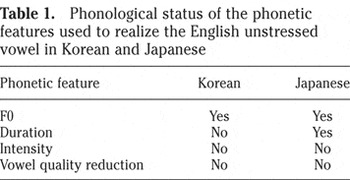
First, two languages (Korean and Japanese) that clearly have different prosodic systems from each other and from English were selected. The purpose of this design was to investigate the potentially different effects of the L1 on the acquisition of four phonetic features used to signal an English unstressed vowel (F0, duration, intensity, and vowel quality reduction). Phonetic features used to signal phonological differences in the L1 are predicted to be produced accurately. Table 1 summarizes the phonological status in Korean and Japanese of the phonetic features used to realize English unstressed vowels. Based on the feature hypothesis (McAllister et al., 2002), the following two hypotheses are made:
- Korean speakers are predicted to be accurate in their production of F0 for unstressed vowels as compared to stressed vowels, but less accurate for the other features.
- Japanese speakers, on the other hand, are predicted to be accurate in their production of both F0 and duration of unstressed vowels as compared to stressed vowels, but less accurate for the other features.
Phonological status of the phonetic features used to realize the English unstressed vowel in Korean and Japanese

Less accurate productions for intensity and duration might simply result from not using these features in producing English unstressed vowels. In other words, English L2 learners might not produce lower intensities and shorter durations for unstressed vowels in comparison to stressed vowels. The nature of less accurate productions for vowel quality reduction, on the other hand, could have several outcomes. If the vowels are not reduced in quality, they will be full vowels, and the resultant question concerns which full vowel will be realized. Participants might use full vowels suggested by the orthography, either using the orthographic conventions of English or of the transliteration systems of their respective L1s. Alternatively, the participants might use a single vowel for all productions. In the case of the Korean-English bilinguals, the Korean full central vowel

(Yang, 1996) is a likely possibility for two reasons. First, it is a central vowel and in that way similar to the English reduced vowel. Second, it is an epenthetic vowel used in loan word adaptation and, thus, might be considered a default vowel in Korean. As Japanese has no mid- or high-central vowels (Vance, 1987), the possibility of using a L1 vowel seems less likely.
To address the second aim, the L2 learners from each language background were divided into two groups according to age of acquisition: early learners (6 years old or younger) and late learners (15 years old or older). This was done to investigate the effect of age of acquisition on the production of unstressed English vowels by early and late bilinguals from each language background. Specifically, the question of whether the phonological status of a phonetic feature in the L1 would differentially affect the production of English unstressed vowels as a function of age of acquisition was considered. Given the findings from previous research that even early learners show evidence of delayed exposure to the L2 (e.g., Flege, Frieda, & Nozawa, 1997) and later learners more so, the following two additional hypotheses were made:
- The early learners in this study are predicted to exhibit some differences from NSs.
- The late learners are predicted to exhibit more differences from NSs than the early learners.
If differences are found between early and late learners, the next step, which is one of the focuses of this project, is to determine whether the differences are related to the L1 phonological system. If so, support will have been found for the view that the more fully developed the L1 is at the time of L2 learning, the more negatively it will impact L2 learning (Bialystok, 1997; Flege, 1999; Oyama, 1979). Specifically, the development of the L1 processing system could be the underlying source of both L1 influence and the effect of age of acquisition on English reduced vowel production. Effects of the L1 on the L2 in early bilinguals could reflect the tuning of the L1 attentional system as it has developed throughout early childhood. Greater effects of the L1 on L2 production for the late bilinguals could reflect the continuing development and refinement of the L1 attentional and processing systems.
METHOD
Participants
In this study, the participants' level of English proficiency was strictly controlled to include only advanced speakers who use English frequently, have long lengths of residence, and have attended colleges or universities in the United States. The participants' level of proficiency was objectively confirmed by standardized tests. The motivation for this careful selection was to recruit participants who have had sufficient L2 input in terms of quality and quantity as well as sufficient use of the L2 to have reached something close to their ultimate attainment. However, as with all naturally occurring populations, confounds between age of acquisition and other subject factors such as length of residence and L2 use are found (Flege, 1988).
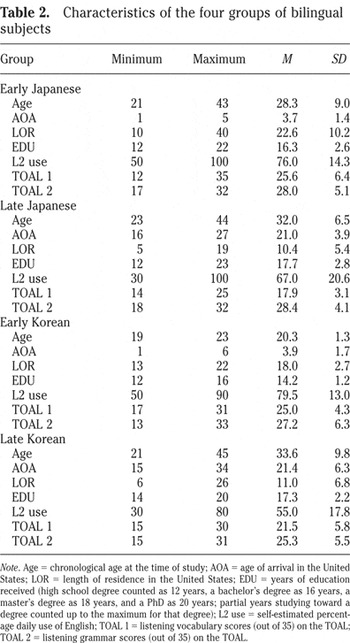
Five groups (N = 50) consisting of 10 NSs of English to serve as controls (5 female, 5 male, mean age = 24.9 years), 10 early Korean-English bilinguals (7 female, 3 male), 10 late Korean-English bilinguals (7 female, 3 male), 10 early Japanese-English bilinguals (6 female, 4 male), and 10 late Japanese-English bilinguals (6 female, 4 male) participated as paid subjects. All of the participants reported normal hearing and passed a pure-tone hearing screening in both ears from 500 to 4000 Hz at octave intervals (48 at 20 dB and 2 at 25 dB). The native English group spoke no other language in their childhood and had never lived abroad for more than 3 months, although many had studied a foreign language in high school or college. The early bilinguals had their first massive exposure to an English-speaking environment before the age of 6 and the late bilinguals after the age of 15. At the time of testing, the bilinguals had resided in the United States for an average of approximately 10 years for the late bilinguals and 20 years for the early bilinguals. All of the bilinguals used English on a daily basis at the time of the study. When asked what overall percentage of the time they used English on a daily basis, the early bilinguals reported using English 78% of the time, whereas the late bilinguals reported using English 61% of the time (for each bilingual group's background, see Table 2).
Characteristics of the four groups of bilingual subjects

All bilinguals were highly proficient in English as measured by standardized tests. Two subtests of the Test of Adolescent and Adult Language (TOAL: Hammill, Brown, Larsen, & Weiderholt, 1994)—those that focus on listening vocabulary and listening grammar—were administered to the bilingual groups. These tests were chosen to assess general proficiency. There was no significant difference among the four bilingual groups for TOAL test 2 (listening grammar), F(3, 36) = 0.668, p = .577, although the late Japanese bilinguals scored lower on test 1 (listening vocabulary) than the other groups, F(3, 36) = 4.896, p < .01. However, given that the late Japanese bilingual group scored highest on the listening grammar section, none of the groups differed significantly in the total scores, F(3, 36) = 1.656, p = .194.
Materials and Procedures
The test items consisted of the 19 English words listed in (1). The unstressed vowels are marked in bold and the main stress is marked with an acute accent. The words were chosen as a fairly representative sample of unstressed vowels with respect to position within the word (initial, medial, or final) and orthographic representation. Note that two words, agenda and banana, each included two unstressed vowels; thus, the total number of unstressed vowels was 21.

Before producing the target words, the bilingual participants were asked to rate their confidence of their knowledge of each word's meaning and of their ability to pronounce the word on 5-point scales. For any given participant, only words with a rating of 5 on both scales were considered in the analysis. As an additional check, a NS of English listened to the recordings made by the learners and noted the placement of the main stress in the words. All of the words that were rated 5 on both scales had the appropriate main stress placement.
For the production task, the words were presented orthographically (i.e., in English spelling). The participants were asked to produce the 19 words once in a carrier phrase, “I said _____ this time.” This carrier phrase was used to ensure a constant prosodic environment for the target word production. Their production was recorded on DAT tape and digitized at the sample rate of 22.05 kHz (16 bit) on a personal computer.
Measurements and Analysis
Several acoustic measures were made of the unstressed and primary stressed vowels using PCQuirer 6.3: fundamental frequency (in hertz), intensity (in decibels), and duration (in milliseconds). Fundamental frequency and intensity were both measured at the peak. The F1 and F2 frequencies (in hertz) were also measured for the unstressed vowels on the assumption that the F1 and F2 are the acoustic correlates of vowel quality. The ratio of the unstressed to the stressed vowel in a given word was calculated for the duration, fundamental frequency, and intensity measures.3
Three speakers produced several carrier phrases with rising intonation, but all of the data were included for analysis because in many of them, rising pitch started right after the target word—that is, on the last two words “this time”—and none of these values was an outlier.
The vocal tract lengths of the participants were expected to vary due to sex-linked differences and, therefore, the F1 and F2 measurements were normalized for the spectral analyses of the unstressed vowels. All formant values were normalized to one randomly selected member of the control group with reference to the average third formant (F3) of

in banana, basket, calendar, giraffe, and manage (see Guion, 2003; Yang, 1996). The mean F3 of this speaker was taken as the norm and was divided by the mean F3 for each speaker. Then the formants for each speaker were multiplied by the factor derived from their own F3. Additionally, to assess the differences in vowel formants between the NSs of English and each bilingual group in terms of their perceptual quality, the formant frequencies were converted to the mel scale, which more closely approximates human perception (Ladefoged, 1996).
RESULTS AND DISCUSSION
The mean ratio of unstressed vowels to stressed vowels for the duration and fundamental frequency, the log ratio calculated from the mean differences between them for the intensity, and both the vowel plots of normalized F1 and F2 frequencies of the unstressed vowels and the perceptual distance between the vowels for each group were obtained. The differences between the English NSs and the bilingual speakers are presented in the following subsections.
Duration
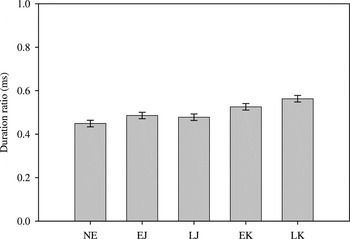
Figure 1 presents the mean ratio of the duration of unstressed to stressed vowels produced by the five groups (the native English group, the early and late Japanese bilinguals, and the early and late Korean bilinguals). Note that lower bars indicate the relatively shorter duration of the unstressed vowel.

The mean ratio ± one standard error of the duration of unstressed vowels to stressed vowels for the five groups (NE = native English, EJ = early Japanese-English bilinguals, LJ = late Japanese-English bilinguals, EK = early Korean-English bilinguals, and LK = late Korean-English bilinguals). Lower bars indicate the relatively shorter duration of the unstressed vowel.
The English NSs produced unstressed vowels with roughly half the duration of the stressed vowels (ratio = .45). As shown in Figure 1, both early and late Japanese bilinguals produced duration differences within roughly the same range as the English NSs. On the other hand, the early Korean bilinguals were closer to the native English mean than the late Korean bilinguals, although the ratio for the early Korean bilinguals was clearly larger than that of the English NSs. The ratios were submitted to a two-way Group (5) × Word (21) ANOVA, which yielded significant main effects and a significant interaction between the two factors: group, F(4, 895) = 8.772, p < .01; word, F(20, 895) = 43.772, p < .01; Group × Word, F(80, 895) = 1.699, p < .01. Tukey's tests (p < .05) revealed that both the early and late Korean bilinguals showed significantly less difference in duration between stressed and unstressed vowels than the English NSs (p < .01). On the other hand, the two Japanese bilingual groups showed no significant difference in duration from the native English group.
These results support the predictions made by the feature hypothesis (McAllister et al., 2002): A L2 phonetic feature will be more accurately produced if it is used to signal a phonological difference in L1 than if it is not. Japanese uses duration differences to code moraic length, whereas Korean does not use duration to signal phonological differences; Japanese speakers more accurately produced the durational difference between English stressed and unstressed vowels than Korean speakers did.
Age of acquisition did not significantly affect production of the durational difference between English stressed and unstressed vowels. Neither early nor late Japanese bilinguals were significantly different from English NSs. On the other hand, both early and late Korean bilinguals were. There was a nonsignificant trend for the early Korean bilinguals to be more like the English NSs than were the late Korean bilinguals. However, the two groups of Korean bilinguals were not significantly different from each other. Thus, even early learners were found to exhibit effects of the L1 in their L2 vowel production.
Fundamental Frequency
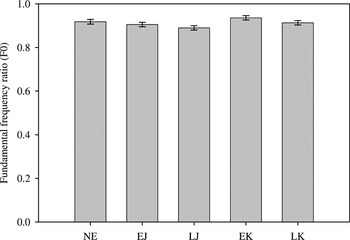
Figure 2 presents the mean ratio of the fundamental frequency of unstressed to stressed vowels for the five groups under investigation. All of the groups produced the unstressed vowels with slightly lower fundamental frequencies than the stressed vowels. The ratios for all groups were quite similar, ranging from .89 to .93. In Figure 2, lower bars indicate the relatively lower fundamental frequency of the unstressed vowel.

The mean ratio ± one standard error of the fundamental frequency of unstressed vowels to stressed vowels for the five groups. Lower bars indicate the relatively lower fundamental frequency of the unstressed vowel.
The results of the ANOVA revealed a significant main effect of group and word, although no significant interaction between the two factors was found: group, F(4, 795) = 3.076, p < .05; word, F(20, 795) = 3.636, p < .01; Group × Word, F(80, 795) = 1.163, p = .165. However, Tukey's tests (p < .05) revealed no significant difference in the ratio for the fundamental frequency between the NSs and the four bilingual groups. This means that the bilinguals, regardless of their L1 backgrounds or age of acquisition, produced the peak of F0 in unstressed vowels in a nativelike fashion. These results support the predictions made by the feature hypothesis (McAllister et al., 2002). Both Japanese and Korean use F0 to signal prosodically relevant information about pitch accent (Japanese at the word level and Korean at the phrase level), and both the Japanese and Korean bilinguals were able to accurately produce differences in F0 between unstressed and stressed English vowels.
However, it should be noted that in this study, the peak of F0, not its configuration, was investigated. Thus, the question of whether either early or late bilinguals can acquire a nativelike pitch contour still remains. For example, a difference in the location of F0 fall between English and Japanese was reported by Sugito (1980): It occurs at a syllable boundary in Japanese, but starts earlier within a syllable in English. Future research should examine whether early and late Japanese bilinguals can produce all of the phonetic features of F0 patterns in English.
Intensity
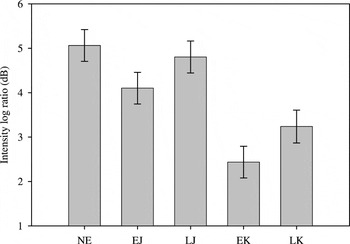
Figure 3 presents the log ratio of the intensity for the stressed to unstressed vowels, calculated by subtracting the intensity (in decibels) of the unstressed vowel from that of the stressed vowel. Unlike the graphs shown for the analyses of duration and fundamental frequency, the higher bars indicate the relatively greater intensity of the stressed vowel. The English NSs produced the unstressed vowels an average of 5.1 dB lower than the stressed vowels. The early and late Japanese groups were roughly within the native English range: 4.1 and 4.8 dB lower, respectively. The early and late Korean groups, on the other hand, produced a much smaller intensity difference than the English NSs, with averages of only 2.4 and 3.2 dB lower, respectively.

The log ratio ± one standard error of the intensity of the stressed to unstressed vowels calculated by subtracting the intensity (in decibels) of the unstressed vowel from that of the stressed vowel. Higher bars indicate the relatively greater intensity of the stressed vowel.
The intensity differences between unstressed and stressed vowels were submitted to a two-way group (5) and word (21) ANOVA, which yielded significant main effects for both factors and no interaction between the two factors: group, F(4, 926) = 9.271, p < .01; word, F(20, 926) = 11.562, p < .01; Group × Word, F(80, 926) = 1.100, p = .263. Tukey's tests (p < .05) revealed that both groups of Japanese bilinguals did not differ from the English NSs. However, both the early and late Korean bilinguals showed significantly smaller intensity differences than the English NSs.
These results do not support the predictions made by the feature hypothesis (McAllister et al., 2002). As neither the Korean nor Japanese group is reported to use intensity to signal phonological information in their prosodic systems, they are predicted to be equally inaccurate in producing intensity differences between unstressed and stressed vowels in English. However, the Japanese group was more nativelike than the Korean group. It is worth noting that although only the Japanese group attained nativelike levels, speakers from both language backgrounds produced some intensity differences between unstressed and stressed vowels. With regard to age of acquisition differences, there was a nonsignificant trend for the late bilinguals to produce greater intensity differences than the early bilinguals, which was not anticipated from the prediction that early bilinguals would outperform late bilinguals in L2 pronunciation.
Vowel Quality
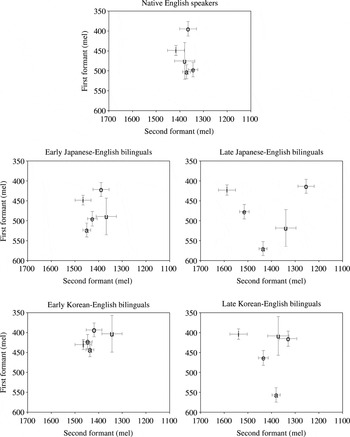
Figure 4 presents normalized F1 and F2 for unstressed vowels (in mel) produced by each group. The productions are presented separately for each orthographic spelling of the unstressed vowel. All five of the different spellings for the unstressed vowel tended to converge in the native English group and the two early bilingual groups, whereas the unstressed vowels diverged by orthographic representation in the late bilingual groups.4
As in the study by Flege and Bohn (1989), test words in a carrier sentence were presented orthographically to the subjects. Although we are aware of a plausible hypothesis that this might have contributed to the learners' spelling pronunciation to some extent, it does not falsify our results showing distinct effects according to the different groups. Further research comparable to the current study but using a nonorthographic method of data solicitation would provide further insight into this matter.

Normalized F1 and F2 mean values ± one standard error of unstressed vowels by orthographic representation for the five groups.
Considering the early bilingual groups first, the Japanese bilinguals were more like the English NSs than the Korean bilinguals were. The early Japanese bilinguals, like the English NSs, produced the unstressed vowels in a mid-central manner—albeit with a fair amount of variance—regardless of the orthographic representation. The early Korean bilinguals, on the other hand, produced the unstressed vowel with a lower F1 (i.e., higher in the vowel space) and with less variance.
These differences might be attributed to the fact that the Korean vowel system has a high-central vowel and the Japanese vowel system does not have any high- or mid-central vowels (Vance, 1987; Yang, 1996). The early Korean bilinguals' unstressed vowel production is quite similar to the values reported for Korean

(Yang). As a result, the early Korean bilinguals might have equated the English unstressed vowel with Korean

and thus never developed nativelike formant values or nativelike variance because, as Flege (1995) suggested, they did not discern the slight difference between the two sounds. The early Japanese bilinguals, on the other hand, had no similar vowel in Japanese and developed a mid-central, or reduced, manner of producing the unstressed vowel.
Now considering the late bilingual groups, both groups were nonnativelike in their production of the English unstressed vowel. Instead of mid-central values for the formants, the late bilinguals produced vowels that were more dispersed in the vowel space. In general, the English unstressed vowels were produced with formant frequencies similar to full vowels with the same orthographic representation. For example, English unstressed vowels spelled “i” were produced in a high front [i] location. This is perhaps partially explained by the transliterations of Japanese and Korean into English orthography as well as English orthographic conventions: The orthographic “i” symbol represents the [i] vowel in Roman transliteration systems for both Korean and Japanese and sometimes represents the [ı] in English orthography.5
The number of tokens spelled “o” (introduce, potato, posses) and “u” (medium) is limited. Thus, the apparently reversed values for “o” and “u” for the late bilinguals in Figure 4 might be supported by a larger sample. Nonetheless, the orthographic symbols typically used to indicate front vowels—“i” and “e”—are produced in a front location of the vowel space, the orthographic symbols typically used to indicate back vowels—“u” and “o”—are produced in a back location in the vowel space, and the orthographic symbol typically used to indicate a low vowel—“a”—is produced in a low location of the vowel space.
To numerically investigate the reduction of unstressed vowels for the five groups, the perceptual distance, Dij, defined as the Euclidean distance between two vowel points, was calculated following Lindblom (1986), as shown in (2):

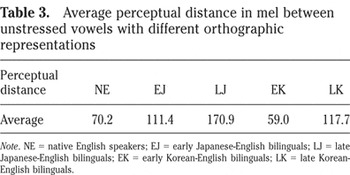
where i and j indicate two different vowel productions, whereas M1 and M2 are F1 and F2, respectively, in mel. This equation was applied to all pairings of the 21 unstressed vowels produced by a given speaker; concentration of unstressed vowels (despite orthographic differences) in the vowel space is reflected in a relatively small perceptual difference, whereas greater dispersion results in a greater perceptual difference. A mean perceptual distance was calculated for each speaker and then, in turn, for each group. Table 3 shows the average perceptual distance in mel between unstressed vowels for each of the groups.
Average perceptual distance in mel between unstressed vowels with different orthographic representations

The smallest perceptual distance, or dispersion, between the 21 productions of the English unstressed vowel was found for the early Korean bilinguals, followed by the English NSs. The early Japanese and late Korean groups had similar dispersion values and both had greater dispersion than the English NSs. Finally, the late Japanese group had the greatest dispersion.
The finding that the early Korean bilinguals had the smallest dispersion for English unstressed vowel production is consistent with the proposal that they used a native vowel target, namely

. The unstressed reduced English vowel is thought not to have a target in the way a full vowel has and, therefore, to be more subject to coarticulatory effects (Browman & Goldstein, 1992). Thus, the greater dispersion for the native English group is also to be expected.
The relatively smaller dispersion found for the late Korean compared to the late Japanese bilinguals might also be explained by the sporadic use of the Korean

target in the late Korean bilinguals' production. This L1 substitution seemed to be used only for English unstressed vowels spelled “u” and “o” (see Figure 4) but would have served to lower the overall dispersion of the unstressed vowels produced by the late Korean bilinguals. However, given the relatively small number of tokens spelled “u” and “o,” this suggestion must remain tentative.
GENERAL DISCUSSION
The goal of this study was to investigate the production of English unstressed vowels by early and late Korean- and Japanese-English bilinguals. Following the feature hypothesis of McAllister et al. (2002), phonetic features that are not phonologically relevant to either Korean or Japanese but that signal vowel reduction in English were predicted to have low production accuracy for the respective bilinguals. The extent to which age of acquisition modulated the effect of the L1 phonological system on the acquisition of English unstressed vowels was also investigated. Given that previous research found effects of delayed exposure for even very early bilinguals (Flege et al., 1997; see also the review by Hyltenstam & Abrahamsson, 2003), the early learners in this study were predicted to exhibit some differences from NSs. If the differences were related to the L1 phonological system, the view that greater development of the L1 at the time of learning leads to greater negative impact on the L2 would be supported (Bialystok, 1997; Flege, 1999; Oyama, 1979).
Table 4 summarizes the results of the study. The four phonetic features used to produce unstressed vowels in English—namely, reduced vowel quality as well as lower F0, shorter duration, and weaker intensity values than stressed vowels—are listed. The status of these phonetic features as relevant to the phonology of Korean and Japanese prosody is also indicated. Most, but not all, of the predictions made by the feature hypothesis were upheld. All groups were predicted to have high production accuracy of F0, and all groups attained nativelike production of this phonetic feature, at least as measured at peak frequency. The Japanese bilinguals were predicted to produce durational differences more accurately than the Korean bilinguals; both groups of Japanese bilinguals but neither group of Korean bilinguals were nativelike in the production of this feature. Neither language group was predicted to produce intensity differences accurately. Neither group of Korean bilinguals produced this phonetic feature in a nativelike manner. However, both groups of Japanese bilinguals produced intensity differences in a nativelike manner, falsifying the feature hypothesis prediction. Finally, all groups were predicted to have low production accuracy for the feature of vowel quality reduction. Even though the early Japanese and Korean bilingual groups were very close to nativelike with regard to this feature, none of the four groups was truly nativelike.
Summary of the predictions made on the basis of L1 phonological status and the findings for the phonetic features used to realize the English unstressed vowel in early and late Korean and Japanese bilinguals

Overall, the results support the view that phonological relevance of a L1 phonetic feature tunes the perceptual system in a way that affects learning and, ultimately, production of a L2. Similar results have been found for the acquisition of the vowel length distinction in Swedish (McAllister et al., 2002), the acquisition of the tone system in Mandarin (Gottfried & Suiter, 1997; Guion & Pederson, in press), the perception of English [r] (Iverson et al., 2003), and the perception of Korean stops (Francis & Nusbaum, 2002). However, not all predictions made following this approach were substantiated. It seems that some phonetic features might be produced at nativelike levels even though they are not used to signal phonological distinctions in the L1. Here, intensity differences were produced accurately by the Japanese bilinguals. This finding suggests that L2 learners can perceptually detect and learn to produce acoustic cues not used by the prosodic system of their L1.6
Although the view is generally accepted that fundamental frequency is the only acoustic cue that marks accent in Japanese (Beckman, 1986), the acoustic correlates of Japanese accent have been controversial. Neustupny (1966) argued that intensity might also play an important role in determining the accent placement in Japanese, reporting that there were cases in which one could not identify the accent without taking intensity into account. Similarly, Homma (1971, p. 11; 1985, p. 39) mentioned that although fundamental frequency is “much more regular,” pitch and intensity correlate with each other in both the Tokyo and Kyoto accents. However, opposed to Neustupny's view, Sugito (1969, p. 39, 1980, p. 114) argued that intensity does not have anything “to do with determining the Japanese accent.” Recently, Glen (2003), in his acoustic study on two-mora words in Japanese collected with both an elicitation method and a data-based approach, showed that accent is signaled through both fundamental frequency and intensity level. Another view is that a pitch accent language might mark accent with a difference in both pitch and intensity. Van der Mark (2002) examined the acoustic correlates of prominence in Blackfoot (a pitch accent language spoken in Alberta and Montana) and found that both F0 and average amplitude were correlated with accent in Blackfoot. These arguments might suggest that intensity is at least a secondary acoustic cue in identifying Japanese accent, which might account for the difference in performance between the Japanese groups and the Korean groups. In other words, if intensity indeed is a secondary cue to pitch accent in Japanese, familiarity with this acoustic feature might suggest that Japanese-English bilinguals were able to more easily attend to the phonetic feature of intensity in English than were Korean-English bilinguals.
The four predictions made for each L1-L2 pairing by the feature hypothesis were found to be largely supported by the data from the late bilinguals: All but one of the predictions were upheld. Specifically, the late Japanese bilinguals produced nativelike intensity differences. Also, although not significant, the late Korean bilinguals showed a trend toward more nativelike intensity differences when compared to the early Korean group.
Similarly, all but one of the predictions made by the feature hypothesis were upheld in the early bilingual data—namely, the early Japanese bilinguals produced nativelike intensity differences. However, both early bilingual groups also showed trends toward nativeness not predicted by the feature hypothesis. The early Japanese group had near-nativelike vowel quality reductions but demonstrated more variance than the native English group. The early Korean bilingual group had a trend toward nativelike durational differences and vowel quality reduction. Thus, some evidence was found that age of acquisition modulated the effect of the L1 phonological system on the acquisition of phonetic cues to English unstressed vowels. The early groups were more likely to have greater trends toward nativelike production than the late groups.
However, as predicted based on results of previous research (Hyltenstam & Abrahamsson, 2003), the early groups were not completely nativelike. With the exception of the differences in accuracy in intensity, the production characteristics of the two early bilingual groups can be traced to differences in the L1s of these early English learners. The finding that early Japanese but not early Korean bilinguals produce durational differences accurately can be attributed to the status of duration as a cue to moraic rhythm and phonological length distinctions in Japanese but not Korean. Additionally, the results from the vowel quality investigation revealed L1 influences. Both early groups produced centralized vowels. However, the early Korean bilinguals produced the unstressed vowels in a higher region of the vowel space and had less dispersion than the early Japanese bilinguals. These differences in vowel quality can be attributed to the influence of the Korean high-central vowel. An explanation in terms of perceptual assimilation and its effects on L2 learning can be provided: If the English unstressed vowel was perceptually assimilated to the Korean high-central vowel (Best, 1995), then it could block the acquisition of the English vowel's more mid-central quality (Flege, 1995). In support of this explanation, the early Korean bilinguals exhibited less variance in their production of the unstressed vowel than the English NSs, indicating that, unlike the NSs, they had a vowel target of the type found for full vowels (Browman & Goldstein, 1992).
CONCLUSION
The finding that even early learners are differentially affected by their L1 and that this effect is stronger for later learners than early learners provides new evidence for understanding the underlying causes of age of acquisition effects. The results from this study support the view that greater development of the L1 at the time of learning leads to greater negative impact on the L2 (Bialystok, 1997; Flege, 1999; Oyama, 1979). Although an account based on neural plasticity (Lenneberg, 1967) cannot be ruled out, the specific predictions of a L1 development hypothesis are upheld by the current results. We suggest that the allocation of attention in phonological processing to specific acoustic cues is tuned by linguistic experience and that allocation of processing to language-specific cues leads to underattending of other acoustic cues.
Thus, acoustic cues used to signal phonological information in the L2 but not the L1 will be underattended (Francis & Nusbaum, 2002; Guion & Pederson, in press; Iverson et al., 2003) and, as a result, these cues are not likely to be processed further or ultimately learned (Schmidt, 2001; Tomlin & Villa, 1994). However, the plasticity in the attentional system found in previous studies (Francis et al., 2000; Francis & Nusbaum; Guion & Pederson) might provide an explanation for the acquisition or partial acquisition of some features not used in the L1. In this study, the early bilinguals were more nativelike in vowel reduction than the late bilinguals and the Japanese bilinguals were nativelike in the use of intensity. These findings suggest that learners, especially early ones, can learn to attend to acoustic cues not used in the phonology of their L1 and develop productions that come close to native norms.
Although differences between early and late bilinguals were found in this study, we must be cautious; thus, we will not claim that these differences were necessarily due to age of acquisition effects alone. As naturally occurs in bilingual populations, the early bilinguals had a longer length of residence in the United States than the late bilinguals. Also, even though the participants in both groups reported using English on a daily basis an average of more than 50% of the time, the early group reported higher usage percentages. In some studies, length of residence and amount of L2 use have been found to correlate with foreign accent ratings (Piske et al., 2001).
In summary, this research contributes to a better understanding of the L2 acquisition of prosodic features in English in two ways. First, this study compared two groups of learners whose L1 prosodic systems are quite different from English as well as from each other. This allowed for an estimation of language-specific effects in the acquisition of English prosodic features. Second, this research contrasted two groups of early and late bilinguals, allowing investigation into the interaction between language-specific and age of acquisition effects.